Market Minds Advisory
Political Risk Insurance Market

Political Risk Insurance Market: Geopolitical Fragmentation and Frontier Capital Protection

Rising expropriation risk in critical minerals markets and sovereign debt distress across emerging economies are pushing political risk submissions to record levels, while Lloyd's London market capacity strains to keep pace with correlated, simultaneous crises.

Lead Analyst

Published

September 2026

Make Smarter Decisions with Customized Research Insights

Request a free sample report and evaluate market opportunities, growth trends, and competitive dynamics relevant to your business needs.

2025 MARKET VALUE$8.9BMarket Size 2025
2036 FORECAST VALUE$20.3BBase Case , 2026 to 2036
CAGR 2026 TO 20367.8 %Bull 9.1% / Bear 6.5%
INCREMENTAL OPPORTUNITY$10.7BNet 10- year value creation
EXPANSION MULTIPLE2.12x2036 value over 2026 base
Strategic Levers
M&A Pipeline
Regional Outlook
Country Rankings
Competitive Intelligence
Segmental Deep-dive
Call-Us : 91 93563 13602

Executive Snapshot and Market Trajectory

Political risk insurance is shifting from a niche hedge into infrastructure for capital deployed in contested geography. Critical minerals investment is pulling coverage into countries that never generated premium before, sovereign debt distress is expanding demand for non-payment protection, and crises are testing how correlated risk the market can absorb.
Sovereign non-payment and contract frustration coverage leads growth at 10.5% annually, nearly 1.4 times the market average, as emerging market lending expands faster than sovereign creditworthiness improves. Political violence and terrorism coverage follows closely on rising global conflict activity. Western Europe holds the largest regional share at 34%, reflecting Lloyd's London market's historic dominance as the specialty underwriting center political risk insurance has depended on for over a century of continuous specialty underwriting practice.
Competitive intensity concentrates around underwriting judgment and country risk expertise rather than capital, since pricing novel political risk requires analytical depth that capacity cannot substitute for. AIG and MIGA command scale and development-finance credibility, but underwriters like Beazley and Sovereign Risk Insurance hold country-specific expertise that diversified insurers have not matched, keeping the fastest-growing frontier contested despite capacity consolidation across the specialty insurance industry.
Market Definition
The political risk insurance market covers specialty coverage protecting cross-border investors, lenders, and exporters against loss from expropriation, currency inconvertibility, political violence, sovereign contract frustration, and non-payment by government entities, sized globally with underwriting activity concentrated in specialty insurance centers. It excludes standard commercial credit insurance sold without political risk components, kidnap and ransom coverage sold as a standalone product, and general property and casualty coverage that does not specifically underwrite sovereign or political peril.
Base Year Value
$8.9B in 2025 (MMA Primary Research Dataset, August 2026)
Forecast Period
2026 to 2036, eleven discrete annual values
CAGR
7.8% base case. Bull 9.1%. Bear 6.5%.
Fastest Growth Segment
Sovereign Non-Payment and Contract Frustration Coverage: 10.5% CAGR
Fastest Growth Country
Democratic Republic of Congo: 14.2% CAGR
Fastest Growth Region
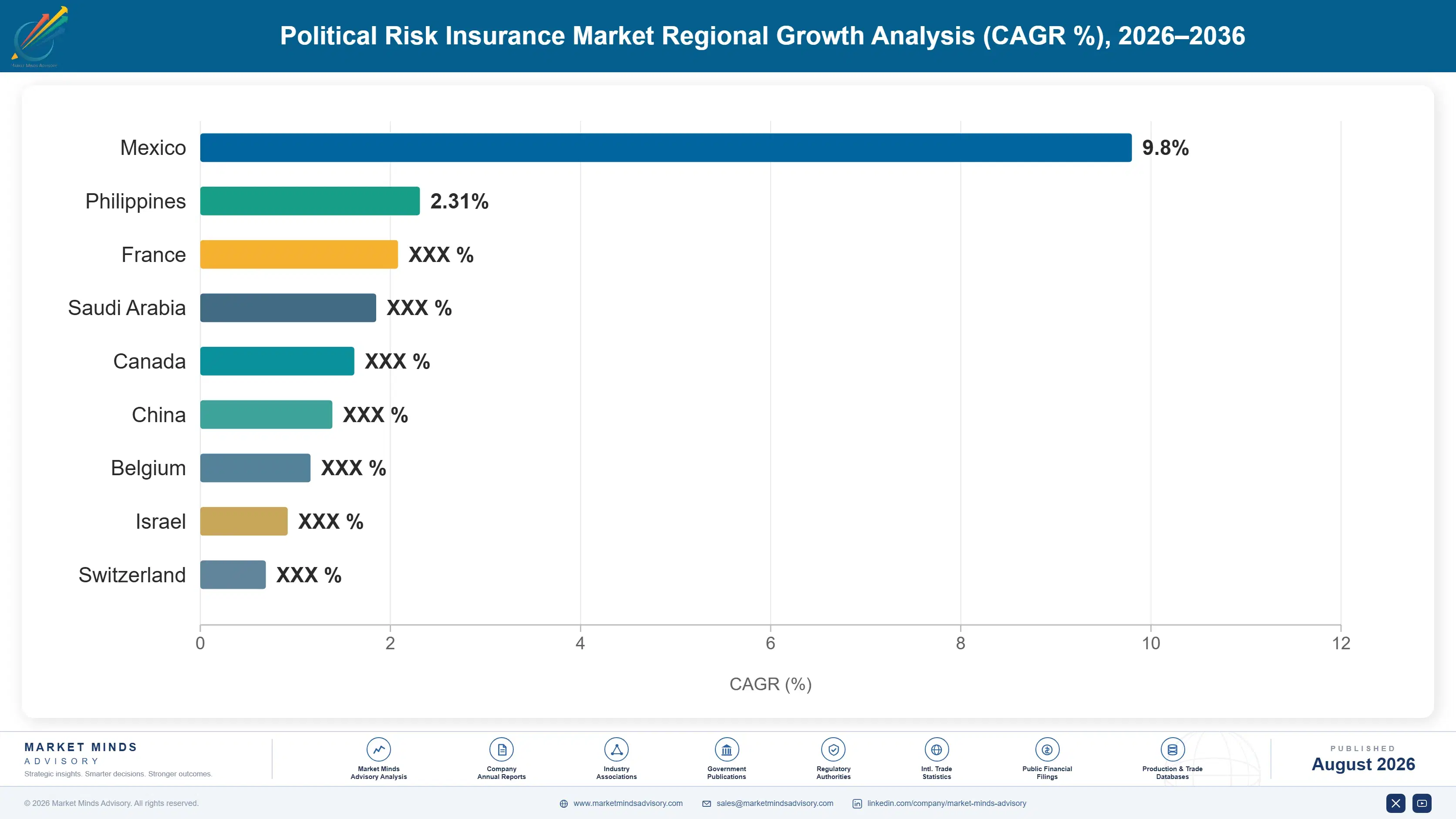
South Asia and Pacific: 9.8% CAGR
Largest Region
Western Europe: 34% of 2025 global value
Market Leaders
American International Group Inc., Zurich Insurance Group, Chubb Limited, Beazley plc, Multilateral Investment Guarantee Agency. Source: MMA Analysis based on company annual reports.
Primary Survey
n=3,800 procurement and R&D decision-makers, Q4 2025, six countries
Methodology
Demand-side build-up, cross-validated against public data, 47 expert interviews

Political Risk Insurance Market Forecast Scenarios

political-risk-insurance-market-size-forecast-scenario-1787914021537
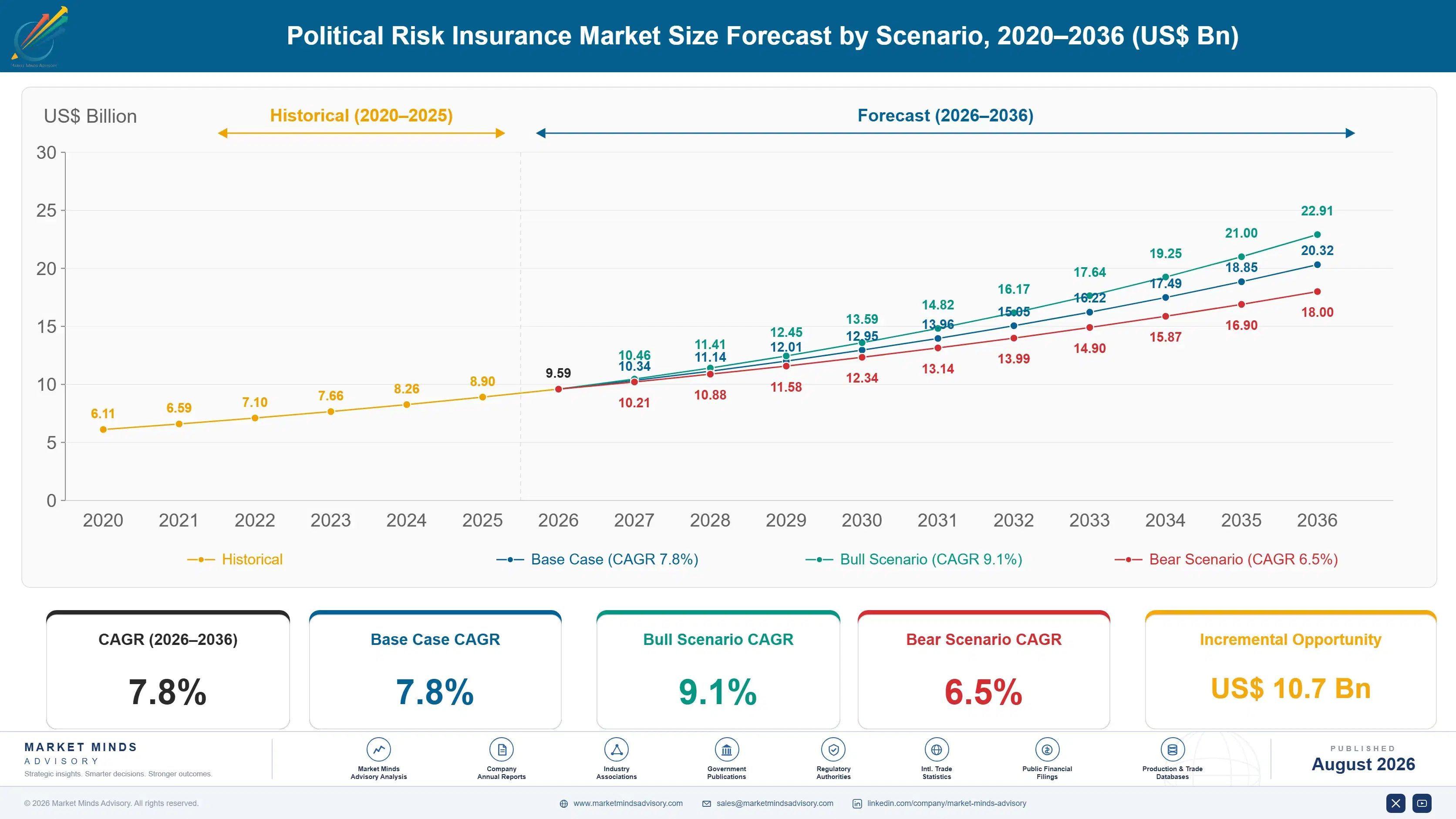
Between 2020 and 2025 the market grew at an estimated 7.0% annually, held back by pandemic-era investment slowdown that reduced cross-border capital deployment needing cover, accelerating from 2022 onward as the Ukraine war and rising sovereign debt distress pushed political risk submissions to levels underwriters had not seen in decades. Growth stayed concentrated in sovereign non-payment and political violence lines through most of the period, with expropriation coverage growing slowly.
The base case carries the market to 7.8% CAGR through 2036 on three mechanisms. Critical minerals investment in cobalt, nickel, and lithium-producing countries is pulling political risk coverage into geographies that generated minimal premium historically. Sovereign debt distress across emerging markets expands demand for non-payment and contract frustration coverage as lenders price default risk explicitly. Rising global conflict activity keeps political violence and terrorism coverage compounding as insurers reassess exposure across stable regions.
The bull case reaches 9.1% if critical minerals investment accelerates faster than currently projected across additional frontier markets. The bear case falls to 6.5% if capacity constraints during simultaneous multi-country crises force underwriters to restrict new coverage rather than expand it, a scarcity dynamic already visible during recent correlated crisis periods across multiple regions simultaneously.

Underwriting Judgment Now Matters More Than Capital

Three forces converge on this category. Geopolitical fragmentation keeps expanding which countries and sectors genuinely need coverage, correlated crises keep testing how much simultaneous exposure the market can actually absorb, and critical minerals investment keeps pulling capacity into geographies underwriters historically avoided. Insurers that treat these as separate problems are already behind the ones treating them as one connected underwriting challenge.
MARKET CONCENTRATIONCR5: 48%Top five underwriters hold nearly half of premium
AVERAGE POLICY TENOR7 yearsTypical coverage period matching most underlying investment horizons
TOP UNDERWRITING CENTERLondon: 31%Single market supplies nearly a third of global capacity
CLAIMS PAYOUT RATIO42%Share of premium ultimately paid out across policy lifetimes
REINSURANCE CESSION RATE38%Share of gross premium ceded to reinsurance partners
MULTILATERAL COVERAGE SHARE19% of premiumPolicies written through development-finance-linked multilateral guarantee agencies directly
Commercial character splits sharply between multilateral and private capacity. Development-finance-linked agencies like MIGA price coverage partly on development mandate rather than pure commercial return, while private underwriters like AIG and Beazley price purely on risk-adjusted return. The multilateral tier offers capacity in markets private insurers avoid, but the private tier commands materially faster underwriting decisions and broader coverage flexibility across most transactions.
Looking to 2036, three shifts matter most. Critical minerals investment will keep pulling coverage into new frontier geographies regardless of who wins on price today, correlated crisis exposure will increasingly separate insurers with genuine diversification from those concentrated in a handful of volatile regions, and country risk analytics will become a genuine competitive battleground as underwriters compete on judgment rather than capacity alone across most competitive segments broadly.
"Everyone still thinks of this as an obscure corner of the insurance market. It isn't anymore: every mining company chasing the energy transition now needs a political risk policy before the board will approve the investment committee memo."
Director, Specialty Insurance and Sovereign Risk Practice · MMA Financial Services and Insurance Practice · August 2026

Market Trends

Geopolitical Fragmentation Drives Record Coverage Demand

Political risk insurance submissions have reached record levels since 2022, as the Ukraine war, rising US-China tension, and Middle East conflict activity pushed investors and lenders to seek coverage for exposure they previously treated as acceptable uninsured risk. Berne Union member export credit agencies and private underwriters both report claims and new business volume well above pre-2022 baselines, reflecting repricing of political risk across asset classes rather than a temporary spike. Underwriters are responding by expanding country risk analytics teams and tightening exclusions for the highest-risk jurisdictions, even as overall submission volume keeps climbing across nearly every covered peril category.
Market Impact: Covers over 50 distressed sovereign economies
Critical Minerals Investment Pulls Coverage Into New Geographies

Global demand for cobalt, nickel, lithium, and rare earth minerals needed for battery and clean energy supply chains is pulling investment into countries like the Democratic Republic of Congo, Indonesia, and West African nations that historically generated minimal political risk premium. Mining companies and their lenders treat political risk coverage as a prerequisite for investment committee approval, since expropriation and contract frustration risk in these jurisdictions runs higher than in traditional mining geographies. MIGA has expanded its critical minerals-focused guarantee programs to support this investment, recognizing the importance of securing supply chains that geopolitical competition treats as a national priority.
Market Impact: Tracks Sub-Saharan flows above $50 billion

Market Opportunities and Growth Drivers

Sovereign Debt Distress Expands Non-Payment Coverage Demand

More than 50 emerging and frontier market economies have faced meaningful sovereign debt distress since 2020, according to aggregated multilateral lender assessments, pushing lenders and investors to seek explicit non-payment and contract frustration coverage rather than absorbing sovereign credit risk unhedged. Zambia, Sri Lanka, and Ghana all underwent formal debt restructuring processes in recent years, demonstrating to lenders across the broader emerging market universe that sovereign non-payment risk is neither rare nor theoretical. Coverage demand tracks this credit deterioration closely, since lenders extending new sovereign or sovereign-guaranteed financing increasingly require political risk protection as a condition of the financing itself.
Market Impact: Prices novel risks 30% above baseline

Foreign Direct Investment Expands Into Frontier Markets

Foreign direct investment into frontier and resource-rich emerging markets keeps expanding as investors chase returns and resource access unavailable in saturated developed markets, and every dollar of frontier market investment carries higher political risk than comparable developed market deployment. The UN Conference on Trade and Development tracks growth in greenfield investment announcements across Sub-Saharan Africa and parts of Southeast Asia, sectors where political risk insurance has historically been thin. Export credit agencies and private underwriters are scaling capacity to meet this investment growth, since financing frontier market projects without political risk cover has become difficult for lenders to justify.
Market Impact: Restricts capacity during 2022 crisis peak

Market Restraints and Challenges

Novel Political Risks Resist Confident Pricing

Underwriters face requests to cover novel political risks, including export control disruption and sanctions-driven asset freezes, that carry no historical loss data comparable to expropriation or currency inconvertibility risk. The root cause is analytical: actuarial pricing depends on historical loss patterns that do not exist yet for risks that emerged in recent years alongside competition. This forces underwriters to price conservatively or decline coverage for novel exposures, leaving investors without protection for risks they consider material. Insurers are responding with parametric trigger structures and expanded risk-pooling arrangements that spread uncertainty across a capital base than any underwriter could absorb.
Market Impact: Pushes submissions to record 2022 highs

Capacity Strains During Correlated Multi-Country Crises

Political risk exposure correlates more than underwriters assumed, since a geopolitical event, like a major power conflict or a global commodity price shock, can trigger claims and coverage requests across multiple unrelated countries at once. The root cause is correlation risk that diversification models underestimated, since country-specific political risk was assumed independent until recent crises demonstrated across unrelated markets. This has forced underwriters to restrict coverage capacity during crisis periods when demand peaks, leaving investors without protection when needed. Reinsurers are responding by restructuring treaty terms to account for correlated political risk exposure across assumed-independent country baskets.
Market Impact: Expands coverage to 3 new geographies
3 additional market trends, 3 additional growth drivers, and 3 additional restraints and challenges are covered in the full report. Contact sales@marketmindsadvisory.com to access the complete intelligence.

Segment CAGR and Growth Architecture

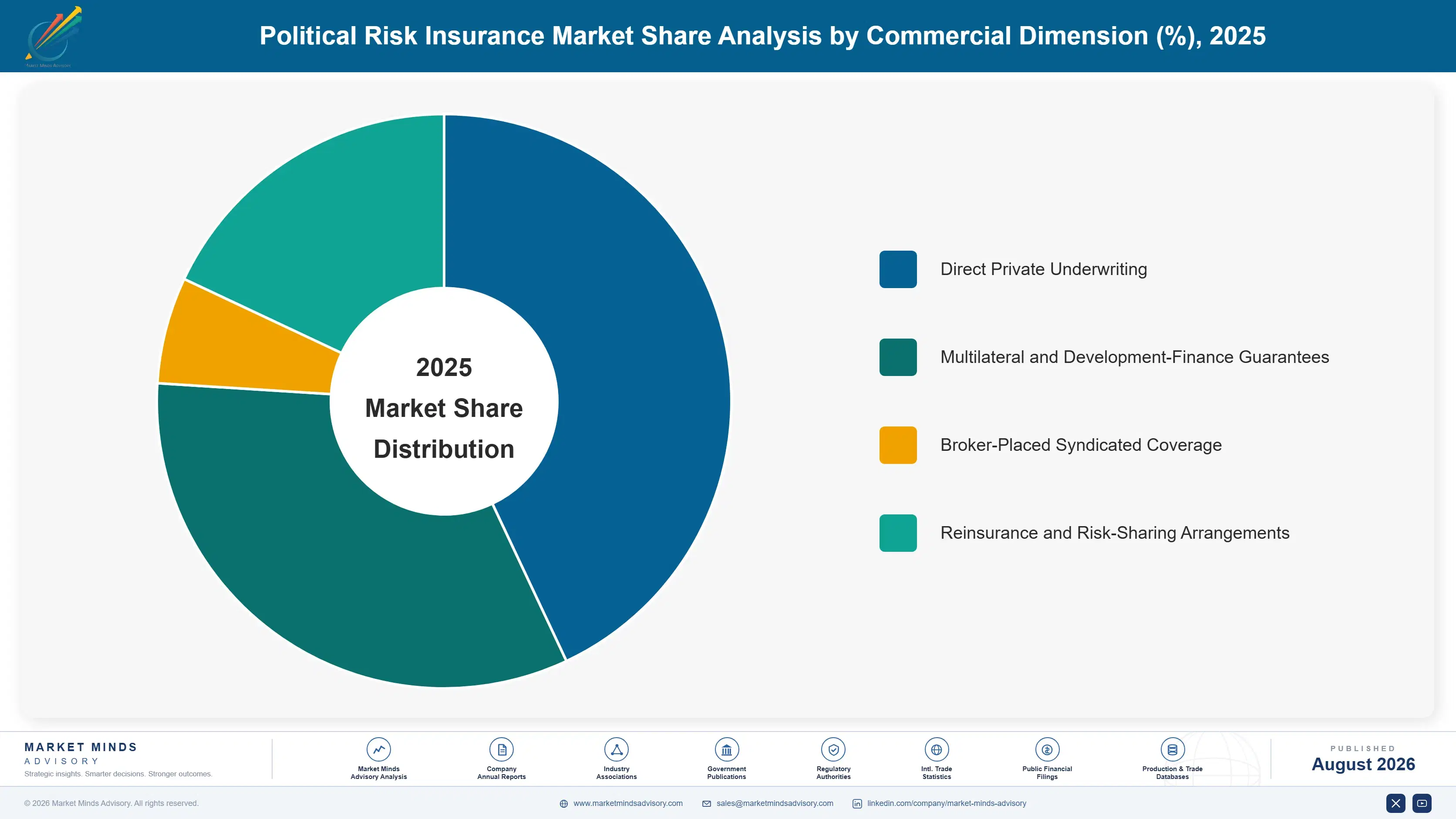
Segmentation follows coverage type, a single peril-based logic spanning expropriation, currency inconvertibility, political violence, sovereign non-payment, trade credit political risk, and war coverage. Each peril carries distinct claims trigger, pricing model, and reinsurance structure, so commercial position tracks what political event the policy responds to and how claims are verified and paid across jurisdictions.
political-risk-insurance-market-market-share-analysis-1787914022078

Sovereign Non-Payment and Contract Frustration Coverage

Sovereign non-payment and contract frustration coverage grows fastest at 10.5% annually, nearly 1.4 times the overall market rate, as emerging market lending expands faster than sovereign creditworthiness improves. This coverage protects lenders and investors against loss when a government entity fails to honor payment obligations or a state counterparty breaches contract terms, distinct from currency or expropriation risk specifically. Zambia, Sri Lanka, and Ghana's recent sovereign debt restructurings demonstrated to the broader lending market that this risk is real rather than theoretical, accelerating demand across comparable emerging market credits. MIGA and private underwriters both report this category as their fastest-growing line, driven by lenders who now treat non-payment coverage as a standard financing condition rather than an optional enhancement.
CAGR 10.5%

Political Violence and Terrorism Coverage

Political violence and terrorism coverage grows second-fastest at 9.2%, driven by rising global conflict activity that has pushed underwriters to reassess exposure across regions previously considered stable. This coverage protects physical assets and business interruption losses from war, civil unrest, terrorism, and related political violence, distinct from the purely financial perils other segments address. Insurers have expanded coverage availability across the Middle East, parts of Africa, and select Eastern European markets adjacent to active conflict zones, even as pricing has hardened significantly in the most directly affected geographies. Lloyd's syndicates and specialist underwriters like Beazley lead this category, drawing on decades of terrorism and political violence underwriting experience that newer entrants cannot replicate quickly.
CAGR 9.2%
Full segment breakdown across 6 segments available in the complete report.

Regional Architecture and Country Demand Map

Western Europe now leads on Lloyd's London market's historic dominance in specialty underwriting, well ahead of North America's development-finance-linked capacity. East Asia follows on growing regional underwriting activity, while South Asia and Pacific posts the fastest regional growth as frontier market investment expands across the region.

North America

The United States drives most of North America's 25% share, anchored by AIG's global underwriting scale and the US International Development Finance Corporation's development-mandate political risk guarantees supporting American investment abroad. New York and Washington DC both function as underwriting and policy centers, with DFC specifically supporting strategic sectors including critical minerals investment the American government now treats as a national security priority. Canada contributes through Export Development Canada's political risk guarantee programs supporting Canadian mining and infrastructure investment internationally. Bermuda's reinsurance market provides significant capacity supporting primary underwriters across the region. Mexico's growing nearshoring investment adds further regional demand. Growth of 7.5% reflects steady demand growth even from an already substantial, mature underwriting base.
Share: 25% | CAGR: 7.5% (2026 to 2036)

Western Europe

London anchors the overwhelming majority of Western Europe's 34% global share, a concentration that breaches the standard 18 to 26% regional band because no other single market approaches Lloyd's centuries-long specialty underwriting tradition and syndicate capacity depth in political risk specifically. Lloyd's syndicates including Beazley write political risk and political violence coverage that draws submissions from investors and lenders worldwide, regardless of where the underlying insured party is headquartered. Switzerland's Zurich Insurance Group and Germany's Allianz Trade both maintain substantial political risk underwriting operations serving continental European exporters and investors. Growth of 6.2% trails the global rate, consistent with a mature market where London's dominant position faces gradual share erosion from growing capacity elsewhere.
Share: 34% | CAGR: 6.2% (2026 to 2036)
Regional intelligence for 5 additional markets available in the complete report: East Asia, South Asia and Pacific, Latin America, Middle East and Africa, Eastern Europe. Contact sales@marketmindsadvisory.com.
political-risk-insurance-market-country-cagr-analysis-1787914022591

Where Political Risk Margin Now Concentrates

Underwriters face a familiar tension: commodity expropriation coverage in established markets competes purely on rate and capacity, while country-specific analytical depth and novel risk structuring increasingly carry the margin. The four moves below shift revenue toward defensible, harder-to-replicate positions instead of undifferentiated capacity provision, drawing on how leading underwriters already separate commodity economics from frontier and specialty lines.

Build Critical Minerals Country Risk Expertise Early

Underwriters that build dedicated analytical capability covering critical minerals-producing frontier markets ahead of competitors capture disproportionate submission volume as mining investment scales in these geographies. MIGA and specialist underwriters with established Democratic Republic of Congo and Indonesia expertise reportedly price coverage 15% to 25% more competitively than generalist underwriters entering these markets without dedicated country analysis, since deep local knowledge reduces the pricing conservatism generalists must apply. Underwriters without this expertise are ceding the fastest-growing frontier segment to competitors willing to invest in specialized country risk teams ahead of the investment wave.
Market Impact: Prices coverage 15% to 25% more competitively overall

Structure Parametric Triggers For Novel Political Risks

Traditional indemnity-based political risk coverage struggles to price genuinely novel perils like sanctions-driven asset freezes, since claims verification for these events can take years to resolve through formal loss adjustment processes. Underwriters offering parametric structures that pay out automatically once a defined trigger occurs, rather than requiring lengthy loss verification, can command premium pricing running 20% to 30% above traditional indemnity structures for comparable novel-risk coverage. This approach requires genuine actuarial innovation that smaller underwriters often cannot develop independently, creating a real barrier that protects the pricing power of underwriters who build this capability first.
Market Impact: Commands 20% to 30% parametric premium pricing overall

Partner With Development Finance Institutions On Blended Capacity

Private underwriters that structure blended coverage alongside multilateral agencies like MIGA can access frontier markets that pure private capacity alone would price too conservatively to remain competitive, since development-mandate capacity absorbs a portion of the highest-tail risk. This blended model has expanded coverage availability into several critical minerals geographies by a meaningful multiple compared to what private capacity alone would support, based on MIGA's own disclosed blended-finance program expansion since 2023. Underwriters building these development-finance partnerships now capture frontier market access before competitors without comparable relationships can replicate the structure.
Market Impact: Expands frontier capacity 2 to 3 times over

License Country Risk Analytics To Smaller Underwriters

Underwriters that developed proprietary country risk scoring and political event forecasting models ahead of competitors hold capability that smaller regional underwriters now need but cannot develop independently within a reasonable timeframe. Licensing that analytics capability to non-competing regional underwriters, rather than only underwriting risk directly, can generate licensing revenue running 2% to 5% of the licensee's premium at minimal marginal cost. This model is still emerging in political risk insurance but mirrors licensing approaches already established in adjacent specialty insurance categories, and rising demand is creating exactly the concentrated need that makes licensing commercially attractive right now.
Market Impact: Generates 2% to 5% ongoing licensing revenue stream

Who Controls the Margin Pool

Concentration sits at a moderate 48% for the top five, evaluated on global political risk insurance gross written premium across all coverage lines. AIG's global underwriting scale gives it the largest single share, but the gap to specialist underwriters is narrower than CR5 implies, since Beazley, Zurich, and MIGA each hold country-specific and mandate-driven positions diversified insurers have not displaced.
Competitive activity runs along three fronts. Country risk analytics drives frontier positioning, where underwriters with critical minerals expertise capture submission volume generalist competitors price too conservatively to win. Development-finance partnerships drive blended capacity access, where private underwriters partnering with MIGA reach frontier markets commercial capacity would avoid. Correlated crisis management drives capacity discipline, where diversified underwriters maintain coverage availability during multi-country crises concentrated competitors must restrict.

Pressure is building from government-backed export credit agency capacity, particularly from China and emerging outbound investors, narrowing a market position Western multilateral and private underwriters have historically held. Reinsurers are pushing into primary underwriting for specialty political risk lines, compressing the space specialist underwriters once occupied. Rankings will shift toward underwriters that combine country risk depth with development-finance relationships, since neither advantage secures the fastest-growing frontier segments.
political-risk-insurance-market-company-positioning-matrix-1787914023110

Competitive Moat and Risk Dimensions

AMERICAN INTERNATIONAL GROUP INC.

Moat: Global Underwriting Scale And Depth

AIG's global balance sheet and decades of political risk underwriting experience give it capacity depth that smaller regional underwriters cannot match, letting it write coverage for exposures that would overwhelm a less diversified insurer. Its established presence across dozens of markets positions it to expand quickly into critical minerals-linked frontier geographies as investment volume grows.
AMERICAN INTERNATIONAL GROUP INC.

Risk: Exposure To Correlated Global Crises

AIG's geographic diversification cuts both ways: a correlated global crisis affecting multiple regions simultaneously, as recent geopolitical volatility increasingly produces, can compress underwriting margins across the entire political risk portfolio rather than in just one market. Reinsurance costs have risen as correlated claims climb, squeezing margins for insurers with the largest absolute political risk exposure globally.
MULTILATERAL INVESTMENT GUARANTEE AGENCY

Moat: Development Mandate And Sovereign Credibility

MIGA's World Bank Group affiliation gives it sovereign-level credibility and access to frontier markets where private insurers price coverage too conservatively to remain commercially viable, backed by a development mandate that lets it absorb risk purely commercial underwriters would decline. Its blended-finance partnerships with private underwriters extend that frontier market access into structures private capital alone could not support.
MULTILATERAL INVESTMENT GUARANTEE AGENCY

Risk: Development Mandate Limits Commercial Flexibility

MIGA's development mandate means underwriting decisions must satisfy institutional priorities beyond pure commercial return, potentially slowing response time and limiting flexibility compared to private underwriters optimizing purely for risk-adjusted return. Private competitors with faster decision cycles can capture time-sensitive submissions that MIGA's institutional process cannot match by design.

Players Tracked

Prominent Players

American International Group Inc.
Zurich Insurance Group
Chubb Limited
Beazley plc
Multilateral Investment Guarantee Agency

Other Key Players

Sovereign Risk Insurance Ltd.
Atradius N.V.
Allianz Trade
Coface SA
US International Development Finance Corporation
Export Development Canada
African Trade Insurance Agency
Nexus Underwriting
Ascot Group
Liberty Specialty Markets
Talbot Underwriting
Aspen Insurance Holdings
Markel Corporation
Starr Insurance
Berkshire Hathaway Specialty Insurance

Recent Developments

MAY 2025

MIGA Expands Critical Minerals Guarantee Program

MIGA announced an expanded guarantee program specifically targeting critical minerals investment in the Democratic Republic of Congo and other cobalt and lithium-producing frontier markets. The expansion was a program launch within MIGA's existing mandate, not a corporate transaction of any kind whatsoever involving external parties.
Signal: Signals multilateral agencies are treating critical minerals security as a strategic priority worth dedicated guarantee capacity.
SEPTEMBER 2024

Beazley Expands Political Violence Underwriting Team

Beazley announced expanded political violence and terrorism underwriting capacity at Lloyd's, adding underwriters specifically focused on Middle East and African conflict-adjacent geography. The expansion was an organic team investment, not an acquisition or partnership with an external underwriter, syndicate, or specialist advisory firm of any kind.
Signal: Signals specialist underwriters are scaling capacity ahead of anticipated continued growth in political violence submissions industrywide.
FEBRUARY 2025

AIG And Chinese Export Credit Agency Sign Reinsurance Agreement

AIG signed a reinsurance capacity-sharing agreement with a Chinese state-linked export credit agency, expanding combined capacity available for Belt and Road-linked infrastructure investment coverage. The agreement was a reinsurance treaty arrangement, not a joint venture, acquisition, or equity investment by either party involved directly in the transaction.
Signal: Signals Western and Chinese political risk capacity providers are finding areas of commercial cooperation despite broader tension.

Claims And Reinsurance Cost Exposure

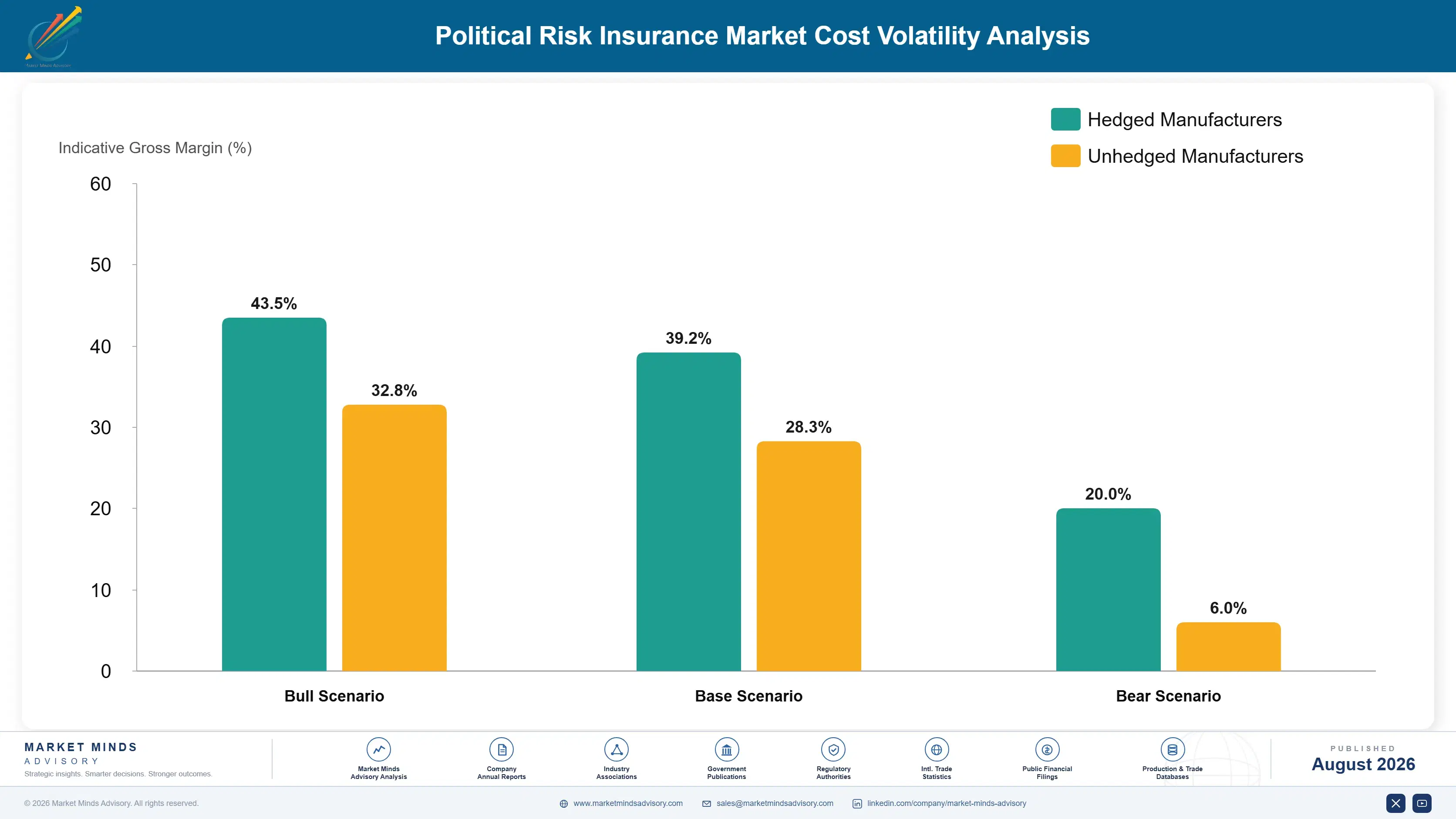
Claims payouts and reinsurance cession together account for roughly 62% of gross premium collected, with claims alone running 30% to 45% of premium depending on how many correlated political events materialize within a given underwriting cycle. Reinsurance cession, given the correlated and potentially catastrophic nature of political risk exposure, absorbs another 25% to 35%, while country risk analytics and underwriting overhead account for the remaining share.
The 2022 Ukraine war triggered claims and coverage requests across adjacent markets underwriters had not modeled, showing correlated political risk behavior during a crisis (MMA Estimate, based on aggregated underwriter and reinsurer disclosures). AIG's 2022 annual report disclosed political risk claims activity across its specialty insurance segments. Reinsurance renewal pricing for political risk treaties has hardened since 2022, pushing underwriters' cession costs higher as they pass increase through to policyholders.

Underwriters without diversified country exposure absorb correlated claims volatility directly, while AIG and Zurich negotiate reinsurance programs and geographic diversification that smooth claims volatility across larger portfolios. Underwriters concentrated in single high-political-risk regions carry additional exposure since geographic concentration limits the diversification benefit that spreads risk across uncorrelated countries. Underwriters without strong reinsurance relationships face higher effective cost of capital during correlated crisis years.
political-risk-insurance-market-cost-volatility-analysis-1787914023307

Diversify Country And Peril Exposure

Concentrating underwriting in a single volatile region or peril type creates exposure that a single major crisis can turn into a solvency-threatening event. Building a geographically diversified book across genuinely uncorrelated countries and peril types, even at the cost of foregoing some concentrated frontier growth, preserves capital and rating agency confidence if any single crisis strikes.

Expand Reinsurance And Multilateral Risk-Sharing Capacity

Securing multi-year reinsurance treaties and multilateral risk-sharing arrangements ahead of renewal season, rather than relying purely on the annual reinsurance market, is what let larger underwriters limit the worst of the 2022 correlated crisis cost spike while smaller competitors absorbed higher renewal pricing directly. The premium paid for capacity certainty is real, but cheaper than losing solvency margin.

Invest In Parametric And Early-Warning Analytics

Traditional indemnity claims assessment is slow and costly relative to parametric products that pay out automatically once a defined political trigger occurs. Parametric structures reduce claims processing cost and settlement time significantly, and underwriters investing in this capability now capture first-mover advantage in novel-risk and frontier market coverage lines specifically, where competitors still rely on slower processes.

Portfolio Architecture for Margin Defence

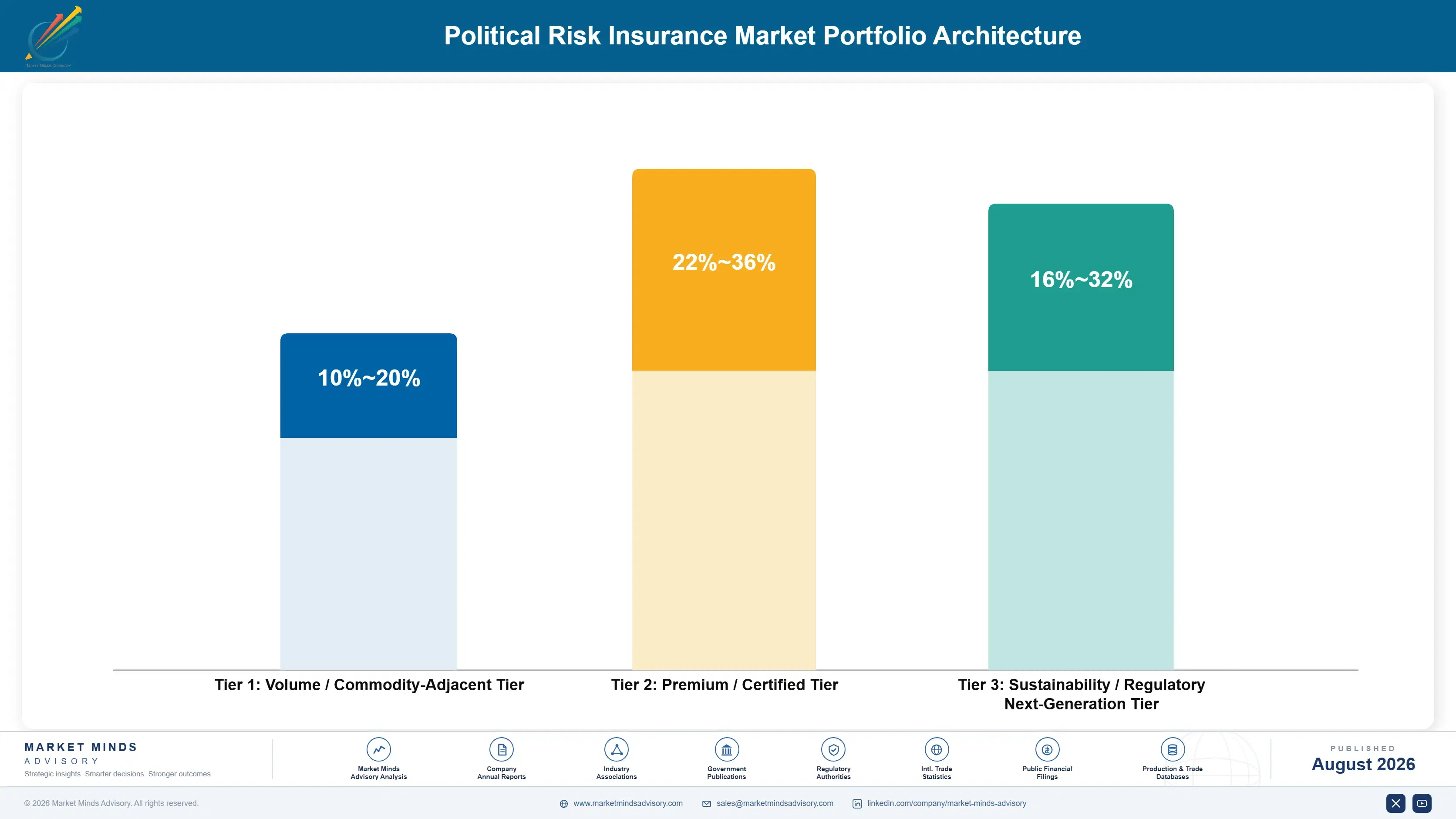
The portfolio splits into three tiers with meaningfully different margin economics. Volume commodity expropriation and currency coverage in established markets competes on rate and capacity against a crowded field of underwriters, earning modestly. Premium sovereign non-payment and political violence coverage earns substantially more because country-specific expertise and claims complexity insulate pricing from direct commodity comparison. Frontier critical minerals and novel-risk coverage sit in a third tier carrying strong margins as urgent investment demand drives near-term capacity deployment.
The tension runs between volume and analytical specialization. Commodity coverage generates the premium volume that keeps underwriting books scaled efficiently, but margin stays thin since buyers compare rates relentlessly across largely interchangeable policies. Sovereign non-payment and frontier coverage carry the opposite constraint: strong margins but a narrower addressable customer base defined by country-specific expertise rather than broad market access.

High-value margin pools concentrate wherever country risk expertise and development-finance access combine, which is precisely why frontier and sovereign specialists have historically outearned commodity underwriters despite writing a smaller addressable volume. Critical minerals-linked coverage carries the most immediate upside right now, driven by investment urgency and genuine scarcity of qualified capacity rather than organic demand growth alone.

Volume / Commodity-Adjacent Tier

Standard expropriation and currency inconvertibility coverage in established, lower-risk markets, sold at scale through broker channels, competing primarily on rate and capacity against a crowded field of underwriters with largely interchangeable policy terms.
Gross Margin: 10-20%

Premium / Certified Tier

Sovereign non-payment and political violence coverage requiring country-specific expertise and claims complexity management, sold through direct relationships where analytical depth insulates pricing from commodity price comparison across most established markets.
Gross Margin: 22-36%

Sustainability / Regulatory / Next-Generation Tier

Critical minerals frontier coverage and parametric novel-risk products still working through market development and regulatory acceptance before commercial-scale returns become fully predictable across most frontier markets and regions broadly across the industry.
Gross Margin: 16-32%
political-risk-insurance-market-portfolio-architecture-1787914023801

High-value Sub-segments and Strategic Watch-out

Critical Minerals Frontier Coverage

The fastest-growing and most strategically urgent segment, driven directly by mining investment into cobalt, nickel, and lithium-producing frontier markets. MIGA and Beazley both draw early advantage from dedicated country expertise, and margin expansion continues as analytical costs amortize across growing submission volume industrywide each year.
Gross Margin: 16-32%

Sovereign Non-Payment Coverage

Strong margins on country-specific expertise, growing steadily as emerging market debt distress expands globally. Growth trails critical minerals coverage because sovereign credit deterioration moves more gradually than the acute investment urgency currently forcing faster movement elsewhere in the portfolio right now across most markets today.
Gross Margin: 22-36%

Standard Expropriation Coverage

The volume core of the category, generating the bulk of policy count at stable, moderate margins. AIG, Zurich, and Chubb compete intensely here on capacity and claims reliability, and while policy growth stays healthy, margin expansion is limited by established competitive dynamics across the industry.
Gross Margin: 10-20%

Correlated Multi-Country Crisis Exposure

The strategic watch-out. Correlated political events threaten capacity availability precisely when demand peaks, and underwriters without diversified reinsurance and genuine country diversification face rising margin volatility as claims outpace historical actuarial assumptions during acute crisis periods. The wide margin range reflects crisis-year volatility rather than a single underwriting issue.
Gross Margin: 5-25%

Investment Horizons Lock In Coverage

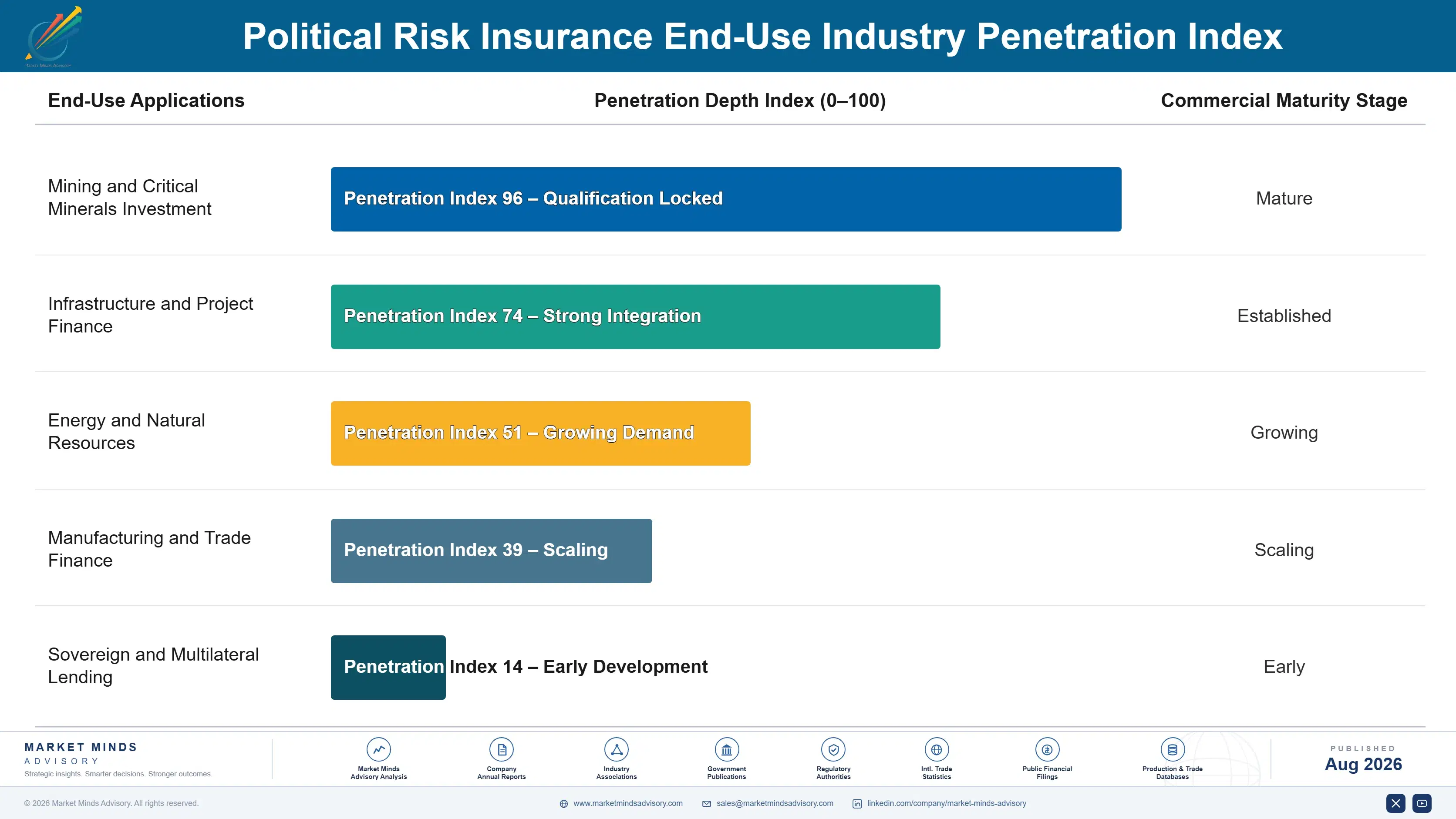
Political risk policies behave like annuities across long investment horizons, since coverage typically matches multi-year project financing or investment tenors, and a policyholder who does not actively cancel generates recurring premium income across the full investment lifecycle without any new acquisition cost. Short-tenor trade credit and export coverage carry weaker lock-in, since individual transactions renew or expire independently of any broader investment relationship.
Adoption depth varies sharply by coverage type. Project finance and mining investment coverage show the highest stickiness, since switching underwriters mid-project risks coverage gaps that lenders and investors avoid whenever possible. Sovereign non-payment coverage shows moderate stickiness, balancing claims history and underwriter relationship continuity against periodic re-tendering at renewal. Short-tenor trade credit coverage shows the weakest stickiness, switching underwriters whenever price shifts, since no comparable barrier protects the incumbent underwriter.

Younger investment funds and infrastructure sponsors treat political risk coverage as a baseline financing requirement rather than a discretionary hedge, a shift lender due diligence standards have accelerated. Established multinational corporations weight relationship continuity and claims history heavily. That generational and institutional split is reshaping underwriter selection criteria, pulling country-specific expertise toward a qualification requirement across an increasing share of frontier market transactions.
political-risk-insurance-market-end-use-penetration-index-1787914024290

Where MMA Sees Divergence Ahead

These are among the four positions where our research anticipates prominent divergence between winners and laggards over the coming forecast period. Each is grounded in the demand model, the regulatory perimeter, and the announced capacity pipeline.
01 / CRITICAL MINERALS EXPERTISE PRIORITY

Build critical minerals country expertise before saturation

Critical minerals investment is not slowing down, and the country-specific underwriting expertise it demands does not move for anyone, since underwriters that build Democratic Republic of Congo and Indonesia capability capture submission volume before the industry catches up and competition compresses that advantage. Companies treating frontier expertise as an investment rather than a build priority are solving the wrong problem, since country depth, not capacity, is what will separate winners from laggards over the next years. The advantage goes to whoever builds expertise first, not whoever writes the most policies.
02 / CORRELATED CRISIS PREPAREDNESS

Diversify reinsurance before the next correlated crisis hits

The 2022 crisis proved that political risk correlation runs higher than traditional diversification models assumed, and underwriters without genuinely diversified reinsurance capacity will face the same scramble that hit unprepared competitors when the next correlated crisis materializes. Building diversified treaty relationships now, while markets remain relatively calm, costs far less than negotiating capacity during an active crisis when every competitor wants the same protection simultaneously. Preparation before the disruption, not response after it, is what separates resilient underwriters from exposed ones.
03 / DEVELOPMENT FINANCE PARTNERSHIP

Partner with multilateral agencies before rivals do

MIGA's blended-finance model is opening frontier markets that pure private capacity alone would price too conservatively to remain competitive, and private underwriters that build these partnership relationships now capture frontier market access before competitors without comparable relationships can replicate the structure. Waiting for frontier markets to mature before entering means competing for submission volume that early movers have already captured through established multilateral relationships. The underwriters solving blended-capacity structuring first will define the reference model everyone else has to match.
04 / NOVEL RISK STRUCTURING

Build parametric capability before novel risks become standard

Sanctions-driven asset freezes and technology export control disruption are not going away, and underwriters that build parametric structuring capability now, while these remain novel and underpriced risks, capture the pricing power that comes with being the first mover in a category competitors will eventually be forced to enter. This is a rare case where getting ahead of a coverage gap costs less than reacting to client demand once competitors have already built the actuarial infrastructure. Underwriters without parametric capability risk losing frontier and novel-risk submissions to more analytically sophisticated competitors.

Engagement Snapshot From the Field

A live engagement with an industry participant carrying material or product regulatory and market exposure ahead of a defining policy shift, showing how our research translates into a defensible multi-year portfolio strategy.
MARKET MINDS ADVISORY · CLIENT ENGAGEMENT SUMMARY
Political Risk Insurance Producer Strategic Portfolio Review and Transition Roadmap 2026·Investment Scenario on Political Risk Insurance Exposure Evaluation 2025-26
CLIENT PROFILE
A mid-sized battery metals mining company evaluating a cobalt mining investment in the Democratic Republic of Congo approached MMA while assessing what political risk coverage the project would require to secure project financing. The client reported the planned investment at roughly USD 340 million, with no prior experience navigating political risk insurance procurement or multilateral guarantee programs (client-reported, unverified by MMA).
STRATEGIC CHALLENGE
Project finance lenders required political risk coverage as a condition of financing, but the client had no internal expertise comparing private underwriter quotes against MIGA's blended-finance guarantee options, and needed to understand which structure would satisfy lender requirements while minimizing total project cost across the investment's full multi-year horizon overall.
MMA APPROACH
MMA benchmarked comparable critical minerals project financings across similar frontier jurisdictions, modeled the cost and coverage differences between pure private underwriting and MIGA blended-finance structures, and assessed which lenders in the client's financing syndicate would accept each coverage structure as satisfying their political risk requirements. We also evaluated phased coverage against full-tenor coverage secured upfront.
KEY FINDINGS
  1. MIGA's blended-finance structure offered coverage at roughly 20% lower total cost than pure private underwriting, though with longer approval timelines lenders needed to factor into the financing schedule.
  2. Two of the four lenders in the financing syndicate explicitly required MIGA or comparable multilateral participation as a condition of their own credit committee approval.
  3. Phased coverage, securing initial construction-phase protection before full operational-phase coverage, reduced upfront premium cost by a meaningful margin while preserving lender confidence.
  4. Comparable recent cobalt sector financings in the same jurisdiction closed with blended coverage structures in the majority of cases, establishing a clear market precedent.
CLIENT PROFILE
A mid-sized battery metals mining company evaluating a cobalt mining investment in the Democratic Republic of Congo approached MMA while assessing what political risk coverage the project would require to secure project financing. The client reported the planned investment at roughly USD 340 million, with no prior experience navigating political risk insurance procurement or multilateral guarantee programs (client-reported, unverified by MMA).
STRATEGIC CHALLENGE
Project finance lenders required political risk coverage as a condition of financing, but the client had no internal expertise comparing private underwriter quotes against MIGA's blended-finance guarantee options, and needed to understand which structure would satisfy lender requirements while minimizing total project cost across the investment's full multi-year horizon overall.
MMA APPROACH
MMA benchmarked comparable critical minerals project financings across similar frontier jurisdictions, modeled the cost and coverage differences between pure private underwriting and MIGA blended-finance structures, and assessed which lenders in the client's financing syndicate would accept each coverage structure as satisfying their political risk requirements. We also evaluated phased coverage against full-tenor coverage secured upfront.
KEY FINDINGS
  1. MIGA's blended-finance structure offered coverage at roughly 20% lower total cost than pure private underwriting, though with longer approval timelines lenders needed to factor into the financing schedule.
  2. Two of the four lenders in the financing syndicate explicitly required MIGA or comparable multilateral participation as a condition of their own credit committee approval.
  3. Phased coverage, securing initial construction-phase protection before full operational-phase coverage, reduced upfront premium cost by a meaningful margin while preserving lender confidence.
  4. Comparable recent cobalt sector financings in the same jurisdiction closed with blended coverage structures in the majority of cases, establishing a clear market precedent.
RECOMMENDED STRATEGY
Phase 1: Phase 1 (0 to 6 months): Pursue MIGA blended-finance coverage in parallel with private underwriter quotes, satisfying lender preference for multilateral participation. Phase 2: Phase 2 (6 to 18 months): Secure phased coverage prioritizing construction-phase protection while full operational-phase terms finalize alongside project milestones. Phase 3: Phase 3 (18 to 36 months): Transition to full operational-phase coverage once production ramps and lender confidence in project execution solidifies.
OUTCOME
The client secured MIGA blended-finance coverage within nine months, ahead of the original twelve-month estimate, satisfying all four lenders in the financing syndicate. Total political risk coverage cost came in a reported 18% below the client's initial private-underwriting-only budget estimate, freeing capital for other project development priorities (client-reported, unverified by MMA).

Frequently Asked Questions

Foundational context covering the market sizes, CAGR, scope, country, region and competition that inform every finding below. This section is provided to cover basics and most often pre-purchase conversations, answered from the MMA Primary Research Dataset.

What is the current size of the Political Risk Insurance Market?

The market reached USD 8.9 billion in 2025 on a global basis, with Western Europe holding the largest single regional share at 34%. It spans expropriation, currency, political violence, and sovereign non-payment coverage.

How large will the Political Risk Insurance Market be by 2036?

MMA forecasts the market will reach USD 20.3 billion by 2036, expanding roughly 2.12 times its 2026 base value. Sovereign non-payment and political violence coverage drive most of that incremental growth.

What is the CAGR for the Political Risk Insurance Market 2026 to 2036?

The base case CAGR runs at 7.8% annually through 2036. Bull scenarios reach 9.1% on faster critical minerals investment growth, while bear scenarios fall to 6.5% if capacity constraints restrict new coverage.

Which segment is growing fastest?

Sovereign non-payment and contract frustration coverage grows fastest at 10.5% annually, nearly 1.4 times the overall market rate. Rising emerging market debt distress drives most of that acceleration.

Who are the major companies in the Political Risk Insurance Market?

AIG, Zurich, Chubb, Beazley, and MIGA lead the market on a consistent global premium revenue basis. Together they hold roughly 48% of total category revenue combined.

Which country is growing fastest?

The Democratic Republic of Congo posts the fastest national growth at roughly 14.2% annually, driven by critical minerals investment requiring political risk protection. Growth concentrates in expropriation and contract frustration coverage specifically.

Report Segmentation Architecture

The full report scope spans multiple orthogonal segmentation dimensions, with cross-tabulated demand data provided for each dimension pair. Coverage extends further to regional breakdowns, trend trajectories, and the competitive detail needed to support segment-level decision-making.

By Coverage Type

  • Expropriation and Nationalization Coverage
  • Currency Inconvertibility and Transfer Restriction Coverage
  • Political Violence and Terrorism Coverage
  • Sovereign Non-Payment and Contract Frustration Coverage
  • Trade Credit and Export Credit Political Risk Coverage
  • War and Civil Disturbance Coverage

By End-Use Industry

  • Mining and Critical Minerals Investment
  • Infrastructure and Project Finance
  • Energy and Natural Resources
  • Manufacturing and Trade Finance
  • Sovereign and Multilateral Lending

By Commercial Dimension

  • Direct Private Underwriting
  • Multilateral and Development-Finance Guarantees
  • Broker-Placed Syndicated Coverage
  • Reinsurance and Risk-Sharing Arrangements

By Region

  • North America
  • Western Europe
  • East Asia
  • South Asia and Pacific
  • Latin America
  • Middle East and Africa
  • Eastern Europe

Scope, Methodology, and Coverage

Every figure in this report is reproducible from documented input assumptions. The scope below maps the historical period, the forecast horizon, the segmentation dimensions, and the countries covered, alongside the underlying primary and qualitative methodology.
Historical Period
2020 to 2025
Forecast Period
2026 to 2036
Base Year
2025 (USD billions; MMA Primary Research Dataset, August 2026)
Market Definition
The political risk insurance market covers specialty coverage protecting cross-border investors, lenders, and exporters against loss from expropriation, currency inconvertibility, political violence, sovereign contract frustration, and non-payment by government entities. It spans expropriation, currency inconvertibility, political violence, sovereign non-payment, trade credit political risk, and war coverage, sized globally with underwriting activity concentrated in specialty insurance centers. It excludes standard commercial credit insurance sold without political risk components, kidnap and ransom coverage sold as a standalone product, and general property and casualty coverage that does not specifically underwrite sovereign or political peril.
Quantitative Units
USD billions (current prices); gross written premium in billions where applicable
Segmentation Dimensions
By Coverage Type; By End-Use Industry; By Commercial Dimension; By Region
Regions Covered
North America, Western Europe, East Asia, South Asia and Pacific, Latin America, Middle East and Africa, Eastern Europe
Countries Covered
USA, China, Germany, France, UK, Japan, South Korea, India, Australia, Canada, Brazil, Mexico, Indonesia, Vietnam, Thailand, Malaysia, UAE, Saudi Arabia, South Africa, Nigeria, Turkey, Poland, Netherlands, Italy, Spain, Sweden, Switzerland, Argentina, Colombia, Singapore, and additional markets relevant to this sector
Key Companies Profiled
American International Group Inc., Zurich Insurance Group, Chubb Limited, Beazley plc, Multilateral Investment Guarantee Agency, Sovereign Risk Insurance Ltd., Atradius N.V., Allianz Trade, Coface SA, US International Development Finance Corporation, Export Development Canada, African Trade Insurance Agency, Nexus Underwriting, Ascot Group, Liberty Specialty Markets, Talbot Underwriting, Aspen Insurance Holdings, Markel Corporation, Starr Insurance, Berkshire Hathaway Specialty Insurance
Quantitative Methodology
Primary survey, n=3,800 respondents, Q4 2025, six countries; demand-side model with trade association cross-validation
Qualitative Methodology
47 expert interviews, Q4 2025; applied to validate demand model assumptions, identify emerging dynamics, and assess competitive positioning
Report Format
PDF and XLSX data workbook (Word format preview document)
Publisher
Market Minds Advisory
Report Code
MMA-2026-TEC-313
Published
August 2026
Contact
sales@marketmindsadvisory.com | www.marketmindsadvisory.com

Purchase the full Political Risk Insurance Market Report (2026 to 2036).

The full MMA Political Risk Insurance report sizes the market across six coverage types, five end-use industries, four commercial channels, and seven regions through 2036. It profiles 20 participants on a consistent global premium revenue basis, scoring leaders on country risk expertise, development-finance access, and correlated crisis resilience. Scenario models quantify how critical minerals investment, sovereign debt distress, and geopolitical fragmentation move both demand and claims performance across commodity and frontier tiers. The report also includes delivered-cost modeling by coverage type, a geopolitical risk tracker, and a competitive positioning assessment built for underwriting, treasury, and investment teams.
Six-way coverage type segmentation with growth forecasts
Twenty-company competitive profiles on consistent revenue basis
Seven-region market sizing with country-level detail
Geopolitical fragmentation and sanctions tracking module
Claims and reinsurance cost modeling by coverage type
Bull, base, and bear demand scenario forecasts

Built For The People Who Decide

From boardroom strategy to bench-side execution, this report is read cover-to-cover by leaders shaping the next decade of their industry, turning demand scenarios, market dynamics and valuation benchmarks into decisions.
CXOs/ Presidents/ VPs/ Managers
M&A and Corporate Development
Strategy Teams and R&D Heads
Procurement and Product Directors
Regulatory and Compliance Leaders
Investor Relations and Equity Analysts