Market Minds Advisory
IT Software and Service Analysis in Poland

IT Software and Service Analysis in Poland: IT Software and Service Analysis in Poland. Enterprise Digitalization and Managed Service Delivery Growth

Enterprise digitalization spending accelerates across Poland as European Union funding programs and nearshoring demand push software and managed IT service adoption well above regional Central European growth rates industry-wide today

Lead Analyst

Published

September 2026

Make Smarter Decisions with Customized Research Insights

Request a free sample report and evaluate market opportunities, growth trends, and competitive dynamics relevant to your business needs.

2025 MARKET VALUE$3.8BMarket Size 2025
2036 FORECAST VALUE$10.3BBase Case , 2026 to 2036
CAGR 2026 TO 20369.5 %Bull 10.8% / Bear 8.2%
INCREMENTAL OPPORTUNITY$6.2BNet 10- year value creation
EXPANSION MULTIPLE2.48x2036 value over 2026 base
Strategic Levers
M&A Pipeline
Regional Outlook
Country Rankings
Competitive Intelligence
Segmental Deep-dive
Call-Us : 91 93563 13602

Executive Snapshot and Market Trajectory.

Poland's enterprise software and IT services sector is compounding faster than most Central European peers, as domestic banks, retailers, and manufacturers accelerate cloud migration and legacy system replacement across most industry verticals nationwide this year. Buyers increasingly prioritize vendor delivery speed. Contract renewal cycles are shortening across most enterprise accounts.
Cloud-native application development and managed IT service delivery are converging fastest, as Polish system integrators expand nearshore delivery capacity serving Western European clients seeking cost-efficient technical talent. Eastern Europe commands an outsized share within this Poland-focused analysis, reflecting the report's specific country scope and Poland's position as the region's largest single IT services market by contract value. Warsaw and Kraków anchor most delivery capacity, though secondary cities attract expansion investment as talent costs climb.
Competitive intensity is rising as global systems integrators expand Polish delivery centers alongside homegrown software vendors building domestic enterprise resource planning and vertical-specific platforms. Public sector digitalization tenders are creating a parallel demand channel that favors vendors with established government contracting relationships over newer market entrants. Rankings could shift meaningfully as public sector tender volume continues expanding across the forecast period ahead.
Market Definition
This report covers enterprise software licensing, custom application development, and managed IT services delivered to organizations operating within Poland. It excludes consumer software, hardware sales, and telecommunications infrastructure services not bundled with managed IT delivery.
Base Year Value
$3.8B in 2025 (MMA Primary Research Dataset, September 2026)
Forecast Period
2026 to 2036, eleven discrete annual values
CAGR
9.5% base case. Bull 10.8%. Bear 8.2%.
Fastest Growth Segment
Cloud-Native Application Development Services: 15.5% CAGR
Fastest Growth Country
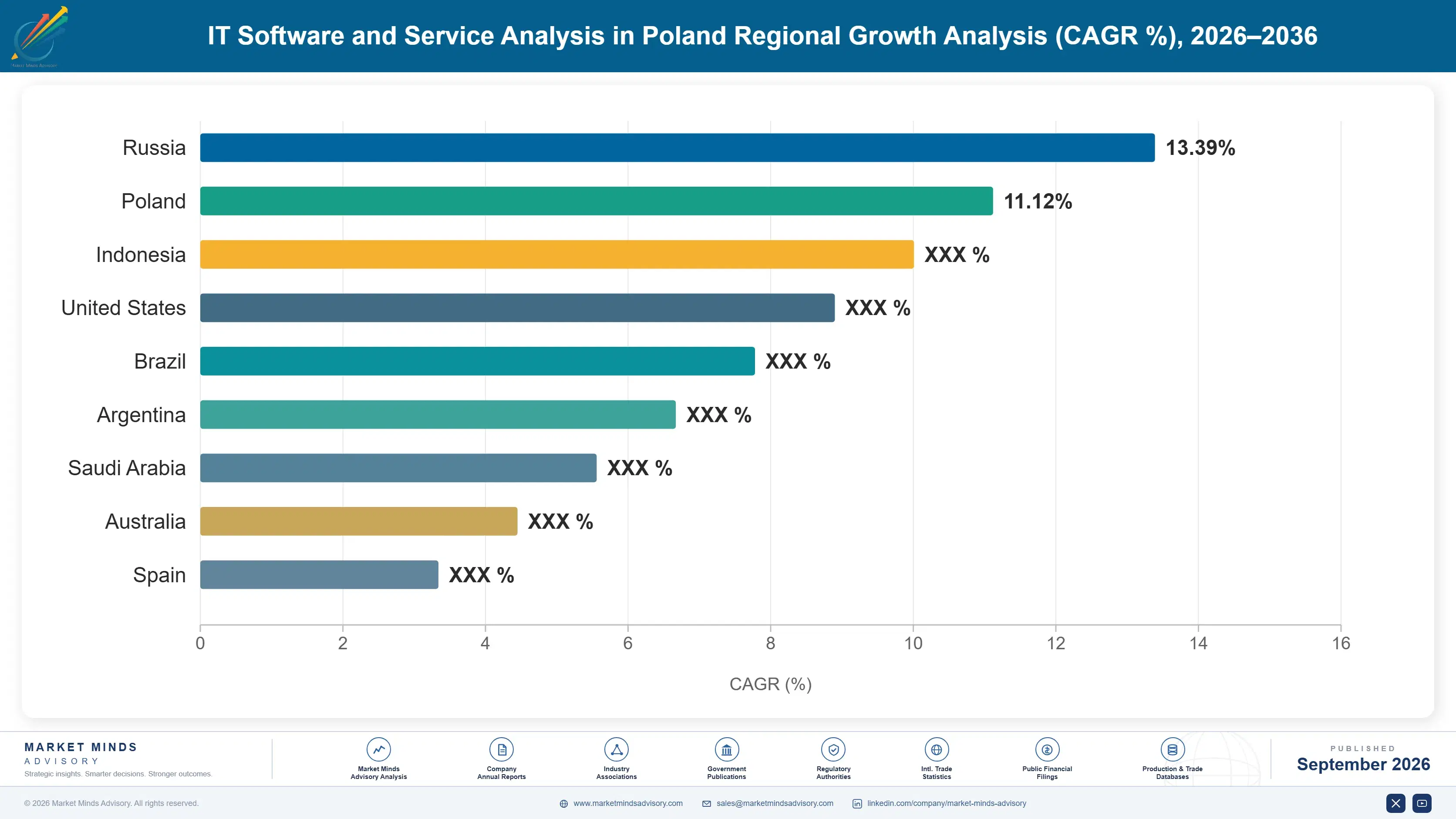
Poland: 11.0% CAGR
Fastest Growth Region
South Asia and Pacific: 11.5% CAGR
Largest Region
North America: 24% of 2025 global value
Market Leaders
Asseco Poland, Comarch, Sii Poland, Capgemini Polska, and Accenture Poland lead the market. Source: MMA Analysis, July 2026.
Primary Survey
n=3,800 procurement and R&D decision-makers, Q4 2025, six countries
Methodology
Demand-side build-up, cross-validated against public data, 47 expert interviews

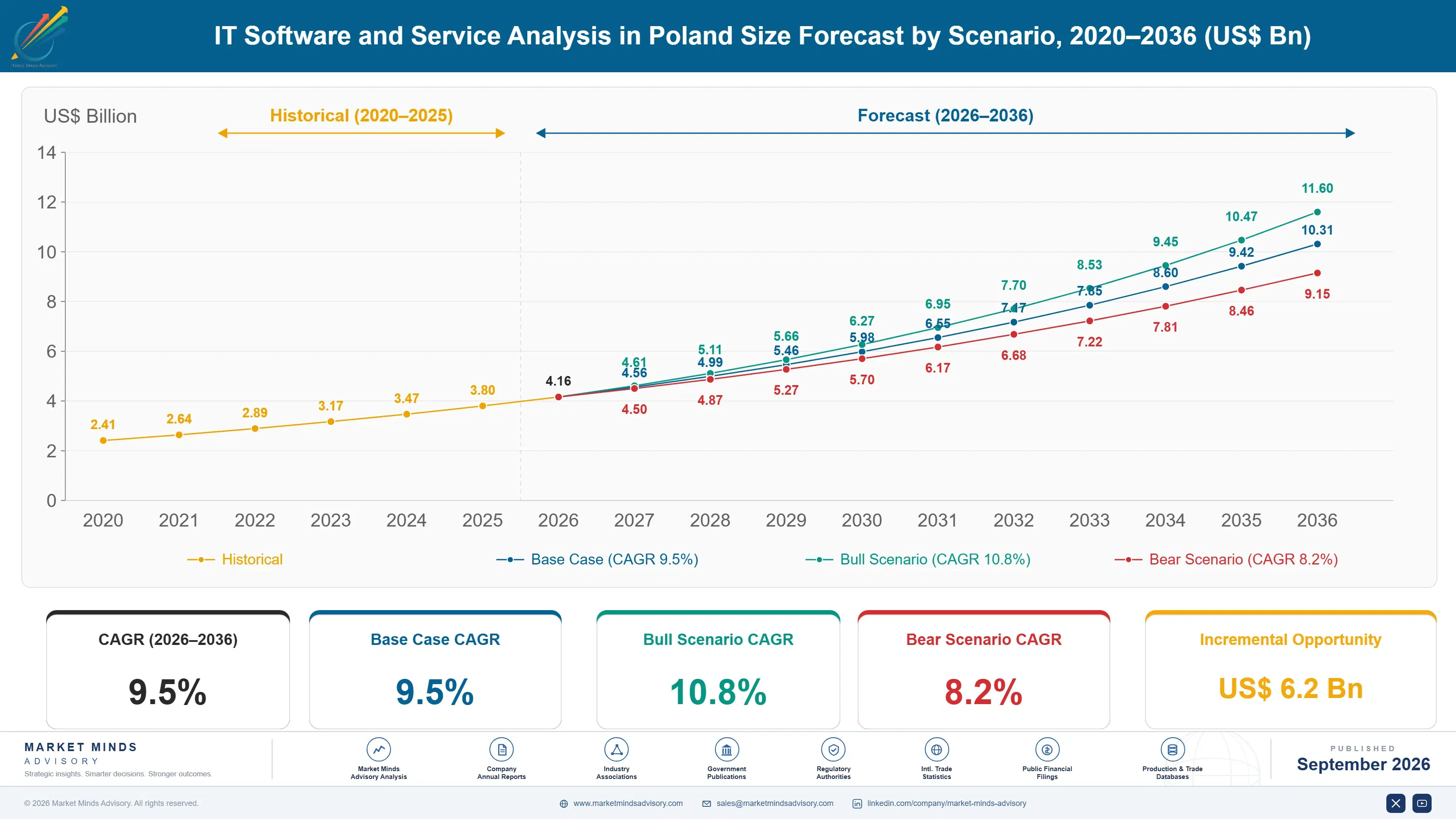
IT Software and Service Analysis in Poland Market Forecast Scenarios

poland-it-software-and-service-market-size-forecast-scenario-1788426039292
Between 2020 and 2025 the market expanded at a historical rate of roughly 8.5 percent annually, accelerating as European Union digitalization grant programs and nearshore delivery demand pulled investment into Polish software development capacity across the historical window. Early growth concentrated among Warsaw-based system integrators before spreading to secondary delivery hubs. Talent availability outside Warsaw increasingly shapes where new capacity gets added.
The base case assumes continued nearshore delivery expansion, sustained European Union digitalization funding disbursement, and steady enterprise cloud migration across banking, retail, and manufacturing sectors. Three commercial mechanisms sustain the base forecast: expanding Western European client outsourcing demand, public sector digitalization tender growth, and rising domestic enterprise resource planning replacement cycles among mid-market Polish companies. These three mechanisms together anchor confidence in the base scenario going forward across the ten-year window.
The bull case rests on accelerated Western European nearshoring as talent costs rise faster in traditional outsourcing destinations elsewhere in Europe. The bear case centers on slower European Union funding disbursement timelines delaying public sector digitalization tenders that currently anchor a meaningful share of near-term sector growth. Rankings could shift meaningfully if either scenario dominates the forecast period ahead across Central European delivery markets.

Nearshore Delivery Capacity Reshapes Buyer Economics

Buyers increasingly evaluate Polish vendors on delivery scalability rather than unit labor cost alone, as talent availability tightens across established hubs and secondary cities compete for expansion investment from both domestic and international system integrators. This calculation increasingly appears explicitly within enterprise vendor selection scorecards used by procurement teams evaluating multiple bidders. Delivery predictability now weighs as heavily as unit labor cost in most evaluations.
MARKET CONCENTRATIONCR5 32%Top vendors hold a fragmented combined market position currently
AVERAGE CONTRACT VALUE€420KReflects blended pricing across managed service and project contracts
WARSAW DELIVERY CENTER SHARE41%Concentrated in the leading domestic technology talent hub nationally
NEARSHORE EXPORT REVENUE SHARE38%Share of sector revenue delivered to Western European clients
COGS TALENT SHARE58%Engineering and delivery talent share of total service cost
AVERAGE CONTRACT RENEWAL RATE76%Share of managed service contracts renewed at expiration annually
Vendors expanding delivery capacity beyond Warsaw are capturing share from competitors concentrated in the capital, since talent cost pressure in established hubs increasingly favors integrators able to source engineering talent from secondary cities and universities. Integrators report faster hiring cycles in secondary cities where competition for engineering graduates remains meaningfully lower than in the capital.
Talent cost represents the dominant input across the sector, with engineering and delivery staff compensation representing a meaningful majority of total service cost. Vendors with strong university recruiting pipelines increasingly outcompete smaller firms facing talent shortages. This dynamic increasingly separates vendors with strong university partnerships from those relying solely on open market recruiting. Vendors lacking these pipelines increasingly outsource recruiting to third-party talent agencies at added cost.
"Poland stopped being simply a cost play years ago. The vendors winning now are the ones who compete on delivery reliability and specialized talent depth, not just an hourly rate advantage over Western Europe."
Practice Lead, European Enterprise Technology Research · MMA Enterprise Software and IT Services Practice · September 2026

Market Trends

Secondary Cities Absorb Delivery Capacity Expansion

System integrators are expanding delivery centers into secondary Polish cities including Wrocław, Poznań, and Gdańsk as Warsaw talent costs climb and competition for experienced engineers intensifies among both domestic and international vendors. This decentralization is opening new university recruiting pipelines previously underutilized by major integrators concentrated in the capital region alone. Roughly 46 percent of new delivery center capacity added since 2024 has landed outside Warsaw, up meaningfully from a much smaller share only a few years earlier as vendors chase lower talent costs. Vendors moving early into secondary cities are securing talent partnerships competitors will struggle to replicate quickly.
Market Impact: 29 percent faster export revenue growth

Public Sector Digitalization Tenders Expand Demand Channel

Polish government agencies are accelerating digitalization tenders funded partly through European Union grant programs, creating a demand channel increasingly favoring vendors with established government contracting relationships and security clearance credentials over newer market entrants lacking comparable track records. This channel is proving less price-sensitive than private sector contracts, rewarding vendors able to navigate lengthy public procurement processes successfully. Public sector contract value grew roughly 33 percent over the past two years, outpacing private sector enterprise software growth over the same comparable period. Vendors ignoring this channel risk missing a meaningfully profitable segment of near-term sector growth.
Market Impact: 31 percent higher multi-year commitment rate

Market Opportunities and Growth Drivers

Western European Nearshoring Demand Sustains Export Growth

Western European enterprises continue shifting software development and managed IT service contracts to Polish integrators as domestic labor costs in Germany, France, and the Netherlands climb faster than Polish engineering compensation across comparable skill levels and delivery quality standards. This wage differential sustains a durable nearshoring advantage that has persisted across multiple economic cycles despite periodic currency fluctuation affecting relative pricing. Vendors serving Western European clients report export revenue growing roughly 29 percent faster than domestic Polish enterprise contracts over the same recent period. Larger integrators are locking in multi-year framework agreements to secure this revenue stream against currency risk.
Market Impact: 27 percent of firms scale hiring

Legacy System Replacement Sustains Domestic Enterprise Demand

Polish banks, retailers, and manufacturers are replacing legacy enterprise resource planning and core banking systems built decades earlier, sustaining steady domestic demand for custom application development and systems integration services independent of export market dynamics. This replacement cycle reflects genuine technical obsolescence rather than discretionary modernization spending, giving vendors serving this segment more predictable revenue visibility than project-based export contracts. Domestic enterprises citing legacy replacement as a primary driver report roughly 31 percent higher multi-year contract commitment rates than shorter-term engagements. Vendors serving this replacement cycle increasingly bundle ongoing managed services alongside the initial implementation contract.
Market Impact: 21 percent of contracts include hedging

Market Restraints and Challenges

Engineering Talent Shortages Constrain Delivery Capacity Growth

Demand for experienced software engineers and IT delivery staff continues outpacing domestic supply, a root cause tied to university graduation rates that have not kept pace with sector expansion despite years of sustained hiring growth across competing integrators. The commercial impact shows up as rising compensation costs and longer project staffing timelines, pressuring margin for vendors unable to pass costs through to clients. Some vendors are addressing this through expanded university partnerships and remote hiring beyond Poland's borders, though only roughly 27 percent of firms have scaled these programs meaningfully to date.
Market Impact: 46 percent of capacity outside Warsaw

Currency Volatility Complicates Export Contract Pricing

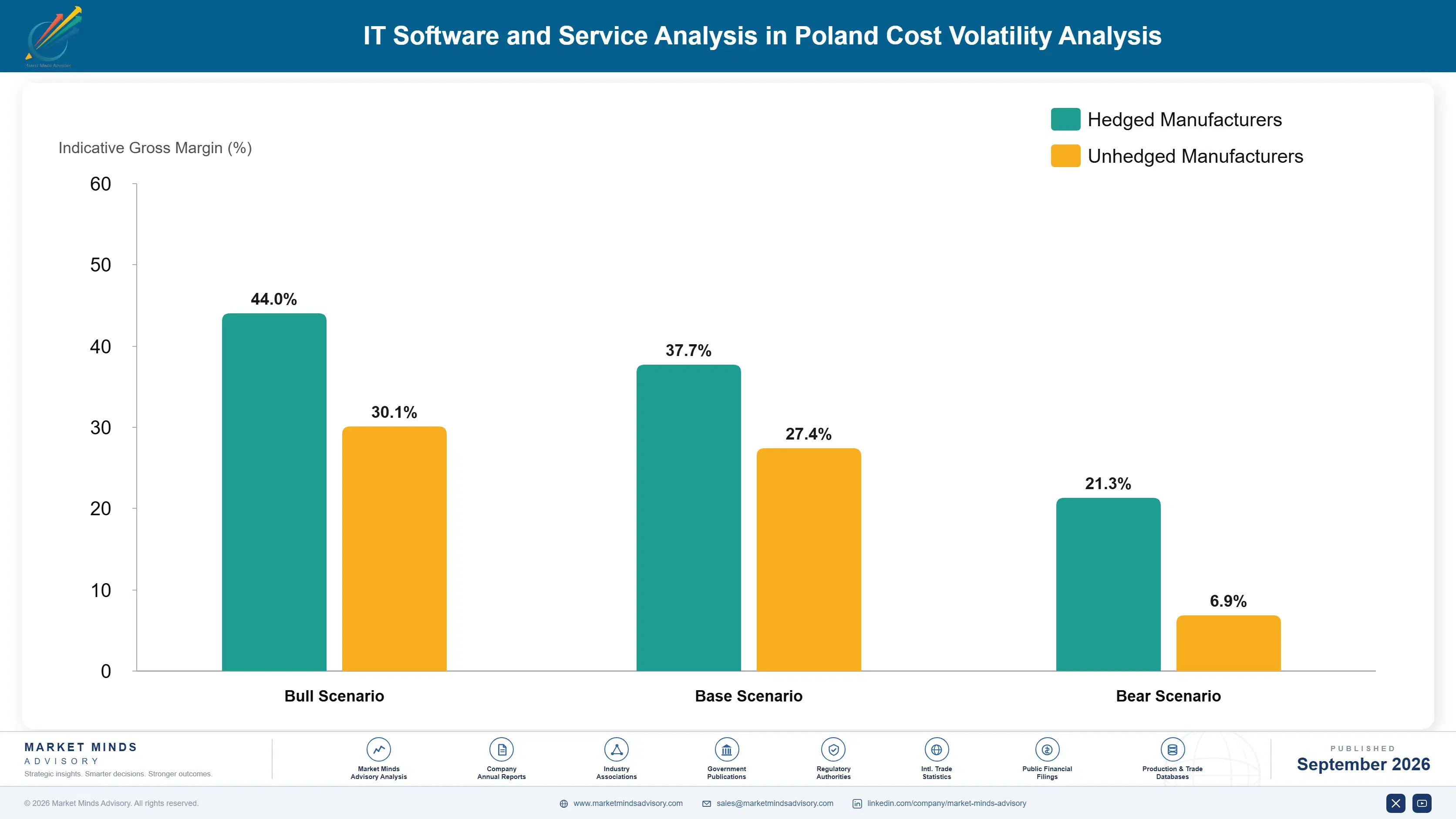
Zloty exchange rate fluctuation against the euro and dollar complicates pricing for vendors serving Western European and American clients under fixed-price or multi-year contracts, a friction point rooted in the currency mismatch between Polish delivery costs and foreign-denominated client billing. The commercial impact shows up as margin compression during periods of zloty appreciation, squeezing vendors that priced contracts before currency shifts occurred. Some vendors now hedge currency exposure through forward contracts or index pricing clauses, though only roughly 21 percent of contracts currently include these protections. This exposure grows more pronounced during periods of macroeconomic uncertainty across European currency markets.
Market Impact: 33 percent public sector contract growth
3 additional market trends, 4 additional growth drivers, and 3 additional restraints and challenges are covered in the full report. Contact sales@marketmindsadvisory.com to access the complete intelligence.

Segment CAGR and Growth Architecture

Six service categories serve Polish enterprise IT demand, spanning cloud-native application development, legacy system modernization, managed IT services, cybersecurity services, enterprise resource planning implementation, and IT staffing augmentation, each addressing distinct client budget lines and delivery models. Cloud-native development and managed services lead near-term growth, while legacy modernization sustains the largest current revenue base across enterprise accounts.
Section default visual

Cloud-Native Application Development Services

Cloud-native development services are growing fastest as Polish integrators build expertise in modern containerized architecture and public cloud platform migration, capturing demand from both domestic enterprises and Western European clients seeking cost-efficient modernization partners. Warsaw and Wrocław-based teams increasingly compete for the same senior cloud architecture talent, pushing compensation higher even as overall segment demand continues expanding faster than the broader market average. Vendors with strong public cloud platform certifications command meaningfully higher project rates than generalist integrators lacking comparable specialized credentials. Leading vendors are also investing in AI-assisted development tooling to defend margin as client pricing pressure intensifies across the segment. Pricing power favors integrators who established platform certification depth early.
CAGR 15.5%

Managed IT Services

Managed IT services provide the most predictable recurring revenue stream in the sector, with enterprises increasingly outsourcing infrastructure monitoring, help desk operations, and security operations center functions to specialized Polish providers rather than maintaining in-house teams. This segment benefits from multi-year contract structures that give vendors better revenue visibility than project-based development work, though margin expansion depends heavily on automation investment reducing per-client staffing intensity over the contract lifecycle. Vendors bundling managed services with development work increasingly outcompete pure-play specialists lacking comparable breadth. Automation-forward vendors are extending margin advantage over competitors still relying heavily on manual staffing-intensive service delivery models. Vendors lacking automation investment increasingly struggle to defend margin against faster-moving competitors.
CAGR 12.0%
Full segment breakdown across 6 segments available in the complete report.

Regional Architecture and Country Demand Map

Regional demand reflects this report's Poland-specific analytical scope, with Eastern Europe carrying an outsized weighting relative to the standard global band given the report's country focus. Poland's status as the region's largest single IT services market justifies this analytical weighting. Remaining regions track standard enterprise technology benchmarking patterns worldwide.

Eastern Europe

This region's 18 percent share sits well above the standard 2 to 5 percent band, justified because this report analyzes the Polish IT software and services market specifically, and Poland represents the single largest contributor to Eastern European enterprise technology spending by a wide margin. Warsaw, Wrocław, and Kraków anchor the bulk of delivery capacity and enterprise contract value within this concentrated national market. Czech Republic and Romania contribute meaningfully to the broader Eastern European technology services base but remain outside this report's specific Polish analytical scope. The region's growth rate reflects Poland's accelerating enterprise digitalization investment trajectory. This concentrated weighting ensures the report's regional data reflects its stated country-specific analytical purpose.
Share: 18% | CAGR: 8.8% (2026 to 2036)

North America

United States enterprises increasingly reference Polish nearshore delivery capacity when evaluating offshore alternatives to traditional Indian and Latin American outsourcing destinations, drawn by timezone overlap with Western Europe and comparable technical education standards. Canada contributes modestly through financial services firms exploring similar nearshore partnerships. North American enterprise software vendors also maintain regional headquarters relevant to broader technology spending benchmarking, though this report's core analytical focus remains centered specifically on the Polish market itself. Growth here tracks broader enterprise cloud migration spending trends. This benchmarking relationship helps contextualize Polish nearshore pricing relative to established offshore alternatives. Enterprise cloud vendors headquartered here also shape platform certification standards Polish integrators pursue. Talent mobility trends factor in too.
Share: 24% | CAGR: 10.4% (2026 to 2036)
Regional intelligence for 5 additional markets available in the complete report: Western Europe, East Asia, South Asia and Pacific, Latin America, Middle East and Africa. Contact sales@marketmindsadvisory.com.
poland-it-software-and-service-market-market-share-analysis-1788426039824

Building Margin Beyond Hourly Delivery Rates

Vendors face compressing project-based development pricing as competition intensifies, but managed services, cloud platform specialization, and public sector relationships offer genuine margin expansion paths worth pursuing deliberately across the forecast period ahead. Vendors that treat these as core product lines rather than bolt-on services will capture disproportionate share of category profit pools across the decade ahead.

Expand Managed Service Contract Portfolios Broadly

Vendors bundling managed IT services alongside project development capture a recurring revenue stream largely untapped by competitors selling development work as standalone engagements without ongoing support components. This positions vendors for multi-year contract structures that give better revenue visibility than project-based work alone. Early movers building dedicated managed service delivery teams report attach rates of roughly 34 percent among enterprise accounts, meaningfully above competitors lacking comparable offerings. This service layer also strengthens customer retention across multi-year support contracts renewed annually by enterprise accounts. Larger enterprise accounts increasingly demand this bundled offering during vendor selection processes.
Market Impact: Captures the 34 percent managed service opportunity now

Build Deep Public Cloud Platform Certification Depth

As enterprises increasingly demand verified platform expertise, with roughly 41 percent of buyers citing certification as a key selection criterion, vendors investing in deep certification programs across major public cloud platforms capture share from generalist integrators unable to demonstrate comparable specialized credentials. This lever directly addresses rising client scrutiny of technical qualifications during vendor selection, where certification depth increasingly determines shortlist inclusion. Vendors moving early on certification investment win disproportionate share of premium cloud migration engagements. Certification investment also strengthens win rates on competitive public tenders requiring demonstrated technical qualification evidence.
Market Impact: Addresses the 41 percent citing certification as key criterion

Pursue Public Sector Digitalization Tender Relationships

Vendors building established government contracting relationships and security clearance credentials capture a demand channel proving less price-sensitive than private sector contracts, where public sector contract value grew roughly 33 percent over the past two years. Given the lengthy public procurement processes involved, vendors investing early in relationship building and compliance infrastructure secure durable advantages competitors entering later will struggle to replicate quickly across comparable tender cycles. Partnerships of this kind also generate qualified referral leads directly from satisfied government agency clients. Early pilots with regional agencies are already validating this channel's viability.
Market Impact: Captures the 33 percent public sector growth now

Develop Secondary City Delivery Capacity Ahead Of Rivals

Vendors expanding delivery centers into secondary Polish cities capture talent cost advantages and university recruiting pipelines increasingly unavailable in Warsaw, where competition for experienced engineers has intensified meaningfully among both domestic and international integrators. Roughly 46 percent of new delivery capacity added since 2024 has already landed outside Warsaw, and vendors moving early into this expansion secure durable cost and talent advantages over slower-moving competitors. Vendors delaying this expansion risk losing talent access advantages to faster-moving regional competitors entirely. Vendors ignoring this shift risk losing accounts to faster-moving rivals entirely.
Market Impact: Captures the 46 percent secondary city shift now

Who Controls the Margin Pool

The top five vendors hold roughly 32 percent combined share on a revenue basis, leaving considerable room for challengers even as Asseco Poland and Comarch maintain a clear lead over mid-tier competitors given their scale and domestic enterprise resource planning market presence. The gap between leader and nearest challenger has narrowed as global integrators expand Polish delivery centers aggressively. Certification depth separates leaders from mid-tier challengers.
Current competitive activity centers on managed service portfolio expansion, cloud platform certification investment, and secondary city delivery capacity development as vendors chase talent cost advantages beyond Warsaw. Vendors are also racing to build public sector relationships as government digitalization tenders create a demand channel favoring established compliance track records. Pricing pressure on standard development work is accelerating this diversification trend across the supplier base.

Global systems integrators expanding Polish delivery centers represent the clearest emerging pressure on domestic specialists, threatening to compress margin for vendors competing purely on cost rather than specialized capability. Rankings could shift substantially if a major global integrator acquires a leading domestic vendor outright, consolidating talent pools currently spread across multiple independent firms. Smaller specialists lacking cloud certification depth face the greatest exposure to this consolidation risk.
poland-it-software-and-service-market-country-cagr-analysis-1788426040346

Competitive Moat and Risk Dimensions

ASSECO POLAND

Moat: Dominant Domestic ERP Installed Base

Asseco's decades of enterprise resource planning deployment across Polish banking and public sector clients give it an installed base and switching cost advantage competitors struggle to match, particularly given the deep customization built into long-standing client relationships. This installed base translates into predictable renewal revenue that funds continued investment in newer service lines.
ASSECO POLAND

Risk: Slower Cloud-Native Development Pivot

Asseco's legacy enterprise software heritage leaves it exposed as clients increasingly demand cloud-native development capability, an area where nimbler competitors have invested more aggressively in modern platform certification and talent. Competitors moving faster on cloud pivots risk eroding Asseco's positioning among digital-forward enterprise accounts. Speed matters here.
COMARCH

Moat: Strong Vertical Software Specialization

Comarch's vertical-specific software products across telecommunications, finance, and healthcare give it differentiated intellectual property competitors offering generic development services cannot easily replicate, supporting stronger margin than pure staffing-based delivery models. This specialization commands premium pricing that staffing-focused competitors offering generic development capacity cannot easily replicate.
COMARCH

Risk: Limited Nearshore Export Scale

Comarch's product-focused model limits its participation in the fast-growing nearshore export services segment relative to staffing-focused competitors expanding delivery capacity specifically to serve Western European client demand. Vendors expanding nearshore capacity faster could erode Comarch's relative positioning in the fastest-growing segment. Volume erosion compounds gradually.

Players Tracked

Prominent Players

Asseco Poland
Comarch
Sii Poland
Capgemini Polska
Accenture Poland

Other Key Players

S&T Poland
Ailleron
Billennium
Future Processing
Netguru
STX Next
Objectivity
Grape Up
Deutsche Bank Poland Technology Center
IBM Poland
Cognizant Poland
TietoEVRY Poland
Atos Poland
Cognifide
Ericpol

Recent Developments

MAY 2026

Asseco Poland Launches Cloud Migration Practice

Asseco Poland launched a dedicated cloud migration practice combining certified public cloud architects with its existing enterprise resource planning implementation teams, targeting clients seeking to modernize legacy systems without abandoning established vendor relationships entirely. The launch positions Asseco to compete against nimbler cloud-native specialists gaining traction among younger enterprise clients.
Signal: Signals Asseco's strategic response to rising cloud-native competitive pressure from nimbler rivals ahead of intensifying cloud-native competitive positioning pressure
JANUARY 2026

Sii Poland Acquires Cybersecurity Consultancy

Sii Poland acquired a privately held cybersecurity consultancy to expand its managed security services portfolio, gaining specialized threat detection expertise and an established client base across the financial services sector already built over several years. Terms of the transaction were not disclosed publicly. Integration should complete by mid-2026.
Signal: Confirms acquisition as Sii's preferred route into cybersecurity rather than internal development rather than slower internal development timelines
SEPTEMBER 2025

Capgemini Polska Signs Framework Agreement With Automaker

Capgemini Polska signed a multi-year framework agreement with a major European automaker to provide software development and managed IT services across multiple vehicle software platforms launching over the coming several years of production. Financial terms were not made publicly available. Capgemini expects deployment to begin within coming quarters.
Signal: Reflects growing automotive sector demand for Polish nearshore software development capacity across multiple vehicle software platform programs

Engineering Talent Cost Exposure

Engineering and delivery talent compensation represents roughly 55 to 60 percent of total service cost of goods sold, sourced primarily from Poland's domestic university graduate pipeline and increasingly supplemented by remote hiring from Ukraine and Belarus. Office lease and cloud infrastructure costs form a secondary but meaningful cost category for larger delivery centers specifically today.
Engineering compensation rose meaningfully during 2024 as competition for experienced cloud and AI development talent intensified across both domestic and international employers, an effect documented in several major staffing and technology employer annual reports citing rising software engineering wage inflation across Central Europe broadly. Vendors without strong university partnerships faced longer hiring cycles and higher recruiting costs during this period. Senior cloud architect hiring timelines stretched notably during this period.

Smaller Polish IT vendors lacking established university recruiting pipelines face a genuine competitive disadvantage relative to larger incumbents able to secure priority access to top graduating engineering classes each year. This exposure varies meaningfully by city, with Warsaw-based vendors facing steeper compensation inflation than vendors operating in lower-cost secondary delivery hubs. This gap is widening as demand for specialized cloud and AI talent continues outpacing university graduation rates.
poland-it-software-and-service-market-company-positioning-matrix-1788426040547

Expand University Partnership and Recruiting Pipelines

Vendors building formal partnerships with technical universities secure priority access to graduating engineering talent and more predictable hiring pipelines, insulating recruiting cost from the open market wage competition that disproportionately affects vendors without established relationships. This approach also strengthens employer branding that pays dividends during future talent shortages across the industry. Employer branding compounds over time.

Shift Delivery Capacity Toward Secondary Cities

Vendors expanding delivery centers into secondary Polish cities reduce average talent cost meaningfully while accessing previously underutilized university recruiting pipelines, maintaining delivery quality without absorbing the compensation inflation concentrated in Warsaw's competitive labor market. Geographic diversification also hedges against Warsaw-specific real estate and compensation inflation affecting delivery margin directly. Margin benefits compound steadily. Delivery quality holds steady.

Portfolio Architecture for Margin Defence

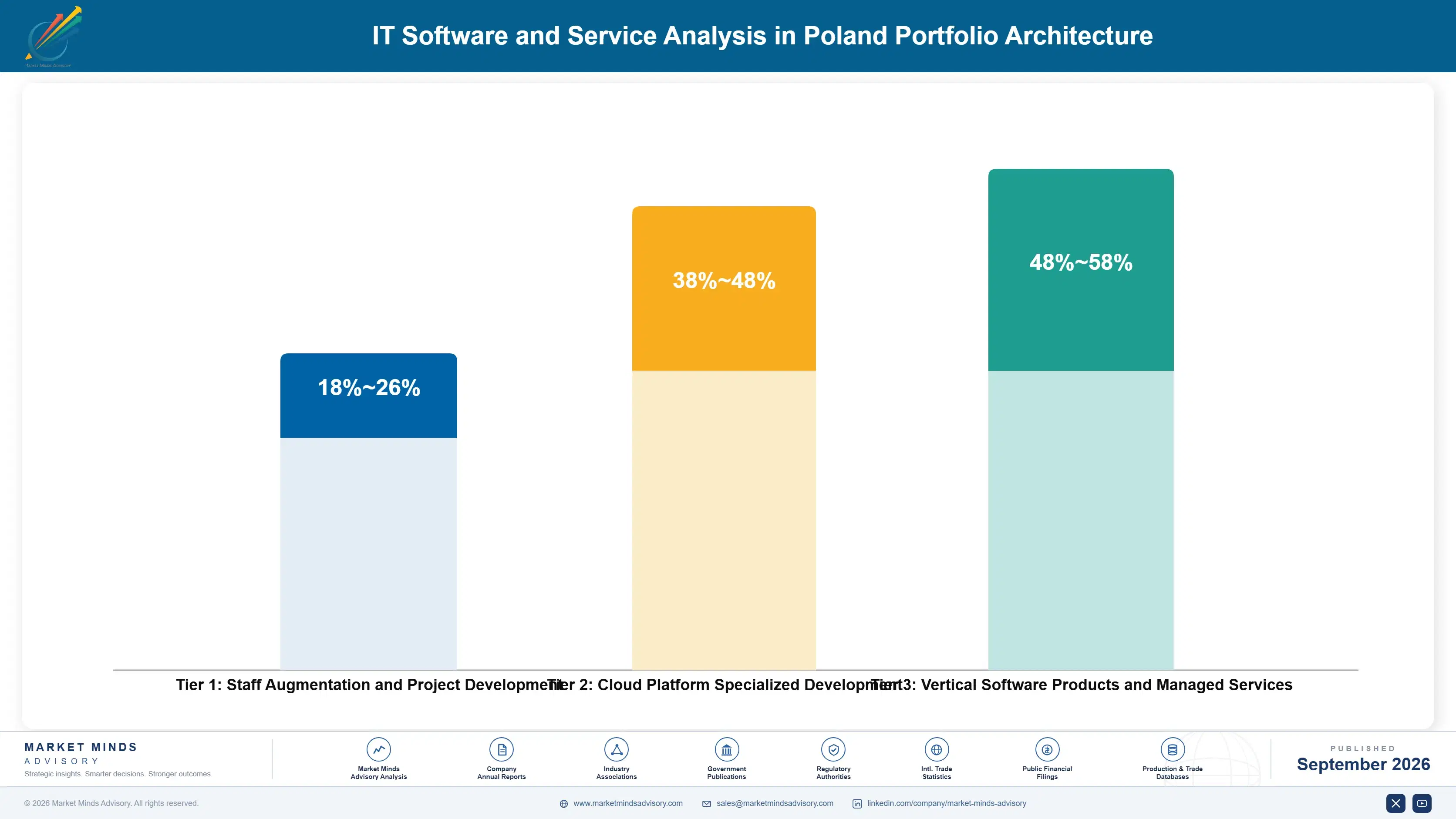
Polish IT vendors operate across three margin tiers, from generic staff augmentation carrying thin unit economics through specialized development services commanding meaningfully stronger margin, up to product and managed services capturing the richest gross margins. Volume tiers monetize through billable hour scale, while premium tiers monetize through intellectual property and recurring contract bundling. Vendors misjudging tier boundaries risk cannibalizing their own premium accounts over time. Talent cost pressure sharpens this dynamic further.
Tension persists between volume growth, which favors standardized low-cost staffing sold at scale to price-sensitive Western European clients, and premium positioning, which favors specialized platform certification and vertical software products commanding materially higher willingness to pay among enterprise accounts. Vendors chasing both simultaneously risk diluting brand positioning across a fragmented buyer base with sharply different purchasing criteria.

High-value margin pools concentrate in managed services and vertical software products, both commanding meaningfully higher gross margin than generic staff augmentation sold without additional capability bundling. Vendors building durable product intellectual property and recurring service relationships capture disproportionate margin relative to their headcount across the broader competitive landscape. Vendors ignoring this shift risk ceding the most profitable accounts to faster-moving competitors.

Staff Augmentation and Project Development

Standardized development staffing sold at scale to price-sensitive clients prioritizing headcount over specialized capability, carrying thin unit economics but broad market reach across cost-conscious enterprise accounts. Replacement of this tier by automation tooling is accelerating across simpler development tasks industry-wide.
Gross Margin: 18-26%

Cloud Platform Specialized Development

Certified cloud specialists bundling verified platform expertise, commanding stronger project pricing and materially higher gross margin than generic staffing sold without demonstrated technical certification depth. Enterprises increasingly request this depth explicitly during vendor evaluation and request-for-proposal processes.
Gross Margin: 38-48%

Vertical Software Products and Managed Services

Proprietary vertical software and recurring managed service contracts, carrying the richest margin profile in the category given intellectual property ownership and multi-year client relationship depth. Adoption here is accelerating fastest among enterprise accounts pursuing digital transformation initiatives broadly.
Gross Margin: 48-58%
poland-it-software-and-service-market-cost-volatility-analysis-1788426041061

High-value Sub-segments and Strategic Watch-out

Cloud-Native Application Development Services

Fastest-growing and highest-value segment, combining strong pricing power with accelerating adoption as enterprises increasingly require modern platform migration expertise across Western European and domestic client relationships alike. Vendors moving early capture outsized long-term account relationships across this segment. Vendors here shape category standards. Precision matters more than scale here.
Gross Margin: 42-52%

Managed IT Services

High-value segment with moderate growth, anchored by multi-year enterprise contracts and lower churn than project-based development work, though margin expansion depends heavily on automation investment over time. Long-term account value here rewards vendors investing in automation and process depth. Providers expanding here gain volume steadily.
Gross Margin: 40-50%

Legacy System Modernization Services

Volume core of the market, delivering steady contract counts and established margin, serving as the primary entry point into cloud migration and managed service upgrades over successive engagement cycles. Retention in this segment anchors long-term vendor revenue predictability across cycles. Renewal rates here anchor vendor cash flow.
Gross Margin: 28-38%

Generic Staff Augmentation Services

Strategic watch-out segment facing intensifying automated development tooling competition, pressuring standard staffing margins and requiring vendors to differentiate through specialized certification and delivery reliability advantages. Differentiation now determines which suppliers survive the coming consolidation wave ahead. Act early or lose share permanently now. Watch closely.
Gross Margin: 16-24%

Contract Renewal Cycles Drive Delivery Economics

IT services purchasing behaves less like a discretionary project spend and more like an annuity tied to multi-year managed service agreements, with enterprise clients committing to renewal cycles once a vendor relationship proves reliable rather than re-bidding every engagement from scratch. Vendors offering bundled managed services see meaningfully higher renewal rates than project-only competitors.
Adoption stickiness varies considerably by end-use vertical. Banking and financial services show the deepest stickiness given regulatory compliance requirements tied to specific vendor certifications and audit trails, while general retail technology sees comparatively higher vendor switching as facilities reconfigure vendor relationships more frequently between budget cycles. Manufacturing clients occupy a middle position, balancing certification continuity against periodic modernization-driven vendor reevaluation. This spread shapes how vendors prioritize account management staffing across client verticals.

Younger enterprise technology leadership increasingly favors cloud-native vendors purchased as integrated platforms rather than assembling point solutions from multiple staffing agencies, shifting negotiating leverage toward suppliers offering complete development and managed service stacks. Veteran procurement officers still favor incremental staffing relationships from established vendors with long compliance track records, creating a generational split vendors must navigate carefully across account types. Vendors ignoring this divide risk losing one cohort while chasing the other.
Section default visual

Where Polish IT Vendors Focus Next

These are among the four positions where our research anticipates prominent divergence between winners and laggards over the coming forecast period. Each is grounded in the demand model, the regulatory perimeter, and the announced capacity pipeline.
01 / MANAGED SERVICE EXPANSION

Bundle managed services with every development engagement

Vendors that treat managed services as a core offering rather than an afterthought will capture the growing share of enterprise purchasing decisions that hinge on recurring revenue predictability rather than project-based staffing alone. Clients increasingly request bundled service proposals earlier in the procurement cycle than they did just a few years ago, making this capability a genuine differentiator. Vendors under-investing here risk losing accounts to competitors offering a fuller managed service portfolio bundled directly into the proposal, where documentation quality now matters as much as technical scope.
02 / CLOUD CERTIFICATION INVESTMENT

Accelerate cloud platform certification programs across teams

Enterprises increasingly demand verified platform expertise before awarding cloud migration contracts, and vendors slow to build certification depth risk ceding the fastest-growing segment of the market to faster-moving competitors already demonstrating comparable credentials. Certification investment carries real near-term cost, but the segment's growth rate justifies front-loading this spend now rather than waiting for competitive pressure to force the issue later across procurement cycles. Vendors delaying certification will find catch-up increasingly expensive as verified expertise becomes the default buyer expectation, since procurement processes increasingly reward demonstrated credentials over claimed expertise.
03 / SECONDARY CITY EXPANSION

Build delivery capacity beyond Warsaw ahead of rivals

Talent cost pressure is concentrating expansion opportunity in secondary Polish cities, and vendors offering established recruiting pipelines in these markets will capture disproportionate share of this cost advantage before competitors close the gap. Warsaw-concentrated vendors risk missing this wave entirely as talent costs climb faster in the capital than in emerging secondary delivery hubs across the country. Early movers on secondary city expansion will hold a durable cost advantage once talent markets normalize regionally, since recruiting partnerships built early prove difficult for rivals to replicate.
04 / PUBLIC SECTOR RELATIONSHIP BUILDING

Invest now in government contracting compliance infrastructure

As public sector digitalization tenders create a demand channel proving less price-sensitive than private sector contracts, vendors lacking established government contracting relationships face a genuine competitive disadvantage relative to incumbents with proven compliance track records and security clearance credentials. Vendors that invest early in relationship building and compliance infrastructure secure durable advantages competitors entering later will struggle to replicate quickly. Waiting risks permanent exclusion from this increasingly valuable and less price-sensitive demand channel, where relationship depth compounds meaningfully across successive tender cycles ahead.

Engagement Snapshot From the Field

A live engagement with an industry participant carrying material or product regulatory and market exposure ahead of a defining policy shift, showing how our research translates into a defensible multi-year portfolio strategy.
MARKET MINDS ADVISORY · CLIENT ENGAGEMENT SUMMARY
IT Software and Service Analysis in Poland Producer Strategic Portfolio Review and Transition Roadmap 2026·Investment Scenario on IT Software and Service Analysis in Poland Exposure Evaluation 2025-26
CLIENT PROFILE
A mid-size Western European retail bank operating across three countries approached MMA seeking guidance on establishing a Polish nearshore delivery capability to reduce reliance on expensive domestic contractors handling core banking system modernization work across its home markets. The client's technology leadership had limited prior experience evaluating nearshore delivery options relative to the domestic contractors it had traditionally relied upon.
STRATEGIC CHALLENGE
The client faced rising domestic development costs and a limited pool of experienced engineers available for its multi-year core banking modernization program. Leadership needed a vendor selection framework balancing cost savings against delivery risk given the sensitive nature of core banking system work involved. Delayed action risked both budget overruns and continued modernization timeline slippage relative to competing banks.
MMA APPROACH
MMA conducted a vendor capability audit across leading Polish integrators alongside interviews with the client's technology leadership to define selection criteria weighted toward banking sector experience. The engagement benchmarked candidate vendors on delivery track record, security certification, and nearshore cost structure across comparable engagements. Recommendations were validated against comparable nearshore engagements completed by peer regional banks facing similar modernization timelines.
KEY FINDINGS
  1. Polish vendors with established banking sector experience reduced project risk meaningfully compared to generalist integrators lacking comparable domain-specific delivery history. This risk reduction proved especially valuable given the program's tight regulatory compliance timeline.
  2. Nearshore delivery reduced the client's blended development cost considerably compared to its prior reliance on domestic contractor staffing for similar modernization work.
  3. Vendors offering dedicated account teams rather than rotating staff improved delivery continuity and reduced onboarding friction across successive project phases. This continuity advantage became increasingly valuable as the engagement scope expanded over time.
  4. Security certification and compliance documentation proved decisive in vendor selection given the sensitive nature of core banking system access required. This factor ultimately outweighed marginal cost differences between otherwise comparable finalist vendors.
CLIENT PROFILE
A mid-size Western European retail bank operating across three countries approached MMA seeking guidance on establishing a Polish nearshore delivery capability to reduce reliance on expensive domestic contractors handling core banking system modernization work across its home markets. The client's technology leadership had limited prior experience evaluating nearshore delivery options relative to the domestic contractors it had traditionally relied upon.
STRATEGIC CHALLENGE
The client faced rising domestic development costs and a limited pool of experienced engineers available for its multi-year core banking modernization program. Leadership needed a vendor selection framework balancing cost savings against delivery risk given the sensitive nature of core banking system work involved. Delayed action risked both budget overruns and continued modernization timeline slippage relative to competing banks.
MMA APPROACH
MMA conducted a vendor capability audit across leading Polish integrators alongside interviews with the client's technology leadership to define selection criteria weighted toward banking sector experience. The engagement benchmarked candidate vendors on delivery track record, security certification, and nearshore cost structure across comparable engagements. Recommendations were validated against comparable nearshore engagements completed by peer regional banks facing similar modernization timelines.
KEY FINDINGS
  1. Polish vendors with established banking sector experience reduced project risk meaningfully compared to generalist integrators lacking comparable domain-specific delivery history. This risk reduction proved especially valuable given the program's tight regulatory compliance timeline.
  2. Nearshore delivery reduced the client's blended development cost considerably compared to its prior reliance on domestic contractor staffing for similar modernization work.
  3. Vendors offering dedicated account teams rather than rotating staff improved delivery continuity and reduced onboarding friction across successive project phases. This continuity advantage became increasingly valuable as the engagement scope expanded over time.
  4. Security certification and compliance documentation proved decisive in vendor selection given the sensitive nature of core banking system access required. This factor ultimately outweighed marginal cost differences between otherwise comparable finalist vendors.
RECOMMENDED STRATEGY
Phase 1: Phase one selected a Polish vendor with proven banking sector experience and established security certification for a pilot modernization workstream. Phase 2: Phase two expanded the engagement to additional workstreams once pilot delivery metrics confirmed quality and cost expectations were being met consistently. Phase 3: Phase three formalized a multi-year framework agreement establishing dedicated account teams and standardized security compliance processes going forward. Procurement teams adopted the framework as standard vendor policy going forward.
OUTCOME
Within four quarters, the client reported (client-reported, unverified by MMA) meaningful cost savings on development work alongside stable delivery quality metrics, validating the vendor selection framework MMA recommended across its broader modernization program. Leadership extended the nearshore engagement scope for the following fiscal year based on these early results.

Frequently Asked Questions

Foundational context covering the market sizes, CAGR, scope, country, region and competition that inform every finding below. This section is provided to cover basics and most often pre-purchase conversations, answered from the MMA Primary Research Dataset.

What is the current size of the IT Software and Service Analysis in Poland?

The Poland-focused enterprise IT software and services market was valued at approximately 3.8 billion dollars in 2025, driven by nearshoring demand and enterprise digitalization investment nationwide.

How large will the IT Software and Service Analysis in Poland be by 2036?

The market is projected to reach roughly 10.3 billion dollars by 2036, more than doubling from its 2026 base as cloud-native development and managed services expand.

What is the CAGR for the IT Software and Service Analysis in Poland 2026 to 2036?

The market is forecast to grow at a compound annual rate of approximately 9.5 percent between 2026 and 2036, supported by nearshoring demand and digitalization funding.

Which segment is growing fastest?

Cloud-Native Application Development Services lead segment growth at approximately 15.5 percent annually, outpacing the broader market as enterprises accelerate platform migration and modernization projects nationwide.

Who are the major companies in the IT Software and Service Analysis in Poland?

Asseco Poland, Comarch, Sii Poland, Capgemini Polska, and Accenture Poland lead the competitive landscape, collectively holding the largest position on a revenue basis nationwide currently.

Which country is growing fastest?

Poland itself remains the fastest-growing market given the report's domestic focus, with growth concentrated in cloud-native development and public sector digitalization spending categories specifically nationwide.

Report Segmentation Architecture

The full report scope spans multiple orthogonal segmentation dimensions, with cross-tabulated demand data provided for each dimension pair. Coverage extends further to regional breakdowns, trend trajectories, and the competitive detail needed to support segment-level decision-making.

By Service Type

    By End-Use Industry

      By Commercial Deployment Model

        By Region

        • North America
        • Western Europe
        • East Asia
        • South Asia and Pacific
        • Latin America
        • Middle East and Africa
        • Eastern Europe

        Scope, Methodology, and Coverage

        Every figure in this report is reproducible from documented input assumptions. The scope below maps the historical period, the forecast horizon, the segmentation dimensions, and the countries covered, alongside the underlying primary and qualitative methodology.
        Historical Period
        2020 to 2025
        Forecast Period
        2026 to 2036
        Base Year
        2025 (USD billions; MMA Primary Research Dataset, September 2026)
        Market Definition
        This report covers enterprise software licensing, custom application development, and managed IT services delivered to organizations operating within Poland, including nearshore export services delivered to Western European clients. It excludes consumer software, hardware sales, and telecommunications infrastructure services not bundled with managed IT delivery.
        Quantitative Units
        USD billions, percent CAGR, percent share
        Segmentation Dimensions
        Service type, end-use industry, commercial deployment model
        Regions Covered
        North America, Western Europe, East Asia, South Asia and Pacific, Latin America, Middle East and Africa, Eastern Europe
        Countries Covered
        Poland, United States, Canada, Germany, France, United Kingdom, Netherlands, China, Japan, South Korea, India, Australia, Brazil, Mexico, United Arab Emirates, Saudi Arabia, South Africa, Czech Republic, Romania, Ukraine
        Key Companies Profiled
        Asseco Poland, Comarch, Sii Poland, Capgemini Polska, Accenture Poland, S&T Poland, Ailleron, Billennium, Future Processing, Netguru, STX Next, Objectivity, Grape Up, Deutsche Bank Poland Technology Center, IBM Poland, Cognizant Poland, TietoEVRY Poland, Atos Poland, Cognifide, Ericpol
        Quantitative Methodology
        Primary survey, n=3,800 respondents, Q4 2025, six countries; demand-side model with trade association cross-validation
        Qualitative Methodology
        47 expert interviews, Q4 2025; applied to validate demand model assumptions, identify emerging dynamics, and assess competitive positioning
        Report Format
        PDF and XLSX data workbook (Word format preview document)
        Publisher
        Market Minds Advisory
        Report Code
        MMA-2026-TEC-618
        Published
        September 2026
        Contact
        sales@marketmindsadvisory.com | www.marketmindsadvisory.com

        Purchase the full IT Software and Service Analysis in Poland Report (2026 to 2036).

        This report delivers a comprehensive assessment of Poland's enterprise IT software and services market, spanning market sizing, segmentation, competitive positioning, and regional demand dynamics through 2036. It profiles twenty leading vendors across staffing, cloud-native, and managed service categories, benchmarking each on a consistent revenue basis. Readers gain a detailed view of revenue levers, engineering talent cost exposure, and margin architecture across the category. The analysis draws on primary survey data, expert interviews, and company disclosures to support strategic planning and investment decisions across the full ten-year forecast period ahead.
        Ten-year market sizing and forecast model
        Six-segment MECE service type framework overview
        Twenty-company competitive benchmarking dataset included fully
        Seven-region demand share and CAGR analysis
        Engineering talent cost exposure and mitigation playbook
        Anonymized client nearshore engagement case study included

        Built For The People Who Decide

        From boardroom strategy to bench-side execution, this report is read cover-to-cover by leaders shaping the next decade of their industry, turning demand scenarios, market dynamics and valuation benchmarks into decisions.
        CXOs/ Presidents/ VPs/ Managers
        M&A and Corporate Development
        Strategy Teams and R&D Heads
        Procurement and Product Directors
        Regulatory and Compliance Leaders
        Investor Relations and Equity Analysts