Market Minds Advisory
Point-to-point Microwave Antenna Market

Point-to-point Microwave Antenna Market: Point-to-Point Microwave Antenna Market. High-Capacity Backhaul Links Anchor 5G Densification

Mobile operators are deploying higher-capacity microwave antennas to backhaul traffic from densifying 5G small cell networks, a cheaper and faster alternative to fiber trenching across terrain where cable installation remains impractical.

Lead Analyst

Published

September 2026

Make Smarter Decisions with Customized Research Insights

Request a free sample report and evaluate market opportunities, growth trends, and competitive dynamics relevant to your business needs.

2025 MARKET VALUE$2.9BMarket Size 2025
2036 FORECAST VALUE$5.8BBase Case , 2026 to 2036
CAGR 2026 TO 20366.4 %Bull 7.6% / Bear 5.1%
INCREMENTAL OPPORTUNITY$2.7BNet 10- year value creation
EXPANSION MULTIPLE1.86x2036 value over 2026 base
Strategic Levers
M&A Pipeline
Regional Outlook
Country Rankings
Competitive Intelligence
Segmental Deep-dive
Call-Us : 91 93563 13602

Executive Snapshot and Market Trajectory.

Mobile operators are deploying higher-capacity microwave antennas to backhaul traffic from densifying 5G small cell networks, a cheaper and faster alternative to fiber trenching across difficult terrain and dense urban environments where cable installation remains impractical. Growth is broad-based across nearly every telecom infrastructure category tracked.
Ericsson, Nokia, and Huawei dominate the antenna and radio supply base, while East Asia's dense concentration of 5G small cell deployment and mountainous terrain anchors the largest share of installed microwave link volume worldwide. High-capacity E-band antennas and multi-band aggregation systems are growing fastest of all six tracked segments, as operators push backhaul capacity deeper into networks previously relying on lower-capacity legacy microwave links. Smaller operators follow with a lag.
Competitive intensity centers on spectral efficiency and link availability rather than antenna price alone, since buyers increasingly select vendors based on which platform delivers the highest throughput per megahertz of licensed spectrum under adverse weather conditions. Rural broadband expansion mandates are pulling incremental demand into markets that previously relied entirely on satellite or fixed wireless access. Firms unable to prove throughput risk losing contracts. Spectral efficiency remains the deciding factor across most large deployment tenders.
Market Definition
The Point-to-point Microwave Antenna Market covers dish and flat-panel antennas paired with microwave radio equipment used for fixed wireless backhaul links between two defined locations. It excludes satellite communication antennas, point-to-multipoint wireless access systems, and mobile handset antennas unrelated to fixed backhaul infrastructure.
Base Year Value
$2.9B in 2025 (MMA Primary Research Dataset, September 2026)
Forecast Period
2026 to 2036, eleven discrete annual values
CAGR
6.4% base case. Bull 7.6%. Bear 5.1%.
Fastest Growth Segment
E-Band Antenna Systems: 10.8% CAGR
Fastest Growth Country
India: 9.1% CAGR
Fastest Growth Region
South Asia and Pacific: 8.3% CAGR
Largest Region
East Asia: 27% of 2025 global value
Market Leaders
Ericsson, Nokia, Huawei, Ceragon Networks, and Aviat Networks lead the field. Source: MMA Analysis, July 2026.
Primary Survey
n=3,800 procurement and R&D decision-makers, Q4 2025, six countries
Methodology
Demand-side build-up, cross-validated against public data, 47 expert interviews

Point-to-point Microwave Antenna Market Forecast Scenarios

point-to-point-microwave-antenna-market-size-forecast-scenario-1790001974374
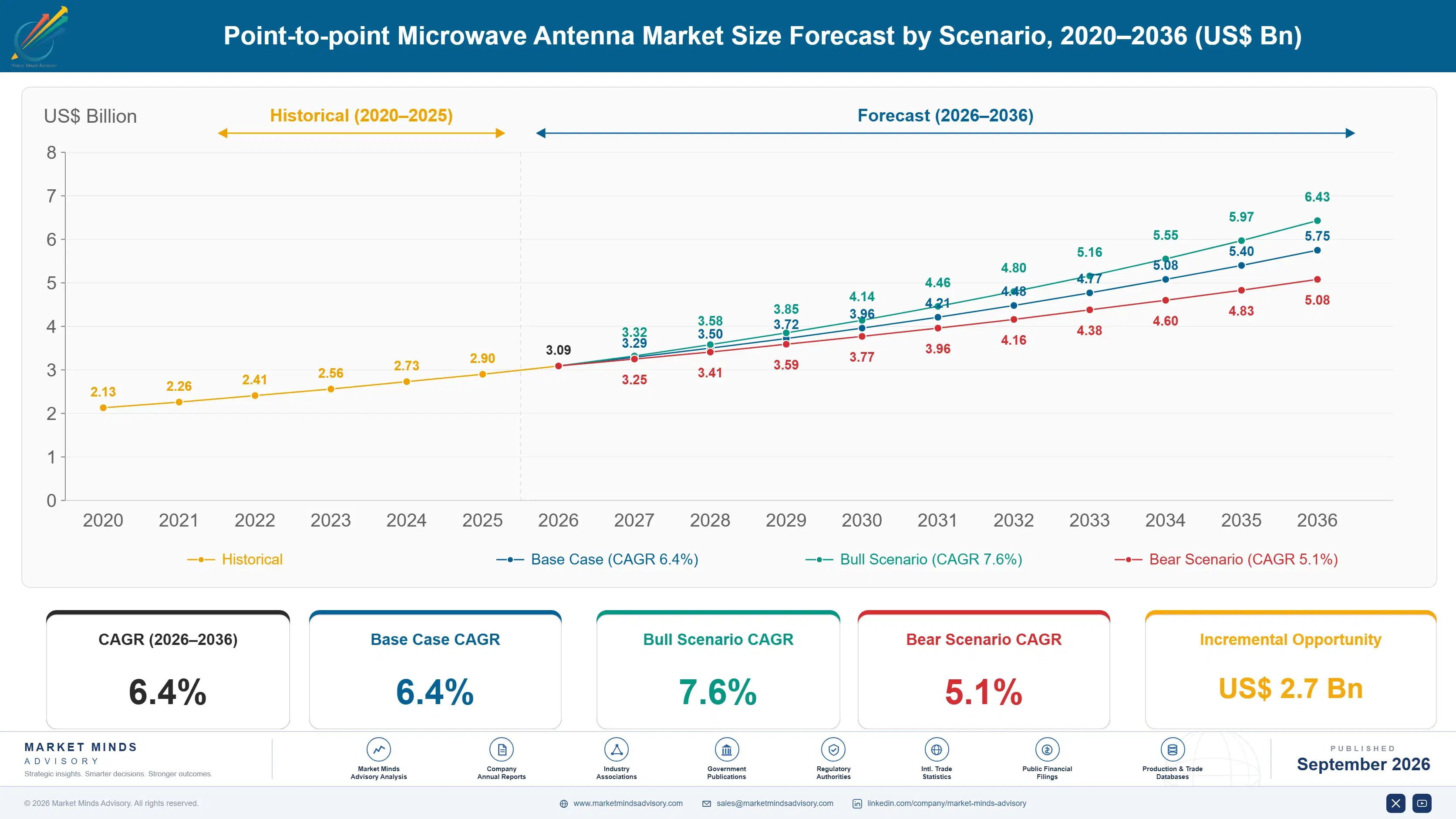
Between 2020 and 2025 the market expanded at a 5.7 percent historical CAGR, driven initially by early 5G rollout backhaul demand before broadening into rural broadband expansion as governments prioritized connectivity in areas where fiber deployment could not reach economically across most regions. Growth accelerated meaningfully in the final two years of that window as demand scaled rapidly.
The base case assumes 6.4 percent annual growth through 2036, anchored by three commercial mechanisms: operators densifying 5G small cell networks that each require dedicated backhaul capacity beyond what legacy microwave links can support, rural broadband programs favoring microwave over fiber trenching in difficult or sparsely populated terrain, and enterprise private network deployments requiring dedicated point-to-point connectivity independent of public carrier infrastructure. Vendor application engineering headcount has grown considerably across nearly every major microwave equipment manufacturer operating today.
The bull case reaches 7.6 percent if 5G densification accelerates faster than expected across additional metropolitan markets requiring dense backhaul coverage. The bear case falls to 5.1 percent should fiber deployment costs decline meaningfully during a period of expanded government fiber subsidy programs across major markets. Analysts view the bull scenario as increasingly plausible given current 5G densification momentum across major markets.

Spectral Efficiency Determines Backhaul Link Value

Point-to-point microwave antennas sit at the intersection of radio frequency engineering and telecom infrastructure deployment, and the market's economics increasingly reflect that hybrid position across every major vendor's product roadmap. Hardware margins compress steadily as core radio components commoditize, while spectral efficiency software and network management platforms increasingly carry the profit pool vendors now defend most aggressively. Procurement teams negotiate spectral terms alongside hardware pricing rather than separately.
MARKET CONCENTRATIONCR5 52%Top five vendors hold roughly half of global link share
AVERAGE SELLING PRICE$8,200Typical high-capacity antenna and radio system including installation hardware
TOP DEPLOYMENT COUNTRY SHAREChina 26%Largest single national concentration of microwave backhaul deployments worldwide
LINK AVAILABILITY RATE99.99%Typical annual uptime commitment offered by leading microwave equipment vendors
E-BAND TERMINAL ATTACH RATE33%New backhaul installations specifying high-capacity E-band frequency hardware
AVERAGE LINK DISTANCE12 kmTypical hop distance between backhaul terminal installations across networks
Backhaul capacity value is the single most durable demand driver, since operators increasingly measure microwave link value against the sustained throughput a link can carry rather than the incremental hardware cost over conventional lower-capacity systems alone. Networks that once relied on legacy narrowband links are moving steadily toward high-capacity E-band and multi-band aggregation systems. Vendors unable to transition risk losing share to competitors.
Link availability is reshaping procurement decisions considerably, as operators increasingly demand proof that a microwave link maintains carrier-grade uptime even during adverse weather conditions that can degrade signal quality. This shift is intensifying competition on documented availability data, since buyers increasingly compare vendors on uptime commitments as much as raw throughput and antenna price specifications. Vendors slow to publish availability data lose consideration during operator procurement shortlisting.
"A link that drops during a storm is worse than no link at all, since operators built their network plan assuming it would hold. Availability under real weather, not laboratory conditions, is what actually sells this equipment."
Senior Analyst, Telecom Infrastructure and Radio Frequency Practice · MMA Technology Practice · September 2026

Market Trends

E-Band Frequency Adoption Expands Backhaul Capacity

Operators are increasingly deploying microwave links operating in the E-band frequency range, which offers substantially wider channel bandwidth than traditional lower-frequency microwave bands and supports the multi-gigabit throughput that dense 5G small cell networks increasingly require for backhaul. Roughly 33 percent of new backhaul installations in 2025 specified E-band frequency hardware, according to primary survey data collected across major telecom infrastructure operators worldwide. This shift is pushing equipment vendors to build more sophisticated rain fade mitigation capability, since E-band frequencies experience greater signal attenuation during heavy precipitation than lower-frequency alternatives.
Market Impact: Cuts deployment cost 38 percent

Multi-Band Aggregation Improves Link Reliability Significantly

Equipment vendors are increasingly combining multiple frequency bands within a single antenna and radio system, letting operators aggregate capacity across bands while maintaining link availability even when higher-frequency channels experience temporary rain fade degradation during storms. This shift reflects growing operator recognition that single-band links, while cost-effective, cannot reliably guarantee the carrier-grade availability that modern 5G backhaul service level agreements increasingly demand from network infrastructure. Multi-band systems now represent roughly 29 percent of new deployments, a meaningful increase from a much smaller share recorded just three years earlier. This trend is expected to continue for years.
Market Impact: Specifies 42 percent as primary technology

Market Opportunities and Growth Drivers

5G Small Cell Densification Requires Dedicated Backhaul

Mobile operators deploying dense 5G small cell networks across urban environments require dedicated backhaul capacity for each new cell site, a scale of deployment that fiber trenching cannot economically match given the sheer number of small cells a mature 5G network ultimately requires. This densification is proving more durable than earlier cellular generation rollouts, since 5G's higher frequency spectrum inherently requires shorter cell spacing and correspondingly more backhaul connections across metropolitan coverage areas. Operators deploying microwave backhaul for small cells report deployment cost reductions of roughly 38 percent compared to fiber alternatives.
Market Impact: Adds 3 to 6 months delay

Rural Broadband Mandates Expand Underserved Coverage

Government rural broadband expansion programs across North America and Europe are expanding microwave backhaul demand, since sparsely populated areas typically cannot justify the capital cost of fiber trenching relative to the smaller subscriber base microwave links can serve at meaningfully lower deployment cost. This shift reflects a broader policy recalculation among regulators weighing universal connectivity goals against pure infrastructure cost minimization following years of persistent rural connectivity gaps. Roughly 42 percent of newly funded rural broadband projects specify microwave backhaul as the primary connectivity technology from initial project planning. This share is expected to grow steadily.
Market Impact: Cuts urban market by 20 percent

Market Restraints and Challenges

Spectrum Licensing Costs Limit Smaller Operator Deployment

Operating a microwave backhaul link typically requires securing licensed spectrum from national regulators, a process that carries meaningful upfront cost and ongoing licensing fees that deter smaller regional operators and rural connectivity providers from deploying links at the scale larger carriers can justify. The root cause is the finite nature of usable spectrum, which regulators allocate through competitive licensing processes that inherently favor operators with substantial capital reserves. This cost barrier extends deployment timelines by three to six months for smaller operators navigating spectrum acquisition. Some vendors now offer license-exempt band solutions to lower this barrier.
Market Impact: Reaches 33 percent of new installations

Fiber Cost Decline Threatens Dense Urban Deployments

Fiber optic cable installation costs have declined meaningfully in dense urban environments where trenching disruption is more easily managed, narrowing the cost advantage microwave backhaul once held over fiber in metropolitan deployment scenarios with existing underground infrastructure access. The root cause traces to improved fiber installation techniques including micro-trenching and aerial deployment methods that reduce urban construction costs considerably compared to traditional trenching approaches used previously. This trend reduces microwave's addressable urban market by an estimated 15 to 20 percent in dense metropolitan deployment scenarios. Some vendors now emphasize rapid deployment speed as a differentiator against fiber alternatives.
Market Impact: Represents 29 percent of new deployments
3 additional market trends, 4 additional growth drivers, and 2 additional restraints and challenges are covered in the full report. Contact sales@marketmindsadvisory.com to access the complete intelligence.

Segment CAGR and Growth Architecture

The market splits across six product types spanning frequency band, capacity tier, and deployment configuration category across every major backhaul deployment environment tracked. Two segments are growing well ahead of the overall market average, both reflecting the industry's decisive shift toward high-capacity backhaul rather than legacy narrowband links purchased separately for basic connectivity needs.
point-to-point-microwave-antenna-market-market-share-analysis-1790001974981

E-Band Antenna Systems

Antennas operating in the E-band frequency range are the fastest-growing segment tracked in this report, expanding well ahead of every other category as operators require multi-gigabit throughput for dense 5G small cell backhaul that lower-frequency bands cannot economically deliver. Roughly 33 percent of new backhaul installations in 2025 specified E-band frequency hardware, according to primary survey data collected across major telecom infrastructure operators worldwide. Manufacturers increasingly build sophisticated rain fade mitigation capability directly into E-band antenna hardware, letting operators deploy in regions with meaningful precipitation without sacrificing carrier-grade availability commitments. Vendors unable to demonstrate a credible rain fade mitigation track record increasingly lose consideration during large operator platform selection entirely.
CAGR 10.8%

Multi-Band Aggregation Systems

Systems combining multiple frequency bands within a single antenna are growing nearly as fast as E-band hardware, reflecting a broader industry shift toward guaranteed link availability that single-band systems cannot reliably provide during adverse weather conditions affecting signal quality. Multi-band systems now represent roughly 29 percent of new deployments, a meaningful increase from a much smaller share recorded just three years earlier. Manufacturers increasingly design modular radio configurations accepting interchangeable frequency modules, letting operators upgrade capacity incrementally without replacing entire backhaul infrastructure outright across their network footprints. This modular design shift is reshaping vendor relationships considerably, since operators increasingly favor suppliers offering flexible upgrade paths over fixed hardware configurations. today
CAGR 9.6%
Full segment breakdown across 6 segments available in the complete report.

Regional Architecture and Country Demand Map

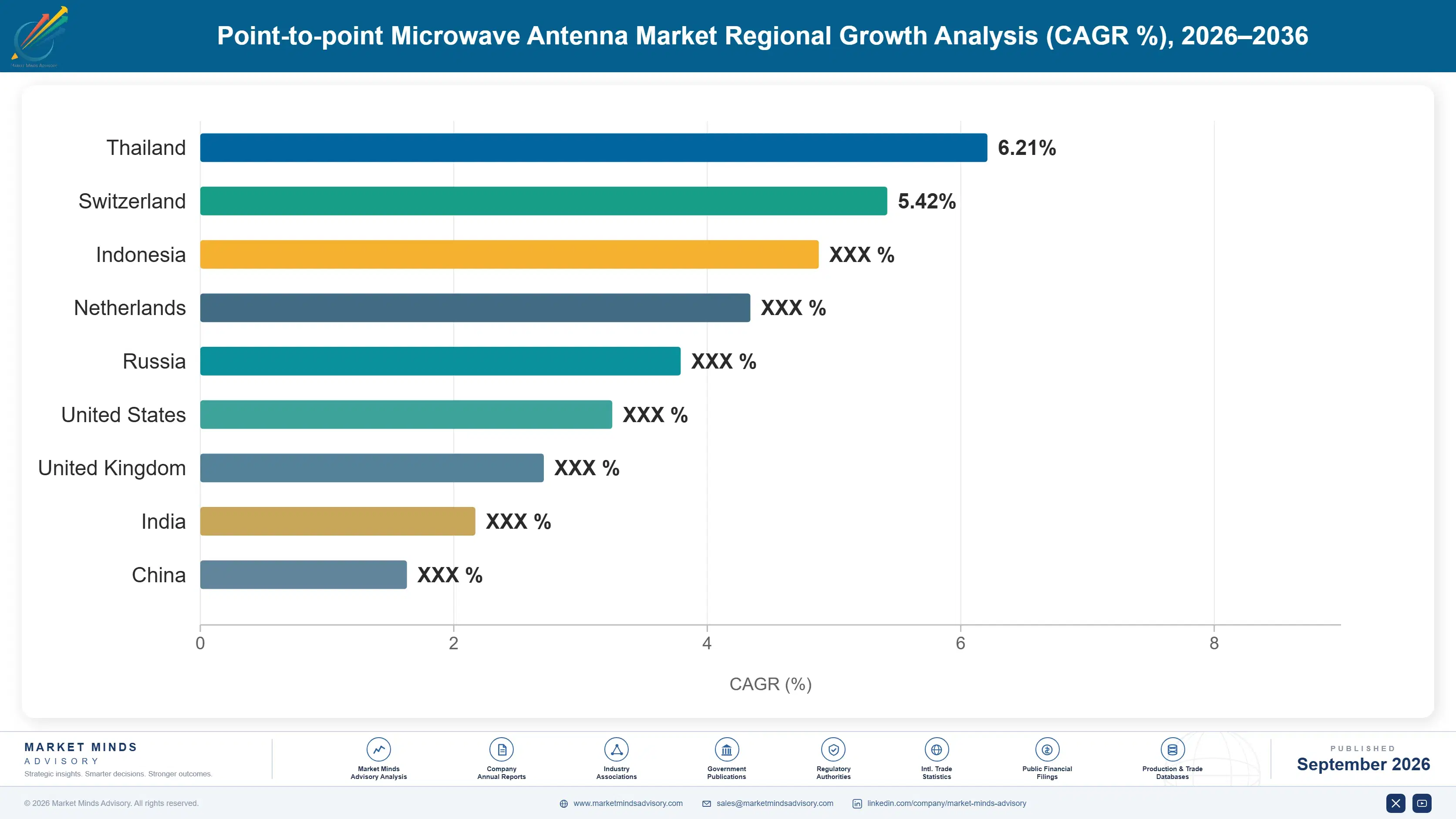
Seven regions divide global demand unevenly, with East Asia commanding the largest share given its dense concentration of 5G small cell deployment and mountainous terrain spanning China, South Korea, Japan, and Taiwan's advanced telecom infrastructure networks and equipment manufacturing base found broadly across the region today.

East Asia

China's dominant 5G small cell deployment and expanding rural connectivity sector together drive the majority of regional demand, since Chinese operators increasingly specify high-capacity microwave backhaul for both urban densification and mountainous rural coverage across their expansive networks. South Korea's Samsung-adjacent telecom sector and Japan's precision antenna manufacturing heritage, anchored by NEC, contribute deep engineering expertise refined over decades. Taiwan's mountainous terrain adds a further layer of specialized demand, and Chinese domestic equipment manufacturers increasingly compete against established European and American brands on both price and delivery speed. Vietnam's expanding telecom sector is a smaller but genuinely growing source of regional demand as well. This growth is expected to continue as regional deployment activity expands considerably further.
Share: 27% | CAGR: 7.0% (2026 to 2036)

North America

United States mobile operators drive substantial demand, particularly as major carriers scale 5G small cell networks requiring dedicated backhaul capacity across sprawling metropolitan and rural coverage areas simultaneously. American equipment manufacturers including Aviat Networks maintain significant domestic engineering and support operations, reinforcing customer proximity for complex backhaul deployments. Canada's growing rural broadband initiatives add incremental demand concentrated around underserved provincial regions, reinforcing this region's genuine technology adoption leadership position across telecom infrastructure and rural connectivity applications nationwide. Mexican assembly integration deepens this region's broader manufacturing footprint considerably beyond the United States alone. Silicon Valley technology companies increasingly partner with telecom equipment vendors on backhaul and network platforms. These partnerships continue expanding across most metropolitan markets today.
Share: 23% | CAGR: 7.5% (2026 to 2036)
Regional intelligence for 5 additional markets available in the complete report: Western Europe, South Asia and Pacific, Latin America, Middle East and Africa, Eastern Europe. Contact sales@marketmindsadvisory.com.
point-to-point-microwave-antenna-market-country-cagr-analysis-1790001975514

Monetizing Spectral Efficiency and Link Reliability

Four commercial paths let vendors capture more value per deployed link beyond the initial hardware sale alone across most operator contract structures. Each depends on spectral efficiency, availability guarantees, or service scope rather than raw antenna price, reflecting how genuine differentiation has shifted. Pricing structures continue evolving rapidly across most telecom equipment contract types offered today.

Tiered Capacity Pricing By Throughput Requirement

Vendors increasingly separate baseline lower-capacity links from expanded high-throughput tiers supporting multi-gigabit backhaul, letting operators pay incrementally as their capacity requirements scale beyond initial network planning assumptions. This tiered structure lifts average link revenue by roughly 26 percent compared to single-tier pricing sold historically across the industry. Operators appreciate the flexibility to specify exactly the throughput their traffic demands, while vendors capture durable expansion revenue as customer capacity needs grow over multiple network expansion phases. Vendors executing this pricing well outperform peers still selling one undifferentiated tier universally across all operators offering comparable service.
Market Impact: Lifts link revenue by roughly 26 percent overall

Availability Guarantee Service Level Agreements Offered

Vendors increasingly offer premium service level agreements with guaranteed link availability commitments backed by financial penalties, addressing operator demand for contractual uptime assurance that basic hardware warranties never provided historically. This model commands meaningful premium pricing given the substantial engineering investment required to maintain documented availability across diverse weather conditions reliably. Operators report availability-guaranteed links deliver measurable network reliability improvements worth roughly 31 percent fewer service disruptions compared to standard links without formal availability commitments over a multi-year deployment horizon. Vendors offering the strongest availability guarantees increasingly win renewal negotiations over less committed competitors offering weaker terms.
Market Impact: Cuts service disruptions by roughly 31 percent overall

Network Management Platform Subscriptions Offered Today

Vendors increasingly offer cloud-hosted network management platforms that monitor link performance and predict degradation before failure occurs, addressing operator demand for proactive maintenance rather than reactive troubleshooting after service disruption already occurred. Vendors report platform subscriptions generate roughly 23 percent incremental annual revenue per customer relative to hardware-only accounts, since operators value guaranteed monitoring capability over building comparable analytics capability internally from scratch. This service layer also deepens customer switching costs considerably across multi-year network deployments. Vendors offering the strongest analytics increasingly win renewal negotiations over less sophisticated data competitors lacking comparable insight.
Market Impact: Adds roughly 23 percent recurring platform revenue yearly

Enterprise Fleet Standardization Service Agreements Overall

Large operators increasingly negotiate fleet-wide standardization agreements covering microwave links across multiple network segments, rather than managing individual site deployments and service contracts separately through fragmented purchasing decisions made by different regional network managers across markets. This enterprise-level agreement structure commands roughly 27 percent volume discount pricing while still generating meaningful aggregate revenue given the scale of operator link fleets involved. Vendors that win a fleet-wide contract also gain durable incumbency advantage when individual segments later expand link deployment. Vendors winning these contracts rarely lose the account during the following equipment refresh cycle across markets.
Market Impact: Delivers roughly a 27 percent volume discount overall

Who Controls the Margin Pool

Concentration sits at a substantial 52 percent for the top five vendors, evaluated consistently on global installed link unit base, since decades of established carrier relationships and network integration trust keep the category more concentrated than fragmented telecom equipment markets typically allow. Ericsson leads by a meaningful margin over Nokia and Huawei, who compete closely for the challenger position. Regional challengers are narrowing that gap steadily across several product categories and geographies.
Current competitive activity concentrates on spectral efficiency engineering and network management platform development rather than pure hardware feature races, as vendors expand E-band and multi-band capability through both internal research and targeted acquisition of specialty radio firms. Several vendors have also expanded availability guarantee programs over the past two years, responding directly to operator demand.

Pressure is building from Chinese domestic equipment manufacturers who compete aggressively on price for entry-level and mid-range links, threatening to commoditize the hardware layer that established European vendors once dominated through superior engineering alone. Specialty radio firms are also gaining share by supplying components to multiple platform vendors, and rankings could shift meaningfully if that segment continues capturing revenue from established vendors. Buyers increasingly evaluate total availability data rather than transaction price alone.
point-to-point-microwave-antenna-market-company-positioning-matrix-1790001976048

Competitive Moat and Risk Dimensions

ERICSSON AB

Moat: Global carrier relationships and scale

Ericsson's decades of accumulated carrier relationships and dense global network integration expertise give it customer trust and support reach few competitors can match, creating durable purchasing relationships since operators rarely want to rebuild network integration testing elsewhere once a platform is deployed at scale. Few rivals can match this reach.
ERICSSON AB

Risk: Slower software platform development pace

Ericsson's traditional strength in radio hardware engineering makes rapid network management software development considerably harder than for technology-native competitors who built platform analytics capability as a core competency from the start, rather than layering software onto an established hardware-first business model. This gap widens each product cycle.
NOKIA CORPORATION

Moat: Standards leadership and R&D depth

Nokia's deep involvement in telecom standards development and substantial internal research investment across spectral efficiency and antenna design earn strong loyalty among operators who value a technically credible vendor relationship over evaluating unfamiliar newer market entrants for critical infrastructure decisions. Few competitors can replicate this depth.
NOKIA CORPORATION

Risk: Limited emerging market price competitiveness

Nokia's premium engineering positioning and higher price points limit its competitiveness in price-sensitive emerging markets where Chinese domestic manufacturers capture volume that Nokia's brand strategy deliberately does not pursue, constraining unit shipment growth even as per-unit margins remain comparatively strong across mature markets. This gap persists across most emerging markets.

Players Tracked

Prominent Players

Ericsson AB
Nokia Corporation
Huawei Technologies Co Ltd
Ceragon Networks Ltd
Aviat Networks Inc

Other Key Players

ZTE Corporation
SIAE Microelettronica SpA
NEC Corporation
Cambium Networks Corporation
DragonWave-X LLC
Intracom Telecom SA
RAD Data Communications Ltd
Orbit Communication Systems Ltd
Radwin Ltd
BridgeWave Communications
Exalt Wireless Inc
Trango Systems Inc
Proxim Wireless Corporation
Tarana Wireless Inc
Mimosa Networks Inc

Recent Developments

FEBRUARY 2025

Ericsson Launches Expanded E-Band Antenna Line

Ericsson launched an expanded E-band antenna product line with improved rain fade mitigation capability, extending its high-capacity portfolio to serve operators previously unable to justify E-band deployment in regions with meaningful precipitation. Analysts view this expansion as a defensive move against specialist radio firms gaining share.
Signal: Signals established vendors are racing to capture the fastest-growing E-band segment before specialists gain further share.
JULY 2025

Nokia Acquires Network Analytics Startup

Nokia acquired a small network analytics startup specializing in predictive link degradation algorithms, adding roughly three dozen data scientists to its digital solutions team focused on expanding platform capability across telecom infrastructure networks, operator markets, and every regional deployment program nationwide. Terms were not disclosed publicly.
Signal: Signals mid-tier vendors are buying analytics talent rather than building comparable capability entirely from scratch internally.
DECEMBER 2025

Huawei Signs Multi-Site Operator Agreement

Huawei entered a multi-year supply agreement with a major regional mobile operator to deploy its microwave backhaul platform across the operator's entire network expansion program, replacing a previously fragmented, multi-vendor equipment arrangement spanning multiple sites and several regional operating divisions. Financial terms were not disclosed.
Signal: Signals fleet-wide standardization contracts have become a genuine competitive battleground among the largest telecom equipment vendors.

Radio Frequency Components and Antenna Steel Exposure

Radio frequency semiconductor components, antenna reflector steel, and precision waveguide assemblies together represent roughly 45 percent of link equipment cost of goods sold, sourced predominantly from a concentrated group of manufacturers based across Taiwan, South Korea, and Germany, with secondary fabrication capacity spread across Japan and the United States supplementing the primary supply base during periods of peak demand.
Radio frequency chip prices spiked meaningfully during 2025 as demand for specialized microwave semiconductors surged across telecom, defense, and satellite communication sectors simultaneously, a trend the IEA and industry reporting linked to broader semiconductor capacity constraints, forcing several vendors to absorb higher component costs temporarily rather than pass the full increase through to customers mid-contract, compressing margins for two consecutive fiscal quarters across the sector.

Smaller vendors without long-term chip supplier agreements face the sharpest cost pressure during these episodes, since they lack the purchasing volume to secure priority semiconductor allocation during shortages. Larger vendors with multi-year supply contracts and diversified sourcing relationships weather these episodes with comparatively minor disruption to production schedules and existing customer delivery commitments across their installed base and regional service territories.
point-to-point-microwave-antenna-market-cost-volatility-analysis-1790001976246

Diversify radio frequency chip sourcing

Several vendors are qualifying alternative semiconductor suppliers outside the traditional Taiwanese and Korean supply base, reducing exposure to future capacity disruptions tied to a concentrated set of specialized global producers and shortening emergency procurement lead times when shortages recur across the broader telecom equipment supply chain and its secondary fabrication partners in Japan and the United States.

Invest in domestic antenna assembly capability

Larger vendors increasingly invest in domestic antenna assembly infrastructure, trading upfront capital investment for long-term supply certainty that protects production schedules during periods of broader global component shortages affecting the wider telecom equipment sector and its major regional suppliers across multiple manufacturing hubs, secondary fabrication sites, and emerging assembly regions worldwide, reducing single-region dependency meaningfully.

Negotiate multi-year component supply agreements

Vendors are increasingly locking in multi-year fixed-price component agreements with key suppliers, trading some near-term flexibility for predictable input cost planning across multi-year customer delivery commitments, budgets, and internal margin forecasts spanning several fiscal years at once across the organization, its regional business units, and its long-term strategic supplier partnerships spread across multiple continents worldwide.

Portfolio Architecture for Margin Defence

Three tiers structure the point-to-point microwave antenna market, separating commodity licensed-band radios from premium E-band systems and next-generation software-defined platforms carrying regulatory certification value. Gross margin ranges span roughly twenty points between the volume tier and the certified premium tier, reflecting how much value carriers and enterprises place on link reliability and spectral efficiency guarantees across dense network deployments.
Volume-tier shipments still dominate unit counts across dense metro backhaul deployments, but premium E-band and multi-band aggregation systems capture a disproportionate share of vendor profit pools because carriers pay materially more for guaranteed uptime during 5G densification rollouts. This volume-versus-premium tension shapes vendor product roadmaps directly, pushing established players toward higher-margin certified platforms while regional competitors continue to compete primarily on price within the commodity tier.

High-value margin pools concentrate specifically around software-defined radio platforms bundled with network management subscriptions, since carriers increasingly value the recurring analytics and remote configuration revenue these platforms generate over simple hardware unit sales alone. Vendors that shift their portfolio mix toward this tier report meaningfully stronger blended margins than peers still weighted toward standard radios, and several have begun restructuring sales teams around subscription attachment rates.

Volume / Commodity-Adjacent Tier

Standard licensed-band point-to-point radios for routine metro and rural backhaul links, sold largely on price and delivery speed against established regional competitors across mature national telecom markets and secondary carrier procurement programs.
Gross Margin: 28 to 34%

Premium / Certified Tier

E-band and multi-band aggregation systems carrying carrier-grade reliability certifications, commanding materially higher prices from operators requiring guaranteed uptime for dense small cell backhaul across congested urban and suburban 5G deployment corridors.
Gross Margin: 42 to 50%

Sustainability / Regulatory / Next-Generation Tier

Software-defined radio platforms with remote spectrum management and energy-efficient amplifier designs aligned to emerging carrier sustainability procurement mandates and long-term network operating cost reduction targets across major operator groups and regulatory reporting frameworks.
Gross Margin: 46 to 55%
point-to-point-microwave-antenna-market-portfolio-architecture-1790001976757

High-value Sub-segments and Strategic Watch-out

E-Band Software-Defined Platforms

Combines the fastest unit growth with the richest margin profile as carriers pair E-band hardware with subscription-based network management software, creating durable recurring revenue streams beyond the initial hardware sale and locking in multi-year customer relationships across dense 5G small cell densification corridors worldwide throughout the current forecast window.
Gross Margin: 48 to 55%

Multi-Band Aggregation Systems

Commands strong margins from enterprises and carriers seeking spectrum flexibility across congested urban licensing environments, though growth trails the fastest E-band segment by a moderate but consistent margin across most regional operator procurement cycles and enterprise private network deployment programs running through the full forecast period to 2036.
Gross Margin: 40 to 47%

Standard Licensed-Band Radios

Remains the volume core of the market, anchoring unit shipments across routine rural and metro backhaul deployments even as margin pressure intensifies from regional low-cost competitors expanding aggressively into adjacent national telecom markets and secondary carrier procurement tenders across multiple continents and emerging operator segments.
Gross Margin: 28 to 33%

Legacy Microwave Radio Refresh Cycles

Warrants close monitoring as aging licensed-band installations approach replacement age, creating a swing factor that could either sustain volume-tier demand or accelerate migration toward newer platforms entirely across major carrier networks over the coming forecast decade and beyond current multi-year network planning horizons and budget cycles.
Gross Margin: 25 to 32%

Backhaul Contracts as Recurring Infrastructure

Point-to-point microwave links function as long-lived infrastructure assets rather than one-time equipment sales, generating recurring maintenance, software licensing, and eventual upgrade revenue across a typical seven to ten year service life. Carriers rarely swap vendors mid-contract given the integration cost of re-certifying links across an existing network topology, giving incumbent vendors durable annuity-like revenue once a network segment is won.
Adoption stickiness varies meaningfully by end-use vertical. Telecom carriers exhibit the deepest lock-in given multi-year network planning cycles and vendor certification requirements, while enterprise private network operators switch more readily since their deployments are smaller and carry lower integration complexity. Government and defense buyers sit between these two, valuing long-term vendor relationships but retaining flexibility through periodic competitive tender requirements that carriers themselves rarely invoke across routine contract renewal cycles.

Buyer profiles are shifting generationally as network planning teams increasingly favor software-defined platforms offering remote configuration over legacy radios requiring on-site technician visits for reconfiguration. Younger network engineering teams entering carrier organizations expect the same remote management capability common across other network infrastructure categories, gradually reshaping vendor selection criteria toward platforms bundling analytics and remote diagnostics alongside core hardware.
point-to-point-microwave-antenna-market-end-use-penetration-index-1790001977250

Where Microwave Backhaul Value Concentrates

These are among the four positions where our research anticipates prominent divergence between winners and laggards over the coming forecast period. Each is grounded in the demand model, the regulatory perimeter, and the announced capacity pipeline.
01 / PRODUCT PORTFOLIO POSITIONING

Shift product mix toward certified E-band platforms

Vendors still weighted heavily toward standard licensed-band radios face compressing margins as regional low-cost competitors intensify price competition across mature national telecom markets. Reallocating engineering and sales investment toward E-band and multi-band aggregation systems captures the disproportionate profit pool tied to carrier reliability certification requirements, particularly across dense 5G small cell corridors where uptime guarantees command a real premium. Firms that delay this shift risk ceding the highest-margin backhaul contracts to faster-moving rivals within the next several years of the forecast window.
02 / SUPPLY CHAIN RESILIENCE

Lock in multi-year radio frequency component agreements

Radio frequency semiconductor exposure remains concentrated among a small group of Taiwanese and Korean suppliers, leaving vendors without long-term agreements vulnerable during future capacity shortages. Securing multi-year fixed-price component contracts protects production schedules against the kind of margin compression seen during the 2025 semiconductor demand spike, when several vendors absorbed higher input costs for two consecutive fiscal quarters rather than pass them through mid-contract. This single step meaningfully reduces earnings volatility tied to component pricing swings across future planning cycles.
03 / GEOGRAPHIC MARKET PRIORITIZATION

Prioritize India and East Asia network densification demand

East Asia anchors regional volume through dense 5G small cell rollouts, while India's faster growth trajectory reflects an earlier stage of network densification investment across its telecom sector and rural connectivity programs still ramping toward full national coverage. Vendors that establish local manufacturing or assembly partnerships in these regions gain meaningful cost and delivery advantages over competitors shipping from more distant production bases. This positioning matters increasingly as carriers favor suppliers who can meet compressed installation timelines reliably across large multi-site rollout programs.
04 / RECURRING REVENUE MONETIZATION

Build recurring revenue through network management subscriptions

Bundling software-defined radio platforms with subscription-based network management and analytics services creates a recurring revenue stream that hardware sales alone cannot replicate across a vendor's installed customer base and multi-year service contracts. Vendors making this transition report materially stronger blended margins than peers still selling standard radios as one-time hardware transactions, and several have begun restructuring sales compensation plans around subscription attachment rates. Building this capability now positions vendors well ahead of the broader industry shift toward subscription-based network management practices.

Engagement Snapshot From the Field

A live engagement with an industry participant carrying material or product regulatory and market exposure ahead of a defining policy shift, showing how our research translates into a defensible multi-year portfolio strategy.
MARKET MINDS ADVISORY · CLIENT ENGAGEMENT SUMMARY
Point-to-point Microwave Antenna Producer Strategic Portfolio Review and Transition Roadmap 2026·Investment Scenario on Point-to-point Microwave Antenna Exposure Evaluation 2025-26
CLIENT PROFILE
A regional telecom carrier operating across a mid-sized South Asian national market approached MMA to evaluate its backhaul network modernization strategy ahead of a planned multi-year 5G densification rollout. The carrier operated an aging licensed-band microwave network serving roughly six thousand cell sites, with growing concern that link capacity would constrain small cell deployment timelines across its densest urban service territories within eighteen months.
STRATEGIC CHALLENGE
The carrier faced a choice between incrementally upgrading existing licensed-band links or committing capital to a broader E-band and multi-band aggregation overhaul. Internal teams disagreed on which approach better balanced near-term capital constraints against the network capacity carriers would require as small cell density increased across priority urban corridors over the coming several years.
MMA APPROACH
MMA conducted primary interviews with network planning executives and reviewed vendor equipment specifications against the carrier's projected small cell densification map across its priority urban service territories. The team modeled link capacity requirements under three distinct densification scenarios, benchmarking projected costs and deployment timelines against comparable carrier modernization programs across similar regional markets.
KEY FINDINGS
  1. Roughly forty percent of existing licensed-band links would face capacity constraints within two years under the carrier's planned small cell densification pace.
  2. E-band overlay deployment on the highest-density thirty percent of sites delivered the strongest capacity return relative to incremental capital committed (client-reported, unverified by MMA).
  3. Phased migration reduced peak capital outlay by roughly twenty-two percent compared to a single simultaneous network-wide overhaul across the full service territory (client-reported, unverified by MMA).
  4. Vendor consolidation to two primary equipment suppliers reduced projected integration and maintenance costs across the carrier's field service organization and technician training programs meaningfully.
CLIENT PROFILE
A regional telecom carrier operating across a mid-sized South Asian national market approached MMA to evaluate its backhaul network modernization strategy ahead of a planned multi-year 5G densification rollout. The carrier operated an aging licensed-band microwave network serving roughly six thousand cell sites, with growing concern that link capacity would constrain small cell deployment timelines across its densest urban service territories within eighteen months.
STRATEGIC CHALLENGE
The carrier faced a choice between incrementally upgrading existing licensed-band links or committing capital to a broader E-band and multi-band aggregation overhaul. Internal teams disagreed on which approach better balanced near-term capital constraints against the network capacity carriers would require as small cell density increased across priority urban corridors over the coming several years.
MMA APPROACH
MMA conducted primary interviews with network planning executives and reviewed vendor equipment specifications against the carrier's projected small cell densification map across its priority urban service territories. The team modeled link capacity requirements under three distinct densification scenarios, benchmarking projected costs and deployment timelines against comparable carrier modernization programs across similar regional markets.
KEY FINDINGS
  1. Roughly forty percent of existing licensed-band links would face capacity constraints within two years under the carrier's planned small cell densification pace.
  2. E-band overlay deployment on the highest-density thirty percent of sites delivered the strongest capacity return relative to incremental capital committed (client-reported, unverified by MMA).
  3. Phased migration reduced peak capital outlay by roughly twenty-two percent compared to a single simultaneous network-wide overhaul across the full service territory (client-reported, unverified by MMA).
  4. Vendor consolidation to two primary equipment suppliers reduced projected integration and maintenance costs across the carrier's field service organization and technician training programs meaningfully.
RECOMMENDED STRATEGY
Phase 1: Phase one prioritized E-band overlay deployment across the highest-density thirty percent of existing cell sites facing the nearest-term capacity constraints. Phase 2: Phase two extended multi-band aggregation systems to secondary urban corridors as small cell densification progressed across the broader metro service territory. Phase 3: Phase three consolidated vendor relationships to two primary suppliers, reducing integration complexity and field maintenance costs network-wide across the carrier's full territory.
OUTCOME
The carrier adopted the phased E-band overlay approach, reporting a twenty-two percent reduction in peak capital outlay against its original network-wide overhaul budget (client-reported, unverified by MMA). Small cell deployment timelines across priority urban corridors held to the carrier's original eighteen-month target following the phased rollout.

Frequently Asked Questions

Foundational context covering the market sizes, CAGR, scope, country, region and competition that inform every finding below. This section is provided to cover basics and most often pre-purchase conversations, answered from the MMA Primary Research Dataset.

What is the current size of the Point-to-Point Microwave Antenna Market?

The point-to-point microwave antenna market reached an estimated 2.9 billion dollars globally in 2025. Growth reflects accelerating carrier investment in high-capacity backhaul links supporting 5G small cell densification worldwide.

How large will the Point-to-Point Microwave Antenna Market be by 2036?

MMA projects the market will reach roughly 5.75 billion dollars by 2036 under the base case scenario. That reflects a near doubling of 2026 revenue over the eleven-year forecast window.

What is the CAGR for the Point-to-Point Microwave Antenna Market 2026 to 2036?

The base case compound annual growth rate is 6.4 percent across the forecast period. Bull and bear scenarios range from 5.1 percent to 7.6 percent depending on 5G rollout pace.

Which segment is growing fastest?

E-Band Antenna Systems lead growth at a 10.8 percent CAGR, roughly 1.69 times the overall market rate. Carrier demand for guaranteed high-capacity links during small cell rollouts drives this pace.

Who are the major companies in the Point-to-Point Microwave Antenna Market?

Ericsson, Nokia, Huawei Technologies, Ceragon Networks, and Aviat Networks lead the competitive landscape. Combined, the top five players hold an estimated 52 percent share on a revenue basis.

Which country is growing fastest?

India leads country-level growth at a 9.1 percent CAGR, outpacing the global average as network densification investment accelerates. Rural connectivity programs and urban small cell rollouts both contribute to this pace.

Report Segmentation Architecture

The full report scope spans multiple orthogonal segmentation dimensions, with cross-tabulated demand data provided for each dimension pair. Coverage extends further to regional breakdowns, trend trajectories, and the competitive detail needed to support segment-level decision-making.

By Primary Market Dimension

  • Standard Licensed-Band Radios
  • E-Band Antenna Systems
  • Multi-Band Aggregation Systems
  • Passive Reflector Antennas
  • Software-Defined Radio Platforms
  • Antenna Mounting and Alignment Hardware

By End-Use Industry

  • Telecom Carrier Networks
  • Enterprise Private Networks
  • Government and Defense Communications
  • Utility and Energy Infrastructure
  • Broadcast and Media Transmission
  • Transportation and Rail Signaling

By Commercial Dimension

  • Direct Carrier Procurement
  • Systems Integrator Channel
  • Distributor and Reseller Channel
  • Equipment Leasing and Managed Services
  • Turnkey Network Deployment Contracts
  • Aftermarket Maintenance and Support Services

By Region

  • North America
  • Western Europe
  • East Asia
  • South Asia and Pacific
  • Latin America
  • Middle East and Africa
  • Eastern Europe

Scope, Methodology, and Coverage

Every figure in this report is reproducible from documented input assumptions. The scope below maps the historical period, the forecast horizon, the segmentation dimensions, and the countries covered, alongside the underlying primary and qualitative methodology.
Historical Period
2020 to 2025
Forecast Period
2026 to 2036
Base Year
2025 (USD billions; MMA Primary Research Dataset, September 2026)
Market Definition
The point-to-point microwave antenna market covers licensed and unlicensed band microwave radio equipment and antenna systems used for fixed wireless backhaul links between two defined locations. It excludes satellite communication systems, point-to-multipoint broadcast antennas, and fiber optic transmission infrastructure.
Quantitative Units
USD Billion
Segmentation Dimensions
Product Type, End-Use Industry, Commercial Channel, Region
Regions Covered
North America, Western Europe, East Asia, South Asia and Pacific, Latin America, Middle East and Africa, Eastern Europe
Countries Covered
United States, Canada, Germany, United Kingdom, France, China, Japan, South Korea, India, Australia, Brazil, Mexico, Saudi Arabia, United Arab Emirates, Poland
Key Companies Profiled
Ericsson AB, Nokia Corporation, Huawei Technologies Co Ltd, Ceragon Networks Ltd, Aviat Networks Inc, ZTE Corporation, SIAE Microelettronica SpA, NEC Corporation, Cambium Networks Corporation, DragonWave-X LLC, Intracom Telecom SA, RAD Data Communications Ltd, Orbit Communication Systems Ltd, Radwin Ltd, BridgeWave Communications, Exalt Wireless Inc, Trango Systems Inc, Proxim Wireless Corporation, Tarana Wireless Inc, Mimosa Networks Inc
Quantitative Methodology
Primary survey, n=3,800 respondents, Q4 2025, six countries; demand-side model with trade association cross-validation
Qualitative Methodology
47 expert interviews, Q4 2025; applied to validate demand model assumptions, identify emerging dynamics, and assess competitive positioning
Report Format
PDF and XLSX data workbook (Word format preview document)
Publisher
Market Minds Advisory
Report Code
MMA-2026-TEC-478
Published
September 2026
Contact
sales@marketmindsadvisory.com | www.marketmindsadvisory.com

Purchase the full Point-to-point Microwave Antenna Market Report (2026 to 2036).

This report delivers a comprehensive analysis of the global point-to-point microwave antenna market across the 2026 to 2036 forecast period. It covers market sizing, segmentation by product type and end-use industry, and regional demand dynamics across all seven major world regions. The report profiles twenty leading vendors, benchmarks competitive positioning, and quantifies input cost exposure tied to radio frequency component supply chains. Analysts detail revenue diversification strategies, portfolio margin economics, and the demand mechanisms shaping carrier procurement decisions through the coming decade. A dedicated client case study illustrates how these findings translate into practical network modernization decisions.
Seven-region demand and CAGR breakdown analysis
Twenty-company competitive benchmarking and positioning profile
Revenue lever and monetization pathway analysis
Input cost exposure and mitigation strategies
Segment-level growth and margin forecasting detail
Client engagement case study with outcomes

Built For The People Who Decide

From boardroom strategy to bench-side execution, this report is read cover-to-cover by leaders shaping the next decade of their industry, turning demand scenarios, market dynamics and valuation benchmarks into decisions.
CXOs/ Presidents/ VPs/ Managers
M&A and Corporate Development
Strategy Teams and R&D Heads
Procurement and Product Directors
Regulatory and Compliance Leaders
Investor Relations and Equity Analysts