Market Minds Advisory
Point-of-Care Food Sensitivity Testing Market

Point-of-Care Food Sensitivity Testing Market: Molecular Resolution Against a Consumer Channel Nobody Regulates

One part of this market is validated molecular allergology that changes clinical decisions, and another part is a consumer panel that allergy societies explicitly advise against, priced higher than the first.

Lead Analyst

Alice Ballenger

Published

September 2026

Make Smarter Decisions with Customized Research Insights

Request a free sample report and evaluate market opportunities, growth trends, and competitive dynamics relevant to your business needs.

2025 MARKET VALUE$0.7BMarket Size 2025
2036 FORECAST VALUE$1.9BBase Case , 2026 to 2036
CAGR 2026 TO 20369.6 %Bull 10.8% / Bear 8.4%
INCREMENTAL OPPORTUNITY$1.1BNet 10- year value creation
EXPANSION MULTIPLE2.48x2036 value over 2026 base
Strategic Levers
M&A Pipeline
Regional Outlook
Country Rankings
Competitive Intelligence
Segmental Deep-dive
Call-Us : 91 93563 13602

Executive Snapshot and Market Trajectory

Two very different businesses share this market's name. One resolves allergy at the molecular level and genuinely changes whether a child undergoes an oral food challenge. The other sells immunoglobulin G panels that every major allergy society has advised against, direct to consumers, at a higher price.
Growth comes from clinical substitution rather than from rising test volume alone. Component-resolved multiplex panels grow fastest at 14.4%, exactly 1.50 times the market rate, because distinguishing a genuine peanut storage protein sensitisation from a harmless cross-reactive one avoids a hospital challenge that costs several thousand dollars. Near-patient analysers follow at 13.2%. Western Europe holds the largest value pool, ahead of North America, on earlier molecular adoption.
Concentration reaches 54% across the top five measured on installed platform base, and the leaders are established immunoassay houses rather than diagnostic start-ups. Platform lock-in through proprietary reagent cartridges is the commercial architecture here. Regulatory attention on unvalidated consumer panels is building, and it lands on roughly a fifth of current market value. Several smaller developers hold better arrays than the leaders do, and none of them has the placement reach to use that.
Market Definition
This market covers in vitro diagnostic products used to identify food allergy and food sensitivity at or near the point of care, including rapid immunoassay devices, near-patient analysers, multiplex component panels, and skin prick test devices with standardised extracts. Scope spans specialist clinic, primary care, pharmacy, and direct-to-consumer channels. Central laboratory reference testing, coeliac serology, food intolerance breath testing, elimination diet services, and immunotherapy products are excluded.
Base Year Value
$0.7B in 2025 (MMA Primary Research Dataset, August 2026)
Forecast Period
2026 to 2036, eleven discrete annual values
CAGR
9.6% base case. Bull 10.8%. Bear 8.4%.
Fastest Growth Segment
Component-Resolved Multiplex Immunoassay Panels: 14.4% CAGR
Fastest Growth Country
China: 15.4% CAGR
Fastest Growth Region
South Asia and Pacific: 11.7% CAGR
Largest Region
Western Europe: 28% of 2025 global value
Market Leaders
Thermo Fisher Scientific. Siemens Healthineers. Hycor Biomedical. Bio-Rad Laboratories. Macro Array Diagnostics. Source: MMA Analysis based on company annual reports.
Primary Survey
n=3,800 procurement and R&D decision-makers, Q4 2025, six countries
Methodology
Demand-side build-up, cross-validated against public data, 47 expert interviews

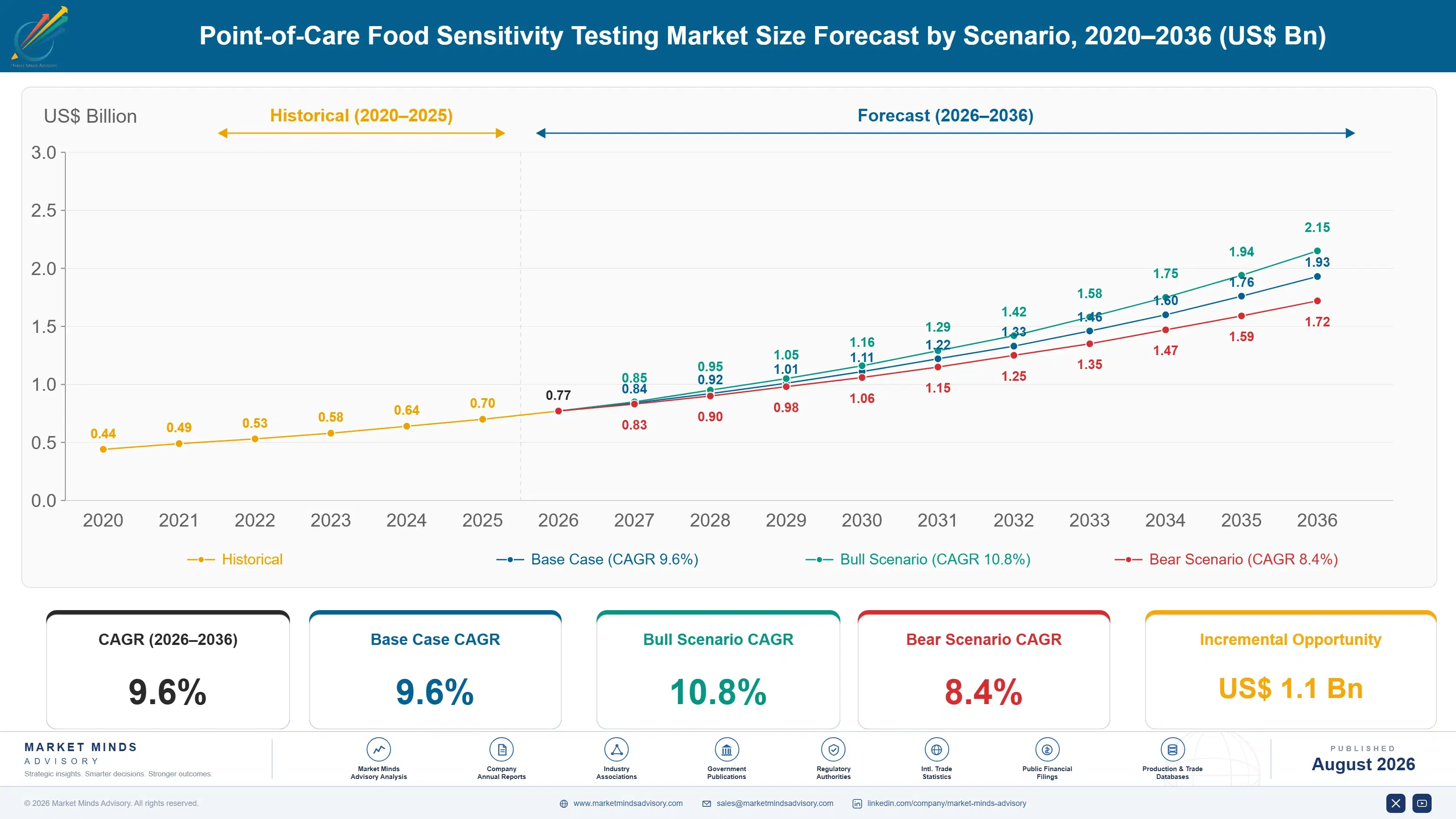
Point-of-Care Food Sensitivity Testing Market Forecast Scenarios

point-of-care-food-sensitivity-testing-market-size-forecast-scenario-1787298979524
The 2020 to 2025 period split cleanly down the middle of this category. Clinical molecular allergology advanced steadily as European guidance bodies incorporated component resolution into diagnostic pathways, while the consumer sensitivity panel business grew faster still on wellness retail and online channels. An 8.3% historical rate averages disciplined clinical adoption against a consumer segment that answered to almost nobody.
Three mechanisms carry the 9.6% base case. Oral food challenge avoidance is the largest, since a component panel that rules out genuine sensitisation removes a supervised hospital procedure with real cost and real risk. Paediatric allergy prevalence growth across urbanising Asia is the second. And near-patient analyser placement in specialist clinics is the third, converting a send-out laboratory test into a same-visit result and a reagent annuity. None of the three depends on allergy prevalence rising further.
The 10.8% bull case rests on component-resolved panels entering primary care rather than staying inside specialist allergy practice, which would multiply the addressable testing population several times over. The 8.4% bear case is regulatory action against unvalidated consumer immunoglobulin G panels in two or more major markets, removing close to a fifth of current value with no clinical replacement.

Molecular Resolution Meets an Unregulated Consumer Shelf

The clinical case here is unusually clean for a diagnostic. A child with a positive whole-peanut immunoglobulin E result may be genuinely allergic or may simply cross-react with birch pollen, and the two lead to completely different lives. Component resolution separates them. Avoiding one supervised oral food challenge saves several thousand dollars and a day of hospital risk, which is an easy argument to make to any payer who will listen.
TOP FIVE CONCENTRATION54%Concentrated among established immunoassay platform suppliers rather than newcomers
COMPONENT PANEL ADOPTION41%Specialist allergy workups now using molecular resolution methods
AVERAGE PANEL PRICEUSD 118Per patient across reimbursed specialist and consumer channels
SKIN PRICK DISPLACEMENT23%Workups where blood testing has replaced the older method
RESULT TURNAROUND TIME22 minutesMedian for near-patient platforms in specialist clinic settings
CONSUMER CHANNEL SHARE19%Value sold outside any clinical referral or reimbursement pathway
The consumer side operates on entirely different logic. Immunoglobulin G food sensitivity panels sell well because people with genuine digestive symptoms want an answer, and every major allergy society, including the European and American academies, has stated that these panels do not diagnose food intolerance. They still account for roughly 19% of market value. That contradiction is the single most important commercial fact in this category. No supplier we interviewed disputes the underlying science.
Two forces shape the next decade. Near-patient analyser placement converts send-out testing into same-visit results and locks in a reagent annuity. And regulatory attention on unvalidated consumer panels is building, unevenly, in a way that could remove a fifth of the market. Neither force shows up in reported category growth yet, and both will.
"We keep being asked to size the food sensitivity market as though it were one thing. It is two. One half is a diagnostic that changes clinical management, and the other half is a retail product that professional bodies have spent fifteen years telling people not to buy. Sizing them together produces a number that means nothing."
Director. In Vitro Diagnostics and Near-Patient Testing Practice · MMA In Vitro

Market Trends

Component Resolution Replaces Whole-Extract Testing In Specialist Practice

European molecular allergology guidance moved component-resolved diagnostics from research interest into routine specialist workup, and adoption now covers about 41% of allergy investigations in the leading markets. The clinical driver is specific: distinguishing storage protein sensitisation, which predicts genuine systemic reaction, from pollen cross-reactive proteins that predict nothing worse than an itchy mouth. Whole-extract testing cannot make that distinction at all. Multiplex arrays covering more than a hundred allergen components now run on near-patient platforms rather than only in reference laboratories, which is what moved this trend out of academic centres.
Market Impact: Avoids procedures costing 3,000 dollars
Near-Patient Analysers Convert Send-Out Testing Into Reagent Annuities

Benchtop immunoanalysers sized for a specialist clinic return results inside about 22 minutes, which means the allergist discusses findings in the same appointment rather than in a follow-up three weeks later. Clinics value that for scheduling reasons as much as clinical ones. Commercially the placement matters more than the instrument margin, because proprietary reagent cartridges then generate recurring revenue for the platform's working life. Suppliers increasingly place instruments at minimal upfront cost and recover through consumables, which is the classic diagnostics model arriving in a category that previously sent everything to a laboratory.
Market Impact: China grows at 15.4% annually

Market Opportunities and Growth Drivers

Oral Food Challenge Avoidance Carries A Direct Payer Argument

A supervised oral food challenge occupies a day bed, requires resuscitation-capable staffing, and carries genuine anaphylaxis risk, costing several thousand dollars per procedure in most developed systems. A component panel that confidently rules out genuine sensitisation removes that procedure entirely. This is the rare diagnostic where the health economic case needs no modelling assumptions, because the avoided cost is a line item a hospital finance director already sees. Paediatric allergy services with the longest challenge waiting lists have adopted component testing fastest, and reimbursement has generally followed rather than led that adoption.
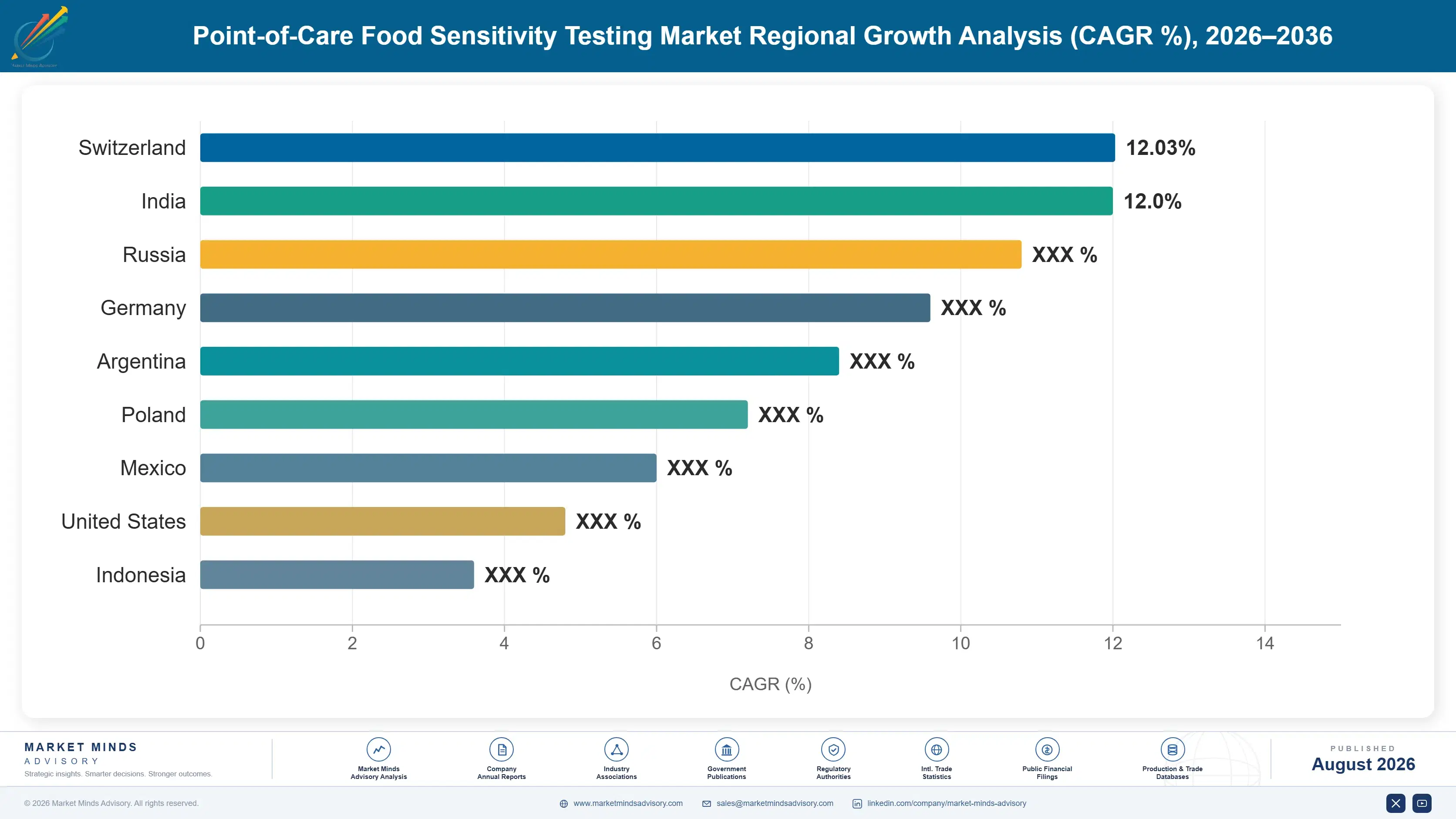
Market Impact: Places 19% of value at risk

Asian Paediatric Allergy Prevalence Rises With Urban Diet Change

Food allergy prevalence in urban Chinese. Korean, and Indian paediatric populations has risen sharply over two decades, tracking dietary westernisation and reduced early allergen exposure. Chinese tertiary paediatric centres have built allergy services from a very low base, and domestic immunoassay manufacturers have made platform placement affordable in ways imported systems were not. China contributes the fastest national growth rate in this forecast at 15.4%. Diagnosis rates across the region remain far below Western levels, so the addressable population expands through both prevalence and detection at the same time. Korean and Japanese services already test at Western standards.
Market Impact: Switching costs 40,000 dollars typically

Market Restraints and Challenges

Consumer Sensitivity Panels Lack Any Diagnostic Validation Whatsoever

Immunoglobulin G food panels sold direct to consumers measure an antibody that indicates exposure rather than intolerance, and the American and European allergy academies have both stated plainly that they should not be used diagnostically. The root cause is regulatory: wellness-positioned tests avoid the clinical claims that would trigger diagnostic device oversight. Commercial impact cuts both ways, since the segment funds distribution reach while contaminating clinical credibility for the validated products beside it. Participants are responding by separating brand architecture, adding clinician interpretation services, and in a few cases exiting the consumer channel entirely.
Market Impact: Covers 41% of specialist workups

Reagent Cartridge Lock-In Slows Specialist Platform Switching Considerably

Once a clinic places a near-patient analyser, its allergen panel content, result formats, and staff competency all attach to that platform's proprietary cartridges. Switching means revalidation, retraining, and a period running two systems in parallel. The root cause is deliberate commercial design rather than technical necessity, since no interoperability standard exists for multiplex allergen cartridges. Impact falls on smaller suppliers with better panels who cannot displace incumbents. Mitigation is running through open-cartridge initiatives, laboratory information system integration that abstracts the platform, and placement deals that fund the parallel-running period directly.
Market Impact: Results return within 22 minutes
3 additional market trends, 4 additional growth drivers, and 2 additional restraints and challenges are covered in the full report. Contact sales@marketmindsadvisory.com to access the complete intelligence.

Segment CAGR and Growth Architecture

Segmentation follows test methodology, because methodology determines regulatory pathway, clinical validity, reimbursement status, and which channel the product can legally be sold through. Care setting cuts across every methodology rather than separating them, and allergen type does the same, so neither serves as a workable primary dimension for this category. Six methodologies result, and their regulatory standing differs enormously.
point-of-care-food-sensitivity-testing-market-market-share-analysis-1787298980057

Component-Resolved Multiplex Immunoassay Panels

The fastest methodology at 14.4%, exactly 1.50 times the market rate, and the only one in this market with an uncontested clinical case. Measuring immunoglobulin E against individual allergen proteins rather than crude extract separates genuine systemic risk from harmless pollen cross-reactivity, which decides whether a child faces a supervised oral food challenge or goes home. European guidance incorporated the method years before it reached routine United States practice, and adoption now covers about 41% of specialist workups in leading markets. Panel breadth is the competitive dimension, with arrays now exceeding a hundred components. The constraint is interpretation: a hundred-component result needs an allergist who can read it, which is why primary care entry has been slow.
CAGR 14.4%

Benchtop Near-Patient Immunoanalyser Systems

Second fastest at 13.2%, and commercially the most attractive position in the category because of what it does to revenue quality. An analyser sized for a specialist clinic returns results in about 22 minutes, which converts a send-out test into a same-visit conversation and removes a follow-up appointment from the schedule. Clinics adopt for workflow reasons more than analytical ones. For suppliers the instrument itself matters far less than the proprietary reagent cartridges it consumes across a working life of seven years or more. Placement economics increasingly resemble the wider diagnostics model, with instruments placed at minimal cost and margin recovered through consumables the clinic cannot source elsewhere. Revalidation cost keeps clinics attached once a platform is placed.
CAGR 13.2%
Full segment breakdown across 6 segments available in the complete report.

Regional Architecture and Country Demand Map

Distribution here follows clinical guidance adoption rather than allergy prevalence, and the two are not well correlated. Western Europe leads because its guidance bodies incorporated molecular allergology into routine practice years before other regions, which pushed it modestly above its framework band. Every other region sits inside its band.

Western Europe

Twenty-eight percent, modestly above the framework band, and the reason is that European allergy guidance adopted component-resolved diagnostics into routine practice well ahead of anywhere else. Molecular allergology moved from academic centres into ordinary specialist workup across Germany. Austria. Switzerland, and the Nordic markets while other regions were still debating clinical utility. Austria and Germany also host several of the multiplex array developers, which concentrated early platform placement locally. The consumer immunoglobulin G panel channel is large here too, particularly in Germany and the United Kingdom. Growth at 8.0% is the slowest of any region precisely because the clinical conversion has largely already happened and pricing pressure now dominates. Reference pricing between member states compounds that pressure.
Share: 28% | CAGR: 8.0% (2026 to 2036)

East Asia

Twenty-two percent, and the region where the addressable population is expanding fastest for reasons that have nothing to do with guidance. Paediatric food allergy prevalence in urban China. South Korea, and Japan has risen sharply over two decades with dietary change and reduced early allergen exposure. Chinese tertiary paediatric centres built allergy services from almost nothing, and domestic immunoassay manufacturers made platform placement affordable where imported systems were not. Japan runs sophisticated component testing already and behaves more like Western Europe commercially. Growth at 11.0% is driven by Chinese detection rates catching up to a prevalence that was always there but rarely measured or coded. Korean services adopted component testing early and thoroughly.
Share: 22% | CAGR: 11.0% (2026 to 2036)
Regional intelligence for 5 additional markets available in the complete report: North America, South Asia and Pacific, Latin America, Middle East and Africa, Eastern Europe. Contact sales@marketmindsadvisory.com.
point-of-care-food-sensitivity-testing-market-country-cagr-analysis-1787298980564

Four Ways to Build Value Here

Instrument margin is thin and panel content is increasingly comparable, so nobody wins on hardware or on allergen count alone. Value comes from placing analysers that generate cartridge annuities, from proving challenge avoidance to payers, from making results readable outside specialist practice, and from separating the clinical brand from the consumer one. Four levers follow, and none concerns allergen count.

Place Analysers Free And Recover Through Cartridge Consumption

A specialist clinic analyser runs for seven years or more and consumes proprietary cartridges throughout, so instrument margin is worth far less than placement volume. Suppliers who place at minimal upfront cost and price recovery into consumables capture roughly three to four times the lifetime value of an outright sale, and they win placements that capital-constrained clinics would otherwise defer indefinitely. Switching cost afterwards runs around 40,000 dollars in revalidation and parallel running, which protects the position. This is standard practice across diagnostics generally and remains oddly underused in allergy specifically.
Market Impact: Captures 3 to 4 times the lifetime value

Build Challenge Avoidance Evidence For Payer Submissions

The strongest health economic argument in this category is also the least documented. A supervised oral food challenge costs several thousand dollars, and a component panel that safely avoids one pays for itself many times over, yet few suppliers have run the prospective study that proves the avoidance rate. Commissioning that work across three or four paediatric allergy services costs roughly 1.4 million dollars and produces the evidence every reimbursement submission needs. Competitors are still submitting analytical performance data to payers who want economic data, which is the wrong conversation entirely.
Market Impact: A prospective study costs about 1.4 million dollars

Make Hundred-Component Results Readable In Primary Care

Component panels stay inside specialist practice because a hundred-component report needs an allergist to interpret it, and that ceiling caps the addressable population at whatever allergist capacity exists. Interpretation software that reduces the panel to a clear management recommendation removes the ceiling. Primary care referral volumes exceed specialist testing volumes by roughly five to one in most developed systems, so even partial primary care entry multiplies the market. Development cost runs near 2 million dollars against that prize, and the supplier who solves interpretation first defines how the whole category is used afterwards.
Market Impact: Opens a pool 5 times current specialist volume

Separate Clinical Brand Architecture From Consumer Panel Business

Consumer immunoglobulin G panels represent about 19% of market value and carry regulatory risk that the validated clinical products beside them do not deserve to share. Running both under one brand means an allergist who distrusts the consumer product distrusts the clinical one too, and specialists talk to each other constantly. Separating brand architecture costs little and protects the clinical franchise if regulatory action arrives in a major market. Several participants have already done it quietly. Those who have not are betting a validated diagnostic business on a product their own customers publicly criticise.
Market Impact: Protects roughly 19% of the exposed market value

Who Controls the Margin Pool

Concentration reaches 54% across the top five measured on installed near-patient platform base, and the leaders are established immunoassay houses rather than allergy specialists. That matters because their allergy franchises sit inside much larger diagnostic portfolios and compete internally for development capital. The gap to challengers is narrower on panel content than on placement reach, and several smaller developers hold better multiplex arrays than the leaders do.
Competition runs on three fronts. Placement footprint is the first, since a cartridge annuity only exists where an instrument sits. Panel breadth and component quality are the second, and the specialist developers lead there. Interpretation support is the third and newest, and nobody has yet made a hundred-component result usable by a general practitioner. Interpretation is where the next position will be built.

Pressure comes from two directions. Chinese immunoassay manufacturers are placing affordable platforms across domestic paediatric services at prices imported systems cannot match. And regulatory attention on unvalidated consumer panels threatens participants whose brand architecture ties the two businesses together. Both pressures fall hardest on the incumbents with the widest portfolios, and neither is priced in.
point-of-care-food-sensitivity-testing-market-company-positioning-matrix-1787298981086

Competitive Moat and Risk Dimensions

THERMO FISHER SCIENTIFIC

Moat: Reference method incumbency in allergy

The company's immunoassay platform has functioned as the de facto reference method for specific immunoglobulin E measurement for decades, and clinical literature, guidance documents, and comparison studies all anchor on it. Displacing a reference method takes more than a better assay, because every published cut-off attaches to the incumbent.
THERMO FISHER SCIENTIFIC

Risk: Allergy competes for internal capital

Allergy diagnostics sits inside a life sciences portfolio measured in tens of billions, so development capital competes against opportunities with far larger addressable markets. Specialist developers with nothing else to fund move faster on panel content and interpretation tools. Reference incumbency also breeds conservatism about changing anything.
SIEMENS HEALTHINEERS

Moat: Integrated hospital laboratory footprint

Allergy testing runs alongside dozens of other immunoassays on shared hospital analysers, and a supplier already installed across a health system's laboratory estate adds allergen panels at close to zero placement cost. That integration is a placement cost advantage built out of infrastructure already installed. Competitors selling a dedicated allergy instrument must justify a footprint the incumbent already occupies.
SIEMENS HEALTHINEERS

Risk: Weak in near-patient clinic settings

The strength lies in centralised hospital laboratories, while growth is moving toward benchtop analysers placed inside specialist allergy clinics for same-visit results. Those are different buyers and different price points. Clinics choosing near-patient testing are explicitly choosing not to send work to the central laboratory.

Players Tracked

Prominent Players

Thermo Fisher Scientific
Siemens Healthineers
Hycor Biomedical
Bio-Rad Laboratories
Macro Array Diagnostics

Other Key Players

Abbott Laboratories
Danaher
bioMerieux
DiaSorin
Revvity
Omega Diagnostics Group
Dr. Fooke Laboratorien
R-Biopharm
Lofarma
ALK-Abello
Stallergenes Greer
Jubilant HollisterStier
Getein Biotech
Guangzhou Wondfo Biotech
Hangzhou AllTest Biotech

Recent Developments

FEBRUARY 2025

Austrian developer widens multiplex array beyond three hundred components

An Austrian molecular allergology company extended its multiplex array content past three hundred individual allergen components, adding storage proteins and lipid transfer proteins relevant to regional dietary patterns. The expansion was organic product development on the existing platform rather than any acquisition or licensing arrangement with another array developer.
Signal: Panel breadth is becoming a specialist developer advantage that the large diagnostic houses are not matching on content
MAY 2025

European paediatric services publish challenge avoidance outcome data

A consortium of European paediatric allergy centres published prospective data on oral food challenges avoided through component-resolved testing, reporting avoidance rates and associated cost savings by allergen group. The work was investigator-initiated clinical research rather than any manufacturer-sponsored study, and it covers several thousand paediatric workups.
Signal: Independent economic evidence arriving without manufacturer sponsorship makes payer conversations considerably easier for every supplier in the category
AUGUST 2025

Chinese manufacturer places near-patient analysers across paediatric hospitals

A Chinese in vitro diagnostics manufacturer expanded placement of benchtop allergy analysers across tertiary paediatric hospitals, using instrument pricing well below imported systems. The rollout was organic commercial expansion through existing hospital relationships rather than any partnership with an international diagnostics group. Instrument volumes were not disclosed publicly.
Signal: Domestic platform pricing reaches Chinese paediatric services that imported instrument cost structures were never going to serve

What Sits Inside a Cartridge

Recombinant and purified allergen proteins are the dominant input at roughly 38% of cost of goods, produced in specialist expression facilities concentrated in Austria. Germany, and increasingly China. Detection antibodies and conjugates add a further 19%, sourced from a narrow set of reagent houses. Consumable plastics, microarray substrates, and cold chain distribution make up most of the remainder, and none of them is individually large.
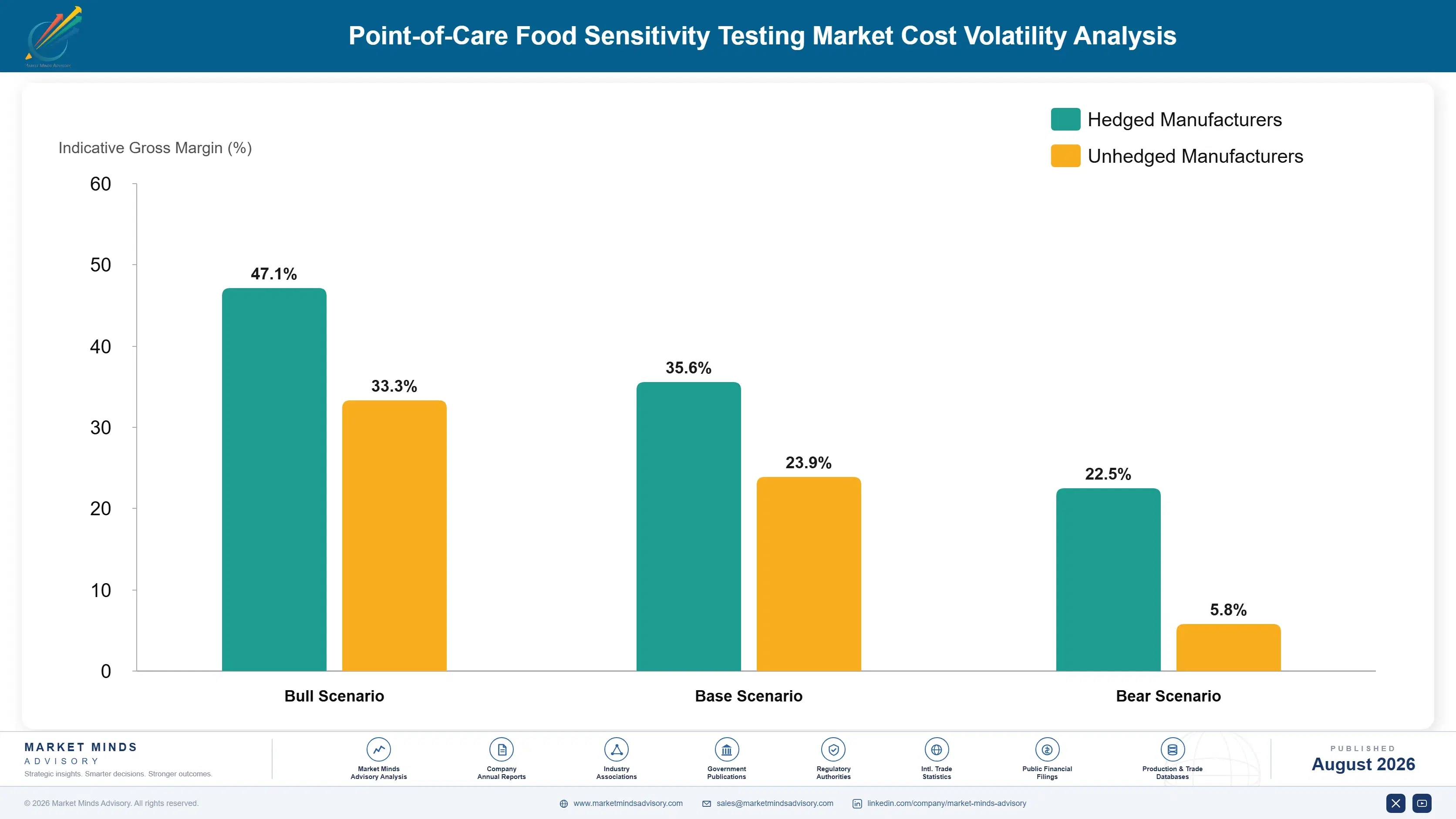
The volatility that mattered most came from allergen protein supply rather than from any commodity. Several specific recombinant components are produced by only one or two qualified suppliers worldwide, and a single facility interruption during the recent period forced panel content substitutions across multiple manufacturers. Company annual reports across the sector describe qualified single-source dependency in similar terms, and requalifying a component takes twelve months of comparability work.

The competitive disadvantage mechanism runs through qualification depth rather than purchase price. Manufacturers with dual-qualified sources for critical components absorb an interruption; those with single sources substitute panel content and lose comparability with their own published cut-offs. Smaller array developers are worst placed, since they lack the volume to interest a second supplier in qualifying at all. Vertically integrated producers expressing their own proteins avoid it entirely.
point-of-care-food-sensitivity-testing-market-cost-volatility-analysis-1787298981281

Dual-qualify critical recombinant allergen components ahead of need

Requalification takes twelve months or more of comparability work, which means it cannot be started once a supply interruption has already happened and the panel content is already at risk. Qualifying a second source while the first is still functioning costs perhaps 200,000 dollars per component, and it is the only mitigation that genuinely works.

Bring expression of high-volume components in-house

Components appearing on every panel a manufacturer sells justify internal expression capability in a way that niche components never will. In-house production removes supply risk and improves margin on the highest-volume line items at the same time. Capital and regulatory qualification are both significant here, so scale rather than preference decides whether it makes any sense.

Design panels so content substitution preserves clinical comparability

Panels built with documented equivalence between alternative component sources allow substitution without invalidating published cut-offs. This is a design decision taken years before any interruption occurs, and it costs almost nothing at the design stage. Manufacturers who skipped it discover during a shortage that changing a component means changing the clinical interpretation their customers rely upon.

Portfolio Architecture for Margin Defence

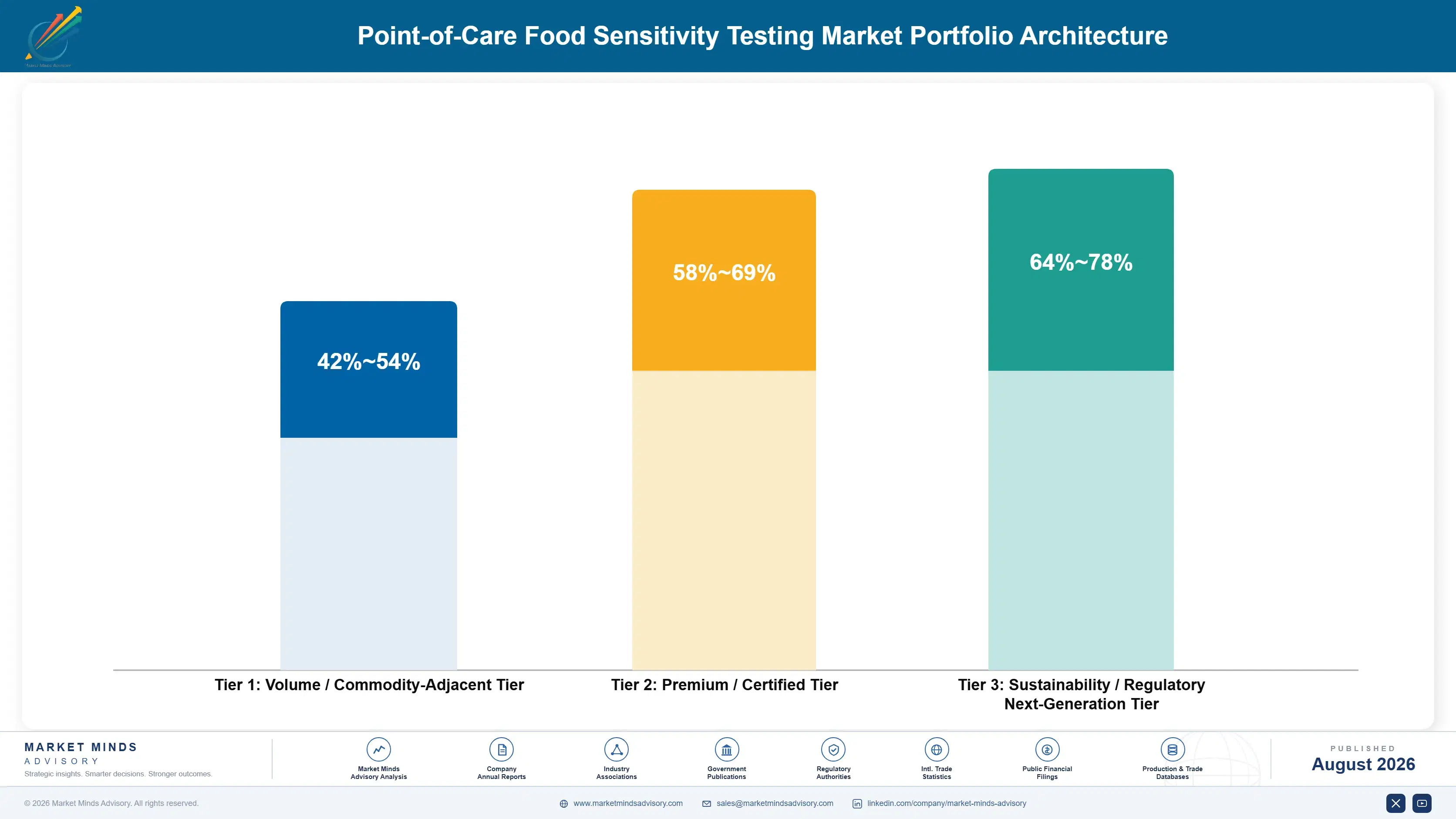
Three tiers describe this market and they differ more in regulatory standing than in manufacturing cost. Consumer sensitivity panels sit at the bottom on price realisation relative to content, sold through wellness channels with minimal validation burden. Certified clinical assays with regulatory clearance and established cut-offs occupy the middle at considerably better margin. And component-resolved multiplex arrays with documented clinical utility sit at the top, where the payer conversation
The tension is unusual. The lowest tier carries the highest regulatory risk despite the lowest validation burden, which inverts the normal packaging of risk and reward. Participants running both a clinical and a consumer business find their specialist customers questioning the clinical products because of the consumer ones, and specialists in this field talk to each other more than in most disciplines. Reputational contagion runs one way only, from consumer to clinical.

High-value pools concentrate wherever a test displaces a procedure rather than another test. Challenge avoidance and referral avoidance both carry costs a payer can already see on a budget line. A test that displaces another test argues about unit price instead, which is a losing conversation.

Volume / Commodity-Adjacent Tier

Consumer immunoglobulin G sensitivity panels and single-allergen rapid tests sold through wellness retail, pharmacy, and telehealth channels. Minimal validation burden and reasonable unit economics, offset by regulatory exposure that is rising unevenly across jurisdictions.
Gross Margin: 42-54%

Premium / Certified Tier

Regulatory-cleared specific immunoglobulin E assays with established clinical cut-offs, sold into specialist practice and hospital laboratories. Margin reflects the clearance burden and the reference comparability that clinicians depend upon when interpreting results.
Gross Margin: 58-69%

Sustainability / Regulatory / Next-Generation Tier

Component-resolved multiplex arrays and near-patient cartridge systems with documented challenge avoidance evidence. Priced against the supervised procedure they displace rather than against competing tests, which is a fundamentally different pricing conversation.
Gross Margin: 64-78%
point-of-care-food-sensitivity-testing-market-portfolio-architecture-1787298981781

High-value Sub-segments and Strategic Watch-out

Component-Resolved Multiplex Arrays

Best margin and fastest growth in the category, priced against an avoided hospital procedure rather than against competing diagnostics. The constraint is interpretation capacity, since a hundred-component report currently requires an allergist to read it and allergist numbers are not growing. Interpretation software is the obvious way past that ceiling.
Gross Margin: 64-78%

Near-Patient Cartridge Consumables

Strong margin and highly predictable volume, generated across an instrument working life of seven years or more, with switching costs near 40,000 dollars protecting the annuity throughout. Growth tracks placement activity rather than testing demand, which makes the placement pipeline the only metric that really matters.
Gross Margin: 61-73%

Cleared Specific Immunoglobulin E Assays

The clinical volume core, running on hospital laboratory analysers across established referral pathways with reimbursement in place. Growth is slow as component testing displaces whole-extract methods, but the installed base and comparability history make displacement gradual rather than abrupt. Reimbursement is settled and referral pathways are long established.
Gross Margin: 58-69%

Consumer Immunoglobulin G Panels

The strategic watch-out, contributing roughly 19% of market value against explicit advice from every major allergy society and against rising regulatory attention across several jurisdictions. Margin is reasonable today, but a single regulatory interpretation in one large market removes the whole segment with nothing to replace it.
Gross Margin: 42-54%

Where the Repeat Revenue Lives

The instrument is sold once and the cartridges are sold forever, which is the entire commercial logic of near-patient allergy testing. An analyser placed in a specialist clinic consumes proprietary consumables across a working life exceeding seven years, and switching afterwards costs around 40,000 dollars in revalidation and parallel running. That makes the placement decision far more valuable than the instrument margin suggests, and it explains why suppliers increasingly give the hardware away
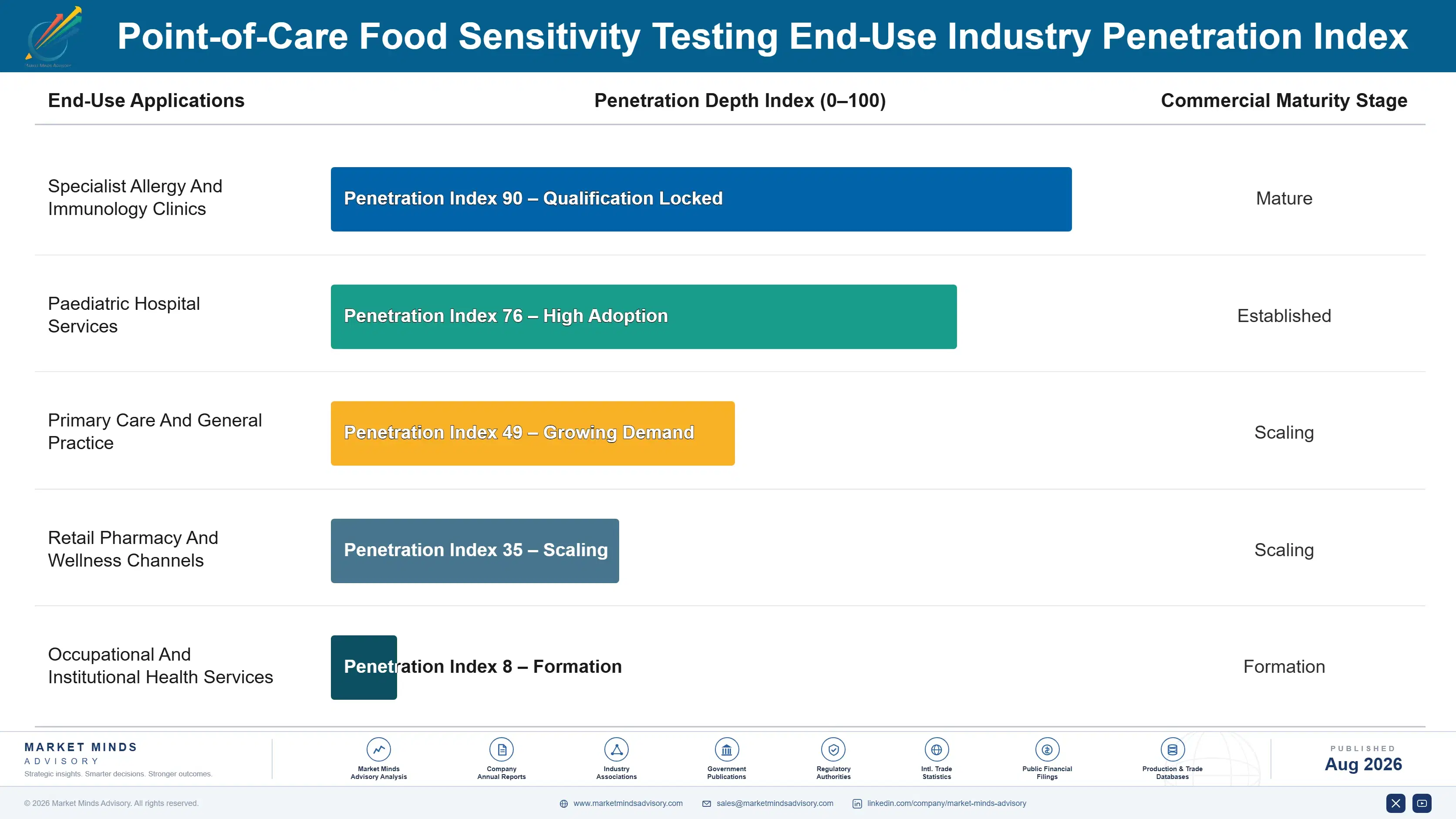
Adoption depth varies sharply by setting. Specialist allergy clinics test broadly, interpret confidently, and repeat testing as children outgrow sensitisations, which produces the deepest and most durable demand. Paediatric hospital services test heavily but centralise through laboratories. Primary care refers rather than tests, capped by interpretation capacity rather than by willingness. Consumer channels generate high volume with no repeat logic at all, since a sensitivity panel is bought once and rarely revisited.

Buyer profiles are shifting as parents arrive having already bought a consumer panel online. Allergists increasingly spend the first part of a consultation explaining why a result the family paid for means nothing clinically. That consultation time is unbilled and increasingly resented across specialist practice, and it is getting worse.
point-of-care-food-sensitivity-testing-market-end-use-penetration-index-1787298982269

What We Would Tell a Board

These are among the four positions where our research anticipates prominent divergence between winners and laggards over the coming forecast period. Each is grounded in the demand model, the regulatory perimeter, and the announced capacity pipeline.
01 / PLACEMENT ECONOMICS DISCIPLINE

Give the analyser away and price the cartridges properly

An instrument placed in a specialist clinic consumes proprietary cartridges for seven years or more, and that annuity is worth roughly three to four times the lifetime value of an outright instrument sale. Switching afterwards costs around 40,000 dollars in revalidation and parallel running, which protects the position durably once established. Boards still measuring allergy diagnostics on instrument gross margin are optimising the smallest number in the whole business model, and they are losing placements to competitors who worked this out already.
02 / HEALTH ECONOMIC EVIDENCE

Prove challenge avoidance or keep losing payer arguments

A supervised oral food challenge costs several thousand dollars and a component panel that safely avoids one pays for itself many times over, yet almost nobody has run the prospective study that quantifies the avoidance rate. Commissioning that work across three or four paediatric allergy services costs roughly 1.4 million dollars. Competitors are still submitting analytical performance data to payers who are plainly asking economic questions, and the first supplier holding real avoidance evidence will define the reimbursement conversation for everyone.
03 / INTERPRETATION LAYER OWNERSHIP

The ceiling is allergist capacity, not panel content

Component panels remain locked inside specialist practice because a hundred-component report needs a trained allergist to interpret it, and allergist numbers are not growing in any market we track. Primary care referral volume exceeds specialist testing volume by roughly five to one in developed systems, so software that turns a panel into a clear management recommendation multiplies the addressable market rather than merely improving a product. Whoever solves interpretation first will define how this entire category is used for the following decade.
04 / BRAND ARCHITECTURE SEPARATION

Do not let the consumer panel contaminate the clinical franchise

Consumer immunoglobulin G panels contribute about 19% of market value while carrying a regulatory exposure that a properly validated clinical assay does not deserve to share with them. Allergists who distrust the consumer product transfer that distrust directly to the clinical products sitting beside it, and specialists in this particular field talk to each other constantly. Separating the brand architecture costs very little, and it protects the clinical franchise entirely if regulatory action arrives in any major market during the forecast period.

Engagement Snapshot From the Field

A live engagement with an industry participant carrying material or product regulatory and market exposure ahead of a defining policy shift, showing how our research translates into a defensible multi-year portfolio strategy.
MARKET MINDS ADVISORY · CLIENT ENGAGEMENT SUMMARY
Point-of-Care Food Sensitivity Testing Producer Strategic Portfolio Review and Transition Roadmap 2026·Investment Scenario on Point-of-Care Food Sensitivity Testing Exposure Evaluation 2025-26
CLIENT PROFILE
A European in vitro diagnostics manufacturer with approximately 310 million dollars in annual revenue (client-reported, unverified by MMA), holding a strong multiplex allergen array and a small near-patient analyser installed base. The company sold instruments outright at healthy gross margin, ran a separate consumer sensitivity panel brand under the same corporate name, and had been unsuccessful in three national reimbursement submissions during the preceding two years.
STRATEGIC CHALLENGE
Management believed the reimbursement failures reflected inadequate analytical performance data and had commissioned further method comparison work. Placement growth had also slowed while a competitor placing instruments free was winning specialist clinics. The board wanted an independent read on whether the problem sat with the evidence, the commercial model, or something else.
MMA APPROACH
We reviewed all three rejected submissions against the published assessment criteria, interviewed assessment body advisers and specialist allergists across five national markets, and modelled lifetime value under outright sale versus placement economics. Brand perception among specialist allergists was tested separately to isolate the effect of the consumer panel business on clinical credibility.
KEY FINDINGS
  1. All three reimbursement rejections cited absence of clinical utility and cost offset evidence rather than analytical performance, which the submissions had documented thoroughly and unnecessarily.
  2. Placement modelling showed lifetime cartridge value at roughly 3.6 times outright instrument sale value, meaning the current model was destroying value on every unit it sold.
  3. Specialist allergists in four of five markets associated the corporate name with the consumer sensitivity panel and rated the clinical array less credible than blinded product assessment indicated.
  4. No competitor in the category had published prospective oral food challenge avoidance data, leaving the evidence position genuinely open to whoever commissioned the work first.
CLIENT PROFILE
A European in vitro diagnostics manufacturer with approximately 310 million dollars in annual revenue (client-reported, unverified by MMA), holding a strong multiplex allergen array and a small near-patient analyser installed base. The company sold instruments outright at healthy gross margin, ran a separate consumer sensitivity panel brand under the same corporate name, and had been unsuccessful in three national reimbursement submissions during the preceding two years.
STRATEGIC CHALLENGE
Management believed the reimbursement failures reflected inadequate analytical performance data and had commissioned further method comparison work. Placement growth had also slowed while a competitor placing instruments free was winning specialist clinics. The board wanted an independent read on whether the problem sat with the evidence, the commercial model, or something else.
MMA APPROACH
We reviewed all three rejected submissions against the published assessment criteria, interviewed assessment body advisers and specialist allergists across five national markets, and modelled lifetime value under outright sale versus placement economics. Brand perception among specialist allergists was tested separately to isolate the effect of the consumer panel business on clinical credibility.
KEY FINDINGS
  1. All three reimbursement rejections cited absence of clinical utility and cost offset evidence rather than analytical performance, which the submissions had documented thoroughly and unnecessarily.
  2. Placement modelling showed lifetime cartridge value at roughly 3.6 times outright instrument sale value, meaning the current model was destroying value on every unit it sold.
  3. Specialist allergists in four of five markets associated the corporate name with the consumer sensitivity panel and rated the clinical array less credible than blinded product assessment indicated.
  4. No competitor in the category had published prospective oral food challenge avoidance data, leaving the evidence position genuinely open to whoever commissioned the work first.
RECOMMENDED STRATEGY
Phase 1: Phase 1 (months one to six): halt further method comparison work and commission a prospective challenge avoidance study across four paediatric allergy services. Phase 2: Phase 2 (months six to eighteen): convert to placement economics with cartridge recovery pricing, and separate consumer panel brand architecture from the clinical franchise. Phase 3: Phase 3 (months eighteen to thirty): resubmit for reimbursement with avoidance evidence, and begin interpretation software development for primary care entry.
OUTCOME
The client redirected its evidence budget into the avoidance study and converted to placement economics across two national markets. Specialist placements rose materially within three quarters and the first resubmission was accepted (client-reported, unverified by MMA), with the consumer brand now operating under a separate name entirely.

Frequently Asked Questions

Foundational context covering the market sizes, CAGR, scope, country, region and competition that inform every finding below. This section is provided to cover basics and most often pre-purchase conversations, answered from the MMA Primary Research Dataset.

What is the current size of the Point-of-Care Food Sensitivity Testing Market?

The market is valued at USD 0.68 billion in 2025, rising to USD 0.75 billion in 2026. Roughly 19% of that value sits in unvalidated consumer channels.

How large will the Point-of-Care Food Sensitivity Testing Market be by 2036?

MMA forecasts USD 1.86 billion by 2036, an increase of USD 1.11 billion over the 2026 base. That represents an expansion multiple of 2.48 times.

What is the CAGR for the Point-of-Care Food Sensitivity Testing Market 2026 to 2036?

The base case CAGR is 9.6%, with a bull case of 10.8% and a bear case of 8.4%. The historical rate from 2020 to 2025 was 8.3%.

Which segment is growing fastest?

Component-resolved multiplex immunoassay panels at 14.4%, exactly 1.50 times the market rate. They separate genuine systemic allergy risk from harmless pollen cross-reactivity, which decides whether a child needs a supervised food challenge.

Who are the major companies in the Point-of-Care Food Sensitivity Testing Market?

Thermo Fisher Scientific, Siemens Healthineers, Hycor Biomedical, Bio-Rad Laboratories, and Macro Array Diagnostics lead on installed platform base. The top five together hold 54% of the market.

Which country is growing fastest?

China at 15.4%, driven by rising urban paediatric allergy prevalence and by domestic manufacturers placing affordable analysers across tertiary hospitals. Diagnosis rates remain far below Western levels.

Report Segmentation Architecture

The full report scope spans multiple orthogonal segmentation dimensions, with cross-tabulated demand data provided for each dimension pair. Coverage extends further to regional breakdowns, trend trajectories, and the competitive detail needed to support segment-level decision-making.

By Test Methodology

  • Component-Resolved Multiplex Immunoassay Panels
  • Benchtop Near-Patient Immunoanalyser Systems
  • Lateral Flow Rapid Immunoglobulin E Tests
  • Oral Food Challenge Support Kits
  • Direct Consumer Immunoglobulin G Panels
  • Skin Prick Devices And Standardised Extracts

By End-Use Industry

  • Specialist Allergy And Immunology Clinics
  • Paediatric Hospital Services
  • Primary Care And General Practice
  • Retail Pharmacy And Wellness Channels
  • Occupational And Institutional Health Services

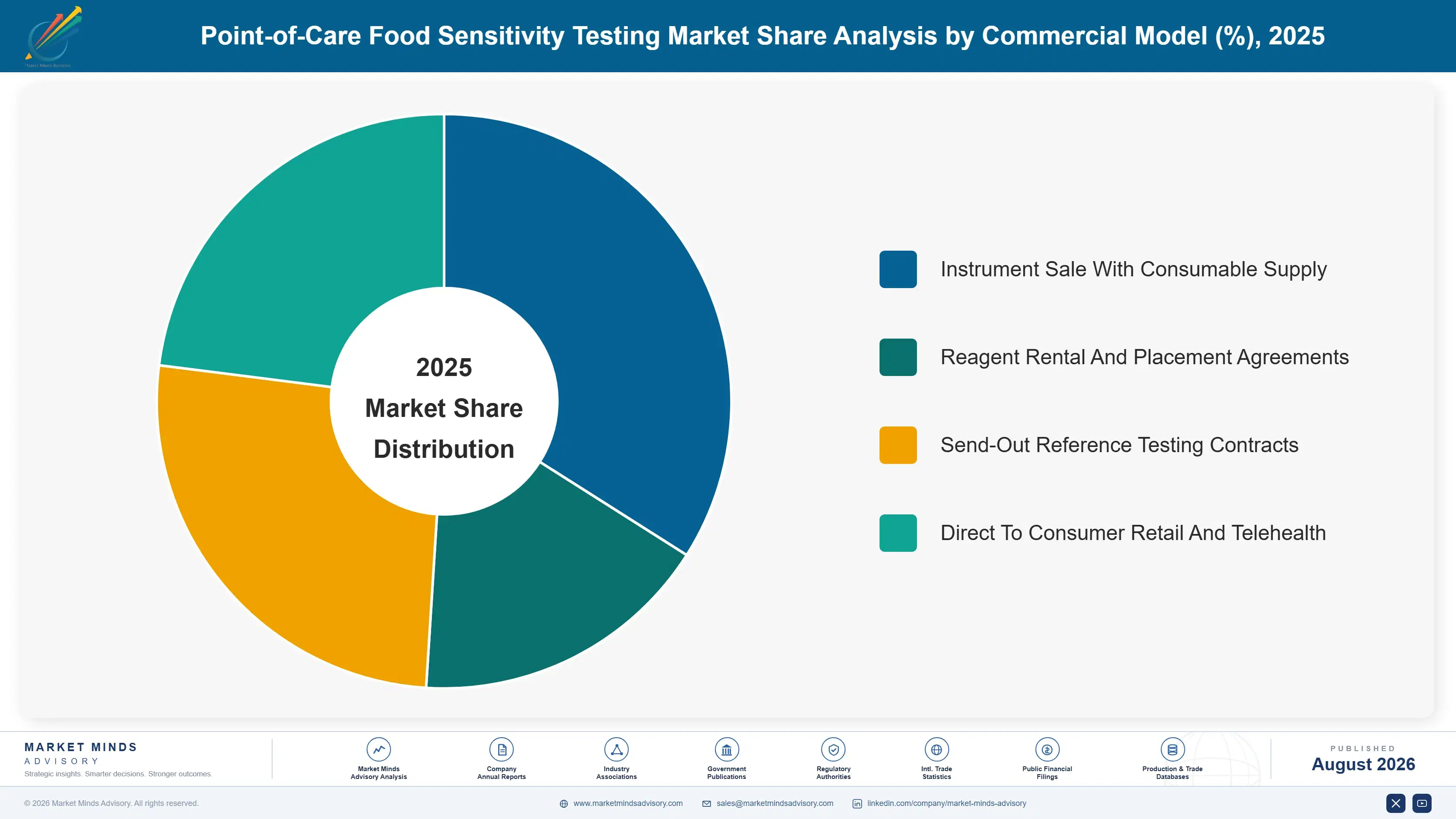
By Commercial Model

  • Instrument Sale With Consumable Supply
  • Reagent Rental And Placement Agreements
  • Send-Out Reference Testing Contracts
  • Direct To Consumer Retail And Telehealth

By Region

  • Western Europe
  • East Asia
  • North America
  • South Asia and Pacific
  • Latin America
  • Middle East and Africa
  • Eastern Europe

Scope, Methodology, and Coverage

Every figure in this report is reproducible from documented input assumptions. The scope below maps the historical period, the forecast horizon, the segmentation dimensions, and the countries covered, alongside the underlying primary and qualitative methodology.
Historical Period
2020 to 2025
Forecast Period
2026 to 2036
Base Year
2025 (USD billions; MMA Primary Research Dataset, August 2026)
Market Definition
This market comprises in vitro diagnostic products used to detect food allergy and food sensitivity at or near the point of care, measured at manufacturer realised prices across instruments, consumable cartridges, reagents, and standardised extract devices. Methodology coverage spans component-resolved multiplex arrays, benchtop near-patient immunoanalysers, lateral flow immunoglobulin E devices, oral food challenge support products, consumer immunoglobulin G panels, and skin prick test devices. Central laboratory reference testing services, coeliac and gluten serology, hydrogen and methane breath testing, elimination diet programmes, allergen immunotherapy products, and epinephrine autoinjectors fall outside scope.
Quantitative Units
USD billions (current prices); tests performed annually; installed analyser base
Segmentation Dimensions
By Test Methodology; By End-Use Industry; By Commercial Model; By Region
Regions Covered
Western Europe, East Asia, North America, South Asia and Pacific, Latin America, Middle East and Africa, Eastern Europe
Countries Covered
Germany, Austria, Switzerland, UK, France, Italy, Spain, Netherlands, Sweden, Denmark, Poland, Czechia, USA, Canada, Mexico, Brazil, Argentina, Chile, China, Japan, South Korea, Taiwan, India, Australia, Thailand, Singapore, Saudi Arabia, UAE, South Africa, and additional markets relevant to this sector
Key Companies Profiled
Thermo Fisher Scientific, Siemens Healthineers, Hycor Biomedical, Bio-Rad Laboratories, Macro Array Diagnostics, Abbott Laboratories, Danaher, bioMerieux, DiaSorin, Revvity, Omega Diagnostics Group, Dr. Fooke Laboratorien, R-Biopharm, Lofarma, ALK-Abello, Stallergenes Greer, Jubilant HollisterStier, Getein Biotech, Guangzhou Wondfo Biotech, Hangzhou AllTest Biotech
Quantitative Methodology
Primary survey, n=3,800 respondents, Q4 2025, six countries; demand-side model with trade association cross-validation
Qualitative Methodology
47 expert interviews, Q4 2025; applied to validate demand model assumptions, identify emerging dynamics, and assess competitive positioning
Report Format
PDF and XLSX data workbook (Word format preview document)
Publisher
Market Minds Advisory
Report Code
MMA-2026-MED-210
Published
August 2026
Contact
sales@marketmindsadvisory.com | www.marketmindsadvisory.com

Purchase the full Point-of-Care Food Sensitivity Testing Market Report (2026 to 2036).

The full report sizes point-of-care food sensitivity testing across six test methodologies, five end-use settings, four commercial models, and seven regions, with country detail for the twenty largest national markets. It separates validated clinical testing from consumer sensitivity panels throughout, sizing each independently so the two are never conflated. Installed analyser base and placement pipeline are tracked by supplier and by region, alongside cartridge consumption economics across a full instrument life. Competitive profiling covers twenty companies on installed platform base. Regulatory position on consumer immunoglobulin G panels is tracked jurisdiction by jurisdiction.
Clinical and consumer channel sizing kept strictly separate
Installed analyser base and placement pipeline by supplier
Cartridge consumption economics across full instrument working life
Consumer panel regulatory position tracked by jurisdiction
Oral food challenge cost offset modelling by market
Component array content benchmarking across leading multiplex platforms

Built For The People Who Decide

From boardroom strategy to bench-side execution, this report is read cover-to-cover by leaders shaping the next decade of their industry, turning demand scenarios, market dynamics and valuation benchmarks into decisions.
CXOs/ Presidents/ VPs/ Managers
M&A and Corporate Development
Strategy Teams and R&D Heads
Procurement and Product Directors
Regulatory and Compliance Leaders
Investor Relations and Equity Analysts