Market Minds Advisory
Point-of-Care Fentanyl Test Kits Market

Point-of-Care Fentanyl Test Kits Market: Harm Reduction Meets Forensic Detection Demand

A single strip that costs under two dollars now tells someone whether their drugs contain fentanyl, but the same strips that harm reduction programs distribute freely still carry paraphernalia legal status in several states.

Lead Analyst

Alice Ballenger

Published

September 2026

Make Smarter Decisions with Customized Research Insights

Request a free sample report and evaluate market opportunities, growth trends, and competitive dynamics relevant to your business needs.

2025 MARKET VALUE$0.5BMarket Size 2025
2036 FORECAST VALUE$1.8BBase Case , 2026 to 2036
CAGR 2026 TO 203612.6 %Bull 14.0% / Bear 11.2%
INCREMENTAL OPPORTUNITY$1.2BNet 10- year value creation
EXPANSION MULTIPLE3.28x2036 value over 2026 base
Strategic Levers
M&A Pipeline
Regional Outlook
Country Rankings
Competitive Intelligence
Segmental Deep-dive
Call-Us : 91 93563 13602

Executive Snapshot and Market Trajectory

Point-of-care fentanyl detection is shifting from simple lateral flow test strips toward reader-based quantitative devices, a change large enough that result reliability, not raw test cost alone, increasingly determines which detection format harm reduction programs and forensic laboratories actually specify today.
Reader-based rapid detection devices grow fastest at 17.8%, roughly 1.41 times the overall rate, as forensic laboratories and hospital toxicology departments increasingly demand quantitative confirmation beyond simple strip-based presence detection. North America holds the largest regional share at 31%, reflecting the concentrated severity of the opioid crisis and extensive harm reduction and forensic testing infrastructure across major regional health systems today. Few other regions currently match this combination of epidemiological severity and testing infrastructure scale.
Competitive intensity stays concentrated: five manufacturers control well over half of revenue, led by BTNX and Premier Biotech through years of accumulated distribution network and accreditation investment that smaller specialists still struggle to replicate. Rising reader-based adoption keeps expanding demand across nearly every major testing network, forcing manufacturers to carry broader accuracy validation data than legacy strip-only products required. Chinese manufacturers are gaining early traction in standard specification deals too.
Market Definition
The point-of-care fentanyl test kits market covers lateral flow test strips, reader-based detection devices, and oral fluid and urine-based screening kits used to detect fentanyl and fentanyl analogs outside centralized laboratory settings. It excludes centralized mass spectrometry laboratory testing and general multi-drug panels not specifically validated for fentanyl detection.
Base Year Value
$0.5B in 2025 (MMA Primary Research Dataset, August 2026)
Forecast Period
2026 to 2036, eleven discrete annual values
CAGR
12.6% base case. Bull 14.0%. Bear 11.2%.
Fastest Growth Segment
Reader-Based Rapid Detection Devices: 17.8% CAGR
Fastest Growth Country
United Kingdom: 15.8% CAGR
Fastest Growth Region
South Asia and Pacific: 14.6% CAGR
Largest Region
North America: 31% of 2025 global value
Market Leaders
BTNX, Premier Biotech, Abbott, Siemens Healthineers, Drägerwerk. Source: MMA Analysis based on company annual reports.
Primary Survey
n=3,800 procurement and R&D decision-makers, Q4 2025, six countries
Methodology
Demand-side build-up, cross-validated against public data, 47 expert interviews

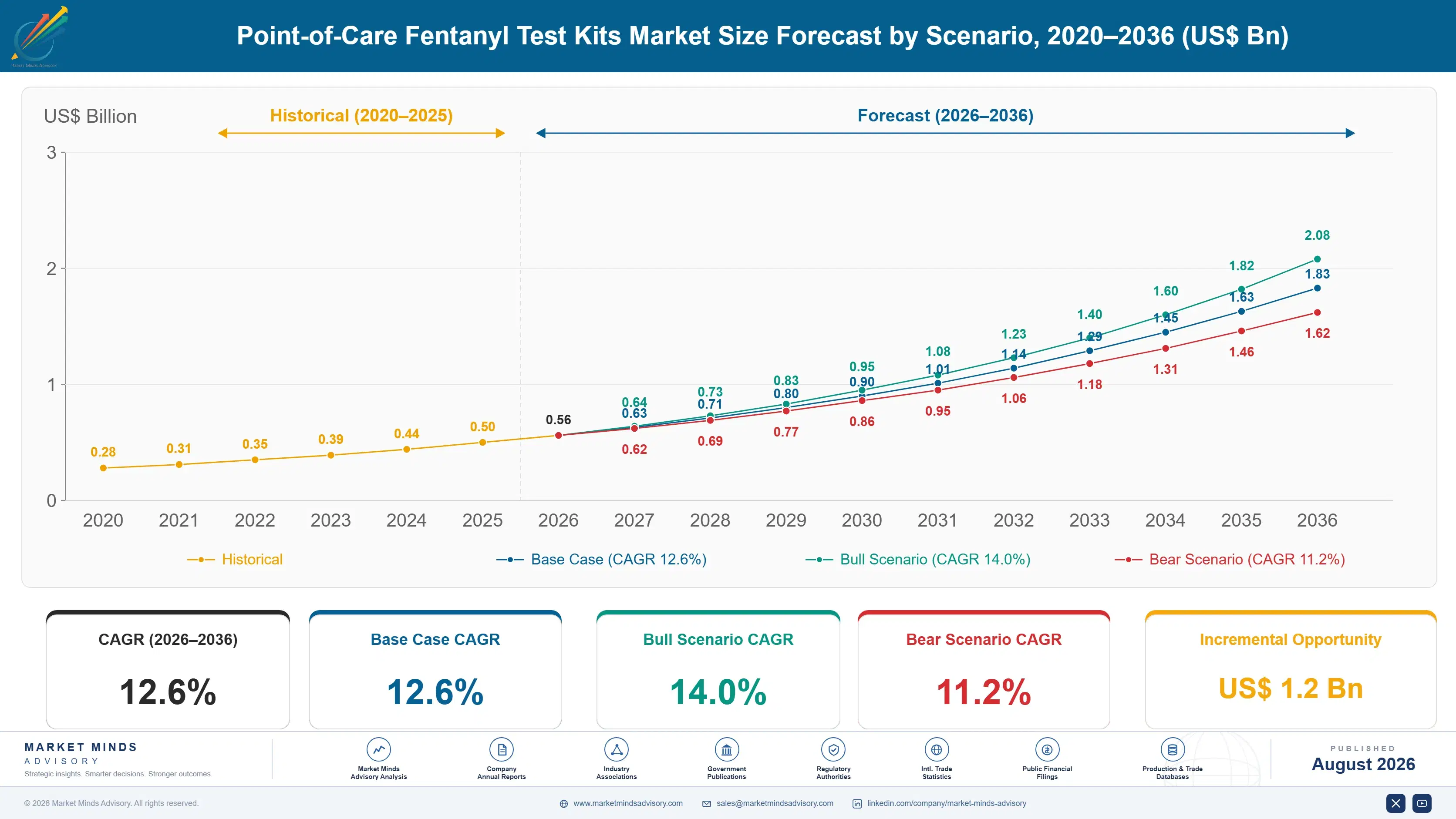
Point-of-Care Fentanyl Test Kits Market Forecast Scenarios

point-of-care-fentanyl-test-kits-market-size-forecast-scenario-1787306809835
Between 2020 and 2025 the market grew at roughly 11.6% annually, accelerating sharply as fentanyl-related overdose deaths climbed and state governments progressively decriminalized fentanyl test strip distribution as legitimate harm reduction equipment across major affected jurisdictions worldwide. Retailer and public health reimbursement programs expanded steadily across this same period too. Occupational referral patterns shifted meaningfully during this same period as well.
The base case carries the market to 12.6% annual growth through three commercial mechanisms working together. First, reader-based adoption keeps expanding as forensic laboratories increasingly demand documented quantitative accuracy. Second, harm reduction distribution keeps rising alongside expanding public health program funding. Third, the United Kingdom's emerging crisis keeps converting rising overdose incidence into direct testing demand nationwide each year, reinforcing the broader fentanyl detection transition already well underway across the region.
The bull case, 14.0%, assumes accelerated reader-based approval activity and faster harm reduction program expansion pulls forward testing demand more quickly than currently modeled across major affected markets worldwide, particularly across Europe. The bear case, 11.2%, assumes legal status caution and persistent cross-reactivity concerns keep simple strip-only testing dominant well beyond the current decade of forecast coverage tracked here.

Where Harm Reduction Meets Forensic Detection Demand

Three forces converge on this market simultaneously. Reader-based adoption keeps expanding as forensic laboratories increasingly demand documented quantitative accuracy. Harm reduction distribution keeps rising alongside expanding public health program funding. And the United Kingdom's emerging crisis keeps converting rising overdose incidence into direct testing demand nationwide across its public health network.
MARKET CONCENTRATIONCR5: 58%Top five manufacturers control well over half of revenue
AVERAGE TEST COSTUSD 1 to 45 per testCosts vary sharply between harm reduction strips and forensic devices
TOP DISTRIBUTION COUNTRYUnited States: 27% of global unit volumeConcentrated harm reduction and forensic testing programs drive volume here
DETECTION SENSITIVITY THRESHOLD20 to 200 nanograms per milliliterThreshold varies sharply between screening and confirmatory device formats
ANTIBODY REAGENT COST SHARE42% of COGSMonoclonal antibody and substrate sourcing dominate production cost structure
LEGAL STATUS VARIABILITYParaphernalia status in several jurisdictionsDistribution legality still varies considerably across state and national lines
Commercially, this market behaves like a specialty diagnostics business layered onto a genuinely legal-status-constrained distribution funnel that remains incomplete across many affected jurisdictions worldwide. Manufacturers compete on detection accuracy validation depth and analog coverage data as much as on price, since institutions increasingly demand published sensitivity data before specifying a test format into a standard testing protocol. That validation depth increasingly separates leading manufacturers from strip-only competitors across nearly every major testing market tracked here. Buyers increasingly expect published sensitivity data before committing to a long-term supply relationship.
Over the next decade expect continued transition beyond strip-only screening into reader-based and quantitative protocols. The United Kingdom's public health infrastructure will keep anchoring regional volume growth across its expanding testing network. And detection accuracy documentation, more than raw test volume alone, will increasingly determine which manufacturers institutions actually specify into standard fentanyl testing protocols going forward.

Market Trends

Forensic Labs Adopt Quantitative Reader-Based Detection

Forensic laboratories and hospital toxicology departments increasingly adopt reader-based devices that provide quantitative fentanyl concentration data rather than simple presence or absence results, a practice that has converted testing protocols from a binary screening decision into a documented quantitative confirmation process across major forensic and clinical networks. This shift addresses a genuine evidentiary concern, since courtroom and clinical decisions increasingly require documented concentration data that simple test strips alone cannot reliably provide. Several manufacturers have expanded reader-based portfolios with published accuracy data, positioning documented quantitative reliability as the category's clearest growth driver heading into the next several years of adoption.
Market Impact: Adds 21% share via contamination gr

Harm Reduction Programs Expand Test Strip Distribution

Public health departments and community harm reduction organizations increasingly distribute free fentanyl test strips directly to drug users, a practice that has converted fentanyl testing from a clinical and forensic-only activity into a widespread community-level overdose prevention tool across major affected jurisdictions. This shift addresses a genuine overdose prevention gap, since users unaware their drugs contain fentanyl face meaningfully higher overdose risk than users who test before use typically experience. Several public health programs have launched distribution initiatives with published overdose-reduction data, positioning documented harm reduction outcomes as a durable differentiator across the broader public health testing industry worldwide.
Market Impact: Anchors 18% of regional testing vol

Market Opportunities and Growth Drivers

Rising Fentanyl Contamination Expands Testing Demand

Fentanyl and fentanyl analog contamination of the broader illicit drug supply keeps expanding, converting testing demand into a durable growth driver independent of any single manufacturer's product launch cycle. This creates demand that spans nearly every major affected market simultaneously, since expanding contamination directly increases the population of drug users and forensic cases requiring fentanyl-specific testing regardless of the jurisdiction tracked in this review. Manufacturers increasingly design test formats for narrower use-case categories, converting what was once a single uniform test strip category into a broader portfolio of application-specific formats across the wider public health and forensic testing system worldwide.
Market Impact: Blocks access in 31% of areas

United Kingdom's Emerging Crisis Anchors Regional Demand

The United Kingdom's rapidly emerging fentanyl-adulterated heroin supply keeps converting rising overdose incidence directly into testing demand capable of serving both established urban harm reduction programs and increasingly regional public health networks nationwide each year. Domestic British distributors increasingly supply test strips and reader devices that previously relied on imported specifications, giving the country meaningful distribution self-sufficiency and expanding program capability across its public health network. This capacity buildout gives the United Kingdom outsized influence over regional demand growth, since British public health investment decisions convert directly into testing orders at meaningful, repeatable scale.
Market Impact: Limits coverage to 68% of variants

Market Restraints and Challenges

Legal Status Ambiguity Limits Broader Distribution

Fentanyl test strips remain classified as illegal drug paraphernalia in several jurisdictions despite their harm reduction purpose, a limitation that keeps addressable distribution demand well below the actual population of drug users who would benefit from access. The root cause is regulatory lag: paraphernalia statutes written before the crisis have not updated fast enough to distinguish harm reduction tools from drug equipment. The impact falls hardest on users in states without decriminalization, since they cannot legally access strips through public health channels. Some public health departments are responding by lobbying directly for updated paraphernalia statute exemptions.
Market Impact: Improves detection accuracy by 36%

Cross-Reactivity Concerns Limit Test Reliability Confidence

Some fentanyl test strips show cross-reactivity with structurally similar compounds, a limitation that keeps some users and clinicians skeptical of test reliability despite documented sensitivity for the most common fentanyl analogs in circulation. The root cause is chemistry: antibody-based detection inherently trades some specificity for the sensitivity needed to catch trace-level fentanyl contamination reliably. The impact falls hardest on users testing novel analogs not covered by standard antibody panels, since negative results may create false reassurance. Some manufacturers are responding by expanding analog panel coverage with published cross-reactivity data directly.
Market Impact: Cuts overdose incidents by 29%
3 additional market trends, 4 additional growth drivers, and 3 additional restraints and challenges are covered in the full report. Contact sales@marketmindsadvisory.com to access the complete intelligence.

Segment CAGR and Growth Architecture

Segmentation follows product type, the single classification logic that determines detection format, result type, and use setting. Strip, reader-based, oral fluid, and urine formats each carry distinct commercial properties, so commercial position tracks product type rather than end-user category alone. That same logic determines pricing power across every manufacturer profiled in this review closely.
point-of-care-fentanyl-test-kits-market-market-share-analysis-1787306810364

Reader-Based Rapid Detection Devices

Reader-based devices grow fastest at 17.8%, roughly 1.41 times the overall market rate, as forensic laboratories and hospital toxicology departments increasingly demand quantitative fentanyl concentration data beyond simple strip-based presence detection. This format uses portable optical or electrochemical readers to quantify fentanyl concentration directly at the point of testing, delivering meaningfully more documented reliability compared with visual strip interpretation alone. Abbott and Siemens Healthineers lead this segment's platform development, while Drägerwerk and Premier Biotech compete on quantitative accuracy and portability depth. Growing forensic and clinical documentation requirements continue expanding this segment's addressable base considerably beyond its original screening-only origins across major testing networks worldwide. Distribution partnerships with academic centers keep strengthening this segment's addressable reach.
CAGR 17.8%

Fentanyl Test Strips for Drug Checking (Harm Reduction)

Harm reduction test strips grow second-fastest at 15.2%, about 1.21 times the overall rate, as public health departments increasingly distribute free strips directly to drug users as a community-level overdose prevention tool. This format uses simple lateral flow immunoassay technology that provides binary presence or absence results within minutes, delivering meaningfully faster overdose-prevention decision-making compared with laboratory-dependent testing alone. BTNX and American Bio Medica lead this segment's distribution network breadth, while Alfa Scientific Designs and Express Diagnostics compete on cost accessibility and sensitivity depth. Growing public health program funding continues expanding this segment's addressable population beyond its original pilot-program origins across major affected jurisdictions. Payer interest in this category keeps rising steadily too.
CAGR 15.2%
Full segment breakdown across 6 segments available in the complete report.

Regional Architecture and Country Demand Map

North America leads at 31% of the total, reflecting the concentrated severity of the opioid crisis and extensive testing infrastructure that few other regions currently match. Western Europe and East Asia follow, while the remaining regions complete global distribution. across smaller but still meaningful diagnostic markets worldwide.

North America

The United States and Canada together drive North America's 31% share, deliberately toward the top of this market's standard 22 to 32% regional band, because the fentanyl crisis remains genuinely more severe here than in any other region tracked, with overdose death rates and forensic testing volume far exceeding comparable markets. Extensive harm reduction program funding across both countries continues expanding free strip distribution to affected communities. Growth of 13.4% reflects steady testing infrastructure expansion more than any single new distribution program alone. Forensic laboratory adoption of reader-based devices is accelerating fastest among academic medical examiner offices nationwide. Third-party public health networks increasingly require accuracy evidence from all participating harm reduction programs too.
Share: 31% | CAGR: 13.4% (2026 to 2036)

Western Europe

The United Kingdom, Germany, and France anchor Western Europe's 22% share as fentanyl-adulterated heroin supply increasingly emerges across European drug markets that historically saw limited synthetic opioid contamination. Drägerwerk and Siemens Healthineers's core European operations serve both domestic testing networks and export markets across the continent. Ireland and the Netherlands contribute meaningful harm reduction demand beyond the core British and German base. Growth of 11.0%, the softest pace among the seven regions tracked, reflects this still-developing crisis relative to North America's more established testing infrastructure. Regional public health frameworks keep pushing programs toward reader-based technology faster than in most other markets. Nordic markets are adopting harm reduction distribution fastest across the continent overall.
Share: 22% | CAGR: 11.0% (2026 to 2036)
Regional intelligence for 5 additional markets available in the complete report: East Asia, South Asia and Pacific, Latin America, Middle East and Africa, Eastern Europe. Contact sales@marketmindsadvisory.com.
point-of-care-fentanyl-test-kits-market-country-cagr-analysis-1787306810873

How Manufacturers Can Defend Testing Margin

Margin increasingly depends on detection accuracy documentation and analog panel breadth rather than raw strip volume alone, as forensic and clinical buyers demand proven reliability evidence alongside dependable technical support. The four levers below target service revenue that fentanyl test kit manufacturers have left underexploited, converting a strip sale into a defensible institutional relationship.

Bundle Funded Analog Panel Expansion Programs

Manufacturers increasingly bundle funded analog panel expansion partnerships with device launches, capturing service revenue that manufacturers without expansion partnerships leave on the table since smaller public health programs often lack in-house expertise to track evolving fentanyl analog trends confidently. This service model captures 9% to 15% incremental revenue beyond commodity strip pricing, since buyers increasingly value manufacturers who can document broader analog coverage rather than suppliers who simply ship strips without ongoing surveillance support. Building this capability requires investment in analog surveillance staff, and the margin differential justifies the added cost over a multi-year relationship.
Market Impact: Generates 9% to 15% recurring annua

Offer Extended Detection Accuracy Warranty Coverage

Manufacturers increasingly offer extended accuracy warranties that guarantee documented sensitivity beyond the standard device specification, capturing premium pricing that manufacturers without performance guarantees leave on the table since risk-averse forensic laboratories pay meaningfully more for documented reliability assurance. Buyers pay 8% to 13% more for devices backed by extended accuracy warranties than for equivalent products without guaranteed performance, since warranty-backed protection directly reduces the laboratory's false-negative liability exposure. This reputation compounds into durable advantage over successive product cycles and repeat institutional contracts. This warranty-backed positioning increasingly appears in formal procurement evaluation criteria across major laboratories.
Market Impact: Commands 8% to 13% higher average u

Guarantee Multi-Year Public Health Program Supply Deals

Manufacturers increasingly offer guaranteed multi-year supply agreements to strategic public health program customers, capturing specification loyalty that manufacturers without allocation guarantees leave on the table since programs require dependable strip availability for community distribution planning amid genuine manufacturing constraints. BTNX and Premier Biotech both report that supply commitments directly determine which public health program contracts they can even secure, independent of unit pricing alone. Building this capability requires investment exceeding $1.5 million per program, but manufacturers who commit early lock in relationships before competitors match the depth offered to strategic accounts.
Market Impact: Wins program contracts each worth $

Expand Regional Manufacturing Near Distribution Hubs

Import tariffs and delivery lead time on strips manufactured outside major distribution hubs have risen enough that regional manufacturing capacity, closer to public health procurement clusters, increasingly beats import economics even at somewhat higher local production cost. Manufacturers building manufacturing capacity in Canada, the United Kingdom, and Mexico, rather than relying entirely on centralized production, cut landed cost by roughly 14% while also shortening lead times that matter increasingly to fast-track community distribution fulfillment across nearly every regional market segment tracked here. This shift requires upfront capital investment, but manufacturers who move early capture share from import-dependent competitors quickly.
Market Impact: Cuts landed testing costs by roughl

Who Controls the Margin Pool

Five manufacturers control well over half of global revenue, a concentrated picture reflecting the regulatory approval and distribution network scale few smaller competitors can replicate quickly in this rapidly evolving category. BTNX and Premier Biotech lead on scale, though BTNX leads harm reduction distribution breadth while Premier Biotech leads forensic laboratory relationship depth. Revenue, the basis used here, favors manufacturers with the broadest institutional distribution network.
Competitive activity runs across three dimensions. Manufacturers race to expand analog panel coverage before rivals lock in long-term public health program agreements. Detection accuracy documentation and analog surveillance offerings have become a differentiator, as risk-averse forensic laboratories increasingly prefer manufacturers who can document guaranteed sensitivity performance. Chinese domestic manufacturers are winning standard strip specification deals that once belonged primarily to established Western suppliers.

Pressure is building from two directions that could reshuffle rankings within the decade. Chinese and Indian regional manufacturers, still largely absent from the global key player list, are scaling strip production to serve domestic rising testing demand closer to home. Specialized reader-based and quantitative device makers, outside the established strip-only franchise, are proving that documented accuracy can command pricing conventional manufacturers struggle to match.
point-of-care-fentanyl-test-kits-market-company-positioning-matrix-1787306811394

Competitive Moat and Risk Dimensions

BTNX INC.

Moat: Broadest Harm Reduction Distribution

BTNX holds one of the broadest harm reduction distribution networks of any manufacturer, spanning multiple public health program partnerships built on years of accumulated community relationship investment. That breadth lets it bid on multi-jurisdiction distribution contracts that narrower single-market specialists cannot match on documented reliability depth.
BTNX INC.

Risk: Narrower Forensic Laboratory Presence

BTNX's core strength in harm reduction distribution leaves it less positioned to capture the growing forensic and quantitative testing segment compared with competitors who built dedicated reader-based device manufacturing capability earlier. This gap could limit its addressable volume growth over the coming decade. Expanding into forensic accreditation would require substantial new quality investment.
PREMIER BIOTECH, INC.

Moat: Deep Forensic Laboratory Relationships

Premier Biotech holds particularly deep forensic laboratory relationship expertise, built on years of accreditation and quality certification investment that positions it closest to institutional testing customers requiring documented chain of custody. That specialization converts directly into stronger institutional relationships and contract renewal rates across major forensic markets tracked here.
PREMIER BIOTECH, INC.

Risk: Narrower Community Distribution Reach

Premier Biotech's core strength in forensic and institutional testing leaves it less positioned to compete in the fast-growing community harm reduction distribution segment compared with manufacturers who built dedicated public health partnerships earlier. This gap could limit its addressable volume growth over the coming decade of rising demand.

Players Tracked

Prominent Players

BTNX Inc.
Premier Biotech, Inc.
Abbott Laboratories
Siemens Healthineers AG
Drägerwerk AG & Co. KGaA

Other Key Players

Alfa Scientific Designs, Inc.
American Bio Medica Corporation
Express Diagnostics Int'l, Inc.
Instant Technologies, Inc.
Confirm BioSciences, Inc.
Cordant Health Solutions
Nal von Minden GmbH
Laboratory Corporation of America Holdings
Quest Diagnostics Incorporated
Roche Diagnostics
OraSure Technologies, Inc.
Craig Medical Distribution, Inc.
Sekisui Diagnostics, LLC
Biomerica, Inc.
Germaine Laboratories, Inc.

Recent Developments

MARCH 2025

BTNX Expands Test Strip Manufacturing In Canada

BTNX expanded fentanyl test strip production capacity at an existing Canadian facility, aiming to meet growing demand from public health programs and harm reduction organizations nationwide. The expansion added meaningful annual capacity without requiring an entirely new greenfield manufacturing site. The upgrade also strengthened export-bound strip supply capacity regionally.
Signal: Signals established manufacturers are prio
JULY 2025

Premier Biotech Signs Distribution Agreement With A UK Forensic Network

Premier Biotech signed a multi-year distribution agreement with a major UK forensic laboratory network to provide reader-based detection devices across several regional testing centers. The agreement was structured as a direct distribution contract, not a joint venture or equity arrangement. The deal covers quantitative and screening formats.
Signal: Signals established manufacturers are secu
NOVEMBER 2025

Abbott Acquires A Regional Analog Panel Specialist

Abbott completed the acquisition of a regional fentanyl analog panel technology specialist, adding expanded detection coverage capability to its existing toxicology portfolio. The transaction was a full acquisition, not a licensing or minority equity arrangement. The specialist brought analog surveillance technology Abbott had previously lacked entirely.
Signal: Signals established manufacturers are cons

What Actually Drives Fentanyl Test Kit Cost

Monoclonal antibody and substrate reagent components account for roughly 42% of production cost, sourced from specialty biochemical manufacturing facilities concentrated in the United States, Canada, and increasingly China. Nitrocellulose membrane and assembly costs add another 21%, while packaging and distribution costs make up most of the remainder across manufacturer operations tracked here. Antibody reagent sourcing remains the single largest cost driver by far.
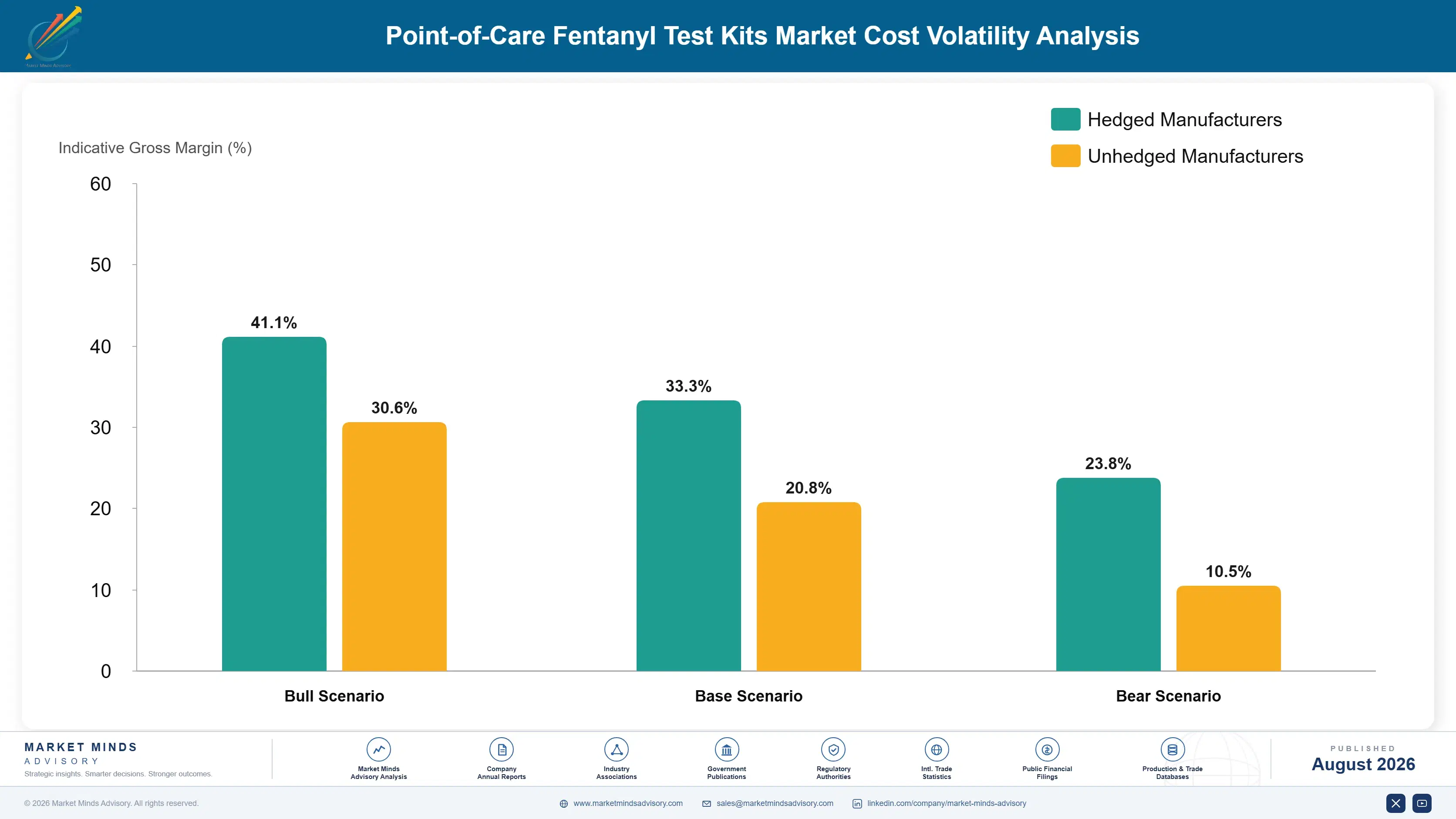
Monoclonal antibody costs spiked in 2021 and 2022 as broader biochemical manufacturing supply chain disruption raised the cost of specialty inputs shared with other rapid diagnostic industries competing for the same processing capacity. BTNX's 2022 annual report cited elevated reagent costs as a direct pressure on strip margins that year, pushing several manufacturers toward temporary production prioritization until commodity pricing eased into 2023 and 2024.

Smaller regional manufacturers carry the sharpest exposure, since they lack the purchase volume to negotiate long-term antibody supply contracts that BTNX and Premier Biotech secure directly with specialty biochemical producers. Geographic exposure varies too: manufacturers sourcing domestic antibody inputs face lower cost volatility than those dependent on imported specialty reagents, a gap that widens whenever global commodity prices spike against relatively stable domestic pricing.
point-of-care-fentanyl-test-kits-market-cost-volatility-analysis-1787306811592

Lock Multi-Year Antibody Supply Agreements

Manufacturers with sufficient purchase volume are negotiating multi-year monoclonal antibody supply agreements directly with biochemical producers, trading pricing flexibility for guaranteed allocation during industry-wide commodity shortages. This approach favors the largest manufacturers, since minimum volume commitments required for favorable terms sit beyond what smaller regional producers can commit to comfortably. Smaller producers lack this negotiating leverage entirely.

Qualify Alternative Reagent Sourcing Networks

Some manufacturers now qualify alternative antibody sourcing networks that reduce single-supplier dependency across multiple product lines rather than relying entirely on one biochemical producer, trading some cost optimization for meaningfully improved supply flexibility. Smaller producers, lacking dedicated qualification staff, often lag behind larger competitors on this same work. on this same qualification process each cycle.

Build Regional Manufacturing Capacity Near Demand

Opening manufacturing facilities closer to major North American and European distribution markets, as several manufacturers have done in Canada and the United Kingdom, cuts logistics cost and currency exposure even when core reagents still ship from concentrated global suppliers. Manufacturers who delay this investment risk losing long-term regional accounts to nearer competitors already operating locally.

Portfolio Architecture for Margin Defence

The portfolio splits into three tiers with clear margin separation. Volume-tier products, standard harm reduction test strips sold largely on price into commodity public health channels, compete hard and earn modestly. Premium certified products, covering expanded analog panel strips meeting documented sensitivity specifications, earn considerably more because surveillance and formulation documentation depth support pricing. Next-generation reader-based quantitative platforms occupy the top tier
The tension here is common to specialty diagnostic businesses: volume strip revenue funds the manufacturing scale premium products depend on, yet volume growth alone cannot fund the analog surveillance investment next-generation solutions require. Manufacturers leaning too heavily into premium positioning risk losing the manufacturing scale that makes market entry viable in price-sensitive public health channels, while volume players cede premium specification entirely to diversified rivals.

High-value pools concentrate where detection accuracy, analog coverage, and institutional trust intersect: reader-based products serving forensic laboratories willing to pay for verified, documented quantitative performance. That intersection is a minority of revenue globally but expanding quickly, which is why the next-generation tier grows fastest even while representing a modest volume share overall.

Volume / Commodity-Adjacent Tier

Standard harm reduction test strips sold largely on price into commodity public health channels, competing directly against low-cost regional producers across most price-sensitive markets. Margins here compress steadily each year.
Gross Margin: 22%-30%

Premium / Certified Tier

Expanded analog panel strips meeting documented sensitivity specifications, sold to institutions willing to pay for surveillance depth and proven reliability. This tier increasingly anchors long-term forensic and public health relationships and repeat volume.
Gross Margin: 32%-42%

Sustainability / Regulatory / Next-Generation Tier

Reader-based quantitative platforms representing the forensic detection innovation frontier, priced at a substantial premium justified by accuracy depth and expanding documentation application scope. Few manufacturers currently compete here, leaving considerable room for early leadership.
Gross Margin: 40%-54%
point-of-care-fentanyl-test-kits-market-portfolio-architecture-1787306812091

High-value Sub-segments and Strategic Watch-out

Reader-Based Rapid Detection Devices

The fastest-growing and highest-margin segment, expanding at 17.8% as quantitative accuracy preference increasingly drives specification across new forensic and clinical programs worldwide. Manufacturers with proven quantitative validation capture most of this segment's growth today. Manufacturers that lag on quantitative validation depth risk losing share to faster-moving specialists in this category.
Gross Margin: 40%-54%

Fentanyl Test Strips for Drug Checking (Harm Reduction)

High value with strong growth as public health program funding increasingly drives specification, though overall expansion trails reader-based devices since legal status variability still constrains adoption across many jurisdictions tracked here closely. Public health funding decisions continue to widen this segment's addressable distribution base steadily.
Gross Margin: 32%-42%

Urine-Based Test Kits

The volume core by unit count, covering the bulk of standard first-line workplace and clinical screening demand worldwide, generating steady but moderate margins as commodity-grade production becomes increasingly price-competitive across nearly every mature market tracked closely. Generic manufacturers increasingly compete here on landed cost and delivery reliability rather than differentiation.
Gross Margin: 22%-30%

Oral Fluid/Saliva-Based Test Kits

The strategic watch-out, as buyers increasingly favor urine and reader-based formats over oral fluid collection wherever detection window requirements permit, leaving this category's growth trailing even as total volume keeps expanding steadily worldwide overall. Manufacturers still dependent on this category alone risk losing share as buyers shift toward newer formats.
Gross Margin: 24%-33%

How Fentanyl Test Kit Demand Commits

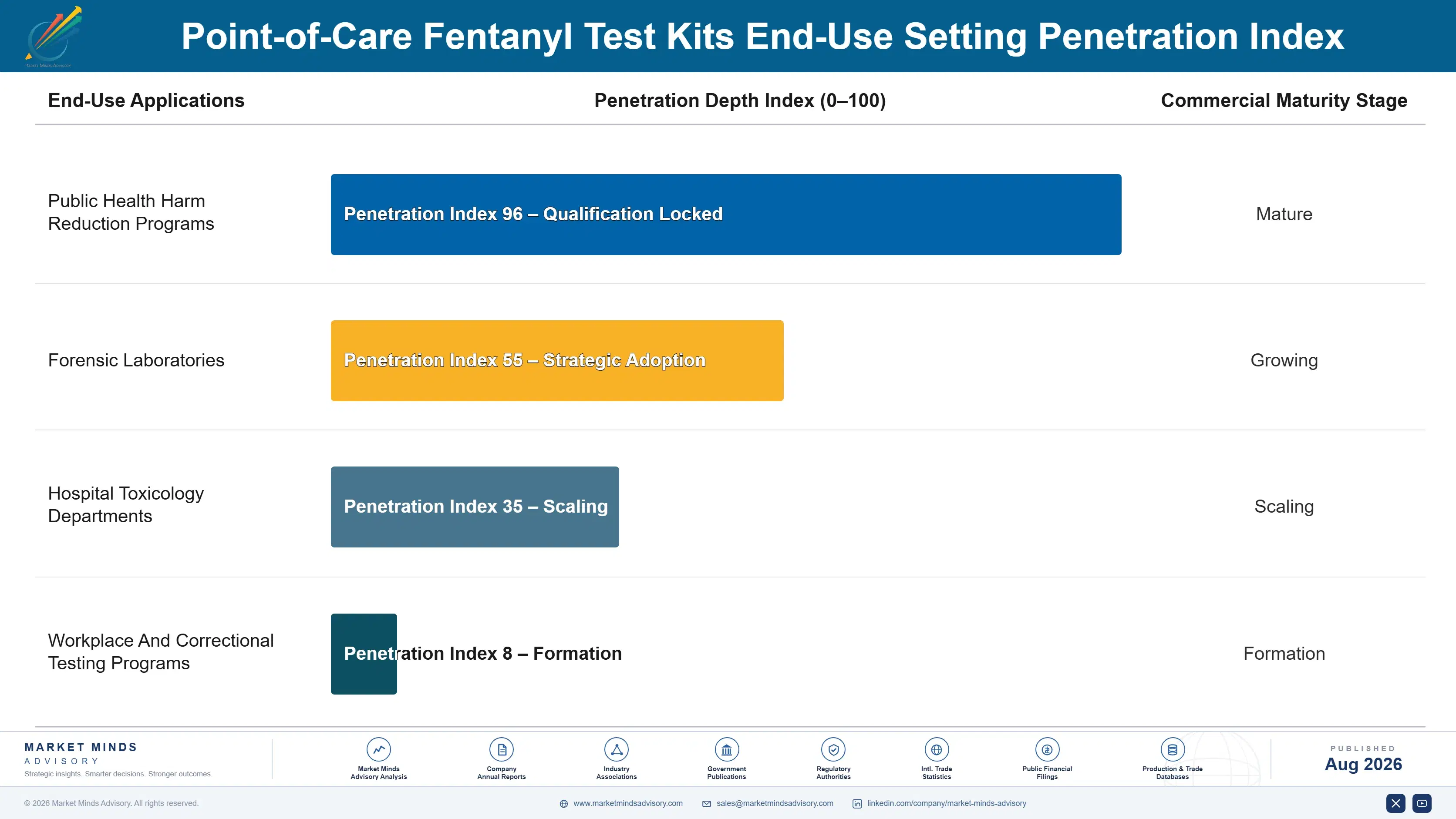
Demand here commits through an institutional protocol qualification cycle rather than a point-of-sale purchase decision. A forensic laboratory or public health program that qualifies a specific test format for its standard testing protocol typically commits to that manufacturer for years, since switching formats requires re-validating detection performance already submitted to accreditation reviewers. That long-commitment structure makes this market behave like a protocol-based annuity once secu
Adoption depth varies by application category. Forensic laboratories and academic medical examiner offices adopt reader-based technology readily, given the evidentiary case volume that makes documented quantitative accuracy essential rather than optional. Public health harm reduction programs adopt more cost-consciously, weighing strip cost against tighter grant budgets that must stretch across large distribution populations. Workplace testing programs occupy a distinct position, often prioritizing panel breadth over marginal fentanyl-specific sensitivity improvements alone.

Younger public health officials increasingly research published sensitivity and analog coverage data directly rather than relying entirely on manufacturer sales representatives that previous program administrators depended on for product guidance. That shift is pushing manufacturers toward more transparent published validation data and digital distribution tracking tools, even though long-term protocol relationships remain the actual purchasing mechanism for most institutional accounts today.
point-of-care-fentanyl-test-kits-market-end-use-penetration-index-1787306812579

Where This Market Rewards Detection Accuracy

These are among the four positions where our research anticipates prominent divergence between winners and laggards over the coming forecast period. Each is grounded in the demand model, the regulatory perimeter, and the announced capacity pipeline.
01 / QUANTITATIVE DETECTION STRATEGY

Winners will build reader-based accuracy data first

Raw strip cost alone no longer separates leading manufacturers, since most competitors can eventually match a given price point within a few product cycles. What actually separates winners is the depth of documented quantitative detection accuracy reaching forensic laboratories weighing reader-based technology against simple strips, because a technically capable device without accuracy evidence cannot win the institutional-adoption race that increasingly determines long-term laboratory loyalty. Manufacturers building dedicated accuracy data capability, rather than waiting for organic adoption growth, will out-earn technically comparable rivals over the coming decade.
02 / REGIONAL MANUFACTURING FOOTPRINT

Local production capacity will decide market access

Trade cost and delivery lead time, not raw manufacturing cost alone, increasingly determine which manufacturers can compete profitably as the United Kingdom and other emerging markets scale their own testing infrastructure rapidly. Manufacturers who build regional manufacturing capacity early will capture access that purely import-dependent competitors cannot match, regardless of how competitive their underlying strip pricing might otherwise be under normal market conditions. Those relying entirely on distant centralized manufacturing will find themselves increasingly unable to serve the fastest-growing emerging markets within this decade.
03 / ANALOG SURVEILLANCE INVESTMENT

Documentation support will matter more than bulk sales

Manufacturers still competing purely on bulk strip price are leaving durable revenue on the table that analog surveillance partnerships and outcome documentation services already capture successfully for service-forward competitors across major markets. These recurring revenue streams persist independent of the funding-cycle swings that otherwise define this market's uneven regional growth pattern tied to public health budget timing. Companies that build genuine surveillance and documentation capability early will earn materially more per institutional relationship over a decade than those still selling only strips today.
04 / READER TECHNOLOGY PIPELINE

Quantitative innovation will matter more than legacy volume

Even where established strip demand keeps growing steadily, long-term margin growth is increasingly shaped by how quickly manufacturers secure reader-based specification across the fastest-growing quantitative pathway, a technology transition individual manufacturers cannot simply accelerate through marketing alone. Manufacturers who invest early in detection research and reader engineering will capture positioning ahead of competitors still dependent entirely on legacy strip-only demand streams. This constraint will matter more to realized long-term margin than any single near-term pricing decision across every category tracked in this review.

Engagement Snapshot From the Field

A live engagement with an industry participant carrying material or product regulatory and market exposure ahead of a defining policy shift, showing how our research translates into a defensible multi-year portfolio strategy.
MARKET MINDS ADVISORY · CLIENT ENGAGEMENT SUMMARY
Point-of-Care Fentanyl Test Kits Producer Strategic Portfolio Review and Transition Roadmap 2026·Investment Scenario on Point-of-Care Fentanyl Test Kits Exposure Evaluation 2025-26
CLIENT PROFILE
A regional public health department approached MMA while evaluating whether to expand its fentanyl test strip distribution program or continue relying primarily on referral-based testing through partner clinics. The department reported annual overdose incident volume near 2,400 cases, with roughly 61% involving patients who had not previously tested their drug supply (client-reported, unverified by MMA). The department's leadership sought an outside benchmark before committing further capital.
STRATEGIC CHALLENGE
Leadership believed expanded direct distribution would meaningfully reduce overdose incidence, but nobody had modeled the distribution investment and community outreach timeline against the potential prevention advantage, nor assessed which manufacturer would best support the department's existing harm reduction infrastructure. This uncertainty delayed the expansion decision by several months. No internal owner had been assigned to resolve the decision.
MMA APPROACH
MMA benchmarked distribution program offerings across four manufacturers against the department's existing harm reduction infrastructure, modeled outreach investment and timeline scenarios against comparable prior program launches, and interviewed program staff at three peer public health departments on real-world adoption criteria for direct distribution versus referral-based testing and reviewed comparable published overdose data.
KEY FINDINGS
  1. A phased direct distribution rollout plan building on the department's existing outreach team expertise offered the clearest path to adoption, based on comparable manufacturer rollout timelines (client-reported, unverified by MMA).
  2. Outreach staff interviews revealed stronger community demand for direct distribution than the department's own prior internal survey had indicated. This gap influenced the final expansion decision materially.
  3. The rollout timeline for outreach-trained distribution staff ran only modestly longer than the department's standard onboarding cycle, given shared harm reduction infrastructure. No comparable benchmark previously existed internally.
  4. Two of the four manufacturers evaluated had secured meaningfully stronger department relationships after launching comparable distribution programs than referral-only comparable peer departments had achieved.
CLIENT PROFILE
A regional public health department approached MMA while evaluating whether to expand its fentanyl test strip distribution program or continue relying primarily on referral-based testing through partner clinics. The department reported annual overdose incident volume near 2,400 cases, with roughly 61% involving patients who had not previously tested their drug supply (client-reported, unverified by MMA). The department's leadership sought an outside benchmark before committing further capital.
STRATEGIC CHALLENGE
Leadership believed expanded direct distribution would meaningfully reduce overdose incidence, but nobody had modeled the distribution investment and community outreach timeline against the potential prevention advantage, nor assessed which manufacturer would best support the department's existing harm reduction infrastructure. This uncertainty delayed the expansion decision by several months. No internal owner had been assigned to resolve the decision.
MMA APPROACH
MMA benchmarked distribution program offerings across four manufacturers against the department's existing harm reduction infrastructure, modeled outreach investment and timeline scenarios against comparable prior program launches, and interviewed program staff at three peer public health departments on real-world adoption criteria for direct distribution versus referral-based testing and reviewed comparable published overdose data.
KEY FINDINGS
  1. A phased direct distribution rollout plan building on the department's existing outreach team expertise offered the clearest path to adoption, based on comparable manufacturer rollout timelines (client-reported, unverified by MMA).
  2. Outreach staff interviews revealed stronger community demand for direct distribution than the department's own prior internal survey had indicated. This gap influenced the final expansion decision materially.
  3. The rollout timeline for outreach-trained distribution staff ran only modestly longer than the department's standard onboarding cycle, given shared harm reduction infrastructure. No comparable benchmark previously existed internally.
  4. Two of the four manufacturers evaluated had secured meaningfully stronger department relationships after launching comparable distribution programs than referral-only comparable peer departments had achieved.
RECOMMENDED STRATEGY
Phase 1: Phase 1 (0 to 4 months): Finalize the phased direct distribution rollout plan with community partners and regional outreach coordinators directly. Phase 2: Phase 2 (4 to 10 months): Complete initial distribution while maintaining existing referral-based testing across lower-priority sites. throughout the transition window. Phase 3: Phase 3 (10 to 18 months): Launch full direct distribution availability across all sites, monitoring overdose and outcome results closely.
OUTCOME
The department proceeded with the phased direct distribution rollout plan and began community outreach on schedule, tracking meaningfully faster than the originally projected timeline, with initial distribution completed ahead of the internal target date. The department reported strong early overdose-reduction improvement ahead of the anticipated rollout expansion (client-reported, unverified by MMA).

Frequently Asked Questions

Foundational context covering the market sizes, CAGR, scope, country, region and competition that inform every finding below. This section is provided to cover basics and most often pre-purchase conversations, answered from the MMA Primary Research Dataset.

What is the current size of the Point-of-Care Fentanyl Test Kits Market?

The market stood at USD 0.48 billion in 2025, based on MMA Primary Research Dataset findings. Rising fentanyl contamination of the illicit drug supply remains the largest driver of overall testing demand.

How large will the Point-of-Care Fentanyl Test Kits Market be by 2036?

MMA projects the market will reach USD 1.77 billion by 2036 under the base case scenario, representing roughly 3.28 times the 2026 opening value across the eleven-year forecast period.

What is the CAGR for the Point-of-Care Fentanyl Test Kits Market 2026 to 2036?

The base case CAGR is 12.6% annually. MMA's bull scenario reaches 14.0% while the bear scenario, reflecting legal status constraints, runs closer to 11.2% over the forecast period.

Which segment is growing fastest?

Reader-based rapid detection devices lead at 17.8% CAGR, roughly 1.41 times the overall market rate, as quantitative confirmation steadily replaces simple presence-only strip testing across forensic and clinical settings.

Who are the major companies in the Point-of-Care Fentanyl Test Kits Market?

BTNX, Premier Biotech, Abbott, Siemens Healthineers, and Drägerwerk lead the market, together controlling an estimated 58% of global revenue on a consistent basis measured across every product category.

Which country is growing fastest?

The United Kingdom posts the fastest national growth at 15.8% CAGR, driven by its rapidly emerging fentanyl-adulterated heroin supply and expanding harm reduction infrastructure. Domestic distributors increasingly compete for regional supply orders.

Report Segmentation Architecture

The full report scope spans multiple orthogonal segmentation dimensions, with cross-tabulated demand data provided for each dimension pair. Coverage extends further to regional breakdowns, trend trajectories, and the competitive detail needed to support segment-level decision-making.

By Product Type

  • Lateral Flow Immunoassay Test Strips
  • Reader-Based Rapid Detection Devices
  • Oral Fluid/Saliva-Based Test Kits
  • Urine-Based Test Kits

By End-Use Setting

  • Public Health Harm Reduction Programs
  • Forensic Laboratories
  • Hospital Toxicology Departments
  • Workplace And Correctional Testing Programs

By Commercial Dimension

  • Direct Public Health Program Distribution
  • Institutional And Laboratory Sales
  • Retail And Online Consumer Sales
  • Government And Law Enforcement Procurement

By Region

  • North America
  • Western Europe
  • East Asia
  • South Asia and Pacific
  • Latin America
  • Middle East and Africa
  • Eastern Europe

Scope, Methodology, and Coverage

Every figure in this report is reproducible from documented input assumptions. The scope below maps the historical period, the forecast horizon, the segmentation dimensions, and the countries covered, alongside the underlying primary and qualitative methodology.
Historical Period
2020 to 2025
Forecast Period
2026 to 2036
Base Year
2025 (USD billions; MMA Primary Research Dataset, August 2026)
Market Definition
The point-of-care fentanyl test kits market covers lateral flow test strips, reader-based detection devices, and oral fluid and urine-based screening kits used to detect fentanyl and fentanyl analogs outside centralized laboratory settings. It excludes centralized mass spectrometry laboratory testing and general multi-drug panels not specifically validated for fentanyl detection.
Quantitative Units
USD billions (current prices); test units shipped where applicable
Segmentation Dimensions
By Product Type; By End-Use Setting; By Commercial Dimension; By Region
Regions Covered
North America, Western Europe, East Asia, South Asia and Pacific, Latin America, Middle East and Africa, Eastern Europe
Countries Covered
USA, Canada, China, Japan, South Korea, India, Australia, Vietnam, Indonesia, Germany, UK, Ireland, France, Netherlands, Italy, Spain, Brazil, Mexico, UAE, Saudi Arabia, South Africa, Poland, Czech Republic, Hungary, Romania, Russia, and additional markets relevant to this sector
Key Companies Profiled
BTNX Inc., Premier Biotech, Inc., Abbott Laboratories, Siemens Healthineers AG, Drägerwerk AG & Co. KGaA, Alfa Scientific Designs, Inc., American Bio Medica Corporation, Express Diagnostics Int'l, Inc., Instant Technologies, Inc., Confirm BioSciences, Inc., Cordant Health Solutions, Nal von Minden GmbH, Laboratory Corporation of America Holdings, Quest Diagnostics Incorporated, Roche Diagnostics, OraSure Technologies, Inc., Craig Medical Distribution, Inc., Sekisui Diagnostics, LLC, Biomerica, Inc., Germaine Laboratories, Inc.
Quantitative Methodology
Primary survey, n=3,800 respondents, Q4 2025, six countries; demand-side model with trade association cross-validation
Qualitative Methodology
47 expert interviews, Q4 2025; applied to validate demand model assumptions, identify emerging dynamics, and assess competitive positioning
Report Format
PDF and XLSX data workbook (Word format preview document)
Publisher
Market Minds Advisory
Report Code
MMA-2026-MED-178
Published
August 2026
Contact
sales@marketmindsadvisory.com | www.marketmindsadvisory.com

Purchase the full Point-of-Care Fentanyl Test Kits Market Report (2026 to 2036).

The full MMA Point-of-Care Fentanyl Test Kits report sizes the market across four product-type categories, four end-use settings, four commercial channels, and seven regions through 2036. It profiles 20 participants on a consistent revenue basis, scoring the top five on distribution network breadth, detection accuracy validation, and institutional relationship reliability. Scenario models quantify how reader-based adoption, harm reduction program funding, and the UK's emerging crisis expansion move both demand and realizable pricing. The report also includes delivered-cost modelling by product type, a regional legal status tracker, and a competitive benchmarking tool built for manufacturer strategy, public health procurement, and investor due diligence teams.
Four-category product-type segmentation with regional cross-tabulation
Legal status and paraphernalia policy tracker across twelve major markets
Competitive benchmarking on consistent revenue basis
Delivered-cost modelling by product type and region
Scenario models for reader-based and harm reduction demand
UK emerging crisis expansion analysis by manufacturer

Built For The People Who Decide

From boardroom strategy to bench-side execution, this report is read cover-to-cover by leaders shaping the next decade of their industry, turning demand scenarios, market dynamics and valuation benchmarks into decisions.
CXOs/ Presidents/ VPs/ Managers
M&A and Corporate Development
Strategy Teams and R&D Heads
Procurement and Product Directors
Regulatory and Compliance Leaders
Investor Relations and Equity Analysts