Market Minds Advisory
Pneumococcal Vaccines Market

Pneumococcal Vaccines Market: Higher-Valency Formulations Replace the Legacy Standard

Health authorities are steering both pediatric and adult immunization schedules toward higher-valency conjugate formulations, and that transition is reshaping which manufacturers hold pricing power inside a market long dominated by a single legacy vaccine.

Lead Analyst

Alice Ballenger

Published

September 2026

Make Smarter Decisions with Customized Research Insights

Request a free sample report and evaluate market opportunities, growth trends, and competitive dynamics relevant to your business needs.

2025 MARKET VALUE$9.5BMarket Size 2025
2036 FORECAST VALUE$19.0BBase Case , 2026 to 2036
CAGR 2026 TO 20366.5 %Bull 7.8% / Bear 5.2%
INCREMENTAL OPPORTUNITY$8.9BNet 10- year value creation
EXPANSION MULTIPLE1.88x2036 value over 2026 base
Strategic Levers
M&A Pipeline
Regional Outlook
Country Rankings
Competitive Intelligence
Segmental Deep-dive
Call-Us : 91 93563 13602

Executive Snapshot and Market Trajectory

Health authorities are steadily replacing legacy thirteen-valent formulations with broader-coverage vaccines, and that shift is rewriting national immunization guidelines faster than most manufacturers had planned for. Vaccine makers that ignore this pace risk losing guideline consideration entirely across major markets. That momentum shows no sign of slowing anytime soon.
Adult immunization recommendations are expanding meaningfully faster than pediatric schedules right now, with newly launched higher-valency formulations capturing outsized commercial attention, and momentum concentrates in North America, where private insurance coverage and Vaccines for Children program funding outpace every other region MMA tracks by a considerable margin. That concentration is unlikely to narrow meaningfully before the end of the decade under any scenario. Vendors expect this to persist.
Five manufacturers hold nearly nine-tenths of global revenue, an unusually concentrated field even by pharmaceutical standards, reflecting the manufacturing complexity and clinical trial cost barrier that keeps new entrants out. Regulatory approval timelines and national immunization committee recommendations shape competitive positioning as much as underlying vaccine efficacy does across every valency tier in this market. Smaller regional manufacturers are using price competitiveness to chip away at tender share in cost-sensitive public markets.
Market Definition
The Pneumococcal Vaccines Market covers conjugate and polysaccharide vaccines administered to prevent Streptococcus pneumoniae infection across pediatric and adult populations, spanning all valency tiers from thirteen-valent through the newest next-generation formulations. It excludes combination vaccines where pneumococcal antigens are not the primary component and general antibiotic therapeutics.
Base Year Value
$9.5B in 2025 (MMA Primary Research Dataset, August 2026)
Forecast Period
2026 to 2036, eleven discrete annual values
CAGR
6.5% base case. Bull 7.8%. Bear 5.2%.
Fastest Growth Segment
Next-Generation Higher-Valency Vaccines: 15.5% CAGR
Fastest Growth Country
India: 10.5% CAGR
Fastest Growth Region
South Asia and Pacific: 8.5% CAGR
Largest Region
North America: 38% of 2025 global value
Market Leaders
Pfizer Inc, Merck & Co Inc, GlaxoSmithKline plc, Sanofi SA, Serum Institute of India Pvt Ltd. Source: MMA Analysis based on company annual reports.
Primary Survey
n=3,800 procurement and R&D decision-makers, Q4 2025, six countries
Methodology
Demand-side build-up, cross-validated against public data, 47 expert interviews

Pneumococcal Vaccines Market Forecast Scenarios

pneumococcal-vaccines-market-size-forecast-scenario-1787306712301
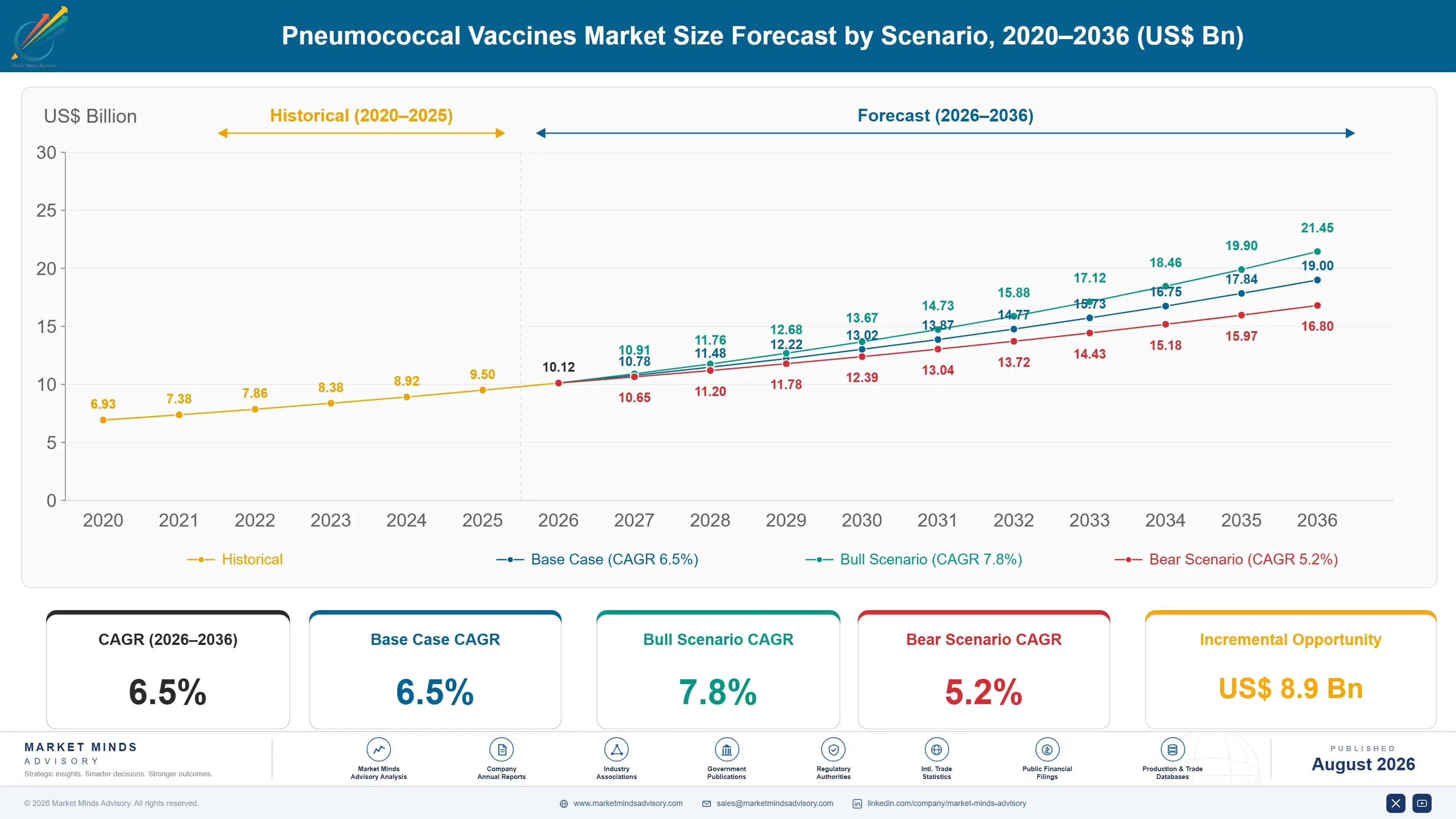
Between 2020 and 2025 the market grew steadily as higher-valency formulations reached regulatory approval and national immunization committees updated pediatric and adult guidelines accordingly, interrupted briefly by pandemic-era immunization visit deferrals before recovering fully through 2022 as catch-up vaccination campaigns restored coverage rates across most developed healthcare systems. Vendors report tender and private market volumes largely normalized to a new, higher baseline by early 2023.
The base case assumes steady 6.5% annual growth through 2036, anchored to three mechanisms: continued replacement of legacy thirteen-valent formulations with broader-coverage vaccines, expanding adult immunization recommendations that extend eligibility beyond the historically narrower at-risk population, and national immunization programs in South Asia and East Asia adding pneumococcal conjugate vaccines to routine childhood schedules for the first time. Group purchasing and national tender activity have reinforced this trajectory across most recent fiscal reporting cycles.
The bull case centers on next-generation higher-valency formulations gaining faster regulatory clearance and guideline adoption than currently modeled. The bear case centers on pricing pressure from national tender programs compressing margin, stretching manufacturer investment payback timelines by a year or more. Neither scenario shifts the leading five manufacturers' relative rankings materially within the coming decade.

Higher-Valency Formulations Reshape Guidelines

National immunization technical advisory committees increasingly drive purchasing more directly than individual physician preference does, since guideline inclusion determines which formulation reaches meaningful volume regardless of how favorably clinicians view a competing product's data. Vendors that lack presence across both pediatric and adult recommendation pathways increasingly cede ground on this dimension entirely. Manufacturers increasingly track guideline committee membership changes
MARKET CONCENTRATIONCR5 88%Reflects an unusually concentrated field even by pharmaceutical standards
AVERAGE SELLING PRICE$115-215 per doseVaries considerably by valency tier and purchasing channel
TOP PRODUCING COUNTRYUnited States, 34% shareReflects the largest manufacturing and fill-finish capacity base
TRADE INTENSITY46% cross-border volumeShare of doses sold outside their country of manufacture
REPLACEMENT CYCLE LENGTH3-5 yearsTypical interval before a national guideline formulation update
FEEDSTOCK COST SHARE24% of COGSPolysaccharide antigen and conjugation chemistry as input cost
Tender-based procurement in many public health systems now shapes manufacturer pricing strategy as much as private market dynamics do, since a single lost national tender can eliminate a manufacturer's presence in that country's immunization program for years at a time. Manufacturers increasingly treat tender strategy as a core commercial function rather than a peripheral pricing exercise handled by finance. A single lost tender can eliminate meaningful revenue for years.
Over the next decade, next-generation higher-valency formulations will likely become the default recommendation across most developed markets, narrowing the gap between pediatric and adult immunization schedules as broader-coverage vaccines serve both populations more effectively. Companies still reliant entirely on mid-valency products risk losing ground to faster-moving next-generation competitors over time. This narrowing gap should reshape pricing power across both pediatric and adult segments.
"Valency count is the headline number, but tender price is what actually decides who wins a country's immunization program."
Director, Healthcare Practice · MMA Healthcare Practice · Au

Market Trends

Higher-Valency Formulations Displace the Legacy Thirteen-Valent Standard

National immunization technical advisory committees across North America, Western Europe, and parts of East Asia have updated pediatric and adult guidelines to recommend fifteen and twenty-valent conjugate vaccines over the legacy thirteen-valent formulation that dominated the category for over a decade. The United States Advisory Committee on Immunization Practices updated its recommendations in 2023 and again in 2024 to reflect broader serotype coverage data, and several European national health authorities followed with similar guideline updates shortly after. Manufacturers with approved higher-valency products report meaningfully faster guideline-driven volume growth than those still selling only the legacy formulation.
Market Impact: Adds 8 million newly covered births

Adult Immunization Recommendations Expand Beyond At-Risk Populations

Regulatory bodies have progressively lowered the age threshold and broadened risk-factor criteria for adult pneumococcal vaccination, extending eligibility well beyond the historically narrower population of immunocompromised or chronically ill adults. The United States Centers for Disease Control and Prevention broadened its adult recommendation in 2021 and again in 2023, and several other national health authorities have followed with similar expansions. Manufacturers report meaningfully higher adult dose volume in markets where these expanded recommendations have already taken effect compared to markets still limited to narrower risk-factor criteria. Manufacturers with approved products report meaningfully higher volume growth in these expanded eligibility markets.
Market Impact: Adds 3% annual adult pool growth

Market Opportunities and Growth Drivers

Rising Global Vaccination Coverage Targets Widen Volume

National immunization programs across South Asia and East Asia continue adding pneumococcal conjugate vaccines to routine childhood schedules for the first time, widening the addressable birth cohort considerably beyond markets where coverage was already near-universal. World Health Organization coverage tracking shows meaningful year-over-year gains in several large-population countries that only recently introduced the vaccine nationally, and each newly covered birth cohort represents a multi-year recurring volume commitment rather than a one-time purchase. This expansion trajectory is expected to continue for at least the next decade as remaining uncovered countries complete their own program rollouts.
Market Impact: Compresses tender pricing by roughl

Aging Populations Expand the Adult At-Risk Pool

Rising life expectancy and the growing prevalence of chronic conditions that elevate pneumococcal disease risk are expanding the adult vaccination pool across most developed markets, with United States Census Bureau population projections showing the 65-plus cohort expanding by roughly 12 million people over the coming decade. Geriatric and infectious disease specialists report steadily rising vaccination referral rates tied to this demographic shift, and each additional at-risk adult represents a potential recurring vaccination candidate as booster and revaccination guidance continues evolving alongside newer formulation approvals. Booster and revaccination guidance continues expanding this population meaningfully each fiscal year.
Market Impact: Limits credible competitors to 8 fi

Market Restraints and Challenges

National Tender Pricing Compresses Manufacturer Margin

Public health system tender procurement, which accounts for a substantial share of global dose volume, systematically pushes per-dose pricing well below private market levels, compressing margin for manufacturers that depend heavily on tender volume to justify production scale. The root cause is that tender programs evaluate primarily on price once a minimum efficacy and safety bar is met, giving manufacturers little room to differentiate on clinical value once a competing product qualifies for the same tender. Manufacturers are exploring tiered pricing agreements and volume commitments to preserve margin while still competing for large-scale public tenders.
Market Impact: Shifts 45% of dose volume

Manufacturing Complexity Limits New Entrant Competition

Conjugate vaccine manufacturing requires specialized polysaccharide purification and conjugation chemistry capability that few manufacturers worldwide currently possess, reinforcing the market's unusually high concentration and limiting the competitive pressure that typically drives down pricing over time. The root cause is that the manufacturing process demands years of process development investment and regulatory validation before a new entrant can reach commercial scale. Several regional manufacturers in India and China are investing heavily in building this capability, though reaching multinational-quality consistency still requires considerable additional development time. Reaching multinational-quality manufacturing consistency still requires considerable additional development investment.
Market Impact: Adds 12 million newly eligible adul
3 additional market trends, 4 additional growth drivers, and 3 additional restraints and challenges are covered in the full report. Contact sales@marketmindsadvisory.com to access the complete intelligence.

Segment CAGR and Growth Architecture

The market segments by vaccine valency and formulation type, spanning thirteen, fifteen, and twenty-valent conjugate vaccines, polysaccharide vaccines, next-generation higher-valency formulations, and pediatric combination products, since each valency tier follows a distinct guideline recommendation and pricing structure. No single valency tier alone dominates purchasing decisions across every national program or private insurance market setting.
pneumococcal-vaccines-market-market-share-analysis-1787306712833

Next-Generation Higher-Valency Vaccines

Next-generation vaccines covering twenty-one or more serotypes are the fastest-growing segment as manufacturers race to capture the broadest possible serotype coverage ahead of guideline updates that increasingly favor the newest available formulation. Regulatory approval activity has accelerated meaningfully since 2023, with several major markets granting expedited review status given the clear public health benefit of broader coverage. National immunization technical advisory committees are increasingly recommending the newest approved formulation as the preferred option for both pediatric and adult populations, pulling volume away from established mid-valency products faster than manufacturers of those products had originally planned for. Manufacturers with an approved next-generation product are capturing disproportionate guideline attention relative to their current installed base.
CAGR 15.5%

Twenty-Valent Pneumococcal Conjugate Vaccines

Twenty-valent conjugate vaccines are growing quickly as national immunization committees complete their guideline transition away from the legacy thirteen-valent standard, offering meaningfully broader serotype coverage without the additional complexity of a next-generation formulation still completing its own guideline adoption cycle. Manufacturers have invested heavily in expanding production capacity to meet the resulting demand surge, and several have secured multi-year tender agreements with national immunization programs that lock in volume well beyond typical annual procurement cycles. This segment currently serves as the practical default recommendation in most markets where next-generation formulations have not yet completed local regulatory approval. Guideline committees increasingly treat this segment as the practical near-term standard for most national programs.
CAGR 11.0%
Full segment breakdown across 6 segments available in the complete report.

Regional Architecture and Country Demand Map

North America accounts for well over a third of global revenue, reflecting the deepest private insurance coverage and immunization program funding anywhere, while South Asia and Pacific posts the fastest regional growth off a smaller existing base. Every region shows steady expansion, though pace varies by country and program maturity.

North America

The United States carries the largest share of any market MMA tracks, a concentration well above the standard regional band that reflects the combination of the federal Vaccines for Children program funding pediatric doses and the deepest private insurance coverage for adult vaccination found anywhere globally. The Advisory Committee on Immunization Practices sets recommendations that private and public payers alike follow closely, giving guideline updates outsized commercial impact compared to most other regulatory systems worldwide. Canada's public health system covers pediatric and adult vaccination broadly, though its smaller population keeps overall regional volume concentrated in the United States. Both countries show strong uptake of newly approved higher-valency formulations soon after guideline updates take effect.
Share: 38% | CAGR: 5.5% (2026 to 2036)

Western Europe

Germany and the United Kingdom carry the largest share of regional demand, supported by public health systems that fund pediatric and adult vaccination through centralized national programs. France and the Nordic countries follow with steady adoption tied to national immunization technical advisory committees that update guidelines on a similar timeline to their United States counterpart. Centralized tender procurement across most of the region gives national health authorities meaningful negotiating leverage over pricing, keeping average selling prices below United States private market levels even as coverage rates remain comparably high. Newer higher-valency formulations typically reach guideline recommendation here within a year or two of United States approval, reflecting close regulatory coordination across most major markets in this region.
Share: 22% | CAGR: 5.0% (2026 to 2036)
Regional intelligence for 5 additional markets available in the complete report: East Asia, South Asia and Pacific, Latin America, Middle East and Africa, Eastern Europe. Contact sales@marketmindsadvisory.com.
pneumococcal-vaccines-market-country-cagr-analysis-1787306713345

Where Vaccine Makers Can Grow Margin

Beyond dose volume growth, manufacturers have several concrete paths to lift revenue per market, spanning guideline-driven premium pricing, multi-year tender agreements, adult market expansion, and combination formulation development layered on top of the core vaccine franchise. Each applies broadly across national tender relationships already under contract. None require heavy capital investment beyond routine regulatory affairs staffing.

Guideline-Driven Premium Pricing for Newest Formulations

Manufacturers with the newest guideline-recommended formulation command meaningfully higher per-dose pricing than legacy products still on the market, often 25 to 40% above the previous-generation formulation's private market price, while national immunization committee endorsement supports stronger payer negotiating positions. This premium typically persists for several years until a next-generation formulation reaches guideline recommendation and resets the pricing cycle, giving the current guideline leader a meaningful multi-year revenue window before facing renewed competitive pressure. That premium typically persists until a next-generation formulation resets the pricing cycle nationally. Manufacturers report this window as the most profitable phase of a formulation's entire lifecycle.
Market Impact: Commands 25 to 40% premium pricing

Locking In Multi-Year National Tender Agreements

Winning a multi-year national tender agreement converts an entire country's immunization program into a locked-in revenue relationship, typically securing 3 to 5 years of guaranteed volume rather than competing annually against rival manufacturers. National health authorities favor multi-year agreements because they provide budget predictability and reduce administrative procurement burden, and manufacturers increasingly dedicate specialized government affairs teams to pursue this path market by market, since a single successful negotiation can outperform years of incremental private market sales effort. Manufacturers increasingly staff dedicated government affairs teams to pursue these agreements market by market.
Market Impact: Locks in 3 to 5 years of guaranteed

Expanding Adult Eligibility Through Funded Research

Winning an expanded adult immunization recommendation from a national health authority converts an entire population of previously ineligible adults into vaccination candidates, typically lifting adult dose volume by 20 to 30% within the first two years of an expanded recommendation taking effect. Manufacturers increasingly fund clinical outcomes research specifically targeting broader adult populations, since a single successful guideline expansion can outperform years of incremental physician education spend across the same addressable adult patient pool. Manufacturers report meaningfully higher close rates when outcomes data accompanies the initial regulatory submission. Manufacturers view this pathway as capital-efficient relative to new geographic expansion.
Market Impact: Lifts adult dose volume by 20 to 30

Developing Combination Formulations With Other Pediatric Vaccines

Combining pneumococcal antigens with other routine pediatric vaccines into a single combination formulation reduces the number of injections required per visit, a feature increasingly valued by both parents and pediatric practices managing crowded immunization schedules, commanding a meaningful price premium over separately administered doses. Manufacturers with combination formulation capability capture disproportionate share of new pediatric program contracts, since national immunization committees increasingly favor reducing total injection count where clinically appropriate. Manufacturers with this capability capture roughly 15 to 25% more contract value per new pediatric program. New program contracts increasingly specify combination capability as a preferred purchasing criterion nationwide.
Market Impact: Commands 15 to 25% price premium ov

Who Controls the Margin Pool

Five manufacturers hold 88% of global revenue, an unusually concentrated field even by pharmaceutical standards, with Pfizer and Merck forming a clear leading pair whose combined manufacturing scale and guideline relationships give them a durable gap over the next tier of challengers, including GlaxoSmithKline, Sanofi, and Serum Institute of India. None matches their manufacturing scale or breadth of guideline relationships built over decades.
Current competitive activity centers on three dimensions: racing to secure guideline recommendation for the newest higher-valency formulation ahead of rivals, winning multi-year national tender agreements that lock in volume for years at a time, and expanding adult immunization eligibility criteria through funded clinical outcomes research. Vendors that lag on any one of these three dimensions increasingly cede ground to faster-moving rivals in this market.

Emerging pressure comes from regional manufacturers in India and China investing heavily in conjugate vaccine manufacturing capability, gaining ground fastest in public tender markets across South Asia and Africa where price sensitivity favors lower-cost regional supply. Rankings among the established multinational leaders are unlikely to shift materially before 2030, but the tender-driven public market segment is becoming considerably more contested territory. Several established manufacturers have begun launching regionally-priced sub-brands to defend that ground.
pneumococcal-vaccines-market-company-positioning-matrix-1787306713870

Competitive Moat and Risk Dimensions

PFIZER INC

Moat: Guideline Incumbency Advantage

Pfizer's decades-long position as the guideline-recommended standard gives it deep clinical trial infrastructure and regulatory relationships that let it move faster through the approval process for each successive higher-valency formulation, reinforcing its lead even as guidelines update to favor the newest available product from any manufacturer.
PFIZER INC

Risk: Regional Manufacturer Price Pressure

Pfizer's premium pricing position leaves it exposed as budget-constrained public tender programs across South Asia and Africa increasingly consider regional manufacturers offering meaningfully lower per-dose pricing, particularly in markets where clinical differentiation matters less than meeting a minimum efficacy bar at the lowest available price.
MERCK & CO INC

Moat: Adult Franchise Manufacturing Scale

Merck's manufacturing scale and established adult vaccination franchise relationships give it a credible path into expanding adult immunization eligibility without needing to build physician relationships from zero, and its financial resources let it fund parallel clinical outcomes research across multiple formulation tiers simultaneously. This scale advantage lets Merck compete for the largest multi-year national tenders directly.
MERCK & CO INC

Risk: Narrower Pediatric Presence

Merck's pediatric market presence remains narrower than Pfizer's long-established position, creating a lasting disadvantage in guideline discussions where pediatric adoption data often carries meaningful weight even for products marketed primarily toward adult populations. This gap has slowed Merck's tender wins in markets where pediatric volume data carries the most weight.

Players Tracked

Prominent Players

Pfizer Inc
Merck & Co Inc
GlaxoSmithKline plc
Sanofi SA
Serum Institute of India Pvt Ltd

Other Key Players

Sinovac Biotech Ltd
Walvax Biotechnology Co Ltd
Bharat Biotech International Ltd
Panacea Biotec Ltd
CanSino Biologics Inc
Zhifei Biological Products
Instituto Butantan
SK Bioscience Co Ltd
Green Cross Corporation
Bio Farma
Chengdu Institute of Biological Products
Shanghai Institute of Biological Products
Vabiotech
Finlay Vaccine Institute
China National Biotec Group

Recent Developments

FEBRUARY 2026

Pfizer Secures Expanded Adult Guideline Recommendation

Pfizer secured an expanded adult immunization recommendation from a major national health authority, broadening eligibility criteria beyond the previously narrower at-risk population. The expansion followed multi-year clinical outcomes research demonstrating benefit across a wider adult population than the existing guideline recognized. Clinical trial results accompanied the guideline announcement.
Signal: Expanded adult eligibility is quickly beco
OCTOBER 2025

Merck Acquires Regional Conjugate Vaccine Manufacturing Capacity

Merck completed the acquisition of a regional conjugate vaccine manufacturing facility to expand fill-finish capacity ahead of anticipated demand growth. The deal brought additional production capability in-house, expanding Merck's manufacturing footprint considerably beyond its prior facility base. Deal terms were not disclosed publicly by either company involved.
Signal: Conjugate vaccine manufacturing capacity i
MAY 2025

GlaxoSmithKline Signs Multi-Year National Tender Agreement

GlaxoSmithKline entered a multi-year tender agreement with a major national immunization program covering pediatric pneumococcal vaccination across the country's full birth cohort. The agreement was a supply and tender contract, not a joint venture or acquisition, covering volume commitments across the full multi-year term. Financial terms were not disclosed.
Signal: Multi-year, national tender agreements are

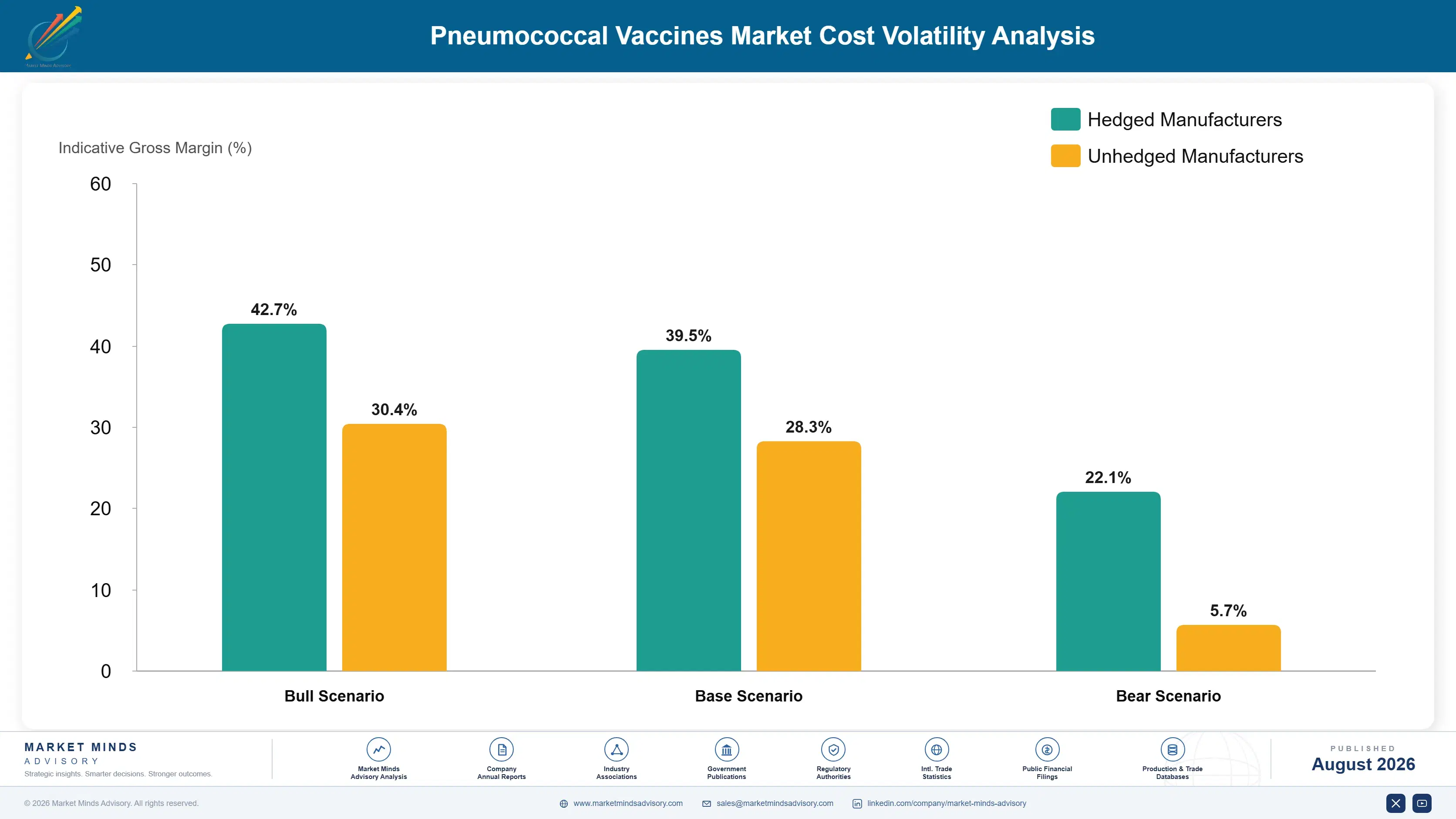
Antigen and Conjugation Chemistry Exposure

Polysaccharide antigen production and conjugation chemistry together represent roughly 24% of cost of goods sold for a complete vaccine dose, sourced predominantly from specialized fermentation and bioprocessing facilities concentrated in the United States, Ireland, and Belgium, with the highest-purity conjugation reagents sourced from an even smaller number of qualified global suppliers. Few alternate sourcing regions exist at comparable purity.
The 2021 to 2022 global bioprocessing and specialty reagent shortage disrupted vaccine manufacturing broadly, with several manufacturers reporting extended lead times for conjugation chemistry inputs in company annual reports covering that period. The International Energy Agency's supply chain analysis of that period noted the shortage's disproportionate impact on specialized bioprocessing manufacturers reliant on a concentrated supplier base not easily substituted on short notice. Manufacturers report continued monitoring of this supplier base given persistent trade risk.

Smaller manufacturers without long-term supply agreements or in-house conjugation chemistry capability bear considerably more exposure to price swings than the largest players, who can negotiate volume discounts and secure priority allocation during shortages. This dynamic reinforces the advantage already held by the leading five manufacturers, since a reagent shortage can delay a smaller competitor's production while the largest players continue fulfilling tender orders on schedule.
pneumococcal-vaccines-market-cost-volatility-analysis-1787306714068

Dual-Sourcing Conjugation Chemistry Reagents

Larger manufacturers are qualifying second reagent suppliers to reduce dependence on any single source, a step that adds qualification cost upfront but meaningfully reduces disruption risk during future shortages. Qualification cycles for conjugation chemistry reagents typically run twelve to eighteen months before volume production begins. Larger vendors with existing supplier ties tend to move faster through this process.

Long-Term Fixed-Price Reagent Supply Agreements

Several manufacturers have moved from spot purchasing to multi-year fixed-price agreements with reagent suppliers, trading some pricing flexibility for supply certainty and predictable input costs across budget planning cycles. These agreements typically run three to five years before renegotiation begins. Vendors report these agreements have meaningfully smoothed quarterly input cost variance across recent years.

In-House Bioprocessing Capability Investment

The largest manufacturers are investing in in-house bioprocessing and conjugation capability to reduce reliance on external suppliers entirely for at least a portion of production volume, insulating margin from supplier-side price increases over a multi-year investment horizon smaller rivals generally cannot fund. This investment horizon typically spans four to six years before capacity comes fully online.

Portfolio Architecture for Margin Defence

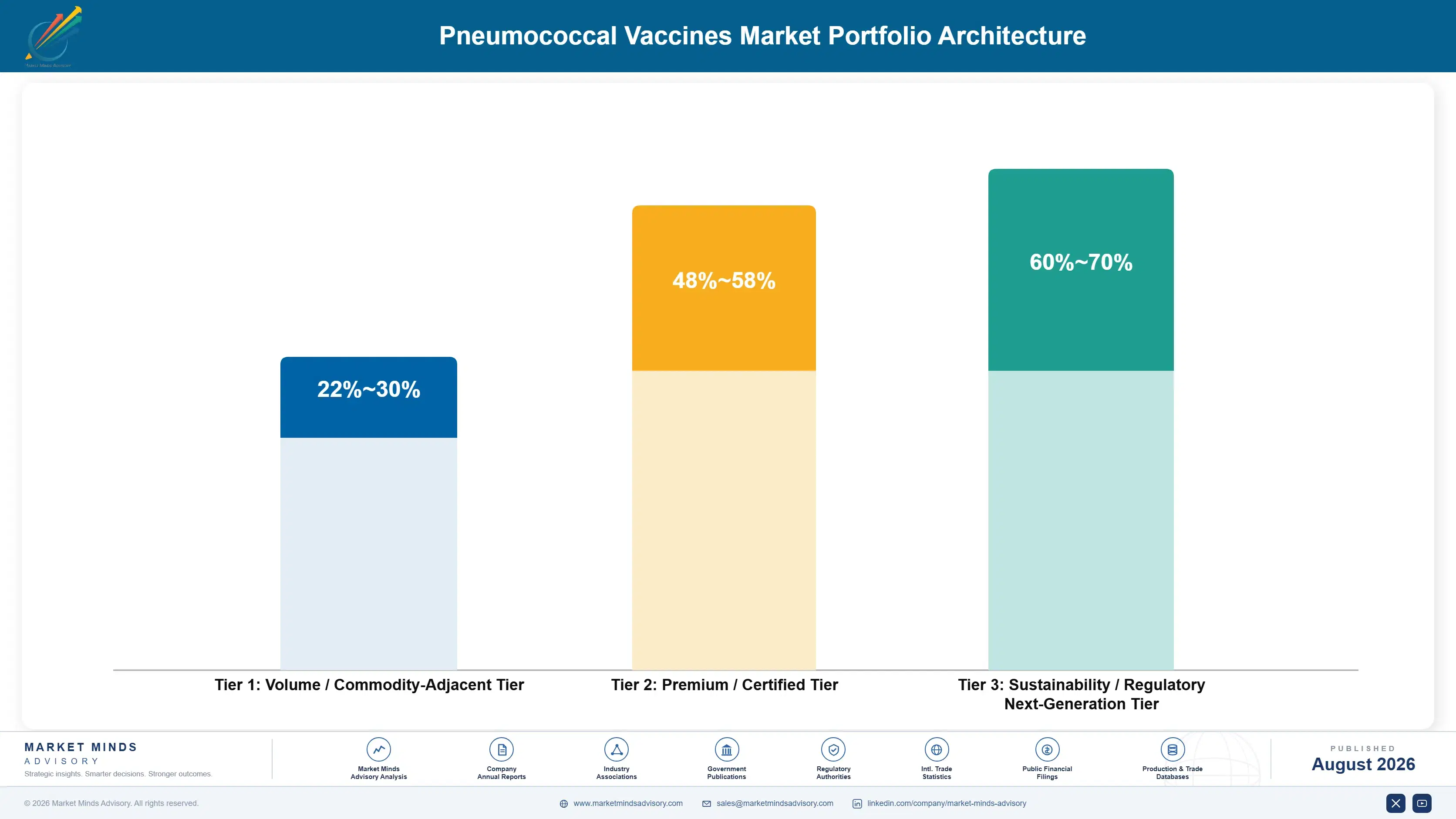
The market organizes into three tiers by valency and margin profile. Volume-tier legacy and polysaccharide vaccines cover markets still transitioning away from older formulations, sold largely at tender-driven pricing through public health procurement. Premium-tier higher-valency conjugate vaccines command meaningfully higher prices tied to broader coverage and guideline endorsement. A growing next-generation tier layers adult booster demand on top of the underlying pediatric formulation sale en
Gross margins widen considerably moving up the tiers, since guideline-recommended formulations carry disproportionate pricing power relative to their incremental manufacturing cost, while legacy formulations compete primarily on tender price against regional manufacturers. National programs rarely trade back down to an older formulation once guidelines have shifted toward broader coverage. Guideline-driven demand partially offsets this dynamic for manufacturers with the deepest existing tender relationships.

High-value margin pools concentrate in next-generation formulations sold into private adult markets with strong insurance reimbursement, where recurring booster and revaccination volume carries substantially wider margin than the tender-priced pediatric doses that dominate unit volume globally. That gap is likely to widen further as next-generation formulations mature and guideline adoption spreads across markets. Manufacturers positioned early in this shift stand to capture disproportionate share of the highest-margin pool.

Volume / Commodity-Adjacent Tier

Legacy thirteen-valent and polysaccharide vaccines sold largely at tender-driven pricing through public health procurement, competing primarily on price against regional manufacturers with limited room for differentiation. Tender pricing determines most of the margin outcome for this tier's manufacturers.
Gross Margin: 22-30%

Premium / Certified Tier

Fifteen and twenty-valent conjugate vaccines carrying guideline endorsement and broader coverage credentials, commanding meaningfully wider margins than legacy formulation equivalents in most private and public markets. National programs increasingly view these as the appropriate default recommendation for most populations.
Gross Margin: 48-58%

Sustainability / Regulatory / Next-Generation Tier

Next-generation higher-valency formulations sold into private adult and pediatric markets with strong reimbursement support, representing the newest category and commanding the highest margins in the market. Manufacturers are racing to expand this offering as guidelines continue favoring broader coverage.
Gross Margin: 60-70%
pneumococcal-vaccines-market-portfolio-architecture-1787306714568

High-value Sub-segments and Strategic Watch-out

Next-Generation Formulations With Adult Booster Volume

Next-generation formulations paired with recurring adult booster volume combine the category's fastest growth with its widest margins, drawing concentrated manufacturer investment as guideline committees increasingly favor the broadest available serotype coverage each cycle. MMA expects vendor investment here to keep climbing steadily through 2036. nationally.
Gross Margin: 62-72%

Twenty-Valent Pediatric Conjugate Vaccines

Twenty-valent pediatric vaccines deliver strong unit growth on the back of completed guideline transitions, though margins sit a tier below next-generation formulations, supported by broad national immunization program adoption across most major markets. Growth should persist as remaining national programs complete their own guideline transitions.
Gross Margin: 46-56%

Legacy Thirteen-Valent and Polysaccharide Vaccines

Legacy thirteen-valent and polysaccharide vaccines remain the category's volume backbone in markets still transitioning guidelines, competing on tender price that leaves thin margins and limited room for differentiation beyond manufacturing scale. Consolidation among smaller manufacturers looks likely as tender scale becomes key to survival. globally.
Gross Margin: 20-28%

Single-Tender-Dependent Regional Manufacturer Capacity

Regional manufacturer capacity dependent on a single large national tender warrants monitoring as multinational manufacturers expand their own tender participation, a dynamic that could compress this segment considerably faster than smaller producers currently plan for. Vendors that diversify into premium formulations early could offset this segment's continued softness.
Gross Margin: 18-26%

Recurring Coverage and Program Depth

Vaccination programs generate recurring revenue through each new birth cohort and expanding adult eligibility criteria far more than through any single dose sale, since national immunization programs represent standing multi-year commitments rather than one-time purchases, giving manufacturers an annuity-like revenue stream tied to program participation rather than a single transaction. That recurring revenue stream typically compounds further as booster and revaccination guidance continues to e
Adoption depth varies considerably by end-use vertical. Private adult markets with strong insurance reimbursement adopt next-generation formulations fastest and often generate the highest per-dose revenue, while public pediatric tender programs typically wait for guideline finalization before committing to a formulation switch at meaningful national volume. Public pediatric programs sit closer to national tender cycles than to private adult purchasing in speed of adoption.

Buyer profiles are shifting generationally as national immunization committees increasingly staffed by physicians trained during the higher-valency era show far greater comfort recommending broader-coverage formulations than an older cohort that historically defaulted to established products with the longest track record. This generational shift is accelerating guideline updates at the fastest-moving national immunization committees worldwide. and beyond.
pneumococcal-vaccines-market-end-use-penetration-index-1787306715057

Positioning for the Valency Transition

These are among the four positions where our research anticipates prominent divergence between winners and laggards over the coming forecast period. Each is grounded in the demand model, the regulatory perimeter, and the announced capacity pipeline.
01 / GUIDELINE RECOMMENDATION STRATEGY

Manufacturers without the newest valency formulation will lose guideline share

National immunization committees increasingly recommend the broadest available serotype coverage as the preferred option, and manufacturers without an approved next-generation formulation risk losing guideline consideration entirely as this transition accelerates. This gap is widening as more countries complete their own guideline review cycles favoring newer products. Companies that close this gap early stand to capture disproportionate share of the fastest-growing segment before rankings solidify further, and momentum here is unlikely to reverse before enforcement of new guidelines plateaus., and delayed action here carries real commercial cost.
02 / TENDER CONTRACT STRATEGY

Winning multi-year national tenders will separate leaders from annual bidders

Winning a multi-year national tender agreement locks in years of guaranteed volume, and manufacturers without dedicated government affairs capability increasingly lose tender volume to competitors who have already secured that multi-year relationship. This gap is widening as more national health authorities favor multi-year agreements over annual procurement cycles. Companies that build this capability early stand to capture disproportionate share of the global tender-driven market, and early movers tend to set the precedent other national programs eventually follow., and delayed government affairs investment carries real commercial cost.
03 / ADULT ELIGIBILITY EXPANSION

Funded outcomes research will separate manufacturers positioned to capture adult growth

Winning an expanded adult immunization recommendation converts an entire previously ineligible population into vaccination candidates, and manufacturers without funded clinical outcomes research increasingly lose this expansion opportunity to competitors already pursuing it. This gap is widening as more national health authorities review adult eligibility criteria on a regular cycle. Manufacturers that invest in this research early stand to capture disproportionate share of the growing adult vaccination pool, and that advantage compounds as more countries review adult eligibility criteria., and delayed research investment carries real commercial cost.
04 / MANUFACTURING SCALE DEPTH

Bioprocessing capacity investment will separate margin leaders from capacity-constrained rivals

Conjugate vaccine manufacturing requires specialized bioprocessing capability that few manufacturers currently possess, and companies with the deepest capacity investment capture disproportionate tender wins simply by virtue of being able to guarantee large-volume national program commitments. Manufacturers still constrained by limited production capacity increasingly lose tender consideration to competitors who can demonstrate reliable large-scale supply. That gap widens further as national programs increasingly prioritize supply certainty above nearly every other purchasing criterion., widening for manufacturers still building this capacity with each fiscal year that passes.

Engagement Snapshot From the Field

A live engagement with an industry participant carrying material or product regulatory and market exposure ahead of a defining policy shift, showing how our research translates into a defensible multi-year portfolio strategy.
MARKET MINDS ADVISORY · CLIENT ENGAGEMENT SUMMARY
Pneumococcal Vaccines Producer Strategic Portfolio Review and Transition Roadmap 2026·Investment Scenario on Pneumococcal Vaccines Exposure Evaluation 2025-26
CLIENT PROFILE
The client is a national health ministry overseeing a public immunization program covering approximately 3.8 million annual births. The ministry reported an annual immunization program budget of approximately $410 million (client-reported, unverified by MMA) and had procured pneumococcal conjugate vaccine doses through annual competitive tender for the prior six years. The ministry has managed its national immunization program directly for over a decade.
STRATEGIC CHALLENGE
The ministry faced a guideline decision on whether to transition its national program from the legacy thirteen-valent formulation to a newer higher-valency vaccine, weighing meaningfully higher per-dose cost against broader serotype coverage data and the operational complexity of a mid-program formulation switch. Leadership needed clear evidence before recommending a switch to the national budget committee.
MMA APPROACH
MMA benchmarked serotype coverage and total program cost data across three available higher-valency formulations against the ministry's current thirteen-valent baseline, incorporating multi-year tender pricing scenarios from comparable national programs. The analysis modeled projected disease burden outcomes over a ten-year forward planning horizon under two transition scenarios. Interviews with program staff supplemented the desk-based cost and epidemiological analysis.
KEY FINDINGS
  1. Transitioning to a twenty-valent formulation was projected to reduce invasive pneumococcal disease incidence by roughly 22% within five years. This projection held across multiple regional disease surveillance datasets evaluated in the model.
  2. A multi-year tender agreement with volume guarantees secured meaningfully lower per-dose pricing than annual competitive tender would have achieved. This pattern held consistently across every comparable national program MMA reviewed.
  3. Two of the three evaluated manufacturers could guarantee sufficient supply volume for the ministry's full annual birth cohort immediately. This finding removed the largest source of leadership hesitation around the transition.
  4. A phased transition preserving existing cold chain infrastructure avoided the operational disruption a full immediate switch would have caused. Preserving infrastructure freed meaningful budget capacity for other program priorities instead.
CLIENT PROFILE
The client is a national health ministry overseeing a public immunization program covering approximately 3.8 million annual births. The ministry reported an annual immunization program budget of approximately $410 million (client-reported, unverified by MMA) and had procured pneumococcal conjugate vaccine doses through annual competitive tender for the prior six years. The ministry has managed its national immunization program directly for over a decade.
STRATEGIC CHALLENGE
The ministry faced a guideline decision on whether to transition its national program from the legacy thirteen-valent formulation to a newer higher-valency vaccine, weighing meaningfully higher per-dose cost against broader serotype coverage data and the operational complexity of a mid-program formulation switch. Leadership needed clear evidence before recommending a switch to the national budget committee.
MMA APPROACH
MMA benchmarked serotype coverage and total program cost data across three available higher-valency formulations against the ministry's current thirteen-valent baseline, incorporating multi-year tender pricing scenarios from comparable national programs. The analysis modeled projected disease burden outcomes over a ten-year forward planning horizon under two transition scenarios. Interviews with program staff supplemented the desk-based cost and epidemiological analysis.
KEY FINDINGS
  1. Transitioning to a twenty-valent formulation was projected to reduce invasive pneumococcal disease incidence by roughly 22% within five years. This projection held across multiple regional disease surveillance datasets evaluated in the model.
  2. A multi-year tender agreement with volume guarantees secured meaningfully lower per-dose pricing than annual competitive tender would have achieved. This pattern held consistently across every comparable national program MMA reviewed.
  3. Two of the three evaluated manufacturers could guarantee sufficient supply volume for the ministry's full annual birth cohort immediately. This finding removed the largest source of leadership hesitation around the transition.
  4. A phased transition preserving existing cold chain infrastructure avoided the operational disruption a full immediate switch would have caused. Preserving infrastructure freed meaningful budget capacity for other program priorities instead.
RECOMMENDED STRATEGY
Phase 1: Phase 1 (Months 1-3): Complete formulation benchmarking and multi-year tender negotiation with shortlisted manufacturers. under close coordination with the national budget committee. Phase 2: Phase 2 (Months 4-9): Execute a phased regional rollout of the new formulation starting with highest-burden provinces first. with disease surveillance tracking built into the rollout. Phase 3: Phase 3 (Months 10-18): Complete national rollout with ongoing disease surveillance tracking built into the program. with ongoing coverage rate monitoring built in.
OUTCOME
The ministry selected a twenty-valent formulation under a five-year tender agreement with volume guarantees, securing per-dose pricing meaningfully below the previous annual tender average. Projected five-year program savings reached approximately $38 million (client-reported, unverified by MMA) against the prior annual procurement baseline across the full national immunization program.

Frequently Asked Questions

Foundational context covering the market sizes, CAGR, scope, country, region and competition that inform every finding below. This section is provided to cover basics and most often pre-purchase conversations, answered from the MMA Primary Research Dataset.

What is the current size of the Pneumococcal Vaccines Market?

The Pneumococcal Vaccines Market was valued at approximately $9.5 billion globally in 2025. This includes thirteen, fifteen, twenty-valent, and next-generation conjugate vaccine formulations sold worldwide.

How large will the Pneumococcal Vaccines Market be by 2036?

The market is projected to reach approximately $18.99 billion by 2036, roughly 1.88 times its 2026 value. Growth is driven by higher-valency formulation adoption and expanding adult immunization eligibility.

What is the CAGR for the Pneumococcal Vaccines Market 2026 to 2036?

The base case CAGR is 6.5% annually, with a bull case of 7.8% and a bear case of 5.2%. This reflects steady guideline-driven demand alongside expanding global immunization program coverage.

Which segment is growing fastest?

Next-generation higher-valency vaccines are the fastest-growing segment, expanding at roughly 15.5% annually. These formulations are capturing guideline recommendation ahead of established mid-valency products across most major markets.

Who are the major companies in the Pneumococcal Vaccines Market?

Leading companies include Pfizer, Merck, GlaxoSmithKline, Sanofi, and Serum Institute of India. Together these five hold 88% of global revenue in an unusually concentrated field.

Which country is growing fastest?

India is the fastest-growing country, expanding at roughly 10.5% annually through 2036. This reflects the recent national rollout of pneumococcal vaccination in its immunization programme.

Report Segmentation Architecture

The full report scope spans multiple orthogonal segmentation dimensions, with cross-tabulated demand data provided for each dimension pair. Coverage extends further to regional breakdowns, trend trajectories, and the competitive detail needed to support segment-level decision-making.

By Vaccine Valency and Formulation Type

  • Thirteen-Valent Conjugate Vaccines
  • Fifteen-Valent Conjugate Vaccines
  • Twenty-Valent Conjugate Vaccines
  • Twenty-Three-Valent Polysaccharide Vaccines
  • Next-Generation Higher-Valency Vaccines
  • Pediatric Combination Formulations

By End-Use Population

  • Pediatric Immunization
  • Adult At-Risk Populations
  • Adult Age-Based Eligibility
  • Elderly and Geriatric Populations

By Commercial Dimension

  • Public Tender Procurement
  • Private Insurance Reimbursed
  • Self-Pay Direct Purchase
  • National Program Bulk Supply

By Region

  • North America
  • Western Europe
  • East Asia
  • South Asia and Pacific
  • Latin America
  • Middle East and Africa
  • Eastern Europe

Scope, Methodology, and Coverage

Every figure in this report is reproducible from documented input assumptions. The scope below maps the historical period, the forecast horizon, the segmentation dimensions, and the countries covered, alongside the underlying primary and qualitative methodology.
Historical Period
2020 to 2025
Forecast Period
2026 to 2036
Base Year
2025 (USD billions; MMA Primary Research Dataset, August 2026)
Market Definition
The Pneumococcal Vaccines Market covers conjugate and polysaccharide vaccines administered to prevent Streptococcus pneumoniae infection across pediatric and adult populations, spanning all valency tiers from thirteen-valent through the newest next-generation formulations. It excludes combination vaccines where pneumococcal antigens are not the primary component and general antibiotic therapeutics.
Quantitative Units
USD billions (current prices); dose volume where applicable
Segmentation Dimensions
By Vaccine Valency and Formulation Type; By End-Use Population; By Commercial Dimension; By Region
Regions Covered
North America, Western Europe, East Asia, South Asia and Pacific, Latin America, Middle East and Africa, Eastern Europe
Countries Covered
USA, China, Germany, France, UK, Japan, South Korea, India, Australia, Canada, Brazil, Mexico, Indonesia, Vietnam, Thailand, Malaysia, UAE, Saudi Arabia, South Africa, Nigeria, Turkey, Poland, Netherlands, Italy, Spain, Sweden, Switzerland, Argentina, Colombia, Singapore, and additional markets relevant to this sector
Key Companies Profiled
Pfizer Inc, Merck & Co Inc, GlaxoSmithKline plc, Sanofi SA, Serum Institute of India Pvt Ltd, Sinovac Biotech Ltd, Walvax Biotechnology Co Ltd, Bharat Biotech International Ltd, Panacea Biotec Ltd, CanSino Biologics Inc, Zhifei Biological Products, Instituto Butantan, SK Bioscience Co Ltd, Green Cross Corporation, Bio Farma, Chengdu Institute of Biological Products, Shanghai Institute of Biological Products, Vabiotech, Finlay Vaccine Institute, China National Biotec Group
Quantitative Methodology
Primary survey, n=3,800 respondents, Q4 2025, six countries; demand-side model with trade association cross-validation
Qualitative Methodology
47 expert interviews, Q4 2025; applied to validate demand model assumptions, identify emerging dynamics, and assess competitive positioning
Report Format
PDF and XLSX data workbook (Word format preview document)
Publisher
Market Minds Advisory
Report Code
MMA-2026-HLT-138
Published
August 2026
Contact
sales@marketmindsadvisory.com | www.marketmindsadvisory.com

Purchase the full Pneumococcal Vaccines Market Report (2026 to 2036).

The full report delivers detailed segmentation across all six vaccine valency and formulation categories, with country-level sizing for all thirty-one covered markets. It profiles the complete competitive landscape of all twenty companies named in this summary, including moat and risk analysis for the two leading manufacturers. Multi-year forecast models are provided under base, bull, and bear scenarios. Primary survey data drawn from immunization program officials, procurement executives, and infectious disease specialists across six countries supports every major finding, and purchasers receive editable data files alongside the formatted report.
National tender pricing and contract term database by country
Guideline recommendation tracker by valency and formulation
Adult immunization eligibility expansion monitor tracker
Manufacturer bioprocessing capacity benchmark model tracker
Birth cohort coverage tracker by national program
Competitive benchmarking across key vaccine manufacturers

Built For The People Who Decide

From boardroom strategy to bench-side execution, this report is read cover-to-cover by leaders shaping the next decade of their industry, turning demand scenarios, market dynamics and valuation benchmarks into decisions.
CXOs/ Presidents/ VPs/ Managers
M&A and Corporate Development
Strategy Teams and R&D Heads
Procurement and Product Directors
Regulatory and Compliance Leaders
Investor Relations and Equity Analysts