Market Minds Advisory
Plastic Rubber Composite Market

Plastic Rubber Composite Market: Circular Content and Regional Demand to 2036

Automotive sealing suppliers and flooring manufacturers are scaling recycled tire rubber into plastic composite formulations as circular economy mandates tighten, while virgin rubber and polymer feedstock prices reshape how compounders balance recycled content and performance.

Lead Analyst

Bilal Shaikh

Published

September 2026

Make Smarter Decisions with Customized Research Insights

Request a free sample report and evaluate market opportunities, growth trends, and competitive dynamics relevant to your business needs.

2025 MARKET VALUE$4.6BMarket Size 2025
2036 FORECAST VALUE$8.8BBase Case , 2026 to 2036
CAGR 2026 TO 20366.1 %Bull 7.3% / Bear 4.8%
INCREMENTAL OPPORTUNITY$3.9BNet 10- year value creation
EXPANSION MULTIPLE1.81x2036 value over 2026 base
Strategic Levers
M&A Pipeline
Regional Outlook
Country Rankings
Competitive Intelligence
Segmental Deep-dive
Call-Us : 91 93563 13602

Executive Snapshot and Market Trajectory

Plastic rubber composite selection has moved from a straightforward cost-driven material choice into a circular content and performance engineering decision, as automotive and construction manufacturers increasingly specify recycled tire rubber-plastic blends over virgin formulations to meet tightening sustainability procurement requirements across major manufacturing regions.
Recycled tire rubber-plastic composites are growing fastest as automotive sealing suppliers and flooring manufacturers scale circular content formulations that meet sustainability procurement mandates, pulling volume toward recycled-content blends over conventional virgin rubber-plastic composites. China's dominant automotive and industrial manufacturing base absorbs the largest share of global plastic rubber composite demand, even as European and American specialty compounders retain deep recycled content processing and performance consistency expertise built over decades of tire recycling development.
Competition sits between diversified compounding majors offering broad rubber-plastic portfolios across multiple application categories and specialty recyclers competing on tire crumb processing quality and consistency. Rising circular economy mandates and extended producer responsibility regulation are accelerating recycled content adoption across automotive and construction applications, while virgin rubber and polymer feedstock price volatility periodically compresses compounder margins and pushes formulators toward higher recycled content ratios to manage cost exposure.
Market Definition
Plastic rubber composites are engineered materials combining thermoplastic polymers with rubber compounds, including recycled tire rubber, used across automotive sealing, construction, industrial damping, and consumer product applications. The market excludes pure thermoplastic elastomers without distinct rubber-phase blending and standalone recycled rubber crumb sold unprocessed.
Base Year Value
$4.6B in 2025 (MMA Primary Research Dataset, August 2026)
Forecast Period
2026 to 2036, eleven discrete annual values
CAGR
6.1% base case. Bull 7.3%. Bear 4.8%.
Fastest Growth Segment
Recycled Tire Rubber-Plastic Composites: 8.9% CAGR
Fastest Growth Country
China: 7.6% CAGR
Fastest Growth Region
South Asia and Pacific: 8.1% CAGR
Largest Region
East Asia: 29% of 2025 global value
Market Leaders
Teknor Apex Company, Lehigh Technologies, Continental AG, Trelleborg AB, and Kraton Corporation lead the field. Source: MMA Analysis based on company annual reports.
Primary Survey
n=3,800 procurement and R&D decision-makers, Q4 2025, six countries
Methodology
Demand-side build-up, cross-validated against public data, 47 expert interviews

Plastic Rubber Composite Market Forecast Scenarios

plastic-rubber-composite-market-trends-size-forecast-scenario-1787581271645
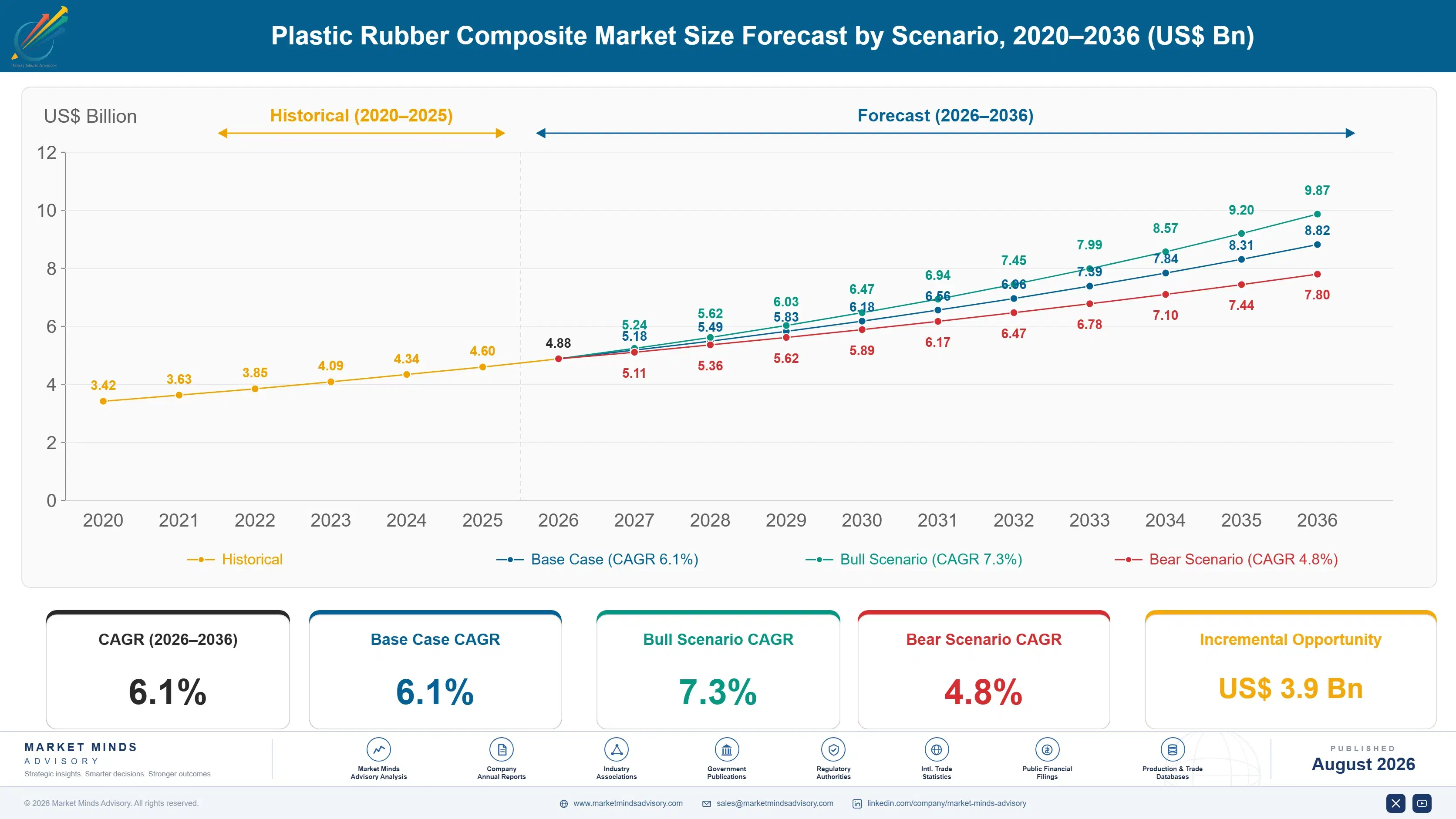
Between 2020 and 2025 plastic rubber composite demand grew at roughly 5.4 percent a year, held back early by pandemic-era automotive production disruption before accelerating as circular economy mandates spread across major manufacturing regions and construction specifications increasingly favored recycled content. Virgin rubber and polymer feedstock price spikes during 2021 and 2022 pushed some compounders toward higher recycled content ratios, accelerating substitution beyond what mandates alone would have driven.
The base case assumes continued growth as three mechanisms compound: automotive manufacturers specifying recycled content sealing and gasket components to meet sustainability procurement targets across major vehicle platforms; construction material specifiers increasingly favoring recycled rubber-plastic flooring and roofing membrane products that qualify for green building certification programmes; and extended producer responsibility regulation in several major markets mandating minimum recycled tire rubber content, creating sustained policy-driven demand independent of virgin material cost cycles.
The bull case turns on faster-than-expected extended producer responsibility mandate expansion across additional major manufacturing regions following European Union regulatory precedent. The bear case centers on a sustained virgin polymer price collapse, which has historically weakened the cost case for recycled content substitution and slowed compounder margin expansion, a pattern last seen during the 2020 oil price collapse.

Circular Content Mandates and Feedstock Substitution Economics

Plastic rubber composites sit at the intersection of circular economy policy, automotive and construction manufacturing cycles, and rising sustainability procurement requirements. As regulators and brand owners push recycled content adoption, compounders increasingly compete on documented tire crumb processing quality and performance consistency rather than raw material cost alone, even where recycled content formulations carry a meaningful price premium over conventional virgin rubber-plastic blends.
MARKET CONCENTRATIONCR5: 36%Ownership concentrates among a handful of established compounders
AVERAGE SELLING PRICE$2,600 per tonnePricing varies sharply by recycled content and application grade
CAPACITY UTILISATION72%Compounding plants run moderately below full rated capacity
TOP PRODUCER SHARETop 3 countries: 56%Manufacturing concentrates near major global automotive assembly hubs
TRADE INTENSITY41% cross-borderFinished composites ship globally to component manufacturing customers
RECYCLED CONTENT SHARE29% of volumeRecycled tire rubber formulations now approach a third of shipments
Commercially the category splits between diversified compounding majors offering broad rubber-plastic portfolios across multiple application categories and specialty recyclers competing on tire crumb processing quality and consistency for specific applications. Diversified majors compete on manufacturing scale and breadth across applications, while specialty recyclers win on deep technical expertise in tire crumb processing, since automotive, construction, and industrial applications each demand distinct performance and consistency specifications.
The next decade will be shaped by continued extended producer responsibility mandate expansion, rising demand for recycled content formulations across automotive and construction applications, and virgin feedstock price volatility that periodically strengthens the economic case for recycled content substitution. Compounders that can pair documented recycled content performance with consistent processing quality stand to capture share from competitors still selling conventional virgin formulations without comparable sustainability credentials.
"Nobody specified recycled tire rubber content five years ago just because it was cheaper; now automakers write it into the purchasing spec because their own sustainability targets demand it, and that regulatory pull is what's actually driving procurement volume."
Director, Circular Materials and Specialty Compounds Practice · MMA Chemicals and Materials Practice · August 2026

Market Trends

Extended Producer Responsibility Mandates Drive Recycled Content Adoption

Regulators across the European Union, several North American states, and increasingly China are expanding extended producer responsibility mandates requiring minimum recycled tire rubber content in qualifying automotive and construction applications, pushing compounders toward higher recycled content formulations across broader product lines. Compliance has required compounders to requalify entire formulation systems against automotive and construction performance standards, a process that can take nine to fifteen months per grade given extensive mechanical and durability testing requirements. Compounders with established recycled content expertise and certification documentation are capturing share from smaller producers unable to invest in the qualification infrastructure required.
Market Impact: Adds 5 percent volume from mandates
Automotive Sealing Applications Demand Higher Recycled Content Ratios

Automotive manufacturers increasingly specify recycled tire rubber-plastic composites for sealing, gasket, and weatherstripping components as sustainability procurement targets extend beyond exterior body panels into functional sealing components previously reserved for virgin material formulations exclusively. This application segment commands substantially higher per-tonne pricing than commodity construction-grade composites, reflecting the certification and performance requirements automotive manufacturers demand from qualified suppliers meeting durability and sealing performance standards. Several major automotive suppliers have introduced dedicated recycled-content sealing product lines specifically engineered for functional automotive applications, and suppliers with proven automotive qualification track records are winning platform contracts faster than construction-focused compounders.
Market Impact: Sustains 3 percent baseline volume

Market Opportunities and Growth Drivers

Circular Economy Regulation Expands Across Major Manufacturing Regions

Governments across the European Union, several North American states, and increasingly Asian manufacturing hubs continue expanding circular economy and extended producer responsibility regulation, requiring documented recycled content in qualifying automotive and construction applications following growing policy consensus around tire waste diversion from landfills. Every regulatory mandate expansion creates sustained, policy-driven demand for recycled tire rubber-plastic composites independent of virgin material cost cycles that historically drove substitution decisions. Suppliers that secure recycled content certification and documented compliance infrastructure gain multi-year volume visibility uncommon in most specialty compound categories, since regulatory mandates rarely reverse once implemented and scaled across a manufacturing region.
Market Impact: Adds up to 15 percent cost

Construction Green Building Certification Sustains Steady Demand

Construction material specifiers increasingly favor recycled rubber-plastic flooring, roofing membrane, and underlayment products that qualify for green building certification programmes, sustaining steady baseline demand independent of the faster-growing automotive segment driving overall category value growth. Recycled content flooring and roofing products deliver comparable performance to virgin equivalents while contributing directly toward green building certification point requirements that increasingly influence commercial construction material specification decisions. Established suppliers with long-term construction material distributor relationships benefit from specification stability, since building material specifiers rarely switch suppliers once a product is validated and approved for certification-qualifying construction use.
Market Impact: Adds up to 18 percent cost

Market Restraints and Challenges

Tire Crumb Processing Quality Variability Limits Consistency

Recycled tire crumb rubber quality varies meaningfully depending on the source tire composition, collection method, and processing technology used, creating consistency challenges that compounders must manage through additional quality control testing beyond what virgin formulations typically require. Root causes include the heterogeneous nature of end-of-life tires collected from diverse sources, combined with varying processing maturity across recycling facilities. When processing quality proves inconsistent, compounders invest in additional sorting infrastructure or accept higher formulation variability, both of which have historically limited recycled content adoption in the most demanding applications. Larger compounders mitigate exposure through dedicated tire crumb quality certification programmes.
Market Impact: Shifts 16 percent volume to recycled

Virgin Feedstock Price Volatility Compresses Compounder Margins

Virgin polymer and rubber feedstock prices track volatile petrochemical markets rather than composite demand directly, creating cost swings that compounders cannot easily pass through on fixed-price customer contracts negotiated months before delivery. Root causes include crude oil price volatility and periodic petrochemical capacity disruptions affecting cross-border polymer and synthetic rubber supply chains. When feedstock prices spike, compounders absorb margin compression or attempt contract renegotiation, which customers often resist given their own fixed-price downstream contracts. Larger compounders are mitigating exposure through multi-origin feedstock sourcing agreements and increased recycled content substitution where application performance allows.
Market Impact: Commands 2x automotive-grade premium
3 additional market trends, 4 additional growth drivers, and 3 additional restraints and challenges are covered in the full report. Contact sales@marketmindsadvisory.com to access the complete intelligence.

Segment CAGR and Growth Architecture

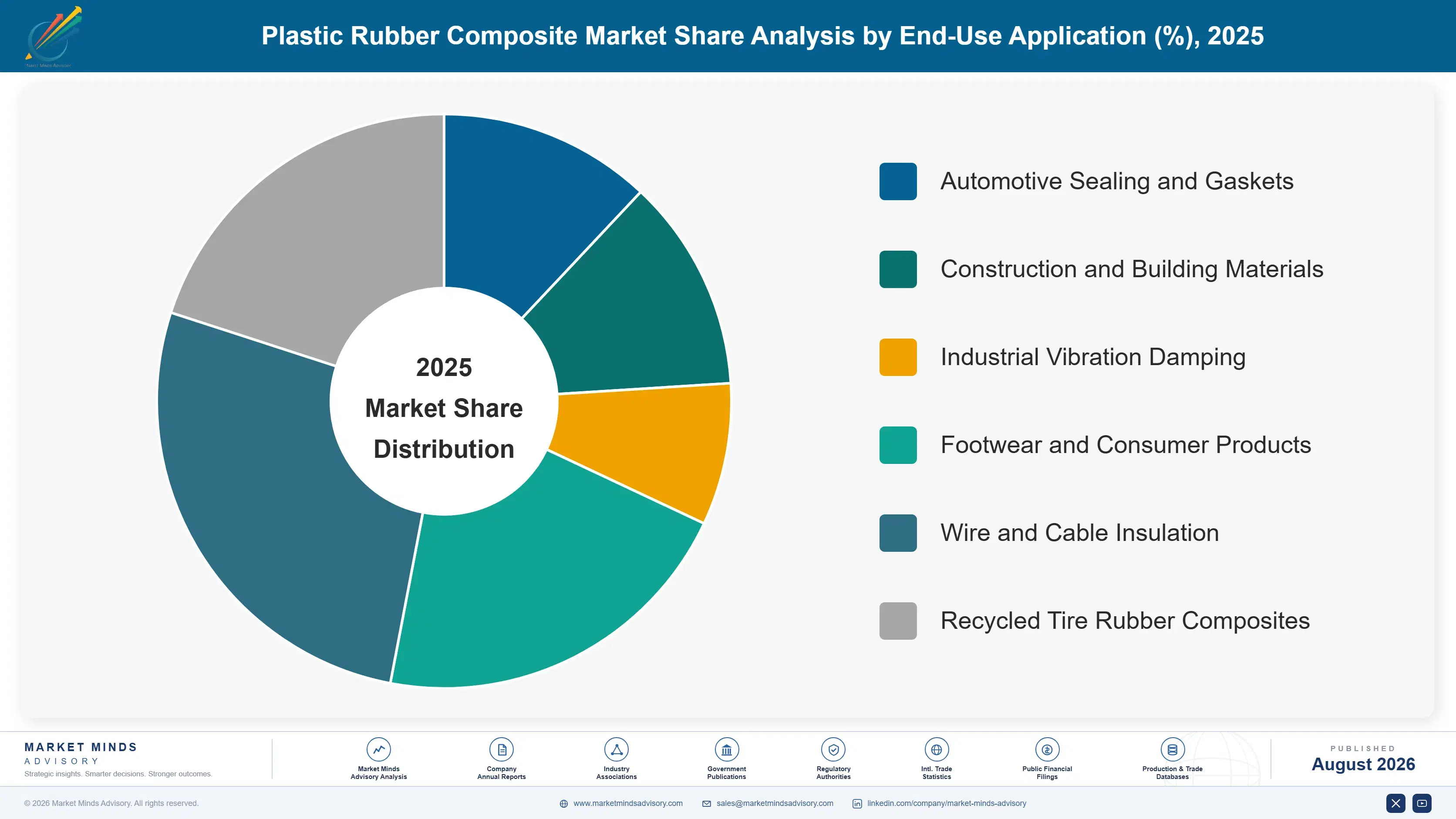
Plastic rubber composites segment most usefully by end-use application, since automotive, construction, industrial damping, and footwear formulations carry distinct performance requirements, recycled content specifications, and certification relevance. This framework mirrors how compounders organise formulation and quality teams and how manufacturers specify composite requirements across different demanding applications and sustainability targets. That structure guides research investment across formulation teams.
plastic-rubber-composite-market-trends-market-share-analysis-1787581272206

Recycled Tire Rubber-Plastic Composites

Recycled tire rubber-plastic composites are the fastest-growing segment as extended producer responsibility mandates and sustainability procurement targets push automotive and construction manufacturers toward documented recycled content formulations across broader product lines. Regulatory mandates increasingly specify minimum recycled content percentages that compounders must document through certified tire crumb sourcing and processing traceability, creating a meaningful barrier for suppliers without established recycling infrastructure relationships. Growth concentrates among compounders with proven tire crumb processing quality and certification documentation capability, since automotive and construction qualification rarely favors switching suppliers once a formulation passes validation testing. China and the European Union's expanding circular economy regulation are the fastest-growing demand centers, absorbing rising volume as mandate compliance requirements continue tightening across both regions' manufacturing bases.
CAGR 8.9%

Automotive Sealing and Gasket Composites

Automotive sealing and gasket composites form the second-fastest-growing segment, benefiting from expanding vehicle platform sustainability procurement targets that increasingly extend recycled content requirements beyond exterior components into functional sealing applications previously reserved for virgin formulations. Automotive-grade composites must meet substantially more demanding durability and sealing performance specifications than construction-grade equivalents, reflecting the safety and reliability requirements automotive manufacturers demand from qualified suppliers across vehicle platforms. Growth is fastest in China and North America's expanding electric vehicle manufacturing base, where new platforms provide opportunities to specify recycled content sealing from initial design rather than retrofitting virgin material specifications later. Established suppliers with proven durability testing hold an advantage as this segment expands.
CAGR 7.2%
Full segment breakdown across 6 segments available in the complete report.

Regional Architecture and Country Demand Map

Plastic rubber composite demand concentrates where automotive and construction manufacturing capacity intersect with circular economy regulatory development. East Asia's dominant automotive and industrial manufacturing base accounts for the largest share of global demand, while North America and Western Europe retain the deepest recycled content processing expertise and regulatory precedent.

East Asia

China's dominant automotive and industrial manufacturing base drives the largest share of regional plastic rubber composite demand, and its rapidly expanding domestic tire recycling and compounding capacity increasingly supplies both local manufacturers and growing export volume to global customers. South Korea and Japan's advanced automotive manufacturing sectors drive substantial demand for premium recycled content sealing and gasket composites meeting exacting original equipment manufacturer specifications. Domestic Chinese compounders are increasingly competing on both cost and processing sophistication, narrowing what was once a substantial technology gap with established Western specialty producers serving premium automotive applications. Rising domestic circular economy regulation continues accelerating recycled content adoption across the region's expanding manufacturing base. Regulatory documentation determines which domestic suppliers qualify for export contracts.
Share: 29% | CAGR: 7.1% (2026 to 2036)

North America

The United States automotive and construction manufacturing sector drives substantial demand for both commodity and premium plastic rubber composites, with electric vehicle production expansion increasingly requiring recycled content sealing components sourced from both domestic and international suppliers. Extended producer responsibility regulation across several states, among the most developed frameworks globally, means regional compounders compete primarily on documented recycled content performance and certification depth rather than price alone. Canada's tire recycling infrastructure contributes meaningful additional regional compounding capacity. Growth is supported by continued automotive electrification and construction green building certification programme expansion across the region's manufacturing and building sectors. Sports and industrial equipment manufacturers add further steady demand across the region's diversified market.
Share: 24% | CAGR: 6.7% (2026 to 2036)
Regional intelligence for 5 additional markets available in the complete report: Western Europe, South Asia and Pacific, Latin America, Middle East and Africa, Eastern Europe. Contact sales@marketmindsadvisory.com.
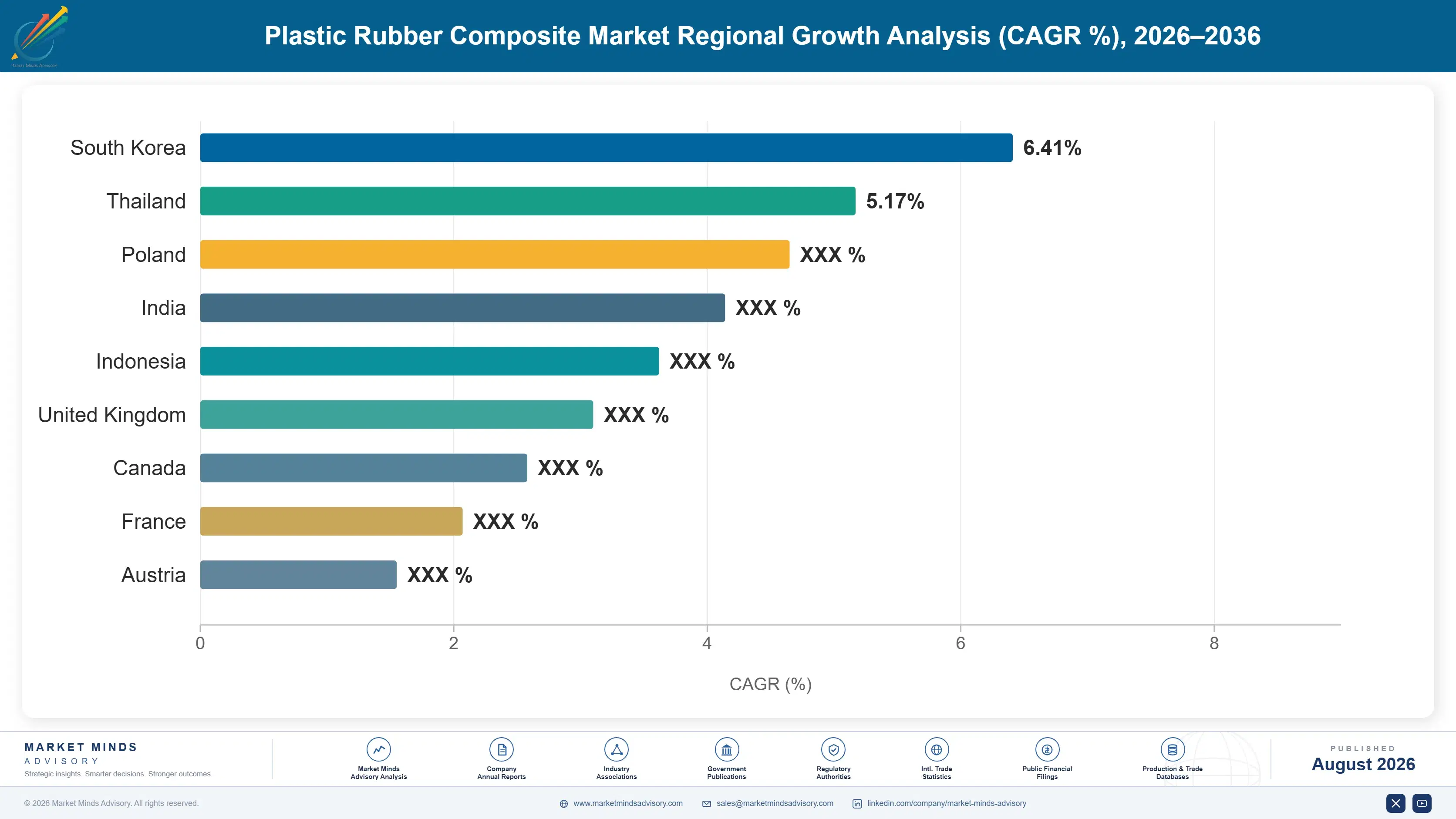
plastic-rubber-composite-market-trends-country-cagr-analysis-1787581272744

Recycled Content Premiumisation and Certification Bundling

Compounders can grow revenue per tonne even where commodity volume growth is modest by shifting customers toward higher recycled content formulations, bundling certification and traceability documentation with material sales, and securing multi-year automotive and construction manufacturer supply contracts. The most durable gains come from capturing regulatory-driven premium demand rather than commodity price competition. across a compounder's full production life.

Developing Automotive-Grade Recycled Content Sealing Products

Compounders investing in automotive-grade recycled content sealing and gasket product lines capture a price premium of roughly 50 to 80 percent over standard construction-grade recycled composites, reflecting the durability certification, performance testing, and automotive qualification these products require from qualified suppliers. This product development requires substantial upfront investment in formulation research and automotive certification testing, but the investment pays back through durable manufacturer qualification once achieved, since automotive customers rarely switch suppliers mid-platform after completing lengthy validation processes. The approach works best for compounders already serving automotive customers with comparable certification infrastructure.
Market Impact: Commands 50 to 80 percent price premium overall

Bundling Recycled Content Traceability Documentation With Sales

Compounders offering documented tire crumb sourcing, processing quality, and recycled content percentage traceability bundled directly with material sales are capturing revenue that previously went to independent certification firms, simplifying regulatory compliance for customers facing tightening extended producer responsibility disclosure requirements across major markets. This bundled approach commands meaningfully higher margins than commodity composite sales alone, and customers increasingly prefer suppliers who can guarantee certification outcomes over managing testing and material procurement separately, since documentation increasingly determines market access across regulated applications. Suppliers offering this bundle report certification timelines shortening by roughly 25 percent compared with unbundled arrangements.
Market Impact: Lifts contract margin roughly 20 percent every year

Securing Multi-Year Automotive Manufacturer Supply Agreements

Compounders winning multi-year supply agreements with automotive manufacturers secure volume commitments that provide revenue visibility uncommon in most specialty compound categories, since automotive customers rarely switch suppliers mid-contract given the substantial requalification cost changing an approved formulation supplier requires. These agreements also create durable switching barriers, since automotive manufacturers face real regulatory filing and warranty risk changing suppliers outside scheduled platform revalidation windows. Compounders with established automotive supply relationships report contract renewal rates roughly 3 times higher than construction-grade commodity sales, reflecting the stability multi-year automotive relationships provide. Reliability improves accordingly across successive platform generations over time.
Market Impact: Lifts contract renewal rate roughly 3 times higher

Expanding Tire Crumb Processing Capacity Ahead Of Demand

Compounders investing in dedicated tire crumb processing capacity ahead of full regulatory mandate implementation position themselves to capture disproportionate share as extended producer responsibility requirements scale from early adoption to mainstream compliance, capturing early-mover pricing power before competitors build comparable processing capacity. This early investment requires accepting lower near-term capacity utilization in exchange for established supply relationships once mandate compliance becomes universal, a trade-off that has historically rewarded early movers with roughly 25 to 35 percent higher margins during subsequent mandate expansion phases. Early movers report meaningfully stronger customer retention once mandate compliance becomes universal across regulated markets.
Market Impact: Captures 25 to 35 percent margin premium overall

Who Controls the Margin Pool

The plastic rubber composite market is moderately concentrated, with an estimated CR5 near 36 percent, reflecting a category where recycled content certification depth and tire crump processing quality matter as much as manufacturing scale. Teknor Apex and Continental lead on combined portfolio breadth and automotive qualification depth, but the gap to specialty recyclers is narrower on commodity construction-grade applications than on premium automotive-grade recycled formulations.
Competitive activity centers on three fronts: automotive-grade recycled content product development aimed at capturing sustainability procurement demand, certification and traceability documentation bundling across markets facing tightening extended producer responsibility requirements, and tire crumb processing capacity expansion to stay ahead of mandate implementation timelines. Acquisitions of specialty recyclers with established tire crumb processing capability have picked up as diversified compounders seek to close recycled content capability gaps organically.

Emerging pressure comes from Chinese and Indian compounders rapidly closing the processing quality and certification gap, threatening established European and American specialty makers on price in the fastest-growing automotive manufacturing markets. Integrated tire recyclers are also pushing downstream into finished compounding, threatening to disintermediate specialty compounders who purchase tire crumb externally. Rankings could shift meaningfully if a Chinese compounder achieves automotive-grade certification parity with established global suppliers.
plastic-rubber-composite-market-trends-company-positioning-matrix-1787581273267

Competitive Moat and Risk Dimensions

TEKNOR APEX COMPANY

Moat: Broad Compounding Portfolio Scale

Teknor Apex's diversified compounding portfolio spanning multiple polymer and rubber blend categories gives it manufacturing scale and technical breadth that smaller specialty recyclers cannot easily match, particularly for customers seeking a single supplier across multiple composite application categories. That integrated position lets Teknor Apex win large multi-application contracts where breadth matters as much as depth.
TEKNOR APEX COMPANY

Risk: Slower Recycled Content Innovation Pace

Teknor Apex's diversified portfolio and centralised formulation development make it comparatively slower to pursue narrow, emerging recycled content niches than specialty recyclers unencumbered by existing virgin material product line considerations. This has cost Teknor Apex share in fast-emerging automotive recycled content categories, where nimbler specialists identified opportunity earlier and built dedicated processing capability ahead of larger competitors.
CONTINENTAL AG

Moat: Deep Automotive Qualification Relationships

Continental's long-standing automotive component manufacturing relationships give it deep, established qualification relationships that are difficult and costly for new entrants to replicate, since automotive customers rarely requalify a supplier once approved for a vehicle platform. That qualification depth supports durable, high-margin revenue from customers requiring documented performance unlikely to switch suppliers absent a serious quality failure.
CONTINENTAL AG

Risk: Limited Scale In Construction-Grade Volume

Continental's automotive-focused portfolio leaves it comparatively less competitive on price for large-volume construction-grade applications, where scale compounders with lower-cost processing can win purely on delivered price. Customers seeking a single supplier across both automotive and construction-grade requirements sometimes choose broader competitors over Continental's more narrowly focused, if deeply qualified, automotive-grade offering.

Players Tracked

Prominent Players

Teknor Apex Company
Lehigh Technologies
Continental AG
Trelleborg AB
Kraton Corporation

Other Key Players

Avient Corporation
LyondellBasell Industries
Celanese Corporation
Hexpol AB
RubberForm Recycled Products
Liberty Tire Recycling
Genan Group
Entech Inc
Ecore International
American Biltrite Inc
Rubberecycle
Green Rubber Global
Sun Plastics
Sirmax Group
Elastron Kimya

Recent Developments

MARCH 2026

Teknor Apex Expands Recycled Content Compounding Capacity In China

Teknor Apex announced expanded recycled content plastic rubber composite compounding capacity at a facility in China, aimed at directly serving the country's rapidly expanding automotive manufacturing sector from local production rather than importing finished composites from North American facilities, reducing lead times for Chinese automotive manufacturers significantly.
Signal: Signals established compounders prioritising local Asian manufacturing presence over exporting finished composites from existing facilities. for the region's largest manufacturers.
SEPTEMBER 2025

Continental Launches Certified Recycled Content Sealing Product Line

Continental introduced a new certified recycled content sealing and gasket product line targeted at automotive manufacturers facing tightening sustainability procurement requirements in key markets, positioning the product as a direct replacement for virgin formulations without sacrificing documented durability performance across demanding platforms. Demand for compliant alternatives continues rising steadily.
Signal: Confirms regulatory pressure is now shaping mainstream automotive product launches, not just niche specialty formulations. ahead of smaller specialty rivals.
JANUARY 2026

Lehigh Technologies Announces Backward Integration Into Tire Crumb Processing

Lehigh Technologies announced expanded backward integration into tire crumb processing capacity, securing feedstock supply ahead of the open market and reducing exposure to processing quality variability that has periodically compressed margins across the specialty composite industry in recent years. The move follows rising demand for reliable, scaled recycled content supply.
Signal: Marks growing compounder interest in vertical integration as recycled content applications scale toward commercial volume broadly.

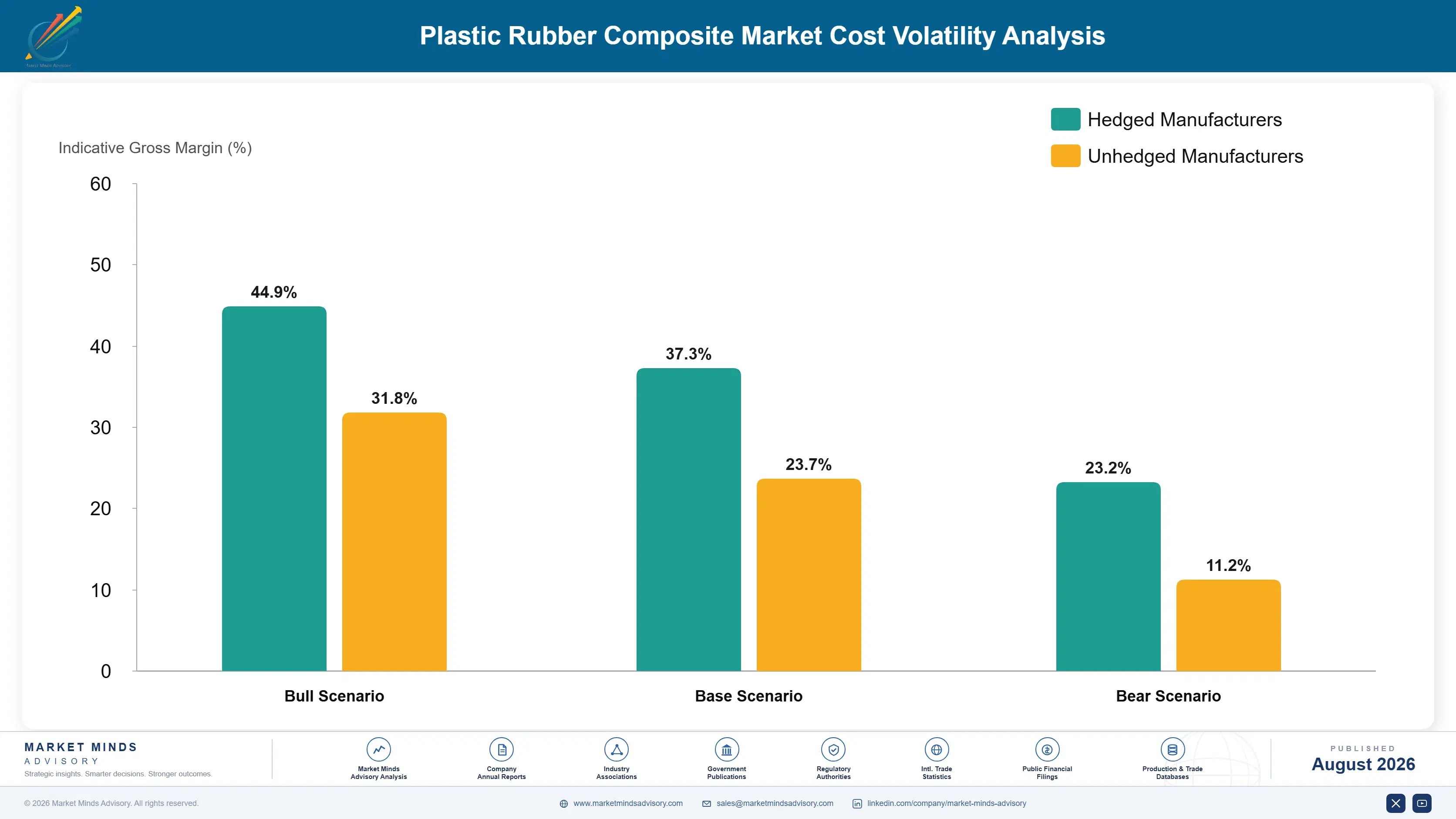
Virgin Polymer And Tire Crumb Cost Exposure

Virgin polymer and rubber feedstocks account for roughly 45 percent of cost of goods sold across most plastic rubber composite manufacturing, with tire crumb processing, additives, and quality testing costs making up most of the remainder. Feedstock sourcing concentrates heavily in China, the United States, and the Middle East, tying compounding costs directly to global petrochemical market dynamics.
Crude oil price spikes and petrochemical capacity disruptions during 2021 and 2022 pushed virgin polymer and rubber prices up by more than 22 percent within several months, according to IEA reporting on global petrochemical market disruption, forcing compounders with contracts signed before the spike to absorb significant margin compression. Compounders without diversified feedstock sourcing agreements faced the sharpest impact, and several smaller regional producers reported delayed deliveries while sourcing alternative material at workable prices.

Exposure varies sharply by player type: larger integrated compounders like Continental, with direct petrochemical and tire recycling stakes, weather price spikes with meaningfully less margin disruption than smaller compounders reliant on open-market feedstock purchases. Geographic exposure also differs, since compounders sourcing primarily from Middle Eastern petrochemical production face different risk timing than those dependent on Chinese or domestic United States resin supply, meaning cost impact varies considerably.
plastic-rubber-composite-market-trends-cost-volatility-analysis-1787581273462

Diversifying Feedstock Sourcing Across Multiple Producing Regions

Compounders are increasingly qualifying feedstock suppliers across China, the United States, and the Middle East simultaneously rather than relying on a single origin, so a disruption or price spike in one region does not halt production entirely. This diversification raises logistics complexity modestly but reduces the risk of the sharp price spikes that hit under-diversified compounders hardest during recent volatility.

Increasing Recycled Content Ratios To Offset Virgin Exposure

Compounders are increasingly shifting formulation ratios toward higher recycled tire rubber content where application performance allows, trading on different cost dynamics than virgin petrochemical feedstock and dampening overall formulation cost volatility. Substitution is limited by performance requirements in the most demanding automotive applications, so it functions as a partial hedge rather than a full replacement strategy across the product range.

Securing Multi-Year Feedstock Supply Agreements With Producers

Larger compounders are signing multi-year supply agreements directly with petrochemical producers, securing guaranteed allocation ahead of the open market and capturing pricing stability that smaller compounders reliant on spot purchases cannot access. This approach requires committed volume most smaller compounders cannot guarantee, reinforcing a cost and availability advantage for larger, established producers. Smaller compounders rarely hold this negotiating position.

Portfolio Architecture for Margin Defence

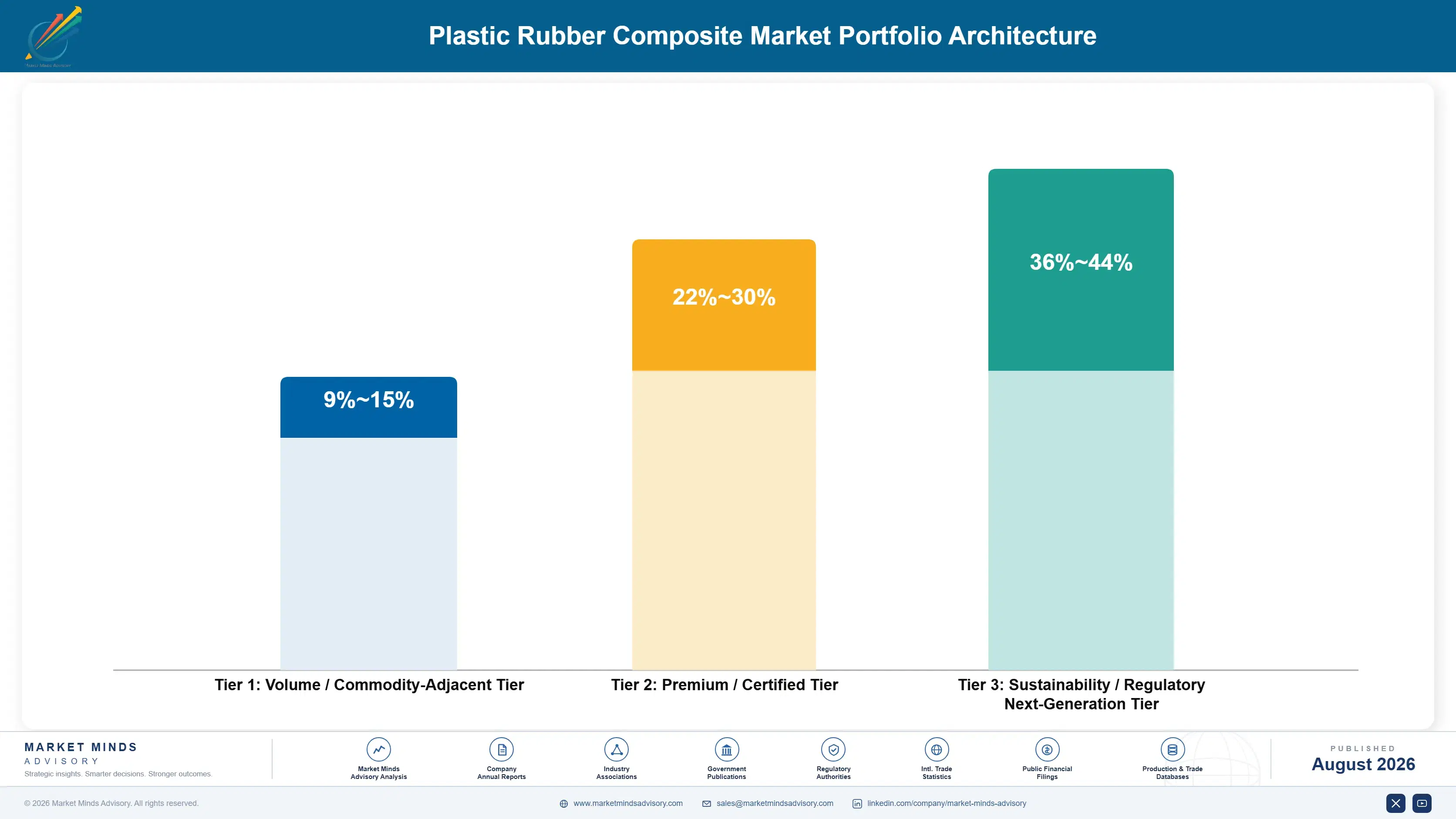
Plastic rubber composites organise into three commercial tiers running from standard virgin and low-recycled-content formulations through certified mid-recycled-content construction and industrial grades to next-generation automotive-grade and high-recycled-content certified products. Gross margins widen sharply moving up the tiers, since standard formulations compete largely on feedstock cost and delivery price, while certified and automotive-grade composites capture value from documented recycled content, certification depth, and application-specific engineering rather than raw material cost alone.
The tension between commodity volume and premium certified revenue shapes compounder strategy: standard formulations generate the manufacturing scale that supports feedstock purchasing power, but certified and automotive-grade composites generate the margin that justifies continued research investment. Compounders overweighted toward commodity-only sales face intensifying price competition from lower-cost regional producers, while premium-forward compounders carry steadier, higher-margin profitability less exposed to virgin feedstock price cycles.

High-value pools concentrate among automotive-grade recycled content composites sold to manufacturers with rigorous certification requirements, and among certified construction-grade products sold into green building certification-qualifying applications. Both pools reward compounders who can pair documented recycled content performance with reliable processing quality rather than competing purely on commodity composite price alone. Both approaches require sustained investment in sourcing and brand positioning.

Volume / Commodity-Adjacent Tier

Standard virgin and low-recycled-content formulations sold largely on feedstock cost and delivery price, competing on proximity to manufacturing facilities, serving cost-sensitive commercial applications broadly. Buyers here rarely pay for documentation beyond basic safety data sheets and delivery reliability.
Gross Margin: 9-15%

Premium / Certified Tier

Certified mid-recycled-content construction and industrial grades backed by documented performance testing, sold at a meaningful premium to manufacturers requiring formal sustainability compliance documentation. These customers typically require annual requalification audits and periodic batch testing procedures.
Gross Margin: 22-30%

Sustainability / Regulatory / Next-Generation Tier

Automotive-grade and high-recycled-content certified products sold to manufacturers requiring documented durability and traceability, priced on certification rather than raw material cost. Adoption concentrates among compounders already serving pharmaceutical-adjacent automotive markets closely.
Gross Margin: 36-44%
plastic-rubber-composite-market-trends-portfolio-architecture-1787581273980

High-value Sub-segments and Strategic Watch-out

Automotive-Grade Recycled Content Sealing Composites

Automotive-grade recycled content composites sold into sealing and gasket applications command the category's highest margins and fastest growth, concentrated among compounders with proven durability certification and tire crumb processing quality supporting rigorous automotive qualification requirements. Compounders compete primarily on certification breadth and documented durability performance records.
Gross Margin: 38-46%

Certified Construction-Grade Recycled Composites

Certified construction-grade composites sold into green building certification-qualifying applications carry strong margins tied to documentation depth, though growth is more moderate than automotive-grade material since adoption depends on individual project certification timelines. Adoption is strongest among manufacturers already pursuing green building certification targets. today. broadly.
Gross Margin: 26-34%

Standard Commodity Virgin And Low-Recycled Formulations

Standard formulations remain the largest volume category by far, generating steady manufacturing revenue across cost-sensitive commercial applications, even as growth increasingly shifts toward certified and automotive-grade products elsewhere in the portfolio. Volume stays large even as unit economics gradually erode across most markets. today. broadly.
Gross Margin: 9-14%

Tire Crumb Processing Quality Consistency Risk

Variable tire crumb processing quality across regional recycling infrastructure represents a meaningful ongoing risk, since inconsistent feedstock could disrupt formulation reliability that compounders dependent heavily on recycled content volume must monitor closely across supplier relationships. Established compounders must close the gap or cede volume to rivals.
Gross Margin: n/a

Qualification-Locked Platform Economics

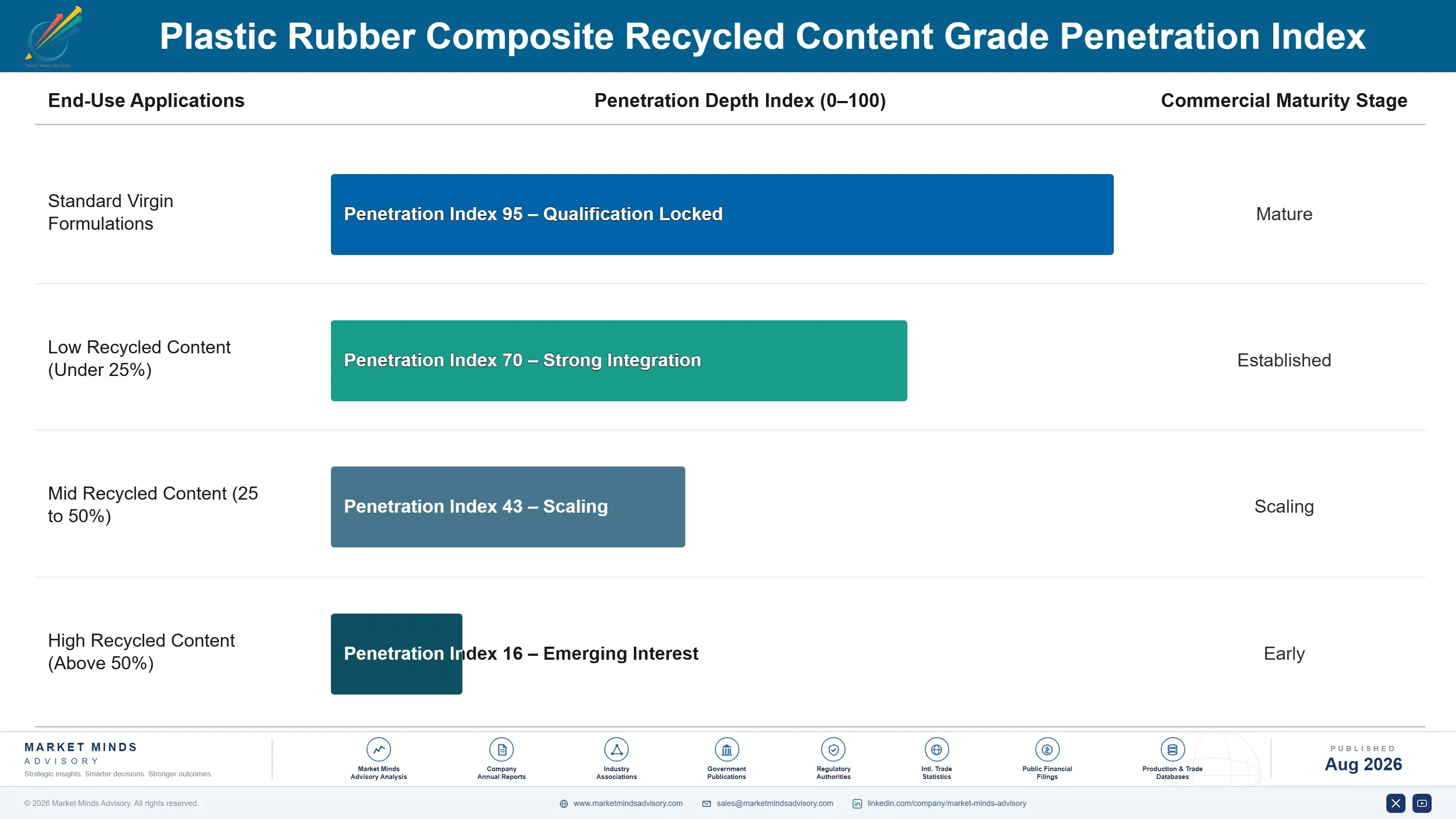
Plastic rubber composite demand behaves like an annuity once a manufacturer completes formulation qualification for a specific application, since switching compounders requires costly requalification and durability revalidation that most customers strongly prefer to avoid absent a serious quality failure. That qualification lock-in shapes how compounders price and structure long-term supply relationships. That durability shapes how compounders structure long-term account pricing and investment decisions.
Adoption depth varies sharply by end use: automotive manufacturers penetrate deepest into documented, certified supply relationships, often single-sourcing a qualified compounder for an entire vehicle platform, while construction material manufacturers adopt more transactionally, switching suppliers more readily based on price and delivery reliability. Industrial damping and footwear manufacturers sit between the two, balancing certification stability against periodic competitive sourcing reviews. Footwear manufacturers show a similar mid-tier pattern shaped by product design cycles.

A generational shift in buyer profiles is underway as younger materials engineers and procurement professionals, increasingly focused on documented sustainability and recycled content data, demand comprehensive certification evidence before qualifying a supplier, replacing an older generation that selected suppliers primarily on price and existing relationships. Compounders slow to adapt risk losing share to certification-forward competitors. Suppliers slow to adapt risk losing share.
plastic-rubber-composite-market-trends-end-use-penetration-index-1787581274473

Where To Focus Capital Next

These are among the four positions where our research anticipates prominent divergence between winners and laggards over the coming forecast period. Each is grounded in the demand model, the regulatory perimeter, and the announced capacity pipeline.
01 / AUTOMOTIVE-GRADE FORMULATION INVESTMENT

Prioritise Automotive-Grade Recycled Content Over Commodity Volume

Automotive-grade recycled content composites are growing fastest and carry the category's widest margins, driven by manufacturers expanding sustainability procurement targets to meet rising demand across most major vehicle platform categories globally. Compounders that invest in dedicated automotive certification infrastructure are capturing this premium demand at a faster rate than competitors still selling commodity formulations without comparable qualification depth. Capital allocated toward automotive certification testing and formulation research will likely generate better returns than commodity capacity expansion over the next several years.
02 / CERTIFICATION DOCUMENTATION BUNDLING

Bundle Traceability Documentation Ahead Of Tightening Mandates

Extended producer responsibility mandates are tightening across the European Union, several North American states, and increasingly China, and compounders who bundle certification documentation ahead of enforcement capture customers before competitors catch up to the new standard. Documentation bundling raises near-term compliance costs, but early movers are establishing certification credibility with customers that laggards will struggle to replicate once mandates take full effect. Waiting for mandatory compliance dates risks ceding the fastest-growing recycled content segment to faster-moving rivals already selling certified alternatives.
03 / TIRE CRUMB PROCESSING INVESTMENT

Expand Tire Crumb Processing Capacity Ahead Of Mandate Scale-Up

Extended producer responsibility mandates are scaling from early adoption toward mainstream compliance, and compounders who invest in dedicated tire crumb processing capacity ahead of this scale-up position themselves to capture disproportionate share and pricing power before competitors build comparable capacity. Early investment requires accepting lower near-term capacity utilization in exchange for established supply relationships once mandate compliance becomes universal across regulated markets. Compounders that delay this investment risk ceding the most attractive emerging application volume entirely to competitors already positioned with early processing scale.
04 / ASIAN MANUFACTURING LOCALISATION

Expand Asian Manufacturing To Match Automotive Concentration

East Asia's dominant and still-growing share of global automotive manufacturing output means compounders without substantial local production presence face a meaningful cost and lead-time disadvantage against domestic Chinese compounders rapidly improving certification and processing capability. Establishing deeper Asian manufacturing presence allows established compounders to compete on price while retaining higher-margin certification and automotive-grade revenue centrally. Compounders that delay this localisation risk ceding a growing share of the world's largest automotive manufacturing market entirely to domestic competitors already building direct relationships with regional manufacturing customers.

Engagement Snapshot From the Field

A live engagement with an industry participant carrying material or product regulatory and market exposure ahead of a defining policy shift, showing how our research translates into a defensible multi-year portfolio strategy.
MARKET MINDS ADVISORY · CLIENT ENGAGEMENT SUMMARY
Plastic Rubber Composite Producer Strategic Portfolio Review and Transition Roadmap 2026·Investment Scenario on Plastic Rubber Composite Exposure Evaluation 2025-26
CLIENT PROFILE
The client is a mid-sized automotive tier-one sealing component supplier facing new sustainability procurement requirements from three major vehicle platform customers, representing approximately 8.5 million sealing components produced annually (client-reported, unverified by MMA). The supplier needed to qualify a recycled content composite formulation meeting stringent durability requirements ahead of upcoming platform sourcing decisions. The supplier needed a formulation meeting stringent durability requirements ahead of the sourcing decision.
STRATEGIC CHALLENGE
Engineering and procurement leadership needed to evaluate competing recycled content composite suppliers against documented durability and certification data, but lacked internal testing capacity to independently verify supplier performance claims against the customer's specific sealing application requirements. Leadership also needed board-level sign-off given the scale of the affected annual revenue base.
MMA APPROACH
MMA analysts benchmarked candidate suppliers against documented qualification outcomes from comparable automotive sealing component manufacturers, modeling expected qualification timeline and durability performance across representative application scenarios. The engagement combined primary interviews with engineering staff, supplier capability comparison, and analysis against MMA's broader dataset of automotive recycled content qualification outcomes. Analysis also incorporated platform sourcing decision timelines.
KEY FINDINGS
  1. The recommended supplier's recycled content formulation showed documented durability performance roughly 20 percent better than the lowest-cost competing proposal, based on published testing data (client-reported, unverified by MMA).
  2. Two of four benchmarked suppliers lacked sufficient tire crumb processing consistency to meet the customer's accelerated qualification timeline requirements. within the customer's accelerated qualification window.
  3. Formulations with higher recycled content ratios showed meaningfully more consistent durability performance correlation with documented field data than lower-ratio alternatives. across the supplier's production batches.
  4. The recommended supplier offered dedicated engineering support for application-specific formulation tuning, reducing implementation risk compared with competing proposals. during the qualification review process.
CLIENT PROFILE
The client is a mid-sized automotive tier-one sealing component supplier facing new sustainability procurement requirements from three major vehicle platform customers, representing approximately 8.5 million sealing components produced annually (client-reported, unverified by MMA). The supplier needed to qualify a recycled content composite formulation meeting stringent durability requirements ahead of upcoming platform sourcing decisions. The supplier needed a formulation meeting stringent durability requirements ahead of the sourcing decision.
STRATEGIC CHALLENGE
Engineering and procurement leadership needed to evaluate competing recycled content composite suppliers against documented durability and certification data, but lacked internal testing capacity to independently verify supplier performance claims against the customer's specific sealing application requirements. Leadership also needed board-level sign-off given the scale of the affected annual revenue base.
MMA APPROACH
MMA analysts benchmarked candidate suppliers against documented qualification outcomes from comparable automotive sealing component manufacturers, modeling expected qualification timeline and durability performance across representative application scenarios. The engagement combined primary interviews with engineering staff, supplier capability comparison, and analysis against MMA's broader dataset of automotive recycled content qualification outcomes. Analysis also incorporated platform sourcing decision timelines.
KEY FINDINGS
  1. The recommended supplier's recycled content formulation showed documented durability performance roughly 20 percent better than the lowest-cost competing proposal, based on published testing data (client-reported, unverified by MMA).
  2. Two of four benchmarked suppliers lacked sufficient tire crumb processing consistency to meet the customer's accelerated qualification timeline requirements. within the customer's accelerated qualification window.
  3. Formulations with higher recycled content ratios showed meaningfully more consistent durability performance correlation with documented field data than lower-ratio alternatives. across the supplier's production batches.
  4. The recommended supplier offered dedicated engineering support for application-specific formulation tuning, reducing implementation risk compared with competing proposals. during the qualification review process.
RECOMMENDED STRATEGY
Phase 1: Phase 1 (Months 1 to 5): Qualify the recommended supplier's formulation against the customer's highest-volume sealing application through validation testing. Phase 2: Phase 2 (Months 6 to 10): Extend qualification to remaining sealing applications using validated performance data from the initial phase. Phase 3: Phase 3 (Months 11 to 14): Finalise a multi-year supply agreement with pricing terms informed by qualification performance data. with pricing secured.
OUTCOME
The supplier selected the recommended composite and completed qualification ahead of its platform sourcing decision timeline. Early production units showed meaningful durability performance consistency within the first year (client-reported, unverified by MMA), and engineering leadership credited the phased qualification approach with strengthening the platform sourcing bid submission.

Frequently Asked Questions

Foundational context covering the market sizes, CAGR, scope, country, region and competition that inform every finding below. This section is provided to cover basics and most often pre-purchase conversations, answered from the MMA Primary Research Dataset.

What is the current size of the Plastic Rubber Composite Market?

The global plastic rubber composite market was valued at approximately $4.6 billion in 2025. Demand is driven by automotive sustainability procurement, construction certification programmes, and extended producer responsibility regulation.

How large will the Plastic Rubber Composite Market be by 2036?

MMA forecasts the market will reach approximately $8.82 billion by 2036, roughly 1.81 times its 2026 value. Growth is driven by circular economy mandates and automotive recycled content adoption.

What is the CAGR for the Plastic Rubber Composite Market 2026 to 2036?

The market is projected to grow at a compound annual growth rate of 6.1 percent between 2026 and 2036. Bull and bear scenarios range from roughly 4.8 to 7.3 percent depending on virgin feedstock cost trends.

Which segment is growing fastest?

Recycled tire rubber-plastic composites are the fastest-growing segment, expanding at approximately 8.9 percent annually, driven by extended producer responsibility mandates and sustainability procurement targets. across regulated markets today.

Who are the major companies in the Plastic Rubber Composite Market?

Leading compounders include Teknor Apex Company, Lehigh Technologies, Continental AG, Trelleborg AB, and Kraton Corporation. Competition centers on certification depth, recycled content processing, and automotive qualification.

Which country is growing fastest?

China is the fastest-growing major market, driven by its dominant and rapidly scaling automotive manufacturing base absorbing a growing share of global plastic rubber composite production and consumption.

Report Segmentation Architecture

The full report scope spans multiple orthogonal segmentation dimensions, with cross-tabulated demand data provided for each dimension pair. Coverage extends further to regional breakdowns, trend trajectories, and the competitive detail needed to support segment-level decision-making.

By End-Use Application

  • Automotive Sealing and Gaskets
  • Construction and Building Materials
  • Industrial Vibration Damping
  • Footwear and Consumer Products
  • Wire and Cable Insulation
  • Recycled Tire Rubber Composites

By Recycled Content Grade

  • Standard Virgin Formulations
  • Low Recycled Content (Under 25%)
  • Mid Recycled Content (25 to 50%)
  • High Recycled Content (Above 50%)

By Commercial Dimension

  • Commodity Bulk Supply
  • Certified Construction-Grade Supply
  • Automotive-Grade Certified Supply
  • Traceability and Certification Services

By Region

  • North America
  • Western Europe
  • East Asia
  • South Asia and Pacific
  • Latin America
  • Middle East and Africa
  • Eastern Europe

Scope, Methodology, and Coverage

Every figure in this report is reproducible from documented input assumptions. The scope below maps the historical period, the forecast horizon, the segmentation dimensions, and the countries covered, alongside the underlying primary and qualitative methodology.
Historical Period
2020 to 2025
Forecast Period
2026 to 2036
Base Year
2025 (USD billions; MMA Primary Research Dataset, August 2026)
Market Definition
The plastic rubber composite market covers engineered materials combining thermoplastic polymers with rubber compounds, including recycled tire rubber, used across automotive sealing, construction, industrial damping, and consumer product applications. It excludes pure thermoplastic elastomers without distinct rubber-phase blending and standalone recycled rubber crumb sold unprocessed.
Quantitative Units
USD billions (current prices); volume in metric tonnes where cited
Segmentation Dimensions
By End-Use Application; By Recycled Content Grade; By Commercial Dimension; By Region
Regions Covered
North America, Western Europe, East Asia, South Asia and Pacific, Latin America, Middle East and Africa, Eastern Europe
Countries Covered
USA, China, Germany, France, UK, Japan, South Korea, India, Australia, Canada, Brazil, Mexico, Indonesia, Vietnam, Thailand, Malaysia, UAE, Saudi Arabia, South Africa, Nigeria, Turkey, Poland, Netherlands, Italy, Spain, Sweden, Switzerland, Argentina, Colombia, Singapore, and additional markets relevant to this sector
Key Companies Profiled
Teknor Apex Company, Lehigh Technologies, Continental AG, Trelleborg AB, Kraton Corporation, Avient Corporation, LyondellBasell Industries, Celanese Corporation, Hexpol AB, RubberForm Recycled Products, Liberty Tire Recycling, Genan Group, Entech Inc, Ecore International, American Biltrite Inc, Rubberecycle, Green Rubber Global, Sun Plastics, Sirmax Group, Elastron Kimya
Quantitative Methodology
Primary survey, n=3,800 respondents, Q4 2025, six countries; demand-side model with trade association cross-validation
Qualitative Methodology
47 expert interviews, Q4 2025; applied to validate demand model assumptions, identify emerging dynamics, and assess competitive positioning
Report Format
PDF and XLSX data workbook (Word format preview document)
Publisher
Market Minds Advisory
Report Code
MMA-2026-CHM-102
Published
August 2026
Contact
sales@marketmindsadvisory.com | www.marketmindsadvisory.com

Purchase the full Plastic Rubber Composite Market Report (2026 to 2036).

The full report provides a complete quantitative and qualitative assessment of the global plastic rubber composite market through 2036, including detailed regional sizing across all seven MMA-tracked geographies and application-level segmentation covering automotive, construction, and industrial composite categories. It profiles twenty leading and emerging compounders, benchmarking certification infrastructure, tire crumb processing capability, and automotive qualification depth. The report includes primary survey findings from 3,800 respondents and 47 expert interviews conducted in the fourth quarter of 2025, alongside detailed input cost and petrochemical supply chain risk analysis. Buyers receive segment-level revenue models, editable data tables, and a structured framework for evaluating compounder and market entry decisions.
Seven-region market sizing with application-level revenue breakdowns
Twenty-company competitive profiles with moat and risk analysis
Primary survey data from 3,800 respondents across six countries
Forty-seven expert interviews on regulatory and automotive trends
Editable data tables for custom scenario and sensitivity modeling
Petrochemical input cost and supply chain risk assessment

Built For The People Who Decide

From boardroom strategy to bench-side execution, this report is read cover-to-cover by leaders shaping the next decade of their industry, turning demand scenarios, market dynamics and valuation benchmarks into decisions.
CXOs/ Presidents/ VPs/ Managers
M&A and Corporate Development
Strategy Teams and R&D Heads
Procurement and Product Directors
Regulatory and Compliance Leaders
Investor Relations and Equity Analysts