Market Minds Advisory
Plastic Liner Market

Plastic Liner Market: Containment Regulation Redraws Geomembrane Demand

Tightening landfill and mining containment regulation is pushing operators toward heavier-gauge, chemically resistant geomembrane liners even as legacy PVC formats face growing displacement from reinforced polypropylene and LLDPE alternatives across major containment markets.

Lead Analyst

Bilal Shaikh

Published

September 2026

Make Smarter Decisions with Customized Research Insights

Request a free sample report and evaluate market opportunities, growth trends, and competitive dynamics relevant to your business needs.

2025 MARKET VALUE$3.8BMarket Size 2025
2036 FORECAST VALUE$7.7BBase Case , 2026 to 2036
CAGR 2026 TO 20366.6 %Bull 7.8% / Bear 5.4%
INCREMENTAL OPPORTUNITY$3.6BNet 10- year value creation
EXPANSION MULTIPLE1.89x2036 value over 2026 base
Strategic Levers
M&A Pipeline
Regional Outlook
Country Rankings
Competitive Intelligence
Segmental Deep-dive
Call-Us : 91 93563 13602

Executive Snapshot and Market Trajectory

Landfill operators and mining companies are replacing legacy PVC containment liners with heavier-gauge HDPE and reinforced polypropylene formats faster than at any point in the past decade, chasing chemical resistance and seam durability that older material formulations cannot match under sustained leachate exposure and prolonged UV loading over decades ahead.
Reinforced polypropylene liners are pulling ahead of every other category as water utilities and floating cover operators chase UV resistance and field-seaming speed that PVC and standard HDPE cannot match. East Asia concentrates the largest share of global demand given China's massive engineered landfill construction programme and expansive heap-leach mining base, while China itself is growing fastest as domestic producers scale capacity to serve both municipal remediation mandates and export containment orders simultaneously.
Competitive character splits between large diversified geomembrane manufacturers defending broad multinational containment supply relationships and regional specialists competing hard on price and delivery lead time across mid-tier mining accounts. Tightening leachate containment standards, combined with rising demand for double-liner redundancy systems, are pushing buyers toward producers that smaller regional converters increasingly cannot match without meaningful polymer science investment of their own capital.
Market Definition
The plastic liner market covers geomembrane and containment liner sheeting used across landfill, mining, water and wastewater management, and agricultural containment applications, including HDPE, LLDPE, PVC, reinforced polypropylene, and specialty composite liners. It excludes geosynthetic clay liners, geotextile fabrics without a plastic membrane layer, and roofing membrane applications.
Base Year Value
$3.8B in 2025 (MMA Primary Research Dataset, August 2026)
Forecast Period
2026 to 2036, eleven discrete annual values
CAGR
6.6% base case. Bull 7.8%. Bear 5.4%.
Fastest Growth Segment
Reinforced Polypropylene Liners: 9.8% CAGR
Fastest Growth Country
China: 8.4% CAGR
Fastest Growth Region
South Asia and Pacific: 8.6% CAGR
Largest Region
East Asia: 30% of 2025 global value
Market Leaders
Solmax International Inc., AGRU Kunststofftechnik GmbH, Naue GmbH and Co. KG, Officine Maccaferri S.p.A., Atarfil S.L. Source: MMA Analysis based on company annual reports and investor filings.
Primary Survey
n=3,800 procurement and R&D decision-makers, Q4 2025, six countries
Methodology
Demand-side build-up, cross-validated against public data, 47 expert interviews

Plastic Liner Market Forecast Scenarios

plastic-liner-market-size-forecast-scenario-1787298264249
Growth from 2020 to 2025 compounded near 5.6%, held back early by pandemic-era construction delays that suppressed landfill and mining capital orders across most major containment markets, then accelerated as deferred infrastructure projects resumed and mining capacity expansion pulled demand higher through the back half of the historical period and its recovering order volumes and gradually easing resin input costs.
Three mechanisms carry the base case to 6.6%. First, expanding heap-leach mining capacity, which delivers chemical resistance requirements that legacy PVC liners cannot reliably meet across comparable containment lifespans. Second, tightening landfill leachate containment regulation, which drives demand for double-liner redundancy systems across major municipal waste programmes. Third, growing water scarcity across emerging agricultural markets, which sustains predictable recurring liner demand across most developing irrigation networks and their expanding capital equipment plans.
The bull case at 7.8% assumes mining capacity expansion accelerates into additional emerging markets faster than current permitting timelines suggest, pulling forward producer capital orders considerably. The bear case at 5.4% assumes construction capital spending tightens under broader commodity price softness and buyers defer non-mandatory liner upgrades across several major markets at once, stretching replacement cycles well beyond plan.

Containment Regulation Redraws Liner Specification

Three forces converge on this market simultaneously and reshape producer investment patterns considerably. Heap-leach mining capacity keeps expanding as operators chase chemical resistance that legacy PVC liners cannot reliably meet across comparable containment lifespans. Landfill leachate containment regulation keeps tightening, driving demand for double-liner redundancy systems across major municipal waste programmes. Water scarcity keeps growing across emerging agricultural markets, sustaini
MARKET CONCENTRATIONCR5 46%Reflects a market shaped by diversified producers and regional specialists
AVERAGE SELLING PRICEUSD 0.85-4.20 per square metreVaries substantially by material grade, thickness, and reinforcement
TOP PRODUCING COUNTRY SHAREChina 24%Reflects concentrated landfill construction and mining containment scale
CAPACITY UTILISATION76%Average producer line utilisation across major producing regions
TRADE INTENSITY29%Share of finished liner sheeting crossing borders before installation
INSTALLED BASE LIFESPAN20-30 yearsTypical service life before containment systems require replacement
Commercially, the market splits between large diversified geomembrane manufacturers defending broad multinational containment supply relationships across multiple end-use categories simultaneously and regional specialists competing hard on price and delivery lead time across mid-tier mining accounts. Diversified manufacturers capture value through polymer science depth and multinational certification coverage, while regional specialists compete primarily on price and faster turnaround in developing containment markets.
Looking ahead, expanding heap-leach mining capacity, tightening leachate containment regulation, and growing emerging market water scarcity will shape which producers capture the fastest-growing demand pools over the coming decade, rewarding those who invested early in both chemical-resistant polymer science and high-speed extrusion capacity rather than those relying solely on legacy PVC formulations carried over from earlier decades.
"A landfill liner used to be a commodity purchase decided on thickness alone. Now it's a forty-year chemical resistance bet made before a single ton of waste ever arrives, and that distinction is where the real margin sits."
Director, Geosynthetics and Containment Practice · MMA Chemicals and Materials -

Market Trends

Reinforced Polypropylene Adoption Accelerates Across Water Utilities

Water utilities keep expanding reinforced polypropylene liner adoption across most major floating cover and potable storage programmes, pushing capital budgets toward producers that deliver UV resistance and field-seaming speed legacy PVC equipment cannot reliably match at comparable installation pace. Utilities previously running standard HDPE formats for routine storage applications increasingly rewrite specifications to require reinforced polypropylene capability before renewing supply contracts, since seam failures carry substantial water loss cost. Producers with validated reinforced polypropylene platforms already proven across comparable utility deployments are capturing orders competitors still relying on legacy designs cannot bid on at all.
Market Impact: Chinese liner orders grew 24%
Double-Liner Redundancy Systems Reshape Landfill Specification

Double-liner redundancy systems keep expanding across most major municipal landfill programmes as regulatory pressure forces operators to extend leak-detection requirements to a broader range of containment cells than earlier permit specifications allowed. This shift is reshaping which producers can compete profitably for large municipal contracts, since achieving validated double-liner platforms requires polymer science investment that smaller regional producers increasingly cannot match on comparable research budgets. Producers with proven redundancy systems are winning municipal contracts that competitors relying on single-liner designs increasingly cannot match on documented leak-detection performance and long-term monitoring reliability.
Market Impact: Heap-leach liner demand grew 18%

Market Opportunities and Growth Drivers

Chinese Landfill Remediation Programme Expands Very Rapidly

China's national landfill remediation programme continues expanding engineered cell construction as municipal authorities pursue higher containment capacity than previous generation informal dumps increasingly could not sustain given persistent waste volume growth simultaneously and aggressively across most major provincial and municipal jurisdictions. Each newly engineered cell requires substantial validated liner supply meeting consistent leachate containment standards rather than informal regional-grade specifications. Chinese authorities increasingly treat validated liner supply as a critical input in national environmental compliance rather than a downstream construction decision, pushing producers further into certification earlier than before in their planning cycles.
Market Impact: Standard HDPE pricing fell over 7%

Heap-Leach Mining Capacity Sustains Chemical Resistance Demand

Heap-leach mining capacity keeps climbing across most major copper and gold extraction programmes, forcing operators to expand chemical-resistant liner procurement at a pace conventional capital budgets increasingly struggle to accommodate across comparable extraction volume growth. Mining companies increasingly favor producers with documented chemical-resistance and puncture credentials in recurring supply agreements, pushing producers to treat containment reliability as a commercial necessity rather than a routine catalog item. Producers with proven liner platforms are winning multi-year supply contracts that competitors relying on generic designs increasingly cannot match on documented reliability performance and long-term durability data.
Market Impact: Adds 4 to 9 weeks

Market Restraints and Challenges

Commodity Price Erosion Squeezes Standard HDPE Margin

Standard HDPE liner pricing has fallen considerably faster than general polymer inflation across recent years, squeezing margin on high-volume municipal tenders won primarily through price competition rather than material differentiation. The root cause is commoditisation of conventional HDPE liner formulations that producers cannot meaningfully differentiate once basic thickness specifications become standard across the category. The commercial impact falls hardest on smaller regional producers lacking scale to compete on price alone. Several producers now shift capacity toward reinforced polypropylene categories and are exiting commodity tenders where possible, redirecting sales teams toward higher-margin categories instead.
Market Impact: Reinforced polypropylene orders rose 25%

Resin Price Volatility Delays Producer Capacity Planning

Persistent resin price volatility at upstream petrochemical suppliers is delaying producer capacity planning decisions even when municipal and mining demand forecasts proceed on schedule without complication elsewhere in the procurement process. The root cause traces to global petrochemical supply swings outpacing rapidly expanding producer capital ambitions across most major producing jurisdictions globally. The commercial impact includes delayed capacity commissioning and rising per-unit resin costs that erode budget producers originally allocated for. Several producers now lock in multi-year resin contracts and are qualifying recycled feedstock where capital allows it, reducing exposure to future price spikes.
Market Impact: Double-liner system demand grew 21%
3 additional market trends, 4 additional growth drivers, and 3 additional restraints and challenges are covered in the full report. Contact sales@marketmindsadvisory.com to access the complete intelligence.

Segment CAGR and Growth Architecture

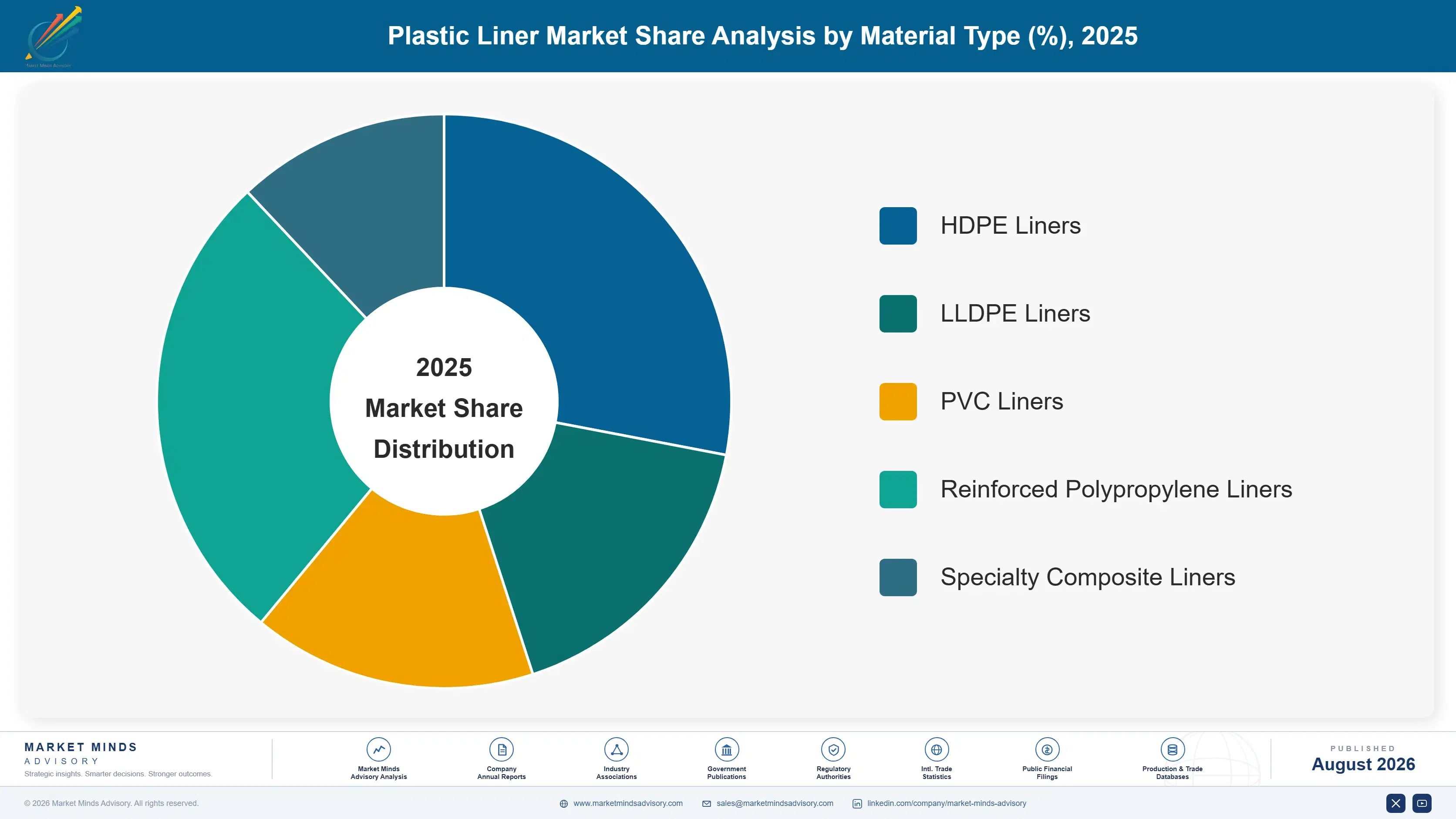
Segmentation follows material type rather than end-use application, since a single producer commonly manufactures several liner materials side by side for the same containment customer and shares extrusion tooling between them. This reflects how producers actually organise product development, capital investment, and commercial catalog structure internally across their own extrusion divisions worldwide today and going forward.
plastic-liner-market-market-share-analysis-1787298265093

Reinforced Polypropylene Liners

Reinforced polypropylene liners deliver UV-resistant, field-seamable containment for floating covers and potable water storage, most valued where utilities pursue rapid installation and long service life that PVC and standard HDPE reliably cannot match across comparable exposure conditions. Growth outpaces every other category as utilities increasingly specify reinforced polypropylene capability at the design stage rather than treating it as an optional upgrade. Producers with validated reinforced polypropylene platforms already proven across comparable utility deployments are capturing orders that competitors still relying on legacy PVC designs cannot bid on at all. China and North America drive the bulk of current volume given their concentration of active water storage and floating cover projects.
CAGR 9.8%

LLDPE Liners

LLDPE liners deliver flexible, puncture-resistant containment for heap-leach mining pads and irregular terrain applications, most valued where operators pursue conformability that rigid HDPE sheeting reliably cannot support across comparable terrain variation requirements. Growth is second-fastest across the segmentation, driven by expanding heap-leach mining capacity and rising demand for puncture-resistant flexibility beyond traditional rigid approaches. Producers with validated LLDPE platforms are capturing mining contracts that competitors still relying on standard HDPE designs increasingly cannot match on documented flexibility performance. Pricing reflects that complexity, commanding meaningfully higher per-unit value than standard HDPE alternatives across nearly every major mining segment tracked in this year's report and its underlying survey data and expert interviews.
CAGR 8.6%
Full segment breakdown across 5 segments available in the complete report.

Regional Architecture and Country Demand Map

East Asia holds the largest share given China's massive engineered landfill construction programme and expansive heap-leach mining base. China is growing fastest as domestic producers scale capacity to serve both municipal remediation mandates and export containment orders across coastal and inland manufacturing hubs nationwide each year.

North America

United States mining companies and municipal landfill operators drive the overwhelming majority of regional demand through recurring containment cell orders at massive extraction volumes, with Solmax and domestic producers anchoring supply across most established mining groups and their permitted containment cells. Canada contributes a meaningful base through its own mining sector, tightly linked to cross-border supply chains and shared producer ownership structures. Growth trails the fastest-growing regions because much of the region's landfill base already runs modern double-liner systems installed during previous permitting cycles, leaving replacement rather than new capacity as the primary driver of near-term order volume, with buyers weighing total lifecycle cost against annual maintenance contract pricing across most established mining and municipal accounts operating throughout the region.
Share: 24% | CAGR: 6.0% (2026 to 2036)

Western Europe

Germany anchors regional demand through its dense polymer engineering base and concentration of premium waste management operators running double-liner redundancy programmes ahead of most regional peers and their comparable permit requirements. France contributes significant volume through comparable producers serving municipal containment customers internationally from European production bases spanning years of accumulated polymer science knowledge. The Netherlands adds further volume through its dense water management sector serving both domestic and export containment customers directly. The region's strict EU Landfill Directive sustains steady conversion investment independent of demand cycles entirely. Growth trails the global average as much of the region's producer base already runs certified double-liner formats, leaving replacement rather than new capacity as the primary driver of near-term order volume.
Share: 21% | CAGR: 5.1% (2026 to 2036)
Regional intelligence for 5 additional markets available in the complete report: East Asia, South Asia and Pacific, Latin America, Middle East and Africa, Eastern Europe. Contact sales@marketmindsadvisory.com.
plastic-liner-market-country-cagr-analysis-1787298265991

Where Producers Can Capture More Value

Producers sit between commoditising standard HDPE pricing and rising demand for reinforced polypropylene and double-liner redundancy platforms, a position that offers several distinct paths to capture more value than a standard liner sale provides, particularly as bundled supply contracts and polymer science gain commercial importance among mining and municipal buyers. The four levers below reflect where margin is genuinely shifting.

Bundle Double-Liner Conversion With Supply Contracts

Municipal operators navigating increasingly demanding leak-detection requirements increasingly prefer producers who bundle full double-liner conversion with broader supply contracts, since that pairing reduces the operator's own vendor management complexity considerably compared with sourcing standard and redundant liner systems separately from different suppliers. Solmax and AGRU have both expanded dedicated conversion programmes covering municipal portfolios worth well over USD 230 million combined across recent years of active contract renewal in the sector. That structure builds stickier customer relationships since switching producers mid-contract would force operators to requalify vendors entirely from scratch and delay permitting.
Market Impact: Municipal conversion programmes now exceed USD 230 million

Expand Reinforced Polypropylene Capacity Now Aggressively

Reinforced polypropylene capacity demand represents a considerably more defensible margin pool than standard HDPE demand alone could ever support, since reinforced polypropylene pricing commands roughly 2 times standard HDPE per-unit value across most major producing markets tracked in this report. Producers expanding dedicated extrusion capacity capture utility contracts that generalist competitors increasingly cannot match, generating meaningful revenue through phased capacity conversion that unfolds across multiple budget cycles rather than a single capital purchase decision made all at once across the producer's broader capital and polymer science strategy for the years ahead.
Market Impact: Reinforced pricing exceeds standard HDPE by roughly 2 times

Build Direct Mining Framework Relationships Early

Large mining groups increasingly consolidate containment procurement through direct framework agreements, and producers who maintain direct relationships with these mining groups capture recurring multi-site revenue considerably more predictable than one-off individual orders alone ever provide, often worth USD 6 million or more annually across a comparable mining relationship. That relationship also generates early visibility into upcoming extraction expansion cycles before competitors even learn a tender is coming their way at all. Building this relationship depth should rank above chasing every available individual order across the wider containment market and its adjacent permitting cycles.
Market Impact: Framework agreements renew across 4 to 6 year cycles

Expand Indian Water Management Presence Now

Indian liner demand is scaling quickly, growing near 9% annually, as domestic producers expand capacity requiring validated containment engineering meeting international environmental standards across most major metropolitan waste management hubs and their satellite markets. Producers establishing local commissioning and service presence early are winning multi-year municipal contracts before competitors relying solely on imported product can match local pricing and delivery turnaround speed across comparable market scale. That early-mover position compounds considerably as India's waste management sector keeps climbing through the remainder of the decade ahead of most other regional markets.
Market Impact: Indian demand grows near 9% each year now

Who Controls the Margin Pool

Concentration sits at a moderate 46% for the top five, reflecting a market shaped by large diversified geomembrane manufacturers defending broad multinational containment supply relationships and numerous regional specialists competing hard on price and delivery lead time. The gap between leaders and challengers comes down to polymer science depth rather than raw extrusion scale alone. All participants here are assessed on one basis, annual liner sheeting revenue, excluding broader geosynthetics
Competition runs along three lines. First, polymer science depth, since producers with documented chemical-resistance credentials win mining tenders competitors still completing certification cannot bid on. Second, manufacturing scalability, as operators increasingly demand consistent multi-site delivery bundled into standard supply agreements. Third, distribution reach, particularly for producers pursuing fast-growing Indian and Latin American containment markets directly.

Pressure is building from two directions. Regional specialists are narrowing the polymer science gap considerably faster than expected, squeezing volume established diversified manufacturers previously captured on brand reputation alone. Meanwhile larger diversified materials companies keep acquiring specialty polymer science firms to fill capability gaps rather than build organically, consolidating the field further. Rankings should favor producers combining polymer science depth with genuine regional service reach.
plastic-liner-market-company-positioning-matrix-1787298266878

Competitive Moat and Risk Dimensions

SOLMAX INTERNATIONAL INC.

Moat: Deep global manufacturing scale

Solmax's decades-long presence across geomembrane manufacturing, expanded further through its GSE acquisition, gives it deep credibility with operators navigating containment specification, supporting premium pricing that narrower regional competitors cannot command. Its scale supports polymer science investment in next-generation reinforced formats that smaller specialty producers typically cannot match on comparable research budgets.
SOLMAX INTERNATIONAL INC.

Risk: Integration and scale complexity

Solmax's rapid consolidation through acquisition leaves it more exposed to integration execution risk than smaller, more focused competitors operating single-site facilities, particularly across emerging markets where operational complexity runs considerably higher than in established regions. Focused regional rivals can often move faster on localised customer decisions.
AGRU KUNSTSTOFFTECHNIK GMBH

Moat: Deep engineering certification depth

AGRU's long-standing engineering reputation across European and export containment markets gives it deep certification credibility that narrower regional competitors cannot easily replicate. Its technical support network supports rapid design assistance that smaller specialty producers typically cannot match on engineering depth across comparable containment projects and their regulatory submission requirements.
AGRU KUNSTSTOFFTECHNIK GMBH

Risk: Premium pricing volume exposure

AGRU's premium engineering-led pricing strategy leaves it more exposed to price-sensitive municipal demand than lower-cost regional producers competing aggressively on cost, particularly across emerging markets where municipal capital budgets remain considerably tighter than in established regions and their better-funded, longer-established programmes and procurement standards, a gap that widens further during commodity price downturns.

Players Tracked

Prominent Players

Solmax International Inc.
AGRU Kunststofftechnik GmbH
Naue GmbH and Co. KG
Officine Maccaferri S.p.A.
Atarfil S.L.

Other Key Players

Firestone Building Products Company, LLC
Carlisle SynTec Systems, Inc.
Raven Industries, Inc.
Layfield Group Ltd.
Cooley Group Holdings, Inc.
Serrot International
Huesker Synthetic GmbH
Juta a.s.
Freudenberg Performance Materials SE and Co. KG
Nilex Inc.
Sotrafa S.A.U.
Plastika Kritis S.A.
Shandong Taian Modern Plastic Co., Ltd.
Hebei Baoyu Plastic Group Co., Ltd.
Jiangsu Kingde Plastic Chemical Co., Ltd.

Recent Developments

FEBRUARY 2025

Solmax launches next-generation reinforced polypropylene platform

Solmax launched a next-generation reinforced polypropylene liner platform designed to meet expanding floating cover and potable storage requirements across major water utilities with improved field-seaming speed beyond its prior design. This was a product launch rather than an acquisition, extending Solmax's polymer science reach into a broader utility customer base.
Signal: Producers are increasingly launching dedicated reinforced platforms rather than adapting standard designs after the original release.
SEPTEMBER 2024

AGRU acquires specialty mining liner technology developer

AGRU acquired a specialty mining liner technology developer to strengthen its extraction containment portfolio rather than continue developing comparable technology internally across its broader geomembrane catalog and customer base. This was a confirmed acquisition, extending AGRU's operational capability directly and permanently across its entire product division and regional service network.
Signal: Larger diversified producers are acquiring specialty technology developers to internalise polymer science capability rather than license it.
MAY 2025

Naue signs multi-year supply agreement across Indian irrigation network

Naue signed a multi-year containment supply agreement covering validated liner deliveries across several Indian irrigation and water storage expansion projects currently under active development across multiple states. This was a confirmed supply agreement rather than an acquisition, extending Naue's South Asian presence directly and substantially over time.
Signal: Containment supply agreements are increasingly tied to national water management expansion cycles rather than standalone one-off tenders.

Resin and Reinforcement Fabric Cost Exposure

Polyethylene and polypropylene resin, woven reinforcement scrim, and specialty stabiliser additives together make up roughly 58% of production cost, with resin sourced through a concentrated group of petrochemical suppliers producers cannot meaningfully influence on their own, and reinforcement scrim sourced through a constrained pool of specialist weaving mills subject to their own certification requirements and capacity limits.
Resin and scrim input costs rose considerably through 2024, with published IEA and industry data showing sustained upward pricing pressure tied to constrained petrochemical supply and rising global containment demand competing directly with producers for available resin supply across every major producing region. Several producers absorbed a meaningful share of the cost increase rather than risk losing fixed-price municipal supply agreements already signed before the volatility began that year.

Larger diversified producers with greater purchasing scale negotiate more favorable resin and scrim input economics than smaller regional producers, who typically lack comparable volume leverage with upstream petrochemical and weaving mill suppliers across most specialty markets. That gap widens further for producers dependent on a small number of qualified scrim sources, since switching sources requires renewed qualification testing taking several months to complete.
plastic-liner-market-cost-volatility-analysis-1787298267129

Qualify Multiple Resin and Scrim Suppliers

Producers qualifying two or more sources for critical resin and scrim components reduce single-source dependency risk considerably, though the qualification process itself requires meaningful upfront testing investment and lead time before a second source becomes usable in volume production supporting validated containment requirements across every material family currently active under development and its associated supply contracts.

Negotiate Multi-Year Index-Linked Supply Contracts

Producers negotiating multi-year resin and scrim supply contracts with indexed pricing formulas protect margin predictability better than those repricing purchases annually, a structure that requires accepting somewhat higher baseline pricing in exchange for materially reduced volatility exposure across the full contract term negotiated with each upstream supplier directly and renewed periodically as demand shifts over time.

Build Cost Escalation Clauses Into Municipal Agreements

Producers building input cost escalation clauses directly into multi-year municipal supply agreements pass volatility through to buyers rather than absorbing it against thin tender margin, a structure that protects profitability during price spikes though it requires negotiating leverage smaller producers often lack against larger municipal systems and procurement teams with considerably more purchasing scale.

Portfolio Architecture for Margin Defence

The portfolio splits into three tiers with sharply different economics. Standard HDPE and PVC liners form the volume tier, competing largely on price and municipal tender terms with margin set by extrusion scale and distribution efficiency. LLDPE and reinforced polypropylene formats earn considerably more because flexibility engineering and documented chemical resistance both resist the commoditisation pressure hitting standard HDPE. Double-liner redundancy systems sit differently, priced agains
The tension runs between winning standard HDPE volume on price and delivery speed, and building LLDPE or reinforced capability that protects margin over the long run. A producer chasing every standard commodity tender available eventually gets squeezed as regional manufacturers undercut aggressively on price, yet building specialty capability requires polymer science investment thin-margin standard sales rarely fund adequately on their own.

High-value pools concentrate where material complexity, validated chemical resistance clearance, or recurring operator relationships limit competition: reinforced polypropylene platforms serving utility and floating cover customers, double-liner systems serving regulation-driven municipal operators, and framework-backed relationships spanning multiple years of recurring supply. Standard HDPE sheeting sits at the other end, competing almost entirely on price and delivery lead time.

Volume / Commodity-Adjacent Tier

Standard HDPE and PVC liners for mainstream landfill and agricultural applications, competing largely on price and delivery speed with thin, scale-dependent margin across most tenders and municipal bids reviewed each purchasing cycle.
Gross Margin: 15-27%

Premium / Certified Tier

LLDPE and reinforced polypropylene formats with validated flexibility engineering and documented chemical resistance performance serving mining and utility customers directly, priced for material complexity, reliability depth, and operator relationship value.
Gross Margin: 29-42%

Sustainability / Regulatory / Next-Generation Tier

Double-liner redundancy systems with connected leak-detection documentation, priced on compliance and environmental risk value that extends well beyond raw unit economics and standard pricing alone across most regulated segments and relationships.
Gross Margin: 33-46%
plastic-liner-market-portfolio-architecture-1787298267628

High-value Sub-segments and Strategic Watch-out

Reinforced Polypropylene Liners

High value and high growth at 9.8%, the fastest category by a wide margin, as utilities chase UV resistance and field-seaming speed that PVC and standard HDPE cannot reliably deliver across nearly every major producing region tracked closely throughout this entire report and its underlying survey data today.
Gross Margin: 29-42%

LLDPE Liners

High value with strong growth at 8.6%, driven by expanding heap-leach mining capacity and rising demand for puncture-resistant flexibility beyond traditional rigid approaches, a gap that keeps widening across most mining categories tracked carefully across this entire report and its underlying survey data and forecasts today.
Gross Margin: 29-42%

HDPE Liners

The volume core by installed area, growing near 4.8% as standard HDPE applications remain the largest category even as growth concentrates in reinforced and LLDPE formats elsewhere across the broader portfolio, margin mix, producer budget allocation, and evolving catalog structure over the entire coming decade.
Gross Margin: 15-27%

PVC Liners

The strategic watch-out, growing slowest at roughly 3.6% and facing steady displacement as standard PVC applications lose ground to alternative materials rather than remaining a genuinely differentiated purchase decision across most regional tenders reviewed carefully throughout this entire full analysis and its underlying survey data today.
Gross Margin: 13-23%

Recurring Supply Revenue Through Permit Cycles

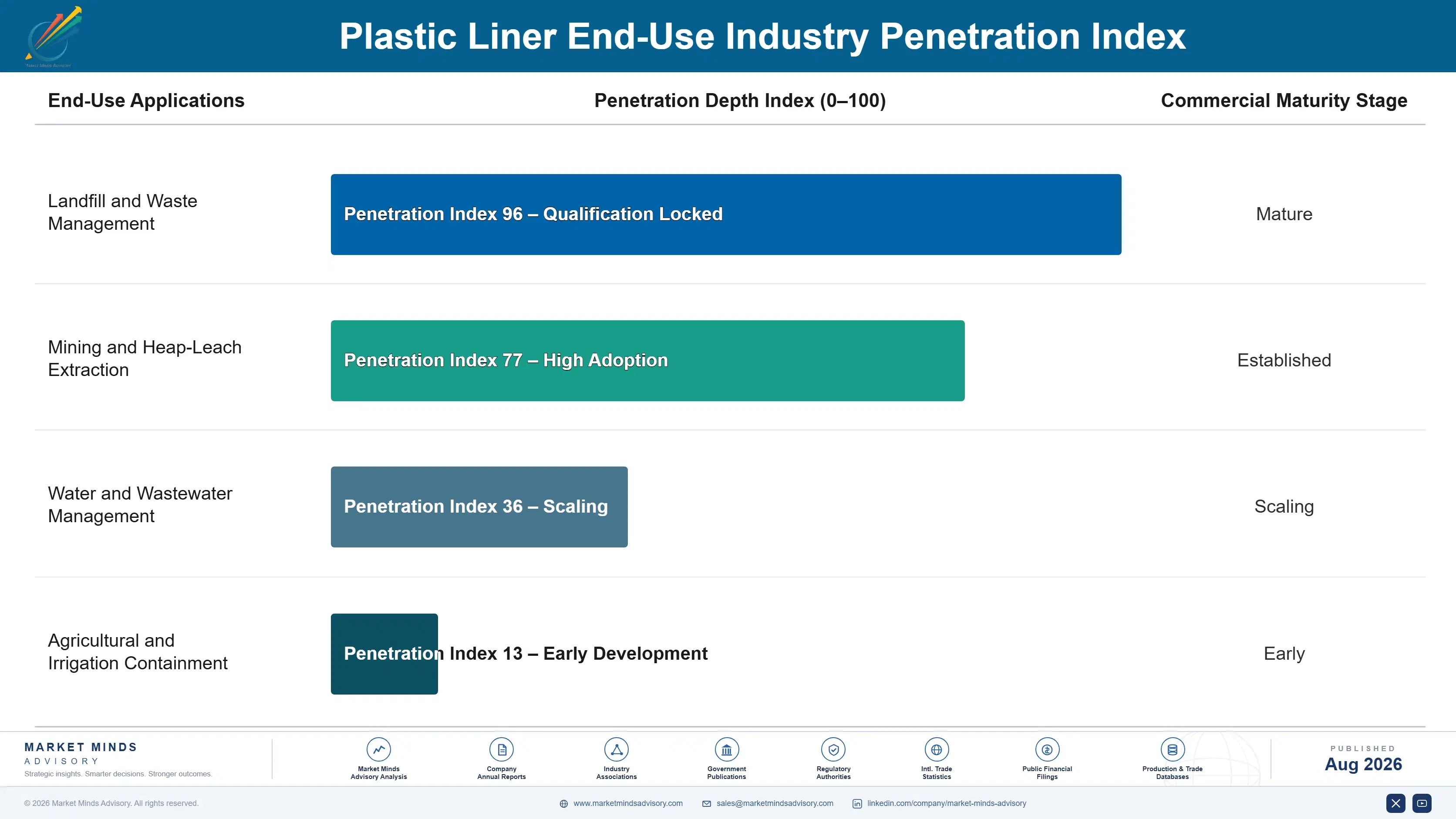
Liner revenue increasingly behaves like an annuity layered on top of the original containment permit rather than a one-time transaction. Every capacity expansion, double-liner conversion, and cell renewal extends the producer relationship well beyond initial installation, and producers with validated chemical resistance credentials capture repeat orders with lower friction than switching to an unproven alternative producer would require of a demanding municipal or mining customer.
Adoption depth varies considerably by end-use vertical. Large multinational mining groups have the deepest, most established liner adoption given regulatory and reputational requirements that make unconverted containment extremely costly in environmental exposure terms, while smaller regional mining operators are earlier in adopting comparable reliability-documented producers and still weighing cost against demonstrated durability improvement. Municipal waste operators sit differently, adopting double-liner platforms quickly given the recurring, high-stakes nature of their regulatory compliance obligations.

A generational shift is underway in procurement teams across most major markets. Younger procurement leadership increasingly treats chemical resistance depth and double-liner redundancy as baseline containment requirements rather than differentiators, a shift that is compressing the commercial advantage early-adopting producers once held over competitors still running largely commodity-focused product catalogs.
plastic-liner-market-end-use-penetration-index-1787298268112

Where Producers Should Focus Next

These are among the four positions where our research anticipates prominent divergence between winners and laggards over the coming forecast period. Each is grounded in the demand model, the regulatory perimeter, and the announced capacity pipeline.
01 / DOUBLE-LINER CONVERSION BUNDLING

Bundled double-liner conversion increasingly separates leaders from challengers

Municipal operators navigating increasingly demanding leak-detection requirements increasingly prefer producers who bundle full double-liner conversion with broader supply contracts, since that pairing reduces the operator's own vendor management complexity considerably compared with sourcing standard and redundant liner systems separately from different suppliers. That structure builds stickier customer relationships since switching producers mid-contract would force operators to requalify vendors entirely from scratch. Producers without comparable conversion programmes remain exposed as operators increasingly expect integrated redundancy expertise rather than sheeting alone, a gap that keeps widening with each renewal cycle.
02 / REINFORCED POLYPROPYLENE EXPANSION

Reinforced capacity expansion beats commodity HDPE volume

Reinforced polypropylene capacity demand represents a considerably more defensible margin pool than standard HDPE demand alone could ever support, since reinforced polypropylene pricing commands roughly 2 times standard HDPE per-unit value across most major producing markets tracked in this report. Producers expanding dedicated extrusion capacity capture utility contracts that generalist competitors increasingly cannot match, generating meaningful revenue through phased capacity conversion unfolding across multiple budget cycles. Building this capacity should rank above chasing standard HDPE tenders exclusively across every major utility relationship.
03 / MINING FRAMEWORK RELATIONSHIPS

Direct mining relationships beat one-off containment orders

Large mining groups increasingly consolidate containment procurement through direct framework agreements, and producers who maintain direct relationships with these mining groups capture recurring multi-site revenue considerably more predictable than one-off individual orders alone ever provide across a comparable mining relationship. That relationship also generates early visibility into upcoming extraction expansion cycles before competitors even learn a tender is coming their way. Building this relationship depth should rank above chasing every available individual order across the wider containment market and its adjacent permitting cycles.
04 / INDIAN MARKET EXPANSION

Early presence in Indian water management expansion compounds over time

Indian liner demand is scaling quickly as domestic producers expand capacity requiring validated containment engineering meeting international environmental standards across most major metropolitan waste management hubs and their satellite markets. Producers establishing local commissioning and service presence early are winning multi-year municipal contracts before competitors relying solely on imported product can match local pricing and delivery turnaround. That early position compounds considerably as India's waste management sector keeps climbing through the remainder of the decade, rewarding early movers meaningfully over slower-moving competitors.

Engagement Snapshot From the Field

A live engagement with an industry participant carrying material or product regulatory and market exposure ahead of a defining policy shift, showing how our research translates into a defensible multi-year portfolio strategy.
MARKET MINDS ADVISORY · CLIENT ENGAGEMENT SUMMARY
Plastic Liner Producer Strategic Portfolio Review and Transition Roadmap 2026·Investment Scenario on Plastic Liner Exposure Evaluation 2025-26
CLIENT PROFILE
A mid-size copper mining operator running two heap-leach extraction sites engaged MMA while evaluating a system-wide liner modernisation strategy ahead of a planned extraction capacity expansion cycle spanning the following two fiscal years. The client reported reliance on standard HDPE liners across most of its containment cells, with limited reinforced polypropylene capability concentrated at only its flagship site (client-reported, unverified by MMA).
STRATEGIC CHALLENGE
Leadership needed to decide whether full reinforced polypropylene conversion across both sites would reduce leak exposure faster than continuing the mixed liner approach, while also weighing which producers offered engineering support flexible enough to sequence conversion across sites without disrupting existing extraction schedules already committed to current suppliers and their delivery timelines.
MMA APPROACH
MMA benchmarked four qualified producers on chemical resistance credential validation, capacity flexibility, and total lifecycle cost against the operator's two-site conversion plan in considerable detail. We modelled a phased conversion sequence prioritising the highest-volume site first across the programme. We then assessed each producer's field-seaming support capacity given the client's aggressive conversion timeline.
KEY FINDINGS
  1. Converting the highest-volume site first would capture roughly 54% of projected leak exposure reduction within the programme's first full year of operation.
  2. Two of four candidate producers could not guarantee extrusion capacity meeting the operator's aggressive conversion timeline across both sites reliably or within budget.
  3. Full reinforced polypropylene conversion would reduce projected seam failure incidents by an estimated 31% once fully operational across the entire converted site network.
  4. The leading producer's bundled field-seaming training programme would reduce the operator's own crew onboarding burden by several weeks per site overall, freeing supervisory capacity.
CLIENT PROFILE
A mid-size copper mining operator running two heap-leach extraction sites engaged MMA while evaluating a system-wide liner modernisation strategy ahead of a planned extraction capacity expansion cycle spanning the following two fiscal years. The client reported reliance on standard HDPE liners across most of its containment cells, with limited reinforced polypropylene capability concentrated at only its flagship site (client-reported, unverified by MMA).
STRATEGIC CHALLENGE
Leadership needed to decide whether full reinforced polypropylene conversion across both sites would reduce leak exposure faster than continuing the mixed liner approach, while also weighing which producers offered engineering support flexible enough to sequence conversion across sites without disrupting existing extraction schedules already committed to current suppliers and their delivery timelines.
MMA APPROACH
MMA benchmarked four qualified producers on chemical resistance credential validation, capacity flexibility, and total lifecycle cost against the operator's two-site conversion plan in considerable detail. We modelled a phased conversion sequence prioritising the highest-volume site first across the programme. We then assessed each producer's field-seaming support capacity given the client's aggressive conversion timeline.
KEY FINDINGS
  1. Converting the highest-volume site first would capture roughly 54% of projected leak exposure reduction within the programme's first full year of operation.
  2. Two of four candidate producers could not guarantee extrusion capacity meeting the operator's aggressive conversion timeline across both sites reliably or within budget.
  3. Full reinforced polypropylene conversion would reduce projected seam failure incidents by an estimated 31% once fully operational across the entire converted site network.
  4. The leading producer's bundled field-seaming training programme would reduce the operator's own crew onboarding burden by several weeks per site overall, freeing supervisory capacity.
RECOMMENDED STRATEGY
Phase 1: Phase 1 (0 to 5 months): Finalise producer selection and convert the highest-volume site identified across the entire extraction network first. Phase 2: Phase 2 (5 to 10 months): Complete remaining site conversion sequenced around ongoing extraction scheduling and training commitments across both locations. Phase 3: Phase 3 (10 to 18 months): Complete full network conversion and renegotiate framework terms under the newly established supply structure.
OUTCOME
The operator completed priority site conversion within the targeted six-month window and reported leak exposure reduction tracking close to the modelled estimate across the converted site network. Projected seam failure rates also declined measurably under the new containment standard, though full eighteen-month transition figures were not yet available at the time of reporting (client-reported, unverified by MMA).

Frequently Asked Questions

Foundational context covering the market sizes, CAGR, scope, country, region and competition that inform every finding below. This section is provided to cover basics and most often pre-purchase conversations, answered from the MMA Primary Research Dataset.

What is the current size of the Plastic Liner Market?

The global plastic liner market is valued at USD 3.8 billion in 2025, covering HDPE, LLDPE, PVC, reinforced polypropylene, and specialty composite geomembrane liners for containment applications.

How large will the Plastic Liner Market be by 2036?

The market is projected to reach USD 7.68 billion by 2036, roughly 1.89 times its 2026 value of USD 4.05 billion, driven by mining containment and landfill regulation.

What is the CAGR for the Plastic Liner Market 2026 to 2036?

The base case CAGR is 6.6%, with a bull case of 7.8% if mining capacity expansion accelerates into additional emerging markets sooner, and a bear case of 5.4% under tighter capital spending.

Which segment is growing fastest?

Reinforced Polypropylene Liners lead at a 9.8% CAGR, roughly 1.48 times the overall market rate, as utilities chase UV resistance and field-seaming speed beyond standard HDPE.

Who are the major companies in the Plastic Liner Market?

Solmax, AGRU, Naue, Officine Maccaferri, and Atarfil lead the market, together holding roughly 46% of liner sheeting revenue generated worldwide each year currently, per company filings.

Which country is growing fastest?

China leads at a 8.4% CAGR as domestic producers scale capacity to serve both municipal remediation mandates and export containment orders across major coastal manufacturing hubs nationwide.

Report Segmentation Architecture

The full report scope spans multiple orthogonal segmentation dimensions, with cross-tabulated demand data provided for each dimension pair. Coverage extends further to regional breakdowns, trend trajectories, and the competitive detail needed to support segment-level decision-making.

By Material Type

  • HDPE Liners
  • LLDPE Liners
  • PVC Liners
  • Reinforced Polypropylene Liners
  • Specialty Composite Liners

By End-Use Industry

  • Landfill and Waste Management
  • Mining and Heap-Leach Extraction
  • Water and Wastewater Management
  • Agricultural and Irrigation Containment

By Commercial Dimension

  • Direct Producer Supply Contracts
  • Framework and Multi-Year Agreements
  • Distributor and Installer Channels
  • Government and Municipal Tenders

By Region

  • North America
  • Western Europe
  • East Asia
  • South Asia and Pacific
  • Latin America
  • Middle East and Africa
  • Eastern Europe

Scope, Methodology, and Coverage

Every figure in this report is reproducible from documented input assumptions. The scope below maps the historical period, the forecast horizon, the segmentation dimensions, and the countries covered, alongside the underlying primary and qualitative methodology.
Historical Period
2020 to 2025
Forecast Period
2026 to 2036
Base Year
2025 (USD billions; MMA Primary Research Dataset, August 2026)
Market Definition
The plastic liner market covers geomembrane and containment liner sheeting used across landfill, mining, water and wastewater management, and agricultural containment applications, including HDPE, LLDPE, PVC, reinforced polypropylene, and specialty composite liners. It excludes geosynthetic clay liners, geotextile fabrics without a plastic membrane layer, and roofing membrane applications.
Quantitative Units
USD billions (current prices); installed area where applicable
Segmentation Dimensions
By Material Type; By End-Use Industry; By Commercial Dimension; By Region
Regions Covered
North America, Western Europe, East Asia, South Asia and Pacific, Latin America, Middle East and Africa, Eastern Europe
Countries Covered
China, USA, Germany, France, Netherlands, Japan, South Korea, India, Australia, Canada, Chile, Peru, Mexico, Brazil, UAE, Saudi Arabia, South Africa, Nigeria, Turkey, Poland, Spain, Italy, Vietnam, Indonesia, Czech Republic, and additional markets relevant to this sector
Key Companies Profiled
Solmax International Inc., AGRU Kunststofftechnik GmbH, Naue GmbH and Co. KG, Officine Maccaferri S.p.A., Atarfil S.L., Firestone Building Products Company, LLC, Carlisle SynTec Systems, Inc., Raven Industries, Inc., Layfield Group Ltd., Cooley Group Holdings, Inc., Serrot International, Huesker Synthetic GmbH, Juta a.s., Freudenberg Performance Materials SE and Co. KG, Nilex Inc., Sotrafa S.A.U., Plastika Kritis S.A., Shandong Taian Modern Plastic Co., Ltd., Hebei Baoyu Plastic Group Co., Ltd., Jiangsu Kingde Plastic Chemical Co., Ltd.
Quantitative Methodology
Primary survey, n=3,800 respondents, Q4 2025, six countries; demand-side model with trade association cross-validation
Qualitative Methodology
47 expert interviews, Q4 2025; applied to validate demand model assumptions, identify emerging dynamics, and assess competitive positioning
Report Format
PDF and XLSX data workbook (Word format preview document)
Publisher
Market Minds Advisory
Report Code
MMA-2026-CHM-157
Published
August 2026
Contact
sales@marketmindsadvisory.com | www.marketmindsadvisory.com

Purchase the full Plastic Liner Market Report (2026 to 2036).

The full report delivers granular sizing and forecasts across all five material type segments and seven global regions through 2036. It profiles twenty companies across large diversified geomembrane manufacturers and regional specialists, benchmarking polymer science depth, manufacturing scalability, and distribution reach in considerable detail. Analysts detail resin and reinforcement fabric cost exposure, portfolio margin tiers, and demand architecture by end-use vertical across major global markets and their evolving procurement environments. Buyers receive both the standalone report and full access to underlying data tables supporting every figure and forecast presented throughout.
Five-segment material type sizing and full forecasts
Seven-region global market share breakdown detail
Twenty-company detailed competitive profile benchmarking analysis
Resin and reinforcement fabric cost exposure mitigation analysis
Portfolio margin tier benchmarking economics framework
Anonymised client engagement outcome case study

Built For The People Who Decide

From boardroom strategy to bench-side execution, this report is read cover-to-cover by leaders shaping the next decade of their industry, turning demand scenarios, market dynamics and valuation benchmarks into decisions.
CXOs/ Presidents/ VPs/ Managers
M&A and Corporate Development
Strategy Teams and R&D Heads
Procurement and Product Directors
Regulatory and Compliance Leaders
Investor Relations and Equity Analysts