Market Minds Advisory
Plastic Fasteners Market

Plastic Fasteners Market: Rattle, Recycled Resin and the Electric Vehicle Reset

Take the engine out of a car and every trim clip that used to hide behind combustion noise becomes audible, which turned a nine cent component into a warranty problem worth arguing about.

Lead Analyst

Bilal Shaikh

Published

September 2026

Make Smarter Decisions with Customized Research Insights

Request a free sample report and evaluate market opportunities, growth trends, and competitive dynamics relevant to your business needs.

2025 MARKET VALUE$9.6BMarket Size 2025
2036 FORECAST VALUE$17.5BBase Case , 2026 to 2036
CAGR 2026 TO 20365.6 %Bull 6.8% / Bear 4.4%
INCREMENTAL OPPORTUNITY$7.3BNet 10- year value creation
EXPANSION MULTIPLE1.72x2036 value over 2026 base
Strategic Levers
M&A Pipeline
Regional Outlook
Country Rankings
Competitive Intelligence
Segmental Deep-dive
Call-Us : 91 93563 13602

Executive Snapshot and Market Trajectory

A trim clip that rattled quietly inside a combustion car is plainly audible inside an electric one, and customers report it as a defect. That single acoustic change has rewritten fastener specifications across every platform now in development. Nobody costed for that when the platforms were planned.
Vibration-damping and isolating fasteners grow at 8.4%, half again the market rate of 5.6%, because noise and harshness targets on electric platforms are tighter than anything the industry set before. Cable ties and routing clips follow, driven by high-voltage harness runs that need retention and separation the old wiring never required. East Asia holds 33% of value, above the usual band, on vehicle and appliance assembly concentration.
The countervailing pressure is material. End-of-life vehicle recycled content targets push fastener makers off virgin polyamide, and recycled resin loses retention force after heat cycling in exactly the way a clip cannot afford. Recycled content above roughly 22% fails retention testing today. Concentration is low at 31%, and tooling ties suppliers to programmes for years. Programme tooling amortises over roughly 3.5 years, so a supplier winning a platform holds it well beyond that.
Market Definition
Engineered plastic fasteners used for mechanical assembly and attachment, including push-in clips, rivets and expansion pins, threaded plastic fasteners, cable ties and routing clips, quarter-turn fasteners and vibration-isolating mounts. Excludes metal fasteners, adhesives and bonding systems, plastic housings and enclosures, and commodity packaging closures such as bottle caps.
Base Year Value
$9.6B in 2025 (MMA Primary Research Dataset, August 2026)
Forecast Period
2026 to 2036, eleven discrete annual values
CAGR
5.6% base case. Bull 6.8%. Bear 4.4%.
Fastest Growth Segment
Vibration-Damping and Isolating Fasteners: 8.4% CAGR
Fastest Growth Country
India: 8.9% CAGR
Fastest Growth Region
South Asia and Pacific: 7.8% CAGR
Largest Region
East Asia: 33% of 2025 global value
Market Leaders
Nifco, ARaymond, Illinois Tool Works, Böllhoff, TR Fastenings. Source: MMA Primary Research Dataset, July 2026.
Primary Survey
n=3,800 procurement and R&D decision-makers, Q4 2025, six countries
Methodology
Demand-side build-up, cross-validated against public data, 47 expert interviews

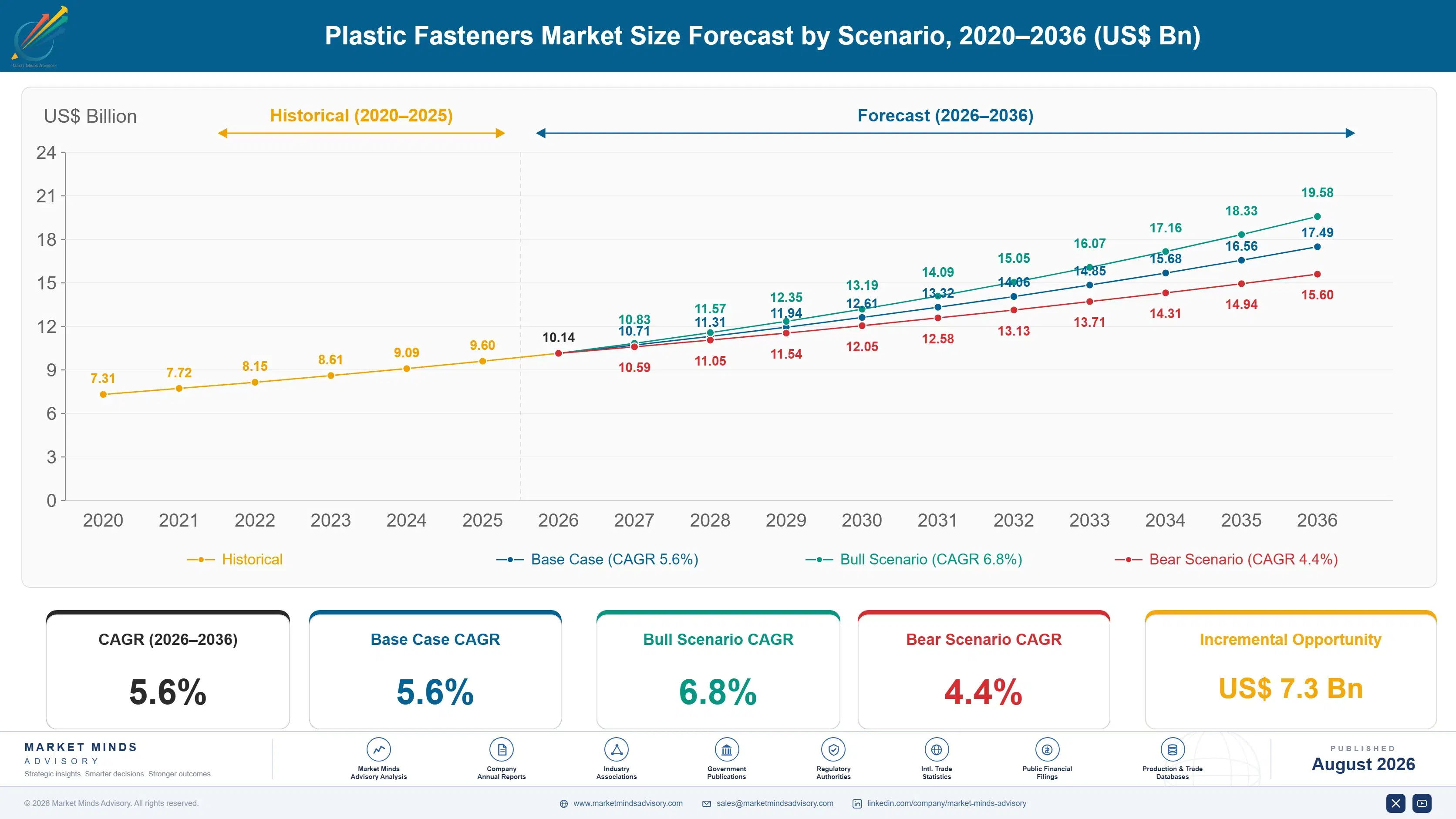
Plastic Fasteners Market Forecast Scenarios

plastic-fasteners-market-trends-size-forecast-scenario-1787580542541
Growth tracked vehicle and appliance build rates closely between 2020 and 2025, running near 4.5% through a period that included a semiconductor shortage, a resin supply crisis and a partial recovery. Fastener demand follows units assembled rather than value, so it fell harder than automotive revenue during the shortage and recovered more slowly afterwards. Content per vehicle rose steadily throughout, which cushioned the volume decline somewhat.
Base case 5.6% rests on three mechanisms. Electric platforms carry more attachment points than combustion equivalents once battery pack, thermal management and high-voltage harness routing are counted, despite losing engine bay hardware. Noise and harshness targets on those platforms have moved damping and isolating fasteners from a niche into standard specification. And Indian and Southeast Asian vehicle assembly is expanding at rates that pull component demand with them regardless of powertrain mix.
The bull case at 6.8% assumes recycled content requirements are met through material development rather than through fastener redesign, keeping unit counts intact. The bear case at 4.4% is a combination of slower electric vehicle adoption and appliance market weakness in China, which together account for enough assembly volume to hold growth near replacement rates.

Nine Cents That Decide a Warranty Claim

Combustion engines are loud, and that noise masked a great deal. A trim clip losing a fraction of its retention force after three summers of heat cycling produced a rattle nobody could hear over an idling four-cylinder. In an electric vehicle the cabin is quiet enough that the same rattle reaches the driver directly, and it arrives as a dealer visit rather than as an engineering note.
TOP FIVE CONCENTRATION31%Automotive specialists lead a highly fragmented supplier field
FASTENERS PER VEHICLE480Typical engineered plastic attachment points on passenger cars
AVERAGE SELLING PRICE$0.09Blended price per unit across automotive fastener types
POLYAMIDE COST SHARE38%Share of piece cost carried by engineered polyamide
TOOLING AMORTISATION PERIOD3.5 yearsTypical mould payback across a vehicle programme life
RECYCLED CONTENT CEILING22%Maximum recycled resin holding retention force after cycling
The response has been specification tightening across the board. Retention force after accelerated heat and humidity cycling is now tested to limits that were considered laboratory curiosities a decade ago, and damping geometries once reserved for luxury programmes appear on volume vehicles. Roughly 480 engineered plastic attachment points sit in a typical passenger car, so a specification change propagates across a large number of parts at once.
Material policy is pulling in the opposite direction. European end-of-life vehicle rules are setting recycled plastic content targets that fastener makers cannot meet with current chemistry, because recycled polyamide carries chain length variation that shows up as creep and lost retention. Testing puts the practical ceiling near 22% recycled content before retention falls outside specification. Compatibilising additives and mechanical recycling improvements are both being funded hard.
"This is a component nobody thinks about until a customer hears it. The suppliers who understood that the electric transition was an acoustics problem rather than a powertrain problem have been redesigning clips for four years, and the ones who treated it as a volume forecast are about to find out what they missed."
Principal, Automotive Components and Materials Practice · MMA Automotive and Industrial Components Practice · August 2026

Market Trends

Electric platform acoustics rewriting trim attachment specifications

Noise and harshness targets on battery electric platforms are tighter than anything set for combustion vehicles, because there is no masking noise source anywhere in the drivetrain. Attachment points that produced inaudible movement now generate rattles that reach the cabin directly. Manufacturers have responded by specifying damping geometries, elastomer overmoulds and higher retention tolerances across trim, door and dashboard attachment. The change applies to hundreds of parts per vehicle rather than to a handful, which is why it moves a whole segment rather than a product line. Suppliers found out through customer escalation rather than through any forecast.
Market Impact: Saves 2 seconds per attachment
High-voltage harness routing multiplying cable retention requirements

Battery electric architectures run high-voltage cable between pack, inverter and motor at gauges and separation distances that low-voltage harnesses never required. Routing clips must hold position under vibration, maintain clearance from low-voltage runs, and survive temperatures around the pack that a conventional harness clip was never tested for. Content per vehicle in this category runs materially above combustion equivalents. Suppliers with flame rating and dielectric test capability have taken most of the new business, because qualification here is stricter than in conventional routing. Content here rises even where total attachment points fall.
Market Impact: Delivers 8.9% annual Indian growth

Market Opportunities and Growth Drivers

Assembly labour cost pushing designers toward snap-fit attachment

A push-in clip installs in about two seconds with no tool, where a threaded metal fastener takes several times that and requires a driver, a torque check and often a second operator position. As assembly labour costs rise across every major manufacturing region, that difference compounds across hundreds of attachment points per unit. Design teams have been converting metal attachment to snap-fit plastic wherever load permits for two decades and the conversion is nowhere near complete. Appliance and electronics assembly follow the same logic on shorter cycles. The conversion runs quietly and never stops.
Market Impact: Caps recycled content at 22%

Indian and Southeast Asian vehicle assembly capacity expansion

India grows fastest anywhere at 8.9%, on assembly capacity being commissioned by domestic manufacturers and by Japanese and Korean joint ventures building for export as well as local sale. Fastener demand follows units built rather than vehicle value, so a market producing large volumes of small vehicles generates more fastener demand than its revenue share suggests. Southeast Asian plants in Thailand, Indonesia and Vietnam follow the same pattern. Local content requirements are also pulling fastener production into the region rather than leaving it imported. Tooling delivered locally beats tooling delivered from Japan on lead time, and that decides awards here.
Market Impact: Locks positions for 3.5 years

Market Restraints and Challenges

Recycled polyamide fails retention testing above modest content levels

European end-of-life vehicle rules are setting recycled plastic content targets that current fastener chemistry cannot meet. The root cause is molecular: mechanically recycled polyamide carries chain length variation and residual contamination, which produce creep under sustained load and lost retention force after heat cycling. Testing puts the practical ceiling near 22% recycled content before parts fall outside specification. Suppliers are funding compatibilising additive packages, chemical recycling routes that restore chain length, and redesigns that lower sustained load on the retention feature itself. None of those routes is proven at volume yet.
Market Impact: Applies to 480 attachment points

Programme tooling locks suppliers and buyers together for years

Every fastener geometry needs a dedicated injection mould, typically amortised over about 3.5 years of programme life, and the tooling is usually funded by the supplier against expected volume. That arrangement makes switching expensive for both sides and slows any response to a better product. The root cause is that fastener geometry is specific to the panel it retains, so nothing transfers between programmes. Suppliers are moving toward modular tool inserts and family moulds that spread cost across several geometries and shorten new programme lead times. The lock cuts both ways, which is why buyers accept it.
Market Impact: Raises routing content 40% per vehicle
3 additional market trends, 4 additional growth drivers, and 2 additional restraints and challenges are covered in the full report. Contact sales@marketmindsadvisory.com to access the complete intelligence.

Segment CAGR and Growth Architecture

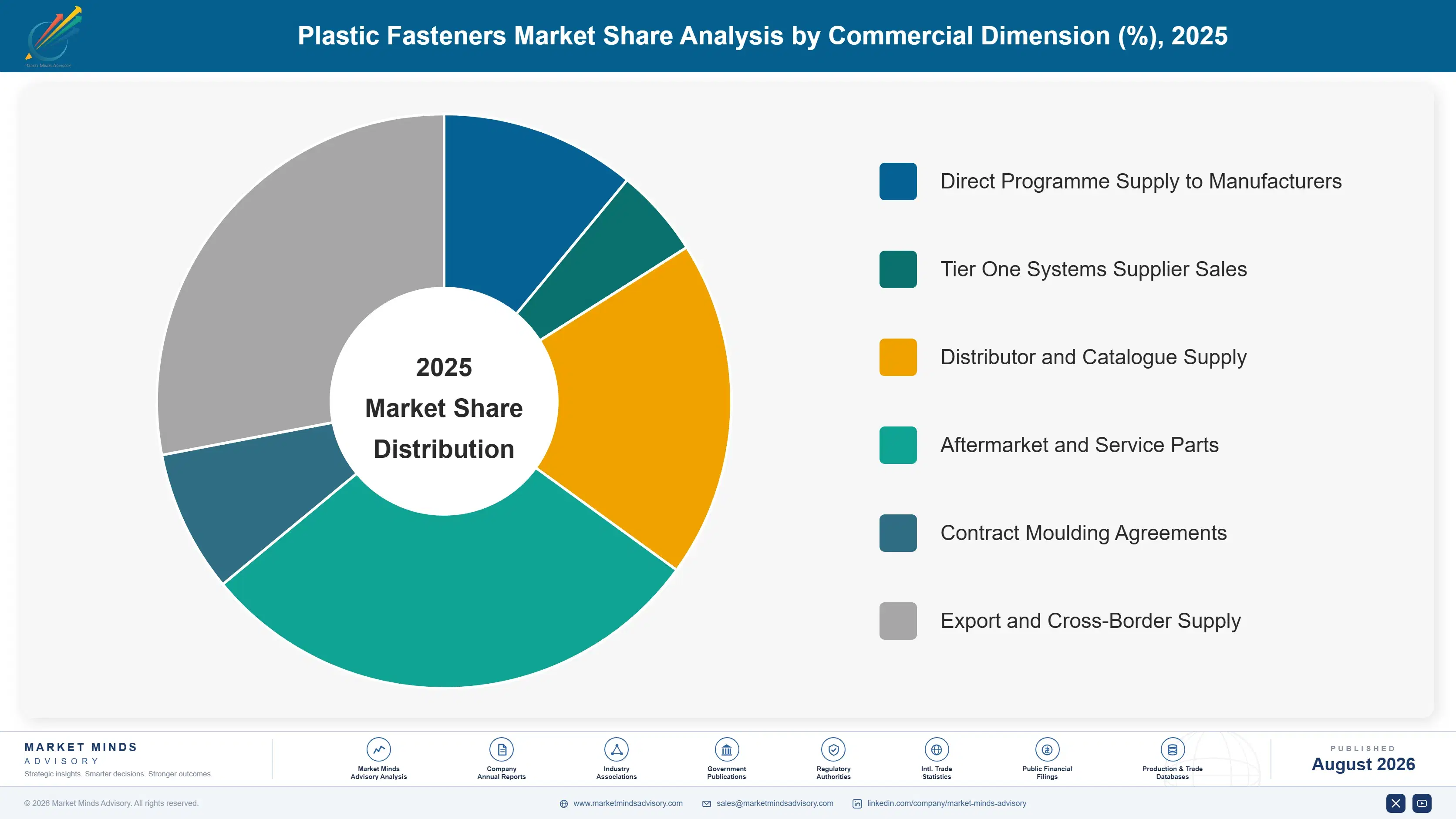
Six segments split by fastener type, because type determines the load case, the qualification testing required and therefore which suppliers can compete for the business at all. A clip supplier and a cable tie supplier rarely meet in a tender. End-use industry and commercial channel are handled separately in the framework. The two rarely compete for the same business.
plastic-fasteners-market-trends-market-share-analysis-1787580543085

Vibration-Damping and Isolating Fasteners

Growing at 8.4%, half again the market rate of 5.6%, this segment covers clips and mounts with elastomer overmoulds, damping geometries or deliberate compliance built into the retention feature. Demand comes almost entirely from electric platform acoustics, where the absence of engine noise makes trim movement audible in the cabin. Parts cost several times a plain push-in clip and carry qualification testing that plain clips never faced, covering retention after heat and humidity cycling, and measured buzz and rattle performance. Two-shot moulding capability is the practical entry barrier, and it has concentrated the business among suppliers who already had it. Programmes now in development specify these across full trim sets rather than at selected points.
CAGR 8.4%

Cable Ties and Wire Routing Clips

At 7.5% this segment grows on high-voltage harness architecture rather than on vehicle count. Electric platforms route heavy cable between pack, inverter and motor with separation and clearance requirements that low-voltage harnesses never imposed, and clips near the battery pack face thermal exposure a conventional routing clip was never tested against. Flame rating, dielectric performance and vibration retention all form part of qualification here, which excludes commodity cable tie suppliers from the automotive portion of the segment entirely. Industrial and electronics applications remain price-led and considerably more fragmented than the automotive business is. Automotive qualification here takes longer than in any other routing application, and the positions won correspondingly outlast several product cycles in the industrial side of the segment.
CAGR 7.5%
Full segment breakdown across 6 segments available in the complete report.

Regional Architecture and Country Demand Map

East Asia holds 33% of value, above its usual band, because Chinese, Japanese and Korean plants assemble the largest share of world vehicles and appliances and fastener demand follows units built. North America follows at 24% and Western Europe at 21%, where recycled content rules bite hardest.

North America

Light truck and SUV mix gives American assembly a higher fastener count per unit than most regions, since larger bodies carry more trim and more attachment points. Detroit programmes have adopted damping specifications more slowly than European ones, partly because electric adoption has been slower and partly because acoustic targets were historically looser. Mexican assembly plants account for a growing share of regional consumption, with several fastener suppliers operating dedicated moulding capacity near Bajío and Saltillo. Appliance manufacturing in the American southeast provides meaningful non-automotive demand. Recycled content rules have no federal equivalent, which removes the material pressure European suppliers are managing. That leaves acoustic specification as the only force moving the market here.
Share: 24% | CAGR: 4.9% (2026 to 2036)

Western Europe

End-of-life vehicle recycled content rules make this the most technically demanding region for fastener materials anywhere. German programmes set the specifications the rest of the region follows, and the combination of tight acoustic targets and recycled content obligations produces requirements that current polyamide chemistry struggles to satisfy at once. ARaymond and Böllhoff hold strong positions built on decades of German platform work. French and Spanish assembly contributes volume, with Czech and Slovak plants counted in Eastern Europe. Regional growth runs below the base case because vehicle build volumes are flat, not because content per vehicle is falling. Content per vehicle is the highest of any region, and unit volumes are the constraint rather than the specification.
Share: 21% | CAGR: 4.2% (2026 to 2036)
Regional intelligence for 5 additional markets available in the complete report: East Asia, South Asia and Pacific, Latin America, Middle East and Africa, Eastern Europe. Contact sales@marketmindsadvisory.com.
plastic-fasteners-market-trends-country-cagr-analysis-1787580543652

Four Positions Worth Building Now

This is a business where a nine cent part carries qualification testing worth more than the annual contract, and where tooling decisions made once govern revenue for years. The levers that matter all involve getting specified early or removing a technical constraint that competitors have not solved yet. Price is never the argument. Nobody wins these on price.

Build two-shot damping capability before competitors qualify

Vibration-damping fasteners with elastomer overmoulds grow at 8.4% and require two-shot moulding that most fastener suppliers do not currently operate. A two-shot cell costs roughly 900 thousand dollars installed and qualifies over about a year, which sounds slow until compared against the programme cycles this business runs on. Suppliers who invested before 2024 are being specified on platforms now entering development, and those positions hold for the programme life. Late entrants face qualifying against an incumbent whose parts are already in the acoustic sign-off package. The window is open for perhaps two more platform cycles.
Market Impact: Costs $900 thousand for each two-shot moulding cell

Solve recycled polyamide retention before regulation forces it

Recycled content above roughly 22% fails retention testing after heat cycling, and European rules are heading past that threshold regardless. Compatibilising additive packages and chemical recycling routes both restore enough chain length consistency to move the ceiling, at development cost in the low millions. The supplier who gets there first sells a compliant part that competitors cannot offer, into programmes with no alternative. This is the single largest technical opportunity in the category, and most participants are waiting to see who solves it rather than funding the work themselves. Waiting is the common strategy and the wrong one.
Market Impact: Moves the ceiling well beyond 22% recycled content

Move tooling to modular family mould architecture

Each fastener geometry conventionally needs a dedicated mould amortised over about 3.5 years, funded by the supplier against volumes that may not arrive. Family moulds with interchangeable inserts spread base tool cost across several geometries and cut new programme lead time by roughly a third. That matters most in Chinese and Indian programmes, where tooling delivery speed is a genuine selection criterion rather than a courtesy. The capital saving is real and the lead time advantage is what actually wins the business in those markets. Chinese programmes in particular reward it heavily.
Market Impact: Cuts new programme lead time by roughly 33%

Localise moulding capacity inside growth assembly regions

A fastener sells for around nine cents and weighs almost nothing, which sounds like an ideal export product until inventory, duty and lead time are counted against local content requirements. India, Mexico and Morocco all reward local production with programme access that imported parts cannot obtain. A regional moulding cell costs far less than a full plant and can be justified against a single platform award. A regional cell pays back inside 2 years on a single award, and suppliers who localised early hold positions that competitors serving from Europe or Japan now struggle to contest on any basis.
Market Impact: Opens programmes carrying 8.9% annual regional growth rates

Who Controls the Margin Pool

Participation is measured on annual unit shipment volume of engineered plastic fasteners, and on that basis the top five hold 31%. The field is fragmented because geometry is programme-specific and regional suppliers win on tooling proximity. Nifco and ARaymond lead through decades of automotive platform work in Japan and Germany respectively. The gap to challengers is qualified programme positions and two-shot capability rather than manufacturing scale.
Competition currently runs on three fronts. Programme specification is the first and most important, since being designed into a platform is worth years of volume. Technical capability is the second, particularly two-shot moulding and the testing infrastructure for acoustic sign-off. Tooling delivery speed is the third, and it decides most Chinese and Indian awards outright. Piece price matters only once two suppliers are technically equivalent, which is rarer than buyers assume.

The pressure ahead comes from material science rather than from competitors. Whoever solves recycled polyamide retention first sells parts that others cannot legally supply into European programmes, which would reorder positions faster than any commercial move. Expect development partnerships with resin producers rather than acquisitions. Rankings also shift as Chinese suppliers qualify onto export platforms, where they have historically been absent.
plastic-fasteners-market-trends-company-positioning-matrix-1787580544175

Competitive Moat and Risk Dimensions

NIFCO

Moat: Geometry library and Japanese qualification

Nifco developed a large share of the clip and retainer geometries now used across the industry, and Japanese platform qualification standards for retention after ageing are the strictest anywhere. Parts qualified to those standards carry into other regions without rework, which shortens development for global programmes and makes the company a default choice on new platform launches.
NIFCO

Risk: Japanese platform volume dependence

A substantial share of revenue follows Japanese manufacturer platforms, and those manufacturers have lost share in China and moved cautiously on electric vehicles. Chinese domestic suppliers are taking the fastest-growing programmes on tooling speed and price. Rebuilding position on Chinese electric platforms means competing on criteria where Nifco's technical depth is not what buyers weigh most heavily.
ARAYMOND

Moat: German platform engineering integration

ARaymond works inside German manufacturer development processes early enough to shape attachment design rather than respond to it, which is where fastener business is actually won. Its two-shot and damping capability was built out ahead of the electric acoustic requirement, giving it qualified parts on platforms competitors are only now approaching with prototypes.
ARAYMOND

Risk: Recycled content compliance exposure

European end-of-life vehicle rules bear hardest on exactly the German programmes that carry most of ARaymond's volume, and current polyamide chemistry cannot meet the coming content thresholds. If a competitor or a resin producer solves recycled retention first, the company's strongest customer relationships become its most exposed ones within a single programme cycle.

Players Tracked

Prominent Players

Nifco
ARaymond
Illinois Tool Works
Böllhoff
TR Fastenings

Other Key Players

HellermannTyton
Panduit
Essentra Components
Bossard Group
Piolax
Daiwa Kasei Industry
Stanley Engineered Fastening
Norma Group
Heyco Products
Southco
Camloc Motion Control
Würth Group
Richco
Thomas and Betts
Fischer Group

Recent Developments

MARCH 2026

European manufacturer specifies damping clips across a full electric platform

A German manufacturer specified elastomer-overmoulded damping clips across the complete interior trim set of a new electric platform, replacing plain push-in retainers throughout. The decision followed buzz and rattle testing that identified trim attachment as the dominant remaining cabin noise source, with plain retainers retained only in non-visible locations.
Signal: Acoustic requirements are moving damping geometries from selective application into full platform standard specification across trim
SEPTEMBER 2025

Resin producer and fastener supplier begin joint recycled polyamide programme

A polyamide producer and an automotive fastener supplier started a joint development programme on compatibilised recycled grades targeting retention performance after heat cycling. The arrangement is a development partnership with shared intellectual property terms, not a joint venture and not an equity transaction. Timelines were not disclosed by either party.
Signal: Material chemistry rather than part design is now where the recycled content problem is being attacked
DECEMBER 2025

Japanese fastener supplier commissions Indian moulding capacity for local programmes

A Japanese fastener supplier commissioned dedicated moulding capacity in western India to serve domestic assembly programmes with local tooling and shorter lead times. The investment is an organic capacity expansion rather than an acquisition or any partnership with a local manufacturer. Tooling is being cut locally for the first time.
Signal: Local content requirements are pulling moulding capacity into growth assembly regions rather than leaving parts imported

Where the Piece Cost Goes

Engineered polyamide runs about 38% of piece cost across most automotive fastener types, with PA66 and PA6 grades sourced from American, European, Chinese and Korean producers. Acetal and polypropylene cover lower-load applications at lower cost. Moulding conversion, meaning machine time, energy and labour, accounts for roughly 29%, while tooling amortisation adds a further 12% spread across the programme life.
The 2021 adiponitrile disruption remains the reference event for this industry. Force majeure declarations across the PA66 intermediate chain, disclosed in Ascend and Invista customer communications and reflected in downstream annual reporting for that year, pushed resin pricing to multiples of contract levels and left fastener suppliers holding automotive contracts they could not reprice. Several absorbed the entire increase, and a few smaller moulders did not survive the following eighteen months.

Exposure varies enormously by resin position and by contract structure. A supplier holding annual piece price agreements with spot resin buying carries the full swing, while one with matched contracts or qualified PA6 alternatives moves within a quarter. Geography adds a second layer: European moulders carry industrial electricity costs well above Asian levels, per IEA industrial tariff data, on an energy intensive process.
plastic-fasteners-market-trends-cost-volatility-analysis-1787580544374

Qualify a second resin grade against the same part specification

Holding an approved PA6 alternative alongside PA66 for the same fastener lets a moulder switch when intermediate supply tightens, which is the exposure that damaged this industry most recently. Qualification requires retention and ageing retesting with the customer, costing perhaps 60 thousand dollars per part family, and recovers within a single disruption. Few moulders hold a second qualified grade.

Match resin contract tenor to customer piece price agreements

Automotive piece prices are agreed annually and rarely reopened, while many moulders buy resin on shorter terms. Aligning both to the same tenor removes most of the margin variance that spot exposure creates. The cost is missing resin troughs, which matters far less than surviving a supply event with fixed downstream pricing already committed for the year.

Locate high-volume moulding where industrial power costs least

Moulding conversion is energy intensive and European industrial electricity tariffs run well above Asian and North American levels. Placing high-volume commodity geometries in lower-cost locations while keeping programme-critical and two-shot work near customers captures the difference. Freight on a light part is modest, though local content requirements limit how far this can be pushed on award-critical business.

Portfolio Architecture for Margin Defence

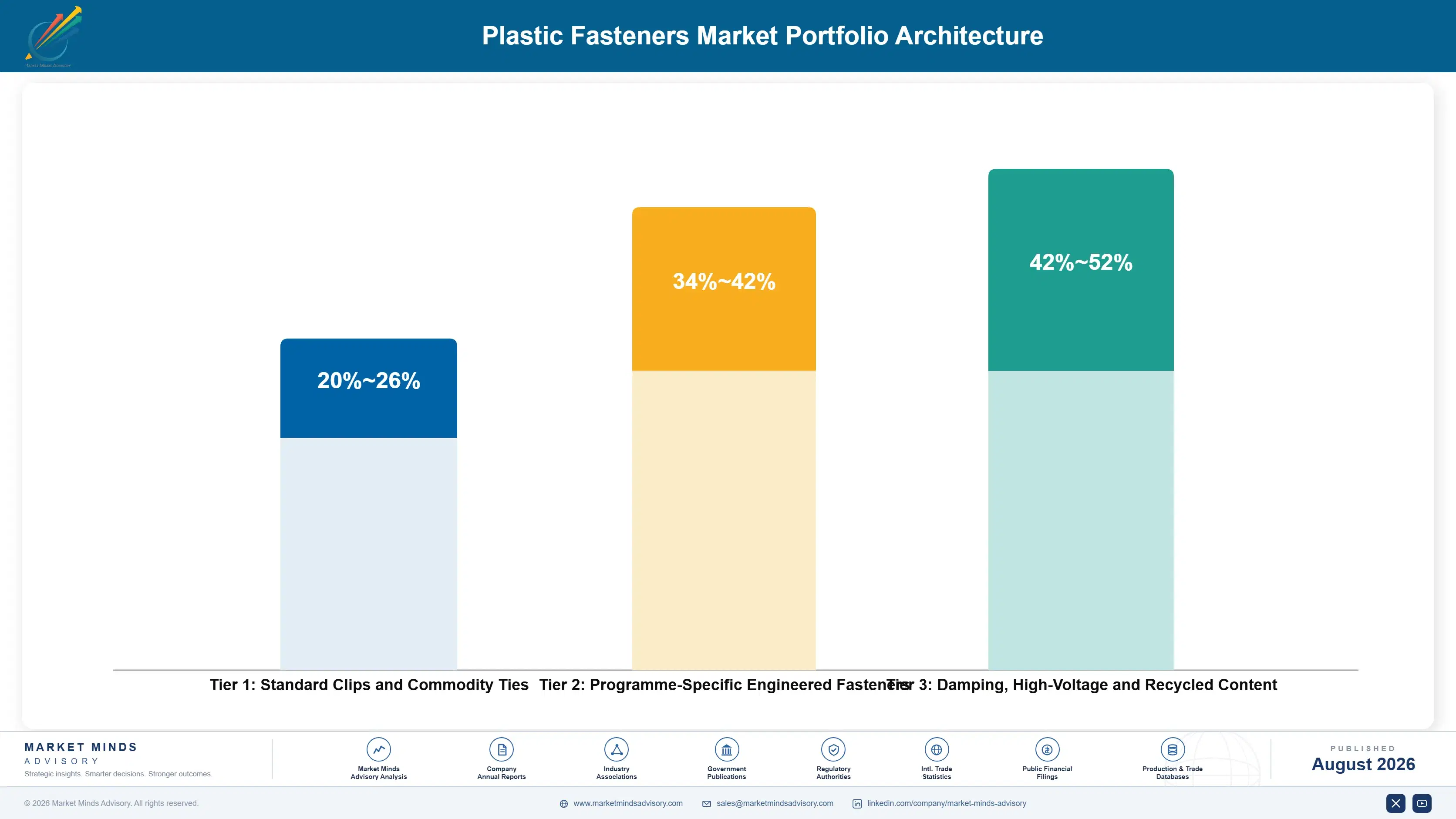
Margin in this business tracks qualification difficulty almost perfectly. Plain push-in clips and commodity cable ties earn margins in the low twenties, because geometry is easily copied, tooling is cheap and buyers can qualify a second source without much effort. Volume is enormous and the pricing power is not there, which is the arrangement most of the industry has lived with for decades.
Programme-specific engineered fasteners do considerably better at margins in the mid thirties to low forties, since the part is designed into a panel and the tooling is dedicated. The range is wide because it depends on whether the supplier participated in the design or merely quoted against a finished drawing, and those are entirely different commercial positions with entirely different pricing outcomes.

The best economics sit in damping and high-voltage routing, running into the high forties, where two-shot capability and acoustic or dielectric qualification exclude most of the field. Those margins reflect a capability gap rather than a market grant, and they will compress as competitors install two-shot cells. The question is how much programme position gets locked in before that happens.

Standard Clips and Commodity Ties

Plain push-in retainers, expansion rivets and industrial cable ties sold across many customers. Geometry is easily copied and second sourcing is straightforward, so the six point range reflects volume scale and moulding location rather than any product advantage.
Gross Margin: 20-26%

Programme-Specific Engineered Fasteners

Parts designed into a specific panel or platform with dedicated tooling and programme qualification. The eight point range depends on whether the supplier shaped the attachment design or quoted against a finished drawing, which are different commercial positions entirely.
Gross Margin: 34-42%

Damping, High-Voltage and Recycled Content

Two-shot damping fasteners, high-voltage routing clips and any compliant recycled content parts. The ten point range reflects how few suppliers hold the qualification, which varies sharply by application and by which regional specification applies.
Gross Margin: 42-52%
plastic-fasteners-market-trends-portfolio-architecture-1787580544894

High-value Sub-segments and Strategic Watch-out

Two-Shot Damping Fasteners

High value and high growth. Electric platform acoustic targets are moving these from selective use into full platform specification, and two-shot capability excludes most of the supplier field. Positions won during platform development hold for the programme life. Capability, not sales effort, decides who competes for this business.
Gross Margin: 44-52%

High-Voltage Routing Clips

High value, moderate growth, and rising in content per vehicle rather than with vehicle count. Flame rating and dielectric qualification keep commodity cable tie suppliers out of the automotive portion entirely. Thermal exposure near the pack raises the technical bar further. Content rises even as attachment points fall.
Gross Margin: 40-48%

Standard Interior Trim Clips

The volume core and permanently price-led. Geometry is copied readily, tooling is inexpensive and buyers qualify second sources as a matter of routine. Growth tracks vehicle build volume with modest content gains and no realistic margin improvement available. Scale and moulding location are the only levers a supplier holds here.
Gross Margin: 20-26%

Recycled Content Compliant Parts

The strategic watch-out and the largest technical unknown. Nobody currently holds a compliant part above the 22% retention ceiling, so the margin range assumes a chemistry outcome that has not arrived. Whoever solves it first reorders the whole competitive field. Nobody knows yet who will get there or when.
Gross Margin: 38-50%

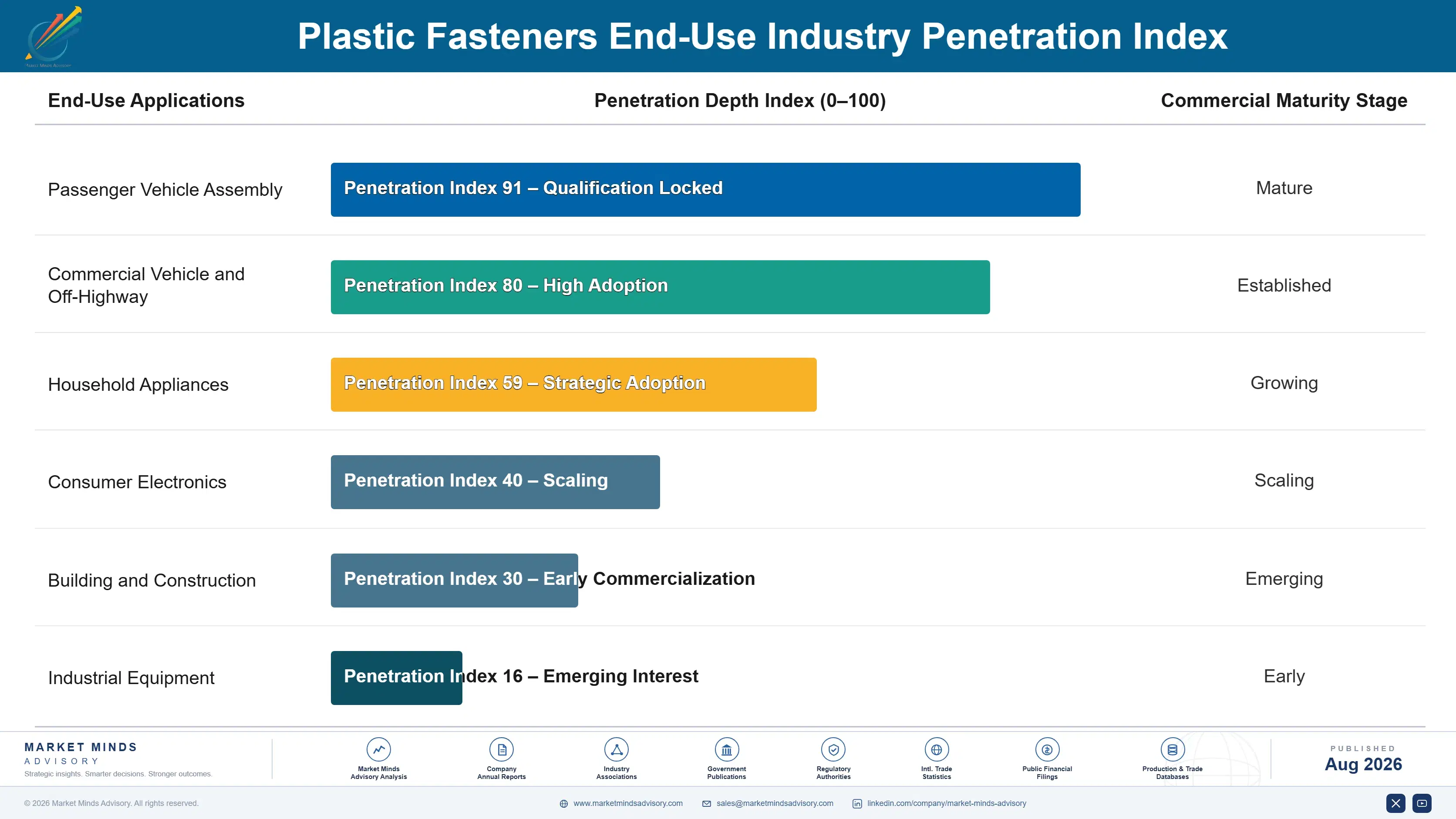
How the Programme Volume Repeats

A fastener award behaves like an annuity with a fixed term. Once a part is designed into a platform and the tooling is cut, volume follows build rates for the life of that programme, typically six to eight years, with the supplier amortising tooling over roughly the first 3.5 years and earning properly thereafter. Nobody changes a qualified fastener mid-programme without a quality reason, because revalidation costs exceed any piece price saving.
Stickiness varies by how the part was won. Suppliers who shaped the attachment design during platform development are effectively locked in, since the panel geometry assumes their part. Those who quoted against a finished drawing are replaceable at the next model refresh. Aftermarket and appliance business switches far more readily, on shorter cycles and with looser qualification. Industrial cable tie demand is nearly spot in character throughout.

The buyer has moved earlier in the process. Fastener selection was once a purchasing decision made after design freeze, on price against a drawing. Acoustic and recycled content requirements have pulled it into platform engineering, where suppliers now sit with development teams years before any part is ordered, and where the commercial outcome is largely settled.
plastic-fasteners-market-trends-end-use-penetration-index-1787580545386

Where We Would Invest

These are among the four positions where our research anticipates prominent divergence between winners and laggards over the coming forecast period. Each is grounded in the demand model, the regulatory perimeter, and the announced capacity pipeline.
01 / TWO-SHOT CAPABILITY BUILD

Install damping capability before the next platform development cycle

Vibration-damping fasteners grow at 8.4% and need two-shot moulding that most of the supplier field does not operate today. A cell costs roughly 900 thousand dollars installed and qualifies over about a year, which is fast against the platform cycles this business actually runs on. Suppliers who invested before 2024 are being specified onto platforms now in development, and those awards hold for six to eight years, so arriving late means waiting a full programme generation for the next opportunity to compete at all.
02 / RECYCLED RETENTION CHEMISTRY

Fund the material work instead of waiting for someone else

Recycled polyamide fails retention testing above roughly 22% content, and European end-of-life vehicle rules are heading past that threshold regardless of whether the chemistry is ready. Compatibilising packages and chemical recycling routes both look tractable at development cost in the low millions, shared with a resin producer willing to co-fund it. Whoever gets there first supplies compliant parts into programmes that have no alternative source, which is comfortably the single largest repositioning opportunity available anywhere in this category over the whole forecast period.
03 / DESIGN STAGE PARTICIPATION

Get into platform engineering rather than quoting finished drawings

A supplier who shapes attachment design during development is effectively locked in for the programme life, because the panel geometry assumes their part and revalidation costs exceed any piece price saving on offer. A supplier quoting against a finished drawing is entirely replaceable at the next model refresh. Acoustic and recycled content requirements have pulled this decision years earlier into engineering, and the commercial outcome is now largely settled long before anyone in purchasing is involved in the conversation at all.
04 / REGIONAL MOULDING LOCALISATION

Put capacity inside the assembly regions that are growing

India grows at 8.9% and local content requirements there, in Mexico and in Morocco reward domestic production with programme access imported parts cannot obtain. A regional moulding cell costs far less than a full plant and is justifiable against a single platform award, particularly in markets where tooling delivery speed is itself a formal selection criterion. Suppliers who localised before 2024 hold positions that competitors serving those programmes from Europe or Japan now struggle to contest on any basis whatsoever.

Engagement Snapshot From the Field

A live engagement with an industry participant carrying material or product regulatory and market exposure ahead of a defining policy shift, showing how our research translates into a defensible multi-year portfolio strategy.
MARKET MINDS ADVISORY · CLIENT ENGAGEMENT SUMMARY
Plastic Fasteners Producer Strategic Portfolio Review and Transition Roadmap 2026·Investment Scenario on Plastic Fasteners Exposure Evaluation 2025-26
CLIENT PROFILE
A European tier one supplier of interior trim and door systems to German and French vehicle manufacturers, with annual revenue near 1.4 billion euros and plants across five countries (client-reported, unverified by MMA). Fastener selection was handled programme by programme through purchasing, sourcing from a panel of four suppliers with no group-level specification or material strategy in place.
STRATEGIC CHALLENGE
Two electric platforms in development had returned buzz and rattle results attributing most residual cabin noise to trim attachment, and the customer had escalated. Separately, recycled content obligations were coming into force across the same programmes. Management needed to know whether the existing supplier panel could deliver on either requirement, and whether fastener decisions should move out of purchasing entirely.
MMA APPROACH
MMA audited the four panel suppliers for two-shot capability, acoustic test infrastructure and recycled polyamide development status, then benchmarked them against eight suppliers outside the panel. Retention performance after accelerated heat and humidity cycling was tested across candidate parts at varying recycled content levels. Interviews with 47 experts covered platform engineering, resin supply and acoustic validation practice.
KEY FINDINGS
  1. Only one of the four panel suppliers operated two-shot moulding, and its damping parts were not yet qualified to the acoustic standard the customer had begun applying.
  2. Retention force fell outside specification above roughly 22% recycled polyamide content across every candidate part tested, regardless of which supplier produced it.
  3. Fastener decisions taken at purchasing stage after design freeze consistently produced worse acoustic outcomes than the two programmes where a supplier had joined development early.
  4. Two suppliers outside the existing panel held qualified damping parts on competitor platforms and could be qualified within a single development cycle.
CLIENT PROFILE
A European tier one supplier of interior trim and door systems to German and French vehicle manufacturers, with annual revenue near 1.4 billion euros and plants across five countries (client-reported, unverified by MMA). Fastener selection was handled programme by programme through purchasing, sourcing from a panel of four suppliers with no group-level specification or material strategy in place.
STRATEGIC CHALLENGE
Two electric platforms in development had returned buzz and rattle results attributing most residual cabin noise to trim attachment, and the customer had escalated. Separately, recycled content obligations were coming into force across the same programmes. Management needed to know whether the existing supplier panel could deliver on either requirement, and whether fastener decisions should move out of purchasing entirely.
MMA APPROACH
MMA audited the four panel suppliers for two-shot capability, acoustic test infrastructure and recycled polyamide development status, then benchmarked them against eight suppliers outside the panel. Retention performance after accelerated heat and humidity cycling was tested across candidate parts at varying recycled content levels. Interviews with 47 experts covered platform engineering, resin supply and acoustic validation practice.
KEY FINDINGS
  1. Only one of the four panel suppliers operated two-shot moulding, and its damping parts were not yet qualified to the acoustic standard the customer had begun applying.
  2. Retention force fell outside specification above roughly 22% recycled polyamide content across every candidate part tested, regardless of which supplier produced it.
  3. Fastener decisions taken at purchasing stage after design freeze consistently produced worse acoustic outcomes than the two programmes where a supplier had joined development early.
  4. Two suppliers outside the existing panel held qualified damping parts on competitor platforms and could be qualified within a single development cycle.
RECOMMENDED STRATEGY
Phase 1: Phase one: move fastener selection out of purchasing and into platform engineering, with suppliers joining development before attachment geometry is frozen. Phase 2: Phase two: add two qualified damping suppliers to the panel and retire the two with no two-shot capability or acoustic test infrastructure. Phase 3: Phase three: enter a joint development arrangement with a resin producer on recycled polyamide retention, ahead of the content thresholds taking effect.
OUTCOME
Both electric platforms met their revised buzz and rattle targets at the following validation gate, and the group reported trim attachment warranty claims falling by roughly 40% across launched programmes (client-reported, unverified by MMA). Fastener selection now sits with platform engineering, and the recycled polyamide development work began in early 2026.

Frequently Asked Questions

Foundational context covering the market sizes, CAGR, scope, country, region and competition that inform every finding below. This section is provided to cover basics and most often pre-purchase conversations, answered from the MMA Primary Research Dataset.

What is the current size of the Plastic Fasteners Market?

MMA sizes it at USD 9.6 billion in 2025, rising to USD 10.14 billion in 2026. The figure covers engineered plastic fasteners for mechanical assembly, excluding metal fasteners, adhesives and packaging closures.

How large will the Plastic Fasteners Market be by 2036?

USD 17.49 billion by 2036, an incremental USD 7.35 billion over the 2026 base and an expansion multiple of 1.72 times. Damping and routing fasteners account for a disproportionate share.

What is the CAGR for the Plastic Fasteners Market 2026 to 2036?

5.6% in the base case, with a bull case at 6.8% and a bear case at 4.4%. The spread turns on electric vehicle adoption pace and on whether recycled content rules force fastener redesign.

Which segment is growing fastest?

Vibration-damping and isolating fasteners at 8.4%, half again the market rate of 5.6%. Electric platform acoustic targets have moved damping geometries from selective use into standard specification.

Who are the major companies in the Plastic Fasteners Market?

Nifco, ARaymond, Illinois Tool Works, Böllhoff and TR Fastenings lead on annual unit shipment volume. Fifteen further participants are profiled in the full report alongside them.

Which country is growing fastest?

India at 8.9%, on assembly capacity commissioned by domestic manufacturers and by Japanese and Korean joint ventures. Small vehicle mix produces high unit counts relative to vehicle value.

Report Segmentation Architecture

The full report scope spans multiple orthogonal segmentation dimensions, with cross-tabulated demand data provided for each dimension pair. Coverage extends further to regional breakdowns, trend trajectories, and the competitive detail needed to support segment-level decision-making.

By Fastener Type

  • Push-In Clips and Christmas Tree Retainers
  • Plastic Rivets and Expansion Pins
  • Threaded Plastic Fasteners and Nuts
  • Cable Ties and Wire Routing Clips
  • Quarter-Turn and Quick-Release Fasteners
  • Vibration-Damping and Isolating Fasteners

By End-Use Industry

  • Passenger Vehicle Assembly
  • Commercial Vehicle and Off-Highway
  • Household Appliances
  • Consumer Electronics
  • Building and Construction
  • Industrial Equipment

By Commercial Dimension

  • Direct Programme Supply to Manufacturers
  • Tier One Systems Supplier Sales
  • Distributor and Catalogue Supply
  • Aftermarket and Service Parts
  • Contract Moulding Agreements
  • Export and Cross-Border Supply

By Region

  • North America
  • Western Europe
  • East Asia
  • South Asia and Pacific
  • Latin America
  • Middle East and Africa
  • Eastern Europe

Scope, Methodology, and Coverage

Every figure in this report is reproducible from documented input assumptions. The scope below maps the historical period, the forecast horizon, the segmentation dimensions, and the countries covered, alongside the underlying primary and qualitative methodology.
Historical Period
2020 to 2025
Forecast Period
2026 to 2036
Base Year
2025 (USD billions; MMA Primary Research Dataset, August 2026)
Market Definition
Engineered plastic fasteners used for mechanical assembly and attachment across vehicle, appliance, electronics, construction and industrial applications, spanning push-in clips and retainers, rivets and expansion pins, threaded plastic fasteners, cable ties and routing clips, quarter-turn fasteners and vibration-isolating mounts. Metal fasteners, adhesives and bonding systems, plastic housings and enclosures, and commodity packaging closures are excluded. Value is measured at manufacturer selling price.
Quantitative Units
USD billions (current prices); billion units shipped annually; USD per thousand units by fastener type and region
Segmentation Dimensions
Fastener type; end-use industry; commercial dimension; region
Regions Covered
North America, Western Europe, East Asia, South Asia and Pacific, Latin America, Middle East and Africa, Eastern Europe
Countries Covered
United States, Canada, Mexico, Germany, France, United Kingdom, Spain, Italy, China, Japan, South Korea, India, Thailand, Indonesia, Australia, Brazil, Morocco, South Africa, Poland, Czech Republic
Key Companies Profiled
Nifco, ARaymond, Illinois Tool Works, Böllhoff, TR Fastenings, HellermannTyton, Panduit, Essentra Components, Bossard Group, Piolax, Daiwa Kasei Industry, Stanley Engineered Fastening, Norma Group, Heyco Products, Southco, Camloc Motion Control, Würth Group, Richco, Thomas and Betts, Fischer Group
Quantitative Methodology
Primary survey, n=3,800 respondents, Q4 2025, six countries; demand-side model with trade association cross-validation
Qualitative Methodology
47 expert interviews, Q4 2025; applied to validate demand model assumptions, identify emerging dynamics, and assess competitive positioning
Report Format
PDF and XLSX data workbook (Word format preview document)
Publisher
Market Minds Advisory
Report Code
MMA-2026-AUT-121
Published
August 2026
Contact
sales@marketmindsadvisory.com | www.marketmindsadvisory.com

Purchase the full Plastic Fasteners Market Report (2026 to 2036).

The full report sizes each fastener type separately through 2036 and quantifies content per vehicle across combustion, hybrid and battery electric architectures. It models retention performance against recycled polyamide content, maps two-shot moulding capability across the supplier field, and tracks acoustic specification changes by manufacturer and platform. Regional chapters cover all seven regions with assembly plant level detail where disclosure permits. Competitive profiling covers 20 participants on a single unit shipment basis, alongside tooling amortisation benchmarks and programme award timing compared across each region covered.
Content per vehicle modelled across three powertrain architectures
Retention performance mapped against recycled polyamide content
Two-shot moulding capability audited across supplier field
Acoustic specification changes tracked by manufacturer platform
Twenty participants profiled on one consistent basis
Tooling amortisation benchmarks compared by region

Built For The People Who Decide

From boardroom strategy to bench-side execution, this report is read cover-to-cover by leaders shaping the next decade of their industry, turning demand scenarios, market dynamics and valuation benchmarks into decisions.
CXOs/ Presidents/ VPs/ Managers
M&A and Corporate Development
Strategy Teams and R&D Heads
Procurement and Product Directors
Regulatory and Compliance Leaders
Investor Relations and Equity Analysts