Market Minds Advisory
Plastic Compounding Market

Plastic Compounding Market: Circular Economy Mandates Reshape Formulation Demand

Brand owners committing to recycled-content packaging targets are pulling bio-based and post-consumer compound demand well ahead of conventional reinforced compound growth, rewarding compounders with formulation depth over commodity blending capacity alone.

Lead Analyst

Bilal Shaikh

Published

September 2026

Make Smarter Decisions with Customized Research Insights

Request a free sample report and evaluate market opportunities, growth trends, and competitive dynamics relevant to your business needs.

2025 MARKET VALUE$62.4BMarket Size 2025
2036 FORECAST VALUE$114.8BBase Case , 2026 to 2036
CAGR 2026 TO 20365.7 %Bull 6.7% / Bear 4.7%
INCREMENTAL OPPORTUNITY$48.9BNet 10- year value creation
EXPANSION MULTIPLE1.74x2036 value over 2026 base
Strategic Levers
M&A Pipeline
Regional Outlook
Country Rankings
Competitive Intelligence
Segmental Deep-dive
Call-Us : 91 93563 13602

Executive Snapshot and Market Trajectory

Plastic compounding demand remains anchored in reinforced automotive and industrial grades, but bio-based and recycled content compounds are pulling ahead fast as brand owners commit to circular economy targets conventional virgin compounds cannot satisfy. Producers with formulation depth capture the resulting margin premium. That gap widens further each year.
Demand concentrates in three areas: reinforced and filled compounds providing structural performance for automotive and industrial components, flame retardant compounds meeting electrical and building safety requirements, and bio-based and recycled content compounds meeting sustainability procurement mandates. China anchors global consumption given its dominant automotive and electronics manufacturing base. Consumer goods applications round out a genuinely diversified global demand base spanning multiple sectors.
Competition remains genuinely fragmented among specialty compounders, led by Avient and RTP Company, both maintaining deep formulation and application engineering relationships with molders worldwide. Recycled content documentation and formulation consistency, not raw compounding capacity, increasingly decide which suppliers win long-term brand owner and molder contracts. That formulation depth compounds as brand owners lock designs into sustainability documentation for years, favoring early movers. Smaller producers lacking that depth compete mostly on price alone across the industry.
Market Definition
This market covers custom and proprietary plastic compounds formulated with reinforcements, additives, colorants, and recycled or bio-based content for injection molding, extrusion, and other conversion processes. It excludes base resin production, finished molded products, and masterbatch sold as standalone colorant concentrate without full compound formulation.
Base Year Value
$62.4B in 2025 (MMA Primary Research Dataset, August 2026)
Forecast Period
2026 to 2036, eleven discrete annual values
CAGR
5.7% base case. Bull 6.7%. Bear 4.7%.
Fastest Growth Segment
Bio-Based and Recycled Content Compounds: 7.8% CAGR
Fastest Growth Country
China: 7.2% CAGR
Fastest Growth Region
South Asia and Pacific: 7.9% CAGR
Largest Region
East Asia: 29% of 2025 global value
Market Leaders
Avient Corporation, RTP Company, Ravago Group, LyondellBasell Industries N.V., SABIC. Source: MMA Analysis based on company annual reports.
Primary Survey
n=3,800 procurement and R&D decision-makers, Q4 2025, six countries
Methodology
Demand-side build-up, cross-validated against public data, 47 expert interviews

Plastic Compounding Market Forecast Scenarios

plastic-compounding-market-trends-size-forecast-scenario-1787311867175
Plastic compounding demand grew steadily through 2020 to 2025 as automotive and electronics production recovered from pandemic-related disruption while recycled content adoption accelerated. The market grew at an estimated 5.0% historical CAGR across the period, with bio-based and recycled content compound volume consistently outpacing virgin reinforced compound demand from 2022 onward. Supply chain disruption affecting base resin periodically constrained available production capacity.
The base case assumes 5.7% CAGR through 2036, driven by three mechanisms operating together. First, continued automotive and industrial production growth is sustaining demand for reinforced and filled compounds providing structural performance in lightweighting applications. Second, brand owner sustainability commitments and extended producer responsibility regulation are driving specification of recycled and bio-based content compounds that virgin material formulations cannot satisfy. Third, expanding electronics and electrical infrastructure investment continues driving flame retardant compound demand across safety-critical applications.
The bull case (6.7% CAGR) assumes faster-than-expected recycled content mandate adoption and accelerated automotive production growth pull premium compound demand forward ahead of current planning assumptions. The bear case (4.7% CAGR) reflects the risk that global automotive and electronics production growth slows meaningfully, tempering the recycled content segment that has driven above-average growth across this otherwise mature specialty materials market overall.

Recycled Content Documentation Separates Premium From Commodity

Plastic compounding economics increasingly separate along recycled content documentation and formulation consistency rather than raw compounding capacity, since brand owners pay premium pricing for verified content traceability that conventional virgin material blending cannot reliably deliver. This dynamic is reshaping how compounders allocate capital across their existing production and traceability infrastructure base worldwide.
CR5 CONCENTRATION32%share held by the top five global compounding producers
AVERAGE SELLING PRICE$1,600-4,200/tonrange spanning standard reinforced to recycled content compounds
TOP PRODUCING COUNTRY SHAREChina, 24%share of total global plastic compounding production today
CAPACITY UTILIZATION71%average operating rate across qualified compounding production facilities
TRADE INTENSITY22%of finished compound volume crossing borders before molding application
FEEDSTOCK COST SHARE46% of COGSbase resin and reinforcement fiber inputs combined together
Automotive OEMs and consumer brand owners behave very differently as buyers. Automotive OEMs negotiate primarily on structural performance documentation and multi-year qualification given the safety stakes of automotive component applications, while consumer brand owners prioritize recycled content verification and sustainability documentation over pure material pricing. Neither buyer type shows much willingness to switch suppliers once an established qualification relationship proves reliable over multiple product cycles. Certification depth increasingly separates qualified suppliers from transactional commodity sellers competing purely on price.
Over the next decade, two forces will determine winners. Continued automotive and industrial production growth will keep expanding addressable reinforced compound demand, while recycled content mandate adoption adds a second, sustainability-driven growth vector rewarding compounders with strong formulation and traceability documentation support. Compounders slow to invest in either dimension risk ceding share to faster-moving, better-capitalized competitors over the coming decade as sustainability mandates accelerate.
"Plastic compounding used to be about hitting a spec sheet on tensile strength. Now the compounder winning the brand owner contract has to prove exactly what percentage of that pellet came from a certified post-consumer stream, and that documentation chain is worth more than the raw material itself."
Director, Polymer Compounding and Circular Materials Practice · MMA Chemicals an

Market Trends

Brand Owner Sustainability Commitments Drive Recycled Demand

Consumer brand owners across packaging, automotive, and consumer goods categories are increasingly specifying compounds with verified recycled or bio-based content to meet public sustainability commitments and extended producer responsibility regulation that conventional virgin material formulations cannot satisfy. This demand has grown fastest among companies facing regulatory deadlines for recycled content minimums, where compliance timelines leave little flexibility for delayed formulation qualification. Several major compounders have expanded dedicated recycled content processing and traceability documentation lines specifically to serve this growing demand, recognizing that once a brand owner qualifies a formulation, switching suppliers becomes costly given the sustainability audit validation involved.
Market Impact: Adds 4 percent reinforced segment s

EV Electronics Growth Sustains Conductive Compound Demand

Continued electric vehicle and electronics production growth is sustaining demand for conductive and electromagnetic shielding compounds engineered to manage the electrical and thermal management requirements EV battery and power electronics applications create. This demand has grown steadily as automotive electrification expands the addressable base of components requiring specialized conductive or shielding compound properties beyond conventional structural applications. Compounders serving this segment typically maintain close engineering collaboration relationships with automotive and electronics OEMs from early component design through production qualification. Producers securing early qualification with OEM engineering teams gain multi-year program revenue visibility spanning full platform generations.
Market Impact: Adds 3 percent flame retardant dema

Market Opportunities and Growth Drivers

Automotive Lightweighting Sustains Reinforced Compound Demand

Continued automotive lightweighting initiatives, driven by fuel efficiency and EV range optimization requirements, sustain steady demand for glass fiber and mineral reinforced compounds that deliver structural performance at lower weight than metal alternatives across body and powertrain applications. This demand has remained remarkably stable given the consistent structural performance requirements across successive vehicle platform generations, supporting predictable baseline revenue for compounders serving this application even during periods of recycled content demand softness. Compounders serving this demand typically maintain long-standing relationships with automotive OEMs built over years of consistent formulation performance.
Market Impact: Adds 17 percent feedstock cost vola

Building Safety Regulation Sustains Flame Retardant Demand

Global building and electrical safety regulation continues to drive demand for flame retardant compounds meeting increasingly stringent fire safety specifications across construction, electrical, and electronics applications. This demand has grown steadily as regulatory bodies tighten fire safety requirements following documented incidents involving conventional material formulations, a compliance consideration that shapes compound specification across the entire value chain. Compounders serving this demand typically maintain close technical relationships with electrical equipment manufacturers built over years of consistent formulation performance. Continued regulatory tightening is expected to sustain this demand pattern well into the next decade.
Market Impact: Adds 15 percent formulation rejecti

Market Restraints and Challenges

Base Resin Price Volatility Compresses Margins

Base resin and reinforcement fiber feedstock prices have shown meaningful volatility tied to broader petrochemical supply and demand cycles, creating margin pressure for compounders unable to pass through cost increases quickly given multi-year fixed-price agreements common with automotive OEM contracts. This volatility disproportionately affects smaller compounders with limited feedstock purchasing scale, since these raw materials represent a substantial share of total production cost that cannot easily be offset through process efficiency alone. Compounders are addressing this through longer-term resin supply agreements and, where feasible, backward integration into upstream polymer production capacity.
Market Impact: Adds 10% recycled content segment v

Recycled Feedstock Quality Variability Limits Formulation Consistency

Post-consumer and post-industrial recycled feedstock streams show meaningful quality and composition variability compared to virgin resin, creating formulation consistency challenges that many smaller compounders lack the sorting and purification infrastructure to manage without dedicated capital investment. This root cause traces directly to the fragmented and inconsistent nature of recycling collection infrastructure across most markets, a supply chain limitation that compounders cannot resolve through formulation expertise alone. Compounders are addressing this through direct recycling stream partnerships and advanced sorting technology investment that improves feedstock consistency ahead of the compounding process itself.
Market Impact: Adds 6% conductive compound segment
3 additional market trends, 4 additional growth drivers, and 3 additional restraints and challenges are covered in the full report. Contact sales@marketmindsadvisory.com to access the complete intelligence.

Segment CAGR and Growth Architecture

MMA segments this market by compound formulation type, the classification molders and brand owners use when specifying performance and content requirements for a given application. This lens separates reinforced, flame retardant, and recycled content compounds by underlying formulation purpose rather than end-use industry alone. Buyer relationships vary considerably across each of these formulation categories and application contexts.
plastic-compounding-market-trends-market-share-analysis-1787311867707

Bio-Based and Recycled Content Compounds

Bio-based and recycled content compounds is the fastest-growing segment by a meaningful margin, expanding directly alongside brand owner sustainability commitments as companies specify formulations meeting verified content traceability requirements that conventional virgin material blending cannot achieve. This segment commands premium pricing in the market, reflecting the sustained sorting, purification, and traceability documentation investment required to achieve consistent recycled content verification across production batches. Avient and RTP Company hold strong positions in this segment given established recycling stream partnerships and long-standing brand owner relationships built over years of qualification work. Growth here concentrates disproportionately in packaging and consumer goods applications where regulatory recycled content mandates create binding compliance deadlines customers must meet.
CAGR 7.8%

Conductive and EMI Shielding Compounds

Conductive and electromagnetic shielding compound demand is expanding faster than the broader commodity base, driven by automotive and electronics manufacturers adopting specialized formulations for electric vehicle battery and power electronics applications requiring precise electrical and thermal management properties. This segment requires close collaboration between compounders and OEM engineering teams during formulation selection, since conductive performance depends heavily on the specific electrical and thermal requirements of each individual component application. Celanese and SABIC maintain meaningful positions in this segment given established formulation expertise. Growth here tracks EV and electronics platform design cycles rather than short-term commodity price swings affecting standard reinforced compounds. Continued global electronics manufacturing investment supports durable long-term demand visibility for this segment specifically.
CAGR 7.0%
Full segment breakdown across 6 segments available in the complete report.

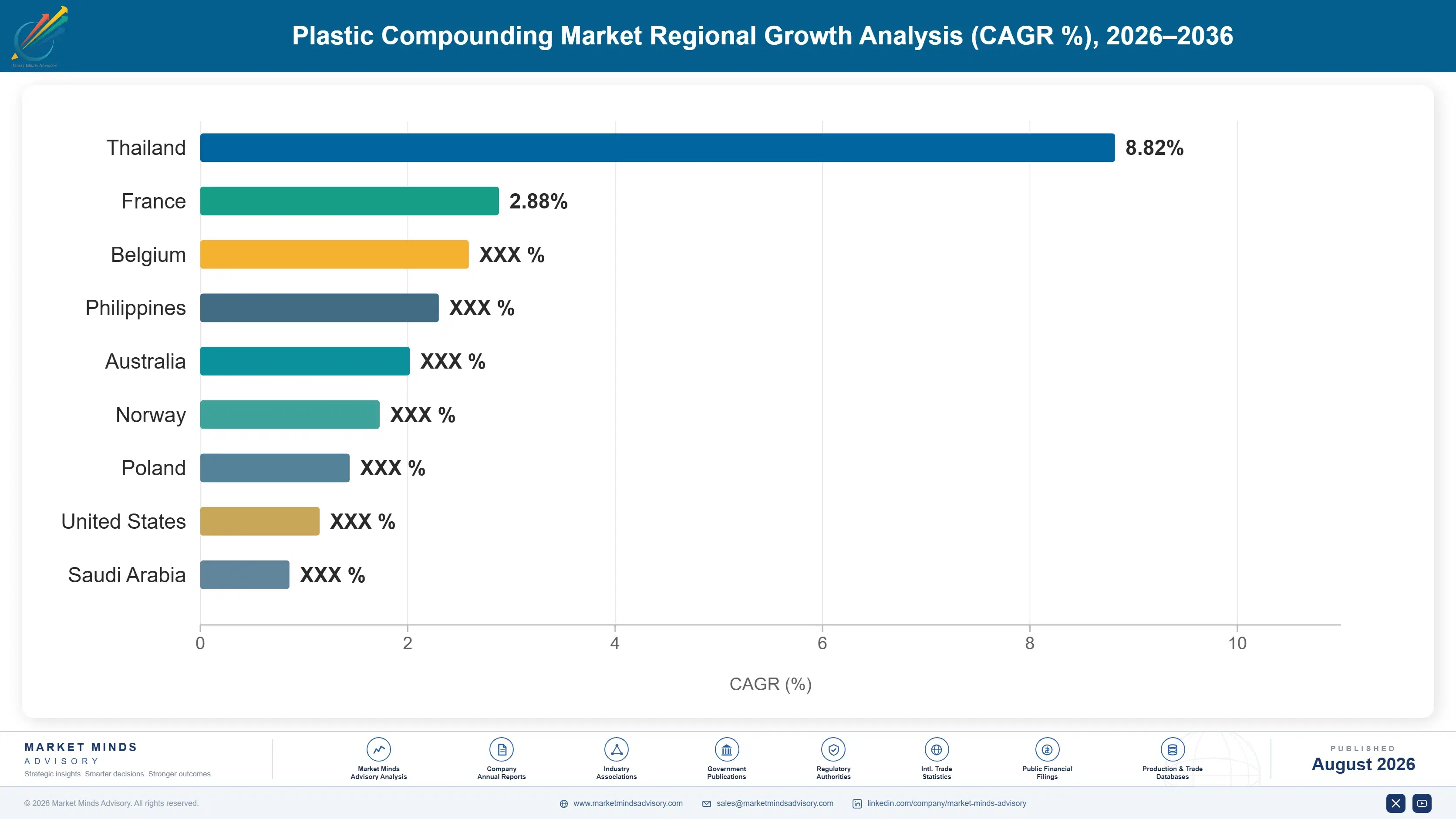
Regional Architecture and Country Demand Map

East Asia dominates plastic compounding production and consumption given China's dominant automotive and electronics manufacturing base, with North America and Western Europe following through established automotive and industrial demand. South Asia and Pacific trails only slightly given India's rapidly expanding manufacturing investment. Chemical intensity varies by grade type.

North America

United States automotive and electronics manufacturing, concentrated across established clusters in the Midwest and Southeast, anchors North American plastic compounding demand alongside substantial packaging and consumer goods volume across the broader region. Avient and RTP Company maintain significant domestic production and application engineering capacity serving both automotive and packaging customers directly from established regional facilities. Canada contributes smaller but steady industrial demand tied to its established automotive parts manufacturing sector. Growing domestic recycled content investment, driven by state-level extended producer responsibility legislation and corporate sustainability commitments, has accelerated demand across multiple compounders in recent years. Growth trails East Asia's faster-expanding manufacturing base but benefits from strong, diversified demand across automotive, packaging, and electronics applications.
Share: 25% | CAGR: 6.0% (2026 to 2036)

Western Europe

Germany, France, and Italy anchor European plastic compounding demand through established automotive and packaging manufacturing industries. Ravago and SABIC, both with substantial European operations, maintain deep production and formulation development infrastructure serving automotive and packaging customers across established regional facilities. European Union circular economy regulation and packaging waste directives have driven meaningful recycled content demand growth among regional brand owners pursuing compliance with binding content mandates. Automotive electrification investment across German and French manufacturers is adding further conductive compound demand for EV applications. Growth trails the global average as the region's mature automotive production base grows more slowly than expanding Asian manufacturing markets. Regional producers continue investing in recycled content research to sustain their qualification edge over Asian competitors.
Share: 18% | CAGR: 4.0% (2026 to 2036)
Regional intelligence for 5 additional markets available in the complete report: East Asia, South Asia and Pacific, Latin America, Middle East and Africa, Eastern Europe. Contact sales@marketmindsadvisory.com.
plastic-compounding-market-trends-country-cagr-analysis-1787311868224

Where Compounders Can Expand Margins

Compounders create outsized value not from standard reinforced tonnage but from recycled content documentation, brand owner qualification, and long-term contract security built over years of investment. The levers below identify where margin expands fastest, moving beyond commodity compound sales toward verified content, traceability, and contract security. Sustained investment across each dimension compounds meaningfully over time for compounders pursuing multiple pathways.

Recycled Content Traceability Commands Strong Premium

Compounders that develop verified recycled content traceability systems capture meaningfully higher realized pricing than standard virgin compounds, often 20 to 35% more per ton for equivalent volume, because brand owners pay for the documented content verification this traceability provides over conventional formulations. This traceability development requires sustained sorting and documentation investment, but compounders that achieve it gain access to the highest-margin segment of the entire market well ahead of competitors selling standard commodity-grade compounds. This positions certified compounders to capture disproportionate profit share while holding modest tonnage relative to overall market volume.
Market Impact: Adds 400 to 550 basis points gross

Automotive OEM Qualification Secures Multi-Year Revenue

Compounders that achieve automotive OEM platform qualification capture long-term program relationships that packaging customers rarely offer, since automotive component platforms typically remain in production for 5 to 7 years once a compound formulation is locked into engineering documentation. This qualification requires sustained testing and documentation investment, but compounders achieving it convert early qualification work into revenue visibility spanning the full production life of the vehicle platform, a durability advantage smaller commodity compound producers cannot match. This durability advantage compounds across each platform's multi-year production run, since requalification carries real safety validation cost.
Market Impact: Secures 5 to 7 years of program rev

Direct Recycling Stream Partnerships Improve Consistency

Compounders that establish direct partnerships with recycling stream operators capture more consistent feedstock quality than competitors relying on merchant market recycled material purchases, converting a formulation consistency challenge into a durable supply chain advantage across recycled content compound production. This partnership approach requires substantial relationship and quality control investment, but compounders achieving proven feedstock consistency typically reduce formulation rejection rates by 20 to 30% relative to competitors sourcing recycled material through unverified channels. Consistent supply performance across multiple contract cycles reinforces this competitive advantage over time. This advantage compounds meaningfully.
Market Impact: Cuts rejection rates 20 to 30 perce

Building Long-Term Brand Owner Supply Contracts

Compounders that secure multi-year supply agreements tied to specific brand owner sustainability programs gain revenue visibility spanning the full duration of the regulatory compliance commitment, typically 4 to 6 years, since brand owners rarely switch recycled content suppliers mid-program given the sustainability audit revalidation risk involved in changing formulation sources. This contract security requires proven content verification consistency and delivery reliability, but compounders achieving program-level qualification convert commodity volume into durable, multi-year revenue relationships smaller transactional sellers cannot match. Later programs benefit similarly. Contracts renew consistently as agencies favor established, proven relationships.
Market Impact: Secures 4 to 6 years of program rev

Who Controls the Margin Pool

CR5 stands at 32%, reflecting a genuinely fragmented market shaped by the regional nature of compounding logistics and the formulation flexibility that favors established local compounders over global consolidation. The gap between the top five and smaller compounders is widest in recycled content documentation, where traceability and sustainability audit barriers protect leaders far more than in standard reinforced compound production.
Competition currently plays out across three dimensions: recycled content traceability races among compounders serving brand owners, automotive OEM qualification investment among producers building long-term platform relationships, and capacity expansion timed to Asian automotive and electronics manufacturing growth among a broader group of regional compounders. Smaller regional compounders compete primarily on proximity-driven cost advantage within limited freight radii rather than formulation depth or global contract scale.

Emerging pressure comes from two directions. Asian compounders are investing in recycled content and traceability capability to reduce reliance on imported premium formulations, though sustainability documentation depth remains a gap relative to established Western suppliers. Continued brand owner sustainability commitment expansion could also reorder competitive rankings if recycled content demand accelerates faster than currently expected, favoring compounders with early traceability investment over pure-volume competitors.
plastic-compounding-market-trends-company-positioning-matrix-1787311868742

Competitive Moat and Risk Dimensions

AVIENT CORPORATION

Moat: Deepest Recycled Content Documentation

Avient operates extensive recycled content sorting, purification, and traceability documentation capacity built over years of sustainability infrastructure investment, giving it preferred supplier status across brand owners requiring the deepest content verification available in the industry. This depth is difficult for smaller regional compounders to replicate without comparable long-term sustainability infrastructure investment.
AVIENT CORPORATION

Risk: Recycled Feedstock Cost Exposure

Avient's growing recycled content business exposes it to feedstock quality and pricing volatility tied to fragmented recycling collection infrastructure that established virgin resin supply chains do not experience to the same degree. Diversifying feedstock sourcing further would help Avient reduce this recycled material exposure over time.
RTP COMPANY

Moat: Deep Custom Formulation Engineering

RTP Company operates extensive custom formulation engineering capacity built over decades of application-specific compound development, giving it preferred supplier status across specialty automotive and electronics customers requiring highly engineered compound solutions. This positioning gives RTP Company a durable advantage that pure-volume competitors lacking comparable expertise cannot easily match.
RTP COMPANY

Risk: Limited Scale Versus Diversified Majors

RTP Company operates meaningfully smaller production capacity than diversified petrochemical majors entering the compounding space, limiting its ability to compete on delivered cost for high-volume standard compound programs. Expanding production scale through partnership or investment would help RTP Company compete for larger volume programs. Progress here remains gradual.

Players Tracked

Prominent Players

Avient Corporation
RTP Company
Ravago Group
LyondellBasell Industries N.V.
SABIC

Other Key Players

Celanese Corporation
Trinseo plc
Techmer PM LLC
Kraton Corporation
Mitsubishi Chemical Group Corporation
Envalior B.V.
PolyKemi AB
Nexeon Plastics
KRAIBURG TPE GmbH & Co. KG
Kingfa Sci. & Tech. Co. Ltd.
Foster Corporation
Distrupol
Washington Penn Plastic Co. Inc.
PlastiComp Inc.
Wittenburg Kunststoffcompounds GmbH

Recent Developments

FEBRUARY 2025

Avient Expands Recycled Content Production Capacity

Avient announced completion of a capacity expansion at its domestic production facility, adding qualified recycled content compound capacity to serve growing brand owner sustainability demand. The expansion follows several years of traceability documentation investment supporting content verification requirements. The expansion strengthens Avient's fastest-growing segment position.
Signal: Confirms leading compounders are dedicatin
JUNE 2025

Kingfa Science and Technology Expands Domestic Production Capacity

Kingfa Science and Technology announced completion of a capacity expansion at its domestic production facility, adding qualified compound capacity to serve growing Chinese automotive and electronics customer demand. The expansion follows several years of investment tracking continued domestic manufacturing growth. The expansion strengthens Kingfa's domestic market position.
Signal: Signals major Chinese compounders are scal
OCTOBER 2025

RTP Company and a Major Automaker Sign Supply Agreement

RTP Company signed a multi-year supply agreement with a major automaker covering reinforced compound supply for a new electric vehicle platform. The agreement secures forward volume for RTP Company at negotiated pricing tied to the automaker's long-term production planning schedule. The deal reflects growing preference for locked-in supply security.
Signal: Signals automakers are increasingly securi

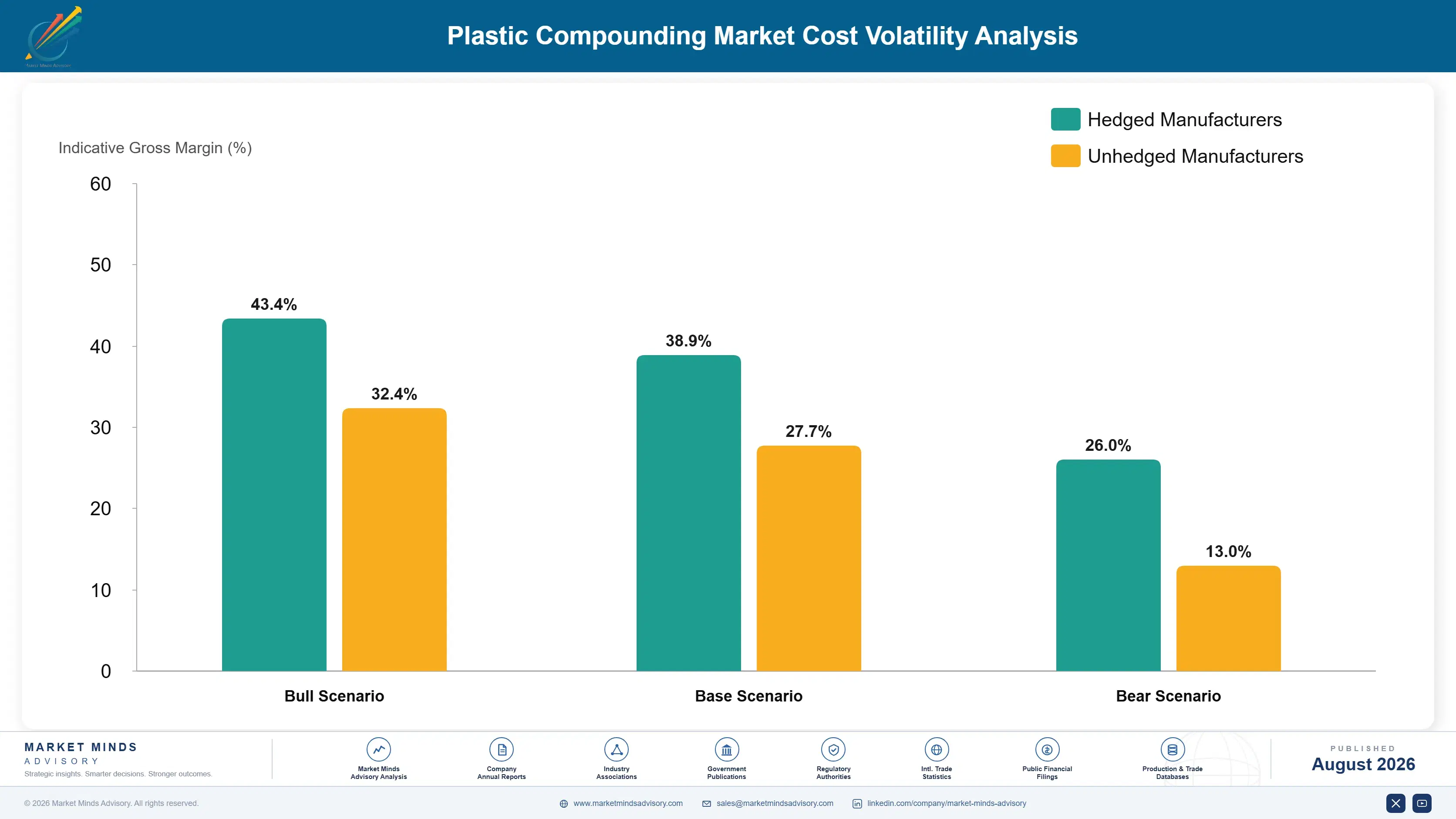
Base Resin and Reinforcement Fiber Exposure

Base resin and reinforcement fiber inputs together account for roughly 46% of cost of goods sold across plastic compounding production, with pricing tied to broader petrochemical supply and demand cycles rather than compounding-specific dynamics. Compounders relying on spot-market resin purchases face greater price exposure than those with long-term supply agreements. Producers with long-term contracts face less exposure to short-term pricing volatility than spot-market buyers.
Base resin prices rose sharply during 2021 and 2022, documented in company annual reports across the sector, as broader petrochemical supply disruption tightened available material faster than downstream demand could adjust. Several compounders reported compressed margins during this period, since customer pricing on longer-term automotive contracts could not be renegotiated quickly enough to reflect rising feedstock cost. Recovery in downstream pricing followed only gradually as contract renegotiation cycles took time.

This exposure disadvantages smaller compounders without long-term resin supply agreements relative to larger, better-capitalized competitors who hedge exposure through diversified sourcing and, in some cases, backward integration into upstream resin production. Compounders without secured supply face meaningfully greater difficulty maintaining consistent margins during periods of raw material volatility. Margin compression is most acute among smaller regional compounders lacking diversified sourcing relationships.
plastic-compounding-market-trends-cost-volatility-analysis-1787311868936

Long-Term Resin Supply Contracts

Compounders are locking in multi-year base resin supply contracts at fixed or formula-based pricing, trading some upside flexibility for predictable production costs. This approach has become more common since 2021 as compounders sought greater cost predictability across volatile pricing periods. Compounders report this approach has meaningfully smoothed quarterly production cost variance since broader adoption began.

Backward Integration Into Resin Production

Several larger compounders are investing in backward integration into upstream base resin production capacity, directly reducing exposure to merchant market pricing volatility. This approach requires substantial capital investment but delivers a durable cost advantage once facilities reach full operating scale. Several compounders are pursuing this route to achieve durable long-term cost advantages over merchant market alternatives.

Diversified Geographic Sourcing Strategies

Compounders are diversifying resin and fiber sourcing across multiple geographic suppliers, reducing overall exposure to any single region's petrochemical supply disruption or production policy risk. This diversification has become standard practice among the largest compounders. This diversification has become a standard risk management practice among the largest global compounders today. Adoption continues to grow.

Portfolio Architecture for Margin Defence

MMA organizes this market into three tiers by formulation complexity and margin profile. The volume tier covers standard reinforced compounds sold into conventional industrial applications, competing primarily on price. The premium tier covers flame retardant and conductive compounds commanding higher margins through formulation engineering and certification barriers. The sustainability tier captures recycled and bio-based content compounds still scaling toward broader commercial adoption.
Volume tier compounders compete on price and delivery consistency with moderate margins, while premium tier suppliers protect pricing power through formulation research and certification barriers that keep new entrants out for years at a time. This creates real tension inside diversified compounders, since capital allocated to sustaining standard capacity competes directly with capital needed to fund recycled content traceability and automotive-grade testing infrastructure, and most large compounders now favor the latter given superior long-term returns.

The highest-value pools concentrate in recycled content compounds for brand owner sustainability programs and long-term automotive supply agreements, where traceability barriers and contract security combine to support the strongest pricing power in the entire market. Conductive and EMI shielding compounds are emerging as a further high-value position as electrification accelerates industry-wide.

Volume / Commodity-Adjacent Tier

Standard reinforced compounds sold into conventional industrial applications, competing primarily on price and delivery consistency across established relationships. Producers compete mainly through delivery consistency and price position across established regional customer bases.
Gross Margin: 12-18%

Premium / Certified Tier

Flame retardant and conductive compounds commanding higher margins through formulation engineering, certification, and durable multi-year customer relationships. Suppliers protect this pricing power through sustained engineering and certification investment few competitors can match.
Gross Margin: 26-36%

Sustainability / Regulatory / Next-Generation Tier

Recycled and bio-based content compounds positioned ahead of rising circular economy requirements, commanding premium pricing among sustainability-focused brand owners. Producers investing early in traceability systems are positioned to capture durable advantages as demand grows.
Gross Margin: 20-30%
plastic-compounding-market-trends-portfolio-architecture-1787311869430

High-value Sub-segments and Strategic Watch-out

Recycled Content Compounds for Brand Owner Programs

This segment combines the strongest traceability barriers in the market with steady growth tied to continued sustainability mandates. Compounders with established documentation systems hold a durable and difficult-to-replicate advantage over newer entrants. Producers with early documentation investment are best positioned to capture this segment's above-average pricing power.
Gross Margin: 28-36%

Long-Term Automotive Platform Supply Agreements

Automotive production supports steady demand growth largely independent of broader commodity plastics cycles, with established qualification providing meaningful competitive protection against new entrants lacking comparable infrastructure. Producers with proven qualification and multi-year platform relationships hold the strongest position in this segment. Loyalty endures across contract cycles.
Gross Margin: 22-30%

Standard Reinforced Compounds for Industrial Applications

The largest volume base by tonnage, this segment covers standard-grade compounds sold into conventional industrial applications, where competition is driven mostly by price and delivery consistency. Margins stay thin for most participants competing here. Freight cost and logistics position set the effective competitive radius for most producers here.
Gross Margin: 10-16%

Conductive and EMI Shielding Compound Expansion

Compounders are expanding conductive and shielding compound capability to serve growing EV and electronics demand, a trajectory worth monitoring closely by compounders still focused primarily on standard reinforced compounds. Producers focused primarily on standard compounds face the greatest pressure to adapt to this emerging shift.
Gross Margin: 20-28%

Qualification Durability Across Application Categories

Once a compounder secures qualification within an automotive platform's engineering documentation or a brand owner's approved supplier list, that relationship typically persists for the full platform or program production life, since switching suppliers requires requalification that most customers avoid absorbing without strong cause. This creates durable, low-churn revenue characteristics for automotive and brand owner-linked supply, distinct from the more transactional nature of standard indus
Adoption depth varies sharply by end use. Automotive OEMs show the deepest stickiness, since switching compound suppliers mid-platform requires extensive safety and performance requalification that most avoid absorbing without strong cause. Brand owners pursuing recycled content programs show similarly strong stickiness tied to sustainability audit continuity requirements. Standard industrial customers show the least stickiness of the three, since these purchases occur more transactionally on standard commodity specifications.

Buyer profiles are shifting as procurement teams increasingly weigh recycled content documentation and supply chain resilience, not just price, as explicit criteria following recent periods of regulatory tightening on sustainability disclosure. Younger procurement teams increasingly favor compounders with credible traceability data over pure commodity sourcing, a consideration that has grown more prominent following recent sustainability compliance episodes across multiple industries.
plastic-compounding-market-trends-end-use-penetration-index-1787311869921

Where MMA Sees the Opportunity

These are among the four positions where our research anticipates prominent divergence between winners and laggards over the coming forecast period. Each is grounded in the demand model, the regulatory perimeter, and the announced capacity pipeline.
01 / RECYCLED CONTENT INVESTMENT

Build Recycled Content Traceability Ahead of Mandates

Recycled content compounds command the strongest pricing power in the entire market, and compounders that invest in sorting, purification, and traceability documentation now position themselves ahead of continued brand owner sustainability commitment expansion through 2036. This capability requires sustained infrastructure investment across multiple years of qualification work. Waiting until recycled demand is obviously dominant risks ceding this traceability advantage to compounders who invested earlier and already hold brand owner relationships spanning multiple program generations and years of accumulated verification trust.
02 / AUTOMOTIVE OEM QUALIFICATION

Build Automotive Qualification for Program Revenue

Automotive OEM qualification provides the most direct path to winning long-term platform revenue in a market where packaging customers offer far shorter relationship duration. Compounders that invest in testing and documentation now position themselves ahead of competitors still selling primarily into commodity industrial applications. This capability requires substantial testing investment, but compounders that achieve it convert qualification work into revenue visibility spanning the full production life of the vehicle platform smaller competitors, lacking comparable testing and engineering infrastructure, cannot easily replicate.
03 / RECYCLING STREAM PARTNERSHIP DEVELOPMENT

Build Direct Recycling Partnerships for Consistency

Direct recycling stream partnerships represent a genuine growth opportunity in a market where most compounders still source recycled material through unverified merchant channels rather than dedicated supply relationships. Compounders that build partnerships capture feedstock consistency advantages that competitors cannot easily replicate, converting a formulation challenge into a durable supply chain advantage. This partnership approach requires substantial relationship investment, but compounders achieving proven consistency secure customer trust that unverified competitors cannot access without comparable investment and years of accumulated feedstock trust behind them.
04 / BRAND OWNER CONTRACT DEVELOPMENT

Secure Long-Term Brand Owner Contracts Early

Brand owners rarely switch recycled content suppliers mid-program, and compounders that secure supply positions with sustainability programs currently expanding gain revenue visibility spanning years of future compliance monitoring. This positioning requires proven content verification consistency and delivery reliability relative to competing suppliers. Compounders that achieve it convert commodity volume into the most durable revenue relationships available in this market, and waiting until programs are already committed risks missing this opportunity entirely, ceding it fully and permanently to earlier, better-qualified competitors instead.

Engagement Snapshot From the Field

A live engagement with an industry participant carrying material or product regulatory and market exposure ahead of a defining policy shift, showing how our research translates into a defensible multi-year portfolio strategy.
MARKET MINDS ADVISORY · CLIENT ENGAGEMENT SUMMARY
Plastic Compounding Producer Strategic Portfolio Review and Transition Roadmap 2026·Investment Scenario on Plastic Compounding Exposure Evaluation 2025-26
CLIENT PROFILE
The client is a global consumer packaging brand generating substantial annual revenue from packaged goods distributed across multiple regional markets. The company committed to ambitious recycled content targets across its packaging portfolio and was evaluating supplier consolidation to strengthen traceability documentation ahead of upcoming regulatory compliance deadlines. The company has invested steadily in expanding its recycled content portfolio across multiple product categories.
STRATEGIC CHALLENGE
The client needed to decide whether to consolidate recycled content compound sourcing to two strategic suppliers offering deeper traceability documentation, accepting a modest price premium estimated at $2.9 million annually (client-reported, unverified by MMA), or maintain its existing fragmented supplier base prioritizing lowest unit price across each purchase. Leadership needed a defensible answer before the next annual compliance planning cycle.
MMA APPROACH
MMA's advisory team conducted primary interviews with the client's sustainability and procurement staff about historical traceability documentation quality across its existing supplier base, and benchmarked that documentation against comparable brand owners using consolidated strategic supplier relationships. The analysis weighed the price premium against regulatory compliance risk. Findings were validated against comparable brand owner experiences during recent audit cycles.
KEY FINDINGS
  1. Interview data indicated the client's existing fragmented supplier base delivered inconsistent traceability documentation, with meaningful gaps between its best and worst performing suppliers on content verification depth.
  2. Comparable brand owners using consolidated strategic supplier relationships with dedicated traceability documentation reported meaningfully fewer compliance audit findings relative to fragmented sourcing approaches.
  3. The price premium for strategic supplier consolidation represented a modest share of the client's total packaging material budget relative to the regulatory compliance risk inconsistent documentation could create.
  4. The client's sustainability team identified specific product lines where documentation gaps had already drawn regulatory scrutiny during a recent compliance review. Corrective action followed.
CLIENT PROFILE
The client is a global consumer packaging brand generating substantial annual revenue from packaged goods distributed across multiple regional markets. The company committed to ambitious recycled content targets across its packaging portfolio and was evaluating supplier consolidation to strengthen traceability documentation ahead of upcoming regulatory compliance deadlines. The company has invested steadily in expanding its recycled content portfolio across multiple product categories.
STRATEGIC CHALLENGE
The client needed to decide whether to consolidate recycled content compound sourcing to two strategic suppliers offering deeper traceability documentation, accepting a modest price premium estimated at $2.9 million annually (client-reported, unverified by MMA), or maintain its existing fragmented supplier base prioritizing lowest unit price across each purchase. Leadership needed a defensible answer before the next annual compliance planning cycle.
MMA APPROACH
MMA's advisory team conducted primary interviews with the client's sustainability and procurement staff about historical traceability documentation quality across its existing supplier base, and benchmarked that documentation against comparable brand owners using consolidated strategic supplier relationships. The analysis weighed the price premium against regulatory compliance risk. Findings were validated against comparable brand owner experiences during recent audit cycles.
KEY FINDINGS
  1. Interview data indicated the client's existing fragmented supplier base delivered inconsistent traceability documentation, with meaningful gaps between its best and worst performing suppliers on content verification depth.
  2. Comparable brand owners using consolidated strategic supplier relationships with dedicated traceability documentation reported meaningfully fewer compliance audit findings relative to fragmented sourcing approaches.
  3. The price premium for strategic supplier consolidation represented a modest share of the client's total packaging material budget relative to the regulatory compliance risk inconsistent documentation could create.
  4. The client's sustainability team identified specific product lines where documentation gaps had already drawn regulatory scrutiny during a recent compliance review. Corrective action followed.
RECOMMENDED STRATEGY
Phase 1: Phase 1 (Months 1-3): Select two strategic recycled content suppliers based on traceability documentation quality and capacity assessment., coordinating closely with sustainability audit teams throughout Phase 2: Phase 2 (Months 4-9): Transition packaging product lines to strategic supplier formulations during scheduled reformulation cycles, tracking documentation quality closely. Phase 3: Phase 3 (Months 10-18): Evaluate documentation results against baseline performance, finalizing long-term supply agreements with the selected strategic suppliers., monitoring documentation quality closely across both relationships
OUTCOME
The client completed supplier consolidation within 16 months, within the projected timeline, and achieved documentation quality consistent with comparable industry benchmarks identified during the advisory engagement. The client reported that the price premium was more than offset by reduced compliance risk and improved audit outcomes across the transitioned product lines.

Frequently Asked Questions

Foundational context covering the market sizes, CAGR, scope, country, region and competition that inform every finding below. This section is provided to cover basics and most often pre-purchase conversations, answered from the MMA Primary Research Dataset.

What is the current size of the Plastic Compounding Market?

The Plastic Compounding Market was valued at $62.4 billion in 2025. MMA projects it will reach $65.96 billion in 2026 as automotive and recycled content demand both continue expanding.

How large will the Plastic Compounding Market be by 2036?

MMA forecasts the market will reach $114.82 billion by 2036, up from $65.96 billion in 2026. That represents a 1.74 times expansion over the ten-year forecast window.

What is the CAGR for the Plastic Compounding Market 2026 to 2036?

The market is projected to grow at a 5.7% CAGR between 2026 and 2036. MMA's bull and bear scenarios range from 6.7% to 4.7% depending on recycled content mandate adoption pace.

Which segment is growing fastest?

Bio-Based and Recycled Content Compounds is the fastest-growing segment, expanding at a 7.8% CAGR, roughly 1.37 times the overall market rate as sustainability mandates accelerate.

Who are the major companies in the Plastic Compounding Market?

Avient, RTP Company, Ravago Group, LyondellBasell, and SABIC lead the market, together holding an estimated 32% of global production capacity. CR5 concentration reflects genuinely regional, freight-driven industry economics.

Which country is growing fastest?

China is the fastest-growing country market, expanding at an estimated 7.2% CAGR as its automotive and electronics manufacturing base continues rapid expansion. This reflects both manufacturing scale and rapidly expanding electronics investment.

Report Segmentation Architecture

The full report scope spans multiple orthogonal segmentation dimensions, with cross-tabulated demand data provided for each dimension pair. Coverage extends further to regional breakdowns, trend trajectories, and the competitive detail needed to support segment-level decision-making.

By Primary Market Dimension

  • Reinforced and Filled Compounds
  • Flame Retardant Compounds
  • Impact Modified Compounds
  • Bio-Based and Recycled Content Compounds
  • Conductive and EMI Shielding Compounds

By End-Use Industry

  • Automotive
  • Packaging
  • Electronics and Electrical
  • Building and Construction
  • Consumer Goods

By Commercial Dimension

  • OEM Direct Supply
  • Molder and Converter Supply
  • Distribution and Trading Supply

By Region

  • North America
  • Western Europe
  • East Asia
  • South Asia and Pacific
  • Latin America
  • Middle East and Africa
  • Eastern Europe

Scope, Methodology, and Coverage

Every figure in this report is reproducible from documented input assumptions. The scope below maps the historical period, the forecast horizon, the segmentation dimensions, and the countries covered, alongside the underlying primary and qualitative methodology.
Historical Period
2020 to 2025
Forecast Period
2026 to 2036
Base Year
2025 (USD billions; MMA Primary Research Dataset, August 2026)
Market Definition
This report covers custom and proprietary plastic compounds formulated with reinforcements, additives, colorants, and recycled or bio-based content for injection molding, extrusion, and other conversion processes. It excludes base resin production, finished molded products, and masterbatch sold as standalone colorant concentrate without full compound formulation.
Quantitative Units
USD billions (current prices); metric tons of production capacity where applicable
Segmentation Dimensions
By Compound Formulation Type; By End-Use Industry; By Commercial Dimension; By Region
Regions Covered
North America, Western Europe, East Asia, South Asia and Pacific, Latin America, Middle East and Africa, Eastern Europe
Countries Covered
USA, China, Germany, France, Italy, UK, Japan, South Korea, India, Australia, Canada, Brazil, Mexico, Vietnam, Thailand, UAE, Saudi Arabia, South Africa, Poland, Hungary, Netherlands, Belgium, Sweden, Argentina, Colombia, and additional markets relevant to this sector
Key Companies Profiled
Avient Corporation, RTP Company, Ravago Group, LyondellBasell Industries N.V., SABIC, Celanese Corporation, Trinseo plc, Techmer PM LLC, Kraton Corporation, Mitsubishi Chemical Group Corporation, Envalior B.V., PolyKemi AB, Nexeon Plastics, KRAIBURG TPE GmbH & Co. KG, Kingfa Sci. & Tech. Co. Ltd., Foster Corporation, Distrupol, Washington Penn Plastic Co. Inc., PlastiComp Inc., Wittenburg Kunststoffcompounds GmbH
Quantitative Methodology
Primary survey, n=3,800 respondents, Q4 2025, six countries; demand-side model with trade association cross-validation
Qualitative Methodology
47 expert interviews, Q4 2025; applied to validate demand model assumptions, identify emerging dynamics, and assess competitive positioning
Report Format
PDF and XLSX data workbook (Word format preview document)
Publisher
Market Minds Advisory
Report Code
MMA-2026-CHM-134
Published
August 2026
Contact
sales@marketmindsadvisory.com | www.marketmindsadvisory.com

Purchase the full Plastic Compounding Market Report (2026 to 2036).

The full Plastic Compounding Market report delivers ten-year forecasts across all seven regions, six compound formulation segments, and the full competitive landscape of twenty profiled producers. It includes detailed analysis of recycled content traceability economics, automotive qualification pathways, and demand drivers spanning automotive, packaging, electronics, and building applications. Buyers receive segment-level margin benchmarking across the volume, premium, and sustainability tiers identified in this summary. The report also includes primary survey data from 3,800 respondents and 47 expert interviews conducted in the fourth quarter of 2025, supporting every demand and pricing assumption in the forecast.
Ten-year regional and segment-level forecast models
Competitive profiles covering twenty plastic compounding producers
Recycled content traceability economics and pricing analysis
Automotive qualification pathway and documentation mapping
Portfolio margin benchmarking across three commercial tiers
Primary survey and expert interview data appendix

Built For The People Who Decide

From boardroom strategy to bench-side execution, this report is read cover-to-cover by leaders shaping the next decade of their industry, turning demand scenarios, market dynamics and valuation benchmarks into decisions.
CXOs/ Presidents/ VPs/ Managers
M&A and Corporate Development
Strategy Teams and R&D Heads
Procurement and Product Directors
Regulatory and Compliance Leaders
Investor Relations and Equity Analysts