Market Minds Advisory
Plant-Based Yogurt Market

Plant-Based Yogurt Market: Protein, Hydrocolloids and the Clean Label Contradiction

Shoppers left dairy for a shorter ingredient list and bought a pot with sixteen ingredients and one gram of protein, and the base materials that fix both are only now reaching commercial scale.

Lead Analyst

Lisa Gevelber

Published

September 2026

Make Smarter Decisions with Customized Research Insights

Request a free sample report and evaluate market opportunities, growth trends, and competitive dynamics relevant to your business needs.

2025 MARKET VALUE$3.4BMarket Size 2025
2036 FORECAST VALUE$8.9BBase Case , 2026 to 2036
CAGR 2026 TO 20369.2 %Bull 10.5% / Bear 8.0%
INCREMENTAL OPPORTUNITY$5.2BNet 10- year value creation
EXPANSION MULTIPLE2.41x2036 value over 2026 base
Strategic Levers
M&A Pipeline
Regional Outlook
Country Rankings
Competitive Intelligence
Segmental Deep-dive
Call-Us : 91 93563 13602

Executive Snapshot and Market Trajectory

Yogurt is the plant dairy category that actually works, because the occasion tolerates a price premium and the texture reference is more forgiving than milk in a coffee. It is also the category with the sharpest internal contradiction, and shoppers have started to notice it clearly. Shoppers noticed first.
Plant bases carry no casein micelle network, so body and mouthfeel are engineered with starch, pectin, locust bean gum and gellan. A typical coconut pot lists 14 to 16 ingredients against three for set dairy yogurt. Protein is the second problem: coconut and almond bases deliver roughly one gram per pot where Greek style dairy delivers ten. The health shopper bought a dessert and is working that out. Nobody set out to build that product.
Fava and pea protein bases grow at 13.8%, half again the market rate of 9.2%, because legumes gel naturally and bring protein with them, which cuts hydrocolloid load and closes the nutrition gap at the same time. Western Europe holds 31% of value, above the usual band, on penetration rates no other region approaches. Concentration is high at 41%. Danone and Alpro hold most of the branded shelf across Europe.
Market Definition
Fermented plant-based products sold as yogurt or yogurt alternatives, cultured with live bacteria and distributed chilled or ambient, across coconut, oat, soy, nut, legume protein and precision-fermented protein bases. Excludes unfermented plant desserts and puddings, plant drinks, plant cheese, kefir positioned as a beverage, and conventional dairy yogurt containing any plant blend.
Base Year Value
$3.4B in 2025 (MMA Primary Research Dataset, August 2026)
Forecast Period
2026 to 2036, eleven discrete annual values
CAGR
9.2% base case. Bull 10.5%. Bear 8.0%.
Fastest Growth Segment
Fava and Pea Protein Base: 13.8% CAGR
Fastest Growth Country
India: 12.4% CAGR
Fastest Growth Region
South Asia and Pacific: 11.4% CAGR
Largest Region
Western Europe: 31% of 2025 global value
Market Leaders
Danone, Oatly Group, Chobani, Lactalis, Yili Group. Source: MMA Primary Research Dataset, July 2026.
Primary Survey
n=3,800 procurement and R&D decision-makers, Q4 2025, six countries
Methodology
Demand-side build-up, cross-validated against public data, 47 expert interviews

Plant-Based Yogurt Market Forecast Scenarios

plant-based-yogurt-market-trends-size-forecast-scenario-1787580506281
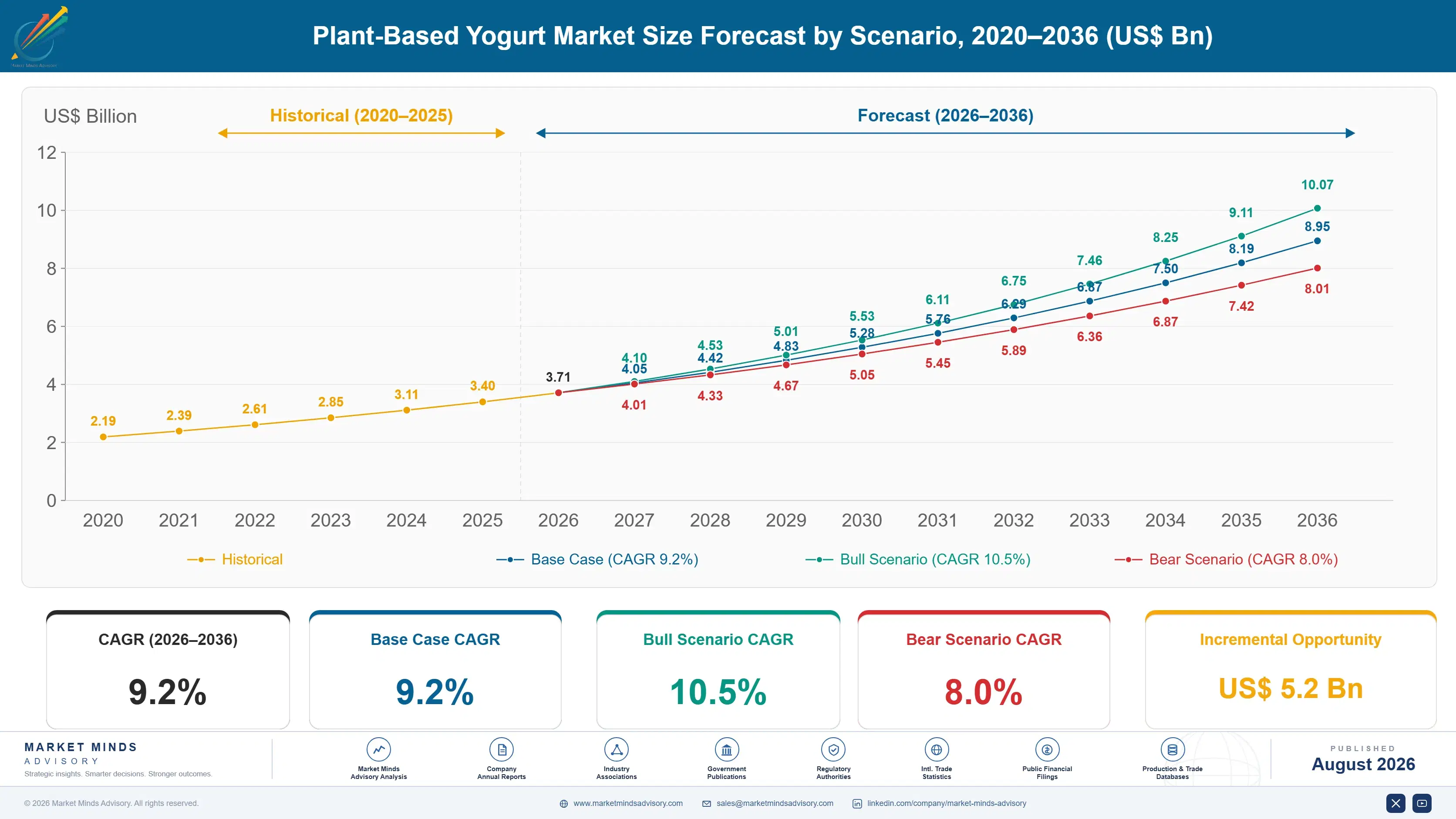
Growth ran near 8.0% between 2020 and 2025 and held up when plant milk slowed, which surprised most category managers. Yogurt kept its premium because the occasion is a snack rather than a commodity pour, and because a pot competes on flavour rather than on coffee performance. Coconut and oat bases carried nearly all of that volume, and both now grow slowest in the category.
Base case 9.2% rests on three mechanisms. Fava and pea protein isolates have reached a price and flavour profile that permits a naturally gelling, high-protein pot without a long hydrocolloid list. European retailers are applying front-of-pack nutrition scoring that penalises the sugar and starch loads typical of coconut formulations. And precision-fermented casein has cleared regulatory review in the United States and Singapore, which puts real dairy protein into a plant format for the first time.
The bull case at 10.5% turns on precision-fermented casein reaching cost parity with legume isolate before 2031, which would remove the texture problem completely. The bear case at 8.0% is a front-of-pack scoring outcome that treats all plant yogurt as a confectionery product, stranding the coconut base that still carries most of the category's shelf space today.

The Ingredient List Nobody Wanted to Read

Dairy yogurt gets its body free. Casein micelles coagulate as acidity falls during fermentation, building a gel with no help from anything else, which is why a pot of set yogurt lists milk, cultures and nothing more. Plant bases have no equivalent protein network. Coconut fat, oat starch and almond solids do not coagulate, so texture has to be constructed from outside using starches, pectins and gums.
TOP FIVE CONCENTRATION41%Dairy incumbents hold most of the branded shelf space
PROTEIN PER POT GAP7gDeficit measured against conventional Greek style dairy yogurt
RETAIL PRICE PREMIUM1.6xAgainst conventional set yogurt at equivalent pot size
HYDROCOLLOID COST SHARE9%Share of formulation cost carried by texturising agents
REPEAT PURCHASE RATE47%Buyers returning to the category within the replenishment window
CHILLED DISTRIBUTION REACH68%Grocery outlets carrying at least one plant option
That construction is what shows on the label. Fourteen to sixteen declared ingredients is normal for a coconut pot, and shoppers who left dairy specifically for a shorter list find that difficult to reconcile. The industry's answer has been to reformulate toward starches with friendlier names rather than remove them, which addresses optics and not substance. Northern European retail buyers have begun asking harder questions.
Protein is the more serious commercial problem. A coconut pot delivers around one gram, an oat pot two, against ten for a Greek style dairy product, and the nutrition scoring systems now appearing on European front-of-pack labelling read that gap accurately. Legume bases fix it because fava and pea proteins both gel and deliver protein. Precision-fermented casein fixes it more completely, and costs considerably more today.
"The category sold itself on a shorter ingredient list and then spent ten years lengthening one. Whoever gets a five-ingredient, ten-gram pot onto shelf at a sensible price takes the whole premium tier, and it will not be a coconut producer."
Director, Dairy and Alternative Proteins Practice · MMA Food and Agriculture Ingredients Practice · August 2026

Market Trends

Legume protein bases displacing coconut in premium retail

Fava bean and pea protein isolates have improved enough on flavour that formulators can build a pot around them without heavy masking, and both gel under acid fermentation the way plant fats never will. The practical effect is an ingredient list of five or six items and a protein figure near eight grams, which is the first plant yogurt that reads well on a nutrition panel. European premium retail has moved fastest, with own-label ranges reformulating away from coconut through 2025. Cost per pot runs slightly higher, and buyers are paying it.
Market Impact: Puts 34% of listings at risk
Precision-fermented casein entering commercial yogurt formulation

Casein produced by engineered microflora has cleared regulatory review in the United States and Singapore, and the first commercial yogurt applications reached shelf in 2025. The material behaves like dairy casein because it is dairy casein, coagulating under acid without any added hydrocolloid, which collapses the ingredient list and the protein gap simultaneously. Cost currently runs roughly three times legume isolate on a protein equivalent basis. Fermentation capacity coming out of the wider precision protein build-out is expected to close much of that gap. The regulatory work is done in two markets and pending in Europe.
Market Impact: Requires 5 grams protein minimum

Market Opportunities and Growth Drivers

Front-of-pack nutrition scoring reaching plant dairy shelves

Nutri-Score and comparable schemes across France, Germany, Belgium and the Netherlands now apply to plant yogurt, and the scoring reads added sugar, saturated fat and low protein exactly as it does for dairy. Coconut formulations score badly on all three counts. Retailers in these markets have begun setting minimum score thresholds for own-label listings, which functions as a reformulation mandate rather than a suggestion. Roughly 34% of Western European listings would fail a threshold set at grade C, and manufacturers know which ones they are. Reformulation deadlines are already written into next year's contracts.
Market Impact: Cuts declared ingredients by 50%

Retail own-label reformulation toward higher protein specifications

Major European grocers have rewritten own-label plant yogurt specifications to require a minimum protein content, typically five grams per hundred, which coconut and almond bases cannot meet at any formulation. That single procurement decision moves volume toward soy, fava and pea bases regardless of what shoppers say they prefer. Own label carries a substantial share of European plant yogurt volume, so the specification change reshapes the category faster than any brand launch could. Contract manufacturers have been requalifying lines since early 2025 to keep the business. Brands are following the tender, not the shopper.
Market Impact: Limits reach to 68% of grocery

Market Restraints and Challenges

Hydrocolloid load contradicts the clean label purchase reason

Plant yogurt pots typically declare 14 to 16 ingredients where dairy declares three, and a meaningful share of buyers came to the category expecting the opposite. The root cause is physical: without casein there is no acid-set gel, so starch, pectin, locust bean gum and gellan do the gelling work instead. Commercially it undermines the premium positioning that supports a 1.6 times price gap. Producers are moving to legume bases that gel naturally and to fermentation-derived casein, both of which cut declared ingredients by half or better. The optics improve and the physics do not change.
Market Impact: Delivers 8 grams protein per pot

Chilled distribution costs restrict reach outside modern grocery

Cultured plant yogurt needs an unbroken cold chain, which confines it to modern grocery and keeps distribution reach near 68% even in developed markets. The cause is that live cultures and a set gel both degrade above refrigeration temperature, and ambient sterilisation destroys the cultures that justify the product. That closes convenience, traditional trade and most of the emerging market opportunity. Ambient formats using heat-resistant strains and post-fermentation stabilisation are in development, though they currently sacrifice the live culture claim entirely. Until then the category stays inside modern grocery, which is where almost all of its value already sits today.
Market Impact: Costs 3x legume isolate today
3 additional market trends, 4 additional growth drivers, and 2 additional restraints and challenges are covered in the full report. Contact sales@marketmindsadvisory.com to access the complete intelligence.

Segment CAGR and Growth Architecture

Six segments split by base material, because the base determines whether the product gels on its own, how much protein it carries, and therefore how long the ingredient list has to be. Every commercial variable in this category descends from that one choice. Flavour, format and pack size sit in the framework rather than in this hierarchy.
plant-based-yogurt-market-trends-market-share-analysis-1787580506814

Fava and Pea Protein Base

Growing at 13.8%, half again the market rate of 9.2%, legume protein bases solve the category's two problems with one decision. Fava and pea proteins coagulate under acid fermentation much as casein does, so the pot sets without a hydrocolloid package, and they carry protein at around eight grams per serving. Flavour was the historic obstacle and isolate processing has largely resolved it, removing the bitterness that made earlier pea formulations unsellable. European premium and own-label ranges are reformulating toward these bases now, driven by retailer protein specifications rather than by consumer request. Cost per pot runs modestly higher than coconut and the shelf is absorbing it. The shelf is reorganising around this base faster than most brands planned.
CAGR 13.8%

Precision-Fermented Dairy Protein Base

At 12.6% this is the most technically complete answer and the most expensive one. Casein and whey produced by engineered microflora behave identically to their dairy equivalents because they are molecularly the same proteins, which means acid coagulation, genuine dairy mouthfeel, and an ingredient list as short as conventional yogurt. Regulatory clearance exists in the United States and Singapore, with European review still in progress. Cost runs roughly three times legume isolate per gram of protein, confining current use to premium positioning. The segment is small today and holds the best long-run position of anything in the category. European clearance would change the arithmetic quickly, and several applications are already in review with the relevant authorities.
CAGR 12.6%
Full segment breakdown across 6 segments available in the complete report.

Regional Architecture and Country Demand Map

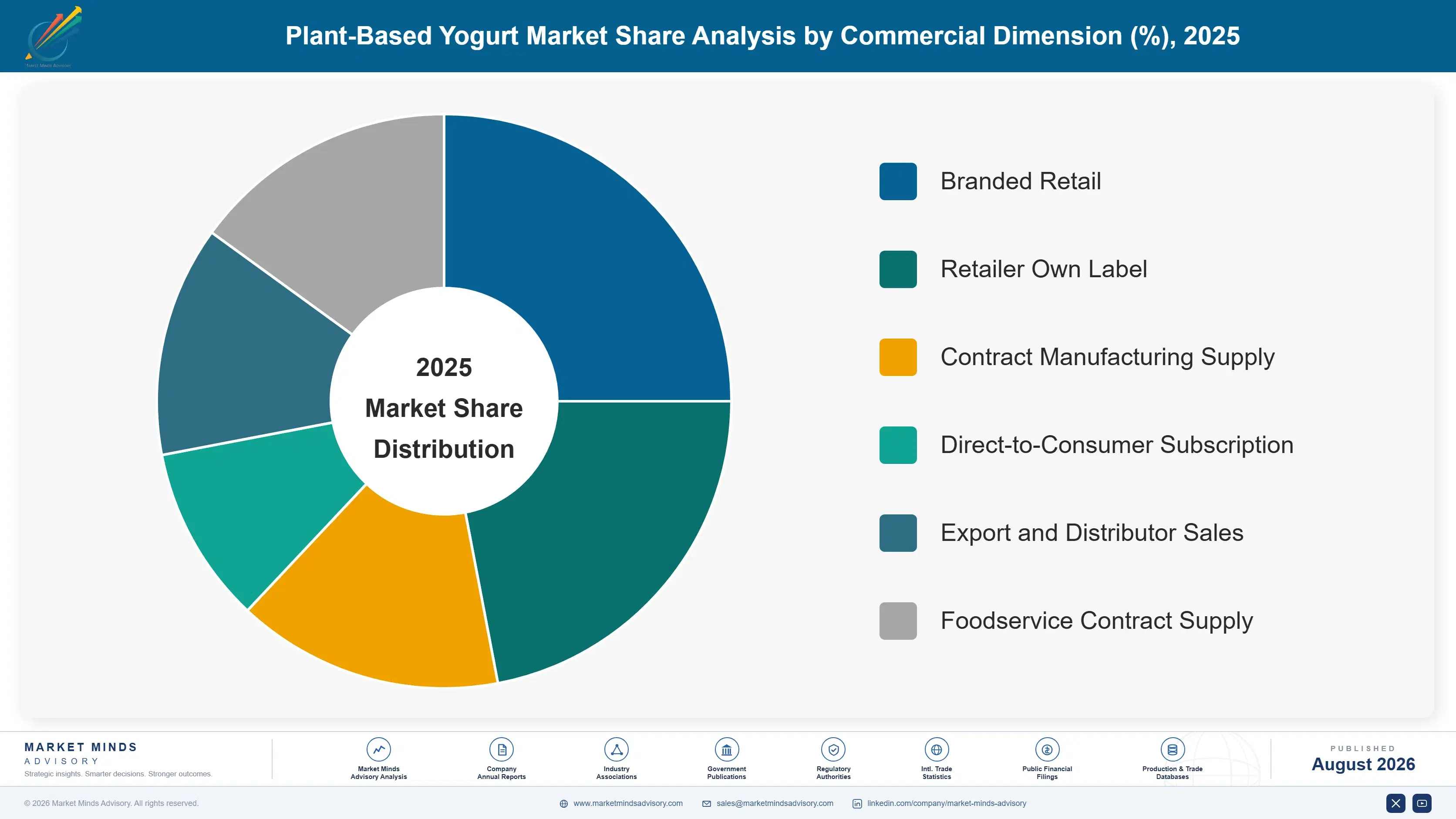
Western Europe holds 31% of value, above the usual band, because per capita plant yogurt penetration across Germany, the Netherlands and the United Kingdom runs at multiples of any other region. North America follows at 27%. East Asia sits below its usual band at 20% of global value.

North America

Coconut and almond bases still dominate the American shelf, a legacy of the category's origins in natural channel retail where fat content mattered less than dairy avoidance. That leaves US formulations more exposed to protein criticism than European ones, and the reformulation wave has arrived later here. Chobani and Danone hold most branded volume, with Forager and Kite Hill occupying the premium natural tier. Canadian demand skews toward oat, helped by domestic oat processing and a colder-climate supply base. The absence of front-of-pack nutrition scoring across North America removes the regulatory pressure that is driving European reformulation, so change here depends on retailer initiative alone. That makes American reformulation slower and less certain than the European wave.
Share: 27% | CAGR: 8.6% (2026 to 2036)

Western Europe

Penetration explains the 31% share, which sits above the usual band because German, Dutch and British households buy plant yogurt at rates no other region approaches. Alpro built the category across the continent long before the current wave and Danone now runs it as a scale business. Nutri-Score adoption across France, Belgium and the Netherlands is forcing reformulation faster than anywhere else, and retailer own-label protein specifications are doing the rest. Nordic markets lead on oat, with Valio and Oatly supplying formats built around domestic oat streams. Southern European demand stays modest, where dairy yogurt traditions remain strong and price sensitivity higher. No other region comes close on per capita consumption of these products.
Share: 31% | CAGR: 7.8% (2026 to 2036)
Regional intelligence for 5 additional markets available in the complete report: East Asia, South Asia and Pacific, Latin America, Middle East and Africa, Eastern Europe. Contact sales@marketmindsadvisory.com.
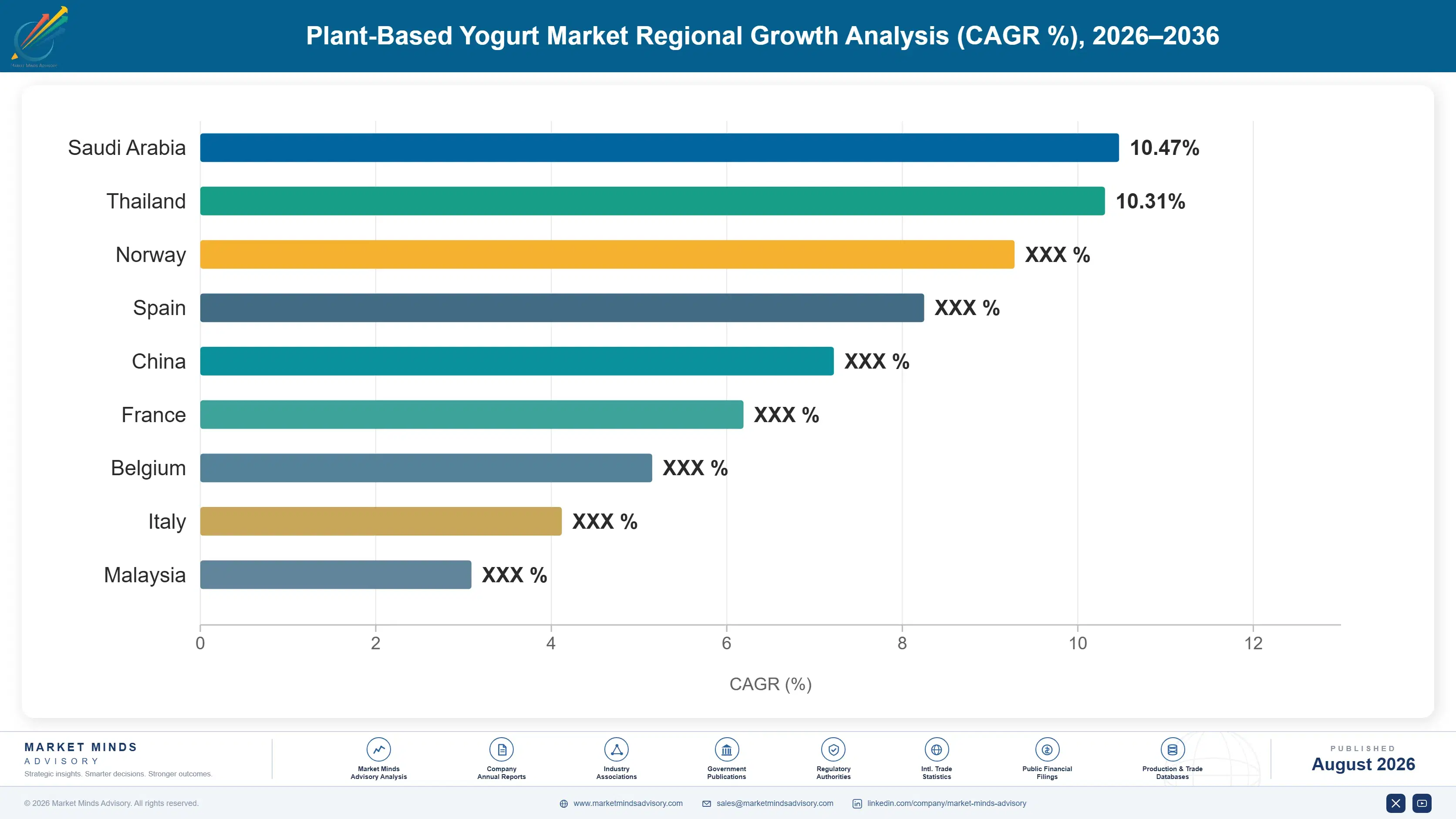
plant-based-yogurt-market-trends-country-cagr-analysis-1787580507354

Four Decisions That Move Margin

The commercial choices in this category all reduce to base material and to who sets the specification. Retailers are rewriting protein minimums faster than brands are reformulating, and the producers who move first capture own-label volume that takes years to win back. Everything else is packaging and flavour work. The specification is the strategy now.

Convert own-label lines to legume protein bases

European grocers are writing minimum protein specifications near five grams per hundred into own-label tenders, and coconut and almond bases cannot meet them at any formulation. Contract manufacturers who requalified lines to fava and pea bases during 2025 held their business; those who waited lost tenders they had run for years. Conversion costs roughly 400 thousand dollars per line in equipment and qualification work, against annual own-label contracts worth several times that. The specification change is not reversible, because the retailer has already printed the claim. Readiness decides these tenders, not price.
Market Impact: Costs $400 thousand per fermentation line converted to legume

Cut the declared ingredient list before regulators force it

A coconut pot declaring 16 ingredients sits badly against the clean label promise that brought shoppers to the category, and Northern European retail buyers have started asking about it directly. Legume bases gel naturally and remove most of the hydrocolloid package, halving declared ingredients without any loss of texture. The reformulation costs less than the marketing spend currently defending the long list. Producers who lead here get to make the claim; those who follow are simply catching up to a shelf standard someone else set. The shelf standard gets set by whoever moves first.
Market Impact: Halves a 16 item ingredient list on every pot

Secure precision-fermented casein supply well before parity

Casein from engineered microflora removes both the texture problem and the protein gap, and it costs roughly 3 times legume isolate today on a protein equivalent basis. Capacity coming out of the wider precision fermentation build-out will compress that, and the producers holding supply agreements when it does will have a premium tier nobody can copy quickly. Offtake commitments signed now cost little and secure allocation later. Waiting for cost parity means arriving after the first mover has already taken the shelf position. Allocation, not cost, is what runs short first in these build-outs.
Market Impact: Locks casein allocation at 3x current legume isolate cost

Build ambient formats for markets without cold chain

Chilled distribution caps reach near 68% of grocery even in developed markets and effectively excludes traditional trade across most of Asia, Africa and Latin America. Heat-resistant culture strains combined with post-fermentation stabilisation permit ambient formats, at the cost of the live culture claim. In markets where the claim carries little weight and refrigeration is scarce, that trade is obviously worth making. The addressable outlet count roughly triples, and the format suits the price points those markets actually support. Traditional trade and convenience open up entirely, at price points chilled formats were never going to reach.
Market Impact: Triples outlet reach beyond the 68% grocery ceiling

Who Controls the Margin Pool

Participation is measured on retail shipment volume of finished plant yogurt, and on that basis the top five hold 41%. That is high for a plant category, and the reason is that dairy incumbents brought chilled distribution, fermentation know-how and retailer relationships with them. Danone leads through Alpro and its American brands. The gap to the challengers is distribution reach rather than product capability.
Competition currently runs on three things. Base material choice matters most, with retailer protein specifications forcing decisions that used to be marketing preferences. Own-label tenders are the second, since they carry the volume that fills a fermentation line. Fermentation and culture capability is third, where dairy companies hold an advantage plant-native brands consistently underestimate. Brand spending has fallen sharply since 2023 across almost every participant.

Pressure comes next from the precision fermentation companies, which sell protein rather than yogurt and can supply anyone. That flattens the playing field: a small brand with a good formulation gains access to the same casein a multinational uses. Expect supply agreements and offtake commitments rather than acquisitions in the near term. Rankings shift when a mid-sized producer launches a five-ingredient, ten-gram pot at a mainstream price.
plant-based-yogurt-market-trends-company-positioning-matrix-1787580507872

Competitive Moat and Risk Dimensions

DANONE

Moat: Chilled distribution and fermentation depth

Danone runs chilled logistics and culture development at a scale no plant-native brand approaches, and yogurt is a category where both determine what reaches shelf. Alpro gives it European incumbency measured in decades. Retailers award own-label alongside branded listings to the same supplier, which compounds the advantage every time a tender comes round.
DANONE

Risk: Coconut portfolio reformulation exposure

A substantial part of the installed portfolio sits on coconut and almond bases that cannot meet the protein specifications European retailers are now writing. Reformulating a large branded range means relaunch costs, recipe changes consumers notice, and the risk of conceding the protein claim to a challenger while the work is under way across several markets.
OATLY GROUP

Moat: Oat processing technology ownership

Oatly's enzymatic oat base technology gives it a distinctive texture and flavour platform that competitors buying oat concentrate cannot match directly. The company also owns the category association in consumers' minds across several markets, which is a genuine asset in a shelf where most products look alike and shoppers decide quickly.
OATLY GROUP

Risk: Oat protein content ceiling

Oat delivers around two grams of protein per pot and no processing change moves that materially, which leaves the platform exposed exactly where retailer specifications are tightening. Adding legume or fermented protein means diluting the oat identity the brand is built on, and the company has been slow to resolve that tension publicly.

Players Tracked

Prominent Players

Danone
Oatly Group
Chobani
Lactalis
Yili Group

Other Key Players

Nestlé
General Mills
Valio
Arla Foods
Ehrmann
FrieslandCampina
Bel Group
Forager Project
Kite Hill
COYO
Vitasoy International
Yofix Probiotics
Perfect Day
Andros Group
Emmi Group

Recent Developments

APRIL 2026

Dutch grocer sets minimum protein specification for own-label plant yogurt

A large Dutch grocery group rewrote its own-label plant yogurt specification to require a minimum of five grams of protein per hundred, effective across the range. Coconut and almond formulations cannot meet that threshold at any workable recipe, and the change binds from the next contract year.
Signal: Retailer specifications are now reshaping base material choice faster than any consumer preference shift has managed
OCTOBER 2025

First precision-fermented casein yogurt reaches United States retail shelves

A premium brand launched a cultured plant yogurt using precision-fermented casein, listing five ingredients and ten grams of protein per pot. The product carries a substantial price premium over conventional plant yogurt and reached limited natural channel distribution, with volumes constrained by protein allocation rather than demand.
Signal: The technical answer now exists on shelf, and the remaining question is purely one of production cost
JANUARY 2026

European contract manufacturer requalifies lines to fava protein base

A European contract manufacturer completed requalification of three fermentation lines from coconut to fava protein base, citing own-label tender requirements as the reason. The conversion covered equipment, culture adaptation and shelf-life validation across the affected product range. The conversion took roughly five months from decision to first commercial output.
Signal: Contract manufacturing capacity is moving ahead of brand reformulation, which usually indicates where volume goes next

What Sits Behind the Pot Price

Base material runs about 31% of cost of goods and varies enormously by choice: coconut cream from Philippine and Indonesian processors, oat concentrate largely from Nordic and Canadian mills, and fava and pea isolate from French and Canadian protein plants. Hydrocolloids add roughly 9%, sourced from Asian gum processors and European pectin producers. Chilled packaging and distribution take a further 24%.
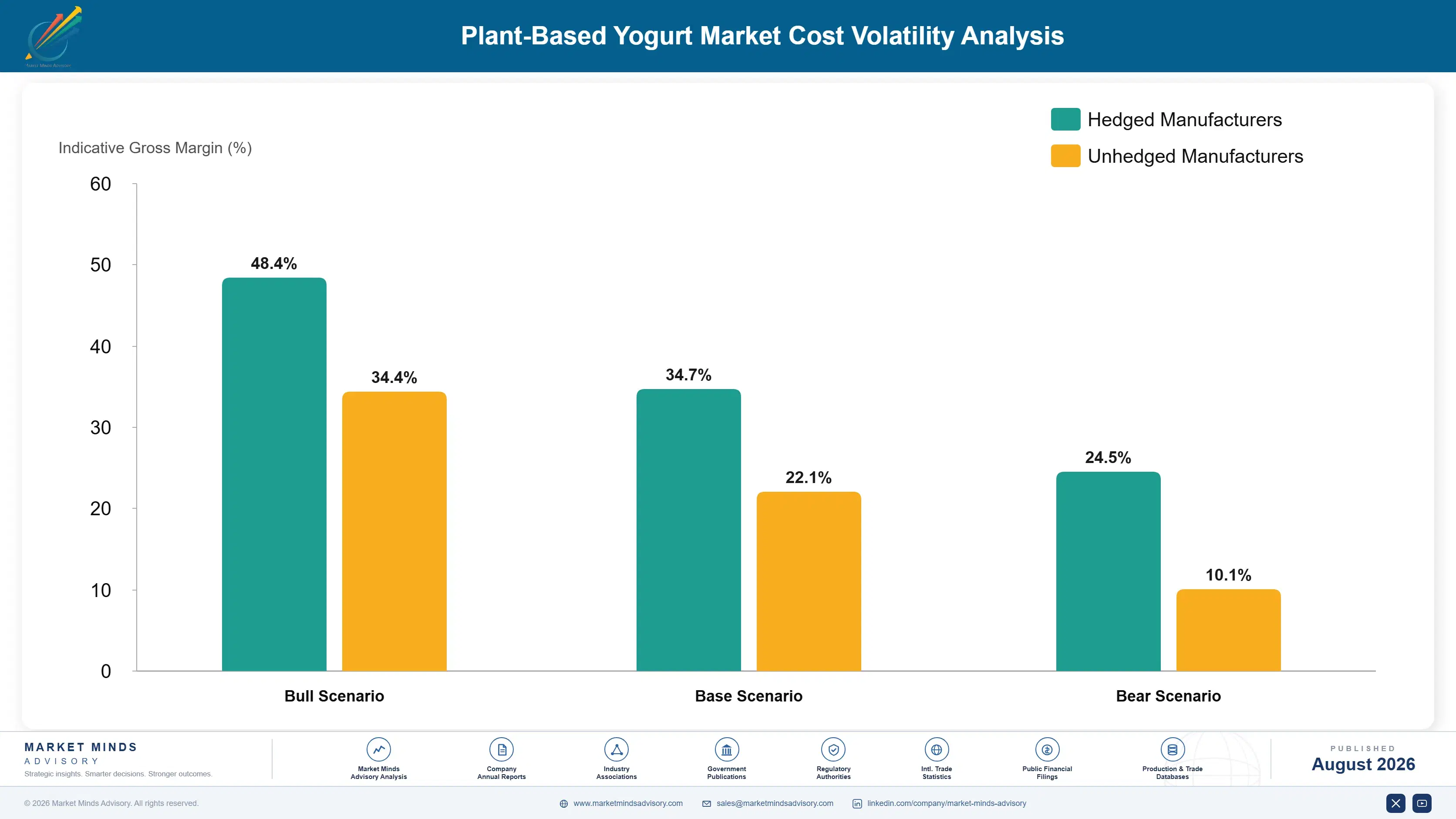
Coconut cream pricing has been the category's worst input exposure. Philippine copra output fell sharply after successive typhoon seasons through 2023 and 2024, and processor prices rose well above their five-year average before easing. Producers formulating exclusively on coconut carried the swing directly into gross margin, since chilled yogurt retail pricing is set annually and cannot move mid-contract. Several own-label suppliers reported the impact in their annual disclosures for that period.

The exposure differs sharply by base and by scale. A producer running only coconut cannot substitute when copra tightens, while one holding qualified oat and legume recipes switches within a run. Geography compounds it: European plants buying coconut at import parity carry landed cost that Southeast Asian producers never see, per USDA tropical products trade data, which is why premium European positioning increasingly favours domestic legume bases.
plant-based-yogurt-market-trends-cost-volatility-analysis-1787580508067

Qualify two base materials for the same finished product

Holding an approved coconut and an approved legume recipe for the same pack lets a producer switch when copra or isolate pricing moves, protecting several margin points across a cycle. Qualification costs perhaps 120 thousand dollars per additional base including shelf-life validation, and recovers within a single input swing in most years. Most producers hold only one qualified base.

Shift base sourcing toward domestically grown legume protein

European and Canadian fava and pea supply avoids the import parity and freight exposure that tropical bases carry, and pricing has been considerably steadier through recent cycles. The switch also supports origin claims that retailers increasingly want on own-label packs. The trade-off is a flavour profile that needs more development work upfront than coconut ever did.

Match retail pricing tenor to input contract tenor

Chilled yogurt retail prices are set annually while many producers buy base materials on spot terms, which guarantees margin variance whenever inputs move. Contracting base supply annually removes most of that mismatch at the cost of missing troughs. Producers who can reprice more frequently, mainly branded rather than own-label suppliers, have less need for this.

Portfolio Architecture for Margin Defence

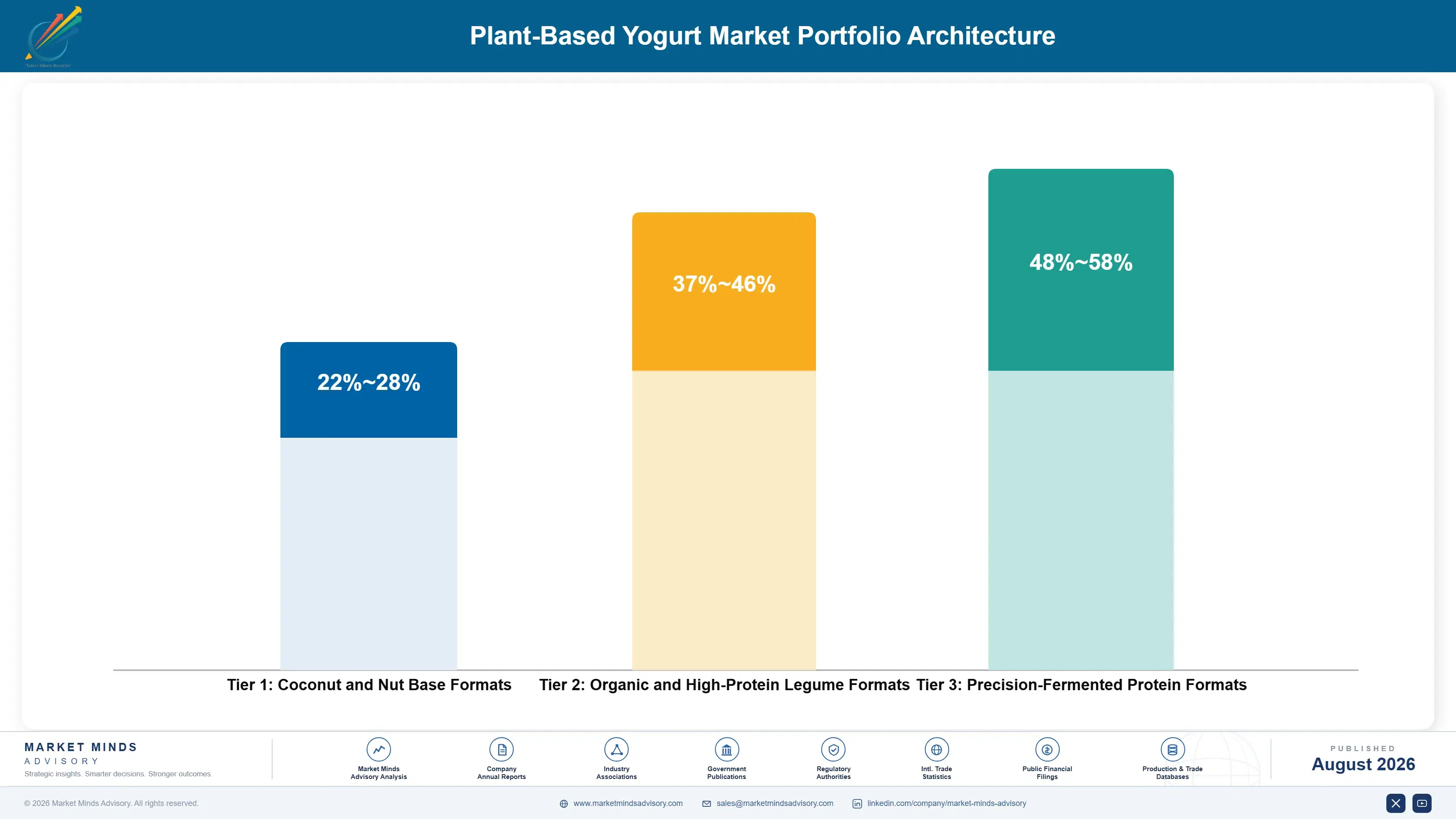
Margin in plant yogurt tracks base material cost and the claim that base material supports. Coconut and almond formats sit closest to commodity, earning margins in the mid twenties, because they compete on price against an increasingly crowded shelf and cannot make a protein claim. Own-label supply on those bases earns less still, and it is the volume most exposed to retailer specification changes now under way.
Certified and premium formats do considerably better. Organic, high-protein and specialty positioned pots hold margins in the high thirties to mid forties, and the range is wide because certification cost and retailer pricing power differ sharply between Northern and Southern European markets. Legume base products increasingly occupy this tier, since they support both a protein claim and a shorter ingredient list at the same time.

The high-value pool is precision-fermented protein, where margins run into the mid fifties on the small volumes currently shipping. That is a premium the technology earns rather than one the market grants, and it will compress as capacity arrives. The strategic question is whether to take that margin now or build volume position before the compression happens.

Coconut and Nut Base Formats

Standard coconut, almond and cashew pots supplying mass grocery and own-label contracts. Competition is open and price-led, so the six point range reflects contract scale and base material sourcing rather than any product differentiation worth defending.
Gross Margin: 22-28%

Organic and High-Protein Legume Formats

Organic certified and protein-positioned pots built on fava, pea and soy bases. The nine point range reflects genuinely different certification costs and retailer pricing power between Northern and Southern European markets, alongside varying isolate contract terms.
Gross Margin: 37-46%

Precision-Fermented Protein Formats

Pots built on fermentation-derived casein or whey, currently in premium and natural channel distribution. The ten point range reflects protein input cost that varies with offtake terms, since supply is allocated rather than openly traded at present.
Gross Margin: 48-58%
plant-based-yogurt-market-trends-portfolio-architecture-1787580508568

High-value Sub-segments and Strategic Watch-out

High-Protein Legume Base Pots

High value and high growth. Retailer protein specifications are pushing own-label and branded volume here simultaneously, and legume bases support both a protein claim and a short ingredient list. Isolate contract terms are the main margin variable and have been steady. Tender demand, not shopper demand, drives it.
Gross Margin: 39-46%

Precision-Fermented Protein Pots

High value, moderate growth for now, and the strongest long-run position in the category. Regulatory clearance exists in two markets with Europe still pending. Volume is capped by allocation rather than by demand, which will change as capacity arrives. Offtake terms decide who has a premium tier later.
Gross Margin: 48-58%

Coconut Base Mass Grocery Pots

The volume core and the most exposed position on the shelf. Front-of-pack nutrition scoring reads the sugar, saturated fat and low protein accurately, and retailer specifications are already moving against it. Growth runs well below the category rate now. Reformulation or decline are the only two options left.
Gross Margin: 22-28%

Ambient Shelf-Stable Formats

The strategic watch-out. Ambient formats triple addressable outlets in markets without reliable cold chain but sacrifice the live culture claim entirely. Whether that trade works depends on markets where the claim was never the purchase reason to begin with. The outlet arithmetic is what makes it worth testing.
Gross Margin: 26-34%

How the Pot Gets Rebought

Yogurt is bought weekly and consumed daily, which makes it the closest thing to an annuity in plant dairy. Repeat purchase reaches 47% within the replenishment window, well above plant milk and far above plant meat, because a pot is a snack decision rather than a substitution decision and nobody is comparing it against a remembered original. Households that adopt tend to keep buying, and they buy the same flavour set repeatedly.
Stickiness varies by where the product sits. Own-label supply is the stickiest commercially, since a retailer rarely retenders more than annually and switching means new artwork and shelf-life data. Foodservice and institutional catering come next, held by menu and supply commitments. Branded retail shoppers switch on promotion and on flavour novelty, which is why brand spending in this category buys less loyalty than participants expect it to.

The buyer has changed twice. The original cohort avoided dairy for allergy or ethical reasons and accepted whatever texture was available. The current buyer is a mainstream shopper trading between dairy and plant within the same week, and increasingly reads the nutrition panel, which is exactly why protein content has become the commercial battleground it now is.
plant-based-yogurt-market-trends-end-use-penetration-index-1787580509058

Where We Would Commit Capital

These are among the four positions where our research anticipates prominent divergence between winners and laggards over the coming forecast period. Each is grounded in the demand model, the regulatory perimeter, and the announced capacity pipeline.
01 / BASE MATERIAL CONVERSION

Move own-label lines to legume protein before the next tender

European grocers are writing minimum protein specifications near five grams per hundred into own-label contracts, and no coconut or almond formulation can meet them. Contract manufacturers who requalified lines during 2025 kept business that competitors lost outright, at a conversion cost near 400 thousand dollars per line. The specification change is not reversible because the retailer has already committed to the claim on pack, so waiting for further evidence amounts to conceding the volume permanently to whichever competitor moved first.
02 / INGREDIENT LIST DISCIPLINE

Cut declared ingredients rather than defending the long list

A coconut pot declaring 16 ingredients contradicts the clean label reason most shoppers gave for leaving dairy, and Northern European retail buyers have begun asking about it directly rather than politely. Legume bases gel under acid fermentation without a hydrocolloid package, halving the declared list at no cost to texture. The reformulation is cheaper than the marketing spend currently defending the status quo, and it sets a shelf standard that competitors then have to match on their own cost base.
03 / FERMENTED PROTEIN ALLOCATION

Sign casein offtake now rather than waiting for parity

Precision-fermented casein removes the texture problem and the protein gap simultaneously, and costs roughly three times legume isolate on a protein equivalent basis today. Capacity from the wider fermentation build-out will compress that, and allocation is being committed well ahead of the compression. Offtake agreements signed now cost little and secure a premium tier that arrives with the cost curve, whereas waiting for parity means entering the tier after somebody else already holds the shelf position and the retailer relationship.
04 / AMBIENT FORMAT DEVELOPMENT

Build shelf-stable formats for markets without reliable refrigeration

Chilled distribution caps reach near 68% of grocery in developed markets and excludes almost all traditional trade across Asia, Africa and Latin America. Heat-resistant culture strains combined with post-fermentation stabilisation permit an ambient pot, sacrificing only the live culture claim that those markets never bought the product for. In markets where that claim was never the purchase reason, the trade is obviously worth making, and the addressable outlet count roughly triples at price points those markets genuinely support rather than at the premium chilled formats require.

Engagement Snapshot From the Field

A live engagement with an industry participant carrying material or product regulatory and market exposure ahead of a defining policy shift, showing how our research translates into a defensible multi-year portfolio strategy.
MARKET MINDS ADVISORY · CLIENT ENGAGEMENT SUMMARY
Plant-Based Yogurt Producer Strategic Portfolio Review and Transition Roadmap 2026·Investment Scenario on Plant-Based Yogurt Exposure Evaluation 2025-26
CLIENT PROFILE
A European own-label chilled dairy manufacturer supplying plant yogurt to grocery groups across five countries, with annual revenue near 480 million euros and roughly 40% of that from plant formats (client-reported, unverified by MMA). The plant portfolio was built almost entirely on coconut and almond bases installed between 2018 and 2021, across four fermentation lines at two sites.
STRATEGIC CHALLENGE
Two of the group's largest customers had signalled minimum protein specifications for the following contract year, thresholds the existing coconut range could not meet. Management needed to decide whether to requalify lines, exit the affected contracts, or attempt reformulation within the coconut base. Internal opinion was divided and the tender deadline allowed roughly seven months.
MMA APPROACH
MMA modelled requalification cost and timeline for each fermentation line, benchmarked fava, pea and soy isolate on price, gelling behaviour and flavour across eleven suppliers, and tested finished prototypes against the customers' stated specifications. Interviews with 47 experts covered retailer category management, protein isolate supply and culture development, with consumer acceptance drawn from the quantitative survey base.
KEY FINDINGS
  1. No coconut formulation reached the five gram threshold without protein fortification that materially damaged texture and added more declared ingredients than it removed.
  2. Fava isolate delivered acceptable gelling and flavour at a base cost premium near 14% over coconut, recoverable within the own-label contract price already tendered.
  3. Requalifying two lines rather than four covered both at-risk contracts, at roughly 800 thousand dollars total against annual contract value several times higher.
  4. Two competing contract manufacturers had already begun conversion, meaning the tender outcome would turn on readiness rather than on price or existing relationship.
CLIENT PROFILE
A European own-label chilled dairy manufacturer supplying plant yogurt to grocery groups across five countries, with annual revenue near 480 million euros and roughly 40% of that from plant formats (client-reported, unverified by MMA). The plant portfolio was built almost entirely on coconut and almond bases installed between 2018 and 2021, across four fermentation lines at two sites.
STRATEGIC CHALLENGE
Two of the group's largest customers had signalled minimum protein specifications for the following contract year, thresholds the existing coconut range could not meet. Management needed to decide whether to requalify lines, exit the affected contracts, or attempt reformulation within the coconut base. Internal opinion was divided and the tender deadline allowed roughly seven months.
MMA APPROACH
MMA modelled requalification cost and timeline for each fermentation line, benchmarked fava, pea and soy isolate on price, gelling behaviour and flavour across eleven suppliers, and tested finished prototypes against the customers' stated specifications. Interviews with 47 experts covered retailer category management, protein isolate supply and culture development, with consumer acceptance drawn from the quantitative survey base.
KEY FINDINGS
  1. No coconut formulation reached the five gram threshold without protein fortification that materially damaged texture and added more declared ingredients than it removed.
  2. Fava isolate delivered acceptable gelling and flavour at a base cost premium near 14% over coconut, recoverable within the own-label contract price already tendered.
  3. Requalifying two lines rather than four covered both at-risk contracts, at roughly 800 thousand dollars total against annual contract value several times higher.
  4. Two competing contract manufacturers had already begun conversion, meaning the tender outcome would turn on readiness rather than on price or existing relationship.
RECOMMENDED STRATEGY
Phase 1: Phase one: requalify the two highest-utilisation fermentation lines to fava protein base, prioritising the customers whose specifications take effect soonest. Phase 2: Phase two: retain coconut capacity for markets and customers without protein specifications, treating it as a declining rather than a growth position. Phase 3: Phase three: open discussions on precision-fermented casein allocation for a premium own-label tier, ahead of any European regulatory clearance arriving.
OUTCOME
The group completed conversion of two lines within six months and retained both at-risk contracts, with plant format revenue growing roughly 11% in the following year (client-reported, unverified by MMA). Coconut volumes declined as expected and were not replaced, and the group has since begun early discussions on fermented protein supply for a premium tier.

Frequently Asked Questions

Foundational context covering the market sizes, CAGR, scope, country, region and competition that inform every finding below. This section is provided to cover basics and most often pre-purchase conversations, answered from the MMA Primary Research Dataset.

What is the current size of the Plant-Based Yogurt Market?

MMA sizes it at USD 3.4 billion in 2025, rising to USD 3.71 billion in 2026. The figure covers fermented plant products sold as yogurt or yogurt alternatives across chilled and ambient formats.

How large will the Plant-Based Yogurt Market be by 2036?

USD 8.95 billion by 2036, an incremental USD 5.24 billion over the 2026 base and an expansion multiple of 2.41 times. Higher-protein bases account for most of that addition.

What is the CAGR for the Plant-Based Yogurt Market 2026 to 2036?

9.2% in the base case, with a bull case at 10.5% and a bear case at 8.0%. The spread turns on fermented protein cost and on how front-of-pack nutrition scoring treats the category.

Which segment is growing fastest?

Fava and pea protein bases at 13.8%, half again the market rate of 9.2%. Legume proteins gel naturally under acid fermentation and carry protein, solving two category problems at once.

Who are the major companies in the Plant-Based Yogurt Market?

Danone, Oatly Group, Chobani, Lactalis and Yili Group lead on retail shipment volume of finished plant yogurt. Fifteen further participants are profiled in the full report alongside them.

Which country is growing fastest?

India at 12.4%, where fermented curd is already a daily staple and a plant version needs no cultural introduction. Cold chain rather than demand is the binding constraint there.

Report Segmentation Architecture

The full report scope spans multiple orthogonal segmentation dimensions, with cross-tabulated demand data provided for each dimension pair. Coverage extends further to regional breakdowns, trend trajectories, and the competitive detail needed to support segment-level decision-making.

By Base Material

  • Coconut Base
  • Oat Base
  • Soy Base
  • Almond and Cashew Base
  • Fava and Pea Protein Base
  • Precision-Fermented Dairy Protein Base

By End-Use Industry

  • Grocery Retail
  • Natural and Specialty Retail
  • Convenience Retail
  • Foodservice and Café
  • Institutional and Contract Catering
  • Industrial Food Manufacturing

By Commercial Dimension

  • Branded Retail
  • Retailer Own Label
  • Contract Manufacturing Supply
  • Direct-to-Consumer Subscription
  • Export and Distributor Sales
  • Foodservice Contract Supply

By Region

  • North America
  • Western Europe
  • East Asia
  • South Asia and Pacific
  • Latin America
  • Middle East and Africa
  • Eastern Europe

Scope, Methodology, and Coverage

Every figure in this report is reproducible from documented input assumptions. The scope below maps the historical period, the forecast horizon, the segmentation dimensions, and the countries covered, alongside the underlying primary and qualitative methodology.
Historical Period
2020 to 2025
Forecast Period
2026 to 2036
Base Year
2025 (USD billions; MMA Primary Research Dataset, August 2026)
Market Definition
Fermented plant-based products sold as yogurt or yogurt alternatives, cultured with live bacteria and distributed chilled or ambient, spanning coconut, oat, soy, nut, legume protein and precision-fermented protein bases across branded and own-label supply. Unfermented plant desserts, plant drinks, plant cheese, beverage kefir and conventional dairy yogurt containing plant blends are excluded. Value is measured at manufacturer selling price.
Quantitative Units
USD billions (current prices); thousand tonnes shipped; USD per kilogramme by base material and channel
Segmentation Dimensions
Base material; end-use industry; commercial dimension; region
Regions Covered
North America, Western Europe, East Asia, South Asia and Pacific, Latin America, Middle East and Africa, Eastern Europe
Countries Covered
United States, Canada, Germany, Netherlands, United Kingdom, France, Sweden, Spain, Italy, China, Japan, South Korea, India, Australia, Indonesia, Brazil, Mexico, United Arab Emirates, South Africa, Poland
Key Companies Profiled
Danone, Oatly Group, Chobani, Lactalis, Yili Group, Nestlé, General Mills, Valio, Arla Foods, Ehrmann, FrieslandCampina, Bel Group, Forager Project, Kite Hill, COYO, Vitasoy International, Yofix Probiotics, Perfect Day, Andros Group, Emmi Group
Quantitative Methodology
Primary survey, n=3,800 respondents, Q4 2025, six countries; demand-side model with trade association cross-validation
Qualitative Methodology
47 expert interviews, Q4 2025; applied to validate demand model assumptions, identify emerging dynamics, and assess competitive positioning
Report Format
PDF and XLSX data workbook (Word format preview document)
Publisher
Market Minds Advisory
Report Code
MMA-2026-AGR-177
Published
August 2026
Contact
sales@marketmindsadvisory.com | www.marketmindsadvisory.com

Purchase the full Plant-Based Yogurt Market Report (2026 to 2036).

The full report sizes each base material separately through 2036 and explains why the gelling behaviour of the base governs every commercial variable downstream. It models hydrocolloid load and declared ingredient counts against retailer specifications, tracks front-of-pack nutrition scoring exposure by market, and prices precision-fermented casein against legume isolate on a protein equivalent basis. Regional chapters cover all seven regions with channel detail on grocery, own label and foodservice. Competitive profiling covers 20 participants on a single retail shipment volume basis, alongside own-label tender specifications tracked by retail group.
Base material sizing across six product categories
Hydrocolloid load modelled against declared ingredient counts
Nutrition scoring exposure mapped by European market
Fermented casein priced against legume isolate directly
Twenty participants profiled on one consistent basis
Own-label tender specifications tracked by retail group

Built For The People Who Decide

From boardroom strategy to bench-side execution, this report is read cover-to-cover by leaders shaping the next decade of their industry, turning demand scenarios, market dynamics and valuation benchmarks into decisions.
CXOs/ Presidents/ VPs/ Managers
M&A and Corporate Development
Strategy Teams and R&D Heads
Procurement and Product Directors
Regulatory and Compliance Leaders
Investor Relations and Equity Analysts