Market Minds Advisory
Plant-Based Shrimp Market

Plant-Based Shrimp Market: Texture Economics, Allergen Positioning and the Repeat Purchase Problem, 2026 to 2036

Shrimp is the easiest seafood of all to imitate, because texture rather than flavour carries the eating experience, yet only three in ten first-time buyers ever purchase a second pack.

Lead Analyst

Lisa Gevelber

Published

September 2026

Make Smarter Decisions with Customized Research Insights

Request a free sample report and evaluate market opportunities, growth trends, and competitive dynamics relevant to your business needs.

2025 MARKET VALUE$0.1BMarket Size 2025
2036 FORECAST VALUE$0.4BBase Case , 2026 to 2036
CAGR 2026 TO 203614.0 %Bull 15.3% / Bear 12.7%
INCREMENTAL OPPORTUNITY$0.3BNet 10- year value creation
EXPANSION MULTIPLE3.71x2036 value over 2026 base
Strategic Levers
M&A Pipeline
Regional Outlook
Country Rankings
Competitive Intelligence
Segmental Deep-dive
Call-Us : 91 93563 13602

Executive Snapshot and Market Trajectory

Shrimp is the seafood analogue that actually works technically. Texture rather than flavour carries the eating experience, and konjac and alginate systems reproduce the snap and the bite convincingly enough that blind tasting panels frequently cannot separate them from the real thing at all.
Mycoprotein and fermentation-derived formats grow at 21.0%, a full 1.50 times the market rate, because they deliver protein content and a fibrous structure that hydrocolloid systems cannot match on nutrition panels. East Asia holds 32% of global value, above the standard regional band, because mock seafood carries a centuries-old Buddhist vegetarian tradition across the region and because regional shrimp consumption per head is the highest anywhere in the world.
Concentration is moderate at 44% for the top five, unusually high for a nascent category, and it reflects how few companies have solved texture at commercial scale. Repeat purchase is the honest weakness: only 31% of first-time retail buyers return, because a 2.3 times price premium is not matched by parity eating experience. Foodservice takes 57% of volume precisely because shrimp is an ingredient in those dishes rather than the hero of the plate.
Market Definition
The market covers plant-based and fermentation-derived shrimp analogue products formulated to replicate whole shrimp, prawn and langoustine formats in appearance, texture and culinary use. It spans konjac and hydrocolloid structured, pea and soy protein extruded, algae-based, mycoprotein and starch-based value formats. It excludes cell-cultivated shrimp, plant-based fish fillet, crab, scallop and tuna analogues, shrimp-flavoured seasonings and pastes, conventional shrimp products, and plant protein ingredients sold as raw material.
Base Year Value
$0.1B in 2025 (MMA Primary Research Dataset, August 2026)
Forecast Period
2026 to 2036, eleven discrete annual values
CAGR
14.0% base case. Bull 15.3%. Bear 12.7%.
Fastest Growth Segment
Mycoprotein and Fermentation-Derived Shrimp: 21.0% CAGR
Fastest Growth Country
India: 17.4% CAGR
Fastest Growth Region
South Asia and Pacific: 16.3% CAGR
Largest Region
East Asia: 32% of 2025 global value
Market Leaders
Thai Union, OmniFoods, New Wave Foods, Nestle, Vegan Zeastar. Source: MMA Primary Research Dataset, July 2026.
Primary Survey
n=3,800 procurement and R&D decision-makers, Q4 2025, six countries
Methodology
Demand-side build-up, cross-validated against public data, 47 expert interviews

Plant-Based Shrimp Market Forecast Scenarios

plant-based-shrimp-market-trends-size-forecast-scenario-1787312562238
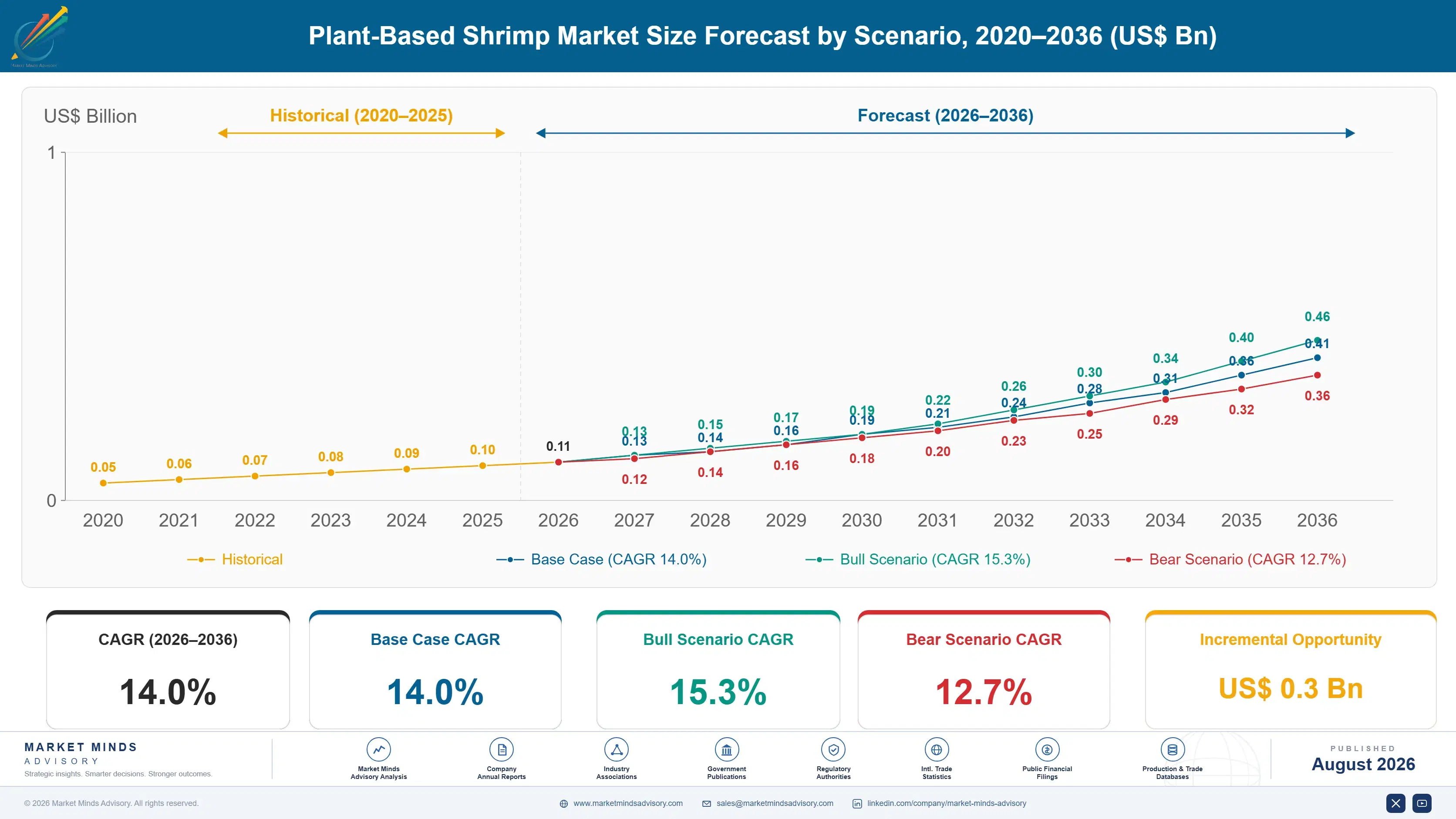
The market compounded at 12.5% between 2020 and 2025, which sounds impressive until the base is examined. Launches proliferated across 2021 and 2022 as plant-based investment peaked, then a substantial number were withdrawn when repeat purchase failed to materialise. What survived the shakeout was foodservice supply and a much smaller retail presence than the launch activity implied at the time.
The 14.0% base case rests on three mechanisms. First, foodservice adoption keeps growing where shrimp is a component rather than the centrepiece, in dumplings, sushi rolls, curries and pasta dishes. Second, shellfish allergen positioning gives the category a genuine functional claim that other plant-based proteins simply do not have. Third, fermentation-derived formats are steadily closing the nutrition gap that made hydrocolloid products so hard to defend on a nutrition label.
The bull case at 15.3% assumes fermentation capacity brings cost toward parity while allergen-driven institutional catering adoption accelerates. The bear case at 12.7% turns on conventional shrimp pricing: Ecuadorian and Indian production expansion has pushed farmed shrimp cheaper in real terms for several years, and a further fall would widen a price gap the category already struggles to justify at retail.

Why Texture Solves What Flavour Cannot

Of all the animal proteins the plant-based industry has attempted, shrimp is the one where the technical problem is genuinely tractable. Shrimp has very little flavour of its own. What people recognise is the snap, the resistance to the bite and the way the flesh separates, and hydrocolloid systems reproduce all three.
TOP FIVE CONCENTRATION44%Combined position of the five largest plant-based seafood brands
AVERAGE RETAIL PRICE$18 per kilogramTypical shelf price across retail plant-based shrimp formats
PREMIUM TO CONVENTIONAL2.3 timesMultiple of conventional frozen shrimp shelf price paid
FOODSERVICE CHANNEL SHARE57%Portion of volume sold through restaurant and catering channels
PROTEIN INPUT SHARE36% of COGSStructured protein and hydrocolloid share of production cost
REPEAT PURCHASE RATE31%Share of first-time retail buyers who purchase again
That is why blind panels return results the rest of the plant-based category can only envy, and why the commercial performance has nonetheless disappointed. The eating experience is close but the price is not: retail plant-based shrimp sits at roughly 2.3 times conventional frozen shrimp, in a category where the conventional product is abundant, cheap and getting cheaper as farmed production expands. Consumers try it and mostly do not return, which is what a 31% repeat rate actually means.
Foodservice has absorbed the difference, and it now takes 57% of volume. In a dumpling, a sushi roll, a laksa or a pasta dish, shrimp is a component rather than the centrepiece, the portion size is small, and the price premium disappears into a dish costing far more than its ingredients. Operators also value the allergen position genuinely, because shellfish is among the most serious allergens a kitchen handles.
"This category made the classic mistake of selling a substitute to people who wanted the original. The buyers who actually repeat are households with a shellfish allergy and caterers who cannot risk one, and they were never chasing a vegan claim at all. The winning brands are the ones that worked that out and stopped putting a leaf on the packaging."
Senior Analyst, Alternative Protein and Seafood Practice · MMA Agriculture Pract

Market Trends

Allergen Positioning Displaces Vegan Messaging On Pack

Brands have shifted front-of-pack messaging from plant-based and vegan claims toward shellfish-free positioning, and the commercial results have been markedly better. Shellfish is among the most serious food allergens, affecting roughly 2% of adults in most developed markets with reactions severe enough to matter clinically. That audience buys the product because it solves a problem rather than because it expresses a value, and it repeats at rates several times the category average. Retailers have followed by merchandising these products within free-from sections rather than in the chilled vegan fixtures where they previously sat.
Market Impact: Covers 4,800 catering contracts
Fermentation Formats Close The Nutrition Panel Gap

Konjac and alginate structured shrimp deliver excellent texture and almost no protein, which makes the nutrition panel awkward against a product consumers associate with lean protein. Mycoprotein and fungal fermentation formats carry ten to fourteen grams of protein per hundred, alongside a fibrous structure that reads correctly on the palate. That combination is what allows a genuine nutritional claim rather than merely a texture demonstration. Production cost remains meaningfully higher than hydrocolloid systems, though fermentation capacity originally built for other alternative proteins is available on toll terms across several markets.
Market Impact: Drives 21% of foodservice volume

Market Opportunities and Growth Drivers

Institutional Catering Removes Shellfish From Menus

Schools, hospitals, airlines and contract caterers have strong operational reasons to eliminate shellfish from kitchens entirely, because cross-contamination controls are expensive and the consequences of any failure are severe. Plant-based shrimp lets those operators serve dishes they would otherwise remove from menus altogether. Roughly 4,800 institutional catering contracts across Europe and North America now specify entirely shellfish-free kitchens. That demand is specification-driven rather than preference-driven, which makes it far steadier than any retail demand and considerably less sensitive to the price premium involved. Contract durations run one to three years.
Market Impact: Loses 69% of first-time buyers

Aquaculture Sustainability Scrutiny Now Reaches Procurement

Mangrove destruction, antibiotic residues and labour practices across shrimp aquaculture have moved from advocacy campaigns into corporate procurement policy at several large foodservice and retail groups. Those buyers now require certification or traceability that a meaningful share of global farmed shrimp supply simply cannot provide. Plant-based alternatives sidestep the question entirely, which is exactly why procurement teams rather than menu category managers have driven several of the largest contracts signed to date. Roughly 21% of foodservice plant-based shrimp volume is bought under sustainability sourcing commitments rather than menu innovation budgets.
Market Impact: Widens gap beyond 2.3 times

Market Restraints and Challenges

Repeat Purchase Fails Against A Cheap Conventional Product

Only 31% of first-time retail buyers purchase plant-based shrimp again, which is poor even by plant-based category standards. The root cause is the gap between a good but imperfect eating experience and a 2.3 times price premium against a conventional product that is abundant and inexpensive. Commercially this makes retail distribution expensive to hold, since rate of sale never justifies the shelf space it occupies. Participants are responding by concentrating on foodservice, by targeting allergen households who repeat far better than average, and by attacking unit cost through fermentation scale.
Market Impact: Serves 2% of adults with allergy

Conventional Shrimp Keeps Getting Cheaper In Real Terms

Ecuadorian and Indian farmed shrimp production has expanded substantially, and real farmed shrimp prices have fallen across several recent years rather than risen. The root cause is aquaculture productivity improvement combined with genuine oversupply in some seasons. Commercially this widens the price gap the category must justify, and it moves in the opposite direction to the trend that helped plant-based dairy and meat. Participants are addressing it by pursuing applications where the comparison is a dish rather than a raw ingredient, and by targeting allergen and sustainability buyers who are not price-comparing at all.
Market Impact: Carries 14 grams protein per hundre
2 additional market trends, 4 additional growth drivers, and 3 additional restraints and challenges are covered in the full report. Contact sales@marketmindsadvisory.com to access the complete intelligence.

Segment CAGR and Growth Architecture

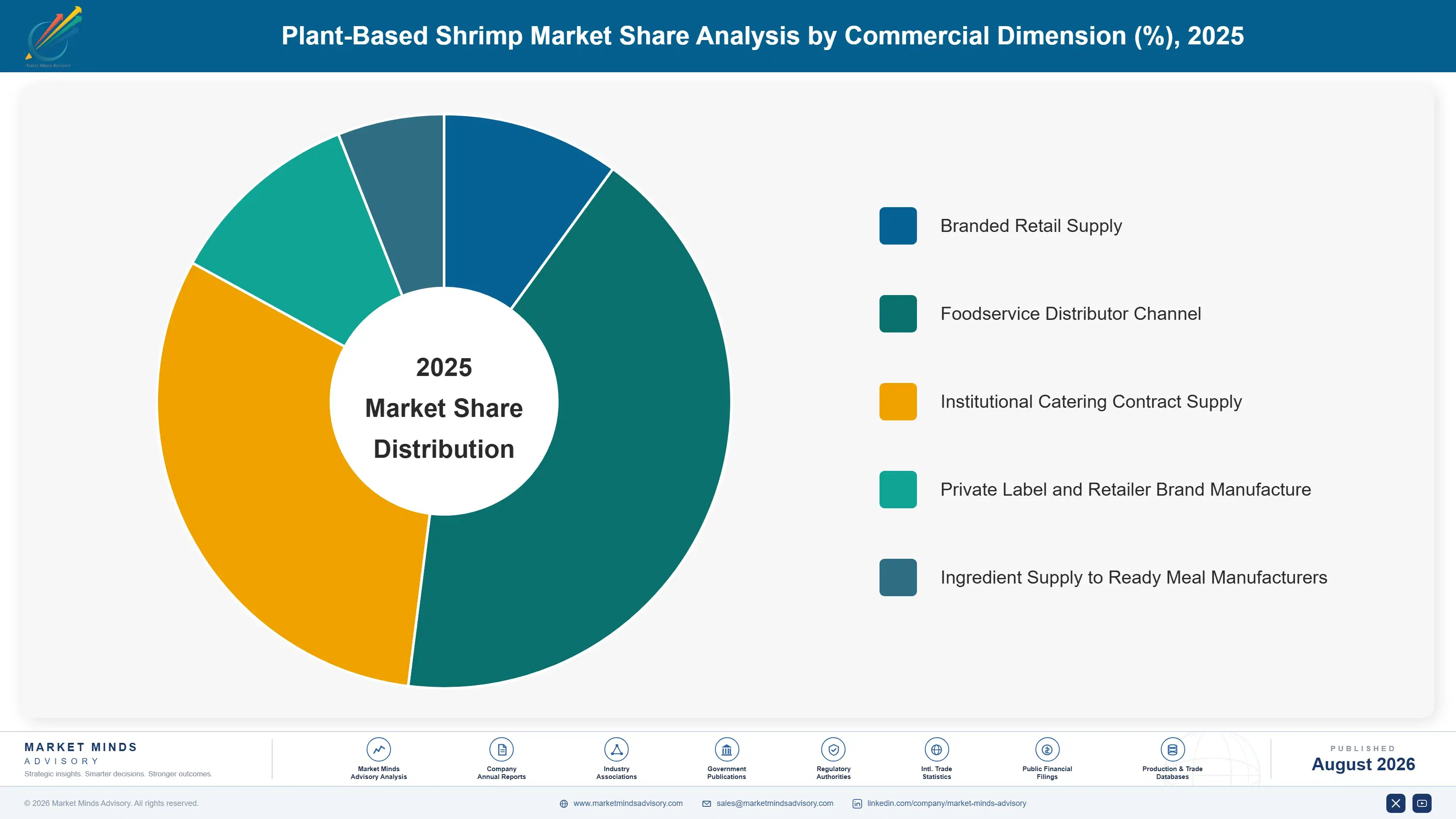
Segmentation here follows the base protein and structuring system, meaning whatever actually creates the bite and holds the shape. That single dimension determines the nutrition panel, the achievable texture, ingredient cost, regulatory approval pathway and which consumer objection a product can credibly answer, which together govern the entire commercial position a product can occupy.
plant-based-shrimp-market-trends-market-share-analysis-1787312563186

Mycoprotein and Fermentation-Derived Shrimp

The fastest segment at 21.0%, a full 1.50 times the market rate, covering shrimp analogues built on fungal mycoprotein or other fermentation-derived biomass rather than on any hydrocolloid gel system. The attraction of these formats is nutritional rather than textural: these formats carry ten to fourteen grams of protein per hundred alongside a naturally fibrous structure, which together answer the nutrition panel problem that konjac products simply cannot address. Production cost sits above hydrocolloid systems today, though toll fermentation capacity built for other alternative proteins is available in several markets. Regulatory novel food approval timelines vary considerably between jurisdictions and remain the practical constraint on how brands sequence their launches.
CAGR 21.0%

Algae-Based Shrimp Analogue

Growing at 18.2% annually on shrimp analogues built from microalgae and seaweed-derived proteins and structuring agents, which between them carry a genuine marine flavour profile that terrestrial plant proteins can only imitate artificially. Umami and mineral notes come directly from the raw material itself rather than from any added flavouring, and that authenticity shows up consistently in blind tasting panel results. Omega-3 content adds a nutritional claim that conventional farmed shrimp itself only partially delivers. Cultivation cost remains the practical constraint here, since photobioreactor and fermentation-grown algal biomass is genuinely expensive to produce, and heterotrophic production routes are only now reaching the scale that genuinely changes that arithmetic for anyone.
CAGR 18.2%
Full segment breakdown across 5 segments available in the complete report.

Regional Architecture and Country Demand Map

East Asia leads on a long mock seafood tradition combined with the highest regional shrimp consumption anywhere. South Asia and Pacific grows fastest of all as Indian vegetarian food manufacture scales up. North America holds the largest retail brand presence alongside the most severe repeat purchase problem.

East Asia

Thirty-two percent of global value sits here. Note: this exceeds the standard regional band because mock seafood has a centuries-old Buddhist vegetarian tradition across China, Taiwan and Japan, and because regional shrimp consumption per head is the highest anywhere in the world. Konjac-based analogues originated in this region and consumers approach them without the novelty scepticism found in Western markets. Hong Kong and Singapore have produced several of the category's most technically credible brands. Growth of 15.2% reflects both foodservice adoption across dim sum and noodle formats and retail acceptance that Western markets have not achieved. Local manufacturers hold most listings rather than international brands. Novelty scepticism is largely absent here.
Share: 32% | CAGR: 15.2% (2026 to 2036)

North America

Twenty-five percent of global value, with the largest retail brand presence anywhere and, not coincidentally, the most severe repeat purchase problem in the category. Launch activity across 2021 and 2022 was intense and a substantial number of those products have since been withdrawn from chilled and frozen fixtures. What has worked is allergen positioning in free-from sections and institutional catering supply into schools, hospitals and airlines. Growth of 13.4% comes disproportionately from foodservice rather than grocery. Conventional shrimp is abundant and inexpensive here, which makes the retail price comparison unusually unforgiving for brands. Free-from merchandising is the single change that has most improved rate of sale. Retail contribution is negative for most brands once trade spend is allocated.
Share: 25% | CAGR: 13.4% (2026 to 2036)
Regional intelligence for 5 additional markets available in the complete report: Western Europe, South Asia and Pacific, Latin America, Middle East and Africa, Eastern Europe. Contact sales@marketmindsadvisory.com.
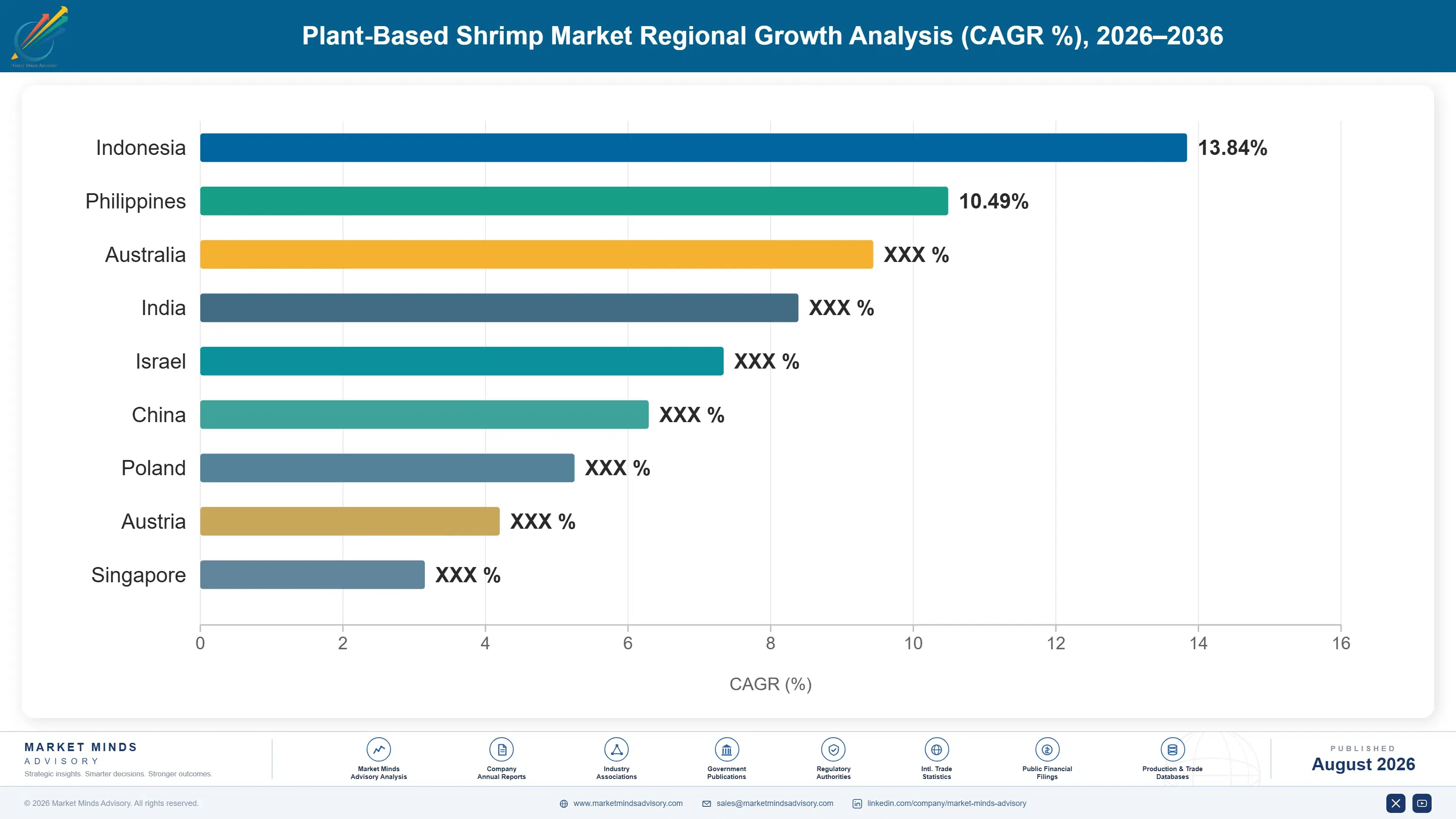
plant-based-shrimp-market-trends-country-cagr-analysis-1787312564077

Where This Category Actually Makes Money

Four commercial moves separate the brands earning a durable position from those merely buying trial they never manage to convert. Each depends on finding the buyer for whom this product solves a problem rather than expresses a preference: allergen households, shellfish-free kitchens, sustainability procurement teams, or dish applications where portion size hides the premium.

Sell Shellfish-Free Rather Than Plant-Based Claims

Households managing a shellfish allergy buy this product because it solves a genuine clinical problem for them, and they repeat at roughly three times the category average of 31%. Brands that moved front-of-pack messaging from vegan claims to allergen positioning, and persuaded retailers to merchandise them in free-from rather than chilled vegan fixtures, report rate of sale improving by 40% to 60% on identical product. The change costs a packaging revision and a retailer conversation, nothing more, which makes it comfortably the highest-return commercial move available anywhere in this category.
Market Impact: Improves rate of sale by up to 60%

Target Kitchens That Must Exclude Shellfish

Schools, hospitals, airlines and contract caterers eliminate shellfish for operational reasons rather than dietary ones, because cross-contamination control is expensive and the consequences of failure are severe. Roughly 4,800 such catering contracts now operate across Europe and North America alone. Supplying them is specification-driven business at contracted volumes rather than promotional retail, and it prices on solving the operator's cross-contamination problem rather than against conventional shrimp at all. Winning it requires allergen documentation and demonstrable supply reliability rather than brand investment, which suits smaller manufacturers particularly well against funded competitors.
Market Impact: Addresses about 4,800 shellfish-fre

Position Into Dishes Rather Than Onto Plates

In a dumpling, a sushi roll, a laksa or a pasta dish, shrimp is a component at small portion size inside a dish costing far more than its ingredients, and the 2.3 times premium simply disappears. Sold as a centre-of-plate item sitting next to conventional frozen shrimp, that same premium becomes the entire purchase decision for the shopper. Brands concentrating deliberately on component applications report gross margins eight to twelve points above those chasing centre-of-plate retail listings, and considerably better volume stability across the promotional cycles that destroy retail predictability.
Market Impact: Earns up to 12 points above centre-

Use Toll Fermentation Before Building Capacity

Mycoprotein and fermentation formats answer the nutrition panel problem that hydrocolloid products cannot, but dedicated capacity costs between $40 million and $90 million and cannot be justified at current category volumes by anyone at all. Toll fermentation capacity built originally for other alternative proteins is available across North America, Europe and Asia at utilisation rates well below nameplate. Using it converts a capital decision into a variable cost, and it lets a brand test nutrition-led positioning properly before committing to an asset that this category may not yet support at all.
Market Impact: Avoids up to $90 million of dedicat

Who Controls the Margin Pool

Concentration is moderate at 44% for the top five, measured on plant-based shrimp revenue across all participants, which is unusually high for a nascent category and reflects how few companies have solved texture at commercial scale. Thai Union leads on foodservice reach through existing seafood distribution, and the gap to the second tier is widest in channel access rather than in product capability.
Competition runs on three dimensions. Foodservice distribution decides most volume, since 57% of the category sells through kitchens, and incumbent seafood suppliers already hold those relationships. Texture credibility decides which operators will list a product at all, because a poor analogue damages a menu item permanently. Price competition is fiercest in retail, where the shopper compares directly against conventional frozen shrimp and the comparison rarely favours the analogue.

Two pressures are building. Conventional seafood companies have entered the category using their own foodservice distribution, which is an advantage that specialist plant-based startups cannot replicate through funding alone. Meanwhile fermentation-derived formats will progressively make hydrocolloid products look nutritionally weak on shelf. Rankings shift where foodservice distribution meets fermentation capability, since brands holding one without the other face either a channel problem or a nutrition panel problem.
plant-based-shrimp-market-trends-company-positioning-matrix-1787312564986

Competitive Moat and Risk Dimensions

THAI UNION

Moat: Existing seafood foodservice distribution

Established relationships with foodservice distributors, caterers and retail seafood buyers across Asia, Europe and North America give the company channel access that specialist plant-based startups cannot replicate with funding. In a category where 57% of volume moves through kitchens, that distribution is worth considerably more than any product advantage.
THAI UNION

Risk: Cannibalising a much larger business

Conventional shrimp and seafood generate revenue orders of magnitude larger than the analogue category, and internal enthusiasm for displacing that volume is understandably limited. Investment decisions compete against a core business the same customers buy. That tension has slowed several conventional seafood companies entering alternatives, and it is unlikely to resolve while the size gap persists.
OMNIFOODS

Moat: Deepest Asian mock seafood credibility

Product development rooted in the Asian mock seafood tradition, combined with distribution across Hong Kong, Singapore and mainland Chinese foodservice, gives the company credibility with operators who judge these products against a long culinary reference rather than as a novelty. That reference frame is genuinely different from Western scepticism and it converts to listings far faster.
OMNIFOODS

Risk: Limited Western retail traction

Success in Asian markets has not translated into comparable Western retail performance, where repeat purchase difficulties affect the company as much as anyone. Building Western foodservice distribution from scratch is slow and expensive against incumbents. The regional strength is real but it concentrates the business in markets where competition from local manufacturers is also intensifying.

Players Tracked

Prominent Players

Thai Union
OmniFoods
New Wave Foods
Nestle
Vegan Zeastar

Other Key Players

Konscious Foods
The Plant Based Seafood Co
Good Catch
Ocean Hugger Foods
Hooked Foods
Revo Foods
Sophie's Bionutrients
Happiee
Loma Linda
Sophie's Kitchen
Quorn Foods
Gardein
Vivera
Zhenmeat
BeLeaf

Recent Developments

MARCH 2025

Thai Union expands plant-based shrimp foodservice distribution

Distribution of the company's whole plant-based shrimp range was extended substantially across both European and North American foodservice distribution channels, using the company's existing seafood distributor relationships rather than building the entirely separate route to market that specialist plant-based brands have been forced to construct.
Signal: Incumbent seafood distribution is now prov
JULY 2025

Revo Foods commissions fermentation-based seafood capacity

Dedicated production capacity for fermentation-derived seafood analogues entered commercial service at a European production site during the year, directly addressing the nutrition panel weakness that hydrocolloid-structured products all carry and positioning the range against conventional shrimp on protein content rather than only on texture credibility.
Signal: Fermentation formats are being built to an
NOVEMBER 2025

Major contract caterer adopts shellfish-free menu policy

One of the largest European contract catering groups adopted a fully shellfish-free kitchen policy right across the whole of its education and healthcare catering portfolio, replacing all conventional shrimp with plant-based analogues purely on operational cross-contamination grounds rather than for any sustainability or dietary reason whatsoever.
Signal: Allergen operational risk rather than cons

What Drives Delivered Product Cost

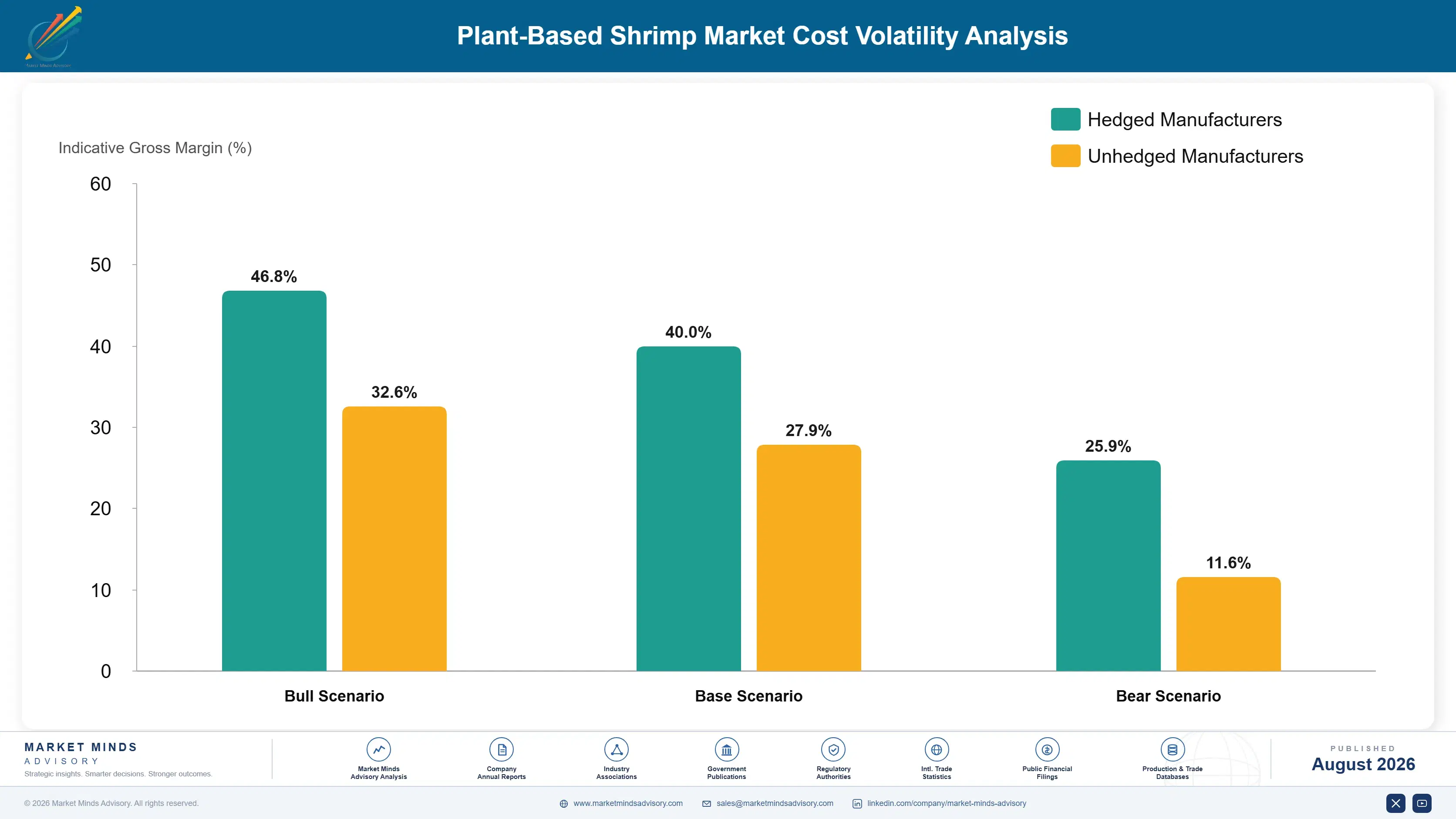
Structured protein and hydrocolloid ingredients account for roughly 36% of cost of goods, with konjac glucomannan, sodium alginate, pea and soy isolates and mycoprotein biomass making up the bulk. Flavour systems and marine extracts add 12%, packaging 14% because chilled and frozen formats need barrier materials, and manufacturing conversion a further 21% at the modest scale the category currently runs.
Scale rather than any single input drives the cost problem. Production volumes across the whole category remain small enough that conversion cost per kilogram sits far above conventional seafood processing, and short production runs on shared lines add changeover cost that dedicated facilities would avoid. Nestle disclosures across its plant-based portfolio have documented the margin difficulty of sub-scale alternative protein manufacture. Konjac pricing also rose sharply through 2023 after a poor Chinese growing season.

The competitive disadvantage mechanism runs through manufacturing scale and channel mix. A brand on toll manufacture at low volume carries conversion cost no ingredient saving offsets, and selling that into retail against conventional shrimp makes the premium indefensible. One producing at scale and selling into foodservice component applications faces neither problem. Conventional seafood companies sit best, absorbing analogue volume into existing chilled and frozen manufacturing overhead.
plant-based-shrimp-market-trends-cost-volatility-analysis-1787312565362

Use toll manufacture until volumes justify dedicated lines

Dedicated capacity at current category volumes produces poor utilisation and high fixed cost per kilogram, which is exactly the trap that closed several early entrants. Toll manufacture on existing chilled and frozen lines converts that fixed cost into a variable one, and it preserves the flexibility to change format entirely as the category settles on what actually sells.

Contract konjac supply across growing regions

Konjac glucomannan comes overwhelmingly from Chinese and Southeast Asian growing regions, and the 2023 season demonstrated how sharply pricing moves on a poor harvest. Contracting konjac supply across several separate origins costs a modest premium over spot pricing and it removes a volatility exposure sitting on roughly a third of the whole ingredient cost base.

Concentrate production runs to reduce changeover cost

Short runs across many formats on shared lines generate changeover and cleaning cost that dedicated production would avoid entirely. Rationalising to fewer formats produced in longer campaigns cuts conversion cost by roughly four percentage points, and it also improves consistency, which matters considerably more to foodservice operators than any amount of range breadth ever does.

Portfolio Architecture for Margin Defence

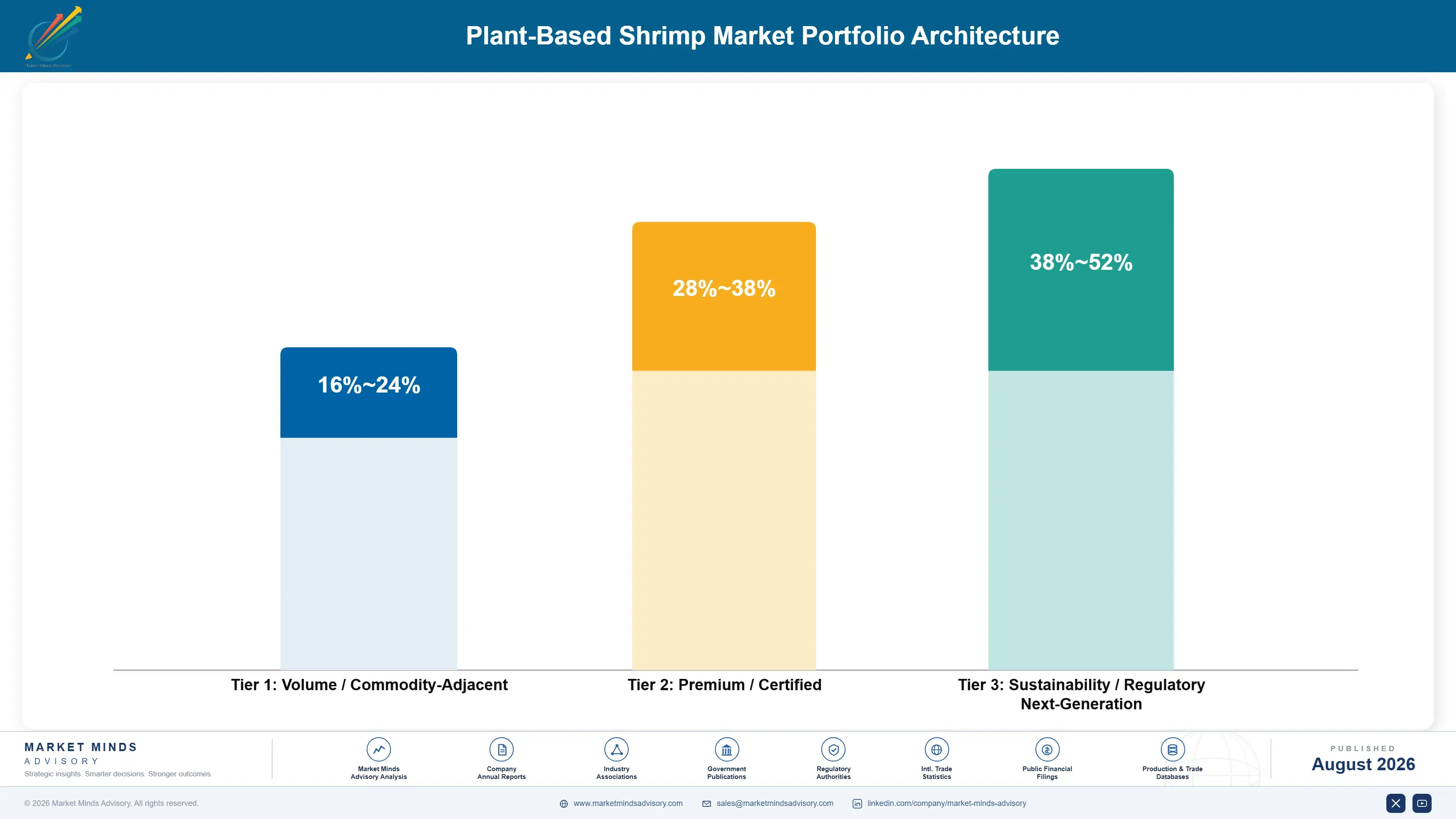
Margin architecture tracks who is buying and why, not what the product is made from. Retail centre-of-plate formats sold against conventional shrimp run at gross margins in the high teens after promotional support, because rate of sale never justifies the listing and trade spend consumes the premium. Component and allergen-led supply earns roughly double.
The volume-versus-premium tension works differently here from most food categories. Retail distribution is expensive to hold and delivers poor economics, yet brands pursue it because it creates the visibility that foodservice buyers and investors respond to. Several manufacturers have concluded that retail is effectively a marketing cost carried at negative contribution, funded by foodservice margin. That is an uncomfortable position to describe to a board but it reflects how the category actually works today.

Value concentrates where the buyer is not comparing against conventional shrimp at all. Institutional catering under shellfish-free policy sits at the top, because the operator is solving a cross-contamination problem and the alternative is removing the dish entirely. Allergen household retail sits alongside on the same logic. Centre-of-plate retail sits at the other extreme, where the shopper holds a bag of frozen shrimp in the other hand and the arithmetic is brutal.

Volume / Commodity-Adjacent

Centre-of-plate retail formats merchandised against conventional frozen shrimp in chilled and frozen fixtures. Shoppers compare directly on price, repeat purchase is weak, and trade spend consumes most of the premium. This distribution exists largely for visibility rather than for contribution.
Gross Margin: 16-24%

Premium / Certified

Foodservice component supply into dumplings, sushi, curries and pasta dishes where portion size is small and the premium disappears into a much larger dish price. Operator consistency requirements and menu stability support pricing considerably better than retail does.
Gross Margin: 28-38%

Sustainability / Regulatory / Next-Generation

Allergen-positioned retail in free-from fixtures, institutional catering under shellfish-free policies, and fermentation-derived formats carrying genuine protein claims. Solving an operational or clinical problem, rather than offering a dietary alternative, justifies the pricing here.
Gross Margin: 38-52%
plant-based-shrimp-market-trends-portfolio-architecture-1787312566240

High-value Sub-segments and Strategic Watch-out

Shellfish-Free Institutional Supply

High value on genuinely high growth, because the operator is solving a cross-contamination problem and the alternative is deleting a menu item entirely. Contracts are specification-driven at agreed volumes, which makes this comfortably the steadiest and least price-sensitive demand pool anywhere in the whole category.
Gross Margin: 40-52%

Allergen Household Retail

Strong margins on solid growth, and the only retail buyer group repeating at three times the category average of thirty-one percent. Free-from fixture merchandising rather than chilled vegan placement is what reaches them, and it costs little more than a packaging revision to achieve properly.
Gross Margin: 36-46%

Centre-Of-Plate Retail

The retail visibility that funds foodservice credibility elsewhere, earning gross margins in the high teens after trade support while losing fully sixty-nine percent of its first-time buyers. Several manufacturers now treat this distribution honestly as a marketing cost rather than as a genuinely contributing business line.
Gross Margin: 16-24%

Hydrocolloid Structured Formats

The strategic watch-out sitting squarely in this portfolio. Texture performance here is excellent and unit cost is the lowest available anywhere, but the nutrition panel carries almost no protein, and fermentation formats arriving at scale will make that weakness increasingly visible on the shelf directly beside them.
Gross Margin: 24-34%

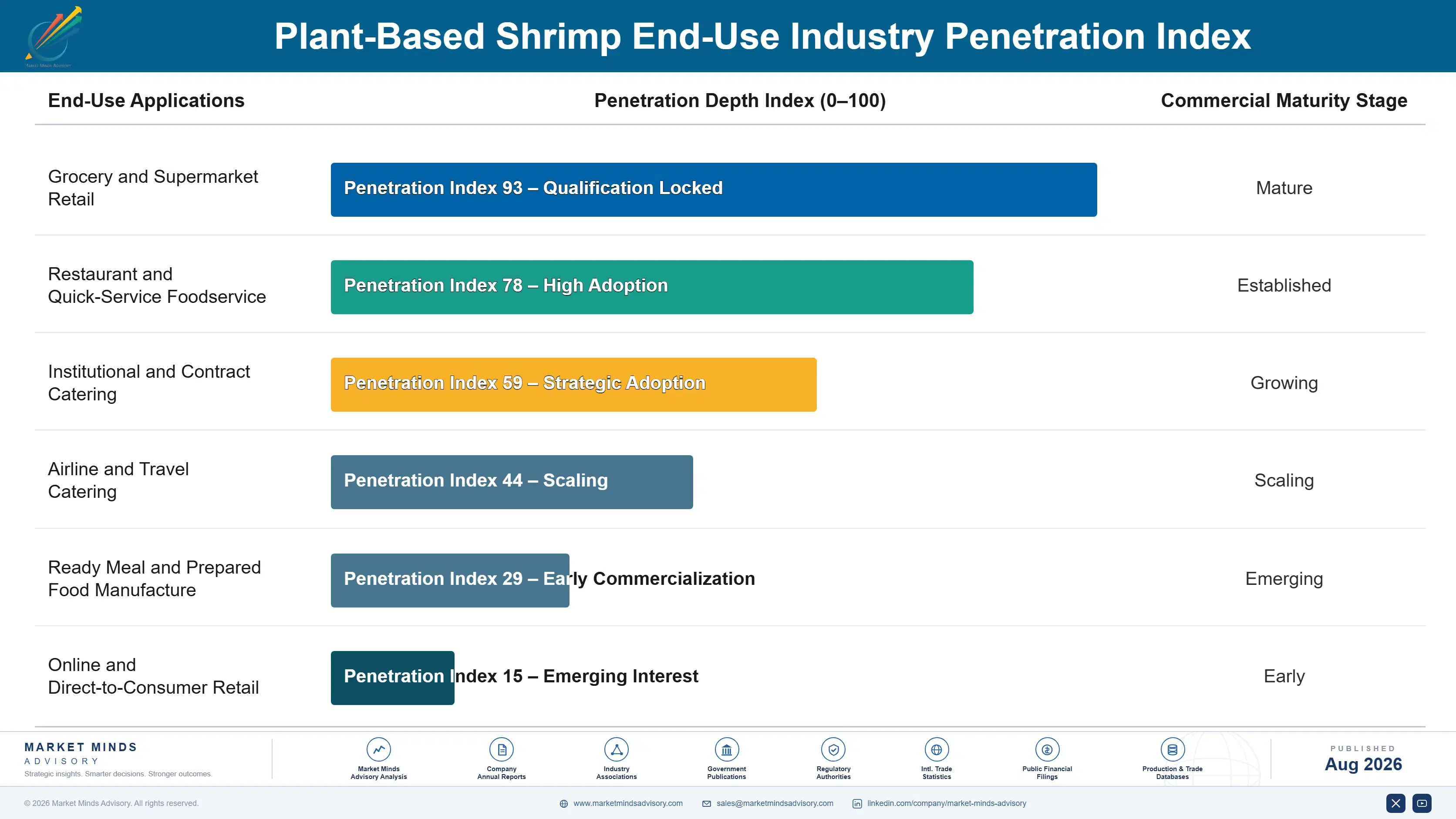
How This Demand Actually Repeats

Demand splits cleanly between buyers who repeat and buyers who do not, and the distinction is whether the product solves a problem. An allergen household or a shellfish-free kitchen has no alternative and returns reliably. A curious shopper comparing against frozen shrimp tries once, and roughly seven in ten never come back.
Stickiness therefore varies more sharply here than in almost any food category. Institutional catering contracts are the tightest, running one to three years with allergen documentation and supply reliability requirements that make switching a genuine project. Allergen household retail sits close behind, repeating at roughly three times the category average. Centre-of-plate retail is barely sticky at all, with repeat purchase at 31% describing a category that mostly sells trial.

Buyer profiles have changed as brands learned what actually works. Distribution decisions once sat with grocery plant-based category managers assessing a growing shelf. They now frequently involve free-from buyers, catering procurement teams and food safety functions asking about allergen documentation, cross-contamination controls and supply continuity. Brands whose commercial approach still leads with sustainability messaging find themselves talking to people whose actual question is whether a kitchen can rely on them.
plant-based-shrimp-market-trends-end-use-penetration-index-1787312567116

Where To Place Capital

These are among the four positions where our research anticipates prominent divergence between winners and laggards over the coming forecast period. Each is grounded in the demand model, the regulatory perimeter, and the announced capacity pipeline.
01 / POSITIONING MESSAGE DISCIPLINE

Allergen framing outperforms every vegan claim

Households managing a shellfish allergy repeat at roughly three times the category average of 31%, because for them the product solves a genuine clinical problem rather than expressing any dietary preference. Brands moving front-of-pack messaging to shellfish-free positioning and securing free-from rather than chilled vegan merchandising report rate of sale improving 40% to 60% on identical product. That costs a packaging revision and a retailer conversation, nothing more, which makes it comfortably the highest-return decision available anywhere in this category.
02 / CHANNEL WEIGHTING CHOICE

Foodservice carries the category, retail buys visibility

Foodservice takes 57% of category volume and earns gross margins around ten points above retail equivalents, because portion size hides the 2.3 times premium entirely inside a dish costing far more than its ingredients. Retail centre-of-plate distribution loses 69% of first-time buyers and consumes the entire premium in trade spend. Several manufacturers now treat retail honestly as a marketing cost funded by foodservice margin, which is uncomfortable to present to a board but reflects the actual economics of the category.
03 / INSTITUTIONAL CONTRACT FOCUS

Kitchens excluding shellfish are the durable buyer

Roughly 4,800 institutional catering contracts across Europe and North America now operate entirely shellfish-free kitchens for cross-contamination reasons rather than dietary ones, and for those operators the only alternative is deleting the menu item altogether. That business is specification-driven at contracted volumes and it does not price against conventional shrimp in any way at all. Winning that work requires allergen documentation and demonstrable supply reliability rather than brand investment, which suits smaller manufacturers particularly well against far better funded competitors.
04 / FERMENTATION ROUTE TIMING

Rent the capacity before you build any

Fermentation formats do answer the nutrition panel weakness that hydrocolloid products carry, but dedicated capacity costs between $40 million and $90 million, and current category volumes cannot possibly justify that for anyone today. Toll fermentation capacity built for other alternative proteins runs well below nameplate right across North America, Europe and Asia. Using it converts a capital decision into variable cost and it permits testing nutrition-led positioning properly before committing to an asset that this category may never support at all.

Engagement Snapshot From the Field

A live engagement with an industry participant carrying material or product regulatory and market exposure ahead of a defining policy shift, showing how our research translates into a defensible multi-year portfolio strategy.
MARKET MINDS ADVISORY · CLIENT ENGAGEMENT SUMMARY
Plant-Based Shrimp Producer Strategic Portfolio Review and Transition Roadmap 2026·Investment Scenario on Plant-Based Shrimp Exposure Evaluation 2025-26
CLIENT PROFILE
A venture-backed North American plant-based seafood brand with annual revenue near $19 million (client-reported, unverified by MMA), producing konjac-structured shrimp analogues through toll manufacture. Roughly 72% of revenue came from grocery retail distribution built through heavy trade investment, front-of-pack messaging led with plant-based and vegan claims, and foodservice supply was minimal across every one of its markets.
STRATEGIC CHALLENGE
Retail rate of sale had fallen below the threshold two major grocery chains required to maintain listings, and repeat purchase measured at 27% against a category average already considered poor. The board had funding for one further push and needed to decide between more retail trade investment, a foodservice build, or repositioning the existing product entirely.
MMA APPROACH
MMA analysed repeat purchase by buyer type using primary survey data, sized the shellfish-free institutional catering opportunity across North America, and modelled full channel contribution under three separate positioning scenarios. Findings were tested against 47 expert interviews covering grocery free-from buying practice, contract catering allergen policy and foodservice distributor economics.
KEY FINDINGS
  1. Repeat purchase among households reporting a shellfish allergy measured 74% against 21% for all other buyers, a difference the brand had never segmented or measured before.
  2. Free-from fixture placement rather than chilled vegan merchandising was available at both chains and required only a packaging revision costing under $180,000 (client-reported, unverified by MMA).
  3. Institutional catering contracts specifying shellfish-free kitchens represented an addressable pool the brand had never approached, requiring allergen documentation it already largely held.
  4. Retail contribution was negative once trade investment was fully allocated, meaning the channel had been funded from investor capital rather than from any operating margin at all.
CLIENT PROFILE
A venture-backed North American plant-based seafood brand with annual revenue near $19 million (client-reported, unverified by MMA), producing konjac-structured shrimp analogues through toll manufacture. Roughly 72% of revenue came from grocery retail distribution built through heavy trade investment, front-of-pack messaging led with plant-based and vegan claims, and foodservice supply was minimal across every one of its markets.
STRATEGIC CHALLENGE
Retail rate of sale had fallen below the threshold two major grocery chains required to maintain listings, and repeat purchase measured at 27% against a category average already considered poor. The board had funding for one further push and needed to decide between more retail trade investment, a foodservice build, or repositioning the existing product entirely.
MMA APPROACH
MMA analysed repeat purchase by buyer type using primary survey data, sized the shellfish-free institutional catering opportunity across North America, and modelled full channel contribution under three separate positioning scenarios. Findings were tested against 47 expert interviews covering grocery free-from buying practice, contract catering allergen policy and foodservice distributor economics.
KEY FINDINGS
  1. Repeat purchase among households reporting a shellfish allergy measured 74% against 21% for all other buyers, a difference the brand had never segmented or measured before.
  2. Free-from fixture placement rather than chilled vegan merchandising was available at both chains and required only a packaging revision costing under $180,000 (client-reported, unverified by MMA).
  3. Institutional catering contracts specifying shellfish-free kitchens represented an addressable pool the brand had never approached, requiring allergen documentation it already largely held.
  4. Retail contribution was negative once trade investment was fully allocated, meaning the channel had been funded from investor capital rather than from any operating margin at all.
RECOMMENDED STRATEGY
Phase 1: Phase one: revise packaging to lead with shellfish-free positioning and negotiate free-from fixture placement, since it costs least and addresses the repeat purchase problem directly. Phase 2: Phase two: build institutional catering supply using existing allergen documentation, targeting education and healthcare contracts rather than restaurant menu innovation budgets. Phase 3: Phase three: reduce retail trade investment deliberately to the level that maintains visibility, accepting lower distribution in exchange for positive contribution.
OUTCOME
The client completed repositioning within five months and reported rate of sale rising roughly 52% at the two retained grocery chains (client-reported, unverified by MMA). Two institutional catering contracts were secured in the following year, and retail trade investment was cut by more than half without losing either listing.

Frequently Asked Questions

Foundational context covering the market sizes, CAGR, scope, country, region and competition that inform every finding below. This section is provided to cover basics and most often pre-purchase conversations, answered from the MMA Primary Research Dataset.

What is the current size of the Plant-Based Shrimp Market?

The market was worth $0.1 billion in 2025 and is forecast to reach $0.11 billion in 2026. Foodservice channels account for 57% of that volume rather than grocery retail.

How large will the Plant-Based Shrimp Market be by 2036?

MMA forecasts $0.41 billion by 2036, an expansion multiple of 3.71 times the 2026 base. That represents $0.30 billion of incremental value across the forecast period.

What is the CAGR for the Plant-Based Shrimp Market 2026 to 2036?

The base case compound annual growth rate is 14.0%, with a bull case of 15.3% and a bear case of 12.7%. Historical growth from 2020 to 2025 ran at 12.5%.

Which segment is growing fastest?

Mycoprotein and fermentation-derived shrimp at 21.0%, a full 1.50 times the market rate. These formats answer the nutrition panel weakness that konjac and hydrocolloid structured products carry.

Who are the major companies in the Plant-Based Shrimp Market?

Thai Union, OmniFoods, New Wave Foods, Nestle and Vegan Zeastar lead, holding 44% of revenue between them. Fifteen further brands hold meaningful regional or format positions.

Which country is growing fastest?

India at 17.4%, where a very large vegetarian population is being offered an experience rather than a substitute. That framing removes the price comparison problem entirely.

Report Segmentation Architecture

The full report scope spans multiple orthogonal segmentation dimensions, with cross-tabulated demand data provided for each dimension pair. Coverage extends further to regional breakdowns, trend trajectories, and the competitive detail needed to support segment-level decision-making.

By Base Protein System

  • Mycoprotein and Fermentation-Derived Shrimp
  • Algae-Based Shrimp Analogue
  • Konjac and Hydrocolloid Structured
  • Pea and Soy Protein Extruded
  • Starch-Based Value Formats

By End-Use Industry

  • Grocery and Supermarket Retail
  • Restaurant and Quick-Service Foodservice
  • Institutional and Contract Catering
  • Airline and Travel Catering
  • Ready Meal and Prepared Food Manufacture
  • Online and Direct-to-Consumer Retail

By Commercial Dimension

  • Branded Retail Supply
  • Foodservice Distributor Channel
  • Institutional Catering Contract Supply
  • Private Label and Retailer Brand Manufacture
  • Ingredient Supply to Ready Meal Manufacturers

By Region

  • North America
  • Western Europe
  • East Asia
  • South Asia and Pacific
  • Latin America
  • Middle East and Africa
  • Eastern Europe

Scope, Methodology, and Coverage

Every figure in this report is reproducible from documented input assumptions. The scope below maps the historical period, the forecast horizon, the segmentation dimensions, and the countries covered, alongside the underlying primary and qualitative methodology.
Historical Period
2020 to 2025
Forecast Period
2026 to 2036
Base Year
2025 (USD billions; MMA Primary Research Dataset, August 2026)
Market Definition
This report covers plant-based and fermentation-derived shrimp analogue products formulated to replicate whole shrimp, prawn and langoustine formats in appearance, texture and culinary application. Coverage spans konjac and hydrocolloid structured, pea and soy protein extruded, algae-based, mycoprotein and fermentation-derived, and starch-based value formats across retail, foodservice and institutional catering channels. Cell-cultivated shrimp, plant-based fish fillet, crab, scallop and tuna analogues, shrimp-flavoured seasonings and pastes, conventional shrimp products, and plant protein ingredients sold as raw material are excluded from scope.
Quantitative Units
USD billions at retail and foodservice value; volume in thousand tonnes; gross margin percentages and repeat purchase rates by tier.
Segmentation Dimensions
Base protein system, end-use channel, commercial dimension, region.
Regions Covered
North America, Western Europe, East Asia, South Asia and Pacific, Latin America, Middle East and Africa, Eastern Europe
Countries Covered
China, Japan, South Korea, Singapore, India, Australia, Thailand, Vietnam, United States, Canada, Mexico, United Kingdom, Netherlands, Germany, Sweden, Brazil, Chile, Poland, Israel, United Arab Emirates.
Key Companies Profiled
Thai Union, OmniFoods, New Wave Foods, Nestle, Vegan Zeastar, Konscious Foods, Revo Foods, Good Catch, Sophie's Bionutrients, Quorn Foods, and ten further brands.
Quantitative Methodology
Primary survey, n=3,800 respondents, Q4 2025, six countries; demand-side model with trade association cross-validation
Qualitative Methodology
47 expert interviews, Q4 2025; applied to validate demand model assumptions, identify emerging dynamics, and assess competitive positioning
Report Format
PDF and XLSX data workbook (Word format preview document)
Publisher
Market Minds Advisory
Report Code
MMA-2026-AGR-802
Published
August 2026
Contact
sales@marketmindsadvisory.com | www.marketmindsadvisory.com

Purchase the full Plant-Based Shrimp Market Report (2026 to 2036).

The full report sets out ten-year forecasts for plant-based shrimp by base protein system, channel and commercial model across seven regions. It quantifies repeat purchase by buyer type, separating allergen households from general trial buyers and showing where the category actually retains customers. Competitive assessment covers twenty brands on a consistent revenue basis, mapping foodservice distribution access against product capability. Institutional shellfish-free catering demand is sized contract by contract across Europe and North America. Findings draw on a quantitative survey of 3,800 respondents across six countries and 47 expert interviews conducted during the fourth quarter of 2025.
Ten-year forecasts by base protein system and region
Repeat purchase quantified by buyer type and channel
Institutional shellfish-free catering demand sized by contract
Twenty-brand assessment on consistent revenue basis
Contribution modelled across retail and foodservice channels
Margin architecture across three commercial portfolio tiers

Built For The People Who Decide

From boardroom strategy to bench-side execution, this report is read cover-to-cover by leaders shaping the next decade of their industry, turning demand scenarios, market dynamics and valuation benchmarks into decisions.
CXOs/ Presidents/ VPs/ Managers
M&A and Corporate Development
Strategy Teams and R&D Heads
Procurement and Product Directors
Regulatory and Compliance Leaders
Investor Relations and Equity Analysts