Market Minds Advisory
Plant-Based Pork Market

Plant-Based Pork Market: Dumpling Fillings, Luncheon Meat and the Formats That Actually Work

Western producers built patties for a burger occasion that pork never had, while the formats that genuinely work are minced, seasoned and wrapped in dough somewhere between Guangzhou and Hanoi.

Lead Analyst

Lisa Gevelber

Published

September 2026

Make Smarter Decisions with Customized Research Insights

Request a free sample report and evaluate market opportunities, growth trends, and competitive dynamics relevant to your business needs.

2025 MARKET VALUE$0.6BMarket Size 2025
2036 FORECAST VALUE$1.5BBase Case , 2026 to 2036
CAGR 2026 TO 20368.6 %Bull 9.8% / Bear 7.4%
INCREMENTAL OPPORTUNITY$0.9BNet 10- year value creation
EXPANSION MULTIPLE2.28x2036 value over 2026 base
Strategic Levers
M&A Pipeline
Regional Outlook
Country Rankings
Competitive Intelligence
Segmental Deep-dive
Call-Us : 91 93563 13602

Executive Snapshot and Market Trajectory

Pork analogues work where the reference product is already minced, seasoned and cooked inside something else. That is dumpling filling, luncheon meat and sausage, not bacon. The industry spent a decade proving this and mostly refused to believe it. Geography followed the formats, not the other way round.
Minced and dumpling filling formats grow at 12.9%, half again the market rate of 8.6%, because a consumer eating a dumpling is not comparing texture against a whole muscle cut. Luncheon meat follows closely, for the same reason. East Asia holds 34% of global value, above the usual band, since pork accounts for the majority of meat eaten across China, Vietnam and the Philippines. Vietnam grows fastest of any country at 11.6%.
Bacon remains the unsolved problem and the largest single prize, because fat striation demands a layered build that extrusion does not produce. Concentration sits at 26% for the top five, and the leaders are regional specialists rather than the global plant meat brands. Chinese and Hong Kong producers set the format agenda now. Western entrants are buying their way in. That is a genuine reversal of position.
Market Definition
Plant protein products formulated and marketed as substitutes for pork across minced, sausage, bacon, luncheon meat and whole-cut formats, sold through retail and foodservice. Excludes cultivated pork, mycoprotein products not positioned against pork, generic tofu and tempeh, and plant proteins sold as ingredients rather than as finished analogue products.
Base Year Value
$0.6B in 2025 (MMA Primary Research Dataset, August 2026)
Forecast Period
2026 to 2036, eleven discrete annual values
CAGR
8.6% base case. Bull 9.8%. Bear 7.4%.
Fastest Growth Segment
Minced and Dumpling Filling Formats: 12.9% CAGR
Fastest Growth Country
Vietnam: 11.6% CAGR
Fastest Growth Region
South Asia and Pacific: 10.8% CAGR
Largest Region
East Asia: 34% of 2025 global value
Market Leaders
OmniFoods, Impossible Foods, Zhenmeat, Starfield Food Science and Technology, Vivera. Source: MMA Primary Research Dataset, July 2026.
Primary Survey
n=3,800 procurement and R&D decision-makers, Q4 2025, six countries
Methodology
Demand-side build-up, cross-validated against public data, 47 expert interviews

Plant-Based Pork Market Forecast Scenarios

plant-based-pork-market-trends-size-forecast-scenario-1787580488021
Growth between 2020 and 2025 ran near 7.5% and came almost entirely from Asian foodservice rather than from Western retail. Hong Kong and Singapore chains put plant pork into dim sum and rice bowls while European launches chased sausage and bacon, where the sensory gap is widest. The Western retail cohort has since contracted. Asian foodservice volume has not, and it now carries the category.
Base case 8.6% rests on three mechanisms. Chinese food safety and provenance concerns after successive African swine fever waves have made a shelf-stable pork alternative commercially interesting to institutional buyers. Dumpling and bao manufacturers are qualifying plant fillings as a hedge against pork price cycles that swing 60% peak to trough. And luncheon meat, a format with no texture expectation at all, has proven the easiest conversion anywhere in plant protein.
The bull case at 9.8% depends on a layered fat technology reaching commercial cost, which would open bacon and belly formats that carry the highest willingness to pay in the category. The bear case at 7.4% is a pork price collapse: when conventional pork mince falls below its five-year average, plant volumes drop within a quarter and retailers cut facings quickly.

Why the Dumpling Beat the Bacon Rasher

Texture expectation is the whole commercial variable. A shopper eating a pork chop has a precise sensory reference and notices every deviation from it. A shopper eating a dumpling has almost none, because the filling was minced, seasoned with ginger and soy, and steamed inside a wrapper. Plant protein wins in the second case and loses badly in the first.
TOP FIVE CONCENTRATION26%Regional specialists rather than global brands hold position
RETAIL PRICE PREMIUM1.7xAgainst conventional pork mince at equivalent pack weight
FOODSERVICE SHARE OF VOLUME44%Dumpling houses and chain restaurants take nearly half
EXTRUSION CAPACITY UTILISATION51%Installed high-moisture extrusion lines running below nameplate throughput
PROTEIN INPUT COST SHARE34%Share of finished goods cost carried by protein
REPEAT PURCHASE RATE38%Buyers returning to the category within the replenishment window
Luncheon meat makes the point most sharply. Canned pork luncheon meat is a heavily processed, uniformly textured, salt-forward product that nobody eats for its resemblance to a pig. Plant versions match it closely at a manufacturing cost that is competitive, and Hong Kong, Philippine and Korean consumers have taken them without much persuasion at all. Western producers largely ignored the format because it does not exist on their shelves.
Bacon is the opposite case and the reason so much development money has been spent badly. Striated fat needs a layered build, alternating lean and adipose phases, and high-moisture extrusion produces fibre alignment rather than lamination. Several producers are working on co-extrusion and layered deposition. None has reached a cost that a retail rasher price will support, and the ones claiming otherwise are selling at a loss.
"The category kept trying to win the argument it was always going to lose. Nobody needed a plant bacon rasher to fool them; they needed a dumpling filling that behaved properly in a steamer, and the companies that worked that out are the ones still shipping."
Principal, Protein and Alternative Foods Practice · MMA Food and Agriculture Ingredients Practice · August 2026

Market Trends

Asian foodservice formats displacing Western retail launches

Dim sum houses, bao chains and rice bowl operators across Hong Kong, Singapore and increasingly mainland China have taken plant pork into standing menu items rather than limited promotions. Foodservice now carries 44% of category volume, and in East Asia that figure runs higher still. The reason is operational rather than ideological: a filling is portioned by weight, cooked to a fixed schedule, and never plated as a recognisable cut. Kitchens can substitute without retraining anyone, which is not true of a Western sausage or a rasher. The economics follow the kitchen, not the shelf.
Market Impact: Hedges 60% price swing exposure

Layered fat deposition entering pilot scale production

Co-extrusion and layered deposition systems that build alternating lean and fat phases have moved from laboratory rigs to pilot lines at three European and two Asian producers. The technique produces visible striation for the first time, which matters because bacon and belly command the highest price per kilogramme in the pork set. Current cost runs roughly 2.4 times conventional high-moisture extrusion, driven by line speed rather than by materials. Line speed improves with engineering, so the cost curve is more tractable than the sensory problem ever was. That distinction matters for how capital is allocated.
Market Impact: Achieves 38% repeat purchase rate

Market Opportunities and Growth Drivers

Pork price volatility after successive African swine fever waves

Chinese pork prices have swung roughly 60% peak to trough across the past two cycles, and institutional buyers running fixed menu pricing cannot absorb that. Dumpling and ready meal manufacturers are qualifying plant fillings specifically as a hedge, holding a second approved recipe they can switch into when hog prices spike. The purchase logic has nothing to do with sustainability and everything to do with input predictability. That makes it far more durable than the environmental positioning that carried Western retail, because a procurement hedge survives a change of marketing director.
Market Impact: Blocks 20% of value pool

Luncheon meat conversion across Hong Kong and Philippine retail

Canned plant luncheon meat has taken meaningful shelf space in Hong Kong, the Philippines and parts of Korea, where the conventional product is a household staple with no texture expectation attached. Conversion rates in these markets run well above any Western format, and repeat purchase reaches 38% against a category average far below that. The product is shelf stable, needs no cold chain, and prices within striking distance of the conventional can. Manufacturers get a format that suits extrusion economics and consumers get something they already recognise. Nothing about the format needs explaining.
Market Impact: Cuts volume within 1 quarter

Market Restraints and Challenges

Bacon striation remains commercially unsolved at retail price

Bacon is the highest value pork format and the one plant protein cannot yet reproduce. The root cause is process physics: high-moisture extrusion aligns protein fibres in a single direction and cannot build the alternating lean and adipose lamination that a rasher requires. Commercially that leaves perhaps a fifth of the pork value pool inaccessible. Producers are testing co-extrusion, layered deposition and fat encapsulation, with pilot lines running at roughly 2.4 times standard extrusion cost. Engineering improvements to line speed look more promising than any reformulation route has. The prize stays visible and out of reach.
Market Impact: Foodservice carries 44% of volume

Conventional pork price collapse erases the volume premium

Plant pork retails near 1.7 times conventional pork mince, and that gap is not a matter of consumer conviction but of arithmetic at the shelf. When hog cycles turn and conventional prices fall below their five-year average, plant volumes drop inside a single quarter and retailers cut facings shortly afterwards. The cause is that plant pork sits in the same basket rather than in a premium set. Producers are responding with foodservice contracts that fix price annually, and with luncheon meat formats where the conventional reference is itself expensive. Neither response is a complete answer.
Market Impact: Costs 2.4x standard extrusion today
3 additional market trends, 4 additional growth drivers, and 2 additional restraints and challenges are covered in the full report. Contact sales@marketmindsadvisory.com to access the complete intelligence.

Segment CAGR and Growth Architecture

Six segments defined by product format, because format determines the sensory expectation a plant protein has to meet and therefore determines whether the technology can meet it at all. Nothing else in this category explains as much. End-use channel and protein source are treated separately in the framework rather than folded into this hierarchy.
plant-based-pork-market-trends-market-share-analysis-1787580488550

Minced and Dumpling Filling Formats

Growing at 12.9%, half again the market rate of 8.6%, this is the format where plant protein has the smallest sensory gap to close. Minced pork in a dumpling, bao, wonton or ready meal filling is already seasoned, bound and hidden inside a wrapper, so fibre structure barely registers. Foodservice takes most of the volume, with dumpling houses and frozen ready meal manufacturers running plant fillings as a standing line rather than a promotion. Cost per kilogramme is the most competitive in the category because the format tolerates simpler extrusion. This segment is the reason East Asia leads the market and will keep leading it. Nothing about that is likely to change.
CAGR 12.9%

Luncheon Meat and Canned Formats

At 11.4% this is the second fastest format and arguably the easiest technical win in all of plant protein. Canned pork luncheon meat is uniformly textured, salt-forward and heavily processed, so a plant version faces almost no comparison problem. Hong Kong, the Philippines and Korea drive the volume, where the conventional product is a household staple carrying a meaningful price. Shelf stability removes cold chain cost and widens distribution into convenience and traditional trade. Margins run better than minced formats because the conventional reference is itself expensive, giving producers room that fresh mince never allows them. Western producers ignored the format for a decade because it does not appear on their own shelves at all.
CAGR 11.4%
Full segment breakdown across 6 segments available in the complete report.

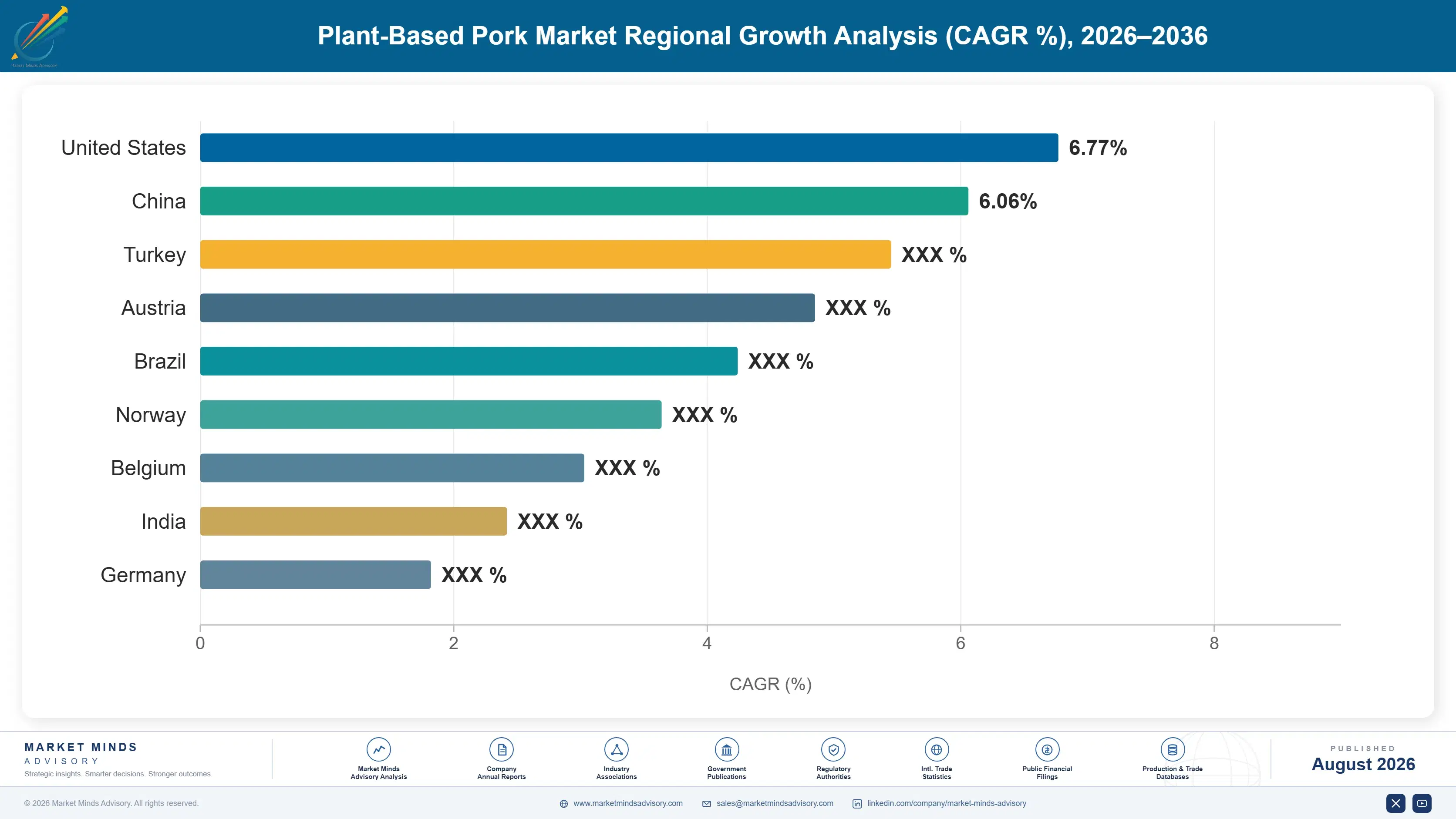
Regional Architecture and Country Demand Map

East Asia holds 34% of value, above its usual band, because pork is the dominant meat across China, Vietnam and the Philippines and the working formats are Asian ones. South Asia and Pacific sits at 13% on Southeast Asian foodservice demand. North America follows at 22%.

North America

Breakfast sausage and bacon dominate the American pork occasion, which is precisely the wrong shape for this technology. US retail volumes contracted through 2024 as the broader plant meat correction took hold, and several launches were withdrawn entirely. What survives sits in foodservice: chain restaurant breakfast items and college dining contracts where a fixed annual price beats commodity pork volatility. Canada is smaller and steadier, helped by pea protein processing capacity in Manitoba and Saskatchewan that gives domestic formulators an input cost advantage. The most interesting American development is Asian grocery, where imported luncheon meat and dumpling formats sell without any plant positioning at all. That is not where the marketing budget went.
Share: 22% | CAGR: 7.6% (2026 to 2036)

Western Europe

Sausage is the European pork format, and it is a harder problem than minced filling but easier than bacon by some distance. Germany leads regional value, where Rügenwalder Mühle converted a conventional meat business into a plant one and holds distribution across the discounters. The Netherlands contributes manufacturing depth through Vivera and a dense extrusion capacity base. British retail moved early and then retreated, with own-label ranges rationalised through 2024 and 2025. Spanish and Italian demand stays small because cured pork traditions leave little room for an analogue. Regional growth runs below the base case and will keep doing so. The manufacturing base is more interesting than the consumption story here.
Share: 19% | CAGR: 7.0% (2026 to 2036)
Regional intelligence for 5 additional markets available in the complete report: East Asia, South Asia and Pacific, Latin America, Middle East and Africa, Eastern Europe. Contact sales@marketmindsadvisory.com.
plant-based-pork-market-trends-country-cagr-analysis-1787580489070

Four Moves Worth Making Here

The commercial question in this category is not how to build a better analogue. It is which formats to abandon and which contracts to sign, because the technology gap varies enormously by format and the buyer economics vary just as much. Getting that allocation wrong has already cost several producers their independence. That allocation is the decision.

Abandon bacon until the cost curve moves

Bacon carries the highest price per kilogramme in the pork set and the widest sensory gap, and pilot layered deposition still runs at roughly 2.4 times standard extrusion cost. Producers who kept funding rasher development through the 2024 correction burned capital on a format they could not price. The discipline is to hold a watching brief, license rather than build, and redeploy that development budget into minced and canned formats where the technology already works properly. Revisit when line speed engineering brings the premium under 1.4 times. Nothing about that is a defeat.
Market Impact: Redeploys development spend until the premium falls below 1.4x

Sign annual price contracts with foodservice buyers

Institutional kitchens running fixed menu pricing cannot absorb a 60% swing in hog prices, and that is the argument that sells plant pork to them. An annual fixed-price contract converts a volatile commodity relationship into predictable volume, and it removes the retail promotion cycle entirely. Foodservice already carries 44% of category volume for exactly this reason. Contracts also lock a recipe into a kitchen's standard operating procedure, which is a far stickier position than any retail listing, because changing it means retraining staff across every site. That is the whole commercial argument here.
Market Impact: Converts 44% of category volume to fixed annual pricing

Build the canned luncheon meat position first

Canned plant luncheon meat needs no cold chain, faces almost no texture comparison, and prices within reach of a conventional product that is itself expensive. Repeat purchase reaches 38% in Hong Kong and Philippine retail against a category average well below that figure. It is the cheapest route to volume in the entire category and the one Western producers ignored for a decade because the format does not exist on their own shelves. Distribution reaches traditional trade and convenience, which chilled formats never will. It is also the fastest route to positive contribution margin.
Market Impact: Reaches 38% repeat purchase against a lower category average

Licence Asian formats rather than developing them

The working recipes for minced filling, luncheon meat and char siu were developed in Hong Kong and mainland China, and licensing them costs a fraction of the four to six million dollars a Western producer typically spends discovering the same answers slowly. Licensing also brings the application knowledge, meaning the cooking behaviour in a steamer or a wok, which no formulation sheet ever transfers on its own. Several European producers have taken this route since 2024 and reached commercial launch inside a year rather than three. Speed matters more than pride in this category.
Market Impact: Saves $4 million against three years of internal development

Who Controls the Margin Pool

Participation is measured throughout on retail and foodservice shipment volume of finished plant pork product, and on that basis the top five hold 26%. Concentration is low and unusually regional. OmniFoods and the Chinese specialists lead on Asian formats, while Impossible and Vivera hold Western sausage and mince positions that have not grown since 2023. The gap is format fit, not scale.
Three things are being competed on right now. Foodservice contract wins matter most, because they carry annual volume commitments that retail listings never do. Format development is the second, with layered fat systems at pilot scale across five producers. Input cost is third: protein pricing differences move gross margin by several points. Brand spending has largely stopped, which is a rational response to what happened in Western retail.

The conventional pork processors are where the pressure comes from next. Charoen Pokphand and WH Group already own the customer relationships, the cold chain and the extrusion capacity, and can treat plant pork as a hedge rather than a business. Expect supply agreements and minority stakes rather than acquisitions. Rankings change when a processor converts an idle line rather than buying a brand.
plant-based-pork-market-trends-company-positioning-matrix-1787580489597

Competitive Moat and Risk Dimensions

OMNIFOODS

Moat: Asian format application knowledge

OmniFoods built its products around dim sum, luncheon meat and rice bowl occasions rather than adapting Western patties, and that application knowledge sits in cooking behaviour rather than in a formulation sheet. Chefs across Hong Kong and Singapore know how the product handles in a steamer and a wok, which is a position no competitor buys quickly at any price.
OMNIFOODS

Risk: Narrow geographic revenue base

Revenue concentrates in Hong Kong, Singapore and mainland Chinese foodservice, which leaves the company exposed to a small number of urban markets and to the health of Asian dining traffic. Western expansion has proved slow because the formats need explanation on shelves where luncheon meat and bao are unfamiliar categories to most shoppers.
IMPOSSIBLE FOODS

Moat: Heme flavour platform ownership

The soy leghemoglobin platform gives Impossible a flavour position that is patented, regulatory approved across several jurisdictions, and genuinely difficult to replicate. Applied to pork formats it addresses the savoury depth that plant proteins usually lack. The regulatory approvals themselves took years to secure and function as a barrier quite apart from the underlying technology.
IMPOSSIBLE FOODS

Risk: Western retail format dependence

The company's pork range was built for Western sausage and ground applications, precisely the formats where volumes contracted hardest through the 2024 correction. Rebuilding around Asian filling and canned formats would mean competing on the incumbents' own ground without their application knowledge, and the regulatory approvals it holds carry no advantage there.

Players Tracked

Prominent Players

OmniFoods
Impossible Foods
Zhenmeat
Starfield Food Science and Technology
Vivera

Other Key Players

Beyond Meat
THIS
Heura Foods
Rügenwalder Mühle
Garden Gourmet
Quorn Foods
Hey Maet
Whole Perfect Food
Qishan Foods
Otsuka Foods
Fuji Oil Holdings
Amy's Kitchen
Upton's Naturals
La Vie
Prime Roots

Recent Developments

MAY 2026

Chinese dumpling manufacturer qualifies plant filling as a standing second recipe

A large frozen dumpling manufacturer completed qualification of a plant protein filling as an approved alternative recipe, allowing production switching whenever hog prices exceed a defined threshold. The arrangement is a supply qualification rather than any form of equity investment or joint venture between the parties.
Signal: Procurement hedging, not consumer demand, is now the mechanism putting plant pork into industrial food manufacturing
SEPTEMBER 2025

OmniFoods expands canned luncheon meat distribution into Philippine traditional trade

OmniFoods extended distribution of its canned plant luncheon meat beyond modern retail into Philippine traditional trade outlets, reaching sari-sari stores through a national distributor agreement. Shelf stability removed the cold chain constraint that limits every chilled plant protein format sold in that market. Volumes were not disclosed.
Signal: Shelf-stable formats reach a distribution depth that chilled analogue products cannot achieve in Southeast Asian retail
JANUARY 2026

European producer commissions pilot layered fat deposition line

A Dutch producer commissioned a pilot line using layered deposition to build alternating lean and fat phases for bacon and belly formats. The company confirmed the process currently runs at roughly 2.4 times standard extrusion cost, driven by line speed rather than by any material input.
Signal: Bacon striation is now an engineering problem with a visible cost curve rather than an unsolved formulation question

What the Protein Actually Costs

Protein isolate and concentrate run about 34% of cost of goods across most formats: pea protein from Canadian, French and Chinese processors, soy concentrate largely from Brazilian and American crush, and mung bean isolate almost entirely from Chinese suppliers. Fats and binders take a further 18%, with coconut and sunflower oil the dominant choices. Packaging and cold chain add roughly 20% for chilled formats.
Pea protein pricing moved sharply through 2022 and 2023 as European processing capacity came online faster than demand, then fell back as the plant meat correction cut offtake. Roquette and Cosucra both flagged utilisation pressure in their annual reporting for that period. Producers who had signed long pea contracts at the peak carried an input disadvantage of several points against competitors formulating on soy, and some never recovered it.

That formulation choice is the competitive mechanism nobody discusses openly. A producer locked into one protein source cannot arbitrage as relative prices move, while multi-protein formulators switch within a production run. Exposure varies by geography too: Chinese producers formulating on domestic soy and mung bean hold a persistent cost advantage over European plants buying isolate at import parity, per USDA oilseed trade data.
plant-based-pork-market-trends-cost-volatility-analysis-1787580489792

Qualify multi-protein formulations that permit switching

Holding two or three approved protein bases for the same finished product lets a formulator move between pea, soy and mung bean as relative prices shift, capturing several points of gross margin across a cycle. Qualification costs perhaps 90 thousand dollars per additional base and pays back within one price swing in most years.

Move volume toward shelf-stable canned formats

Cold chain adds roughly 20% to delivered cost for chilled products and nothing at all for canned goods. Shifting mix toward luncheon meat and other shelf-stable formats reduces both logistics exposure and waste, while widening distribution into traditional trade. The trade-off is a narrower format set, which suits Asian markets far better than Western ones.

Contract protein annually rather than on spot terms

Annual protein contracts smooth the input swings that destroyed several producers between 2022 and 2024, at the cost of missing the troughs. Given that finished goods pricing to foodservice is itself annual, matching contract tenor on both sides removes most of the margin variance. Spot buying only makes sense for producers who can reprice monthly.

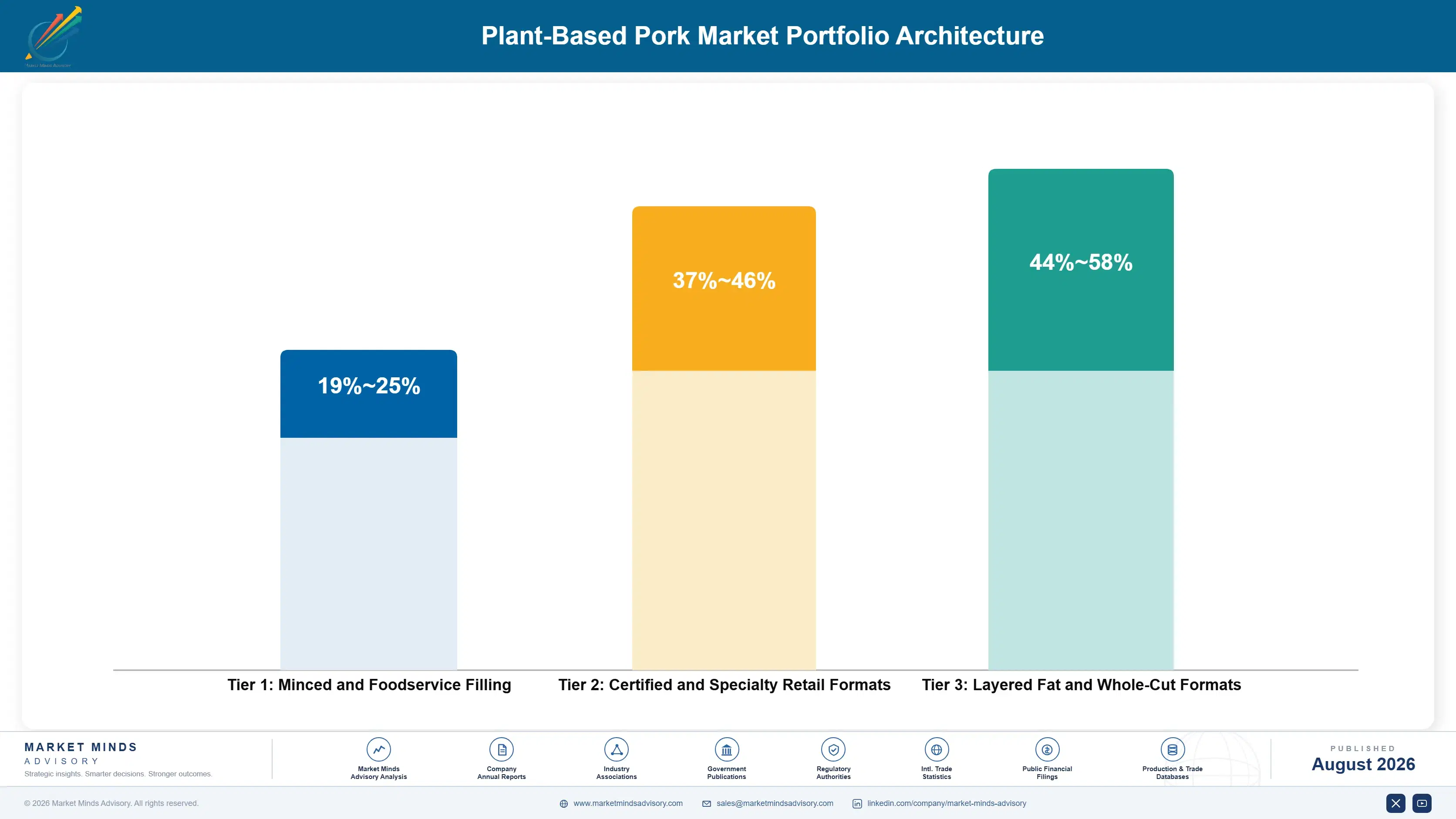
Portfolio Architecture for Margin Defence

Margin follows format difficulty in the opposite direction to what most producers assumed. Minced and filling formats are technically easy and commercially crowded, so they earn commodity-adjacent margins in the low twenties. Canned luncheon meat does considerably better, because the conventional reference product is itself expensive and shelf stability removes cold chain cost from the delivered price. Nobody planned it that way.
Premium certified formats, meaning products carrying organic, non-GMO or clean label positioning into specialty retail, hold the middle ground at margins in the high thirties to mid forties. That range is wide because certification cost varies by protein source and by jurisdiction, and because specialty retail pricing power differs sharply between Western and Asian markets. The gap is real rather than a measurement artefact. Buyers price it accordingly.

The high-value pool sits where nobody can yet reach it. Bacon and whole-cut formats would carry the best margins in the category if the technology supported them, and pilot cost still runs 2.4 times standard extrusion. Producers face a genuine allocation choice: fund a format they cannot price, or bank the canned and foodservice margins available to them now. Most are choosing wrongly.

Minced and Foodservice Filling

Bulk minced product supplied to dumpling manufacturers, ready meal producers and institutional kitchens. Competition is open and specification-driven, so the six point range reflects contract scale and protein formulation choice rather than any brand position.
Gross Margin: 19-25%

Certified and Specialty Retail Formats

Organic, non-GMO and clean label positioned products sold through specialty and premium retail. The nine point range reflects genuinely different certification costs by protein source and jurisdiction, alongside pricing power that varies sharply between Asian and Western specialty channels.
Gross Margin: 37-46%

Layered Fat and Whole-Cut Formats

Bacon, belly and whole-cut products using layered deposition or co-extrusion. The fourteen point range is a function of pilot scale economics, where line speed differences of two to three times drive unit cost more than any other single variable.
Gross Margin: 44-58%
plant-based-pork-market-trends-portfolio-architecture-1787580490289

High-value Sub-segments and Strategic Watch-out

Canned Plant Luncheon Meat

High value and high growth. Shelf stability removes cold chain cost, the conventional reference product is expensive, and texture expectation is effectively absent. Hong Kong, Philippine and Korean retail drive volume, and traditional trade distribution reaches depth that chilled formats never manage. Cold chain never enters the calculation.
Gross Margin: 41-48%

Foodservice Dumpling and Bao Filling

High value in absolute terms, moderate in margin, and growing steadily year after year. Annual contracts with dumpling manufacturers and chain kitchens deliver predictable volume insulated from retail promotion cycles. Switching costs are real because recipes enter standard operating procedures across every site. Seasonality is the main variable.
Gross Margin: 22-28%

Retail Sausage and Ground Formats

The volume core in Western markets and the most exposed to conventional pork pricing anywhere. Facings get cut within a quarter when hog prices fall below their five-year average. Growth runs below the category rate and private label competition continues to compress the available margin.
Gross Margin: 18-24%

Retail Bacon and Rasher Formats

The strategic watch-out. Development spending here has consumed capital across the industry with no commercially priceable output, and pilot cost still runs 2.4 times standard extrusion. The margin range shown assumes a technology outcome that has not yet arrived at any scale. Capital allocated here has produced very little.
Gross Margin: 26-36%

Where the Repeat Volume Sits

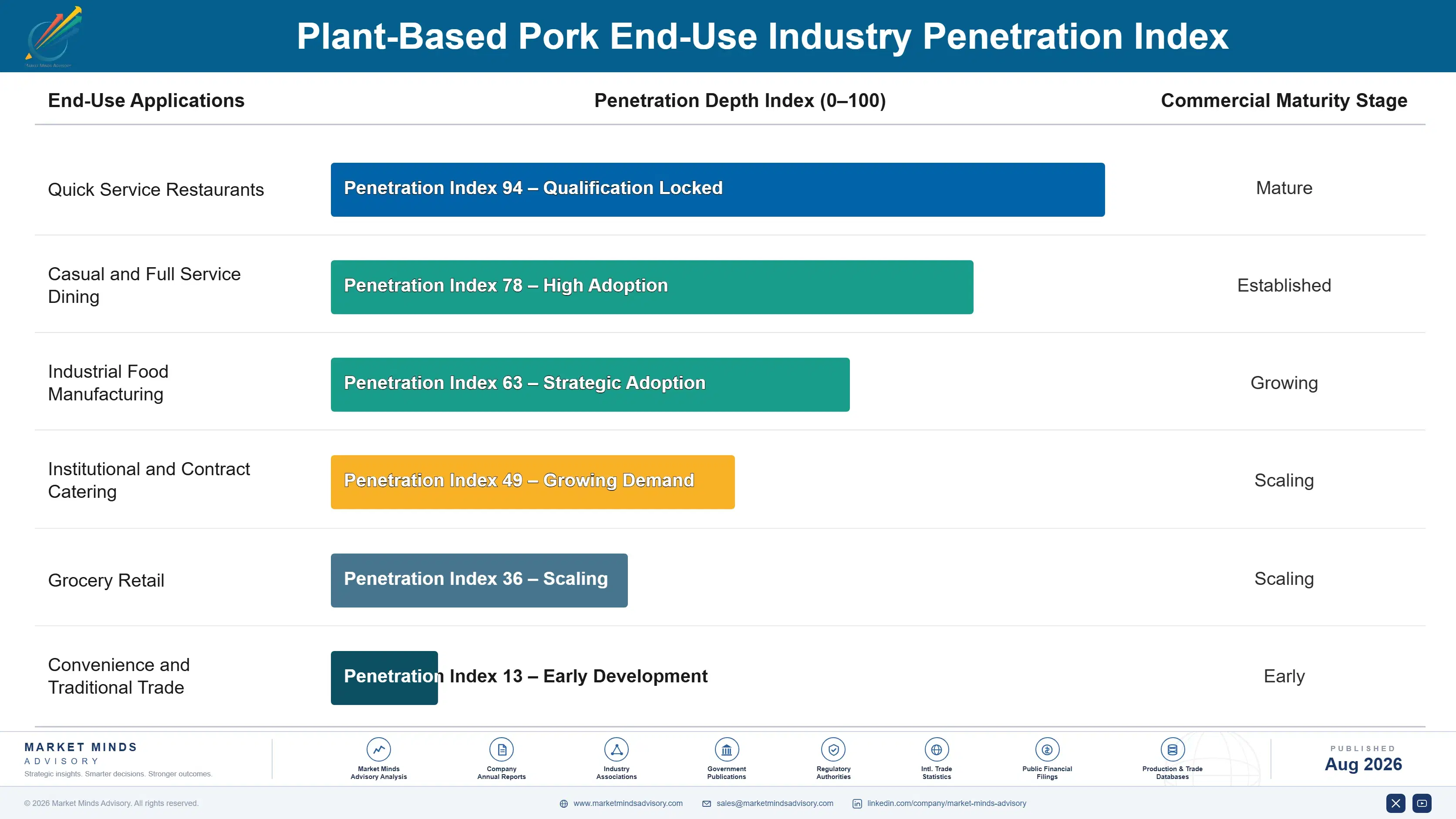
Foodservice contracts behave like annuities and retail listings do not. A dumpling manufacturer that qualifies a plant filling writes it into a production specification and reorders on a schedule, with volume varying by season rather than by promotion. Retail volume moves with facings, price gaps and shelf resets, none of which the producer controls. That explains why the surviving companies all skew heavily to foodservice.
Stickiness varies by vertical in a way that maps directly onto operational disruption. Industrial food manufacturers are stickiest, because a qualified recipe sits in a food safety document and requalification costs real money. Chain restaurants come next, since a menu item carries training and supply chain commitments across every site. Independent restaurants switch freely. Retail shoppers switch most freely of all, and roughly 38% return within the replenishment window.

Buyer profiles have shifted since 2021. The early Western consumer was ideologically motivated and price insensitive, and that cohort turned out to be far smaller than anyone modelled. The buyer who matters now is a procurement manager hedging hog price exposure, or an Asian household buying a canned product it already recognises for reasons that have nothing to do with sustainability.
plant-based-pork-market-trends-end-use-penetration-index-1787580490777

Where We Would Commit Capital

These are among the four positions where our research anticipates prominent divergence between winners and laggards over the coming forecast period. Each is grounded in the demand model, the regulatory perimeter, and the announced capacity pipeline.
01 / FORMAT PORTFOLIO DISCIPLINE

Stop funding bacon and bank the canned margin instead

Layered fat deposition remains at roughly 2.4 times standard extrusion cost, and producers who kept funding rasher development through the 2024 correction spent capital on a format they could not price at retail. Canned luncheon meat delivers margins in the low forties today with no technology risk attached to it at all. The disciplined move is a watching brief on bacon, licensing rather than building, and redeployment of that budget into the minced and canned formats where the technology already works commercially today.
02 / FOODSERVICE CONTRACT WEIGHTING

Build annual contracted volume before chasing another retail listing

Foodservice already carries 44% of category volume, and the reason is that institutional kitchens running fixed menu pricing cannot absorb a 60% swing in hog prices. Annual fixed-price contracts convert that exposure into predictable volume and remove the retail promotion cycle entirely from the revenue line. A recipe written into a kitchen's standard operating procedure is also far harder to displace than a listing, because changing it requires retraining kitchen staff across every single site in the estate, which nobody does lightly.
03 / ASIAN FORMAT LICENSING

License the working recipes rather than rediscovering them slowly

The formats that work commercially were developed in Hong Kong and mainland China, and a Western producer typically spends four to six million dollars arriving at the same answers over three years. Licensing brings the application knowledge as well as the formulation, meaning how the product behaves in a steamer or a wok, which no specification sheet ever transfers properly. Several European producers took this route after 2024 and reached commercial launch inside twelve months rather than the three years internal development would have taken.
04 / PROTEIN FORMULATION FLEXIBILITY

Qualify multiple protein bases before the next price cycle turns

Producers locked into a single protein source carried input disadvantages of several margin points through the pea capacity cycle, and some never closed that gap before Western retail contracted underneath them. Qualifying a second or third approved base costs roughly 90 thousand dollars per formulation and permits switching within a production run as relative prices move. The payback arrives inside one price swing in most years, which makes this the cheapest defensive spend available anywhere in a producer's entire formulation budget.

Engagement Snapshot From the Field

A live engagement with an industry participant carrying material or product regulatory and market exposure ahead of a defining policy shift, showing how our research translates into a defensible multi-year portfolio strategy.
MARKET MINDS ADVISORY · CLIENT ENGAGEMENT SUMMARY
Plant-Based Pork Producer Strategic Portfolio Review and Transition Roadmap 2026·Investment Scenario on Plant-Based Pork Exposure Evaluation 2025-26
CLIENT PROFILE
A Southeast Asian foodservice group operating quick service and casual dining brands across four markets, with roughly 780 outlets and annual system sales near 610 million dollars (client-reported, unverified by MMA). Pork accounted for a substantial share of protein purchasing across the portfolio, and hog price volatility had forced two menu repricings in three years, both of which damaged traffic badly in the value tiers.
STRATEGIC CHALLENGE
The group needed a protein hedge that would not read as a compromise to customers. Earlier trials of imported Western plant products had failed on both cost and sensory grounds in wok and steamer applications. Management wanted to know whether any plant pork format could hold up operationally at scale, and whether to contract supply or invest in a producer directly.
MMA APPROACH
MMA benchmarked eleven plant pork products across minced, luncheon meat and whole-cut formats in the group's own kitchens, testing cooking behaviour rather than laboratory texture profiles. Supply chain analysis covered regional extrusion capacity and protein input exposure. Interviews with 47 experts spanned formulation, foodservice procurement and conventional pork trading, with menu-level willingness to pay drawn from the quantitative survey base.
KEY FINDINGS
  1. Minced filling formats performed acceptably in steamer and wok applications, while every sausage and rasher product tested failed on operational grounds in the group's own kitchens.
  2. Annual fixed-price contracts with two regional producers would remove roughly 60% of hog price exposure on the affected menu items without any retail price increase.
  3. Canned luncheon meat outperformed all chilled formats on cost, shelf life and customer acceptance, and suited three of the group's four market positions well.
  4. Direct investment in a producer carried technology risk the group could not diligence, whereas contracted supply achieved the same hedge at a fraction of the exposure.
CLIENT PROFILE
A Southeast Asian foodservice group operating quick service and casual dining brands across four markets, with roughly 780 outlets and annual system sales near 610 million dollars (client-reported, unverified by MMA). Pork accounted for a substantial share of protein purchasing across the portfolio, and hog price volatility had forced two menu repricings in three years, both of which damaged traffic badly in the value tiers.
STRATEGIC CHALLENGE
The group needed a protein hedge that would not read as a compromise to customers. Earlier trials of imported Western plant products had failed on both cost and sensory grounds in wok and steamer applications. Management wanted to know whether any plant pork format could hold up operationally at scale, and whether to contract supply or invest in a producer directly.
MMA APPROACH
MMA benchmarked eleven plant pork products across minced, luncheon meat and whole-cut formats in the group's own kitchens, testing cooking behaviour rather than laboratory texture profiles. Supply chain analysis covered regional extrusion capacity and protein input exposure. Interviews with 47 experts spanned formulation, foodservice procurement and conventional pork trading, with menu-level willingness to pay drawn from the quantitative survey base.
KEY FINDINGS
  1. Minced filling formats performed acceptably in steamer and wok applications, while every sausage and rasher product tested failed on operational grounds in the group's own kitchens.
  2. Annual fixed-price contracts with two regional producers would remove roughly 60% of hog price exposure on the affected menu items without any retail price increase.
  3. Canned luncheon meat outperformed all chilled formats on cost, shelf life and customer acceptance, and suited three of the group's four market positions well.
  4. Direct investment in a producer carried technology risk the group could not diligence, whereas contracted supply achieved the same hedge at a fraction of the exposure.
RECOMMENDED STRATEGY
Phase 1: Phase one: contract annual fixed-price supply of minced filling from two regional producers, covering the dumpling and rice bowl items most exposed to hog price movement. Phase 2: Phase two: introduce canned luncheon meat formats into the three markets where the conventional product is already a recognised and well-established household staple. Phase 3: Phase three: hold a watching brief on layered fat formats, revisiting whole-cut applications only once pilot cost falls below 1.4 times standard extrusion.
OUTCOME
The group contracted supply from two producers during 2025 and reported protein cost variance on affected menu items falling by roughly two thirds within four quarters (client-reported, unverified by MMA). No customer-facing plant positioning was used on the minced items, and traffic in the value tiers recovered to pre-repricing levels over the same period.

Frequently Asked Questions

Foundational context covering the market sizes, CAGR, scope, country, region and competition that inform every finding below. This section is provided to cover basics and most often pre-purchase conversations, answered from the MMA Primary Research Dataset.

What is the current size of the Plant-Based Pork Market?

MMA sizes it at USD 0.62 billion in 2025, rising to USD 0.67 billion in 2026. The figure covers finished plant protein products marketed as pork substitutes across retail and foodservice.

How large will the Plant-Based Pork Market be by 2036?

USD 1.53 billion by 2036, an incremental USD 0.86 billion over the 2026 base and an expansion multiple of 2.28 times. Asian formats account for most of that addition.

What is the CAGR for the Plant-Based Pork Market 2026 to 2036?

8.6% in the base case, with a bull case at 9.8% and a bear case at 7.4%. The spread turns on layered fat technology cost and on where conventional hog prices settle.

Which segment is growing fastest?

Minced and dumpling filling formats at 12.9%, half again the market rate of 8.6%. The filling is already seasoned and hidden inside a wrapper, so texture expectation barely applies.

Who are the major companies in the Plant-Based Pork Market?

OmniFoods, Impossible Foods, Zhenmeat, Starfield Food Science and Technology and Vivera lead on shipment volume. Fifteen further participants are profiled in the full report alongside them.

Which country is growing fastest?

Vietnam at 11.6%, where pork carries the national cuisine and urban foodservice is expanding faster than domestic hog supply can follow. Foodservice drives almost all of that growth.

Report Segmentation Architecture

The full report scope spans multiple orthogonal segmentation dimensions, with cross-tabulated demand data provided for each dimension pair. Coverage extends further to regional breakdowns, trend trajectories, and the competitive detail needed to support segment-level decision-making.

By Product Format

  • Minced and Dumpling Filling Formats
  • Luncheon Meat and Canned Formats
  • Sausage and Frankfurter Formats
  • Bacon and Streaky Formats
  • Whole-Cut Analogue Formats
  • Ground Patty and Meatball Formats

By End-Use Industry

  • Quick Service Restaurants
  • Casual and Full Service Dining
  • Industrial Food Manufacturing
  • Institutional and Contract Catering
  • Grocery Retail
  • Convenience and Traditional Trade

By Commercial Dimension

  • Branded Retail
  • Private Label Supply
  • Foodservice Contract Supply
  • Industrial Ingredient Supply
  • Export and Distributor Sales
  • Direct-to-Consumer Channels

By Region

  • North America
  • Western Europe
  • East Asia
  • South Asia and Pacific
  • Latin America
  • Middle East and Africa
  • Eastern Europe

Scope, Methodology, and Coverage

Every figure in this report is reproducible from documented input assumptions. The scope below maps the historical period, the forecast horizon, the segmentation dimensions, and the countries covered, alongside the underlying primary and qualitative methodology.
Historical Period
2020 to 2025
Forecast Period
2026 to 2036
Base Year
2025 (USD billions; MMA Primary Research Dataset, August 2026)
Market Definition
Finished plant protein products formulated and marketed as pork substitutes, spanning minced and filling formats, luncheon meat and canned products, sausage, bacon, whole-cut analogues and ground patties, sold through retail and foodservice channels. Cultivated pork, generic tofu and tempeh, mycoprotein products not positioned against pork, and plant proteins sold as bulk ingredients are excluded. Value is measured at manufacturer selling price.
Quantitative Units
USD billions (current prices); thousand tonnes shipped; USD per kilogramme by format and channel
Segmentation Dimensions
Product format; end-use industry; commercial dimension; region
Regions Covered
North America, Western Europe, East Asia, South Asia and Pacific, Latin America, Middle East and Africa, Eastern Europe
Countries Covered
United States, Canada, Germany, Netherlands, United Kingdom, France, Spain, China, Japan, South Korea, Hong Kong, Vietnam, Philippines, Thailand, Australia, Brazil, Mexico, Israel, South Africa, Poland
Key Companies Profiled
OmniFoods, Impossible Foods, Zhenmeat, Starfield Food Science and Technology, Vivera, Beyond Meat, THIS, Heura Foods, Rügenwalder Mühle, Garden Gourmet, Quorn Foods, Hey Maet, Whole Perfect Food, Qishan Foods, Otsuka Foods, Fuji Oil Holdings, Amy's Kitchen, Upton's Naturals, La Vie, Prime Roots
Quantitative Methodology
Primary survey, n=3,800 respondents, Q4 2025, six countries; demand-side model with trade association cross-validation
Qualitative Methodology
47 expert interviews, Q4 2025; applied to validate demand model assumptions, identify emerging dynamics, and assess competitive positioning
Report Format
PDF and XLSX data workbook (Word format preview document)
Publisher
Market Minds Advisory
Report Code
MMA-2026-AGR-176
Published
August 2026
Contact
sales@marketmindsadvisory.com | www.marketmindsadvisory.com

Purchase the full Plant-Based Pork Market Report (2026 to 2036).

The full report sizes each pork format separately through 2036 and explains why the sensory gap varies so sharply between them. It models layered fat deposition cost against standard extrusion, tracks foodservice contract penetration by market, and quantifies how plant volumes respond to conventional hog price movement. Regional chapters cover all seven regions, with particular depth on Chinese, Vietnamese and Philippine channel structures. Competitive profiling covers 20 participants on a single shipment volume basis, alongside protein input cost exposure by formulation choice and by producer geography.
Format-level sizing across six pork product categories
Layered fat deposition cost modelled against extrusion
Foodservice contract penetration tracked by market
Hog price elasticity quantified for plant volumes
Twenty participants profiled on one consistent basis
Protein input exposure mapped by formulation choice

Built For The People Who Decide

From boardroom strategy to bench-side execution, this report is read cover-to-cover by leaders shaping the next decade of their industry, turning demand scenarios, market dynamics and valuation benchmarks into decisions.
CXOs/ Presidents/ VPs/ Managers
M&A and Corporate Development
Strategy Teams and R&D Heads
Procurement and Product Directors
Regulatory and Compliance Leaders
Investor Relations and Equity Analysts