Market Minds Advisory
Plant-Based Fiber Market

Plant-Based Fiber Market: Clean-Label Reformulation and Regional Demand to 2036

Gut-health marketing and clean-label reformulation are pushing food manufacturers toward pea, chicory, and psyllium fiber blends as sugar reduction mandates spread, while inconsistent chicory and psyllium harvests test how ingredient suppliers manage sourcing risk.

Lead Analyst

Lisa Gevelber

Published

September 2026

Make Smarter Decisions with Customized Research Insights

Request a free sample report and evaluate market opportunities, growth trends, and competitive dynamics relevant to your business needs.

2025 MARKET VALUE$6.8BMarket Size 2025
2036 FORECAST VALUE$14.9BBase Case , 2026 to 2036
CAGR 2026 TO 20367.4 %Bull 8.7% / Bear 6.1%
INCREMENTAL OPPORTUNITY$7.6BNet 10- year value creation
EXPANSION MULTIPLE2.04x2036 value over 2026 base
Strategic Levers
M&A Pipeline
Regional Outlook
Country Rankings
Competitive Intelligence
Segmental Deep-dive
Call-Us : 91 93563 13602

Executive Snapshot and Market Trajectory

Plant-based fiber sourcing has moved from a niche functional food additive into a mainstream reformulation tool, as manufacturers facing sugar and calorie reduction mandates increasingly specify pea, chicory, and psyllium fiber blends over synthetic bulking agents across bakery, beverage, and dietary supplement product categories worldwide.
Pea and legume fiber is growing fastest as clean-label food manufacturers seek plant-derived bulking agents that pair naturally with rising plant protein demand, pulling volume toward premium legume-derived formulations over conventional chicory-based inulin. Western Europe's deep-rooted chicory root processing industry, concentrated in Belgium and France, absorbs and supplies the largest share of global plant-based fiber demand, even as North American ingredient formulators retain the deepest expertise in fiber blending and clean-label reformulation.
Competition sits between diversified fiber ingredient majors offering broad portfolios across multiple fiber source categories and specialty processors competing on single-source expertise and clean-label certification depth. Rising sugar and calorie reduction mandates across major food markets are accelerating fiber fortification adoption well beyond traditional dietary supplement applications, while inconsistent chicory and psyllium harvest yields periodically disrupt raw material supply and push formulators toward diversified sourcing across multiple regions.
Market Definition
Plant-based fiber ingredients are dietary fiber products derived from chicory root, peas, psyllium husk, citrus, oats, and other plant sources, used to fortify food, beverage, and supplement products with soluble or insoluble fiber content. The market excludes synthetic fiber additives and whole-food products sold without fiber-specific ingredient extraction or processing.
Base Year Value
$6.8B in 2025 (MMA Primary Research Dataset, August 2026)
Forecast Period
2026 to 2036, eleven discrete annual values
CAGR
7.4% base case. Bull 8.7%. Bear 6.1%.
Fastest Growth Segment
Pea and Legume Fiber: 10.2% CAGR
Fastest Growth Country
India: 9.8% CAGR
Fastest Growth Region
South Asia and Pacific: 9.4% CAGR
Largest Region
North America: 26% of 2025 global value
Market Leaders
Beneo GmbH, Cosucra Groupe Warcoing, Tate & Lyle PLC, Ingredion Incorporated, and Archer Daniels Midland lead the field. Source: MMA Analysis based on company annual reports.
Primary Survey
n=3,800 procurement and R&D decision-makers, Q4 2025, six countries
Methodology
Demand-side build-up, cross-validated against public data, 47 expert interviews

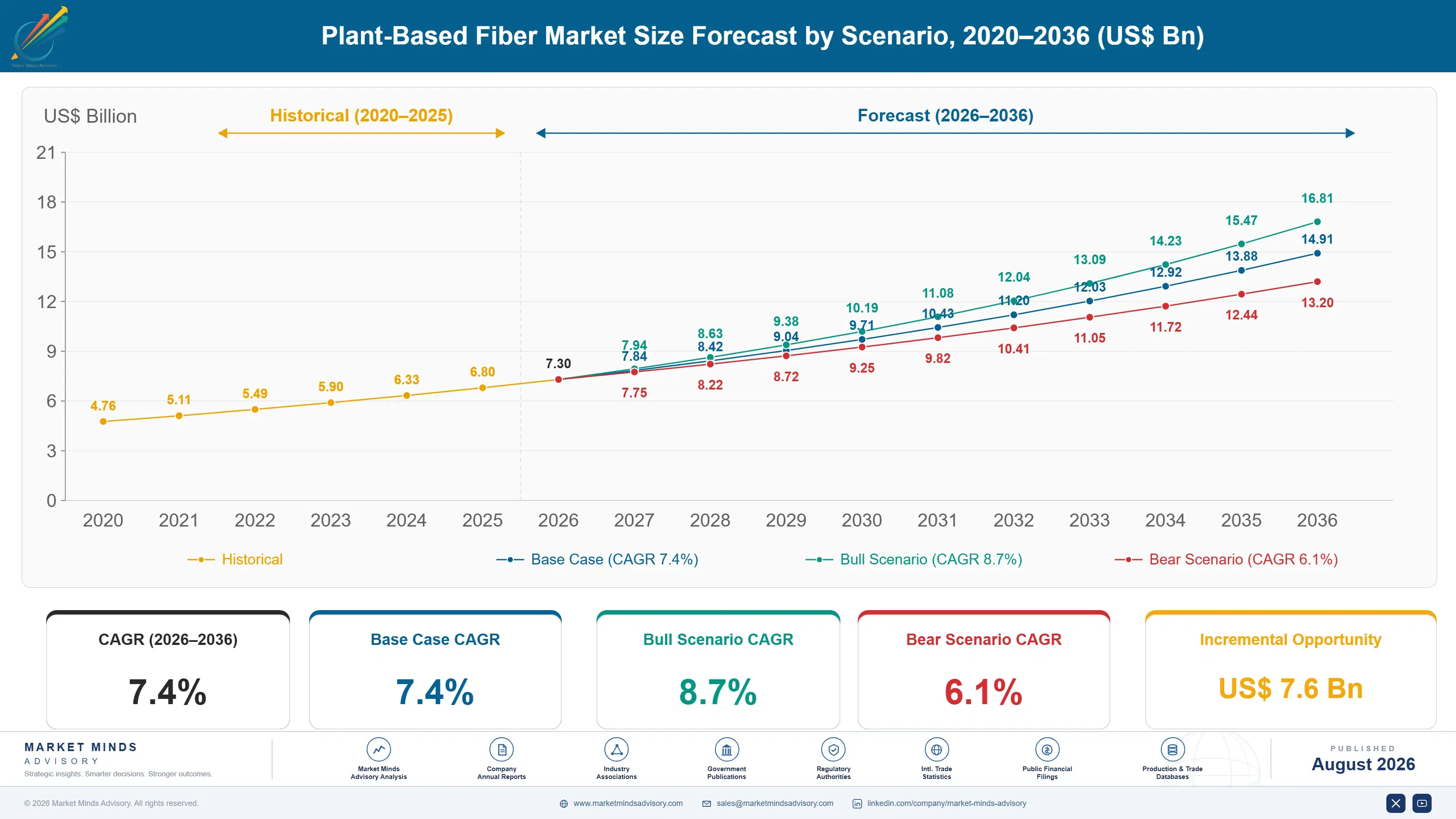
Plant-Based Fiber Market Forecast Scenarios

plant-based-fiber-market-trends-size-forecast-scenario-1787581249727
Between 2020 and 2025 plant-based fiber demand grew at roughly 6.5 percent a year, held back early by pandemic-era food manufacturing disruption before accelerating as sugar and calorie reduction mandates spread across major markets and clean-label reformulation trends broadened fiber adoption beyond dietary supplement applications. Chicory and psyllium harvest volatility during 2022 pushed raw material prices higher, temporarily compressing formulator margins across the industry.
The base case assumes continued growth as three mechanisms compound: food manufacturers reformulating products to meet sugar and calorie reduction mandates across major consuming markets, requiring fiber-based bulking agents that maintain texture and mouthfeel while reducing sugar content; rising consumer interest in digestive and gut health driving fiber fortification across mainstream food and beverage categories beyond specialty supplement channels; and plant protein manufacturers increasingly pairing pea and legume fiber with protein ingredients in combined formulations.
The bull case turns on faster-than-expected sugar reduction mandate adoption across additional major food markets following World Health Organization guidance. The bear case centers on a sustained chicory or psyllium harvest shortfall, which has historically compressed raw material supply and pushed formulator costs sharply higher, a pattern last seen during the 2022 harvest disruption across several producing regions.

Sugar Reduction Mandates and Clean-Label Reformulation Economics

Plant-based fiber sits at the intersection of food reformulation policy, rising consumer gut-health awareness, and agricultural raw material supply economics. As regulators and retailers push sugar and calorie reduction, formulators increasingly compete on documented fiber functionality and clean-label sourcing rather than base fiber content alone, even where premium legume-derived fiber carries a meaningful price premium over conventional chicory-based inulin.
MARKET CONCENTRATIONCR5: 38%Ownership concentrates among a handful of established formulators
AVERAGE SELLING PRICE$3,200 per tonnePricing varies sharply by fiber source and purity grade
CAPACITY UTILISATION73%Processing plants run moderately below full rated capacity
TOP PRODUCER SHARETop 3 countries: 59%Manufacturing concentrates near major global chicory growing regions
TRADE INTENSITY46% cross-borderFinished fiber ingredients ship globally to formulation customers
SUGAR REDUCTION SHARE34% of volumeReformulation-driven demand now exceeds a third of shipments
Commercially the category splits between diversified fiber ingredient majors offering broad portfolios across multiple fiber source categories and specialty processors competing on single-source expertise and application-specific formulation support. Diversified majors compete on manufacturing scale and breadth across fiber types, while specialty processors win on deep technical expertise in specific fiber sources, since bakery, beverage, and supplement applications each demand distinct fiber functionality and processing characteristics.
The next decade will be shaped by continued sugar and calorie reduction mandate expansion, rising demand for pea and legume fiber paired with plant protein trends, and diversification of raw material sourcing beyond traditional chicory-growing regions facing periodic harvest volatility. Formulators that can pair documented fiber functionality with diversified, resilient sourcing stand to capture share from competitors still selling single-source fiber without comparable supply resilience.
"Fiber used to be the ingredient nobody thought about on the label; now it's the reason a reformulated product can carry a lower-sugar claim at all, and that regulatory tailwind is what's actually driving procurement volume."
Director, Functional Food Ingredients Practice · MMA Agriculture and Food Ingredients Practice · August 2026

Market Trends

Sugar Reduction Mandates Accelerate Fiber Reformulation Demand

Food manufacturers across major consuming markets are increasingly reformulating products to meet sugar and calorie reduction mandates, specifying fiber-based bulking agents that maintain texture and mouthfeel while reducing overall sugar content in bakery, beverage, and confectionery applications. Reformulation requires extensive product testing to match the functional properties of sugar being replaced, a process that can take six to twelve months per product line given texture and shelf-life validation requirements. Formulators with established reformulation expertise and documented functional performance data are capturing share from smaller regional suppliers unable to invest in the extensive testing infrastructure the transition requires.
Market Impact: Adds 6 percent volume from mandates

Pea Fiber And Protein Pairing Drives Combined Formulation Demand

Plant protein product manufacturers are increasingly pairing pea and legume fiber with plant protein ingredients in combined formulations, since both ingredients derive from the same crop processing streams and share consumer appeal around clean-label, plant-based positioning across health-conscious retail categories. This pairing trend benefits pea fiber suppliers with established relationships to pea protein processors, since combined ingredient sourcing simplifies procurement for formulators developing new plant-based product lines. Several major ingredient suppliers have introduced combined pea protein and fiber product lines specifically engineered for simplified formulation, and suppliers with proven combined sourcing capability are winning contracts faster than single-ingredient specialists.
Market Impact: Adds 5 percent gut health volume

Market Opportunities and Growth Drivers

Global Sugar And Calorie Reduction Policy Expansion

Governments across major consuming markets continue expanding sugar and calorie reduction policy, including sugar taxes and mandatory reformulation targets, following World Health Organization guidance aimed at reducing diet-related chronic disease prevalence at national population scale. Every reformulated product requires a functional fiber-based bulking agent to replace the texture and mouthfeel sugar previously provided, creating sustained, policy-driven demand for fiber ingredients across bakery, beverage, and confectionery categories. Suppliers that secure reformulation partnerships with major manufacturers gain multi-year volume visibility uncommon in most specialty categories, since reformulated products rarely revert to prior sugar-based formulations once launched.
Market Impact: Adds up to 20 percent cost

Rising Consumer Gut Health Awareness Drives Fortification Demand

Consumer interest in digestive and gut health continues rising across major developed markets, driven by growing awareness of the gut microbiome's broader health role, and fiber fortification increasingly extends beyond specialty supplement channels into mainstream food and beverage categories targeting general health-conscious consumers. Retailers increasingly dedicate shelf space specifically to high-fiber product claims, supporting incremental category growth beyond what reformulation mandates alone would drive across most major grocery retail channels. Suppliers serving this segment increasingly invest in documented digestive health research that smaller regional suppliers rarely develop given the substantial clinical research cost involved.
Market Impact: Requires 6 to 12 months testing

Market Restraints and Challenges

Chicory And Psyllium Harvest Volatility Compresses Margins

Chicory root and psyllium husk supply depends directly on harvest volume and quality across concentrated growing regions in Belgium, France, and India, and weather-driven yield fluctuations can meaningfully constrain raw material availability with limited ability to substitute alternative fiber sources quickly given distinct functional properties across fiber types. Root causes include chicory's sensitivity to weather extremes and psyllium's concentrated cultivation in specific Indian growing regions vulnerable to monsoon variability. When supply tightens, formulators absorb higher costs or pass them through, compressing demand during shortage periods. Larger formulators mitigate exposure through multi-region sourcing agreements.
Market Impact: Shifts 14 percent volume to reformulation

Reformulation Testing Costs Slow New Product Timelines

Food manufacturers require extensive product testing, including texture, sweetness, and shelf-life validation, before approving a fiber-based reformulation for production use, a process that can take six to twelve months and substantial upfront investment with no guaranteed successful outcome across every product line attempted. The root cause is that manufacturers bear significant brand and consumer acceptance risk if a reformulated product fails to match prior taste and texture expectations, making them cautious about rushing reformulation timelines across their broader product portfolios. Suppliers are addressing the barrier by offering dedicated formulation support and pre-validated fiber blend systems.
Market Impact: Adds 11 percent volume from pairing
3 additional market trends, 4 additional growth drivers, and 3 additional restraints and challenges are covered in the full report. Contact sales@marketmindsadvisory.com to access the complete intelligence.

Segment CAGR and Growth Architecture

Plant-based fiber segments most usefully by source type, since chicory, pea, psyllium, citrus, and oat-derived fibers carry distinct functional properties, processing requirements, and application relevance. This framework mirrors how suppliers organise processing and formulation teams and how food manufacturers specify fiber requirements across different demanding reformulation applications and product development programmes. That structure guides research investment.
plant-based-fiber-market-trends-market-share-analysis-1787581250276

Pea and Legume Fiber

Pea and legume fiber is the fastest-growing segment as clean-label food manufacturers seek plant-derived bulking agents that pair naturally with rising plant protein demand across health-conscious retail categories. Pea fiber's clean-label positioning and functional versatility across bakery, beverage, and meat alternative applications give it broad formulation appeal beyond traditional chicory-based inulin. Growth concentrates among suppliers with established relationships to pea protein processors, since combined sourcing simplifies procurement for formulators developing new plant-based product lines requiring both protein and fiber ingredients. Growth is fastest in North America and Western Europe, where plant-based food innovation is most developed and manufacturers increasingly specify pea-derived ingredients across both fiber and protein applications simultaneously within combined product formulations.
CAGR 10.2%

Psyllium Husk Fiber

Psyllium husk fiber forms the second-fastest-growing segment, benefiting from rising demand in digestive health supplement applications and growing use in low-carbohydrate and keto-style baking formulations where psyllium's binding properties replace gluten structure. India's dominant position as the primary global psyllium growing and processing region supports substantial export volume to formulators worldwide. Growth is fastest in North America, where low-carbohydrate dietary trends and digestive health supplement demand continue expanding faster than most other fiber categories, and formulators increasingly specify psyllium for its documented functional performance in both baking structure and digestive health applications across diverse product categories. Established suppliers with proven Indian grower relationships hold a durable advantage as this segment expands across supplement and specialty baking applications.
CAGR 8.8%
Full segment breakdown across 6 segments available in the complete report.

Regional Architecture and Country Demand Map

Plant-based fiber demand concentrates where food reformulation activity and chicory processing infrastructure are most developed. North America's mature functional food formulation base and Western Europe's dominant chicory processing industry together account for the largest shares of global demand, while South Asia's psyllium production concentration supports an elevated regional demand base.

North America

The United States food and beverage manufacturing sector, among the most active globally in sugar and calorie reduction reformulation, drives substantial demand for fiber-based bulking agents across bakery, beverage, and confectionery product categories. Dietary supplement manufacturers add further steady demand for digestive health-positioned fiber ingredients including psyllium and inulin across the region's large nutraceutical retail sector. Canada's food processing sector, closely integrated with United States supply chains, contributes meaningful additional regional demand. Growth is supported by continued reformulation activity and rising plant protein and fiber pairing trends across the region's expanding plant-based food category. Retail category managers continue expanding dedicated shelf space to serve this steadily growing demand base across the region.
Share: 26% | CAGR: 8.0% (2026 to 2036)

Western Europe

Belgium and France's chicory root processing industry, among the most established fiber production bases globally, supplies both substantial domestic demand and significant export volume to formulators worldwide, reflecting decades of accumulated processing and purification expertise concentrated in this specific growing region. Germany's food manufacturing sector contributes substantial additional demand tied to reformulation activity across its large consumer packaged goods industry. The United Kingdom's sugar tax policy has directly accelerated regional fiber-based reformulation demand since its implementation. Growth trails the fastest-growing regions because the region's reformulation transition is comparatively advanced already, with further gains depending on incremental formulation upgrades. Regional demand growth trails the fastest-expanding South Asian and North American markets by a meaningful margin overall.
Share: 22% | CAGR: 5.9% (2026 to 2036)
Regional intelligence for 5 additional markets available in the complete report: East Asia, South Asia and Pacific, Latin America, Middle East and Africa, Eastern Europe. Contact sales@marketmindsadvisory.com.
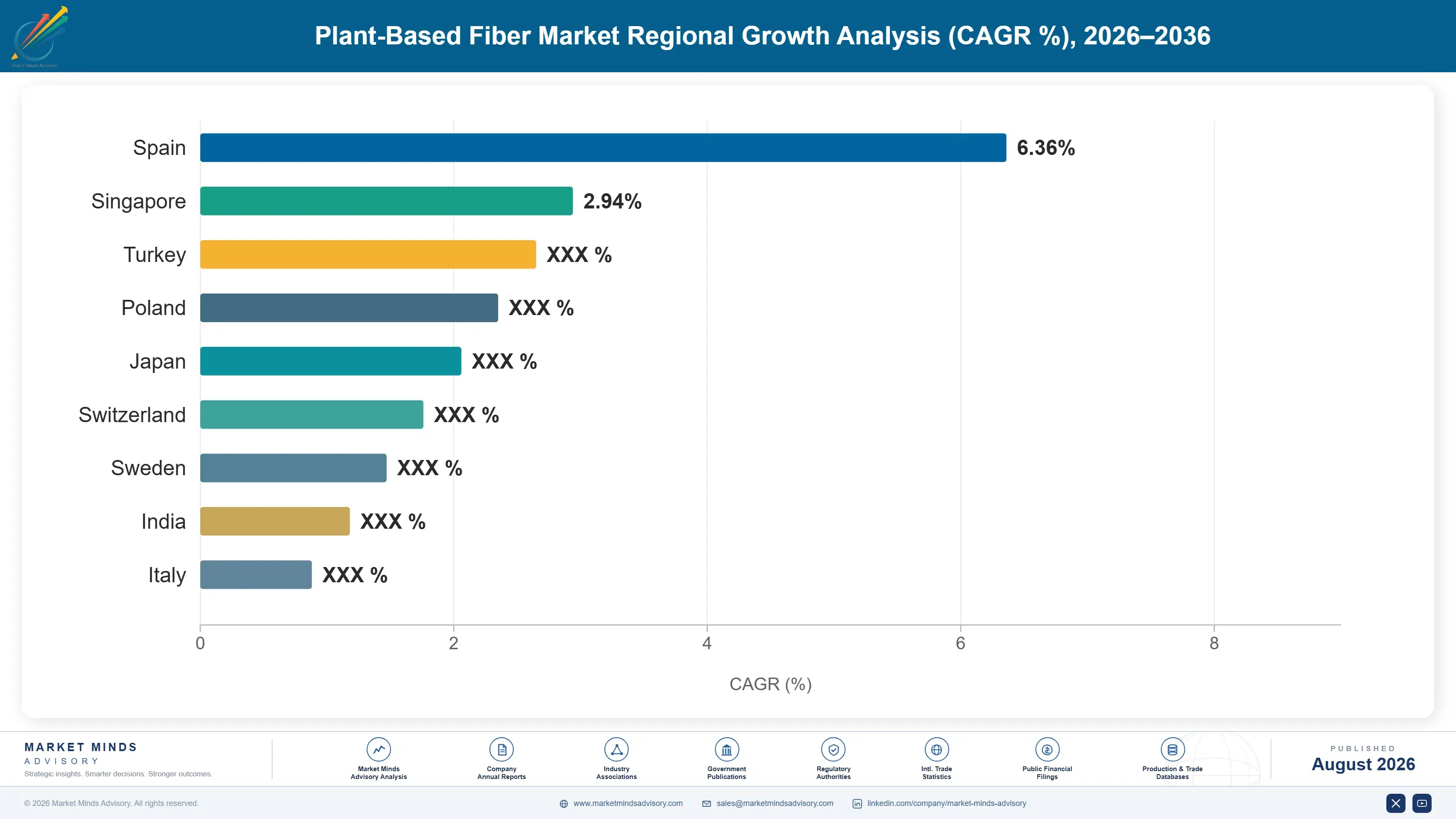
plant-based-fiber-market-trends-country-cagr-analysis-1787581250800

Reformulation Partnership and Combined Ingredient Bundling

Suppliers can grow revenue per tonne even where commodity fiber volume growth is modest by securing multi-year reformulation partnerships with major food manufacturers, bundling pea fiber with protein ingredients for combined product development, and diversifying raw material sourcing across multiple fiber source types. The most durable gains come from capturing policy-driven reformulation demand rather than commodity fiber price competition.

Securing Multi-Year Reformulation Partnerships With Manufacturers

Suppliers winning multi-year reformulation partnerships with major food manufacturers secure volume commitments that provide revenue visibility uncommon in most specialty ingredient categories, since manufacturers rarely revert to prior sugar-based formulations once a reformulated product launches successfully in retail distribution. These partnerships also create durable switching barriers, since manufacturers face real reformulation and testing cost changing suppliers mid-product-line. Suppliers with established reformulation partnerships report contract renewal rates roughly 3 times higher than spot-market commodity fiber sales. This durability compounds across successive reformulation cycles as manufacturers expand fiber use into additional product lines over time.
Market Impact: Lifts contract renewal rate roughly 3 times higher

Bundling Pea Fiber With Protein Ingredients For Formulators

Suppliers offering combined pea fiber and pea protein product lines are capturing revenue that previously went to separate ingredient suppliers, simplifying procurement for formulators developing new plant-based product lines that require both ingredients from compatible processing streams. This bundled approach commands meaningfully higher margins than single-ingredient fiber sales alone, and formulators increasingly prefer suppliers who can guarantee compatible sourcing and formulation support rather than managing separate protein and fiber supplier relationships, worth an estimated 18 percent higher combined contract value than separate ingredient purchasing. Formulators increasingly value this coordinated sourcing simplicity across their broader plant-based product development pipelines.
Market Impact: Lifts combined contract value roughly 18 percent higher

Diversifying Raw Material Sourcing Across Multiple Regions

Suppliers signing sourcing agreements spanning Belgium, France, and India simultaneously rather than relying on a single producing region secure meaningfully more stable raw material availability than competitors dependent on single-origin supply during periodic harvest disruptions. This diversification requires establishing grower and processor relationships across multiple countries with different agricultural practices, a substantial coordination investment most smaller suppliers cannot easily replicate. Suppliers with diversified sourcing report supply disruption exposure roughly 35 percent lower than single-origin competitors, reflecting the resilience diversified sourcing provides during regional harvest volatility. Reliability improves accordingly across multiple growing seasons and regional harvest cycles.
Market Impact: Cuts supply disruption risk roughly 35 percent overall

Offering Dedicated Reformulation Technical Support Services

Suppliers offering dedicated formulation technical support alongside fiber ingredient sales, including texture matching and shelf-life validation guidance, are capturing revenue that previously went to separate formulation consultants, simplifying product development for manufacturers undertaking sugar reduction reformulation for the first time. This bundled technical support commands meaningfully higher margins than raw ingredient sales alone, and manufacturers increasingly prefer suppliers who can guarantee formulation performance rather than managing separate ingredient and consulting relationships, reducing reformulation risk by roughly 20 percent across new product launches on average. Manufacturers increasingly value this coordinated approach.
Market Impact: Lifts bundled contract value roughly 20 percent higher

Who Controls the Margin Pool

The plant-based fiber market is moderately concentrated, with an estimated CR5 near 38 percent, reflecting a category where reformulation partnership depth and raw material sourcing relationships matter as much as manufacturing scale. Beneo and Tate & Lyle lead on combined portfolio breadth and reformulation partnership depth, but the gap to specialty regional processors is narrower on commodity fiber supply than on premium reformulation-grade ingredients.
Competitive activity centers on three fronts: reformulation partnership development aimed at capturing sugar and calorie reduction mandate demand, pea fiber and protein bundling to serve expanding plant-based product development, and raw material sourcing diversification across multiple producing regions to reduce single-origin harvest risk. Acquisitions of specialty regional processors with established grower relationships have picked up as global players seek diversified sourcing presence.

Emerging pressure comes from Indian and Chinese processors rapidly closing the formulation and quality gap on commodity fiber supply, threatening established European and American specialty makers on price in cost-sensitive reformulation segments. Integrated agricultural processors are also pushing further downstream into finished fiber ingredient production, threatening to disintermediate specialty formulators who purchase raw material externally. Rankings could shift meaningfully if an Asian processor achieves reformulation partnership scale comparable to established Western suppliers.
plant-based-fiber-market-trends-company-positioning-matrix-1787581251318

Competitive Moat and Risk Dimensions

BENEO GMBH

Moat: Integrated Chicory Sourcing And Scale

Beneo's direct ownership stakes in chicory root growing and processing operations give it cost stability and supply reliability that smaller regional processors cannot easily match, particularly during raw material price spikes when open-market chicory becomes scarce. That integrated position lets Beneo serve large multinational food manufacturers requiring consistent global supply across multiple reformulation product categories simultaneously.
BENEO GMBH

Risk: Exposure To Chicory Harvest Concentration

Beneo's heavy reliance on Belgian and French chicory cultivation leaves it more exposed to region-specific weather disruptions than competitors with more geographically diversified fiber sourcing across multiple crop types and growing regions. This has occasionally cost the company supply reliability during regional disruptions where diversified competitors maintained steadier continuity for customers.
TATE & LYLE PLC

Moat: Deep Reformulation Partnership Relationships

Tate & Lyle's long-standing focus on sugar reduction and reformulation support gives it deep customer partnership relationships that are difficult for new entrants to replicate, since manufacturers rarely switch partners once a formulation is validated. That partnership depth supports durable, high-margin revenue from customers unlikely to switch suppliers absent a serious failure.
TATE & LYLE PLC

Risk: Limited Commodity Scale

Tate & Lyle's specialty reformulation focus leaves it comparatively less competitive on price for large-volume commodity fiber applications, where scale processors with lower-cost production can win purely on delivered price. Customers seeking a single supplier across both specialty and commodity-grade requirements sometimes choose broader competitors over Tate & Lyle's more narrowly focused, if deeply qualified, premium reformulation offering.

Players Tracked

Prominent Players

Beneo GmbH
Cosucra Groupe Warcoing
Tate & Lyle PLC
Ingredion Incorporated
Archer Daniels Midland

Other Key Players

Roquette Frères
Kerry Group
Cargill
Sensus
Emsland Group
J. Rettenmaier & Söhne
Nutriati
AIDP Inc
Fiberstar Inc
Grain Processing Corporation
Batory Foods
DSM-Firmenich
Herbafood Ingredients GmbH
CP Kelco
Farbest Brands

Recent Developments

MARCH 2026

Beneo Expands Chicory Fiber Production Capacity In Belgium

Beneo announced expanded chicory root fiber production capacity at a facility in Belgium, aimed at directly serving growing global sugar reduction reformulation demand from established processing infrastructure, reducing lead times for European and North American food manufacturer customers significantly compared with previous production constraints. Local production also shortens delivery timelines.
Signal: Signals established chicory processors prioritising capacity investment over continued raw material export volume alone. ahead of smaller regional rivals.
SEPTEMBER 2025

Tate & Lyle Launches Combined Reformulation Technical Support Platform

Tate & Lyle introduced a comprehensive reformulation technical support platform bundled with fiber ingredient sales, providing documented texture matching and shelf-life validation guidance increasingly demanded by food manufacturers undertaking sugar reduction reformulation projects across multiple product categories simultaneously. The launch follows growing customer demand for coordinated reformulation support.
Signal: Confirms technical support bundling is becoming a standard competitive requirement among major fiber ingredient suppliers. across the broader ingredient industry.
JANUARY 2026

Ingredion Announces Combined Pea Protein And Fiber Product Line

Ingredion announced a new combined pea protein and fiber product line specifically engineered for simplified plant-based product formulation, targeting manufacturers developing new plant-based food and beverage products requiring both ingredients from compatible processing streams and supply relationships. The launch follows rising customer demand for simplified plant-based sourcing.
Signal: Marks growing supplier interest in combined ingredient bundling as plant-based product development accelerates. across the specialty ingredient category.

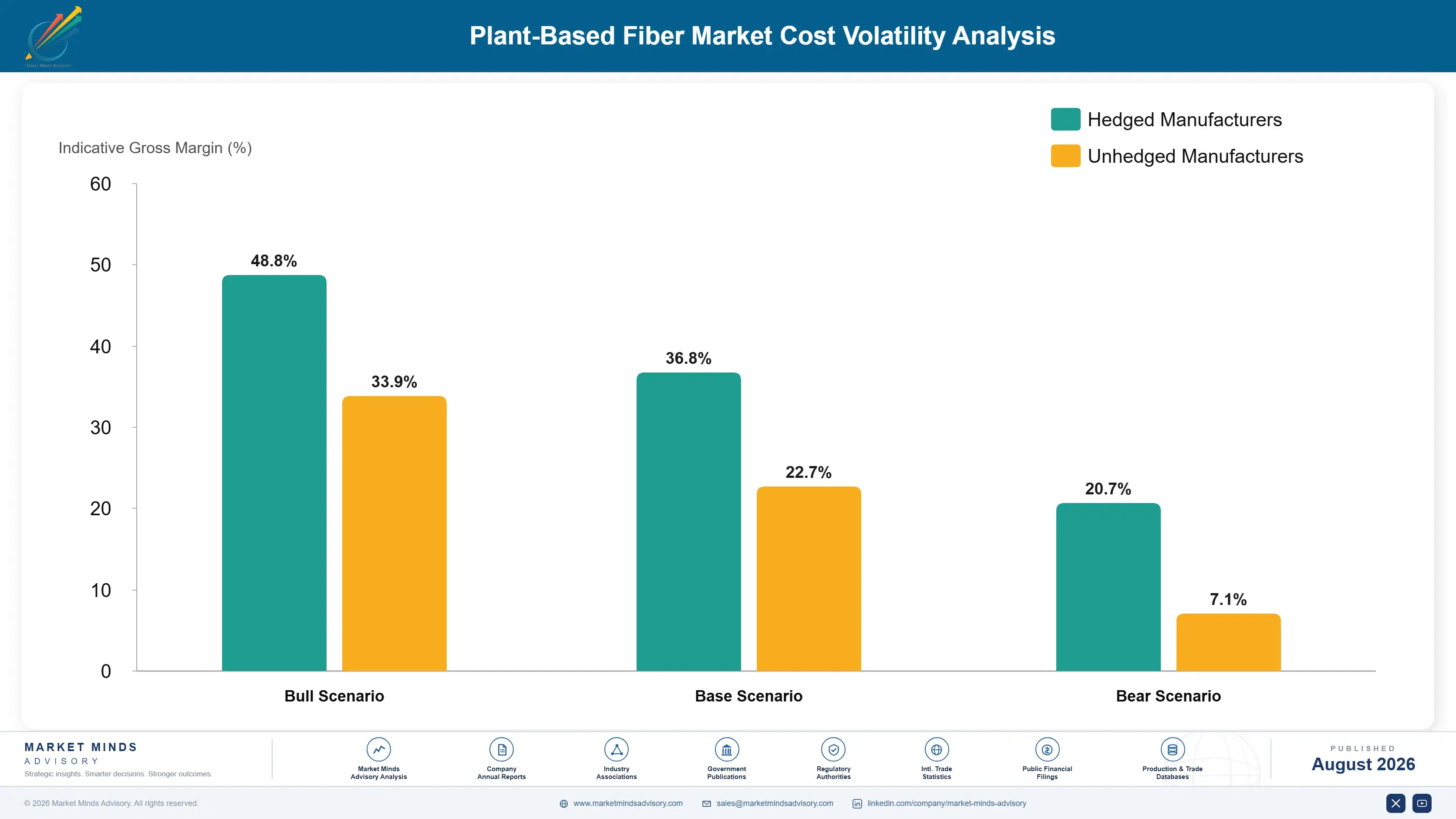
Chicory And Psyllium Raw Material Exposure

Raw chicory root and psyllium husk procurement accounts for roughly 46 percent of cost of goods sold across most plant-based fiber processing, with purification, processing, and quality testing costs making up most of the remainder. Raw material sourcing concentrates heavily in Belgium, France, and India, tying production costs directly to concentrated agricultural growing region conditions rather than broader industrial commodity markets.
Adverse weather affecting chicory harvests across Belgium and France during 2022 pushed raw material prices up by more than 25 percent within several months, according to European Commission agricultural market reporting on chicory and specialty crop production, forcing formulators with contracts signed before the spike to absorb significant margin compression. Formulators without diversified sourcing agreements faced the sharpest impact, and several smaller regional processors reported delayed deliveries while sourcing alternative fiber supply at workable prices.

Exposure varies sharply by player type: larger integrated processors like Beneo, with direct grower relationships and diversified regional sourcing, weather harvest disruptions with meaningfully less margin impact than smaller processors reliant on open-market spot purchases. Geographic exposure also differs, since processors sourcing from European chicory chains face different risk timing than those dependent on Indian psyllium production.
plant-based-fiber-market-trends-cost-volatility-analysis-1787581251516

Diversifying Raw Material Sourcing Across Multiple Regions

Processors are increasingly qualifying grower relationships across Belgium, France, and India simultaneously rather than relying on a single producing region, so a weather disruption in one area does not halt production entirely. This diversification raises logistics and quality coordination complexity modestly but significantly reduces the risk of the sharp, single-origin price spikes that hit under-diversified processors hardest during recent volatility.

Securing Multi-Year Forward Purchasing Agreements With Growers

Processors are increasingly signing multi-year forward purchasing agreements directly with chicory and psyllium growers, securing guaranteed allocation ahead of the open market and capturing pricing stability that smaller processors reliant on spot purchases cannot access. This approach requires committed volume most smaller processors cannot guarantee, reinforcing a cost and availability advantage for larger, established processors.

Backward Integration Into Chicory Growing And Processing

The largest fiber processors are pursuing direct ownership stakes in chicory growing and processing operations, securing supply ahead of the open market and capturing margin that would otherwise go to independent growers and intermediaries. This approach requires capital most smaller processors lack, reinforcing a durable cost advantage for scale players during periods of raw material scarcity.

Portfolio Architecture for Margin Defence

Plant-based fiber organises into three commercial tiers running from standard commodity fiber supply through certified reformulation-grade ingredients to next-generation combined protein-fiber and clinically validated specialty products. Gross margins widen sharply moving up the tiers, since commodity fiber competes largely on raw material cost and delivery price, while reformulation-grade and combined products capture value from documented functional performance, formulation support, and application-specific engineering rather than raw material cost alone.
The tension between commodity volume and premium reformulation revenue shapes processor strategy: commodity fiber generates the sourcing scale that supports raw material purchasing power, but reformulation-grade and combined products generate the margin that justifies continued formulation research investment. Processors overweighted toward commodity-only sales face intensifying price competition from lower-cost regional makers, while premium-forward processors carry steadier, higher-margin profitability less exposed to commodity fiber price cycles.

High-value pools concentrate among reformulation-grade fiber sold to major food manufacturers with documented sugar reduction requirements, and among combined pea protein and fiber products sold to plant-based product developers. Both pools reward processors who can pair documented functional performance with reliable, diversified raw material sourcing rather than competing purely on commodity fiber price alone.

Volume / Commodity-Adjacent Tier

Standard commodity fiber sold largely on raw material cost and delivery price, competing on proximity to food manufacturing facilities, serving cost-sensitive commercial applications across most standard product categories broadly. Buyers here rarely pay for documentation beyond basic safety data sheets.
Gross Margin: 10-16%

Premium / Certified Tier

Certified reformulation-grade ingredients backed by documented functional performance testing, sold at a meaningful premium to food manufacturers requiring formal sugar reduction reformulation documentation and support. These customers typically require annual requalification audits and batch testing procedures.
Gross Margin: 24-32%

Sustainability / Regulatory / Next-Generation Tier

Combined protein-fiber and clinically validated specialty products sold to plant-based product developers requiring documented functional performance, priced on formulation support rather than raw material cost. Adoption concentrates among suppliers already serving plant-based product developers.
Gross Margin: 36-44%
plant-based-fiber-market-trends-portfolio-architecture-1787581252043

High-value Sub-segments and Strategic Watch-out

Combined Pea Protein And Fiber Formulations

Combined pea protein and fiber products sold to plant-based product developers command the category's highest margins and fastest growth, concentrated among suppliers with compatible sourcing relationships and formulation support capability supporting rigorous new product development requirements. Suppliers compete primarily on sourcing compatibility and formulation support depth.
Gross Margin: 38-46%

Reformulation-Grade Fiber For Sugar Reduction Products

Reformulation-grade fiber sold to food manufacturers undertaking sugar reduction carries strong margins tied to documented functional performance, though growth is more moderate than combined products since adoption depends on individual manufacturer reformulation timelines. Adoption is strongest among manufacturers already committed to sugar reduction targets. today.
Gross Margin: 26-34%

Standard Commodity Chicory And Psyllium Fiber

Commodity fiber remains the largest volume category by far, generating steady processing revenue across cost-sensitive standard food applications, even as growth increasingly shifts toward reformulation-grade and combined products elsewhere in the broader portfolio. Volume stays large even as unit economics gradually erode over time. today.
Gross Margin: 10-15%

Chicory And Psyllium Harvest Concentration Risk

Global fiber supply's dependence on concentrated European chicory and Indian psyllium growing regions represents a meaningful ongoing risk, since a severe regional weather event could constrain global raw material availability that processors dependent heavily on single-region sourcing must monitor closely. Diversified suppliers weather these swings better than single-origin dependents overall.
Gross Margin: n/a

Reformulation-Locked Customer Economics

Plant-based fiber demand behaves like an annuity once a food manufacturer completes a reformulation using a specific fiber supplier, since switching suppliers requires costly reformulation and consumer taste testing that most manufacturers strongly prefer to avoid absent a serious quality failure. That reformulation lock-in shapes how processors price and structure long-term supply relationships. That durability shapes how processors structure long-term account pricing and investment decisions.
Adoption depth varies sharply by end use: major food manufacturers undertaking sugar reduction reformulation penetrate deepest into documented, long-term supply relationships, often single-sourcing a qualified processor for an entire product line, while dietary supplement manufacturers adopt more transactionally, switching suppliers more readily based on price and availability. Beverage manufacturers sit between the two, balancing formulation consistency against periodic competitive sourcing reviews. Beverage manufacturers show a similar mid-tier pattern shaped by product reformulation cycles.

A generational shift in buyer profiles is underway as younger formulation scientists and procurement professionals, increasingly focused on documented sustainability and sourcing traceability, demand certified supply chain evidence before qualifying a supplier, replacing an older generation that selected suppliers primarily on price and existing relationships. Processors slow to adapt risk losing share to certification-forward competitors. Processors slow to adapt risk losing share.
plant-based-fiber-market-trends-end-use-penetration-index-1787581252539

Where To Focus Capital Next

These are among the four positions where our research anticipates prominent divergence between winners and laggards over the coming forecast period. Each is grounded in the demand model, the regulatory perimeter, and the announced capacity pipeline.
01 / REFORMULATION PARTNERSHIP INVESTMENT

Prioritise Reformulation Partnerships Over Commodity Fiber Volume

Reformulation-grade fiber demand is growing fastest and carries the category's widest margins, driven by food manufacturers undertaking sugar and calorie reduction across most major consuming markets facing tightening regulatory and retail pressure. Processors that invest in reformulation technical support and documented functional performance are capturing this premium demand at a faster rate than competitors still selling commodity fiber without comparable support. Capital allocated toward reformulation partnership development and technical support infrastructure will likely generate better returns than commodity capacity expansion over the next several years.
02 / COMBINED INGREDIENT BUNDLING

Bundle Pea Fiber With Protein Ingredients For Formulators

Plant-based product developers increasingly demand combined protein and fiber ingredients from compatible processing streams, and suppliers who bundle these ingredients capture share before competitors recognise the simplified procurement opportunity clearly. This bundled approach is already commanding meaningfully higher contract values than separate ingredient sales among suppliers who have adopted it early in the current plant-based product development cycle. Suppliers that delay building this bundled capability risk ceding fast-growing combined formulation demand entirely to more prepared competitors already established with plant-based product developers.
03 / SOURCING DIVERSIFICATION STRATEGY

Diversify Raw Material Sourcing Across Multiple Growing Regions

Chicory and psyllium harvest volatility periodically compresses margins across the industry, and processors who diversify raw material sourcing across Belgium, France, and India gain meaningfully more stable input availability than competitors reliant entirely on single-region supply during periods of weather disruption. This diversification requires substantial coordination investment across multiple countries with different agricultural practices that smaller processors cannot easily replicate. Processors that delay this diversification risk continued supply volatility that better-diversified competitors have already substantially reduced through geographic sourcing spread.
04 / TECHNICAL SUPPORT SERVICE EXPANSION

Build Reformulation Technical Support Capability Ahead Of Demand

Sugar reduction reformulation is opening a substantial addressable market among food manufacturers new to fiber-based bulking agents, and processors who build dedicated reformulation technical support capture share before competitors recognise the opportunity clearly. This bundled support approach is already commanding premium pricing among processors serving manufacturers undertaking reformulation for the first time. Processors that delay building this bundled capability risk ceding substitution-driven volume entirely to more prepared competitors already established with major food manufacturer customers and relationships built over time.

Engagement Snapshot From the Field

A live engagement with an industry participant carrying material or product regulatory and market exposure ahead of a defining policy shift, showing how our research translates into a defensible multi-year portfolio strategy.
MARKET MINDS ADVISORY · CLIENT ENGAGEMENT SUMMARY
Plant-Based Fiber Producer Strategic Portfolio Review and Transition Roadmap 2026·Investment Scenario on Plant-Based Fiber Exposure Evaluation 2025-26
CLIENT PROFILE
The client is a regional bakery products manufacturer facing new sugar reduction labeling requirements across its core product lines, representing approximately 45 million units produced annually (client-reported, unverified by MMA). The manufacturer needed to reformulate its flagship product lines using fiber-based bulking agents while maintaining consumer-acceptable taste and texture ahead of the new labeling requirement deadline.
STRATEGIC CHALLENGE
Product development leadership needed to evaluate competing fiber ingredient suppliers against documented reformulation performance data, but lacked internal testing capacity to independently verify supplier claims against the manufacturer's specific product formulations and consumer taste expectations. Leadership also needed board-level sign-off given the scale of the affected annual production volume and revenue base.
MMA APPROACH
MMA analysts benchmarked candidate suppliers against documented reformulation outcomes from comparable bakery manufacturers, modeling expected consumer acceptance and reformulation timeline across representative product scenarios. The engagement combined primary interviews with product development staff, supplier capability comparison, and analysis against MMA's broader dataset of sugar reduction reformulation outcomes. Analysis also incorporated regulatory labeling requirement timelines.
KEY FINDINGS
  1. The recommended supplier's fiber blend showed documented consumer taste acceptance roughly 22 percent higher than the lowest-cost competing proposal, based on published testing data (client-reported, unverified by MMA).
  2. Two of four benchmarked suppliers lacked sufficient reformulation technical support capacity to meet the manufacturer's accelerated timeline requirements. within the manufacturer's accelerated timeline requirements.
  3. Product lines reformulated during scheduled recipe review cycles showed lower implementation cost than those requiring dedicated mid-cycle reformulation projects. across the manufacturer's broader recipe portfolio.
  4. The recommended supplier offered dedicated technical support for texture and shelf-life optimization, reducing the manufacturer's internal testing burden compared with competing proposals.
CLIENT PROFILE
The client is a regional bakery products manufacturer facing new sugar reduction labeling requirements across its core product lines, representing approximately 45 million units produced annually (client-reported, unverified by MMA). The manufacturer needed to reformulate its flagship product lines using fiber-based bulking agents while maintaining consumer-acceptable taste and texture ahead of the new labeling requirement deadline.
STRATEGIC CHALLENGE
Product development leadership needed to evaluate competing fiber ingredient suppliers against documented reformulation performance data, but lacked internal testing capacity to independently verify supplier claims against the manufacturer's specific product formulations and consumer taste expectations. Leadership also needed board-level sign-off given the scale of the affected annual production volume and revenue base.
MMA APPROACH
MMA analysts benchmarked candidate suppliers against documented reformulation outcomes from comparable bakery manufacturers, modeling expected consumer acceptance and reformulation timeline across representative product scenarios. The engagement combined primary interviews with product development staff, supplier capability comparison, and analysis against MMA's broader dataset of sugar reduction reformulation outcomes. Analysis also incorporated regulatory labeling requirement timelines.
KEY FINDINGS
  1. The recommended supplier's fiber blend showed documented consumer taste acceptance roughly 22 percent higher than the lowest-cost competing proposal, based on published testing data (client-reported, unverified by MMA).
  2. Two of four benchmarked suppliers lacked sufficient reformulation technical support capacity to meet the manufacturer's accelerated timeline requirements. within the manufacturer's accelerated timeline requirements.
  3. Product lines reformulated during scheduled recipe review cycles showed lower implementation cost than those requiring dedicated mid-cycle reformulation projects. across the manufacturer's broader recipe portfolio.
  4. The recommended supplier offered dedicated technical support for texture and shelf-life optimization, reducing the manufacturer's internal testing burden compared with competing proposals.
RECOMMENDED STRATEGY
Phase 1: Phase 1 (Months 1 to 4): Reformulate the two highest-volume product lines using the recommended supplier's fiber blend to validate consumer acceptance. Phase 2: Phase 2 (Months 5 to 9): Extend reformulation to remaining product lines using validated performance data from the initial phase. Phase 3: Phase 3 (Months 10 to 12): Finalise a multi-year supply agreement with pricing terms informed by reformulation performance data. with pricing terms secured.
OUTCOME
The manufacturer completed reformulation of its full product portfolio ahead of the labeling requirement deadline within twelve months. Early consumer response showed meaningful taste and texture acceptance within the first year (client-reported, unverified by MMA), and product development leadership credited the phased approach with avoiding consumer backlash during the transition.

Frequently Asked Questions

Foundational context covering the market sizes, CAGR, scope, country, region and competition that inform every finding below. This section is provided to cover basics and most often pre-purchase conversations, answered from the MMA Primary Research Dataset.

What is the current size of the Plant-Based Fiber Market?

The global plant-based fiber market was valued at approximately $6.8 billion in 2025. Demand is driven by sugar reduction reformulation, gut health awareness, and plant protein pairing trends worldwide.

How large will the Plant-Based Fiber Market be by 2036?

MMA forecasts the market will reach approximately $14.91 billion by 2036, roughly 2.04 times its 2026 value. Growth is driven by reformulation mandates and combined protein-fiber product development.

What is the CAGR for the Plant-Based Fiber Market 2026 to 2036?

The market is projected to grow at a compound annual growth rate of 7.4 percent between 2026 and 2036. Bull and bear scenarios range from roughly 6.1 to 8.7 percent depending on reformulation policy pace.

Which segment is growing fastest?

Pea and legume fiber is the fastest-growing segment, expanding at approximately 10.2 percent annually, driven by clean-label manufacturers pairing fiber with rising plant protein product demand.

Who are the major companies in the Plant-Based Fiber Market?

Leading suppliers include Beneo GmbH, Cosucra Groupe Warcoing, Tate & Lyle PLC, Ingredion Incorporated, and Archer Daniels Midland. Competition centers on reformulation partnerships, sourcing diversification, and technical support.

Which country is growing fastest?

India is the fastest-growing major market, driven by its dominant position in global psyllium husk production and growing domestic demand for functional food and dietary supplement applications.

Report Segmentation Architecture

The full report scope spans multiple orthogonal segmentation dimensions, with cross-tabulated demand data provided for each dimension pair. Coverage extends further to regional breakdowns, trend trajectories, and the competitive detail needed to support segment-level decision-making.

By Fiber Source Type

  • Inulin and Chicory Root Fiber
  • Pea and Legume Fiber
  • Psyllium Husk Fiber
  • Citrus and Fruit Fiber
  • Oat and Cereal Bran Fiber
  • Resistant Starch and Other Functional Fibers

By End-Use Application

  • Bakery and Snacks
  • Beverages
  • Dietary Supplements
  • Meat Alternatives and Plant Protein Products
  • Dairy Alternatives

By Commercial Dimension

  • Commodity Bulk Supply
  • Reformulation-Grade Certified Supply
  • Combined Protein-Fiber Supply
  • Technical Support and Formulation Services

By Region

  • North America
  • Western Europe
  • East Asia
  • South Asia and Pacific
  • Latin America
  • Middle East and Africa
  • Eastern Europe

Scope, Methodology, and Coverage

Every figure in this report is reproducible from documented input assumptions. The scope below maps the historical period, the forecast horizon, the segmentation dimensions, and the countries covered, alongside the underlying primary and qualitative methodology.
Historical Period
2020 to 2025
Forecast Period
2026 to 2036
Base Year
2025 (USD billions; MMA Primary Research Dataset, August 2026)
Market Definition
The plant-based fiber market covers dietary fiber ingredients derived from chicory root, peas, psyllium husk, citrus, oats, and other plant sources, used to fortify food, beverage, and supplement products with soluble or insoluble fiber content. It excludes synthetic fiber additives and unprocessed whole-food products.
Quantitative Units
USD billions (current prices); volume in metric tonnes where cited
Segmentation Dimensions
By Fiber Source Type; By End-Use Application; By Commercial Dimension; By Region
Regions Covered
North America, Western Europe, East Asia, South Asia and Pacific, Latin America, Middle East and Africa, Eastern Europe
Countries Covered
USA, China, Germany, France, UK, Japan, South Korea, India, Australia, Canada, Brazil, Mexico, Indonesia, Vietnam, Thailand, Malaysia, UAE, Saudi Arabia, South Africa, Nigeria, Turkey, Poland, Netherlands, Italy, Spain, Sweden, Switzerland, Argentina, Colombia, Singapore, and additional markets relevant to this sector
Key Companies Profiled
Beneo GmbH, Cosucra Groupe Warcoing, Tate & Lyle PLC, Ingredion Incorporated, Archer Daniels Midland, Roquette Frères, Kerry Group, Cargill, Sensus, Emsland Group, J. Rettenmaier & Söhne, Nutriati, AIDP Inc, Fiberstar Inc, Grain Processing Corporation, Batory Foods, DSM-Firmenich, Herbafood Ingredients GmbH, CP Kelco, Farbest Brands
Quantitative Methodology
Primary survey, n=3,800 respondents, Q4 2025, six countries; demand-side model with trade association cross-validation
Qualitative Methodology
47 expert interviews, Q4 2025; applied to validate demand model assumptions, identify emerging dynamics, and assess competitive positioning
Report Format
PDF and XLSX data workbook (Word format preview document)
Publisher
Market Minds Advisory
Report Code
MMA-2026-AGR-101
Published
August 2026
Contact
sales@marketmindsadvisory.com | www.marketmindsadvisory.com

Purchase the full Plant-Based Fiber Market Report (2026 to 2036).

The full report provides a complete quantitative and qualitative assessment of the global plant-based fiber market through 2036, including detailed regional sizing across all seven MMA-tracked geographies and source-type segmentation covering chicory, pea, psyllium, and citrus fiber categories. It profiles twenty leading and emerging suppliers, benchmarking reformulation partnership depth, sourcing diversification, and technical support infrastructure across the competitive landscape. The report includes primary survey findings from 3,800 respondents and 47 expert interviews conducted in the fourth quarter of 2025, alongside detailed input cost and raw material supply chain risk analysis. Buyers receive segment-level revenue models, editable data tables, and a structured framework for evaluating supplier and market entry decisions.
Seven-region market sizing with source-type revenue breakdowns
Twenty-company competitive profiles with moat and risk analysis
Primary survey data from 3,800 respondents across six countries
Forty-seven expert interviews on reformulation and gut health trends
Editable data tables for custom scenario and sensitivity modeling
Chicory and psyllium input cost and supply chain risk assessment

Built For The People Who Decide

From boardroom strategy to bench-side execution, this report is read cover-to-cover by leaders shaping the next decade of their industry, turning demand scenarios, market dynamics and valuation benchmarks into decisions.
CXOs/ Presidents/ VPs/ Managers
M&A and Corporate Development
Strategy Teams and R&D Heads
Procurement and Product Directors
Regulatory and Compliance Leaders
Investor Relations and Equity Analysts