Market Minds Advisory
Plant-Based Collagen Market

Plant-Based Collagen Market: Builder Blends, Fermented Peptides and the Labelling Question

Every serving sold as plant collagen contains no collagen at all, unless it came from a fermentation tank, and regulators across three jurisdictions have started reading the labels properly for the first time.

Lead Analyst

Lisa Gevelber

Published

September 2026

Make Smarter Decisions with Customized Research Insights

Request a free sample report and evaluate market opportunities, growth trends, and competitive dynamics relevant to your business needs.

2025 MARKET VALUE$0.9BMarket Size 2025
2036 FORECAST VALUE$3.1BBase Case , 2026 to 2036
CAGR 2026 TO 203612.4 %Bull 13.6% / Bear 11.1%
INCREMENTAL OPPORTUNITY$2.1BNet 10- year value creation
EXPANSION MULTIPLE3.22x2036 value over 2026 base
Strategic Levers
M&A Pipeline
Regional Outlook
Country Rankings
Competitive Intelligence
Segmental Deep-dive
Call-Us : 91 93563 13602

Executive Snapshot and Market Trajectory

The category has a naming problem it sold as a product. Nothing plant-derived contains collagen, which is an animal protein, so what shoppers buy is either a builder blend of amino acids or genuine collagen brewed in yeast. That gap is the whole of the commercial story.
Builder blends carry roughly 61% of value because they cost a fraction of a dollar per serving and can be blended by any contract manufacturer. Recombinant material made in fermentation tanks is the real product, and it prices at eight to 12 times the blend on an equivalent claim basis. East Asia takes 33% of global value, and Korean and Japanese beauty-from-within brands set the format the rest of the world copies.
Concentration is low at 29% for the top five, and the leaders are fermentation specialists rather than the gelatin houses that own animal collagen. Recombinant yeast-fermented collagen grows at 18.6%, half again the market rate of 12.4%. Labelling enforcement in the EU and Korea is the force that decides which half of the category survives. Neither side is standing still, and the split already shows in launches.
Market Definition
Ingestible and topical collagen-positioned products containing no animal-derived collagen: amino acid builder blends, botanical support actives, plant protein hydrolysates, and recombinant collagen produced by yeast or bacterial fermentation. Marine, bovine and porcine hydrolysed collagen are excluded, as are gelatin, collagen casings and medical-grade collagen scaffolds sold as devices.
Base Year Value
$0.9B in 2025 (MMA Primary Research Dataset, August 2026)
Forecast Period
2026 to 2036, eleven discrete annual values
CAGR
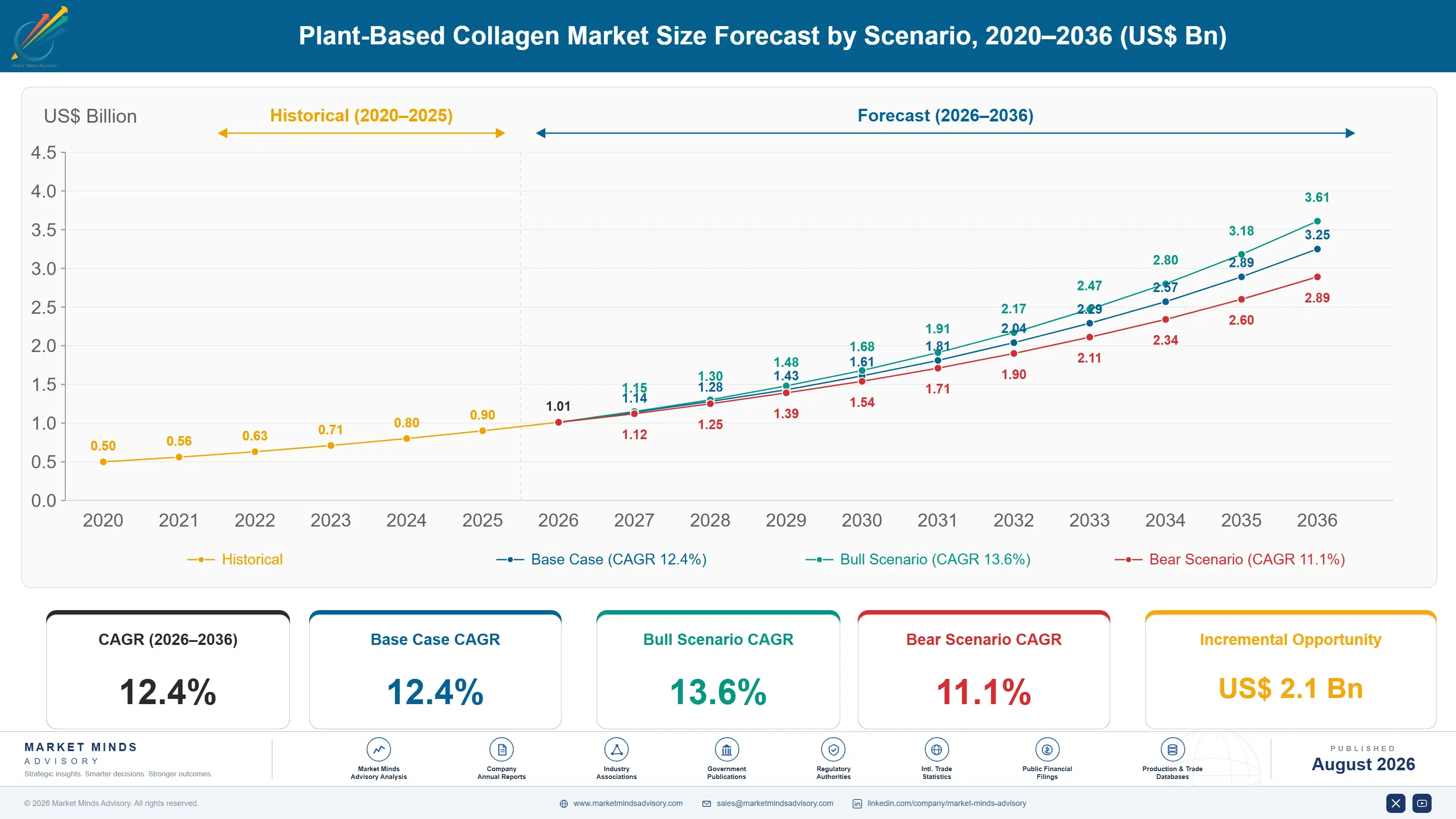
12.4% base case. Bull 13.6%. Bear 11.1%.
Fastest Growth Segment
Recombinant Yeast-Fermented Collagen: 18.6% CAGR
Fastest Growth Country
India: 15.1% CAGR
Fastest Growth Region
South Asia and Pacific: 14.6% CAGR
Largest Region
East Asia: 33% of 2025 global value
Market Leaders
Geltor, Evonik Industries, Modern Meadow, Jellatech, Cambrium. Source: MMA Primary Research Dataset, July 2026.
Primary Survey
n=3,800 procurement and R&D decision-makers, Q4 2025, six countries
Methodology
Demand-side build-up, cross-validated against public data, 47 expert interviews

Plant-Based Collagen Market Forecast Scenarios

plant-based-collagen-market-size-forecast-scenario-1787580469875
Between 2020 and 2025 the category grew on claim permissiveness rather than on science. Vegan collagen builders entered mainstream retail with almost no regulatory friction, and a historical CAGR near 11.2% came mostly from shelf placement. Fermentation-derived material existed but sold in gram quantities to formulators, priced for laboratories rather than for supplement aisles. That has changed on both counts.
Base case 12.4% rests on three mechanisms. Fermentation capacity built for precision dairy proteins is being requalified for collagen, which cuts recombinant cost per gram faster than any dedicated build would. Korean functional beauty regulation now recognises fermented collagen as a distinct ingredient class, giving it a claim the builder blends cannot make. And prestige skincare brands are buying recombinant collagen for topical lines, which absorbs early capacity at prices supplements cannot pay.
The bull case at 13.6% turns on precision fermentation capacity coming out of the dairy protein build-out at utilisation rates that halve collagen cost by 2029. The bear case at 11.1% is a labelling ruling: if the EU or Korea forbids the word collagen on builder blends, roughly 61% of current value loses its selling proposition overnight.

Where Fermentation Meets a Labelling Deadline

Two products share one name and almost nothing else. A builder blend is glycine, proline, vitamin C and silica, costing perhaps 11 cents a serving, and it works only to the extent the body was short of those inputs to begin with. Recombinant collagen is the actual protein, sequence-identical to human type I or type III, brewed by an engineered yeast.
TOP FIVE CONCENTRATION29%Fermentation specialists lead a field of contract blenders
RECOMBINANT COST PREMIUM8-12xFermented material against amino acid builder blends today
AVERAGE RETAIL SERVING PRICE$1.15Blended shelf price across ingestible plant collagen formats
FERMENTATION CAPACITY UTILISATION54%Contracted precision fermentation lines running below nameplate throughput
ACTIVES COST SHARE38%Share of finished goods cost carried by actives
REPEAT PURCHASE WINDOW4.2 monthsTypical replenishment interval before consumers lapse or switch
The price gap explains the shelf. Builder blends fill mass retail because they hit the price points a supplement buyer expects, and brands rarely explain what is inside. Recombinant material has gone first into prestige topicals and Korean ampoules, where a gram of active can carry a retail price no capsule ever will. Supplements come later, once cost falls.
What holds the whole category together is a claim, and claims are administrative objects. EFSA has never authorised a skin health claim for ingested collagen of any origin, and Korean functional food rules are tightening around what a collagen designation requires. Companies with fermentation assets are indifferent to that. Companies with blending contracts are not. The gap between those two positions is the investable question in this category.
"The interesting companies here are not selling collagen alternatives, they are selling collagen. It just came out of a tank instead of a hide, and once the price falls the animal-derived incumbents have a problem they have not priced."
Director, Nutrition and Functional Ingredients Practice · MMA Nutrition and Functional Ingredients Practice · August 2026

Market Trends

Precision fermentation capacity repurposed from dairy proteins

Fermentation lines built between 2021 and 2024 for recombinant whey and casein are running below nameplate, and collagen is the obvious second product. The organism differs, the downstream purification differs somewhat, but the tanks, the utilities and the regulatory dossiers for the facility are already there. Requalification takes roughly nine months against three years for a greenfield line. Several ingredient houses have taken tolling agreements rather than build, which is why recombinant collagen cost per gram has fallen faster than any capital plan predicted it would. Tolling also keeps the capital off their own balance sheets.
Market Impact: Worth $240 million in listings
Prestige topical skincare absorbs early recombinant output

Recombinant type III collagen has moved into premium serums and post-procedure creams ahead of any supplement application, because a topical at 90 dollars for 30 millilitres can carry an active that costs 40 dollars a gram. Korean and Chinese prestige brands took most of the first commercial volumes. That demand is small in tonnes and large in value, and it funds the cost-down curve that supplements need. Ingestible launches follow roughly two years behind each topical price point. Nobody in supplements can bid against a prestige gross margin, so they wait.
Market Impact: Locks 10 year supply qualification

Market Opportunities and Growth Drivers

Vegan certification requirements in Korean and European beauty retail

Retail buyers in Korean drugstore chains and European pharmacy formats now require vegan certification on a growing share of beauty-from-within listings, and animal collagen fails that test regardless of its efficacy record. That single procurement rule created the category. It is worth roughly 240 million dollars of listings previously held by marine and bovine peptides, and it does not depend on any consumer belief about how collagen works. The buyer specification does the work by itself, listing by listing. Efficacy arguments arrive afterwards, if they arrive at all. The rule is not up for negotiation.
Market Impact: Blocks 31% of pharmacy channel

Medical aesthetics demand for animal-free injectable-grade collagen

Dermal filler and wound care manufacturers want collagen without animal-origin risk, and regulators in both the FDA and EU medical device routes reward that. Recombinant human collagen removes the viral clearance and TSE documentation burden entirely, which shortens a device dossier by months. Volumes here are tiny against supplements, perhaps 40 tonnes a year, but the price per kilogram runs an order of magnitude higher and the qualification, once granted, locks a supplier in for a decade. That is the most defensible revenue in the whole category. Capacity rather than demand caps it.
Market Impact: Holds price at 8-12x parity

Market Restraints and Challenges

No authorised health claim for ingested collagen anywhere

EFSA has rejected every skin health claim submitted for ingested collagen, and the plant-based versions inherit that refusal without ever having been tested separately. The root cause is mechanistic: any ingested protein is digested to amino acids, so a specific skin effect is hard to demonstrate. Commercially it means European marketing runs on beauty language rather than health language, which limits pharmacy channels. Participants are funding independent clinical work on fermented collagen peptides specifically, hoping a sequence-defined material clears a bar that hydrolysates never could. Three trials are reading out during 2027.
Market Impact: Cuts qualification to 9 months

Recombinant cost still eight to twelve times blends

A gram of recombinant collagen lands between 30 and 45 dollars depending on purity and type, against a builder blend at roughly 11 cents a serving. The cause is titre: collagen expresses poorly compared with dairy proteins because the triple helix needs hydroxylation, so fermentation yields stay low. That keeps the honest product out of every mass channel. Producers are engineering co-expressed prolyl hydroxylase strains and switching to Pichia platforms, with titre gains of roughly 40% reported since 2024. Parity with marine peptides is still several years out. Nobody claims otherwise.
Market Impact: Absorbs 70% of early output
3 additional market trends, 4 additional growth drivers, and 2 additional restraints and challenges are covered in the full report. Contact sales@marketmindsadvisory.com to access the complete intelligence.

Segment CAGR and Growth Architecture

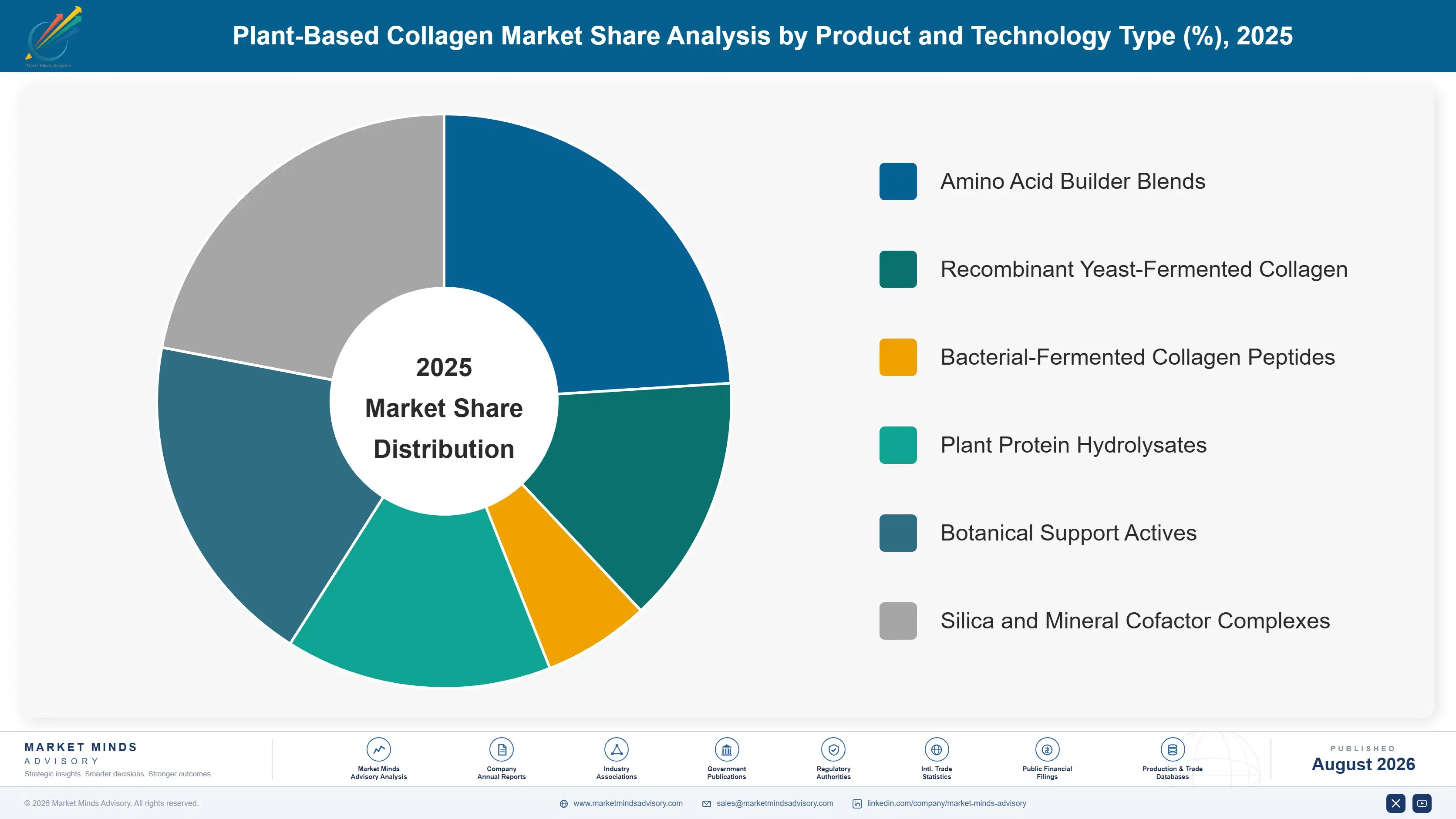
Six segments split by what the product actually is rather than by where it sells, because the material difference between a cofactor blend and a fermented protein governs every commercial variable in this category: cost, claim, channel and defensibility. Mixing the two logics is how this market gets misread. Application splits belong in the framework instead.
plant-based-collagen-market-market-share-analysis-1787580470443

Recombinant Yeast-Fermented Collagen

Growing at 18.6%, half again the market rate of 12.4%, this is the only segment selling collagen rather than something adjacent to it. Engineered Pichia or Saccharomyces strains express human type I or type III sequences, purified to a defined molecular weight. Prestige topicals take most current output because they can absorb 30 to 45 dollars a gram; medical aesthetics takes the rest at higher prices still. Ingestible use begins around 2028 on current cost curves. The segment holds a small share of volume and a disproportionate share of gross profit, and it is the only part of the category that a labelling ruling cannot damage. That last point matters more than the growth rate does.
CAGR 18.6%

Bacterial-Fermented Collagen Peptides

At 16.2% this segment uses E. coli and Bacillus platforms to produce shorter collagen-derived peptides rather than full-length triple helix protein. Titre runs higher and cost lands lower, roughly 12 to 18 dollars a gram, which puts it within reach of premium ingestible formats several years before the yeast route gets there. The trade-off is that shorter peptides make a weaker molecular claim and cannot serve medical device applications. Commercially it occupies the middle: too expensive for mass supplements, cheap enough for Korean ampoules and premium sachets, and it is where most 2026 launches sit. Volume growth here will outrun the yeast segment for at least the next four years, even though the value pool is smaller.
CAGR 16.2%
Full segment breakdown across 6 segments available in the complete report.

Regional Architecture and Country Demand Map

East Asia holds 33% of value, above its usual band, because Korean, Japanese and Chinese beauty-from-within formats define the category and set its pricing. North America follows at 25%, with Western Europe at 20% and constrained by claim rules rather than by demand. The gap is a regulatory artefact.

North America

Mass retail drives the American position: warehouse clubs and drugstore chains list builder blends at price points that reward blending economics over ingredient quality. Roughly 62% of US plant collagen value moves through those channels. Canada contributes a smaller but disciplined market where Health Canada's natural health product licensing forces a documented rationale for each ingredient, which has kept some of the weaker formulations out. The specialty health channel is where fermented material appears first, and it accepts a 3x price premium that mass grocery will not. The FDA has taken no position on the collagen designation for plant products, and that silence is worth a great deal to blenders. Nobody in the industry is asking for clarity.
Share: 25% | CAGR: 12.0% (2026 to 2036)

Western Europe

Claim rules, not consumer appetite, set the European ceiling. EFSA's refusal to authorise skin health claims for ingested collagen means German and French pharmacy channels, which drive most premium supplement value on the continent, cannot market the products the way Korean brands do. Sales run through beauty positioning instead, mainly in Italy and Spain where the aesthetic framing works well. The UK moved faster after leaving the EU claim register, and British subscription brands now carry a disproportionate share of European fermented collagen listings. Nordic retailers apply their own vegan certification standards, which favours plant material regardless of the claim question. Demand is there; the language to sell it is not.
Share: 20% | CAGR: 10.8% (2026 to 2036)
Regional intelligence for 5 additional markets available in the complete report: East Asia, South Asia and Pacific, Latin America, Middle East and Africa, Eastern Europe. Contact sales@marketmindsadvisory.com.
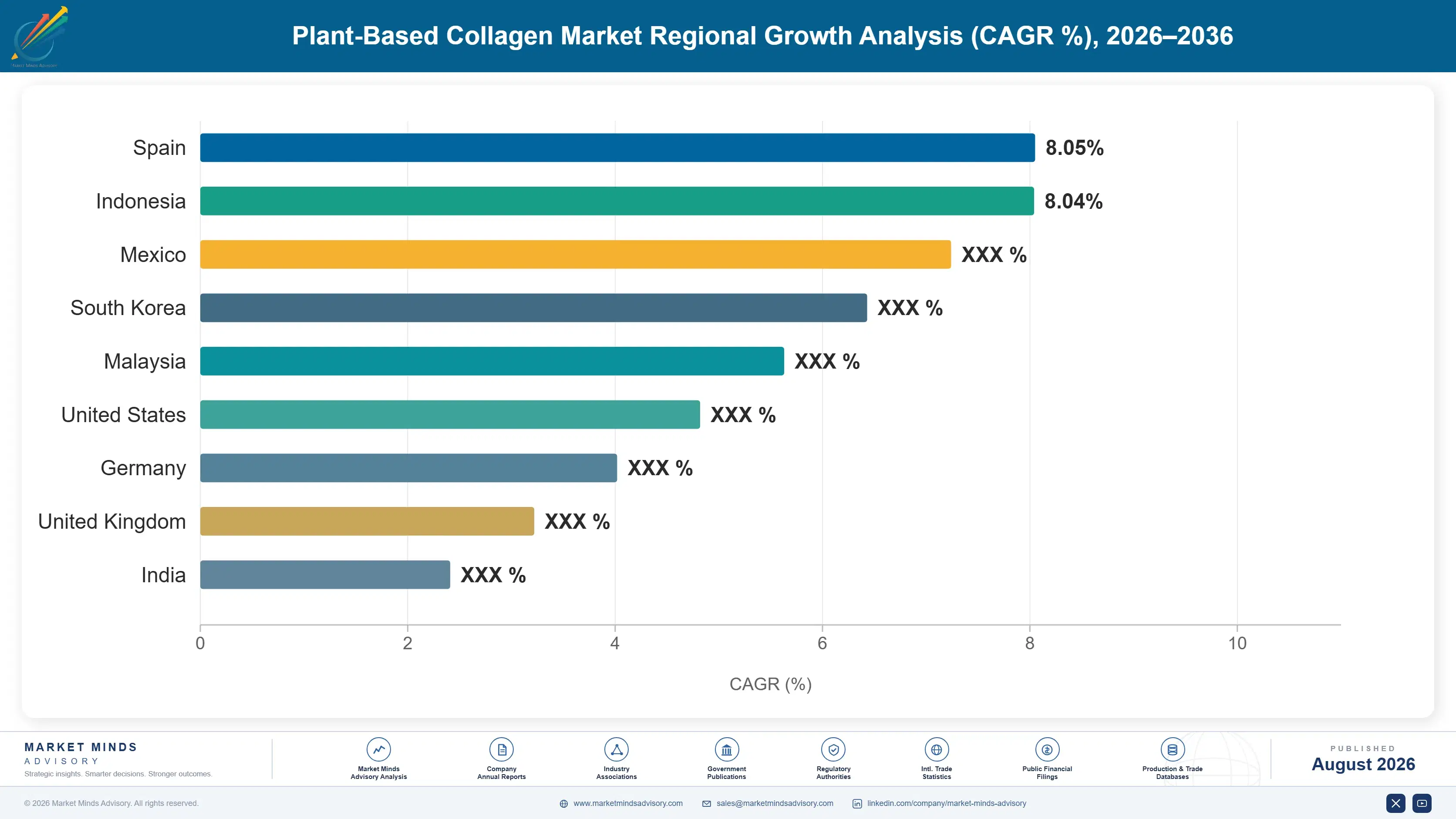
plant-based-collagen-market-country-cagr-analysis-1787580470979

Where Margin Actually Sits Here

Four moves separate the companies that will still be here in 2032 from the ones renting a claim. Each depends on owning either a fermentation asset, a clinical dataset, or a regulatory position that a contract blender cannot buy at short notice. Competing on price here is how a brand disappears. Nothing else here is defensible.

Tolling fermentation capacity rather than building it

Requalifying an existing precision fermentation line for collagen takes about nine months and a fraction of the capital a greenfield plant needs, and dairy protein capacity built in 2022 and 2023 is running near 54% utilisation. Companies taking tolling agreements have brought recombinant cost down roughly 35% in two years without carrying the asset. The trade-off is queue position: toll customers get bumped when the owner has better-margin work. Signing capacity reservations with take-or-pay floors solves that, and the floors are cheaper than the plant would be. Most groups have chosen the floors.
Market Impact: Cuts recombinant cost 35% without adding capital spend

Selling to medical aesthetics before supplements

A dermal filler or wound care manufacturer pays perhaps 12 times what a supplement brand will for the same recombinant collagen, and once the material is written into a device dossier it stays there for a decade. Qualification takes 18 to 24 months and demands documentation most ingredient firms have never produced. The reward is revenue that does not move on retail promotion cycles. Firms that started medical qualification in 2024 are now carrying gross margins in the high sixties on that volume alone, which no supplement channel will ever match.
Market Impact: Delivers 12x price against supplement channel volumes today

Owning the vegan certification specification outright

Retail buyers, not consumers, decide what gets listed, and the vegan certification requirement in Korean drugstore and European pharmacy formats is worth roughly 240 million dollars of shelf that animal collagen cannot touch. Suppliers holding the certification audits, the documentation and the supply chain traceability get specified by name. Those who buy certified inputs from a trader do not. Building direct certified supply costs perhaps 4% of ingredient cost and converts a commodity relationship into a specification lock that survives a change of buyer at the retailer. Buyers change more often than specifications do.
Market Impact: Locks buyer specification worth $240 million in annual listings

Funding the clinical evidence nobody else will

No authorised health claim exists for ingested collagen in Europe, and the companies complaining about that are not the ones funding trials. A properly powered skin elasticity study on a sequence-defined fermented peptide costs roughly 1.4 million dollars and takes two years. If it reads out positively, the sponsor holds a claim its competitors cannot use without repeating the work on their own material. That is a durable position in a category where almost nothing else is defensible, and three such trials are running now with readouts due during 2027.
Market Impact: Costs $1.4 million for a decade of claim exclusivity

Who Controls the Margin Pool

Participation here is measured by contracted output of plant-derived and fermented collagen material, and on that basis the top five hold 29%. That is low even for an early category. Geltor and Evonik lead on qualified fermentation capacity rather than on tonnes shipped. Behind them sit dozens of contract blenders with no proprietary material. The gap is not scale, it is whether a company owns an organism.
Competition runs on three fronts. Strain performance decides cost, and titre improvements of roughly 40% since 2024 separate serious platforms from demonstrations. Regulatory qualification decides access, with medical device and Korean functional food dossiers taking 18 months or more. Supply agreements with prestige skincare houses decide who gets paid now rather than in 2029. Nobody is competing on retail brand, because these firms rarely sell to consumers.

The gelatin houses are the pressure nobody has priced. Gelita, Rousselot and Nitta hold the customer relationships, application knowledge and balance sheets, and none needs to invent a plant story, only buy one. Expect equity stakes and supply agreements rather than outright acquisitions. Rankings shift when a company with 40 years of collagen application data acquires an organism, and that is a matter of when.
plant-based-collagen-market-company-positioning-matrix-1787580471498

Competitive Moat and Risk Dimensions

GELTOR

Moat: Qualified prestige customer base

Geltor commercialised recombinant collagen into prestige skincare years before anyone else got a dossier through, and those formulation qualifications do not move. A prestige brand that has stability-tested a serum around one supplier's material faces reformulation and retesting to switch, which costs more than the ingredient saving is worth on any realistic volume it could run.
GELTOR

Risk: Narrow application concentration

Revenue concentrates in topical beauty, a category driven by launch cycles and marketing budgets rather than by regulated demand. A downturn in prestige skincare, or a single large customer reformulating, removes a disproportionate share of volume. Broadening into medical aesthetics requires documentation and quality systems the company is still building out at some expense.
EVONIK INDUSTRIES

Moat: Fermentation scale and dossiers

Evonik operates pharmaceutical grade fermentation and the quality systems that go with it, which means medical device and pharmaceutical customers can qualify its material without demanding a supplier upgrade first. That combination of capacity and documentation is expensive to replicate and is precisely what the small platform companies lack when they try to move upmarket.
EVONIK INDUSTRIES

Risk: Slow internal capital allocation

A specialty chemicals group allocates capital across many businesses, and a nascent collagen line competes internally against established franchises with predictable returns. Focused platform companies can commit to a strain programme faster and price more aggressively for early share. Evonik risks arriving with better capability once the specification is already written around someone else's material.

Players Tracked

Prominent Players

Geltor
Evonik Industries
Modern Meadow
Jellatech
Cambrium

Other Key Players

Gelita
Rousselot
Nitta Gelatin
Ashland
Croda International
Givaudan Active Beauty
BASF
Symrise
Lonza
Glanbia Nutritionals
Kerry Group
Sabinsa
Arjuna Natural
Bioiberica
Provenance Bio

Recent Developments

MARCH 2026

Korean MFDS grants functional designation to a fermented collagen peptide

The Ministry of Food and Drug Safety added a fermented collagen peptide to its functional ingredient list, giving products containing it a defined claim in Korean health food retail. Builder blends received no equivalent designation and cannot make the same statement on pack. The distinction now appears on pack.
Signal: Regulatory recognition now separates fermented material from blends in the one market that sets category formats
NOVEMBER 2025

Evonik converts existing pharmaceutical fermentation capacity to recombinant collagen

Evonik requalified installed pharmaceutical fermentation capacity for recombinant collagen production rather than building new, bringing qualified output online in under a year. The company described the project as a repurposing of installed assets, not a greenfield investment of any kind. Qualified customers began drawing material immediately afterwards.
Signal: Requalification of existing tanks is now the default route to capacity, compressing both timelines and capital requirements
JULY 2025

Geltor signs multi-year supply agreement with an Asian prestige skincare group

Geltor entered a multi-year supply agreement covering recombinant type III collagen for a prestige skincare portfolio across Korean and Chinese markets. The arrangement is a supply contract carrying volume commitments, not an equity investment and not a joint venture. Volumes were not disclosed at the time.
Signal: Prestige topical demand is contracting forward, which funds cost reduction long before supplement pricing becomes achievable

What Actually Sits in the Cost

For a builder blend the actives run about 38% of cost of goods: vitamin C from Chinese fermentation, glycine and proline mostly from Chinese and Indian amino acid producers, silica from European and North American mineral suppliers. Packaging and fill take another 30%. For recombinant material the arithmetic inverts entirely, with fermentation utilities and downstream purification carrying more than 60% of the total.
Vitamin C pricing has moved violently twice this decade. Chinese ascorbic acid production concentrated after 2021 capacity rationalisation, and spot prices roughly doubled through 2022 before falling back. DSM-Firmenich noted the resulting margin pressure in its 2023 Annual Report. Because vitamin C is the one ingredient in a builder blend carrying an authorised EFSA claim for normal collagen formation, reformulating around it is not an option, so blenders absorbed the swing themselves.

That asymmetry punishes the small blender. A brand buying finished blends from a contract manufacturer sees the input swing passed through in full within a quarter, while integrated players holding annual contracts absorb it over a year. Fermentation producers are exposed instead to industrial electricity and natural gas, per IEA data on European industrial tariffs, making Asian and North American tank capacity consistently cheaper.
plant-based-collagen-market-cost-volatility-analysis-1787580471692

Dual-source ascorbic acid outside single-country supply

Qualifying a second ascorbic acid source outside China, whether European or Indian, costs perhaps 6% more per kilogram in normal conditions and removes most of the exposure to a concentrated supply event. Brands running annual retail price contracts recover that premium within a single volatility cycle, and buyers increasingly ask for the second source by name.

Contract fermentation capacity where industrial power is cheapest

Electricity is the dominant variable cost in recombinant production, so siting or tolling capacity in regions with cheap industrial tariffs changes unit economics more than any strain improvement will in the short run. North American and Southeast Asian capacity currently runs well below European cost per kilogram, and toll agreements make that difference accessible without capital.

Reformulate cofactor ratios to reduce spike exposure

Builder blends carry more vitamin C than the authorised claim threshold requires, largely for label optics. Trimming to the claim level and rebalancing toward silica and amino acids cuts exposure to ascorbic acid volatility by roughly half without changing what the pack can legally say. The reformulation cost is small and recovers inside one production run.

Portfolio Architecture for Margin Defence

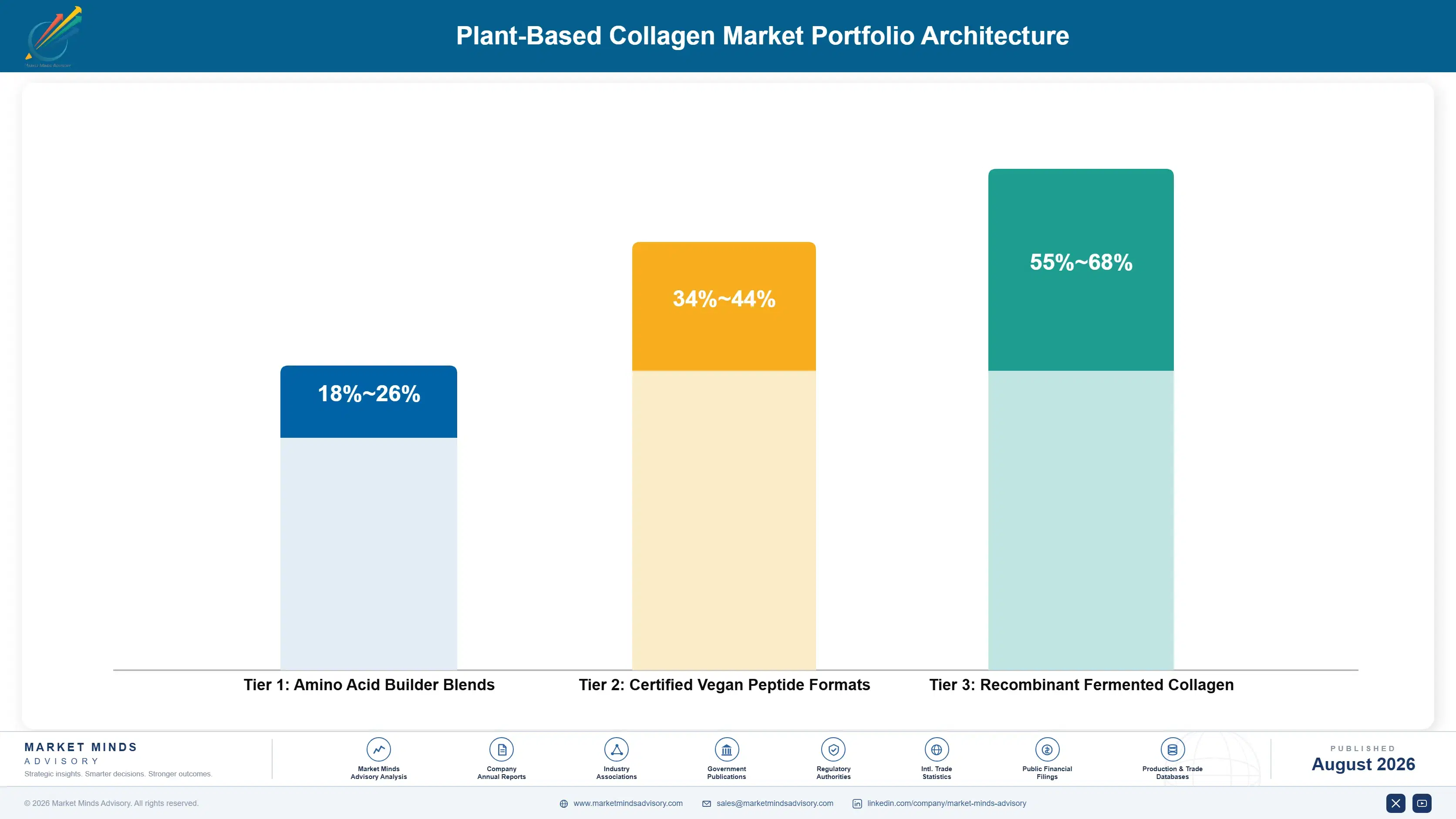
Margin in this category tracks whether the company owns the molecule. Builder blends are a formulation service dressed as an ingredient business, and they earn what formulation services earn: high teens to mid twenties gross margin, with the price set by whichever contract manufacturer wants the volume most this quarter. Certified vegan peptide formats do better, because certification and documentation are genuine barriers.
Recombinant material sits in another economic universe. Gross margins run from the mid fifties into the high sixties, and the spread is wide because cost per gram varies enormously by strain, by platform and by whether the producer owns or tolls the tank. That range is not imprecision, it reflects a genuine three-fold difference in production cost between the best and worst platforms currently shipping commercial volumes.

The tension is that volume and margin point in opposite directions. Blends deliver the tonnage, the retail listings and the cash that funds everything else; recombinant delivers the profit and the defensibility but almost no volume for another three years. Companies that abandoned blends early ran out of money. Companies that never left them own nothing.

Amino Acid Builder Blends

Glycine, proline, vitamin C and silica blended to a brand specification. Contract manufacturers compete openly on price, so the eight point range reflects scale and packaging format rather than any formulation advantage worth defending.
Gross Margin: 18-26%

Certified Vegan Peptide Formats

Plant hydrolysates and fermented peptides carrying vegan certification and traceability documentation. The ten point range comes from whether the supplier holds the certification directly or buys certified input from a trader, which changes both cost and specification power.
Gross Margin: 34-44%

Recombinant Fermented Collagen

Sequence-defined human collagen from engineered yeast or bacteria. The thirteen point range reflects a genuine threefold spread in production cost per gram between the strongest and weakest expression platforms currently shipping commercially.
Gross Margin: 55-68%
plant-based-collagen-market-portfolio-architecture-1787580472194

High-value Sub-segments and Strategic Watch-out

Recombinant Type III for Prestige Topicals

High value and high growth. Prestige skincare absorbs early output at prices no ingestible format can match, and formulation qualification locks the supplier in. The wide range reflects platform cost differences rather than pricing variation across customers. Formulation qualification, not price, is the real barrier here.
Gross Margin: 62-70%

Injectable-Grade Recombinant Collagen

High value, moderate growth. Medical device qualification takes 18 to 24 months and then holds for a decade, so volumes build slowly and predictably. The range reflects purity grade requirements, which vary sharply between wound care and dermal filler applications. Volumes stay small in tonnage terms.
Gross Margin: 58-66%

Retail Builder Blend Sachets and Capsules

The volume core, and the part most exposed to a labelling ruling. Price competition is continuous and switching costs for brand owners are effectively zero. Growth continues at below market rate while the claim environment remains permissive in most jurisdictions. Almost nothing about it is defensible.
Gross Margin: 18-24%

Claim-Dependent Beauty Drinks

The strategic watch-out. Ready-to-drink collagen beverages carry packaging and logistics cost against a claim that European regulators have never authorised. An enforcement action would strand inventory and listings simultaneously, and the format has no obvious repositioning available. Repositioning would mean abandoning the beverage format entirely.
Gross Margin: 26-34%

How the Repeat Purchase Works

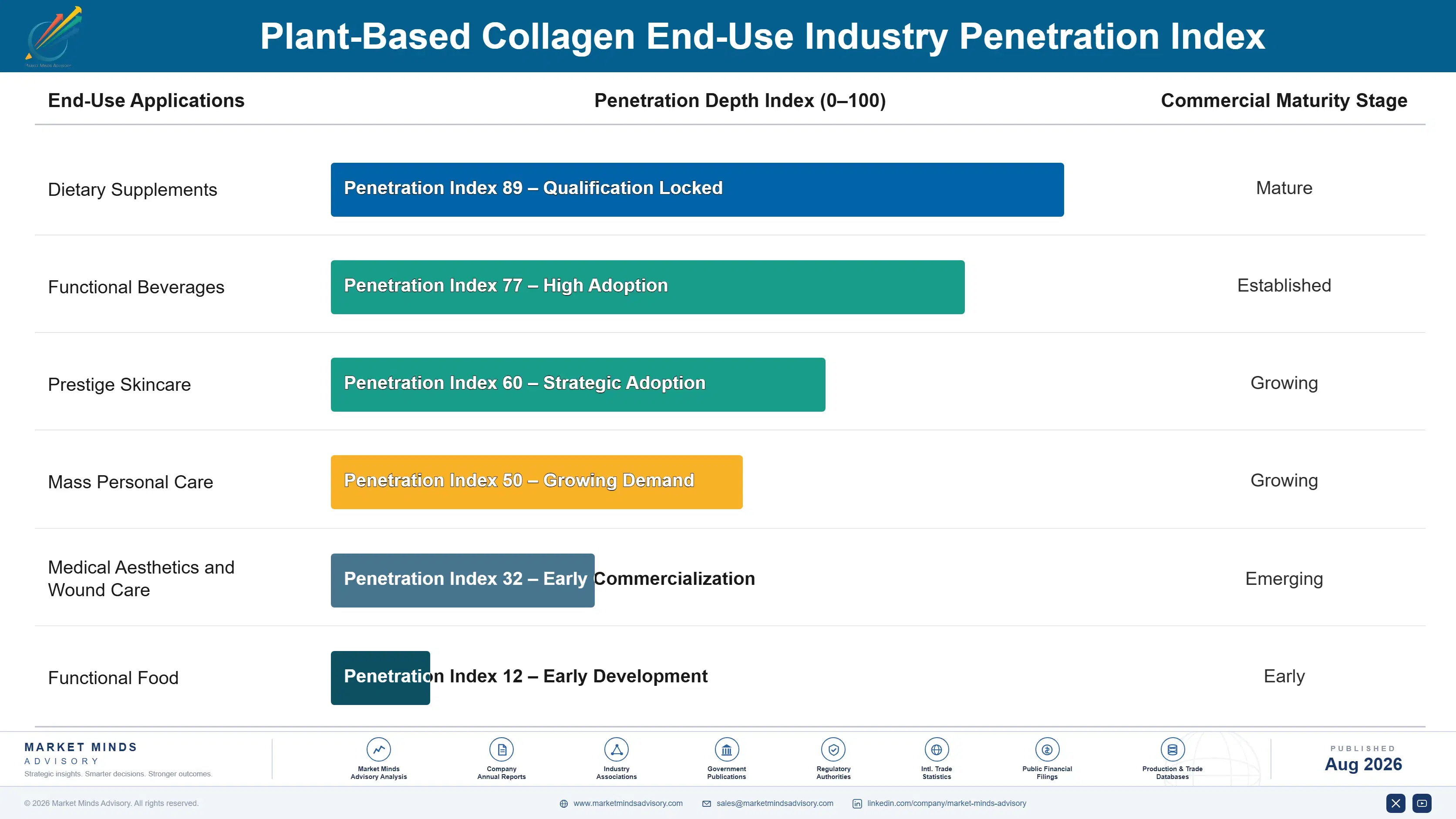
Collagen is bought on a replenishment rhythm, not on a purchase decision. The typical user reorders every 4.2 months and lapses rather than switches, which makes subscription and autoship formats worth roughly twice a one-off retail sale over a two-year horizon. Brands that moved to subscription early hold customer lifetime values the mass retail listings cannot approach, and they know when a customer is drifting.
Stickiness varies enormously by end use. Prestige skincare brands, once they have stability-tested a serum around a supplier's material, effectively never change it inside a product's life. Medical device manufacturers are stickier still, because the ingredient sits in a regulatory dossier. Supplement brand owners are the opposite: they retender annually and switch on a few cents per serving. Depth of qualification, not relationship quality, determines who stays.

The buyer is also changing. Collagen sold to women over 45 on an anti-ageing promise for a decade. It now sells to buyers in their twenties on preventative and wellness framing, and to men through sports nutrition channels where the vegan angle carries less weight than the protein claim does. That shift is only beginning.
plant-based-collagen-market-end-use-penetration-index-1787580472683

Where We Would Place Capital

These are among the four positions where our research anticipates prominent divergence between winners and laggards over the coming forecast period. Each is grounded in the demand model, the regulatory perimeter, and the announced capacity pipeline.
01 / FERMENTATION ASSET ACCESS

Secure tank access before the dairy protein capacity is booked

Precision fermentation capacity built for recombinant dairy proteins is running near 54% utilisation, and collagen requalification takes roughly nine months against three years for a greenfield line. That window closes as other protein categories discover the same arbitrage and book the tanks first. Take-or-pay reservations cost less than owning the asset and remove the queue risk that undermines every tolling arrangement when the plant owner finds better-margin work elsewhere, which is exactly when a collagen customer most needs the tank and least wants to renegotiate for it.
02 / REGULATORY CLAIM POSITIONING

Fund the clinical work rather than lobbying against the rules

No skin health claim for ingested collagen has ever been authorised in Europe, and complaining about EFSA has produced nothing in fifteen years. A powered study on a sequence-defined fermented peptide costs about 1.4 million dollars over two years. A positive readout hands the sponsor a claim competitors cannot use without repeating the trial on their own material, which is the only durable advantage available in a category otherwise built on assertion, borrowed vocabulary and the hope that nobody in Brussels reads the pack closely.
03 / MEDICAL CHANNEL QUALIFICATION

Qualify into device dossiers even at painful documentation cost

Dermal filler and wound care manufacturers pay roughly 12 times supplement prices for the same recombinant material, and once written into a device dossier a supplier stays for a decade. Qualification demands quality systems most ingredient firms have never built and takes 18 to 24 months. The cost is real and the payback is slow, but this is the only revenue in the category insulated from retail promotion cycles, from promotional discounting and from the annual retender that governs every supplement ingredient relationship.
04 / RETAIL SPECIFICATION CONTROL

Own the certification rather than buying certified inputs

Vegan certification requirements in Korean drugstore and European pharmacy formats govern roughly 240 million dollars of listings that animal collagen cannot reach. Suppliers holding the audits and traceability get named in the buyer specification; those sourcing certified material through traders remain interchangeable. Direct certified supply adds perhaps 4% to ingredient cost and converts a price-led relationship into a specification lock that survives a change of category buyer and, more usefully, a change of ownership at the retailer or a shift in its own private label strategy.

Engagement Snapshot From the Field

A live engagement with an industry participant carrying material or product regulatory and market exposure ahead of a defining policy shift, showing how our research translates into a defensible multi-year portfolio strategy.
MARKET MINDS ADVISORY · CLIENT ENGAGEMENT SUMMARY
Plant-Based Collagen Producer Strategic Portfolio Review and Transition Roadmap 2026·Investment Scenario on Plant-Based Collagen Exposure Evaluation 2025-26
CLIENT PROFILE
A European specialty ingredients group with an established amino acid and vitamin premix business serving supplement brand owners across the EU and UK. Annual divisional revenue near 340 million euros (client-reported, unverified by MMA). The group held no fermentation assets and no collagen position, but supplied several of the largest plant collagen builder blends on European shelves under private label arrangements.
STRATEGIC CHALLENGE
The board had approved a review of whether to build recombinant collagen capability, acquire a platform company, or defend the existing blending business. Internal opinion split sharply. Commercial leadership argued the blends were profitable and growing; the technical function argued the category's central claim would not survive European enforcement, and that the group was renting a position it did not own.
MMA APPROACH
MMA mapped contracted fermentation capacity across European and North American sites, tested requalification timelines with plant operators, and modelled recombinant cost per gram against three expression platforms. Interviews covered 47 experts across regulatory affairs, contract manufacturing and prestige skincare procurement. A separate workstream tested European pharmacy buyer intentions on collagen designation using the quantitative survey base.
KEY FINDINGS
  1. Requalifying existing dairy protein fermentation capacity for collagen took roughly nine months against three years for a greenfield line, at a fraction of the capital.
  2. European pharmacy buyers expected a collagen designation ruling within three years and were already asking suppliers what their contingency formulation would be.
  3. Prestige skincare procurement would pay 30 to 45 dollars a gram for qualified recombinant type III, absorbing early output at prices no supplement channel could approach.
  4. Acquiring a platform company carried strain performance risk the group could not diligence properly; tolling gave equivalent access at a fraction of the exposure.
CLIENT PROFILE
A European specialty ingredients group with an established amino acid and vitamin premix business serving supplement brand owners across the EU and UK. Annual divisional revenue near 340 million euros (client-reported, unverified by MMA). The group held no fermentation assets and no collagen position, but supplied several of the largest plant collagen builder blends on European shelves under private label arrangements.
STRATEGIC CHALLENGE
The board had approved a review of whether to build recombinant collagen capability, acquire a platform company, or defend the existing blending business. Internal opinion split sharply. Commercial leadership argued the blends were profitable and growing; the technical function argued the category's central claim would not survive European enforcement, and that the group was renting a position it did not own.
MMA APPROACH
MMA mapped contracted fermentation capacity across European and North American sites, tested requalification timelines with plant operators, and modelled recombinant cost per gram against three expression platforms. Interviews covered 47 experts across regulatory affairs, contract manufacturing and prestige skincare procurement. A separate workstream tested European pharmacy buyer intentions on collagen designation using the quantitative survey base.
KEY FINDINGS
  1. Requalifying existing dairy protein fermentation capacity for collagen took roughly nine months against three years for a greenfield line, at a fraction of the capital.
  2. European pharmacy buyers expected a collagen designation ruling within three years and were already asking suppliers what their contingency formulation would be.
  3. Prestige skincare procurement would pay 30 to 45 dollars a gram for qualified recombinant type III, absorbing early output at prices no supplement channel could approach.
  4. Acquiring a platform company carried strain performance risk the group could not diligence properly; tolling gave equivalent access at a fraction of the exposure.
RECOMMENDED STRATEGY
Phase 1: Phase one: sign take-or-pay tolling capacity at two qualified European fermentation sites, avoiding acquisition and preserving optionality on expression platform choice. Phase 2: Phase two: qualify recombinant material into prestige topical customers first, where price supports the cost curve, before approaching any ingestible brand owner. Phase 3: Phase three: fund a powered clinical study on the fermented peptide, positioning for a claim the existing blending competitors cannot replicate without repeating it.
OUTCOME
The group signed tolling capacity at one site in late 2025 and reported first qualified prestige customer shipments within eleven months, at gross margins above 55% (client-reported, unverified by MMA). The blending business was retained but repriced on shorter contracts, reducing exposure to a labelling ruling that both functions now expect.

Frequently Asked Questions

Foundational context covering the market sizes, CAGR, scope, country, region and competition that inform every finding below. This section is provided to cover basics and most often pre-purchase conversations, answered from the MMA Primary Research Dataset.

What is the current size of the Plant-Based Collagen Market?

MMA sizes it at USD 0.86 billion in 2025, rising to USD 0.97 billion in 2026. The figure covers ingestible and topical collagen-positioned products containing no animal-derived collagen.

How large will the Plant-Based Collagen Market be by 2036?

USD 3.12 billion by 2036, an incremental USD 2.15 billion over the 2026 base and an expansion multiple of 3.22 times. Fermented material accounts for most of that addition.

What is the CAGR for the Plant-Based Collagen Market 2026 to 2036?

12.4% in the base case, with a bull case at 13.6% and a bear case at 11.1%. The spread turns almost entirely on whether labelling rules keep permitting the collagen designation on builder blends.

Which segment is growing fastest?

Recombinant yeast-fermented collagen at 18.6%, half again the market rate of 12.4%. It is the only segment selling collagen itself rather than ingredients that support its formation.

Who are the major companies in the Plant-Based Collagen Market?

Geltor, Evonik Industries, Modern Meadow, Jellatech and Cambrium lead on contracted output of plant-derived and fermented collagen material. Fifteen further participants are profiled in the full report.

Which country is growing fastest?

India at 15.1%, where ayurvedic positioning gives plant collagen builders a cultural fit animal collagen never had. FSSAI nutraceutical rules permit the ingredient without requiring a health claim.

Report Segmentation Architecture

The full report scope spans multiple orthogonal segmentation dimensions, with cross-tabulated demand data provided for each dimension pair. Coverage extends further to regional breakdowns, trend trajectories, and the competitive detail needed to support segment-level decision-making.

By Product and Technology Type

  • Amino Acid Builder Blends
  • Recombinant Yeast-Fermented Collagen
  • Bacterial-Fermented Collagen Peptides
  • Plant Protein Hydrolysates
  • Botanical Support Actives
  • Silica and Mineral Cofactor Complexes

By End-Use Industry

  • Dietary Supplements
  • Functional Beverages
  • Prestige Skincare
  • Mass Personal Care
  • Medical Aesthetics and Wound Care
  • Functional Food

By Commercial Dimension

  • Pharmacy and Drugstore Retail
  • Mass Grocery and Warehouse Club
  • Specialty Health Retail
  • Direct-to-Consumer Subscription
  • Ingredient Supply to Brand Owners
  • Contract Manufacturing Supply

By Region

  • North America
  • Western Europe
  • East Asia
  • South Asia and Pacific
  • Latin America
  • Middle East and Africa
  • Eastern Europe

Scope, Methodology, and Coverage

Every figure in this report is reproducible from documented input assumptions. The scope below maps the historical period, the forecast horizon, the segmentation dimensions, and the countries covered, alongside the underlying primary and qualitative methodology.
Historical Period
2020 to 2025
Forecast Period
2026 to 2036
Base Year
2025 (USD billions; MMA Primary Research Dataset, August 2026)
Market Definition
Ingestible and topical collagen-positioned products containing no animal-derived collagen, spanning amino acid builder blends, botanical support actives, plant protein hydrolysates, and recombinant collagen produced by yeast or bacterial fermentation. Marine, bovine and porcine hydrolysed collagen, gelatin, collagen casings and medical-grade collagen scaffolds regulated as devices are excluded. Value is measured at manufacturer level for ingredients and at brand owner level for finished goods.
Quantitative Units
USD billions (current prices); tonnes of active material; USD per gram of active by platform and grade
Segmentation Dimensions
Product and technology type; end-use industry; commercial dimension; region
Regions Covered
North America, Western Europe, East Asia, South Asia and Pacific, Latin America, Middle East and Africa, Eastern Europe
Countries Covered
United States, Canada, Germany, France, United Kingdom, Italy, Spain, China, Japan, South Korea, India, Australia, Indonesia, Brazil, Mexico, Saudi Arabia, United Arab Emirates, South Africa, Poland, Czech Republic
Key Companies Profiled
Geltor, Evonik Industries, Modern Meadow, Jellatech, Cambrium, Gelita, Rousselot, Nitta Gelatin, Ashland, Croda International, Givaudan Active Beauty, BASF, Symrise, Lonza, Glanbia Nutritionals, Kerry Group, Sabinsa, Arjuna Natural, Bioiberica, Provenance Bio
Quantitative Methodology
Primary survey, n=3,800 respondents, Q4 2025, six countries; demand-side model with trade association cross-validation
Qualitative Methodology
47 expert interviews, Q4 2025; applied to validate demand model assumptions, identify emerging dynamics, and assess competitive positioning
Report Format
PDF and XLSX data workbook (Word format preview document)
Publisher
Market Minds Advisory
Report Code
MMA-2026-HLT-118
Published
August 2026
Contact
sales@marketmindsadvisory.com | www.marketmindsadvisory.com

Purchase the full Plant-Based Collagen Market Report (2026 to 2036).

The full report separates the two businesses hiding under one category name and sizes each independently through 2036. It models recombinant collagen cost per gram across yeast and bacterial expression platforms, tracks contracted fermentation capacity by site, and quantifies what a European or Korean labelling ruling would strand. Regional chapters cover all seven regions with channel-level detail on pharmacy, mass retail, specialty and subscription. Competitive profiling covers 20 participants on a single contracted-output basis, with qualification timelines for medical device and Korean functional food routes set out side by side.
Recombinant cost per gram modelled by expression platform
Contracted fermentation capacity mapped by site
Labelling ruling exposure quantified by segment
Channel-level regional detail across all seven regions
Twenty participants profiled on one consistent basis
Medical and functional food qualification timelines compared

Built For The People Who Decide

From boardroom strategy to bench-side execution, this report is read cover-to-cover by leaders shaping the next decade of their industry, turning demand scenarios, market dynamics and valuation benchmarks into decisions.
CXOs/ Presidents/ VPs/ Managers
M&A and Corporate Development
Strategy Teams and R&D Heads
Procurement and Product Directors
Regulatory and Compliance Leaders
Investor Relations and Equity Analysts