Market Minds Advisory
Plant-Based Chicken Market

Plant-Based Chicken Market: Whole-Cut Texture Innovation and the Second-Wave Trust Rebuild

Plant-based chicken is finally solving the texture problem that stalled the category's first wave, and whole-cut formats convincing enough for foodservice chains are pulling investment away from processed formats that dominated early product launches.

Lead Analyst

Lisa Gevelber

Published

September 2026

Make Smarter Decisions with Customized Research Insights

Request a free sample report and evaluate market opportunities, growth trends, and competitive dynamics relevant to your business needs.

2025 MARKET VALUE$2.8BMarket Size 2025
2036 FORECAST VALUE$7.8BBase Case , 2026 to 2036
CAGR 2026 TO 20369.8 %Bull 11.2% / Bear 8.3%
INCREMENTAL OPPORTUNITY$4.8BNet 10- year value creation
EXPANSION MULTIPLE2.55x2036 value over 2026 base
Strategic Levers
M&A Pipeline
Regional Outlook
Country Rankings
Competitive Intelligence
Segmental Deep-dive
Call-Us : 91 93563 13602

Executive Snapshot and Market Trajectory

Plant-based chicken is entering its second product wave, where whole-cut texture innovation is replacing the ground and processed formats that defined the category's early years, finally addressing the mouthfeel complaints that limited repeat purchase among flexitarian consumers across most major retail markets worldwide today and increasingly beyond.
Commercial momentum concentrates in foodservice partnerships with major quick-service and casual dining chains, where whole-cut and breaded formats increasingly appear on mainstream menus rather than dedicated plant-based sections across most tracked distribution categories nationwide. North America and Western Europe together account for the deepest commercial penetration, reflecting concentrated flexitarian consumer spending and established foodservice distribution infrastructure built over years of steady category investment across most major consuming markets worldwide today and beyond.
Competitive character is shifting as legacy meat processors invest in plant-based manufacturing capability to defend shelf space against dedicated alternative protein brands entering the category from the opposite direction entirely. Ingredient labeling and clean-label formulation standards are tightening steadily across major food safety jurisdictions worldwide, pushing reformulation investment higher for suppliers competing in premium whole-cut categories nationwide and across most major export markets globally today and beyond.
Market Definition
The plant-based chicken market covers plant protein formulations engineered to replicate chicken meat texture and flavor, including whole-cut, ground, breaded, and processed formats. It excludes cultivated meat products and hybrid plant-animal protein blends.
Base Year Value
$2.8B in 2025 (MMA Primary Research Dataset, August 2026)
Forecast Period
2026 to 2036, eleven discrete annual values
CAGR
9.8% base case. Bull 11.2%. Bear 8.3%.
Fastest Growth Segment
Whole-Cut Plant-Based Chicken Alternatives: 16.8% CAGR
Fastest Growth Country
India: 13.4% CAGR
Fastest Growth Region
South Asia and Pacific: 11.8% CAGR
Largest Region
North America: 28% of 2025 global value
Market Leaders
Beyond Meat Inc, Impossible Foods Inc, Tyson Foods Inc, Kellanova, Maple Leaf Foods Inc. Source: MMA Analysis based on company annual reports.
Primary Survey
n=3,800 procurement and R&D decision-makers, Q4 2025, six countries
Methodology
Demand-side build-up, cross-validated against public data, 47 expert interviews

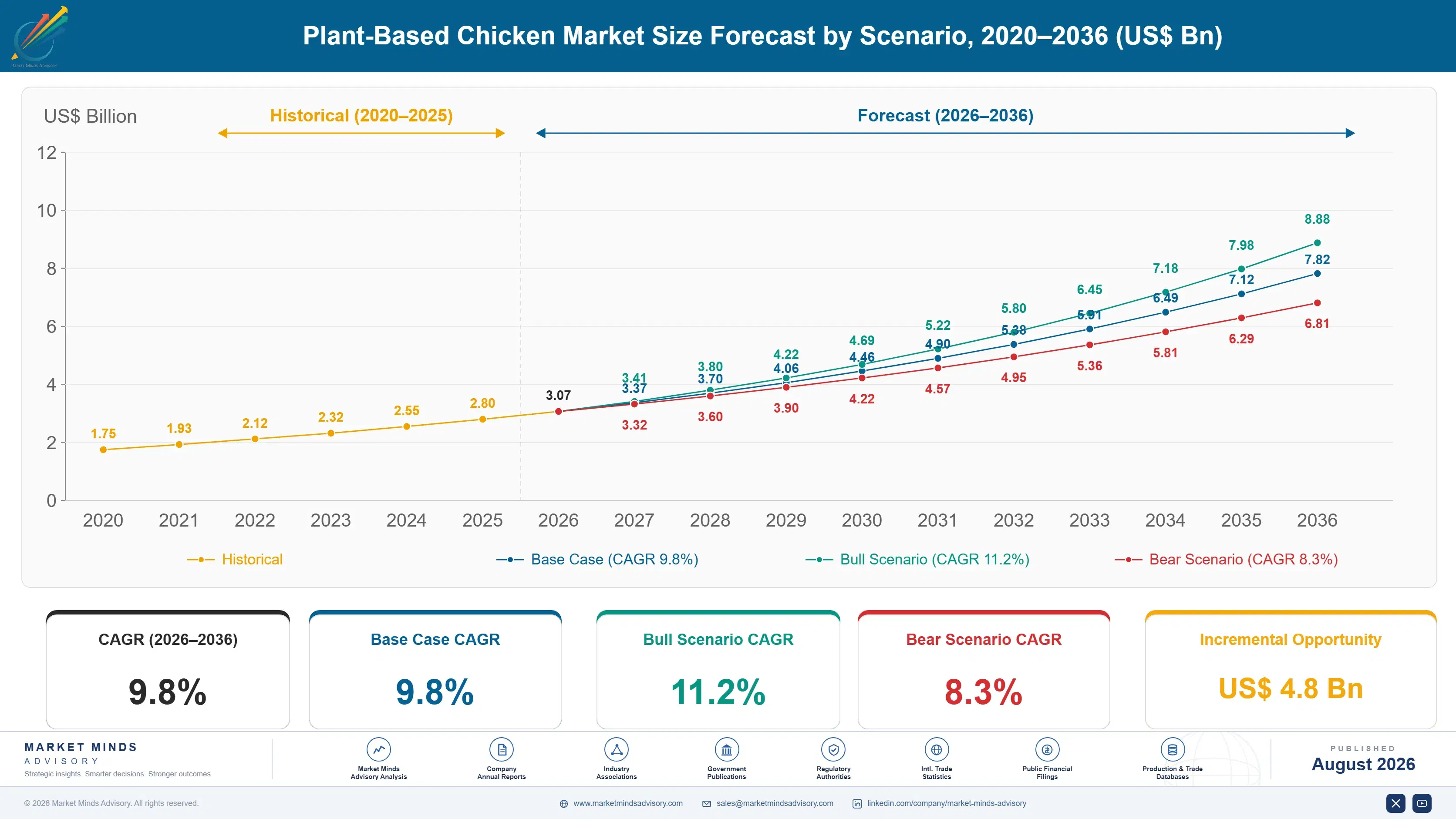
Plant-Based Chicken Market Forecast Scenarios

plant-based-chicken-market-trends-size-forecast-scenario-1787335229814
Plant-based chicken demand grew unevenly from 2020 through 2025 as early ground and processed formats disappointed on texture, causing category growth to stall before whole-cut innovation reignited consumer interest, a trend that accelerated once manufacturers finally solved fibrous texture replication challenges that had limited repeat purchase for years across most tracked retail and foodservice markets worldwide.
MMA's base case assumes a 9.8% CAGR through 2036, anchored by three mechanisms: expanding whole-cut texture innovation that finally satisfies mainstream consumer expectations, rising foodservice partnership adoption as quick-service chains normalize plant-based menu items across most major markets, and steady category penetration growth across East Asia and Western Europe where flexitarian consumer spending is scaling rapidly, a combination that should sustain above-average growth even as early adopter category penetration begins to mature.
The bull case assumes whole-cut texture innovation accelerates faster than expected as foodservice chains normalize plant-based menu items across most major markets worldwide today and beyond, lifting growth toward 11.2%. The bear case assumes consumer skepticism from early disappointing formats persists longer than expected, pulling growth down toward 8.3% across most texture-challenged supplier portfolios industry wide nationwide.

Texture Credibility Reshapes Category Economics

The plant-based chicken market sits at the intersection of food science breakthrough and consumer trust recovery, where whole-cut texture innovation increasingly separates second-wave category leaders from first-wave producers still struggling with the mouthfeel complaints that stalled early growth across nearly every major retail and foodservice channel worldwide today and increasingly beyond. Texture credibility, not marketing claims alone, is now the category's genuine commercial differentiator driving retailer and foodservice adoption.
TOP FIVE SUPPLIER CONCENTRATION44% CR5Share held by the five largest suppliers globally today
AVERAGE WHOLE-CUT PRICE$8.90Typical retail price across standard whole-cut product lines
LEADING COUNTRY OUTPUT SHAREUnited States 26%Share of global production concentrated in one country
PRODUCTION LINE CAPACITY UTILIZATION74%Average utilization across tracked manufacturing facilities worldwide today
CROSS-BORDER TRADE INTENSITY24%Share of finished product moving across international borders yearly
PEA PROTEIN COGS SHARE38%Portion of production cost tied to pea protein sourcing
Commercially, the category behaves like a trust rebuilding exercise as much as a product launch cycle, with foodservice partnerships increasingly serving as the credibility proof point that retail alone could not establish during the category's disappointing first wave across most tracked consumer segments. Suppliers with genuine whole-cut texture credibility capture disproportionate foodservice partnership opportunities versus first-wave competitors still associated with early quality complaints.
Over the next decade, texture replication depth and foodservice partnership breadth will separate suppliers more decisively than flavor variety or marketing spend alone, as consumers demand more convincing proof before returning to a category that disappointed many early adopters worldwide. Suppliers that invest early in whole-cut manufacturing capability should capture a disproportionate share of the category's expanding premium segment through 2036, well ahead of slower moving first-wave competitors.
"The first wave of plant-based chicken taught consumers to distrust the category. The second wave has to out-argue their taste buds, not just their conscience."
Director, Alternative Protein and Food Innovation Practice · MMA Agriculture and Alternative Protein Practice · August 2026

Market Trends

Whole-Cut Texture Innovation Accelerates Foodservice Partnership Adoption

Whole-cut texture innovation, using techniques including shear cell processing and fibrous extrusion, is advancing well beyond the ground and processed formats that defined the category's disappointing first wave, as manufacturers finally solve the mouthfeel challenges that limited repeat purchase. This capability shift is pulling foodservice partnership investment away from generic plant-based menu items toward genuine whole-cut credibility commanding meaningfully stronger commercial traction. Suppliers without dedicated texture innovation infrastructure increasingly risk losing foodservice partnership opportunities as convincing texture replication becomes a genuine commercial requirement rather than an aspirational marketing claim across most major retail and foodservice channels.
Market Impact: Adds 19 new retail freezer accounts
Clean-Label Ingredient Reformulation Reshapes Consumer Trust

Clean-label reformulation has become a baseline consumer expectation rather than a differentiator, as shoppers increasingly scrutinize ingredient lists on plant-based products following early category skepticism about ultra-processed formulations nationwide. Suppliers that reformulated early using simplified ingredient lists and recognizable plant proteins are capturing disproportionate shelf space as legacy heavily processed formats face growing consumer distrust on premium retail accounts. This shift is reshaping supplier economics meaningfully, since reformulation requires both new ingredient sourcing relationships and updated testing documentation that smaller regional suppliers often lack the capital to build quickly enough.
Market Impact: Adds 12 new quick-service chain partners

Market Opportunities and Growth Drivers

Rising Flexitarian Consumer Spending Sustains Baseline Demand

Flexitarian consumers who reduce but do not eliminate meat consumption have become a durable demand base across most major developed economies, sustaining baseline demand for plant-based chicken even during periods of broader retail softness. Retailers have responded by expanding dedicated plant-based freezer sections and signing new supplier contracts at a pace well above the broader packaged food category average, reflecting genuine confidence in continued category recovery. This baseline demand gives suppliers with reliable whole-cut manufacturing capability a defensible revenue floor even as foodservice partnerships capture a growing share of incremental category spending nationwide and internationally.
Market Impact: Limits repeat purchase recovery to 8%

Expanding Quick-Service Chain Menu Adoption Drives New Demand

Quick-service and casual dining chains have expanded plant-based chicken menu adoption well beyond dedicated vegetarian sections into mainstream mixed menu items, letting suppliers reach flexitarian consumers directly through trusted foodservice brand relationships rather than relying on retail trial alone. Limited-time menu offerings common in these partnerships are also generating meaningful trial rates measurably above traditional retail sampling, improving conversion economics for suppliers with strong foodservice relationship capability. This channel expansion is proving especially valuable for whole-cut formats, which demonstrate texture credibility more convincingly through professional foodservice preparation than through retail self-cooking nationwide.
Market Impact: Raises feedstock cost volatility by 12%

Market Restraints and Challenges

Consumer Texture Skepticism Limits Repeat Purchase Recovery

Consumer skepticism from the category's disappointing first wave of ground and processed formats continues to limit repeat purchase recovery, as many consumers who tried early plant-based chicken products and found the texture unconvincing remain reluctant to try newer whole-cut formats. The root cause is that trust, once damaged by an unconvincing product experience, takes considerably longer to rebuild than it took to lose in the first place. Some suppliers are mitigating this by partnering with trusted foodservice brands to reintroduce skeptical consumers to improved texture formats in a lower-risk trial setting.
Market Impact: Lifts foodservice partnership revenue to 27%

Pea and Soy Protein Feedstock Volatility Limits Cost Predictability

Pea and soy protein feedstock costs, the primary ingredient inputs for plant-based chicken production, have grown more volatile as global commodity markets face weather-driven supply disruptions across major pea and soy producing regions worldwide. The root cause is plant-based chicken production's dependence on concentrated pea and soy protein isolates as primary structural inputs, leaving producers exposed to agricultural commodity price cycles largely outside their direct control. Some suppliers are mitigating exposure through multi-year feedstock supply agreements and diversified protein sourcing across multiple producing regions, though these approaches require capital most mid-tier producers cannot easily commit.
Market Impact: Cuts ultra-processed formula share by 9%
3 additional market trends, 4 additional growth drivers, and 3 additional restraints and challenges are covered in the full report. Contact sales@marketmindsadvisory.com to access the complete intelligence.

Segment CAGR and Growth Architecture

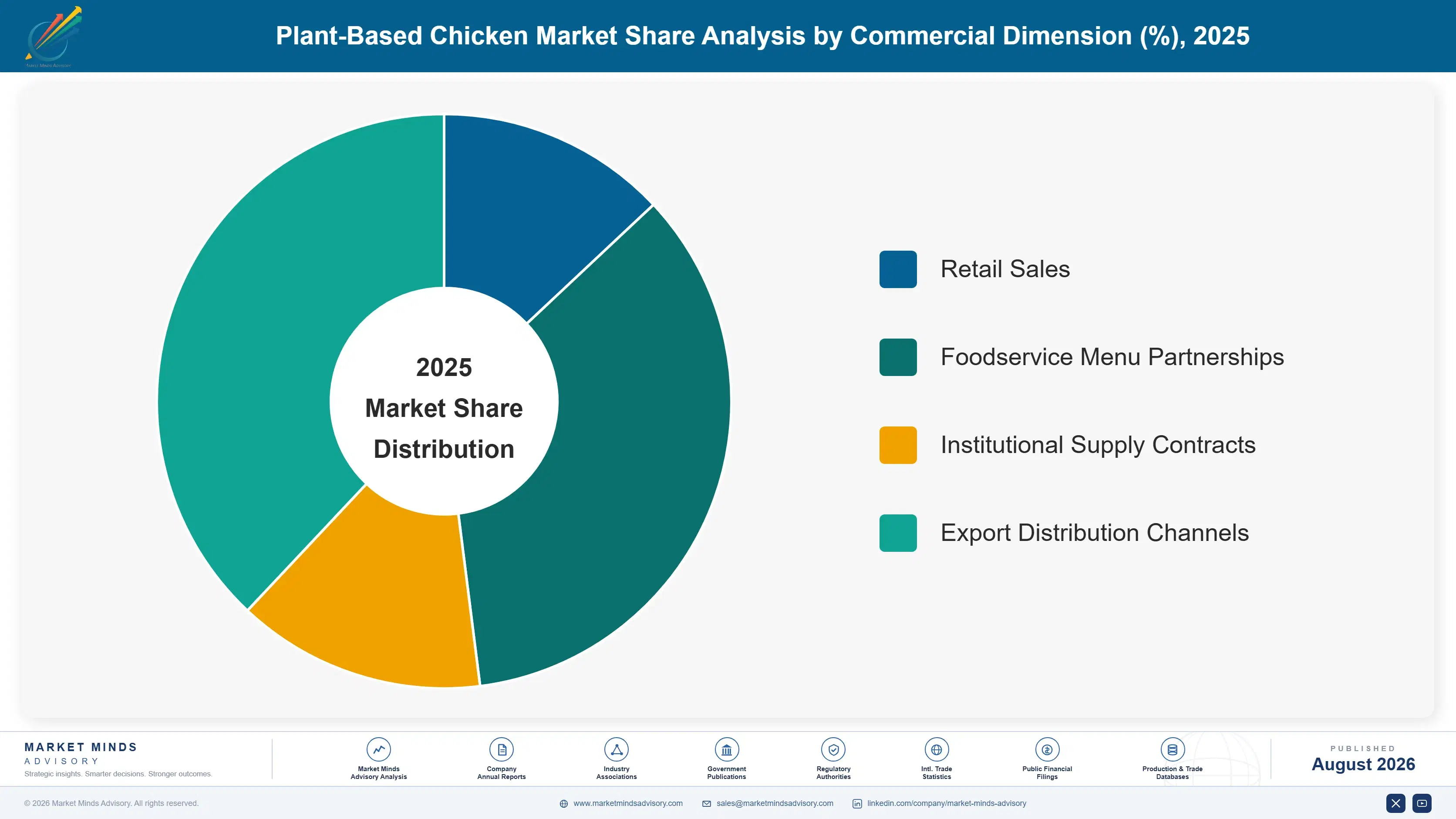
Segmentation here follows product cut and format category, the dimension that most directly determines texture credibility, foodservice suitability, and pricing power across this market right now today and going forward. Six categories span ground and processed formats through the whole-cut systems commanding the industry's fastest growth and highest sustained margin today across most major markets worldwide.
plant-based-chicken-market-trends-market-share-analysis-1787335230351

Whole-Cut Plant-Based Chicken Alternatives

Whole-cut plant-based chicken alternatives, engineered using shear cell processing and fibrous extrusion techniques to replicate the texture of intact chicken breast and tenders, are growing at roughly 16.8% CAGR, well over 1.7 times the broader category average pace, as foodservice chains and retailers increasingly favor convincing texture credibility over ground and processed formats nationwide and steadily beyond. Suppliers with genuine whole-cut manufacturing infrastructure are capturing pricing premiums well above ground and processed alternatives, and that gap is widening further as consumer trust rebuilds around demonstrably improved texture across most major developed retail and foodservice markets worldwide today. This segment increasingly behaves like a genuine meat replacement category rather than a plant-based novelty product.
CAGR 16.8%

Plant-Based Chicken Nuggets and Tenders

Plant-based chicken nuggets and tenders, combining familiar breaded formats with improved plant protein binding technology, are growing at roughly 12.4% CAGR as manufacturers extend texture innovation into family-friendly, high frequency purchase categories across most major grocery and quick-service retail channels worldwide today and increasingly beyond their traditional reach. This format lets families incrementally trial improved plant-based chicken without committing to whole-cut price premiums, lowering the adoption barrier considerably compared to switching entire meal categories at once and immediately. Suppliers with established breading and coating manufacturing capability are capturing disproportionate share of new product launches as the format becomes a genuine gateway into the broader whole-cut category today and increasingly beyond.
CAGR 12.4%
Full segment breakdown across 6 segments available in the complete report.

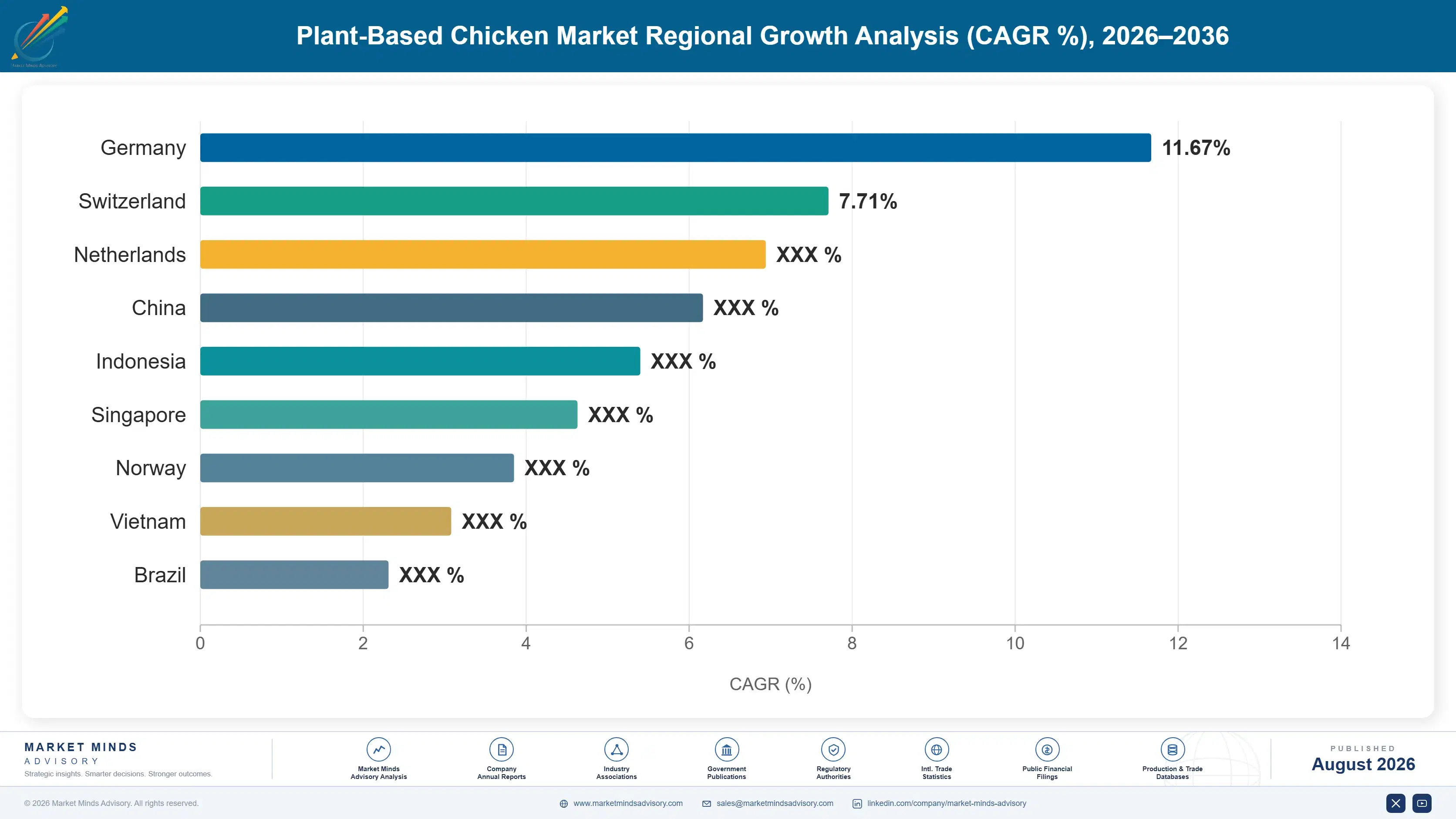
Regional Architecture and Country Demand Map

North America leads on the strength of the deepest foodservice partnership infrastructure and established flexitarian consumer base, while South Asia and Pacific posts the fastest regional growth as flexitarian adoption expands rapidly across India and Australia, and East Asia follows closely behind at meaningful scale.

North America

The United States anchors North America's leadership position, driven by the deepest quick-service and casual dining foodservice partnership infrastructure and the highest concentration of established flexitarian consumer spending across most major metropolitan retail markets nationwide and increasingly well beyond its current footprint and reach entirely and completely today and going forward steadily and consistently over time. Retailers here have responded to whole-cut texture innovation by dedicating expanding freezer and refrigerated aisles to premium plant-based formats well ahead of most other regions worldwide today. Canada contributes meaningfully too, with a comparably mature retail and foodservice infrastructure supporting steady regional category growth alongside its larger neighbor across most established distribution channels nationwide.
Share: 28% | CAGR: 9.8% (2026 to 2036)

Western Europe

Germany, the United Kingdom, and France drive Western Europe's plant-based chicken demand, supported by well established grocery and foodservice retail channels and increasingly strict EU labeling regulations that favor clean-label, simplified ingredient formulations over legacy heavily processed lines still common elsewhere globally today and well beyond that reach entirely. Consumers across the region show strong preference for whole-cut, minimally processed formulations, pushing suppliers toward texture innovation faster than in less regulated markets elsewhere around the world today. Growth trails the global average modestly as the category matures earlier here than in faster growing developing regions, though whole-cut formats continue gaining share within an otherwise steady overall regional demand base nationwide.
Share: 20% | CAGR: 8.3% (2026 to 2036)
Regional intelligence for 5 additional markets available in the complete report: East Asia, South Asia and Pacific, Latin America, Middle East and Africa, Eastern Europe. Contact sales@marketmindsadvisory.com.
plant-based-chicken-market-trends-country-cagr-analysis-1787335230866

Moving Beyond the Commodity Ground Format Sale

Suppliers moving decisively beyond commodity ground and processed pricing toward whole-cut texture innovation, foodservice partnership depth, and targeted regional expansion are capturing a disproportionate share of the category's expanding premium margin pool across most major consuming markets worldwide. Four levers stand out as the clearest paths to sustained margin growth through the full 2036 forecast window.

Building Dedicated Whole-Cut Texture Manufacturing Capability

Building dedicated whole-cut texture manufacturing capability, including shear cell processing and fibrous extrusion infrastructure, lets suppliers command pricing 32 to 44% above standard ground and processed formulations while capturing the fastest growing segment of the category overall today. This requires substantial upfront capital in texture science and processing equipment, but suppliers that have already invested are seeing foodservice and retailer relationships deepen quickly as texture credibility matures and consumer confidence grows steadily. The capability gap between suppliers with and without dedicated whole-cut infrastructure is widening each year as expectations rise steadily.
Market Impact: Commands pricing 32 to 44% above legacy formats

Building Direct Foodservice Chain Partnership Relationships

Building direct relationships with quick-service and casual dining chains through menu development partnerships and limited-time offerings adds 19 to 27% above standard retail pricing as foodservice credibility becomes the single most influential trust rebuilding mechanism in this category across most major markets worldwide today and beyond. Suppliers that invest in foodservice-facing partnership capability capture disproportionate trial conversion versus competitors relying solely on retail marketing and shelf placement alone entirely. This lever requires sustained investment in menu development and culinary relationships but pays back quickly once foodservice credibility rebuilds broader consumer trust.
Market Impact: Adds 19 to 27% above standard retail pricing now

Expanding East Asian Formulation and Distribution Capacity

Expanding formulation and distribution capacity across China and South Korea captures a growing $8M regional demand segment now while the region still has meaningfully less established whole-cut formulation competition than North America or Western Europe currently offer suppliers. Early movers building local manufacturing relationships and retail partnerships are securing preferential shelf positioning ahead of larger multinational suppliers that have not yet prioritized dedicated regional capacity investment. Given the region's above average growth rate, suppliers establishing genuine local presence now should see that early investment compound meaningfully over the coming decade.
Market Impact: Captures a growing $8M regional demand segment now

Securing Long-Term Retailer Design-In Supply Contracts

Securing long-term supply contracts with major grocery retailers and foodservice distributors captures a growing $11M distribution demand pool now while locking in shelf and menu space ahead of increasingly intense competition for premium whole-cut positioning nationwide and well beyond today. These contracts typically require suppliers to commit dedicated production capacity and meet stricter texture and clean-label documentation standards, but they provide revenue visibility that supports further manufacturing investment. Suppliers without such contracts face genuine risk of losing shelf space to competitors willing to commit capacity on more favorable long-term terms.
Market Impact: Captures a growing $11M distribution demand pool now

Who Controls the Margin Pool

The plant-based chicken market carries a CR5 of 44%, reflecting a landscape where dedicated alternative protein pioneers and legacy meat processors both hold meaningful share alongside a long tail of regional specialty formulators. Assessment here is based on annual revenue disclosed across plant-based meat and alternative protein product segments. The gap between leading suppliers and mid-tier challengers has narrowed as texture credibility matters more than brand recognition alone.
Current competitive activity centers on three dimensions: whole-cut texture innovation investment and processing technology development, foodservice partnership expansion with major dining chains, and clean-label reformulation breadth. Leading suppliers are increasingly acquiring specialty texture technology formulators to close capability gaps faster than internal development timelines would allow, reshaping the competitive landscape meaningfully.

Emerging pressure comes from specialty texture technology startups without legacy manufacturing scale but with genuine whole-cut processing expertise, an area where larger legacy meat processors have historically underinvested relative to their traditional protein processing budgets. Rankings are most likely to shift among suppliers still concentrated in ground and processed product lines, since consumer skepticism there shows no sign of easing and whole-cut formulation capability increasingly determines foodservice partnership survival over the next several years.
plant-based-chicken-market-trends-company-positioning-matrix-1787335231418

Competitive Moat and Risk Dimensions

BEYOND MEAT INC

Moat: Established Foodservice Partnerships

Beyond Meat's established foodservice partnership relationships and early-mover texture research investment, spanning multiple major quick-service chain collaborations, let it absorb whole-cut processing development costs faster than smaller regional competitors. Its existing brand recognition among flexitarian consumers gives new whole-cut formats immediate market credibility that competitors without comparable brand history must earn incrementally over multiple product cycles.
BEYOND MEAT INC

Risk: First-Wave Brand Baggage

The company's brand still carries meaningful association with the category's disappointing first wave of ground and processed formats, leaving exposure to consumer skepticism that newer entrants without that history do not face. Its pivot toward whole-cut texture credibility has required considerable investment to overcome accumulated consumer distrust, a challenge smaller, newer competitors without legacy brand baggage manage less extensively.
TYSON FOODS INC

Moat: Legacy Protein Processing Scale

Tyson Foods' established meat processing infrastructure and existing retailer and foodservice distribution relationships give it a genuine advantage in scaling whole-cut plant-based production without the capital investment smaller dedicated plant-based competitors must make from scratch. That infrastructure, built over decades of traditional protein processing, transfers efficiently to plant-based whole-cut manufacturing at meaningful commercial scale.
TYSON FOODS INC

Risk: Conventional Meat Brand Perception

Tyson Foods' core identity as a conventional meat processor can create consumer skepticism among dedicated flexitarian and vegan shoppers who prefer brands without conventional meat industry ties. Its scale in plant-based specific texture innovation still trails dedicated alternative protein specialists that have built deeper category-specific formulation expertise over a longer, more focused development period.

Players Tracked

Prominent Players

Beyond Meat Inc
Impossible Foods Inc
Tyson Foods Inc
Kellanova
Maple Leaf Foods Inc

Other Key Players

Quorn Foods Ltd
Gardein Protein International
Nestle SA
Kraft Heinz Company
Motif FoodWorks Inc
Rebellyous Foods Inc
Daring Foods Inc
Simulate Inc
Meati Foods Inc
Redefine Meat Ltd
Sunfed Meats Limited
Livekindly Collective
VFC Foods Ltd
THIS Isn't Foods Ltd
Planted Foods AG

Recent Developments

JULY 2026

Beyond Meat Acquires South Korean Texture Technology Formulator

Beyond Meat acquired a South Korean texture technology formulator in July 2026, adding regional shear cell processing capacity to support the company's expansion into East Asia's fastest growing plant-based chicken market segment. The deal gives Beyond Meat established distribution relationships across South Korean specialty retail immediately upon closing.
Signal: Signals accelerating multinational investment in East Asian plant-based chicken manufacturing capacity ahead of rising demand growth.
MARCH 2026

Tyson Foods Signs North American Quick-Service Restaurant Agreement

Tyson Foods signed a multi-year supply agreement with a major North American quick-service restaurant chain in March 2026, securing dedicated menu placement for its whole-cut plant-based chicken product lines across the chain's locations nationwide immediately upon signing. The agreement covers both dine-in and delivery distribution channels.
Signal: Signals growing supplier reliance on foodservice partnerships to rebuild consumer trust in mature North American markets.
NOVEMBER 2025

Impossible Foods and Maple Leaf Foods Form Texture Joint Venture

Impossible Foods and Maple Leaf Foods formed a joint venture in November 2025 to develop whole-cut texture technology, combining Impossible's protein science infrastructure with Maple Leaf's established manufacturing scale and foodservice distribution relationships. The venture initially targets both North American and European foodservice channels first.
Signal: Signals consolidating whole-cut texture expertise as suppliers pool capability rather than building it independently from scratch.

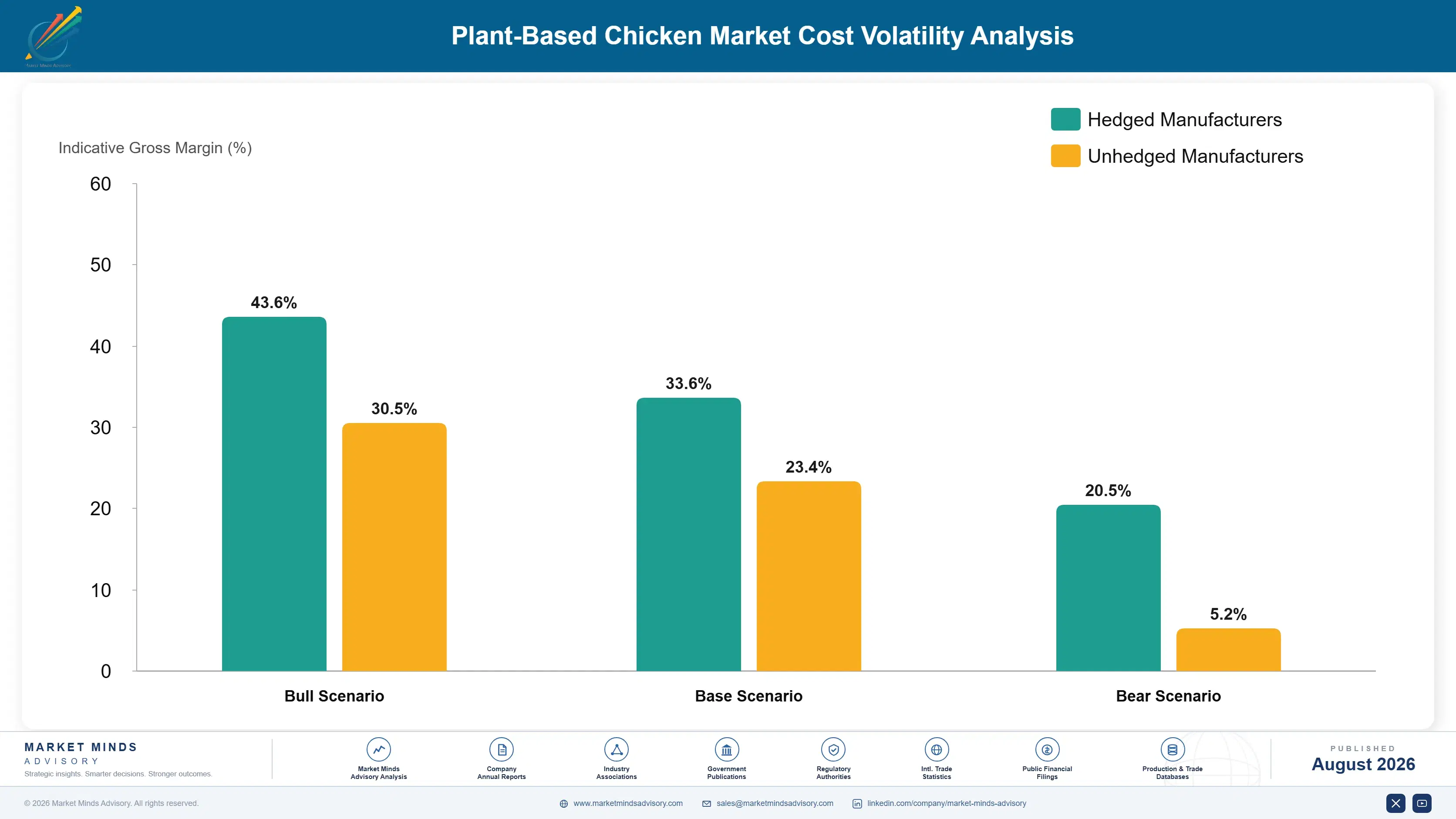
Pea and Soy Protein Feedstock Cost Exposure

Pea and soy protein isolates together represent roughly 34 to 42% of COGS for most plant-based chicken producers, sourced primarily from Canada, France, and various soy processing regions across North America and Southeast Asia and well beyond. Flavoring and binding agents add another meaningful share of total input cost for whole-cut format producers specifically today.
Pea protein pricing rose sharply through 2024 following supply disruptions at major Canadian and French processing facilities, an event tracked by the USDA and reflected in rising input costs across most global plant-based meat producers during that period. Suppliers without diversified sourcing relationships absorbed meaningfully higher costs than those with multi-region supply agreements already in place, according to disclosures in several producers' annual reports covering the affected fiscal year.

Smaller regional formulators face the steepest competitive disadvantage from this volatility, since they typically lack the purchasing scale to negotiate multi-year fixed pricing agreements that larger diversified producers secure routinely. Exposure varies meaningfully by geography too: producers with direct access to domestic pea and soy processing face considerably less currency-driven volatility than those relying on cross-border protein imports, giving vertically integrated regional producers a genuine cost advantage in select categories.
plant-based-chicken-market-trends-cost-volatility-analysis-1787335231623

Multi-Year Fixed Pricing Agreements Across Sourcing Regions

Suppliers are securing multi-year fixed pricing agreements with pea and soy protein processors across multiple sourcing regions simultaneously, meaningfully reducing exposure to any single facility disruption or currency fluctuation event that could otherwise compress margin sharply within a single fiscal year across most affected product categories and geographic sourcing footprints today and well into the future.

Vertical Integration Into Pea Protein Processing

Vertical integration into pea protein processing, particularly for producers with direct agricultural sourcing relationships in Canada and France, is letting larger suppliers capture margin previously paid entirely to third-party processors while also meaningfully improving supply reliability that customers increasingly require for large-scale whole-cut production contracts nationwide and internationally this year and well into the future ahead.

Diversified Multi-Region Protein Sourcing Strategy

Diversifying pea and soy protein sourcing across Canada, France, and Southeast Asian processors reduces single-region concentration risk meaningfully, giving suppliers considerably more negotiating leverage during localized supply disruptions and substantially reducing the overall commercial impact of any single region's disruption on production continuity across most major product lines and categories nationwide today and going forward.

Portfolio Architecture for Margin Defence

The plant-based chicken portfolio splits across three tiers with meaningfully different margin economics: volume commodity-adjacent ground and processed formats carrying gross margin near 13 to 19%, premium certified clean-label formats near 21 to 29%, and whole-cut texture-credible systems commanding the highest gross margin of the three tiers at 30 to 41% across nearly every producing region worldwide today and increasingly well beyond.
Suppliers competing purely in the volume tier face persistent price compression from private label competitors scaling aggressively on cost alone, while those with whole-cut texture capability capture considerably fatter margin pools that keep expanding as foodservice partnership and retailer procurement mandates broaden across major consumer and export accounts nationwide and increasingly well beyond their traditional domestic markets and established multi year distribution networks.

The clearest strategic tension sits between defending volume share in commodity ground and processed categories and committing capital toward the whole-cut manufacturing infrastructure premium tiers genuinely require, a tradeoff nearly every major supplier in this market is actively navigating this year as texture credibility demand accelerates and clean-label requirements tighten steadily across most regulated end-use categories and adjacent commercial segments nationwide and beyond.

Volume / Commodity-Adjacent Tier

Standard ground and processed formats serving routine retail and foodservice needs across most established distribution channels, priced primarily on protein cost and production scale rather than differentiated texture or certified clean-label performance features today.
Gross Margin: 13%-19%

Premium / Certified Tier

Certified clean-label formats engineered for simplified ingredient lists and process consistency, commanding meaningful premiums through validated production performance and testing documentation that retailers now require for most regulated categories today.
Gross Margin: 21%-29%

Sustainability / Regulatory / Next-Generation Tier

Whole-cut texture-credible systems designed for documented mouthfeel efficacy and foodservice compliance, engineered for extended shelf outcomes and validated formulation data that increasingly anchor long-term foodservice and retailer procurement decisions across most major regulated accounts.
Gross Margin: 30%-41%
plant-based-chicken-market-trends-portfolio-architecture-1787335232124

High-value Sub-segments and Strategic Watch-out

Whole-Cut Plant-Based Chicken Alternatives

Whole-cut texture-credible systems serving major foodservice and export retailer accounts represent the highest value, fastest growing pool in this market, combining premium pricing with expanding trust linked procurement mandates across large multinational retailer accounts spanning multiple continents and steadily growing even much wider still today.
Gross Margin: 32%-41%

Certified Clean-Label Formats

Certified clean-label formats serving regulated retail categories offer strong value with moderate growth, sustained by steady replacement demand and simplified ingredient certification requirements that limit competitive entry from smaller, less differentiated regional formulators lacking dedicated testing infrastructure and capability of their own to fully match.
Gross Margin: 22%-29%

Standard Ground and Processed Formats

Standard ground and processed formats remain the volume core of the market, delivering steady but comparatively thin margin on routine retailer shipments across most established distribution channels nationwide today, sustained mainly by recurring restocking cycles rather than any meaningful pricing power or genuine differentiation now overall.
Gross Margin: 13%-17%

Nugget and Tender Premium Formats

Nugget and tender premium formats warrant strategic monitoring as adoption in premium family and quick-service categories could accelerate quickly if major retailers standardize around the format industry wide, a shift that would meaningfully reshape competitive positioning among mid-tier suppliers currently underexposed to this fast growing category overall.
Gross Margin: 19%-25%

Trial-to-Loyalty Economics and Trust Evolution

Plant-based chicken purchasing behaves less like a genuine annuity business and more like a trial-conversion funnel, where the category's disappointing first wave means every purchase carries a higher trust burden than typical packaged food categories. Consumers who try a convincing whole-cut product typically become far more reliable repeat purchasers than average, turning a single successful trial into meaningfully more durable loyalty than early ground formats ever achieved.
Adoption stickiness varies meaningfully by end use vertical. Foodservice trial shows the deepest conversion to retail repeat purchase once consumers experience convincing texture in a professional preparation setting, while retail-only trial sees considerably higher abandonment as home cooking often fails to replicate restaurant-quality texture. Nugget and tender formats sit between the two, anchored by familiar preparation methods that sustain repeat purchase discipline across most tracked cohorts.

Buyer profiles have shifted generationally too. Younger, flexitarian-curious consumers try new plant-based formats with less accumulated skepticism than consumers burned by the category's first wave, treating each new launch as a genuine trial opportunity rather than a repeat disappointment. Older cohorts increasingly follow that shift as texture credibility rebuilds broader trust. That convergence is broadening the addressable buyer base well beyond the category's original early-adopter customer core.
plant-based-chicken-market-trends-end-use-penetration-index-1787335232612

MMA Category Growth Verdict

These are among the four positions where our research anticipates prominent divergence between winners and laggards over the coming forecast period. Each is grounded in the demand model, the regulatory perimeter, and the announced capacity pipeline.
01 / WHOLE-CUT TEXTURE INVESTMENT

Build Whole-Cut Texture Capability Before Ground Format Margin Erodes

Suppliers still concentrated in ground and processed formats face intensifying price competition as whole-cut alternatives grow at nearly twice the broader category average through 2036, a gap that compounds meaningfully across even a five year planning horizon for established producers. The shear cell and fibrous extrusion infrastructure whole-cut formulation requires takes years to build and cannot be assembled quickly once competitors have already secured foodservice design-in agreements across major accounts. Acting within the next two years preserves considerably more pricing power than waiting for the gap to widen further.
02 / FOODSERVICE PARTNERSHIP STRATEGY

Secure Foodservice Partnerships Before Competitors Lock In Trust

Foodservice partnerships have become the most credible trust rebuilding mechanism in this category, since professional preparation demonstrates texture credibility more convincingly than retail self-cooking ever can for skeptical consumers across most major markets. Suppliers that secure exclusive or preferred foodservice relationships now, before competitors lock in the major quick-service and casual dining chains, will capture a durable trust advantage that retail marketing alone cannot replicate quickly. Suppliers that wait risk losing foodservice partnership opportunities to competitors already embedded in chain menu development cycles.
03 / REGIONAL CAPACITY ALLOCATION

Weight New Capacity Toward East Asian Flexitarian Growth

East Asia is growing faster than the global category average, yet capacity commitments across the industry still concentrate disproportionately in North America and Western Europe despite that widening demand gap across major flexitarian growth markets. That mismatch leaves suppliers exposed to meaningful logistics cost and lead time disadvantages against regional competitors building formulation capacity closer to these faster growing demand centers across multiple large national markets. Early regional capacity investment secures durable share before local suppliers fully scale production and close the current cost and speed gap.
04 / TRUST REBUILDING CHANNEL PRIORITY

Prioritize Foodservice Channels to Rebuild Consumer Trust Fastest

Foodservice channels rebuild consumer trust faster than retail alone because professional preparation eliminates the home cooking variability that damaged consumer confidence during the category's disappointing first wave of ground and processed formats sold nationwide and beyond. Suppliers still weighted primarily toward retail-only distribution risk rebuilding trust more slowly than competitors already embedded in foodservice partnerships that demonstrate texture credibility directly to skeptical consumers. Prioritizing foodservice investment now captures that faster trust rebuilding pathway before competitors establish it as standard industry practice.

Engagement Snapshot From the Field

A live engagement with an industry participant carrying material or product regulatory and market exposure ahead of a defining policy shift, showing how our research translates into a defensible multi-year portfolio strategy.
MARKET MINDS ADVISORY · CLIENT ENGAGEMENT SUMMARY
Plant-Based Chicken Producer Strategic Portfolio Review and Transition Roadmap 2026·Investment Scenario on Plant-Based Chicken Exposure Evaluation 2025-26
CLIENT PROFILE
The client is a mid-tier North American alternative protein manufacturer with an established ground and processed plant-based chicken portfolio sold primarily through mass retail and grocery accounts. Revenue had declined as consumer skepticism from the category's first wave intensified, and leadership sought an independent assessment of where to reallocate formulation and capital investment across the broader plant-based chicken category going forward.
STRATEGIC CHALLENGE
The client's portfolio skewed heavily toward ground and processed formats facing accelerating consumer skepticism and declining repeat purchase rates across multiple retail channels. Leadership needed clarity on whether to defend that legacy position or pivot capital toward whole-cut formats where competitors were already capturing premium foodservice partnerships and stronger trust rebuilding momentum.
MMA APPROACH
MMA conducted primary interviews with regional foodservice buyers and grocery category managers across multiple accounts, benchmarked margin structures across all three portfolio tiers in detail, and modeled demand trajectories for whole-cut, certified, and standard ground formats through 2036 using the firm's primary survey dataset and forty seven expert interview panel.
KEY FINDINGS
  1. Whole-cut texture-credible formats were forecast to grow at nearly twice the client's existing ground format revenue base over the entire coming decade.
  2. Consumer skepticism from the category's first wave was found to depress repeat purchase rates on ground formats considerably more than industry-wide averages suggested.
  3. Competitors with dedicated whole-cut manufacturing capability were commanding meaningful pricing premiums over standard ground formats across comparable foodservice distribution channels nationwide and internationally.
  4. The client's East Asian distribution penetration lagged the category average significantly, concentrating revenue in slower growing, more mature North American grocery channels.
CLIENT PROFILE
The client is a mid-tier North American alternative protein manufacturer with an established ground and processed plant-based chicken portfolio sold primarily through mass retail and grocery accounts. Revenue had declined as consumer skepticism from the category's first wave intensified, and leadership sought an independent assessment of where to reallocate formulation and capital investment across the broader plant-based chicken category going forward.
STRATEGIC CHALLENGE
The client's portfolio skewed heavily toward ground and processed formats facing accelerating consumer skepticism and declining repeat purchase rates across multiple retail channels. Leadership needed clarity on whether to defend that legacy position or pivot capital toward whole-cut formats where competitors were already capturing premium foodservice partnerships and stronger trust rebuilding momentum.
MMA APPROACH
MMA conducted primary interviews with regional foodservice buyers and grocery category managers across multiple accounts, benchmarked margin structures across all three portfolio tiers in detail, and modeled demand trajectories for whole-cut, certified, and standard ground formats through 2036 using the firm's primary survey dataset and forty seven expert interview panel.
KEY FINDINGS
  1. Whole-cut texture-credible formats were forecast to grow at nearly twice the client's existing ground format revenue base over the entire coming decade.
  2. Consumer skepticism from the category's first wave was found to depress repeat purchase rates on ground formats considerably more than industry-wide averages suggested.
  3. Competitors with dedicated whole-cut manufacturing capability were commanding meaningful pricing premiums over standard ground formats across comparable foodservice distribution channels nationwide and internationally.
  4. The client's East Asian distribution penetration lagged the category average significantly, concentrating revenue in slower growing, more mature North American grocery channels.
RECOMMENDED STRATEGY
Phase 1: Phase one: reallocate a defined share of capital expenditure toward whole-cut texture manufacturing infrastructure over an eighteen month planning window. Phase 2: Phase two: build dedicated foodservice partnership and menu development capability to meaningfully rebuild consumer trust well beyond retail marketing alone. Phase 3: Phase three: phase down ground and processed capacity gradually while monitoring margin recovery across the repositioned whole-cut portfolio segments over time.
OUTCOME
Within twelve months of the engagement, the client reported (client-reported, unverified by MMA) a meaningful gross margin improvement across its repositioned whole-cut portfolio segments, alongside new foodservice partnership wins it attributed directly to the texture manufacturing investment guided by MMA's independent analysis and strategic recommendations.

Frequently Asked Questions

Foundational context covering the market sizes, CAGR, scope, country, region and competition that inform every finding below. This section is provided to cover basics and most often pre-purchase conversations, answered from the MMA Primary Research Dataset.

What is the current size of the Plant-Based Chicken Market?

The global plant-based chicken market reached an estimated $2.8 billion in 2025. This figure reflects consumption across all product format segments and regions tracked by MMA's primary survey dataset.

How large will the Plant-Based Chicken Market be by 2036?

The market is forecast to reach approximately $7.8 billion by 2036, expanding at a 9.8% compound annual growth rate from 2026 through 2036 under MMA's base case scenario.

What is the CAGR for the Plant-Based Chicken Market 2026 to 2036?

MMA projects a base case CAGR of 9.8% for 2026 to 2036, with a bull scenario of 11.2% and a bear scenario of 8.3% depending on texture innovation pace.

Which segment is growing fastest?

Whole-Cut Plant-Based Chicken Alternatives is the fastest growing segment, expanding at roughly 16.8% CAGR, about 1.7 times the category average, driven by foodservice adoption of credible formats.

Who are the major companies in the Plant-Based Chicken Market?

Major companies include Beyond Meat, Impossible Foods, Tyson Foods, Kellanova, and Maple Leaf Foods, alongside a broad base of specialty formulators competing across all three portfolio tiers.

Which country is growing fastest?

India is the fastest growing major country market, supported by rapidly expanding organized retail infrastructure and rising flexitarian consumer adoption among a large and increasingly urban middle class population nationwide.

Report Segmentation Architecture

The full report scope spans multiple orthogonal segmentation dimensions, with cross-tabulated demand data provided for each dimension pair. Coverage extends further to regional breakdowns, trend trajectories, and the competitive detail needed to support segment-level decision-making.

By Product Cut and Format Category

  • Ground and Crumble Formats
  • Processed and Deli Formats
  • Breaded Nuggets and Tenders
  • Whole-Cut Breast and Fillet Alternatives
  • Broth and Bouillon Formats
  • Shredded and Pulled Formats

By End-Use Industry

  • Mass Retail and Grocery
  • Quick-Service and Casual Dining Foodservice
  • Institutional and Foodservice Contracts
  • E-Commerce and Direct-to-Consumer

By Commercial Dimension

  • Retail Sales
  • Foodservice Menu Partnerships
  • Institutional Supply Contracts
  • Export Distribution Channels

By Region

  • North America
  • Western Europe
  • East Asia
  • South Asia and Pacific
  • Latin America
  • Middle East and Africa
  • Eastern Europe

Scope, Methodology, and Coverage

Every figure in this report is reproducible from documented input assumptions. The scope below maps the historical period, the forecast horizon, the segmentation dimensions, and the countries covered, alongside the underlying primary and qualitative methodology.
Historical Period
2020 to 2025
Forecast Period
2026 to 2036
Base Year
2025 (USD billions; MMA Primary Research Dataset, August 2026)
Market Definition
The plant-based chicken market covers plant protein formulations engineered to replicate chicken meat texture and flavor, including whole-cut, ground, breaded, and processed formats. It excludes cultivated meat products and hybrid plant-animal protein blends.
Quantitative Units
USD billions (current prices); million kilogram units of volume where applicable
Segmentation Dimensions
By Product Cut and Format Category; By End-Use Industry; By Commercial Dimension; By Region
Regions Covered
North America, Western Europe, East Asia, South Asia and Pacific, Latin America, Middle East and Africa, Eastern Europe
Countries Covered
USA, Canada, Germany, UK, France, China, Japan, South Korea, India, Australia, Brazil, Mexico, Indonesia, Vietnam, UAE, Saudi Arabia, South Africa, Nigeria, Turkey, Poland, Czech Republic, Netherlands, Italy, Spain, Sweden, Switzerland, Argentina, Colombia, Singapore, Thailand, and additional markets relevant to this sector
Key Companies Profiled
Beyond Meat Inc, Impossible Foods Inc, Tyson Foods Inc, Kellanova, Maple Leaf Foods Inc, Quorn Foods Ltd, Gardein Protein International, Nestle SA, Kraft Heinz Company, Motif FoodWorks Inc, Rebellyous Foods Inc, Daring Foods Inc, Simulate Inc, Meati Foods Inc, Redefine Meat Ltd, Sunfed Meats Limited, Livekindly Collective, VFC Foods Ltd, THIS Isn't Foods Ltd, Planted Foods AG
Quantitative Methodology
Primary survey, n=3,800 respondents, Q4 2025, six countries; demand-side model with trade association cross-validation
Qualitative Methodology
47 expert interviews, Q4 2025; applied to validate demand model assumptions, identify emerging dynamics, and assess competitive positioning
Report Format
PDF and XLSX data workbook (Word format preview document)
Publisher
Market Minds Advisory
Report Code
MMA-2026-AGR-109
Published
August 2026
Contact
sales@marketmindsadvisory.com | www.marketmindsadvisory.com

Purchase the full Plant-Based Chicken Market Report (2026 to 2036).

This report provides comprehensive coverage of the global plant-based chicken market, including detailed segmentation across six format categories and seven-region demand analysis. It benchmarks twenty leading suppliers on texture innovation capability, foodservice partnership depth, and margin structure, and models base, bull, and bear demand trajectories through 2036. The analysis draws on MMA's primary survey of 3,800 respondents and 47 expert interviews conducted in Q4 2025, alongside company disclosures and government trade data. Together these give strategy and commercial teams a defensible basis for capital and formulation investment decisions.
Six-segment format breakdown with growth rankings
Seven-region demand architecture and pricing analysis
Twenty-company competitive benchmarking and moat analysis
Input cost and feedstock volatility exposure modeling
Revenue lever and margin expansion pathway analysis
Anonymized client case study with strategic recommendations

Built For The People Who Decide

From boardroom strategy to bench-side execution, this report is read cover-to-cover by leaders shaping the next decade of their industry, turning demand scenarios, market dynamics and valuation benchmarks into decisions.
CXOs/ Presidents/ VPs/ Managers
M&A and Corporate Development
Strategy Teams and R&D Heads
Procurement and Product Directors
Regulatory and Compliance Leaders
Investor Relations and Equity Analysts