Market Minds Advisory
Plant-Based Burger Market

Plant-Based Burger Market: The repeat purchase failure, unreachable price parity and whole-food reformulation to 2036

Awareness was achieved and distribution was won, and roughly a fifth of the people who tried this product ever bought it a second time, which is the only number that ever mattered.

Lead Analyst

Lisa Gevelber

Published

September 2026

Make Smarter Decisions with Customized Research Insights

Request a free sample report and evaluate market opportunities, growth trends, and competitive dynamics relevant to your business needs.

2025 MARKET VALUE$3.1BMarket Size 2025
2036 FORECAST VALUE$6.1BBase Case , 2026 to 2036
CAGR 2026 TO 20366.4 %Bull 7.6% / Bear 5.2%
INCREMENTAL OPPORTUNITY$2.8BNet 10- year value creation
EXPANSION MULTIPLE1.86x2036 value over 2026 base
Strategic Levers
M&A Pipeline
Regional Outlook
Country Rankings
Competitive Intelligence
Segmental Deep-dive
Call-Us : 91 93563 13602

Executive Snapshot and Market Trajectory

Trial reached levels most new food categories never approach, and roughly 21% of first-time buyers purchased again. Awareness and distribution were solved comprehensively. Repeat purchase was not, and the industry spent most of its money on the two problems it had already fixed. Repeat is where the money belonged.
Three reasons explain the shortfall and none of them was addressed by the spending. Taste and texture against a familiar reference. Price at roughly 1.9 times beef mince per equivalent weight. And an ingredient list running near 18 declared components on a product sold partly on health grounds, which made it an easy target. Promotional spending addressed only the second of those three, and made the price expectation considerably worse in doing so.
Whole-food and minimally processed formats grow at 9.6%, half again the market rate of 6.4%, because they answer the third objection directly rather than arguing with it. They already carry 16% of category volume. North America holds 32% of value and Western Europe follows at 30%. European penetration per capita exceeds American rates. East Asia sits at 16%. Retail facings are the constraint that follows.
Market Definition
This report covers plant-based burger patties and formed products sold as meat alternatives, spanning soy protein based, pea protein based, whole-food and minimally processed, mycoprotein and fermentation-derived, blended meat and plant formats, and other legume and grain formats. Value is measured at manufacturer level across retail and foodservice sales. Excluded are plant-based sausages, mince and other formats, dairy alternatives, cultivated meat products, protein isolates and ingredients sold to formulators, and traditional vegetarian foods not positioned as meat alternatives.
Base Year Value
$3.1B in 2025 (MMA Primary Research Dataset, August 2026)
Forecast Period
2026 to 2036, eleven discrete annual values
CAGR
6.4% base case. Bull 7.6%. Bear 5.2%.
Fastest Growth Segment
Whole-Food and Minimally Processed: 9.6% CAGR
Fastest Growth Country
India: 9.4% CAGR
Fastest Growth Region
South Asia and Pacific: 8.6% CAGR
Largest Region
North America: 32% of 2025 global value
Market Leaders
Beyond Meat, Nestle, Unilever, Kellanova and Impossible Foods lead the market. Source: MMA Primary Research Dataset, July 2026.
Primary Survey
n=3,800 procurement and R&D decision-makers, Q4 2025, six countries
Methodology
Demand-side build-up, cross-validated against public data, 47 expert interviews

Plant-Based Burger Market Forecast Scenarios

plant-based-burger-market-trends-size-forecast-scenario-1787580450629
Growth ran at 9.8% between 2020 and 2025, and quoting that figure without qualification badly misleads anybody planning against it. The first half of the period saw expansion at rates no packaged food category sustains, driven by distribution gains and heavy investment. Retail volumes then declined across several major markets from 2022 as trial converted to repeat far more weakly than anybody had modelled.
The 6.4% base case describes a category that now behaves like ordinary packaged food, and it rests on three mechanisms. Whole-food and minimally processed formats at 9.6% answering the ingredient objection directly. Mycoprotein and fermentation-derived products at 8.8% on texture that extrusion struggles to reach. And Indian growth at 9.4%, the fastest of any country, where the comparison is not against inexpensive beef at all. None requires the price gap against beef to close.
The 7.6% bull case is reformulation genuinely closing the taste gap in whole-food formats, since that objection is the one consumers cite most and the one nobody has yet solved convincingly. The 5.2% bear case is retail delisting continuing as buyers reallocate shelf space that repeat purchase rates no longer justify holding. Reduced facings then lower trial, lowering volume further.

Trial Won, Repeat Lost

This category achieved something most new food propositions never manage, which was near universal awareness and mainstream retail distribution within a few years. It then discovered that neither of those was the constraint. Roughly 21% of first-time buyers purchased again, and a category converting one trial in five cannot sustain the shelf space that distribution success awarded it.
TOP-FIVE CONCENTRATION34%Combined position across supply held by the leading manufacturers
TRIAL TO REPEAT CONVERSION21%Share of first-time buyers who purchase the product again
PRICE AGAINST BEEF MINCE1.9xShelf price relative to conventional mince per equivalent weight
INGREDIENT LIST LENGTH18 itemsTypical declared components on a leading retail formulation
FOODSERVICE VOLUME SHARE38%Portion of category volume sold through restaurants and catering
WHOLE-FOOD FORMAT GROWTH SHARE16%Category volume now carrying a short recognisable component list
Three reasons account for the shortfall and the industry addressed none of them directly. Taste and texture measured against a reference product every consumer knows intimately. Price at around 1.9 times beef mince per equivalent weight, where the promised parity was never arithmetically available because protein isolate, methylcellulose and flavour systems do not cheapen the way commodity inputs do, while beef mince is inexpensive partly because a carcass carries by-product credits a patty has no equivalent of.
The third objection landed hardest because it was self-inflicted. A product sold partly on health grounds carrying around 18 declared ingredients was an easy target once ultra-processed food became a mainstream conversation. Arguing the point with consumers has achieved nothing anywhere it has been attempted, and whole-food formats now remove it instead.
"Everyone in this category benchmarked trial and treated repeat as something that would follow. It did not follow. One buyer in five came back, and the three reasons the other four gave were taste, price and the ingredient list, none of which distribution or advertising was ever going to fix."
Director, Alternative Proteins and Packaged Foods Practice · MMA Food and Agriculture Ingredients Practice · August 2026

Market Trends

Whole-food formats answer the processing objection directly

A product sold partly on health credentials while declaring around 18 ingredients was always exposed once ultra-processed food became a mainstream concern, and arguing the point with consumers has proved entirely futile. Whole-food formats built on visible legumes, mushrooms and grains with short recognisable component lists answer the objection rather than contesting it, and they now carry 16% of category volume while growing at 9.6%. Commercially this is where reformulation effort produces the clearest return, because the objection it removes is the only one a manufacturer fully controls. It is also the objection that most reduces ingredient cost.
Market Impact: Indian demand compounds at 9.4%

Foodservice holds up where retail shelf comparison does not

Foodservice accounts for 38% of category volume and has proved considerably more resilient than retail, because a menu item competes for a specific occasion rather than sitting on a shelf beside beef mince with a price label directly alongside it. A flexitarian eating with a group orders the plant option without conducting any price comparison at all. Commercially this makes foodservice the more defensible channel despite lower margins, and manufacturers who withdrew from it to concentrate on retail economics chose the harder environment. Rebuilding a surrendered menu listing is far harder than retaining one.
Market Impact: Segment compounds at 8.8% annually

Market Opportunities and Growth Drivers

Markets without cheap beef reference judge the product differently

Indian growth at 9.4% leads every country in this market, and the reason is that the comparison a consumer makes there is not against inexpensive beef mince at all. Where the reference point is paneer, legume patties or chicken, a plant-based burger is judged on its own terms rather than as a substitute failing to match something familiar and cheaper. Quick service restaurant expansion carries the format into markets where it arrives as a new product rather than as an imitation of an existing one. That is a considerably easier product to sell.
Market Impact: Priced at 1.9 times beef mince

Fermentation-derived proteins reach textures extrusion struggles with

Mycoprotein and fermentation-derived proteins grow at 8.8% because filamentous structures produce fibrous texture natively rather than through the shear and pressure that extrusion applies to isolates, which is a genuinely different route to the eating quality consumers keep citing as the reason they did not return. Ingredient lists on these products also tend to be shorter. Commercially the capacity is capital intensive and slow to build, which limits how quickly the segment can grow even where demand supports it. Fermentation plant takes years to commission. Capacity rather than demand caps the growth here.
Market Impact: Repeat conversion sits at 21%

Market Restraints and Challenges

Price parity was promised and is not arithmetically available

Plant-based burgers sit around 1.9 times beef mince per equivalent weight and the gap has not closed with scale. The root cause is that protein isolates, methylcellulose, refined oils and flavour systems do not cheapen the way commodity inputs do, while beef mince is inexpensive partly because a carcass generates by-product credits across hide, tallow and offal that a plant patty has no equivalent of at all. Commercially the parity promise raised expectations the category could never meet, and manufacturers are now competing on other grounds. Scale was never going to change that arithmetic.
Market Impact: Whole-food formats hold 16% share

Retail buyers reallocate shelf space repeat rates cannot justify

A category converting roughly 21% of trial into repeat purchase cannot hold the shelf space that distribution success originally won, and retail buyers reviewing rate of sale reach that conclusion without any prompting. The root cause is straightforward category management rather than any hostility toward plant-based products. Commercially this compounds, since reduced facings lower visibility which lowers trial which lowers total volume further. Manufacturers are consolidating ranges toward fewer better-performing lines, which is the correct response and an uncomfortable one. Consolidating toward fewer better-performing lines is the correct response and an uncomfortable one for anybody who built the range.
Market Impact: Foodservice takes 38% of volume
4 additional market trends, 3 additional growth drivers, and 2 additional restraints and challenges are covered in the full report. Contact sales@marketmindsadvisory.com to access the complete intelligence.

Segment CAGR and Growth Architecture

Value is classified here by protein source and formulation approach, since ingredient list length, texture route and price position all follow directly from what the patty is actually built from. Distribution channel, consumer motivation and pack format are handled separately in the framework below, because most formulations reach consumers through several routes at once.
plant-based-burger-market-trends-market-share-analysis-1787580451196

Whole-Food and Minimally Processed

Growing at 9.6%, half again the market rate, whole-food formats are built on visible legumes, mushrooms, grains and vegetables with short recognisable ingredient lists, and they answer the ultra-processed objection by removing it rather than by arguing about it. That objection is the only one of the three repeat purchase barriers a manufacturer fully controls, which is why reformulation effort produces the clearest return here. These products generally make no claim to imitate beef, which sidesteps the taste comparison that defeats extruded formats and accepts a smaller addressable audience in exchange for a considerably more loyal one. They now carry 16% of category volume. That trade is deliberate and it works.
CAGR 9.6%

Mycoprotein and Fermentation-Derived

Filamentous fungal and fermentation-derived proteins produce fibrous texture natively rather than through the shear, heat and pressure that extrusion applies to protein isolates, which is a genuinely different route to the eating quality consumers cite when explaining why they did not buy again. Ingredient lists tend to be shorter as a result, which helps with the processing objection at the same time. Growth at 8.8% is constrained by capacity rather than demand, since fermentation plant is capital intensive and slow to commission, and that constraint will persist regardless of how well the products perform with consumers. Consumers describing why they did not repurchase cite eating quality more than anything else.
CAGR 8.8%
Full segment breakdown across 6 segments available in the complete report.

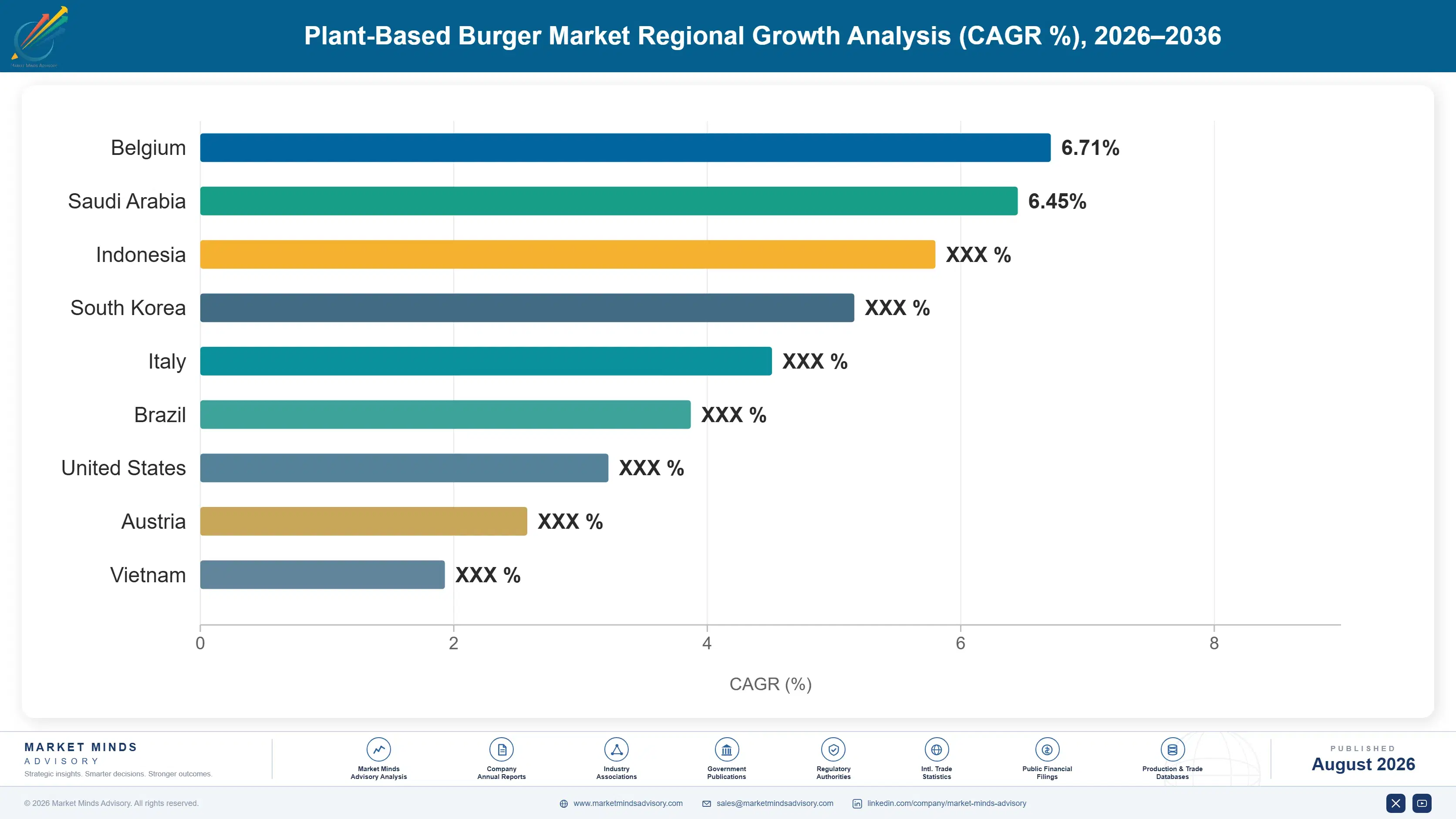
Regional Architecture and Country Demand Map

North America holds 32% of value and Western Europe follows closely at 30%, above its usual band, because per capita plant-based penetration across British, German and Dutch retail exceeds American rates on a considerably smaller total base. East Asia sits at 16%, below its own band.

North America

This is where the category was built and where its retreat has been most visible, with retail volumes declining across several years as trial failed to convert into repeat purchase at rates supporting the shelf space distribution had won. Beef mince is inexpensive and culturally central, which makes the price and taste comparisons unusually harsh here. Foodservice has held up considerably better than retail through quick service and casual dining listings. Whole-food formats are gaining ground as the processing criticism landed hard in a market attentive to it. Growth at 5.4% reflects a category past its expansion phase. Retail buyers here review rate of sale rigorously, which has accelerated the facings reduction considerably.
Share: 32% | CAGR: 5.4% (2026 to 2036)

Western Europe

At 30% this region sits above the standard band, because per capita plant-based consumption across British, German, Dutch and Scandinavian retail exceeds American rates even on a smaller total population base. The category is more embedded in mainstream grocery here and less dependent on a single wave of distribution gains. Retailer own label entered early and holds substantial share, which compressed branded pricing but also normalised the category. Processing criticism has been vocal, particularly in Germany and the Netherlands. Growth at 4.8% is the weakest on this table and reflects genuine maturity. Retailer own label entered early and holds substantial share, which compressed branded pricing while normalising the category among mainstream shoppers.
Share: 30% | CAGR: 4.8% (2026 to 2036)
Regional intelligence for 5 additional markets available in the complete report: East Asia, South Asia and Pacific, Latin America, Middle East and Africa, Eastern Europe. Contact sales@marketmindsadvisory.com.
plant-based-burger-market-trends-country-cagr-analysis-1787580451781

Where Category Value Can Still Grow

Four moves matter in a category that solved awareness and distribution comprehensively and then discovered that neither of them was ever the problem. Two concern the repeat purchase barriers a manufacturer can genuinely act upon, and two concern the channels and markets where the comparison being made is not the one this category keeps losing.

Remove the ingredient objection rather than arguing it

A product sold partly on health credentials while declaring around 18 ingredients was always vulnerable once ultra-processed food became a mainstream conversation, and contesting the point with consumers has achieved nothing anywhere. Whole-food formats with short recognisable lists remove the objection entirely and grow at 9.6% while holding 16% of volume. This is the only one of the three repeat barriers a manufacturer fully controls, which makes it the reformulation with the clearest return available. Flavour systems and texturisers are expensive to buy. Cost and credibility improve together. The reformulation pays twice.
Market Impact: Cuts an 18 item list of declared ingredients

Defend foodservice rather than retreating into retail

Foodservice carries 38% of category volume and has proved far more resilient, because a menu item competes for an occasion rather than sitting beside beef mince with a price label attached. A diner ordering the plant option in a group makes no price comparison at all. Manufacturers who withdrew from foodservice to chase retail margin moved into the harder environment, and rebuilding those listings afterwards is considerably more difficult than holding them was. Chains rarely reopen a listing decision once taken. Margin is lower and the volume is steadier. Occasion beats price comparison.
Market Impact: Protects 38% of the total volume in category

Stop promising parity that arithmetic will not deliver

Plant burgers sit around 1.9 times beef mince per equivalent weight and scale has not closed it, because protein isolates and flavour systems do not cheapen like commodities while beef carries by-product credits across hide, tallow and offal that a patty cannot replicate. Continuing to promise parity sustains an expectation the category will keep failing. Competing on taste, ingredient simplicity or occasion is honest and winnable, and price is neither. Expectations set by a promise nobody can keep are worse than no promise at all, and the category has been living with that for years.
Market Impact: Accepts a 1.9 times position against beef mince

Grow where the reference product is not cheap beef

Indian growth at 9.4% leads this market because consumers compare a plant burger against paneer, legume patties or chicken rather than against inexpensive beef mince, which changes the judgement entirely and removes both the price and the imitation problems at once. Markets with established vegetarian eating receive the product as something new rather than as a substitute failing to match a familiar reference. That is a fundamentally easier proposition to sell. Both objections disappear at once in those markets. The product is received as new rather than imitative. That is an easier sale entirely.
Market Impact: Serves demand that is growing at 9.4% yearly

Who Controls the Margin Pool

Five manufacturers hold 34% of this market, measured on retail and foodservice sales value at manufacturer level, the basis used throughout this section. Concentration is falling rather than consolidating, because retailer own label entered early in European markets and because contract manufacturing capacity built during the expansion phase is now available to anybody wanting a brand on a pack. Barriers to entry have fallen considerably.
Competition runs on four dimensions. Reformulation capability toward shorter ingredient lists, which addresses the one objection manufacturers actually control themselves. Foodservice channel position, which has held up considerably where retail has not. Texture technology, since eating quality remains the most cited barrier to repurchase. And cost structure against a price gap that scale is not going to close in any timeframe.

Rankings shift toward manufacturers with whole-food formats and durable foodservice listings, and away from those built entirely on extruded isolate products sold across retail shelves. Large food companies hold distribution reach and the patience to sustain a portfolio through a downturn. Specialists hold texture technology and brand credibility. Fermentation participants hold a genuinely different route to eating quality. None of those three advantages is easily copied.
plant-based-burger-market-trends-company-positioning-matrix-1787580452307

Competitive Moat and Risk Dimensions

NESTLE

Moat: Distribution reach and patience

The company reaches retail and foodservice across every major market through existing relationships rather than through category-specific listings, and it can sustain a portfolio through a downturn that has forced specialists to retrench sharply. Reformulation capability across whole-food and shorter ingredient formats also sits within existing research resources rather than requiring fresh investment.
NESTLE

Risk: Brand credibility with committed consumers

The consumers most likely to repeat purchase are frequently those most sceptical of large food companies, and a corporate brand carries less credibility in this category than in most others. Specialists with clear positioning hold that loyal segment. Whole-food formats appeal precisely to consumers who read labels carefully and consider who made the product.
QUORN FOODS

Moat: Fermentation texture and history

Mycoprotein produces fibrous texture natively rather than through extrusion of isolates, which addresses the eating quality objection through a genuinely different route, and the company has decades of consumer familiarity behind it in several European markets. Ingredient lists are shorter than extruded equivalents, which helps with the processing criticism at the same time.
QUORN FOODS

Risk: Fermentation capacity constrains growth

Fermentation plant is capital intensive and slow to commission, which caps how quickly supply can respond regardless of how well products perform with consumers. Extruded manufacturers can add capacity far more readily through contract arrangements. A texture advantage that cannot be scaled at demand speed converts into a smaller position than the product quality would otherwise support.

Players Tracked

Prominent Players

Beyond Meat
Nestle
Unilever
Kellanova
Impossible Foods

Other Key Players

Conagra Brands
Maple Leaf Foods
Quorn Foods
Amy's Kitchen
Vivera
Heura Foods
Redefine Meat
THIS
Oumph
Moving Mountains
Naturli Foods
Dr. Oetker
Grupo Bimbo
Charoen Pokphand Foods
Ajinomoto

Recent Developments

FEBRUARY 2025

A retailer reduced plant-based facings on rate of sale

A grocery retailer reduced plant-based burger facings across its estate following a category review of rate of sale and repeat purchase data, reallocating the space to categories with stronger repeat performance. This was a category management decision rather than any transaction between manufacturers. Repeat purchase data drove the review.
Signal: Shelf space follows repeat purchase, and reduced facings then lower trial which lowers total volume further
JUNE 2025

A manufacturer launched a short ingredient list range

A plant-based manufacturer launched a range built on visible legumes and vegetables with a substantially shorter declared ingredient list, positioned against processing criticism rather than as an imitation of beef. This was a product launch rather than any acquisition or partnership arrangement. Beef imitation was explicitly abandoned.
Signal: Removing the processing objection is the only repeat purchase barrier that a manufacturer genuinely controls alone
OCTOBER 2025

A quick service chain retained plant listings despite retail decline

An international quick service chain retained its plant-based burger menu listings across markets where retail volumes had declined, citing consistent order rates from group dining occasions rather than any dedicated consumer segment. This was an operational decision rather than a supplier arrangement. Retail delisting had already occurred.
Signal: Menu occasions sustain the demand that any shelf comparison against inexpensive beef mince will consistently destroy

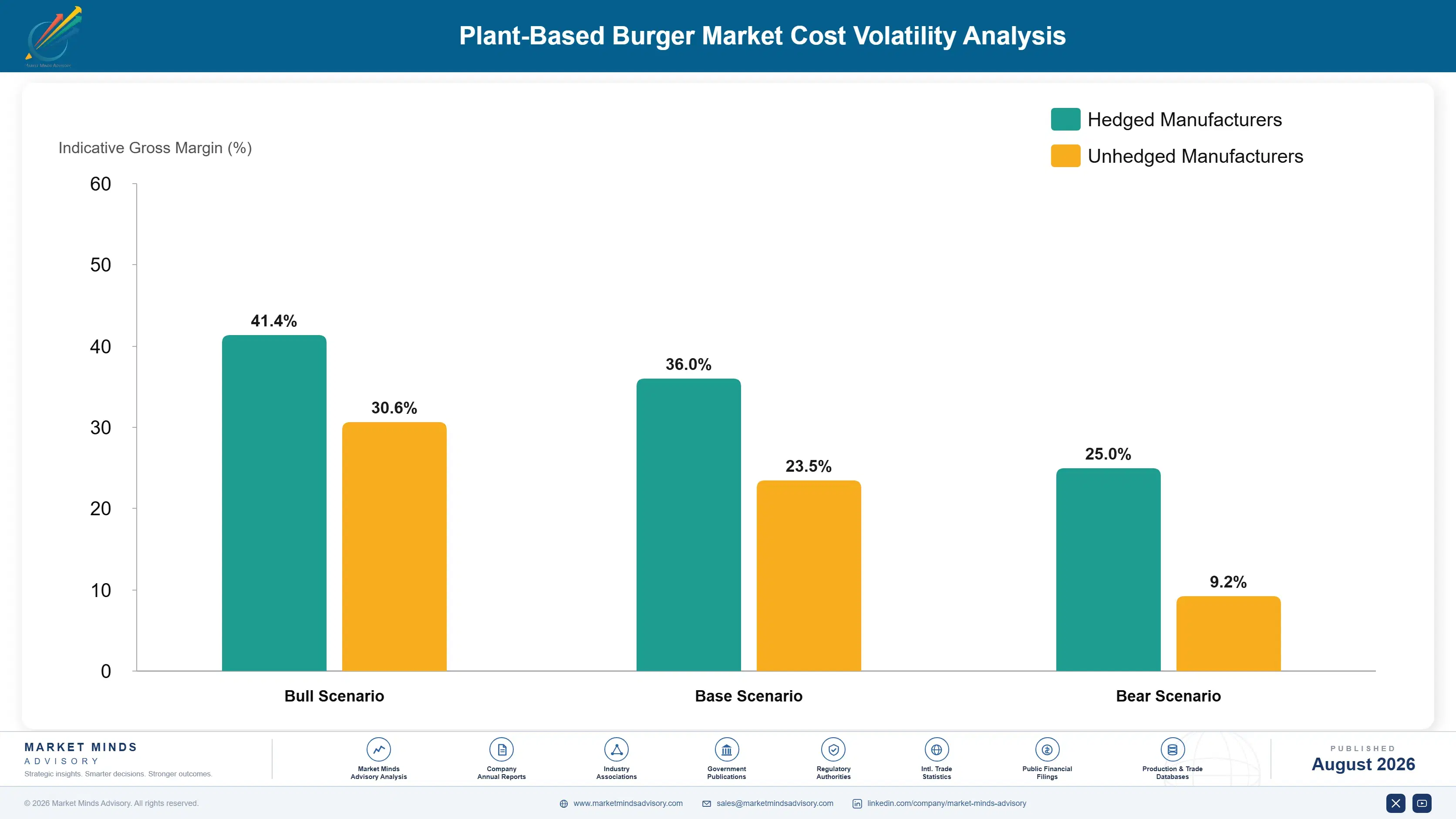
What Sets Product Cost

Protein isolate or concentrate accounts for roughly 34% of manufactured cost, with refined oils, methylcellulose, flavour systems and colouring adding around 26% between them. Extrusion or fermentation processing takes about 17%, and fermentation carries considerably higher capital recovery than extrusion does. Packaging and chilled or frozen distribution consume most of the remainder across every format in the category.
Pea and soy protein isolate prices rose sharply through 2022 as agricultural commodity and processing energy costs climbed together, and specialty ingredient supply tightened as capacity built for expected category growth was reassessed. Beyond Meat noted input cost and demand pressure across its operations in its Annual Report 2022. Manufacturers on annual retail pricing absorbed most of it while facing consumers already resistant to the existing price gap.

The disadvantage falls on everybody relative to beef, and it operates through inputs rather than through efficiency. Beef mince is inexpensive partly because a carcass generates by-product credits across hide, tallow and offal that offset the cost of the meat itself, and a plant patty has no equivalent revenue anywhere. That is why parity was never arithmetically available, and no processing improvement or scale increase changes the underlying comparison.
plant-based-burger-market-trends-cost-volatility-analysis-1787580452502

Reformulate toward fewer and simpler declared ingredients

Around 18 declared components on a product sold partly on health grounds created an objection that arguing with consumers has never resolved. Shorter lists built on visible legumes and vegetables remove it, and they frequently reduce ingredient cost at the same time since flavour systems and texturisers are expensive. The reformulation addresses cost and credibility together.

Hold foodservice listings through the retail downturn

Foodservice carries 38% of volume and competes for an occasion rather than against a price label on an adjacent shelf, which has made it considerably more durable. Margins are lower and the volume is steadier. Rebuilding a menu listing once surrendered is far harder than retaining it, since chains rarely reopen decisions they have already made.

Rationalise ranges toward lines that actually repeat

A category converting roughly 21% of trial cannot hold the shelf space distribution won, and retail buyers reach that conclusion from rate of sale data without prompting. Consolidating toward fewer better-performing lines concentrates volume, improves rate of sale on what remains and gives buyers a reason to keep the facings that survive. Buyers respond to rate of sale.

Portfolio Architecture for Margin Defence

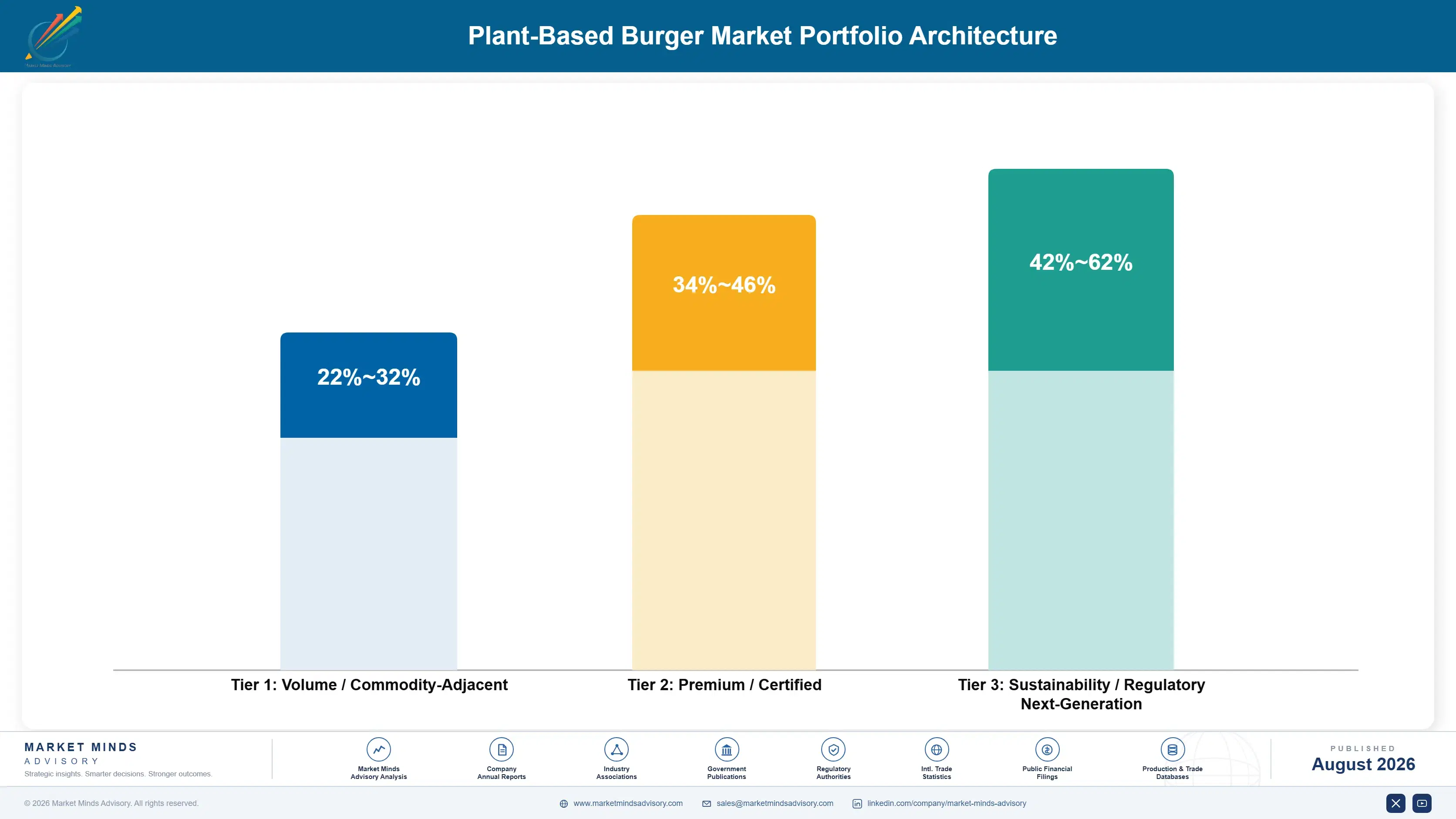
Margin separates on formulation approach and channel rather than on manufacturing scale, which is not what the category expected when it was building capacity. Extruded isolate products on retail shelves run at gross margins in the mid twenties while facing a price gap consumers reject and a processing criticism they accept. Foodservice supply runs lower still on contract pricing. Whole-food formats run considerably better on shorter ingredient lists and a loyal audience. Fermentation-derived products run highest where capacity allows them to be supplied at all.
The tension is that extruded retail products carry the installed capacity while whole-food and fermentation formats carry the growth, and moving between them means new equipment or new plant rather than a recipe change. Manufacturers holding extrusion capacity built for a growth rate that did not materialise face utilisation problems that reformulation does not solve. Several are running lines well below design throughput while the growth sits in formats they cannot make.

High-value pools sit in whole-food formats, fermentation-derived texture and durable foodservice listings. Extruded isolate retail products are where trial was won, repeat was lost and the shelf is now being reallocated.

Volume / Commodity-Adjacent

Extruded soy and pea isolate patties competing on retail shelves against beef mince pricing and retailer own label. The ten-point range separates manufacturers with owned extrusion capacity from brands relying entirely on contract manufacturing arrangements.
Gross Margin: 22%-32%

Premium / Certified

Blended formats and branded products supported by texture technology and established consumer familiarity. The twelve-point spread reflects formulation capability and brand credibility rather than any manufacturing advantage available to competitors.
Gross Margin: 34%-46%

Sustainability / Regulatory / Next-Generation

Whole-food formats with short ingredient lists and fermentation-derived products with native fibrous texture. The twenty-point range is wide because ingredient simplicity and texture quality vary enormously between manufacturers and individual product lines.
Gross Margin: 42%-62%
plant-based-burger-market-trends-portfolio-architecture-1787580452995

High-value Sub-segments and Strategic Watch-out

Whole-Food Short List Formats

Compounding at 9.6% and already 16% of volume, removing the processing objection rather than contesting it. This is the only repeat purchase barrier a manufacturer genuinely controls without needing consumers to change. It also tends to reduce ingredient cost. Consumers control the rest. Reformulation is available.
Gross Margin: 44%-60%

Fermentation-Derived Texture

Growing at 8.8% on fibrous structure produced natively rather than through extrusion of isolates. Capacity rather than demand constrains it, since fermentation plant is capital intensive and slow to commission. Capital intensity limits how fast supply can respond at all. Demand is not the constraint.
Gross Margin: 46%-62%

Durable Foodservice Listings

Carrying 38% of category volume where a menu item competes for an occasion rather than against a price label. Rebuilding a surrendered listing is far harder than retaining one. Group dining occasions carry the volume rather than any dedicated segment. No price label sits alongside.
Gross Margin: 26%-38%

Extruded Retail Products

Where trial was won and repeat was lost, facing shelf reallocation as buyers review rate of sale. Manage this for range rationalisation rather than for any recovery in facings. Own label and contract capacity have removed the entry barrier. Rationalise toward what repeats. Facings keep being reviewed.
Gross Margin: 22%-32%

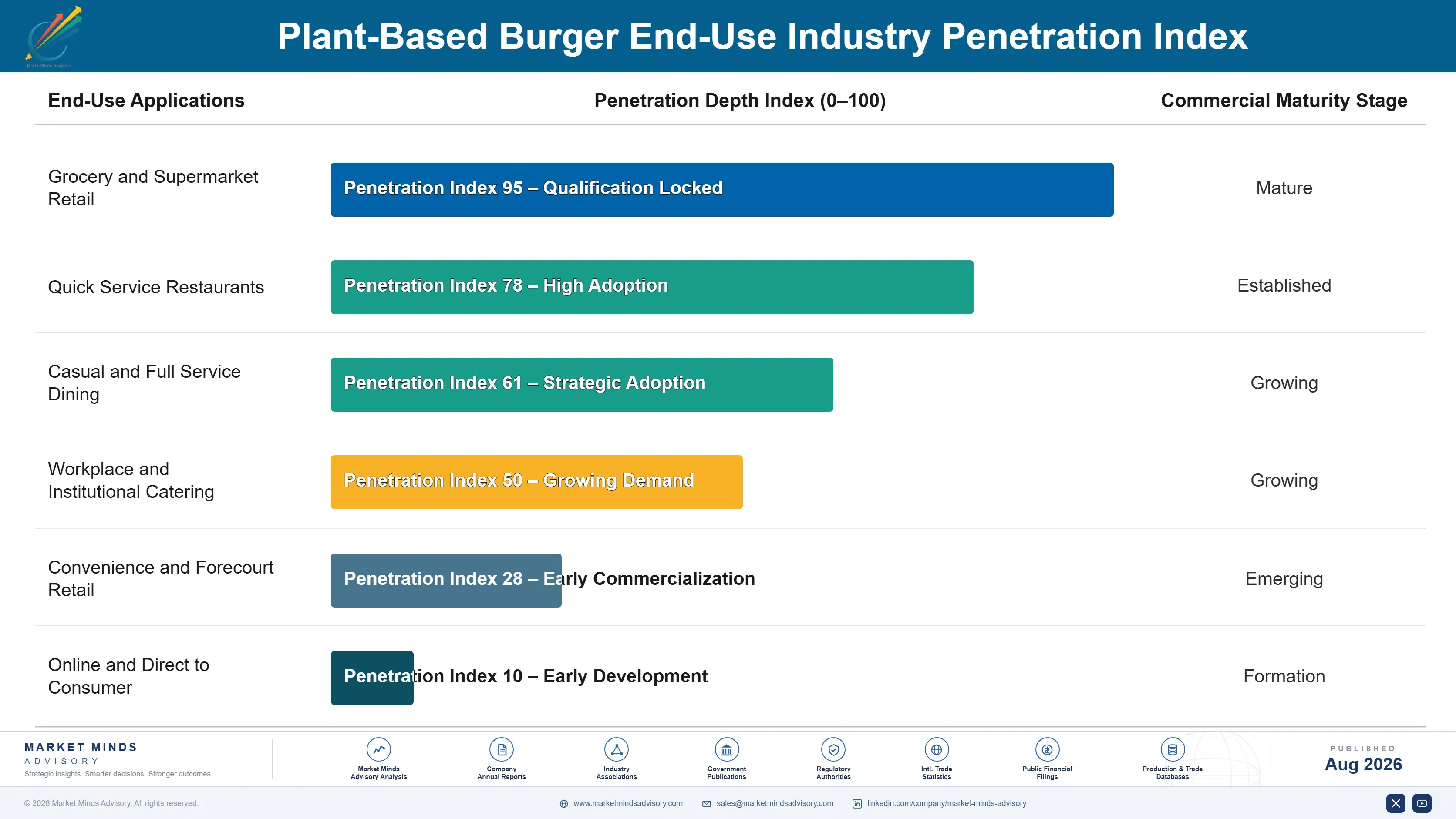
How Category Demand Renews

Demand renews on repeat purchase, and this category's defining problem is that it largely does not. Roughly 21% of first-time buyers return, which means volume depends on continuously recruiting new triallists rather than on retaining anybody, and that is an expensive way to run a food business. Categories that work convert trial into habit and then spend on recruitment only at the margin, which is precisely the position this one has never reached.
Stickiness varies sharply by why the consumer bought. Someone eating plant-based on ethical or environmental conviction repeats reliably and represents a small committed base. Someone trying the product out of curiosity or health interest is the four in five who did not return, and price and ingredient lists are what they cite. Foodservice occasions renew differently again, tied to group dining rather than to any household purchasing decision.

The buyer the category chased and the buyer it retained are not the same person, which is the miscalculation underneath everything else. Marketing addressed a mainstream flexitarian who would substitute for beef. The consumers who actually repeat are committed plant eaters and, increasingly, people buying whole-food formats that make no claim to imitate meat at all.
plant-based-burger-market-trends-end-use-penetration-index-1787580453491

Where To Place The Bet

These are among the four positions where our research anticipates prominent divergence between winners and laggards over the coming forecast period. Each is grounded in the demand model, the regulatory perimeter, and the announced capacity pipeline.
01 / INGREDIENT SIMPLIFICATION PRIORITY

Remove the objection instead of debating it

A product sold partly on health credentials while declaring around 18 separate ingredients was always going to be exposed once ultra-processed food became a mainstream public conversation, and contesting that point with consumers has demonstrably achieved nothing anywhere it has been attempted. Whole-food formats with short recognisable component lists remove the objection entirely rather than arguing about it, and they compound at 9.6% while already holding 16% of category volume. This is the only repeat purchase barrier a manufacturer fully controls.
02 / FOODSERVICE POSITION DEFENCE

Hold the menu, do not chase the shelf

Foodservice carries 38% of category volume and has proved considerably more resilient than retail, because a menu item competes for a specific dining occasion rather than sitting on a shelf directly beside beef mince with a price label attached to it. A diner ordering the plant option within a group makes no price comparison whatsoever. Manufacturers who withdrew from foodservice to pursue retail margin moved into the harder environment, and rebuilding surrendered listings is far more difficult than holding them.
03 / PARITY PROMISE RETIREMENT

Stop promising a price that cannot arrive

Plant-based burgers sit at roughly 1.9 times beef mince per equivalent weight and scale has conspicuously failed to close that gap, because protein isolates, methylcellulose and flavour systems do not cheapen the way commodity inputs do while beef mince stays inexpensive partly through by-product credits across hide, tallow and offal that a plant patty simply cannot replicate. Continuing to promise parity sustains an expectation this category will keep failing to meet publicly. Taste, ingredient simplicity and occasion are all winnable and price is not.
04 / REFERENCE MARKET SELECTION

Sell where cheap beef is not the comparison

Indian country growth at 9.4% leads this entire market because consumers there compare a plant-based burger against paneer, legume patties or chicken rather than against inexpensive beef mince, which changes the judgement being made in a fundamental way. Markets with established vegetarian eating traditions receive the product as something genuinely new rather than as a substitute failing to match a familiar and cheaper reference. That removes both the price objection and the imitation problem simultaneously, which is a far easier proposition.

Engagement Snapshot From the Field

A live engagement with an industry participant carrying material or product regulatory and market exposure ahead of a defining policy shift, showing how our research translates into a defensible multi-year portfolio strategy.
MARKET MINDS ADVISORY · CLIENT ENGAGEMENT SUMMARY
Plant-Based Burger Producer Strategic Portfolio Review and Transition Roadmap 2026·Investment Scenario on Plant-Based Burger Exposure Evaluation 2025-26
CLIENT PROFILE
A European plant-based manufacturer with annual revenue around EUR 96 million (client-reported, unverified by MMA), selling extruded pea protein burgers through grocery retail across five markets. Foodservice had been exited to concentrate on retail margin. All products carried long declared ingredient lists. Volumes had declined for two years. All lines used long ingredient declarations. Foodservice was exited.
STRATEGIC CHALLENGE
Retail volumes had declined for two consecutive years and facings were being reduced by two major grocers, and management proposed increased promotional spending to defend distribution. Nobody had established why consumers were not returning after trial or whether promotion addressed any of it. The reasons for non-repeat had never been tested with anybody.
MMA APPROACH
MMA analysed repeat purchase behaviour by product line and by consumer segment rather than treating the decline as uniform. Reasons for non-repeat were tested directly with lapsed buyers. Foodservice performance among competitors who retained listings was compared against the client's exited position and its retail-only outcome. Competitor channel positions were benchmarked.
KEY FINDINGS
  1. Repeat purchase concentrated almost entirely among committed plant-based consumers, while the flexitarian audience the marketing addressed converted at a small fraction of that rate.
  2. Lapsed buyers cited ingredient list length and price roughly as often as taste, and promotional spending addressed only the second of those three while making the price expectation worse.
  3. Competitors who retained foodservice listings had seen far shallower volume decline, and two grocers cited menu visibility when discussing why they retained certain competing brands on shelf.
  4. The client's extrusion capacity was running well below design throughput, and whole-food formats growing fastest in the category could not be made on that equipment at all.
CLIENT PROFILE
A European plant-based manufacturer with annual revenue around EUR 96 million (client-reported, unverified by MMA), selling extruded pea protein burgers through grocery retail across five markets. Foodservice had been exited to concentrate on retail margin. All products carried long declared ingredient lists. Volumes had declined for two years. All lines used long ingredient declarations. Foodservice was exited.
STRATEGIC CHALLENGE
Retail volumes had declined for two consecutive years and facings were being reduced by two major grocers, and management proposed increased promotional spending to defend distribution. Nobody had established why consumers were not returning after trial or whether promotion addressed any of it. The reasons for non-repeat had never been tested with anybody.
MMA APPROACH
MMA analysed repeat purchase behaviour by product line and by consumer segment rather than treating the decline as uniform. Reasons for non-repeat were tested directly with lapsed buyers. Foodservice performance among competitors who retained listings was compared against the client's exited position and its retail-only outcome. Competitor channel positions were benchmarked.
KEY FINDINGS
  1. Repeat purchase concentrated almost entirely among committed plant-based consumers, while the flexitarian audience the marketing addressed converted at a small fraction of that rate.
  2. Lapsed buyers cited ingredient list length and price roughly as often as taste, and promotional spending addressed only the second of those three while making the price expectation worse.
  3. Competitors who retained foodservice listings had seen far shallower volume decline, and two grocers cited menu visibility when discussing why they retained certain competing brands on shelf.
  4. The client's extrusion capacity was running well below design throughput, and whole-food formats growing fastest in the category could not be made on that equipment at all.
RECOMMENDED STRATEGY
Phase 1: Phase one: stop promotional spending that reinforces a price expectation the category cannot meet, and accept the volume decline in extruded retail lines rather than funding it. Phase 2: Phase two: develop whole-food short ingredient formats, since that objection is the only repeat barrier the client controls and it requires different equipment. Phase 3: Phase three: rebuild foodservice listings, accepting lower margin for volume that competes on occasion rather than against a shelf price comparison.
OUTCOME
Promotional spending stopped and gross margin improved on declining volume. A whole-food range launched using contract capacity while equipment decisions are assessed. Two foodservice listings have been regained, and the client reports total volume stabilising on a better mix (client-reported, unverified by MMA). Facings stabilised at two grocers.

Frequently Asked Questions

Foundational context covering the market sizes, CAGR, scope, country, region and competition that inform every finding below. This section is provided to cover basics and most often pre-purchase conversations, answered from the MMA Primary Research Dataset.

What is the current size of the Plant-Based Burger Market?

The market was valued at USD 3.1 billion in 2025, rising to an estimated USD 3.30 billion in 2026. North America holds the largest regional share at 32% of value.

How large will the Plant-Based Burger Market be by 2036?

MMA forecasts USD 6.13 billion by 2036 under the base case, an expansion multiple of 1.86 times the 2026 value. That represents USD 2.83 billion of incremental value.

What is the CAGR for the Plant-Based Burger Market 2026 to 2036?

The base case runs at 6.4% compound annual growth between 2026 and 2036, with a bull case at 7.6% and a bear case at 5.2%. Historical growth from 2020 to 2025 was 9.8%.

Which segment is growing fastest?

Whole-food and minimally processed formats lead at 9.6%, half again the market rate, by removing the ingredient objection entirely. Fermentation-derived products follow closely at 8.8%.

Who are the major companies in the Plant-Based Burger Market?

Beyond Meat, Nestle, Unilever, Kellanova and Impossible Foods hold 34% of the market. Concentration is falling as own label and contract capacity lower entry barriers considerably.

Which country is growing fastest?

India leads at 9.4%, because consumers there compare the product against paneer, legume patties or chicken rather than against any cheap beef mince at all.

Report Segmentation Architecture

The full report scope spans multiple orthogonal segmentation dimensions, with cross-tabulated demand data provided for each dimension pair. Coverage extends further to regional breakdowns, trend trajectories, and the competitive detail needed to support segment-level decision-making.

By Protein Source and Formulation

  • Soy Protein Based Burgers
  • Pea Protein Based Burgers
  • Whole-Food and Minimally Processed
  • Mycoprotein and Fermentation-Derived
  • Blended Meat and Plant Formats
  • Other Legume and Grain Formats

By End-Use Industry

  • Grocery and Supermarket Retail
  • Quick Service Restaurants
  • Casual and Full Service Dining
  • Workplace and Institutional Catering
  • Convenience and Forecourt Retail
  • Online and Direct to Consumer

By Consumer Motivation

  • Committed Plant-Based Diets
  • Flexitarian Substitution
  • Health and Nutrition Driven
  • Environmental and Ethical
  • Curiosity and Occasion Trial

By Region

  • North America
  • Western Europe
  • East Asia
  • South Asia and Pacific
  • Latin America
  • Middle East and Africa
  • Eastern Europe

Scope, Methodology, and Coverage

Every figure in this report is reproducible from documented input assumptions. The scope below maps the historical period, the forecast horizon, the segmentation dimensions, and the countries covered, alongside the underlying primary and qualitative methodology.
Historical Period
2020 to 2025
Forecast Period
2026 to 2036
Base Year
2025 (USD billions; MMA Primary Research Dataset, August 2026)
Market Definition
The market comprises plant-based burger patties and formed products sold as meat alternatives, including soy protein based, pea protein based, whole-food and minimally processed, mycoprotein and fermentation-derived, blended meat and plant formats, and other legume and grain formats, distributed through grocery, quick service, dining, catering, convenience and online channels. Value is measured at manufacturer level across retail and foodservice sales. Plant-based sausages, mince and other formats, dairy alternatives, cultivated meat, protein isolates sold to formulators, and traditional vegetarian foods not positioned as meat alternatives fall outside scope.
Quantitative Units
USD billions (current prices); thousand tonnes sold; USD per kilogramme by formulation and channel
Segmentation Dimensions
By Protein Source and Formulation; By End-Use Industry; By Consumer Motivation; By Region
Regions Covered
North America, Western Europe, East Asia, South Asia and Pacific, Latin America, Middle East and Africa, Eastern Europe
Countries Covered
United States, Canada, Mexico, Brazil, Argentina, Chile, Colombia, United Kingdom, Germany, Netherlands, Sweden, Denmark, France, Spain, Italy, Switzerland, Poland, Czechia, Hungary, China, Japan, South Korea, Taiwan, India, Thailand, Singapore, Australia, New Zealand, Israel, South Africa
Key Companies Profiled
Beyond Meat, Nestle, Unilever, Kellanova, Impossible Foods, Conagra Brands, Maple Leaf Foods, Quorn Foods, Amy's Kitchen, Vivera, Heura Foods, Redefine Meat, THIS, Oumph, Moving Mountains, Naturli Foods, Dr. Oetker, Grupo Bimbo, Charoen Pokphand Foods, Ajinomoto
Quantitative Methodology
Primary survey, n=3,800 respondents, Q4 2025, six countries; demand-side model with trade association cross-validation
Qualitative Methodology
47 expert interviews, Q4 2025; applied to validate demand model assumptions, identify emerging dynamics, and assess competitive positioning
Report Format
PDF and XLSX data workbook (Word format preview document)
Publisher
Market Minds Advisory
Report Code
MMA-2026-AGR-175
Published
August 2026
Contact
sales@marketmindsadvisory.com | www.marketmindsadvisory.com

Purchase the full Plant-Based Burger Market Report (2026 to 2036).

The full report sizes the global plant-based burger market to 2036 across six formulations and seven regions, measured at manufacturer level across retail and foodservice. It treats repeat purchase rather than trial or distribution as the category's determining variable, and quantifies each of the three barriers consumers actually cite when explaining non-repeat. Competitive analysis covers 20 manufacturers on one consistent revenue basis, with moat and risk assessment for the two leaders. Retail and foodservice channel performance is separated throughout by region. Four quantified revenue levers close the analysis.
Six formulation segments with individual growth rates
Repeat purchase modelled as the determining category variable
Price gap against beef mince decomposed by input structure
Retail and foodservice channel performance separated by region
Twenty-manufacturer competitive map on one consistent revenue basis
Four quantified revenue levers with commercial impact ranges

Built For The People Who Decide

From boardroom strategy to bench-side execution, this report is read cover-to-cover by leaders shaping the next decade of their industry, turning demand scenarios, market dynamics and valuation benchmarks into decisions.
CXOs/ Presidents/ VPs/ Managers
M&A and Corporate Development
Strategy Teams and R&D Heads
Procurement and Product Directors
Regulatory and Compliance Leaders
Investor Relations and Equity Analysts