Market Minds Advisory
Plant-Based API Market

Plant-Based API Market: Botanical and Phytopharmaceutical Active Ingredient Manufacturing

Opiate alkaloid supply concentrates in a handful of licensed growers just as oncology demand for taxane and vinca alkaloids climbs, pushing sponsors toward plant cell culture routes that sidestep harvest yield and land constraints entirely.

Lead Analyst

Alice Ballenger

Published

September 2026

Make Smarter Decisions with Customized Research Insights

Request a free sample report and evaluate market opportunities, growth trends, and competitive dynamics relevant to your business needs.

2025 MARKET VALUE$4.6BMarket Size 2025
2036 FORECAST VALUE$11.4BBase Case , 2026 to 2036
CAGR 2026 TO 20368.6 %Bull 9.8% / Bear 7.4%
INCREMENTAL OPPORTUNITY$6.4BNet 10- year value creation
EXPANSION MULTIPLE2.28x2036 value over 2026 base
Strategic Levers
M&A Pipeline
Regional Outlook
Country Rankings
Competitive Intelligence
Segmental Deep-dive
Call-Us : 91 93563 13602

Executive Snapshot and Market Trajectory

Licensed opiate alkaloid growers cannot expand poppy acreage fast enough to match rising demand, pushing sponsors toward plant cell culture and biosynthesis routes that remove harvest yield risk from the supply chain entirely this year, reshaping how oncology manufacturers plan long-term sourcing across their most critical raw material categories.
Alkaloid-based APIs still carry the largest share of revenue, but plant cell culture and biosynthesis-derived production is expanding fastest as pharmaceutical sponsors chase supply security beyond agricultural harvest cycles. Demand concentrates among oncology drug manufacturers requiring taxane and vinca alkaloid actives, where synthetic alternatives remain commercially uncompetitive against natural extraction on cost and purity grounds across most therapeutic applications reviewed this year and into the next several procurement cycles.
Competition splits between vertically integrated extraction specialists controlling their own agricultural or licensed growing supply and contract manufacturers purchasing crude botanical material on the open market from multiple regional sources. Tightening narcotics licensing regimes, plus growing sponsor interest in traceable, non-agricultural production routes, are pulling investment toward biosynthesis platforms that reduce single-harvest supply concentration risk across therapeutic categories and their long-term contract structures, particularly among sponsors managing multiple oncology product lines simultaneously across global markets.
Market Definition
The plant-based API market covers active pharmaceutical ingredients extracted, purified, or biosynthesized from botanical sources for use in prescription drugs and standardized phytopharmaceutical formulations. It excludes dietary supplement raw materials, cosmetic botanical extracts, and fully synthetic small-molecule APIs that merely replicate a plant-derived structure without any botanical origin.
Base Year Value
$4.6B in 2025 (MMA Primary Research Dataset, August 2026)
Forecast Period
2026 to 2036, eleven discrete annual values
CAGR
8.6% base case. Bull 9.8%. Bear 7.4%.
Fastest Growth Segment
Plant Cell Culture and Biosynthesis-Derived APIs: 13.8% CAGR
Fastest Growth Country
China: 11.5% CAGR
Fastest Growth Region
South Asia and Pacific: 10.6% CAGR
Largest Region
East Asia: 26% of 2025 global value
Market Leaders
Indena S.p.A., Johnson Matthey Macfarlan Smith Limited, Tasmanian Alkaloids Pty Ltd, Noramco, LLC, Sami Labs Limited. Source: MMA Analysis based on company annual reports.
Primary Survey
n=3,800 procurement and R&D decision-makers, Q4 2025, six countries
Methodology
Demand-side build-up, cross-validated against public data, 47 expert interviews

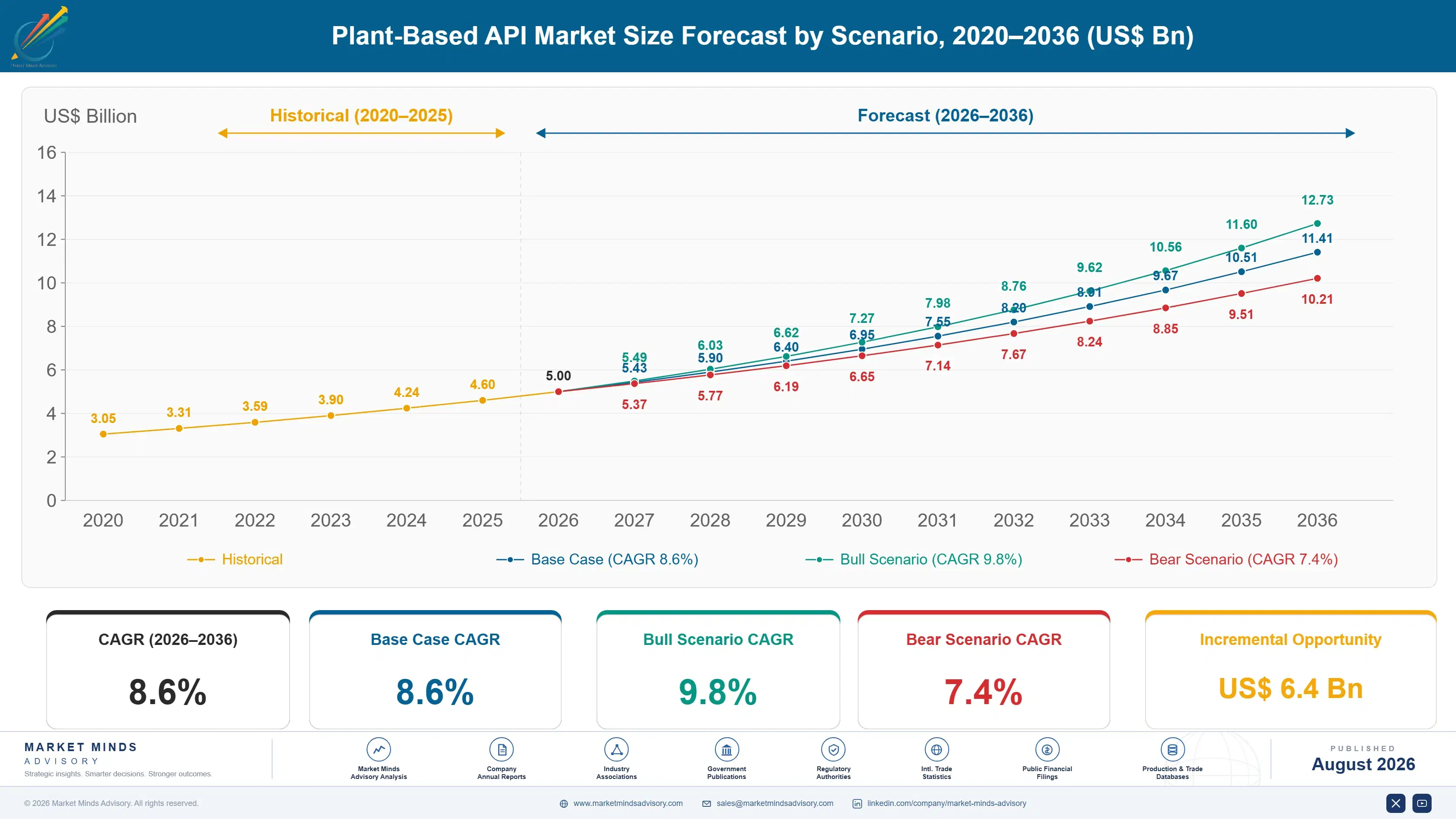
Plant-Based API Market Forecast Scenarios

plant-based-api-market-size-forecast-scenario-1787298755306
Growth from 2020 to 2025 compounded near 7.6%, held back by pandemic-era supply chain disruption affecting cross-border botanical raw material shipments, then recovering as oncology API demand rebounded and new licensed growing regions came online across several producing countries and their expanding extraction facility networks, gradually restoring pre-pandemic shipment reliability across most established trade corridors.
Three mechanisms carry the base case to 8.6%. First, rising oncology drug production requiring taxane and vinca alkaloid actives that synthetic routes still cannot match on cost at commercial scale. Second, biosynthesis and plant cell culture platforms reaching commercial validation, which frees supply from dependence on agricultural harvest cycles and land availability. Third, tightening narcotics licensing regimes for opiate alkaloid growing, which push buyers toward diversified or non-agricultural sourcing arrangements across multiple qualified suppliers.
The bull case at 9.8% assumes biosynthesis platforms reach commercial cost parity faster than current pilot timelines suggest, pulling forward buyer conversion considerably across oncology and cardiac API categories and their long-term supply contracts. The bear case at 7.4% assumes synthetic route substitution accelerates for select alkaloids as chemical synthesis costs decline relative to extraction across comparable production volumes.

Harvest Risk, Licensing Constraints, and the Push Toward Biosynthesis

Three forces converge on plant-based API production this year. Licensed growing acreage for controlled alkaloid crops expands slowly under narcotics regulatory oversight, oncology demand for taxane and vinca alkaloid actives keeps climbing, and biosynthesis platforms are only just reaching commercial scale after years of pilot validation across several producing countries and applications, leaving buyers to manage genuine near-term supply tightness across nearly every affected therapeutic catego
MARKET CONCENTRATIONCR5 27%top five producers hold a moderate combined share overall
AVERAGE API PRICE PREMIUM35-60% over syntheticnatural extraction commands a sizable premium over synthetic routes
TOP PRODUCING COUNTRY SHAREChina 31%leading share of global botanical extraction capacity by volume
CAPACITY UTILISATION72-80%extraction facilities running below peak seasonal harvest levels currently
TRADE INTENSITY64%share of output crossing borders before final formulation
FEEDSTOCK COST SHARE45-55%raw botanical material dominates total production cost structure heavily
The market behaves less like a standard specialty chemical category and more like an agricultural commodity layered with pharmaceutical purity requirements. Producers compete on documented yield consistency and regulatory dossier depth rather than price alone, since sponsors qualifying a new supplier face lengthy validation timelines that discourage frequent switching between extraction partners once a relationship is established and running smoothly, absent a genuine supply disruption forcing the issue.
Plant cell culture, hairy root biosynthesis, and microbial fermentation routes mimicking plant biosynthetic pathways are reshaping supplier selection criteria across the next decade, favoring producers that can prove consistent purity against harvest-dependent extraction baselines documented across comparable client contracts and multiple growing seasons under varying weather conditions and evolving regulatory expectations.
"Sponsors used to treat botanical API sourcing like any other raw material purchase. Now they model harvest failure risk the way they model currency exposure, because a bad poppy season in one licensed region can shut down an entire oncology supply chain."
Director, Pharmaceutical Ingredients and Specialty Chemicals Practice · MMA Phar

Market Trends

Plant Cell Culture Platforms Reach Commercial Validation Scale

Several producers have moved plant cell culture and hairy root biosynthesis platforms beyond pilot scale into commercial production runs for select taxane and alkaloid actives, offering sponsors a non-agricultural supply route free of harvest yield variability and seasonal weather risk. Early commercial batches show purity profiles comparable to conventional extraction, though production cost still runs higher than mature agricultural supply chains for most established alkaloids. Sponsors evaluating long-term supply security increasingly qualify a biosynthesis source alongside their existing agricultural supplier as a documented contingency arrangement across this year's primary survey data and expert interviews.
Market Impact: Adds 6% annual demand growth
Narcotics Licensing Regimes Tighten Around Opiate Alkaloid Growing

Regulatory authorities across major growing regions have tightened licensing conditions for controlled poppy cultivation, adding quota reviews and expanded compliance reporting requirements that raise the administrative burden on licensed growers. Smaller growing operations increasingly consolidate under larger licensed operators able to absorb the added compliance cost, concentrating supply among fewer, larger producers across the licensed growing regions covered in this year's assessment. Buyers respond by qualifying suppliers across multiple licensed jurisdictions simultaneously rather than depending on a single growing region for critical alkaloid supply, spreading qualification investment across several licensed jurisdictions simultaneously.
Market Impact: Raises entry barrier cost 20%

Market Opportunities and Growth Drivers

Rising Oncology Drug Production Lifts Taxane and Alkaloid Demand

Expanding oncology drug portfolios across major pharmaceutical manufacturers keep raising demand for taxane actives derived from yew biomass and vinca alkaloids derived from Madagascar periwinkle, since synthetic total synthesis routes remain commercially uncompetitive against semi-synthetic and fully extracted natural production at current commercial scale. Generic oncology drug manufacturers entering the market after patent expiry add further incremental demand for qualified API supply, often requiring the same botanical sourcing relationships the originator manufacturer already established across multiple licensed growing regions and extraction partners currently operating near full seasonal capacity most years.
Market Impact: Swings annual yield 25%

Traceability Regulation Favors Vertically Integrated Producers

Regulators increasingly require documented chain of custody from cultivation through final API purification, favoring vertically integrated producers that control growing operations directly over intermediaries purchasing crude botanical material on the open market from multiple, less traceable sources. This shift raises entry barriers for new market participants lacking established growing relationships or licensed cultivation capacity of their own, while rewarding incumbent producers that invested early in direct agricultural control and documented supply chain traceability systems across their entire production network and contracted growing partners spanning multiple licensed jurisdictions and harvest seasons.
Market Impact: Adds 15% fixed compliance cost

Market Restraints and Challenges

Agricultural Harvest Variability Disrupts Supply Predictability

Weather events, pest outbreaks, and disease pressure on botanical crops can swing annual yield by wide margins, and unlike synthetic chemical production, extraction-based API supply cannot simply be manufactured on demand when harvests underperform. The root cause is the industry's continued dependence on open-field or greenhouse cultivation for the majority of commercial volume despite decades of biosynthesis research. This creates genuine price volatility and delivery uncertainty for pharmaceutical buyers, and several large producers are now investing in geographically diversified growing operations and parallel biosynthesis capacity specifically to smooth supply across bad harvest years.
Market Impact: Adds 8% of new supply capacity

Narcotics Regulatory Compliance Raises Fixed Operating Cost

Controlled alkaloid producers face extensive security, reporting, and licensing obligations under international narcotics control conventions that smaller producers struggle to absorb profitably at limited production scale. The root cause is the dual nature of these molecules as both essential pharmaceutical precursors and controlled substances requiring strict chain of custody documentation across every production stage. This compliance burden pushes consolidation toward larger operators, and some smaller producers are exploring shared compliance infrastructure and regional licensing cooperatives to spread fixed cost across multiple growers operating in the same licensed jurisdiction and reporting to the same regulatory authority.
Market Impact: Cuts licensed growers count 12%
3 additional market trends, 4 additional growth drivers, and 2 additional restraints and challenges are covered in the full report. Contact sales@marketmindsadvisory.com to access the complete intelligence.

Segment CAGR and Growth Architecture

Segmentation follows chemical class because extraction methods, regulatory handling requirements, and buyer qualification processes differ substantially between alkaloid, terpenoid, glycoside, polyphenol, and biosynthesis-derived API categories, each with its own distinct supply chain structure, cost profile, and regulatory documentation burden across producing regions, buyer categories, and therapeutic end markets served by each individual chemical class today.
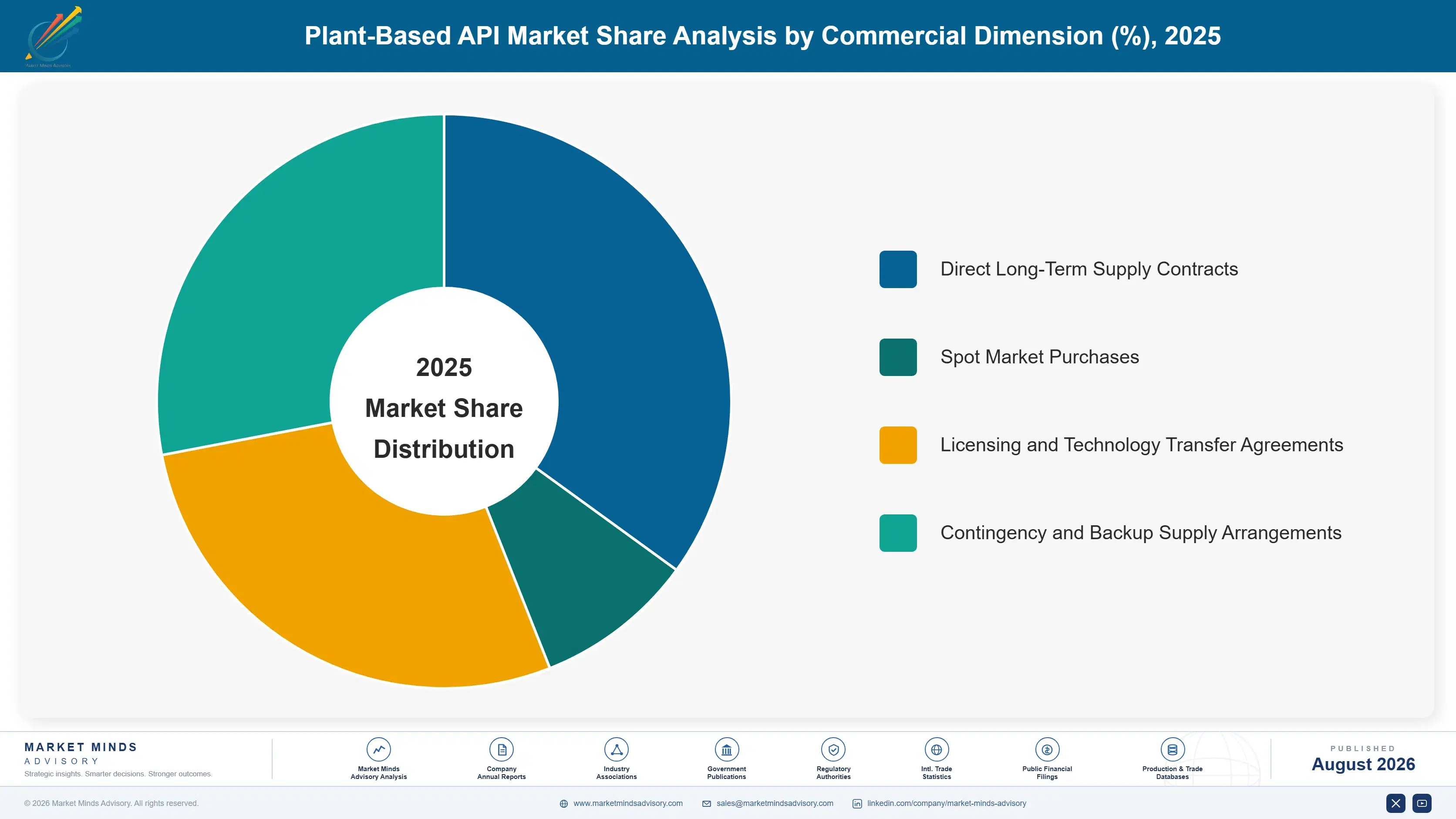
plant-based-api-market-market-share-analysis-1787298755840

Plant Cell Culture and Biosynthesis-Derived APIs

This segment grows fastest at 13.8% as producers move plant cell culture and hairy root biosynthesis platforms from pilot into commercial-scale production for select taxane and alkaloid actives. Sponsors value the non-agricultural supply route for its immunity to harvest yield variability, weather disruption, and licensed acreage constraints affecting conventional extraction. Production cost still runs above mature agricultural supply chains for most established molecules, limiting near-term volume to sponsors prioritizing supply security over lowest unit cost. Demand concentrates among sponsors that experienced a prior harvest-related supply disruption and now require a documented contingency source alongside their primary agricultural supplier under board-level risk management policy covering critical oncology raw materials across every marketed product line.
CAGR 13.8%

Terpenoid and Terpene-Based APIs

Terpenoid and terpene-based APIs grow at 10.8% as expanding oncology drug production lifts demand for taxane actives extracted from yew biomass and semi-synthesized into paclitaxel and docetaxel. This segment carries the highest agricultural dependency in the portfolio, since yew biomass supply concentrates in a limited number of geographic regions with suitable growing conditions and established harvesting infrastructure. Sponsors with long-term supply agreements secured before recent demand acceleration hold a genuine cost advantage over newer entrants now competing for the same constrained biomass supply across fewer qualified growing regions and extraction partners currently operating near capacity with limited room for near-term expansion, a dynamic expected to persist through most of the forecast period.
CAGR 10.8%
Full segment breakdown across 6 segments available in the complete report.

Regional Architecture and Country Demand Map

East Asia leads on China's established traditional medicine extraction infrastructure and low-cost processing capacity, while South Asia and Pacific grows fastest as India expands phytopharmaceutical manufacturing and contract extraction services this year and into the following forecast decade of coverage across every major producing country tracked.

North America

The United States accounts for the largest share of regional demand as major oncology and cardiac drug manufacturers headquartered there purchase substantial taxane, vinca alkaloid, and glycoside API volume for domestic formulation. Tasmania-linked opiate alkaloid supply chains run through licensed United States importers under long-standing narcotics control board quota arrangements governing controlled substance trade. Canada contributes a smaller share tied to its own licensed poppy growing operations and shared regulatory framework with United States pharmaceutical buyers, plus growing biosynthesis pilot investment from domestic biotechnology firms. Growth trails the fastest-growing regions since domestic agricultural expansion for controlled crops faces stricter licensing constraints than emerging producing regions elsewhere in Asia and Latin America.
Share: 24% | CAGR: 8.4% (2026 to 2036)

Western Europe

France and the United Kingdom anchor regional demand, with France's licensed poppy growing regions and the United Kingdom's Macfarlan Smith alkaloid processing operations supplying much of the region's controlled substance API requirements under strict national narcotics licensing oversight. Italy contributes substantial extraction capacity through established phytopharmaceutical manufacturers serving both domestic and export markets across multiple therapeutic categories. Germany's pharmaceutical manufacturing base drives steady demand for standardized botanical extract APIs used in registered phytopharmaceutical products. Growth runs below the global average as the region's licensed growing acreage expansion faces tighter regulatory ceilings than emerging Asian producing regions with more room to expand licensed cultivation area under comparatively newer regulatory frameworks still being finalized.
Share: 23% | CAGR: 7.0% (2026 to 2036)
Regional intelligence for 5 additional markets available in the complete report: East Asia, South Asia and Pacific, Latin America, Middle East and Africa, Eastern Europe. Contact sales@marketmindsadvisory.com.
plant-based-api-market-country-cagr-analysis-1787298756349

Where Botanical API Producers Can Expand Margin Now

Producers selling crude extract alone are leaving margin on the table. Four levers let established suppliers expand revenue per contract without simply chasing acreage expansion across an increasingly constrained and highly regulated agricultural supply base facing rising compliance cost and mounting licensing scrutiny each renewal cycle across every major producing jurisdiction covered in this year's assessment.

Move Downstream Into Semi-Synthetic Finishing Steps

Producers selling crude taxane extract alone leave the higher-margin semi-synthetic conversion into finished paclitaxel or docetaxel to downstream specialty chemical partners, even when the underlying botanical expertise already sits inside their own extraction operations. Adding semi-synthetic finishing capability raises average revenue per contract by an estimated 20 to 30% while capturing value that otherwise flows entirely to separate conversion specialists downstream. Sponsors increasingly prefer fewer, more vertically capable suppliers for critical oncology actives, particularly given the regulatory scrutiny applied to every additional handoff point in the botanical supply chain and its regulatory documentation.
Market Impact: Raises revenue per contract 20-30% within three years

Qualify Biosynthesis Supply as a Contingency Offering

Producers with validated plant cell culture or hairy root biosynthesis capability can charge premium rates for supply security assurances that pure agricultural extractors cannot credibly offer, since sponsors increasingly weigh documented contingency sourcing heavily during supplier qualification reviews. Contracts bundling primary agricultural supply with a validated biosynthesis backup support pricing premiums of roughly 12 to 18% above standard single-source agreements. This lever rewards producers that invested early in biosynthesis validation rather than those still relying entirely on conventional extraction with no documented alternative production route available to offer prospective sponsor clients.
Market Impact: Supports a pricing premium of roughly 12-18% per contract

Diversify Growing Regions Ahead of Licensing Risk

Establishing licensed growing operations across multiple jurisdictions ahead of confirmed regulatory tightening lets producers win long-term supply contracts that single-region competitors cannot credibly guarantee, since new licensing applications and growing infrastructure often take two years or longer to establish before a region can supply commercial volume. Early movers captured an estimated 18% larger share of new long-term supply contracts awarded over the past two years compared with producers that waited for confirmed demand signals before committing capital to new growing region development and its associated licensing process, regulatory relationships, and staff certification requirements.
Market Impact: Captures roughly 18% more new supply contracts yearly

Expand Traceability Documentation Into Premium Contracts

Sponsors facing tightening chain-of-custody regulation increasingly need documented traceability data spanning cultivation, harvest, and extraction stages that generalist producers frequently cannot supply in sufficient regulatory detail. Producers building dedicated blockchain or database-backed traceability systems capture incremental contract value estimated near 10% above standard supply agreements, since sponsors otherwise must contract separately with third-party auditors to reconstruct comparable chain-of-custody documentation after the fact across multiple growing seasons and processing facilities spanning several licensed jurisdictions, an expense that grows more burdensome each time a sponsor's own regulatory affairs team requests updated records ahead of an inspection or renewal filing.
Market Impact: Adds roughly 10% incremental contract value each year

Who Controls the Margin Pool

CR5 sits near 27%, evaluated on disclosed botanical API production revenue across public filings and industry disclosures where available. The gap between the top five vertically integrated producers and the next tier of regional extraction specialists is moderate, since several mid-size firms hold licensed growing rights or extraction expertise in specific botanical categories that larger generalist competitors cannot easily replicate, particularly in narrow alkaloid subcategories with thin glo
Current competitive activity centers on three dimensions: biosynthesis platform investment, vertical integration into growing operations, and geographic supply diversification. Vertically integrated producers bundle cultivation, extraction, and semi-synthetic finishing into single contracts, while smaller specialists compete purely on extraction purity and narrow botanical category expertise documented across comparable client portfolios and multi-year regulatory dossiers.

Emerging pressure comes from biosynthesis-focused entrants offering non-agricultural supply routes without any traditional growing infrastructure, forcing established agricultural producers to prove their own biosynthesis roadmaps keep pace with these newer, more narrowly focused competitors. Rankings could shift toward producers combining validated biosynthesis capability with geographically diversified licensed growing operations over the next several supply contract renewal cycles across major oncology sponsor accounts and their risk management committees.
plant-based-api-market-company-positioning-matrix-1787298756871

Competitive Moat and Risk Dimensions

INDENA S.P.A.

Moat: Proprietary extraction and phytosome technology

Indena's decades of accumulated extraction know-how and proprietary phytosome delivery technology give it regulatory dossier depth across dozens of jurisdictions that narrower regional competitors cannot easily replicate. Its established relationships with major pharmaceutical sponsors support long-term supply contracts that smaller producers typically cannot win on comparable terms or duration.
INDENA S.P.A.

Risk: Exposure to single-region harvest failure

Indena's supply chain still depends heavily on specific growing regions for several key botanical inputs, leaving it exposed to localized weather or disease disruption more than competitors with broader geographic sourcing diversification. Competitors positioning themselves around multi-region or biosynthesis-backed supply use this concentration directly in competitive sales pitches against Indena during contract renewal negotiations.
JOHNSON MATTHEY MACFARLAN SMITH LIMITED

Moat: Legacy controlled-substance manufacturing licenses

Macfarlan Smith's long-standing narcotics manufacturing licenses and established relationships with regulatory authorities create a licensing barrier that new entrants find difficult and slow to replicate, since controlled substance manufacturing approval processes typically span several years. This positions the company as a preferred supplier for sponsors requiring guaranteed continuity of controlled alkaloid supply across long-term contracts.
JOHNSON MATTHEY MACFARLAN SMITH LIMITED

Risk: Declining base opioid alkaloid demand

Reduced opioid prescribing in several major markets following prior public health concerns has softened demand growth for some base alkaloid products, leaving the company more exposed to volume normalization than competitors with broader diversification into oncology and cardiac glycoside categories carrying stronger underlying demand growth.

Players Tracked

Prominent Players

Indena S.p.A.
Johnson Matthey Macfarlan Smith Limited
Tasmanian Alkaloids Pty Ltd
Noramco, LLC
Sami Labs Limited

Other Key Players

Linnea SA
Sabinsa Corporation
Naturex S.A.
Alkaloida Chemical Company Zrt.
Xi'an Sost Biotech Co., Ltd.
Shaanxi Undersun Biomedtech Co., Ltd.
Verdure Sciences, Inc.
Naturalin Bio-Resources Co., Ltd.
Ipca Laboratories Limited
Alchem International Pvt. Ltd.
Euromed S.A.
PhytoLab GmbH & Co. KG
Cerbios-Pharma SA
Amoli Organics Pvt. Ltd.
Xi'an Lyphar Biotech Co., Ltd.

Recent Developments

MARCH 2025

Indena expands paclitaxel extraction capacity in Italy

Indena expanded its paclitaxel extraction and semi-synthetic finishing capacity at its Italian facility, an organic capacity expansion rather than an acquisition, adding throughput to meet rising oncology sponsor demand for taxane actives across multiple long-term supply contracts currently under negotiation with major pharmaceutical manufacturers across several therapeutic categories.
Signal: Confirms established extraction specialists are investing ahead of confirmed long-term oncology demand growth signals across the sector.
AUGUST 2024

Sami Labs acquires botanical extraction facility in India

Sami Labs completed an acquisition of an additional botanical extraction facility in southern India, adding standardized extract production capacity rather than building comparable infrastructure from scratch, extending its contract manufacturing offering for international phytopharmaceutical sponsors seeking GMP-certified Indian supply across multiple botanical categories and export destinations.
Signal: Signals continued consolidation of Indian extraction capacity under larger, better-capitalized operators this cycle and the next.
JANUARY 2025

Tasmanian Alkaloids forms alkaloid supply diversification joint venture

Tasmanian Alkaloids and a Chinese traditional medicine ingredient manufacturer formed a joint venture establishing shared alkaloid processing capacity across two continents, splitting investment in extraction infrastructure rather than either party expanding independently, targeting sponsors seeking geographically diversified controlled substance supply across multiple regulatory jurisdictions and climate zones.
Signal: Shows geographic supply diversification increasingly happens through shared-risk cross-border partnerships this cycle and the following one.

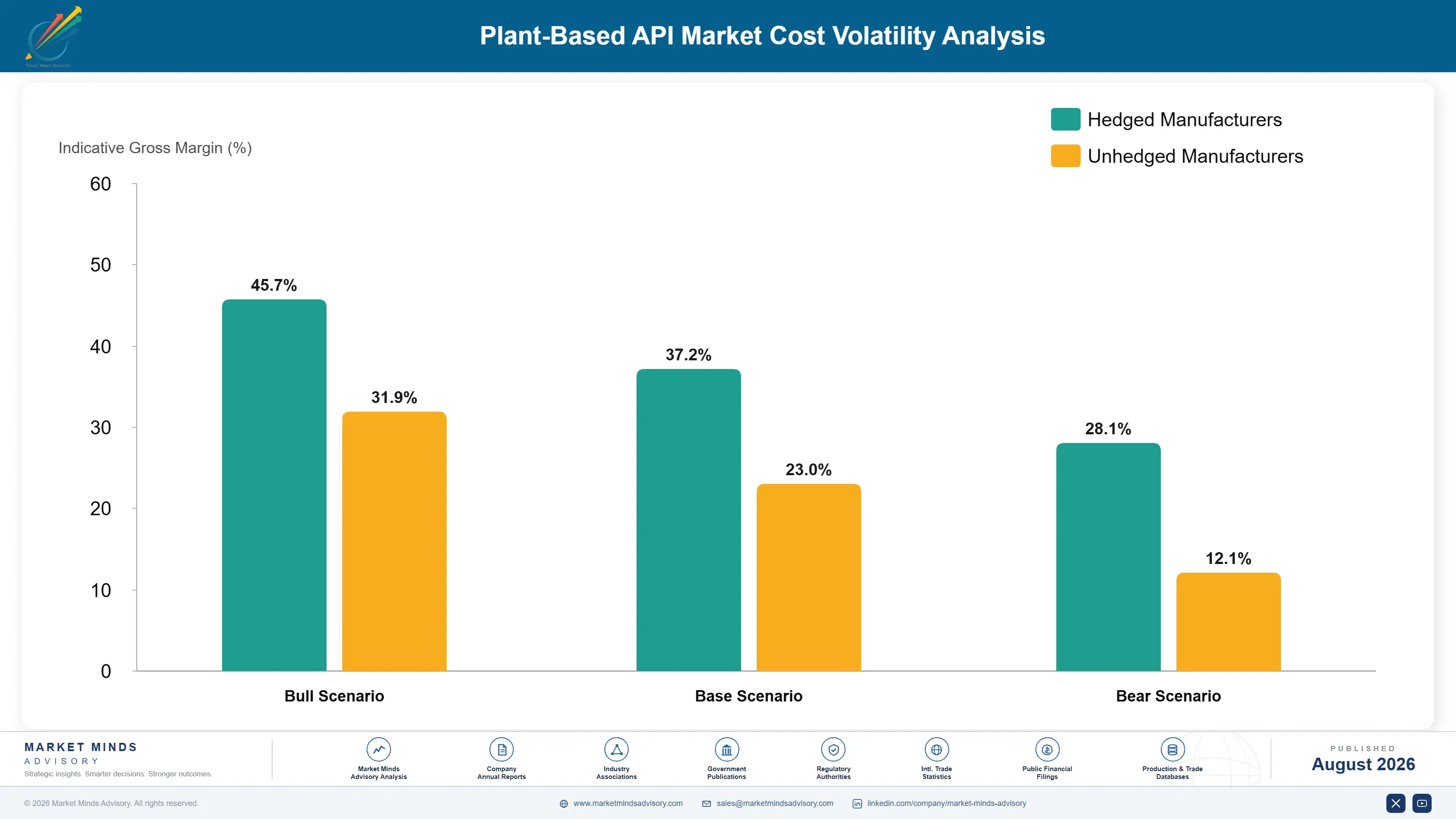
Botanical Feedstock Cost and Harvest Exposure

Raw botanical feedstock represents roughly 45 to 55% of production cost, spanning licensed poppy straw, yew biomass, periwinkle leaf, and foxglove leaf sourced primarily from licensed growing regions across Tasmania, France, India, and China, where land availability and licensing quotas both constrain near-term supply expansion beyond what growers currently plan to cultivate under their existing regulatory approvals and seasonal planting schedules.
A drought across parts of Tasmania's licensed poppy growing region reduced 2024 harvest yields materially below prior-year levels, compressing available raw material supply and pushing spot prices higher for affected alkaloid categories, according to disclosures in Sun Pharmaceutical Industries' annual report covering that period. Producers with multi-year supply contracts absorbed part of the cost increase rather than immediately repricing agreements, pressuring near-term margin across the affected supply chain and its downstream formulation partners.

Producers with growing capacity concentrated in a single region carry substantially more weather and yield risk than those with diversified cultivation footprints across multiple climate zones. Smaller producers lacking geographic diversification face a genuine competitive disadvantage against larger vertically integrated operators able to shift sourcing toward whichever growing region delivered the strongest harvest that season.
plant-based-api-market-cost-volatility-analysis-1787298757065

Diversify Growing Regions Across Multiple Climate Zones

Producers are establishing licensed growing operations across multiple countries and climate zones rather than concentrating cultivation in a single region, reducing weather and disease exposure while maintaining flexibility to shift sourcing toward whichever region delivers the strongest harvest in a given season and its associated pricing terms, without disrupting downstream extraction schedules or client delivery commitments.

Build Biosynthesis Capacity as Supply Insurance

Larger producers are investing in plant cell culture and biosynthesis capability specifically as insurance against agricultural harvest failure, accepting higher near-term production cost in exchange for supply continuity that pure agricultural sourcing cannot guarantee during a genuinely bad growing season across primary licensed regions and their existing production contracts, an insurance premium sponsors increasingly value highly.

Index Multi-Year Contracts to Harvest Yield Benchmarks

Newer supply contracts increasingly include yield indexing clauses tied to published regional harvest benchmarks, passing a portion of weather-driven cost volatility through to buyers automatically rather than absorbing the full impact against fixed multi-year pricing agreed before the growing season outcome is known or the harvest is fully counted and verified against contract terms.

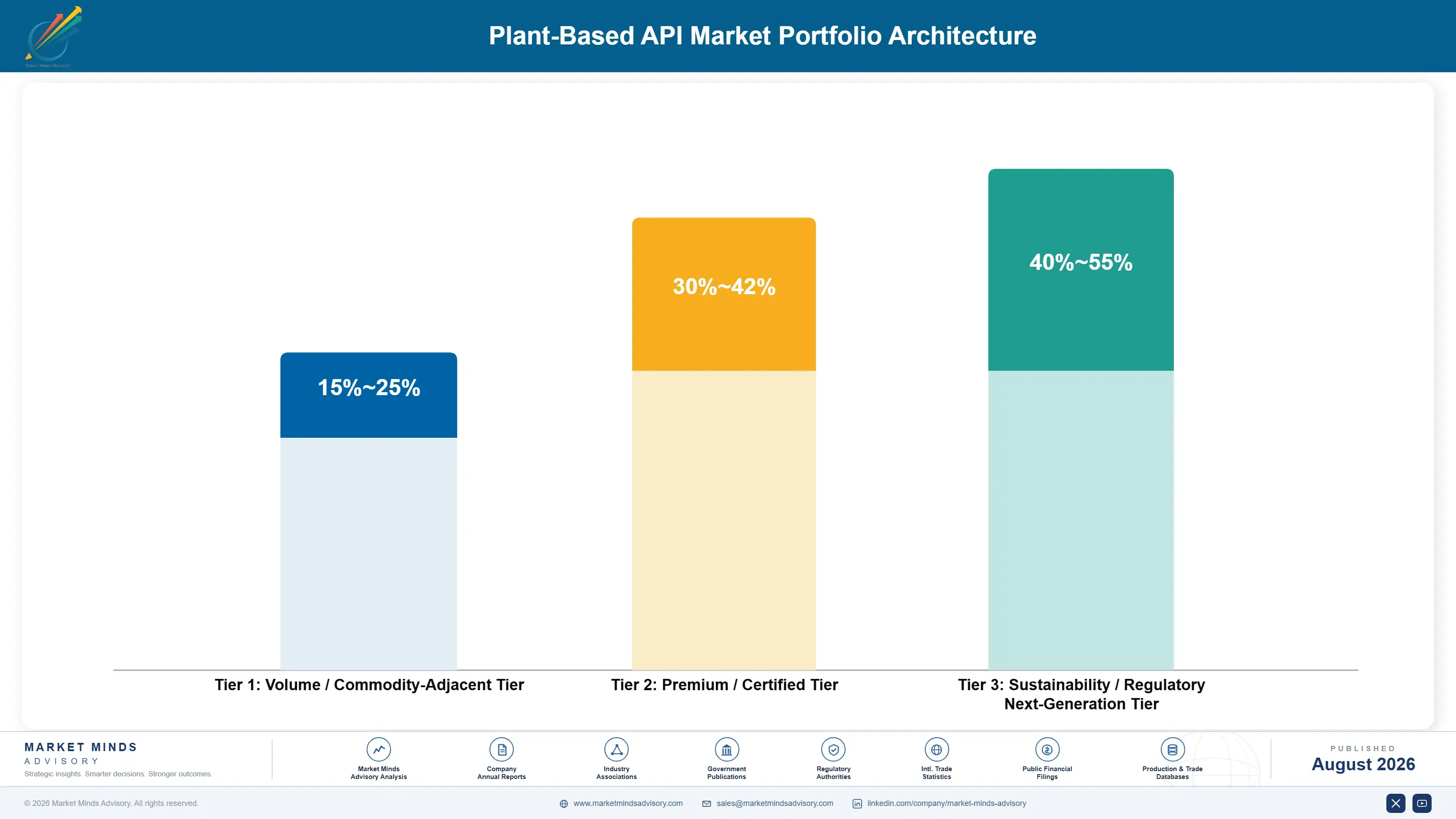
Portfolio Architecture for Margin Defence

The portfolio splits across three tiers. Volume crude extract supply carries thin margin driven by agricultural cost competition, premium semi-synthetic finished actives command considerably stronger margin on downstream processing expertise and regulatory dossier depth, and emerging biosynthesis-derived supply commands the strongest margin of all while volume remains comparatively small relative to the mature agricultural extraction base that still anchors most producer revenue today across the
Volume and premium work pull producers in different directions. Crude extraction scale justifies continued agricultural investment because it anchors long-term supply relationships and funds processing infrastructure, but margin expansion increasingly depends on winning higher-value semi-synthetic finishing and biosynthesis contracts layered on top of that base agricultural relationship rather than crude extract volume alone across a growing sponsor roster spanning several therapeutic categories and their associated regulatory filing calendars.

High-value margin pools concentrate around semi-synthetic oncology actives requiring downstream chemical conversion expertise and validated biosynthesis platforms serving sponsors prioritizing supply security enough to justify premium pricing above standard agricultural extraction rates in most established producing regions with long-standing sponsor relationships.

Volume / Commodity-Adjacent Tier

Crude botanical extract and standardized extract API supply priced on agricultural volume, competing mainly on harvest cost and delivery consistency across large pharmaceutical buyer contracts, multi-year purchase agreements, and recurring seasonal orders.
Gross Margin: 15-25%

Premium / Certified Tier

Semi-synthetic finished actives and regulatory-dossier-supported extraction requiring downstream chemical conversion expertise commanding higher pricing across specialist oncology and cardiac categories with established, long-standing sponsor relationships and renewal history spanning multiple therapeutic areas.
Gross Margin: 30-42%

Sustainability / Regulatory / Next-Generation Tier

Plant cell culture and biosynthesis-derived actives, priced on documented supply security and traceability rather than raw agricultural volume across long-term contingency contracts, risk management arrangements, and board-level sourcing policies reviewed annually.
Gross Margin: 40-55%
plant-based-api-market-portfolio-architecture-1787298757556

High-value Sub-segments and Strategic Watch-out

Plant Cell Culture and Biosynthesis-Derived APIs

High value and high growth at 13.8%, the fastest category by a wide margin, as producers move biosynthesis from pilot into commercial supply this year and its underlying survey data, expert interviews, and long-range forecasts through the full decade ahead across all producing regions and sponsor categories tracked.
Gross Margin: 40-55%

Terpenoid and Terpene-Based APIs

High value with strong growth at 10.8%, driven by expanding oncology drug production lifting demand for taxane actives extracted from increasingly constrained yew biomass supply across major producing regions and their licensed growers currently under long-term contract, renewal review, and active expansion discussion this cycle.
Gross Margin: 30-42%

Alkaloid-Based APIs

The volume core by production volume, growing near 6.5% as controlled substance demand remains steady even as margin concentrates elsewhere across the broader portfolio, margin mix, and evolving licensing structure over the coming forecast decade and well beyond it across every major producing market tracked.
Gross Margin: 15-25%

Glycoside-Based APIs

The strategic watch-out, growing slowest at roughly 5.2% and facing commoditisation as standard cardiac glycoside actives become a mature, price-competitive category rather than a differentiated purchase decision across most sponsor accounts reviewed this year and the last two full forecast cycles under active ongoing review.
Gross Margin: 18-28%

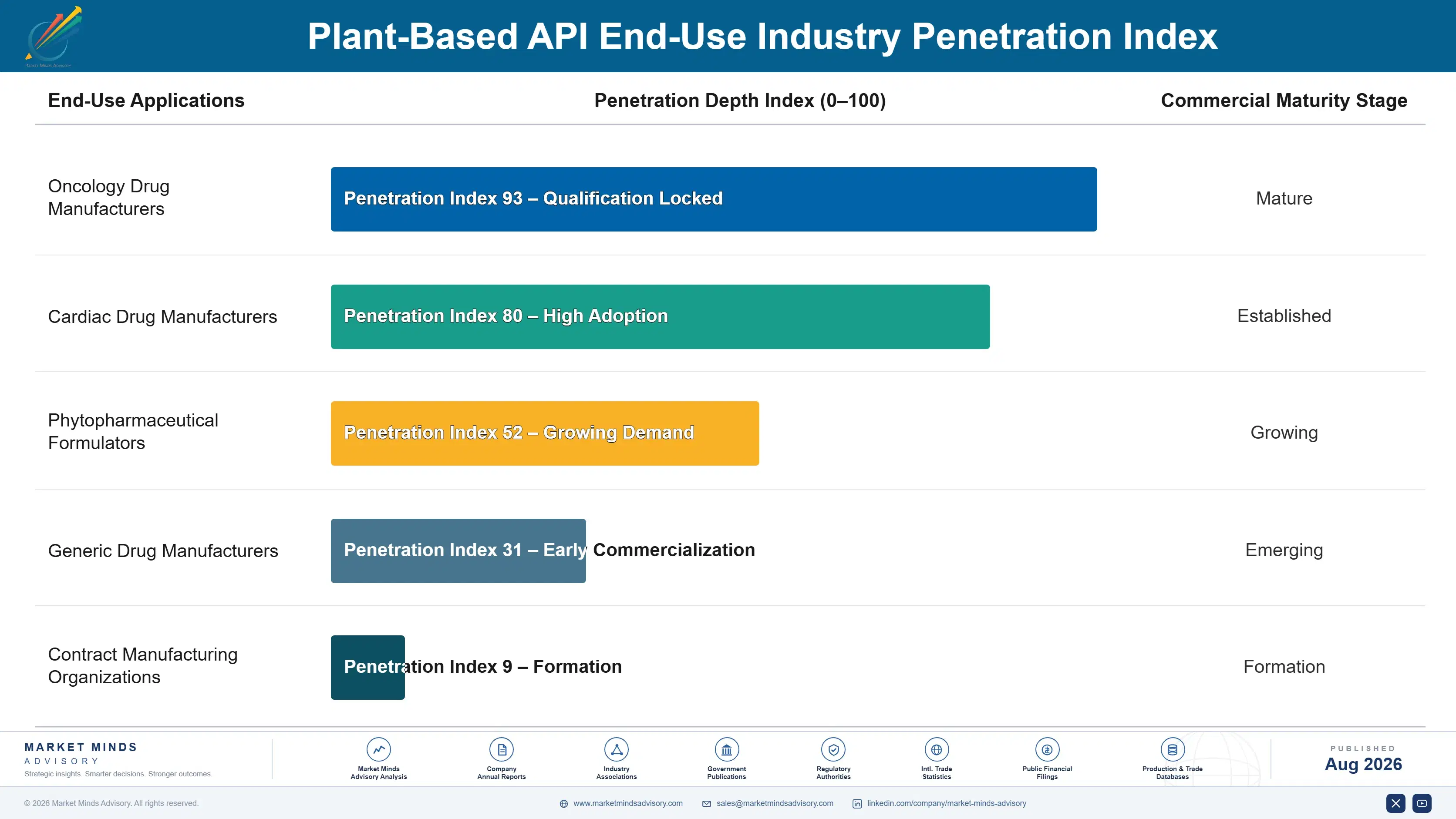
Long Supply Contracts Anchor Producer Relationships

Botanical API supply behaves like an annuity tied to each finished drug's entire commercial lifecycle rather than a one-time purchase order. Every new drug approval and generic entrant extends the producer relationship, and switching suppliers mid-contract carries genuine regulatory revalidation risk that keeps renewal rates high across established agricultural and biosynthesis supply relationships built over many growing seasons and multiple successful harvest cycles.
Adoption depth varies by therapeutic vertical and buyer sophistication. Large oncology drug manufacturers maintain the deepest supply diversification, often qualifying multiple growing regions and a biosynthesis backup simultaneously, while smaller generic manufacturers typically depend on a single established supplier relationship until a harvest disruption forces diversification. This dynamic keeps switching costs asymmetric across sponsor size and risk tolerance, favoring producers that can demonstrate documented supply resilience upfront rather than promise it after a disruption already occurred.

A generational shift is underway in sponsor procurement leadership. Younger supply chain officers trained on climate risk modeling favor suppliers demonstrating diversified, documented sourcing over suppliers relying purely on established reputation, gradually reshaping which producers win new long-term supply mandates across the industry and how existing contracts get renegotiated at each renewal point.
plant-based-api-market-end-use-penetration-index-1787298758044

Where Botanical API Producers Focus Next

These are among the four positions where our research anticipates prominent divergence between winners and laggards over the coming forecast period. Each is grounded in the demand model, the regulatory perimeter, and the announced capacity pipeline.
01 / BIOSYNTHESIS INVESTMENT PRIORITY

Fund commercial-scale biosynthesis before competitors close the gap

Producers without validated commercial-scale biosynthesis capability will lose ground to competitors that invested early, since sponsors increasingly demand documented contingency sourcing before signing new long-term supply contracts across oncology and cardiac categories. The window for differentiated positioning is narrowing as more producers reach comparable biosynthesis maturity within the next several growing seasons across the industry. Waiting another harvest cycle risks permanent competitive disadvantage against early movers who already hold demonstrable commercial-scale evidence in front of prospective sponsor clients evaluating comparable supplier shortlists.
02 / GEOGRAPHIC SUPPLY DIVERSIFICATION

Diversify growing regions beyond single-country concentration risk

Producers concentrated in one growing region face real weather and licensing exposure that diversified competitors can better absorb through flexible regional sourcing shifts. Tasmania and France remain essential growing capacity, but building parallel cultivation across India and additional licensed jurisdictions reduces single point of failure risk considerably over coming growing seasons. This matters most for producers carrying multi-year fixed-price supply contracts signed before recent harvest volatility emerged across those regions and their local growing conditions, since delayed diversification risks margin erosion outpacing what yield-indexed pricing alone can recover.
03 / VERTICAL INTEGRATION STRATEGY

Move downstream into semi-synthetic finishing steps now

Capturing semi-synthetic conversion margin currently flowing to downstream specialty chemical partners requires investment in finishing capability that most pure agricultural extractors lack today. Sponsors increasingly prefer fewer, more vertically capable suppliers for critical oncology actives, particularly given regulatory scrutiny applied to every additional supply chain handoff point across the botanical value chain. Producers that delay this vertical move risk losing the finishing margin entirely to specialty chemical competitors already positioned downstream and building direct sponsor relationships of their own across comparable therapeutic categories.
04 / TRACEABILITY SYSTEM DEVELOPMENT

Build documented chain-of-custody systems ahead of regulation

Tightening traceability regulation increasingly favors vertically integrated producers over intermediaries sourcing crude material from multiple, less documented origins, making early investment in chain-of-custody documentation systems a genuine competitive advantage rather than shared compliance cost. Producers building these systems now secure premium contract positioning that competitors relying on manual, ad hoc documentation will struggle to match once regulation tightens further across major importing jurisdictions and their sponsor buyers. Delaying this investment risks losing preferred supplier status to competitors already able to produce audit-ready records on demand.

Engagement Snapshot From the Field

A live engagement with an industry participant carrying material or product regulatory and market exposure ahead of a defining policy shift, showing how our research translates into a defensible multi-year portfolio strategy.
MARKET MINDS ADVISORY · CLIENT ENGAGEMENT SUMMARY
Plant-Based API Producer Strategic Portfolio Review and Transition Roadmap 2026·Investment Scenario on Plant-Based API Exposure Evaluation 2025-26
CLIENT PROFILE
A mid-size generic oncology drug manufacturer producing taxane-based chemotherapy products engaged MMA after a regional harvest disruption cut its primary yew biomass supplier's output sharply, threatening production continuity for two flagship generic products. The client reported roughly forty percent of its annual API volume tied to the single affected supplier relationship (client-reported, unverified by MMA).
STRATEGIC CHALLENGE
The client's single-supplier dependency left production vulnerable to any future harvest disruption, yet qualifying an alternative supplier typically required lengthy regulatory revalidation that could not happen quickly enough to prevent near-term stockouts. Leadership needed both an immediate sourcing fix and a longer-term diversification plan approved before the next board review.
MMA APPROACH
MMA benchmarked the client's current supplier against four alternative taxane API producers, evaluated biosynthesis contingency options against traditional agricultural alternatives, and modeled the regulatory revalidation timeline and cost for each realistic qualification pathway available given the client's urgent supply continuity requirements and its regulatory filing obligations across affected markets and existing product approvals on file.
KEY FINDINGS
  1. Two of four alternative suppliers offered expedited regulatory revalidation support, cutting qualification time by roughly six months compared with standard industry timelines observed.
  2. One evaluated biosynthesis supplier could deliver commercial volume within the client's required window, though at a documented cost premium over agricultural extraction.
  3. The client's existing supplier agreement lacked any yield-contingency clause, an omission common across comparable mid-size manufacturer contracts reviewed during this engagement and prior projects.
  4. Diversifying across two agricultural suppliers plus one biosynthesis contingency source reduced projected future disruption risk by an estimated 60% under modeled scenarios.
CLIENT PROFILE
A mid-size generic oncology drug manufacturer producing taxane-based chemotherapy products engaged MMA after a regional harvest disruption cut its primary yew biomass supplier's output sharply, threatening production continuity for two flagship generic products. The client reported roughly forty percent of its annual API volume tied to the single affected supplier relationship (client-reported, unverified by MMA).
STRATEGIC CHALLENGE
The client's single-supplier dependency left production vulnerable to any future harvest disruption, yet qualifying an alternative supplier typically required lengthy regulatory revalidation that could not happen quickly enough to prevent near-term stockouts. Leadership needed both an immediate sourcing fix and a longer-term diversification plan approved before the next board review.
MMA APPROACH
MMA benchmarked the client's current supplier against four alternative taxane API producers, evaluated biosynthesis contingency options against traditional agricultural alternatives, and modeled the regulatory revalidation timeline and cost for each realistic qualification pathway available given the client's urgent supply continuity requirements and its regulatory filing obligations across affected markets and existing product approvals on file.
KEY FINDINGS
  1. Two of four alternative suppliers offered expedited regulatory revalidation support, cutting qualification time by roughly six months compared with standard industry timelines observed.
  2. One evaluated biosynthesis supplier could deliver commercial volume within the client's required window, though at a documented cost premium over agricultural extraction.
  3. The client's existing supplier agreement lacked any yield-contingency clause, an omission common across comparable mid-size manufacturer contracts reviewed during this engagement and prior projects.
  4. Diversifying across two agricultural suppliers plus one biosynthesis contingency source reduced projected future disruption risk by an estimated 60% under modeled scenarios.
RECOMMENDED STRATEGY
Phase 1: Phase 1 (Months 1-4): Qualify a second agricultural supplier under expedited regulatory revalidation to restore near-term production supply continuity quickly and reliably. Phase 2: Phase 2 (Months 5-12): Add a validated biosynthesis contingency source and renegotiate existing contracts to include yield-indexing pricing clauses fully. Phase 3: Phase 3 (Months 13-18): Formalize a documented multi-source sourcing policy covering all critical botanical API categories across the whole company.
OUTCOME
The client restored full production continuity within five months and reported a 60% reduction in projected future supply disruption risk following diversification, while avoiding an estimated stockout that would have affected two flagship generic products and their downstream distribution commitments across several regional pharmacy partners (client-reported, unverified by MMA).

Frequently Asked Questions

Foundational context covering the market sizes, CAGR, scope, country, region and competition that inform every finding below. This section is provided to cover basics and most often pre-purchase conversations, answered from the MMA Primary Research Dataset.

What is the current size of the Plant-Based API Market?

The global plant-based API market is valued at USD 4.6 billion in 2025, covering alkaloid, terpenoid, glycoside, polyphenol, and biosynthesis-derived active pharmaceutical ingredients used worldwide.

How large will the Plant-Based API Market be by 2036?

The market is projected to reach USD 11.4 billion by 2036, roughly 2.28 times its 2026 value of USD 5.0 billion, driven by oncology demand and biosynthesis adoption.

What is the CAGR for the Plant-Based API Market 2026 to 2036?

The base case CAGR is 8.6%, with a bull case of 9.8% if biosynthesis platforms reach commercial cost parity faster than expected, and a bear case of 7.4% under synthetic substitution.

Which segment is growing fastest?

Plant Cell Culture and Biosynthesis-Derived APIs lead at a 13.8% CAGR, roughly 1.6 times the overall market rate, as producers move biosynthesis into full commercial supply.

Who are the major companies in the Plant-Based API Market?

Indena, Johnson Matthey Macfarlan Smith, Tasmanian Alkaloids, Noramco, and Sami Labs lead the market, together holding roughly 27% of botanical API production revenue worldwide, per company disclosures.

Which country is growing fastest?

China leads at an 11.5% CAGR as expanding traditional medicine extraction infrastructure and rising domestic pharmaceutical production both compound across major manufacturing provinces and export hubs.

Report Segmentation Architecture

The full report scope spans multiple orthogonal segmentation dimensions, with cross-tabulated demand data provided for each dimension pair. Coverage extends further to regional breakdowns, trend trajectories, and the competitive detail needed to support segment-level decision-making.

By Chemical Class

  • Alkaloid-Based APIs
  • Terpenoid and Terpene-Based APIs
  • Glycoside-Based APIs
  • Polyphenol and Flavonoid-Based APIs
  • Plant Cell Culture and Biosynthesis-Derived APIs
  • Standardized Botanical Extract APIs

By End-Use Industry

  • Oncology Drug Manufacturers
  • Cardiac Drug Manufacturers
  • Phytopharmaceutical Formulators
  • Generic Drug Manufacturers
  • Contract Manufacturing Organizations

By Commercial Dimension

  • Direct Long-Term Supply Contracts
  • Spot Market Purchases
  • Licensing and Technology Transfer Agreements
  • Contingency and Backup Supply Arrangements

By Region

  • North America
  • Western Europe
  • East Asia
  • South Asia and Pacific
  • Latin America
  • Middle East and Africa
  • Eastern Europe

Scope, Methodology, and Coverage

Every figure in this report is reproducible from documented input assumptions. The scope below maps the historical period, the forecast horizon, the segmentation dimensions, and the countries covered, alongside the underlying primary and qualitative methodology.
Historical Period
2020 to 2025
Forecast Period
2026 to 2036
Base Year
2025 (USD billions; MMA Primary Research Dataset, August 2026)
Market Definition
The plant-based API market covers active pharmaceutical ingredients extracted, purified, or biosynthesized from botanical sources for use in prescription drugs and standardized phytopharmaceutical formulations. It excludes dietary supplement raw materials, cosmetic botanical extracts, and fully synthetic small-molecule APIs that merely replicate a plant-derived structure.
Quantitative Units
USD billions (current prices); production volume where applicable
Segmentation Dimensions
By Chemical Class; By End-Use Industry; By Commercial Dimension; By Region
Regions Covered
North America, Western Europe, East Asia, South Asia and Pacific, Latin America, Middle East and Africa, Eastern Europe
Countries Covered
USA, China, Germany, France, UK, Japan, South Korea, India, Australia, Canada, Brazil, Mexico, Italy, Poland, UAE, Egypt, South Africa, Morocco, Turkey, Romania, Hungary, Peru, Colombia, Switzerland, Ireland, Singapore, and additional markets relevant to this sector
Key Companies Profiled
Indena S.p.A., Johnson Matthey Macfarlan Smith Limited, Tasmanian Alkaloids Pty Ltd, Noramco, LLC, Sami Labs Limited, Linnea SA, Sabinsa Corporation, Naturex S.A., Alkaloida Chemical Company Zrt., Xi'an Sost Biotech Co., Ltd., Shaanxi Undersun Biomedtech Co., Ltd., Verdure Sciences, Inc., Naturalin Bio-Resources Co., Ltd., Ipca Laboratories Limited, Alchem International Pvt. Ltd., Euromed S.A., PhytoLab GmbH & Co. KG, Cerbios-Pharma SA, Amoli Organics Pvt. Ltd., Xi'an Lyphar Biotech Co., Ltd.
Quantitative Methodology
Primary survey, n=3,800 respondents, Q4 2025, six countries; demand-side model with trade association cross-validation
Qualitative Methodology
47 expert interviews, Q4 2025; applied to validate demand model assumptions, identify emerging dynamics, and assess competitive positioning
Report Format
PDF and XLSX data workbook (Word format preview document)
Publisher
Market Minds Advisory
Report Code
MMA-2026-CHM-169
Published
August 2026
Contact
sales@marketmindsadvisory.com | www.marketmindsadvisory.com

Purchase the full Plant-Based API Market Report (2026 to 2036).

The full report delivers granular sizing and forecasts across all six chemical class segments and seven global regions through 2036. It profiles twenty companies across vertically integrated extraction specialists and biosynthesis-focused entrants, benchmarking growing capacity, regulatory dossier depth, and downstream finishing capability in considerable detail. Analysts detail botanical feedstock cost exposure, portfolio margin tiers, and demand architecture by therapeutic vertical across major producing regions and their evolving licensing environments. Buyers receive both the standalone report and full access to underlying data tables supporting every figure and forecast presented throughout.
Six-segment chemical class sizing and full forecasts
Seven-region global market share breakdown detail
Twenty-company detailed competitive profile benchmarking analysis
Botanical feedstock cost exposure and mitigation pathway analysis
Portfolio margin tier benchmarking economics framework
Anonymised client engagement outcome case study

Built For The People Who Decide

From boardroom strategy to bench-side execution, this report is read cover-to-cover by leaders shaping the next decade of their industry, turning demand scenarios, market dynamics and valuation benchmarks into decisions.
CXOs/ Presidents/ VPs/ Managers
M&A and Corporate Development
Strategy Teams and R&D Heads
Procurement and Product Directors
Regulatory and Compliance Leaders
Investor Relations and Equity Analysts