Market Minds Advisory
Plano Sunglasses Market

Plano Sunglasses Market: Plano Sunglasses Market. Polarized Lens Innovation and Direct-to-Consumer Growth Reshape Eyewear Demand

Expanding polarized lens adoption, growing direct-to-consumer brand competition, and rising demand for sport-specific eyewear are reshaping plano sunglasses purchasing across mass, prestige, and specialty retail channels worldwide. each retail season.

Lead Analyst

Published

September 2026

Make Smarter Decisions with Customized Research Insights

Request a free sample report and evaluate market opportunities, growth trends, and competitive dynamics relevant to your business needs.

2025 MARKET VALUE$8.5BMarket Size 2025
2036 FORECAST VALUE$13.8BBase Case , 2026 to 2036
CAGR 2026 TO 20364.5 %Bull 5.7% / Bear 3.3%
INCREMENTAL OPPORTUNITY$4.9BNet 10- year value creation
EXPANSION MULTIPLE1.55x2036 value over 2026 base
Strategic Levers
M&A Pipeline
Regional Outlook
Country Rankings
Competitive Intelligence
Segmental Deep-dive
Call-Us : 91 93563 13602

Executive Snapshot and Market Trajectory.

Polarized lens plano sunglasses are reshaping the market fastest right now, propelled by rising consumer awareness of glare reduction benefits spreading well beyond dedicated outdoor sport enthusiasts. Manufacturers are responding by pushing polarized options further down into entry-level price tiers previously reserved for basic tinted lenses. Adoption continues broadening.
Commercial momentum concentrates around direct-to-consumer brand competition, sport-specific eyewear demand, and premium polarized lens adoption, with North America and Western Europe together anchoring the largest share of global purchasing across nearly every retail channel tracked this year. Retailers report the strongest growth within sport-specific and polarized categories rather than basic tinted fashion lines favored by earlier generations of shoppers. Adoption continues broadening steadily.
The competitive field remains heavily consolidated around one dominant eyewear conglomerate, though independent direct-to-consumer challengers continue capturing share within value and mid-tier price segments the incumbent's licensed fashion portfolio addresses less directly. Independent brands slower to build strong direct-to-consumer distribution risk losing visibility to both the dominant conglomerate and newer digitally native competitors simultaneously. These smaller entrants often move faster on lens innovation, building credibility with performance buyers legacy brands sometimes struggle to reach.
Market Definition
The Plano Sunglasses Market covers non-prescription sunglasses sold for fashion, sport, and everyday sun protection use. It excludes prescription sunglasses, safety eyewear, and non-tinted corrective eyeglasses.
Base Year Value
$8.5B in 2025 (MMA Primary Research Dataset, September 2026)
Forecast Period
2026 to 2036, eleven discrete annual values
CAGR
4.5% base case. Bull 5.7%. Bear 3.3%.
Fastest Growth Segment
Polarized Lens Plano Sunglasses: 7.0% CAGR
Fastest Growth Country
India: 6.5% CAGR
Fastest Growth Region
South Asia and Pacific: 6.5% CAGR
Largest Region
North America: 30% of 2025 global value
Market Leaders
EssilorLuxottica, Safilo Group, Kering Eyewear, Marcolin Group, and Maui Jim lead the global competitive field. Source: MMA Analysis, company annual reports and investor filings, 2025.
Primary Survey
n=3,800 procurement and R&D decision-makers, Q4 2025, six countries
Methodology
Demand-side build-up, cross-validated against public data, 47 expert interviews

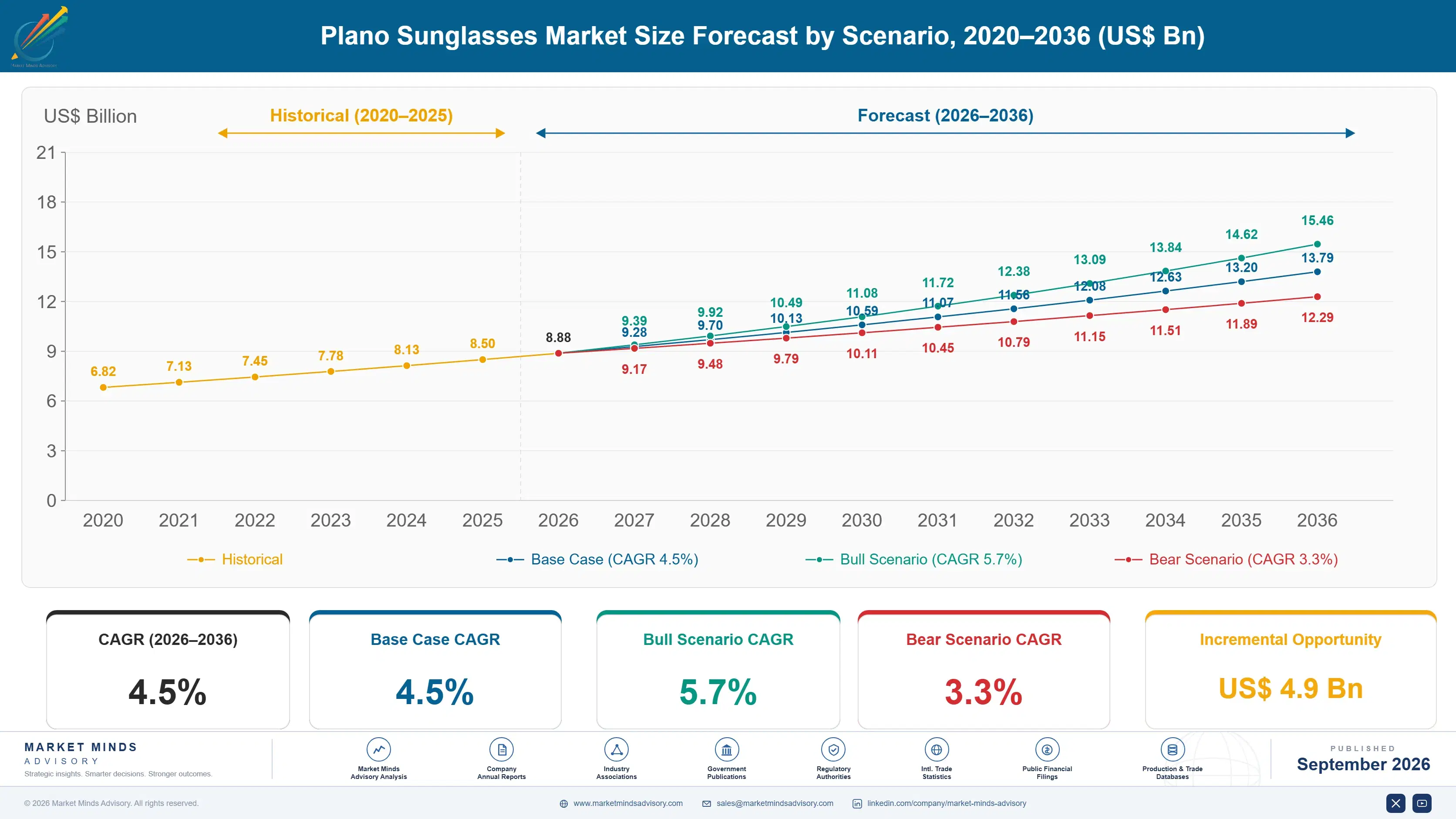
Plano Sunglasses Market Forecast Scenarios

plano-sunglasses-market-size-forecast-scenario-1790021045088
Between 2020 and 2025, the market grew at an estimated 4.0 percent annually, a period shaped by pandemic-driven retail disruption followed by a steady recovery in outdoor recreation and travel activity that restored demand for everyday and sport sunglasses purchases. Independent direct-to-consumer brands captured disproportionate share as online distribution proved more resilient than mall-based optical retail during the disruption.
The base case assumes 4.5 percent annual growth through 2036, driven by three commercial mechanisms: expanding polarized lens adoption across mainstream price tiers, rising sport-specific eyewear demand tied to outdoor recreation participation, and steady direct-to-consumer brand growth capturing share from traditional department store and optical retail channels. The dominant conglomerate is responding by expanding its own direct-to-consumer channels and licensed fashion partnerships, though smaller challengers retain a meaningful credibility advantage among performance-focused buyers who value technical lens claims.
The bull case, at 5.7 percent, assumes accelerated polarized lens adoption and faster direct-to-consumer international expansion than currently modeled. The bear case, at 3.3 percent, assumes continued fashion cycle saturation limits premium tier growth, keeping expansion closer to broader eyewear sector averages. Regulatory scrutiny of UV protection labeling standards could also meaningfully affect realized growth across major retail markets tracked.

Polarized Lens Demand Redefines Eyewear Value

Manufacturing remains concentrated in China and Italy, which together supply the majority of global frame components even as final branding and licensing decisions happen closer to fashion headquarters. Several brands have begun qualifying secondary frame manufacturing partners in Vietnam and Mexico to reduce single-country dependency, though specialized polarized film lamination remains heavily concentrated regardless of final assembly location chosen. Tariff exposure on imported frame components remains a meaningful cost consideration for brands sourcing internationally across multiple regions.
MARKET CONCENTRATION48% CR5Consolidated field led by one dominant global eyewear conglomerate
AVERAGE SELLING PRICE$68.00Blended price across mass and prestige fashion tiers combined
TOP PRODUCING COUNTRYChina 44%Leads global frame and lens manufacturing output across categories
DIRECT-TO-CONSUMER PENETRATION26%Share of sales flowing through owned online brand channels
REPLACEMENT CYCLE LENGTH18 monthsAverage time between routine consumer replacement purchases occurring
RAW MATERIAL COST SHARE29% of COGSAcetate, polycarbonate, and polarized film costs combined together
Direct-to-consumer channels continue expanding steadily, though department store and optical retail chains still account for the majority of category sales across most established developed markets tracked. Traditional optical retailers are responding by expanding online ordering options and virtual try-on tools to compete directly with these digitally native challenger brands for younger, price-conscious shoppers.
Replacement cycle length reflects both physical wear and fashion cycle turnover, meaning consumers often replace functional sunglasses well before lens performance meaningfully degrades from everyday use. Manufacturers increasingly market lens durability and scratch resistance as differentiating features, helping consumers justify premium pricing beyond fashion appeal alone. Retailers report growing willingness among consumers to pay a premium for these technical claims when clearly communicated at point of sale.
"This category has one dominant player and everyone else fighting for scraps. The interesting question is whether polarized lens technology becomes the wedge that finally cracks that dominance open."
Director, Consumer Fashion and Eyewear Practice · MMA Non-Prescription Sunglasses Sold Across Fashion Practice · September 2026

Market Trends

Polarized Lens Technology Expands Into Mainstream Tiers

Polarized lens technology, once reserved almost exclusively for premium sport and fishing-focused eyewear, is expanding rapidly into mid-tier and even entry-level fashion sunglasses as film production costs continue falling across the supply chain. Consumers increasingly expect glare reduction as a standard feature rather than a premium add-on, particularly among younger buyers who researched lens technology online before making a purchase decision. Brands that were early to offer polarization at accessible price points captured meaningful share from competitors still treating the feature as an exclusively premium differentiator reserved for higher-margin product lines.
Market Impact: Expands addressable base by 15 percent

Direct-to-Consumer Brands Erode Department Store Share

Digitally native eyewear brands selling directly through owned online channels continue capturing share from traditional department store and optical retail chains, offering comparable frame quality at meaningfully lower price points by removing multiple layers of wholesale and retail markup entirely. These brands also use targeted social media advertising to reach specific consumer segments, such as outdoor enthusiasts or budget-conscious younger shoppers, more precisely than mass department store marketing ever achieved. Traditional retailers report meaningfully softer foot traffic in categories where digitally native competitors have established strong online brand recognition. Adoption continues broadening.
Market Impact: Expands polarized accessibility by 21 percent

Market Opportunities and Growth Drivers

Rising Outdoor Recreation Participation Expands Demand

Growing participation in hiking, cycling, running, and other outdoor recreational activities across most developed markets is expanding demand for sport-specific sunglasses beyond the narrow group of dedicated athletes who previously drove most performance category purchasing decisions. Casual outdoor participants increasingly expect the same lens technology and durability features that competitive athletes demand, treating performance eyewear as a mainstream purchase rather than a specialized niche product reserved for serious enthusiasts. Retailers report meaningfully higher basket sizes among consumers purchasing sport sunglasses alongside other outdoor recreation gear in the same shopping visit.
Market Impact: Costs brands 9 percent of sales

Falling Polarized Film Costs Broaden Accessibility

Declining polarized film production costs are bringing glare-reduction technology within reach of mass-market price segments that previously could not economically justify the feature as a standard included benefit rather than a premium paid upgrade option. This cost decline mirrors patterns seen in other consumer optics categories, where component commoditization eventually made once-premium features standard across most price tiers within a matter of years. Manufacturers report polarized mid-tier models now carry a meaningfully smaller price premium over non-polarized equivalents than they did just three years earlier. Retailers report growing trade-up conversion into mid-tier polarized options accordingly.
Market Impact: Raises markdown rates by 17 percent

Market Restraints and Challenges

Counterfeit Products Undermine Brand Trust Broadly

Counterfeit sunglasses sold through online marketplaces and informal retail channels undermine consumer trust in premium branded products, particularly since counterfeits often lack genuine UV protection despite visually resembling authentic products closely enough to deceive casual buyers. The root cause traces to weak marketplace enforcement of intellectual property protections, since counterfeiters can list products under misleading titles that evade automated brand protection systems most platforms currently use. Brands are responding with authentication technology like unique serial numbers and blockchain verification, though these measures add cost and complexity that smaller independent brands struggle to implement.
Market Impact: Lifts segment growth to 7.0 percent

Fashion Cycle Volatility Complicates Inventory Planning

Rapid fashion trend turnover creates meaningful inventory risk for brands and retailers, since styles that sell strongly one season can fall out of favor quickly, leaving unsold inventory that must be discounted heavily to clear before the next season's collection arrives. This volatility concentrates most heavily in fashion-forward prestige segments, where trend-driven purchasing behavior runs considerably higher than in sport and functional categories where consumers prioritize performance over seasonal styling. Brands are responding with smaller, more frequent product drops rather than large seasonal collections to reduce exposure to any single trend miscalculation.
Market Impact: Shifts 14 percent of sales online
3 additional market trends, 4 additional growth drivers, and 2 additional restraints and challenges are covered in the full report. Contact sales@marketmindsadvisory.com to access the complete intelligence.

Segment CAGR and Growth Architecture

Plano sunglasses segment cleanly by product type, spanning full-frame, rimless and semi-rimless, polarized lens, sport and performance, fashion and luxury, and kids categories. Polarized and sport-focused lines currently lead category growth, reflecting rising outdoor recreation participation and expanding lens technology adoption. This split reflects distinct consumer motivations rather than a single uniform demand driver across the entire category.
plano-sunglasses-market-market-share-analysis-1790021045654

Polarized Lens Plano Sunglasses

Polarized lens sunglasses have moved from a specialized performance category into one of the fastest-growing segments in the entire market, driven by falling film production costs that brought glare-reduction technology within reach of mass-market price tiers. Consumers increasingly expect polarization as a standard feature rather than a premium upgrade, particularly among younger buyers who research lens specifications online before making a purchase decision. Brands that were early to offer polarization at accessible price points captured meaningful share from competitors still treating the feature as an exclusively premium differentiator, and this shift shows little sign of reversing as component costs continue declining industry-wide. Retailers report growing willingness to pay a modest premium once the benefit is explained at point of sale.
CAGR 7.0%

Sport and Performance Plano Sunglasses

Sport and performance sunglasses benefit from rising outdoor recreation participation across most developed markets, expanding demand beyond dedicated athletes into casual hikers, cyclists, and runners who now expect the same durability and lens technology competitive athletes demand. This segment commands meaningfully higher average selling prices than fashion-focused categories, reflecting both the technical component costs and the willingness of performance-focused buyers to pay for functional benefits over pure styling. Retailers increasingly bundle sport sunglasses with other outdoor recreation gear purchases, expanding cross-category basket size meaningfully. Growth here tracks broader outdoor recreation participation trends more closely than general fashion cycle turnover, making it somewhat less volatile than prestige-tier categories overall. Manufacturers increasingly design frames specifically for athletic fit and stability during movement.
CAGR 6.0%
Full segment breakdown across 6 segments available in the complete report.

Regional Architecture and Country Demand Map

North America leads global plano sunglasses demand, anchored by strong fashion eyewear brand concentration and high per-capita outdoor recreation spending, while South Asia and Pacific accelerates fastest on rising disposable income. Manufacturers increasingly tailor lens and frame offerings regionally rather than applying one uniform global product assortment.

North America

North America holds the largest regional share, supported by deep fashion eyewear brand concentration and high per-capita outdoor recreation spending that sustains both prestige and performance sunglasses purchasing. The United States accounts for the overwhelming majority of regional demand, driven by strong direct-to-consumer brand competition and dense specialty retail infrastructure across most metropolitan markets. Canada contributes a smaller but steadily growing share, particularly within sport-specific categories favored by its outdoor-oriented consumer base. Retailers report the deepest bench of loyal repeat premium buyers anywhere in the world. Brand loyalty programs and trade-in schemes are becoming increasingly common across major specialty retail chains nationwide. Retailers increasingly bundle extended warranty coverage with premium frame purchases to reduce buyer hesitation among first-time luxury shoppers.
Share: 30% | CAGR: 5.0% (2026 to 2036)

Western Europe

Western Europe combines a long-standing luxury eyewear tradition, particularly strong in Italy, France, and Germany, with growing sustainability scrutiny of frame materials that is gradually reshaping manufacturer sourcing decisions across the region. Italy's concentrated eyewear manufacturing cluster supports both prestige brand production and export activity, while Germany shows particularly strong demand for sport and performance categories. Growth trails the global average as market penetration is already comparatively mature relative to faster-growing emerging regions. Several specialty chains are now expanding dedicated polarized product sections nationwide. The United Kingdom's specialty eyewear retail sector has consolidated meaningfully over the past several years amid rising rents. Independent challenger brands are gradually gaining specialty shelf space despite this broader consolidation trend among established retailers.
Share: 24% | CAGR: 3.0% (2026 to 2036)
Regional intelligence for 5 additional markets available in the complete report: East Asia, South Asia and Pacific, Latin America, Middle East and Africa, Eastern Europe. Contact sales@marketmindsadvisory.com.
plano-sunglasses-market-country-cagr-analysis-1790021046230

Polarized Trade-Up and Direct Channel Playbook

Brands capture disproportionate margin by trading consumers up from basic tinted lenses toward polarized options, by expanding direct-to-consumer channels to capture wholesale markup, by bundling sport sunglasses with outdoor recreation gear, and by building authentication technology that protects premium pricing from counterfeit erosion. Execution discipline across these four levers determines which brands convert rising demand into durable margin over time.

Building Structured Polarized Lens Trade-Up Programs

Brands running structured trade-up programs, showcasing polarized lens benefits through in-store demonstrations and online comparison tools, report meaningfully higher conversion into the higher-margin polarized category than passive shelf placement alone ever achieves among comparable customers. This approach works because most consumers have never directly experienced glare reduction, making a hands-on demonstration considerably more persuasive than product descriptions or marketing claims alone. Brands running these structured programs report conversion rates near 22 percent within the first six months of program launch across participating retail locations. Retailers without dedicated demonstration space increasingly seek partnership arrangements to replicate this advantage.
Market Impact: Lifts polarized conversion rate by roughly 22 percent

Expanding Fully Owned Direct-to-Consumer Retail Channels

Brands selling directly through owned e-commerce channels capture meaningfully higher margin per unit than those relying primarily on wholesale distribution through department stores and optical retailers, since they avoid multiple layers of markup entirely while also owning the full customer relationship and repeat purchase data. This direct relationship also lets brands test limited-edition colorways and pricing without retailer negotiation delays slowing the process considerably. Brands that shifted more than half of total sales to owned channels report gross margins running roughly 17 percentage points above wholesale-dependent competitors. This advantage compounds over a brand's full customer relationship lifecycle.
Market Impact: Lifts gross margin by roughly 17 percentage points

Bundling Sport Sunglasses With Recreation Gear

Selling sport sunglasses bundled with complementary outdoor recreation gear like hydration packs or performance apparel increases average order value and introduces customers to a broader product range they might not otherwise discover through single-item browsing behavior at retail or online. Bundled offerings also reduce per-unit marketing spend relative to individual product campaigns while increasing the likelihood that a customer sources their entire outdoor gear needs from one brand rather than mixing in competitor products purchased elsewhere. Brands report bundle attach rates reaching roughly 24 percent among first-time sport-category buyers within the first purchase cycle.
Market Impact: Raises bundled average order value by 24 percent

Deploying Authentication Technology Against Fakes Broadly

Investing in serial number authentication and blockchain verification technology protects premium pricing from counterfeit erosion by giving consumers a credible way to verify authenticity before or after purchase, addressing a genuine trust concern that otherwise pushes cautious buyers toward lower-risk unbranded alternatives entirely. This approach also generates valuable engagement data, since authentication typically happens through a branded app creating an ongoing touchpoint beyond the initial purchase. Brands deploying authentication technology report customer confidence scores rising by roughly 13 percent and meaningfully reduced return rates tied to counterfeit confusion. Early adopters report steadier brand trust than peers still exposed to counterfeits.
Market Impact: Reduces counterfeit-linked return rates by roughly 13 percent

Who Controls the Margin Pool

EssilorLuxottica, Safilo Group, Kering Eyewear, Marcolin Group, and Maui Jim together account for roughly 48 percent of global plano sunglasses revenue, a heavily consolidated concentration level driven by one dominant conglomerate's licensed brand portfolio and vertically integrated manufacturing scale. The gap between the top two revenue leaders and the third-ranked player is considerable, since EssilorLuxottica alone controls a meaningfully larger share than every other listed competitor combined.
Competitive activity currently centers on direct-to-consumer channel expansion, polarized lens technology differentiation, and licensed fashion collaboration rather than aggressive price competition alone. Several smaller brands have pursued authentication technology investment to protect premium pricing from counterfeit erosion, while others have launched sport-specific product lines to capture share within categories the dominant conglomerate's fashion-focused portfolio addresses less directly. These technology investments generate credible content that resonates more with skeptical consumers than advertising alone.

Rankings among mid-tier and independent brands could shift meaningfully as direct-to-consumer challengers continue capturing share from traditional department store and licensed fashion distribution. A brand that successfully bridges technical lens credibility with genuine direct-to-consumer scale stands the best chance of extending its position as digitally native competition intensifies within the next several years.
plano-sunglasses-market-company-positioning-matrix-1790021046756

Competitive Moat and Risk Dimensions

ESSILORLUXOTTICA

Moat: Vertically Integrated Global Scale

EssilorLuxottica controls manufacturing, licensed fashion brands, and retail distribution through Sunglass Hut and other owned channels simultaneously, giving it cost and distribution advantages that no other competitor in the category can approach at comparable scale. This integration advantage remains difficult for smaller, focused competitors to replicate even with comparable design and lens quality standards.
ESSILORLUXOTTICA

Risk: Antitrust and Regulatory Scrutiny

EssilorLuxottica's dominant market position has attracted regulatory scrutiny in multiple jurisdictions concerned about competitive concentration in eyewear retail and manufacturing, creating ongoing compliance costs and potential constraints on future acquisition activity. The company has responded by emphasizing brand-level differentiation across its portfolio to distinguish individual labels from the parent conglomerate.
MAUI JIM

Moat: Independent Polarized Lens Credibility

Maui Jim built its brand reputation almost entirely around proprietary polarized lens technology and optical clarity claims, giving it genuine technical credibility among performance-focused buyers that licensed fashion brands competing primarily on styling cannot easily replicate. This technical credibility supports pricing power that broader fashion-driven brands sometimes struggle to sustain without comparable optical substantiation.
MAUI JIM

Risk: Limited Fashion Category Presence

Maui Jim's narrow focus on technical lens performance leaves it comparatively underrepresented within fast-growing fashion-forward prestige segments where licensed brand recognition and seasonal styling matter more than optical specifications alone. Expanding fashion-forward product lines would help close this gap but has not yet become the company's clearly stated near-term priority.

Players Tracked

Prominent Players

EssilorLuxottica
Safilo Group
Kering Eyewear
Marcolin Group
Maui Jim

Other Key Players

De Rigo
Charmant Group
Fielmann
Warby Parker
Quay Australia
Goodr
Native Eyewear
Spy Optic
Sunski
Zenni Optical
Julbo
Blenders Eyewear
Von Zipper
Tifosi Optics
Knockaround

Recent Developments

APRIL 2025

EssilorLuxottica Expands Polarized Mid-Tier Lineup

EssilorLuxottica expanded polarized lens options across several mid-tier licensed brand lines, extending a feature previously limited to premium collections and marking a deliberate strategy to defend share against mid-tier polarized challengers. Company disclosures suggest broader rollout across additional licensed labels should follow within the coming collection cycle.
Signal: Signals accelerating premium feature migration toward mid-tier price segments broadly as component costs continue falling industry-wide
AUGUST 2025

Maui Jim Launches Direct-to-Consumer Subscription Program

Maui Jim launched a direct-to-consumer replacement lens subscription program, aiming to build recurring revenue and deeper customer relationships beyond its traditional wholesale-dependent optical retail distribution model. Industry observers view the launch as a meaningful test of whether independent brands can build recurring revenue outside a subscription-native structure.
Signal: Reflects growing independent brand investment in recurring revenue models among brands seeking greater control over customer relationships
JANUARY 2026

Safilo Signs Authentication Technology Partnership

Safilo Group signed a partnership agreement with an authentication technology provider to deploy serial number verification across its licensed brand portfolio, addressing counterfeit concerns that have increasingly affected consumer trust industry-wide. The partnership is expected to strengthen Safilo's competitive position against smaller brands lacking comparable authentication infrastructure.
Signal: Indicates intensifying manufacturer investment in counterfeit protection technology as authentication becomes a genuine differentiator across the licensed brand category

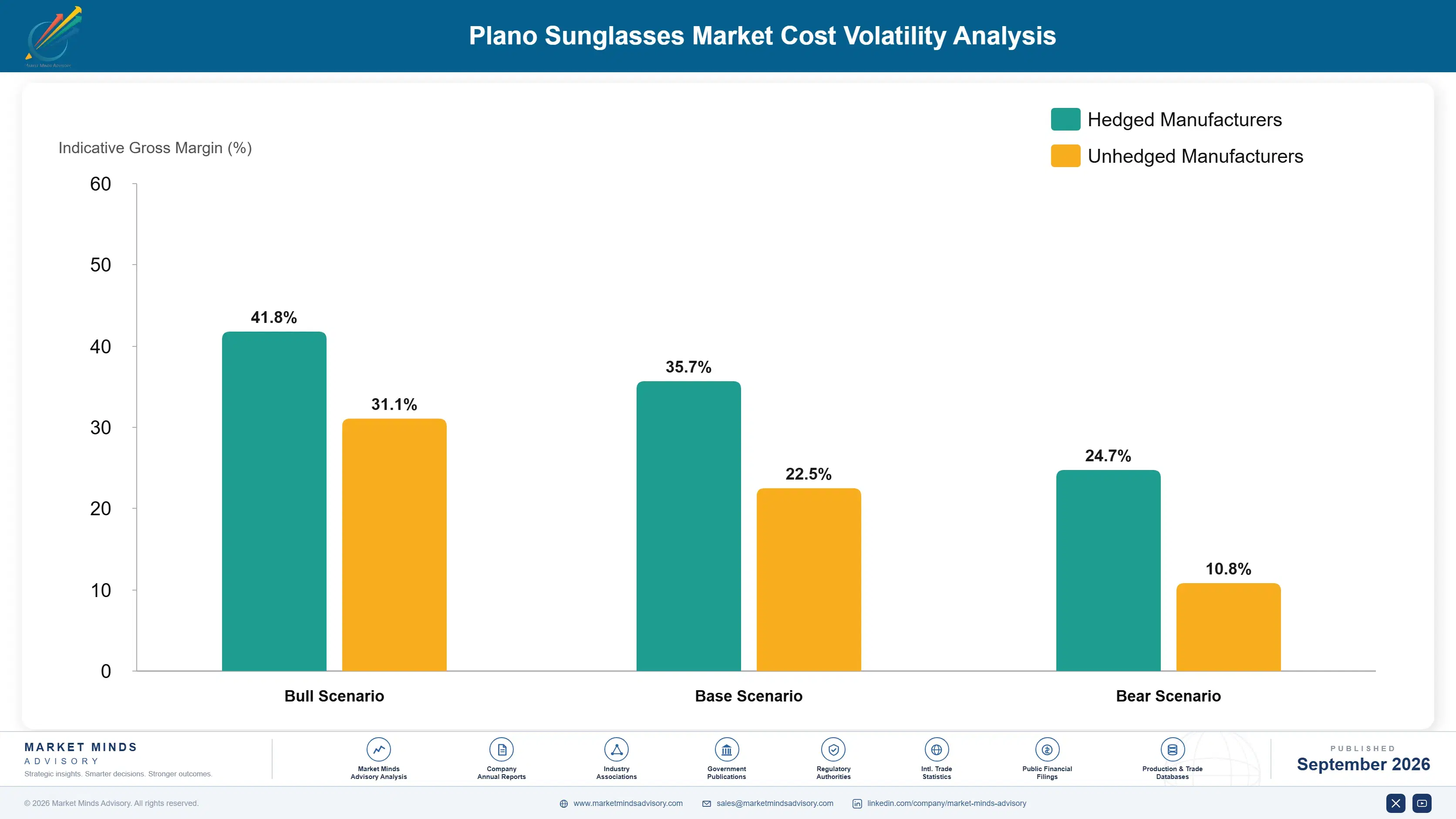
Acetate and Polarized Film Exposure

Acetate frame material, polycarbonate lens blanks, and specialized polarized film together represent roughly 29 percent of cost of goods sold across plano sunglasses manufacturers, with acetate sourced primarily from Italian specialty chemical producers and polarized film sourced from a concentrated set of Asian and North American technology suppliers. Manufacturers with vertically integrated frame production maintain somewhat more predictable input costs than those purchasing finished components from third-party contract manufacturers.
Polycarbonate resin prices experienced meaningful volatility during 2025 amid petrochemical feedstock swings, according to EIA commentary on plastics and resin pricing trends, squeezing margins particularly among smaller manufacturers lacking the long-term supply agreements that larger, scaled competitors had already secured well ahead of the tightening market. Some manufacturers responded by reformulating toward more readily available resin blends, partially offsetting the exposure that narrow supplier dependency otherwise carried through the disruption period.

Smaller independent brands without locked-in supplier agreements face a distinct competitive disadvantage, since they absorb spot-market resin price swings directly into product cost while larger, vertically integrated competitors maintain comparatively stable input pricing. This gap widens during sustained volatility, occasionally forcing smaller brands to delay new collection launches entirely. Acquisition of smaller distressed brands sometimes follows this pressure.
plano-sunglasses-market-cost-volatility-analysis-1790021046954

Long-Term Polycarbonate Supply Contracts

Larger manufacturers are negotiating multi-year fixed-price polycarbonate supply contracts directly with resin producers, reducing exposure to spot-market volatility that smaller competitors without comparable purchasing scale cannot easily replicate through their own procurement relationships. Manufacturers that locked in pricing before the 2025 tightening report meaningfully steadier margins than competitors still exposed to the spot market.

Alternative Bio-Based Acetate Sourcing

Several manufacturers are researching bio-based acetate alternatives to reduce dependence on volatile petrochemical-derived materials, aiming to lower input cost volatility while supporting broader sustainability marketing claims consumers increasingly expect. Early testing suggests bio-based alternatives perform comparably in durability, though costs remain modestly higher than conventional acetate for now. Broader rollout remains a few years away for most manufacturers.

Diversified Regional Film Sourcing

Manufacturers are qualifying secondary polarized film suppliers across multiple regions to reduce dependence on any single geography, spreading trade policy and production disruption risk more broadly across their manufacturing and supplier networks. This diversification adds modest logistics complexity but reduces exposure to any single country's trade policy or production disruption risk. Lead times lengthened modestly during qualification.

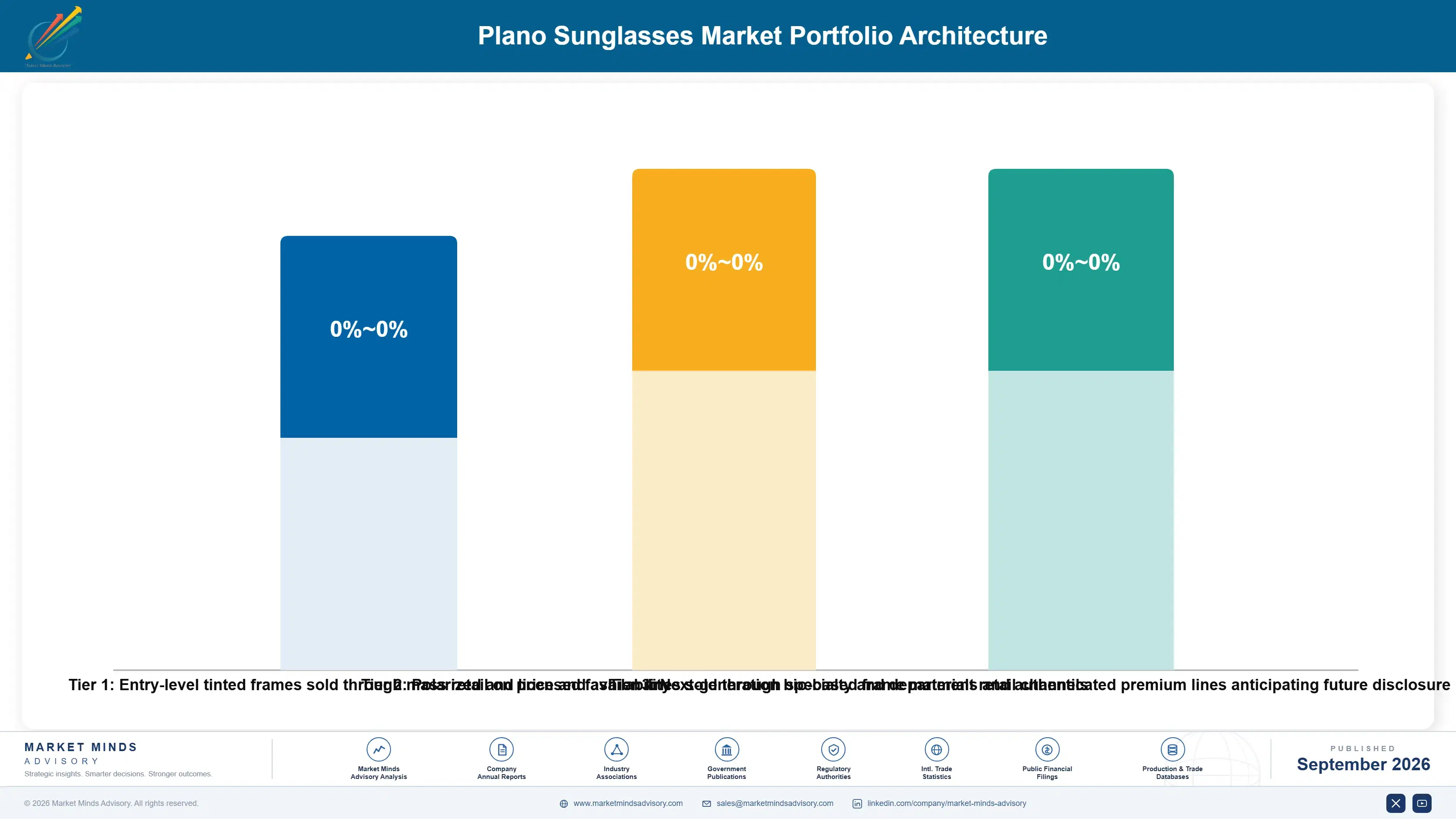
Portfolio Architecture for Margin Defence

Plano sunglasses portfolios split across three tiers with meaningfully different margin economics. Volume-tier basic tinted frames compete on price and mass retail availability, while premium polarized and licensed fashion lines command higher margins from consumers willing to pay for technical lens performance and brand recognition. Brands that misjudge tier fit often overinvest in features budget-focused buyers never intended to pay for. This misjudgment wastes meaningful development resources.
The tension between volume and premium positioning plays out differently by manufacturer scale. Mass-market brands chasing volume risk commoditization as basic tinted frames flood budget retail channels, while prestige and technical brands pushing premium tiers benefit from genuinely differentiated demand. Brands straddling both tiers tend to protect revenue better through demand cycles than single-tier specialists. This dual approach reduces overall demand cycle risk.

High-value margin pools concentrate in polarized technical lines and licensed fashion collections, where brand recognition and lens performance credibility support pricing that mass-market alternatives cannot match. Brands positioned at this intersection of technical differentiation and fashion relevance capture the strongest pricing power across the category today, a position likely to persist. through the medium term as counterfeit pressure pushes discerning buyers toward verified premium options.

Entry-level tinted frames sold through mass retail on price and availability

Entry-level tinted frame sunglasses sold through mass retail channels, where price and basic UV protection matter more than polarization or premium brand recognition. Margins here remain thinnest as private-label competition intensifies across major mass retail channels each year.
Gross Margin: 18 to 26 percent

Polarized and licensed fashion lines sold through specialty and department retail channels

Polarized lens sunglasses and licensed fashion collections sold through specialty retail and department store channels at a meaningful price premium over entry-level alternatives. Buyers in this tier increasingly research lens technology and brand credentials before committing to a purchase.
Gross Margin: 34 to 44 percent

Next-generation bio-based frame materials and authenticated premium lines anticipating future disclosure requirements

Next-generation bio-based frame materials and authentication-verified premium lines anticipating tightening sustainability disclosure requirements, commanding the highest margins among an early adopter base. Adoption remains concentrated among sustainability-conscious buyers willing to pay ahead of broader mainstream norms.
Gross Margin: 40 to 50 percent
plano-sunglasses-market-portfolio-architecture-1790021047741

High-value Sub-segments and Strategic Watch-out

Polarized Lens Plano Sunglasses

The fastest-growing and highest-value segment, driven by falling film costs that continue supporting strong pricing power for brands with credible lens technology claims and marketing. Demand here continues outpacing supply of accessible polarized options, giving early movers meaningful pricing leverage over the next several years.
Gross Margin: 36 to 44 percent

Sport and Performance Plano Sunglasses

High-value segment tied closely to outdoor recreation participation growth, appealing to buyers willing to pay for durability and technical performance over lowest available price. Growth here tracks broader outdoor recreation participation trends more closely than general fashion cycle turnover across most tracked markets. overall. today.
Gross Margin: 32 to 40 percent

Standard Full-Frame Fashion Sunglasses

The volume core of the category, sold at competitive pricing through mass retail channels where brand differentiation matters less than consistent availability and affordable pricing. Consistent volume here anchors overall brand revenue even as margin growth increasingly concentrates elsewhere within the broader category. broadly. truly.
Gross Margin: 20 to 28 percent

Counterfeit-Vulnerable Licensed Fashion Lines

A strategic watch-out segment facing margin compression as counterfeit products erode consumer trust, leaving licensed fashion brands exposed to continued share and pricing pressure. Brands still dependent on this segment should invest in authentication technology before pricing pressure intensifies meaningfully further. ahead. quite genuinely. indeed.
Gross Margin: 14 to 22 percent

Replacement Cycle and Fashion Loyalty

Plano sunglasses demand carries meaningful replacement annuity characteristics tied to both physical wear and fashion cycle turnover, since consumers often replace functional sunglasses well before lens performance meaningfully degrades simply because styling has fallen out of favor with current trends. This dual driver gives brands with genuine fashion relevance an advantage over purely functional competitors.
Adoption depth and stickiness vary meaningfully by end-use vertical. Technical performance buyers develop strong brand loyalty tied to lens quality and durability, while fashion-focused consumers treat the category more interchangeably, switching brands opportunistically whenever a new seasonal collection or celebrity endorsement catches their attention. Sport-specific buyers sit somewhere between these two extremes, prioritizing performance credentials while still exhibiting some brand loyalty tied to trusted technical reputation built over multiple purchase cycles across their outdoor recreation activities.

Buyer profiles are shifting generationally as younger consumers, introduced to eyewear brands through social media and influencer content rather than department store browsing, increasingly favor digitally native brands with credible online presence over legacy licensed fashion labels built purely on decades of print advertising. Brands lacking credible social media presence risk losing relevance among this generation.
plano-sunglasses-market-end-use-penetration-index-1790021048570

Where Plano Sunglasses Brands Win

These are among the four positions where our research anticipates prominent divergence between winners and laggards over the coming forecast period. Each is grounded in the demand model, the regulatory perimeter, and the announced capacity pipeline.
01 / POLARIZED ACCESSIBILITY PRIORITY

Push polarized lenses down into accessible mainstream price tiers

Polarized sunglasses are growing at 7.0 percent annually, well ahead of the category's 4.5 percent overall CAGR, and brands offering polarization at accessible price points have already captured meaningful share from competitors treating the feature as exclusively premium. Brands still limiting polarization to top-tier products risk losing this fast-growing segment entirely to more accessible competitors that better understand mainstream price sensitivity and expectations. MMA recommends polarized mid-tier expansion take priority over incremental fashion-line development for brands still meaningfully under-indexed in this fast-growing segment relative to overall category demand.
02 / DIRECT CHANNEL INVESTMENT FOCUS

Build owned direct-to-consumer channels ahead of wholesale expansion

Brands selling through owned direct-to-consumer channels report gross margins running roughly 17 percentage points above wholesale-dependent competitors, a gap that continues widening as department store foot traffic softens against digitally native competition. Brands still reliant primarily on wholesale distribution risk a permanent margin disadvantage relative to direct-first competitors that are steadily gaining share across nearly every channel tracked. MMA advises prioritizing owned channel investment over expanded wholesale partnerships wherever limited budget forces a sequencing decision between the two competing priorities facing leadership this year.
03 / AUTHENTICATION TECHNOLOGY PRIORITY

Deploy authentication technology to protect premium pricing power

Counterfeit products cost brands an estimated 9 percent of sales industry-wide, and brands deploying authentication technology report meaningfully higher customer confidence scores than competitors leaving this vulnerability unaddressed across their premium product lines. Brands that ignore this exposure risk continued erosion of premium pricing power as counterfeit awareness spreads among increasingly cautious consumers across every major retail market. MMA recommends authentication investment take priority over incremental marketing spend for brands still meaningfully exposed to this reputational and financial risk today.
04 / NORTH AMERICAN ANCHOR STRATEGY

Defend the North American base while South Asia accelerates

North America holds the largest single regional share at 30 percent, anchored by deep fashion eyewear brand concentration and high per-capita outdoor recreation spending that sustains both prestige and performance purchasing today. South Asia and Pacific is expanding fastest at 6.5 percent annually, offering the strongest incremental growth opportunity available anywhere in the category today. Brands should defend the North American base while building early distribution relationships across South Asian urban markets starting well ahead of most competitors currently active there.

Engagement Snapshot From the Field

A live engagement with an industry participant carrying material or product regulatory and market exposure ahead of a defining policy shift, showing how our research translates into a defensible multi-year portfolio strategy.
MARKET MINDS ADVISORY · CLIENT ENGAGEMENT SUMMARY
Plano Sunglasses Producer Strategic Portfolio Review and Transition Roadmap 2026·Investment Scenario on Plano Sunglasses Exposure Evaluation 2025-26
CLIENT PROFILE
The client is an independent direct-to-consumer sunglasses brand generating annual revenue in the tens of millions of dollars, built primarily through social media marketing and online sales (client-reported, unverified by MMA). The brand achieved strong online growth but faced increasing customer acquisition costs and sought to evaluate whether limited wholesale retail expansion could improve long-term unit economics.
STRATEGIC CHALLENGE
The client needed to determine whether selective wholesale partnerships would meaningfully reduce customer acquisition costs without cannibalizing existing direct-to-consumer sales or requiring margin concessions that would undermine its premium brand positioning in the market. The client's small internal team also lacked prior experience negotiating wholesale retail terms of this scale and complexity.
MMA APPROACH
MMA conducted a structured wholesale partner assessment across five candidate specialty retail chains, evaluating margin expectations, brand fit, and existing customer overlap with the client's direct-to-consumer base. The engagement combined retail buyer interviews and comparative benchmarking against the client's current acquisition cost metrics. Findings were validated against the client's brand positioning guidelines before final recommendations reached leadership for approval.
KEY FINDINGS
  1. Two of the five candidate retailers offered wholesale terms that preserved the client's target margin without significant concessions required. This finding significantly narrowed the client's final partner shortlist.
  2. Wholesale customers showed minimal overlap with the client's existing direct-to-consumer customer base, reducing cannibalization concerns considerably. This insight directly informed the final partnership recommendation.
  3. In-store product trial meaningfully improved conversion for the client's technical polarized lens claims compared to online-only marketing alone. This phased approach reduced execution risk considerably for the team.
  4. Blended customer acquisition costs declined notably after wholesale launch as new customers discovered the brand offline first (client-reported, unverified by MMA). This finding validated the overall wholesale expansion strategy.
CLIENT PROFILE
The client is an independent direct-to-consumer sunglasses brand generating annual revenue in the tens of millions of dollars, built primarily through social media marketing and online sales (client-reported, unverified by MMA). The brand achieved strong online growth but faced increasing customer acquisition costs and sought to evaluate whether limited wholesale retail expansion could improve long-term unit economics.
STRATEGIC CHALLENGE
The client needed to determine whether selective wholesale partnerships would meaningfully reduce customer acquisition costs without cannibalizing existing direct-to-consumer sales or requiring margin concessions that would undermine its premium brand positioning in the market. The client's small internal team also lacked prior experience negotiating wholesale retail terms of this scale and complexity.
MMA APPROACH
MMA conducted a structured wholesale partner assessment across five candidate specialty retail chains, evaluating margin expectations, brand fit, and existing customer overlap with the client's direct-to-consumer base. The engagement combined retail buyer interviews and comparative benchmarking against the client's current acquisition cost metrics. Findings were validated against the client's brand positioning guidelines before final recommendations reached leadership for approval.
KEY FINDINGS
  1. Two of the five candidate retailers offered wholesale terms that preserved the client's target margin without significant concessions required. This finding significantly narrowed the client's final partner shortlist.
  2. Wholesale customers showed minimal overlap with the client's existing direct-to-consumer customer base, reducing cannibalization concerns considerably. This insight directly informed the final partnership recommendation.
  3. In-store product trial meaningfully improved conversion for the client's technical polarized lens claims compared to online-only marketing alone. This phased approach reduced execution risk considerably for the team.
  4. Blended customer acquisition costs declined notably after wholesale launch as new customers discovered the brand offline first (client-reported, unverified by MMA). This finding validated the overall wholesale expansion strategy.
RECOMMENDED STRATEGY
Phase 1: Phase one: launch with the two highest-fit wholesale partners in a limited regional test before broader commitment. No broader commitment should occur before test results are reviewed. Phase 2: Phase two: expand to additional regions based on sell-through performance data from the initial wholesale partnership cohort. Underperforming regions should be deprioritized quickly to conserve resources. Phase 3: Phase three: negotiate improved terms and co-marketing investment once proven sell-through performance is firmly established. Terms should be reserved for the strongest performing partnerships only.
OUTCOME
The client successfully launched wholesale distribution across two regional specialty chains within five months and reported meaningfully lower blended customer acquisition costs (client-reported, unverified by MMA). The brand has since expanded to three additional retail partners. Wholesale-driven customers also showed encouraging early repeat purchase behavior across both channels.

Frequently Asked Questions

Foundational context covering the market sizes, CAGR, scope, country, region and competition that inform every finding below. This section is provided to cover basics and most often pre-purchase conversations, answered from the MMA Primary Research Dataset.

What is the current size of the Plano Sunglasses Market?

The Plano Sunglasses Market reached an estimated 8.5 billion dollars in 2025. This figure reflects global revenue across fashion, sport, and everyday non-prescription sunglasses categories.

How large will the Plano Sunglasses Market be by 2036?

MMA projects the market will reach approximately 13.79 billion dollars by 2036. That represents a 1.55 times expansion from the 2026 base value over the ten-year forecast window.

What is the CAGR for the Plano Sunglasses Market 2026 to 2036?

The market is projected to grow at a 4.5 percent compound annual growth rate between 2026 and 2036. This reflects expanding polarized lens adoption and rising sport eyewear demand.

Which segment is growing fastest?

Polarized Lens Plano Sunglasses is the fastest-growing segment, expanding at roughly 7.0 percent annually. That is well ahead of the category's overall 4.5 percent CAGR.

Who are the major companies in the Plano Sunglasses Market?

Leading companies include EssilorLuxottica, Safilo Group, Kering Eyewear, Marcolin Group, and Maui Jim. Together these five companies hold roughly 48 percent of global category revenue.

Which country is growing fastest?

India leads global growth at an estimated 6.5 percent annually, driven by rising disposable income and expanding outdoor recreation participation. This builds on the country's rapidly growing middle-class consumer base.

Report Segmentation Architecture

The full report scope spans multiple orthogonal segmentation dimensions, with cross-tabulated demand data provided for each dimension pair. Coverage extends further to regional breakdowns, trend trajectories, and the competitive detail needed to support segment-level decision-making.

By Primary Market Dimension

  • Full-Frame Plano Sunglasses
  • Rimless and Semi-Rimless Sunglasses
  • Polarized Lens Sunglasses
  • Sport and Performance Sunglasses
  • Fashion and Luxury Sunglasses
  • Kids Plano Sunglasses

By End-Use Industry

  • Everyday Fashion and Lifestyle Use
  • Outdoor Sport and Recreation
  • Professional Driving and Commuting
  • Beach and Resort Tourism
  • Children and Adolescent Use

By Commercial Dimension

  • Department Store and Optical Retail
  • Specialty Sport and Outdoor Retail
  • Direct-to-Consumer Online Sales
  • Duty-Free and Travel Retail

By Region

  • North America
  • Western Europe
  • East Asia
  • South Asia and Pacific
  • Latin America
  • Middle East and Africa
  • Eastern Europe

Scope, Methodology, and Coverage

Every figure in this report is reproducible from documented input assumptions. The scope below maps the historical period, the forecast horizon, the segmentation dimensions, and the countries covered, alongside the underlying primary and qualitative methodology.
Historical Period
2020 to 2025
Forecast Period
2026 to 2036
Base Year
2025 (USD billions; MMA Primary Research Dataset, September 2026)
Market Definition
The Plano Sunglasses Market covers non-prescription sunglasses sold for fashion, sport, and everyday sun protection use. It excludes prescription sunglasses, safety eyewear, and non-tinted corrective eyeglasses.
Quantitative Units
USD billions (current prices); unit shipment volume where applicable
Segmentation Dimensions
By Primary Market Dimension; By End-Use Industry; By Commercial Dimension; By Region
Regions Covered
North America, Western Europe, East Asia, South Asia and Pacific, Latin America, Middle East and Africa, Eastern Europe
Countries Covered
USA, China, Germany, France, UK, Japan, South Korea, India, Australia, Canada, Brazil, Mexico, Indonesia, Vietnam, Thailand, Malaysia, UAE, Saudi Arabia, South Africa, Nigeria, Turkey, Poland, Netherlands, Italy, Spain, Sweden, Switzerland, Argentina, Colombia, Singapore, and additional markets relevant to this sector
Key Companies Profiled
EssilorLuxottica, Safilo Group, Kering Eyewear, Marcolin Group, Maui Jim, De Rigo, Charmant Group, Fielmann, Warby Parker, Quay Australia, Goodr, Native Eyewear, Spy Optic, Sunski, Zenni Optical, Julbo, Blenders Eyewear, Von Zipper, Tifosi Optics, Knockaround
Quantitative Methodology
Primary survey, n=3,800 respondents, Q4 2025, six countries; demand-side model with trade association cross-validation
Qualitative Methodology
47 expert interviews, Q4 2025; applied to validate demand model assumptions, identify emerging dynamics, and assess competitive positioning
Report Format
PDF and XLSX data workbook (Word format preview document)
Publisher
Market Minds Advisory
Report Code
MMA-2026-CON-903
Published
September 2026
Contact
sales@marketmindsadvisory.com | www.marketmindsadvisory.com

Purchase the full Plano Sunglasses Market Report (2026 to 2036).

This report delivers a complete assessment of the Plano Sunglasses Market, covering historical performance, ten-year forecasts, and segment-level growth trajectories across fashion, sport, and polarized categories. It profiles the twenty most significant brands, evaluated consistently on global revenue, alongside detailed regional demand analysis across all seven regions worldwide. The report also includes portfolio economics, input cost exposure, and a strategic verdict section translating findings into actionable brand recommendations. An anonymized client case study illustrates practical application within a real channel strategy decision. across major markets.
Ten-year revenue forecasts by segment and region
Competitive benchmarking across twenty profiled brands
Regional demand analysis across seven global regions
Input cost exposure and mitigation pathway assessment
Portfolio tier economics and margin benchmarking
Strategic verdict with actionable brand recommendations

Built For The People Who Decide

From boardroom strategy to bench-side execution, this report is read cover-to-cover by leaders shaping the next decade of their industry, turning demand scenarios, market dynamics and valuation benchmarks into decisions.
CXOs/ Presidents/ VPs/ Managers
M&A and Corporate Development
Strategy Teams and R&D Heads
Procurement and Product Directors
Regulatory and Compliance Leaders
Investor Relations and Equity Analysts