Market Minds Advisory
Placental Growth Factors Market

Placental Growth Factors Market: The Value Sits Entirely In The Negative Result

Nobody buys this test to diagnose pre-eclampsia. They buy it to send a worried woman home safely instead of admitting her for observation she will almost certainly never need at all.

Lead Analyst

Alice Ballenger

Published

September 2026

Make Smarter Decisions with Customized Research Insights

Request a free sample report and evaluate market opportunities, growth trends, and competitive dynamics relevant to your business needs.

2025 MARKET VALUE$0.5BMarket Size 2025
2036 FORECAST VALUE$1.3BBase Case , 2026 to 2036
CAGR 2026 TO 20369.8 %Bull 11.1% / Bear 8.5%
INCREMENTAL OPPORTUNITY$0.8BNet 10- year value creation
EXPANSION MULTIPLE2.55x2036 value over 2026 base
Strategic Levers
M&A Pipeline
Regional Outlook
Country Rankings
Competitive Intelligence
Segmental Deep-dive
Call-Us : 91 93563 13602

Executive Snapshot and Market Trajectory

This is a rule-out test sold in a market that keeps describing it as a rule-in one. A low placental growth factor ratio carries a negative predictive value near 99.3% over the following week, and the clinical value is discharging a woman safely rather than diagnosing anybody at all.
The market reaches USD 0.46 billion in 2025 and compounds at 9.8% to USD 1.29 billion by 2036, an expansion multiple of 2.55 times. Point-of-care and near-patient assays grow fastest at 14.7%, exactly 1.50 times the market rate. Western Europe holds 32% of value, above the band this framework applies, because European guidance bodies adopted biomarker testing years ahead of anybody else, ahead of every other health system.
Concentration is very high at 74% across the top five, since two automated immunoassay platforms carry almost all clinical volume between them. Adoption and disease burden are inverted here. Roughly 92% of pre-eclampsia deaths occur in lower income countries where the test is barely used, and almost nobody is building for that, Affordable near-patient formats are the only realistic route into those settings, and remarkably few companies are building seriously for them.
Market Definition
The placental growth factors market covers clinical and research use of placental growth factor as a biomarker, spanning automated immunoassay ratio tests combining it with soluble fms-like tyrosine kinase-1, standalone placental growth factor immunoassays, point-of-care and near-patient formats, multiplex biomarker panels incorporating it, and research-grade recombinant proteins and enzyme immunoassay kits. Pre-eclampsia therapeutics including aspirin prophylaxis and antihypertensives, ultrasound and Doppler assessment, other standalone pregnancy biomarkers, and general angiogenesis research reagents are excluded.
Base Year Value
$0.5B in 2025 (MMA Primary Research Dataset, August 2026)
Forecast Period
2026 to 2036, eleven discrete annual values
CAGR
9.8% base case. Bull 11.1%. Bear 8.5%.
Fastest Growth Segment
Point-Of-Care And Near-Patient Assays: 14.7% CAGR
Fastest Growth Country
India: 13.6% CAGR
Fastest Growth Region
South Asia and Pacific: 12.2% CAGR
Largest Region
Western Europe: 32% of 2025 global value
Market Leaders
Roche Diagnostics, Thermo Fisher Scientific, Revvity, QuidelOrtho, Siemens Healthineers. Source: MMA Primary Research Dataset, July 2026.
Primary Survey
n=3,800 procurement and R&D decision-makers, Q4 2025, six countries
Methodology
Demand-side build-up, cross-validated against public data, 47 expert interviews

Placental Growth Factors Market Forecast Scenarios

placental-growth-factors-market-size-forecast-scenario-1787298728347
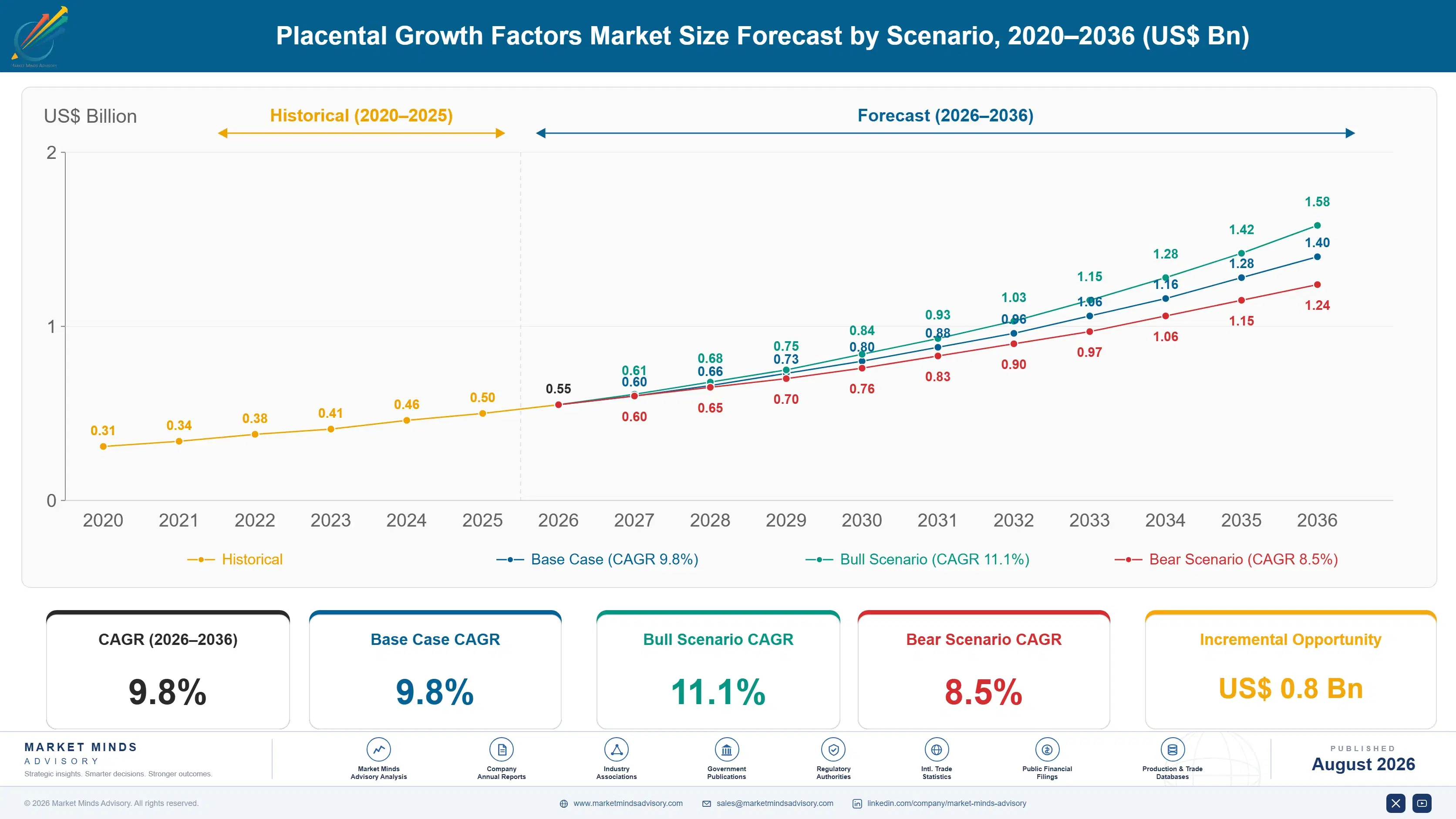
Between 2020 and 2025 adoption advanced on guidance rather than on any new evidence. European clinical guidance recommending biomarker testing in suspected pre-eclampsia drove uptake across national health systems, while American clearance arrived considerably later and hospital adoption lagged behind it. Obstetric volumes were broadly flat throughout. An 8.6% historical CAGR reflects guidance adoption spreading unevenly across health systems that price triage admission quite differently.
Three mechanisms carry the 9.8% base case. Triage admission avoidance is the largest, since a confident negative result discharges a woman who would otherwise occupy an obstetric bed for observation nobody needed. American adoption is the second, following regulatory clearance and slowly building hospital protocol inclusion. And Asian obstetric testing expansion is the third, as domestic manufacturers bring the ratio within reach of routine hospital budgets and Indian chains add it to antenatal panels.
The 11.1% bull case rests on affordable point-of-care formats reaching the settings where pre-eclampsia mortality actually concentrates, which would open a population several times the current testing base. The 8.5% bear case is health systems concluding that outpatient monitoring achieves comparable safety without the biomarker, since the economic argument depends entirely on admission being the alternative.

Buying Confidence To Discharge

Almost every commercial presentation in this market leads with detecting pre-eclampsia, and almost every clinician buying it is thinking about the opposite. A woman presenting with headache, oedema, and borderline blood pressure at thirty weeks is a genuine clinical problem, and roughly 62% of those presentations get admitted for observation because nobody can safely say they are fine. Most of them never develop the disease at all.
TOP FIVE CONCENTRATION74%Two immunoassay platforms carry almost all clinical volume
NEGATIVE PREDICTIVE VALUE99.3%Confidence in ruling out disease over the following week
AVOIDED BED DAYS1.2 daysHospital time saved on each negative triage result
SUSPECTED CASES ADMITTED62%Share of suspected presentations admitted before any biomarker testing
TEST COST TO PAYERUSD 62Price of a single ratio determination on an automated platform
MORTALITY CONCENTRATION92%Portion of pre-eclampsia deaths occurring in lower income countries
A low ratio answers that question with a negative predictive value near 99.3% across the following week, which is enough for an obstetrician to discharge with a review appointment rather than a bed. Each of those decisions saves around 1.2 hospital days against a test costing roughly USD 62. That arithmetic is what sells the product, and it works only where a triage admission is genuinely expensive.
Adoption therefore tracks health system structure rather than disease burden, and the two are close to inverted. Around 92% of pre-eclampsia deaths occur in lower income countries where the test is barely used, while the highest adoption sits in systems where maternal mortality is already very low. Affordable point-of-care formats address the larger need, and very few companies are building seriously for it.
"Vendors keep showing me sensitivity data for detecting pre-eclampsia. The obstetrician wants to know whether she can send this woman home tonight without lying awake about it, and that is a completely different question."
Director, Maternal Health And Diagnostics Practice · MMA Healthcare Practice

Market Trends

Guidance Adoption Rather Than Evidence Drives Uptake

The clinical evidence supporting biomarker-based rule-out has been stable for several years, and what actually moves volume is a national guidance body recommending it. European bodies did so well ahead of anybody else, which explains why regional adoption diverges so sharply from what disease burden or obstetric volume would predict. Each subsequent guidance decision converts a hospital-by-hospital argument into a default protocol overnight, and suppliers who engage guideline committees early see the benefit years before their competitors notice, Health economic modelling matters far more to those committees than analytical data does.
Market Impact: Saves 1.2 bed days per negative
Point-Of-Care Formats Open Settings Analysers Never Reached

Automated immunoassay platforms sit in central laboratories with turnaround measured in hours, which suits a hospital triage unit and excludes almost everywhere else. Near-patient formats returning a result within twenty minutes work in antenatal clinics, community midwifery, and district hospitals without laboratory infrastructure at all. That is precisely where pre-eclampsia mortality concentrates, and it is the only realistic route to the population this test could genuinely help most, Cartridge cost rather than assay biology decides whether low-resource pricing is achievable at all, and very few manufacturers have designed for it.
Market Impact: Domestic pricing runs 60% lower

Market Opportunities and Growth Drivers

Obstetric Triage Admissions Are Expensive And Mostly Unnecessary

Suspected pre-eclampsia is among the most common reasons for unplanned obstetric admission, and roughly 62% of presentations are admitted for observation because clinicians cannot safely rule the condition out on clinical signs alone. Most of those women never develop it. A confident negative result saves around 1.2 bed days each, against a test costing under a hundred dollars, and obstetric units under bed pressure understand that arithmetic immediately without needing much persuasion, Length of stay data from services that adopted it has been unusually persuasive, far more so than any sensitivity figure.
Market Impact: Value falls below 1 bed day

Asian Domestic Manufacturers Cut The Cost Of Routine Testing

Chinese immunoassay manufacturers including Snibe, Autobio, and Maccura now supply placental growth factor and ratio assays at prices well below imported equivalents, which has brought routine antenatal testing within reach of provincial hospital budgets across the region. Obstetric volumes in China and India are very large even as birth rates fall, and domestic supply removes the cost objection that limited adoption. Indian laboratory chains have added the assay to standard antenatal panels, Public sector adoption across both countries still lags private testing considerably, which leaves substantial room ahead, Guidance has moved more slowly than clinical practice across the region.
Market Impact: 92% of deaths go untested

Market Restraints and Challenges

The Economic Case Collapses Without Expensive Admission

The whole value proposition rests on a negative result avoiding a hospital admission that would otherwise happen, so a health system managing suspected pre-eclampsia through cheap outpatient monitoring captures very little benefit. The root cause is that this is a resource allocation test rather than a treatment-guiding one. Commercially it means adoption tracks how a system organises obstetric triage rather than how much disease it has. Participants are mitigating through outpatient monitoring pathway design, through longer interval rule-out claims, and through settings where admission genuinely is the default, Disease burden alone predicts adoption remarkably badly here.
Market Impact: Converts protocol across 1 system

Burden And Adoption Sit In Completely Different Places

Roughly 92% of pre-eclampsia deaths occur in lower income countries where automated immunoassay platforms do not exist and a sixty dollar test is unaffordable within any antenatal budget. The root cause is that the product was developed for well-resourced hospital triage rather than for the settings carrying the mortality. Commercially the largest need is the least addressable at current pricing and format. Mitigation runs toward genuinely low-cost point-of-care devices, toward donor and public health procurement channels, and toward tiered pricing that most manufacturers have avoided, Donor and public health procurement is the only realistic channel into those settings.
Market Impact: Results return within 20 minutes
3 additional market trends, 4 additional growth drivers, and 2 additional restraints and challenges are covered in the full report. Contact sales@marketmindsadvisory.com to access the complete intelligence.

Segment CAGR and Growth Architecture

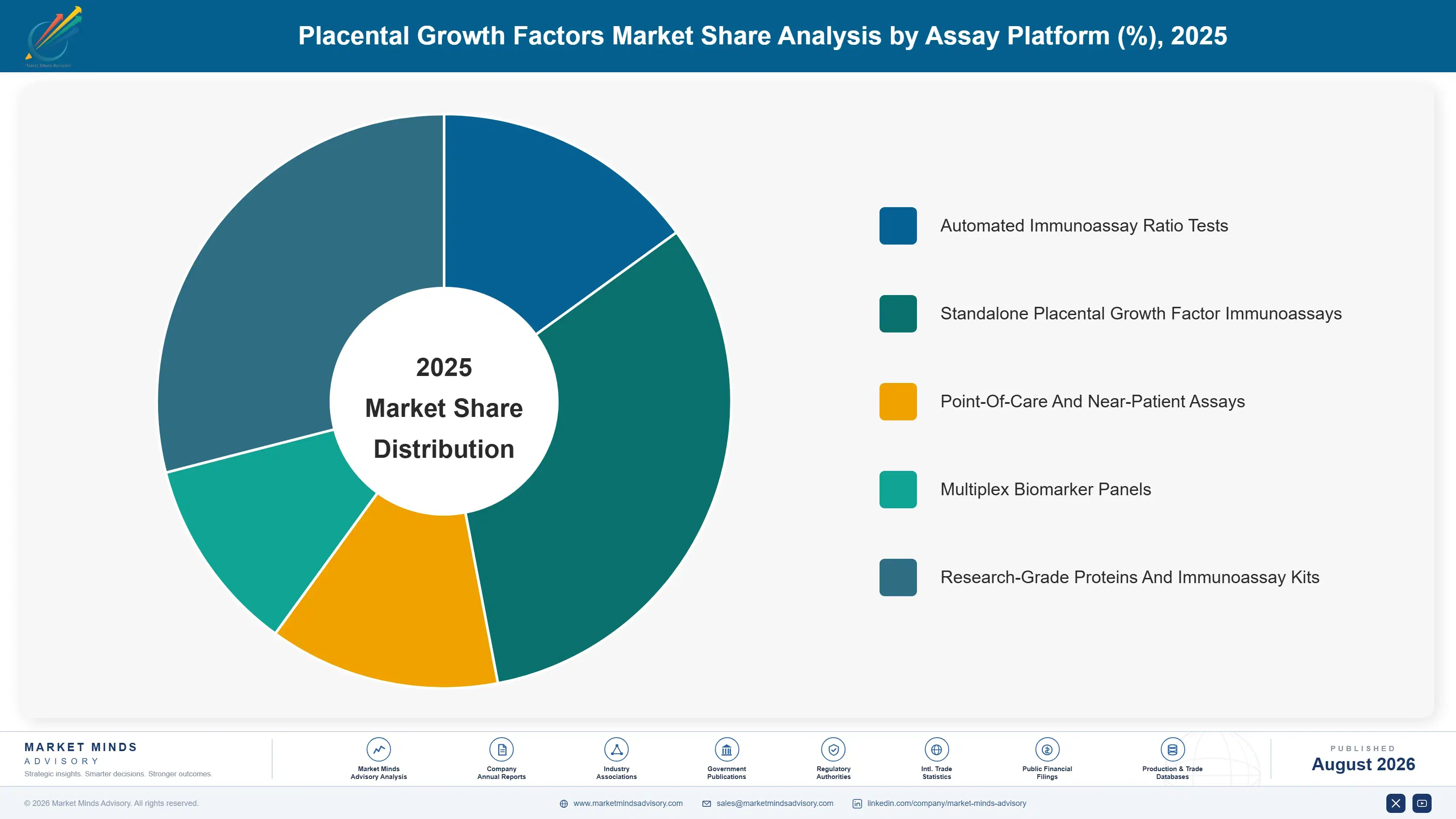
Segmentation follows the assay platform, because the platform determines where a test can physically be performed, how quickly a result returns, what each determination costs, and therefore which clinical decision it can realistically support. Indication, care setting, and purchase route sit in the framework, and none of those three changes where an assay can physically run at all.
placental-growth-factors-market-market-share-analysis-1787298728880

Point-Of-Care And Near-Patient Assays

Near-patient formats grow fastest at 14.7%, exactly 1.50 times the market rate, returning a result inside twenty minutes without any central laboratory involvement. That opens antenatal clinics, community midwifery services, and district hospitals with no immunoassay capability at all, which is precisely where pre-eclampsia mortality concentrates worldwide. Cost per determination remains higher than automated platforms achieve at volume, and turnaround rather than price is what these settings actually need. Very few manufacturers have built seriously for the low-resource use case despite it being the largest unmet one, Donor and public health procurement rather than hospital budgets would fund that volume, which changes the pricing conversation entirely, Turnaround rather than price is what these settings actually need most.
CAGR 14.7%

Automated Immunoassay Ratio Tests

Automated ratio testing grows at 12.1%, combining placental growth factor with soluble fms-like tyrosine kinase-1 on high-throughput hospital analysers already installed for other work. This carries the great majority of clinical volume today because the ratio has the strongest guidance support and the platforms sit exactly where obstetric triage happens. Turnaround measured in hours suits an admission decision comfortably. Reagent pricing has fallen as Chinese manufacturers entered, which has widened access considerably across Asian hospital systems without changing the clinical protocol at all, Guidance naming the ratio rather than the single marker has steadily reinforced this format, and standalone assays are becoming legacy, Hospital laboratories already own the analysers, which removes the capital objection entirely.
CAGR 12.1%
Full segment breakdown across 5 segments available in the complete report.

Regional Architecture and Country Demand Map

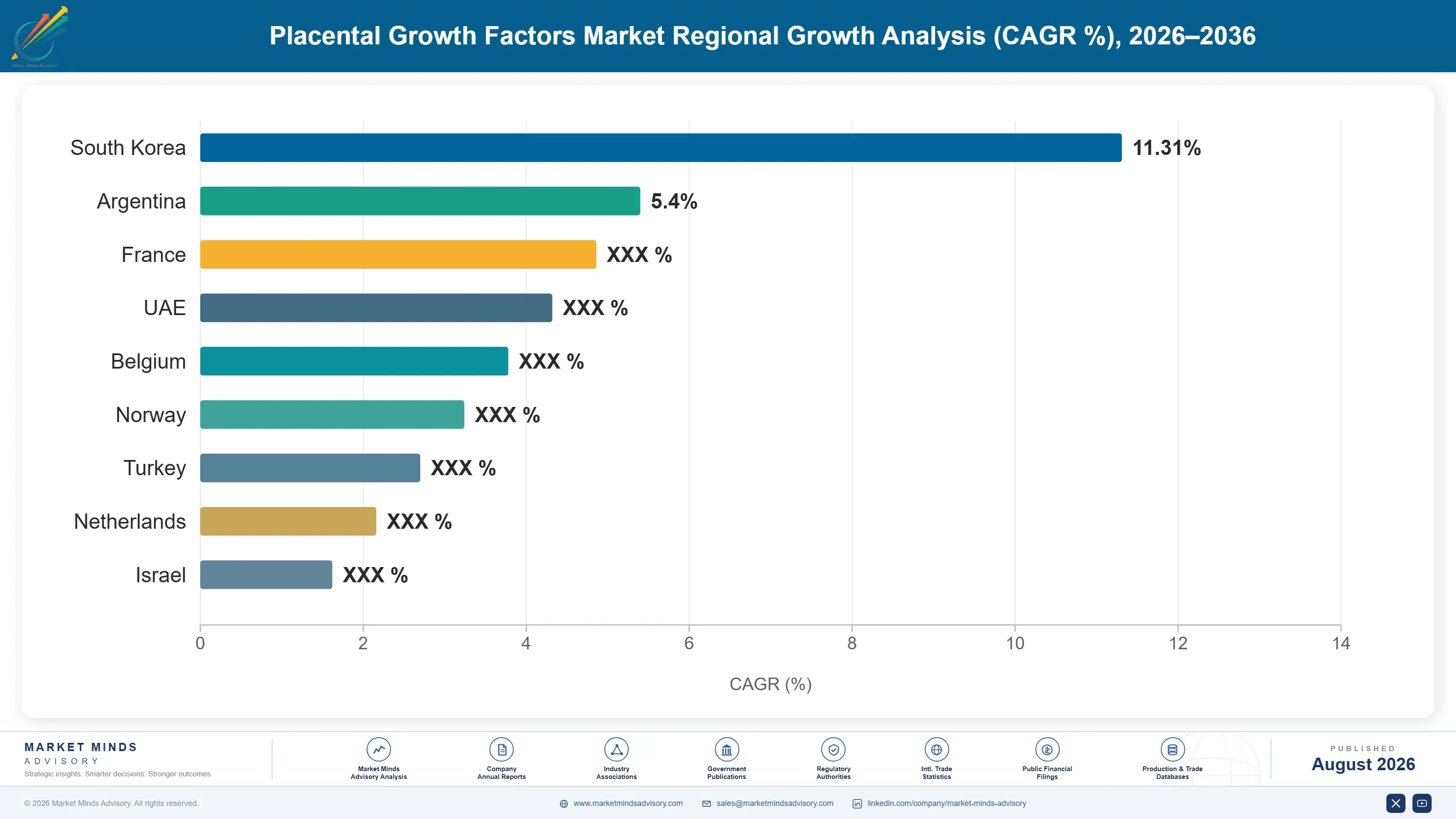
Three regions sit outside the bands this framework applies, and clinical guidance adoption rather than disease burden explains all of it. Where a national body recommended biomarker testing early, uptake followed quickly; where it did not, obstetric volume proved a poor predictor of value, or of adoption.

Western Europe

Western Europe holds 32% of value against a 26% ceiling in this framework, and early guidance adoption rather than obstetric volume explains the breach entirely. British, German, and Swiss bodies recommended biomarker-based rule-out in suspected pre-eclampsia years ahead of anywhere else, which converted a hospital-level argument into national protocol across large populations. Roche and Thermo Fisher both built their clinical evidence base here. Obstetric triage admission is expensive in these systems, which makes the economic case straightforward. Growth at 8.4% trails the global rate on a market already close to fully adopted, Near-patient adoption is limited because central laboratory turnaround already suffices here, Reagent pricing has held up better here than in any other region.
Share: 32% | CAGR: 8.4% (2026 to 2036)

East Asia

Twenty-four percent of value sits in East Asia, where obstetric volumes remain very large despite falling birth rates and domestic immunoassay manufacturers have cut the cost of routine testing substantially. Snibe, Autobio, and Maccura all supply ratio assays at prices well below imported equivalents, which brought antenatal testing within reach of provincial hospital budgets. Japanese and Korean adoption follows European clinical convention closely with higher pricing attached. Chinese guidance has moved more slowly than clinical practice. Growth at 10.3% exceeds the global rate on affordability rather than on any guidance change, Point-of-care formats have found less traction than in South Asian markets, Obstetric volumes remain very large despite falling birth rates across the region.
Share: 24% | CAGR: 10.3% (2026 to 2036)
Regional intelligence for 5 additional markets available in the complete report: North America, South Asia and Pacific, Latin America, Middle East and Africa, Eastern Europe. Contact sales@marketmindsadvisory.com.
placental-growth-factors-market-country-cagr-analysis-1787298729403

Selling A Discharge Decision Properly

Nobody buys this to diagnose anything, so every commercial argument built around detection is aimed at the wrong outcome entirely. Guidance engagement, bed day economics, near-patient formats, and tiered access each address what the buyer is actually deciding. Four levers follow from that, and the first two determine whether anybody adopts the product at all.

Engage Guidance Committees Years Ahead Of Launch

Volume in this market moves when a national body recommends biomarker testing, not when new evidence appears, and the evidence supporting rule-out has been stable for years. European adoption followed guidance decisions and American adoption stalled without them despite better bed day economics. Contributing evidence, health economic modelling, and clinical expertise to guideline development costs USD 300,000 to USD 800,000 per market and converts hospital-by-hospital selling into a default protocol, Suppliers engaging committees late find the protocol written around somebody else's product, and reversing an established protocol afterwards is close to impossible.
Market Impact: Costs USD 300,000 to 800,000 for each market

Quantify Bed Days Rather Than Diagnostic Accuracy

An obstetric unit under bed pressure understands 1.2 avoided admission days per negative result immediately, and it has no particular interest in sensitivity figures for a disease most of these women will never develop. Presenting the arithmetic against a test costing roughly USD 62 makes the case in a single slide. Suppliers still leading with detection performance are answering a question the clinician did not ask, and losing evaluations they should comfortably win, Obstetric leads and operations teams both respond to this immediately, Laboratory managers are not the audience for this argument at all.
Market Impact: Saves 1.2 bed days against a USD 62 test

Build Genuinely Low-Cost Near-Patient Test Formats

Around 92% of pre-eclampsia deaths occur where automated immunoassay platforms do not exist and sixty dollars per determination is unaffordable within any antenatal budget. A near-patient device returning results in twenty minutes at under USD 8 per test addresses a population several times the current testing base. Development costs USD 6 million to USD 15 million, and donor and public health procurement channels will fund volume that hospital budgets never could, Cartridge moulding rather than assay biology is what decides whether that price is reachable, Hospital analyser economics simply do not transfer to those settings.
Market Impact: Development runs USD 6 to 15 million total

Extend Rule-Out Claims To Longer Intervals

A negative result currently supports confident discharge for roughly one week, after which the woman returns and the decision repeats. Evidence supporting a two or four week rule-out interval would reduce repeat testing while making each result considerably more valuable clinically, which sounds contradictory and is not. Longer intervals justify higher pricing per determination and remove the practical objection that repeat visits offset the admission saved, Each additional week of confident rule-out is worth roughly USD 40 in avoided repeat testing, which supports pricing directly, Repeat presentation is the practical objection clinicians raise most often.
Market Impact: Extends rule-out from 1 week to 4 weeks

Who Controls the Margin Pool

Concentration at 74% across the top five reflects how few immunoassay platforms carry validated ratio assays rather than any barrier to making the reagents themselves. All participants here are compared on measured global revenue from placental growth factor testing and reagents, which requires separating that line from far larger immunoassay and life science businesses inside groups that report at a considerably higher level.
Competition runs through installed analyser base rather than through assay performance, since the ratio is well characterised and the platforms differ little clinically. Roche and Thermo Fisher hold the strongest positions, built on European guidance evidence and on analysers already sitting in hospital laboratories. Revvity and QuidelOrtho compete in near-patient and specialised formats. Siemens supplies the assay across its own installed platforms without having led the clinical development.

Pressure is arriving from Asian manufacturers on price and from format innovation at the low-resource end. Snibe, Autobio, and Maccura supply ratio assays well below imported pricing and are exporting beyond their domestic markets. Rankings shift on guidance decisions rather than on anything competitive, since one national recommendation converts an entire health system to protocol testing within a year or two.
placental-growth-factors-market-company-positioning-matrix-1787298729929

Competitive Moat and Risk Dimensions

ROCHE DIAGNOSTICS

Moat: Guidance Evidence And Installed Analysers

Roche funded much of the clinical evidence that European guidance bodies relied on, and its ratio assay runs on immunoassay analysers already installed in the hospital laboratories where obstetric triage happens. Guidance naming the ratio and platforms already present together remove almost every practical objection a laboratory could raise about adoption.
ROCHE DIAGNOSTICS

Risk: Central Laboratory Format Limitation

The position depends on an automated analyser being present, which excludes antenatal clinics, community services, and district hospitals across the settings carrying most global mortality. Near-patient formats reach those places and the company does not lead there. Asian manufacturers are also compressing reagent pricing on exactly the platforms it competes with.
THERMO FISHER SCIENTIFIC

Moat: Established Biomarker Assay Heritage

Thermo Fisher's biomarker portfolio has carried placental growth factor testing since well before guidance adoption, giving it long clinical familiarity and published experience across European maternity services. That history matters in a market where protocol committees weight accumulated clinical use heavily against newer entrants offering equivalent analytical performance.
THERMO FISHER SCIENTIFIC

Risk: Competing Internal Portfolio Priorities

Placental growth factor testing is a very small line inside an enormous life sciences and diagnostics group, competing internally for commercial attention against businesses many times its size. Guidance engagement and low-cost format development both need sustained focus. Specialists concentrating entirely on maternal health have moved faster in the segments now growing quickest.

Players Tracked

Prominent Players

Roche Diagnostics
Thermo Fisher Scientific
Revvity
QuidelOrtho
Siemens Healthineers

Other Key Players

Abbott
Beckman Coulter
DiaSorin
Snibe Diagnostic
Autobio Diagnostics
Maccura Biotechnology
Randox Laboratories
Bio-Techne
PeproTech
Sino Biological
Abcam
Fujirebio
Getein Biotech
Wondfo Biotech
Mindray

Recent Developments

FEBRUARY 2025

National Body Extends Biomarker Testing Recommendation To Further Settings

A national clinical guidance body extended its recommendation for placental growth factor based testing in suspected pre-eclampsia to additional care settings beyond hospital triage. The recommendation is clinical guidance rather than any funding decision, and local commissioning arrangements determine how quickly individual services adopt it.
Signal: Guidance decisions convert hospital-level arguments into default protocol across a whole health system almost overnight everywhere
MAY 2025

Chinese Manufacturer Expands Ratio Assay Supply Beyond Domestic Market

A Chinese immunoassay manufacturer began supplying its placental growth factor ratio assay into Southeast Asian and Middle Eastern markets at pricing well below imported equivalents. The expansion was organic commercial activity rather than any licensing deal, and distribution runs through diagnostic equipment channels already in place locally.
Signal: Price competition arrives first in exactly those markets where guidance has not yet fixed any protocol
SEPTEMBER 2025

Obstetric Unit Publishes Admission Avoidance Data After Protocol Change

A large maternity service published admission and length of stay data following introduction of biomarker-based rule-out in its triage pathway, reporting a substantial reduction in observation admissions for suspected pre-eclampsia. The publication is service evaluation rather than a controlled trial, and it quantified bed days rather than clinical outcomes.
Signal: Bed day evidence persuades hospital management in a way that diagnostic accuracy data has never managed

Antibodies, Calibrators And Cartridges

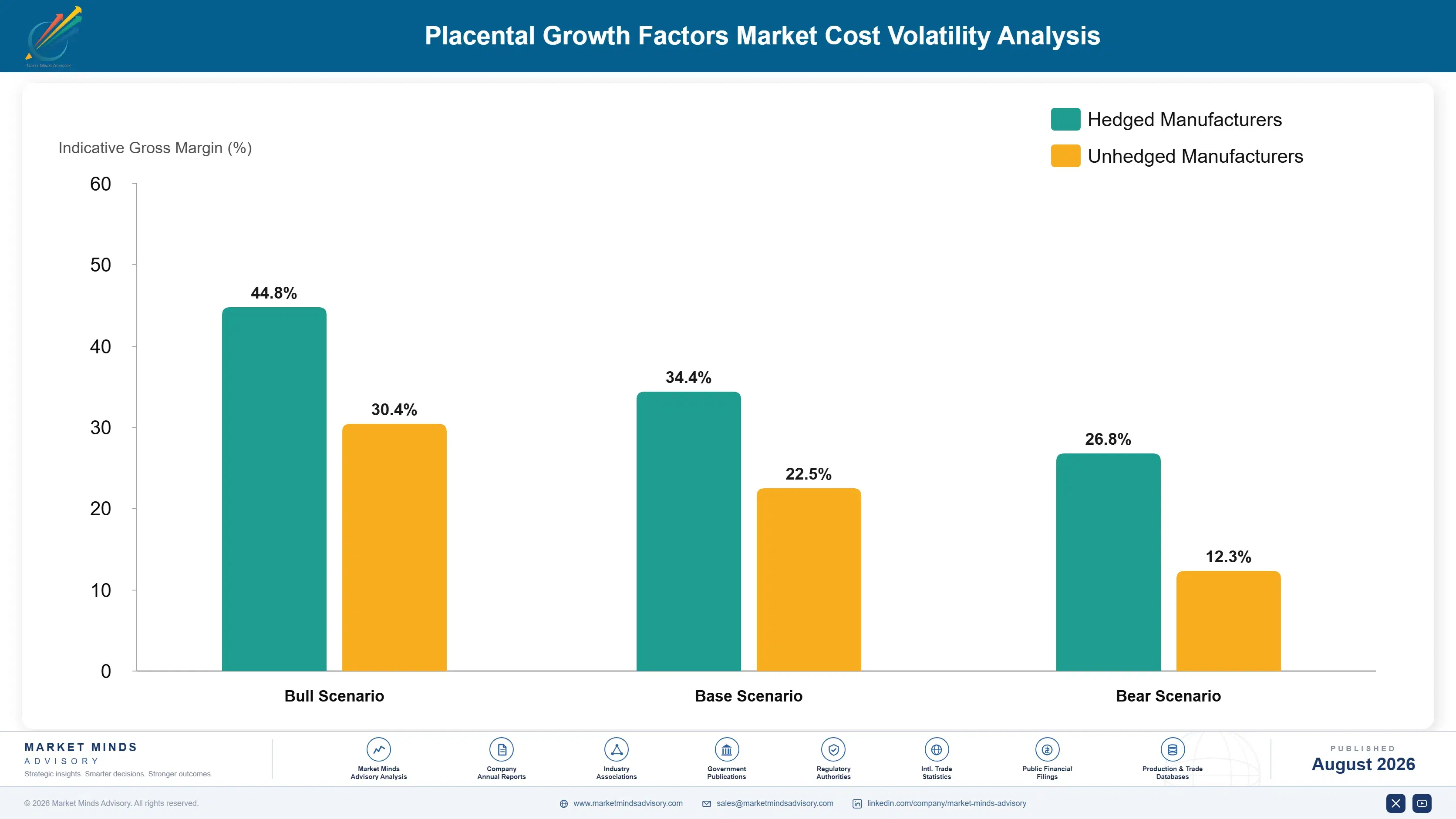
Monoclonal antibody pairs and recombinant protein calibrators account for roughly 28% to 38% of reagent cost of goods, produced by a narrow group of specialist suppliers whose material must be characterised lot by lot. Cartridge and consumable moulding adds 14% to 22% on near-patient formats and far less on automated platforms. Cold chain distribution, quality release testing, and regulatory maintenance carry most of the remainder.
Specialist antibody and recombinant protein supply tightened noticeably through 2021 and 2022 as diagnostic manufacturing absorbed capacity across the entire sector, and lead times on characterised material for immunoassay use stretched considerably. Bio-Techne described sustained demand and constrained specialty protein supply across that period in its 2022 annual reporting. Manufacturers without qualified alternate antibody lots faced assay revalidation rather than simply delayed shipment, which is far more expensive.

Exposure separates by whether a manufacturer controls its own antibody supply. A group producing characterised antibodies internally sets its own lot release schedule and can qualify alternates on its own timeline. One buying material on the open market competes for the same characterised lots against every other immunoassay developer. Near-patient formats face a different problem again, where cartridge moulding cost decides whether low-cost pricing is achievable.
placental-growth-factors-market-cost-volatility-analysis-1787298730128

Qualify Alternate Antibody Lots Within Every Validated Assay

Characterised antibody supply interruption forces assay revalidation rather than a simple substitution, and revalidation means regulatory notification, method comparison work, and customer communication across every market a product is sold in. Qualifying alternate lots at original validation costs modest additional characterisation, and it converts a potential supply failure into a documented within-method change nobody escalates.

Integrate Backward Into Antibody And Protein Production

Characterised antibodies and recombinant calibrator proteins are the largest reagent cost line and come from suppliers who also serve research and pharmaceutical customers paying considerably more per milligram. Producing critical material internally removes that competition for allocation entirely and gives control over lot release timing, which matters more than the unit cost saving in practice.

Design Near-Patient Cartridges For Low-Cost Manufacture

Cartridge moulding and assembly rather than biology decide whether a near-patient test can reach the price points that low-resource antenatal settings actually support. Designing for high volume injection moulding and automated assembly from the outset costs more tooling upfront and produces a device that works economically at the volumes donor and public health procurement would eventually generate.

Portfolio Architecture for Margin Defence

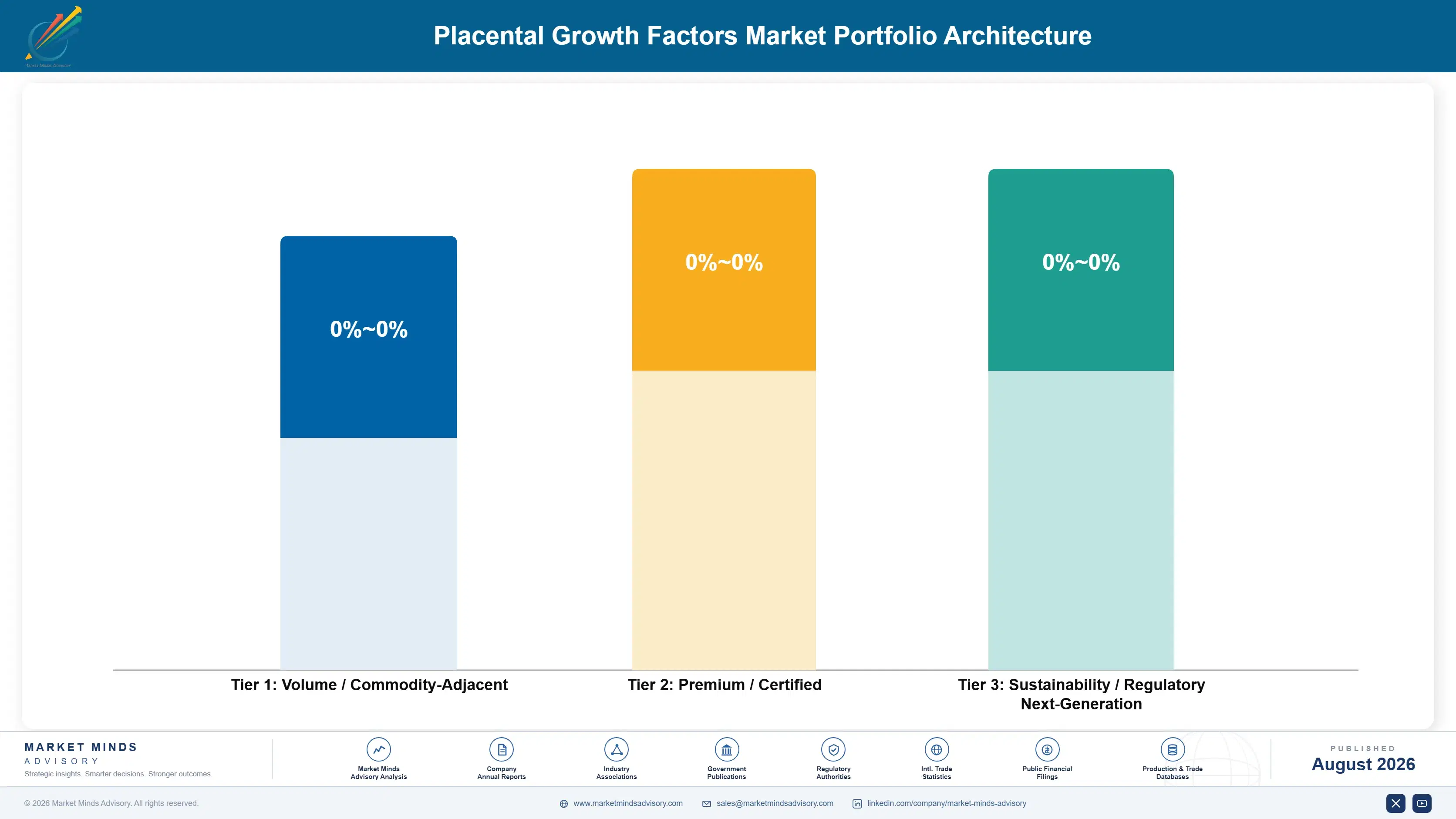
Margin architecture separates by whether the test runs on an analyser somebody else already installed. Automated platform reagents earn 62% to 76%, because the instrument is already present, the assay is guidance-named, and the marginal cost of a determination is small. Research-grade recombinant proteins and enzyme immunoassay kits earn 44% to 58% into a fragmented academic market with no protocol protection at all.
The tension is that the profitable format cannot reach the population that most needs the test. Automated analysers sit in hospital laboratories in well-resourced systems where maternal mortality is already very low, while 92% of pre-eclampsia deaths occur in settings with no immunoassay capability whatsoever. Serving that need requires a cheaper format at a fraction of the price, which nobody has built properly.

High-value pools concentrate in guidance-named automated assays, near-patient formats aimed at low-resource settings, and extended interval rule-out claims. The first exploits protocol inclusion, the second opens an unserved population, and the third raises value per determination. Near-patient formats carry the widest margin range, because a hospital-priced device and a donor-procured one differ entirely in economics, and almost nobody has committed to building for the second.

Volume / Commodity-Adjacent

Research-grade recombinant placental growth factor proteins and enzyme immunoassay kits sold into academic and pharmaceutical research without any clinical protocol protection. The fourteen-point range separates catalogue suppliers with scale from smaller specialists competing on characterisation quality alone.
Gross Margin: 44% to 58%

Premium / Certified

Guidance-named automated immunoassay ratio tests and standalone clinical assays running on analysers already installed in hospital laboratories. The fourteen-point range separates markets where guidance fixes the protocol from those where Asian manufacturers compete directly on reagent price.
Gross Margin: 62% to 76%

Sustainability / Regulatory / Next-Generation

Near-patient and point-of-care formats, multiplex panels, and extended interval rule-out products. The thirty-eight point range reflects genuine divergence: hospital-priced near-patient devices earn well while donor-procured low-cost formats operate on entirely different economics.
Gross Margin: 32% to 70%
placental-growth-factors-market-portfolio-architecture-1787298730620

High-value Sub-segments and Strategic Watch-out

Guidance-Named Automated Assays

The value core of this market, protected by protocol inclusion and by analysers already installed exactly where obstetric triage happens. Guidance decisions rather than competitive activity move share here, and one national recommendation converts a whole health system, within a year or two of the recommendation appearing.
Gross Margin: 66% to 76%

Near-Patient Clinical Formats

Fastest growth, reaching antenatal clinics, community midwifery services, and district hospitals that no automated platform serves at all. Cartridge cost rather than assay biology decides whether low-resource pricing can ever be achieved, Donor procurement would fund volumes that hospital budgets never could, and pilot evaluations have already begun.
Gross Margin: 48% to 70%

Research Proteins And Assay Kits

A steady base with no protocol protection, sold into academic and pharmaceutical research on catalogue availability and characterisation quality. Growth tracks research funding rather than clinical adoption, and pricing pressure comes from catalogue suppliers rather than diagnostics companies, It provides steady volume and no defensible position whatsoever.
Gross Margin: 44% to 58%

Standalone Single-Marker Assays

Strategic watch-out. Guidance increasingly names the ratio rather than placental growth factor alone, which steadily converts standalone testing into a legacy format. Volume persists where analysers cannot run the paired assay, and that ground keeps shrinking, Analysers unable to run the paired assay are the only remaining base.
Gross Margin: 52% to 64%

How Protocol Creates Volume

The recurring unit here is the clinical protocol rather than any customer relationship. A maternity service that writes biomarker rule-out into its triage pathway then tests every suspected presentation automatically, which produces volume determined by obstetric activity rather than by any purchasing decision made afterwards. Protocol inclusion is therefore the entire commercial event, and it happens once, usually following a national guidance recommendation nobody in the supply chain controls.
Depth varies by how the protocol names the product. Where guidance specifies the ratio, any platform running a validated version competes and the incumbent analyser wins on convenience. Where a protocol names a specific assay, the position is close to permanent. Research-grade supply is shallowest, moving on catalogue price with no protocol involvement at all and no repeat obligation of any kind.

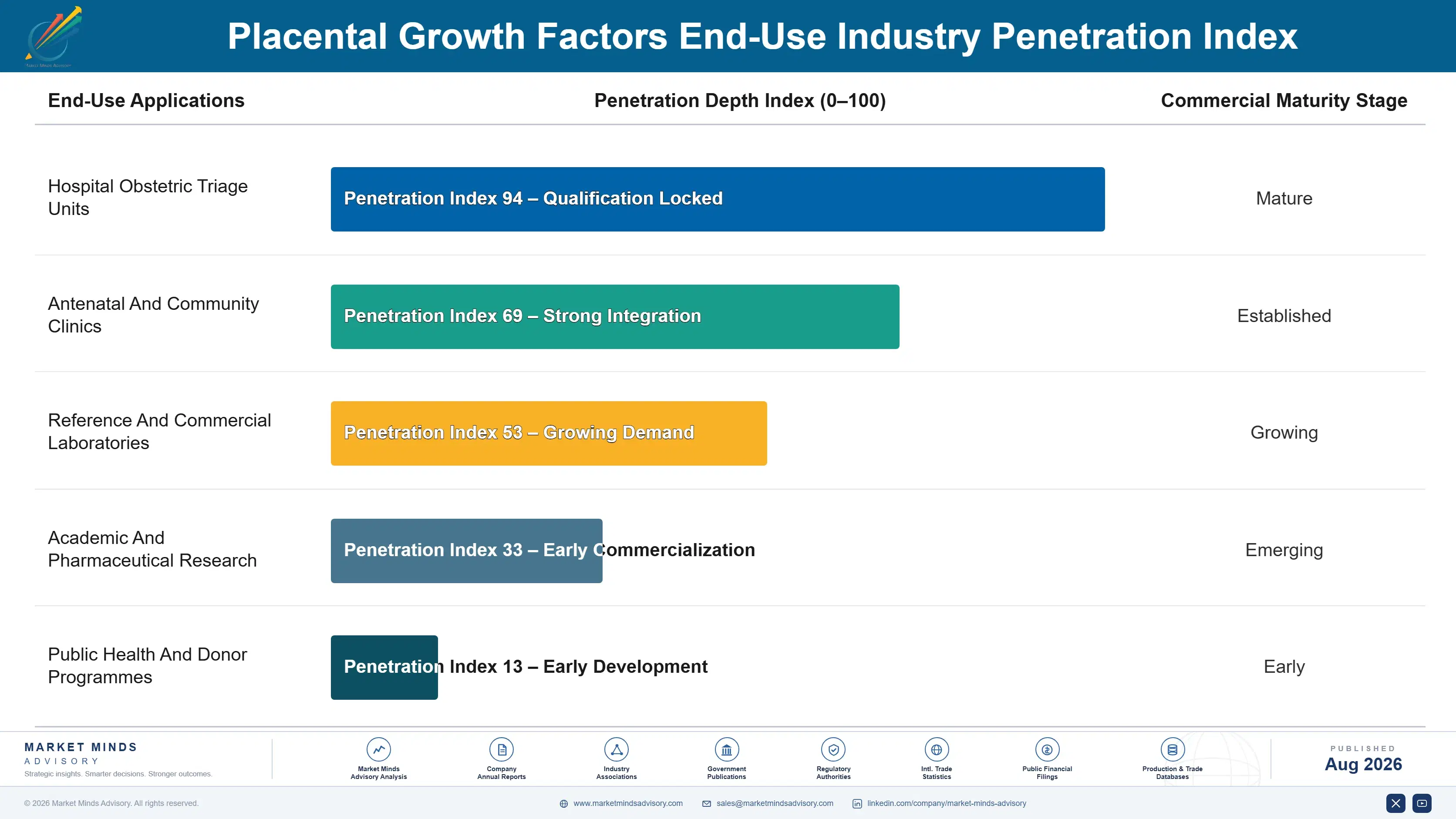
Buyer profiles have shifted toward the people who count beds. Adoption decisions moved from laboratory managers evaluating assay performance toward obstetric leads and hospital operations teams looking at admission rates and length of stay. Guidance committees now weight health economic modelling heavily. Both changes reward suppliers presenting bed day arithmetic rather than sensitivity data, and they leave diagnostics-led commercial teams talking to the wrong audience.
placental-growth-factors-market-end-use-penetration-index-1787298731109

Where We Come Out

These are among the four positions where our research anticipates prominent divergence between winners and laggards over the coming forecast period. Each is grounded in the demand model, the regulatory perimeter, and the announced capacity pipeline.
01 / GUIDANCE COMMITTEE ENGAGEMENT

National recommendations move volume, and nothing else does

The evidence supporting biomarker rule-out in suspected pre-eclampsia has been stable for years, and adoption still varies enormously between health systems with identical disease burden and identical evidence available to them. What separates them is whether a national guidance body made a recommendation. Contributing evidence, health economic modelling, and clinical expertise into guideline development costs three hundred thousand to eight hundred thousand dollars per market and converts hospital-by-hospital selling into default protocol across an entire population, Suppliers arriving late find the protocol written around a competitor's product.
02 / BED DAY ARGUMENT DISCIPLINE

Nobody buys this test to diagnose anybody at all

Roughly sixty-two percent of suspected pre-eclampsia presentations are admitted for observation because clinicians cannot safely rule the condition out on clinical signs, and most of those women never develop it. A negative result with a predictive value near ninety-nine percent saves around one point two bed days against a test costing sixty-two dollars. That single comparison closes evaluations that sensitivity data has been losing for years, and remarkably few commercial teams lead with it, The obstetric lead and the operations director both understand it instantly.
03 / LOW-RESOURCE FORMAT DEVELOPMENT

The mortality is where the product cannot physically go

About ninety-two percent of pre-eclampsia deaths occur in countries where automated immunoassay platforms do not exist and sixty dollars per determination exceeds the entire antenatal budget for a pregnancy. A near-patient device returning results within twenty minutes at under eight dollars addresses a population several times the current testing base. Development runs six to fifteen million dollars, and donor and public health procurement will fund volumes that hospital laboratory budgets never could, Cartridge design rather than assay chemistry decides whether that price is reachable.
04 / INTERVAL EXTENSION RESEARCH

A longer rule-out window is worth more than better sensitivity

A negative result currently supports confident discharge for about one week, after which the woman returns and the whole decision repeats at further cost to the service. Evidence supporting a two or four week interval would make each determination substantially more valuable clinically while reducing repeat testing, which sounds contradictory and is not. It also removes the practical objection that repeat visits partly offset the admission each test avoided in the first place, Each additional week is worth roughly forty dollars in avoided repeat testing.

Engagement Snapshot From the Field

A live engagement with an industry participant carrying material or product regulatory and market exposure ahead of a defining policy shift, showing how our research translates into a defensible multi-year portfolio strategy.
MARKET MINDS ADVISORY · CLIENT ENGAGEMENT SUMMARY
Placental Growth Factors Producer Strategic Portfolio Review and Transition Roadmap 2026·Investment Scenario on Placental Growth Factors Exposure Evaluation 2025-26
CLIENT PROFILE
A European diagnostics manufacturer with a validated placental growth factor ratio assay running on its own installed immunoassay platforms, and roughly EUR 88 million in annual revenue from maternal health testing (client-reported, unverified by MMA). Adoption was strong across three European markets where guidance named the ratio, and negligible everywhere else despite an identical product and comparable analyser installed base.
STRATEGIC CHALLENGE
The company could not explain why adoption in North America and Southern Europe remained minimal when obstetric admission costs were higher and its analysers were already present. Commercial teams had been presenting analytical performance for three years without moving hospital protocols, and the board was considering withdrawal from several markets.
MMA APPROACH
MMA analysed adoption against guidance status across fourteen markets, interviewed twenty-four obstetric leads, laboratory managers, and guideline committee members on what actually changes a triage protocol, and modelled bed day economics under each market's admission practice and cost structure. Near-patient format opportunity in low-resource settings was sized separately against donor procurement channels.
KEY FINDINGS
  1. Adoption correlated almost perfectly with national guidance status and showed no relationship at all with obstetric admission cost, analyser presence, or the client's commercial spend.
  2. Nineteen of twenty-four obstetric leads described the test as a discharge decision tool, while every piece of the client's promotional material presented it as a detection product.
  3. Bed day savings modelled at 1.4 days per negative result in North American settings, worth several times the test price, and no commercial material presented that comparison anywhere.
  4. Near-patient format demand through donor maternal health procurement was sized at roughly 4 times the client's current unit volume, at a price point its cartridge design could not reach.
CLIENT PROFILE
A European diagnostics manufacturer with a validated placental growth factor ratio assay running on its own installed immunoassay platforms, and roughly EUR 88 million in annual revenue from maternal health testing (client-reported, unverified by MMA). Adoption was strong across three European markets where guidance named the ratio, and negligible everywhere else despite an identical product and comparable analyser installed base.
STRATEGIC CHALLENGE
The company could not explain why adoption in North America and Southern Europe remained minimal when obstetric admission costs were higher and its analysers were already present. Commercial teams had been presenting analytical performance for three years without moving hospital protocols, and the board was considering withdrawal from several markets.
MMA APPROACH
MMA analysed adoption against guidance status across fourteen markets, interviewed twenty-four obstetric leads, laboratory managers, and guideline committee members on what actually changes a triage protocol, and modelled bed day economics under each market's admission practice and cost structure. Near-patient format opportunity in low-resource settings was sized separately against donor procurement channels.
KEY FINDINGS
  1. Adoption correlated almost perfectly with national guidance status and showed no relationship at all with obstetric admission cost, analyser presence, or the client's commercial spend.
  2. Nineteen of twenty-four obstetric leads described the test as a discharge decision tool, while every piece of the client's promotional material presented it as a detection product.
  3. Bed day savings modelled at 1.4 days per negative result in North American settings, worth several times the test price, and no commercial material presented that comparison anywhere.
  4. Near-patient format demand through donor maternal health procurement was sized at roughly 4 times the client's current unit volume, at a price point its cartridge design could not reach.
RECOMMENDED STRATEGY
Phase 1: Phase one: rebuild every piece of commercial material around admission avoidance and bed day arithmetic, and retire detection performance as the lead message entirely. Phase 2: Phase two: fund health economic evidence and guideline committee engagement in the four largest markets without current guidance rather than continuing hospital-level selling. Phase 3: Phase three: develop a low-cost near-patient cartridge designed specifically for donor procurement pricing, separately from the hospital analyser product line.
OUTCOME
The client repositioned its commercial materials within a quarter and began guideline engagement in three markets. Hospital protocol adoptions rose from four to nineteen sites in the following year, revenue grew 26%, and one national guidance body opened a formal review of biomarker testing (client-reported, unverified by MMA).

Frequently Asked Questions

Foundational context covering the market sizes, CAGR, scope, country, region and competition that inform every finding below. This section is provided to cover basics and most often pre-purchase conversations, answered from the MMA Primary Research Dataset.

What is the current size of the Placental Growth Factors Market?

The global placental growth factors market reached USD 0.46 billion in 2025, covering clinical and research use of placental growth factor as a biomarker. Pre-eclampsia therapeutics, ultrasound assessment, and general angiogenesis reagents are excluded.

How large will the Placental Growth Factors Market be by 2036?

MMA forecasts USD 1.29 billion by 2036, up from USD 0.51 billion in 2026, an increase of USD 0.78 billion. That represents an expansion multiple of 2.55 times across the forecast period.

What is the CAGR for the Placental Growth Factors Market 2026 to 2036?

The base case CAGR is 9.8%, with a bull case of 11.1% and a bear case of 8.5%. Historical growth between 2020 and 2025 ran at 8.6%, reflecting guidance adoption spreading unevenly across health systems.

Which segment is growing fastest?

Point-of-care and near-patient assays grow fastest at 14.7%, exactly 1.50 times the market rate, reaching settings no automated platform serves. Automated immunoassay ratio tests follow at 12.1% and carry most current volume.

Who are the major companies in the Placental Growth Factors Market?

Roche Diagnostics, Thermo Fisher Scientific, Revvity, QuidelOrtho, and Siemens Healthineers lead, together holding 74% of the market. Two automated immunoassay platforms carry almost all clinical volume.

Which country is growing fastest?

India grows fastest at 13.6%, driven by very large obstetric volumes, high pre-eclampsia burden, and domestic manufacturing that makes routine antenatal testing affordable. Private laboratory chains carry most of that volume.

Report Segmentation Architecture

The full report scope spans multiple orthogonal segmentation dimensions, with cross-tabulated demand data provided for each dimension pair. Coverage extends further to regional breakdowns, trend trajectories, and the competitive detail needed to support segment-level decision-making.

By Assay Platform

  • Automated Immunoassay Ratio Tests
  • Standalone Placental Growth Factor Immunoassays
  • Point-Of-Care And Near-Patient Assays
  • Multiplex Biomarker Panels
  • Research-Grade Proteins And Immunoassay Kits

By End-Use Industry

  • Hospital Obstetric Triage Units
  • Antenatal And Community Clinics
  • Reference And Commercial Laboratories
  • Academic And Pharmaceutical Research
  • Public Health And Donor Programmes

By Commercial Dimension

  • Installed Analyser Reagent Supply
  • Protocol-Driven Hospital Contracts
  • Point-Of-Care Device Placement
  • Donor And Public Procurement
  • Research Catalogue Distribution

By Region

  • Western Europe
  • East Asia
  • North America
  • South Asia and Pacific
  • Latin America
  • Middle East and Africa
  • Eastern Europe

Scope, Methodology, and Coverage

Every figure in this report is reproducible from documented input assumptions. The scope below maps the historical period, the forecast horizon, the segmentation dimensions, and the countries covered, alongside the underlying primary and qualitative methodology.
Historical Period
2020 to 2025
Forecast Period
2026 to 2036
Base Year
2025 (USD billions; MMA Primary Research Dataset, August 2026)
Market Definition
The placental growth factors market covers clinical and research use of placental growth factor as a biomarker, principally in the assessment of suspected pre-eclampsia and placental dysfunction. Scope spans automated immunoassay ratio tests combining it with soluble fms-like tyrosine kinase-1, standalone placental growth factor immunoassays, point-of-care and near-patient formats, multiplex panels incorporating it, and research-grade recombinant proteins and enzyme immunoassay kits. Pre-eclampsia therapeutics, ultrasound and Doppler assessment, other standalone pregnancy biomarkers, and general angiogenesis research reagents are excluded.
Quantitative Units
USD billions at manufacturer revenue level; determinations performed annually; cost per determination by platform.
Segmentation Dimensions
By assay platform; by end-use industry; by commercial dimension; by region.
Regions Covered
Western Europe, East Asia, North America, South Asia and Pacific, Latin America, Middle East and Africa, Eastern Europe
Countries Covered
United Kingdom, Germany, Switzerland, France, Netherlands, Spain, Italy, Poland, Czech Republic, United States, Canada, China, Japan, South Korea, India, Australia, Indonesia, Brazil, Mexico, South Africa.
Key Companies Profiled
Roche Diagnostics, Thermo Fisher Scientific, Revvity, QuidelOrtho, Siemens Healthineers, Abbott, Beckman Coulter, DiaSorin, Snibe Diagnostic, Autobio Diagnostics, Maccura Biotechnology, Randox Laboratories, Bio-Techne, PeproTech, Sino Biological, Abcam, Fujirebio, Getein Biotech, Wondfo Biotech, Mindray.
Quantitative Methodology
Primary survey, n=3,800 respondents, Q4 2025, six countries; demand-side model with trade association cross-validation
Qualitative Methodology
47 expert interviews, Q4 2025; applied to validate demand model assumptions, identify emerging dynamics, and assess competitive positioning
Report Format
PDF and XLSX data workbook (Word format preview document)
Publisher
Market Minds Advisory
Report Code
MMA-2026-HLT-918
Published
August 2026
Contact
sales@marketmindsadvisory.com | www.marketmindsadvisory.com

Purchase the full Placental Growth Factors Market Report (2026 to 2036).

The full MMA report on placental growth factors covers assay platform, regional, and competitive analysis in detail, with separate treatment of the guidance adoption dynamics that determine uptake far more than evidence or disease burden do. It includes bed day economics modelling by health system admission practice, guidance status tracking with adoption correlation across markets, near-patient format cost analysis against low-resource price points, and donor procurement channel sizing. Regional chapters cover twenty countries with guidance status and obstetric practice assessed individually. Competitive profiling spans twenty companies on a consistent revenue basis.
Twenty country guidance status and obstetric practice chapters
Bed day economics modelling by health system admission practice
Guidance adoption correlation analysis across fourteen major markets
Near-patient format cost analysis against low-resource price points
Twenty company competitive profiles compared consistently
Donor and public procurement channel sizing by region

Built For The People Who Decide

From boardroom strategy to bench-side execution, this report is read cover-to-cover by leaders shaping the next decade of their industry, turning demand scenarios, market dynamics and valuation benchmarks into decisions.
CXOs/ Presidents/ VPs/ Managers
M&A and Corporate Development
Strategy Teams and R&D Heads
Procurement and Product Directors
Regulatory and Compliance Leaders
Investor Relations and Equity Analysts