

Market Minds Advisory
Piston Engine Aircraft Market

Piston Engine Aircraft Market: Piston Engine Aircraft: The Customer Changed From Owner To Fleet And The Product Mostly Did Not

Sixty years of building aeroplanes for an individual who flew a hundred hours a year, sold now to flight schools running them a thousand hours annually and wanting entirely different things.

Lead Analyst

Published

September 2026

Make Smarter Decisions with Customized Research Insights

Request a free sample report and evaluate market opportunities, growth trends, and competitive dynamics relevant to your business needs.

2025 MARKET VALUE$1.8BMarket Size 2025
2036 FORECAST VALUE$3.2BBase Case , 2026 to 2036
CAGR 2026 TO 20365.4 %Bull 6.6% / Bear 4.2%
INCREMENTAL OPPORTUNITY$1.3BNet 10- year value creation
EXPANSION MULTIPLE1.69x2036 value over 2026 base
Strategic Levers
M&A Pipeline
Regional Outlook
Country Rankings
Competitive Intelligence
Segmental Deep-dive
Call-Us : 91 93563 13602

Executive Snapshot and Market Trajectory.

The buyer changed and the product mostly did not. Around 44% of deliveries now go to flight training organisations buying fleets rather than to the individual owner-pilot this industry spent sixty years designing aeroplanes for. Almost nobody in this industry adjusted the product properly.
A fleet operator wants entirely different things. An aircraft flown 980 hours annually by students needs parts availability, dispatch reliability and low direct operating cost per hour, and a school buying twenty of them cares about financing terms and support response far more than about interior trim or a panel that impresses at an airshow. Manufacturers who repositioned toward that customer are growing. Those still selling to individuals are not. Both are visible already.
Fuel is the other unresolved question. Leaded aviation gasoline is being withdrawn under a fleet-wide transition targeting the end of this decade, unleaded replacements are approved but not widely distributed, and compression ignition engines burning jet fuel remain the only mature alternative at just 14% of new deliveries. Training singles grow fastest at 8.1% because that is where the customer actually is now. Nothing else in this market grows.
Market Definition
Revenue from new piston-engine aircraft delivered worldwide, covering certified single and twin engine aeroplanes, piston rotorcraft, and kit and experimental aircraft sold as complete kits. Excludes turbine aircraft of any category, used aircraft transactions, engine overhaul and aftermarket parts supply, flight training services themselves, and all unmanned aircraft.
Base Year Value
$1.8B in 2025 (MMA Primary Research Dataset, August 2026)
Forecast Period
2026 to 2036, eleven discrete annual values
CAGR
5.4% base case. Bull 6.6%. Bear 4.2%.
Fastest Growth Segment
Flight Training Singles: 8.1% CAGR
Fastest Growth Country
India: 7.4% CAGR
Fastest Growth Region
South Asia and Pacific: 7.4% CAGR
Largest Region
North America: 32% of 2025 global value
Market Leaders
Textron Aviation, Cirrus Aircraft, Diamond Aircraft Industries, Piper Aircraft and Robinson Helicopter lead on unit billings. Source: General Aviation Manufacturers Association data and MMA Primary Research Dataset, July 2026.
Primary Survey
n=3,800 procurement and R&D decision-makers, Q4 2025, six countries
Methodology
Demand-side build-up, cross-validated against public data, 47 expert interviews

Piston Engine Aircraft Market Forecast Scenarios

piston-engine-aircraft-market-size-forecast-scenario-1787997827026
The 2020 to 2025 period was better for this market than for almost any other part of aviation. Private flying continued through the pandemic when airlines stopped, personal aircraft demand rose as travellers avoided crowded terminals, and flight training accelerated sharply once airline hiring resumed and pilot shortages became visible. Deliveries compounded near 4.6% across the period, a considerably better outcome than most of the industry managed.
Three mechanisms carry the base case. Airline pilot demand keeps flight training organisations buying fleets, and a school aircraft consumed at 980 hours annually is replaced far sooner than a privately owned one. The installed fleet averages 48 years, so replacement demand exists independently of any growth in flying. And jet fuel piston engines expand from 14% of deliveries as leaded fuel withdrawal makes the alternative increasingly awkward to defend.
The bull catalyst is unleaded aviation gasoline reaching genuine national distribution, which would remove the uncertainty currently deterring buyers who fear their aircraft becomes unfuelable. The bear risk is the opposite: a disorderly leaded fuel withdrawal before replacements are distributed would strand a large installed fleet and freeze new orders while owners waited to see what happened next.

Fleets Buy Differently From Owners

A privately owned piston aeroplane flies perhaps a hundred hours a year and is bought partly as an object of affection. A flight school aircraft flies close to a thousand, is bought as production equipment, and is judged on dispatch reliability and cost per hour rather than anything an owner notices. Those are different products sold to different people, and roughly 44% of deliveries now go to the second buyer.
MARKET CONCENTRATION CR561%Share of unit billings held by the largest manufacturers
ANNUAL UNIT SHIPMENTS1,840Certified piston aircraft delivered worldwide during each year
FLEET BUYER SHARE44%Deliveries going to training organisations rather than individuals
TRAINING AIRCRAFT UTILISATION980 hoursAnnual flight time on a school aircraft versus private ownership
AVERAGE FLEET AGE48 yearsMean age of the installed piston aircraft population
JET FUEL ENGINE SHARE14%New deliveries fitted with compression ignition diesel engines
The industry has adjusted unevenly. Manufacturers offering fleet framework agreements, guaranteed parts availability, financing and support response commitments are winning school orders in tens rather than singles. Manufacturers still competing on avionics fit and cabin appointment are selling to a private owner population that is ageing, shrinking and considerably less numerous than it was thirty years ago. Both strategies are visible in the delivery statistics.
Fuel policy sits underneath everything. Leaded gasoline faces withdrawal on a published timetable, unleaded replacements have been approved for the fleet but are not yet widely distributed, and the lead supply itself runs through very few producers. Compression ignition engines burning jet fuel avoid the problem entirely and reach 14% of deliveries, held back by acquisition cost fleet operators tolerate and private owners do not.
"Half this industry is still designing aeroplanes for a retired doctor who wants a nice panel. The other half worked out that a flight school buys production equipment and does not care what the seats look like."
Director, General Aviation and Flight Training Practice · MMA Aerospace and Defence Platforms Practice · August 2026

Market Trends

Flight Schools Buy Fleets Rather Than Individual Aircraft

Training organisations serving airline cadet pipelines order in tens and occasionally in dozens, which changes the transaction entirely. A fleet buyer negotiates framework pricing, guaranteed parts availability, support response times and financing across the whole order, and evaluates cost per flight hour rather than acquisition price. Manufacturers organised around single aircraft sales through dealers find these campaigns difficult to serve and frequently lose them on terms rather than on the aeroplane. The customer profile shifted faster than most of the industry's commercial structures did. The structures lagged the customer badly.
Market Impact: Consumes 980 hours annually each
Leaded Fuel Withdrawal Reaches A Published Timetable

Aviation gasoline containing tetraethyl lead is the last leaded transport fuel in widespread use, and regulators have set a fleet-wide transition targeting the end of this decade. Unleaded replacements have been approved for the entire piston fleet through supplemental certification, and distribution rather than approval is now the constraint, since an airfield with one fuel tank cannot easily stock two products. Owners deferring purchases until the position clarifies are a genuine drag on new deliveries that nobody in the industry discusses comfortably. Approval was never the hard part of this transition.
Market Impact: Ages fleet to 48 years average

Market Opportunities and Growth Drivers

Airline Pilot Demand Drives Training Fleet Replacement

Commercial pilot requirements across the next two decades exceed what current training capacity produces, and every additional cadet consumes airframe hours on a school aircraft flying close to 980 annually. That utilisation retires a training aeroplane in a fraction of the time private ownership would, so the replacement cycle is genuinely short and predictable. Flight training singles accordingly grow at 8.1% against a market rate of 5.4%. This is the most reliable demand mechanism this industry has ever had. Nothing else in general aviation offers demand visibility quite like that.
Market Impact: Leaves 56% of deliveries private

Installed Fleet Age Creates Replacement Independent Of Growth

The worldwide piston fleet averages roughly 48 years old, which is remarkable for aircraft still in daily commercial use and reflects sixty years of low production against durable airframes. Ageing brings corrosion, parts obsolescence and avionics that no longer meet airspace requirements, and at some point maintaining a 1970s airframe costs more than replacing it. That crossover is arriving for a large population simultaneously. Replacement demand therefore exists whether or not anybody flies more hours than they did last year. A large population reaches that crossover at more or less the same time.
Market Impact: Holds jet fuel engines at 14%

Market Restraints and Challenges

Private Owner Population Is Ageing And Shrinking

The individual owner-pilot who sustained this industry for sixty years is now older, less numerous and increasingly priced out by acquisition costs that rose considerably faster than incomes. The root cause is a certification and liability regime that makes a simple four seat aeroplane cost more than a house. Commercially it means the traditional customer base is contracting while fleet demand grows. Manufacturers mitigate by repositioning toward training organisations, offering shared ownership and club structures, and building kit aircraft that avoid certification cost entirely. A simple four seat aeroplane costs more than a house.
Market Impact: Takes 44% of annual deliveries

Fuel Uncertainty Defers Purchases Nobody Can Recover

Buyers reluctant to acquire an aircraft that might become difficult to fuel are simply waiting, and a deferred aircraft purchase is rarely made up later. The root cause is that unleaded replacement approval arrived well before replacement distribution, so an owner can legally burn the new fuel and frequently cannot buy it anywhere convenient. Manufacturers mitigate by offering compression ignition options burning jet fuel, which is universally available, and by supporting distribution efforts they have no direct ability to accelerate themselves. A deferred purchase in this market is usually a lost one.
Market Impact: Targets transition by 2030
3 additional market trends, 4 additional growth drivers, and 2 additional restraints and challenges are covered in the full report. Contact sales@marketmindsadvisory.com to access the complete intelligence.

Segment CAGR and Growth Architecture

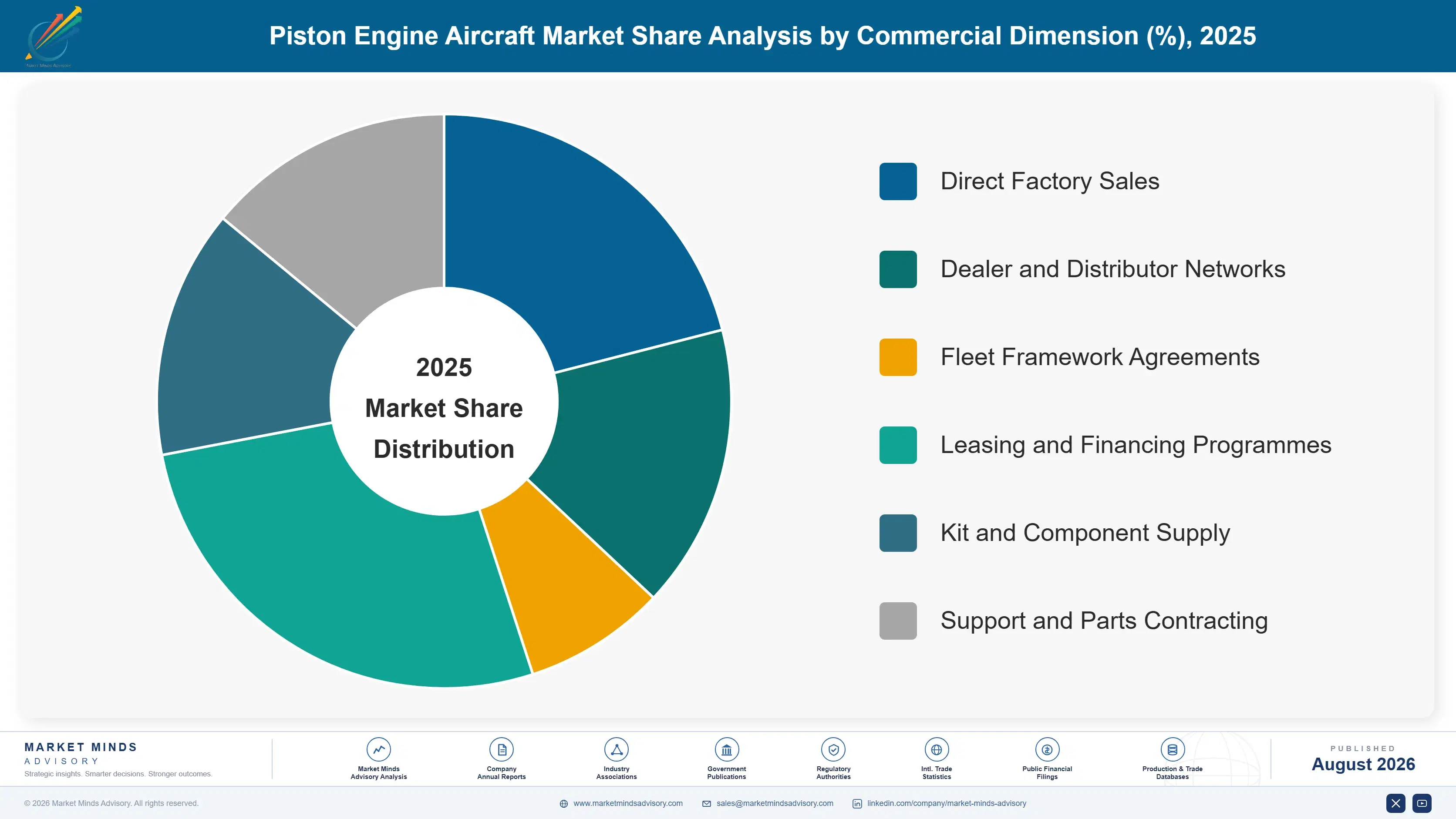
Segmentation follows aircraft category, since that determines who buys it, how many hours it flies and what the purchase decision actually rests on. Six categories describe the market completely, from training singles bought as production equipment in fleets through to the kit aircraft that avoid certification cost by placing the build obligation on the owner instead.
piston-engine-aircraft-market-market-share-analysis-1787997827587

Flight Training Singles

The fastest category grows at 8.1%, half again the market rate of 5.4%, and it grows because airline pilot demand exceeds what current training capacity can produce. A school aircraft flies close to 980 hours annually against perhaps a hundred for a private one, which retires the airframe far sooner and makes replacement predictable rather than discretionary. The purchase itself is unrecognisable to anybody used to selling single aircraft: framework pricing across a fleet, guaranteed parts availability, support response commitments and financing all matter more than the aeroplane's specification. Manufacturers organised around dealer sales to individuals keep losing these campaigns on commercial terms rather than on any product comparison at all.
CAGR 8.1%

Utility and Special Mission Pistons

Utility and special mission aircraft grow at 6.6%, serving aerial survey, pipeline and powerline patrol, border surveillance, parachute operations and agricultural work. What unites them is that the aeroplane is a tool bought on operating economics, and piston power remains genuinely competitive against turbines for missions flown at low altitude and modest speed where fuel burn dominates the calculation. Buyers here are commercial operators rather than enthusiasts, so they evaluate exactly as flight schools do. Special mission modification frequently exceeds the airframe in value, which makes the manufacturer's willingness to support third party installation considerably more important than most of them appear to realise at present. That is a straightforward commercial oversight.
CAGR 6.6%
Full segment breakdown across 6 segments available in the complete report.

Regional Architecture and Country Demand Map

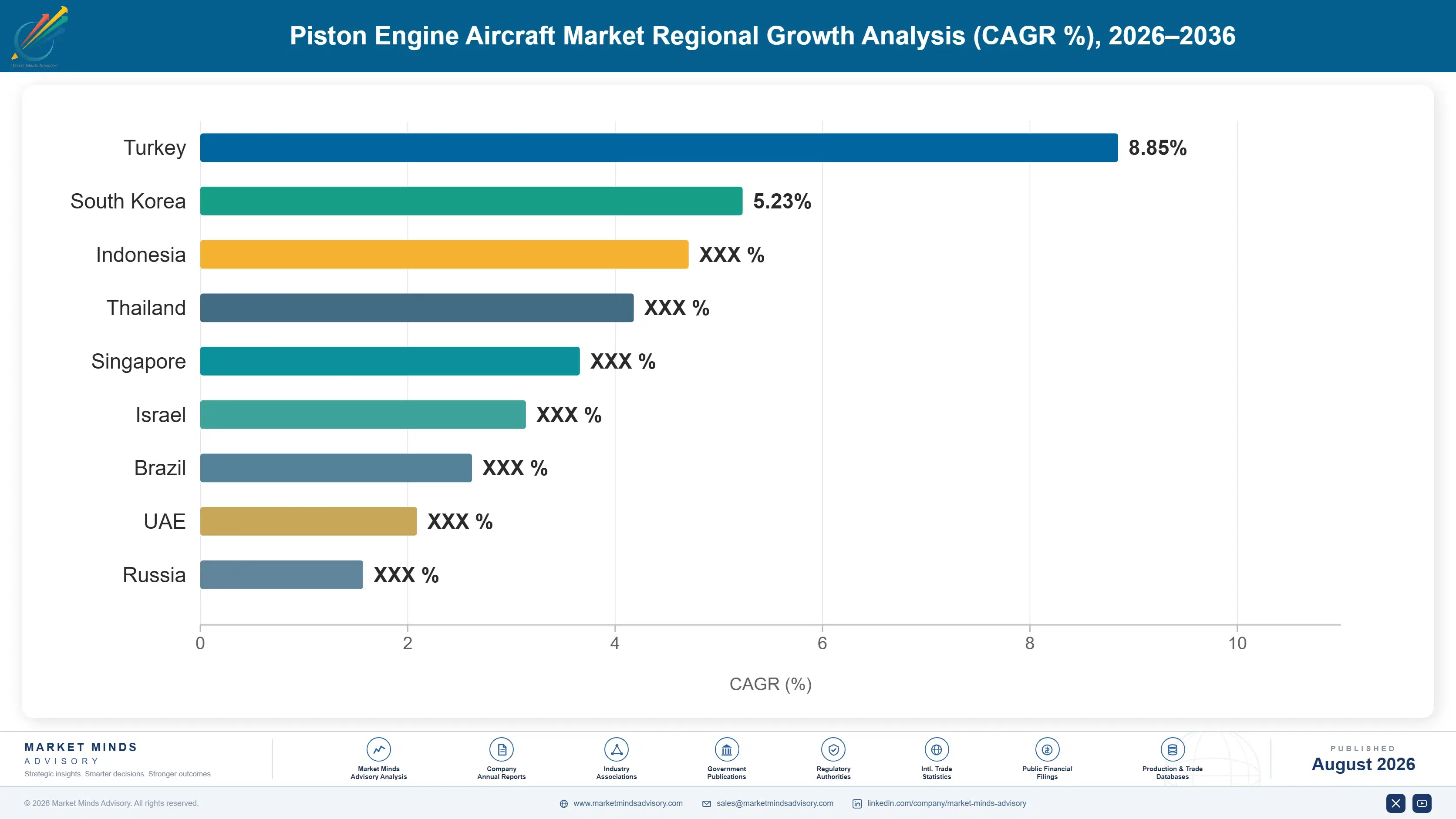
Demand follows general aviation activity and flight training capacity, which distributes unevenly. North America leads on the largest installed fleet and the deepest manufacturing base, with Western Europe and East Asia each holding substantial positions built on manufacturing and on training expansion respectively rather than flying activity.

North America

The largest share sits here at 32%, resting on an installed general aviation fleet larger than the rest of the world combined and on a manufacturing base covering training singles, personal aircraft, piston rotorcraft and kit aircraft alike. Leaded fuel withdrawal is being managed under a national transition programme here, which makes this the region where the fuel question is decided for everybody else. Flight training demand is substantial and the private owner population, while still the world's largest, is ageing considerably faster than it is being replaced. A region deciding the fuel question for everybody else while its own owner population ages faster than it renews is an odd position to hold.
Share: 32% | CAGR: 5.0% (2026 to 2036)

Western Europe

Manufacturing carries more of this region's position than demand does. Austrian, Italian and French manufacturers build training and touring aircraft exported worldwide, and European designs dominate the compression ignition segment because jet fuel availability and gasoline pricing both favoured that route far earlier here than elsewhere. Domestic flying activity is constrained by airspace, airfield access and operating cost in ways North American pilots would find unfamiliar. Training demand is growing steadily and from a considerably smaller base than the manufacturing footprint suggests. A region that manufactures considerably more aviation capability than it flies has been in that position for decades, and its compression ignition lead exists because European fuel pricing made the case long before regulation did.
Share: 23% | CAGR: 4.0% (2026 to 2036)
Regional intelligence for 5 additional markets available in the complete report: East Asia, South Asia and Pacific, Latin America, Middle East and Africa, Eastern Europe. Contact sales@marketmindsadvisory.com.
piston-engine-aircraft-market-country-cagr-analysis-1787997828114

Where Piston Aircraft Margin Sits

Four levers work on customer type, support economics and fuel positioning rather than on aircraft specification, which fleet buyers weigh far less heavily than dealers assume. Fleet commercial structure, support contracting, compression ignition positioning and utilisation-based product design each address something a manufacturer controls today without waiting for anybody else. Specification is not the issue.

Restructure The Commercial Model Around Fleet Buyers

A flight school ordering twenty aircraft negotiates framework pricing, parts availability, support response and financing as a single package, and a manufacturer organised around dealer sales of individual aeroplanes cannot assemble that quickly enough to win. Manufacturers with dedicated fleet sales functions close training campaigns at roughly 2.8 times the rate of those routing them through dealers. The change costs organisational effort rather than capital. Fleet buyers already take 44% of deliveries and the share is rising every year without pause. The share rises every year without any pause at all.
Market Impact: Closes campaigns at around 2.8 times the rate

Sell Support Contracts Alongside Every Fleet Order

An aircraft flying 980 hours annually consumes parts, inspections and unscheduled maintenance at a rate a private owner never approaches, and a school values guaranteed availability above almost anything else because a grounded trainer stops revenue immediately. Manufacturers attaching support agreements realise roughly 1.9 times the lifetime value of an equivalent bare aircraft sale. The commitment requires genuine parts distribution and response capability rather than a written promise. Most manufacturers sell the aeroplane and leave the recurring value to somebody else entirely. A grounded trainer simply stops earning money immediately.
Market Impact: Realises around 1.9 times the lifetime sale value

Position Compression Ignition For Fleet Economics

Jet fuel piston engines reach only 14% of deliveries because acquisition cost is higher, which deters private owners and should not deter fleet operators at all. At 980 annual hours the fuel saving and universal jet fuel availability recover the premium within roughly three years, and the leaded gasoline question disappears entirely. Manufacturers presenting compression ignition on acquisition price lose the argument. Those presenting it on cost per hour across a school's utilisation win it, and remarkably few structure the conversation that way. The arithmetic wins whenever anybody presents it.
Market Impact: Recovers the acquisition premium within about 3 years

Design For Utilisation Rather Than For Ownership

An aeroplane designed for a hundred annual hours and one designed for a thousand differ in landing gear, seat wear, interior durability, inspection access and component life, and most of the certified fleet was designed for the former. Manufacturers optimising for high utilisation report direct maintenance cost 18% to 25% below comparable aircraft designed for private ownership. The engineering is unglamorous and the customer notices immediately, because cost per hour is the only number a training organisation actually evaluates when comparing anything. Cost per hour is the only number that matters.
Market Impact: Cuts the direct maintenance cost by 22% typically

Who Controls the Margin Pool

Concentration is moderate at around 61% across the five largest manufacturers, and the group divides by which customer it serves. Textron Aviation and Piper hold long-established training positions, Cirrus built its position on the private owner and is now repositioning, Diamond leads compression ignition, and Robinson dominates piston rotorcraft entirely. Below them sit light and kit manufacturers competing on price and avoiding certification cost.
Competition runs on three dimensions and specification is the least of them. Fleet commercial capability is the first, since a school ordering twenty aircraft evaluates framework terms rather than aeroplanes. Support and parts availability is the second, because a grounded trainer stops earning immediately. Fuel flexibility is third and newly important, as leaded withdrawal makes compression ignition operational rather than philosophical.

Pressure arrives from the customer, not from new entrants. Flight schools buying fleets impose commercial terms dealer-based manufacturers struggle to meet, and are indifferent to the attributes those manufacturers spent decades refining. Kit aircraft meanwhile take private buyers priced out of certified aeroplanes. Rankings shift against manufacturers holding neither fleet capability nor compression ignition, since both are what the growing customer asks about.
piston-engine-aircraft-market-company-positioning-matrix-1787997828639

Competitive Moat and Risk Dimensions

TEXTRON AVIATION

Moat: Training fleet installed base

Textron Aviation holds the largest installed base of training aircraft anywhere, giving it parts distribution, maintenance familiarity and instructor knowledge together that a school switching manufacturers must rebuild from nothing. Flight organisations standardise fleets deliberately to control cost. Displacing an incumbent trainer across an established school means retraining engineers and restocking parts, which few operators undertake without good reason.
TEXTRON AVIATION

Risk: Airframes designed for private ownership

Much of the training fleet derives from designs originally intended for private owners flying a hundred hours annually, carrying maintenance and component life assumptions that high utilisation exposes. Competitors designing specifically for school utilisation report materially lower direct maintenance cost. Redesigning a certified airframe for utilisation means recertification expense against a market buying fewer than two thousand aircraft yearly.
DIAMOND AIRCRAFT INDUSTRIES

Moat: Compression ignition engine leadership

Diamond built its position around jet fuel piston engines well before leaded gasoline withdrawal made that choice urgent, and it now holds the deepest certified compression ignition range available anywhere. Fleet operators evaluating cost per hour at high utilisation reach conclusions that favour it consistently. Competitors adding compression ignition face certification and integration work measured in years.
DIAMOND AIRCRAFT INDUSTRIES

Risk: Acquisition premium deters private buyers

Compression ignition aircraft cost more to acquire, which fleet operators recover through fuel saving at high utilisation and private owners flying a hundred hours annually simply do not. That confines the advantage largely to one customer type. Should unleaded gasoline distribution resolve quickly, the operational argument weakens considerably while the acquisition premium remains exactly where it was.

Players Tracked

Prominent Players

Textron Aviation
Cirrus Aircraft
Diamond Aircraft Industries
Piper Aircraft
Robinson Helicopter

Other Key Players

Tecnam
Van's Aircraft
Robin Aircraft
American Champion Aircraft
Mooney International
Extra Aircraft
Aquila Aviation
Flight Design
CubCrafters
Vulcanair
Sling Aircraft
Zlin Aircraft
Aeroprakt
Bristell
Glasair Aviation

Recent Developments

OCTOBER 2023

Regulator confirmed leaded aviation gasoline endangerment finding

An environmental regulator issued a finding that lead emissions from piston aircraft endanger public health, providing the formal basis for withdrawing leaded aviation gasoline under a fleet-wide transition programme. This was a regulatory determination by a government agency rather than any commercial arrangement between fuel producers or aircraft manufacturers.
Signal: The last leaded transport fuel in widespread use finally acquired a formal end date at last.
JULY 2022

Unleaded replacement fuel approved across the piston fleet

Supplemental type certification was granted covering an unleaded aviation gasoline for essentially the entire spark ignition piston fleet, removing the approval barrier while leaving distribution unresolved. This was a certification approval by an aviation authority rather than any merger, acquisition or supply agreement between commercial parties.
Signal: Approval arrived years ahead of distribution, which is exactly the gap owners are still waiting inside.
MARCH 2025

Indian training organisations expanded fleet ordering substantially

Flight training organisations across India continued placing multi-aircraft orders to serve airline cadet requirements generated by carrier fleet expansion, buying in tens rather than individually. These were independent purchasing decisions by many separate operators rather than any coordinated commercial arrangement among any of them at all.
Signal: Fleet buying in a market with no private owner tradition shows where this industry is heading.

What Building A Piston Aircraft Costs

Unit cost divides into four components on a typical certified piston aeroplane. The engine and propeller absorb roughly 27% of build cost and come from a very small number of qualified suppliers. Avionics run near 22%, airframe structure, materials and assembly labour near 34%, and certification amortisation with product liability provision accounts for the remaining 17% across a production run.
Product liability is the component with no manufacturing equivalent anywhere else. Certified aircraft carry liability exposure across decades of service life, which raises unit cost far beyond what materials and labour justify and is why a four seat aircraft costs more than a house. Textron discussed general aviation liability and certification cost across recent reporting periods. Kit aircraft avoid it entirely by placing the build obligation on the owner, which is why they compete on price.

Exposure varies by customer type and by fuel choice. Manufacturers selling to fleets recover cost across support agreements rather than the airframe alone. Compression ignition aircraft carry a higher engine cost share that high utilisation recovers and private ownership does not. Kit manufacturers carry almost no certification or liability cost, a genuine advantage that confines them to buyers willing to build their own aeroplane.
piston-engine-aircraft-market-cost-volatility-analysis-1787997828836

Support contracts recovering cost beyond the airframe

An aircraft flying 980 hours annually generates parts and maintenance revenue that a private aeroplane never does, so recovering certification and liability cost across a support agreement rather than the airframe price alone changes what a manufacturer can competitively charge. It requires genuine parts distribution and response capability. Most still sell the aeroplane and leave recurring value to independent shops.

Utilisation focused design reducing maintenance exposure

Landing gear, seat wear, interior durability and inspection access all behave differently at a thousand annual hours than at a hundred, and most certified airframes were designed for the latter. Designing for utilisation cuts direct maintenance cost materially and is immediately visible to the only customer that measures it. The recertification expense is what deters manufacturers from revisiting older airframes.

Compression ignition offsetting fuel supply uncertainty

Jet fuel is universally available at airfields worldwide while unleaded gasoline distribution remains incomplete, so a compression ignition option removes a purchase deterrent that no manufacturer can otherwise address. The engine costs more and high utilisation recovers it within a few years. Presenting the choice on acquisition price rather than cost per hour loses an argument the arithmetic wins.

Portfolio Architecture for Margin Defence

The portfolio separates by who is buying and how many hours they fly. Personal and touring singles form the traditional core: higher unit prices, buyers who care about specification and appointment, and a customer population that is ageing and shrinking every year. Manufacturers hold this business because it built them and because the margins on a well specified personal aircraft remain genuinely attractive whenever one actually sells.
Margin now concentrates where utilisation is high and support attaches. Training fleets and special mission operators both buy on cost per hour and both accept support agreements as part of the purchase, which converts a one-time airframe sale into a recurring relationship measured across a decade. The tension is that these buyers negotiate hard on acquisition price precisely because they understand exactly what the aeroplane will cost them to run.

Kit and experimental aircraft occupy a position the certified manufacturers cannot reach. By placing the build obligation on the owner they avoid certification and liability cost almost entirely, which lets them offer capability at prices certified aircraft cannot approach. That advantage is permanent and so is its limitation, since the customer must be willing to build an aeroplane.

Volume / Commodity-Adjacent

Kit aircraft, light sport and entry level singles sold largely on price. Range spans six points because kit manufacturers avoid certification and liability cost entirely while certified light aircraft carry both in full.
Gross Margin: 8-14%

Premium / Certified

Personal touring singles and light twins sold to individual owners on specification. Range spans eight points because avionics and interior content vary enormously across a category where buyers genuinely notice and pay for both.
Gross Margin: 14-22%

Sustainability / Regulatory / Next-Generation

Training fleets with attached support agreements and compression ignition aircraft. Range spans ten points because support attachment converts a single airframe sale into recurring revenue that bare aircraft sales never generate.
Gross Margin: 18-28%
piston-engine-aircraft-market-portfolio-architecture-1787997829339

High-value Sub-segments and Strategic Watch-out

Flight Training Singles

High value and high growth at 8.1%, driven by airline pilot demand exceeding current training capacity everywhere. The eight point range separates manufacturers attaching support agreements from those selling bare airframes into the identical fleet campaign. Bare airframes and supported fleets earn very differently indeed.
Gross Margin: 18-26%

Utility and Special Mission Pistons

High value with moderate growth at 6.6%, bought by commercial operators purely on operating economics. The eight point range reflects whether a manufacturer supports third party mission modification, which frequently exceeds the airframe in value. The modification frequently costs rather more than the aeroplane itself.
Gross Margin: 16-24%

Personal and Touring Singles

The traditional core and the category this industry was built around entirely. Buyers care about specification and appointment, margins remain attractive when aircraft sell, and the owner population ages and shrinks every single year. The margins hold up well whenever an aircraft actually sells here.
Gross Margin: 14-22%

Leaded Avgas Dependent Fleet

The strategic watch-out rather than a growth pool. Unleaded approval arrived years ahead of distribution, tetraethyl lead supply runs through very few producers, and buyers deferring purchases until this resolves are a real drag. Nobody in this industry discusses that drag comfortably at all yet.
Gross Margin: Variable

Why Flight Schools Buy Fleets

Fleet standardisation produces annuity economics that individual aircraft sales never generate. A training organisation running one aircraft type controls maintenance training, parts inventory, instructor familiarity and student transition cost in a way a mixed fleet cannot, so it buys additional aircraft from the incumbent manufacturer almost automatically. Switching means retraining engineers, restocking parts and revalidating course material, which schools undertake rarely and essentially never for a modest acquisition saving.
Stickiness varies enormously by buyer. Training organisations are the most attached, since fleet standardisation compounds with every additional aircraft. Special mission operators are similar, because the mission modification is frequently type-specific and worth more than the airframe. Private owners are the least attached of all, moving between manufacturers on specification, appearance and dealer relationship in a way no commercial operator would recognise as rational.

Buyer profiles are shifting decisively toward the commercial end. Fleet operators already take 44% of deliveries and the share rises annually, driven by airline pilot demand that shows no sign of easing. Private ownership continues but the population ages faster than it renews. Manufacturers whose commercial structures, product design and support organisations were built for the individual owner serve a customer steadily becoming the minority.
piston-engine-aircraft-market-end-use-penetration-index-1787997829830

Where Piston Builders Should Commit

These are among the four positions where our research anticipates prominent divergence between winners and laggards over the coming forecast period. Each is grounded in the demand model, the regulatory perimeter, and the announced capacity pipeline.
01 / FLEET COMMERCIAL STRUCTURE

A school buying twenty aircraft is not a dealer sale

A flight organisation ordering twenty aeroplanes negotiates framework pricing, parts availability, support response and financing as one package, and a manufacturer organised around dealer sales of individual aircraft cannot assemble that quickly enough to win the campaign. Manufacturers with dedicated fleet sales functions close training competitions at roughly 2.8 times the rate of those routing them through dealer networks instead. Fleet buyers already take 44% of all deliveries and that share rises every single year without any pause at all.
02 / SUPPORT ATTACHMENT DISCIPLINE

The recurring value is worth more than the airframe

An aircraft flying some 980 hours annually consumes parts, inspections and unscheduled maintenance at rates a private aeroplane never once approaches, and a school values guaranteed availability above almost everything else because a grounded trainer stops earning revenue immediately. Manufacturers attaching support agreements realise roughly 1.9 times the lifetime value of an equivalent bare airframe sale into the very same fleet. The commitment demands genuine parts distribution and response capability rather than a written promise that nobody can actually keep.
03 / COMPRESSION IGNITION POSITIONING

Sell jet fuel engines on hours, never on price

Jet fuel piston engines reach only 14% of deliveries because acquisition cost is higher, which properly deters private owners flying only a hundred hours and should not deter fleet operators at all. At 980 annual hours the fuel saving plus universal jet fuel availability recovers the premium within roughly three years, and the whole leaded gasoline question simply disappears. Manufacturers presenting this on acquisition price lose an argument that the cost per hour arithmetic comfortably wins for them every time.
04 / UTILISATION FOCUSED DESIGN

Airframes built for a hundred hours fail at a thousand

Landing gear, seat wear, interior durability, inspection access and component life all behave differently at a thousand annual hours than at a hundred, and most of the certified fleet was designed squarely for the latter. Manufacturers optimising specifically for high utilisation report direct maintenance cost 18% to 25% below comparable aircraft designed around private ownership. The engineering is unglamorous and the customer notices immediately, because cost per hour is the only number a training organisation ever really evaluates at all.

Engagement Snapshot From the Field

A live engagement with an industry participant carrying material or product regulatory and market exposure ahead of a defining policy shift, showing how our research translates into a defensible multi-year portfolio strategy.
MARKET MINDS ADVISORY · CLIENT ENGAGEMENT SUMMARY
Piston Engine Aircraft Producer Strategic Portfolio Review and Transition Roadmap 2026·Investment Scenario on Piston Engine Aircraft Exposure Evaluation 2025-26
CLIENT PROFILE
A certified piston aircraft manufacturer producing four seat singles and a light twin, selling almost entirely through an established dealer network to individual owner-pilots across three continents. Unit deliveries had been flat for six years while the training market grew steadily, and management attributed the stagnation to general aviation decline rather than to the customer segment it had chosen to serve exclusively.
STRATEGIC CHALLENGE
The board needed to understand why competitors were growing in a market it described as declining, and whether its dealer network could serve fleet buyers at all. It also faced repeated questions from prospective customers about leaded fuel that its sales organisation had no agreed answer to, and held no compression ignition option anywhere in its product range.
MMA APPROACH
MMA analysed six years of the client's campaign outcomes by customer type, separating private owner sales from fleet competitions and identifying where each was lost, then benchmarked its direct maintenance cost against aircraft designed for high utilisation. Expert interviews with flight training organisations, dealers and fuel distributors established what fleet buyers evaluate and what the fuel transition means operationally.
KEY FINDINGS
  1. The client had entered nineteen fleet competitions across six years and won two, losing sixteen on commercial terms rather than on any aspect of the aircraft itself.
  2. Direct maintenance cost per hour ran 31% above the closest competitor designed for training utilisation, which fleet buyers calculated and the client's dealers never discussed.
  3. Dealers received identical commission on a single aircraft and on a twenty aircraft fleet order, so none had any incentive to pursue the longer and harder fleet campaigns.
  4. No compression ignition option existed, and four of the sixteen lost competitions had specified jet fuel capability as a mandatory requirement in the tender.
CLIENT PROFILE
A certified piston aircraft manufacturer producing four seat singles and a light twin, selling almost entirely through an established dealer network to individual owner-pilots across three continents. Unit deliveries had been flat for six years while the training market grew steadily, and management attributed the stagnation to general aviation decline rather than to the customer segment it had chosen to serve exclusively.
STRATEGIC CHALLENGE
The board needed to understand why competitors were growing in a market it described as declining, and whether its dealer network could serve fleet buyers at all. It also faced repeated questions from prospective customers about leaded fuel that its sales organisation had no agreed answer to, and held no compression ignition option anywhere in its product range.
MMA APPROACH
MMA analysed six years of the client's campaign outcomes by customer type, separating private owner sales from fleet competitions and identifying where each was lost, then benchmarked its direct maintenance cost against aircraft designed for high utilisation. Expert interviews with flight training organisations, dealers and fuel distributors established what fleet buyers evaluate and what the fuel transition means operationally.
KEY FINDINGS
  1. The client had entered nineteen fleet competitions across six years and won two, losing sixteen on commercial terms rather than on any aspect of the aircraft itself.
  2. Direct maintenance cost per hour ran 31% above the closest competitor designed for training utilisation, which fleet buyers calculated and the client's dealers never discussed.
  3. Dealers received identical commission on a single aircraft and on a twenty aircraft fleet order, so none had any incentive to pursue the longer and harder fleet campaigns.
  4. No compression ignition option existed, and four of the sixteen lost competitions had specified jet fuel capability as a mandatory requirement in the tender.
RECOMMENDED STRATEGY
Phase 1: Phase one: establish a direct fleet sales function with framework pricing, support and financing authority, operating alongside rather than through the dealer network. Phase 2: Phase two: attach support agreements to every fleet proposal, building the parts distribution and response capability those commitments genuinely require first. Phase 3: Phase three: begin compression ignition integration on the highest volume airframe, accepting the certification cost against a mandatory tender requirement.
OUTCOME
The client reported winning four of seven fleet competitions entered within five quarters of establishing direct fleet sales (client-reported, unverified by MMA), against two of nineteen previously. Support agreements were attached to all four. Compression ignition integration entered certification during the fourth quarter of the review period.

Frequently Asked Questions

Foundational context covering the market sizes, CAGR, scope, country, region and competition that inform every finding below. This section is provided to cover basics and most often pre-purchase conversations, answered from the MMA Primary Research Dataset.

What is the current size of the Piston Engine Aircraft Market?

The market is valued at USD 1.8 billion in 2025, measured as revenue from new piston-engine aircraft delivered worldwide across certified aeroplanes, piston rotorcraft and complete kits.

How large will the Piston Engine Aircraft Market be by 2036?

MMA forecasts USD 3.21 billion by 2036, up from USD 1.90 billion in 2026. That represents incremental revenue of USD 1.31 billion and an expansion multiple of 1.69 times.

What is the CAGR for the Piston Engine Aircraft Market 2026 to 2036?

The base case CAGR is 5.4%, with a bull case of 6.6% and a bear case of 4.2%. Flight training fleet demand and replacement of a 48 year old fleet supply most of that growth.

Which segment is growing fastest?

Flight training singles grow at 8.1%, half again the market rate of 5.4%. Airline pilot demand exceeds what current training capacity can actually produce today.

Who are the major companies in the Piston Engine Aircraft Market?

Textron Aviation, Cirrus Aircraft, Diamond Aircraft Industries, Piper Aircraft and Robinson Helicopter lead on unit billings, holding around 61% between them right across the whole market.

Which country is growing fastest?

India grows fastest at 7.4%, driven by flight training expansion serving the carrier fleet orders that require pilot volumes the country has never previously trained.

Report Segmentation Architecture

The full report scope spans multiple orthogonal segmentation dimensions, with cross-tabulated demand data provided for each dimension pair. Coverage extends further to regional breakdowns, trend trajectories, and the competitive detail needed to support segment-level decision-making.

By Aircraft Category

  • Flight Training Singles
  • Personal and Touring Singles
  • Light Twins
  • Utility and Special Mission Pistons
  • Piston Rotorcraft
  • Kit and Experimental Aircraft

By End-Use Industry

  • Flight Training Organisations
  • Private Owner Pilots
  • Aero Clubs and Shared Ownership
  • Aerial Survey and Special Mission
  • Government and Border Patrol
  • Agricultural Operators

By Commercial Dimension

  • Direct Factory Sales
  • Dealer and Distributor Networks
  • Fleet Framework Agreements
  • Leasing and Financing Programmes
  • Kit and Component Supply
  • Support and Parts Contracting

By Region

  • North America
  • Western Europe
  • East Asia
  • South Asia and Pacific
  • Latin America
  • Middle East and Africa
  • Eastern Europe

Scope, Methodology, and Coverage

Every figure in this report is reproducible from documented input assumptions. The scope below maps the historical period, the forecast horizon, the segmentation dimensions, and the countries covered, alongside the underlying primary and qualitative methodology.
Historical Period
2020 to 2025
Forecast Period
2026 to 2036
Base Year
2025 (USD billions; MMA Primary Research Dataset, August 2026)
Market Definition
Revenue from new piston-engine aircraft delivered worldwide, spanning flight training singles, personal and touring singles, light twins, utility and special mission aircraft, piston rotorcraft, and kit and experimental aircraft sold as complete kits. Direct factory sales, dealer distribution, fleet framework agreements, leasing programmes and attached support contracting are included. Turbine aircraft of any category, used aircraft transactions, engine overhaul and aftermarket parts supply, flight training services themselves, and all unmanned aircraft are excluded from scope.
Quantitative Units
USD billions, new aircraft billings
Segmentation Dimensions
Aircraft category, end-use operator industry, commercial sales dimension, region
Regions Covered
North America, Western Europe, East Asia, South Asia and Pacific, Latin America, Middle East and Africa, Eastern Europe
Countries Covered
United States, Canada, Austria, Italy, France, Germany, China, Japan, India, Australia, Brazil, Mexico, South Africa, Czechia
Key Companies Profiled
Textron Aviation, Cirrus Aircraft, Diamond Aircraft Industries, Piper Aircraft, Robinson Helicopter, Tecnam, Van's Aircraft, CubCrafters, Vulcanair, Sling Aircraft
Quantitative Methodology
Primary survey, n=3,800 respondents, Q4 2025, six countries; demand-side model with trade association cross-validation
Qualitative Methodology
47 expert interviews, Q4 2025; applied to validate demand model assumptions, identify emerging dynamics, and assess competitive positioning
Report Format
PDF and XLSX data workbook (Word format preview document)
Publisher
Market Minds Advisory
Report Code
MMA-2026-CON-291
Published
August 2026
Contact
sales@marketmindsadvisory.com | www.marketmindsadvisory.com

Purchase the full Piston Engine Aircraft Market Report (2026 to 2036).

The full report shows that this market's customer changed from individual owner to fleet operator while most of the product and commercial structure did not follow. It quantifies fleet buyer share and campaign win rates by sales channel, models direct maintenance cost for airframes designed around private ownership against those designed for high utilisation, and assesses compression ignition economics at training utilisation rather than at acquisition price. Segment analysis covers all six aircraft categories, with particular attention to training singles as the only genuinely growing customer. Competitive assessment ranks twenty manufacturers on unit billings across every producing region.
Six aircraft category segmentation with growth rates
Fleet campaign win rates compared by sales channel
Twenty manufacturer assessment on unit billings
Direct maintenance cost by design utilisation assumption
Compression ignition payback across utilisation levels
Leaded fuel transition exposure by installed fleet

Built For The People Who Decide

From boardroom strategy to bench-side execution, this report is read cover-to-cover by leaders shaping the next decade of their industry, turning demand scenarios, market dynamics and valuation benchmarks into decisions.
CXOs/ Presidents/ VPs/ Managers
M&A and Corporate Development
Strategy Teams and R&D Heads
Procurement and Product Directors
Regulatory and Compliance Leaders
Investor Relations and Equity Analysts