Market Minds Advisory
Piroctone Olamine Market

Piroctone Olamine Market: Scalp Care Expansion and the Zinc Pyrithione Substitution Wave

Formulators dropping zinc pyrithione over aquatic toxicity concerns are discovering piroctone olamine costs meaningfully more to source at scale, forcing anti-dandruff brands to choose between reformulation cost and regulatory exposure.

Lead Analyst

Bilal Shaikh

Published

September 2026

Make Smarter Decisions with Customized Research Insights

Request a free sample report and evaluate market opportunities, growth trends, and competitive dynamics relevant to your business needs.

2025 MARKET VALUE$0.3BMarket Size 2025
2036 FORECAST VALUE$0.6BBase Case , 2026 to 2036
CAGR 2026 TO 20366.4 %Bull 7.6% / Bear 5.2%
INCREMENTAL OPPORTUNITY$0.3BNet 10- year value creation
EXPANSION MULTIPLE1.85x2036 value over 2026 base
Strategic Levers
M&A Pipeline
Regional Outlook
Country Rankings
Competitive Intelligence
Segmental Deep-dive
Call-Us : 91 93563 13602

Executive Snapshot and Market Trajectory

Regulatory substitution pressure, not raw antifungal efficacy, now decides which supplier wins a formulation slot. Producers with documented zinc pyrithione replacement data are winning briefs that commodity active suppliers cannot match. Buyers now treat that documentation gap as a hard qualification filter from the outset today.
Scalp care brands expanding beyond rinse-off shampoo into leave-on serums are pulling demand toward premium piroctone olamine grades faster than commodity anti-dandruff shampoo volume, while South Korea's scalp health category is the fastest-growing national demand pool. European and Japanese chemical producers hold the deepest synthesis and purification base, while personal care brands worldwide increasingly specify documented substitution data as regulatory scrutiny on zinc pyrithione intensifies.
Competition concentrates among a handful of specialty chemical producers able to guarantee consistent purity and documented safety data at commercial volume, a capability that separates qualified suppliers from smaller regional producers selling variable-grade active. Regulatory substitution cycles, scalp care category expansion, and raw material cost volatility are together reshaping which producers can scale past commodity antifungal sale into premium formulation contracts. That reshaping increasingly rewards documentation depth across every premium account today. overall today.
Market Definition
The piroctone olamine market covers the antifungal active ingredient sold across cosmetic-grade and pharmaceutical-grade purity tiers for anti-dandruff shampoo, conditioner, scalp treatment, nail care, and pet care formulations. It excludes zinc pyrithione and other competing antifungal actives, and unrelated cosmetic preservative categories not based on the piroctone olamine molecule.
Base Year Value
$0.3B in 2025 (MMA Primary Research Dataset, August 2026)
Forecast Period
2026 to 2036, eleven discrete annual values
CAGR
6.4% base case. Bull 7.6%. Bear 5.2%.
Fastest Growth Segment
Scalp Treatment Serums: 9.0% CAGR
Fastest Growth Country
South Korea: 9.8% CAGR
Fastest Growth Region
South Asia and Pacific: 8.4% CAGR
Largest Region
East Asia: 28% of 2025 global value
Market Leaders
Clariant AG, Vivimed Labs Limited, Salvi Chemical Industries, Jiangsu Kailong Chemical Co., Lonza Group. Source: MMA Analysis based on company annual reports.
Primary Survey
n=3,800 procurement and R&D decision-makers, Q4 2025, six countries
Methodology
Demand-side build-up, cross-validated against public data, 47 expert interviews

Piroctone Olamine Market Forecast Scenarios

piroctone-olamine-market-trends-size-forecast-scenario-1787580191394
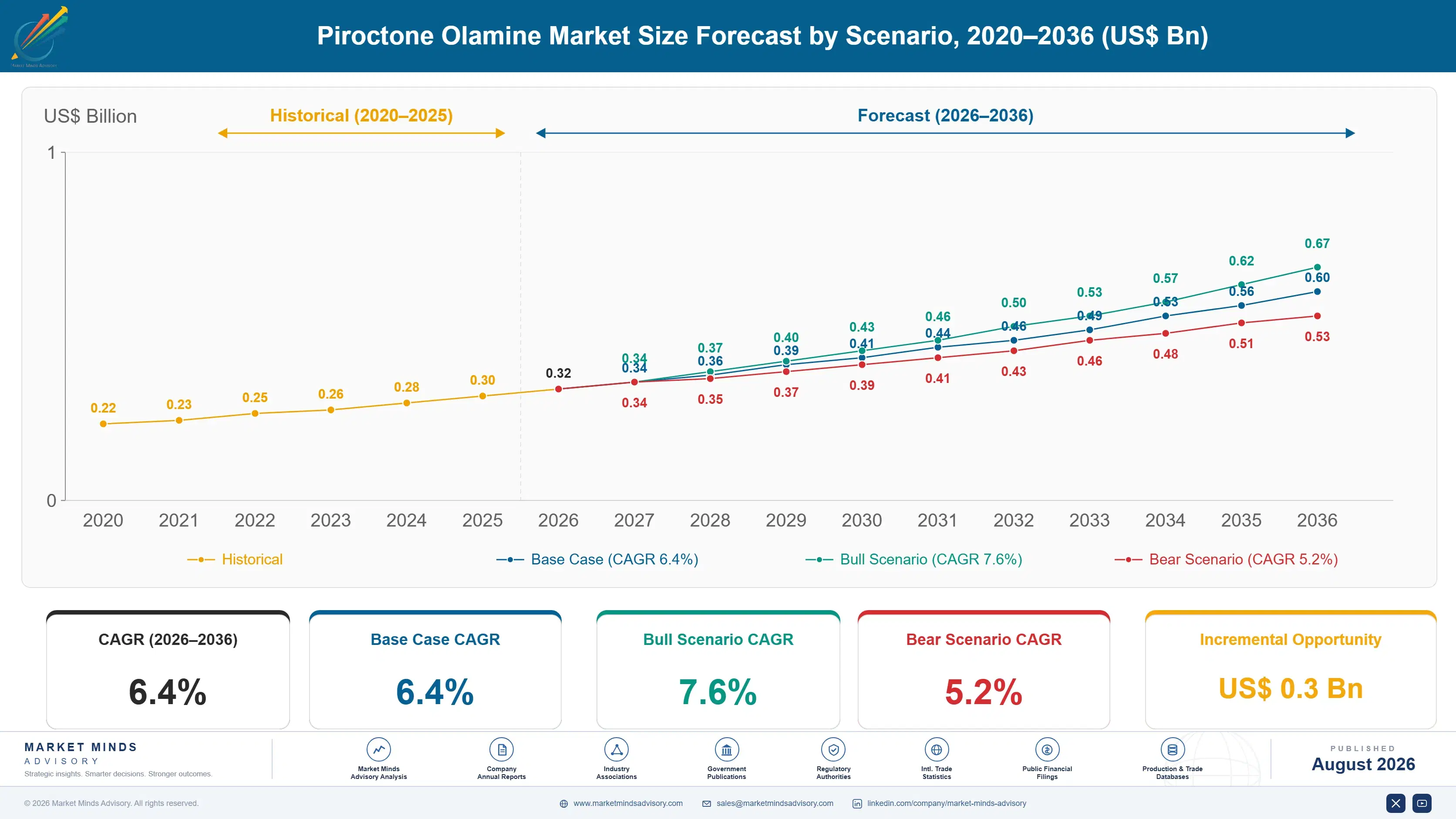
Between 2020 and 2025 the category grew near a 5.6% annual pace as anti-dandruff shampoo demand expanded steadily across emerging markets, before scalp care serum launches accelerated sharply from 2023 onward as premium personal care brands began extending scalp health positioning beyond traditional rinse-off shampoo formats. That transition marked a genuine shift in category economics.
The base case carries the market to a 6.4% CAGR on three mechanisms: continued anti-dandruff category growth across humid climate emerging markets requiring cost-effective antifungal actives, premium scalp care brands specifying documented zinc pyrithione substitution as regulatory scrutiny intensifies across major export markets, and South Korean and Japanese formulators launching leave-on scalp treatment products that require higher-purity cosmetic-grade active than rinse-off formulations typically demand. These three mechanisms reinforce each other across nearly every major personal care market worldwide.
The bull case at 7.6% assumes zinc pyrithione regulatory restriction expands faster than currently modelled across additional major markets. The bear case at 5.2% assumes persistent cost sensitivity among mass-market anti-dandruff brands slows substitution adoption more than currently expected. Both scenarios assume no major disruption to global fine chemical feedstock supply chains overall today. Delays remain possible.

Substitution Pressure and the Purity Grade Premium

Three forces converge on this category. Mass-market anti-dandruff brands need cost-effective antifungal actives that perform reliably across humid climate conditions, premium scalp care brands need documented purity and safety data for leave-on formulations that stay on skin longer than rinse-off products, and regulators across multiple regions are tightening restrictions on zinc pyrithione simultaneously. Reconciling all three is genuinely difficult.
TOP PRODUCER SHAREChina, 26%Share of global output concentrated in Chinese facilities
AVERAGE SELLING PRICEUSD 38 per kgBlended average price across cosmetic and pharmaceutical grades
SYNTHESIS FEEDSTOCK SHARE42% of COGSSpecialty organic intermediate share of overall unit cost
SCALP SERUM SEGMENT SHARE18% of volumeVolume sold directly into leave-on scalp treatment formulations
FORMULATION QUALIFICATION CYCLE8 to 12 monthsTypical time to qualify a new antifungal active
MARKET CONCENTRATIONCR5: 46%Combined share held by five largest active ingredient producers
Commercially, the category rewards documented substitution data over raw antifungal potency. Producers that can guarantee consistent purity and safety documentation command formulation briefs that commodity suppliers cannot access, which is why premium personal care brands increasingly default to a small pool of qualified suppliers rather than sourcing opportunistically from whichever producer offers the lowest price that season. That preference has hardened as reformulation projects have proven costly to redo after failed stability testing. That preference rarely reverses.
Over the next decade, zinc pyrithione substitution depth, scalp care category expansion, and regulatory harmonisation will decide which producers convert commodity antifungal sale into durable premium formulation contracts. Producers without documented safety and purity data risk losing major personal care brand relationships entirely as compliance becomes a baseline requirement rather than a differentiator. Suppliers slow to adapt risk losing access.
"Everyone still treats this as a minor shampoo ingredient nobody thinks twice about. The producers actually winning premium contracts have spent years building the safety documentation that regulators now demand before any substitution decision gets made."
Director, Specialty Cosmetic Actives Practice · MMA Specialty Cosmetic Actives Practice · August 2026

Market Trends

Scalp Health Trend Expands Beyond Rinse-Off Shampoo

Personal care brands are increasingly extending scalp health positioning into leave-on serums and treatments, following the broader skincare industry's shift toward scalp care as a distinct category rather than an afterthought within haircare. Clariant and Vivimed Labs have both expanded cosmetic-grade purity offerings specifically to serve this leave-on formulation channel, which demands documented safety data since these products stay on skin considerably longer than rinse-off shampoo. This shift is pulling qualified producers toward higher-margin scalp treatment contracts that pay more per kilogram. That premium accounts channel has grown steadily as scalp care category expands.
Market Impact: Adds 14% to emerging market volume
Zinc Pyrithione Restrictions Accelerate Substitution Demand

European Union and other regulators have tightened restrictions on zinc pyrithione citing aquatic toxicity concerns, pushing formulators to qualify piroctone olamine as a direct substitute across anti-dandruff product lines. Salvi Chemical Industries and other producers have scaled documentation capability specifically to support formulators navigating this substitution, since switching actives requires fresh stability and efficacy testing that brands cannot skip regardless of formulation urgency. This regulatory-driven substitution is proving more durable than a temporary compliance response, since brands completing the switch rarely revert once reformulation investment is made. That durability increasingly shapes long-term supplier relationships across the category.
Market Impact: Premium orders grow past 12% share

Market Opportunities and Growth Drivers

Emerging Market Anti-Dandruff Category Growth Sustains Volume

Anti-dandruff shampoo demand continues expanding across humid climate emerging markets including India and Southeast Asia, where scalp conditions driven by heat and humidity sustain persistent category growth independent of any premium scalp care trend. Major personal care brands have published formulation guidelines favouring documented antifungal actives across new product development in these markets, giving suppliers with proven efficacy data a direct competitive advantage in formulation briefs. That volume growth has proven durable across multiple product cycles rather than a passing seasonal trend, reinforcing sustained active ingredient procurement growth. That growth compounds steadily each year across the category.
Market Impact: Cost premium runs 20% to 35%

South Korean Scalp Care Brands Drive Premium Formulation Demand

South Korean personal care brands continue launching premium scalp care serums and treatments that require cosmetic-grade piroctone olamine with documented purity exceeding standard shampoo-grade material, reflecting the country's broader leadership in skincare innovation extending into scalp health. Clariant and other premium-grade suppliers have expanded purification capacity specifically to serve this demand, which requires more rigorous testing documentation than standard shampoo-grade material typically carries. This shift is pulling qualified suppliers toward premium accounts that pay meaningfully more per kilogram than commodity shampoo-grade sale. That premium accounts channel has expanded steadily as Korean brands scale production.
Market Impact: Concentration limits affect 20% of formulas

Market Restraints and Challenges

Higher Cost Than Zinc Pyrithione Limits Mass-Market Adoption

Piroctone olamine costs meaningfully more to synthesise and formulate than zinc pyrithione, the long-established incumbent antifungal active, creating genuine cost resistance among mass-market anti-dandruff brands operating on thin margins in price-sensitive emerging markets. The root cause is inherent synthesis complexity rather than any solvable manufacturing inefficiency, since piroctone olamine requires more complex organic chemistry than the simpler zinc pyrithione molecule. Producers are mitigating this through manufacturing scale efficiency and longer-term supply contracts, though the underlying cost gap against zinc pyrithione persists regardless of production volume achieved. That gap persists regardless of manufacturing scale or process efficiency gains.
Market Impact: Scalp serum segment reaches 18% share

Regulatory Concentration Limits Constrain Formulation Flexibility

Regulators in the European Union and other jurisdictions have set maximum concentration limits for piroctone olamine in leave-on and rinse-off cosmetic formulations, restricting how formulators can deploy the active ingredient even as they substitute away from zinc pyrithione. The root cause is a precautionary safety assessment rather than any documented adverse event history, since regulators apply conservative concentration ceilings during periodic ingredient safety reviews. Producers are mitigating this by developing complementary actives and delivery systems that achieve efficacy at lower piroctone olamine concentrations, though this adds formulation complexity that brands must absorb.
Market Impact: Substitution volume grows past 15% yearly
3 additional market trends, 3 additional growth drivers, and 3 additional restraints and challenges are covered in the full report. Contact sales@marketmindsadvisory.com to access the complete intelligence.

Segment CAGR and Growth Architecture

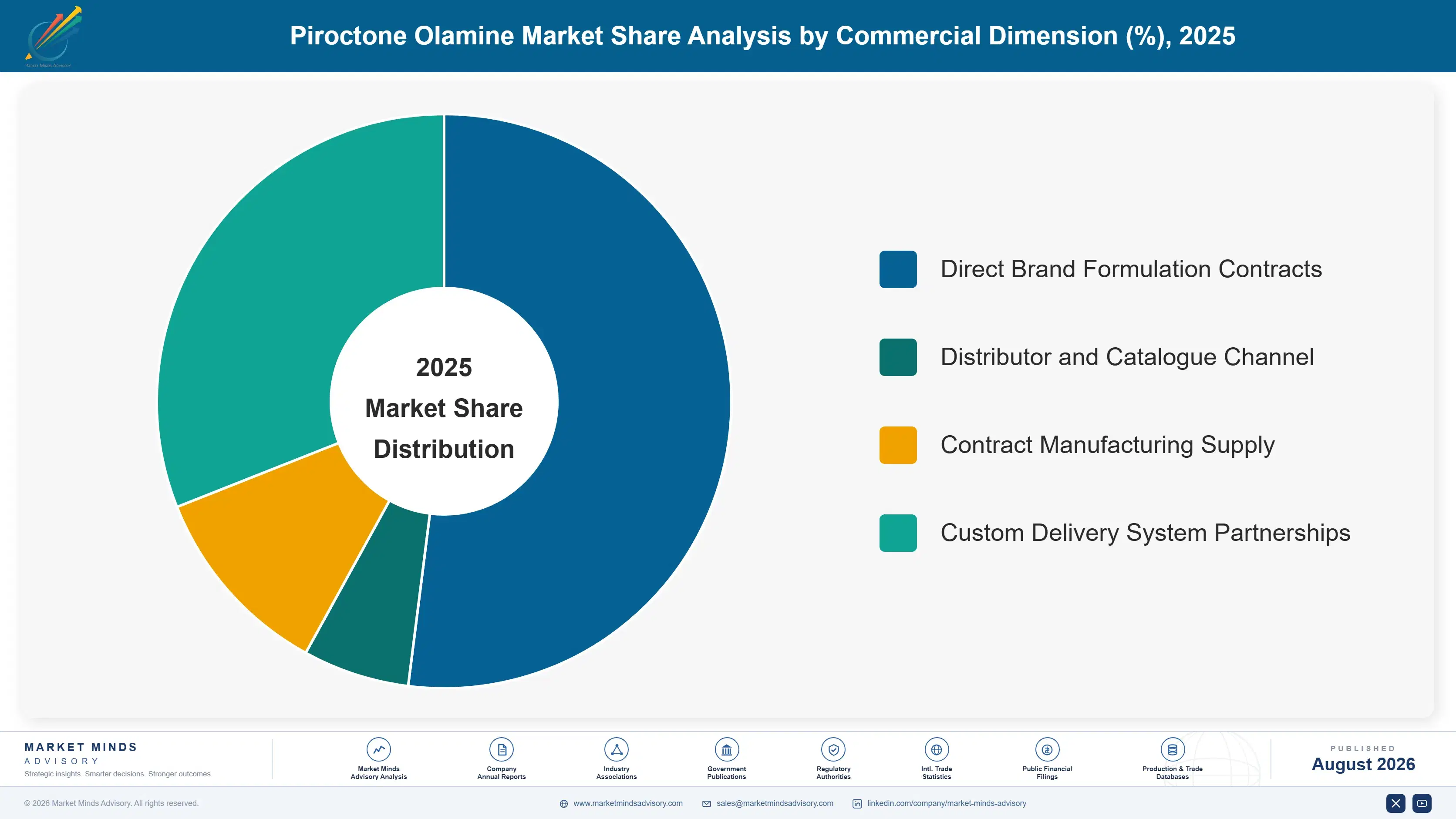
Segmentation follows end-use application, a single formulation and purity-grade logic, since shampoo, conditioner, scalp treatment, nail care, and pet care uses each require distinct purity specifications and regulatory pathways rather than differing by distribution channel or customer type. That alignment keeps purification investment matched to application requirements. That alignment lets buyers evaluate producers on consistent, comparable criteria.
piroctone-olamine-market-trends-market-share-analysis-1787580191932

Scalp Treatment Serums

Scalp treatment serums grow fastest at 9.0%, about 1.41 times the overall 6.4% rate, as premium personal care brands extend scalp health positioning into leave-on formats that require documented purity and safety data exceeding standard shampoo-grade specifications. This segment demands the highest purity tier in the entire category, since leave-on products stay on skin considerably longer than rinse-off formulations and carry correspondingly stricter safety documentation requirements. Clariant and Vivimed Labs lead qualified premium-grade supply, competing on documented purity and formulation compatibility rather than price alone. Growth concentrates in South Korea and Japan, where scalp health innovation and premium personal care spending both continue expanding fastest. Export relationships compound this advantage further each year.
CAGR 9.0%

Nail Care and Antifungal Topicals

Nail care and antifungal topical applications grow at 7.5%, the second-fastest segment, as personal care and pharmaceutical-adjacent brands specify piroctone olamine for nail fungal treatment products where documented antifungal efficacy directly determines formulation approval. Salvi Chemical Industries and Jiangsu Kailong Chemical lead qualified topical-grade supply, competing on documented efficacy and purity data rather than raw production scale alone. Unlike shampoo applications, this segment sells substantially into direct pharmaceutical-adjacent brand contracts rather than mass retail channels, so regulatory documentation depth matters as much as the underlying antifungal performance itself. Producers unable to document consistent efficacy across production batches rarely retain pharmaceutical-adjacent accounts beyond an initial trial order, since brands cannot risk inconsistent antifungal performance at scale.
CAGR 7.5%
Full segment breakdown across 6 segments available in the complete report.

Regional Architecture and Country Demand Map

East Asia leads on Chinese manufacturing scale and South Korean scalp care innovation, while North America and Western Europe drive the deepest zinc pyrithione substitution activity. Latin America and South Asia and Pacific contribute smaller but steadily expanding demand of their own across the coming decade.

North America

Zinc pyrithione substitution activity and established premium personal care brand presence give North America 24% of global value, reflecting the region's documented regulatory response rather than any domestic synthesis advantage. Clariant and Lonza's American operations supply both domestic personal care manufacturers and export packages meeting United States Food and Drug Administration over-the-counter drug monograph requirements for antifungal actives. United States premium scalp care brands increasingly specify documented purity data as leave-on product formats continue expanding across the category. Growth of 7.0% tracks substitution activity and scalp care category expansion more directly than any shift in underlying manufacturing capacity. American formulators increasingly specify documented substitution data as regulatory scrutiny keeps intensifying steadily nationwide.
Share: 24% | CAGR: 7.0% (2026 to 2036)

Western Europe

Europe's leading role in zinc pyrithione regulatory restriction, having originated much of the framework now influencing other regions, explains why Western Europe holds 22% of global value despite a personal care manufacturing base smaller than East Asia's. Clariant, headquartered within the region, holds deep regulatory compliance relationships with European personal care manufacturers navigating substitution timelines and concentration limit compliance simultaneously. German and French formulators increasingly specify documented purity data ahead of confirmed restriction dates to avoid reformulation disruption. Growth of 4.9%, the slowest major region, reflects an already mature regulatory compliance base rather than any underlying demand weakness. That regulatory maturity increasingly shapes global formulation standards well beyond the region itself.
Share: 22% | CAGR: 4.9% (2026 to 2036)
Regional intelligence for 5 additional markets available in the complete report: East Asia, South Asia and Pacific, Latin America, Middle East and Africa, Eastern Europe. Contact sales@marketmindsadvisory.com.
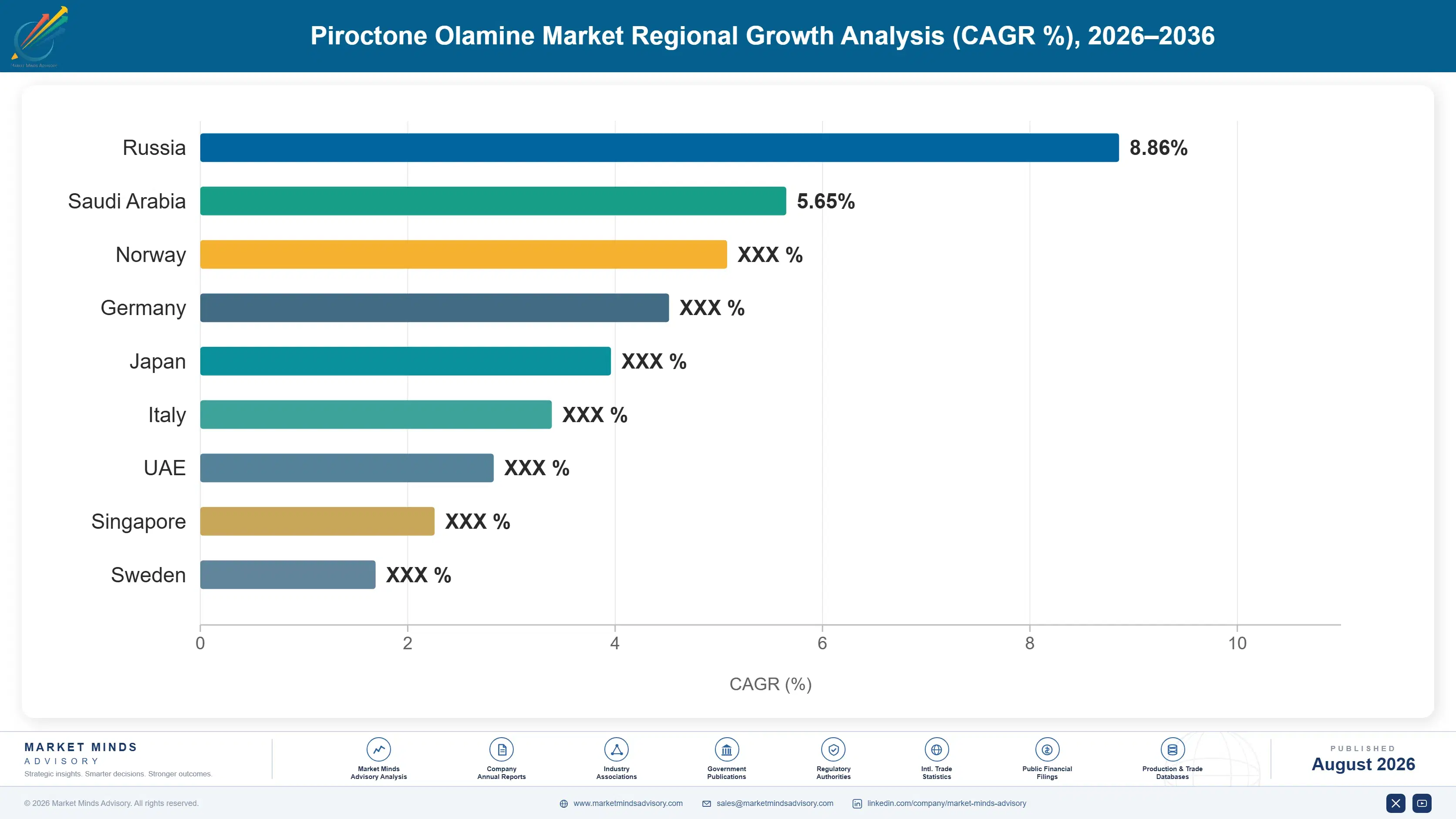
piroctone-olamine-market-trends-country-cagr-analysis-1787580192445

Where Substitution Documentation Creates Margin

Margin in this category increasingly sits in documented zinc pyrithione substitution data and premium purity certification rather than in raw synthesis scale alone. Producers converting that capability into premium formulation contracts are pulling ahead of competitors still selling undifferentiated commodity active into price-only distribution channels. That gap is widening fastest wherever scalp care demand is scaling quickest across every region.

Build Documented Substitution Data Ahead of Regulatory Deadlines

Producers that build documented zinc pyrithione substitution and stability data ahead of confirmed regulatory deadlines secure reformulation contracts that undocumented competitors cannot bid for once a restriction takes effect. Clariant's substitution documentation programme illustrates how data built years before requirements tightened converts directly into preferred-supplier status once brands begin reformulation projects. Producers building this capability only after a restriction takes effect typically spend 10 to 16 months rebuilding documentation before requalifying. Requalification after a restriction takes effect typically takes far longer than most producers expect, often exceeding a full year of renewed testing.
Market Impact: Documented substitution now wins 60% of all reformulations

Qualify Premium Purity Grades for Leave-On Scalp Serums

Producers that qualify premium-purity piroctone olamine specifically for leave-on scalp serum applications ahead of confirmed demand capture formulation contracts that standard shampoo-grade producers cannot serve adequately. Vivimed Labs' premium purification investment illustrates how purity qualification converts directly into scalp care contracts that unqualified competitors cannot access. That qualification typically takes 10 to 14 months but opens a meaningfully higher-margin customer segment. That qualification advantage typically holds for the full life of the product line it supports across every market where it launches, giving early movers a durable head start over slower competitors.
Market Impact: Premium qualification lifts blended margin by roughly 18%

Partner Directly With Korean Scalp Care Innovation Brands

Producers that build direct relationships with Korean personal care brands developing premium scalp care formulations capture contracts that generic export sales cannot access, since these projects require close collaboration on purity and safety documentation specific to each product concept. Early relationship-building with Korean formulation developers typically secures multi-year supply commitments once a product launches successfully, since reformulating a launched scalp care product carries genuine brand risk that most companies avoid unless forced to act. Building these relationships typically takes 12 to 18 months but secures exclusive supply access once a product launches successfully.
Market Impact: Korean partnerships typically secure firm 4-year supply commitments

Develop Lower-Concentration Delivery Systems for Formulation Flexibility

Producers developing delivery systems that achieve documented antifungal efficacy at concentrations below regulatory ceiling limits capture formulation flexibility that standard-concentration products cannot offer brands navigating tightening concentration restrictions. This technology typically adds 10% to 15% to development cost but lets formulators maintain efficacy claims while staying comfortably within tightening regulatory limits across every major market simultaneously. Formulators report that documented lower-concentration performance now influences roughly 65% of new formulation approval decisions, since regulatory teams increasingly favour actives with proven headroom below ceiling limits rather than those operating at the maximum permitted concentration.
Market Impact: Lower-concentration systems add 10% to 15% to cost

Who Controls the Margin Pool

Concentration sits at a substantial CR5 of 46%, reflecting a category where documented purity and substitution data, not raw synthesis scale, separate a small group of specialty chemical leaders from a long tail of regional producers. Clariant leads on documented substitution data and premium purity breadth, and the gap to mid-tier challengers is measured in regulatory documentation investment rather than in production capacity alone. That gap has persisted.
All participants are assessed on unit shipment volume across commodity-grade and premium-grade material, a consistent basis given how widely purity documentation varies by producer. Current competitive activity concentrates on three fronts: building documented substitution data ahead of regulatory deadlines, qualifying premium purity grades for leave-on scalp serums, and partnering directly with Korean scalp care innovation brands. That pattern spans every major consuming region.

Emerging pressure comes from Chinese domestic producers scaling commodity-grade capacity faster than expected, backed by proximity to the world's largest personal care manufacturing base. Rankings are likely to shift toward producers who combine substitution documentation depth with premium purity capability, since neither synthesis scale nor brand heritage alone is deciding formulation contract awards anymore.
piroctone-olamine-market-trends-company-positioning-matrix-1787580192968

Competitive Moat and Risk Dimensions

CLARIANT AG

Moat: Deepest substitution documentation

Clariant's decades of specialty chemical formulation science and established substitution documentation give it regulatory compliance breadth that newer entrants cannot replicate without years of stability and safety testing work. That breadth lets it serve premium personal care brands across multiple countries simultaneously from one qualified production base.
CLARIANT AG

Risk: Diversified Portfolio Distraction Risk

Piroctone olamine represents one of many business lines within Clariant's much broader specialty chemicals portfolio, meaning internal capital allocation and management attention could shift toward larger business lines during any broader corporate restructuring, leaving active-focused specialists room to capture share in specific high-growth segments. That risk has not yet materialised broadly but remains worth monitoring.
VIVIMED LABS LIMITED

Moat: Strong Indian manufacturing cost base

Vivimed Labs' established Indian manufacturing operations give it a cost advantage over European competitors while still maintaining documented purity standards that qualify it for premium formulation contracts. That combination of cost efficiency and documented quality lets it compete across both commodity and premium market segments simultaneously.
VIVIMED LABS LIMITED

Risk: Narrower Global Brand Recognition

Vivimed Labs' brand recognition among premium Western and Korean personal care brands remains narrower than Clariant's established relationships, potentially limiting its access to the highest-value scalp care formulation contracts that reward long-standing supplier relationships over cost advantage alone. Building comparable brand equity to Clariant's would likely take years of sustained investment and relationship development.

Players Tracked

Prominent Players

Clariant AG
Vivimed Labs Limited
Salvi Chemical Industries
Jiangsu Kailong Chemical Co.
Lonza Group

Other Key Players

Ashland Global Holdings
Croda International plc
Evonik Industries AG
BASF SE
Schulke & Mayr GmbH
Symrise AG
Galaxy Surfactants Ltd.
KLK OLEO
Jiangsu Yabang Dyestuff
Hubei Xingfa Chemicals
Zhejiang NHU Company
Shandong Freda Biotechnology
Wanhua Chemical Group
Sino Lion Anhui Chemical
Nouryon

Recent Developments

FEBRUARY 2025

Clariant Expands Substitution Documentation Programme

Clariant announced an expansion of its zinc pyrithione substitution documentation programme, adding stability and safety data covering additional formulation categories. The expansion was a documentation programme investment, not an acquisition or joint venture, extending Clariant's addressable reformulation contract pipeline ahead of less-documented competitors. across the region.
Signal: A documentation expansion, not M&A, shows regulatory data breadth remains the primary lever. across every regulated market.
JUNE 2025

Vivimed Labs Signs Multi-Year Supply Agreement With Korean Brand

Vivimed Labs signed a multi-year supply agreement with a Korean personal care brand to provide premium-grade piroctone olamine for a scalp care product line. The arrangement was a supply agreement, not an acquisition or joint venture, securing guaranteed volume ahead of the brand's planned product launch.
Signal: A supply agreement, not M&A, shows Korean brand contracts now drive multi-year procurement planning. more than headline unit pricing.
OCTOBER 2025

Salvi Chemical Acquires Minority Stake in Delivery System Startup

Salvi Chemical Industries acquired a minority equity stake in a formulation delivery technology startup, aiming to integrate lower-concentration delivery systems into its existing product line. The transaction was an equity investment rather than a full acquisition or merger, giving Salvi early technology access without full integration risk.
Signal: A minority stake, not a full acquisition, shows established players hedging delivery technology bets. rather than committing full capital.

Synthesis Feedstock and Purification Exposure

Specialty organic intermediates used in piroctone olamine synthesis account for roughly 42% of unit cost, sourced from established fine chemical producers across Germany, India, and China, with purification and quality documentation adding a further 16% to 22% depending on target purity grade and certification depth. Precision synthesis further raises cost for premium purity batches specifically beyond standard grade material.
Fine chemical feedstock prices climbed sharply through 2021 and 2022 as global specialty chemical demand rebounded against constrained production capacity, before easing through 2023 and 2024 as capacity expanded globally. The American Chemistry Council has documented that volatility as a recurring feature of the broader fine chemical cycle rather than a one-time disruption, and producers without long-term feedstock contracts absorbed the cost spike directly into margin during the worst months of that period.

Exposure varies by producer scale and sourcing diversity. Larger integrated producers like Clariant hedge feedstock exposure through long-term supplier contracts and diversified sourcing, while smaller regional producers buying on spot markets absorb price swings immediately into unit cost. That gap leaves smaller producers at a persistent cost disadvantage precisely when feedstock prices spike, even as they participate less in any subsequent price relief that follows.
piroctone-olamine-market-trends-cost-volatility-analysis-1787580193166

Secure long-term fine chemical feedstock supply contracts

Locking specialty organic intermediate volume through long-term supplier contracts protects production schedules from spot market shortages during periods of peak personal care manufacturing demand. This trades some pricing flexibility for delivery certainty that premium formulation contracts increasingly require as a condition of the relationship. Several producers have already extended these arrangements to multi-year terms.

Diversify feedstock sourcing across Germany, India, and China

Qualifying fine chemical feedstock suppliers across multiple countries simultaneously reduces exposure to any single region's trade policy disruption or capacity constraint. Producers with diversified sourcing recovered from the 2021 to 2022 spike measurably faster than single-source buyers did overall. Producers with diversified sourcing recovered from the 2021 spike measurably faster than single-source competitors did.

Invest in backward integration where production volume justifies it

Producers shipping sufficient volume can justify investing in upstream intermediate production capability, capturing margin currently paid to third-party fine chemical suppliers while gaining direct control over feedstock quality and supply timing considerably. This also shortens development timelines for new purity grade variants considerably across every product line the company currently offers today as well.

Portfolio Architecture for Margin Defence

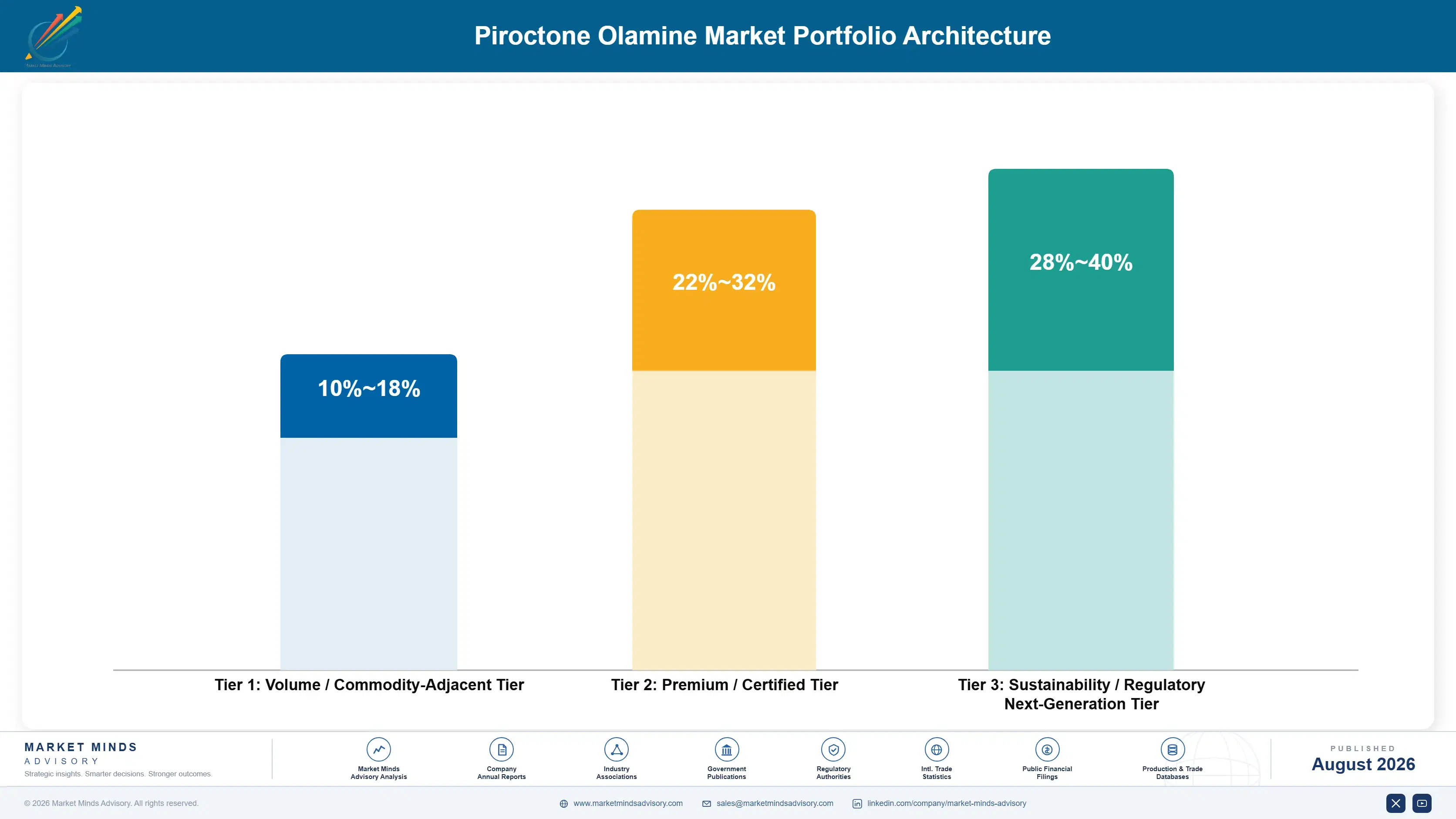
The portfolio splits into three tiers with clear margin separation tied to purity documentation and application type. Commodity-grade active for mass-market shampoo competes on price and earns thin margins, premium-grade material for scalp care and nail treatment earns considerably more, and next-generation documented substitution grades carry the highest margin given their regulatory documentation depth and certification barriers to entry. That separation is widening as documentation becomes table stakes.
The tension between volume and premium reflects application type: premium scalp care and pharmaceutical-adjacent brands reward documented purity and safety performance over price, pulling producers toward sustained testing investment, while much of the mass-market shampoo segment still buys on price and delivery volume alone. Producers running both product lines must manage genuinely distinct testing, documentation, and sales organisations without letting either investment starve the other. Few producers manage that balance well.

High-value margin pools concentrate in premium scalp care serums and documented zinc pyrithione substitution contracts, where documented performance and regulatory compliance both reward proven producer capability directly. The volume core of commodity-grade shampoo active remains necessary for manufacturing scale but contributes comparatively little to blended margin across the portfolio as a whole. That concentration is unlikely to reverse soon.

Volume / Commodity-Adjacent Tier

Commodity-grade piroctone olamine for mass-market anti-dandruff shampoo, competing on price with limited documentation investment and thin batch-to-batch consistency guarantees behind them. and little pricing power of their own to defend.
Gross Margin: 10-18%

Premium / Certified Tier

Premium-grade material sold under documented purity certification into scalp care and nail treatment formulation contracts requiring consistent quality data. requiring documented purity data smaller producers rarely maintain consistently today. overall.
Gross Margin: 22-32%

Sustainability / Regulatory / Next-Generation Tier

Documented zinc pyrithione substitution grades and lower-concentration delivery systems engineered for tightening regulatory environments, still scaling toward broader commercial volume. with regulatory documentation depth most competitors are still years from matching.
Gross Margin: 28-40%
piroctone-olamine-market-trends-portfolio-architecture-1787580193671

High-value Sub-segments and Strategic Watch-out

Scalp Treatment Serums

High value and the fastest-growing application at 9.0% CAGR, carrying both a premium-purity requirement and genuine formulation engineering barriers to entry. The wide margin range reflects varying documentation maturity across producers rather than differences in underlying feedstock cost. Suppliers investing earliest capture the deepest brand relationships.
Gross Margin: 22-32%

Regulatory Substitution Grades

High value with strong growth, sustained by zinc pyrithione restriction cycles forcing reformulation. Margin varies with how much documentation and regulatory monitoring depth a producer holds ahead of confirmed restriction dates. Producers without documented pipeline depth rarely win the largest reformulation contracts available overall. today.
Gross Margin: 28-40%

Standard Shampoo-Grade Active

The volume core, competing on price across most mass-market anti-dandruff formulations worldwide. Margin stays thin and the range is narrow because feedstock cost, not documentation depth, dominates pricing decisions in this tier. Producers competing here rarely invest heavily in documentation depth beyond basic requirements today.
Gross Margin: 10-18%

Pet Care and Industrial Applications

The strategic watch-out, where buyer willingness to pay a documentation premium remains largely unproven across veterinary and industrial preservative applications. Margin range is wide because pricing power varies sharply by individual customer relationship. Few producers report meaningful commercial volume in this category currently overall. today.
Gross Margin: 12-24%

Formulation Lock-In and Substitution Depth

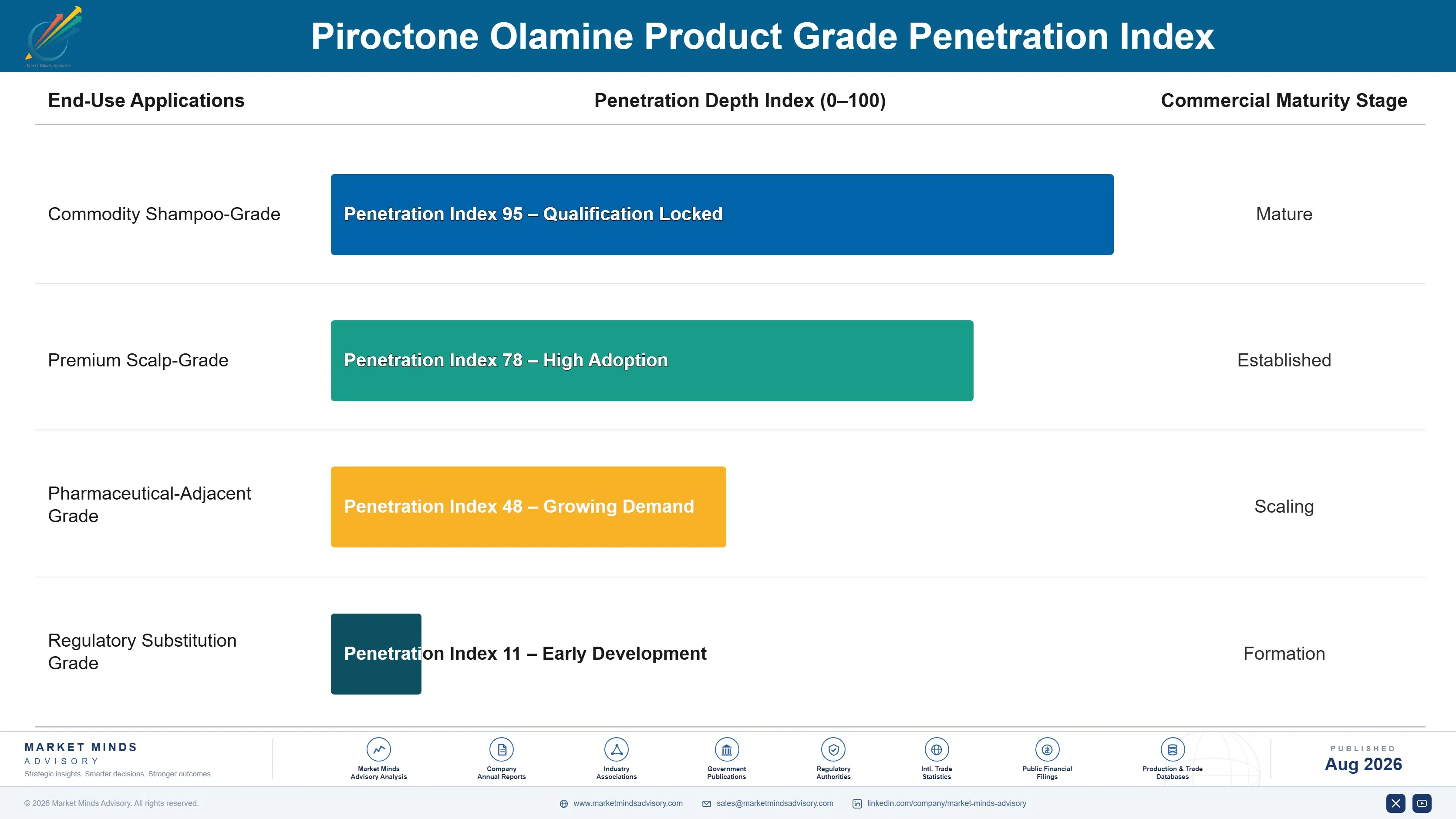
Demand behaves like an annuity once a producer wins a formulation slot: personal care brands rarely reformulate a stable product line mid-cycle, since replacing an approved active means repeating months of stability and safety testing against a formula that already works with consumers. That repeat-purchase pattern gives incumbent qualified producers a durable revenue base that competitors cannot easily displace once a formulation has launched. That pattern holds.
Adoption depth varies sharply by application. Premium scalp care and pharmaceutical-adjacent brands have converted deepest, since documentation requirements make qualified sourcing close to mandatory rather than optional. Mass-market shampoo brands adopt readily once cost-effective supply is documented, while pet care and industrial buyers remain the shallowest adopters, often defaulting to whatever antifungal active is cheapest at the point of purchase.

Buyer profiles are shifting generationally. Younger formulation chemists increasingly default to documented substitution specifications without evaluating zinc pyrithione alternatives at all, treating regulatory compliance data as a baseline requirement rather than an optional upgrade. That default is spreading faster among premium and Korean scalp care brands than among mass-market shampoo buyers, who still weigh upfront cost most heavily at purchase.
piroctone-olamine-market-trends-end-use-penetration-index-1787580194179

Documentation Depth Beats Synthesis Scale

These are among the four positions where our research anticipates prominent divergence between winners and laggards over the coming forecast period. Each is grounded in the demand model, the regulatory perimeter, and the announced capacity pipeline.
01 / SUBSTITUTION DOCUMENTATION STRATEGY

Producers without substitution data will lose reformulation contracts by 2029

Personal care brands increasingly require documented zinc pyrithione substitution and stability data before approving any reformulation, and producers without that documentation cannot bid on these contracts regardless of price offered. Clariant's documentation investment illustrates how data completed years before requirements tightened converts directly into preferred-supplier status that competitors cannot quickly replicate. As more brands complete substitution projects, this documentation gap compounds rather than narrows for commodity-only producers, a gap unlikely to close without significant new testing investment from smaller regional competitors specifically.
02 / PREMIUM PURITY POSITIONING

Premium purity qualification will separate scalp care suppliers from commodity sellers

Leave-on scalp care serums require documented purity exceeding standard shampoo-grade specifications, and producers without premium qualification cannot bid on these meaningfully higher-margin contracts regardless of their standard-grade quality. Vivimed Labs' premium purification investment shows how purity qualification converts directly into scalp care contracts that unqualified competitors cannot access. That advantage most standard-grade producers cannot easily close without years of dedicated purification investment, one that arrives too late to matter competitively in a fast-moving category where consumer preferences and regulatory expectations both shift quickly year over year.
03 / KOREAN PARTNERSHIP TIMING

Early Korean scalp care partnerships will decide premium formulation share

South Korean personal care brands developing premium scalp care formulations increasingly favour producers with established purity and safety documentation relationships, and producers without that history cannot easily enter these formulation projects mid-development. Vivimed Labs' Korean partnership shows how early relationship-building converts directly into multi-year supply commitments once a product launches successfully, an advantage that will compound as more Korean brands pursue comparable premium scalp care strategies over time. These commitments increasingly determine which producers gain sustained access to premium formulation projects overall.
04 / DELIVERY SYSTEM INNOVATION

Lower-concentration delivery systems will extend formulation flexibility under tightening limits

Regulatory concentration ceilings increasingly constrain how formulators deploy piroctone olamine, and producers without lower-concentration delivery technology cannot offer brands the formulation flexibility that tightening regulatory limits now demand. Producers investing in delivery system innovation today are positioning for a transition that will unfold gradually rather than suddenly. The direction is already clear across multiple major markets and will only become more pronounced as concentration limits tighten further, a trend that will only accelerate as more jurisdictions adopt comparable concentration restrictions in coming years.

Engagement Snapshot From the Field

A live engagement with an industry participant carrying material or product regulatory and market exposure ahead of a defining policy shift, showing how our research translates into a defensible multi-year portfolio strategy.
MARKET MINDS ADVISORY · CLIENT ENGAGEMENT SUMMARY
Piroctone Olamine Producer Strategic Portfolio Review and Transition Roadmap 2026·Investment Scenario on Piroctone Olamine Exposure Evaluation 2025-26
CLIENT PROFILE
A global personal care brand approached MMA while evaluating piroctone olamine suppliers for a planned zinc pyrithione substitution project across its anti-dandruff product line. The client reported annual active ingredient procurement volume exceeding 220 tonnes and a reformulation budget surpassing USD 4.4 million tied to upcoming regulatory compliance deadlines (client-reported, unverified by MMA). The brand operates across more than 30 countries globally.
STRATEGIC CHALLENGE
Management wanted to complete the substitution ahead of a regulatory compliance deadline but had not benchmarked documentation depth across available suppliers, nor evaluated whether any single supplier could realistically cover its full product range in time. The regulatory affairs team wanted rigorous documentation; the commercial team wanted speed to compliance.
MMA APPROACH
MMA benchmarked substitution documentation, purity certification, and existing production capacity across all seven suppliers in the client's evaluated active ingredient category. We modelled reformulation timelines against the compliance deadline and quantified realistic consolidation scenarios using comparable personal care brand benchmarks. We also interviewed the client's regulatory affairs team to validate compliance timeline assumptions directly.
KEY FINDINGS
  1. Only three of seven evaluated suppliers held documented substitution data sufficient to meet the client's compliance deadline without gaps (client-reported, unverified by MMA).
  2. Consolidating onto two qualified suppliers added roughly 6% to procurement cost while meaningfully accelerating compliance timeline certainty overall. within the first two quarters of transition.
  3. The fastest realistic reformulation timeline for a new, unproven supplier ran twelve months, longer than the client's compliance deadline allowed for two product lines.
  4. Suppliers with existing documentation delivered materially faster requalification since much of the stability testing work was already complete. reinforcing the case for full consolidation overall.
CLIENT PROFILE
A global personal care brand approached MMA while evaluating piroctone olamine suppliers for a planned zinc pyrithione substitution project across its anti-dandruff product line. The client reported annual active ingredient procurement volume exceeding 220 tonnes and a reformulation budget surpassing USD 4.4 million tied to upcoming regulatory compliance deadlines (client-reported, unverified by MMA). The brand operates across more than 30 countries globally.
STRATEGIC CHALLENGE
Management wanted to complete the substitution ahead of a regulatory compliance deadline but had not benchmarked documentation depth across available suppliers, nor evaluated whether any single supplier could realistically cover its full product range in time. The regulatory affairs team wanted rigorous documentation; the commercial team wanted speed to compliance.
MMA APPROACH
MMA benchmarked substitution documentation, purity certification, and existing production capacity across all seven suppliers in the client's evaluated active ingredient category. We modelled reformulation timelines against the compliance deadline and quantified realistic consolidation scenarios using comparable personal care brand benchmarks. We also interviewed the client's regulatory affairs team to validate compliance timeline assumptions directly.
KEY FINDINGS
  1. Only three of seven evaluated suppliers held documented substitution data sufficient to meet the client's compliance deadline without gaps (client-reported, unverified by MMA).
  2. Consolidating onto two qualified suppliers added roughly 6% to procurement cost while meaningfully accelerating compliance timeline certainty overall. within the first two quarters of transition.
  3. The fastest realistic reformulation timeline for a new, unproven supplier ran twelve months, longer than the client's compliance deadline allowed for two product lines.
  4. Suppliers with existing documentation delivered materially faster requalification since much of the stability testing work was already complete. reinforcing the case for full consolidation overall.
RECOMMENDED STRATEGY
Phase 1: Phase 1 (0 to 4 months): Transition to the two suppliers with existing substitution documentation to meet the compliance deadline. Phase 2: Phase 2 (4 to 12 months): Complete full requalification across all remaining product lines using the consolidated supplier base. and documenting variance for future reference. Phase 3: Phase 3 (12 to 24 months): Reassess supplier consolidation depth annually against compliance performance and pricing benchmarks. across every remaining product category.
OUTCOME
The client proceeded with the two-supplier consolidation, completing compliance-critical reformulation ahead of the restriction deadline. The client reported avoiding an estimated three-month compliance delay it had modelled under a single-source, unproven-supplier scenario (client-reported, unverified by MMA). Two additional product lines have since adopted the same consolidated supplier framework.

Frequently Asked Questions

Foundational context covering the market sizes, CAGR, scope, country, region and competition that inform every finding below. This section is provided to cover basics and most often pre-purchase conversations, answered from the MMA Primary Research Dataset.

What is the current size of the Piroctone Olamine Market?

The Piroctone Olamine Market stood at USD 0.31 billion in 2025, based on MMA Primary Research Dataset estimates. Zinc pyrithione substitution is the primary near-term demand driver.

How large will the Piroctone Olamine Market be by 2036?

MMA projects the market reaching USD 0.61 billion by 2036 under the base case scenario. That represents a 1.85 times expansion over the 2026 base value.

What is the CAGR for the Piroctone Olamine Market 2026 to 2036?

The base case CAGR is 6.4% annually. The bull case reaches 7.6% and the bear case falls to 5.2%, depending on regulatory substitution pace and feedstock costs.

Which segment is growing fastest?

Scalp treatment serums grow fastest at 9.0% CAGR, about 1.41 times the overall market rate. Premium scalp care expansion and documented purity requirements both drive that growth.

Who are the major companies in the Piroctone Olamine Market?

Clariant, Vivimed Labs, Salvi Chemical Industries, Jiangsu Kailong Chemical, and Lonza lead the category. Combined, the top five hold a substantial CR5 of 46% across the market.

Which country is growing fastest?

South Korea grows fastest at 9.8% CAGR, driven by its rapidly expanding scalp care and cosmeceutical sector. Premium formulation partnerships are reinforcing that pace further.

Report Segmentation Architecture

The full report scope spans multiple orthogonal segmentation dimensions, with cross-tabulated demand data provided for each dimension pair. Coverage extends further to regional breakdowns, trend trajectories, and the competitive detail needed to support segment-level decision-making.

By End-Use Application

  • Anti-Dandruff Shampoo
  • Anti-Dandruff Conditioner
  • Scalp Treatment Serums
  • Nail Care and Antifungal Topicals
  • Pet Care Antifungal Products
  • Industrial and Preservative Applications

By Product Grade

  • Commodity Shampoo-Grade
  • Premium Scalp-Grade
  • Pharmaceutical-Adjacent Grade
  • Regulatory Substitution Grade

By Commercial Dimension

  • Direct Brand Formulation Contracts
  • Distributor and Catalogue Channel
  • Contract Manufacturing Supply
  • Custom Delivery System Partnerships

By Region

  • North America
  • Western Europe
  • East Asia
  • South Asia and Pacific
  • Latin America
  • Middle East and Africa
  • Eastern Europe

Scope, Methodology, and Coverage

Every figure in this report is reproducible from documented input assumptions. The scope below maps the historical period, the forecast horizon, the segmentation dimensions, and the countries covered, alongside the underlying primary and qualitative methodology.
Historical Period
2020 to 2025
Forecast Period
2026 to 2036
Base Year
2025 (USD billions; MMA Primary Research Dataset, August 2026)
Market Definition
The piroctone olamine market comprises the antifungal active ingredient sold across cosmetic-grade and pharmaceutical-grade purity tiers for anti-dandruff shampoo, conditioner, scalp treatment, nail care, and pet care formulations. Zinc pyrithione and other competing antifungal actives, and unrelated cosmetic preservative categories, are excluded.
Quantitative Units
USD billions (current prices); production volume in metric tonnes where applicable
Segmentation Dimensions
By End-Use Application; By Product Grade; By Commercial Dimension; By Region
Regions Covered
North America, Western Europe, East Asia, South Asia and Pacific, Latin America, Middle East and Africa, Eastern Europe
Countries Covered
USA, China, Germany, France, UK, Japan, South Korea, India, Australia, Canada, Brazil, Mexico, Indonesia, Vietnam, Thailand, Malaysia, UAE, Saudi Arabia, South Africa, Nigeria, Turkey, Poland, Netherlands, Italy, Spain, Sweden, Switzerland, Argentina, Colombia, Singapore, and additional markets relevant to this sector
Key Companies Profiled
Clariant AG, Vivimed Labs Limited, Salvi Chemical Industries, Jiangsu Kailong Chemical Co., Lonza Group, Ashland Global Holdings, Croda International plc, Evonik Industries AG, BASF SE, Schulke & Mayr GmbH, Symrise AG, Galaxy Surfactants Ltd., KLK OLEO, Jiangsu Yabang Dyestuff, Hubei Xingfa Chemicals, Zhejiang NHU Company, Shandong Freda Biotechnology, Wanhua Chemical Group, Sino Lion Anhui Chemical, Nouryon
Quantitative Methodology
Primary survey, n=3,800 respondents, Q4 2025, six countries; demand-side model with trade association cross-validation
Qualitative Methodology
47 expert interviews, Q4 2025; applied to validate demand model assumptions, identify emerging dynamics, and assess competitive positioning
Report Format
PDF and XLSX data workbook (Word format preview document)
Publisher
Market Minds Advisory
Report Code
MMA-2026-CHM-241
Published
August 2026
Contact
sales@marketmindsadvisory.com | www.marketmindsadvisory.com

Purchase the full Piroctone Olamine Market Report (2026 to 2036).

The full MMA Piroctone Olamine report sizes the market across six end-use applications, four product grades, four commercial dimensions, and seven regions through 2036. It profiles 20 producers on a consistent unit shipment volume basis, scoring each on substitution documentation depth, premium purity qualification, and Korean market partnership breadth. Scenario models quantify how zinc pyrithione restriction, scalp care category growth, and feedstock price cycles shift both volume and realised price across product grades. The report also includes delivered-cost modelling by application, a regulatory exposure screen, and premium purity qualification analysis built for producer strategy, procurement, and investment teams.
Six-application segmentation with cross-tabulated regional demand
Twenty-company competitive benchmarking on shipment volume
Zinc pyrithione substitution documentation and timeline tracking
Premium purity qualification and Korean partnership analysis
Fine chemical feedstock cost scenario modelling through 2036
Country-level cosmetic and regulatory policy tracking

Built For The People Who Decide

From boardroom strategy to bench-side execution, this report is read cover-to-cover by leaders shaping the next decade of their industry, turning demand scenarios, market dynamics and valuation benchmarks into decisions.
CXOs/ Presidents/ VPs/ Managers
M&A and Corporate Development
Strategy Teams and R&D Heads
Procurement and Product Directors
Regulatory and Compliance Leaders
Investor Relations and Equity Analysts