Market Minds Advisory
Pipette Tips Market

Pipette Tips Market: A Cent of Plastic That Decides Whether an Instrument Works

Automation vendors discovered that a tip moulded a few microns out of specification jams a liquid handler worth half a million dollars, which is how a disposable became a locked consumable.

Lead Analyst

Alice Ballenger

Published

September 2026

Make Smarter Decisions with Customized Research Insights

Request a free sample report and evaluate market opportunities, growth trends, and competitive dynamics relevant to your business needs.

2025 MARKET VALUE$2.1BMarket Size 2025
2036 FORECAST VALUE$4.7BBase Case , 2026 to 2036
CAGR 2026 TO 20367.4 %Bull 8.6% / Bear 6.2%
INCREMENTAL OPPORTUNITY$2.4BNet 10- year value creation
EXPANSION MULTIPLE2.04x2036 value over 2026 base
Strategic Levers
M&A Pipeline
Regional Outlook
Country Rankings
Competitive Intelligence
Segmental Deep-dive
Call-Us : 91 93563 13602

Executive Snapshot and Market Trajectory

Nothing about a pipette tip suggests strategic importance. It is roughly two cents of polypropylene, thrown away seconds after use, and yet the instrument vendors have built consumable lock-in around it that resembles the printer cartridge model rather more closely than anybody says aloud.
Automation platform tips compound at 11.1%, a full 1.50x the market rate, because a liquid handler will not tolerate dimensional variation that a human hand corrects without noticing. East Asia holds the largest share at 34%, on injection moulding capacity and medical polymer conversion that supplies most of the world regardless of where the tips are eventually branded. Roughly 48 billion tips are consumed worldwide each year, and most arrive through standing arrangements.
Concentration is high at 63% and rests on qualification rather than manufacturing. A laboratory running a validated assay cannot change tip supplier without revalidation, so incumbency persists through price increases that would be unthinkable in any other commodity plastic. Contamination control specification separates the premium tier from everything else. Procurement has learned to negotiate consumable pricing alongside the instrument purchase rather than afterward, which caps what incumbency can extract.
Market Definition
This market covers disposable pipette tips used in laboratory liquid handling, spanning standard manual pipette tips, filtered and barrier tips, low-retention and surface-treated tips, automation platform tips, and specialty tips for extended-length, wide-bore and gel-loading applications. Pipettes and liquid handling instruments themselves, reagent reservoirs and microplates, syringes and needles, sample collection tubes, and reusable glass pipettes are excluded.
Base Year Value
$2.1B in 2025 (MMA Primary Research Dataset, August 2026)
Forecast Period
2026 to 2036, eleven discrete annual values
CAGR
7.4% base case. Bull 8.6%. Bear 6.2%.
Fastest Growth Segment
Automation Platform Tips: 11.1% CAGR
Fastest Growth Country
India: 11.8% CAGR
Fastest Growth Region
South Asia and Pacific: 9.6% CAGR
Largest Region
East Asia: 34% of 2025 global value
Market Leaders
Thermo Fisher Scientific, Eppendorf, Sartorius, Corning, and Tecan. Source: MMA Primary Research Dataset, July 2026.
Primary Survey
n=3,800 procurement and R&D decision-makers, Q4 2025, six countries
Methodology
Demand-side build-up, cross-validated against public data, 47 expert interviews

Pipette Tips Market Forecast Scenarios

pipette-tips-market-size-forecast-scenario-1787306519441
Growth ran near 6.2% from 2020 to 2025 through the most disrupted period this category has ever seen. Diagnostic testing demand in 2020 and 2021 consumed filtered tips faster than moulding capacity could supply them, and laboratories that had never thought about tip sourcing suddenly could not obtain any. Demand normalised afterward, leaving expanded capacity and considerably more attention on supply security than before.
Base case growth of 7.4% rests on three mechanisms. Laboratory automation installation continues rising and each platform consumes only tips qualified for it, which locks demand to instrument base rather than to competitive selling. Molecular workflows requiring barrier tips keep expanding as sequencing and amplification move into routine use. And low-retention surface treatment keeps taking share as assay volumes shrink and every microlitre matters more. None of the three requires a technology change that has not already happened.
The bull case at 8.6% assumes automation penetration into mid-sized clinical and industrial laboratories accelerates, which would convert manual tip demand into platform-locked demand at higher prices. The bear case at 6.2% reflects sustained price competition from Asian moulders in the standard tip segment, where qualification barriers are lowest and the product is genuinely close to interchangeable.

Tips: Tolerances, Qualification and Lock-In

Roughly 48 billion pipette tips are consumed worldwide each year, each one costing a couple of cents and discarded within seconds. On any reasonable analysis this should be a commodity plastic market, and for much of the volume it is. What complicates it is that a tip has to fit a specific instrument precisely enough that the seal holds and the volume delivered is the volume intended.
TOP FIVE CONCENTRATION63%Concentrated among instrument vendors selling qualified matched consumables
DIMENSIONAL TOLERANCE18 micronsTolerance an automation platform demands from every single tip
PLATFORM TIP PREMIUM3.4xPrice of platform-qualified tips against comparable standard alternatives
REVALIDATION COST$34,000Cost of qualifying an alternative tip into a validated assay
ANNUAL CONSUMPTION48 billion unitsTips consumed worldwide across research, clinical and industrial laboratories
FILTERED TIP SHARE44%Consumption using barrier tips rather than unfiltered standard alternatives
Automation made that tolerance a commercial weapon. A human pipetting by hand feels a poor seal and reseats the tip without conscious thought. A liquid handler does not: a tip moulded outside roughly 18 microns of specification jams the head, aborts the run and wastes reagents worth far more than the entire box. Instrument vendors qualify their own tips against that tolerance and price them at around 3.4 times standard equivalents.
Qualification does the rest. A clinical or industrial laboratory running a validated assay cannot simply change tip supplier, because doing so requires revalidation costing roughly $34,000 and taking months. That converts a disposable plastic item into a locked consumable, and it explains why concentration in this market sits at 63% rather than at the level moulding economics alone would predict.
"The tip business is not a plastics business, it is a qualification business. Anyone can mould polypropylene. Very few people can persuade a laboratory to spend thirty-four thousand dollars revalidating an assay in order to save two cents a tip, and the ones who understand that have built extremely durable positions."
Principal Analyst, Life Science Tools and Laboratory Consumables Practice · MMA

Market Trends

Automation converts a commodity into a locked consumable

A liquid handling platform demands dimensional consistency within roughly 18 microns because it cannot feel a poor seal and correct for it the way a human hand does. A tip outside specification jams the head, aborts the run and wastes reagents worth far more than the box it came from. Instrument vendors qualify matched tips against that tolerance and price them near 3.4 times standard equivalents, and laboratories pay because a failed overnight run costs vastly more than the difference. Demand consequently follows installed instrument base rather than any consumable selling effort, which changes where commercial resource should sit entirely.
Market Impact: Filtered tips reaching 44% of consu
Revalidation cost sustains incumbency through price increases

Changing tip supplier inside a validated clinical or industrial assay requires revalidation running around $34,000 and several months of laboratory time, which no quality manager undertakes to save a fraction of a cent per tip. That converts what should be an annually competed commodity into a position that persists for years. Suppliers have raised prices through periods when polypropylene costs fell and lost almost no accounts, which is not behaviour any commodity plastic market would tolerate. Quality managers know that figure precisely while procurement frequently does not. Stating the figure explicitly turns a price negotiation into a risk conversation.
Market Impact: Retention losses above 3% recovered

Market Opportunities and Growth Drivers

Molecular workflows require barrier tips as standard practice

Amplification-based methods are ruinously sensitive to carryover contamination, and a single aerosol transfer between samples produces a result that looks real and is not. Barrier and filtered tips now account for around 44% of consumption and rise wherever molecular methods move from specialist to routine use. The purchase argument is not efficiency but the cost of a contaminated run, which in clinical settings includes repeat testing and in some cases a patient decision made on a false result. Laboratories that have suffered a contamination event become permanently price-insensitive here. That position is rare and genuinely durable.
Market Impact: Standard tips growing under 4.2%

Shrinking assay volumes make retention economically material

As assay volumes fall toward single microlitres, the liquid retained on the inner wall of a standard tip stops being negligible and becomes a measurable share of what was meant to be delivered. Low-retention surface treatment recovers that volume, which matters most where the reagent is expensive and the sample irreplaceable. Sequencing library preparation and single-cell workflows both fall into that category, and both continue expanding. The treatment adds cost that the recovered reagent value comfortably exceeds. Sequencing library preparation and single-cell workflows both consume these grades heavily, and both continue expanding at rates well above the wider market.
Market Impact: Agreements now covering 5 years

Market Restraints and Challenges

Standard tips remain genuinely close to interchangeable

Outside automation platforms and validated assays, a manual pipette tip from an Asian moulder performs adequately and costs considerably less. The root cause is that manual pipetting tolerates variation because the operator compensates for it unconsciously, so the precision that justifies premium pricing delivers no benefit anyone can measure. Commercial impact is sustained price erosion across the largest volume segment. Participants respond by moving accounts toward filtered and low-retention grades where a performance argument genuinely exists. Defending that volume consumes effort that would earn considerably more elsewhere in the portfolio.
Market Impact: Platform tips priced 3.4x standard

Laboratories increasingly resist single-vendor consumable pricing

Procurement functions have recognised the qualification lock and now negotiate consumables alongside the instrument purchase rather than afterward, when leverage has already gone. The root cause is simply that the model became visible enough to be anticipated. Commercial impact is multi-year consumable pricing agreed at instrument sale, which caps the increases that previously went unchallenged. Participants respond by bundling service, offering volume commitments and competing on validated performance rather than relying on the switching barrier alone. The model became visible enough to be anticipated, and buyers now price it before accepting it.
Market Impact: Revalidation costing roughly $34,00
4 additional market trends, 2 additional growth drivers, and 3 additional restraints and challenges are covered in the full report. Contact sales@marketmindsadvisory.com to access the complete intelligence.

Segment CAGR and Growth Architecture

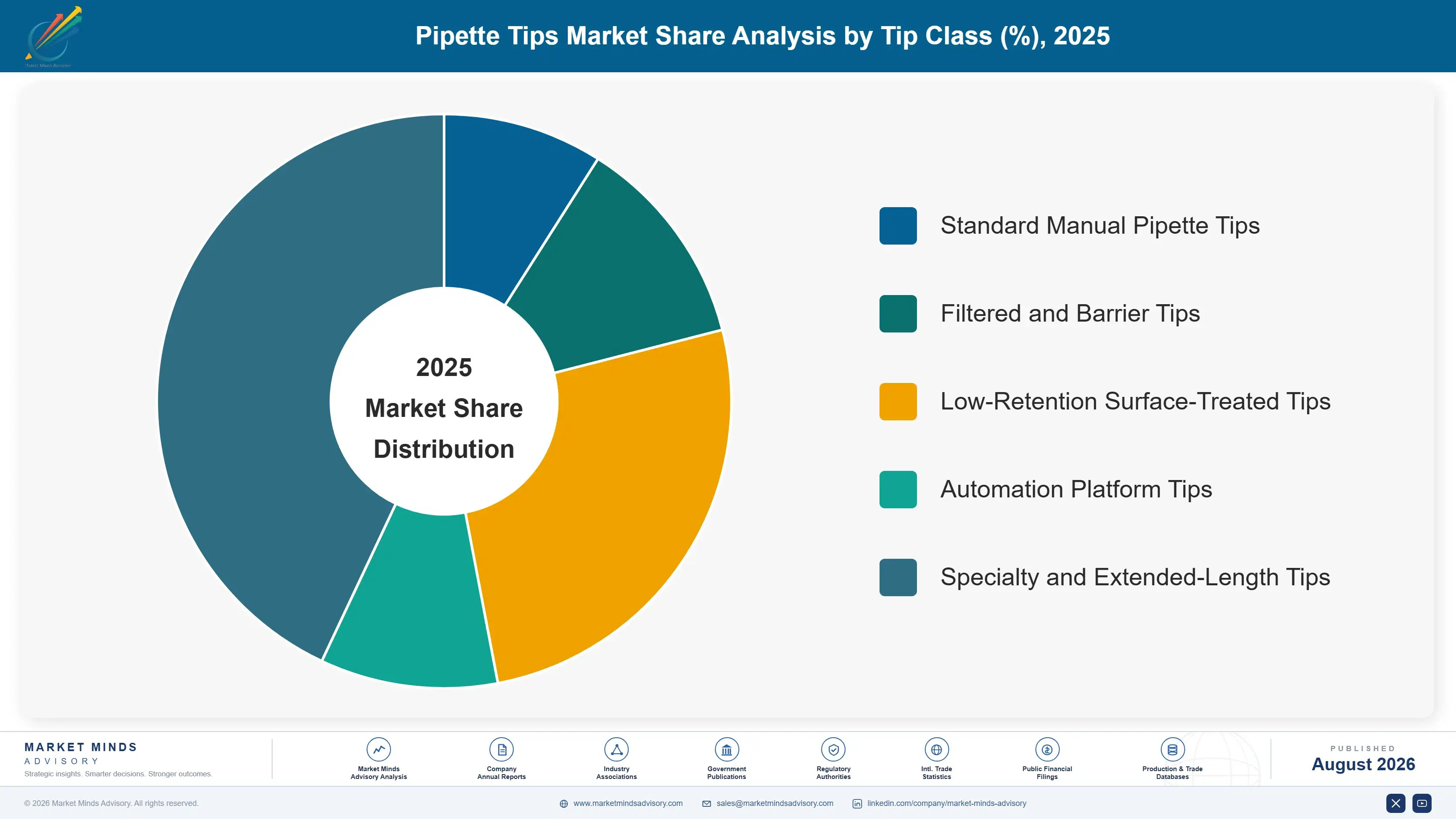
Five tip classes divide this market by contamination control and instrument compatibility, which together determine both price and how easily a laboratory can switch supplier. The division separates genuine performance requirements from the segment where polypropylene moulding cost is honestly the only thing being purchased. Substitution cost rather than product quality is what actually separates these five classes commercially.
pipette-tips-market-market-share-analysis-1787306520012

Automation Platform Tips

Compounding at 11.1%, a full 1.50x the market rate, these tips are qualified against a specific liquid handling platform and must hold roughly 18 microns of dimensional consistency because the instrument cannot detect and correct a poor seal. Pricing runs near 3.4 times standard equivalents and laboratories accept it, since an aborted overnight run wastes reagents worth many times the consumable difference. Demand is locked to installed instrument base rather than won competitively, which makes this segment a function of platform placement rather than of any consumable selling effort. Losing an instrument placement therefore loses a decade of consumable revenue alongside it. Instrument placement rather than consumable selling is the decisive commercial event in this segment.
CAGR 11.1%

Filtered and Barrier Tips

Growing at 8.4% and now around 44% of consumption, barrier tips prevent aerosol carryover between samples, which matters enormously in amplification-based workflows where a trace contaminant produces a convincing false result. Clinical molecular laboratories treat them as mandatory rather than optional, and adoption follows molecular method diffusion into routine testing. Filter material quality and fit consistency separate credible products from cosmetic ones, and laboratories that have experienced a contamination event become permanently insensitive to price in this category. Clinical molecular laboratories treat these as mandatory rather than discretionary, so the purchase argument is contamination risk rather than any efficiency claim. Adoption tracks molecular method diffusion into routine testing closely. Filter media quality separates credible products from cosmetic ones.
CAGR 8.4%
Full segment breakdown across 5 segments available in the complete report.

Regional Architecture and Country Demand Map

Regional distribution reflects moulding capacity rather than laboratory activity, and the two diverge sharply. Much of what is consumed in North America and Europe is moulded in Asia and branded elsewhere, which means value share and manufacturing share tell different stories entirely. Branding location and moulding location rarely coincide here.

East Asia

Thirty-four per cent of global value, the largest regional position, and manufacturing explains it rather than consumption. Note: this exceeds the 22 to 30% band because Chinese and Southeast Asian injection moulding capacity supplies a large share of world tip volume regardless of where the product is eventually branded and sold. Japanese producers hold strong positions in high-precision and low-retention grades where surface treatment expertise matters. China's own laboratory consumption is rising quickly as biotechnology and diagnostic capacity expands, and domestic brands increasingly compete on qualification rather than price alone. Japanese surface treatment expertise in low-retention grades commands genuine premiums across export markets. Domestic Chinese brands increasingly compete on qualification rather than on delivered price alone.
Share: 34% | CAGR: 8.2% (2026 to 2036)

North America

Twenty-five per cent of value on considerably less moulding capacity than East Asia, reflecting the concentration of automation platforms and validated clinical assays. Instrument vendors headquartered here built the matched consumable model and defend it through qualification rather than manufacturing advantage. Procurement functions have become the most sophisticated anywhere at negotiating consumable pricing alongside instrument purchase, which has capped increases that previously went unchallenged. Filtered tip penetration is the highest of any region on molecular testing volume. Automation platform density is also the highest anywhere, which makes the locked consumable segment proportionally more valuable here than in any other region covered. Consumable pricing is negotiated at instrument purchase more systematically here than anywhere else covered.
Share: 25% | CAGR: 7.0% (2026 to 2036)
Regional intelligence for 5 additional markets available in the complete report: Western Europe, South Asia and Pacific, Latin America, Middle East and Africa, Eastern Europe. Contact sales@marketmindsadvisory.com.
pipette-tips-market-country-cagr-analysis-1787306520536

Where Pipette Tip Value Actually Locks

Moulding polypropylene is not a business anybody defends. Value in this category comes from instruments that will only accept a qualified tip, from assays that cannot change supplier without revalidation, and from contamination events that make a laboratory permanently price-insensitive. None of the three is reached by improving the moulding itself, which is why capacity investment answers so little here.

Sell the tip when the instrument is placed

Consumable demand follows installed platform base rather than competitive selling, and the tip decision is effectively made when the liquid handler is chosen. Suppliers competing for consumable business after an instrument is installed are contesting something already settled, and procurement now negotiates both together in any case. Platform tips price near 3.4 times standard equivalents, so the consumable stream over an instrument's life frequently exceeds the instrument margin. Losing the placement loses a decade of consumable revenue with it. Consumable teams arriving afterward contest a settled decision. Procurement now negotiates both together in any case.
Market Impact: Platform tips priced 3.4x standard

Move accounts up the contamination control ladder

Standard tips are genuinely close to interchangeable and erode on price against Asian moulders indefinitely, while filtered and low-retention grades carry performance arguments a laboratory can verify. Filtered tips now account for around 44% of consumption and grow at 8.4%, and a laboratory that has suffered a contamination event becomes permanently insensitive to price in that category. Migrating an account upward is worth considerably more than defending standard tip volume that has no defensible position at all. Standard volume has no defensible position at any price. Migration is worth more than defence here.
Market Impact: Filtered grades now holding 44% of

Make revalidation cost visible during negotiation

Qualifying an alternative tip into a validated assay costs roughly $34,000 and several months, and quality managers know this while procurement frequently does not. Suppliers that put the revalidation figure explicitly into renewal discussions convert a price negotiation into a risk conversation involving the quality function. Participants using this approach reported renewal pricing roughly 15% above those negotiating on unit cost alone. The number is real, verifiable and rarely disputed once someone actually calculates it. Quality functions confirm it immediately when asked. The number is real, verifiable and rarely disputed.
Market Impact: Renewal pricing running roughly 15%

Follow laboratory construction into growth geographies

New laboratories buy instruments and consumables together with no incumbent to displace, which is a fundamentally easier commercial position than any established account presents. India compounds at 11.8% on pharmaceutical, contract research and diagnostic capacity all expanding simultaneously. Reaching those facilities during construction and instrument selection secures consumable positions for a decade. Suppliers waiting until a laboratory is operational arrive after every decision that matters has already been taken by somebody else. Pharmaceutical, contract research and diagnostic capacity are all expanding simultaneously across the country, and each new facility selects instruments and consumables together in a single decision.
Market Impact: India compounding at 11.8% every si

Who Controls the Margin Pool

The top five hold 63% of the market measured on revenue from disposable pipette tip products, the basis used throughout this section. That concentration is remarkable for a moulded plastic item and it rests entirely on qualification rather than manufacturing capability. Thermo Fisher and Eppendorf lead, with both reaching laboratories through instrument relationships that made the consumable decision before any consumable discussion began. Sartorius, Corning and Tecan hold the remaining position
Competitive activity runs along three lines. Instrument vendors are tightening platform qualification specifications, which narrows the field of compatible third-party tips further. Independent consumable specialists are competing on validated equivalence, offering data intended to make substitution defensible to a quality function. And Asian moulders continue pressing standard grades on price while investing in the cleanroom and documentation capability that filtered grades require.

Pressure comes from two directions. Procurement sophistication has capped the consumable price increases that instrument lock previously permitted, and standard tip volume erodes steadily toward low-cost moulders. Rankings will shift toward participants whose consumable revenue is anchored to installed instrument base rather than to competitive tender, since that anchor is the only genuinely durable position here.
pipette-tips-market-company-positioning-matrix-1787306521055

Competitive Moat and Risk Dimensions

THERMO FISHER SCIENTIFIC

Moat: Instrument base anchoring consumables

Consumable demand follows an installed base of liquid handlers, pipettes and analytical instruments that the company placed years earlier, which means tip revenue arrives without any consumable-specific competitive contest. Breadth across the laboratory also lets the company negotiate consumables inside agreements covering many product lines, where a tip specialist has nothing comparable to offer a purchasing group.
THERMO FISHER SCIENTIFIC

Risk: Standard grade price erosion

A substantial share of volume sits in standard manual tips where Asian moulders produce adequate product at materially lower cost and no qualification barrier protects the position. That segment grows below 4.2% under continuous price pressure, and defending it consumes commercial effort that would earn considerably more if directed at filtered and platform-qualified grades instead.
EPPENDORF

Moat: Precision reputation and matched systems

Decades of pipette and tip system design have built a reputation for dimensional precision that laboratories treat as a default rather than a claim requiring evidence, and matched pipette and tip pairings perform measurably better than mixed combinations. Researchers trained on these systems specify them by habit, which is a form of preference that survives procurement pressure surprisingly well.
EPPENDORF

Risk: Narrower instrument portfolio

The company's installed base sits primarily in pipettes and smaller laboratory equipment rather than in the large automation platforms that anchor the fastest-growing consumable segment. That limits participation in platform-locked tip demand, which compounds at 11.1%, and it leaves the position more dependent on manual and semi-automated workflows growing at considerably slower rates.

Players Tracked

Prominent Players

Thermo Fisher Scientific
Eppendorf
Sartorius
Corning
Tecan

Other Key Players

Hamilton Company
Gilson
Sarstedt
Greiner Bio-One
Brand GmbH
Watson Bio Lab
Nichiryo
Labcon North America
Rainin Instrument
Axygen
Biotix
Porvair Sciences
Kirgen
Beaver Biomedical
Tarsons Products

Recent Developments

APRIL 2020

Diagnostic testing demand exhausts filtered tip supply

Global diagnostic testing volumes consumed filtered pipette tips faster than injection moulding capacity could produce them, and laboratories that had never considered tip sourcing found themselves unable to obtain any. Allocation replaced ordinary supply across most markets, and moulders expanded capacity through the following two years.
Signal: A two-cent consumable became a binding con
SEPTEMBER 2022

Automation vendors tighten tip qualification specifications

Liquid handling platform manufacturers narrowed dimensional and material specifications for qualified tips, citing failure rates traced to third-party consumables. The change was a technical specification revision rather than any commercial agreement, and it reduced the number of alternative tips a laboratory could use without voiding platform support.
Signal: Qualification specifications now function
JUNE 2024

Laboratory groups negotiate consumables at instrument purchase

Large laboratory networks and purchasing groups moved to negotiating multi-year consumable pricing at the point of instrument acquisition rather than afterward, having recognised that leverage disappears once a platform is installed. This was a procurement practice shift rather than any regulatory or commercial event affecting the products themselves.
Signal: Buyers learned to price the lock-in before

What Actually Costs Money Here

Polypropylene resin is the obvious input and the least interesting one. Medical-grade virgin resin accounts for roughly 22% of cost of goods, purchased from petrochemical producers whose pricing follows propylene monomer closely. Injection moulding tooling, machine time and cleanroom operation absorb around 41%, and tooling in particular carries very high fixed cost against precision requirements measured in microns rather than millimetres.
Polypropylene pricing moved sharply through 2021 and 2022 on energy and feedstock costs, and suppliers with annual laboratory contracts absorbed the increase for a full cycle before repricing. Laboratory consumable sector reporting documented that compression. Energy costs for moulding and cleanroom operation rose in parallel across European production, which affected regional competitiveness more than resin pricing itself did. Regional cost divergence widened considerably as a result.

Exposure varies most by grade and by production location. Standard tip producers carry resin and energy exposure against thin margins and no pricing power, which is why European moulding of standard grades has become difficult to sustain. Filtered and platform-qualified producers carry cleanroom, filter material and validation costs that raise the barrier meaningfully and support pricing. Asian energy and labour advantages narrow once cleanroom certification is required.
pipette-tips-market-cost-volatility-analysis-1787306521250

Tooling investment concentrated in qualified grades

Precision tooling capable of holding tolerances measured in microns is expensive and its economics depend entirely on running volume through it. Concentrating that investment in platform-qualified and filtered grades, where pricing supports it, rather than spreading it across standard tips, produces materially better returns on the same capital committed. Spreading it across standard grades destroys the return entirely.

Regional moulding against energy cost divergence

European energy costs have made standard grade moulding genuinely uncompetitive against Asian production, and freight on a light bulky product does not offset the gap. Locating standard grade capacity regionally while retaining qualified grade production closer to instrument customers balances cost against the qualification requirements that matter. Freight on a light bulky product does not offset the gap.

Resin index clauses in laboratory supply contracts

Annual contracts through a polypropylene price cycle cost suppliers a full year of compressed margin with no recovery mechanism available to them. Index-linked adjustment transfers that risk, and laboratory purchasing groups accept it more readily than expected because the alternative is suppliers pricing volatility into every quoted position. Index choice and trigger threshold decide most of the value.

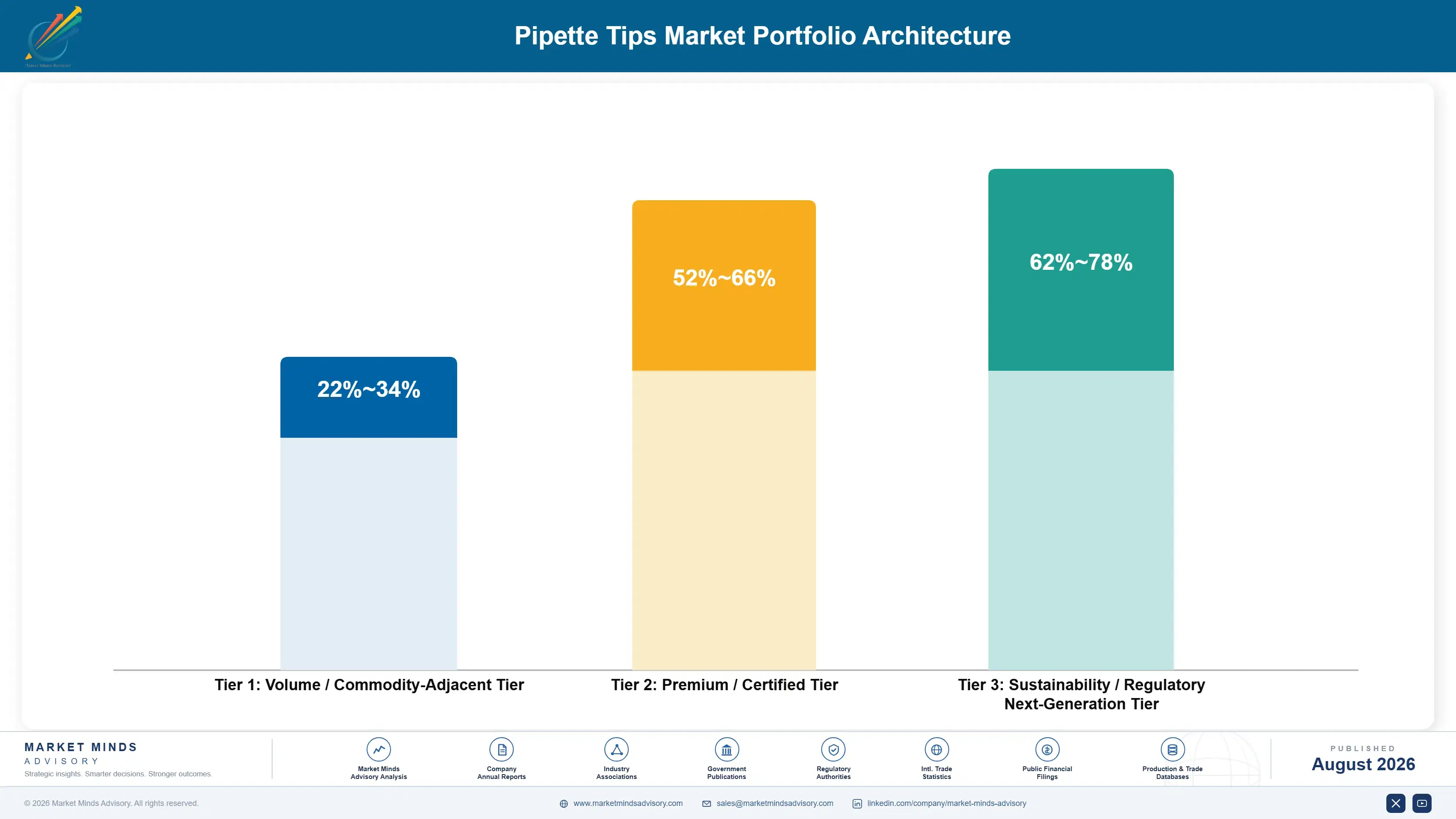
Portfolio Architecture for Margin Defence

Margin architecture separates by whether the buyer can substitute freely. Standard manual tips compete against Asian moulders producing adequate product at materially lower cost, and gross margin sits in the twenties under continuous erosion. Platform-qualified and filtered tips are protected by instrument compatibility and revalidation cost respectively, and both clear well above sixty per cent despite being made from the same resin on similar machines.
The tension is between volume and defensibility. Standard tips represent the largest unit volume and provide the moulding scale that spreads tooling and cleanroom overhead across everything else. They are also indefensible, since the precision that justifies premium pricing produces no measurable benefit in manual pipetting. Nobody has built a viable position on qualified grades alone, and standard-only positions erode continuously.

High-value pools concentrate where substitution carries a cost the laboratory can quantify. Platform tips carry aborted run risk, filtered tips carry contamination risk, and validated assay tips carry revalidation cost. Everything else competes on the price of moulded polypropylene against producers whose energy and labour costs sit well below anything a Western manufacturer can reach. That comparison does not improve with better moulding.

Volume / Commodity-Adjacent Tier

Standard manual pipette tips sold in bulk to academic and general laboratory users, where performance differences are not measurable in ordinary use and Asian moulders set the achievable price level.
Gross Margin: 22-34%

Premium / Certified Tier

Filtered and barrier tips carrying contamination control claims and certified purity documentation, protected by the cost of a contaminated run rather than by any manufacturing capability competitors lack entirely. Filter media quality separates credible products from cosmetic ones.
Gross Margin: 52-66%

Sustainability / Regulatory / Next-Generation Tier

Automation platform tips and low-retention surface-treated grades, defended by instrument qualification, dimensional tolerance requirements and revalidation costs that make substitution genuinely expensive for laboratories. Instrument compatibility is the durable part of that defence.
Gross Margin: 62-78%
pipette-tips-market-portfolio-architecture-1787306521821

High-value Sub-segments and Strategic Watch-out

Automation Platform Tips

High value and the fastest growth at 11.1%, locked to installed instrument base rather than won competitively. The consumable stream over a platform's life frequently exceeds the instrument margin, which makes placement the decisive commercial event. Demand follows installed base rather than selling effort. Placement decides it.
Gross Margin: 62-78%

Filtered and Barrier Tips

High value at 8.4% and around 44% of consumption, protected by the cost of a contaminated run rather than by manufacturing capability. Laboratories that have experienced contamination become permanently insensitive to price here. Adoption tracks molecular method diffusion into routine testing. Contamination risk drives the purchase.
Gross Margin: 52-66%

Standard Manual Pipette Tips

The volume core below 4.2%, providing the moulding scale that spreads tooling and cleanroom overhead across everything else. Genuinely interchangeable and eroding continuously against Asian producers whose costs sit permanently lower. Scale here spreads tooling and cleanroom overhead usefully. No defence exists at any price point.
Gross Margin: 22-34%

Low-Retention Surface-Treated Tips

The strategic watch-out at 9.2%. Recovered reagent value exceeds the treatment cost in expensive workflows, but the argument only holds where volumes are small and reagents costly, which limits the addressable base. The argument holds only where reagents are expensive. Addressable base is correspondingly narrow.
Gross Margin: 58-72%

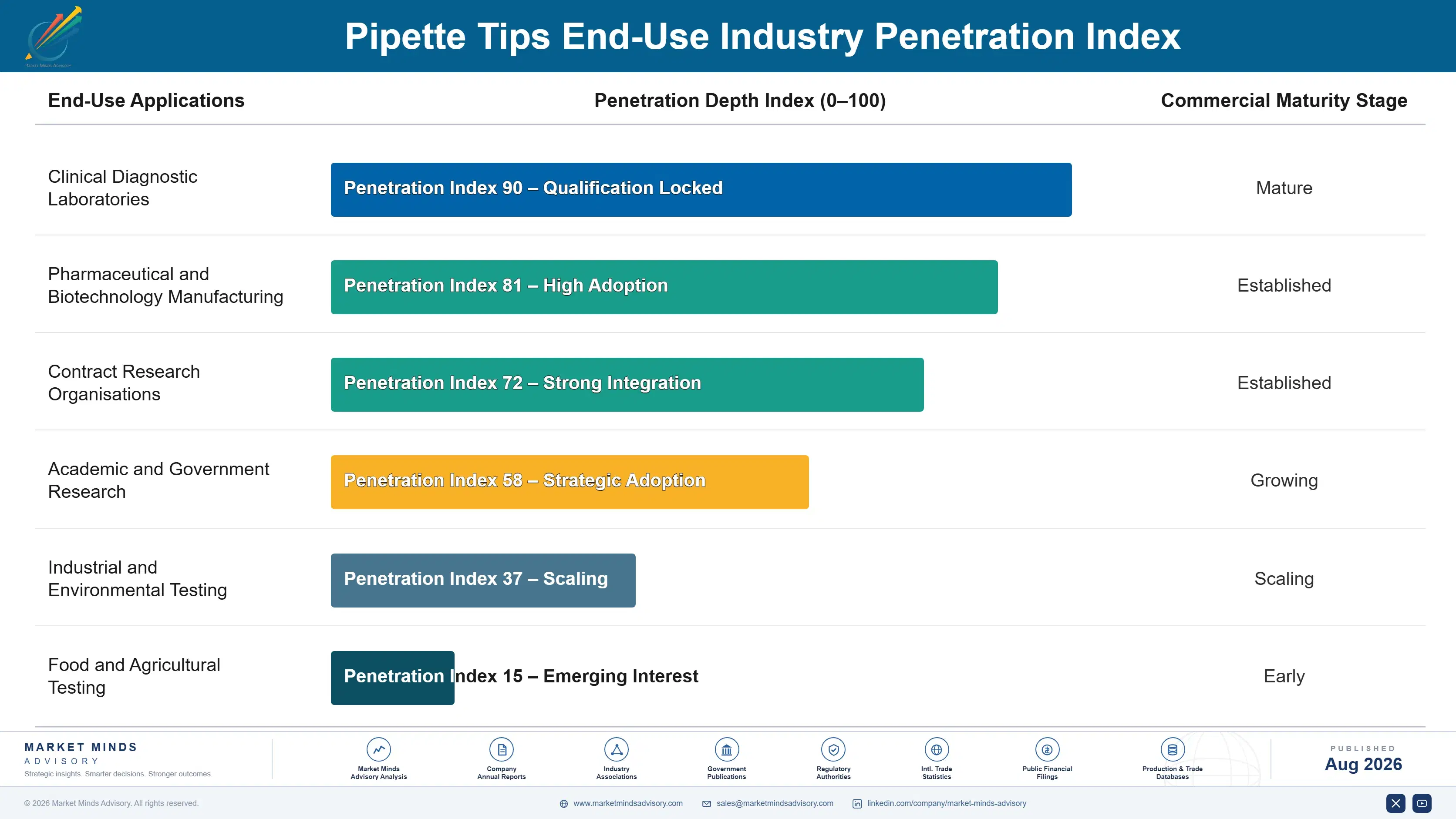
Who Specifies and What Persists

Revenue here is genuinely recurring in a way few product categories match, since tips are consumed continuously and reordered without any decision being revisited. Roughly 48 billion units are consumed annually and the great majority arrive through standing arrangements rather than competitive events. That makes account acquisition the whole commercial game and account defence comparatively straightforward, provided the qualification position holds.
Stickiness varies enormously by workflow. Validated clinical and pharmaceutical assays are the most locked, since substitution requires revalidation costing around $34,000 and months of laboratory time nobody has spare. Automation platform consumption follows closely on instrument compatibility. Academic research is the loosest by a wide margin, with laboratories switching on price between grant cycles and treating tips as exactly the commodity they superficially appear to be.

The deciding function differs by setting in ways that shape commercial approach. Clinical and pharmaceutical laboratories decide through quality functions weighing revalidation risk. Automation users had the decision made when the instrument was chosen. Academic laboratories decide through whoever places the order, frequently a postdoctoral researcher comparing catalogue prices. Selling all three through one commercial motion addresses none of them properly.
pipette-tips-market-end-use-penetration-index-1787306522328

Where Value Actually Sits

These are among the four positions where our research anticipates prominent divergence between winners and laggards over the coming forecast period. Each is grounded in the demand model, the regulatory perimeter, and the announced capacity pipeline.
01 / INSTRUMENT PLACEMENT PRIORITY

The tip contract is signed with the platform

Consumable demand follows the installed platform base rather than any competitive selling that happens afterward, so the tip decision is effectively settled at the moment the liquid handler itself is chosen. Platform-qualified tips price at near 3.4 times standard equivalents, which means the consumable stream across an instrument's full working life frequently exceeds the original instrument margin entirely. Losing an instrument placement therefore loses a decade of locked consumable revenue alongside it, and no subsequent commercial effort recovers any of that.
02 / CONTAMINATION LADDER MIGRATION

Standard tips cannot be defended by anyone

Manual pipetting tolerates dimensional variation because the operator compensates for it unconsciously, which means the precision justifying premium pricing produces no benefit that any laboratory can actually measure in that particular setting. Filtered and low-retention grades by contrast carry performance arguments that a laboratory can verify itself, against contamination risk and reagent loss respectively. Migrating existing accounts upward is therefore worth considerably more than defending standard volume that erodes indefinitely against Asian moulders holding a permanent and unbridgeable cost advantage.
03 / REVALIDATION COST FRAMING

Put thirty-four thousand dollars on the table

Qualifying an alternative tip into an already validated assay costs roughly $34,000 and several months of laboratory time, and quality managers know that number precisely while procurement functions frequently do not know it at all. Stating that figure explicitly during renewal converts a unit price negotiation into a risk conversation that necessarily involves the quality function too. Participants that used this approach reported renewal pricing running roughly 15% above what those negotiating purely on unit cost were able to achieve.
04 / NEW LABORATORY CAPTURE

Arrive during construction, not after commissioning

A new laboratory buys its instruments and consumables together with no incumbent supplier to displace at all, which is a fundamentally easier commercial position than any established account will ever present to a challenger. India compounds at 11.8% as pharmaceutical manufacturing, contract research and diagnostic laboratory capacity all expand simultaneously across the country at once. Suppliers that wait until a facility is fully operational arrive long after every decision that genuinely matters has already been taken by somebody else entirely.

Engagement Snapshot From the Field

A live engagement with an industry participant carrying material or product regulatory and market exposure ahead of a defining policy shift, showing how our research translates into a defensible multi-year portfolio strategy.
MARKET MINDS ADVISORY · CLIENT ENGAGEMENT SUMMARY
Pipette Tips Producer Strategic Portfolio Review and Transition Roadmap 2026·Investment Scenario on Pipette Tips Exposure Evaluation 2025-26
CLIENT PROFILE
A laboratory consumables manufacturer with annual revenue near $220 million (client-reported, unverified by MMA), producing pipette tips and related plasticware at two European sites for academic, clinical and industrial customers. Standard tip volumes had grown while revenue stayed flat for three years, and leadership wanted to understand why scale was not translating into any financial improvement at all.
STRATEGIC CHALLENGE
The company had pursued volume aggressively in standard grades, winning academic and general laboratory accounts on price against Asian competitors while European energy costs rose underneath. Leadership needed to establish whether that volume was worth holding, and what entering platform-qualified and filtered grades would require in tooling, cleanroom and qualification investment.
MMA APPROACH
We rebuilt product-level profitability across the portfolio including allocated tooling, cleanroom and energy cost, which the client had been distributing on revenue rather than on actual consumption. Thirty-four laboratory purchasing and quality managers were interviewed on switching behaviour. We modelled exit from standard grades against continued volume defence and against qualified grade entry.
KEY FINDINGS
  1. Standard tip grades were contributing negative margin once energy and tooling costs were allocated by consumption rather than by revenue, and volume growth was making the position worse.
  2. Twenty-eight of 34 quality managers said they would not change tip supplier inside a validated assay for any price reduction, citing revalidation cost and regulatory risk together.
  3. Platform-qualified entry required tooling investment and instrument vendor qualification the client had assumed was a specification exercise rather than a commercial negotiation with the vendor.
  4. Filtered grade entry was reachable within eighteen months using existing cleanroom capacity, at roughly a fifth of the investment that platform qualification would have demanded.
CLIENT PROFILE
A laboratory consumables manufacturer with annual revenue near $220 million (client-reported, unverified by MMA), producing pipette tips and related plasticware at two European sites for academic, clinical and industrial customers. Standard tip volumes had grown while revenue stayed flat for three years, and leadership wanted to understand why scale was not translating into any financial improvement at all.
STRATEGIC CHALLENGE
The company had pursued volume aggressively in standard grades, winning academic and general laboratory accounts on price against Asian competitors while European energy costs rose underneath. Leadership needed to establish whether that volume was worth holding, and what entering platform-qualified and filtered grades would require in tooling, cleanroom and qualification investment.
MMA APPROACH
We rebuilt product-level profitability across the portfolio including allocated tooling, cleanroom and energy cost, which the client had been distributing on revenue rather than on actual consumption. Thirty-four laboratory purchasing and quality managers were interviewed on switching behaviour. We modelled exit from standard grades against continued volume defence and against qualified grade entry.
KEY FINDINGS
  1. Standard tip grades were contributing negative margin once energy and tooling costs were allocated by consumption rather than by revenue, and volume growth was making the position worse.
  2. Twenty-eight of 34 quality managers said they would not change tip supplier inside a validated assay for any price reduction, citing revalidation cost and regulatory risk together.
  3. Platform-qualified entry required tooling investment and instrument vendor qualification the client had assumed was a specification exercise rather than a commercial negotiation with the vendor.
  4. Filtered grade entry was reachable within eighteen months using existing cleanroom capacity, at roughly a fifth of the investment that platform qualification would have demanded.
RECOMMENDED STRATEGY
Phase 1: Phase one: exit the lowest-margin standard grade accounts deliberately rather than defending volume that contributes negative margin once costs are allocated properly. Phase 2: Phase two: enter filtered and barrier grades using existing cleanroom capacity, targeting clinical molecular laboratories where contamination risk drives purchasing. Phase 3: Phase three: pursue platform qualification selectively with one instrument vendor rather than several, treating it as a commercial negotiation. Vendor terms decide the return.
OUTCOME
Standard grade volume fell by roughly a quarter within a year while gross margin rose by seven points (client-reported, unverified by MMA). Filtered grade revenue reached a fifth of total within eighteen months. Platform qualification discussions opened with one vendor and remain in progress at the time of writing.

Frequently Asked Questions

Foundational context covering the market sizes, CAGR, scope, country, region and competition that inform every finding below. This section is provided to cover basics and most often pre-purchase conversations, answered from the MMA Primary Research Dataset.

What is the current size of the Pipette Tips Market?

The global market is valued at $2.15 billion in 2025, rising to $2.31 billion in 2026. East Asia holds the largest share at 34%, reflecting injection moulding capacity rather than laboratory consumption.

How large will the Pipette Tips Market be by 2036?

MMA forecasts $4.72 billion by 2036, an increase of $2.41 billion over the 2026 base and an expansion multiple of 2.04x. Platform-qualified and filtered grades carry most of that growth.

What is the CAGR for the Pipette Tips Market 2026 to 2036?

The base case compound annual growth rate is 7.4%, with a bull case at 8.6% and a bear case at 6.2%. Historical growth from 2020 to 2025 ran near 6.2% through severe supply disruption.

Which segment is growing fastest?

Automation platform tips compound at 11.1%, a full 1.50x the market rate. Liquid handlers demand dimensional consistency within roughly 18 microns, which locks demand to qualified consumables rather than competitive supply.

Who are the major companies in the Pipette Tips Market?

Thermo Fisher Scientific, Eppendorf, Sartorius, Corning and Tecan together hold 63% of revenue from disposable pipette tip products. That concentration rests on qualification rather than on manufacturing capability.

Which country is growing fastest?

India compounds at 11.8%, faster than any other country covered, as pharmaceutical manufacturing, contract research and diagnostic laboratory capacity expand simultaneously. Domestic moulders serve much of that demand on price.

Report Segmentation Architecture

The full report scope spans multiple orthogonal segmentation dimensions, with cross-tabulated demand data provided for each dimension pair. Coverage extends further to regional breakdowns, trend trajectories, and the competitive detail needed to support segment-level decision-making.

By Tip Class

  • Standard Manual Pipette Tips
  • Filtered and Barrier Tips
  • Low-Retention Surface-Treated Tips
  • Automation Platform Tips
  • Specialty and Extended-Length Tips

By End-Use Industry

  • Clinical Diagnostic Laboratories
  • Pharmaceutical and Biotechnology Manufacturing
  • Contract Research Organisations
  • Academic and Government Research
  • Industrial and Environmental Testing
  • Food and Agricultural Testing

By Commercial Dimension

  • Instrument Vendor Qualified Supply
  • Laboratory Distributor Channels
  • Direct Enterprise Supply Agreements
  • Purchasing Group Contracts
  • Online and Catalogue Sales
  • Private Label and Contract Moulding

By Region

  • East Asia
  • North America
  • Western Europe
  • South Asia and Pacific
  • Latin America
  • Middle East and Africa
  • Eastern Europe

Scope, Methodology, and Coverage

Every figure in this report is reproducible from documented input assumptions. The scope below maps the historical period, the forecast horizon, the segmentation dimensions, and the countries covered, alongside the underlying primary and qualitative methodology.
Historical Period
2020 to 2025
Forecast Period
2026 to 2036
Base Year
2025 (USD billions; MMA Primary Research Dataset, August 2026)
Market Definition
This market comprises disposable pipette tips used in laboratory liquid handling, measured at manufacturer revenue across instrument vendor qualified supply, laboratory distributor channels, direct enterprise supply agreements, purchasing group contracts, online and catalogue sales, and private label or contract moulding arrangements. Coverage spans standard manual pipette tips across volume ranges, filtered and barrier tips incorporating aerosol-blocking media, low-retention and surface-treated tips designed to minimise liquid adherence, automation platform tips qualified against specific liquid handling instruments, and specialty tips including extended-length, wide-bore, gel-loading and positive-displacement configurations. Manual and electronic pipettes and the liquid handling instruments tips are used with, reagent reservoirs, microplates, deep-well plates and other labware, syringes, needles and medical injection devices, sample collection and transport tubes, reusable glass pipettes and serological pipettes, and tip storage racks or reload systems sold independently of tips fall outside scope.
Quantitative Units
USD millions (current prices); units consumed by tip class; average selling price by class; filtered share of consumption; installed automation platforms; revalidation cost; qualification cycle length
Segmentation Dimensions
By Tip Class; By End-Use Industry; By Commercial Dimension; By Region
Regions Covered
East Asia, North America, Western Europe, South Asia and Pacific, Latin America, Middle East and Africa, Eastern Europe
Countries Covered
China, Japan, South Korea, Taiwan, Singapore, United States, Canada, Germany, United Kingdom, France, Italy, Spain, Netherlands, Switzerland, Sweden, Denmark, India, Australia, Thailand, Malaysia, Indonesia, Brazil, Mexico, Argentina, Chile, Colombia, Saudi Arabia, United Arab Emirates, Israel, South Africa, Poland, Czechia, Hungary, Romania, Turkey, and additional markets relevant to laboratory consumables analysis
Key Companies Profiled
Thermo Fisher Scientific, Eppendorf, Sartorius, Corning, Tecan, Hamilton Company, Gilson, Sarstedt, Greiner Bio-One, Brand GmbH, Watson Bio Lab, Nichiryo, Labcon North America, Rainin Instrument, Axygen, Biotix, Porvair Sciences, Kirgen, Beaver Biomedical, Tarsons Products
Quantitative Methodology
Primary survey, n=3,800 respondents, Q4 2025, six countries; demand-side model with trade association cross-validation
Qualitative Methodology
47 expert interviews, Q4 2025; applied to validate demand model assumptions, identify emerging dynamics, and assess competitive positioning
Report Format
PDF and XLSX data workbook (Word format preview document)
Publisher
Market Minds Advisory
Report Code
MMA-2026-HLT-521
Published
August 2026
Contact
sales@marketmindsadvisory.com | www.marketmindsadvisory.com

Purchase the full Pipette Tips Market Report (2026 to 2036).

The full MMA report explains how a two-cent moulded consumable became a locked position, tracing qualification, instrument compatibility and revalidation cost through the commercial consequences of each. It sizes five tip classes and seven regions to 2036, modelling units consumed, pricing by class, filtered share, installed automation base and revalidation economics separately. Competitive assessment covers twenty manufacturers on one consistent revenue basis. Cost exposure is traced through resin, tooling, cleanroom and energy. Four commercial levers and a strategic verdict close the report, grounded in 47 expert interviews and a 3,800-respondent survey.
Five tip classes sized separately through 2036
Platform qualification requirements mapped across major automation vendors
Switching behaviour benchmarked across clinical, industrial and academic laboratories
Twenty manufacturers assessed on one consistent revenue basis
Product-level profitability modelled with consumption-based cost allocation
Anonymised manufacturer engagement with tested portfolio recommendations

Built For The People Who Decide

From boardroom strategy to bench-side execution, this report is read cover-to-cover by leaders shaping the next decade of their industry, turning demand scenarios, market dynamics and valuation benchmarks into decisions.
CXOs/ Presidents/ VPs/ Managers
M&A and Corporate Development
Strategy Teams and R&D Heads
Procurement and Product Directors
Regulatory and Compliance Leaders
Investor Relations and Equity Analysts