Market Minds Advisory
Pipette Controller Market

Pipette Controller Market: Pipette Controller Market: attached consumable economics, battery-limited life and ergonomics budgets to 2036

This device sits in front of a consumable stream worth many times its own value, and almost every manufacturer still sells it as a standalone instrument competing on features and price.

Lead Analyst

Alice Ballenger

Published

September 2026

Make Smarter Decisions with Customized Research Insights

Request a free sample report and evaluate market opportunities, growth trends, and competitive dynamics relevant to your business needs.

2025 MARKET VALUE$0.3BMarket Size 2025
2036 FORECAST VALUE$0.7BBase Case , 2026 to 2036
CAGR 2026 TO 20367.0 %Bull 8.2% / Bear 5.8%
INCREMENTAL OPPORTUNITY$0.4BNet 10- year value creation
EXPANSION MULTIPLE1.97x2036 value over 2026 base
Strategic Levers
M&A Pipeline
Regional Outlook
Country Rankings
Competitive Intelligence
Segmental Deep-dive
Call-Us : 91 93563 13602

Executive Snapshot and Market Trajectory.

A pipette controller placed in a laboratory determines which serological pipettes and membrane filters that bench buys for years afterwards. Attached consumable spending runs around eighteen times the device cost across its working life, and almost nobody sells it that way. Almost nobody sells it that way.
What actually ends that working life is a rechargeable cell rated near 500 charging cycles rather than the pump or the mechanism, both of which outlast it several times over. Around 44% of units ship with no user-replaceable battery at all, which quietly converts a ten-year instrument into a three-year one. Purchasing departments discover that arithmetic on the second replacement rather than during any evaluation, because specification sheets emphasise weight and speed instead.
Cordless extended-battery systems grow at 10.5%, half again the market rate of 7.0%, and the purchase is frequently driven by ergonomics rather than performance. Roughly 34% of laboratory staff report hand or wrist symptoms from pipetting, which moves the decision into a health and safety budget entirely. Manufacturers supplying assessment evidence reach those approvers, while those quoting aspiration speed address a function that has stopped deciding.
Market Definition
This report covers motorised and manual pipette controllers used with serological pipettes, spanning standard motorised controllers, lightweight ergonomic controllers, cordless extended-battery systems, cleanroom and sterile-rated controllers, multichannel and specialty controllers, and manual and bulb-type controllers. Value is measured at manufacturer level on device and dedicated accessory revenue. Excluded are air displacement micropipettes and their tips, serological pipettes and other disposable labware, automated liquid handling platforms, syringe pumps and dispensers, and general laboratory consumables sold separately.
Base Year Value
$0.3B in 2025 (MMA Primary Research Dataset, August 2026)
Forecast Period
2026 to 2036, eleven discrete annual values
CAGR
7.0% base case. Bull 8.2%. Bear 5.8%.
Fastest Growth Segment
Cordless Extended-Battery Systems: 10.5% CAGR
Fastest Growth Country
China: 10.6% CAGR
Fastest Growth Region
South Asia and Pacific: 9.2% CAGR
Largest Region
North America: 32% of 2025 global value
Market Leaders
Thermo Fisher Scientific, Sartorius, Eppendorf, INTEGRA Biosciences and BRAND lead the market. Source: MMA Primary Research Dataset, July 2026.
Primary Survey
n=3,800 procurement and R&D decision-makers, Q4 2025, six countries
Methodology
Demand-side build-up, cross-validated against public data, 47 expert interviews

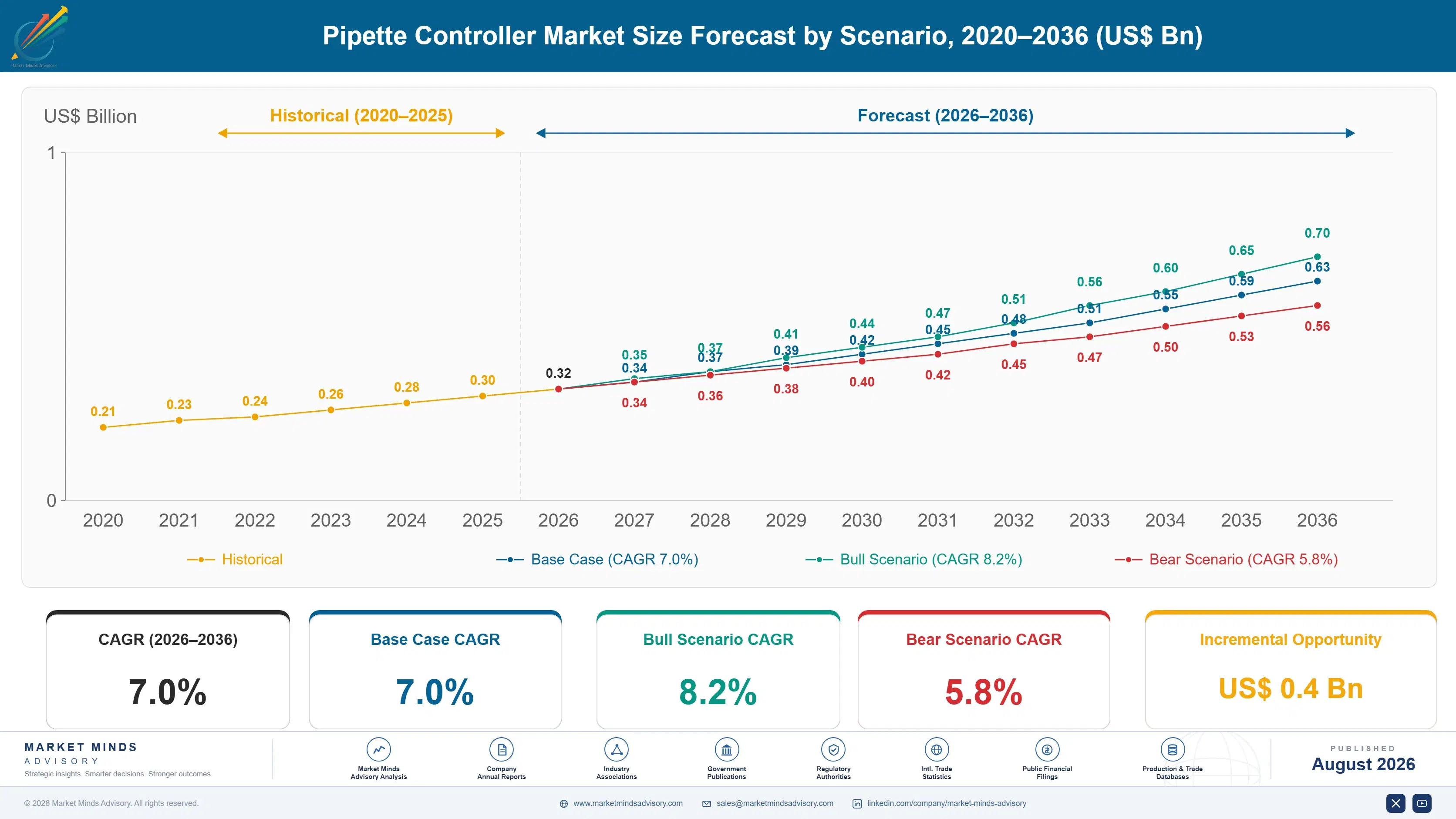
Pipette Controller Market Forecast Scenarios

pipette-controller-market-size-forecast-scenario-1787580427485
Growth ran at 5.8% between 2020 and 2025 across a period distorted at both ends. Laboratory equipment demand surged through 2020 and 2021 as diagnostic and vaccine capacity expanded rapidly, then normalised as that capacity was completed and research funding tightened. Underneath the volatility, ergonomics policy and cell culture volume both grew steadily and neither depended on the pandemic at all.
The 7.0% base case rests on three mechanisms. Cordless extended-battery systems at 10.5% as ergonomics policy replaces older heavier units on institutional programmes. Cleanroom and sterile-rated controllers at 8.8% on biologics manufacturing capacity. And Chinese growth at 10.6%, the fastest of any country, on biopharmaceutical and contract manufacturing capacity being built at considerable scale. None of the three depends on research funding conditions improving anywhere. Consumable attachment remains largely uncontested everywhere.
The 8.2% bull case is manufacturers converting controller placements into attached consumable positions, which would change what a device is worth to whoever supplies it. The 5.8% bear case is research funding tightening further across academic and public laboratories, since a working controller is easy to keep using and ergonomics programmes are among the first budgets deferred.

The Placement Before The Stream

A pipette controller is a small durable instrument that sits in front of a very large consumable stream, and the industry mostly declines to sell it that way. Serological pipette and membrane filter spending on a bench runs around eighteen times the controller cost across the device's working life, and the controller placement influences which of those get bought because compatibility, handling and habit all favour the supplier already on the bench. Manufacturers competing on device features and unit price are contesting the smallest number in the arrangement.
TOP-FIVE CONCENTRATION58%Combined position across supply held by the leading instrument manufacturers
BATTERY CYCLE LIFE500 cyclesCharging cycles before capacity falls below working requirement
SEALED DESIGN SHARE44%Units built without any user replaceable power source
ATTACHED CONSUMABLE MULTIPLE18xSerological pipette spend against the controller over its life
REPETITIVE STRAIN INCIDENCE34%Laboratory staff reporting hand or wrist symptoms from pipetting
FILTER REPLACEMENT INTERVAL90 daysPeriod before a membrane filter requires routine replacement
The device's working life is also determined by something nobody specifies against. A rechargeable cell rated near 500 charging cycles wears out long before the pump, the motor or the housing, and roughly 44% of units are built with no user-replaceable battery whatsoever. That converts a decade-long instrument into a three-year one, and laboratories replacing controllers that often are paying far more than they expected.
The purchase itself increasingly originates outside the laboratory budget. Around 34% of staff report hand or wrist symptoms from pipetting, which makes replacement an occupational health decision rather than an equipment one.
"Everybody in this category sells a device and the money is in what the device causes somebody to buy afterwards. The controller decides the pipettes and the filters for years. Treating it as an instrument sale is like selling the razor and walking away from the shop."
Director, Laboratory Instruments and Life Science Tools Practice · MMA Medical Devices and Laboratory Equipment Practice · August 2026

Market Trends

Sealed battery designs shorten instrument life without disclosure

Around 44% of controllers ship with no user-replaceable power source, and the rechargeable cell inside is rated near 500 charging cycles while the pump, motor and housing comfortably outlast it several times over. The device therefore fails on a component nobody compares during purchasing, since specification sheets emphasise weight, speed and ergonomics instead. Commercially this converts a ten-year instrument into a three-year one and shifts a laboratory's cost of ownership substantially, which purchasing departments discover on the second replacement rather than the first. Specification sheets never mention it at all.
Market Impact: Chinese demand compounds at 10.6%
Ergonomics policy moves the purchase to a different budget

Roughly 34% of laboratory staff report hand or wrist symptoms associated with pipetting, and institutional occupational health programmes now drive controller replacement more reliably than any performance argument a manufacturer might construct. That moves the decision away from laboratory equipment budgets and toward health and safety functions with separate approval routes and different evaluation criteria entirely. Commercially this rewards manufacturers who can supply ergonomic assessment data and injury reduction evidence rather than those quoting aspiration speed and unit price. Approval routes and evaluation criteria differ completely from equipment purchasing. Evidence beats specification here.
Market Impact: Sterile segment grows at 8.8%

Market Opportunities and Growth Drivers

Chinese biopharmaceutical capacity expands at considerable scale

Chinese growth at 10.6% leads every country in this market, driven by biopharmaceutical and contract manufacturing capacity being constructed at a pace no other market matches, and every cell culture suite commissioned adds controllers and the consumable stream behind them. Domestic instrument manufacturers including DLAB compete on price while international suppliers hold positions where validation documentation and sterile ratings matter. Commercially the volume arriving is genuinely new placement rather than replacement, which makes early positioning considerably more valuable than in mature markets. Consumable attachment is weaker there than in Western markets.
Market Impact: Filters last around 90 days

Biologics manufacture requires sterile-rated and validated devices

Cell culture and biologics production demand controllers with autoclavable nosepieces, cleanroom-compatible housings and documentation supporting their use in validated processes, which narrows the qualified field well below the number of manufacturers making controllers at all. Growth at 8.8% follows biologics manufacturing capacity rather than any laboratory equipment cycle. Commercially these customers change suppliers reluctantly once a device appears in a validated procedure, because revalidation costs far more than any device price difference could ever recover for them. Revalidation costs far more than any device price difference could recover, which makes original qualification the entire commercial contest in this segment.
Market Impact: Consumables run 18 times device cost

Market Restraints and Challenges

Working devices are simply kept rather than replaced

A pipette controller that still aspirates and dispenses gets used indefinitely in a laboratory under budget pressure, regardless of its weight, its age or how uncomfortable staff find it. The root cause is that failure is gradual rather than sudden, so there is rarely a moment forcing a decision. Commercially this makes replacement demand dependent on funding conditions and institutional programmes rather than on any device performance. Manufacturers are pursuing ergonomics and occupational health routes, which create a replacement trigger that equipment budgets alone never generate. Nothing forces the decision on any particular date.
Market Impact: Cells last about 500 cycles

Consumable attachment is available and almost never taken

Serological pipette and filter spending runs around eighteen times the controller cost over its working life, yet most manufacturers sell the device and leave the consumable stream to whoever the laboratory already buys from. The root cause is organisational, since instrument and consumable businesses frequently sit in separate divisions with separate targets. Commercially this forfeits the larger revenue attached to a placement the manufacturer already won. Companies with both product lines are beginning to sell them together, which is straightforward and long overdue. Companies holding both product lines are beginning to sell them together, which is straightforward and considerably overdue.
Market Impact: Symptoms affect 34% of staff
4 additional market trends, 3 additional growth drivers, and 2 additional restraints and challenges are covered in the full report. Contact sales@marketmindsadvisory.com to access the complete intelligence.

Segment CAGR and Growth Architecture

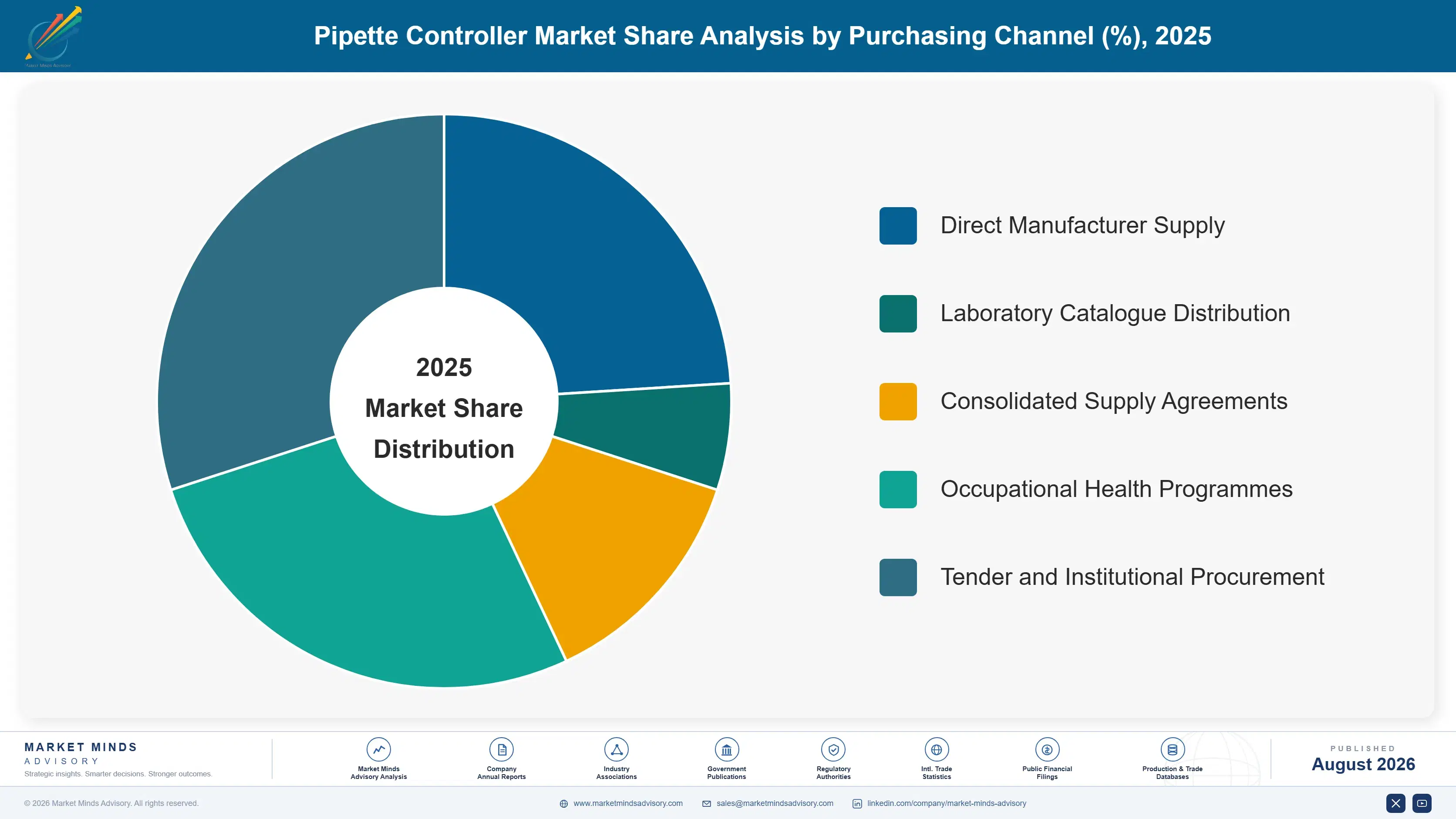
Value is classified here by device type, since power source, weight, sterility rating and intended working environment all follow directly from how a controller is constructed. Application area, purchasing channel and accessory attachment are each handled separately in the framework below, because most of these device types serve several different laboratory settings without any modification.
pipette-controller-market-market-share-analysis-1787580428041

Cordless Extended-Battery Systems

Growing at 10.5%, half again the market rate, cordless systems with extended battery capacity address the practical complaint that dominates laboratory feedback, which is a device running flat during a long cell culture session and leaving the operator waiting. Extended capacity and rapid charging both reduce that, and the better designs restore a user-replaceable cell that sealed units removed. Purchasing frequently originates in occupational health rather than laboratory budgets, since lighter cordless operation reduces the postures associated with hand and wrist symptoms. Manufacturers supplying ergonomic assessment data reach those decision makers, while those quoting aspiration speed reach nobody who now makes the decision. Ergonomic evidence reaches the approver directly. Speed figures reach nobody now.
CAGR 10.5%

Cleanroom and Sterile-Rated Controllers

Biologics manufacture and cell therapy production require controllers with autoclavable nosepieces, cleanroom-compatible housings and documentation supporting use inside validated processes, which narrows the qualified supplier field considerably below the number of manufacturers active in the category. Growth at 8.8% follows biologics capacity construction rather than any laboratory equipment replacement cycle. Once a device is named in a validated procedure the customer changes supplier extremely reluctantly, because revalidation costs far exceed any device price advantage. That makes original qualification the entire commercial contest and subsequent competition close to nonexistent. Autoclavable nosepieces and cleanroom-compatible housings are requirements rather than features here, and documentation supporting use inside a validated process is what actually narrows the field of qualified suppliers.
CAGR 8.8%
Full segment breakdown across 6 segments available in the complete report.

Regional Architecture and Country Demand Map

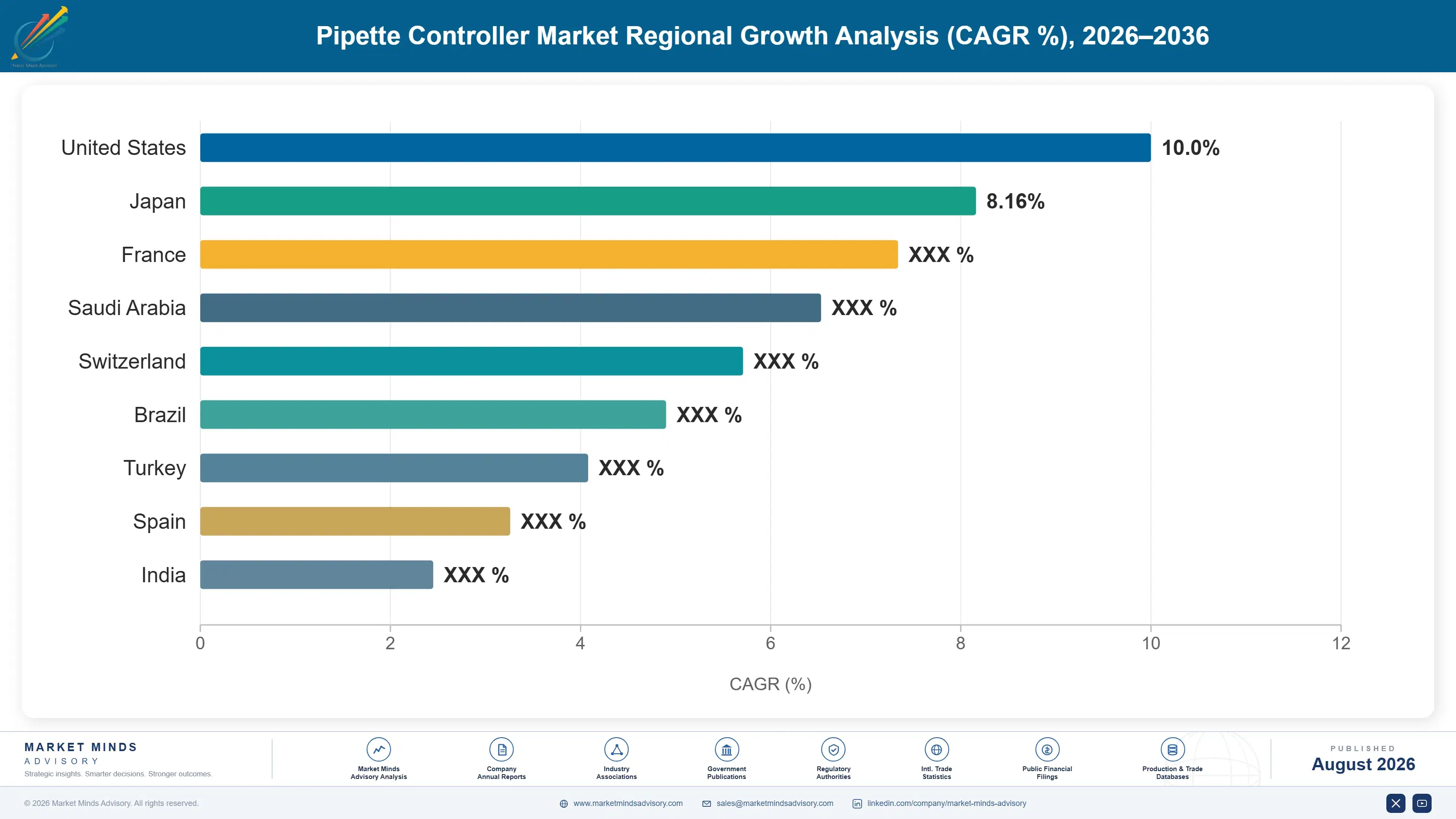
North America holds 32% of value on biopharmaceutical research and manufacturing density that no other market currently matches, with Western Europe following at 24% on the strength of its occupational health practice. East Asia sits at 22% and is growing fastest of all on capacity being newly constructed.

North America

Biopharmaceutical research density, academic laboratory scale and contract manufacturing capacity together make this the largest pool of controller placements anywhere, and the consumable streams attached to them are correspondingly substantial. Occupational health programmes are well established across institutional laboratories, which makes ergonomics a genuine replacement trigger rather than a marketing theme. Research funding conditions have tightened, and laboratories under pressure keep working devices considerably longer than they otherwise would. Thermo Fisher holds a strong position across both instruments and the consumables attached to them. Growth at 6.4% sits below the market rate. Consolidated supply agreements place devices in front of buyers who rarely evaluate alternatives at all. Research funding has tightened.
Share: 32% | CAGR: 6.4% (2026 to 2036)

Western Europe

Occupational health regulation across the region is the most demanding anywhere and institutional ergonomics programmes drive replacement more systematically than in any other market, which gives manufacturers with injury reduction evidence a genuine advantage. Sartorius, Eppendorf, INTEGRA and BRAND are all European companies holding substantial positions built on that engineering emphasis. Biologics manufacturing capacity across Ireland, Switzerland and Germany supports sterile-rated demand. Academic funding is constrained in several markets. Growth at 5.6% is the weakest on this table and reflects a mature installed base. Ergonomic engineering depth among regional manufacturers reflects that regulatory emphasis, which is why so many of the category's specialists are European companies. Biologics capacity supports sterile demand.
Share: 24% | CAGR: 5.6% (2026 to 2036)
Regional intelligence for 5 additional markets available in the complete report: East Asia, South Asia and Pacific, Latin America, Middle East and Africa, Eastern Europe. Contact sales@marketmindsadvisory.com.
pipette-controller-market-country-cagr-analysis-1787580428557

Where Controller Value Actually Sits

Four moves matter for a small instrument that decides several years of consumable purchasing on a bench and whose life is limited by a component nobody compares. Two concern capturing the revenue the placement already earns for somebody, and two concern the budgets and specifications that decide whether a device gets bought at all.

Sell the placement, then the consumable stream

Serological pipette and filter spending runs around eighteen times the controller cost across a device's working life, and the controller on the bench influences which of those a laboratory buys because compatibility, handling and habit all favour the incumbent. Manufacturers holding both product lines and selling them separately are forfeiting the larger number entirely. The organisational barrier is usually that instruments and consumables sit in different divisions with different targets, which is a problem worth solving. A placement worth 18 times its device value should not be handed to a competitor because two divisions carry separate targets.
Market Impact: Captures 18 times the attached device value alone

Restore a user-replaceable cell and say so

Around 44% of controllers ship sealed, and the cell inside is rated near 500 charging cycles while everything else in the device lasts far longer. That converts a ten-year instrument into a three-year one, and purchasing departments discover it on the second replacement rather than during evaluation. A manufacturer offering a replaceable cell and quantifying the cost of ownership difference is competing on the number that actually decides value, which no specification sheet in this category currently addresses. No competitor currently quantifies it anywhere. The grievance is real and customers mention it.
Market Impact: Extends life beyond a 500 cycle battery limit

Reach the occupational health budget, not the laboratory one

Roughly 34% of laboratory staff report hand or wrist symptoms from pipetting, and institutional ergonomics programmes replace devices when equipment budgets under funding pressure never would. That is a different budget, a different approver and different evidence requirements entirely. Manufacturers supplying ergonomic assessment data and injury reduction evidence reach those decision makers directly, while those quoting aspiration speed and unit price are addressing a function that has stopped making the decision. Injury evidence rather than specification wins these decisions. Different approver, different evidence, different budget entirely. Laboratory budgets rarely fund replacement now.
Market Impact: Addresses symptoms reported by 34% of laboratory staff

Qualify into validated processes before the procedure freezes

Biologics and cell therapy manufacture name specific devices in validated procedures, and once written that reference persists because revalidation costs vastly exceed any device price advantage a competitor could offer. Growth at 8.8% in sterile-rated controllers follows biologics capacity construction. Qualification happens during process development rather than during purchasing, which means a manufacturer arriving through procurement has already missed the decision that mattered by a considerable margin. Process development rather than purchasing is where the decision gets made, and a manufacturer arriving later has missed it entirely. Biologics capacity keeps being built.
Market Impact: Serves a segment now growing at 8.8% yearly

Who Controls the Margin Pool

Five manufacturers hold 58% of this market, measured on device and dedicated accessory revenue at manufacturer level, the basis used throughout this section. Concentration is high for a small instrument because laboratory purchasing consolidates around suppliers already present on the bench, and because sterile and validated applications narrow the qualified field considerably further than device manufacturing capability alone would. Bench presence compounds into further purchasing.
Competition runs on four dimensions. Consumable portfolio breadth, which decides whether a placement earns anything at all beyond the initial device sale. Ergonomic evidence, which reaches the budget now actually driving replacement across institutions. Sterile rating and validation documentation for biologics customers who cannot substitute afterwards. And distribution reach into laboratories where purchasing runs through consolidated catalogues rather than any direct relationship.

Rankings shift toward manufacturers converting placements into consumable positions and toward those holding validated qualifications inside biologics manufacture. Large life science suppliers hold both instruments and consumables and mostly still sell them separately through divisions with different targets. European specialists hold genuine ergonomic engineering depth. Chinese manufacturers hold price positions across standard devices and are improving steadily. That gap is not closing quickly.
pipette-controller-market-company-positioning-matrix-1787580429082

Competitive Moat and Risk Dimensions

THERMO FISHER SCIENTIFIC

Moat: Instrument and consumable breadth

The company holds both controllers and the serological pipettes and filters that attach to them, which is the combination turning a placement worth a few hundred dollars into a consumable stream worth many multiples over the device life. Catalogue reach also places devices before buyers who rarely evaluate alternatives.
THERMO FISHER SCIENTIFIC

Risk: Divisional separation forfeits attachment

Holding both product lines matters only if they are sold together, and instrument and consumable businesses commonly operate with separate targets that discourage exactly that. Specialists with ergonomic evidence reach occupational health budgets driving replacement. A supplier winning the device and losing the consumable stream has captured the smallest number available in the arrangement.
INTEGRA BIOSCIENCES

Moat: Ergonomic engineering and evidence

The company built its position on device weight, handling and operator comfort supported by assessment data, which reaches the occupational health budgets that now drive replacement more reliably than laboratory equipment budgets under funding pressure do. That evidence also travels well into institutional programmes where a purchasing decision must be justified against injury reduction rather than against price.
INTEGRA BIOSCIENCES

Risk: Narrow consumable attachment position

Attached serological pipette and filter spending runs around eighteen times the device value over its working life, and a manufacturer without that portfolio wins the placement and hands the larger revenue to whoever supplies the laboratory's consumables. Large life science suppliers hold both. Building a consumable position from an instrument base requires distribution reach that specialist manufacturers rarely possess.

Players Tracked

Prominent Players

Thermo Fisher Scientific
Sartorius
Eppendorf
INTEGRA Biosciences
BRAND

Other Key Players

Corning
Gilson
Hamilton Company
Socorex
Heathrow Scientific
Argos Technologies
Drummond Scientific
Capp
Labnet International
DLAB Scientific
Accumax
Hirschmann Laborgerate
Vitlab
Scilogex
Rainin

Recent Developments

FEBRUARY 2025

An institution replaced controllers under an ergonomics programme

A research institution replaced its pipette controller fleet under an occupational health programme addressing reported hand and wrist symptoms, funded outside the laboratory equipment budget entirely and evaluated on assessment data. This was an internal programme rather than any commercial arrangement with manufacturers. Laboratory budgets funded none of it.
Signal: Ergonomics budgets now replace devices in circumstances where laboratory equipment budgets under pressure simply never would
JUNE 2025

A manufacturer reinstated user-replaceable batteries across a range

An instrument manufacturer reintroduced user-replaceable rechargeable cells across its controller range, publishing cost of ownership comparisons against sealed designs whose usable life ends when the battery does. This was a product decision rather than any acquisition or partnership arrangement with another company. Sealed competitor designs were compared directly.
Signal: Battery replaceability is the cost of ownership variable that no specification sheet in this category addresses
OCTOBER 2025

A biologics manufacturer named a controller in a validated procedure

A biologics manufacturer specified a particular sterile-rated controller within a validated cell culture procedure, following qualification during process development rather than through any subsequent procurement evaluation. This was a process decision rather than any commercial transaction with the supplier. Procurement evaluation never took place. Qualification preceded it entirely.
Signal: Validated procedure references persist for a whole process lifetime because revalidation exceeds any device price advantage

What Drives Device Cost

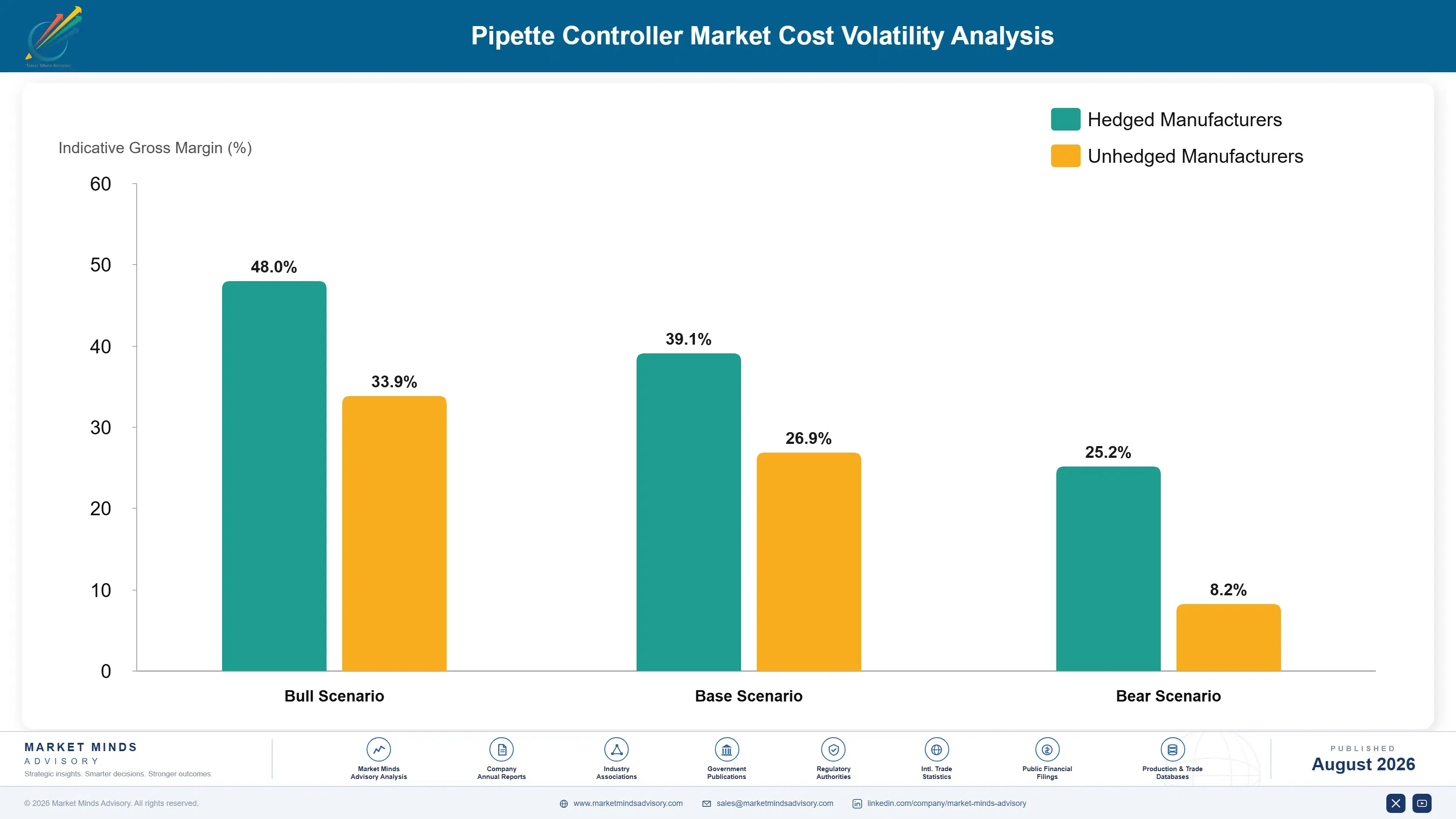
Motor, pump and electronic control assembly account for roughly 41% of manufactured cost, with the rechargeable cell adding around 9% and determining usable life far more than its cost share suggests. Housing, nosepiece and membrane filter components take about 22%, rising where autoclavable and cleanroom-rated materials are required. Assembly, testing and regulatory documentation consume most of the remainder across all device grades.
Electronic component availability rather than price dominated through 2021 and 2022, with controllers and battery cells on extended lead times that delayed instrument shipments regardless of order intake. Sartorius noted supply chain and component availability pressure across its laboratory operations in its Annual Report 2022. Manufacturers on catalogue pricing absorbed most of it, since laboratory list prices are published annually and difficult to adjust mid-period.

The disadvantage falls on manufacturers without a consumable portfolio, and it operates through what a placement is worth rather than through unit cost. A device sold at a competitive price into a laboratory generates attached consumable spending around eighteen times its own value, and a manufacturer without those products watches that revenue accrue to somebody else entirely. Competing harder on device margin addresses the smallest number available in the transaction.
pipette-controller-market-cost-volatility-analysis-1787580429277

Sell devices and consumables through one commercial relationship

Attached serological pipette and filter spending runs around eighteen times device value across a working life, and the placement influences which get bought. Instrument and consumable divisions carrying separate targets prevent that being captured. Aligning the commercial approach costs nothing in manufacturing and converts a small instrument sale into a multi-year revenue stream instead.

Specify replaceable cells and publish ownership cost comparisons

The rechargeable cell adds around 9% of manufactured cost and determines when the device stops working, since it wears out near 500 cycles while everything else lasts far longer. Sealed designs convert a decade-long instrument into a three-year one. Publishing the comparison competes on the variable that actually decides value and which no competitor currently quantifies.

Secure component and cell allocation on multi-year terms

Electronic components and battery cells proved to be an availability problem rather than a price problem, and a missing controller chip halts instrument shipment entirely regardless of demand. Multi-year allocation agreements cost a modest premium and protect delivery. Laboratory customers on consolidated supply agreements remember which suppliers kept shipping during shortages. Availability decides shipment, not price.

Portfolio Architecture for Margin Defence

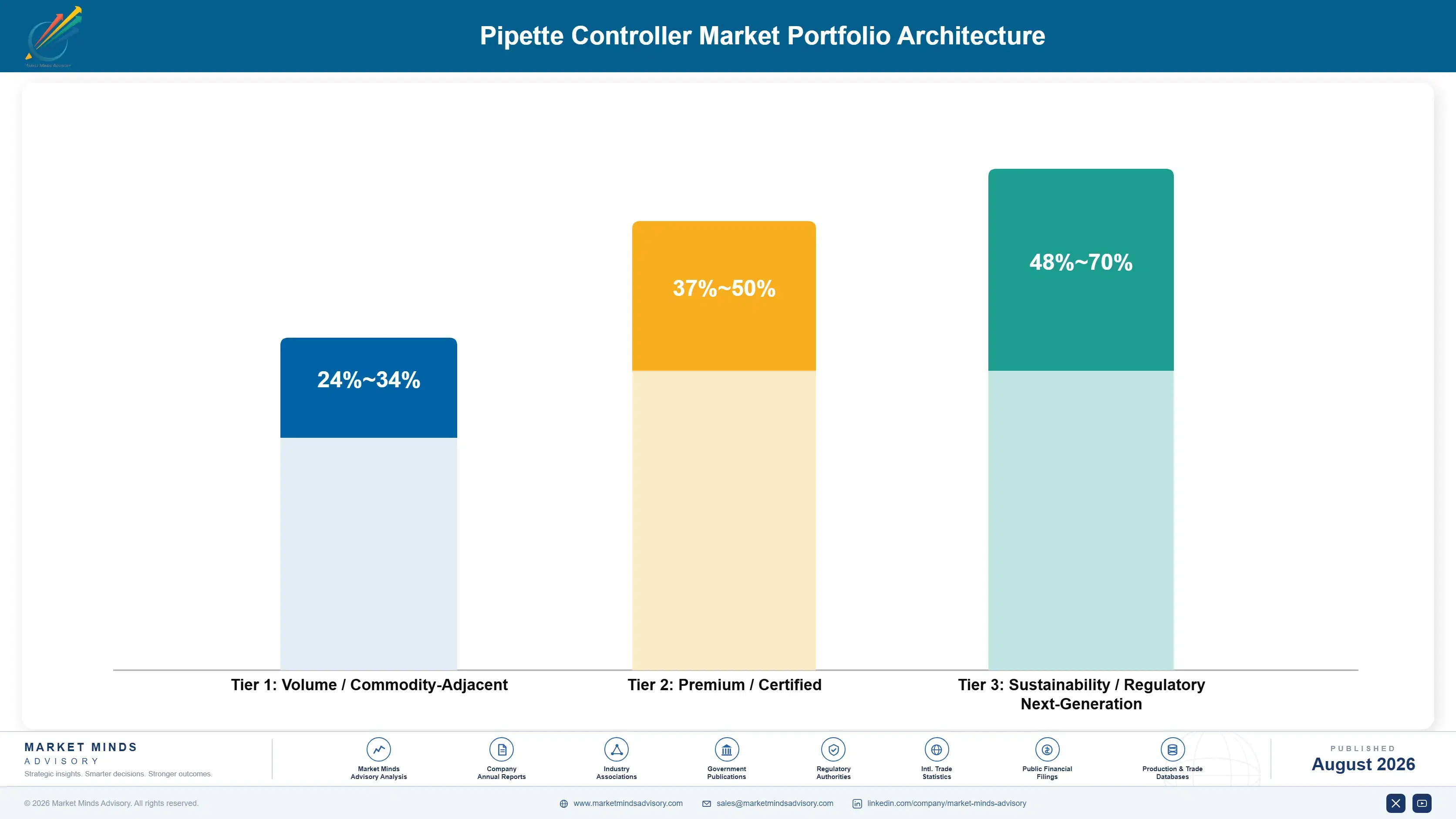
Margin separates on consumable attachment and validation status rather than on device engineering, which is not where a small instrument business expects to compete. Manual and bulb-type controllers run at gross margins in the mid twenties against many suppliers offering functionally identical products. Standard motorised devices run better on brand and catalogue presence. Ergonomic and cordless models run considerably higher on assessment evidence. Sterile-rated validated controllers run highest, because revalidation cost removes price comparison almost entirely from the customer's thinking.
The tension is that device revenue is visible and consumable revenue is larger, and capturing the second requires a portfolio and a commercial structure rather than better engineering. Manufacturers weighted toward instruments alone win placements and forfeit the stream those placements create, which is a peculiar position to occupy knowingly. Several hold both product lines and still sell them through separate organisations with separate incentives, which produces the same outcome for different reasons.

High-value pools sit in validated sterile devices, ergonomic evidence-backed models and attached consumable positions. Manual and standard motorised devices are where functional equivalence has already decided what anybody earns. Functional equivalence at the lower end is not going to change either.

Volume / Commodity-Adjacent

Manual bulb-type and basic motorised controllers competing against functionally equivalent products from many suppliers. The ten-point range separates manufacturers with catalogue presence and component purchasing scale from smaller participants selling through distribution alone.
Gross Margin: 24%-34%

Premium / Certified

Ergonomic and cordless extended-battery models supported by assessment data reaching occupational health budgets. The thirteen-point spread reflects evidence quality and institutional programme access rather than any manufacturing advantage over competitors.
Gross Margin: 37%-50%

Sustainability / Regulatory / Next-Generation

Sterile-rated validated controllers and devices sold with attached consumable programmes. The twenty-two-point range is wide because validation status and consumable attachment vary enormously between manufacturers and individual customer relationships. Attachment varies by relationship.
Gross Margin: 48%-70%
pipette-controller-market-portfolio-architecture-1787580429783

High-value Sub-segments and Strategic Watch-out

Attached Consumable Programmes

Serological pipette and filter spending runs around eighteen times device value across a working life, and the placement influences it. Divisional separation is what prevents most manufacturers capturing any of it. Solving the organisational barrier costs nothing in manufacturing terms. The barrier is purely organisational.
Gross Margin: 52%-70%

Validated Sterile Devices

Growing at 8.8% on biologics capacity, where a device named in a validated procedure persists for the process lifetime. Revalidation cost removes price comparison from the customer's decision entirely. Qualification happens during process development rather than during procurement. Revalidation removes price comparison. Development is the window.
Gross Margin: 50%-66%

Ergonomic Evidence Models

Compounding at 10.5% and reaching occupational health budgets that replace devices when equipment budgets under funding pressure will not. Assessment data rather than specification wins these decisions. Occupational health functions authorise these purchases rather than laboratories. Assessment data is the requirement. Injury data does the persuading.
Gross Margin: 38%-52%

Standard Motorised Devices

The catalogue volume, competing against functionally equivalent products where brand presence and price decide the outcome. Manage this for placement rather than for the margin on the device itself. Catalogue presence and price decide the outcome in this tier. Placement matters more than margin. Brand presence decides it.
Gross Margin: 24%-34%

How Controller Demand Renews

Device demand renews on replacement rather than consumption, and replacement happens when something forces it rather than on any schedule. A controller that still works gets kept, particularly under funding pressure, which makes device revenue lumpy and dependent on institutional programmes. The consumable stream behind the placement renews continuously with laboratory activity, which is why the attachment matters so much: it converts an unpredictable instrument business into a predictable one.
Stickiness runs through validation and habit rather than through contract. A controller named in a validated biologics procedure cannot be changed without revalidation nobody funds for an instrument of this value, which makes those placements effectively permanent. Academic and general laboratory placements are stickier than they look too, since a bench that has standardised on one handling format keeps buying compatible consumables without revisiting the decision.

The buyer has genuinely moved, and manufacturers still selling to laboratory managers are addressing a function that increasingly does not decide. Occupational health programmes fund replacement on injury evidence. Biologics process development names devices during validation. Procurement consolidates catalogue purchasing. In each of those the person choosing is not the person using the device at the bench.
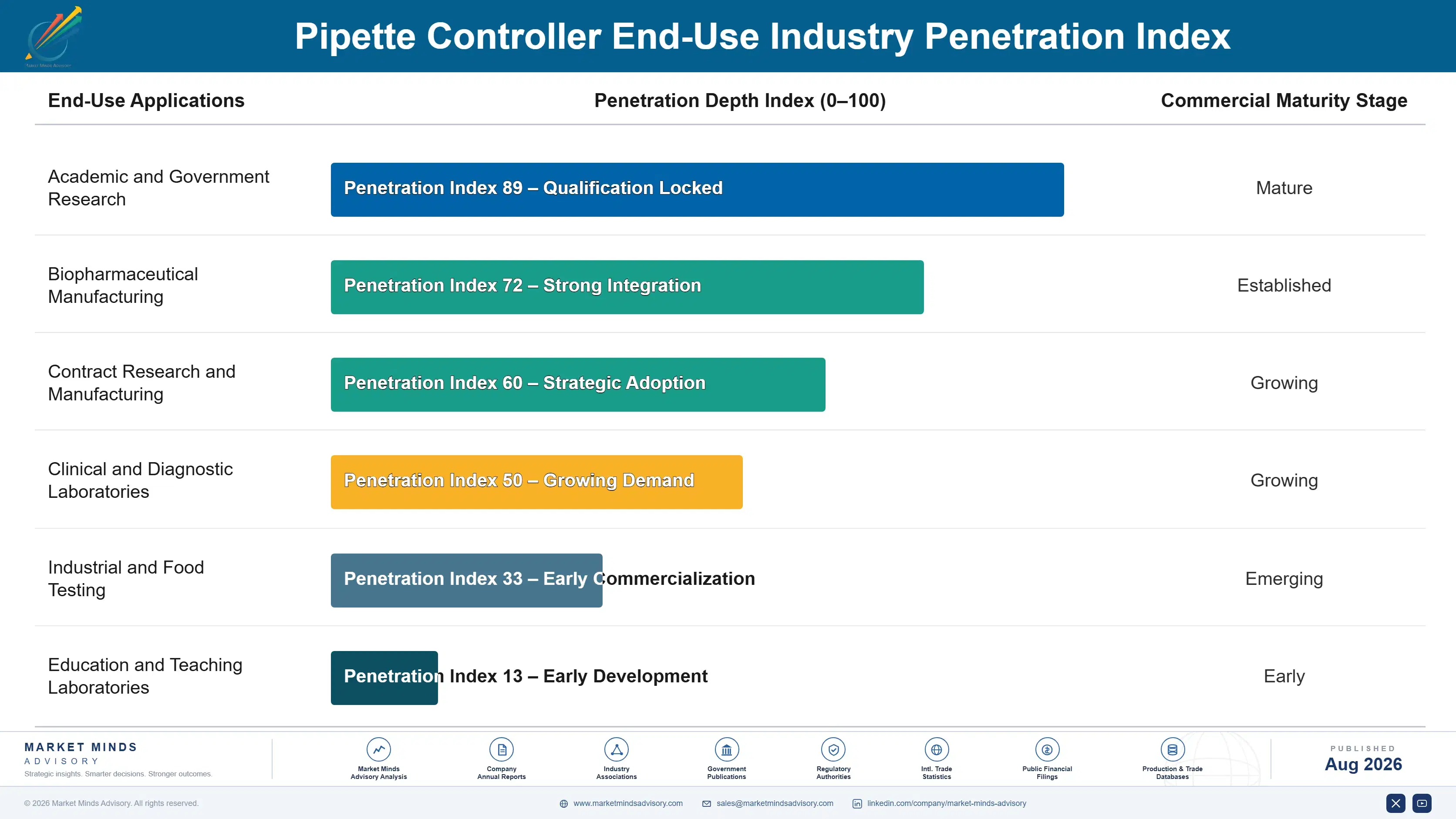
pipette-controller-market-end-use-penetration-index-1787580430271

Where To Place The Bet

These are among the four positions where our research anticipates prominent divergence between winners and laggards over the coming forecast period. Each is grounded in the demand model, the regulatory perimeter, and the announced capacity pipeline.
01 / CONSUMABLE ATTACHMENT CAPTURE

The device sale is the smallest number available

Serological pipette and membrane filter spending attached to a controller placement runs around eighteen times the device cost across its working life, and the controller sitting on the bench genuinely influences which of those a laboratory buys because compatibility, handling and simple habit all favour whoever is already there. Manufacturers holding both product lines and selling them through separate divisions with separate targets forfeit the larger number entirely. The barrier is organisational rather than commercial, which makes it unusually solvable.
02 / BATTERY LIFE DISCLOSURE

Compete on the component that ends the device

Roughly 44% of controllers ship with no user-replaceable power source, and the rechargeable cell inside is rated near 500 charging cycles while the pump, motor and housing comfortably outlast it several times over without difficulty. That quietly converts what should be a ten-year instrument into a three-year one, and purchasing departments discover the arithmetic on their second replacement rather than during any evaluation. A manufacturer offering a replaceable cell and publishing the ownership comparison competes on the variable that actually decides value.
03 / OCCUPATIONAL HEALTH CHANNEL

Sell injury evidence to the budget that pays

Around 34% of laboratory staff report hand or wrist symptoms associated with pipetting, and institutional occupational health programmes now replace controller fleets in circumstances where equipment budgets under research funding pressure simply never would. That is a different budget with a different approver and entirely different evidence requirements from a laboratory purchase. Manufacturers supplying ergonomic assessment data reach those decision makers directly, while those quoting aspiration speed and unit price address a laboratory function that has largely stopped making the decision at all.
04 / VALIDATION WINDOW TIMING

Qualify during process development, not procurement

Biologics and cell therapy manufacture name specific sterile-rated devices inside validated procedures, and once that reference has been written it persists for the entire process lifetime because revalidation costs vastly exceed any price advantage a competing manufacturer could realistically offer. Sterile-rated controllers compound at 8.8%, following biologics capacity construction rather than any equipment replacement cycle at all. Qualification happens during process development, so a manufacturer arriving through procurement has already missed the only decision that genuinely mattered, by a considerable margin.

Engagement Snapshot From the Field

A live engagement with an industry participant carrying material or product regulatory and market exposure ahead of a defining policy shift, showing how our research translates into a defensible multi-year portfolio strategy.
MARKET MINDS ADVISORY · CLIENT ENGAGEMENT SUMMARY
Pipette Controller Producer Strategic Portfolio Review and Transition Roadmap 2026·Investment Scenario on Pipette Controller Exposure Evaluation 2025-26
CLIENT PROFILE
A European laboratory instrument manufacturer with annual revenue around EUR 34 million (client-reported, unverified by MMA), supplying pipette controllers to academic, pharmaceutical and diagnostic laboratories. No serological pipette or filter portfolio existed. Sealed battery designs were used across the range. Sales targeted laboratory managers exclusively. Volumes had been flat for three years. Consumables were absent.
STRATEGIC CHALLENGE
Unit volumes had been flat for three years while the category grew, and management proposed adding device features to differentiate against competitors. Nobody had examined who was actually making replacement decisions or what a placement was worth beyond the device itself. Neither question had been examined. Placement value went unexamined.
MMA APPROACH
MMA traced recent replacement decisions at customer institutions to the budget and function that authorised them rather than to the laboratory that used the devices. Attached consumable spending was quantified per placement across the installed base. Sealed battery cost of ownership was compared against replaceable-cell competitors over a decade. Competitor positions were benchmarked.
KEY FINDINGS
  1. Most replacement decisions had been authorised by occupational health functions on ergonomic grounds, and the client had never presented assessment data to any of them at any point.
  2. Attached consumable spending across the client's installed base substantially exceeded its total device revenue, and every dollar of it was going to other suppliers entirely.
  3. Sealed battery designs meant customers replaced devices roughly three times as often as replaceable-cell competitors required, which several customers had noticed and resented.
  4. Additional device features tested poorly with occupational health approvers, who evaluated posture, weight and injury evidence rather than any functional capability the device offered.
CLIENT PROFILE
A European laboratory instrument manufacturer with annual revenue around EUR 34 million (client-reported, unverified by MMA), supplying pipette controllers to academic, pharmaceutical and diagnostic laboratories. No serological pipette or filter portfolio existed. Sealed battery designs were used across the range. Sales targeted laboratory managers exclusively. Volumes had been flat for three years. Consumables were absent.
STRATEGIC CHALLENGE
Unit volumes had been flat for three years while the category grew, and management proposed adding device features to differentiate against competitors. Nobody had examined who was actually making replacement decisions or what a placement was worth beyond the device itself. Neither question had been examined. Placement value went unexamined.
MMA APPROACH
MMA traced recent replacement decisions at customer institutions to the budget and function that authorised them rather than to the laboratory that used the devices. Attached consumable spending was quantified per placement across the installed base. Sealed battery cost of ownership was compared against replaceable-cell competitors over a decade. Competitor positions were benchmarked.
KEY FINDINGS
  1. Most replacement decisions had been authorised by occupational health functions on ergonomic grounds, and the client had never presented assessment data to any of them at any point.
  2. Attached consumable spending across the client's installed base substantially exceeded its total device revenue, and every dollar of it was going to other suppliers entirely.
  3. Sealed battery designs meant customers replaced devices roughly three times as often as replaceable-cell competitors required, which several customers had noticed and resented.
  4. Additional device features tested poorly with occupational health approvers, who evaluated posture, weight and injury evidence rather than any functional capability the device offered.
RECOMMENDED STRATEGY
Phase 1: Phase one: build ergonomic assessment evidence and take it to occupational health functions, since those authorise the replacements that laboratory budgets no longer fund. Phase 2: Phase two: reinstate user-replaceable cells and publish the ownership comparison, which addresses a genuine customer grievance and differentiates on a variable nobody else quantifies. Phase 3: Phase three: partner or distribute serological pipettes and filters so placements generate the consumable revenue they already create for competitors.
OUTCOME
Ergonomic evidence has opened institutional programmes the client previously never reached. Replaceable cells are reinstated across the range and cited by customers in recent wins. A consumable distribution arrangement is in place, and the client reports revenue per placement improving substantially (client-reported, unverified by MMA).

Frequently Asked Questions

Foundational context covering the market sizes, CAGR, scope, country, region and competition that inform every finding below. This section is provided to cover basics and most often pre-purchase conversations, answered from the MMA Primary Research Dataset.

What is the current size of the Pipette Controller Market?

The market was valued at USD 0.34 billion in 2025, rising to an estimated USD 0.36 billion in 2026. North America holds the largest regional share at 32% of value.

How large will the Pipette Controller Market be by 2036?

MMA forecasts USD 0.72 billion by 2036 under the base case, an expansion multiple of 1.97 times the 2026 value. That represents USD 0.36 billion of incremental value.

What is the CAGR for the Pipette Controller Market 2026 to 2036?

The base case runs at 7.0% compound annual growth between 2026 and 2036, with a bull case at 8.2% and a bear case at 5.8%. Historical growth from 2020 to 2025 was 5.8%.

Which segment is growing fastest?

Cordless extended-battery systems lead at 10.5%, half again the market rate, driven by ergonomics programmes rather than by performance. Sterile-rated controllers follow closely at 8.8%.

Who are the major companies in the Pipette Controller Market?

Thermo Fisher Scientific, Sartorius, Eppendorf, INTEGRA Biosciences and BRAND hold 58% of the market. Catalogue reach and validated positions rather than device engineering sustain that.

Which country is growing fastest?

China leads at 10.6%, driven by biopharmaceutical and contract manufacturing capacity being constructed at a scale that no other market in the world currently matches.

Report Segmentation Architecture

The full report scope spans multiple orthogonal segmentation dimensions, with cross-tabulated demand data provided for each dimension pair. Coverage extends further to regional breakdowns, trend trajectories, and the competitive detail needed to support segment-level decision-making.

By Device Type

  • Standard Motorised Controllers
  • Lightweight Ergonomic Controllers
  • Cordless Extended-Battery Systems
  • Cleanroom and Sterile-Rated Controllers
  • Multichannel and Specialty Controllers
  • Manual and Bulb-Type Controllers

By End-Use Industry

  • Academic and Government Research
  • Biopharmaceutical Manufacturing
  • Contract Research and Manufacturing
  • Clinical and Diagnostic Laboratories
  • Industrial and Food Testing
  • Education and Teaching Laboratories

By Purchasing Channel

  • Direct Manufacturer Supply
  • Laboratory Catalogue Distribution
  • Consolidated Supply Agreements
  • Occupational Health Programmes
  • Tender and Institutional Procurement

By Region

  • North America
  • Western Europe
  • East Asia
  • South Asia and Pacific
  • Latin America
  • Middle East and Africa
  • Eastern Europe

Scope, Methodology, and Coverage

Every figure in this report is reproducible from documented input assumptions. The scope below maps the historical period, the forecast horizon, the segmentation dimensions, and the countries covered, alongside the underlying primary and qualitative methodology.
Historical Period
2020 to 2025
Forecast Period
2026 to 2036
Base Year
2025 (USD billions; MMA Primary Research Dataset, August 2026)
Market Definition
The market comprises motorised and manual pipette controllers used with serological pipettes, including standard motorised controllers, lightweight ergonomic controllers, cordless extended-battery systems, cleanroom and sterile-rated controllers, multichannel and specialty controllers, and manual and bulb-type controllers, supplied through direct, catalogue, consolidated agreement, occupational health and tender channels. Value is measured at manufacturer level on device and dedicated accessory revenue. Air displacement micropipettes and tips, serological pipettes and disposable labware, automated liquid handling platforms, syringe pumps and dispensers, and general laboratory consumables fall outside scope.
Quantitative Units
USD billions (current prices); units shipped annually; USD per unit by device type and channel
Segmentation Dimensions
By Device Type; By End-Use Industry; By Purchasing Channel; By Region
Regions Covered
North America, Western Europe, East Asia, South Asia and Pacific, Latin America, Middle East and Africa, Eastern Europe
Countries Covered
United States, Canada, Mexico, Brazil, Argentina, Colombia, Germany, Switzerland, United Kingdom, France, Ireland, Netherlands, Sweden, Denmark, Italy, Spain, Poland, Czechia, Hungary, China, Japan, South Korea, Taiwan, Singapore, India, Australia, New Zealand, Saudi Arabia, United Arab Emirates, South Africa
Key Companies Profiled
Thermo Fisher Scientific, Sartorius, Eppendorf, INTEGRA Biosciences, BRAND, Corning, Gilson, Hamilton Company, Socorex, Heathrow Scientific, Argos Technologies, Drummond Scientific, Capp, Labnet International, DLAB Scientific, Accumax, Hirschmann Laborgerate, Vitlab, Scilogex, Rainin
Quantitative Methodology
Primary survey, n=3,800 respondents, Q4 2025, six countries; demand-side model with trade association cross-validation
Qualitative Methodology
47 expert interviews, Q4 2025; applied to validate demand model assumptions, identify emerging dynamics, and assess competitive positioning
Report Format
PDF and XLSX data workbook (Word format preview document)
Publisher
Market Minds Advisory
Report Code
MMA-2026-MED-116
Published
August 2026
Contact
sales@marketmindsadvisory.com | www.marketmindsadvisory.com

Purchase the full Pipette Controller Market Report (2026 to 2036).

The full report sizes the global pipette controller market to 2036 across six device types and seven regions, measured at manufacturer level on device and accessory revenue. It quantifies attached consumable spending per placement, which is the number that determines what a controller is genuinely worth to whoever supplies it. Competitive analysis covers 20 manufacturers on one consistent revenue basis, with moat and risk assessment for the two leaders. Battery-limited device life and occupational health purchasing routes are assessed separately by region. Four quantified revenue levers close the analysis.
Six device type segments with individual growth rates
Attached consumable spending quantified per controller placement
Battery-limited device life modelled against sealed design share
Occupational health purchasing routes mapped against equipment budgets
Twenty-manufacturer competitive map on one consistent revenue basis
Four quantified revenue levers with commercial impact ranges

Built For The People Who Decide

From boardroom strategy to bench-side execution, this report is read cover-to-cover by leaders shaping the next decade of their industry, turning demand scenarios, market dynamics and valuation benchmarks into decisions.
CXOs/ Presidents/ VPs/ Managers
M&A and Corporate Development
Strategy Teams and R&D Heads
Procurement and Product Directors
Regulatory and Compliance Leaders
Investor Relations and Equity Analysts