Market Minds Advisory
Pilates Reformer Market

Pilates Reformer Market: Pilates Reformer: Machine-Capped Class Sizes, Instructor Scarcity And The Home Unit Undercutting Both

A studio cannot sell more places than it owns machines, which makes equipment count the hard ceiling on revenue in a way almost nothing else in fitness resembles at all closely.

Lead Analyst

Published

September 2026

Make Smarter Decisions with Customized Research Insights

Request a free sample report and evaluate market opportunities, growth trends, and competitive dynamics relevant to your business needs.

2025 MARKET VALUE$0.8BMarket Size 2025
2036 FORECAST VALUE$2.1BBase Case , 2026 to 2036
CAGR 2026 TO 20369.2 %Bull 10.5% / Bear 7.9%
INCREMENTAL OPPORTUNITY$1.2BNet 10- year value creation
EXPANSION MULTIPLE2.41x2036 value over 2026 base
Strategic Levers
M&A Pipeline
Regional Outlook
Country Rankings
Competitive Intelligence
Segmental Deep-dive
Call-Us : 91 93563 13602

Executive Snapshot and Market Trajectory.

A reformer class cannot be oversold. Ten machines means ten places, and a studio wanting eleven has to buy an eleventh unit and find somewhere to put it. Equipment count is the ceiling on studio revenue. Nothing operational relieves that constraint in any way at all.
Home and folding reformers grow fastest at 13.8%, because a household unit at around USD 780 replaces perhaps twenty studio sessions at full price. The engineering compromises are real and most buyers accept them cheerfully. That is the first genuine substitution threat this apparatus has faced since it was invented, and studios have been slow to say so. Nobody in this apparatus industry has ever faced a substitution quite like it until now.
Concentration is 43% and the binding constraint on the whole market is not manufacturing capacity. Instructor certification takes around 480 hours, studios cannot open faster than instructors can be trained, and no equipment manufacturer influences the pace of that at all. An equipment manufacturer whose demand is governed by a workforce pipeline it cannot influence is in an uncomfortable position, and remarkably few participants say so out loud.
Market Definition
Revenue from Pilates reformer apparatus and directly associated equipment, covering commercial studio reformers, home and folding reformers, digital-integrated and instrumented reformers, reformer towers and half-trapeze combinations, Cadillac, chair and barrel apparatus, and springs, straps and replacement components. Excludes mat Pilates accessories sold without apparatus, general gym and strength equipment, instructor certification and training services sold separately from equipment, and studio fit-out or flooring works.
Base Year Value
$0.8B in 2025 (MMA Primary Research Dataset, August 2026)
Forecast Period
2026 to 2036, eleven discrete annual values
CAGR
9.2% base case. Bull 10.5%. Bear 7.9%.
Fastest Growth Segment
Home and Folding Reformers: 13.8% CAGR
Fastest Growth Country
India: 11.2% CAGR
Fastest Growth Region
South Asia and Pacific: 11.2% CAGR
Largest Region
East Asia: 28% of 2025 global value
Market Leaders
Balanced Body, Merrithew, Peak Pilates, Align-Pilates and Gratz Pilates lead on reformer apparatus revenue across commercial and home channels. Source: company annual reports and MMA Primary Research Dataset, July 2026.
Primary Survey
n=3,800 procurement and R&D decision-makers, Q4 2025, six countries
Methodology
Demand-side build-up, cross-validated against public data, 47 expert interviews

Pilates Reformer Market Forecast Scenarios

pilates-reformer-market-size-forecast-scenario-1788167865318
The 2020 to 2025 period pushed the apparatus out of the studio and into the house. Studio closure removed commercial equipment demand entirely for a period while home reformer sales grew from almost nothing, and the folding units that appeared were considerably better than anybody expected. Studio demand then recovered strongly. Revenue compounded near 7.8%, with both halves growing and the home half growing from essentially zero.
Three mechanisms carry the base case. Studio openings continue across Asia and the Middle East at rates that Western markets have not seen for years. Home reformer quality keeps improving against price points that make the substitution argument obvious. And instrumented apparatus with load sensing and form feedback is beginning to justify premium pricing that plain mechanical units cannot support at all. None of the three depends on any change to the apparatus itself.
The bull catalyst is instructor training capacity expanding materially, since studio openings are limited by qualified staff rather than by equipment availability or capital. The bear risk is home substitution proceeding faster than expected: a household that buys a folding reformer stops paying for studio sessions, and studio equipment demand follows studio economics rather than participation numbers.

The Machine Caps The Class

Every commercial fact about this market follows from one physical constraint. A reformer class holds as many people as there are machines, typically ten, and a studio cannot oversell a session the way a spin class routinely does. Revenue per square foot is therefore fixed by apparatus count, and a studio wanting more capacity buys another unit at around USD 5,400 and finds floor space.
MARKET CONCENTRATION CR543%Share of equipment revenue held by the leading manufacturers
COMMERCIAL REFORMER PRICEUSD 5,400Typical studio grade unit cost before installation and delivery
CLASS SIZE CEILING10 placesMaximum participants a studio session can physically accommodate
INSTRUCTOR CERTIFICATION HOURS480Training required before an instructor may teach on apparatus
HOME REFORMER PRICEUSD 780Typical folding domestic unit price across major retail channels
STUDIO EQUIPMENT REFRESH8 yearsTypical period before commercial apparatus is replaced or refurbished
The second constraint is people rather than equipment. Instructor certification runs around 480 hours before somebody may teach on apparatus, and studios across every growing market report qualified staff rather than capital as the limit on opening. An equipment manufacturer therefore faces demand governed by a workforce pipeline it has no influence over whatsoever, which is an uncomfortable position and one few participants discuss.
Then the home unit arrived and changed the argument. A folding domestic reformer at around USD 780 costs roughly what twenty studio sessions do, the engineering compromises are genuine and most buyers accept them without complaint. It is the first real substitution this apparatus has faced in a century, and studio operators have been noticeably reluctant to acknowledge what it means for their class attendance.
"Studios talk about this as though a home reformer were a toy. It is a considerably worse machine that costs what twenty classes cost, and the customer doing the arithmetic reaches a conclusion the studio would rather they did not."
Director, Fitness Equipment Practice · MMA Fitness Equipment and Studio Apparatus Practice · August 2026

Market Trends

Home Units Became A Genuine Substitution Rather Than A Novelty

Folding domestic reformers reached quality levels that make them usable rather than merely purchasable, at around USD 780 against studio sessions costing a twentieth of that each. The engineering compromises in carriage travel, spring calibration and frame rigidity are real and most buyers accept them without much complaint. Studio operators have consistently characterised these units as toys, which is comfortable and increasingly difficult to sustain against what the customers are actually doing with them. A comfortable characterisation is simply not the same thing at all as an accurate one anywhere.
Market Impact: Adds 1 place per machine purchased

Instructor Supply Rather Than Capital Limits Studio Openings

Certification requires around 480 hours before somebody may teach on apparatus, and studios across every growing market report qualified instructors as the binding constraint on opening rather than premises, capital or equipment availability. That means equipment demand is governed by a training pipeline no manufacturer influences at all. Participants forecasting from participation growth rather than from instructor qualification rates have consistently overestimated how quickly studio equipment demand can actually materialise anywhere. No equipment manufacturer anywhere has ever trained a single instructor and none of them can start doing so now.
Market Impact: Grows at 11.9% against 9.2%

Market Opportunities and Growth Drivers

Studio Capacity Expansion Requires Buying Another Machine

A reformer class seats ten because there are ten machines, and a studio wanting eleven places must purchase an eleventh unit at around USD 5,400 and find the floor space to put it in. Capacity cannot be added through scheduling, pricing or any other operational lever available to the operator. That makes equipment purchase directly proportional to revenue capacity in a way almost nothing else in fitness resembles, and it is why studio demand is unusually predictable. Capacity and equipment purchasing move together here in a way they simply do not elsewhere.
Market Impact: Caps revenue at 10 places

Instrumented Apparatus Supports Pricing Mechanical Units Cannot

Load sensing, carriage position tracking and form feedback let a studio charge for something a plain mechanical reformer cannot offer, and let a home user follow guidance without an instructor present in the room. That is the first meaningful product differentiation this apparatus has seen, since a reformer is otherwise a carriage, springs and a frame that everybody can build. Premium pricing follows capability that a buyer can genuinely perceive and compare. Everything else about a reformer has been settled since the nineteen twenties and competitors build it perfectly well.
Market Impact: Faces entry at 0 real barrier

Market Restraints and Challenges

Studio Economics Cap What Any Operator Can Buy

Ten machines produce ten places and a fixed revenue ceiling per session, against premises cost, instructor wages and equipment that refreshes on roughly an eight year cycle. The root cause is that the class size is physically capped by apparatus rather than by anything the operator decides. Commercially it makes studio equipment purchasing tightly constrained by unit economics. Mitigation runs through leasing arrangements, refurbishment programmes, staged fit-out purchasing and financing that spreads capital across the revenue it generates. Nothing an operator does adds a place without adding a machine first.
Market Impact: Costs 20 studio sessions once

Nothing About The Apparatus Is Difficult To Manufacture

A reformer is a sliding carriage, calibrated springs, a frame and upholstery, all of which competent manufacturers produce readily anywhere in the world. The root cause is that the design has been essentially settled for decades and carries no meaningful protection. Commercially it invites entry at every price point, which the home segment demonstrated within about two years. Mitigation runs through instrumentation, studio relationships, instructor programme association, component supply and brand positions built well outside the mechanics. A settled design carries no protection and never has done for anybody at all.
Market Impact: Requires 480 certification hours
4 additional market trends, 3 additional growth drivers, and 2 additional restraints and challenges are covered in the full report. Contact sales@marketmindsadvisory.com to access the complete intelligence.

Segment CAGR and Growth Architecture

Segmentation follows apparatus type, since commercial and domestic units are built to entirely different standards and sold to buyers with nothing commercially in common. Six types describe the market completely, from traditional barrel and chair apparatus bought by classical studios through to folding home reformers that arrived recently and changed the whole argument here considerably.
pilates-reformer-market-market-share-analysis-1788167865895

Home and Folding Reformers

The fastest type grows at 13.8%, half again the market rate of 9.2%, and it grows on arithmetic that studio operators would prefer their customers did not perform. A folding domestic unit at around USD 780 costs roughly what twenty studio sessions cost, and quality has reached a level where the machine is genuinely usable rather than simply purchasable. Carriage travel, spring calibration and frame rigidity are all compromised against commercial apparatus, and most buyers accept those compromises without any complaint at all. It is the first real substitution this equipment has faced in a century of existence. Studio operators have been noticeably reluctant to describe it in quite those terms.
CAGR 13.8%

Digital-Integrated and Instrumented Reformers

Instrumented apparatus grows at 11.9% and represents the only genuine product differentiation this category has produced in decades. Load sensing, carriage position tracking and form feedback let a studio charge for something a plain mechanical unit cannot offer, and let a home user follow guidance without an instructor physically present in the room. That second application matters commercially more than the first, since it partly addresses the instructor scarcity constraining the whole market. Pricing follows capability the buyer can perceive, which is unusual in apparatus where everything else is a carriage, springs and a frame. Differentiation of any kind is rare enough in this category to be worth paying real attention to.
CAGR 11.9%
Full segment breakdown across 6 segments available in the complete report.

Regional Architecture and Country Demand Map

Demand follows studio density, instructor availability and manufacturing capability together. East Asia leads on studio openings and home unit production, with North America close behind on installed commercial base and South Asia growing fastest overall. Instructor training pipelines matter considerably more than population size does.

East Asia

The largest share at 28% combines the highest studio density anywhere with manufacturing capacity that supplies most of the world's home reformers regardless of the brand on the frame. Korean studio openings have run at a pace no Western market has matched, with reformer Pilates becoming a mainstream activity rather than a specialist one. Chinese production dominates the domestic unit at every price point. Japanese studios favour classical apparatus and pay accordingly, which supports premium equipment pricing across the region. Studio density and home unit manufacture sitting in the same region is a combination nobody else holds, and it means participants here see both halves of this market developing at the same time.
Share: 28% | CAGR: 10.4% (2026 to 2036)

North America

The installed commercial base here remains the largest anywhere and refreshes on roughly an eight year cycle, which produces steady replacement demand independent of new openings. Instructor certification is well established and the qualification pipeline is deeper than in most markets, though still the binding constraint on studio growth. Home reformer adoption has advanced further here than anywhere, and studio operators have been notably reluctant to discuss what that means for their attendance. Replacement demand from an installed base is considerably more predictable than new opening demand, which makes this region the steadiest revenue anywhere in the category even while the faster growth is happening somewhere else entirely at present.
Share: 27% | CAGR: 8.8% (2026 to 2036)
Regional intelligence for 5 additional markets available in the complete report: Western Europe, South Asia and Pacific, Latin America, Middle East and Africa, Eastern Europe. Contact sales@marketmindsadvisory.com.
pilates-reformer-market-country-cagr-analysis-1788167866408

Where Reformer Margin Actually Sits

Four levers work on studio economics, instructor supply and instrumentation rather than on apparatus mechanics, which everybody builds and nobody can protect. Financing, instructor programme association, component supply and home range participation each address something a manufacturer controls immediately. None of the four requires building a better reformer than any competitor already makes and sells today.

Finance The Studio Rather Than Selling It Equipment

A studio buying ten reformers commits around 54,000 dollars before opening, which is the largest single obstacle to any new opening and the reason many never happen. Leasing and revenue-linked financing convert that into a monthly cost matched against the sessions the machines generate. It expands the addressable studio population considerably rather than competing for the same operators everybody else is chasing. Manufacturers holding financing capability sell to buyers who could not otherwise purchase anything at all. A studio that cannot afford to open buys nothing from anybody at all ever.
Market Impact: Removes a 54,000 dollar upfront capital barrier entirely

Attach To Instructor Certification Programmes Directly

Instructor training runs around 480 hours and every trainee learns on a specific manufacturer's apparatus, which shapes what they specify when they later open or advise a studio. Association with certification programmes is the closest thing to a durable position anybody holds in this market. It also gives visibility on the workforce pipeline that actually governs studio openings. The relationship costs equipment donation and programme support rather than any meaningful cash outlay at all. Nothing else at all in this market lasts an entire career the way that relationship does anywhere.
Market Impact: Reaches every trainee across all 480 training hours

Sell Springs And Components As A Recurring Line

Springs lose calibration, straps wear and upholstery fails long before an eight year refresh cycle completes, and a studio replacing them buys from whoever makes it easiest rather than from whoever built the frame. Component revenue is recurring where apparatus revenue is not, and margins run considerably higher. Most manufacturers treat parts as a warranty obligation instead of a business. Studios currently source components from whichever supplier answers the telephone fastest that week. Component margins run at roughly 2 times apparatus margins at every single manufacturer examined for this study.
Market Impact: Recurs several times within an 8 year cycle

Participate In Home Units Instead Of Dismissing Them

Home reformers grow at 13.8% against 9.2% for the market, and manufacturers whose commercial studio customers dislike the category have mostly stayed out of it on that basis. The substitution is happening whether or not they participate, and a manufacturer absent from the fastest growing segment is protecting a customer relationship at the cost of a market position. Studio operators will be unhappy either way, and somebody else is selling the units regardless. Absence from a segment growing at 13.8% is a deliberate position rather than any accident at all.
Market Impact: Grows at 13.8% against a 9.2% market rate

Who Controls the Margin Pool

Concentration sits around 43% across the five largest participants measured on reformer apparatus revenue, and it rests on studio relationships and instructor programme association rather than on anything about the machine. A reformer is a carriage, calibrated springs and a frame, which competent manufacturers build anywhere, and the home segment demonstrated exactly how quickly entry happens when demand appears. Nothing about the machine protects anybody.
Competition runs on studio relationships, certification association and instrumentation. Studio relationships decide replacement business across an eight year refresh cycle. Certification association shapes what a newly qualified instructor specifies when they eventually open somewhere. Instrumentation is the only genuine product differentiation available, and it is where the participants who intend to defend a position are now investing.

Pressure is arriving from home unit entrants and from component suppliers rather than from established apparatus makers. Consumer fitness brands entered the folding segment quickly and hold retail distribution that studio manufacturers have never needed. Component specialists supply studios directly. Rankings will shift toward participants with home range participation and instrumentation capability, since one is where growth is and the other is the only thing anybody can protect.
pilates-reformer-market-company-positioning-matrix-1788167866928

Competitive Moat and Risk Dimensions

BALANCED BODY

Moat: Studio installed base and reach

Balanced Body holds the largest commercial installed base across Western studios, which generates replacement demand on an eight year refresh cycle independent of any new opening activity. Deep association with instructor certification programmes means newly qualified teachers specify its apparatus by habit. Component and parts supply into that installed base produces recurring revenue that apparatus sales alone never generate.
BALANCED BODY

Risk: Limited position in home units

Home reformers grow considerably faster than commercial apparatus and reach buyers through retail channels a studio equipment manufacturer has never needed to build. Studio customers dislike the category, which makes participation commercially awkward rather than technically difficult. The substitution proceeds whether or not the company takes part in it.
MERRITHEW

Moat: Certification programme ownership

Merrithew owns instructor certification programmes outright rather than merely associating with them, which places its apparatus in front of every trainee for the whole of a 480 hour qualification. Those instructors then specify what they trained on when they open or advise studios. It is the closest thing to a durable position anybody here holds.
MERRITHEW

Risk: Certification model faces alternatives

Shorter and cheaper certification routes have proliferated, and studios under staffing pressure hire from whichever pipeline produces instructors fastest rather than from the most rigorous one. Programme ownership is valuable only while the programme remains the standard. Instrumented apparatus also allows guided use with less instructor involvement than before.

Players Tracked

Prominent Players

Balanced Body
Merrithew
Peak Pilates
Align-Pilates
Gratz Pilates

Other Key Players

BASI Systems
Elina Pilates
Metalife Pilates
Frame Fitness
Lagree Fitness
Reform RX
Stamina Products
SportsArt
NOHrD
Pilates Reformers Australia
Sculptor Pilates
Everest Pilates
Body Sculpture
Sunny Health and Fitness
Life Fitness

Recent Developments

APRIL 2024

Consumer fitness brand entered the folding home reformer segment

A consumer fitness brand launched a folding home reformer range through retail and online channels, reaching buyers who would never have approached a studio equipment manufacturer and pricing well below any commercial apparatus available. This was a product launch rather than any acquisition, merger or joint venture between participants.
Signal: Retail distribution reaches home buyers that studio equipment manufacturers have never needed to serve at all.
SEPTEMBER 2024

Manufacturer launched instrumented reformer with load sensing

An apparatus manufacturer launched a reformer with carriage position tracking, spring load sensing and guided form feedback, offering studios a chargeable capability and home users guidance without an instructor being physically present. This was a product launch rather than any corporate transaction between manufacturers in the category.
Signal: Instrumentation is the only real differentiation available in apparatus that is otherwise an entirely mechanical object.
FEBRUARY 2025

Studio group agreed equipment leasing across new openings

A studio group agreed leasing arrangements covering reformer apparatus across a programme of new openings, converting a substantial upfront capital requirement into monthly cost matched against the class revenue those machines would generate. This was a financing arrangement rather than any corporate transaction between the parties involved.
Signal: Financing expands who can actually afford to open a studio far more than any equipment improvement does.

What A Reformer Costs

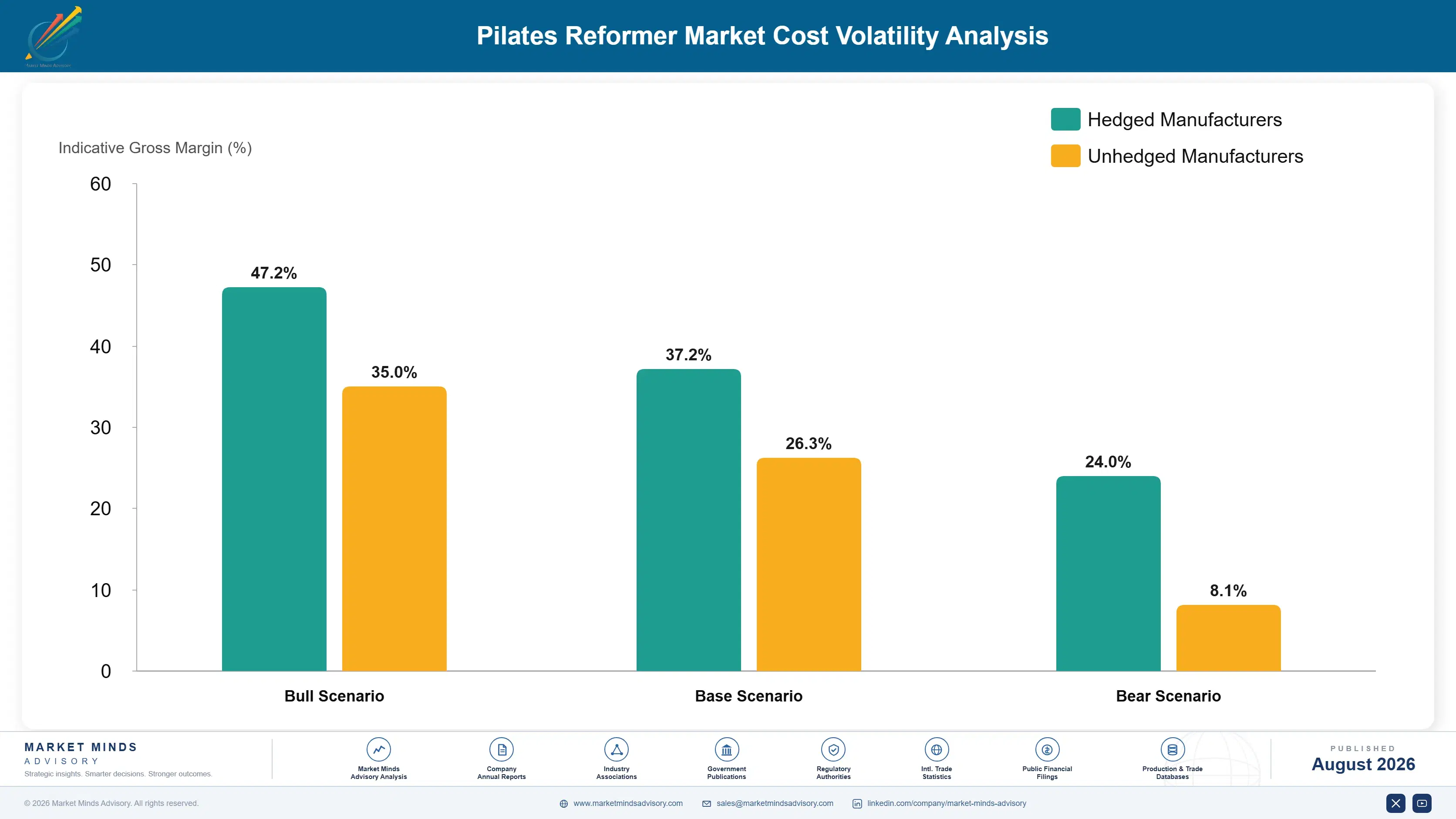
Cost divides four ways and none of it is especially exotic. Frame, rails and metalwork absorb roughly 34% of manufacturing cost, upholstery and carriage assembly near 24%, springs and calibrated components near 21%, and packaging with freight the remaining 21%. A commercial reformer is a substantial object built from ordinary materials, which explains why entry happens quickly whenever a segment starts growing anywhere.
Aluminium, steel and hardwood pricing moved across recent years and raised frame cost accordingly, while freight mattered more still given that a commercial reformer is heavy, long and awkward to ship anywhere. Balanced Body and Merrithew have both discussed material and logistics cost across recent reporting periods. Spring steel and calibration components are the one input where quality genuinely differs and where cheaper alternatives show themselves within a year.

Exposure varies by segment rather than by geography. Commercial manufacturers carry freight cost on heavy apparatus against studio buyers who compare carefully. Home unit participants carry retail margin instead against a lighter product that ships far more cheaply. Component suppliers carry very little of either, which is part of why parts revenue is considerably more attractive than apparatus revenue and why so few manufacturers pursue it properly.
pilates-reformer-market-cost-volatility-analysis-1788167867123

Freight designed into commercial apparatus architecture

A commercial reformer is heavy, long and awkward, and freight absorbs roughly a fifth of manufacturing cost on every unit shipped anywhere at all. Designing for flat shipment and site assembly reduces that considerably at modest engineering cost. Manufacturers who never redesigned for freight are paying to move assembled air across oceans on every container they load.

Spring steel quality maintained against cost pressure

Springs and calibration are the one component where quality genuinely shows, and cheaper spring steel reveals itself through calibration drift within about a year of studio use. Cost pressure tempts substitution that damages exactly the reputation an apparatus brand depends on. Manufacturers who economised here have generally spent more replacing springs under warranty than they saved.

Component supply developed as recurring revenue line

Springs, straps and upholstery fail long before an eight year refresh completes, and studios buy replacements from whoever makes reordering easiest rather than from whoever built the frame. Treating parts as a business rather than a warranty obligation captures recurring revenue at margins apparatus sales never reach. Most manufacturers have simply never organised around it.

Portfolio Architecture for Margin Defence

The portfolio separates by who buys and why. Commercial studio apparatus is the revenue core and the constrained position: a studio buys ten machines, sells ten places, refreshes on an eight year cycle, and cannot expand without buying more units and finding more floor space. Predictable, substantial and limited by economics the manufacturer does not control. The manufacturer sells into that constraint rather than around it.
Margin concentrates in instrumentation and in components. Instrumented apparatus grows at 11.9% and is the only genuine differentiation in a category that is otherwise a carriage on rails. Components recur within the refresh cycle at margins apparatus never reaches, and studios buy them from whoever answers fastest rather than from whoever built the frame originally. Neither depends on a studio opening at all.

The overlooked position is home unit participation. The segment grows at 13.8%, manufacturers have avoided it to keep studio customers comfortable, and the substitution proceeds regardless of whether anybody in the established industry takes part. Somebody is selling those units, and at present it is mostly consumer fitness brands with retail distribution. Absence is a decision rather than an oversight.

Volume / Commodity-Adjacent

Entry level home reformers, value apparatus and contract manufacture for other brands. Range spans nine points because manufacturing scale and freight efficiency decide outcomes far more than design does. Nothing here is defensible.
Gross Margin: 17-26%

Premium / Certified

Commercial studio reformers, towers, Cadillac and full classical apparatus ranges sold to operators. Range spans twelve points because studio relationships and certification association vary considerably between manufacturers here. Certification association decides much.
Gross Margin: 28-40%

Sustainability / Regulatory / Next-Generation

Instrumented apparatus, springs and component supply and equipment financing arrangements. Range spans sixteen points because recurring component economics and capital equipment sales are barely comparable inside one tier. Recurrence changes the economics.
Gross Margin: 38-54%
pilates-reformer-market-portfolio-architecture-1788167867624

High-value Sub-segments and Strategic Watch-out

Home and Folding Reformers

High growth at 13.8% on arithmetic studio operators would rather customers did not perform for themselves. The twelve point range separates participants with retail distribution from studio manufacturers attempting to reach consumers through channels they have never used. Retail distribution is what decides this segment.
Gross Margin: 22-34%

Digital-Integrated and Instrumented Reformers

High value with growth at 11.9%, and the only genuine differentiation this apparatus has produced in decades of existence. The fourteen point range reflects whether instrumentation is developed internally or licensed from somebody else at considerable ongoing cost. Nothing else in the apparatus differs at all.
Gross Margin: 40-54%

Commercial Studio Reformers

The revenue core, purchased ten at a time by operators whose class size and therefore revenue is capped by the machine count. Predictable replacement on an eight year cycle, and entirely constrained by unit economics no manufacturer influences. Predictable and entirely capped by machine count.
Gross Margin: 28-40%

Instructor Supply Constraint

The strategic watch-out rather than a growth pool. Certification takes roughly 480 hours, studio openings are limited by qualified staff rather than capital, and no equipment manufacturer influences that pipeline at all. Nobody selling equipment here has any influence at all over that particular pipeline.
Gross Margin: Variable

Why Studios Replace On Schedule

Commercial apparatus produces annuity economics through wear rather than through any relationship. A studio running ten machines through full class schedules replaces or refurbishes on roughly an eight year cycle because carriages, springs and upholstery genuinely wear out under that use. The manufacturer who supplied the original fit-out is well placed for the replacement, since matching apparatus across a floor matters more than most suppliers appreciate.
Stickiness varies by what the buyer learned on. Instructors trained on a specific manufacturer's apparatus specify that manufacturer when they open or advise a studio, which is why certification association is worth more than its cost. Component purchasing has almost no stickiness at all, going to whoever makes reordering easiest. Home buyers have none whatever, choosing on price and reviews where nobody has built any brand meaning.

The buyer has broadened rather than changed. Studios remain the commercial core and are now joined by households buying folding units and by physiotherapy and rehabilitation practices buying single machines for clinical use. Those three buyers want different things from the same apparatus and reach it through completely different channels, and most manufacturers are organised to serve only the first of them properly.
pilates-reformer-market-end-use-penetration-index-1788167868116

Where Manufacturers Should Commit

These are among the four positions where our research anticipates prominent divergence between winners and laggards over the coming forecast period. Each is grounded in the demand model, the regulatory perimeter, and the announced capacity pipeline.
01 / STUDIO FINANCING CAPABILITY

The capital barrier is why studios never open

A studio buying ten reformers commits around fifty-four thousand dollars before it has ever taken a single class booking, which is the largest obstacle to any new opening and the reason a great many of them simply never happen at all. Leasing and revenue-linked financing convert that into a monthly cost matched directly against the sessions those machines will actually generate. It expands the addressable operator population rather than competing for exactly the same studios everybody else is already chasing.
02 / CERTIFICATION PROGRAMME ASSOCIATION

Instructors specify whatever they trained on

Instructor training here runs around 480 hours and every single trainee learns on one specific manufacturer's apparatus, which shapes what they go on to specify when they later open a studio or advise somebody else who is opening one. Association with certification programmes remains the closest thing to a durable commercial position that anybody holds anywhere in this entire market. It also provides visibility on the workforce pipeline that actually governs how quickly studio equipment demand can actually materialise anywhere.
03 / COMPONENT REVENUE DEVELOPMENT

Springs wear out long before the frame does

Springs lose calibration, straps wear through and upholstery fails well before an eight year refresh cycle has actually completed, and a studio replacing them buys from whoever makes reordering easiest rather than from whoever originally built the frame for them. Component revenue therefore recurs where apparatus revenue does not, and the margins run considerably higher than on the machines themselves at all. Most manufacturers still treat parts as a warranty obligation rather than as an actual business worth running properly.
04 / HOME SEGMENT PARTICIPATION

The substitution happens whether you sell one or not

Home reformers grow at 13.8% against just 9.2% for the wider market, and manufacturers whose commercial studio customers dislike the category have mostly stayed out of it entirely on precisely that basis alone. The substitution is happening regardless of whether or not they participate in it, and a manufacturer absent from the fastest growing segment is protecting a customer relationship at the direct cost of an entire market position. Studio operators will be unhappy either way about all of it.

Engagement Snapshot From the Field

A live engagement with an industry participant carrying material or product regulatory and market exposure ahead of a defining policy shift, showing how our research translates into a defensible multi-year portfolio strategy.
MARKET MINDS ADVISORY · CLIENT ENGAGEMENT SUMMARY
Pilates Reformer Producer Strategic Portfolio Review and Transition Roadmap 2026·Investment Scenario on Pilates Reformer Exposure Evaluation 2025-26
CLIENT PROFILE
A commercial Pilates apparatus manufacturer supplying studios across three markets, with strong certification programme relationships, no home unit range and a parts operation run entirely as a warranty function. Revenue was growing with studio openings while margin had been flat for four years, and management attributed that to competitive pricing on apparatus rather than to anything about its own portfolio mix.
STRATEGIC CHALLENGE
The board needed to establish whether the flat margin came from apparatus pricing or from an absent component business, and whether entering home reformers justified the reaction it would provoke among studio customers. It also faced a decision on equipment financing, which the finance organisation regarded as balance sheet risk outside its normal manufacturing operation entirely.
MMA APPROACH
MMA rebuilt margin by product line across four years, separating apparatus, parts and service revenue properly for the first time. It modelled home range entry against studio customer reaction under several scenarios. Expert interviews with studio operators, instructors, certification bodies and home unit buyers established where purchasing decisions are actually made and by whom.
KEY FINDINGS
  1. Component sales the client treated as a warranty function carried gross margins roughly double its apparatus business, and studios were buying most of those parts elsewhere.
  2. Studio operators interviewed said equipment financing would have changed their opening decision, and several had delayed or abandoned openings on capital grounds alone.
  3. Instructors trained on the client's apparatus specified it reliably, confirming that certification association was worth considerably more than the programme support cost.
  4. Home unit buyers had not considered studio membership at all, which meant the substitution the client feared was smaller than its studio customers believed it to be.
CLIENT PROFILE
A commercial Pilates apparatus manufacturer supplying studios across three markets, with strong certification programme relationships, no home unit range and a parts operation run entirely as a warranty function. Revenue was growing with studio openings while margin had been flat for four years, and management attributed that to competitive pricing on apparatus rather than to anything about its own portfolio mix.
STRATEGIC CHALLENGE
The board needed to establish whether the flat margin came from apparatus pricing or from an absent component business, and whether entering home reformers justified the reaction it would provoke among studio customers. It also faced a decision on equipment financing, which the finance organisation regarded as balance sheet risk outside its normal manufacturing operation entirely.
MMA APPROACH
MMA rebuilt margin by product line across four years, separating apparatus, parts and service revenue properly for the first time. It modelled home range entry against studio customer reaction under several scenarios. Expert interviews with studio operators, instructors, certification bodies and home unit buyers established where purchasing decisions are actually made and by whom.
KEY FINDINGS
  1. Component sales the client treated as a warranty function carried gross margins roughly double its apparatus business, and studios were buying most of those parts elsewhere.
  2. Studio operators interviewed said equipment financing would have changed their opening decision, and several had delayed or abandoned openings on capital grounds alone.
  3. Instructors trained on the client's apparatus specified it reliably, confirming that certification association was worth considerably more than the programme support cost.
  4. Home unit buyers had not considered studio membership at all, which meant the substitution the client feared was smaller than its studio customers believed it to be.
RECOMMENDED STRATEGY
Phase 1: Phase one: build parts and component supply as a proper business with reordering made easier than any competing supplier offers. Phase 2: Phase two: establish equipment financing through a third party partner rather than carrying the balance sheet exposure on its own account directly. Phase 3: Phase three: enter home reformers under a separate brand, accepting studio customer discomfort that the substitution evidence does not actually justify.
OUTCOME
The client reported component revenue roughly tripling within five quarters as reordering was simplified (client-reported, unverified by MMA). A financing partner was appointed and studio openings duly followed. The home range launched under a separate brand, and studio customer reaction proved considerably milder than anybody expected.

Frequently Asked Questions

Foundational context covering the market sizes, CAGR, scope, country, region and competition that inform every finding below. This section is provided to cover basics and most often pre-purchase conversations, answered from the MMA Primary Research Dataset.

What is the current size of the Pilates Reformer Market?

The market is valued at USD 0.8 billion in 2025, measured as revenue from Pilates reformer apparatus and directly associated equipment sold across all channels worldwide.

How large will the Pilates Reformer Market be by 2036?

MMA forecasts USD 2.11 billion by 2036, up from USD 0.87 billion in 2026. That represents incremental revenue of USD 1.23 billion and an expansion multiple of 2.41 times.

What is the CAGR for the Pilates Reformer Market 2026 to 2036?

The base case CAGR is 9.2%, with a bull case of 10.5% and a bear case of 7.9%. Home unit growth and studio openings supply most of that.

Which segment is growing fastest?

Home and folding reformers grow at 13.8%, half again the market rate of 9.2%, because a domestic unit costs roughly what twenty studio sessions cost.

Who are the major companies in the Pilates Reformer Market?

Balanced Body, Merrithew, Peak Pilates, Align-Pilates and Gratz Pilates lead on apparatus revenue, holding around 43% between them across both commercial and home channels combined.

Which country is growing fastest?

India grows fastest at 11.2%, driven by new studio openings across metropolitan areas where a rising professional population has adopted the activity remarkably quickly indeed.

Report Segmentation Architecture

The full report scope spans multiple orthogonal segmentation dimensions, with cross-tabulated demand data provided for each dimension pair. Coverage extends further to regional breakdowns, trend trajectories, and the competitive detail needed to support segment-level decision-making.

By Apparatus Type

  • Commercial Studio Reformers
  • Home and Folding Reformers
  • Digital-Integrated and Instrumented Reformers
  • Reformer Towers and Half-Trapeze Combinations
  • Cadillac, Chair and Barrel Apparatus
  • Springs, Straps and Replacement Components

By End-Use Industry

  • Dedicated Pilates Studios
  • Gyms and Fitness Clubs
  • Physiotherapy and Rehabilitation Practices
  • Home and Domestic Users
  • Hotel and Resort Wellness Facilities
  • Instructor Training Institutions

By Commercial Dimension

  • Direct Studio Sales
  • Equipment Leasing and Financing
  • Retail and Online Consumer Sales
  • Certification Programme Supply
  • Refurbished Equipment Trade
  • Component and Parts Distribution

By Region

  • East Asia
  • North America
  • Western Europe
  • South Asia and Pacific
  • Latin America
  • Middle East and Africa
  • Eastern Europe

Scope, Methodology, and Coverage

Every figure in this report is reproducible from documented input assumptions. The scope below maps the historical period, the forecast horizon, the segmentation dimensions, and the countries covered, alongside the underlying primary and qualitative methodology.
Historical Period
2020 to 2025
Forecast Period
2026 to 2036
Base Year
2025 (USD billions; MMA Primary Research Dataset, August 2026)
Market Definition
Revenue from Pilates reformer apparatus and directly associated equipment, spanning commercial studio reformers, home and folding reformers, digital-integrated and instrumented reformers, reformer towers and half-trapeze combinations, Cadillac, chair and barrel apparatus, and springs, straps and replacement components. Direct studio sales, equipment leasing and financing, retail and online consumer sales, certification programme supply, refurbished equipment trade and component distribution are all included. Mat Pilates accessories sold without apparatus, general gym and strength equipment, instructor certification services sold separately from equipment, and studio fit-out or flooring works are excluded.
Quantitative Units
USD billions, reformer apparatus and component revenue
Segmentation Dimensions
Apparatus type, buyer setting, commercial channel, region
Regions Covered
East Asia, North America, Western Europe, South Asia and Pacific, Latin America, Middle East and Africa, Eastern Europe
Countries Covered
South Korea, China, Japan, United States, Canada, United Kingdom, Germany, Italy, India, Australia, Brazil, Mexico, United Arab Emirates, Poland
Key Companies Profiled
Balanced Body, Merrithew, Peak Pilates, Align-Pilates, Gratz Pilates, BASI Systems, Elina Pilates, Frame Fitness, Lagree Fitness, Reform RX
Quantitative Methodology
Primary survey, n=3,800 respondents, Q4 2025, six countries; demand-side model with trade association cross-validation
Qualitative Methodology
47 expert interviews, Q4 2025; applied to validate demand model assumptions, identify emerging dynamics, and assess competitive positioning
Report Format
PDF and XLSX data workbook (Word format preview document)
Publisher
Market Minds Advisory
Report Code
MMA-2026-CON-471
Published
August 2026
Contact
sales@marketmindsadvisory.com | www.marketmindsadvisory.com

Purchase the full Pilates Reformer Market Report (2026 to 2036).

The full report treats this as the capital equipment business it actually is, sold into a service operation whose revenue is physically capped by the machine count. It quantifies studio unit economics against apparatus purchasing, measures instructor certification capacity as the constraint that governs openings, and assesses home reformer substitution against what studio operators are willing to say about it publicly. Segment analysis covers all six apparatus types, with particular attention to home units and instrumented apparatus where the growth and the differentiation both sit. Competitive assessment ranks twenty participants on reformer apparatus revenue.
Six apparatus type segmentation with growth rates
Studio unit economics modelled against equipment purchasing
Twenty participant assessment on reformer apparatus revenue
Instructor certification capacity mapped against studio opening rates
Home unit substitution quantified against studio session pricing
Component revenue potential assessed across installed apparatus

Built For The People Who Decide

From boardroom strategy to bench-side execution, this report is read cover-to-cover by leaders shaping the next decade of their industry, turning demand scenarios, market dynamics and valuation benchmarks into decisions.
CXOs/ Presidents/ VPs/ Managers
M&A and Corporate Development
Strategy Teams and R&D Heads
Procurement and Product Directors
Regulatory and Compliance Leaders
Investor Relations and Equity Analysts