

Market Minds Advisory
Pigmented Lesion Treatment Market

Pigmented Lesion Treatment Market: Pigmented Lesion Treatment Market. AI Diagnostics Reshape a Category Long Defined by the Laser

AI-assisted dermoscopy is catching melanoma earlier and directing more patients toward laser and pharmacological treatment for benign lesions, pulling commercial value toward device makers who can prove diagnostic accuracy first.

Lead Analyst

Alice Ballenger

Published

September 2026

Make Smarter Decisions with Customized Research Insights

Request a free sample report and evaluate market opportunities, growth trends, and competitive dynamics relevant to your business needs.

2025 MARKET VALUE$3.6BMarket Size 2025
2036 FORECAST VALUE$9.1BBase Case , 2026 to 2036
CAGR 2026 TO 20368.8 %Bull 10.1% / Bear 7.5%
INCREMENTAL OPPORTUNITY$5.2BNet 10- year value creation
EXPANSION MULTIPLE2.32x2036 value over 2026 base
Strategic Levers
M&A Pipeline
Regional Outlook
Country Rankings
Competitive Intelligence
Segmental Deep-dive
Call-Us : 91 93563 13602

Executive Snapshot and Market Trajectory.

AI-assisted dermoscopy is changing which patients reach treatment and how quickly, catching malignant lesions earlier while directing far more benign cases toward laser and topical treatment than dermatologists could triage manually at comparable speed and consistency. That shift is reshaping how practices allocate diagnostic capacity.
Demand concentrates around three categories: laser-based devices treating both benign and malignant pigmented lesions, topical depigmenting agents addressing cosmetic pigmentation concerns, and diagnostic dermoscopy systems increasingly augmented by AI-based lesion classification. AI-assisted diagnostic systems, still a small share of installed volume, are growing fastest as dermatology practices adopt algorithmic triage to manage rising patient volume against limited specialist capacity. North America holds the largest share on concentrated dermatology practice density and aesthetic procedure spending.
Competitive intensity concentrates among established laser device manufacturers competing on treatment precision and safety profile, while a newer wave of AI diagnostic companies competes on classification accuracy and integration with existing practice workflows. Regulatory pathways for AI diagnostic tools remain less mature than for laser devices, creating genuine uncertainty about how quickly algorithmic diagnosis can move from clinical decision support toward more autonomous triage roles. That gap keeps widening.
Market Definition
The pigmented lesion treatment market covers devices, pharmacological agents, and diagnostic systems used to treat or evaluate benign and malignant pigmented skin lesions, including laser and light-based treatment devices, topical depigmenting agents, cryotherapy and photodynamic therapy systems, and dermoscopy and AI-assisted diagnostic platforms. It excludes general dermatology equipment not specific to pigmented lesions, systemic oncology therapeutics for metastatic melanoma, and cosmetic skincare products without a therapeutic or diagnostic function.
Base Year Value
$3.6B in 2025 (MMA Primary Research Dataset, August 2026)
Forecast Period
2026 to 2036, eleven discrete annual values
CAGR
8.8% base case. Bull 10.1%. Bear 7.5%.
Fastest Growth Segment
AI-Assisted Diagnostic and Dermoscopy Systems: 15.5% CAGR
Fastest Growth Country
China: 15.0% CAGR
Fastest Growth Region
South Asia and Pacific: 10.8% CAGR
Largest Region
North America: 29% of 2025 global value
Market Leaders
Candela Corporation, Cynosure LLC, Lumenis Ltd., Fotona, Solta Medical. Source: MMA Analysis based on company disclosures.
Primary Survey
n=3,800 procurement and R&D decision-makers, Q4 2025, six countries
Methodology
Demand-side build-up, cross-validated against public data, 47 expert interviews

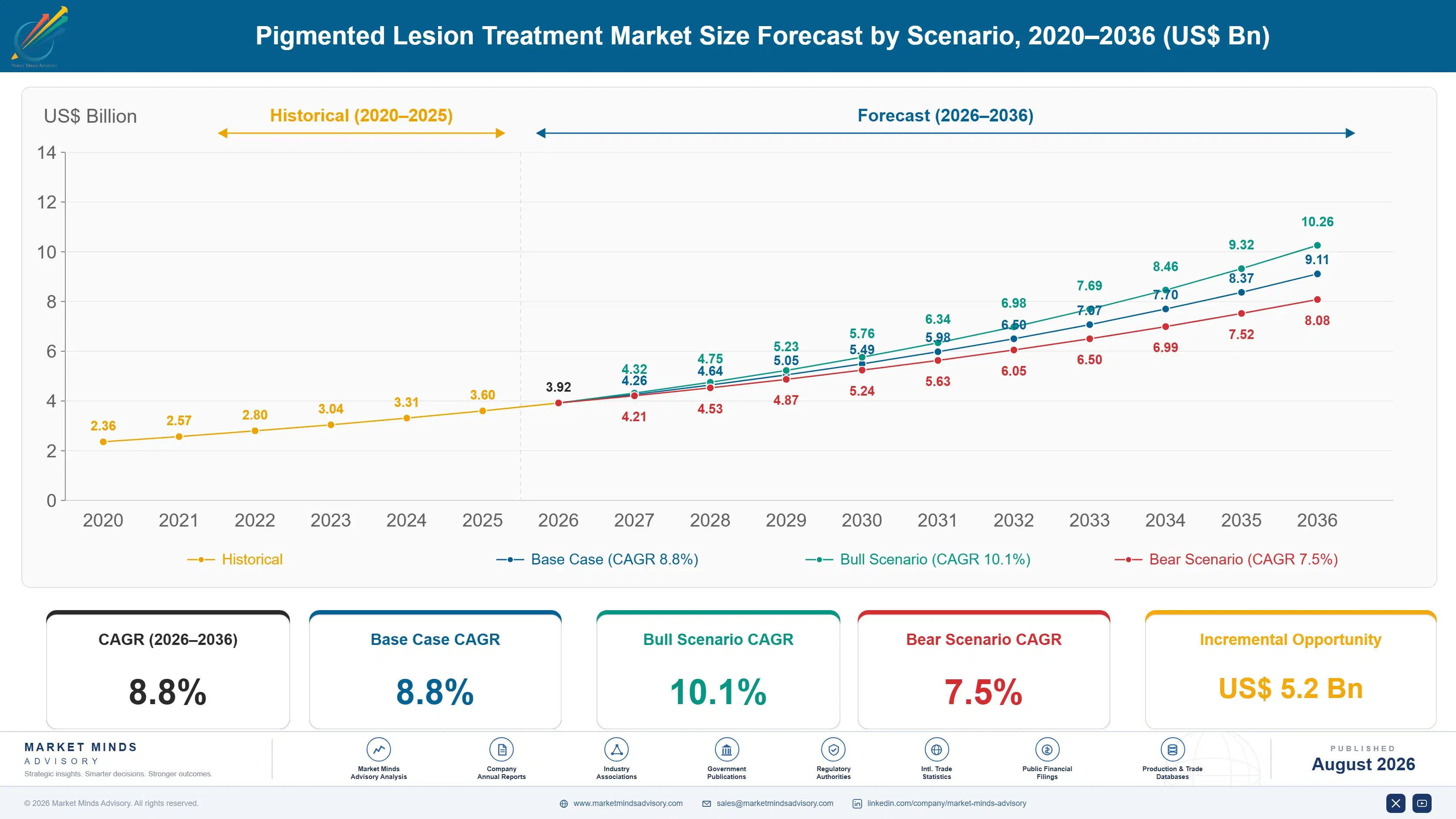
Pigmented Lesion Treatment Market Forecast Scenarios

pigmented-lesion-treatment-market-size-forecast-scenario-1787306382648
Between 2020 and 2025 the market grew at roughly 8.0% a year, recovering from pandemic-era deferrals of elective aesthetic procedures and accelerating afterward as rising skin cancer awareness and expanding aesthetic procedure demand both drove sustained device and treatment volume growth across major markets. That recovery masked how quickly diagnostic adoption was already accelerating. That gap kept widening steadily.
The base case carries the market to a 8.8% CAGR on three mechanisms. First, AI-assisted diagnostic adoption keeps expanding as dermatology practices seek tools to manage patient volume against limited specialist capacity worldwide. Second, aesthetic procedure demand keeps rising as laser treatment for benign pigmentation becomes more mainstream and accessible across broader consumer demographics. Third, rising skin cancer incidence, tracked through national cancer registries in most major markets, keeps expanding the population requiring both diagnostic evaluation and treatment for potentially malignant lesions.
The bull case reaches 10.1% if AI diagnostic tools achieve regulatory clearance for more autonomous triage roles faster than currently expected. The bear case falls to 7.5% if reimbursement policy for AI-assisted diagnosis remains unclear long enough to slow practice-level adoption meaningfully across major healthcare systems. That divergence rests largely on AI clearance pathway timing.

Diagnostic Accuracy Is Becoming the New Competitive Battleground

Three forces converge on this market at once. Rising skin cancer incidence keeps expanding the population requiring diagnostic evaluation, aesthetic procedure demand keeps growing as laser treatment becomes more accessible and affordable, and AI diagnostic accuracy keeps improving toward levels that meaningfully change how practices triage patients. Manufacturers unable to demonstrate genuine diagnostic or treatment performance advantage risk losing share to faster-moving competitors. Manufactur
MARKET CONCENTRATION (CR5)38%Top five manufacturers hold well under half share
AVERAGE LASER SYSTEM PRICE$62,000/unitPremium multi-wavelength systems command notably higher market pricing
TOP PRODUCING COUNTRY SHARE22%United States leads global dermatology device manufacturing volume
DIAGNOSTIC ACCURACY RATE91%Leading AI classification systems approach specialist-level performance consistently
TRADE INTENSITY34%Roughly a third of device volume crosses national borders
COMPONENT COST SHARE36% of COGSLaser optics and sensor components dominate manufacturing cost
Commercially, the market splits between laser and light-based treatment devices, priced at a premium and sold on demonstrated treatment precision and safety data, and diagnostic dermoscopy and AI classification systems, priced more variably depending on whether hardware, software, or a subscription model anchors the commercial relationship. That diagnostic category is growing fastest but still represents a smaller share of total category revenue than treatment devices. That margin gap is widening as practices increasingly prioritize software-driven diagnostic value.
Over the next decade the defining question is whether AI diagnostic tools remain a decision-support aid dermatologists interpret alongside their own judgment, or whether accuracy and regulatory clearance eventually support more autonomous triage roles that meaningfully change how patients enter the treatment pathway in the first place.
"The laser companies in this space spent twenty years competing on wavelength and pulse duration, and that competition is not going away. But the more interesting fight now is happening upstream, in who gets to decide which patients even need a laser in the first place, and that decision is increasingly being made by an algorithm."
Director, Dermatology and Diagnostic Imaging Practice · MMA Medical Devices / De

Market Trends

AI-Assisted Dermoscopy Moves From Pilot to Routine Practice

AI-based lesion classification tools, trained on large image datasets to distinguish malignant from benign pigmented lesions, have moved from academic pilot programs into commercial deployment across dermatology practices since 2023, with several systems now achieving classification accuracy approaching experienced dermatologist performance in published comparative studies. FotoFinder and several newer diagnostic-focused companies have built commercial platforms integrating AI classification directly into practice workflow, letting dermatologists triage a larger patient volume with greater consistency than manual visual assessment alone typically achieves across a full clinic day. Adoption remains concentrated among larger dermatology practices with capital available for new diagnostic technology investment.
Market Impact: Cuts wait times 30% to 45%

Rising Melanoma Incidence Expands the Diagnostic Evaluation Population

Melanoma incidence has continued rising steadily across most major markets according to national cancer registry tracking, driven by cumulative ultraviolet exposure patterns and an aging population more likely to present with age-related pigmented lesions requiring evaluation. Each additional diagnosed case represents not just one treatment episode but ongoing surveillance demand, since melanoma patients require regular follow-up skin examinations to monitor for recurrence or new primary lesions, creating recurring diagnostic volume that compounds over a patient's remaining lifetime following initial diagnosis and treatment. That recurring surveillance demand gives diagnostic providers unusually predictable, long-term patient relationship value beyond any single treatment episode.
Market Impact: Adds 2,000+ new treatment locations

Market Opportunities and Growth Drivers

Dermatologist Capacity Constraints Drive AI Triage Adoption

Dermatologist shortages persist across most major markets relative to growing patient demand for skin cancer screening and aesthetic consultation, and wait times for dermatology appointments have lengthened meaningfully in several countries according to healthcare workforce tracking. AI-assisted triage tools let practices screen more patients per specialist hour by flagging genuinely concerning lesions for priority review, effectively expanding specialist capacity without requiring proportional headcount growth. Practices adopting these tools report meaningfully faster time to diagnosis for high-risk patients, a genuine clinical and commercial advantage in a capacity-constrained specialty. That capacity effect matters as demand keeps outpacing workforce growth.
Market Impact: Adds 12 to 18 months delay

Growing Aesthetic Procedure Demand Expands Laser Treatment Volume

Consumer demand for aesthetic treatment of benign pigmented lesions, including age spots and melasma, has grown steadily as laser treatment becomes more affordable and accessible beyond the premium dermatology clinics that historically dominated the category. Broader retail and medical spa channel expansion has brought laser pigmentation treatment within reach of a meaningfully larger consumer base, and each new treatment location represents recurring equipment and consumables demand tied directly to that location's procedure volume rather than any single formulation or technology cycle specifically. Each new treatment location also builds recurring consumables and service revenue tied directly to ongoing procedure volume growth.
Market Impact: Limits addressable base under 40%

Market Restraints and Challenges

AI Diagnostic Regulatory Pathways Remain Less Mature Than Device Clearance

Regulatory frameworks for AI-based diagnostic classification tools remain less established than the well-understood clearance pathways laser and light-based treatment devices have followed for decades, and the root cause is that algorithmic diagnostic tools raise novel regulatory questions about accuracy validation, ongoing model performance monitoring, and liability that existing device frameworks were not originally designed to address. This regulatory uncertainty slows some practices' willingness to adopt AI diagnostic tools for anything beyond decision support, and complicates reimbursement conversations with unfamiliar payers. Companies are mitigating the barrier by pursuing decision-support positioning rather than autonomous diagnostic claims.
Market Impact: Reaches over 3,000 dermatology prac

Reimbursement Gaps Slow Aesthetic Treatment Accessibility

Most pigmented lesion treatment for benign, cosmetic indications is not covered by health insurance in major markets, and the root cause is that payers reasonably distinguish between medically necessary treatment and elective aesthetic procedures when setting coverage policy. This out-of-pocket cost structure limits the addressable consumer base to those able and willing to pay directly, constraining volume growth in price-sensitive market segments even as awareness and desire for treatment continue rising broadly. Providers are mitigating the barrier by offering financing options and bundled treatment packages that lower the effective per-session cost for consumers.
Market Impact: Melanoma incidence rose 20% to 30%
3 additional market trends, 4 additional growth drivers, and 3 additional restraints and challenges are covered in the full report. Contact sales@marketmindsadvisory.com to access the complete intelligence.

Segment CAGR and Growth Architecture

Segmentation follows treatment modality, a single functional logic distinguishing how each product addresses pigmented lesions across diagnosis and treatment. Practice setting and reimbursement channel are treated as separate commercial dimensions, not parallel segments here. Each modality carries its own clinical role, technical complexity, and reimbursement pathway, so commercial position tracks treatment function rather than device category alone.
pigmented-lesion-treatment-market-market-share-analysis-1787306383184

AI-Assisted Diagnostic and Dermoscopy Systems

AI-assisted diagnostic systems grow fastest at 15.5%, about 1.76 times the overall rate, as dermatology practices adopt algorithmic lesion classification to manage rising patient volume against persistent specialist capacity constraints. These systems combine dermoscopy imaging hardware with machine learning classification software, increasingly sold through subscription or per-scan pricing models rather than pure hardware sales, reflecting the software-driven value proposition. FotoFinder and several newer diagnostic-focused companies lead commercial deployment, though adoption remains concentrated among larger, better-capitalized practices. Regulatory clearance progress toward more autonomous triage roles will likely determine how far this segment's pricing power extends. Practices weigh that pricing durability heavily when evaluating a purchase decision today. That durability shapes long-term vendor selection decisions across the practice network.
CAGR 15.5%

Photodynamic Therapy Systems

Photodynamic therapy systems, which combine light-activated photosensitizing agents with targeted light exposure to treat certain pigmented and precancerous lesions, grow at 10.0%, the second-fastest category, as dermatologists increasingly favor the approach for specific lesion types where it offers advantages over laser treatment or surgical excision alone. The technology requires both device and pharmaceutical-grade photosensitizer supply, creating a distinct commercial structure from pure device categories. Adoption remains concentrated among specialist dermatology and oncology practices with the training and patient volume to justify the specific procedural workflow photodynamic therapy requires beyond standard laser treatment protocols. Manufacturers combining device and pharmaceutical-grade photosensitizer supply under one commercial relationship capture more of the procedure's total value than device-only competitors can.
CAGR 10.0%
Full segment breakdown across 6 segments available in the complete report.

Regional Architecture and Country Demand Map

North America leads on concentrated dermatology practice density and aesthetic procedure spending, East Asia follows closely on South Korea's aesthetic device manufacturing strength, and South Asia and Pacific compounds fastest off a smaller base. Latin America and the Middle East grow steadily off smaller current procedure volume bases.

North America

United States dermatology practices maintain the world's highest per-capita aesthetic and diagnostic procedure spending, supported by both substantial out-of-pocket consumer spending and a deep concentration of dermatologists relative to most other regions globally. Candela and Cynosure both run substantial domestic manufacturing and research operations, maintaining close relationships with the academic dermatology centers that shape clinical practice guidelines nationally. Rising melanoma awareness campaigns, supported by dermatology societies and public health messaging, continue driving diagnostic evaluation volume alongside the region's already-strong aesthetic treatment demand. Growth trails East Asia and South Asia and Pacific because the region's practice base and procedure volume are both already extensively developed, leaving incremental growth rather than first-time market creation as the primary driver going forward.
Share: 29% | CAGR: 7.8% (2026 to 2036)

Western Europe

Germany and France both maintain well-developed dermatology practice networks, with national health systems covering medically necessary lesion evaluation while aesthetic treatment remains largely out-of-pocket, similar to the American market structure though with generally more conservative aesthetic procedure adoption patterns. The United Kingdom's National Health Service has invested in skin cancer screening infrastructure specifically, supporting steady diagnostic volume growth tied to public health screening initiatives rather than purely consumer-driven aesthetic demand. Fotona, headquartered in Slovenia, anchors meaningful regional laser device manufacturing capability serving both domestic and export markets. Growth trails East Asia and South Asia and Pacific as the region's dermatology infrastructure and procedure volume are both already comparatively mature. That combination keeps the region a genuine center of clinical credibility.
Share: 23% | CAGR: 7.2% (2026 to 2036)
Regional intelligence for 5 additional markets available in the complete report: East Asia, South Asia and Pacific, Latin America, Middle East and Africa, Eastern Europe. Contact sales@marketmindsadvisory.com.
pigmented-lesion-treatment-market-country-cagr-analysis-1787306383694

Where Device Makers Can Defend and Grow Margin

Four commercial moves separate companies capturing durable share from those losing ground to shifting diagnostic and treatment dynamics: AI accuracy investment, practice workflow integration, financing accessibility, and regulatory pathway leadership. Each move converts a technical or accessibility advantage into a defensible commercial position competitors without matching validation depth or financing reach cannot easily replicate quickly.

Invest in AI Classification Accuracy to Build Clinical Trust

Dermatologists remain appropriately cautious about AI diagnostic tools until accuracy data proves genuinely comparable to specialist judgment across diverse patient populations and lesion types, and companies investing in rigorous, diverse-population validation studies build the clinical trust that drives sustained practice adoption rather than one-time pilot programs that quietly get abandoned. Companies with the strongest published validation data increasingly win practice contracts that competitors offering comparable hardware but weaker evidence cannot secure. Companies with the strongest validation data report cutting practice adoption decision time by 30% to 40% relative to less-documented competitors.
Market Impact: Cuts practice adoption decision tim

Integrate Diagnostic Output Directly Into Practice Management Workflow

Dermatology practices adopt new diagnostic technology far more readily when it integrates directly with existing electronic health record and practice management systems rather than requiring a separate, disconnected workflow that adds administrative burden to already time-constrained clinical staff. Companies building direct integration capability differentiate meaningfully beyond raw diagnostic accuracy alone, since practices increasingly weigh implementation friction as heavily as underlying technology performance when evaluating a purchase decision. Practices report adoption rates improving 25% to 35% once integration friction is meaningfully reduced through direct system connectivity rather than manual workarounds entirely.
Market Impact: Improves adoption rates by 25% to 3

Offer Patient Financing to Expand the Addressable Aesthetic Market

Most benign pigmented lesion treatment remains an out-of-pocket consumer expense, and device makers or practices offering structured financing options meaningfully expand the addressable patient population beyond those able to pay the full treatment cost upfront in a single visit. This financing approach has proven effective in adjacent aesthetic medicine categories, and companies building financing partnerships directly into their commercial offering capture patients who would otherwise defer or forgo treatment entirely due to upfront cost barriers. Financing partners report treatment conversion rates rising 20% to 30% once payment plans remove the upfront cost barrier entirely.
Market Impact: Expands addressable patient base by

Lead on Regulatory Pathway Development for AI Diagnostic Tools

Companies engaging proactively with regulators to help shape emerging AI diagnostic clearance frameworks, rather than waiting for pathways to fully mature before pursuing clearance, position themselves as the reference point regulators and competitors both look to as the category matures. This engagement also gives these companies earlier insight into evolving requirements, letting them design validation studies and documentation systems aligned with where regulation is heading rather than reacting after requirements are finalized. Companies engaging regulators early typically shorten their own eventual clearance timeline by 6 to 12 months relative to reactive competitors.
Market Impact: Shortens future clearance timelines

Who Controls the Margin Pool

Concentration sits at a modest CR5 of 38%, with a gap separating established laser device manufacturers from a newer, more fragmented field of AI diagnostic companies. Candela and Cynosure compete on laser treatment breadth and clinical relationships, while Lumenis and Fotona anchor strong positions in multi-wavelength system technology and export manufacturing respectively. Smaller diagnostic-focused companies compete for early practice adoption in AI classification.
Current competitive activity runs along three lines: AI diagnostic accuracy improvement, where FotoFinder and newer entrants race to prove specialist-comparable classification performance; practice workflow integration, increasingly a genuine purchasing criterion beyond raw technology performance; and regulatory pathway engagement, as companies work to shape emerging AI clearance frameworks. All participants are assessed on one consistent basis, annual revenue from pigmented lesion treatment and diagnostic products.

Pressure is building from two directions. AI diagnostic companies are capturing practice mindshare and gradually claiming a larger share of the diagnostic value chain dermatologists historically controlled through manual assessment. Meanwhile laser device manufacturers face continued price competition from Asian manufacturers scaling comparable technology at lower cost. Rankings over the next five years will likely shift toward companies combining diagnostic technology depth with established treatment device relationships.
pigmented-lesion-treatment-market-company-positioning-matrix-1787306384210

Competitive Moat and Risk Dimensions

CANDELA CORPORATION

Moat: Deep laser technology patent portfolio

Candela's decades of laser technology development have built a substantial patent portfolio covering wavelength and pulse duration innovations across pigmented lesion treatment, giving it technical differentiation and licensing leverage that newer entrants without comparable years of research and development investment cannot easily replicate. That intellectual property depth also supports licensing revenue few smaller competitors can generate independently.
CANDELA CORPORATION

Risk: Private equity ownership capital constraints

Candela's private equity ownership structure creates capital allocation priorities that may favor near-term returns over the sustained research investment needed to compete with well-capitalized public competitors, particularly as AI diagnostic integration increasingly requires software development capability beyond Candela's traditional hardware engineering strength. That software capability gap could widen further as diagnostic technology increasingly determines competitive positioning industry-wide.
CYNOSURE LLC

Moat: Broadest aesthetic laser platform range

Cynosure's broad portfolio spanning multiple laser wavelengths and treatment applications lets it serve dermatology and medical spa accounts as a single-vendor relationship covering pigmented lesion treatment alongside other aesthetic procedures, a bundling advantage narrower single-application competitors cannot match as easily. That bundling advantage also builds durable switching costs once a practice standardizes its full aesthetic equipment relationship around one vendor.
CYNOSURE LLC

Risk: Intensifying price competition pressure

Cynosure faces mounting price pressure from Asian manufacturers, particularly South Korean and Chinese companies, offering comparable laser technology at meaningfully lower cost, a dynamic that could compress margins faster than the company's premium brand positioning can offset without continued technology differentiation investment. That pricing pressure could accelerate further if Asian manufacturers continue improving technical quality alongside their existing cost advantage.

Players Tracked

Prominent Players

Candela Corporation
Cynosure LLC
Lumenis Ltd.
Fotona
Solta Medical

Other Key Players

Cutera Inc.
Alma Lasers
InMode Ltd.
Sciton Inc.
Sisram Medical
El.En. Group
Quantel Medical
DermaSensor Inc.
SciBase Holding
MetaOptima Technology
FotoFinder Systems
Canfield Scientific
3Gen Inc.
Heine Optotechnik
Michelson Diagnostics

Recent Developments

MARCH 2025

FotoFinder launches AI-enhanced dermoscopy imaging platform

FotoFinder introduced an updated dermoscopy imaging platform featuring improved AI-based lesion classification accuracy and direct electronic health record integration capability. This was an organic product launch, not an acquisition or partnership, developed through internal research and development investment over several years of clinical collaboration. Early reception has reportedly been strong.
Signal: A leading diagnostic imaging company refre
SEPTEMBER 2024

Candela acquires topical depigmenting agent developer

Candela completed the acquisition of a privately held company developing topical depigmenting pharmaceutical agents, adding complementary treatment technology to its existing laser device portfolio. This was an acquisition, not a joint venture or minority investment, giving Candela full ownership and control of the acquired technology and development team.
Signal: A laser incumbent acquiring pharmacologica
JANUARY 2025

Cynosure signs distribution agreement expanding Southeast Asian access

Cynosure signed a distribution agreement with a regional medical device distributor to expand laser device access across several Southeast Asian markets. This was a commercial distribution agreement, not a joint venture or acquisition, extending Cynosure's market reach without altering its ownership or manufacturing structure. Early reception has reportedly been favorable.
Signal: Emerging market distribution investment su

Laser Optics and Sensors Drive Production Cost

Precision laser optics, crystal components, and imaging sensors together account for roughly thirty-six percent of production COGS, sourced from a concentrated group of specialty optical component manufacturers with meaningful barriers to entry given the precision engineering required. Software development and AI model training costs add a further significant and growing cost layer specific to diagnostic-focused companies.
The clearest recent volatility event traces to the 2021 and 2022 global semiconductor shortage, which the United States Department of Commerce documented as extending lead times across precision optical and sensor component categories broadly. Several dermatology device manufacturers reported multi-month order backlogs during the worst of the shortage, as automotive and consumer electronics buyers with larger order volumes crowded out smaller-volume medical device categories for available component manufacturing capacity industry-wide.

Exposure varies by manufacturer scale and sourcing relationships. Larger manufacturers with direct long-term optical component supply agreements weathered the shortage with less production disruption than smaller specialist makers dependent on distributor inventory and spot purchasing. Diagnostic-focused companies faced a different exposure profile, since their primary cost driver, software and AI development talent, faced its own separate competitive labor market pressure during the same period specifically.
pigmented-lesion-treatment-market-cost-volatility-analysis-1787306384405

Secure Direct Optical Component Supply Agreements

Larger manufacturers are increasingly bypassing distributors to negotiate direct multi-year supply agreements with optical component fabricators, securing priority allocation during future shortage events and more predictable pricing than spot market purchasing allows for a critical, concentrated component category. This mirrors sourcing discipline already standard across other precision medical device manufacturing categories facing comparable seasonal demand concentration.

Qualify Multiple Sensor and Optical Suppliers Across Regions

Manufacturers are qualifying second and third sourcing options for precision optical and sensor components across different geographic regions rather than relying on single-supplier relationships, reducing exposure to any one facility disruption or capacity allocation decision favoring larger buyers. Smaller manufacturers are increasingly pooling purchasing volume through industry consortia to negotiate comparable allocation priority overall.

Build Internal AI Development Capability Rather Than Outsourcing

Diagnostic-focused companies are increasingly building internal machine learning development teams rather than depending entirely on external contractors, reducing cost volatility tied to competitive external talent markets while building proprietary technical capability that compounds over successive product generations. This internal capability increasingly differentiates companies able to iterate quickly on model accuracy from those depending entirely on external contractors.

Portfolio Architecture for Margin Defence

The portfolio splits into three tiers with real margin separation. Volume laser treatment devices compete on price and clinical track record for standard aesthetic and dermatology applications, earning solid margins defended through brand reputation and service networks. Certified premium AI diagnostic systems earn substantially more because practices pay for demonstrated classification accuracy and workflow integration few competitors can match. That gap widens further as practices increasingly
The tension between hardware volume and diagnostic software premium positioning shapes company strategy directly: laser device sales build broad practice relationships and steady baseline revenue, but companies that let hardware sales crowd out diagnostic software investment risk losing the fastest-growing, highest-margin category to more software-focused competitors. Companies that manage this balance well capture both the hardware and the software revenue streams.

High-value pools concentrate in AI diagnostic subscription revenue and photodynamic therapy systems, where technical differentiation and recurring software revenue justify premium economics few hardware-only competitors can match. The emerging autonomous triage tier currently earns nothing commercially as companies absorb regulatory and validation investment against still-distant potential clearance. That unevenness should ease as autonomous triage systems accumulate more mature regulatory and clinical validation.

Volume / Commodity-Adjacent Tier

Standard laser and light-based treatment devices sold on price and clinical track record to dermatology and aesthetic clinics., where brand reputation and service network reach determine which manufacturers can sustain acceptable margin under price competition.
Gross Margin: 25-40%

Premium / Certified Tier

AI-assisted diagnostic systems and multi-wavelength laser platforms commanding premium pricing from practices prioritizing accuracy and treatment breadth., who pay durable premiums for demonstrated accuracy rather than risk misclassifying a potentially malignant lesion.
Gross Margin: 42-58%

Sustainability / Regulatory / Next-Generation Tier

Autonomous AI triage systems still in regulatory and clinical validation, absorbing investment against distant potential commercial clearance., where companies are betting regulatory and validation capital on triage roles they expect clearance to eventually support.
Gross Margin: 0-45%
pigmented-lesion-treatment-market-portfolio-architecture-1787306384902

High-value Sub-segments and Strategic Watch-out

AI-Assisted Diagnostic Subscriptions

High value and high growth as accuracy improves and practices adopt algorithmic triage, commanding durable recurring revenue once integration and validation data support broader clinical trust fully. Companies with the strongest validated accuracy increasingly win practice contracts competitors offering comparable hardware cannot secure at all today.
Gross Margin: 45-60%

Multi-Wavelength Laser Treatment Systems

High value with strong current growth as broader treatment applications expand, priced above single-wavelength alternatives while remaining accessible to mainstream dermatology practice budgets. Adoption is broadening steadily beyond premium clinics into mainstream dermatology practices seeking comparable treatment breadth at accessible pricing across the board today.
Gross Margin: 38-52%

Standard Single-Wavelength Laser Devices

The volume core, sold on price to aesthetic clinics and dermatology practices, defended mainly through brand reputation and thin per-unit margin discipline. Competitive pressure here concentrates on brand reputation and service reach rather than the diagnostic differentiation reshaping premium and AI-driven tiers specifically overall today.
Gross Margin: 25-40%

Legacy Non-Integrated Dermoscopy Systems

The strategic watch-out, facing gradual displacement as AI-integrated diagnostic platforms increasingly outperform on both accuracy and workflow efficiency. Manufacturers still dependent on this declining tier should be actively redirecting investment toward AI-integrated platforms rather than defending systems dermatologists increasingly consider inadequate for accurate lesion classification and workflow efficiency.
Gross Margin: 15-32%

How Pigmented Lesion Demand Actually Recurs

Demand here splits between recurring diagnostic surveillance for patients with prior lesion history, tied to ongoing annual or semi-annual screening protocols, and discrete treatment episodes for both malignant lesion removal and elective aesthetic procedures. Both patterns generate meaningfully different revenue predictability, with surveillance demand far more forecastable than discretionary aesthetic treatment volume. That recurring surveillance pattern gives providers unusually predictable,
Adoption depth varies sharply by practice type. Academic and specialist dermatology centers integrate new diagnostic technology deeply into standardized clinical protocols once validated, making switching costly and rare absent a compelling clinical reason. Aesthetic-focused clinics and medical spas, by contrast, evaluate laser treatment options more flexibly based on cost and consumer demand trends, creating more frequent switching opportunities between competing device manufacturers. That difference forces companies to split commercial strategy between clinical depth and flexible responsiveness.

Buyer profiles are shifting generationally as younger dermatologists, trained during residency on AI-assisted diagnostic tools, increasingly expect algorithmic decision support as standard practice infrastructure rather than an optional add-on. Older dermatologists trained primarily on manual visual assessment are adapting more gradually, but that generational shift is accelerating steadily as AI diagnostic accuracy continues improving and gaining broader clinical acceptance.
pigmented-lesion-treatment-market-end-use-penetration-index-1787306385391

Where Pigmented Lesion Value Concentrates Next

These are among the four positions where our research anticipates prominent divergence between winners and laggards over the coming forecast period. Each is grounded in the demand model, the regulatory perimeter, and the announced capacity pipeline.
01 / AI DIAGNOSTIC VALIDATION INVESTMENT

Fund diverse-population accuracy studies before scale matters

Dermatologists will not trust AI diagnostic tools built on narrow, unrepresentative training data, and companies investing in rigorous, diverse-population validation studies now are building the credibility that drives sustained practice adoption rather than pilot programs that quietly fail. This is a multi-year investment with a payoff that compounds as published evidence accumulates and practices increasingly cite specific validated performance data in purchasing decisions. Companies moving slowly here will find themselves permanently behind once the credibility gap becomes difficult to close.
02 / WORKFLOW INTEGRATION PRIORITY

Treat practice management integration as core, not optional

Diagnostic accuracy alone will not win adoption if a tool creates administrative friction that already time-constrained dermatology practices are unwilling to absorb into daily workflow. Companies building direct electronic health record and practice management integration differentiate meaningfully beyond raw technology performance, and this integration increasingly determines purchasing decisions as much as underlying accuracy does. The companies winning practice contracts today are the ones that solved this problem first and most thoroughly., a lead that compounds every additional practice that adopts and validates the integration internally.
03 / AESTHETIC MARKET ACCESSIBILITY

Expand the addressable base through financing, not just marketing

Out-of-pocket cost remains the single biggest barrier to broader aesthetic treatment adoption, and companies building financing partnerships directly into their commercial offering capture patients who would otherwise defer or forgo treatment entirely. This accessibility investment matters more than incremental marketing spend, since it addresses the actual barrier rather than simply building awareness among consumers who already want treatment but cannot afford the upfront cost involved. Companies that address accessibility directly will capture patients who already want treatment but cannot afford the upfront cost involved.
04 / REGULATORY PATHWAY ENGAGEMENT

Shape AI diagnostic regulation rather than wait for clarity

AI diagnostic regulatory frameworks remain genuinely unsettled, and companies engaging proactively with regulators to help shape emerging clearance pathways gain both influence over the eventual requirements and earlier insight into how to design validation studies that will satisfy them. Companies waiting for regulatory clarity before investing risk designing studies against outdated assumptions once frameworks finally solidify. Early engagement is a genuine competitive advantage, not merely a compliance formality worth deferring., and that early engagement compounds as regulators increasingly reference the frameworks these companies helped shape from the outset.

Engagement Snapshot From the Field

A live engagement with an industry participant carrying material or product regulatory and market exposure ahead of a defining policy shift, showing how our research translates into a defensible multi-year portfolio strategy.
MARKET MINDS ADVISORY · CLIENT ENGAGEMENT SUMMARY
Pigmented Lesion Treatment Producer Strategic Portfolio Review and Transition Roadmap 2026·Investment Scenario on Pigmented Lesion Treatment Exposure Evaluation 2025-26
CLIENT PROFILE
A regional dermatology group operating nine clinic locations approached MMA while evaluating AI-assisted dermoscopy adoption to manage rising patient volume against limited specialist capacity across its network. The client reported an approved technology budget of roughly USD 1.8 million for the initiative, with no prior AI diagnostic experience across its clinical staff (client-reported, unverified by MMA).
STRATEGIC CHALLENGE
Clinical leadership wanted to adopt AI-assisted triage to reduce wait times for high-risk patients, but the group's physicians remained divided over whether available systems had accumulated enough validated accuracy data across diverse patient populations to trust clinically. The board wanted a defensible technology decision before the next budget cycle, not another quarter of internal physician disagreement.
MMA APPROACH
MMA benchmarked classification accuracy and validation study quality across four AI diagnostic systems against the client's specific patient demographic mix, modeled workflow integration requirements and total cost of ownership, and assessed each vendor's practice management system compatibility for the group's existing electronic health record platform. We also interviewed practicing dermatologists directly to confirm real-world clinical concerns the quantitative model alone could not capture.
KEY FINDINGS
  1. One system's published validation data specifically included the darker skin tone representation the client's diverse patient population required, a gap two competing systems had not adequately addressed in their own studies.
  2. Direct electronic health record integration reduced projected implementation time meaningfully compared to standalone systems requiring separate workflow steps for clinical staff. That integration advantage weighed heavily in the final vendor selection decision.
  3. Physician confidence in the selected system increased substantially after reviewing the vendor's diverse-population validation data directly, addressing the internal skepticism that had stalled the decision previously.
  4. Financing the technology investment through a vendor-offered payment plan preserved capital the group had originally planned to allocate toward separate facility expansion (client-reported, unverified by MMA).
CLIENT PROFILE
A regional dermatology group operating nine clinic locations approached MMA while evaluating AI-assisted dermoscopy adoption to manage rising patient volume against limited specialist capacity across its network. The client reported an approved technology budget of roughly USD 1.8 million for the initiative, with no prior AI diagnostic experience across its clinical staff (client-reported, unverified by MMA).
STRATEGIC CHALLENGE
Clinical leadership wanted to adopt AI-assisted triage to reduce wait times for high-risk patients, but the group's physicians remained divided over whether available systems had accumulated enough validated accuracy data across diverse patient populations to trust clinically. The board wanted a defensible technology decision before the next budget cycle, not another quarter of internal physician disagreement.
MMA APPROACH
MMA benchmarked classification accuracy and validation study quality across four AI diagnostic systems against the client's specific patient demographic mix, modeled workflow integration requirements and total cost of ownership, and assessed each vendor's practice management system compatibility for the group's existing electronic health record platform. We also interviewed practicing dermatologists directly to confirm real-world clinical concerns the quantitative model alone could not capture.
KEY FINDINGS
  1. One system's published validation data specifically included the darker skin tone representation the client's diverse patient population required, a gap two competing systems had not adequately addressed in their own studies.
  2. Direct electronic health record integration reduced projected implementation time meaningfully compared to standalone systems requiring separate workflow steps for clinical staff. That integration advantage weighed heavily in the final vendor selection decision.
  3. Physician confidence in the selected system increased substantially after reviewing the vendor's diverse-population validation data directly, addressing the internal skepticism that had stalled the decision previously.
  4. Financing the technology investment through a vendor-offered payment plan preserved capital the group had originally planned to allocate toward separate facility expansion (client-reported, unverified by MMA).
RECOMMENDED STRATEGY
Phase 1: Phase 1 (0 to 4 months): Deploy the selected AI diagnostic system at the two highest-volume clinic locations with direct electronic health record integration. Phase 2: Phase 2 (4 to 10 months): Train clinical staff network-wide and expand deployment to remaining locations based on initial performance data. Phase 3: Phase 3 (10 to 24 months): Track diagnostic outcomes systematically and use results to negotiate expanded vendor partnership terms. across the group's full clinic network.
OUTCOME
The dermatology group began Phase 1 deployment on schedule, reporting an estimated reduction in high-risk patient wait times of roughly 35% at the first two deployed locations. The vendor financing arrangement also preserved capital for the group's planned facility expansion (client-reported, unverified by MMA). Physician confidence in the technology also improved measurably following the successful initial rollout.

Frequently Asked Questions

Foundational context covering the market sizes, CAGR, scope, country, region and competition that inform every finding below. This section is provided to cover basics and most often pre-purchase conversations, answered from the MMA Primary Research Dataset.

What is the current size of the Pigmented Lesion Treatment Market?

The pigmented lesion treatment market was valued at USD 3.6 billion in 2025. Growth is driven by AI diagnostic adoption, rising melanoma incidence, and expanding aesthetic treatment demand.

How large will the Pigmented Lesion Treatment Market be by 2036?

The market is projected to reach USD 9.11 billion by 2036 under the base case scenario. That reflects an expansion multiple of roughly 2.32 times the 2026 value.

What is the CAGR for the Pigmented Lesion Treatment Market 2026 to 2036?

The base case CAGR is 8.8%, with a bull case of 10.1% and a bear case of 7.5%. AI diagnostic regulatory clearance speed is the main swing factor between scenarios.

Which segment is growing fastest?

AI-assisted diagnostic and dermoscopy systems grow fastest at 15.5% CAGR, roughly 1.76 times the overall market rate. Photodynamic therapy systems follow as the second-fastest segment at 10.0%.

Who are the major companies in the Pigmented Lesion Treatment Market?

Leading companies include Candela Corporation, Cynosure LLC, Lumenis Ltd., Fotona, and Solta Medical. The top five hold a combined 38% of the market., a moderate concentration that leaves room for specialist diagnostic companies to compete.

Which country is growing fastest?

China is the fastest-growing country at 15.0% CAGR, driven by expanding middle-class aesthetic spending and growing dermatology infrastructure. Domestic and international device makers both compete for this growing demand.

Report Segmentation Architecture

The full report scope spans multiple orthogonal segmentation dimensions, with cross-tabulated demand data provided for each dimension pair. Coverage extends further to regional breakdowns, trend trajectories, and the competitive detail needed to support segment-level decision-making.

By Treatment Modality

  • Laser and Light-Based Treatment Devices
  • Surgical Excision and Biopsy Devices
  • Topical Depigmenting Agents
  • Cryotherapy Devices
  • AI-Assisted Diagnostic and Dermoscopy Systems
  • Photodynamic Therapy Systems

By End-Use Setting

  • Dermatology Clinics and Practices
  • Medical Spas and Aesthetic Centers
  • Hospital Oncology and Dermatology Departments
  • Academic and Research Medical Centers

By Commercial Dimension

  • Direct Device Sales
  • Subscription and Software-as-a-Service Diagnostics
  • Distributor and International Channel
  • Financed and Bundled Treatment Packages

By Region

  • North America
  • Western Europe
  • East Asia
  • South Asia and Pacific
  • Latin America
  • Middle East and Africa
  • Eastern Europe

Scope, Methodology, and Coverage

Every figure in this report is reproducible from documented input assumptions. The scope below maps the historical period, the forecast horizon, the segmentation dimensions, and the countries covered, alongside the underlying primary and qualitative methodology.
Historical Period
2020 to 2025
Forecast Period
2026 to 2036
Base Year
2025 (USD billions; MMA Primary Research Dataset, August 2026)
Market Definition
The pigmented lesion treatment market comprises devices, pharmacological agents, and diagnostic systems used to treat or evaluate benign and malignant pigmented skin lesions, including laser and light-based treatment devices, topical depigmenting agents, cryotherapy and photodynamic therapy systems, and dermoscopy and AI-assisted diagnostic platforms. General dermatology equipment not specific to pigmented lesions, systemic oncology therapeutics for metastatic melanoma, and cosmetic skincare products without a therapeutic or diagnostic function are excluded.
Quantitative Units
USD billions (current prices); installed device and system units where applicable
Segmentation Dimensions
By Treatment Modality; By End-Use Setting; By Commercial Dimension; By Region
Regions Covered
North America, Western Europe, East Asia, South Asia and Pacific, Latin America, Middle East and Africa, Eastern Europe
Countries Covered
USA, China, Germany, France, UK, Japan, South Korea, India, Australia, Canada, Brazil, Mexico, Indonesia, Vietnam, Thailand, Malaysia, UAE, Saudi Arabia, South Africa, Nigeria, Turkey, Poland, Netherlands, Italy, Spain, Sweden, Switzerland, Argentina, Colombia, Singapore, and additional markets relevant to this sector
Key Companies Profiled
Candela Corporation, Cynosure LLC, Lumenis Ltd., Fotona, Solta Medical, Cutera Inc., Alma Lasers, InMode Ltd., Sciton Inc., Sisram Medical, El.En. Group, Quantel Medical, DermaSensor Inc., SciBase Holding, MetaOptima Technology, FotoFinder Systems, Canfield Scientific, 3Gen Inc., Heine Optotechnik, Michelson Diagnostics
Quantitative Methodology
Primary survey, n=3,800 respondents, Q4 2025, six countries; demand-side model with trade association cross-validation
Qualitative Methodology
47 expert interviews, Q4 2025; applied to validate demand model assumptions, identify emerging dynamics, and assess competitive positioning
Report Format
PDF and XLSX data workbook (Word format preview document)
Publisher
Market Minds Advisory
Report Code
MMA-2026-MED-401
Published
August 2026
Contact
sales@marketmindsadvisory.com | www.marketmindsadvisory.com

Purchase the full Pigmented Lesion Treatment Market Report (2026 to 2036).

The full MMA Pigmented Lesion Treatment Market report sizes demand across six treatment modalities, four end-use settings, four commercial dimensions, and seven regions through 2036. It profiles twenty companies on a consistent revenue basis, scoring each on diagnostic accuracy, workflow integration depth, and regulatory pathway progress. Scenario models quantify how AI diagnostic clearance timing and aesthetic treatment accessibility move both demand and realizable pricing. The report includes delivered-cost modeling by treatment modality and a company diagnostic-readiness screen built for clinical and commercial strategy teams. Regional procedure volume tracking rounds out the coverage for clinical and commercial strategy teams.
Treatment modality cost-curve modeling across all major categories
AI diagnostic accuracy and validation study tracking
Melanoma incidence and surveillance demand forecasts by country
Practice workflow integration benchmarking across vendors
Regional aesthetic procedure and device manufacturing tracking
AI regulatory clearance scenarios under bull and bear cases

Built For The People Who Decide

From boardroom strategy to bench-side execution, this report is read cover-to-cover by leaders shaping the next decade of their industry, turning demand scenarios, market dynamics and valuation benchmarks into decisions.
CXOs/ Presidents/ VPs/ Managers
M&A and Corporate Development
Strategy Teams and R&D Heads
Procurement and Product Directors
Regulatory and Compliance Leaders
Investor Relations and Equity Analysts