Market Minds Advisory
Picric Acid Market

Picric Acid Market: Regulated Handling Economics, Diagnostic Reagent Demand and Assay Substitution Risk, 2026 to 2036

Dry picric acid is classified as an explosive, so almost everything about how this material is made, shipped and stored is decided by regulation rather than by chemistry or cost.

Lead Analyst

Bilal Shaikh

Published

September 2026

Make Smarter Decisions with Customized Research Insights

Request a free sample report and evaluate market opportunities, growth trends, and competitive dynamics relevant to your business needs.

2025 MARKET VALUE$0.1BMarket Size 2025
2036 FORECAST VALUE$0.2BBase Case , 2026 to 2036
CAGR 2026 TO 20364.8 %Bull 6.0% / Bear 3.6%
INCREMENTAL OPPORTUNITY$0.1BNet 10- year value creation
EXPANSION MULTIPLE1.60x2036 value over 2026 base
Strategic Levers
M&A Pipeline
Regional Outlook
Country Rankings
Competitive Intelligence
Segmental Deep-dive
Call-Us : 91 93563 13602

Executive Snapshot and Market Trajectory

Regulation has become the entire commercial architecture of this market. Dry picric acid is classified as a Class One explosive, wetted material as a flammable solid, and the licensing, packaging and transport rules that follow decide who can supply whom far more than any cost or quality argument does.
Diagnostic and analytical reagent grade grows at 7.2%, a full 1.50 times the market rate, carried by creatinine testing volumes in clinical chemistry and by histology fixatives that have no equally effective substitute. East Asia holds 32% of global value, slightly above the standard regional band, because Chinese and, to a lesser extent, Japanese nitration capacity between them supply most of the world's technical grade material.
Concentration is high at 56% for the top five, and the field divides between laboratory reagent houses selling small packs at very high unit prices and Asian nitration producers selling drummed technical material. Enzymatic creatinine assays are the honest long-term threat: they are displacing the picrate-based Jaffe reaction in higher-throughput laboratories, and that erosion is slow, steady and almost certainly irreversible across the forecast period. Nothing in the pipeline reverses it.
Market Definition
The market covers picric acid, chemically 2,4,6-trinitrophenol, supplied as water-wetted solid or in solution for analytical, diagnostic, histological, dye intermediate and metallurgical etching use. It spans diagnostic and analytical reagent, pharmacopoeial and histology, dye and pigment intermediate, metallurgical etchant and technical grades. It excludes picrate salts and metal picrates, other nitrophenols, ammonium picrate and military explosive formulations, finished diagnostic assay kits, and prepared histological stains sold as branded reagents.
Base Year Value
$0.1B in 2025 (MMA Primary Research Dataset, August 2026)
Forecast Period
2026 to 2036, eleven discrete annual values
CAGR
4.8% base case. Bull 6.0%. Bear 3.6%.
Fastest Growth Segment
Diagnostic and Analytical Reagent Grade: 7.2% CAGR
Fastest Growth Country
India: 7.6% CAGR
Fastest Growth Region
South Asia and Pacific: 7.1% CAGR
Largest Region
East Asia: 32% of 2025 global value
Market Leaders
Merck KGaA, Thermo Fisher Scientific, Tokyo Chemical Industry, Central Drug House, Loba Chemie. Source: MMA Primary Research Dataset, July 2026.
Primary Survey
n=3,800 procurement and R&D decision-makers, Q4 2025, six countries
Methodology
Demand-side build-up, cross-validated against public data, 47 expert interviews

Picric Acid Market Forecast Scenarios

picric-acid-market-trends-size-forecast-scenario-1787311692138
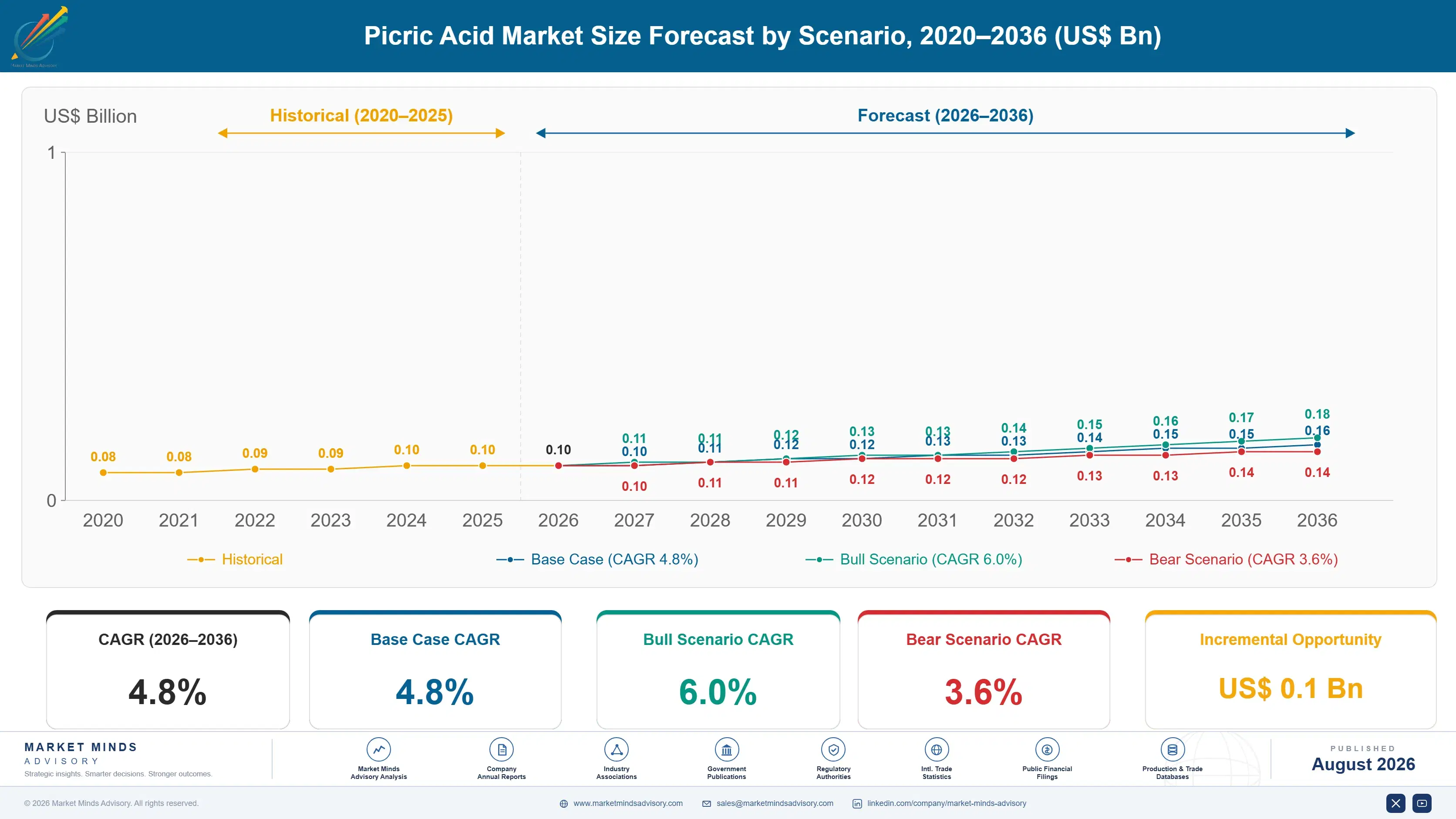
The market compounded at 3.9% between 2020 and 2025, and the composition changed more than the total. Diagnostic laboratory demand rose steadily as clinical chemistry volumes recovered from pandemic disruption and expanded across middle-income markets. Dye intermediate demand fell as textile chemistry moved elsewhere. Regulatory tightening on explosive precursors raised handling and licensing costs for every supplier through the period.
The 4.8% base case rests on three mechanisms. First, clinical chemistry volumes keep growing with population age and testing access, and the Jaffe creatinine method remains dominant in most laboratories outside the highest-throughput tier. Second, histology fixative demand grows with pathology workload and has no equally effective alternative. Third, grade mix keeps shifting toward accredited reagent packs, which realise many times the price per kilogram that drummed technical material commands.
The bull case at 6.0% assumes clinical testing access continues widening across South and Southeast Asia while histology workload grows with cancer screening programmes. The bear case at 3.6% turns on assay substitution: if enzymatic creatinine methods displace the Jaffe reaction faster than expected in mid-throughput laboratories, the largest single demand pool erodes well ahead of any offsetting growth in histology or analytical use.

Why Handling Rules Set The Price

Very little about this market is decided by the molecule. Picric acid is straightforward nitration chemistry that many plants could run. What makes it difficult is that dry material detonates, so it must be kept wetted, shipped under restrictive classification, and stored under licences that most chemical distributors will not hold.
TOP FIVE CONCENTRATION56%Combined position of the five largest reagent grade suppliers
AVERAGE SELLING PRICE$310 per kilogramTypical realised price across reagent and technical grades
TOP PRODUCING COUNTRY SHARE39%Chinese share of global picric acid production capacity
WETTED SHIPMENT SHARE94%Portion of shipments moving with added water for stability
PHENOL INPUT SHARE29% of COGSPhenol and nitric acid share of delivered production cost
DIAGNOSTIC DEMAND SHARE41%Portion of output consumed by clinical and analytical laboratories
That regulatory overhead explains the price structure completely. Technical grade in drums sells at a modest multiple of its input cost. The same material repacked into 100 gram laboratory bottles, with certificates of analysis, wetting verification and hazard documentation, sells for many times that per kilogram, and clinical laboratories pay it without argument because the alternative is holding a licence and managing the hazard themselves. The value added is compliance rather than purification.
Demand is quietly migrating between applications. Dye and pigment intermediate use, once the largest pool, has declined as textile chemistry consolidated in Asia and moved toward other coupling routes. Diagnostic and histology demand has grown to 41% of output and now sets the tone of the market. That migration favours suppliers with laboratory distribution and regulatory documentation over those holding nitration capacity, which is close to a reversal of how this business worked thirty years ago.
"The strange thing about picric acid is that the hardest part of the business has nothing to do with making it. Anyone with a nitration reactor can produce the stuff. Almost nobody wants to hold the licences, manage the wetting, and take responsibility for a drum that becomes an explosive if it dries out, and that reluctance is the whole margin."
Senior Analyst, Fine Chemicals and Laboratory Reagents Practice · MMA Chemicals

Market Trends

Enzymatic Creatinine Assays Erode The Jaffe Method

The picrate-based Jaffe reaction has measured creatinine in clinical chemistry for over a century, and enzymatic methods now displace it in higher-throughput laboratories because they suffer less interference from bilirubin, glucose and drug metabolites. Roughly 22% of clinical chemistry creatinine testing has now moved across to enzymatic methods, against about 12% only five years earlier. The substitution is slow because Jaffe reagents cost considerably less and laboratories must revalidate reference ranges to switch. It is nonetheless entirely one-directional, and it affects the largest single demand pool in this whole market.
Market Impact: Grows test volumes 6% annually
Precursor Regulation Narrows The Distribution Channel

Explosive precursor controls tightened across the European Union, United States and several Asian markets following security reviews, adding licensing, end-use verification and record-keeping obligations on anyone holding stock. Compliance costs run between $150,000 and $400,000 annually for any distributor holding meaningful inventory, which is uneconomic below a certain turnover. Several general chemical distributors have exited the product entirely rather than continue carrying the obligation. The channel has narrowed to specialist laboratory suppliers and a handful of producers, and pricing has firmed considerably for everyone who chose to remain within it.
Market Impact: Serves under 3 substitute options

Market Opportunities and Growth Drivers

Clinical Chemistry Volumes Expand With Testing Access

Renal function testing remains among the most frequently ordered clinical chemistry panels anywhere, and creatinine is measured within almost every single one of them. Volumes grow with population age, diabetes prevalence and expanding laboratory access across middle-income markets, all of which point the same direction. Global clinical chemistry test volumes have grown at around 6% annually since 2021 alone. Even with enzymatic substitution taking share, absolute Jaffe reagent volumes have held up, because the underlying testing base is expanding faster than the method mix is shifting away from picrate chemistry.
Market Impact: Requires 30% minimum water content

Histology Fixative Demand Follows Pathology Workload

Bouin's solution and related picric acid fixatives remain preferred for specific tissue types where formalin alone gives poorer nuclear detail, particularly across testicular, gastrointestinal and certain tumour pathology work. There is no equally effective substitute available, and pathology laboratories are deeply conservative about changing fixatives because diagnostic comparability across archived specimens matters clinically. Cancer screening programme expansion across Asia and Latin America is raising pathology workload steadily year after year. This demand is small in tonnage but exceptionally durable, and it pays accredited reagent rather than technical grade pricing throughout.
Market Impact: Prohibits metal contact throughout

Market Restraints and Challenges

Wetting Requirements Complicate Every Shipment And Store

Picric acid must be maintained at a minimum water content to remain classified as a flammable solid rather than an explosive, and material that dries in storage becomes both a legal and a physical hazard. The root cause is chemistry: the dry crystal is genuinely detonable and no formulation change removes that. Commercially this forces water content verification, restricts packaging options and adds shipping weight nobody is paid for. Participants manage it through solution formats for laboratory use, through moisture-controlled packaging, and through shorter inventory cycles that reduce drying risk.
Market Impact: Removes 22% of creatinine testing

Metal Contact Forms Sensitive Picrate Salts

Picric acid reacts with metals, particularly lead, copper and iron, to form picrate salts that are considerably more shock-sensitive than the parent compound. The root cause is straightforward acid chemistry rather than any impurity or manufacturing defect. Commercially this rules out metal containers, metal-lined equipment and metal plumbing anywhere in the handling chain, which raises packaging cost and eliminates several otherwise convenient logistics options entirely. Participants respond with glass, plastic and specified coated containers, and with written handling protocols that laboratory customers now increasingly require before they will purchase at all.
Market Impact: Costs $400,000 annually to comply
2 additional market trends, 4 additional growth drivers, and 3 additional restraints and challenges are covered in the full report. Contact sales@marketmindsadvisory.com to access the complete intelligence.

Segment CAGR and Growth Architecture

Segmentation here follows product grade, defined by purity specification, pack format and the documentation supplied alongside the material itself. That single dimension determines which customers a supplier can serve, what licensing it must hold, and almost the whole realised price range across a market where the underlying chemistry is common to every single grade.
picric-acid-market-trends-market-share-analysis-1787311692662

Diagnostic and Analytical Reagent Grade

The fastest segment at 7.2%, a full 1.50 times the market rate, covering high-purity material supplied in small laboratory packs and prepared solutions for clinical chemistry, analytical titrimetry and research use. Creatinine measurement by the picrate-based Jaffe reaction accounts for most of the volume, with alkaloid precipitation and a range of other analytical determinations making up the remainder. Realised pricing runs many times drummed technical grade because the value added is compliance documentation, wetting verification and hazard handling rather than any additional purification. Distribution rather than manufacturing decides who competes here at all, since precursor licensing has narrowed the channel considerably and continues to do so with each regulatory review.
CAGR 7.2%

Pharmacopoeial and Histology Grade

Growing at 6.1% annually on material meeting pharmacopoeial purity specifications and on the prepared fixative formulations used throughout histopathology work, principally Bouin's solution and the several variants derived from it. The tissue types where formalin alone yields poorer nuclear detail keep this demand firmly in place, and pathology laboratories change fixatives very reluctantly because diagnostic comparability against archived specimens matters clinically. Volumes here are small in tonnage terms but exceptionally durable, and pricing holds firm through the cycles that affect industrial grades badly. Suppliers here need documented purity control and a genuine laboratory channel rather than any nitration capacity of their own, which is why reagent houses dominate the segment.
CAGR 6.1%
Full segment breakdown across 5 segments available in the complete report.

Regional Architecture and Country Demand Map

East Asia leads on nitration capacity rather than on any laboratory consumption of its own. North America and Western Europe consume disproportionately at the reagent end where documentation matters most. South Asia and Pacific grows fastest of all as Indian clinical testing access and domestic production expand together.

East Asia

Thirty-two percent of global value sits here. Note: this slightly exceeds the standard regional band because Chinese nitration capacity supplies roughly 39% of world production and Japanese reagent houses hold strong positions in analytical grades sold worldwide. Chinese producers concentrate on technical and intermediate grades sold in drums, with limited reagent packaging capability. Japanese suppliers occupy the opposite position entirely, selling small analytical packs at prices many times drummed material. Growth of 6.0% reflects expanding domestic clinical chemistry volumes alongside export demand. Precursor security controls have tightened noticeably across the region since 2021, narrowing the distributor channel considerably. Reagent packaging and accreditation documentation capability remains the region's clear weakest link.
Share: 32% | CAGR: 6.0% (2026 to 2036)

North America

Twenty-four percent of global value, consumed almost entirely as laboratory reagent and histology fixative rather than as any industrial intermediate. Clinical chemistry and pathology laboratory demand dominates, and buyers pay reagent grade pricing without much argument because holding explosive precursor licences themselves is unattractive. Growth of 4.2% tracks clinical testing volumes and pathology workload closely. Enzymatic creatinine substitution is furthest advanced here, particularly across high-throughput reference laboratories, which caps the growth rate. Almost all material arrives imported and is repackaged domestically by laboratory suppliers holding the required licences and storage approvals. Pathology fixative demand is the most durable element, since no equally effective substitute exists for several important tissue types.
Share: 24% | CAGR: 4.2% (2026 to 2036)
Regional intelligence for 5 additional markets available in the complete report: Western Europe, South Asia and Pacific, Latin America, Middle East and Africa, Eastern Europe. Contact sales@marketmindsadvisory.com.
picric-acid-market-trends-country-cagr-analysis-1787311693175

Where The Margin Genuinely Sits

Four commercial moves separate the suppliers earning genuine reagent margins from those merely drumming technical material at nitration economics. Each one depends on holding something a laboratory cannot easily obtain from anywhere else: precursor licensing, documented purity and wetting verification, prepared working solution capability, or the accredited laboratory channel that regulation has now narrowed very considerably.

Hold The Precursor Licences Customers Will Not

Explosive precursor compliance costs $150,000 to $400,000 annually for a distributor carrying meaningful inventory, and that obligation has already driven several general chemical distributors out of the product entirely. Suppliers who hold the licences, manage the storage approvals and take the end-use verification burden realise pricing many times drummed technical value, because their customers are effectively buying relief from a regulatory obligation rather than a chemical. The compliance cost is fixed while the pricing benefit scales with volume, which strongly favours whichever suppliers simply choose to stay in the channel.
Market Impact: Absorbs up to $400,000 of annual co

Sell Prepared Solutions Rather Than Wetted Solid

Laboratories using picric acid for creatinine assays and histology fixatives want a working solution rather than a wetted solid they must weigh, dissolve and then dispose of safely. Prepared solutions eliminate the drying hazard entirely, remove the weighing step and simplify waste handling, and they realise roughly 35% higher margin per unit of active material than solid packs do. Formulation and filling capability costs under $2 million to establish at an existing site. The regulatory position also improves, since solutions below threshold concentrations attract lighter hazard classification across several important jurisdictions.
Market Impact: Realises roughly 35% higher margin

Document Wetting And Purity To Audited Standards

Clinical and pathology laboratories operate under accreditation regimes that require documented reagent provenance, and a certificate confirming water content, purity and metal contamination limits is what allows the reagent into an accredited workflow at all. Suppliers holding audited documentation win specifications outright against material with equivalent chemistry and thinner paperwork, and they hold pricing 15% to 20% higher. Annual documentation maintenance costs under $120,000 across a grade family, which makes the return on it among the cleanest available anywhere in laboratory chemicals. Audit history rather than chemistry is what buyers actually assess.
Market Impact: Holds pricing up to 20% above undoc

Bundle Handling Protocols With Every Reagent Supply

Metal contact forms shock-sensitive picrate salts and dry material becomes detonable, so laboratory customers need written handling, storage and disposal protocols as much as they need the chemical itself. Suppliers providing audited protocols and disposal guidance report renewal rates roughly 25 points above those shipping material alone, because switching supplier means revalidating internal procedures that the laboratory has already had accredited. The documentation costs almost nothing to produce once and then reuses across every single customer in the territory, which makes it the cheapest retention tool available to any supplier here.
Market Impact: Lifts renewal rates by 25 percentag

Who Controls the Margin Pool

Concentration is high at 56% for the top five, measured on picric acid revenue across all participants, and the ranking looks entirely different depending on whether tonnage or value is counted. Merck leads comfortably on reagent revenue while Chinese producers lead on volume, and the gap between those two positions describes how this market actually works.
Competition runs on three dimensions. Documentation completeness matters most in the reagent and histology grades, because accredited laboratories cannot use material whose provenance and water content are not certified. Precursor licensing decides who can distribute at all, and it has narrowed the channel considerably since 2021. Price competition is confined to drummed technical grade sold into the dwindling dye intermediate pool, where nitration cost is essentially the whole basis of comparison.

Two pressures are building. Indian reagent houses have developed documentation and packaging capability that meets Western accreditation requirements, and they compete on price against European suppliers in exactly the growing diagnostic segment. Meanwhile enzymatic creatinine substitution continues eroding the largest demand pool from underneath everyone. Rankings shift where Indian documentation capability meets Western laboratory channels, since the chemistry itself confers no advantage on anyone.
picric-acid-market-trends-company-positioning-matrix-1787311693693

Competitive Moat and Risk Dimensions

MERCK KGAA

Moat: Deepest accredited documentation position

Certificates of analysis and provenance documentation accepted across clinical accreditation regimes worldwide let the company supply laboratories that cannot use material with thinner paperwork, regardless of its chemical equivalence. That position rests on decades of audit history rather than on any manufacturing capability, which makes it slow to erode and awkward for competitors to replicate.
MERCK KGAA

Risk: Exposure to Jaffe method decline

A substantial share of reagent volume serves creatinine measurement by the picrate-based Jaffe reaction, which enzymatic methods are steadily displacing in higher-throughput laboratories. Histology and analytical demand is durable but far smaller. The company sells enzymatic alternatives itself, which cushions revenue while doing nothing at all for this particular product line.
THERMO FISHER SCIENTIFIC

Moat: Broadest laboratory distribution reach

Distribution across clinical, research and pathology laboratories worldwide, combined with the precursor licences and storage approvals required to hold inventory, gives the company channel access that regulation has made genuinely difficult to assemble. Laboratories consolidating reagent purchasing onto fewer suppliers reinforce that position with every procurement review they conduct.
THERMO FISHER SCIENTIFIC

Risk: Small line within vast portfolio

Picric acid is a negligible line inside an enormous laboratory products business, and it competes internally for attention against products many times its size. Investment in prepared solution capability or documentation depth that a focused competitor would fund readily can languish here. In a market where compliance investment is the whole moat, that inattention is a genuine exposure.

Players Tracked

Prominent Players

Merck KGaA
Thermo Fisher Scientific
Tokyo Chemical Industry
Central Drug House
Loba Chemie

Other Key Players

Avantor
Spectrum Chemical Manufacturing
GFS Chemicals
Otto Chemie
Nanjing Chemical Material
Hubei Jusheng Technology
Alfa Chemistry
Triveni Chemicals
Finar Chemicals
SRL Chemicals
Shanghai Macklin Biochemical
Aarti Industries
Atul
Chemos
Combi-Blocks

Recent Developments

JANUARY 2025

Merck expands prepared histology fixative solution capacity

Additional formulation and filling capacity for prepared picric acid fixative solutions entered commercial service at a European site during the quarter, aimed at the pathology laboratories that clearly prefer ready working solutions over wetted solid material requiring in-house weighing, dissolution and hazardous waste handling arrangements of their own.
Signal: Prepared solutions are now steadily displa
MAY 2025

Loba Chemie secures European accreditation documentation approvals

Documentation and independent audit approvals meeting European clinical accreditation requirements were completed across the whole of the company's picric acid grade family during the period, opening up laboratory customers across the region that had previously been quite unable to accept Indian-origin reagent material at all.
Signal: Indian reagent houses are now closing the
SEPTEMBER 2025

Central Drug House expands precursor licensed storage capacity

Additional licensed storage and water content verification capacity was commissioned at the company's main site, reflecting how explosive precursor compliance capability rather than any nitration capability has now become the practical barrier to holding and distributing any meaningful inventory across the regulated markets that matter.
Signal: Licensed storage capacity is now the bindi

What Drives Delivered Reagent Cost

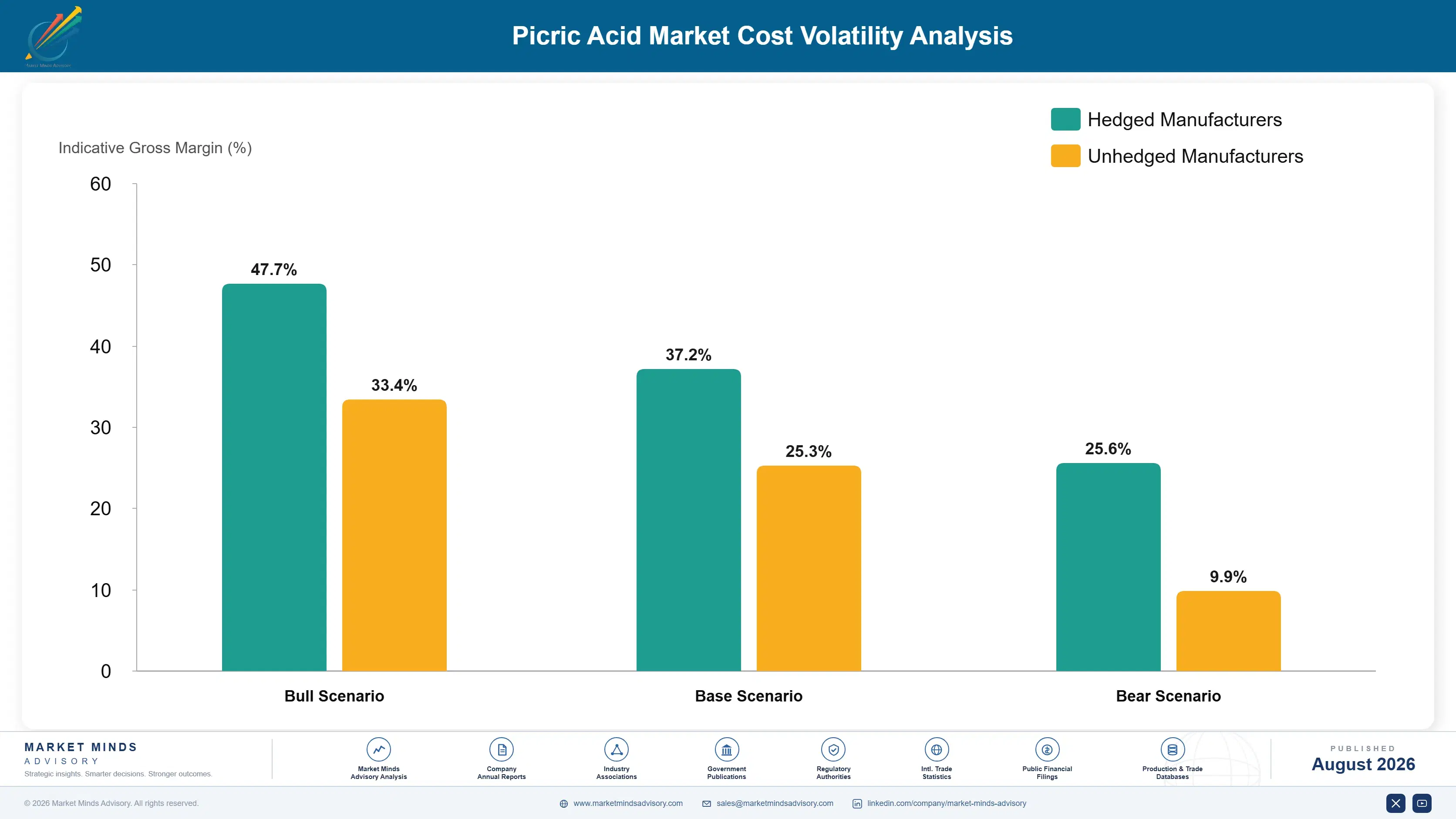
Phenol and nitric acid together account for roughly 29% of cost of goods on technical grade, though the share falls sharply on reagent packs where compliance and packaging dominate. Regulated packaging and labelling contribute 18%, licensing and compliance overhead 16%, and hazardous freight a further 14%, because classification restricts carrier options and consignment sizes considerably.
The 2022 phenol episode raised technical grade cost across the industry. Benzene and phenol pricing rose sharply as European chemical operators curtailed output, and producers of drummed technical material absorbed most of it because dye intermediate customers would not accept increases. Aarti Industries annual reporting for the period documented substantial input cost pressure across its nitration chemistry portfolio. Reagent grade suppliers were barely affected, since raw material is a small fraction of their delivered cost.

The competitive disadvantage mechanism runs through where a supplier sits in the chain, not purchasing. A nitration producer selling drums carries full feedstock exposure with no pricing power. A reagent house repacking purchased material carries feedstock exposure under a tenth of its cost base, pricing against compliance value instead. That asymmetry widens every year, which explains why nitration producers keep attempting to move downstream while reagent houses never move up.
picric-acid-market-trends-cost-volatility-analysis-1787311693890

Move technical grade output into reagent packaging

Nitration producers carrying full feedstock exposure into a price-insensitive dye intermediate market have almost no protection against phenol movement. Adding regulated packaging and documentation capability shifts the same output into a pricing structure where raw material is under a tenth of delivered cost, which dampens feedstock exposure far more effectively than any hedging arrangement could.

Consolidate hazardous freight into fewer consignments

Hazardous classification restricts carrier options and consignment sizes, so freight runs at roughly 14% of delivered cost and rises further on small shipments. Consolidating into scheduled larger consignments with a single approved carrier cuts freight cost of goods by around four percentage points, and it also reduces the substantial documentation workload that each individual hazardous movement generates.

Share licensed storage capacity across product lines

Precursor licensing and approved storage costs are largely fixed and uneconomic against picric acid volumes alone at most suppliers. Distributors holding other regulated precursors in the same licensed facility spread that overhead across several product lines, which is precisely why the surviving channel participants tend to carry broad regulated portfolios rather than any single product.

Portfolio Architecture for Margin Defence

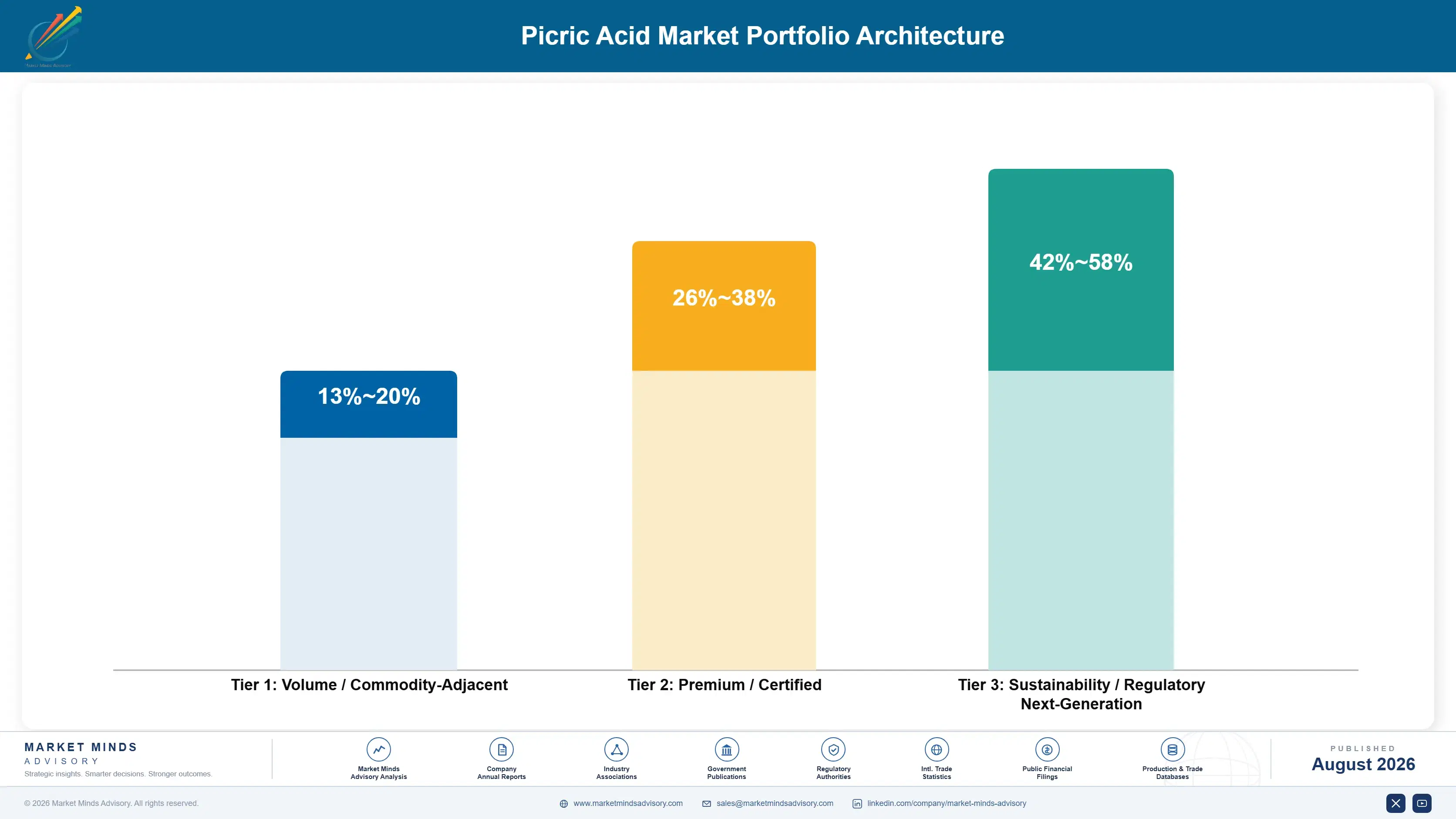
Margin architecture here tracks documentation and licensing rather than purity. Drummed technical grade sold into dye intermediate use runs at gross margins in the mid teens, competing on nitration cost alone against a shrinking customer base. Reagent packs with accredited documentation earn three to four times that.
The volume-versus-premium tension barely exists in the usual form, because the two ends of this market are almost separate businesses. Nitration producers hold capacity that reagent houses do not want and would not use efficiently. Reagent houses hold licences, packaging and channel access that nitration producers find expensive and slow to acquire. Very few participants operate across both, and those who try generally discover the skills do not transfer as readily as the organisation chart suggested.

Value concentrates where accreditation excludes competitors. Clinical and pathology reagent supply sits at the top, because an accredited laboratory cannot use material whose provenance, water content and metal limits are not certified, regardless of what the chemistry says. Prepared solutions sit alongside on hazard elimination logic. Drummed technical grade sits at the other extreme, where a purity figure is the whole basis of comparison and pricing compresses toward phenol cost plus nitration.

Volume / Commodity-Adjacent

Drummed technical and wetted industrial grade sold into dye intermediate synthesis and metallurgical etching. Purity specification is the only comparison buyers make, nitration cost decides pricing, and the customer base has been shrinking steadily for two decades.
Gross Margin: 13-20%

Premium / Certified

Pharmacopoeial purity material and standard laboratory packs supplied to research, industrial testing and academic customers. Purity documentation and regulated packaging support pricing well above drummed material. Range reflects the spread between academic and industrial testing requirements.
Gross Margin: 26-38%

Sustainability / Regulatory / Next-Generation

Accredited clinical diagnostic reagent packs and prepared histology fixative solutions supplied with audited documentation and handling protocols. Licensing, documentation and hazard elimination rather than chemistry justify the pricing achieved in this tier.
Gross Margin: 42-58%
picric-acid-market-trends-portfolio-architecture-1787311694391

High-value Sub-segments and Strategic Watch-out

Accredited Diagnostic Reagent

High value on genuinely high growth at 7.2%, protected because accredited clinical laboratories cannot use material whose provenance and water content are uncertified. Precursor licensing has narrowed the channel so far that pricing power now rests almost entirely with whichever suppliers simply stayed inside it.
Gross Margin: 44-58%

Prepared Fixative Solutions

Strong margins on genuinely durable growth at 6.1% annually, and there is simply no equally effective substitute for picric acid fixatives across several important tissue types. Pathology laboratories change fixatives very reluctantly, because diagnostic comparability against archived specimens genuinely matters clinically rather than merely procedurally.
Gross Margin: 42-54%

Drummed Technical Grade

The shrinking industrial base of this market, earning gross margins in the mid teens against a dye intermediate customer pool that has declined for two decades. Nitration cost is the whole basis of comparison and no commercial action available to a producer improves that position at all.
Gross Margin: 13-20%

Jaffe Assay Reagent Supply

The strategic watch-out sitting squarely in this portfolio. This remains by some way the largest single demand pool, but enzymatic creatinine methods have already taken 22% of clinical testing and the substitution running against it is one-directional, slow and almost certainly irreversible over the forecast period.
Gross Margin: 40-52%

How This Demand Actually Repeats

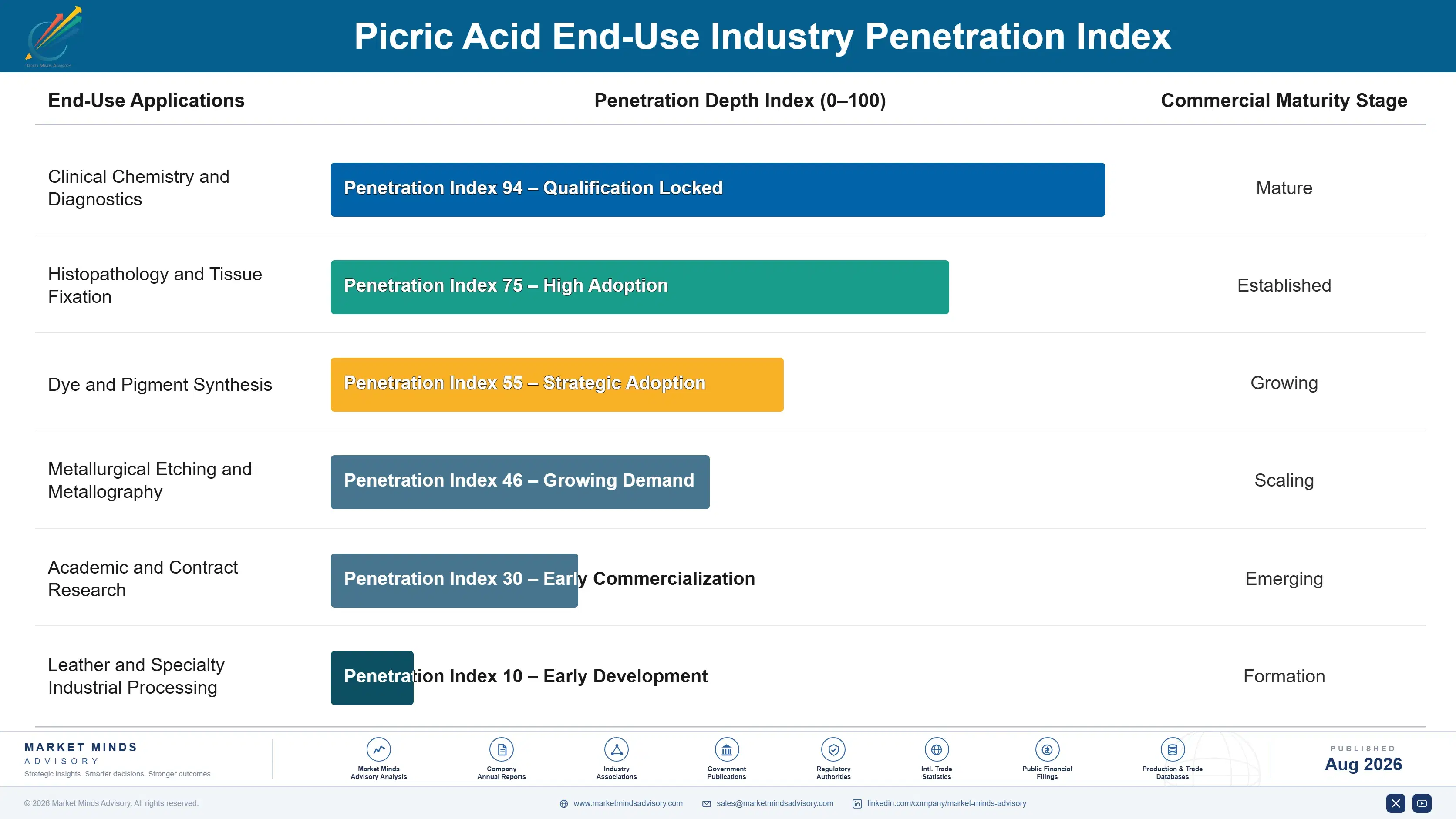
Reagent demand behaves as an annuity attached to an accredited laboratory method rather than to any purchasing relationship. Once a supplier's material is validated into a clinical assay or a histology protocol, it recurs with every test run, because revalidating the method against a different supplier costs laboratory time nobody has.
Stickiness varies considerably by application. Clinical diagnostic supply is the tightest, since accreditation requires documented reagent provenance and method revalidation is a genuine project rather than a purchasing decision. Histology fixatives sit close behind, held by diagnostic comparability against archived specimens. Academic and research use is moderately sticky, with buyers holding preferred suppliers but responding to catalogue pricing. Dye intermediate and etching use is barely sticky at all, with buyers comparing purity and price on every order placed.

Buyer profiles have changed markedly. Purchasing once sat with laboratory managers comparing catalogue prices for a listed chemical. It now frequently involves quality, accreditation and safety functions asking about certificate content, water content verification, metal contamination limits and disposal guidance. Suppliers whose commercial approach still leads with catalogue pricing find themselves talking to buyers for whom price is settled last and documentation is settled first.
picric-acid-market-trends-end-use-penetration-index-1787311694891

Where To Place Capital

These are among the four positions where our research anticipates prominent divergence between winners and laggards over the coming forecast period. Each is grounded in the demand model, the regulatory perimeter, and the announced capacity pipeline.
01 / PRECURSOR LICENCE RETENTION

The compliance burden is the whole moat here

Explosive precursor compliance costs between $150,000 and $400,000 annually for anyone carrying meaningful inventory, and that obligation has already driven several general chemical distributors out of the product entirely. Suppliers who hold the licences realise pricing many times drummed technical value, because customers are buying relief from an obligation rather than a chemical. The compliance cost is fixed while the pricing benefit scales with volume, which rewards whichever suppliers simply choose to stay inside the channel rather than exiting it.
02 / SOLUTION FORMAT CONVERSION

Sell the working solution, not the wetted solid

Laboratories want a working solution rather than a wetted solid they must weigh, dissolve and then dispose of under hazard protocols they wrote themselves. Prepared solutions remove the drying hazard entirely, eliminate weighing and simplify waste handling, realising roughly 35% higher margin per unit of active material supplied. Formulation and filling capability costs under $2 million to establish, and the regulatory classification often improves as well, since dilute solutions attract considerably lighter hazard treatment across several of the most important jurisdictions.
03 / ACCREDITATION DOCUMENTATION DEPTH

Paperwork decides which laboratories can buy

Accredited clinical and pathology laboratories simply cannot use reagent whose provenance, water content and metal contamination limits remain uncertified, whatever the underlying chemistry might say about equivalence. Suppliers holding fully audited documentation hold their pricing 15% to 20% above chemically equivalent material carrying thinner paperwork, at an annual maintenance cost running under $120,000 across a whole grade family. That is among the cleanest returns available anywhere across laboratory chemicals, and most volume nitration producers have simply never once pursued it.
04 / ASSAY SUBSTITUTION PLANNING

Assume the Jaffe method keeps losing ground

Enzymatic creatinine methods have now taken roughly 22% of clinical testing from the picrate-based Jaffe reaction, against about 12% only five years ago, and the substitution is entirely one-directional, because laboratories simply do not revert once they have revalidated a method internally. The substitution is nonetheless slow, since Jaffe reagents cost considerably less and method revalidation is expensive work. Suppliers should therefore plan their growth around histology, analytical use and emerging-market testing access rather than around defending the assay itself indefinitely.

Engagement Snapshot From the Field

A live engagement with an industry participant carrying material or product regulatory and market exposure ahead of a defining policy shift, showing how our research translates into a defensible multi-year portfolio strategy.
MARKET MINDS ADVISORY · CLIENT ENGAGEMENT SUMMARY
Picric Acid Producer Strategic Portfolio Review and Transition Roadmap 2026·Investment Scenario on Picric Acid Exposure Evaluation 2025-26
CLIENT PROFILE
An Indian fine chemicals producer with annual revenue near $64 million (client-reported, unverified by MMA), operating nitration capacity supplying picric acid and related nitrophenols in drummed technical grade. Roughly 82% of picric acid volume sold to dye intermediate and etching customers on price, with no reagent packaging capability, no accreditation documentation and no laboratory channel of any kind.
STRATEGIC CHALLENGE
Dye intermediate demand had declined for four consecutive years while phenol cost volatility repeatedly compressed margins the customer base would not absorb. Management could see reagent grade material selling at many times its own realised pricing but did not know whether the barrier was chemistry, capital or something else entirely, and no one internally had assessed it.
MMA APPROACH
MMA mapped the reagent value chain from nitration through packaging and documentation to accredited laboratory sale, sized the licensing and audit requirements for European and North American clinical accreditation, and assessed which channel routes were realistically open to an Indian producer. Findings were tested against 47 expert interviews covering laboratory accreditation practice, precursor licensing and reagent distributor economics.
KEY FINDINGS
  1. The barrier to reagent grade was documentation and licensing rather than purity, and the client's existing material already met the chemical specification required.
  2. European clinical accreditation documentation would cost approximately $1.4 million and eighteen months (client-reported estimate, unverified by MMA), well within the client's capacity to fund.
  3. Prepared fixative solution capability at under $1.8 million offered better returns than reagent solid packaging alone, because it removed the customer's drying hazard entirely.
  4. Direct laboratory channel access was unrealistic, but supplying accredited material to established reagent houses under their own labels was both open and immediately available.
CLIENT PROFILE
An Indian fine chemicals producer with annual revenue near $64 million (client-reported, unverified by MMA), operating nitration capacity supplying picric acid and related nitrophenols in drummed technical grade. Roughly 82% of picric acid volume sold to dye intermediate and etching customers on price, with no reagent packaging capability, no accreditation documentation and no laboratory channel of any kind.
STRATEGIC CHALLENGE
Dye intermediate demand had declined for four consecutive years while phenol cost volatility repeatedly compressed margins the customer base would not absorb. Management could see reagent grade material selling at many times its own realised pricing but did not know whether the barrier was chemistry, capital or something else entirely, and no one internally had assessed it.
MMA APPROACH
MMA mapped the reagent value chain from nitration through packaging and documentation to accredited laboratory sale, sized the licensing and audit requirements for European and North American clinical accreditation, and assessed which channel routes were realistically open to an Indian producer. Findings were tested against 47 expert interviews covering laboratory accreditation practice, precursor licensing and reagent distributor economics.
KEY FINDINGS
  1. The barrier to reagent grade was documentation and licensing rather than purity, and the client's existing material already met the chemical specification required.
  2. European clinical accreditation documentation would cost approximately $1.4 million and eighteen months (client-reported estimate, unverified by MMA), well within the client's capacity to fund.
  3. Prepared fixative solution capability at under $1.8 million offered better returns than reagent solid packaging alone, because it removed the customer's drying hazard entirely.
  4. Direct laboratory channel access was unrealistic, but supplying accredited material to established reagent houses under their own labels was both open and immediately available.
RECOMMENDED STRATEGY
Phase 1: Phase one: complete European and North American accreditation documentation across the grade family, since it gates every downstream option and costs relatively little. Phase 2: Phase two: install prepared fixative solution formulation and filling capability, prioritising it well ahead of any solid reagent packaging investment. Phase 3: Phase three: supply accredited material to established reagent houses under their labels rather than attempting to build a laboratory channel directly.
OUTCOME
The client completed accreditation documentation within sixteen months and commissioned solution filling the following quarter, reporting realised pricing on accredited material roughly 3.4 times its drummed technical grade (client-reported, unverified by MMA). Two established reagent houses now take accredited material under their own labels, and dye intermediate volume was allowed to decline rather than defended.

Frequently Asked Questions

Foundational context covering the market sizes, CAGR, scope, country, region and competition that inform every finding below. This section is provided to cover basics and most often pre-purchase conversations, answered from the MMA Primary Research Dataset.

What is the current size of the Picric Acid Market?

The market was worth $0.1 billion in 2025 and is forecast to reach $0.10 billion in 2026. Reagent and diagnostic grades account for a disproportionate share of that value.

How large will the Picric Acid Market be by 2036?

MMA forecasts $0.16 billion by 2036, an expansion multiple of 1.60 times the 2026 base. That represents $0.06 billion of incremental value across the forecast period.

What is the CAGR for the Picric Acid Market 2026 to 2036?

The base case compound annual growth rate is 4.8%, with a bull case of 6.0% and a bear case of 3.6%. Historical growth from 2020 to 2025 ran at 3.9%.

Which segment is growing fastest?

Diagnostic and analytical reagent grade at 7.2%, a full 1.50 times the market rate. Clinical creatinine testing volumes and histology fixative demand carry most of that growth.

Who are the major companies in the Picric Acid Market?

Merck KGaA, Thermo Fisher Scientific, Tokyo Chemical Industry, Central Drug House and Loba Chemie lead with 56% between them. Fifteen further suppliers hold meaningful grade or regional positions.

Which country is growing fastest?

India at 7.6%, pulled by rapidly expanding clinical laboratory networks reaching populations without previous routine testing access. Domestic production and reagent packaging capability both support that growth.

Report Segmentation Architecture

The full report scope spans multiple orthogonal segmentation dimensions, with cross-tabulated demand data provided for each dimension pair. Coverage extends further to regional breakdowns, trend trajectories, and the competitive detail needed to support segment-level decision-making.

By Product Grade

  • Diagnostic and Analytical Reagent Grade
  • Pharmacopoeial and Histology Grade
  • Dye and Pigment Intermediate Grade
  • Metallurgical Etchant Grade
  • Wetted Technical Industrial Grade

By End-Use Industry

  • Clinical Chemistry and Diagnostics
  • Histopathology and Tissue Fixation
  • Dye and Pigment Synthesis
  • Metallurgical Etching and Metallography
  • Academic and Contract Research
  • Leather and Specialty Industrial Processing

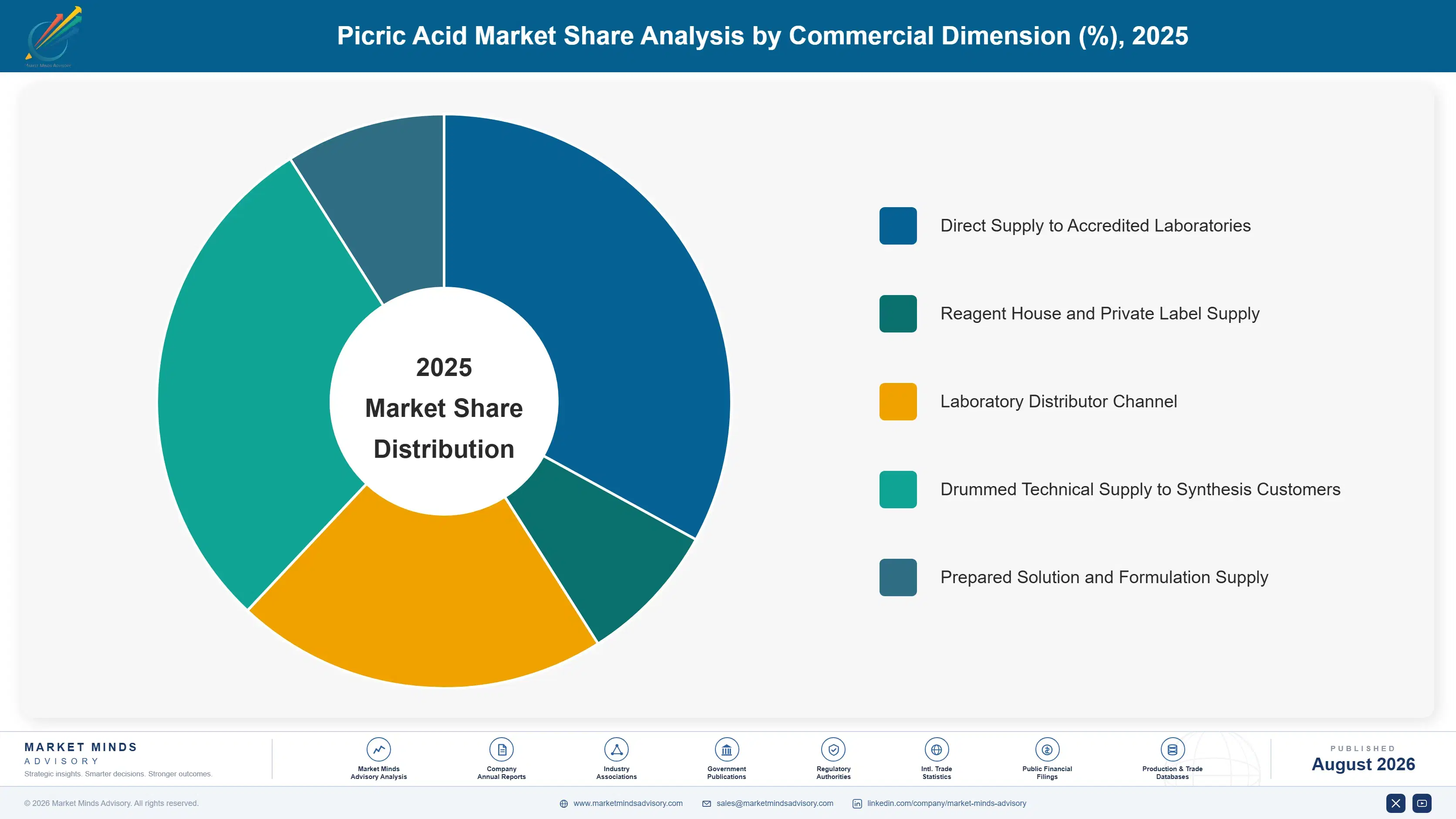
By Commercial Dimension

  • Direct Supply to Accredited Laboratories
  • Reagent House and Private Label Supply
  • Laboratory Distributor Channel
  • Drummed Technical Supply to Synthesis Customers
  • Prepared Solution and Formulation Supply

By Region

  • North America
  • Western Europe
  • East Asia
  • South Asia and Pacific
  • Latin America
  • Middle East and Africa
  • Eastern Europe

Scope, Methodology, and Coverage

Every figure in this report is reproducible from documented input assumptions. The scope below maps the historical period, the forecast horizon, the segmentation dimensions, and the countries covered, alongside the underlying primary and qualitative methodology.
Historical Period
2020 to 2025
Forecast Period
2026 to 2036
Base Year
2025 (USD billions; MMA Primary Research Dataset, August 2026)
Market Definition
This report covers picric acid, chemically 2,4,6-trinitrophenol, supplied as water-wetted solid or in prepared solution for analytical, diagnostic, histological, dye intermediate and metallurgical etching applications. Coverage spans diagnostic and analytical reagent, pharmacopoeial and histology, dye and pigment intermediate, metallurgical etchant and wetted technical grades, together with the documentation and handling protocols supplied alongside them. Picrate salts and metal picrates, other nitrophenols, ammonium picrate and military explosive formulations, finished diagnostic assay kits and branded prepared histological stains are excluded from scope.
Quantitative Units
USD billions at supplier realised prices; volume in tonnes of picric acid on a dry basis; gross margin percentages by commercial tier.
Segmentation Dimensions
Product grade, end-use industry, commercial dimension, region.
Regions Covered
North America, Western Europe, East Asia, South Asia and Pacific, Latin America, Middle East and Africa, Eastern Europe
Countries Covered
China, Japan, South Korea, India, Australia, Indonesia, United States, Canada, Mexico, Germany, Switzerland, United Kingdom, France, Italy, Brazil, Poland, Turkey, Russia, Saudi Arabia, South Africa.
Key Companies Profiled
Merck KGaA, Thermo Fisher Scientific, Tokyo Chemical Industry, Central Drug House, Loba Chemie, Avantor, Spectrum Chemical Manufacturing, Nanjing Chemical Material, Aarti Industries, Finar Chemicals, and ten further suppliers.
Quantitative Methodology
Primary survey, n=3,800 respondents, Q4 2025, six countries; demand-side model with trade association cross-validation
Qualitative Methodology
47 expert interviews, Q4 2025; applied to validate demand model assumptions, identify emerging dynamics, and assess competitive positioning
Report Format
PDF and XLSX data workbook (Word format preview document)
Publisher
Market Minds Advisory
Report Code
MMA-2026-CHM-774
Published
August 2026
Contact
sales@marketmindsadvisory.com | www.marketmindsadvisory.com

Purchase the full Picric Acid Market Report (2026 to 2036).

The full report sets out ten-year forecasts for picric acid by product grade, end-use industry and commercial model across seven regions. It quantifies enzymatic creatinine substitution against the Jaffe assay pool laboratory tier by laboratory tier through 2036. Competitive assessment covers twenty suppliers on a consistent revenue basis, separating nitration capacity from accreditation documentation and licensed distribution capability. Precursor licensing and compliance cost is modelled by jurisdiction, isolating where regulation has narrowed the channel most sharply. Findings draw on a quantitative survey of 3,800 respondents across six countries and 47 expert interviews conducted during the fourth quarter of 2025.
Ten-year forecasts by product grade and region
Enzymatic assay substitution modelled by laboratory tier
Precursor licensing cost mapped by regulatory jurisdiction
Twenty-supplier assessment on consistent revenue basis
Reagent value chain decomposed from nitration to laboratory
Margin architecture across three commercial portfolio tiers

Built For The People Who Decide

From boardroom strategy to bench-side execution, this report is read cover-to-cover by leaders shaping the next decade of their industry, turning demand scenarios, market dynamics and valuation benchmarks into decisions.
CXOs/ Presidents/ VPs/ Managers
M&A and Corporate Development
Strategy Teams and R&D Heads
Procurement and Product Directors
Regulatory and Compliance Leaders
Investor Relations and Equity Analysts