Market Minds Advisory
Pickling Chemicals Market

Pickling Chemicals Market: Steel Processing Legacy and the Stainless Specialty Pull

Pickling chemicals sit between decades-old carbon steel descaling demand tied to China's dominant global steel output, and a fast-emerging stainless and specialty alloy role driven by EV battery enclosure and aerospace manufacturing.

Lead Analyst

Bilal Shaikh

Published

September 2026

Make Smarter Decisions with Customized Research Insights

Request a free sample report and evaluate market opportunities, growth trends, and competitive dynamics relevant to your business needs.

2025 MARKET VALUE$2.4BMarket Size 2025
2036 FORECAST VALUE$3.9BBase Case , 2026 to 2036
CAGR 2026 TO 20364.6 %Bull 5.8% / Bear 3.4%
INCREMENTAL OPPORTUNITY$1.4BNet 10- year value creation
EXPANSION MULTIPLE1.57x2036 value over 2026 base
Strategic Levers
M&A Pipeline
Regional Outlook
Country Rankings
Competitive Intelligence
Segmental Deep-dive
Call-Us : 91 93563 13602

Executive Snapshot and Market Trajectory

Pickling chemicals built their commercial base on hydrochloric acid descaling for carbon steel, a mature process step tied directly to global steel production volume. Stainless steel and specialty alloy pickling is now the segment actually earning the higher margin. Few industrial chemicals carry such a split commercial identity.
Specialty alloy and aerospace pickling is growing fastest as EV battery enclosure manufacturing and aerospace component production both scale, pulling demand into nitric and hydrofluoric acid chemistry that commodity carbon steel pickling never required. East Asia anchors global demand overwhelmingly on China's dominant steel production base, a concentration no other region in this research programme comes close to matching, while North America and Western Europe compete on specialty chemistry depth rather than raw volume.
Twenty companies compete across a market split between bulk carbon steel pickling acid sold largely on delivered cost, and specialty stainless and aerospace-grade chemistry earning meaningfully more on formulation and regulatory compliance depth. Environmental disposal regulation genuinely raises compliance cost that smaller producers increasingly struggle to absorb. Producers increasingly invest in regeneration technology rather than simply absorb the rising disposal cost each year. Slow adapters risk losing large accounts.
Market Definition
The market covers acid-based chemicals, primarily hydrochloric, sulfuric, nitric, and hydrofluoric acid formulations, used to remove oxide scale and prepare metal surfaces before further processing, plus associated pickling inhibitors and passivation chemicals. Electroplating chemicals and finished coating products are excluded.
Base Year Value
$2.4B in 2025 (MMA Primary Research Dataset, August 2026)
Forecast Period
2026 to 2036, eleven discrete annual values
CAGR
4.6% base case. Bull 5.8%. Bear 3.4%.
Fastest Growth Segment
Specialty Alloy and Aerospace Pickling: 6.5% CAGR
Fastest Growth Country
India: 7.5% CAGR
Fastest Growth Region
South Asia and Pacific: 6.8% CAGR
Largest Region
East Asia: 36% of 2025 global value
Market Leaders
Chemetall GmbH, Henkel AG and Co, Quaker Houghton, Nippon Paint Surf Chemicals, Ecolab Inc. Source: MMA Analysis based on company annual reports.
Primary Survey
n=3,800 procurement and R&D decision-makers, Q4 2025, six countries
Methodology
Demand-side build-up, cross-validated against public data, 47 expert interviews

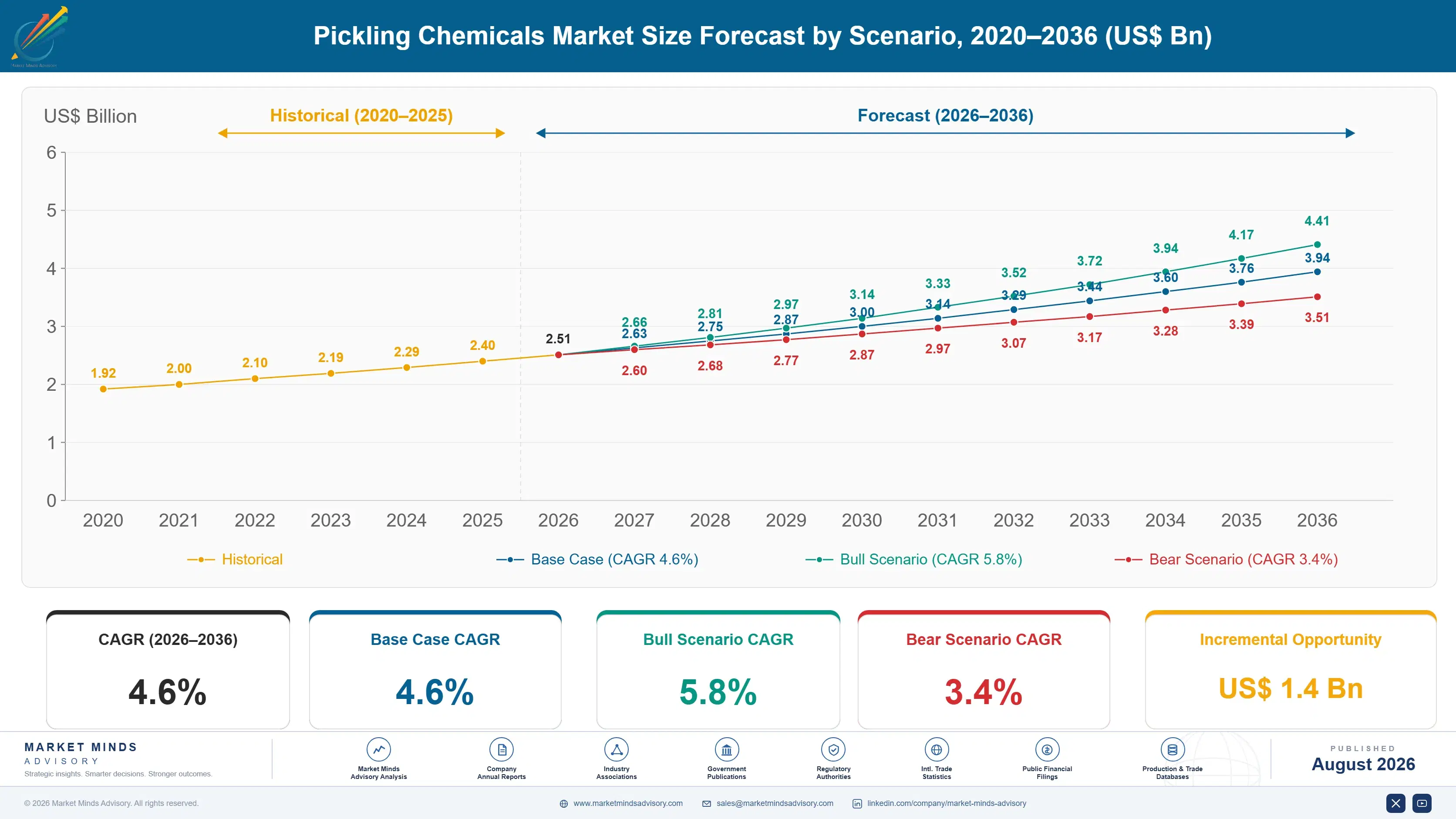
Pickling Chemicals Market Forecast Scenarios

pickling-chemicals-market-trends-size-forecast-scenario-1787559235634
Between 2020 and 2025 the market grew near 3.8% a year, held back by pandemic-era steel production disruption before recovering as global steel output normalised and stainless steel demand for EV battery enclosures began contributing meaningfully to overall growth. Stainless steel demand barely registered as a meaningful growth contributor at the start of that same five-year period.
The base case carries the market to 4.6% CAGR on three mechanisms: continued carbon steel production growth across Asian steel producers, stainless steel demand expansion tied to EV battery enclosure and appliance manufacturing, and specialty alloy pickling growth from aerospace component production. None of these three mechanisms depends on any single national steel tariff decision alone. Each mechanism moves largely independently of the others, which is what makes the base case durable across cycles.
The bull case at 5.8% assumes faster stainless steel demand growth from EV manufacturing than currently modelled. The bear case at 3.4% assumes sustained global steel production weakness and tightening environmental disposal regulation raise compliance cost faster than currently anticipated. Neither scenario depends on any single national steel tariff or trade policy decision alone. Both remain plausible given how unevenly regional steel and stainless demand trends have moved recently.

Carbon Steel Legacy Meets the Stainless Specialty Pull

Three forces converge on this market at once, and each moves on its own separate schedule. Carbon steel pickling demand tracks global steel production volume that swings with construction and industrial cycles, stainless steel pickling demand tracks EV battery enclosure and appliance manufacturing that moves independently of carbon steel cycles, and specialty alloy pickling tracks aerospace production schedules disconnected from either broader driver. None of these three schedules move in step, which is why regional cycles rarely align.
CAPACITY UTILISATION74%acid blending lines run below nameplate most of the year
AVERAGE SELLING PRICEUSD 620/tonneblended price across carbon steel and specialty acid grades
TOP PRODUCER SHARE12%largest single producer share of global chemicals revenue
FEEDSTOCK COST SHARE48% of COGSsulfuric and hydrochloric acid feedstock cost across producers
TRADE INTENSITY28%share of global output moving across a border annually
HHI CONCENTRATION340a genuinely fragmented global producer landscape overall today
Commercially, the market behaves like a bulk industrial chemical business wearing a specialty formulation label. Grade differentiation genuinely exists, stainless and aerospace-grade formulations commanding real premiums over standard hydrochloric acid pickling, but margin still tracks acid feedstock cost and wastewater compliance investment more than pure brand positioning. A producer with captive sulfuric acid supply competes on cost structure long before it competes on formulation depth.
Over the next decade, stainless steel demand and specialty alloy pickling will decide winners more than carbon steel volume growth alone, since carbon steel demand is already a largely mature, cycle-tied base. Producers investing early in specialty stainless and aerospace-grade formulation will capture margin that carbon-steel-only competitors cannot easily replicate without significant reformulation investment.
"Everyone still pictures a rusty steel coil when they hear pickling chemicals. The real margin story now sits inside an EV battery enclosure line, not a hot-rolled steel mill."
Director, Industrial Chemicals Practice · MMA Chemicals and Materials Practice · August 2026

Market Trends

Acid Regeneration Technology Reduces Waste Disposal Cost

Steel producers and pickling chemical suppliers have increasingly adopted acid regeneration technology that recovers and recycles spent hydrochloric acid, reducing both fresh acid purchasing volume and wastewater disposal cost simultaneously. This technology requires meaningful capital investment in regeneration equipment, but it has proven especially valuable for large integrated steel producers processing sufficient volume to justify the investment against ongoing acid and disposal cost savings. Suppliers offering regeneration technology alongside chemical supply are winning long-term contracts that pure chemical suppliers cannot match on total cost of ownership. This shift is gradually changing demand from pure consumption toward a service relationship.
Market Impact: Adds 85,000 tonnes by 2029
EV Battery Enclosure Demand Pulls Stainless Pickling Growth

Electric vehicle battery enclosure manufacturing increasingly specifies stainless steel for its corrosion resistance and structural properties, and this application requires nitric and hydrofluoric acid pickling and passivation chemistry that conventional carbon steel processing never used. Battery enclosure manufacturers specify rigorous passivation validation given the safety-critical nature of the component, creating genuine technical differentiation opportunity for suppliers investing in this specific application. This demand source barely existed as a meaningful category five years ago and is now among the fastest-growing applications in the entire pickling chemicals market. Several battery enclosure manufacturers have already qualified dedicated suppliers ahead of production scale-up.
Market Impact: Adds USD 30 million by 2028

Market Opportunities and Growth Drivers

Global Steel Production Growth Sustains Core Carbon Steel Demand

Global steel production continues expanding, particularly across Asian producers building new capacity to serve both domestic construction and export markets, and every tonne of hot-rolled steel requires pickling to remove oxide scale before further cold rolling or coating processing. This demand base tracks broader steel production volume closely, giving it a genuinely different cyclical pattern than the more secular stainless and specialty alloy growth trend running alongside it. Producers with established steel mill relationships built over decades continue capturing the bulk of this steady, volume-driven demand base. Mills increasingly negotiate multi-year contracts tied to capacity plans.
Market Impact: Raises compliance cost 18%

Rising Stainless Steel Demand Expands Specialty Chemistry Use

Stainless steel demand continues expanding across automotive, EV battery enclosure, and appliance manufacturing applications, and each of these end uses requires nitric and hydrofluoric acid pickling and passivation chemistry that carbon steel processing does not use at all. Appliance and automotive manufacturers increasingly specify stainless steel for both durability and aesthetic reasons, expanding the addressable specialty chemistry market considerably beyond its traditional industrial base. Chemical suppliers serving this segment need formulation and regulatory documentation capability distinct from standard carbon steel pickling acid production. Automotive OEMs increasingly specify stainless components across multiple vehicle platforms simultaneously.
Market Impact: Cuts margin by 220 basis points

Market Restraints and Challenges

Environmental Disposal Regulation Raises Compliance Cost

Wastewater disposal regulation for spent pickling acid continues tightening across major markets, requiring producers and steel mills to invest in treatment infrastructure or acid regeneration technology rather than simple discharge, a cost burden that smaller regional producers increasingly struggle to absorb compared with larger integrated competitors. The root cause is genuine environmental policy concern over heavy metal and acid contamination in industrial wastewater rather than any supplier-imposed barrier, and enforcement has tightened steadily across most major regulated markets. Producers are responding by investing directly in regeneration technology or by partnering with specialized waste treatment companies to manage compliance.
Market Impact: Cuts fresh acid demand 15%

Acid Feedstock Volatility Compresses Non-Integrated Margins

Pickling chemical producers without captive sulfuric or hydrochloric acid production carry direct exposure to petrochemical and sulfur price swings that integrated chemical majors partially insulate through internal acid production. The root cause is the same broader chemical feedstock volatility affecting sulfur, chlor-alkali, and petrochemical markets simultaneously, transmitted directly into pickling chemical production economics. Smaller specialty producers are responding by signing longer-dated acid supply contracts where available and by focusing increasingly on higher-margin specialty stainless and aerospace grades where price sensitivity is lower. Larger integrated producers absorb this exposure more comfortably than smaller merchant chemical makers.
Market Impact: Adds USD 45 million in demand
3 additional market trends, 4 additional growth drivers, and 2 additional restraints and challenges are covered in the full report. Contact sales@marketmindsadvisory.com to access the complete intelligence.

Segment CAGR and Growth Architecture

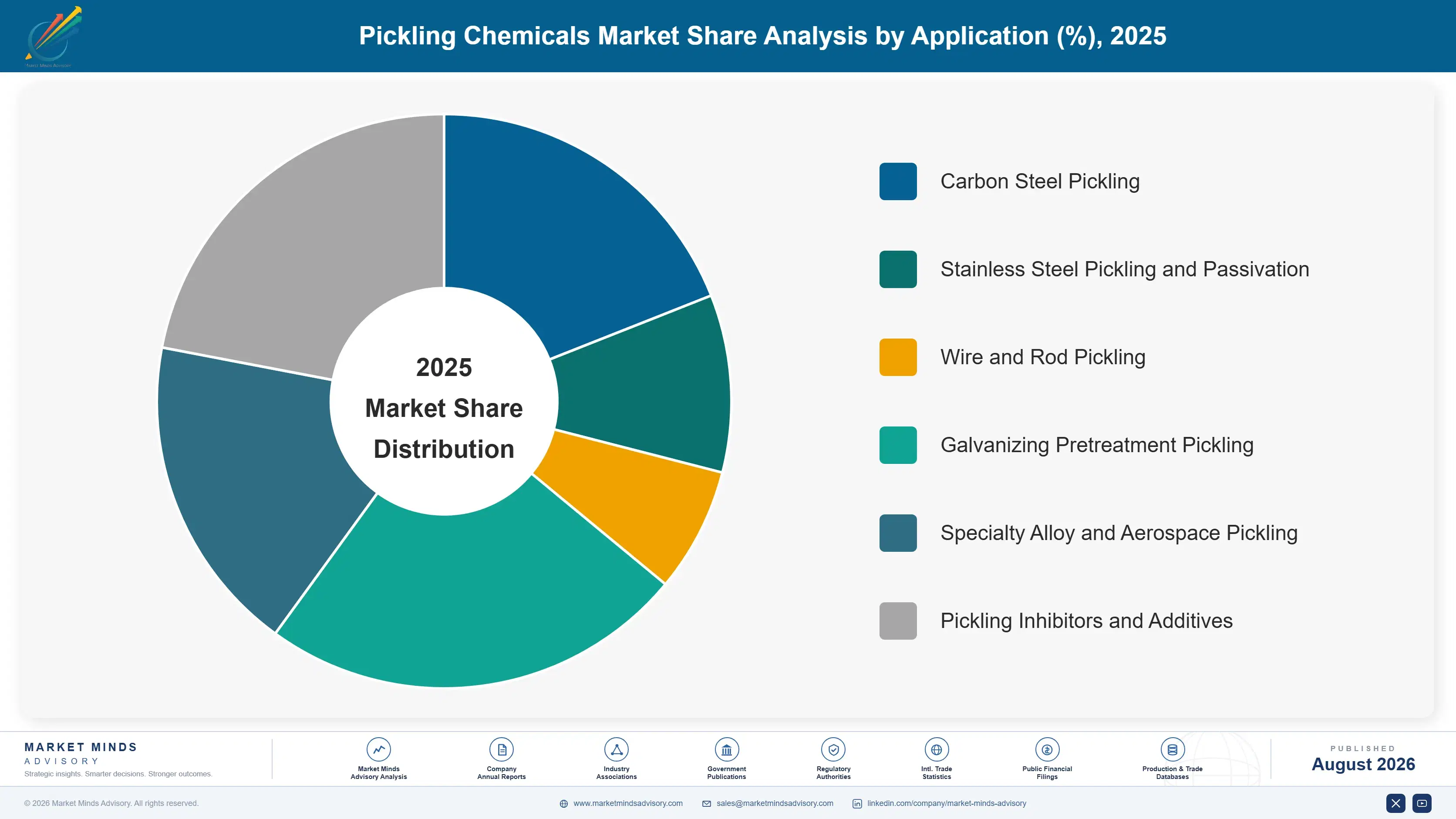
Segmentation follows end-use application, the single commercial logic determining acid chemistry, formulation, and buyer relationship structure. Carbon steel pickling dominates by volume, while specialty alloy and inhibitor additive segments are growing fastest on technology and manufacturing demand. Wire, rod, and galvanizing applications each carry distinct buyer bases and specification cycles of their own. Buyer pathways differ across each category.
pickling-chemicals-market-trends-market-share-analysis-1787559236163

Specialty Alloy and Aerospace Pickling

Specialty alloy and aerospace pickling grows fastest at 6.5%, about 1.41 times the overall 4.6% rate, as aerospace component production and EV battery enclosure manufacturing both scale globally, pulling demand into nitric and hydrofluoric acid chemistry that conventional carbon steel processing never required. Aerospace manufacturers specify rigorous pickling and passivation validation given the safety-critical nature of structural components, creating genuine technical differentiation opportunity for suppliers investing in this specific application depth. Battery enclosure manufacturers similarly demand tight process validation given the safety implications of enclosure integrity. Suppliers serving this segment need specialized formulation and documentation capability entirely distinct from standard carbon steel pickling acid production and supply relationships. Contract terms typically span multiple years given the certification investment required.
CAGR 6.5%

Pickling Inhibitors and Additives

Pickling inhibitors and additives grow second-fastest at 5.8%, driven by steel producers increasingly specifying corrosion inhibitor additives that protect base metal from over-pickling and hydrogen embrittlement during the acid treatment process. These additives represent a genuinely higher-margin adjacent product line for pickling chemical suppliers, since inhibitor formulation requires specialized chemistry expertise beyond bulk acid production capability. Steel producers increasingly view inhibitor selection as a genuine quality and yield consideration rather than a minor cost line item, rewarding suppliers who can demonstrate measurable yield improvement from their specific formulations. This segment remains smaller than bulk acid sales by absolute volume but continues drawing dedicated formulation investment. Contract terms typically favour technical partnership over pure transactional supply relationships.
CAGR 5.8%
Full segment breakdown across 6 segments available in the complete report.

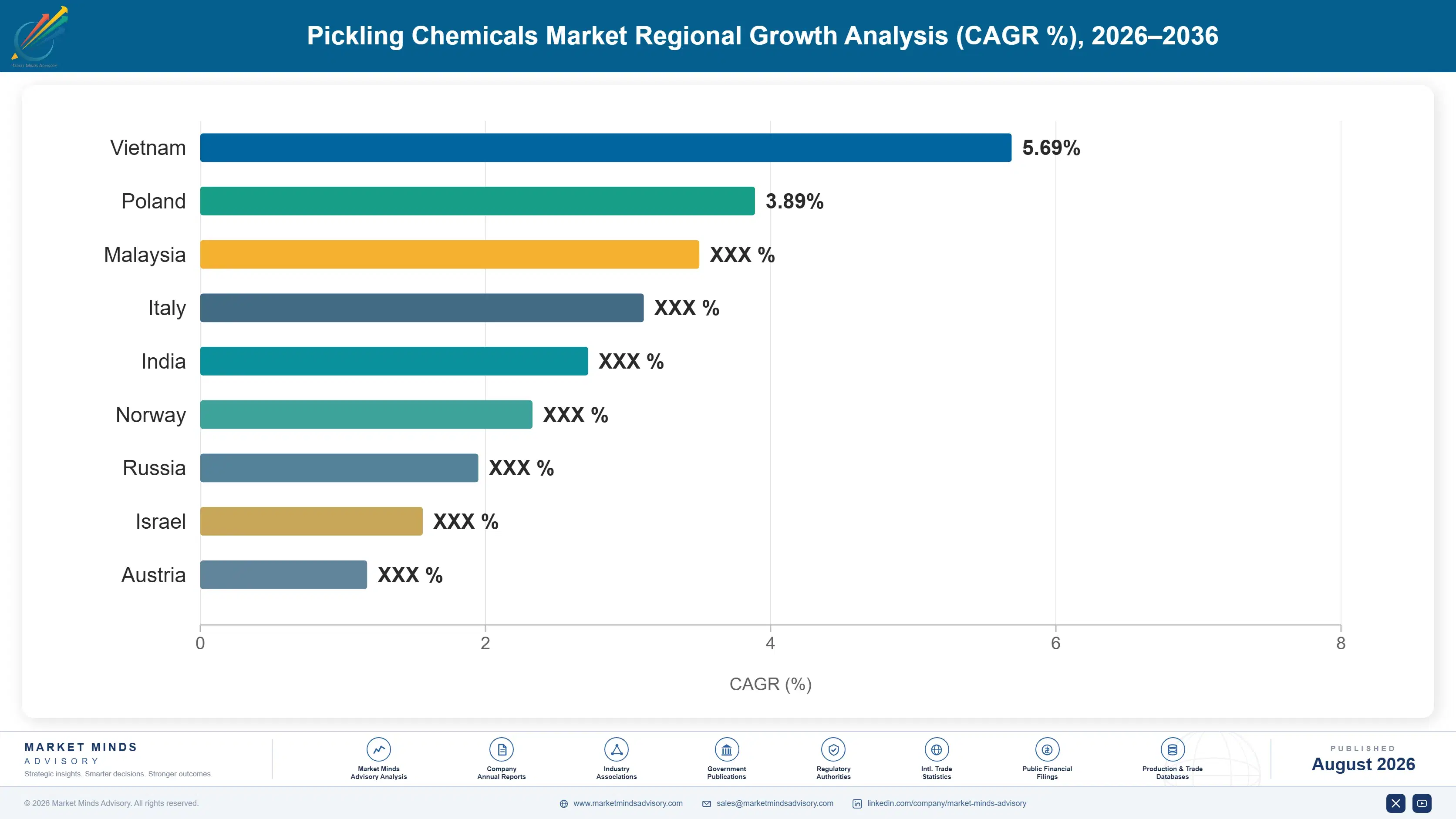
Regional Architecture and Country Demand Map

East Asia dominates on China's outsized global steel production share, a concentration well beyond this report's standard regional band, while North America and Western Europe compete on specialty chemistry depth rather than raw volume. South Asia and Pacific posts the fastest regional growth from a considerably smaller existing base.

North America

Specialty stainless and aerospace chemistry depth explains North America's 22% share and its 4.8% growth, anchored by Chemetall and Ecolab facilities serving EV battery enclosure and aerospace component manufacturers rather than pure bulk carbon steel volume. American steel production itself has declined gradually over decades, shifting the region's pickling chemical demand mix increasingly toward specialty stainless and aerospace grades. Growth here tracks EV battery enclosure manufacturing expansion more than any new carbon steel volume growth, since American conventional steel production is already broadly mature. Canadian production contributes a smaller integrated base serving similar specialty end markets. Domestic capacity keeps expanding to serve both stainless and aerospace customers simultaneously. Aerospace pickling demand also continues expanding steadily across established defense manufacturing hubs.
Share: 22% | CAGR: 4.8% (2026 to 2036)

Western Europe

Established specialty alloy and aerospace manufacturing explains Western Europe's 18% share and its 3.0% growth, the slowest of any region tracked here, given a mature and gradually declining conventional steel production base. German and French specialty steel producers anchor much of the region's demand, and Henkel AG and Co maintains substantial European manufacturing and technical service capacity serving both automotive and aerospace customers directly. European environmental disposal regulation is among the strictest globally, driving early acid regeneration technology adoption across the region's producer base. Growth stays modest because European conventional steel production continues facing steady decline pressure from Asian competition. Automotive stainless demand is emerging as a genuine second growth driver here as well.
Share: 18% | CAGR: 3.0% (2026 to 2036)
Regional intelligence for 5 additional markets available in the complete report: East Asia, South Asia and Pacific, Latin America, Middle East and Africa, Eastern Europe. Contact sales@marketmindsadvisory.com.
pickling-chemicals-market-trends-country-cagr-analysis-1787559236679

Where Producers Can Defend Margin

Acid feedstock exposure and specialty chemistry depth set real limits on margin in this market, but four commercial moves let producers capture more value above that ceiling regardless of feedstock position, and regardless of how any single steel production cycle unfolds. Producers combining several of these moves are pulling ahead of single-strategy competitors. across every major producing region.

Build Specialty Stainless and Aerospace Formulation Capability

Producers investing in nitric and hydrofluoric acid formulation capability for stainless and aerospace-grade pickling, ahead of broader industry recognition of the segment's commercial potential, capture EV battery enclosure and aerospace manufacturer contracts that bulk carbon steel producers cannot service at required specification. This investment requires real formulation expertise, but specialty grades already command premiums of 2 to 3 times carbon steel pickling pricing, and early movers are securing multi-year manufacturer relationships. Later movers will find these early manufacturer relationships considerably harder to displace once qualified. Few competitors currently serve both bulk and specialty buyers with equal technical depth.
Market Impact: Captures roughly 2 to 3 times pricing premium

Offer Acid Regeneration Technology Alongside Chemical Supply

Producers offering acid regeneration technology alongside chemical supply capture long-term contracts that pure chemical suppliers cannot match on total cost of ownership, since regeneration reduces both fresh acid purchasing and wastewater disposal cost simultaneously for large integrated steel producers. This approach requires capital investment spanning 3 to 5 years in regeneration equipment expertise distinct from standard production, but it directly addresses tightening environmental disposal regulation reshaping steel producer specification requirements. Producers without this capability face a widening gap against regeneration-equipped competitors. This capability also generates ongoing service revenue that pure chemical sales cannot easily replicate.
Market Impact: Cuts customer fresh acid demand by roughly 15%

Secure Long-Dated Acid Feedstock Supply Contracts

Producers with captive sulfuric or hydrochloric acid production, or long-dated feedstock supply contracts, avoid the spot-market volatility that compresses margin by roughly 220 basis points for non-integrated competitors during petrochemical price spikes. This integration requires substantial upfront capital investment, but it provides durable cost protection that pure spot-market buyers cannot match across a full commodity price cycle spanning 3 to 5 years. Producers without this integration face a widening disadvantage during future petrochemical price spikes. This protection compounds in value across every subsequent commodity price cycle a producer weathers. Few competitors invest this early in feedstock security.
Market Impact: Cuts margin volatility by roughly 220 basis points

Build Dedicated Technical Support Teams for Steel Mills

Producers offering dedicated technical support helping steel mills optimise pickling line chemistry and yield win preferred-supplier status ahead of pure price competition, since formulation optimisation requires expertise most mills cannot develop independently. This service model deepens customer relationships and provides 6 to 12 months earlier visibility into specification changes than competitors, positioning the producer favourably when mills consolidate their supplier base further. This visibility also positions the producer favourably when mills eventually consolidate their supplier base. Competitors relying only on transactional sales rarely gain this same level of specification visibility.
Market Impact: Lifts contract retention by 10 to 15 points

Who Controls the Margin Pool

Concentration is genuinely low at a CR5 of 32%, measured consistently across all participants on pickling chemicals sales revenue. Chemetall GmbH and Henkel AG and Co lead on specialty formulation depth and global technical service reach respectively, and the gap to Quaker Houghton and other established challengers reflects application breadth rather than any single production technology advantage a challenger cannot eventually close.
Competitive activity today runs along three lines: specialty stainless and aerospace formulation capability investment targeting the fastest-growing segment, acid regeneration technology development to address tightening environmental regulation, and long-dated acid feedstock contracting to reduce margin volatility. Producers lacking captive acid supply increasingly pursue specialty certification investment instead, given the capital intensity of matching integrated majors on pure cost position. This shift is already reshaping how several mid-tier producers allocate capital across their portfolios.

Pressure is building from Asian producers expanding specialty stainless capacity specifically to serve growing regional EV manufacturing, while European incumbents face tightening environmental disposal regulation that rewards early regeneration technology investment. Any producer still relying purely on commodity carbon steel volume without specialty or regeneration investment faces a widening growth disadvantage that pure production scale cannot offset indefinitely.
pickling-chemicals-market-trends-company-positioning-matrix-1787559237196

Competitive Moat and Risk Dimensions

CHEMETALL GMBH

Moat: Deep specialty formulation expertise

Chemetall, part of BASF Coatings, holds decades of specialty stainless and aerospace pickling formulation expertise built through direct technical partnership with automotive and aerospace manufacturers globally. Its broader BASF parent resources also let it fund research and regulatory compliance investment without the capital constraints smaller competitors face.
CHEMETALL GMBH

Risk: Premium pricing limits bulk reach

Chemetall's premium specialty positioning means it competes less effectively in price-sensitive bulk carbon steel pickling segments where lower-cost regional producers increasingly win volume contracts. This could limit its ability to capture bulk volume growth as quickly as more price-flexible competitors focused purely on commodity carbon steel demand.
HENKEL AG AND CO

Moat: Global technical service network reach

Henkel's Bonderite metal pretreatment business holds established technical service relationships across dozens of countries built over decades of steel and automotive industry supply. Its broader diversified chemicals portfolio also lets it cross-sell pickling chemistry alongside other surface treatment products to the same manufacturing customers. Few competitors can match this specific combination of reach and product breadth.
HENKEL AG AND CO

Risk: Complex portfolio dilutes focus

Henkel's breadth across dozens of chemical categories beyond pickling means this specific segment receives less dedicated management attention than at smaller, category-focused competitors. This could slow its response to fast-moving trends like EV battery enclosure pickling demand relative to more specialized rivals. Specialized rivals could move faster given their narrower organisational focus.

Players Tracked

Prominent Players

Chemetall GmbH
Henkel AG and Co
Quaker Houghton
Nippon Paint Surf Chemicals
Ecolab Inc

Other Key Players

Chemtreat Inc
Kemira Oyj
Solvay SA
Arkema SA
Clariant AG
Element Solutions Inc
Atotech
Coventya Group
Aalberts Surface Technologies
Univar Solutions
Brenntag SE
Nihon Parkerizing
Metal Coatings International
DuBois Chemicals
Van Water and Rogers

Recent Developments

FEBRUARY 2025

Chemetall expands specialty pickling chemical capacity

Chemetall GmbH completed a capacity expansion at a specialty stainless pickling chemical manufacturing facility, adding production lines ahead of rising EV battery enclosure demand. The project was an organic capacity expansion funded internally, not an acquisition or joint venture, and targeted automotive and aerospace customers specifically.
Signal: Established specialty chemical producers keep investing directly in dedicated capacity rather than relying on contract manufacturing overall.
OCTOBER 2024

Henkel signs multi-year steel producer supply agreement

Henkel AG and Co signed a multi-year pickling chemical supply agreement with a major steel producer covering both carbon steel and specialty stainless volume across several mill locations. The arrangement was a commercial supply contract, not an equity transaction or joint venture, and included technical support commitments.
Signal: Steel producers increasingly value integrated technical support alongside chemical supply rather than volume alone. each renewal cycle.
JUNE 2025

Quaker Houghton acquires specialty pickling inhibitor company

Quaker Houghton acquired a smaller specialty pickling inhibitor company outright, a genuine acquisition rather than a joint venture or minority stake, adding corrosion inhibitor formulation capability to its pickling chemicals portfolio. Terms of the transaction were not disclosed. The deal closed within the same quarter.
Signal: Diversified industrial chemical companies are increasingly buying specialty inhibitor expertise instead of building it entirely internally.

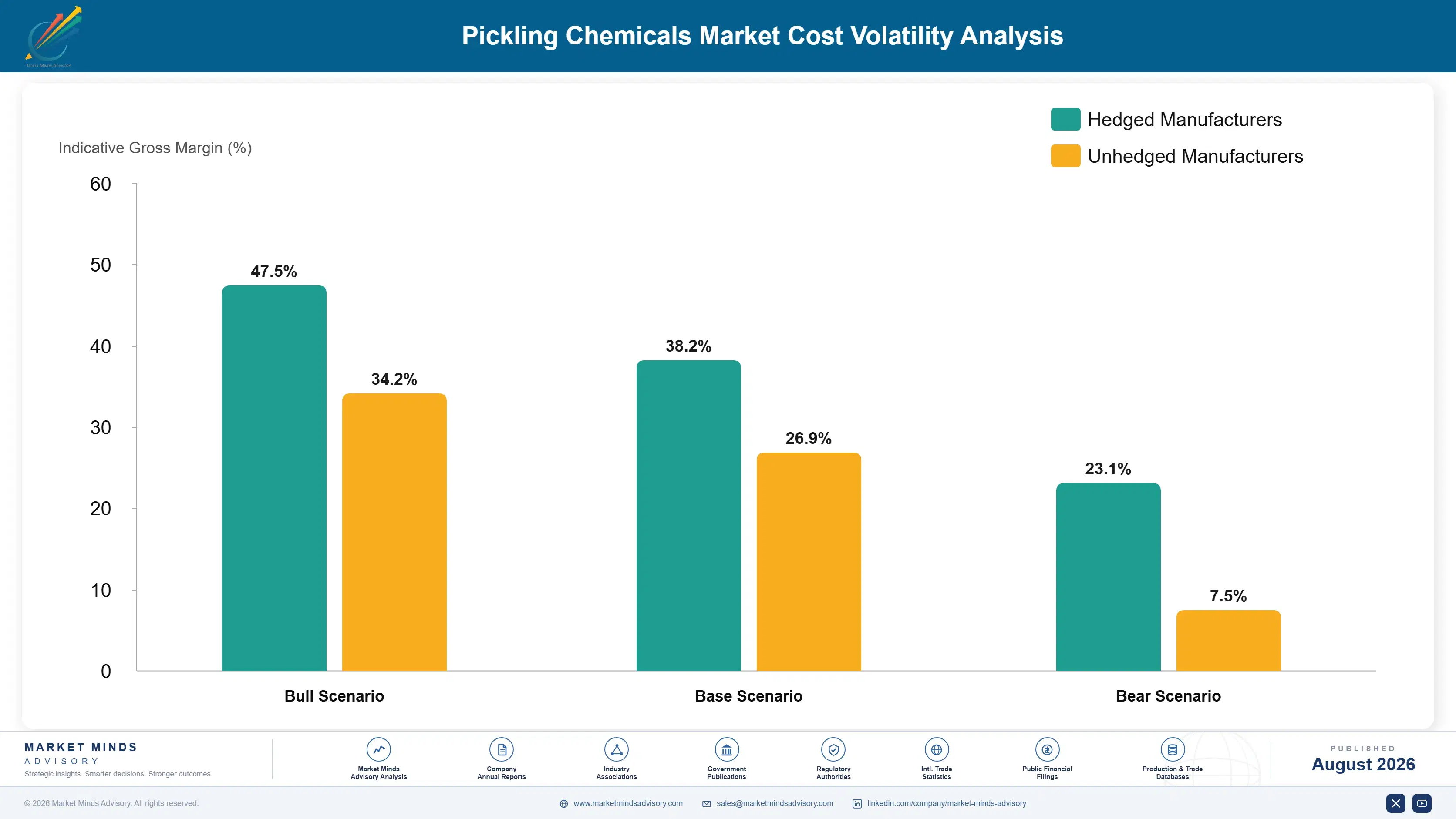
Sulfuric and Hydrochloric Acid Feedstock Exposure

Sulfuric and hydrochloric acid feedstock runs 48% of cost of goods sold across pickling chemical producers, sourced either through integrated chemical production or purchased separately from sulfur and chlor-alkali based supply chains. Formulation, quality testing, and packaging add a further 20% to 26%, with logistics and distribution making up much of the remainder. Smaller producers typically carry less negotiating scale over these input categories.
The 2022 sulfur and chlorine price spike showed how directly that exposure translates into margin. Global sulfur and chlor-alkali prices rose sharply that year as petrochemical feedstock markets tightened following broader energy market disruption, and industry trade data recorded acid feedstock costs climbing meaningfully across the period. Non-integrated pickling chemical producers buying acid on spot terms absorbed that increase directly into thinner margins, while integrated chemical majors felt considerably less impact.

Exposure separates producers cleanly by integration status. Integrated majors with captive acid production absorbed relatively little of that shock, while merchant producers buying acid separately carried the full pass-through directly into their own cost structure. That gap has hardened into a durable disadvantage for non-integrated producers without long-term feedstock contracts in place. This gap has proven persistent across multiple subsequent petrochemical price cycles since.
pickling-chemicals-market-trends-cost-volatility-analysis-1787559237392

Secure long-dated acid supply contracts

Locking multi-year acid pricing removes much of the spot sulfur and chlor-alkali pass-through that compressed margins sharply during the 2022 shock. This approach requires upfront commitment but has proven valuable for non-integrated producers seeking cost predictability comparable to integrated competitors' captive supply position. Several larger producers now treat forward contracting as standard practice regardless of near-term pricing.

Shift product mix toward higher-margin specialty grades

Producers with greater stainless and aerospace-grade revenue share are less exposed to feedstock volatility relative to revenue, since premium specialty pricing carries more room to absorb input cost increases than thin-margin carbon steel sales. This mix shift provides a genuine cushion during periods of sustained feedstock cost pressure. This mix shift reduces overall feedstock sensitivity meaningfully over time.

Pursue backward integration into acid production

Larger specialty producers are increasingly exploring direct sulfuric or hydrochloric acid production to reduce dependence on spot purchases entirely. This approach requires substantial capital investment but offers the most durable protection against future feedstock volatility for producers with sufficient scale to justify it. Few producers have pursued this path aggressively so far, leaving room for genuine differentiation.

Portfolio Architecture for Margin Defence

The portfolio splits into three tiers with real margin separation tied to formulation depth and regulatory compliance rather than raw acid cost alone. Standard carbon steel pickling acid competes largely on delivered cost against benchmark pricing, while specialty stainless and aerospace-grade chemistry earn meaningfully more on formulation and validation depth that commodity producers cannot easily replicate. Buyers increasingly specify tier explicitly during supplier qualification rather than treating pickling chemicals as one undifferentiated commodity. Buyers rarely switch tiers once qualified given the certification cost involved.
The tension between commodity volume and specialty premium runs through every producer's segment allocation decision each year. Carbon steel pickling volume still dominates the market by tonnage, yet margin and growth increasingly concentrate in specialty stainless and inhibitor grades that require formulation investment and technical support most volume-focused producers have not built. That formulation gap, more than any difference in underlying acid chemistry, is what separates the tiers most sharply today.

High-value pools concentrate specifically where technical validation requirements limit substitutable supply: aerospace-grade pickling commanding the strictest specification premiums, and inhibitor additives rewarding producers who invested in yield-improvement chemistry ahead of broader steel producer demand for measurable quality gains.

Volume / Commodity-Adjacent Tier

Standard carbon steel pickling acid sold largely on delivered cost against benchmark pricing across major steel production trade lanes. Producers compete on delivered cost and logistics reliability far more than any formulation differentiation.
Gross Margin: 10-18%

Premium / Certified Tier

Stainless steel pickling and passivation chemistry commanding real premiums for formulation depth and validated manufacturer performance history. Buyers rarely switch suppliers once qualified given the multi-year certification cost involved. Renewal cycles reinforce this loyalty over many years.
Gross Margin: 22-32%

Sustainability / Regulatory / Next-Generation Tier

Aerospace-grade pickling chemistry and inhibitor additives meeting specialized validation and environmental compliance requirements. Supply remains genuinely constrained by validation and regulatory documentation requirements most producers lack. Aerospace buyers demand rigorous, ongoing quality documentation from every supplier.
Gross Margin: 26-38%
pickling-chemicals-market-trends-portfolio-architecture-1787559237891

High-value Sub-segments and Strategic Watch-out

Specialty Alloy and Aerospace Pickling

High value and the fastest-growing segment at 6.5% CAGR, anchored by EV battery enclosure and aerospace component manufacturing scaling globally. Premiums reflect genuine formulation and validation cost rather than brand positioning alone. Early movers are locking in manufacturer relationships before slower competitors even complete comparable investment.
Gross Margin: 24-34%

Pickling Inhibitors and Additives

High value with strong second-fastest growth at 5.8%, driven by steel producers increasingly specifying corrosion inhibitor additives for yield improvement. Supply remains constrained by formulation expertise that generic acid producers lack, sustaining real pricing power. Multi-year specification cycles compound this advantage further for early technical leaders in the space.
Gross Margin: 20-30%

Standard Carbon Steel Pickling Acid

The volume core of the market, competing on delivered cost against benchmark pricing with thin margins and intense producer rivalry across every major trade lane. Growth tracks global steel production directly with limited differentiation. Producers here compete almost entirely on delivered cost and delivery reliability.
Gross Margin: 10-18%

Non-Integrated Commodity-Only Producers

The strategic watch-out. Producers without specialty formulation or regeneration technology investment depend entirely on lower-margin carbon steel work, facing a widening margin disadvantage against qualified competitors capturing premium segment growth. Commodity-only positioning no longer sustains competitive standing here. These producers risk losing relevance as certified segments define category leadership.
Gross Margin: 6-14%

Mill Contracts and Switching Cost

Demand here runs on multi-year steel mill supply contracts rather than transactional sales for the majority of specialty-segment volume, since stainless and aerospace-grade manufacturers need validated, consistent chemical performance qualified years before production begins at scale. Contract renewal typically follows mill production cycles spanning several years rather than the annual transactional purchasing common in bulk carbon steel sales.
Adoption depth varies sharply by end-use vertical. Aerospace and EV battery enclosure manufacturers show the strongest supplier loyalty given multi-year qualification cost and the operational risk of switching mid-programme, while standard carbon steel mills switch relatively freely based on price and delivery lead time alone. Stainless steel producers sit closer to specialty buyers, valuing formulation consistency over transactional pricing.

Buyer profiles have shifted generationally as environmental compliance moved from a cost-focused decision toward a genuine operational priority across most major steel producers. Younger procurement teams now weigh regeneration technology and compliance depth alongside cost, a shift that favours producers with credible sustainability investment over those competing purely on commodity acid pricing. That shift now shapes procurement scorecards as much as it shapes technical specification sheets. Missing a renewal window can cost years of relationship-building effort.
pickling-chemicals-market-trends-end-use-penetration-index-1787559238379

Where Formulation Depth Decides Outcomes

These are among the four positions where our research anticipates prominent divergence between winners and laggards over the coming forecast period. Each is grounded in the demand model, the regulatory perimeter, and the announced capacity pipeline.
01 / SPECIALTY CHEMISTRY INVESTMENT

Early stainless formulation capability will keep capturing growth

Producers investing in nitric and hydrofluoric acid formulation capability for stainless and aerospace-grade pickling are capturing EV battery enclosure and aerospace manufacturer contracts that bulk carbon steel producers cannot service, and that gap will not close quickly given the specialized formulation expertise required. Manufacturers rarely switch suppliers once a formulation is validated against a specific process, giving early movers a durable advantage over later entrants. Expect continued investment concentrating among producers who committed to this capability years ahead of the segment's current growth.
02 / ACID REGENERATION TECHNOLOGY RACE

Early regeneration investment will outcompete late compliance scrambles

Environmental disposal regulation will keep tightening across major markets, and producers who developed acid regeneration technology ahead of that tightening are already winning long-term contracts from large integrated steel producers seeking total cost of ownership advantages. Compliant regeneration capacity remains scarce today relative to steel producer demand, sustaining real advantage for early movers who invested ahead of the requirement, and those who wait until mandates force adoption will find the early advantage largely gone. Expect broader industry investment in regeneration technology to eventually compress this advantage as regulation tightens further.
03 / FEEDSTOCK INTEGRATION ADVANTAGE

Integrated producers will keep outcompeting merchant chemical sellers

Integrated chemical majors with captive sulfuric and hydrochloric acid production absorbed the 2022 feedstock shock with considerably less margin damage than non-integrated merchant producers buying acid on spot terms, and that advantage persists through every subsequent feedstock price cycle. Non-integrated producers without long-term feedstock contracts face a widening cost disadvantage that pure operational efficiency cannot fully offset, though those who diversified sourcing early avoided the worst of that episode. Expect continued consolidation toward integrated producers or those securing comparable long-term feedstock pricing certainty through contracts.
04 / CHINESE STEEL PRODUCTION DOMINANCE

China's steel scale will keep anchoring global demand patterns

China's position as the world's dominant steel producer is the single largest driver of pickling chemicals demand globally, and that position shows no sign of changing given the country's continued industrial manufacturing scale. Producers building regional formulation and manufacturing capability directly in China will capture both conventional and specialty demand growth that exporting from distant Western facilities cannot serve as efficiently, and those without regional presence will find this growth hard to capture remotely. Expect continued capacity investment concentrating specifically in China as conventional and specialty stainless demand continue expanding.

Engagement Snapshot From the Field

A live engagement with an industry participant carrying material or product regulatory and market exposure ahead of a defining policy shift, showing how our research translates into a defensible multi-year portfolio strategy.
MARKET MINDS ADVISORY · CLIENT ENGAGEMENT SUMMARY
Pickling Chemicals Producer Strategic Portfolio Review and Transition Roadmap 2026·Investment Scenario on Pickling Chemicals Exposure Evaluation 2025-26
CLIENT PROFILE
A regional steel producer operating several mills across the American Midwest approached MMA while evaluating acid regeneration technology investment ahead of tightening state wastewater disposal regulation. The client reported annual pickling chemical spend near USD 22 million, with no existing acid regeneration capability across any of its mill locations (client-reported, unverified by MMA). Management had identified regulatory compliance as an urgent, near-term priority.
STRATEGIC CHALLENGE
Management needed to reduce wastewater disposal cost and comply with tightening state regulation, but faced significant capital investment requirements for regeneration technology that competing mills without similar regulatory pressure had not yet made. The operations team wanted to invest immediately across all mill locations, while finance worried that the capital outlay could not be justified without clearer visibility into long-term regulatory and cost trends.
MMA APPROACH
MMA modelled the client's wastewater disposal cost trajectory under current and anticipated tightening regulation, then benchmarked regeneration technology investment payback against the client's specific mill volume and acid consumption patterns. We also assessed which mill locations carried the highest near-term regulatory exposure to prioritise investment sequencing appropriately. We also benchmarked technology vendors against comparable regional mill installations.
KEY FINDINGS
  1. The client's disposal cost trajectory under anticipated regulation was considerably steeper than management had modelled internally before the engagement (client-reported, unverified by MMA).
  2. Regeneration technology investment at the client's two highest-volume mills would pay back within a reasonable timeframe given projected disposal cost avoidance alone.
  3. Smaller mill locations showed considerably longer payback periods, suggesting a phased rather than simultaneous investment approach across the client's full mill network.
  4. Partnering with a chemical supplier offering integrated regeneration technology reduced upfront capital requirements compared with an independent equipment purchase. while preserving flexibility to adjust volume commitments over time.
CLIENT PROFILE
A regional steel producer operating several mills across the American Midwest approached MMA while evaluating acid regeneration technology investment ahead of tightening state wastewater disposal regulation. The client reported annual pickling chemical spend near USD 22 million, with no existing acid regeneration capability across any of its mill locations (client-reported, unverified by MMA). Management had identified regulatory compliance as an urgent, near-term priority.
STRATEGIC CHALLENGE
Management needed to reduce wastewater disposal cost and comply with tightening state regulation, but faced significant capital investment requirements for regeneration technology that competing mills without similar regulatory pressure had not yet made. The operations team wanted to invest immediately across all mill locations, while finance worried that the capital outlay could not be justified without clearer visibility into long-term regulatory and cost trends.
MMA APPROACH
MMA modelled the client's wastewater disposal cost trajectory under current and anticipated tightening regulation, then benchmarked regeneration technology investment payback against the client's specific mill volume and acid consumption patterns. We also assessed which mill locations carried the highest near-term regulatory exposure to prioritise investment sequencing appropriately. We also benchmarked technology vendors against comparable regional mill installations.
KEY FINDINGS
  1. The client's disposal cost trajectory under anticipated regulation was considerably steeper than management had modelled internally before the engagement (client-reported, unverified by MMA).
  2. Regeneration technology investment at the client's two highest-volume mills would pay back within a reasonable timeframe given projected disposal cost avoidance alone.
  3. Smaller mill locations showed considerably longer payback periods, suggesting a phased rather than simultaneous investment approach across the client's full mill network.
  4. Partnering with a chemical supplier offering integrated regeneration technology reduced upfront capital requirements compared with an independent equipment purchase. while preserving flexibility to adjust volume commitments over time.
RECOMMENDED STRATEGY
Phase 1: Phase 1 (0 to 12 months): Install regeneration technology at the two highest-volume mills with the strongest payback profile. Begin vendor selection within the first sixty days. Phase 2: Phase 2 (12 to 24 months): Evaluate regulatory and cost trends before committing to additional mill locations. Track cost savings data monthly during this period. Phase 3: Phase 3 (24 to 36 months): Complete regeneration technology rollout across remaining mills based on validated payback performance. Review terms annually against realised savings.
OUTCOME
The client completed regeneration technology installation at its two priority mills within the planned timeline, reducing wastewater disposal cost meaningfully ahead of the regulatory deadline. The phased approach also secured a reported multi-year chemical supply agreement worth USD 14 million with its regeneration technology partner (client-reported, unverified by MMA).

Frequently Asked Questions

Foundational context covering the market sizes, CAGR, scope, country, region and competition that inform every finding below. This section is provided to cover basics and most often pre-purchase conversations, answered from the MMA Primary Research Dataset.

What is the current size of the Pickling Chemicals Market?

The pickling chemicals market reached USD 2.35 billion in 2025. This figure covers carbon steel, stainless steel, and specialty alloy pickling chemical sales sold globally.

How large will the Pickling Chemicals Market be by 2036?

The market is projected to reach USD 3.86 billion by 2036 under the base case scenario. That represents a 1.57 times expansion over the 2026 starting value.

What is the CAGR for the Pickling Chemicals Market 2026 to 2036?

The base case CAGR is 4.6%, with a bull case of 5.8% and a bear case of 3.4%. Stainless steel demand and environmental regulation drive most of the variance.

Which segment is growing fastest?

Specialty alloy and aerospace pickling grows fastest at 6.5% CAGR, about 1.41 times the overall market rate. EV battery enclosure and aerospace manufacturing growth drives this segment directly.

Who are the major companies in the Pickling Chemicals Market?

Leading producers include Chemetall GmbH, Henkel AG and Co, Quaker Houghton, Nippon Paint Surf Chemicals, and Ecolab Inc. These five hold roughly 32% combined market share.

Which country is growing fastest?

India posts the fastest national growth at 7.5% CAGR, driven by rapidly expanding domestic steel production capacity. Growing conventional and specialty steel demand anchors most of this growth.

Report Segmentation Architecture

The full report scope spans multiple orthogonal segmentation dimensions, with cross-tabulated demand data provided for each dimension pair. Coverage extends further to regional breakdowns, trend trajectories, and the competitive detail needed to support segment-level decision-making.

By Application

  • Carbon Steel Pickling
  • Stainless Steel Pickling and Passivation
  • Wire and Rod Pickling
  • Galvanizing Pretreatment Pickling
  • Specialty Alloy and Aerospace Pickling
  • Pickling Inhibitors and Additives

By End-Use Industry

  • Steel and Metal Production
  • Automotive and EV Manufacturing
  • Aerospace and Defense
  • Appliance Manufacturing
  • Construction

By Commercial Dimension

  • Direct Producer Supply
  • Distributor and Trader Channel
  • Long-Term Mill Contract Sales
  • Spot Market Sales

By Region

  • North America
  • Western Europe
  • East Asia
  • South Asia and Pacific
  • Latin America
  • Middle East and Africa
  • Eastern Europe

Scope, Methodology, and Coverage

Every figure in this report is reproducible from documented input assumptions. The scope below maps the historical period, the forecast horizon, the segmentation dimensions, and the countries covered, alongside the underlying primary and qualitative methodology.
Historical Period
2020 to 2025
Forecast Period
2026 to 2036
Base Year
2025 (USD billions; MMA Primary Research Dataset, August 2026)
Market Definition
This market comprises acid-based chemicals, primarily hydrochloric, sulfuric, nitric, and hydrofluoric acid formulations, used to remove oxide scale and prepare metal surfaces before further processing, plus associated pickling inhibitors and passivation chemicals. Electroplating chemicals and finished coating products are excluded from this scope.
Quantitative Units
USD billions (current prices); metric tonnes of pickling chemical volume where applicable
Segmentation Dimensions
By Application; By End-Use Industry; By Commercial Dimension; By Region
Regions Covered
North America, Western Europe, East Asia, South Asia and Pacific, Latin America, Middle East and Africa, Eastern Europe
Countries Covered
USA, China, Germany, France, UK, Japan, South Korea, India, Australia, Canada, Brazil, Mexico, Indonesia, Vietnam, Thailand, Malaysia, UAE, Saudi Arabia, South Africa, Nigeria, Turkey, Poland, Netherlands, Italy, Spain, Sweden, Switzerland, Argentina, Colombia, Singapore, and additional markets relevant to this sector
Key Companies Profiled
Chemetall GmbH, Henkel AG and Co, Quaker Houghton, Nippon Paint Surf Chemicals, Ecolab Inc, Chemtreat Inc, Kemira Oyj, Solvay SA, Arkema SA, Clariant AG, Element Solutions Inc, Atotech, Coventya Group, Aalberts Surface Technologies, Univar Solutions, Brenntag SE, Nihon Parkerizing, Metal Coatings International, DuBois Chemicals, Van Water and Rogers
Quantitative Methodology
Primary survey, n=3,800 respondents, Q4 2025, six countries; demand-side model with trade association cross-validation
Qualitative Methodology
47 expert interviews, Q4 2025; applied to validate demand model assumptions, identify emerging dynamics, and assess competitive positioning
Report Format
PDF and XLSX data workbook (Word format preview document)
Publisher
Market Minds Advisory
Report Code
MMA-2026-CHM-261
Published
August 2026
Contact
sales@marketmindsadvisory.com | www.marketmindsadvisory.com

Purchase the full Pickling Chemicals Market Report (2026 to 2036).

The full MMA Pickling Chemicals report sizes the market across six application segments, five end-use industries, four commercial channels, and seven regions through 2036. It profiles twenty producers on a consistent basis of pickling chemicals sales revenue, scoring each on specialty formulation depth, regeneration technology readiness, and feedstock integration. Scenario models quantify how stainless steel demand, environmental disposal regulation, and acid feedstock volatility move both demand and realised pricing. The report also includes delivered-cost modelling by feedstock base, an environmental compliance exposure screen, and specialty alloy segment economics built for procurement, strategy, and investment teams.
Six-segment global application demand breakdown detail
Feedstock delivered-cost bridge modelling review detail
Environmental compliance exposure screening framework detail
Producer formulation depth benchmarking review detail
Specialty alloy segment economics deep detail
Regional steel production capacity mapping review

Built For The People Who Decide

From boardroom strategy to bench-side execution, this report is read cover-to-cover by leaders shaping the next decade of their industry, turning demand scenarios, market dynamics and valuation benchmarks into decisions.
CXOs/ Presidents/ VPs/ Managers
M&A and Corporate Development
Strategy Teams and R&D Heads
Procurement and Product Directors
Regulatory and Compliance Leaders
Investor Relations and Equity Analysts