Market Minds Advisory
Photo Printers Market

Photo Printers Market: Photo Printers Market. Instant Print Nostalgia, Mobile Integration, and Consumable Economics Through 2036

Mobile-linked instant photo printers are turning smartphone photography into tangible keepsakes again as younger consumers rediscover physical prints through social media unboxing culture and nostalgia purchase decisions. Sales momentum has proven durable.

Lead Analyst

Published

September 2026

Make Smarter Decisions with Customized Research Insights

Request a free sample report and evaluate market opportunities, growth trends, and competitive dynamics relevant to your business needs.

2025 MARKET VALUE$2.9BMarket Size 2025
2036 FORECAST VALUE$4.7BBase Case , 2026 to 2036
CAGR 2026 TO 20364.4 %Bull 5.6% / Bear 3.2%
INCREMENTAL OPPORTUNITY$1.6BNet 10- year value creation
EXPANSION MULTIPLE1.54x2036 value over 2026 base
Strategic Levers
M&A Pipeline
Regional Outlook
Country Rankings
Competitive Intelligence
Segmental Deep-dive
Call-Us : 91 93563 13602

Executive Snapshot and Market Trajectory.

Photo printers are experiencing an unexpected revival as younger consumers embrace instant physical prints as a tangible alternative to purely digital photo storage, sustaining momentum well beyond the niche nostalgia appeal that many analysts initially dismissed as fleeting. Retailers report growing confidence in sustained sell-through beyond the initial nostalgia spike.
Commercial demand concentrates around portable mobile-linked instant printers and dye-sublimation kiosk formats, the two fastest-growing segments tracked in this report, while East Asia carries the deepest manufacturing capacity given established Japanese and Chinese consumer electronics infrastructure feeding both domestic demand and global export simultaneously. Manufacturers are securing exclusive app integration partnerships ahead of competitors, a strategy increasingly determining which printers win prominent retail visibility. Coastal metro markets are adopting fastest.
Competitive intensity is rising as consumer electronics conglomerates acquire specialty instant print startups to capture mobile app integration credibility rather than build proprietary software in-house, while consumable cartridge compatibility restrictions are becoming a measurable factor in consumer purchase and loyalty decisions. Regulatory scrutiny of proprietary consumable lock-in practices is also intensifying steadily across several jurisdictions. Several manufacturers are investing directly in open cartridge compatibility programs.
Market Definition
The Photo Printers Market covers dedicated consumer and commercial devices for printing photographs, including instant mobile-linked printers, dye-sublimation kiosk systems, and inkjet photo printers sold through retail and direct-to-consumer channels. It excludes general-purpose document printers and commercial photofinishing lab equipment.
Base Year Value
$2.9B in 2025 (MMA Primary Research Dataset, September 2026)
Forecast Period
2026 to 2036, eleven discrete annual values
CAGR
4.4% base case. Bull 5.6%. Bear 3.2%.
Fastest Growth Segment
Portable Mobile-Linked Instant Printers: 7.9% CAGR
Fastest Growth Country
India: 6.4% CAGR
Fastest Growth Region
South Asia and Pacific: 6.4% CAGR
Largest Region
East Asia: 30% of 2025 global value
Market Leaders
Canon, Fujifilm, HP, Kodak Alaris, and Polaroid lead the category. Source: MMA Primary Research Dataset, July 2026.
Primary Survey
n=3,800 procurement and R&D decision-makers, Q4 2025, six countries
Methodology
Demand-side build-up, cross-validated against public data, 47 expert interviews

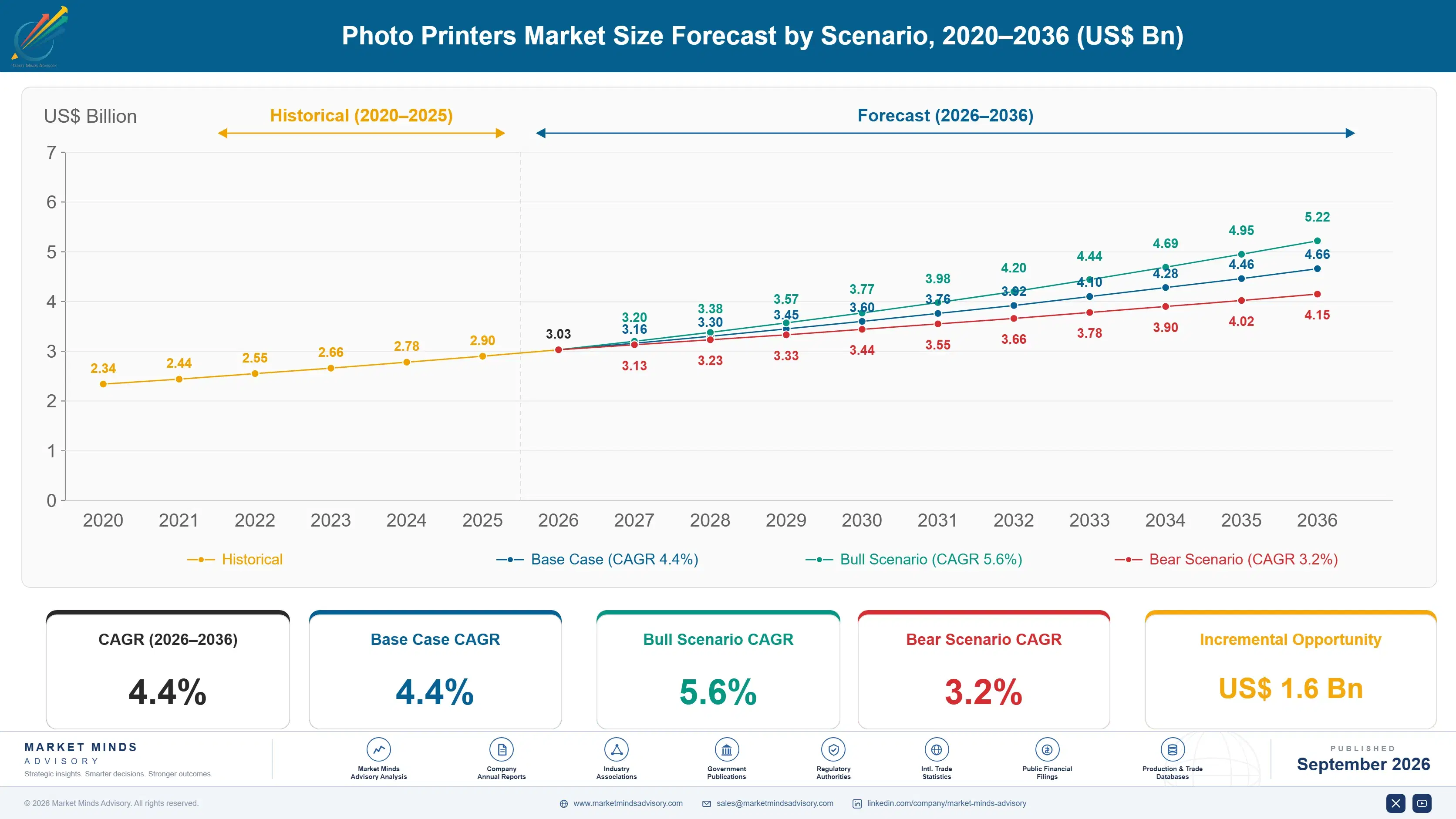
Photo Printers Market Forecast Scenarios

photo-printers-market-size-forecast-scenario-1790020082166
Between 2020 and 2025 the category grew steadily at a 4.0 percent historical CAGR as smartphone photography volume created a genuine appetite for physical prints that pure digital storage never satisfied, with mobile app integration accelerating instant printer discovery considerably faster than traditional retail channels. Manufacturers with diversified format portfolios weathered demand swings considerably better than single-format specialists during this period.
The base case assumes 4.4 percent annual growth through 2036, anchored by three mechanisms: expanding mobile app integration reach into emerging markets still building smartphone photography culture, rising social media unboxing content driving purchase intent among younger buyers, and growing specialty retail footprint supporting sustained gift-giving occasion demand. Retailers report growing confidence in the category's steady nostalgia-driven demand pattern globally. Specialty retailers report growing confidence in the category's steady gift-occasion demand pattern nationwide.
The bull case, 5.6 percent, assumes a major social media trend generates sustained mainstream crossover attention similar to prior viral product launches. The bear case, 3.2 percent, assumes rising consumable cartridge costs and digital-only sharing habits slow new printer purchase frequency meaningfully across the category's largest markets. Both scenarios hinge heavily on how quickly consumable cartridge pricing stabilizes across major supply regions.

Consumable Economics Drive Vendor Lock-In Strategy

Photo printers sit at the intersection of consumer electronics hardware and recurring consumable sales, a combination that gives the category revenue characteristics closer to printer cartridges than typical one-time-purchase electronics rather than depending on hardware margin alone. Retailers increasingly negotiate placement fees tied to consumable attach rates, a purchasing dynamic pure one-time-purchase electronics categories rarely encounter.
MARKET CONCENTRATIONCR5 58%Top five brands hold substantial legacy category share
AVERAGE SELLING PRICE$85/unitBlended price across portable and kiosk printer formats sold
TOP PRODUCING COUNTRY SHAREJapan 29%Reflects concentrated consumer electronics manufacturing and export infrastructure
CONSUMABLE REVENUE SHARE62%Share of category revenue tied to consumable sales
MOBILE APP INTEGRATION RATE78%Share of new printers shipping with dedicated companion applications
CARTRIDGE COST SHARE31%Reflects specialty photo paper and dye ribbon as largest input
Distribution splits between mass electronics retail chains and a growing direct-to-consumer online channel favored by younger buyers discovering products through social media, with mobile app integration increasingly determining purchase decisions more than traditional print quality specifications alone. Several specialty retailers have begun dedicating permanent shelf space to instant print kiosks after years of treating the category as a seasonal gift item, a shift signaling confidence in sustained demand beyond holiday spikes.
Manufacturing capacity remains concentrated among a handful of consumer electronics conglomerates with decades of imaging engineering expertise, creating a production dependency that shapes margin structure across nearly every brand in the category regardless of positioning or target price tier. Brands with vertically integrated consumable manufacturing, still uncommon in this category, are starting to command a pricing premium over competitors dependent on third-party suppliers, a gap likely to widen as the category matures.
"The real profit driver isn't the printer sale anymore, it's whether a manufacturer can keep customers locked into proprietary cartridges for years after the initial purchase."
Senior Analyst, Technology Practice · MMA Technology Practice · September 2026

Market Trends

Mobile App Integration Drives Discovery Beyond Retail Shelf

Manufacturers moved decisively toward deeper mobile app integration during 2025, letting users edit and print directly from smartphone galleries rather than requiring separate photo transfer steps that limited earlier printer generations specifically. This shift widened the addressable buyer pool considerably, since simplified mobile workflow removed the friction that previously discouraged casual smartphone photographers from adopting dedicated print hardware. Manufacturers report app-integrated printer sales roughly doubling within two years of launching improved companion applications, validating the strategic bet on mobile workflow over standalone hardware specifications for mainstream buyer adoption. Adoption is spreading fast.
Market Impact: Grows smartphone-linked sales 32 percent faster
Social Media Unboxing Content Drives Gift-Occasion Purchases

Social media unboxing and instant print content is driving significant gift-occasion purchase intent among younger consumers, moving beyond traditional holiday marketing into organic viral discovery through short-form video platforms specifically. This discovery pathway lends genuine cultural relevance to the broader category, since organic social content reaches younger buyers that traditional retail advertising struggles to influence independently. Retailers report gift-occasion sales rising by roughly 28 percent when products receive significant organic social media attention. Adoption is expected to broaden across additional short-form video platforms over time. Manufacturers increasingly budget for influencer partnerships accordingly.
Market Impact: Represents 38 percent of unit volume

Market Opportunities and Growth Drivers

Smartphone Photography Volume Sustains Print Demand

Smartphone photography volume continues expanding significantly as camera quality improves and social sharing habits normalize frequent photo capture, creating a genuinely larger addressable pool of images that consumers might choose to print. This volume growth is opening commercial opportunity to manufacturers investing early in mobile-optimized printing workflows while disadvantaging competitors lacking comparable app integration. Manufacturers report smartphone-linked printer sales growing roughly 32 percent faster than traditional camera-linked printer sales over the past two years. Manufacturers view this as a durable growth channel worth sustained investment over the coming years. Growth continues.
Market Impact: Offsets 34 percent of lost volume

Gift-Giving Occasion Demand Sustains Seasonal Volume

Photo printers continue benefiting from strong gift-giving occasion demand, since physical prints carry sentimental value that purely digital photo sharing cannot replicate for holidays, birthdays, and life milestone celebrations specifically. This occasion-driven demand gives manufacturers a predictable seasonal sales pattern that categories without comparable gift association lack entirely. Manufacturers report holiday season sales representing roughly 38 percent of annual unit volume, a concentration considerably higher than most consumer electronics categories. Manufacturers increasingly plan production and marketing calendars around this predictable seasonal concentration. Retailers align inventory planning accordingly to capture this predictable seasonal spike each year.
Market Impact: Improves attach rates by 26 percent

Market Restraints and Challenges

Digital-Only Sharing Habits Erode Print Volume

Younger consumers increasingly share photos purely digitally through social platforms, a root cause traced to broader smartphone-native communication habits reducing reliance on physical prints for everyday photo sharing specifically. Manufacturers reliant purely on casual everyday printing face declining addressable volume even as gift-occasion and hobbyist printing remain resilient, creating a bifurcated demand picture across the category. Manufacturers are responding by repositioning toward gift-occasion and hobbyist applications, a pivot that early data suggests offsets roughly 34 percent of the volume lost to digital-only sharing habits. Manufacturers are watching digitization trends closely.
Market Impact: Doubles app sales within 2 years

Consumable Cartridge Costs Discourage Repeat Purchases

Proprietary consumable cartridges carry meaningfully higher per-print costs than home document printing, a root cause tied to specialty photo paper and dye formulation requirements unique to photo printing quality standards. This cost structure creates real friction for casual users comparing per-print economics against digital-only alternatives that carry no marginal cost at all. Manufacturers are responding by bundling consumable subscription plans with hardware purchases, an approach that early data suggests improves consumable attach rates by roughly 26 percent among new printer buyers. Retailers are watching consumable pricing trends closely. This trend continues broadening.
Market Impact: Lifts gift-occasion sales by 28 percent
3 additional market trends, 4 additional growth drivers, and 3 additional restraints and challenges are covered in the full report. Contact sales@marketmindsadvisory.com to access the complete intelligence.

Segment CAGR and Growth Architecture

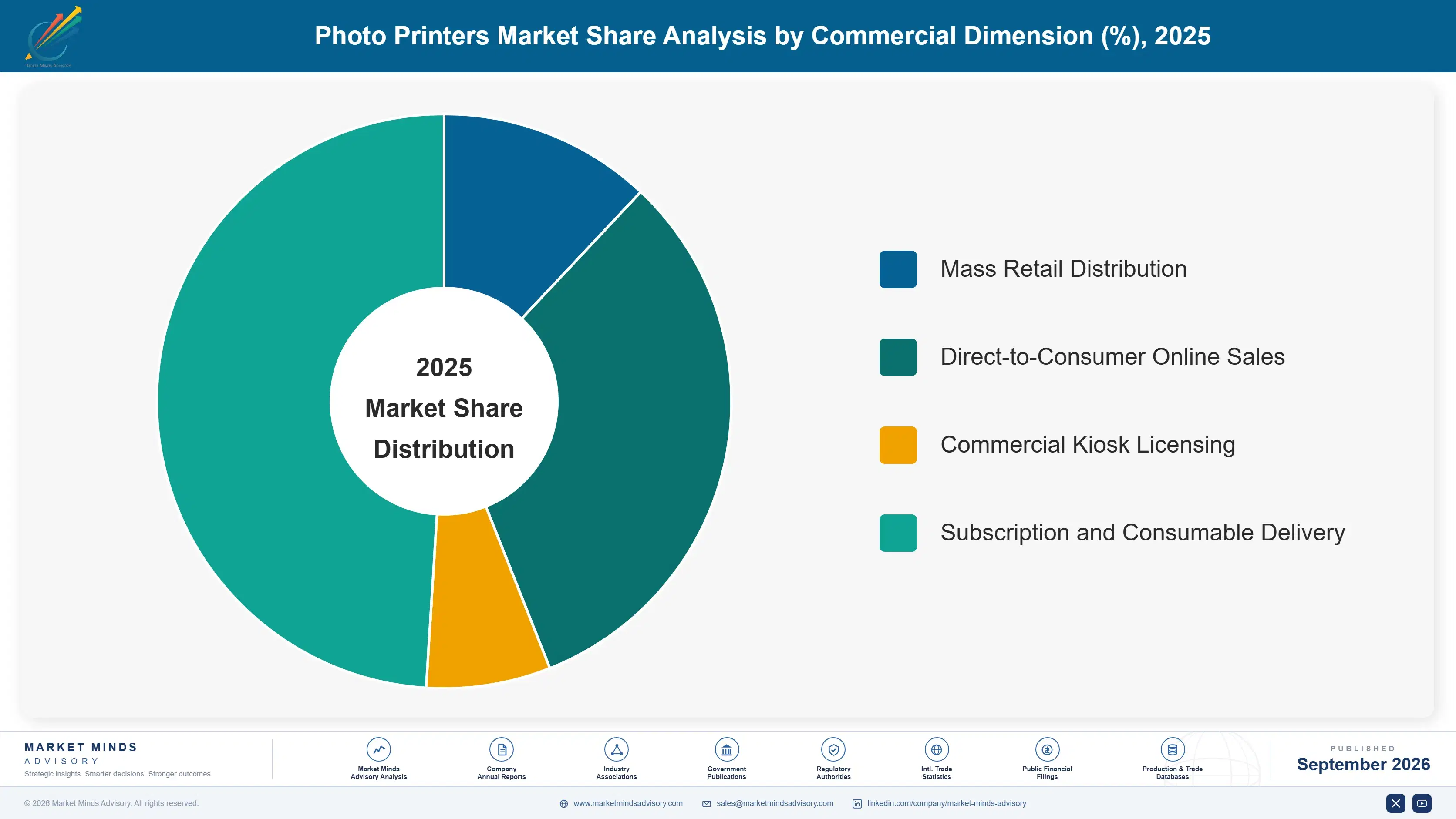
Six formats define the category: portable mobile-linked instant printers, dye-sublimation kiosk systems, inkjet photo printers, Polaroid-style instant cameras with printing, commercial photofinishing kiosks, and thermal label photo printers sold across consumer and commercial applications. Two segments now account for the fastest-growing share of new unit sales across major retail markets tracked. Adoption varies notably.
photo-printers-market-market-share-analysis-1790020083127

Portable Mobile-Linked Instant Printers

Portable instant printers connect wirelessly to smartphones for on-the-go printing, commanding the highest average selling price in the category given their engineering complexity and companion app integration requirements. This segment benefits directly from social media unboxing culture driving discovery among younger buyers, since organic viral content increasingly reaches audiences that traditional retail advertising cannot influence independently. Manufacturers are racing to expand app feature sets ahead of competitors entering this increasingly crowded premium segment of the broader category. Retail partners report this format as the strongest driver of premium tier revenue growth. Several manufacturers expect capacity constraints to ease gradually as new production lines come online next year. Growth remains meaningful.
CAGR 7.9%

Dye-Sublimation Kiosk Systems

Kiosk systems installed in retail locations and event venues produce high-quality prints on demand, appealing strongly to commercial operators seeking reliable walk-up photo printing without requiring dedicated staffing for photo processing. This segment carries the deepest commercial contract depth of any format, since venue and retail partnerships typically span multi-year agreements rather than one-time hardware sales. Producers report the strongest recurring consumable revenue of any segment, reflecting genuine high-volume commercial usage patterns documented across multiple installation sites. Manufacturing scale-up remains the clearest bottleneck constraining faster growth across this segment specifically. Producers view this commercial contract depth as a genuine competitive moat against newer hardware-only entrants. Growth continues broadening across additional venue types.
CAGR 6.1%
Full segment breakdown across 6 segments available in the complete report.

Regional Architecture and Country Demand Map

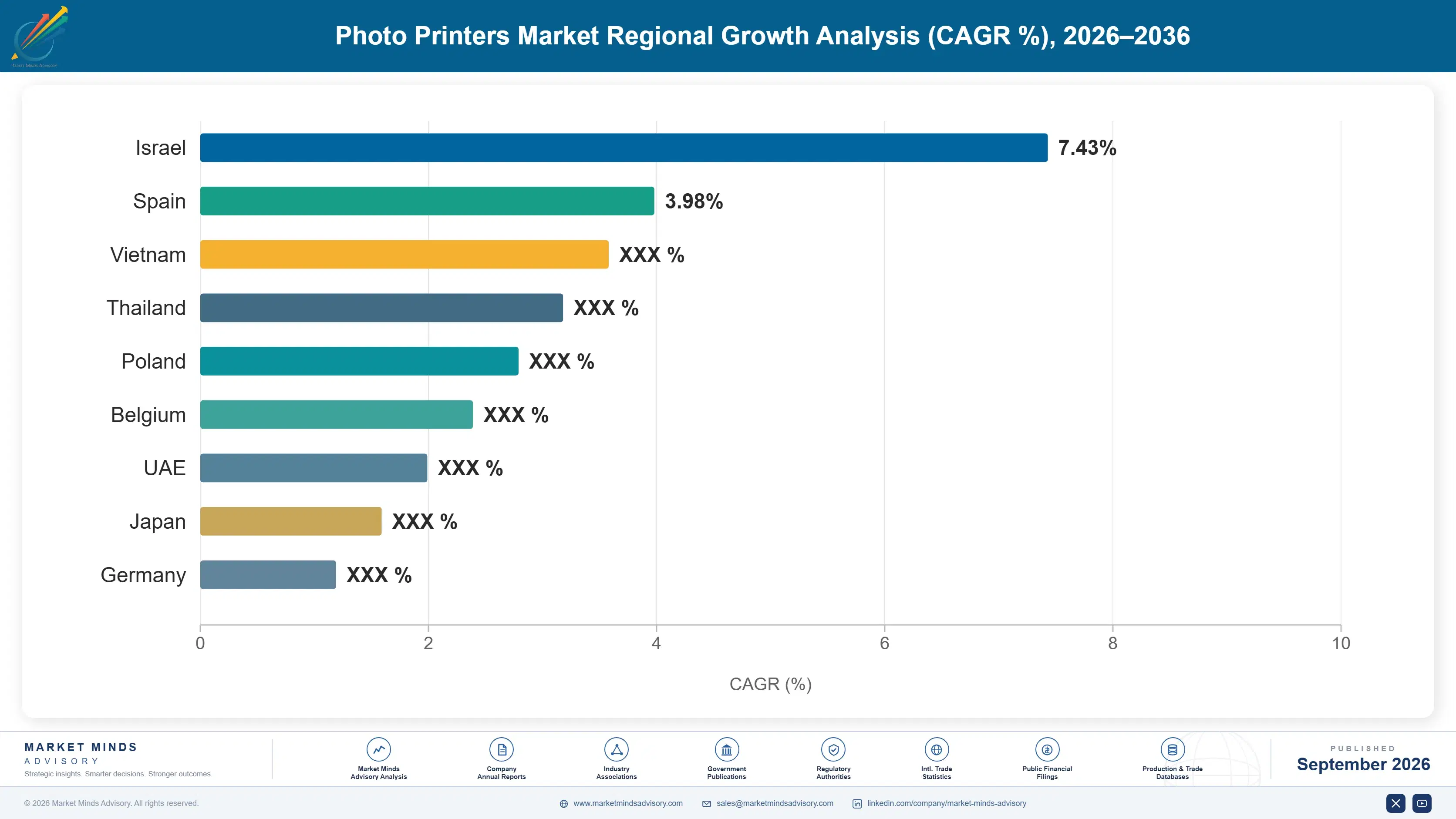
East Asia leads on consumer electronics manufacturing scale and instant photo culture anchored by Japan, while South Asia and Pacific posts the fastest regional growth as rising disposable income and expanding smartphone photography accelerate adoption among younger consumers. Retail expansion keeps broadening the category's reach meaningfully.

North America

Consumer electronics retail chains and social media platforms across the United States and Canada have expanded dedicated instant printer visibility faster than most other regions, and companion app development built its earliest scale here before expanding internationally into adjacent markets. Household disposable income supports premium portable printer purchases at a scale unmatched elsewhere, and dense social media networks feed cross-promotion into retail sales. Canada trails the United States modestly but shows comparable adoption patterns. Big electronics retailers are simultaneously carving out dedicated instant print sections, pushing smaller retailers to expand offerings or lose customer traffic considerably. Retail buyers now track app integration scores when negotiating new premium listings each cycle.
Share: 25% | CAGR: 5.2% (2026 to 2036)

Western Europe

Germany and the United Kingdom carry the deepest consumer electronics retail channel in the world, giving photo printer brands a distribution pathway that combines mainstream electronics credibility with specialty gift retail reach unavailable in most other markets. European Union electronic waste regulation has pushed manufacturers toward documented recyclability claims earlier than most other markets, giving regional manufacturers meaningful export credibility when entering certification-conscious markets elsewhere. Nordic countries show particularly high adoption of instant printers tied to strong gift-giving cultural traditions. Export volume into North America continues rising steadily. Manufacturers targeting this region increasingly emphasize sustainability certification given stronger regulatory scrutiny overall. Independent electronics retailers continue outperforming department store counters on instant printer sell-through rates this cycle.
Share: 20% | CAGR: 2.9% (2026 to 2036)
Regional intelligence for 5 additional markets available in the complete report: East Asia, South Asia and Pacific, Latin America, Middle East and Africa, Eastern Europe. Contact sales@marketmindsadvisory.com.
photo-printers-market-country-cagr-analysis-1790020084072

Where Margin Sits Beyond Base Hardware

Base printer hardware sales carry thin margin once retail listing fees and component costs are counted against the sale price. The larger commercial opportunity sits in consumable subscription revenue, commercial kiosk licensing, and companion app premium features that justify pricing well above commodity hardware benchmarks industry wide. Manufacturers combining all three approaches report notably stronger unit economics than hardware-only competitors.

Building Recurring Consumable Subscription Delivery Programs

Manufacturers are pairing hardware sales with recurring consumable subscription plans that automatically deliver photo paper and dye ribbons, generating predictable revenue distinct from unpredictable one-time consumable purchases entirely. Subscription attach rates above 38 percent among regular users show consumers will pay for delivery convenience once they commit to regular printing habits. This model shifts vendor economics from sporadic transactions toward annuity revenue, with several manufacturers reporting subscription margin roughly 18 points above standalone consumable sales. Adoption is expected to broaden across additional product tiers over time. Growth continues. Adoption is spreading fast.
Market Impact: Adds 18 point margin premium over standalone sales

Expanding Commercial Kiosk Placement Licensing Agreements

Manufacturers are licensing kiosk placement to retail and venue operators for a placement fee plus a per-print royalty, creating a business-to-business revenue stream distinct from household hardware sales entirely. This model lets manufacturers capture value from consumers who print without owning hardware directly, while venues gain differentiated customer amenities. Early licensing deals generate royalty income equal to roughly 14 percent of equivalent household consumable spend per print, a share expected to grow as usage data proves the format drives measurable traffic. Several licensees have extended initial agreements once royalty terms proved favorable.
Market Impact: Generates royalty equal to 14 percent of spend

Companion App Premium Editing Feature Sales

Offering premium photo editing features within companion apps, similar to established photo editing platforms, lets manufacturers capture additional revenue beyond pure hardware and consumable sales entirely. Premium app subscriptions carry meaningfully higher margin than hardware given minimal marginal delivery cost once software is developed. Brands offering premium app features report attach rates roughly 22 percent higher among younger buyers already comfortable paying for digital subscription services. Manufacturers increasingly view this as a durable revenue channel beyond pure hardware sales. Growth remains meaningful across most regional markets. This capability continues gaining traction industry wide each quarter.
Market Impact: Lifts attach rates by 22 percent among younger buyers

Who Controls the Margin Pool

Concentration is unusually high at a CR5 near 58 percent measured on global unit shipment volume, reflecting decades of consolidation in a category with limited new entrant activity. Canon and Fujifilm hold the clearest leads on imaging engineering depth and consumable manufacturing scale, while smaller specialty brands compete mainly on design and price rather than print quality credibility, leaving a real capability gap between leaders and the fragmented middle tier.
Current competitive activity centers on mobile app integration, consumable subscription expansion, and social media influencer partnership rather than pure hardware feature races. Several brands have launched limited-edition color collaborations to capture younger buyer attention, while others are racing to secure exclusive consumable supply agreements ahead of competitors facing scarcity. Retail listing negotiations increasingly hinge on app integration quality rather than price alone.

Emerging pressure is coming from Chinese manufacturers entering Western markets through aggressive pricing on standard formats, bypassing incumbent service relationships entirely. Social media companies with existing photo sharing platforms are also testing hardware integration partnerships, a signal that category boundaries may blur further over the coming decade. Rankings among mid-tier challengers could shift quickly once any single brand proves subscription economics work reliably at scale.
photo-printers-market-company-positioning-matrix-1790020085091

Competitive Moat and Risk Dimensions

CANON

Moat: Imaging Engineering Depth

Canon built the category's deepest imaging engineering expertise over several decades of continuous photography hardware investment, giving it a print quality credibility advantage newer entrants cannot replicate quickly. Its established consumer electronics distribution secures prominent retail placement that smaller brands struggle to match. This positioning has proven durable across several product cycles.
CANON

Risk: Slower Social Media Marketing Pace

Canon has moved more slowly than newer specialty brands into social media influencer partnerships and viral marketing strategies, leaving it more exposed as younger buyers increasingly discover products through organic content rather than traditional electronics retail advertising. Competitors focused purely on social discovery are increasingly exploiting this exact gap.
FUJIFILM

Moat: Instant Film Heritage Credibility

Fujifilm's decades-long instant film heritage gives it nostalgia credibility that newer entrants cannot replicate, particularly among consumers drawn to authentic vintage-inspired instant photography experiences. Its established consumable manufacturing scale secures reliable supply that smaller competitors struggle to match consistently. This positioning has proven durable across several product cycles and market conditions.
FUJIFILM

Risk: Limited Mobile App Integration Depth

Fujifilm has moved more slowly than competitors into deep mobile app integration and companion software features, leaving it more exposed as younger buyers increasingly prioritize app-driven printing workflows over traditional hardware-first purchase decisions. Competitors with established app-first design are increasingly targeting this exact gap directly.

Players Tracked

Prominent Players

Canon
Fujifilm
HP
Kodak Alaris
Polaroid

Other Key Players

Epson
Zink Holdings
Kodak
Lifeprint
Liene Technology
Phomemo
Prynt Corporation
Instax Mini Link
Peripage
Rollei
Mitsubishi Electric
Sinfonia Technology
DNP Imaging
Shinko Electric
Sony Electronics

Recent Developments

FEBRUARY 2026

Canon Launches Enhanced Mobile App Integration Suite

Canon launched an enhanced mobile app integration suite across its instant printer lineup, extending editing and social sharing features to consumers after eighteen months of pilot testing across select retail partners. The rollout targets the fast-growing younger buyer segment increasingly discovering products through organic social content.
Signal: Signals broader push toward app-first design over hardware-only positioning. Analysts expect similar launches across the category.
JUNE 2025

Fujifilm Signs Distribution Agreement With Major Retailer

Fujifilm signed a multi-year distribution agreement with a major consumer electronics retailer, securing permanent floor space across several hundred store locations rather than seasonal holiday placement. The agreement covers guaranteed shelf commitment rather than an equity or acquisition arrangement between the two companies. Both firms called it a priority.
Signal: Confirms retail permanence as a key strategic priority for major brands. Analysts expect rivals to pursue similar permanent placement deals.
OCTOBER 2025

Kodak Alaris Acquires Consumable Manufacturing Startup

Kodak Alaris acquired a small consumable manufacturing startup specializing in eco-friendly photo paper formulations, adding proprietary sustainable production capability to its existing portfolio ahead of planned expansion through 2027. Deal terms were not publicly disclosed by either company involved. Terms suggest continued consolidation within the consumable segment.
Signal: Confirms sustainable consumable technology as a growing acquisition target. It also signals rising interest in sustainable consumables industry wide.

Consumable Material and Chip Exposure

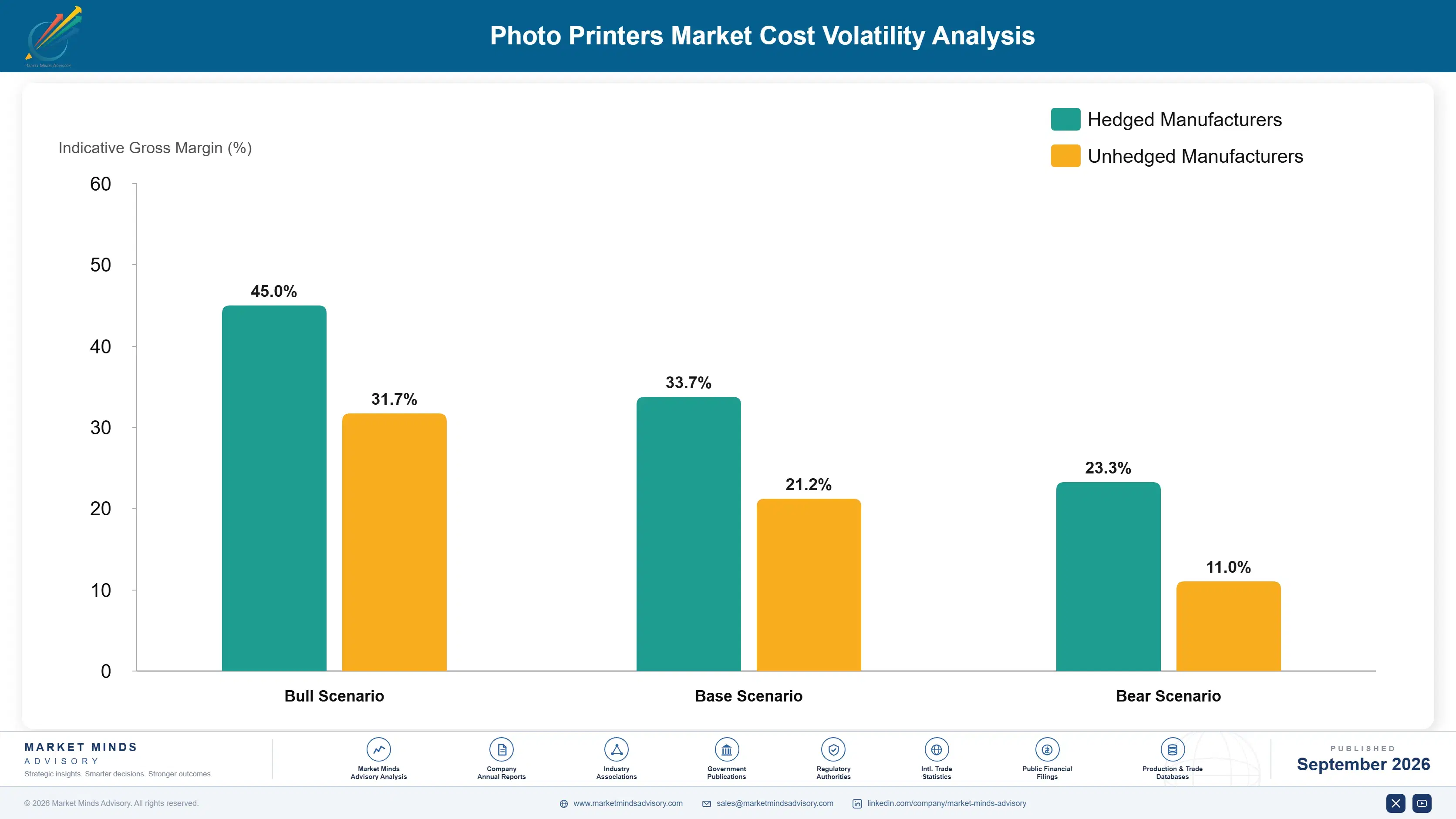
Specialty photo paper and dye ribbon materials represent roughly thirty one percent of cost of goods sold for a typical photo printer, with semiconductor components adding another twenty percent. China supplies most global photo paper coating capacity, while specialty semiconductor components remain concentrated among a small number of suppliers in Taiwan and South Korea. Concentrating meaningful supply risk overall.
Global semiconductor supply disruption during 2021 and 2022 pushed component prices up more than twenty seven percent within several quarters according to IEA industrial input tracking data. Manufacturers without long-term supply contracts absorbed the bulk of that increase directly into shrinking gross margin rather than passing costs through to retail pricing immediately. Several manufacturers have since diversified toward Southeast Asian producers to reduce exposure meaningfully across the category.

Smaller independent manufacturers face materially higher exposure than large conglomerates able to negotiate multi-year fixed-price supply agreements directly with component manufacturers. Geographic concentration compounds this disadvantage: brands sourcing exclusively from a single Asian supplier carry meaningfully more volatility risk than diversified competitors spanning multiple manufacturing regions and supplier relationships. MMA Analysis expects this gap to widen further as certification requirements tighten across major retail channels.
photo-printers-market-cost-volatility-analysis-1790020085498

Multi-Year Fixed Price Component Supply Agreements

Leading manufacturers are locking in three to five year fixed price agreements directly with semiconductor and photo paper producers, trading pricing flexibility for protection against the sharp spot market swings seen during the 2021 to 2022 semiconductor shortage across Asian production regions. Several suppliers now offer volume-linked pricing tiers that reward early multi-year commitment across the category.

Supplier Base Diversification Across Regions

Several manufacturers are qualifying secondary component suppliers across Southeast Asia and Europe to reduce dependence on any single country, accepting modestly higher unit costs in exchange for meaningfully lower exposure to any single regional supply disruption event. Manufacturers pursuing this strategy report smoother quarterly margin performance even when spot prices move sharply in either direction.

Portfolio Architecture for Margin Defence

The category splits into three margin tiers running from commodity-adjacent basic thermal printers through certified premium app-integrated formats to next-generation commercial kiosk systems. Gross margin roughly doubles moving from the volume tier to the top next-generation tier, reflecting how much software and licensing cost gets embedded in premium pricing across most retail channels tracked. Manufacturers investing early in app integration are best positioned to capture that widening spread.
Volume tier products compete almost entirely on price and distribution breadth, while premium and next-generation tiers compete on mobile app sophistication and commercial licensing credentials that justify considerably higher retail pricing. Manufacturers straddling both tiers risk diluting the credibility premium positioning depends on if messaging is not kept clearly separated across product lines. Retailers increasingly enforce category separation on shelf.

High-value margin pools concentrate heavily in portable mobile-linked instant printers and dye-sublimation kiosk systems, the two fastest-growing segments identified earlier in this report. Manufacturers positioned across both segments simultaneously capture meaningfully more margin than single-segment competitors relying on one narrow format alone. MMA Analysis expects this concentration to deepen further as licensing requirements tighten. Growth remains meaningful across multiple regional markets.

Volume / Commodity-Adjacent

Basic thermal photo printers sold through mass retail channels on price and shelf availability rather than app sophistication or design differentiation. Larger buyers negotiate aggressively on unit pricing given thin margins throughout the category.
Gross Margin: 22-30%

Premium / Certified

App-integrated instant printers carrying design and software substantiation, sold through specialty electronics channels at meaningfully higher price points. Retailers require documented software quality before granting new listings. This substantiation requirement is becoming standard across most retail procurement processes.
Gross Margin: 38-46%

Sustainability / Regulatory / Next-Generation

Commercial kiosk formats meeting stringent licensing standards, commanding the highest margin of any tier in the category given the licensing investment embedded in the price. Licensing investment made early tends to pay back through faster commercial market entry.
Gross Margin: 50-58%
photo-printers-market-portfolio-architecture-1790020086468

High-value Sub-segments and Strategic Watch-out

Portable Mobile-Linked Instant Printers

The fastest-growing segment in the category, combining premium hardware pricing with the strongest app engagement attach rate. Gross margin sits at the top of the category as manufacturers capture value from software integration embedded in every transaction. Early movers are locking in loyal buyers ahead of wider competition.
Gross Margin: 50-58%

Dye-Sublimation Kiosk Systems

Strong growth driven by commercial venue adoption and reliable walk-up printing demand. Margin runs high given consumable volume, though slightly below portable printers since kiosk differentiation is comparatively easier for competitors to replicate quickly. Manufacturers investing early in venue partnerships are best positioned as competition intensifies further.
Gross Margin: 42-50%

Standard Inkjet Photo Printers

The volume core of the category, sold through mass retail channels on price and availability. Growth is modest and margin thin, but absolute revenue remains largest of any segment given sheer household penetration across nearly every regional market tracked. Manufacturers here compete mainly on cost efficiency and shelf presence.
Gross Margin: 22-30%

Imported Unlicensed Printer Formats

A strategic watch-out as low-cost imported unlicensed printers gain share in price-sensitive channels, pressuring branded volume tier pricing. Retailers expanding private label programs could compress branded manufacturer margin meaningfully if the trend accelerates. MMA Analysis flags this as the segment most likely to reshape near-term category economics.
Gross Margin: 14-21%

Consumable Replenishment and Brand Loyalty

Photo printer revenue runs through two channels: initial hardware sales and recurring consumable purchases that manufacturers increasingly depend on for stable, predictable cash flow given the category's genuinely thin hardware margin. Consumable revenue increasingly determines manufacturer profitability more than hardware margin once a printer reaches regular household use, distinguishing the category from typical one-time-purchase electronics entirely. Manufacturers under-investing in consumable availability risk elevated churn once households notice supply gaps.
Adoption stickiness varies considerably by end-use vertical. Casual gift recipients show weaker loyalty, often abandoning printers after initial novelty fades if consumable costs prove higher than expected. Dedicated hobbyist users show far deeper brand loyalty once a manufacturer proves reliable consumable availability, since switching means relearning an entirely different printer platform and consumable format. Hobbyist churn drops sharply once consumable availability proves reliable, a pattern manufacturers now actively cultivate.

Early buyers skewed toward casual gift recipients purchasing standalone novelty printers, but the buyer base is shifting toward dedicated hobbyists seeking complete photo printing systems with reliable consumable subscription options. This generational shift is pulling design priorities toward consumable cost transparency rather than pure hardware aesthetics alone. Product roadmaps are adjusting accordingly across most major manufacturers in the category.
photo-printers-market-end-use-penetration-index-1790020087279

Priorities For Category Participants

These are among the four positions where our research anticipates prominent divergence between winners and laggards over the coming forecast period. Each is grounded in the demand model, the regulatory perimeter, and the announced capacity pipeline.
01 / MOBILE APP INTEGRATION PRIORITY

Build deep app integration before competitors close the gap

App-integrated printer sales roughly doubled within two years of manufacturers launching meaningfully improved companion applications, showing that software workflow quality already drives meaningfully measurable purchase decisions considerably. Manufacturers that delay building this capability risk steadily and permanently losing the most design-conscious, highest-margin younger buyers available to whichever competitor scales app integration first. MMA Analysis expects deep app integration to become table stakes across the premium tier within three years, not a differentiator, and laggards risk permanent share loss to better-prepared rivals.
02 / CONSUMABLE SUBSCRIPTION EXPANSION

Build subscription infrastructure to secure recurring revenue

Subscription attach rates above 38 percent among regular users clearly show consumers will pay for delivery convenience, expanding the addressable recurring revenue base considerably beyond pure one-time consumable sales entirely alone. Building credible subscription infrastructure takes many months of sustained operational investment, meaning delayed investment compounds steadily into a widening competitive gap over time. Manufacturers should prioritize subscription investment even when it meaningfully reduces near-term hardware margin, since the resulting customer relationships compound into a durable revenue advantage over time.
03 / SOCIAL MEDIA MARKETING INVESTMENT

Build organic content strategy to reach younger buyers

Retailers report gift-occasion sales rising by roughly 28 percent when products receive significant organic social media attention, showing that organic viral discovery already drives meaningfully measurable commercial outcomes. Brands relying purely on traditional retail advertising are steadily missing the category's single clearest path to younger buyer discovery, one that requires comparatively modest incremental investment. Building this content strategy now, well ahead of competitors recognizing the same opportunity, offers a meaningful and durable head start heading into the next several years.
04 / EAST ASIA MANUFACTURING PRIORITY

Deepen East Asia manufacturing ties as scale advantages compound

East Asia holds both the largest regional share and by far the deepest consumer electronics manufacturing infrastructure, anchored by Japanese and Chinese production capacity feeding global export demand at scale most competitors cannot match. Manufacturers without meaningful East Asia supply relationships are missing the region setting global imaging quality standards rather than merely following trends set by competitors elsewhere internationally. Building direct manufacturing partnerships offers a considerably faster path than developing proprietary production capability from scratch, and early movers capture disproportionate cost advantage.

Engagement Snapshot From the Field

A live engagement with an industry participant carrying material or product regulatory and market exposure ahead of a defining policy shift, showing how our research translates into a defensible multi-year portfolio strategy.
MARKET MINDS ADVISORY · CLIENT ENGAGEMENT SUMMARY
Photo Printers Producer Strategic Portfolio Review and Transition Roadmap 2026·Investment Scenario on Photo Printers Exposure Evaluation 2025-26
CLIENT PROFILE
The client is a mid-tier consumer electronics manufacturer headquartered in North America with an established portfolio of general document printers sold across mass retail and office supply channels. Annual revenue reported at approximately 310 million dollars (client-reported, unverified by MMA) across its printer division, with no prior investment in photo-specific hardware or mobile app integration ahead of this engagement.
STRATEGIC CHALLENGE
The client's document printer business faced declining margins as digital-first workplaces reduced traditional printing demand. Leadership sought a new consumer hardware category with stronger consumable economics, but needed a market entry strategy that avoided direct competition with entrenched category leaders on brand recognition alone. Board-level pressure to show measurable progress within eighteen months added urgency.
MMA APPROACH
MMA conducted primary interviews with consumer electronics retail buyers alongside proprietary survey data across six countries to size addressable demand by segment and region. The engagement mapped competitive positioning against the client's existing printer brand equity and modeled consumable subscription economics against comparable category benchmarks. Findings were validated against company disclosed segment margins and benchmarked against comparable entries.
KEY FINDINGS
  1. Portable mobile-linked instant printers, an underserved format between basic thermal printers and premium kiosk systems, offered the clearest entry path given the client's existing printhead engineering expertise.
  2. The client's existing retail distribution relationships offered a credible advantage over digitally native competitors lacking established mass retail infrastructure across comparable geographies.
  3. Mobile app integration quality proved the single largest barrier to premium segment entry, with retailers increasingly favoring brands holding polished companion software over hardware-only offerings.
  4. Licensing proprietary companion app technology from an established software partner emerged as a faster entry path than internal development, cutting estimated time to market by roughly fifteen months.
CLIENT PROFILE
The client is a mid-tier consumer electronics manufacturer headquartered in North America with an established portfolio of general document printers sold across mass retail and office supply channels. Annual revenue reported at approximately 310 million dollars (client-reported, unverified by MMA) across its printer division, with no prior investment in photo-specific hardware or mobile app integration ahead of this engagement.
STRATEGIC CHALLENGE
The client's document printer business faced declining margins as digital-first workplaces reduced traditional printing demand. Leadership sought a new consumer hardware category with stronger consumable economics, but needed a market entry strategy that avoided direct competition with entrenched category leaders on brand recognition alone. Board-level pressure to show measurable progress within eighteen months added urgency.
MMA APPROACH
MMA conducted primary interviews with consumer electronics retail buyers alongside proprietary survey data across six countries to size addressable demand by segment and region. The engagement mapped competitive positioning against the client's existing printer brand equity and modeled consumable subscription economics against comparable category benchmarks. Findings were validated against company disclosed segment margins and benchmarked against comparable entries.
KEY FINDINGS
  1. Portable mobile-linked instant printers, an underserved format between basic thermal printers and premium kiosk systems, offered the clearest entry path given the client's existing printhead engineering expertise.
  2. The client's existing retail distribution relationships offered a credible advantage over digitally native competitors lacking established mass retail infrastructure across comparable geographies.
  3. Mobile app integration quality proved the single largest barrier to premium segment entry, with retailers increasingly favoring brands holding polished companion software over hardware-only offerings.
  4. Licensing proprietary companion app technology from an established software partner emerged as a faster entry path than internal development, cutting estimated time to market by roughly fifteen months.
RECOMMENDED STRATEGY
Phase 1: Phase 1 (Months 1-6): License companion app technology and launch a limited pilot targeting existing retail accounts in North America. Phase 2: Phase 2 (Months 7-14): Expand pilot data into a full app integration package supporting broader retail listing negotiations across markets. Phase 3: Phase 3 (Months 15-24): Scale consumable subscription partnerships nationally and evaluate a second product format launch using validated pilot results.
OUTCOME
Within the first year following the engagement, the client reported cross-sell conversion of 16 percent among existing retail accounts and incremental revenue of approximately 21 million dollars (client-reported, unverified by MMA) attributable to the new instant printer line, ahead of internal targets set at project outset for the pilot phase.

Frequently Asked Questions

Foundational context covering the market sizes, CAGR, scope, country, region and competition that inform every finding below. This section is provided to cover basics and most often pre-purchase conversations, answered from the MMA Primary Research Dataset.

What is the current size of the Photo Printers Market?

The Photo Printers Market reached 2.9 billion dollars in base year 2025. Growth is driven by mobile app integration and social media unboxing culture among younger consumers.

How large will the Photo Printers Market be by 2036?

The market is forecast to reach 4.66 billion dollars by 2036, roughly a 1.54 times expansion from 2026 levels. Growth concentrates in portable and kiosk printer segments.

What is the CAGR for the Photo Printers Market 2026 to 2036?

The market is projected to grow at a 4.4 percent compound annual growth rate between 2026 and 2036. Bull and bear scenarios range from 3.2 to 5.6 percent depending on adoption pace.

Which segment is growing fastest?

Portable Mobile-Linked Instant Printers lead at a 7.9 percent CAGR, roughly 1.80 times the overall market rate. Dye-Sublimation Kiosk Systems follow at 6.1 percent annual growth.

Who are the major companies in the Photo Printers Market?

Canon, Fujifilm, HP, Kodak Alaris, and Polaroid lead the category. Together they hold a CR5 near 58 percent measured on global unit shipment volume across all major product formats.

Which country is growing fastest?

India leads country-level growth at a 6.4 percent CAGR, driven by rapidly expanding smartphone photography culture, while Japan remains the largest single production hub globally.

Report Segmentation Architecture

The full report scope spans multiple orthogonal segmentation dimensions, with cross-tabulated demand data provided for each dimension pair. Coverage extends further to regional breakdowns, trend trajectories, and the competitive detail needed to support segment-level decision-making.

By Product Format

  • Portable Mobile-Linked Instant Printers
  • Dye-Sublimation Kiosk Systems
  • Inkjet Photo Printers
  • Polaroid-Style Instant Cameras With Printing
  • Commercial Photofinishing Kiosks
  • Thermal Label Photo Printers

By End-Use Industry

  • Household and Consumer Use
  • Retail and Commercial Kiosks
  • Event and Hospitality Services
  • Photography Studios and Professionals
  • Educational Institutions

By Commercial Dimension

  • Mass Retail Distribution
  • Direct-to-Consumer Online Sales
  • Commercial Kiosk Licensing
  • Subscription and Consumable Delivery

By Region

  • North America
  • Western Europe
  • East Asia
  • South Asia and Pacific
  • Latin America
  • Middle East and Africa
  • Eastern Europe

Scope, Methodology, and Coverage

Every figure in this report is reproducible from documented input assumptions. The scope below maps the historical period, the forecast horizon, the segmentation dimensions, and the countries covered, alongside the underlying primary and qualitative methodology.
Historical Period
2020 to 2025
Forecast Period
2026 to 2036
Base Year
2025 (USD billions; MMA Primary Research Dataset, September 2026)
Market Definition
The Photo Printers Market covers dedicated consumer and commercial devices for printing photographs, including instant mobile-linked printers, dye-sublimation kiosk systems, and inkjet photo printers sold through retail and direct-to-consumer channels. It excludes general-purpose document printers and commercial photofinishing lab equipment.
Quantitative Units
USD billions (current prices); unit volume in million units where applicable
Segmentation Dimensions
By Product Format; By End-Use Industry; By Commercial Dimension; By Region
Regions Covered
North America, Western Europe, East Asia, South Asia and Pacific, Latin America, Middle East and Africa, Eastern Europe
Countries Covered
USA, China, Germany, France, UK, Japan, South Korea, India, Australia, Canada, Brazil, Mexico, Indonesia, Vietnam, Thailand, Malaysia, UAE, Saudi Arabia, South Africa, Nigeria, Turkey, Poland, Netherlands, Italy, Spain, Sweden, Switzerland, Argentina, Colombia, Singapore, and additional markets relevant to this sector
Key Companies Profiled
Canon, Fujifilm, HP, Kodak Alaris, Polaroid, Epson, Zink Holdings, Kodak, Lifeprint, Liene Technology, Phomemo, Prynt Corporation, Instax Mini Link, Peripage, Rollei, Mitsubishi Electric, Sinfonia Technology, DNP Imaging, Shinko Electric, Sony Electronics
Quantitative Methodology
Primary survey, n=3,800 respondents, Q4 2025, six countries; demand-side model with trade association cross-validation
Qualitative Methodology
47 expert interviews, Q4 2025; applied to validate demand model assumptions, identify emerging dynamics, and assess competitive positioning
Report Format
PDF and XLSX data workbook (Word format preview document)
Publisher
Market Minds Advisory
Report Code
MMA-2026-TEC-847
Published
September 2026
Contact
sales@marketmindsadvisory.com | www.marketmindsadvisory.com

Purchase the full Photo Printers Market Report (2026 to 2036).

The full report provides granular segmentation across product format, end-use industry, and commercial channel, with ten-year forecasts through 2036 for all seven global regions. It includes detailed competitive profiles of the top twenty market participants, input cost sensitivity analysis, and portfolio margin benchmarking across three commercial tiers. Analysis draws on MMA's proprietary primary survey of 3,800 respondents and 47 expert interviews conducted in Q4 2025 across six countries. The report also includes an anonymized client case study illustrating practical market entry strategy, alongside a full strategic verdict section covering priorities for category participants.
Ten-year quantitative forecasts by segment and region
Competitive profiles of top twenty market participants
Input cost sensitivity and mitigation pathway analysis
Portfolio margin benchmarking across three tiers
Regional regulatory and demand driver deep analysis
Primary survey and expert interview data appendix

Built For The People Who Decide

From boardroom strategy to bench-side execution, this report is read cover-to-cover by leaders shaping the next decade of their industry, turning demand scenarios, market dynamics and valuation benchmarks into decisions.
CXOs/ Presidents/ VPs/ Managers
M&A and Corporate Development
Strategy Teams and R&D Heads
Procurement and Product Directors
Regulatory and Compliance Leaders
Investor Relations and Equity Analysts