Market Minds Advisory
Phlebotomy Equipment Market

Phlebotomy Equipment Market: Safety Regulation Reshapes a Mature Category

Rising diagnostic testing volume and tightening needlestick injury prevention regulation are accelerating the shift toward safety-engineered blood collection devices, pressuring established manufacturers against lower-cost Asian competitors expanding standard tube and needle manufacturing capacity.

Lead Analyst

Alice Ballenger

Published

September 2026

Make Smarter Decisions with Customized Research Insights

Request a free sample report and evaluate market opportunities, growth trends, and competitive dynamics relevant to your business needs.

2025 MARKET VALUE$2.1BMarket Size 2025
2036 FORECAST VALUE$4.3BBase Case , 2026 to 2036
CAGR 2026 TO 20366.8 %Bull 8.0% / Bear 5.6%
INCREMENTAL OPPORTUNITY$2.1BNet 10- year value creation
EXPANSION MULTIPLE1.93x2036 value over 2026 base
Strategic Levers
M&A Pipeline
Regional Outlook
Country Rankings
Competitive Intelligence
Segmental Deep-dive
Call-Us : 91 93563 13602

Executive Snapshot and Market Trajectory

Phlebotomy equipment is shifting from standard needles and manual collection devices toward safety-engineered products that automatically shield or retract sharps after use, as regulatory mandates and hospital liability concerns make needlestick prevention technology a purchasing requirement rather than an optional upgrade for healthcare facilities worldwide.
Demand concentrates in North America and East Asia, where dense hospital and diagnostic laboratory infrastructure alongside China's massive testing volume drive the largest device consumption globally. Safety-engineered blood collection devices are growing fastest as regulatory enforcement of needlestick prevention standards expands into additional jurisdictions and healthcare facility types. Vacuum blood collection tubes remain the largest application by volume given their essential role in routine diagnostic and blood bank testing workflows.
Competition centers on safety mechanism reliability and procurement contract breadth rather than raw product novelty, since core blood collection technology has matured considerably across established manufacturers. BD, Terumo, and Greiner Bio-One each sell proprietary safety device and tube combinations calibrated to specific hospital laboratory workflows, creating meaningful switching costs once a facility standardizes staff training on a particular system. Smaller manufacturers compete on price for standard products in emerging markets still building safety procurement standards.
Market Definition
The Phlebotomy Equipment Market covers needles, vacuum blood collection tubes, safety-engineered collection devices, syringes, lancets, and related accessories used to draw venous or capillary blood samples for diagnostic testing, blood donation, and therapeutic purposes. It excludes intravenous infusion equipment, central line catheters, and laboratory analyzer instrumentation that processes collected samples.
Base Year Value
$2.1B in 2025 (MMA Primary Research Dataset, August 2026)
Forecast Period
2026 to 2036, eleven discrete annual values
CAGR
6.8% base case. Bull 8.0%. Bear 5.6%.
Fastest Growth Segment
Safety-Engineered Blood Collection Devices: 9.8% CAGR
Fastest Growth Country
India: 9.2% CAGR
Fastest Growth Region
South Asia and Pacific: 8.8% CAGR
Largest Region
North America: 27% of 2025 global value
Market Leaders
Becton, Dickinson and Company, Terumo Corporation, Greiner Bio-One International GmbH, Sarstedt AG & Co. KG, and Nipro Corporation. Source: MMA Analysis based on company annual reports.
Primary Survey
n=3,800 procurement and R&D decision-makers, Q4 2025, six countries
Methodology
Demand-side build-up, cross-validated against public data, 47 expert interviews

Phlebotomy Equipment Market Forecast Scenarios

phlebotomy-equipment-market-size-forecast-scenario-1787306280287
Phlebotomy equipment demand grew steadily between 2020 and 2025 at roughly 5.8 percent annually, as pandemic-driven diagnostic testing volume expansion in 2020 and 2021 gave way to sustained elevated routine testing volume and accelerating safety-engineered device regulatory adoption from 2022 onward. Hospital capital equipment budget recovery further supported steady replacement demand through 2024 and 2025 across most developed healthcare systems.
The base case assumes 6.8 percent annual growth through 2036, anchored on three mechanisms: continued regulatory enforcement of needlestick prevention standards expanding safety-engineered device adoption into additional healthcare facility types and jurisdictions, rising diagnostic and preventive testing volume driving routine collection consumable consumption, and expanding diagnostic laboratory infrastructure across emerging markets with growing healthcare access. Hospital procurement departments are also standardizing on comprehensive supply contracts bundling safety devices with routine collection consumables to simplify vendor management.
A bull scenario, at 8.0 percent, assumes faster regulatory enforcement expansion and diagnostic testing volume growth accelerate device consumption beyond current projections. A bear scenario, at 5.6 percent, assumes intensifying price competition from lower-cost Asian manufacturers compresses established manufacturer revenue growth despite steady unit volume. Hospital cost containment pressure could also slow premium safety device adoption in select cost-constrained healthcare systems.

Safety Regulation Reshapes a Mature Category

Phlebotomy equipment sits at the intersection of steady diagnostic testing volume growth, tightening needlestick injury prevention regulation, and a genuine technology transition from standard to safety-engineered collection devices across most developed healthcare systems. This combination gives the category unusually durable demand growth relative to many other mature medical device segments still tied primarily to discretionary hospital capital budget cycles rather than regulatory compliance
MARKET CONCENTRATION (CR5)52%Five manufacturers hold substantial combined category revenue leadership currently
AVERAGE SAFETY DEVICE PREMIUM28%Safety-engineered devices carry a meaningful cost premium over standard products
TOP CONSUMING COUNTRY SHARE21%The United States leads global device consumption and category revenue
SAFETY DEVICE ADOPTION RATE58%A growing majority of collection procedures now use safety mechanisms
AVERAGE TUBE FILL ACCURACY96%Modern vacuum collection systems achieve high sample volume consistency reliably
NEEDLESTICK INJURY REDUCTION72%Safety-engineered devices have meaningfully reduced reported healthcare worker injuries
Commercially, the market splits between established manufacturers selling proprietary safety device and tube combinations through direct hospital and reference laboratory procurement contracts, and a fragmented tier of regional manufacturers competing on price for standard non-safety products in cost-constrained markets. Distribution runs through both direct manufacturer sales for large hospital system accounts and medical distributor networks for smaller independent clinics and laboratories.
Safety mechanism reliability and procurement contract breadth will define competitive position over the next decade more than incremental product design differences, which have converged considerably across established manufacturers. Vendors able to demonstrate consistent safety device performance and simplify multi-facility procurement are positioned to capture disproportionate share of hospital and laboratory supply budgets industry-wide over time.
"Nobody gets excited about a blood collection tube. But get the safety mechanism wrong once, and it becomes the only thing the hospital board wants to talk about."
Director, Medical Consumables and Devices Practice · MMA Medical Consumables and

Market Trends

Safety-Engineered Devices Expand Beyond Hospitals Now

Safety-engineered blood collection devices, which incorporate automatic sharps retraction or shielding mechanisms to reduce needlestick injury risk, are expanding beyond hospital settings into physician office laboratories and outpatient collection centers as regulatory enforcement broadens across additional facility types. BD and Terumo have both expanded safety device product line breadth since 2023, responding to healthcare worker safety advocacy and expanding regulatory enforcement across smaller healthcare facility categories previously exempted from strict compliance requirements. Facility administrators increasingly cite safety device standardization as a liability risk management priority independent of compliance minimums alone. Safety-engineered devices captured an estimated 58 percent of total collection device volume in 2025.
Market Impact: Drives safety adoption across 40-pl
Bundled Procurement Contracts Become Standard Practice

Hospital systems and reference laboratories are increasingly standardizing procurement onto bundled contracts combining safety devices, standard tubes, and collection accessories from a single preferred vendor rather than negotiating separate contracts for each product category across multiple suppliers. This bundling trend reflects growing hospital procurement department preference for simplified vendor management and predictable volume-based pricing over fragmented multi-vendor purchasing arrangements requiring separate contract negotiation and administration. Greiner Bio-One and Sarstedt have both expanded bundled contract offerings to capture this standardization-driven demand from large hospital procurement departments. Bundled procurement contracts now represent an estimated 46 percent of total hospital system collection device spending.
Market Impact: Lifts collection volume 14% since 2

Market Opportunities and Growth Drivers

Tightening Needlestick Injury Prevention Regulation Now

Regulatory bodies across the United States, European Union, and increasingly emerging markets continue tightening needlestick injury prevention standards, requiring healthcare facilities to adopt safety-engineered collection devices rather than continuing to use standard sharps that carry meaningfully higher occupational exposure risk. This regulatory pattern directly increases safety device adoption, creating demand growth independent of any change in underlying diagnostic testing volume or facility formation rates. The United States Needlestick Safety and Prevention Act has driven sustained safety device adoption since its original enactment, with comparable regulatory frameworks now expanding across additional jurisdictions. This dynamic is expected to continue expanding safety device adoption throughout the forecast period as more markets adopt comparable frameworks.
Market Impact: Cuts standard pricing 30% below pre

Rising Diagnostic Testing Volume Worldwide Now

Rising diagnostic and preventive testing volume across most developed and increasingly emerging healthcare markets is directly increasing routine blood collection consumable consumption, since each diagnostic test requires a corresponding collection device and tube regardless of underlying disease incidence trends. Broader preventive health screening programs and expanding chronic disease management protocols are also increasing routine testing frequency, creating demand growth independent of any change in underlying population health status. Reference laboratory networks managing larger testing volumes report particularly strong growth in collection device consumption tied to expanding test menu breadth. This dynamic is expected to sustain steady demand growth throughout the forecast period as testing volume expands globally.
Market Impact: Limits adoption where premium reach

Market Restraints and Challenges

Price Competition From Asian Manufacturers Intensifies

A growing tier of Chinese and Indian manufacturers now offers standard non-safety blood collection devices at meaningfully below established Western and Japanese brand pricing, eroding margins for standard product lines in cost-constrained healthcare markets and academic channels. The root cause is that basic needle and tube manufacturing has become largely commoditized, with low-cost entrants able to access comparable component supply chains to established makers without matching brand and safety device research investment. The commercial impact falls hardest on distributors carrying standard non-safety lines, who face shrinking margin as cost-conscious buyers switch suppliers. Established makers are responding by shifting product development toward safety features budget competitors have not fully replicated.
Market Impact: Captures 58% of total device volume

Facility Cost Containment Slows Adoption Now

Hospital and laboratory cost containment pressure, particularly in public healthcare systems facing constrained procurement budgets, slows premium safety device adoption in favor of continued standard product use where regulatory enforcement remains less strictly monitored or enforced. The root cause is that safety-engineered devices carry a meaningful cost premium over standard products, and cost-constrained facilities facing competing budget priorities sometimes delay safety device conversion beyond minimum compliance requirements where enforcement flexibility exists. This cost sensitivity disproportionately affects public healthcare systems and smaller facilities lacking the negotiating leverage larger hospital systems secure through volume-based procurement. Manufacturers are mitigating the gap with lower-cost safety device variants and flexible volume-based pricing for budget-constrained systems.
Market Impact: Represents 46% of hospital system s
3 additional market trends, 2 additional growth drivers, and 4 additional restraints and challenges are covered in the full report. Contact sales@marketmindsadvisory.com to access the complete intelligence.

Segment CAGR and Growth Architecture

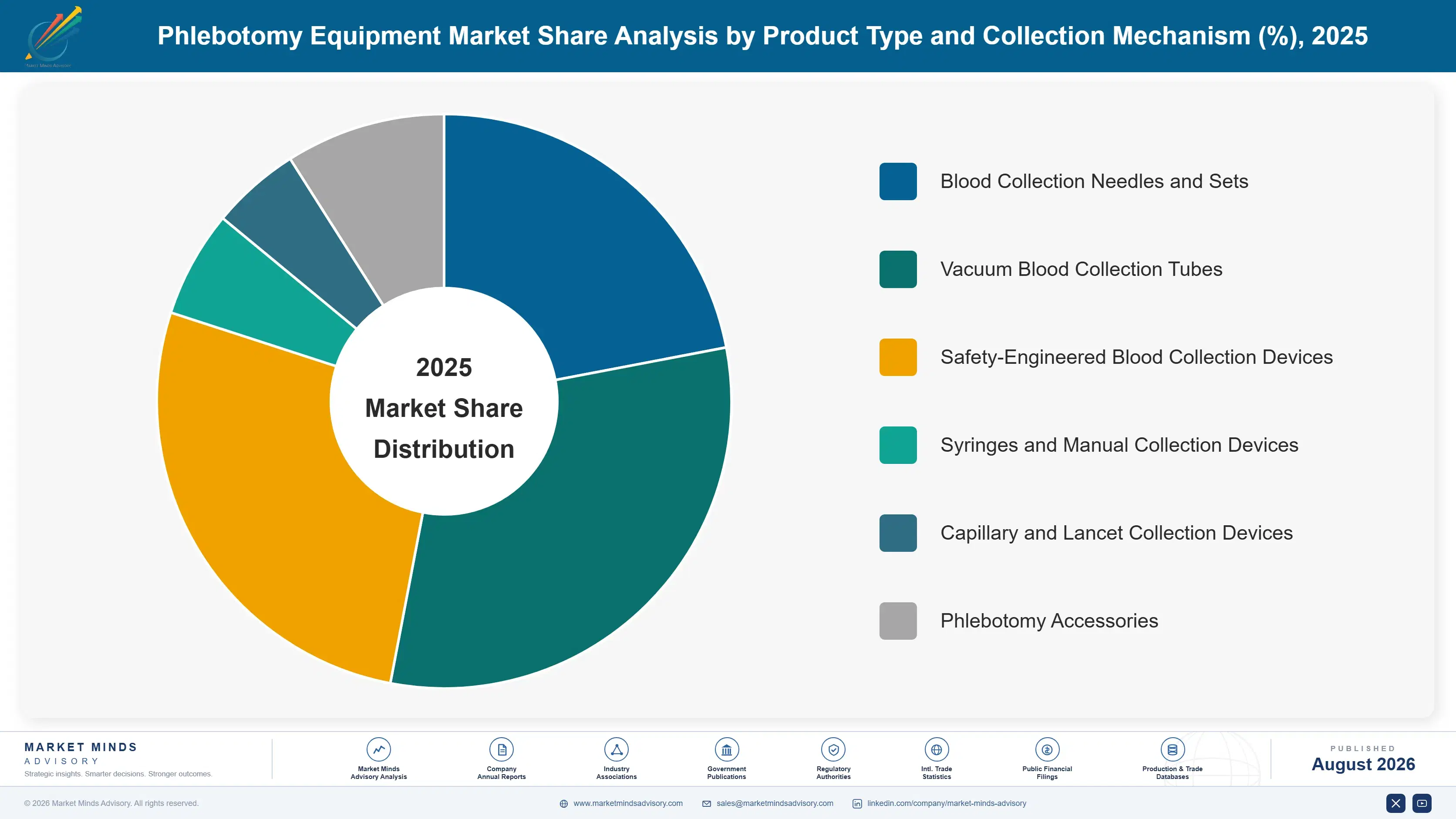
Segmentation follows product type and collection mechanism, the classification hospital procurement teams and laboratories use when specifying blood collection equipment for clinical workflows. Six segments span the full product range from established vacuum collection tubes through emerging safety-engineered devices and capillary collection formats, keeping each category mutually exclusive by underlying product function and collection mechanism.
phlebotomy-equipment-market-market-share-analysis-1787306280818

Safety-Engineered Blood Collection Devices

Safety-engineered blood collection devices incorporate automatic sharps retraction, shielding, or blunting mechanisms activated immediately after venipuncture, substantially reducing the accidental needlestick injury risk that standard collection needles pose to healthcare workers during and after routine blood draw procedures. Growth is accelerating fastest of any segment as regulatory enforcement expands beyond hospital settings into physician office laboratories, outpatient clinics, and blood donation centers previously exempted from strict compliance requirements under earlier regulatory frameworks. BD and Terumo dominate this segment given their established safety mechanism engineering expertise and accumulated regulatory relationships built through years of compliance framework development across multiple jurisdictions. Adoption remains most advanced in developed healthcare markets with strict regulatory enforcement, though emerging markets are increasingly adopting safety devices as local regulation tightens.
CAGR 9.8%

Vacuum Blood Collection Tubes

Vacuum blood collection tubes use pre-calibrated internal vacuum pressure to draw a precise blood sample volume directly into an additive-treated tube during venipuncture, supporting accurate and consistent sample collection across the full range of diagnostic laboratory testing applications. Growth is accelerating as rising diagnostic and preventive testing volume across most developed and emerging healthcare markets directly increases routine tube consumption, since each diagnostic test requires a corresponding collection tube regardless of underlying disease incidence trends. Greiner Bio-One and Sarstedt lead this segment given their established tube manufacturing infrastructure and broad relationships with hospital and reference laboratory procurement teams built across their comprehensive product portfolios. This segment remains the largest by unit volume given its essential role in nearly every diagnostic laboratory testing workflow.
CAGR 7.6%
Full segment breakdown across 6 segments available in the complete report.

Regional Architecture and Country Demand Map

Phlebotomy equipment demand concentrates where hospital and diagnostic laboratory infrastructure density and testing volume run highest. North America's dense healthcare infrastructure, alongside East Asia's massive testing volume and Western Europe's established hospital procurement networks, together account for the large majority of global device revenue worldwide today.

North America

The United States accounts for the large majority of North American demand, reflecting the country's dense hospital and diagnostic laboratory infrastructure alongside strict regulatory enforcement of needlestick injury prevention standards driving comprehensive safety device adoption across most healthcare facility types. Major hospital systems and reference laboratory networks concentrate substantial procurement volume, giving them meaningful negotiating leverage with manufacturers competing for bundled contract business. Canada's smaller but steady demand tracks similar regulatory compliance patterns, though provincial healthcare budget structures keep per-capita device consumption modestly below United States levels. Safety-engineered device adoption has proceeded further in the region than elsewhere, reflecting well-developed regulatory enforcement infrastructure supporting comprehensive compliance across most facility categories.
Share: 27% | CAGR: 7.3% (2026 to 2036)

Western Europe

Germany, France, and the United Kingdom drive most Western European demand, each maintaining well-developed national health system hospital networks with established but comparatively centralized procurement processes favoring large-volume tender contracts over fragmented purchasing. Public healthcare system procurement processes across the region favor established manufacturers with proven reliability and comprehensive product menus over newer entrants offering narrower safety device portfolios. Nordic countries maintain particularly efficient hospital procurement pathways relative to their population size, sustaining steady safety device adoption despite comparatively modest overall population scale across the wider region overall. Currency and national tender pricing negotiations periodically constrain safety device pricing flexibility across smaller public healthcare systems and budgets within the wider region overall today.
Share: 23% | CAGR: 5.2% (2026 to 2036)
Regional intelligence for 5 additional markets available in the complete report: East Asia, South Asia and Pacific, Latin America, Middle East and Africa, Eastern Europe. Contact sales@marketmindsadvisory.com.
phlebotomy-equipment-market-country-cagr-analysis-1787306281344

Where Manufacturers Can Defend Category Margin

Manufacturers face a market where procurement contract breadth and safety device compliance increasingly determine competitive position as much as raw product pricing, making bundled contracts and safety innovation central to sustained revenue growth. Four levers stand out: bundled procurement contract development, safety device innovation investment, emerging market manufacturing expansion, and healthcare facility training support services.

Bundle Safety Devices With Standard Consumables

Manufacturers bundling safety devices with standard tubes and collection accessories into comprehensive procurement contracts are converting hospital systems from purchasing individual products separately into adopting a single integrated vendor relationship covering their full collection device needs. This bundling approach commands meaningful pricing premium over individual product sales while deepening hospital system relationships, since procurement departments increasingly prefer simplified vendor management and predictable volume-based pricing over fragmented multi-vendor purchasing arrangements. Greiner Bio-One and Sarstedt have both expanded bundled contract offerings meaningfully since 2023, reporting adoption rates well above early expectations among large hospital accounts. Bundled contracts now represent an estimated 46 percent of total hospital system collection device revenue.
Market Impact: Represents roughly 46% of total hos

Invest In Safety Mechanism Innovation Now

Manufacturers investing in improved safety mechanism reliability and ease of use, rather than treating safety compliance as a minimum regulatory checkbox requirement, are differentiating premium product lines from competitors offering functionally comparable but less refined safety mechanisms that healthcare workers find less intuitive. This innovation investment addresses the genuine clinical reality that safety mechanism ease of use directly affects healthcare worker compliance and actual injury reduction outcomes, rather than compliance existing purely on paper. BD and Terumo have both expanded safety mechanism research investment since 2023, reporting improved healthcare worker satisfaction scores compared to earlier safety device generations. Premium safety innovation now commands an estimated 28 percent price premium over standard safety-compliant alternatives.
Market Impact: Commands roughly a 28% premium over

Expand Manufacturing Capacity In Emerging Markets

Manufacturers expanding manufacturing capacity within fast-growing emerging markets, rather than serving these markets exclusively through imports from established Western and Japanese production facilities, are capturing cost advantages and improving delivery reliability for price-sensitive regional customers competing against established multinational import pricing structures. This localization approach reduces effective product cost through lower labor and logistics expense while improving supply chain resilience against currency volatility and import tariff exposure affecting imported product competitiveness in price-sensitive markets. Several leading manufacturers have expanded regional manufacturing investment meaningfully since 2023, targeting China and India specifically given their large and growing diagnostic testing volume. Regional manufacturing revenue has grown an estimated 22 percent annually since 2023.
Market Impact: Grows regional manufacturing revenu

Offer Healthcare Facility Training Support Services

Manufacturers offering dedicated healthcare facility training support for proper safety device use and compliance documentation are becoming preferred vendors independent of raw product pricing differences between competing safety-engineered device platforms available across the broader market. This support function addresses a genuine operational challenge for healthcare facilities managing staff turnover and compliance training requirements across large workforces performing routine blood collection procedures daily. Facilities working with vendors offering dedicated training support report meaningfully higher safety device compliance rates and fewer needlestick injury incidents compared to facilities managing training independently. Training program investment has grown an estimated 24 percent annually since 2023 among leading manufacturers.
Market Impact: Grows training program investment r

Who Controls the Margin Pool

Five companies, BD, Terumo, Greiner Bio-One, Sarstedt, and Nipro, hold an estimated 52 percent of global revenue on a company-revenue basis, reflecting a moderately concentrated market anchored by proprietary safety device and tube platform combinations. BD leads by a meaningful margin over the next closest challenger, reflecting its broad safety device product line and long-standing hospital system procurement relationships across most developed healthcare markets.
Current competitive activity centers on three dimensions: bundled procurement contract development to simplify hospital system vendor management, safety mechanism innovation investment to differentiate premium product lines, and emerging market manufacturing capacity expansion to capture fast-growing regional demand. Established manufacturers are also defending standard product pricing against lower-cost Asian competitors through targeted regional manufacturing investment.

Emerging pressure comes primarily from Chinese and Indian manufacturers expanding production capacity to serve fast-growing domestic and export demand, competing increasingly on price against established multinational manufacturers for standard non-safety product lines. If regional manufacturers continue improving safety device capability and certification credibility, competitive rankings in price-sensitive emerging markets could shift faster than in regulation-dense developed markets where established manufacturer relationships remain more durable.
phlebotomy-equipment-market-company-positioning-matrix-1787306281954

Competitive Moat and Risk Dimensions

BECTON, DICKINSON AND COMPANY

Moat: Broadest Safety Device Product Line

BD benefits from the industry's broadest safety-engineered blood collection device product line and deepest accumulated regulatory compliance experience, giving it a scale advantage that smaller competitors cannot easily replicate without comparable decades of safety mechanism engineering investment and healthcare facility relationship building across multiple jurisdictions.
BECTON, DICKINSON AND COMPANY

Risk: Regional Manufacturer Price Competition

BD's premium pricing position faces growing pressure from Chinese and Indian manufacturers offering comparable core collection functionality at meaningfully lower cost, particularly in cost-sensitive emerging market segments where healthcare facility budget constraints outweigh brand loyalty considerations that matter more in developed regulatory-compliant markets today.
TERUMO CORPORATION

Moat: Deep Safety Mechanism Engineering Expertise

Terumo benefits from decades of accumulated needle and safety mechanism engineering expertise applicable across its broader medical device portfolio spanning multiple therapeutic categories, giving it technical differentiation in safety mechanism reliability that narrower single-category competitors have struggled to fully replicate consistently across markets.
TERUMO CORPORATION

Risk: Narrower Bundled Contract Presence

Terumo has moved somewhat more slowly than BD and Greiner Bio-One to build out comprehensive bundled procurement contract offerings, potentially ceding hospital system vendor consolidation opportunities to competitors who prioritized that commercial strategy earlier in their broader product roadmaps and plans.

Players Tracked

Prominent Players

Becton, Dickinson and Company
Terumo Corporation
Greiner Bio-One International GmbH
Sarstedt AG & Co. KG
Nipro Corporation

Other Key Players

Cardinal Health Inc.
Medline Industries LP
B. Braun Melsungen AG
ICU Medical Inc.
Grifols S.A.
Vacutest Kima Srl
Improve Medical Instruments (Guangzhou) Co Ltd
Hindustan Syringes & Medical Devices Ltd
Narang Medical Limited
Weigao Group Medical Polymer Company Limited
Kabe Labortechnik GmbH
Zhejiang Gongdong Medical Technology Co Ltd
AdvaCare Pharma
Kawasumi Laboratories Inc.
Romsons Group of Industries

Recent Developments

MAY 2025

BD Expands Safety Device Product Line Breadth

BD launched an expanded safety-engineered blood collection device product line, an organic product development initiative rather than an acquisition, extending safety mechanism coverage to additional collection formats specifically designed for physician office laboratories and outpatient collection centers facing expanding regulatory enforcement requirements nationwide and abroad.
Signal: Established manufacturers are investing or
SEPTEMBER 2024

Greiner Bio-One Signs Hospital System Bundled Contract Agreement

Greiner Bio-One signed a multi-year bundled procurement contract, not an acquisition or joint venture, with a large multi-state hospital system to provide safety devices and collection tubes under a standardized volume-based pricing structure covering the system's full collection device needs and facilities.
Signal: Manufacturers are increasingly formalizing
JANUARY 2025

Terumo Acquires Regional Safety Device Manufacturing Facility

Terumo completed the acquisition of a specialty safety device manufacturing facility in an emerging market, adding dedicated regional production capacity rather than continuing to rely solely on imports from established production facilities for its collection device product lines going forward across its broader network.
Signal: Established manufacturers are acquiring re

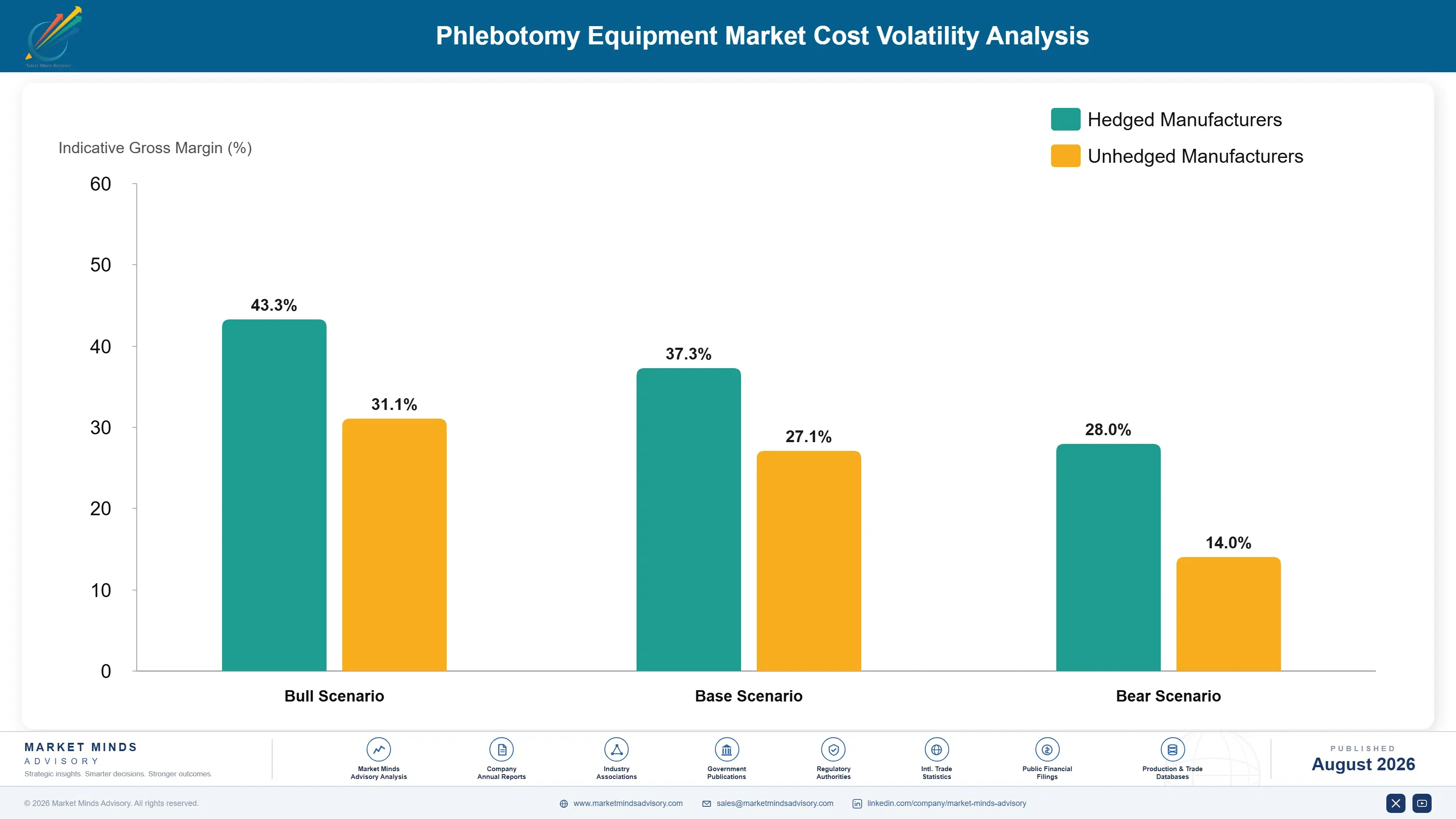
Specialty Polymer and Steel Cost Exposure

Specialty medical-grade polymer resins, precision stainless steel needle components, and vacuum tube additive chemicals together represent roughly 33 percent of cost of goods sold for a typical blood collection device product line, with the remainder split across packaging, sterilization, and quality control processes. Most specialty polymer and precision steel components originate from a comparatively small number of qualified manufacturers in the United States, Germany, and Japan.
The 2021 global medical-grade polymer and steel supply disruption, driven by broader manufacturing capacity constraints affecting numerous medical device categories simultaneously during the pandemic recovery period, delayed collection device shipments industry-wide, with several manufacturers reporting extended lead times through much of 2022. BD's 2022 annual report cited raw material and component availability as a specific factor affecting device segment shipment timing that year, a constraint that eased gradually through 2023 as broader medical device manufacturing capacity normalized across the industry.

Established manufacturers with long-standing polymer and steel supplier relationships and larger purchase volumes secured priority allocation more easily than smaller regional manufacturers during the shortage period, widening the delivery reliability gap between established and emerging manufacturers. Manufacturers without long-term supply agreements, concentrated among smaller regional competitors, faced longer shipment delays and lost some competitive momentum during the broader market recovery period that followed.
phlebotomy-equipment-market-cost-volatility-analysis-1787306282210

Diversify Specialty Polymer Supplier Qualification

Manufacturers are qualifying multiple specialty polymer and precision steel component suppliers across the United States, Germany, and Japan, reducing dependency on any single source following the 2021 shortage experience. Dual-sourcing adds modest qualification cost but has proven worthwhile given the shipment delays single-source manufacturers experienced when raw material availability tightened unexpectedly across the broader supply chain.

Build Strategic Component Inventory Buffers

Several manufacturers have increased safety stock of critical polymer and steel components beyond historical norms, accepting higher working capital cost in exchange for shipment reliability during future supply disruptions across their production networks. This buffer strategy proved valuable during the most recent shortage cycle and is now standard practice among the largest device manufacturers globally.

Pursue Backward Integration Into Component Production

The largest manufacturers are acquiring or building captive polymer and steel component production capacity, insulating their highest-margin safety device product lines from third-party pricing and availability pressure entirely across their broader supply chains. This approach requires significant capital investment but has delivered meaningfully more predictable shipment schedules for companies that have pursued it consistently.

Portfolio Architecture for Margin Defence

The market organizes into three margin tiers running from standard non-safety needles and tubes through certified safety-engineered device lines to next-generation bundled procurement platforms with integrated training support. Gross margins widen substantially moving up this ladder, reflecting both engineering complexity and the regulatory compliance premium hospital systems pay for at the top tier consistently across most developed healthcare markets.
Volume sits overwhelmingly in the mid-tier standard collection consumable segment by unit count, but profitability concentrates in premium safety device platforms and next-generation bundled contract programs where hospital systems pay meaningfully more for compliance simplicity and training support. This volume-versus-margin tension shapes product development priorities across nearly every major manufacturer's roadmap and capital allocation decisions for the years immediately ahead.

High-value pools concentrate specifically around safety-engineered devices and bundled procurement contract programs, both growing considerably faster than the broader phlebotomy equipment category overall. Manufacturers positioned early in these pools are capturing disproportionate profit growth relative to their unit shipment share of the overall market today, a gap likely to widen further as regulatory enforcement continues expanding globally.

Volume / Commodity-Adjacent Tier

Standard non-safety needles, tubes, and manual collection devices sold largely on price and broad compatibility across independent laboratories and smaller regional distributor networks worldwide, with minimal safety mechanism integration required.
Gross Margin: 18-26%

Premium / Certified Tier

Certified safety-engineered device lines with established regulatory compliance documentation, commanding meaningful premiums tied to needlestick injury prevention mandate compliance across major hospital system customers globally and domestically.
Gross Margin: 32-42%

Sustainability / Regulatory / Next-Generation Tier

Bundled procurement platforms with integrated training support and comprehensive product menu coverage, carrying the category's highest margins given technical complexity and compliance simplicity delivered to facilities consistently.
Gross Margin: 40-50%
phlebotomy-equipment-market-portfolio-architecture-1787306282749

High-value Sub-segments and Strategic Watch-out

Safety-Engineered Collection Devices

Safety device platforms combining premium pricing with the category's fastest emerging growth, as regulatory enforcement expands beyond hospital settings into physician office laboratories and outpatient collection centers previously exempted from strict compliance requirements nationwide.
Gross Margin: 44-54%

Bundled Procurement Contract Programs

Bundled contract arrangements carry strong margin given integration value-add, growing steadily as hospital systems standardize procurement around single-vendor comprehensive collection device coverage rather than fragmented multi-vendor purchasing relationships across regions.
Gross Margin: 38-48%

Standard Vacuum Blood Collection Tubes

The largest segment by unit volume, competing primarily on manufacturing reliability and price rather than deep technical differentiation across most hospital and reference laboratory customers worldwide today and abroad.
Gross Margin: 24-32%

Legacy Manual Collection Syringes

Older manual syringe-based collection methods face gradual displacement as vacuum tube and safety device alternatives demonstrate superior consistency, a segment established manufacturers view as declining legacy volume rather than growth potential.
Gross Margin: 16-24%

Regulation-Driven Replacement Economics

Phlebotomy equipment demand functions less like a discretionary medical device purchase and more like an annuity tied to ongoing diagnostic testing volume and regulatory compliance requirements, since healthcare facilities cannot legally operate collection services without properly compliant safety-engineered equipment in regulated jurisdictions. This dynamic insulates a meaningful share of device revenue from broader hospital capital budget cycles affecting other discretionary medical equipment
Adoption depth varies considerably by facility type: large hospital systems and reference laboratories with strict regulatory oversight have adopted comprehensive safety device coverage almost universally, while smaller independent clinics and facilities in less strictly enforced jurisdictions still rely partially on standard non-safety products. Reimbursement-rich, regulation-dense developed markets sit well ahead of cost-constrained systems in overall safety device adoption depth.

A generational shift in hospital procurement and clinical staff buyer profiles is underway as younger healthcare workers, trained during the safety device era rather than the standard needle-dominant period, increasingly expect comprehensive safety mechanism coverage as a standard workplace expectation rather than a specialized precaution. This expectation is accelerating safety device adoption even in facility segments not yet facing direct regulatory pressure to change.
phlebotomy-equipment-market-end-use-penetration-index-1787306283248

Where MMA Sees The Opportunity

These are among the four positions where our research anticipates prominent divergence between winners and laggards over the coming forecast period. Each is grounded in the demand model, the regulatory perimeter, and the announced capacity pipeline.
01 / BUNDLED CONTRACT STRATEGY

Bundle safety devices with consumables before competitors standardize contracts

Hospital systems purchasing safety devices and standard consumables separately from multiple vendors are increasingly frustrated by the coordination burden fragmented procurement creates compared to simplified single-vendor bundled arrangements. Manufacturers bundling comprehensive collection device contracts now are converting hospital systems into single-vendor relationships that competitors cannot easily displace once a facility standardizes procurement on a specific bundled combination. MMA views bundling depth as the single clearest predictor of which manufacturers sustain premium positioning as hospital procurement departments continue consolidating vendor relationships over the next decade.
02 / SAFETY INNOVATION INVESTMENT

Invest in mechanism reliability before compliance becomes a commodity

Safety mechanism compliance is rapidly becoming table stakes across the category, and manufacturers treating it as a minimum regulatory checkbox rather than a genuine differentiation opportunity risk losing premium positioning to competitors investing in meaningfully better mechanism reliability and ease of use. Manufacturers investing early in safety mechanism innovation are positioned to capture premium pricing and healthcare worker preference before competitors close the reliability gap entirely. MMA expects safety mechanism quality to become an increasingly decisive competitive differentiator as basic compliance becomes universal across the category.
03 / EMERGING MARKET MANUFACTURING

Expand regional manufacturing before Asian competitors dominate the segment

Chinese and Indian manufacturers are rapidly scaling production capacity to serve fast-growing domestic and export demand, creating genuine competitive pressure for established manufacturers still serving these markets primarily through higher-cost imports from Western and Japanese production facilities. Manufacturers establishing local production and distribution infrastructure now are positioned to capture disproportionate share of expanding regional demand before domestic manufacturers scale their own competitive capability further across these markets. MMA views regional manufacturing investment as a durable strategic opening for manufacturers willing to invest ahead of demand.
04 / TRAINING SUPPORT EXPANSION

Offer facility training support to differentiate beyond product pricing

Healthcare facilities managing staff turnover and ongoing compliance training requirements represent a persistent operational challenge that manufacturers offering dedicated training support can address more effectively than competitors selling devices without accompanying clinical support services. Manufacturers investing in training support are winning preferred vendor status and capturing disproportionate share of facility procurement budgets independent of raw product pricing differences between competing safety device platforms. MMA expects training support depth to remain a durable competitive advantage throughout the current forecast period as facility staff turnover continues.

Engagement Snapshot From the Field

A live engagement with an industry participant carrying material or product regulatory and market exposure ahead of a defining policy shift, showing how our research translates into a defensible multi-year portfolio strategy.
MARKET MINDS ADVISORY · CLIENT ENGAGEMENT SUMMARY
Phlebotomy Equipment Producer Strategic Portfolio Review and Transition Roadmap 2026·Investment Scenario on Phlebotomy Equipment Exposure Evaluation 2025-26
CLIENT PROFILE
The client is a regional hospital system operating multiple facilities across a metropolitan area, historically managing collection device procurement through separate vendor contracts negotiated independently by each facility (client-reported, unverified by MMA). Leadership sought to consolidate onto a single comprehensive bundled procurement contract to reduce administrative burden and secure volume-based pricing across the full system.
STRATEGIC CHALLENGE
Leadership needed to select a vendor and bundled contract structure capable of supporting standardization across all system facilities within a compressed implementation timeline, while managing staff training requirements associated with any product transitions and controlling total procurement cost across a hospital system balancing multiple simultaneous operational priorities and constraints.
MMA APPROACH
MMA benchmarked candidate vendors against product menu breadth, training support depth, and total cost of ownership including volume-based pricing structures, modeled expected consolidation timeline and cost savings under three distinct vendor scenarios, and recommended a vendor selection and phased facility rollout sequence for the entire hospital system.
KEY FINDINGS
  1. Roughly 55 percent of the system's existing procurement contracts involved redundant separate agreements for products available through a single bundled vendor relationship, representing meaningful consolidation opportunity.
  2. Vendors offering structured facility training support reduced estimated staff transition time by an estimated 30 percent compared to facilities managing product transitions independently.
  3. Total cost of ownership varied meaningfully between vendors based on bundled pricing structures, with comprehensive contracts proving more cost-effective than separate product category purchasing.
  4. Volume-based pricing negotiated across the full system delivered meaningfully better terms than individual facility-level contracts previously negotiated separately by each site.
CLIENT PROFILE
The client is a regional hospital system operating multiple facilities across a metropolitan area, historically managing collection device procurement through separate vendor contracts negotiated independently by each facility (client-reported, unverified by MMA). Leadership sought to consolidate onto a single comprehensive bundled procurement contract to reduce administrative burden and secure volume-based pricing across the full system.
STRATEGIC CHALLENGE
Leadership needed to select a vendor and bundled contract structure capable of supporting standardization across all system facilities within a compressed implementation timeline, while managing staff training requirements associated with any product transitions and controlling total procurement cost across a hospital system balancing multiple simultaneous operational priorities and constraints.
MMA APPROACH
MMA benchmarked candidate vendors against product menu breadth, training support depth, and total cost of ownership including volume-based pricing structures, modeled expected consolidation timeline and cost savings under three distinct vendor scenarios, and recommended a vendor selection and phased facility rollout sequence for the entire hospital system.
KEY FINDINGS
  1. Roughly 55 percent of the system's existing procurement contracts involved redundant separate agreements for products available through a single bundled vendor relationship, representing meaningful consolidation opportunity.
  2. Vendors offering structured facility training support reduced estimated staff transition time by an estimated 30 percent compared to facilities managing product transitions independently.
  3. Total cost of ownership varied meaningfully between vendors based on bundled pricing structures, with comprehensive contracts proving more cost-effective than separate product category purchasing.
  4. Volume-based pricing negotiated across the full system delivered meaningfully better terms than individual facility-level contracts previously negotiated separately by each site.
RECOMMENDED STRATEGY
Phase 1: Phase 1 (Months 1-3): Complete vendor evaluation and finalize bundled contract terms based on product breadth and pricing offered. Phase 2: Phase 2 (Months 4-8): Complete staff training and transition the system's highest-volume facility to the new contract site first. Phase 3: Phase 3 (Months 9-13): Complete remaining facility transition and establish ongoing contract performance monitoring across the entire system.
OUTCOME
Thirteen months into the engagement, the hospital system reported successful procurement consolidation across all facilities, achieving meaningful cost savings and administrative simplification across departments (client-reported, unverified by MMA), validating MMA's vendor selection and phased rollout recommendation fully.

Frequently Asked Questions

Foundational context covering the market sizes, CAGR, scope, country, region and competition that inform every finding below. This section is provided to cover basics and most often pre-purchase conversations, answered from the MMA Primary Research Dataset.

What is the current size of the Phlebotomy Equipment Market?

The global Phlebotomy Equipment Market was valued at approximately $2.1 billion in 2025. Growth is driven by rising diagnostic testing volume and tightening needlestick injury prevention regulation.

How large will the Phlebotomy Equipment Market be by 2036?

The market is projected to reach approximately $4.32 billion by 2036, roughly 1.93 times its 2026 value. Growth is led by safety-engineered device adoption expansion.

What is the CAGR for the Phlebotomy Equipment Market 2026 to 2036?

The market is forecast to grow at a 6.8 percent CAGR between 2026 and 2036. Bull and bear scenarios range from 8.0 percent to 5.6 percent.

Which segment is growing fastest?

Safety-engineered blood collection devices are growing fastest at a 9.8 percent CAGR, roughly 1.44 times the overall market rate, driven by expanding regulatory enforcement worldwide.

Who are the major companies in the Phlebotomy Equipment Market?

BD, Terumo, Greiner Bio-One, Sarstedt, and Nipro lead the market, together holding roughly 52 percent of category revenue on a company-revenue basis today.

Which country is growing fastest?

India is growing fastest among major markets at an estimated 9.2 percent CAGR, driven by rapidly expanding diagnostic laboratory infrastructure investment nationwide.

Report Segmentation Architecture

The full report scope spans multiple orthogonal segmentation dimensions, with cross-tabulated demand data provided for each dimension pair. Coverage extends further to regional breakdowns, trend trajectories, and the competitive detail needed to support segment-level decision-making.

By Product Type and Collection Mechanism

  • Blood Collection Needles and Sets
  • Vacuum Blood Collection Tubes
  • Safety-Engineered Blood Collection Devices
  • Syringes and Manual Collection Devices
  • Capillary and Lancet Collection Devices
  • Phlebotomy Accessories

By End-Use Setting

  • Hospitals
  • Reference Laboratories
  • Physician Office Laboratories
  • Blood Donation Centers

By Commercial Dimension

  • Direct Hospital System Contracts
  • Medical Distributor Networks
  • Bundled Procurement Agreements
  • Training Support Services

By Region

  • North America
  • Western Europe
  • East Asia
  • South Asia and Pacific
  • Latin America
  • Middle East and Africa
  • Eastern Europe

Scope, Methodology, and Coverage

Every figure in this report is reproducible from documented input assumptions. The scope below maps the historical period, the forecast horizon, the segmentation dimensions, and the countries covered, alongside the underlying primary and qualitative methodology.
Historical Period
2020 to 2025
Forecast Period
2026 to 2036
Base Year
2025 (USD billions; MMA Primary Research Dataset, August 2026)
Market Definition
The Phlebotomy Equipment Market covers needles, vacuum blood collection tubes, safety-engineered collection devices, syringes, lancets, and related accessories used to draw venous or capillary blood samples for diagnostic testing, blood donation, and therapeutic purposes. It excludes intravenous infusion equipment, central line catheters, and laboratory analyzer instrumentation that processes collected samples.
Quantitative Units
USD billions (current prices); unit shipment volume where applicable
Segmentation Dimensions
By Product Type and Collection Mechanism; By End-Use Setting; By Commercial Dimension; By Region
Regions Covered
North America, Western Europe, East Asia, South Asia and Pacific, Latin America, Middle East and Africa, Eastern Europe
Countries Covered
USA, China, Germany, France, UK, Japan, South Korea, India, Australia, Canada, Brazil, Mexico, Indonesia, Vietnam, Thailand, Malaysia, UAE, Saudi Arabia, South Africa, Nigeria, Turkey, Poland, Netherlands, Italy, Spain, Sweden, Switzerland, Argentina, Colombia, Singapore, and additional markets relevant to this sector
Key Companies Profiled
Becton, Dickinson and Company, Terumo Corporation, Greiner Bio-One International GmbH, Sarstedt AG & Co. KG, Nipro Corporation, Cardinal Health Inc., Medline Industries LP, B. Braun Melsungen AG, ICU Medical Inc., Grifols S.A., Vacutest Kima Srl, Improve Medical Instruments (Guangzhou) Co Ltd, Hindustan Syringes & Medical Devices Ltd, Narang Medical Limited, Weigao Group Medical Polymer Company Limited, Kabe Labortechnik GmbH, Zhejiang Gongdong Medical Technology Co Ltd, AdvaCare Pharma, Kawasumi Laboratories Inc., Romsons Group of Industries
Quantitative Methodology
Primary survey, n=3,800 respondents, Q4 2025, six countries; demand-side model with trade association cross-validation
Qualitative Methodology
47 expert interviews, Q4 2025; applied to validate demand model assumptions, identify emerging dynamics, and assess competitive positioning
Report Format
PDF and XLSX data workbook (Word format preview document)
Publisher
Market Minds Advisory
Report Code
MMA-2026-MED-342
Published
August 2026
Contact
sales@marketmindsadvisory.com | www.marketmindsadvisory.com

Purchase the full Phlebotomy Equipment Market Report (2026 to 2036).

The full Phlebotomy Equipment Market report provides detailed 2026 to 2036 forecasts across all six product segments and seven global regions, alongside company-level competitive profiles for the twenty manufacturers covered in this summary. It includes primary survey data from 3,800 hospital and laboratory procurement respondents across six countries, supplemented by 47 expert interviews with manufacturers, hospital procurement directors, and healthcare worker safety specialists. The report addresses safety device regulation trends, bundled procurement economics, and emerging market manufacturing patterns in depth. Segment-level margin analysis and vendor selection frameworks support hospital and laboratory strategy decisions across the value chain.
Segment-level 2026-2036 forecasts across all six product types
Full competitive profiles for twenty manufacturers profiled
Regional deep-dive analysis across all seven regions covered
Primary survey data from 3,800 hospital procurement respondents
47 expert interviews with manufacturers and procurement directors
Vendor selection and total cost of ownership frameworks included

Built For The People Who Decide

From boardroom strategy to bench-side execution, this report is read cover-to-cover by leaders shaping the next decade of their industry, turning demand scenarios, market dynamics and valuation benchmarks into decisions.
CXOs/ Presidents/ VPs/ Managers
M&A and Corporate Development
Strategy Teams and R&D Heads
Procurement and Product Directors
Regulatory and Compliance Leaders
Investor Relations and Equity Analysts