Market Minds Advisory
Pharmaceutical Manufacturing Equipment Market

Pharmaceutical Manufacturing Equipment Market: Bioprocessing Systems and Solid Dosage Production Lines

Single-use bioprocessing systems are pulling capital equipment budgets away from traditional stainless steel fermentation infrastructure, forcing established process equipment manufacturers to expand biologics manufacturing capability as biopharma capacity investment accelerates worldwide.

Lead Analyst

Alice Ballenger

Published

September 2026

Make Smarter Decisions with Customized Research Insights

Request a free sample report and evaluate market opportunities, growth trends, and competitive dynamics relevant to your business needs.

2025 MARKET VALUE$16.5BMarket Size 2025
2036 FORECAST VALUE$34.7BBase Case , 2026 to 2036
CAGR 2026 TO 20367.0 %Bull 8.2% / Bear 5.7%
INCREMENTAL OPPORTUNITY$17.1BNet 10- year value creation
EXPANSION MULTIPLE1.97x2036 value over 2026 base
Strategic Levers
M&A Pipeline
Regional Outlook
Country Rankings
Competitive Intelligence
Segmental Deep-dive
Call-Us : 91 93563 13602

Executive Snapshot and Market Trajectory

Single-use bioprocessing systems are pulling capital equipment budgets away from traditional stainless steel fermentation infrastructure, compressing facility commissioning timelines for biopharma manufacturers racing to bring new biologics capacity online nationwide today. Facility engineers describe this as the biggest capital equipment shift the category has seen in a generation broadly now.
Expanding biopharma manufacturing capacity investment, growing generic and biosimilar production capability, and rising domestic manufacturing self-sufficiency initiatives are concentrating demand in North America and Western Europe, where established pharmaceutical manufacturing infrastructure and capital investment sustain the highest per-facility equipment spend of any region tracked in this study. India's rapidly expanding manufacturing base reinforces demand growth well beyond what North American and European volume alone would suggest across nearly every major manufacturing market tracked.
A moderately fragmented group of process equipment manufacturers competes across solid dosage, bioprocessing, and packaging line categories, while single-use technology and continuous manufacturing innovation reshape which companies lead capital equipment procurement conversations at major pharmaceutical engineering conferences worldwide. Smaller specialty manufacturers without meaningful biologics pipelines increasingly struggle to secure large facility accounts across most institutional purchasing decisions studied each cycle today overall.
Market Definition
This market covers capital equipment used in pharmaceutical manufacturing, including solid dosage processing equipment, bioprocessing and fermentation systems, filling and packaging lines, lyophilization systems, and cleanroom and containment infrastructure. It excludes laboratory-scale research equipment and general industrial equipment not specifically designed for regulated pharmaceutical manufacturing environments.
Base Year Value
$16.5B in 2025 (MMA Primary Research Dataset, August 2026)
Forecast Period
2026 to 2036, eleven discrete annual values
CAGR
7.0% base case. Bull 8.2%. Bear 5.7%.
Fastest Growth Segment
Bioprocessing and Fermentation Equipment: 10.8% CAGR
Fastest Growth Country
India: 10.2% CAGR
Fastest Growth Region
South Asia and Pacific: 9.0% CAGR
Largest Region
North America: 29% of 2025 global value
Market Leaders
Syntegon Technology GmbH, GEA Group AG, IMA S.p.A., Sartorius AG, Thermo Fisher Scientific Inc. Source: MMA Analysis based on company annual reports.
Primary Survey
n=3,800 procurement and R&D decision-makers, Q4 2025, six countries
Methodology
Demand-side build-up, cross-validated against public data, 47 expert interviews

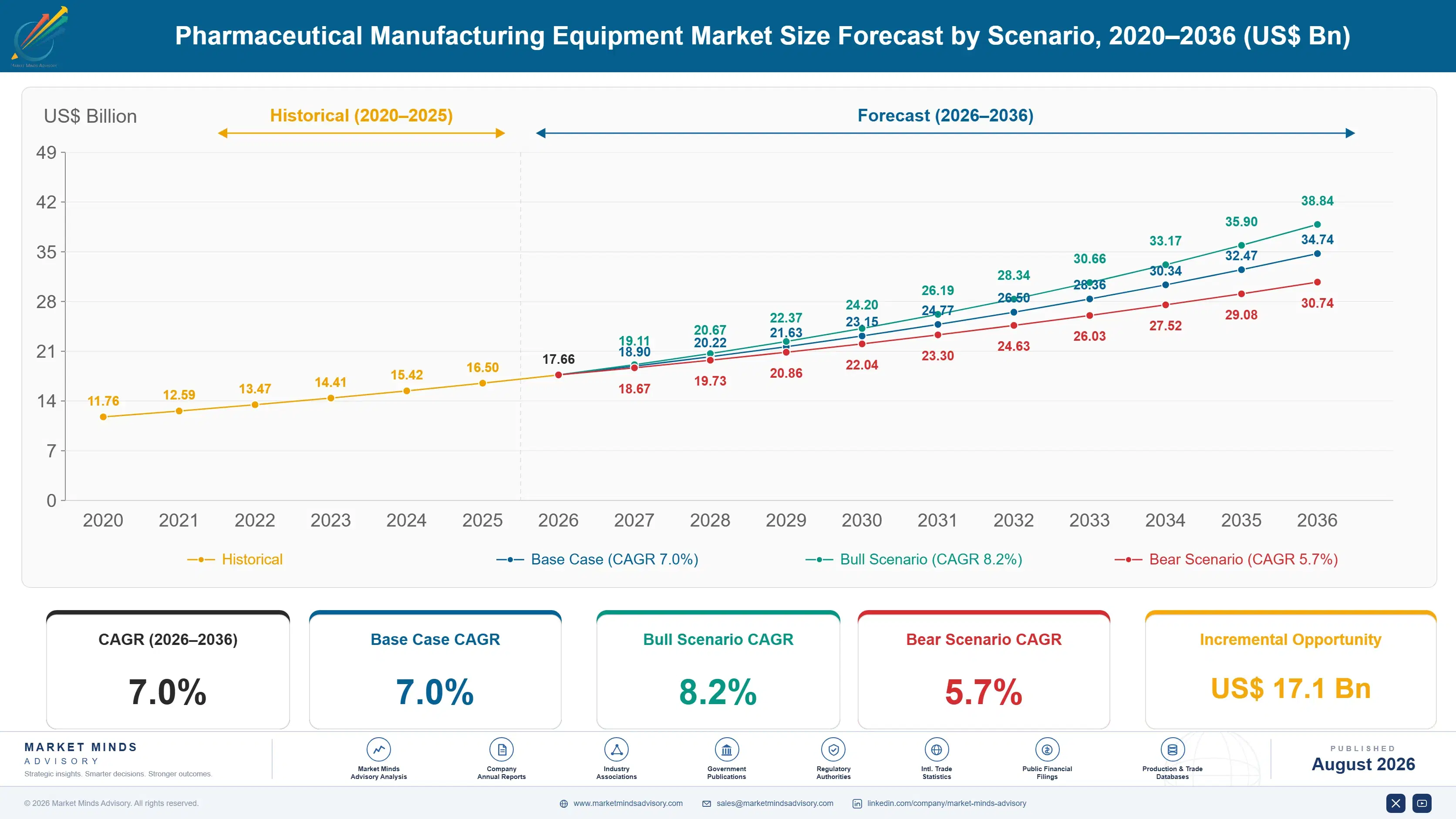
Pharmaceutical Manufacturing Equipment Market Forecast Scenarios

pharmaceutical-manufacturing-equipment-market-size-forecast-scenario-1787306615475
Pharmaceutical manufacturing equipment spending grew at roughly 6.2% annually between 2020 and 2025, as expanding biopharma manufacturing capacity investment and rising domestic pharmaceutical self-sufficiency initiatives brought new production capacity online across major developed and emerging manufacturing markets tracked closely by industry observers. Growth accelerated further toward the end of the historical window as single-use technology gained broader manufacturer acceptance.
The base case assumes continued single-use bioprocessing system adoption, expanding generic and biosimilar manufacturing capacity investment, and steady facility modernization spending, sustaining a 7.0% blended annual growth rate through 2036 across most major manufacturing equipment markets worldwide tracked in this study. Continued service contract investment and modular upgrade path development further reinforce this trajectory across most major manufacturing markets reviewed by MMA analysts across most reimbursement and capital allocation channels tracked today.
A bull scenario assumes faster-than-expected biopharma capacity expansion pulls equipment procurement well ahead of current expectations across emerging manufacturing markets. The bear case centers on pharmaceutical capital budget tightening that slows facility construction and equipment replacement timelines relative to underlying production demand growth. Either scenario would meaningfully reshape which manufacturers lead facility capital investment conversations by the end of the forecast period.

Biologics Capacity Investment Redraws Equipment Demand

Pharmaceutical manufacturing equipment sits at the convergence of biopharma capacity expansion, regulatory manufacturing compliance requirements, and a genuinely fast-moving single-use technology shift that has pulled bioprocessing infrastructure from permanent stainless steel installations into flexible, disposable production systems. Facility engineers increasingly weigh manufacturing flexibility as heavily as raw throughput when selecting equipment. This dynamic increasingly rewards manufactu
MARKET CONCENTRATIONCR5 44%share held by the five largest process equipment manufacturers combined
AVERAGE PRODUCTION LINE PRICE$2.8 millionblended average across solid dosage and bioprocessing production line categories
LEADING COUNTRY SHAREUnited States 21%of global equipment spend concentrated domestically across all facility types
SINGLE-USE SYSTEM PENETRATION42%of installations using single-use rather than stainless steel
FACILITY UTILISATION RATE76%average global pharmaceutical manufacturing facility capacity currently in use
REPLACEMENT CYCLE LENGTH12 yearsaverage pharmaceutical production equipment replacement interval across major categories
Commercially, this market behaves like a large-scale capital equipment category: manufacturers invest in production line hardware infrequently but at substantial cost per installation, while ongoing validation services, spare parts, and consumables generate a meaningful recurring revenue stream layered atop each capital sale. This dual revenue structure increasingly attracts specialty investors seeking durable, service-driven margin profiles. Few other industrial equipment categories combine such distinct hardware and recurring consumable revenue pools.
Over the next decade, expanding biopharma manufacturing capacity, growing domestic pharmaceutical self-sufficiency initiatives, and continued single-use and continuous manufacturing technology adoption will keep pulling capital investment toward flexible, higher-throughput production systems across most major pharmaceutical manufacturing markets tracked in this study. Manufacturers slow to adapt risk ceding facility mindshare to faster-moving competitors across the category.
"Nobody builds a stainless steel fermentation suite for a single biologic anymore. Single-use lets a manufacturer retool for a different product in weeks instead of months, and that flexibility is worth the premium."
Director, Pharmaceutical Manufacturing and Process Equipment Practice · MMA Cons

Market Trends

Single-Use Bioprocessing Systems Displace Stainless Steel

Biopharma manufacturers increasingly specify single-use bioprocessing systems, including disposable bioreactor bags and pre-sterilized flow paths, over traditional stainless steel fermentation infrastructure that requires extensive cleaning validation between production campaigns for different biologic products. Equipment manufacturers report single-use systems now represent roughly 42% of new bioprocessing installations, a substantial increase from a decade ago when stainless steel systems dominated nearly all new facility construction almost universally. This shift is meaningfully reducing facility commissioning timelines while improving manufacturing flexibility for biopharma companies producing multiple biologic products. Manufacturers view this shift as essential to remaining competitive in a flexibility-driven category.
Market Impact: Covers 3,000 plus biopharma facilit
Continuous Manufacturing Technology Gains Regulatory Support

Regulatory agencies increasingly encourage continuous manufacturing technology adoption over traditional batch processing, offering expedited review pathways and technical guidance that support manufacturers transitioning to continuous production lines capable of running extended manufacturing campaigns without the interruptions batch processing requires. Equipment suppliers report continuous manufacturing line orders have grown by roughly 34% since 2022, outpacing traditional batch equipment growth considerably as manufacturers respond to both regulatory encouragement and genuine efficiency advantages continuous processing offers. This trend is pulling equipment manufacturers to redesign core production platforms specifically for continuous rather than batch operation.
Market Impact: Adds capacity across 40 plus facili

Market Opportunities and Growth Drivers

Biopharma Manufacturing Capacity Investment Expands Rapidly

Global biopharma manufacturing capacity investment continues expanding rapidly as biologics, cell and gene therapies, and biosimilar production volume grows, directly driving demand for bioprocessing equipment capable of supporting increasingly complex manufacturing processes across major pharmaceutical markets tracked in this study. Venture capital and pharmaceutical company capital expenditure on biologics manufacturing infrastructure has grown considerably as the therapeutic pipeline increasingly shifts toward biologic rather than small-molecule modalities requiring fundamentally different production equipment. This driver sustains steady baseline equipment demand growth even without accounting for single-use or continuous manufacturing adoption effects separately.
Market Impact: Validation cycles extend timelines

Domestic Manufacturing Self-Sufficiency Initiatives Grow Rapidly

Government initiatives supporting domestic pharmaceutical manufacturing capability, driven by supply chain resilience concerns exposed during recent global health disruptions, continue expanding equipment procurement in markets previously heavily dependent on imported finished pharmaceutical products and active ingredients. National policy across several major markets increasingly prioritizes reducing import dependency for essential medicines, directly driving new facility construction and associated equipment procurement across both developed and emerging manufacturing economies. This driver is expected to sustain above-average equipment demand growth in emerging manufacturing markets for years to come. Manufacturers view emerging market capacity expansion as essential to sustaining long-term category growth.
Market Impact: Delays extend cycles by 18 months

Market Restraints and Challenges

Long Equipment Validation Cycles Slow Replacement Timing

Pharmaceutical manufacturing equipment requires extensive validation and regulatory qualification whenever a facility changes production platforms, creating a genuine switching cost that discourages equipment replacement until existing systems become unsupportable or a major process change is already underway for other reasons. The root cause is that regulated pharmaceutical manufacturers must revalidate entire production processes whenever equipment platforms change, a process that can take many months and requires substantial documentation before regulatory approval to resume commercial production. This constraint disproportionately affects equipment manufacturers competing primarily for replacement cycle volume rather than new facility construction demand.
Market Impact: Adds 42 percent single-use system s

Capital Budget Constraints Delay Facility Modernization

Smaller pharmaceutical manufacturers and generic drug producers frequently face capital budget constraints that delay equipment modernization well beyond optimal technical lifespan, limiting these customers' ability to adopt newer single-use or continuous manufacturing platforms despite genuine efficiency and flexibility benefits available to better-capitalized competitors. The underlying cause is that pharmaceutical manufacturing capital budgets typically compete against research and development investment priorities, and equipment modernization rarely receives the same funding urgency as pipeline development within constrained capital environments. This constraint disproportionately affects smaller generic manufacturers relative to well-funded biopharma companies pursuing premium biologic manufacturing capability.
Market Impact: Grows continuous manufacturing orde
3 additional market trends, 3 additional growth drivers, and 4 additional restraints and challenges are covered in the full report. Contact sales@marketmindsadvisory.com to access the complete intelligence.

Segment CAGR and Growth Architecture

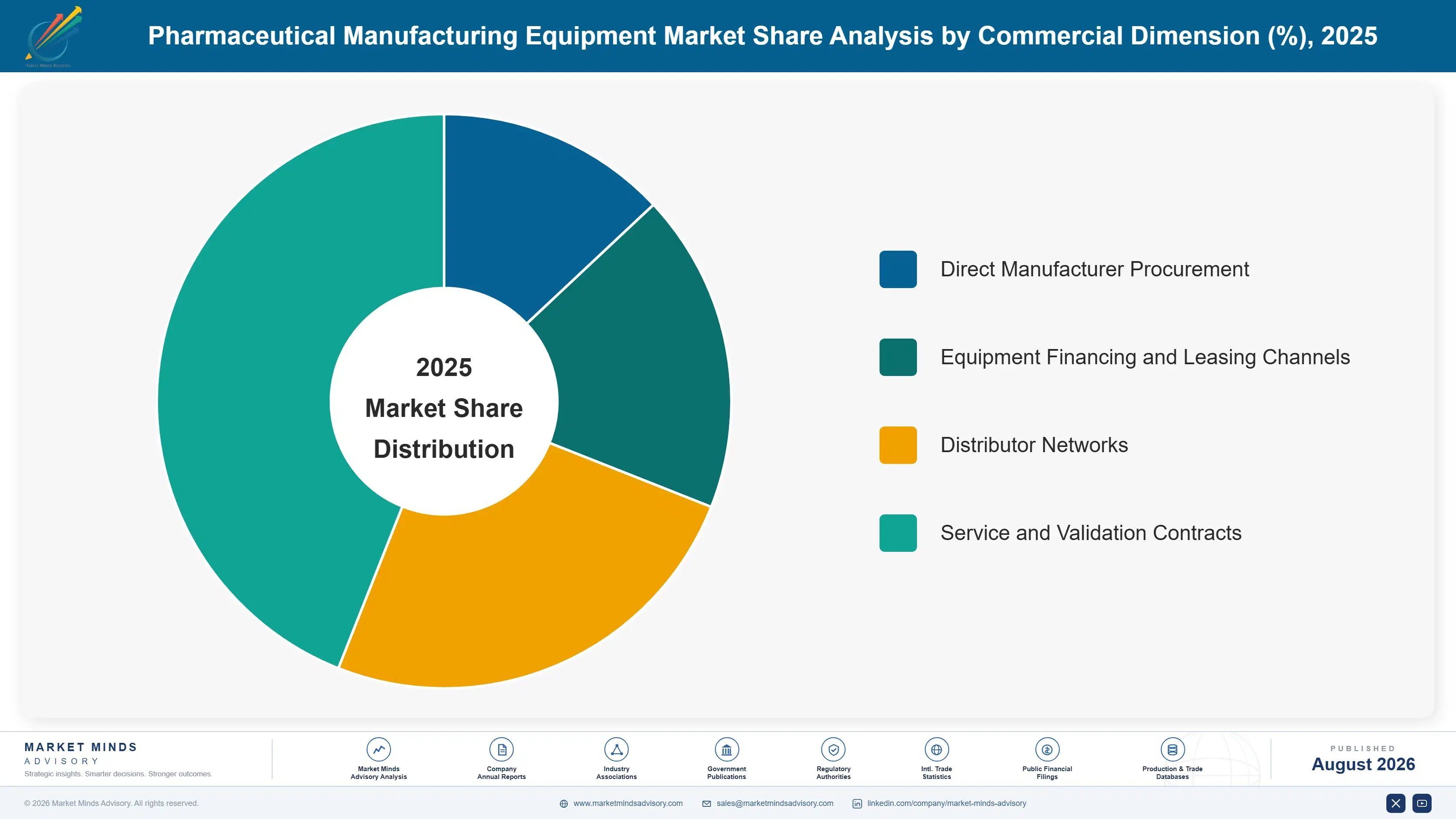
This market segments by equipment category spanning solid dosage processing equipment, bioprocessing and fermentation equipment, filling and packaging line equipment, lyophilization and freeze-drying systems, mixing and blending equipment, and cleanroom and containment systems. This dimension is the one facility engineers actually reference when structuring capital equipment purchasing decisions and technology purchasing decisions across the industry.
pharmaceutical-manufacturing-equipment-market-market-share-analysis-1787306616012

Bioprocessing and Fermentation Equipment

Bioprocessing and fermentation equipment is the fastest-growing segment as biopharma manufacturers expand production capacity for biologics, cell and gene therapies, and biosimilar products that require fundamentally different manufacturing infrastructure than traditional small-molecule solid dosage production lines used historically across the pharmaceutical industry. Single-use technology adoption within this segment specifically has accelerated capacity expansion timelines, since disposable systems eliminate the cleaning validation between production campaigns that traditional stainless steel infrastructure requires for each distinct biologic product manufactured. This segment commands strong pricing power reflecting both its technical complexity and the specialized engineering investment required to support increasingly sophisticated biologic manufacturing processes. Equipment manufacturers are pursuing expanded single-use product lines and continuous bioprocessing capability as this segment increasingly determines competitive positioning industry-wide.
CAGR 10.8%

Lyophilization and Freeze-Drying Systems

Lyophilization and freeze-drying systems are growing considerably faster than the broader market as biologics, vaccines, and other temperature-sensitive biologic products increasingly require freeze-dried formulation to achieve adequate shelf stability without requiring continuous cold chain distribution infrastructure that many emerging markets still lack entirely. This segment benefits from expanding vaccine manufacturing capacity investment globally, since freeze-dried vaccine formulations offer meaningfully improved distribution flexibility compared to liquid formulations requiring uninterrupted refrigeration throughout the supply chain. Manufacturers are investing in larger-capacity, continuous freeze-drying platforms to meet growing biologics manufacturing volume, since batch-based freeze-drying increasingly represents a throughput bottleneck for manufacturers scaling biologic production. This modular approach increasingly determines which manufacturers win larger biologics manufacturing accounts.
CAGR 9.2%
Full segment breakdown across 6 segments available in the complete report.

Regional Architecture and Country Demand Map

North America and Western Europe together account for the majority of global equipment spend, reflecting established pharmaceutical manufacturing infrastructure, biopharma capital investment, and premium equipment procurement across major developed manufacturing markets. East Asia and South Asia are closing the gap fastest as domestic manufacturing investment continues expanding rapidly.

North America

The United States anchors regional demand through its dense concentration of biopharma manufacturing facilities, favorable capital equipment financing availability, and the largest installed base of single-use bioprocessing systems of any national market tracked in this study. Canada maintains a smaller but steadily expanding manufacturing base, with growing biologics investment gradually increasing equipment procurement across major research institutions and contract manufacturers. American biopharma and generic pharmaceutical manufacturers continue driving bulk purchasing volume that gives equipment manufacturers a reliable large-account revenue base ahead of broader smaller manufacturer conversion. This region's manufacturing infrastructure maturity and capital investment make it the benchmark market other national markets reference when evaluating equipment technology adoption timelines. Mexico's growing pharmaceutical manufacturing footprint adds modest additional regional demand.
Share: 29% | CAGR: 7.4% (2026 to 2036)

Western Europe

Germany, France, and the United Kingdom lead regional demand through well-established pharmaceutical manufacturing and biopharma research infrastructure, with Germany's engineering and equipment manufacturing base particularly influential in driving both domestic demand and export-oriented equipment production. Public and private capital investment across the region supports steady manufacturing equipment procurement, though overall capital spending intensity trails North America somewhat across most major markets. Nordic countries show disproportionately high per-facility equipment investment despite small absolute population, reflecting well-funded biopharma research infrastructure supporting advanced manufacturing capability. Regional growth trails North America and East Asia modestly as manufacturing infrastructure among major markets is already comparatively mature. Smaller Western European markets follow this same engineering-driven adoption pattern closely across their national sectors.
Share: 25% | CAGR: 5.5% (2026 to 2036)
Regional intelligence for 5 additional markets available in the complete report: East Asia, South Asia and Pacific, Latin America, Middle East and Africa, Eastern Europe. Contact sales@marketmindsadvisory.com.
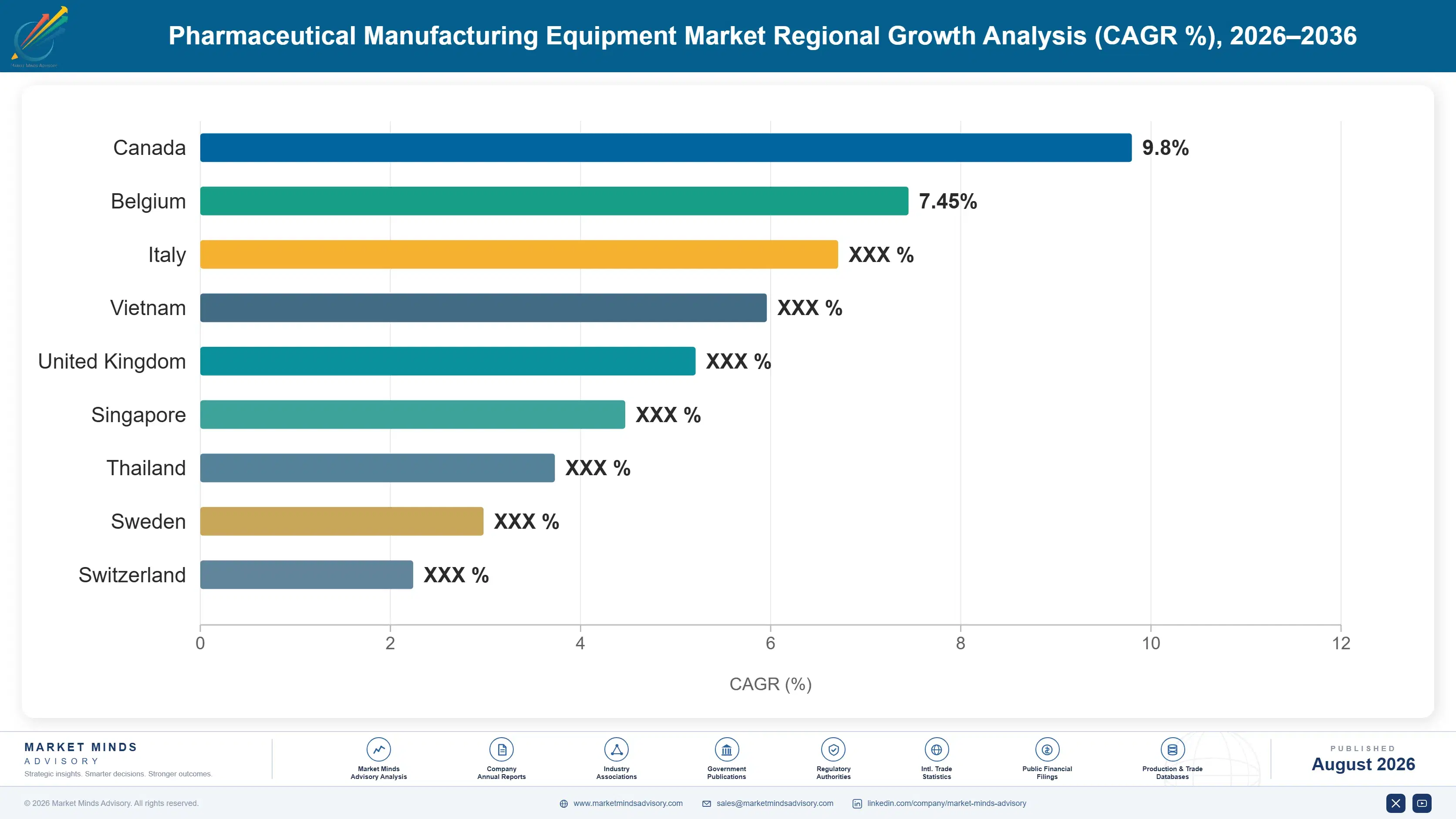
pharmaceutical-manufacturing-equipment-market-country-cagr-analysis-1787306616516

Service Contract and Single-Use Consumables Strategy

Manufacturers are shifting commercial strategy toward extended service contract expansion, single-use consumables attachment, and validation support services, capturing more predictable recurring revenue rather than depending purely on infrequent capital equipment sales alone across the category. This mirrors a broader capital equipment industry shift toward relationship-driven, service-based commercial models overall today across the sector overall.

Single-Use Consumables Attachment Programme Investment Strategy

Manufacturers are structuring bioprocessing system placements to maximize downstream single-use bag and flow path consumable attachment, since these recurring purchases generate materially higher margins than the initial capital equipment sale and recur consistently throughout each production campaign at a given facility. This lever converts a one-time equipment sale into a multi-year recurring revenue relationship similar to commercial models common across other capital-intensive manufacturing equipment categories. Manufacturers report consumables attachment revenue now represents roughly 48% of total bioprocessing category revenue across major manufacturers. Manufacturers view this attachment ratio as the single most important commercial metric tracked internally.
Market Impact: Consumables now drive roughly 48 pe

Extended Service Contract and Validation Support Programmes

Manufacturers are expanding extended service contract and validation support programmes that help pharmaceutical manufacturers navigate the extensive regulatory qualification process required whenever production equipment changes, converting hardware sales into deeper service-enabled relationships that create meaningful switching costs once facilities build validated workflows around a specific platform. This lever strengthens customer retention considerably, since switching equipment platforms requires manufacturers to revalidate entire production processes built around specific equipment configurations. Manufacturers report service contract attachment improving customer retention by roughly 31% compared to standalone equipment sales. Manufacturers increasingly treat service investment as essential to defending long-term facility relationships.
Market Impact: Improves customer retention by roug

Modular Upgrade Path Investment Programme Strategy

Manufacturers are developing modular equipment platforms that allow facilities to upgrade incrementally from batch to continuous manufacturing or from stainless steel to single-use systems, capturing expansion revenue from existing customers rather than depending entirely on new facility construction to drive category growth. This lever captures incremental revenue from manufacturers whose production needs evolve over time, avoiding the customer acquisition cost associated with winning entirely new facility accounts for premium equipment categories. Manufacturers report modular upgrade programmes capturing roughly 26% additional revenue from existing customer accounts. Manufacturers expect this upgrade motion to remain a primary growth driver through the forecast period.
Market Impact: Captures roughly 26 percent more ac

Emerging Market Distribution Partnership Investment Strategy

Manufacturers are building dedicated distributor and technical support partnerships across emerging manufacturing markets with expanding domestic pharmaceutical production investment, capturing early-mover advantage in previously underserved markets before local competitors establish comparable distribution reach and technical support infrastructure across newly accessible manufacturing bases. This lever requires meaningful upfront investment in distributor training and technical support infrastructure, but positions manufacturers favorably as domestic manufacturing investment continues driving addressable facility growth across these markets. Manufacturers report early distribution investment yielding roughly 23% faster market share gains compared to delayed market entry. Manufacturers expect this approach to become increasingly common across the wider equipment.
Market Impact: Speeds share gains by roughly 23 pe

Who Controls the Margin Pool

The top five equipment manufacturers control roughly 44% of global revenue, a moderate concentration reflecting genuine fragmentation across solid dosage, bioprocessing, and packaging line equipment categories, alongside a meaningful long tail of specialty and regional manufacturers competing within narrower application niches. Mid-sized specialty manufacturers with differentiated technology remain attractive acquisition targets for larger originators. This dynamic keeps deal activity elevated r
Current competitive activity centers on single-use bioprocessing technology development and biologics manufacturing capability expansion, continuous manufacturing platform development targeting regulatory-encouraged production methods, and emerging market distribution partnership building across expanding domestic manufacturing economies. Several manufacturers are also piloting bundled financing and service packages to differentiate beyond hardware alone. This positioning increasingly determines which manufacturers win larger, multi-facility manufacturer relationships.

Emerging pressure comes from Asian domestic equipment manufacturers developing lower-cost platforms for their expanding domestic pharmaceutical manufacturing markets, and from smaller specialty companies pursuing next-generation continuous bioprocessing technology that could reshape which companies lead biologics manufacturing equipment conversations. Established leaders are responding by accelerating their own bioprocessing and continuous manufacturing investment, while monitoring these entrants closely for signs of accelerating competitive share gains.
pharmaceutical-manufacturing-equipment-market-company-positioning-matrix-1787306617040

Competitive Moat and Risk Dimensions

SYNTEGON TECHNOLOGY GMBH

Moat: Integrated Line Breadth Advantage

Syntegon sells solid dosage processing, filling, and packaging line equipment under one integrated commercial relationship, giving it cross-selling advantages and workflow integration depth across entire production lines that narrower single-category competitors cannot easily replicate at comparable facility scale. This installed base advantage compounds as facilities build multi-year purchasing relationships around trusted platforms.
SYNTEGON TECHNOLOGY GMBH

Risk: Capital Spending Cycle Exposure Risk

Syntegon's revenue depends heavily on pharmaceutical manufacturer capital equipment spending cycles, and a sustained slowdown in facility construction or modernization investment during economic uncertainty could disproportionately affect new equipment sales relative to more resilient service and consumables revenue streams. Investors are watching facility capital spending trends closely for early signs of slower demand.
SARTORIUS AG

Moat: Single-Use Bioprocessing Technology Leadership

Sartorius maintains one of the industry's most advanced single-use bioprocessing technology platforms and deep integration with major biopharma manufacturers, giving it clinical and commercial-scale manufacturing credibility that newer single-use entrants have not yet matched at comparable scale and customer trust. Few competitors can match this technology depth built over more than a decade of research investment.
SARTORIUS AG

Risk: Large Customer Concentration Risk

A meaningful share of Sartorius's bioprocessing revenue depends on continued capacity expansion decisions from a relatively small number of large biopharma manufacturers, and any pause in these customers' capital investment plans could meaningfully affect near-term revenue visibility despite broader category growth. Sartorius continues diversifying its customer base to reduce this concentration exposure over time.

Players Tracked

Prominent Players

Syntegon Technology GmbH
GEA Group AG
IMA S.p.A.
Sartorius AG
Thermo Fisher Scientific Inc.

Other Key Players

Korsch AG
Romaco Group
Fette Compacting GmbH
Glatt GmbH
Bausch+Ströbel Maschinenfabrik Ilshofen GmbH+Co.KG
Marchesini Group S.p.A.
Uhlmann Pkg Group GmbH
Optima Packaging Group GmbH
Coperion GmbH
ACG Worldwide
Natoli Engineering Company Inc.
Elizabeth Companies Inc.
L.B. Bohle Maschinen + Verfahren GmbH
Steriline S.r.l.
Colorcon Inc.

Recent Developments

MARCH 2026

Sartorius Expands Single-Use Bioprocessing Manufacturing Capacity in Germany

Sartorius announced an organic capacity expansion at its German manufacturing facility to increase single-use bioreactor and flow path production, aimed at meeting rising demand from biopharma manufacturers converting from stainless steel infrastructure across international markets. The expansion is expected to reach full production capacity within the next twelve months of.
Signal: Signals continued manufacturer confidence
OCTOBER 2025

Syntegon Signs Equipment Supply Agreement With Major Generic Manufacturer

Syntegon Technology entered a multi-year equipment supply agreement with a major generic pharmaceutical manufacturer to provide solid dosage processing and packaging lines across its expanding production network, part of a broader capacity expansion initiative. Financial terms of the multi-year agreement were not fully disclosed by either party involved.
Signal: Reflects continued reliance on multi-year
JANUARY 2026

GEA Group Acquires Regional Continuous Manufacturing Technology Startup

GEA Group completed the acquisition of a regional continuous manufacturing technology startup, expanding its process equipment portfolio to include next-generation continuous production platforms targeting the industry's shift away from traditional batch processing methods. Financial terms of the transaction were not disclosed by either company involved in the deal.
Signal: Indicates growing equipment manufacturer i

Precision Engineering and Specialty Materials Exposure

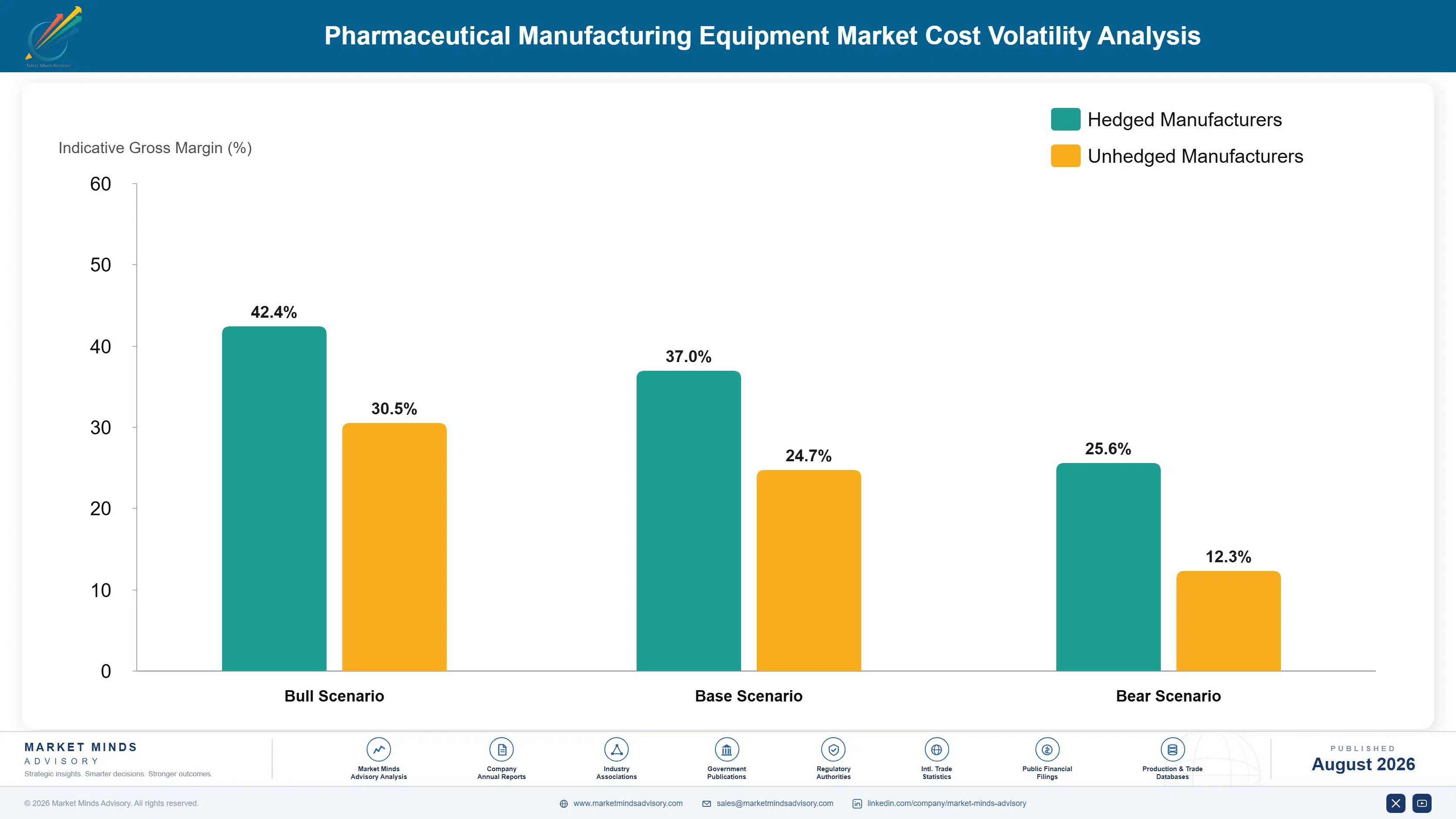
Precision stainless steel components, specialty polymer materials for single-use systems, and precision control electronics together represent roughly 45% of cost of goods sold for pharmaceutical equipment manufacturers, with specialty single-use polymer materials concentrated among a smaller group of qualified medical-grade suppliers. Manufacturers with vertically integrated production face materially less exposure to this concentration today across the industry.
Stainless steel and specialty polymer prices rose meaningfully during 2021 and 2022 amid broader industrial supply chain disruption, with company annual reports from major manufacturers confirming that input cost pressure remained elevated through much of the period before moderating somewhat through 2024 and 2025. Smaller manufacturers absorbed a disproportionate share of this cost inflation given weaker supplier negotiating positions to smaller manufacturers previously lacking comparable purchasing scale.

Smaller specialty equipment manufacturers without long-term supplier contracts face materially higher input cost volatility than the largest players, who can negotiate multi-year fixed pricing given their purchasing scale. This creates a durable cost disadvantage for smaller manufacturers competing against larger competitors able to smooth input cost swings. Geography also matters, since manufacturers closer to steel and polymer supply hubs face smaller logistics cost swings.
pharmaceutical-manufacturing-equipment-market-cost-volatility-analysis-1787306617235

Multi-Year Fixed Pricing Supplier Contracts

Larger manufacturers are locking in multi-year fixed pricing agreements with specialty steel and polymer suppliers, insulating equipment production costs from short-term material price volatility that smaller competitors remain fully exposed to across each purchasing cycle. This approach has become standard practice among the largest equipment manufacturers globally over the past decade, particularly those with strong purchasing scale available.

Vertical Integration Into Single-Use Component Manufacturing

Some larger manufacturers are bringing single-use polymer component manufacturing in-house rather than outsourcing entirely, capturing manufacturing margin previously paid to third-party suppliers while gaining tighter quality control. This shift represents a meaningful strategic bet on long-term category volume growth, reflecting genuine confidence in continued expansion across the wider industry, positioning these manufacturers favorably as biologics production volume continues expanding worldwide.

Secondary Supplier Qualification Programmes

Manufacturers are qualifying secondary steel and polymer suppliers to reduce dependency on any single source, reducing disruption risk when a primary supplier faces its own capacity constraints or quality issues. Smaller manufacturers increasingly pursue this strategy too, despite the added qualification cost involved, and this trend keeps accelerating across the wider equipment industry across the manufacturer's global operations.

Portfolio Architecture for Margin Defence

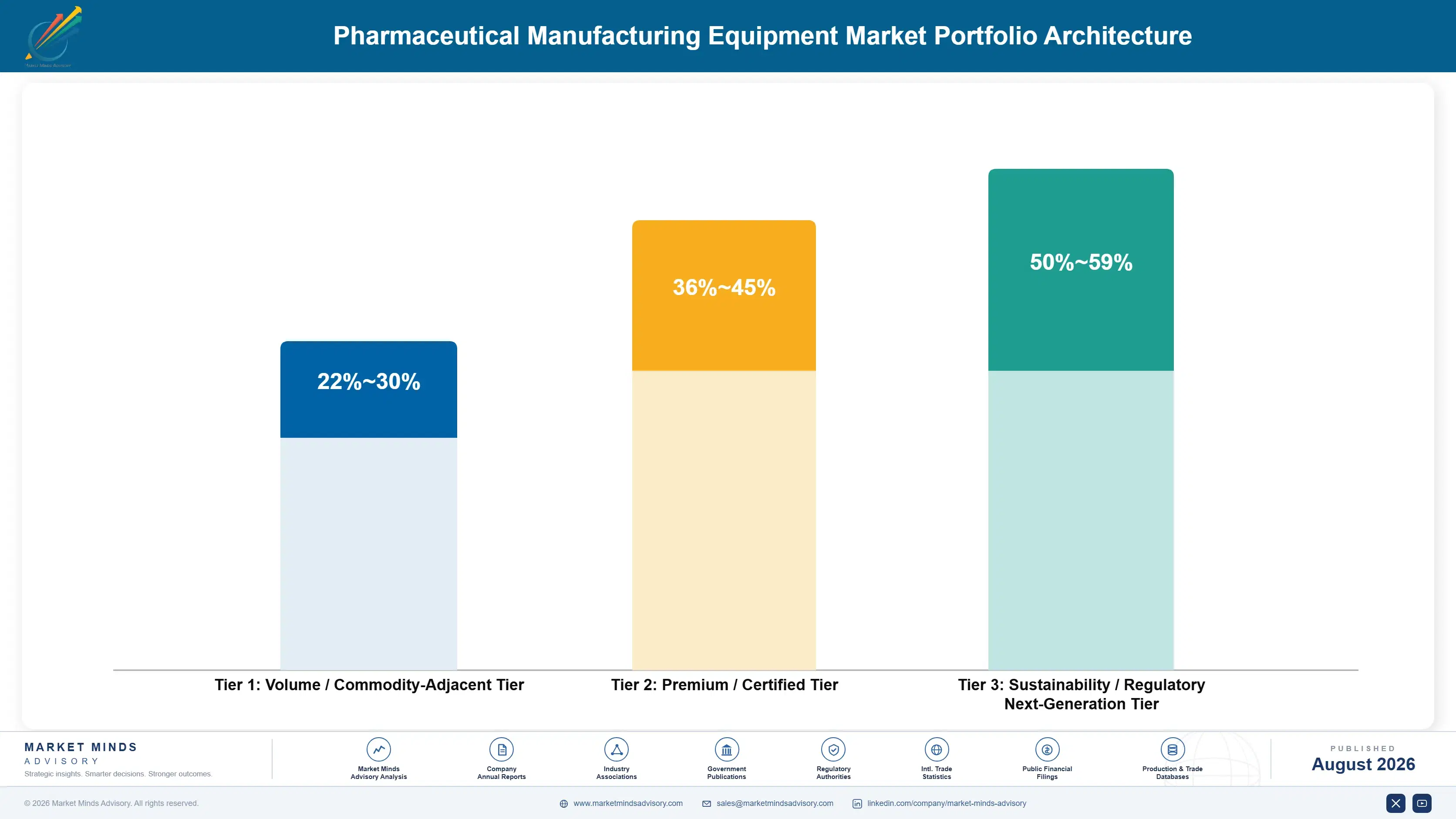
This market organizes into three commercial tiers spanning standard solid dosage processing equipment at the volume end, packaging and filling line systems occupying the premium middle tier, and single-use bioprocessing and continuous manufacturing platforms capturing the strongest margins at the top of the portfolio architecture overall. Manufacturers increasingly structure pricing and research investment explicitly around this three-tier architecture.
Volume and premium tiers pull manufacturers in different directions: standard solid dosage equipment sustains broad manufacturer relationships and unit volume, while bioprocessing and continuous manufacturing platforms deliver materially stronger margins that increasingly determine which companies can fund the research and development the category requires going forward. This explicit structuring helps allocate scarce development resources toward the highest-return opportunities available. Most manufacturers now allocate a growing share of research budget toward the top two tiers.

The highest-value pools concentrate around single-use bioprocessing and continuous manufacturing platforms sold under service and consumables partnerships, where technical differentiation and workflow integration together sustain premium pricing power that standard solid dosage equipment simply cannot match across comparable volume. Manufacturers unable to compete in this tier increasingly struggle to sustain category-leading margins over time. Regulatory encouragement of continuous manufacturing will remain a key factor shaping this trajectory.

Volume / Commodity-Adjacent Tier

Standard solid dosage processing equipment sold into generic and established pharmaceutical manufacturing facilities broadly. This tier represents the largest unit volume category by facility count served across most markets today.
Gross Margin: 22-30%

Premium / Certified Tier

Filling and packaging line systems sold into branded and specialty pharmaceutical manufacturers under strong technical positioning. Facilities in this tier rarely switch platforms once production processes are formally validated each time.
Gross Margin: 36-45%

Sustainability / Regulatory / Next-Generation Tier

Single-use bioprocessing and continuous manufacturing platforms commanding the strongest pricing power given technical differentiation. This tier increasingly determines which companies can fund the research the category requires each cycle going forward.
Gross Margin: 50-59%
pharmaceutical-manufacturing-equipment-market-portfolio-architecture-1787306617732

High-value Sub-segments and Strategic Watch-out

Bioprocessing and Fermentation Equipment

The fastest-growing and highest-margin segment, combining strong biologics manufacturing momentum with genuine technical differentiation across most major pharmaceutical markets tracked, drawing intense investment. Manufacturers are allocating a growing share of research budget toward this segment specifically, and this priority shows no sign of shifting through the current planning cycle.
Gross Margin: 50-59%

Lyophilization and Freeze-Drying Systems

Strong margins and steady growth driven by expanding biologics and vaccine manufacturing demand requiring freeze-dried formulation stability. Manufacturers are developing larger-capacity platforms to further differentiate within this segment, since batch-based systems increasingly represent a throughput bottleneck for scaling manufacturers, limiting how quickly overall segment volume can scale without added training.
Gross Margin: 44-53%

Solid Dosage Processing Equipment

The volume core segment sustaining broad manufacturer relationships even as bioprocessing gradually captures premium positioning industry-wide. Manufacturers rely on this segment to sustain broad facility relationships even as newer categories expand, and this role remains commercially important despite slower growth, providing manufacturers a stable revenue foundation as newer categories mature.
Gross Margin: 24-32%

Mixing and Blending Equipment

A strategic watch-out segment facing slower relative growth as manufacturing shifts toward biologics, though it remains essential for solid dosage production. Manufacturers watch this segment closely for signs of accelerating displacement by biologics manufacturing, since faster than expected decline would materially change portfolio revenue mix.
Gross Margin: 20-27%

Facility Lifecycle Recurring Service Streams

Equipment installation functions as an annuity anchor once a facility validates production processes on a specific platform: every subsequent production campaign generates recurring consumable and service revenue, and switching platforms requires costly revalidation that regulated manufacturers generally avoid unless existing equipment becomes unsupportable. Manufacturers increasingly price initial hardware competitively specifically to accelerate this downstream consumable relationship.
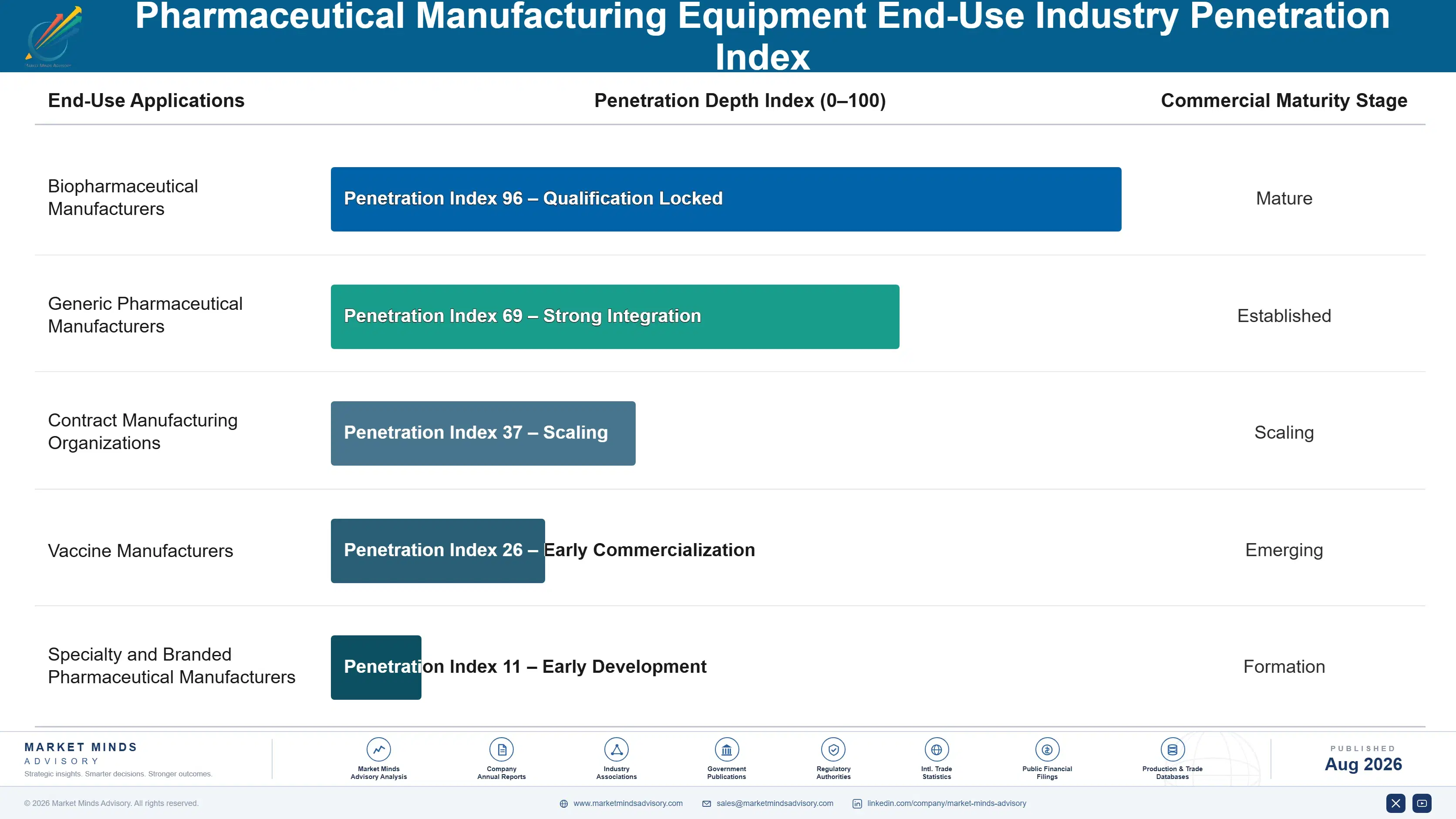
Adoption depth varies considerably by manufacturer type: large biopharma companies and contract manufacturers adopt newer single-use and continuous manufacturing platforms earliest, while smaller generic manufacturers more often continue operating older batch-based configurations until capital budget cycles permit modernization investment. Regional manufacturing infrastructure maturity further shapes which equipment options facilities realistically encounter first. Manufacturers tailor commercial and technical support investment differently across each of these distinct facility tiers.

A generational shift is underway as process engineers trained during the single-use and continuous manufacturing era enter facility roles expecting flexible, modular production platforms as standard practice, gradually normalizing a workflow that earlier-trained engineers historically associated only with fixed, dedicated production infrastructure. Manufacturers are adapting training and marketing investment accordingly to reach this newly influential engineer cohort today across the wider industry.
pharmaceutical-manufacturing-equipment-market-end-use-penetration-index-1787306618226

Where Equipment Economics Are Heading Next

These are among the four positions where our research anticipates prominent divergence between winners and laggards over the coming forecast period. Each is grounded in the demand model, the regulatory perimeter, and the announced capacity pipeline.
01 / MANUFACTURING TECHNOLOGY TRANSITION

Single-use systems will keep displacing stainless steel infrastructure

Biopharma manufacturers converting to single-use bioprocessing platforms are setting a precedent that facility design standards appear increasingly willing to formalize as default practice, and this trajectory shows no sign of reversing given continued flexibility and cost advantages. Stainless steel infrastructure will persist in the largest-scale, dedicated production campaigns rather than disappearing entirely. Manufacturers overweighted toward legacy stainless steel equipment revenue face a gradually shrinking core category over the coming decade regardless of overall market growth, across nearly every manufacturer portfolio MMA analysts reviewed this cycle.
02 / CONSUMABLES REVENUE STRATEGY

Recurring consumable revenue now determines category profitability

Manufacturers that treat equipment placement as the primary revenue event are underpricing the real value of the consumable attachment relationship that follows every production campaign performed thereafter across the equipment's operational lifetime. The razor-and-blade model rewards companies willing to price equipment competitively while protecting consumable margins over the long facility relationship lifecycle. Expect further consolidation among manufacturers unable to sustain this recurring revenue model at meaningful scale within this rapidly consolidating capital equipment category overall within this rapidly consolidating capital equipment category worldwide overall.
03 / CONTINUOUS MANUFACTURING INVESTMENT

Continuous manufacturing will become the primary growth differentiator

Continuous manufacturing technology is still an emerging category today, but regulatory encouragement and genuine efficiency advantages could eventually determine competitive positioning as much as bioprocessing technology itself for facility investment decisions. Manufacturers without a credible continuous manufacturing strategy risk ceding this emerging category to specialized entrants. Expect continuous manufacturing capability to become a standard bundled expectation rather than a differentiating extra within the next several years, particularly those competing for large biopharma facility accounts, particularly those competing for the largest biopharma facility accounts available.
04 / EMERGING MANUFACTURING INVESTMENT

Emerging market manufacturing expansion will sustain long-term volume growth

Government and private investment in domestic pharmaceutical manufacturing capacity across several emerging markets is directly expanding the addressable equipment market beyond what mature market replacement cycles alone could ever generate. Manufacturers investing early in distribution and support infrastructure across these markets are best positioned to capture this expanding volume. Expect emerging market volume growth to meaningfully outpace mature market growth through most of the current forecast period ahead, reshaping which manufacturers lead emerging market growth this decade, reshaping which manufacturers lead emerging market growth over this coming decade.

Engagement Snapshot From the Field

A live engagement with an industry participant carrying material or product regulatory and market exposure ahead of a defining policy shift, showing how our research translates into a defensible multi-year portfolio strategy.
MARKET MINDS ADVISORY · CLIENT ENGAGEMENT SUMMARY
Pharmaceutical Manufacturing Equipment Producer Strategic Portfolio Review and Transition Roadmap 2026·Investment Scenario on Pharmaceutical Manufacturing Equipment Exposure Evaluation 2025-26
CLIENT PROFILE
The client is a mid-sized contract manufacturing organization operating three production facilities, generating projected annual bioprocessing equipment procurement spend of approximately $24 million (client-reported, unverified by MMA) for a planned capacity expansion project. Leadership sought guidance on selecting single-use versus stainless steel infrastructure for its new biologics production capacity across its three-facility network prior to this engagement.
STRATEGIC CHALLENGE
The organization had historically operated stainless steel infrastructure exclusively, and leadership was uncertain whether converting to single-use systems for the new capacity expansion would generate sufficient flexibility and cost benefits to justify the different validation and training investment required across its facilities given significant capital commitment involved across the project.
MMA APPROACH
MMA's team benchmarked comparable contract manufacturing organization capacity expansion decisions, modeled projected total cost of ownership under single-use versus stainless steel scenarios, and evaluated leading single-use platform vendors against the client's projected multi-product manufacturing requirements to inform the client's final infrastructure decision process to inform the client's final infrastructure and vendor decision process.
KEY FINDINGS
  1. Single-use infrastructure was projected to reduce facility commissioning time by roughly 40% compared to stainless steel infrastructure requiring extensive cleaning validation between campaigns.
  2. Total cost of ownership favored single-use systems for the client's projected multi-product manufacturing model, despite higher per-campaign consumable costs than stainless steel alternatives.
  3. Staff training investment for single-use systems was concentrated in the first three months following installation, with minimal ongoing training cost required after initial adoption.
  4. Partnering with a single single-use platform vendor reduced projected validation costs by roughly 19% compared to managing multiple vendor relationships across the facility.
CLIENT PROFILE
The client is a mid-sized contract manufacturing organization operating three production facilities, generating projected annual bioprocessing equipment procurement spend of approximately $24 million (client-reported, unverified by MMA) for a planned capacity expansion project. Leadership sought guidance on selecting single-use versus stainless steel infrastructure for its new biologics production capacity across its three-facility network prior to this engagement.
STRATEGIC CHALLENGE
The organization had historically operated stainless steel infrastructure exclusively, and leadership was uncertain whether converting to single-use systems for the new capacity expansion would generate sufficient flexibility and cost benefits to justify the different validation and training investment required across its facilities given significant capital commitment involved across the project.
MMA APPROACH
MMA's team benchmarked comparable contract manufacturing organization capacity expansion decisions, modeled projected total cost of ownership under single-use versus stainless steel scenarios, and evaluated leading single-use platform vendors against the client's projected multi-product manufacturing requirements to inform the client's final infrastructure decision process to inform the client's final infrastructure and vendor decision process.
KEY FINDINGS
  1. Single-use infrastructure was projected to reduce facility commissioning time by roughly 40% compared to stainless steel infrastructure requiring extensive cleaning validation between campaigns.
  2. Total cost of ownership favored single-use systems for the client's projected multi-product manufacturing model, despite higher per-campaign consumable costs than stainless steel alternatives.
  3. Staff training investment for single-use systems was concentrated in the first three months following installation, with minimal ongoing training cost required after initial adoption.
  4. Partnering with a single single-use platform vendor reduced projected validation costs by roughly 19% compared to managing multiple vendor relationships across the facility.
RECOMMENDED STRATEGY
Phase 1: Phase 1 (Months 1-6): Install single-use bioprocessing infrastructure at the primary expansion facility, establishing vendor partnership and validation protocols with the selected vendor partner. Phase 2: Phase 2 (Months 7-14): Complete facility commissioning and begin initial production campaigns while training staff on single-use system operation on the new production platform. Phase 3: Phase 3 (Months 15-20): Evaluate expansion of single-use infrastructure to the organization's remaining two facilities based on initial results across all remaining production lines.
OUTCOME
The client completed installation and commissioning of the new single-use facility within the recommended timeline, reporting commissioning time savings consistent with initial projections (client-reported, unverified by MMA) while maintaining consistent production quality across the new facility throughout the transition while maintaining consistent production quality across the new facility throughout the entire transition period.

Frequently Asked Questions

Foundational context covering the market sizes, CAGR, scope, country, region and competition that inform every finding below. This section is provided to cover basics and most often pre-purchase conversations, answered from the MMA Primary Research Dataset.

What is the current size of the Pharmaceutical Manufacturing Equipment Market?

The global pharmaceutical manufacturing equipment market was valued at approximately $16.5 billion in 2025. This includes solid dosage, bioprocessing, and packaging line equipment categories sold across biopharma, generic, and specialty manufacturing channels combined.

How large will the Pharmaceutical Manufacturing Equipment Market be by 2036?

The market is projected to reach approximately $34.73 billion by 2036. This reflects continued biopharma capacity expansion and single-use technology adoption worldwide under continued biopharma capacity investment and technology adoption growth.

What is the CAGR for the Pharmaceutical Manufacturing Equipment Market 2026 to 2036?

The market is expected to grow at a compound annual growth rate of 7.0% between 2026 and 2036. This reflects steady demand from expanding pharmaceutical manufacturing capacity.

Which segment is growing fastest?

Bioprocessing and fermentation equipment is the fastest-growing segment, expanding at approximately 10.8% annually. This reflects growing biologics and biosimilar manufacturing capacity investment over traditional stainless steel infrastructure still widely used today.

Who are the major companies in the Pharmaceutical Manufacturing Equipment Market?

Leading companies include Syntegon Technology, GEA Group, IMA, Sartorius, and Thermo Fisher Scientific. Together they account for roughly 44% of global equipment revenue across the broader pharmaceutical manufacturing equipment category worldwide.

Which country is growing fastest?

India is the fastest-growing major market at an estimated 10.2% CAGR, driven by its position as a leading global pharmaceutical manufacturing and export hub across its rapidly expanding generic and biosimilar production sector.

Report Segmentation Architecture

The full report scope spans multiple orthogonal segmentation dimensions, with cross-tabulated demand data provided for each dimension pair. Coverage extends further to regional breakdowns, trend trajectories, and the competitive detail needed to support segment-level decision-making.

By Equipment Category

  • Solid Dosage Processing Equipment
  • Bioprocessing and Fermentation Equipment
  • Filling and Packaging Line Equipment
  • Lyophilization and Freeze-Drying Systems
  • Mixing and Blending Equipment
  • Cleanroom and Containment Systems

By End-Use Industry

  • Biopharmaceutical Manufacturers
  • Generic Pharmaceutical Manufacturers
  • Contract Manufacturing Organizations
  • Vaccine Manufacturers
  • Specialty and Branded Pharmaceutical Manufacturers

By Commercial Dimension

  • Direct Manufacturer Procurement
  • Equipment Financing and Leasing Channels
  • Distributor Networks
  • Service and Validation Contracts

By Region

  • North America
  • Western Europe
  • East Asia
  • South Asia and Pacific
  • Latin America
  • Middle East and Africa
  • Eastern Europe

Scope, Methodology, and Coverage

Every figure in this report is reproducible from documented input assumptions. The scope below maps the historical period, the forecast horizon, the segmentation dimensions, and the countries covered, alongside the underlying primary and qualitative methodology.
Historical Period
2020 to 2025
Forecast Period
2026 to 2036
Base Year
2025 (USD billions; MMA Primary Research Dataset, August 2026)
Market Definition
This report covers capital equipment used specifically in pharmaceutical manufacturing, including solid dosage processing equipment, bioprocessing and fermentation systems, filling and packaging lines, lyophilization systems, and cleanroom and containment infrastructure. It excludes laboratory-scale research equipment and general industrial equipment not specifically designed for regulated pharmaceutical manufacturing environments.
Quantitative Units
USD billions (current prices); equipment unit shipments; average selling price per production line
Segmentation Dimensions
By Equipment Category; By End-Use Industry; By Commercial Dimension; By Region
Regions Covered
North America, Western Europe, East Asia, South Asia and Pacific, Latin America, Middle East and Africa, Eastern Europe
Countries Covered
USA, China, Germany, France, UK, Japan, South Korea, India, Australia, Canada, Brazil, Mexico, Indonesia, Vietnam, Thailand, Malaysia, UAE, Saudi Arabia, South Africa, Nigeria, Turkey, Poland, Netherlands, Italy, Spain, Sweden, Switzerland, Argentina, Colombia, Singapore, and additional markets relevant to this sector
Key Companies Profiled
Syntegon Technology GmbH, GEA Group AG, IMA S.p.A., Sartorius AG, Thermo Fisher Scientific Inc., Korsch AG, Romaco Group, Fette Compacting GmbH, Glatt GmbH, Bausch+Ströbel Maschinenfabrik Ilshofen GmbH+Co.KG, Marchesini Group S.p.A., Uhlmann Pkg Group GmbH, Optima Packaging Group GmbH, Coperion GmbH, ACG Worldwide, Natoli Engineering Company Inc., Elizabeth Companies Inc., L.B. Bohle Maschinen + Verfahren GmbH, Steriline S.r.l., Colorcon Inc.
Quantitative Methodology
Primary survey, n=3,800 respondents, Q4 2025, six countries; demand-side model with trade association cross-validation
Qualitative Methodology
47 expert interviews, Q4 2025; applied to validate demand model assumptions, identify emerging dynamics, and assess competitive positioning
Report Format
PDF and XLSX data workbook (Word format preview document)
Publisher
Market Minds Advisory
Report Code
MMA-2026-CON-129
Published
August 2026
Contact
sales@marketmindsadvisory.com | www.marketmindsadvisory.com

Purchase the full Pharmaceutical Manufacturing Equipment Market Report (2026 to 2036).

The full report provides detailed equipment-level segmentation, manufacturer procurement pattern analysis, and country-level manufacturing investment tracking across all seven regions covered in this study. It includes manufacturer-level competitive benchmarking based on technology capability and service infrastructure. Subscribers receive quarterly updates tracking new facility investment and technology adoption trends as they occur. A companion dataset provides equipment unit volume estimates by category for detailed market sizing purposes A dedicated analyst contact is also available to support custom data requests beyond the standard deliverable scope provided Custom analytical support is available upon request.
Equipment-level segmentation breakdown by category type
Manufacturer procurement pattern trend analysis service
Country-level manufacturing investment tracking and updates
Manufacturer competitive benchmarking scorecards and comparisons
Quarterly facility investment and technology update service
Equipment unit volume dataset by category

Built For The People Who Decide

From boardroom strategy to bench-side execution, this report is read cover-to-cover by leaders shaping the next decade of their industry, turning demand scenarios, market dynamics and valuation benchmarks into decisions.
CXOs/ Presidents/ VPs/ Managers
M&A and Corporate Development
Strategy Teams and R&D Heads
Procurement and Product Directors
Regulatory and Compliance Leaders
Investor Relations and Equity Analysts