Market Minds Advisory
Pet Prebiotics Market

Pet Prebiotics Market: Ingredient Qualification, Veterinary Recommendation and the Move From Claim to Standard Feature

Gut health claims are hardening into expected features across mid-tier pet food, pushing prebiotic fibre from premium differentiation into baseline formulation while veterinary recommendation quietly decides which supplement brands survive.

Lead Analyst

Lisa Gevelber

Published

September 2026

Make Smarter Decisions with Customized Research Insights

Request a free sample report and evaluate market opportunities, growth trends, and competitive dynamics relevant to your business needs.

2025 MARKET VALUE$0.9BMarket Size 2025
2036 FORECAST VALUE$2.7BBase Case , 2026 to 2036
CAGR 2026 TO 203610.4 %Bull 11.6% / Bear 9.2%
INCREMENTAL OPPORTUNITY$1.7BNet 10- year value creation
EXPANSION MULTIPLE2.69x2036 value over 2026 base
Strategic Levers
M&A Pipeline
Regional Outlook
Country Rankings
Competitive Intelligence
Segmental Deep-dive
Call-Us : 91 93563 13602

Executive Snapshot and Market Trajectory

Gut health stopped being a premium differentiator in pet food and became an expected feature, and that single shift is what drives this market now. Prebiotic fibre inclusion is spreading down the price ladder rather than remaining at the top of it. Volume growth follows inclusion, not premiumisation.
Ingredient volume sits with a small number of large pet food manufacturers, which concentrates the customer base and makes supplier qualification slow and defensible once won. The supplement side runs on entirely different economics, with owner-facing brands earning repeat purchase and margin. North America holds the largest share on pet expenditure per household, while East Asia grows fastest as Chinese ownership rises and premiumises quickly.
Concentration is moderate at 38% for the top five, and it splits cleanly between ingredient suppliers selling by the tonne and branded supplement companies selling to owners. Regulatory attention on digestive claims is rising across both the United States and Europe, which favours participants able to fund substantiation and disadvantages brands whose positioning rests on suggestion alone rather than on any published evidence. Feeding trials take well over a year to run properly.
Market Definition
This market covers prebiotic ingredients and finished prebiotic products for companion animals, spanning fibre ingredients supplied into complete pet food, direct-to-owner supplements, and veterinary channel digestive products. Probiotic live cultures sold without a prebiotic component, general pet food not carrying a prebiotic function, and livestock feed additives are excluded.
Base Year Value
$0.9B in 2025 (MMA Primary Research Dataset, August 2026)
Forecast Period
2026 to 2036, eleven discrete annual values
CAGR
10.4% base case. Bull 11.6%. Bear 9.2%.
Fastest Growth Segment
Prebiotic Fibre Ingredients for Complete Pet Food: 15.6% CAGR
Fastest Growth Country
China: 14.8% CAGR
Fastest Growth Region
South Asia and Pacific: 12.6% CAGR
Largest Region
North America: 30% of 2025 global value
Market Leaders
Beneo, Cargill, Ingredion, Nestlé Purina PetCare and Mars Petcare lead on prebiotic ingredient and finished product revenue. Source: MMA Primary Research Dataset, July 2026.
Primary Survey
n=3,800 procurement and R&D decision-makers, Q4 2025, six countries
Methodology
Demand-side build-up, cross-validated against public data, 47 expert interviews

Pet Prebiotics Market Forecast Scenarios

pet-prebiotics-market-trends-size-forecast-scenario-1787322173115
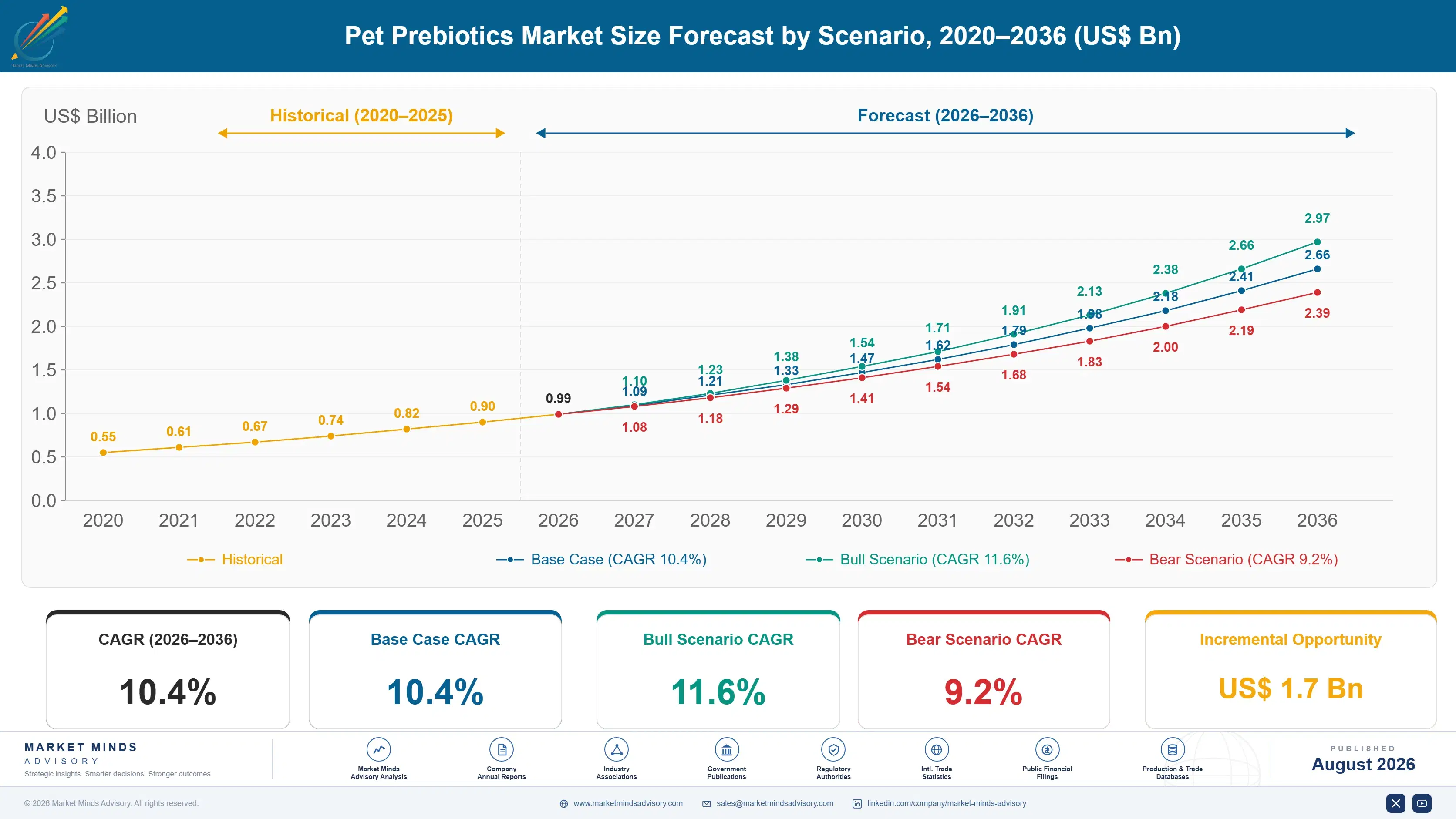
Growth ran at 9.1% annually between 2020 and 2025, and the character of it changed partway through. The early part came from premium food brands adding digestive claims as differentiation. The later part came from mid-tier manufacturers adopting the same ingredients defensively, because a shelf position without a gut health claim started to look dated against competitors that had one.
The base case at 10.4% rests on three mechanisms. Inclusion rates continue spreading through mid-tier dry food as gut health becomes a baseline expectation rather than a premium claim. Veterinary channel supplements grow on practice recommendation, which converts far better than retail shelf claims do. And Chinese and Southeast Asian ownership growth adds genuinely new volume rather than merely upgrading existing feeding, which is what most Western growth amounts to.
The bull case at 11.6% turns on regulatory recognition of specific digestive claims, which would let manufacturers state benefits plainly and accelerate inclusion sharply. The bear case at 9.2% reflects household spending pressure, since supplements are discretionary and owners trade down to unsupplemented food faster than the industry likes to admit when budgets tighten. Neither scenario changes the ingredient side much.

Prebiotic Fibre Moves From Claim To Standard Feature

Two businesses sit inside this market and they behave nothing alike. One sells fibre by the tonne to a handful of large pet food manufacturers on fourteen-month qualification cycles. The other sells chews and powders to pet owners who repurchase or do not, and where the brand rather than the ingredient carries the value.
TOP FIVE CONCENTRATION38%Moderate, split between ingredient suppliers and branded supplement companies
FIBRE INCLUSION RATE1.8% of formulaTypical prebiotic loading in mid-tier complete dry food
INGREDIENT COST SHARE9% of COGSPrebiotic fibre contribution to finished food manufactured cost
VETERINARY CHANNEL SHARE31%Portion of supplement value moving through veterinary practices
QUALIFICATION CYCLE14 monthsTypical time to qualify a new fibre with manufacturers
SUPPLEMENT REPEAT RATE48%Owners repurchasing a digestive supplement within six months
The ingredient side is the larger and faster-growing of the two, and its growth is not really about premiumisation at all. Mid-tier manufacturers are adding prebiotic fibre defensively, because a bag without a digestive claim reads as dated beside competitors carrying one. Typical inclusion sits near 1.8% of formula and contributes roughly 9% of manufactured cost, which is enough to matter in procurement without being enough to reposition a product.
The supplement side runs on veterinary recommendation more than on retail marketing. Roughly 31% of supplement value moves through practices, and conversion there is far better than anything a shelf claim achieves, because the owner is already worried about a specific problem. Repeat purchase within six months sits near 48%, which is respectable for a discretionary category but well short of what food achieves automatically.
"The interesting money here is not in the premium supplement brands everyone watches. It is in being the qualified fibre inside a mid-tier food formula, because that position takes fourteen months to win and roughly forever to lose."
Director, Animal Nutrition and Companion Animal Practice · MMA Animal Nutrition Practice · August 2026

Market Trends

Digestive Claims Descend From Premium Into Mid-Tier Formulation

Gut health began as a premium differentiator and has become something mid-tier manufacturers add defensively, because a bag without a digestive claim now reads as dated beside competitors carrying one. That changes the commercial character of prebiotic fibre supply completely. Volume growth comes from inclusion spreading down the price ladder rather than from premium products taking share, and the buyer is a procurement function optimising cost per tonne rather than a brand team seeking differentiation. Suppliers who priced for a premium positioning are finding that negotiation considerably harder than it used to be.
Market Impact: Adds 14.8% annual growth in China
Veterinary Recommendation Outperforms Retail Shelf Marketing Consistently

A recommendation from a veterinary practice converts far better than any shelf claim, because the owner arrives already worried about a specific digestive problem rather than browsing. Brands investing in practice detailing, clinical data and veterinary-exclusive formats reach roughly 31% of supplement value through that channel and command pricing retail brands cannot approach. The investment is field sales and clinical substantiation rather than consumer marketing, and it builds slowly. What it produces is a customer base that repurchases on professional advice rather than on packaging, which holds up considerably better when spending tightens.
Market Impact: East Asia grows at 11.6% annually

Market Opportunities and Growth Drivers

Companion Animal Humanisation Raises Spending Per Household Steadily

Owners increasingly buy for pets the way they buy for themselves, and digestive health has followed the same path in pet nutrition that it took in human food a decade earlier. Spending per household on pet nutrition has risen across every developed market and is rising fastest in China and Southeast Asia, where ownership itself is still growing. The effect compounds, because owners who trade up rarely trade back down while the animal is healthy. That supports inclusion rates and supplement pricing simultaneously across most of this market. The direction of travel runs one way.
Market Impact: Adds 14 months to launch timing

Chinese And Southeast Asian Ownership Growth Adds Genuine Volume

Most Western growth in this category amounts to upgrading how existing pets are fed rather than feeding more of them. China and Southeast Asia are different, because ownership itself is expanding quickly among urban households and each new pet is genuinely new volume rather than a trade-up. Chinese owners also premiumise unusually fast compared with the path Western markets took, moving to functional claims within a few years of entering the category rather than over a decade. That combination produces growth near 14.8% annually. Local manufacturers are formulating for those claims directly rather than importing.
Market Impact: Cuts supplement volume 12% in downturns

Market Restraints and Challenges

Digestive Health Claims Face Tightening Regulatory Scrutiny Everywhere

Pet food claim regulation is tightening across the United States and Europe, and digestive benefit statements are receiving particular attention. The root cause is that many claims outran the evidence supporting them during the period when gut health was purely a marketing differentiator. Commercially this raises substantiation cost, slows label changes and disadvantages brands whose positioning rests on suggestion. Participants are responding by funding feeding trials, by working through veterinary channels where different evidence standards apply, and by hiring regulatory capability that smaller supplement brands have historically done without entirely.
Market Impact: Inclusion reaches 1.8% of formula

Supplement Demand Softens Quickly When Household Budgets Tighten

Supplements are discretionary in a way complete food is not, and owners trade down to unsupplemented feeding faster than this industry likes to admit. The root cause is that digestive supplements address a problem most owners consider intermittent rather than continuous, so pausing feels reasonable to them. Commercially this makes supplement revenue considerably more cyclical than ingredient revenue and complicates capacity planning. Participants are responding with subscription formats, veterinary recommendation that carries more weight than price, and by shifting portfolio weight toward ingredient supply into food. Ingredient supply carries none of that cyclicality.
Market Impact: Channel carries 31% of supplement value
4 additional market trends, 2 additional growth drivers, and 3 additional restraints and challenges are covered in the full report. Contact sales@marketmindsadvisory.com to access the complete intelligence.

Segment CAGR and Growth Architecture

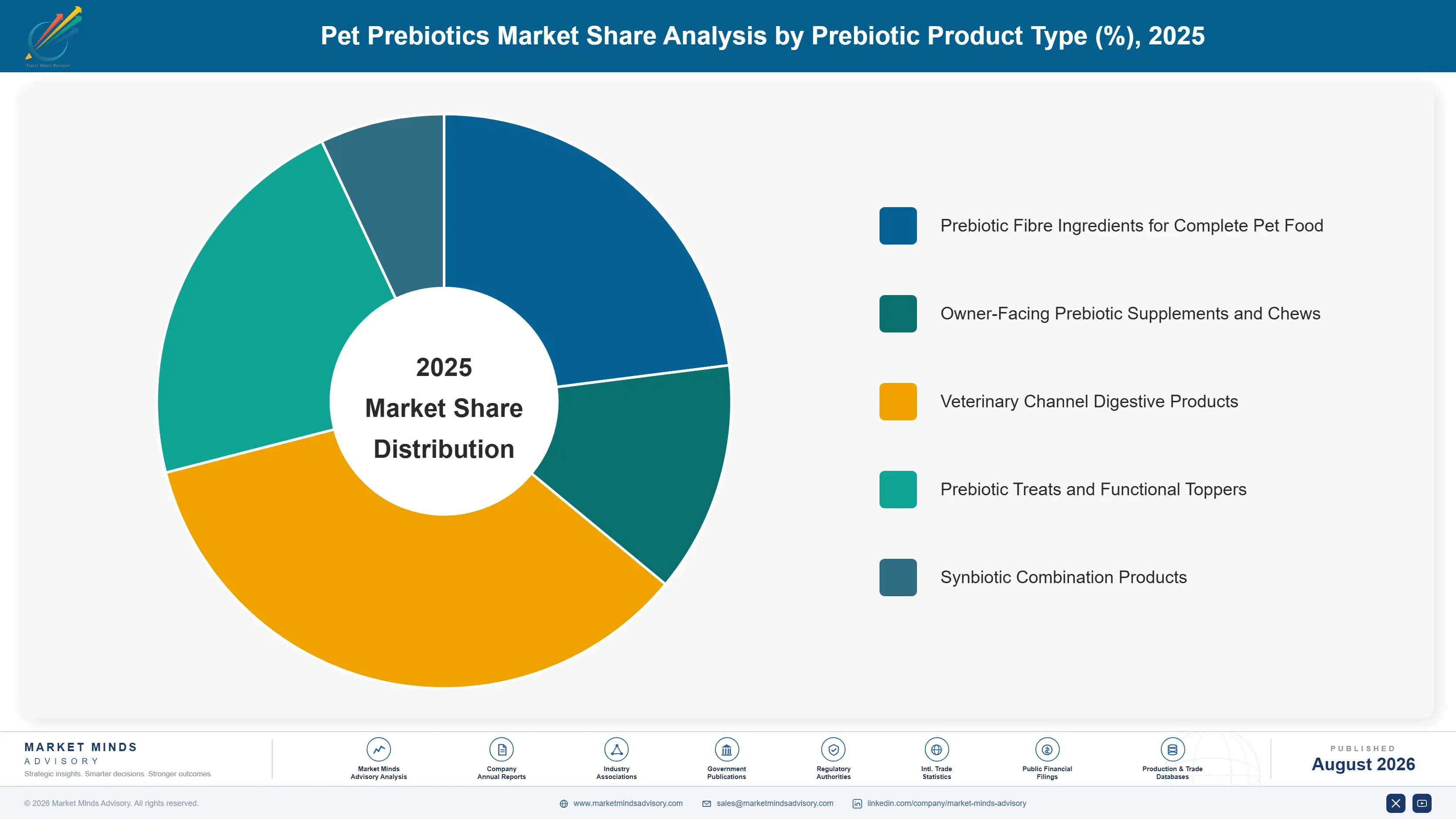
Five product categories divide this market on what the prebiotic actually is and how it reaches the animal. The split that matters commercially runs between fibre supplied as an ingredient into complete food and finished products sold to owners, because the two carry entirely different customer bases, margin structures, selling cycles and defensibility once a position is won.
pet-prebiotics-market-trends-market-share-analysis-1787322173648

Prebiotic Fibre Ingredients for Complete Pet Food

Growing at 15.6% and clearly the fastest part of this market. These are prebiotic fibres supplied as functional ingredients into complete dry and wet pet food rather than sold as separate supplements, which puts the volume inside a food business rather than a supplement one. Chicory root inulin, fructooligosaccharides and beet pulp derivatives dominate the tonnage. What drives the growth is that gut health has moved from a premium claim to an expected feature across mid-tier food, so ingredient inclusion is spreading down the price ladder rather than staying at the top of it. Ingredient suppliers here sell to a small number of large food manufacturers, which concentrates the customer base considerably and makes qualification cycles long.
CAGR 15.6%

Owner-Facing Prebiotic Supplements and Chews

Growing at 13.1% on prebiotic supplements sold directly to pet owners as chews, powders and toppers rather than built into food. This is where brand economics work best, because the owner buys repeatedly and the margin sits with whoever owns the label rather than with a food manufacturer buying by the tonne. Veterinary channel products carry the strongest positioning, since a recommendation from a practice converts far better than any shelf claim. Digestive upset, stool quality and food transition are the three purchase occasions that account for most volume. The constraint is that supplements are discretionary in a way food is not, so the segment softens when household spending tightens and recovers quickly when it loosens again.
CAGR 13.1%
Full segment breakdown across 5 segments available in the complete report.

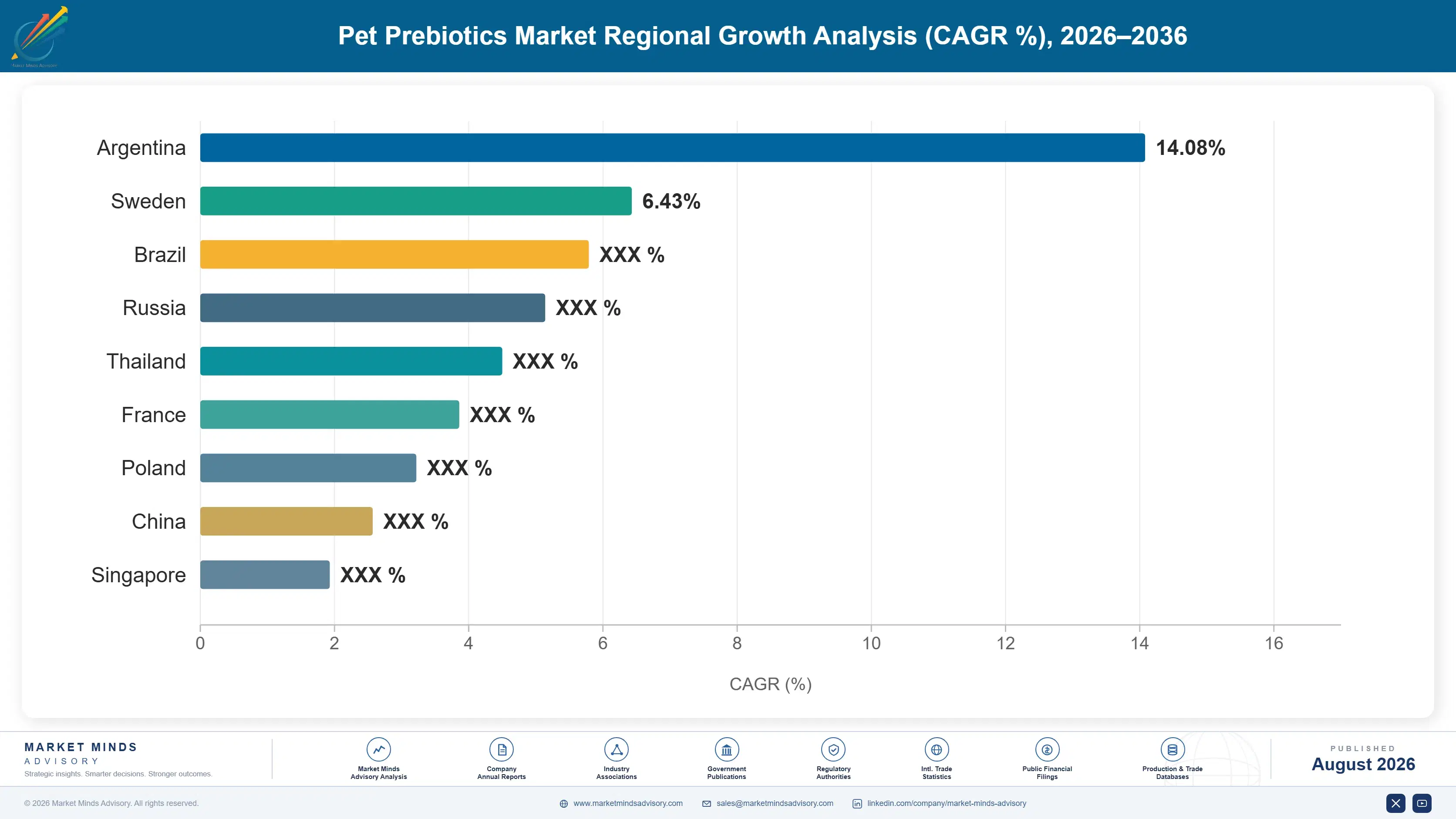
Regional Architecture and Country Demand Map

North America holds 30% of global value on pet expenditure per household rather than on animal numbers, which are broadly flat. East Asia follows at 26% and grows fastest as Chinese urban ownership expands and premiumises unusually quickly against the Western path. Western Europe follows on premiumisation rather than growth.

North America

Pet expenditure per household is what carries this region, not animal numbers, which have been broadly flat since the ownership surge of 2020 and 2021 settled. American owners spend more per animal than anywhere else and treat digestive health as a normal reason to change food or add a supplement rather than as a veterinary matter alone. Mars and Nestlé Purina both formulate here at scale, which concentrates ingredient qualification decisions in a small number of technical teams. Veterinary practice consolidation into corporate groups has also professionalised the recommendation channel considerably, making detailing more systematic and more expensive. Canada follows the same pattern with proportionally heavier veterinary weighting. Private label grocery ranges are also expanding quickly.
Share: 30% | CAGR: 10.2% (2026 to 2036)

Western Europe

Regulation shapes this region more tightly than any other, and European claim rules restrict digestive benefit wording well beyond American practice. That pushes participants toward veterinary channels where evidence standards differ and toward substantiation investment that smaller brands frequently cannot fund. Germany, France and the United Kingdom carry most of the value between them, with the United Kingdom weighted heaviest toward supplements and Germany toward ingredient supply into food manufacturing. Pet ownership is high and stable rather than growing, so value gains come from premiumisation. European owners also show unusually strong preference for named fibre sources such as chicory inulin over generic descriptions on pack. Contract manufacturers in Poland increasingly serve the region on cost.
Share: 24% | CAGR: 8.9% (2026 to 2036)
Regional intelligence for 5 additional markets available in the complete report: East Asia, South Asia and Pacific, Latin America, Middle East and Africa, Eastern Europe. Contact sales@marketmindsadvisory.com.
pet-prebiotics-market-trends-country-cagr-analysis-1787322174165

Where Pet Prebiotic Margin Actually Sits

Four positions separate participants earning durable returns from those competing purely on price per tonne: winning qualified ingredient positions inside mid-tier food formulas, building veterinary practice recommendation ahead of competitors, funding claim substantiation before enforcement tightens further, and converting supplement buyers onto subscription before household budgets tighten again and supplement demand softens across the retail channel.

Win Qualified Fibre Positions Inside Mid-Tier Formulas

Qualification with a large pet food manufacturer takes roughly 14 months of technical work, feeding trials and procurement negotiation, and once won the position is rarely revisited because requalifying carries cost and risk the buyer gains nothing from. Suppliers holding qualified positions realise 18% to 24% higher realised pricing than those selling on spot tonnage, and volumes are predictable enough to plan capacity against. The investment is technical service capability rather than production capacity, which is what most fibre suppliers underestimate. Most fibre suppliers underestimate that, and it is why they stay on tender.
Market Impact: Realises 24% higher pricing on qualified formula volume

Build Veterinary Practice Recommendation Ahead Of Retail

A practice recommendation converts far better than any shelf claim, because the owner arrives worried about a specific problem rather than browsing options. Brands funding field detailing, clinical data and veterinary-exclusive formats reach roughly 31% of supplement value through that channel and hold pricing around 40% above comparable retail products. Practice consolidation into corporate groups has made the channel more systematic and more expensive to reach, which favours participants investing early over those waiting to see how it develops. Waiting to see how the channel develops means arriving after the relationships are already spoken for.
Market Impact: Holds pricing near 40% above retail shelf equivalents

Fund Substantiation Before Claim Rules Tighten Further

Digestive claim regulation is tightening across both the United States and Europe, and many existing claims outran their evidence during the period when gut health was purely a marketing device. Participants funding feeding trials now protect label positions worth far more than the studies cost, while competitors face relabelling that can remove a claim from roughly 30% of a portfolio at once. The work takes 12 to 18 months, which means it cannot be started once enforcement arrives. Enforcement arrives on its own timetable and gives nobody advance warning worth acting on.
Market Impact: Protects label claims across 30% of the portfolio

Convert Supplement Buyers Onto Subscription Before Budgets Tighten

Supplement demand softens quickly when household spending tightens, because owners treat digestive support as intermittent rather than continuous and pausing feels reasonable to them. Subscription conversion lifts repeat purchase from around 48% to above 70% within six months and makes revenue far less cyclical than the category average. The mechanism is checkout design, reminder timing and veterinary endorsement rather than product development, and it costs almost nothing to test against an existing customer base. The base is already there, which is what makes this the cheapest of the four positions to try.
Market Impact: Lifts repeat purchase above 70% within six months

Who Controls the Margin Pool

Concentration sits at 38% for the top five measured on prebiotic ingredient and finished product revenue, the basis used throughout this section, and the figure conceals a clean split. Beneo, Cargill and Ingredion supply fibre by the tonne into food manufacturing. Nestlé Purina PetCare and Mars Petcare sit downstream, formulating and branding, with scale that no challenger in either group approaches.
Competition runs on three fronts. Ingredient qualification is the first, and it is technical service work rather than price competition, since a supplier already qualified inside a formula is difficult to displace. Veterinary channel access is the second, and it is being professionalised as practices consolidate into corporate groups. The third is claim substantiation, which is becoming a genuine cost of participation rather than an optional investment.

Pressure arrives from two directions. Chinese domestic manufacturers are scaling quickly and qualifying ingredients on shorter cycles than Western counterparts, which suits suppliers willing to work at that pace and disadvantages those who cannot. Separately, private label supplement ranges are appearing across grocery and online retail. Rankings will shift toward participants holding qualified formula positions and funded evidence rather than those relying on brand recognition.
pet-prebiotics-market-trends-company-positioning-matrix-1787322174713

Competitive Moat and Risk Dimensions

BENEO

Moat: Qualified positions inside formulas

Chicory inulin and oligofructose positions qualified inside large pet food formulas take roughly fourteen months to win and are rarely revisited afterwards, because requalifying carries cost and risk the buyer gains nothing from. Technical service depth and published feeding trial data also support the claim language manufacturers need on pack, which competitors selling on tonnage alone cannot supply.
BENEO

Risk: Chicory supply concentration exposure

Chicory root production is geographically concentrated across a narrow band of European growing regions, which exposes supply and pricing to weather and agricultural conditions no commercial arrangement can offset. Alternative fibre sources including yeast-derived and legume-derived options are also improving, and manufacturers increasingly test them as second sources during their qualification work.
NESTLÉ PURINA PETCARE

Moat: Veterinary channel and evidence

Established veterinary relationships, clinical research capability and prescription diet ranges give the group access to the recommendation channel that converts better than any retail marketing does. Scale in formulation also means digestive functionality can be added across mid-tier ranges without the cost sensitivity that constrains smaller manufacturers making the same decision.
NESTLÉ PURINA PETCARE

Risk: Slow response to specialists

Direct-to-owner supplement brands built genuine positions in digestive health while large manufacturers treated it as a food formulation matter rather than a separate category. Corporate scale also slows label and formulation changes at a moment when claim regulation is tightening and faster competitors can adjust positioning within a single production cycle.

Players Tracked

Prominent Players

Beneo
Cargill
Ingredion
Nestlé Purina PetCare
Mars Petcare

Other Key Players

Roquette
Tereos
Cosucra
DuPont Nutrition
Kerry Group
ADM
Lallemand
Alltech
Nutreco
Hill's Pet Nutrition
Diamond Pet Foods
Virbac
Vetoquinol
Zesty Paws
NaturVet

Recent Developments

MARCH 2025

Fibre supplier qualified across mid-tier dry food range

A European prebiotic fibre producer completed qualification with a large pet food manufacturer across a full mid-tier dry range rather than a single premium product, converting what had been a specialty supply arrangement into predictable tonnage that supports capacity planning several years forward. Tonnage begins shipping in 2026.
Signal: Prebiotic inclusion is spreading down the price ladder rather than staying inside premium positioning alone any longer
JULY 2025

Feeding trial published supporting digestive claim substantiation

A pet nutrition company published controlled feeding trial results supporting stool quality and digestibility claims across its prebiotic range, moving the positioning from marketing assertion toward evidence that will survive the claim scrutiny both American and European regulators are applying. Regulators in both jurisdictions were consulted.
Signal: Funded evidence is becoming a cost of participation rather than an optional investment in this category
NOVEMBER 2025

Supplement brand acquired for veterinary channel access

An animal health company acquired a direct-to-owner digestive supplement brand, buying established veterinary practice relationships and a repeat customer base that its own corporate structure had not managed to build organically despite several years of attempting it. The practice relationships transferred intact with the acquired brand.
Signal: Veterinary channel access is being bought outright because building practice relationships from nothing takes too long

What Drives Prebiotic Cost Position

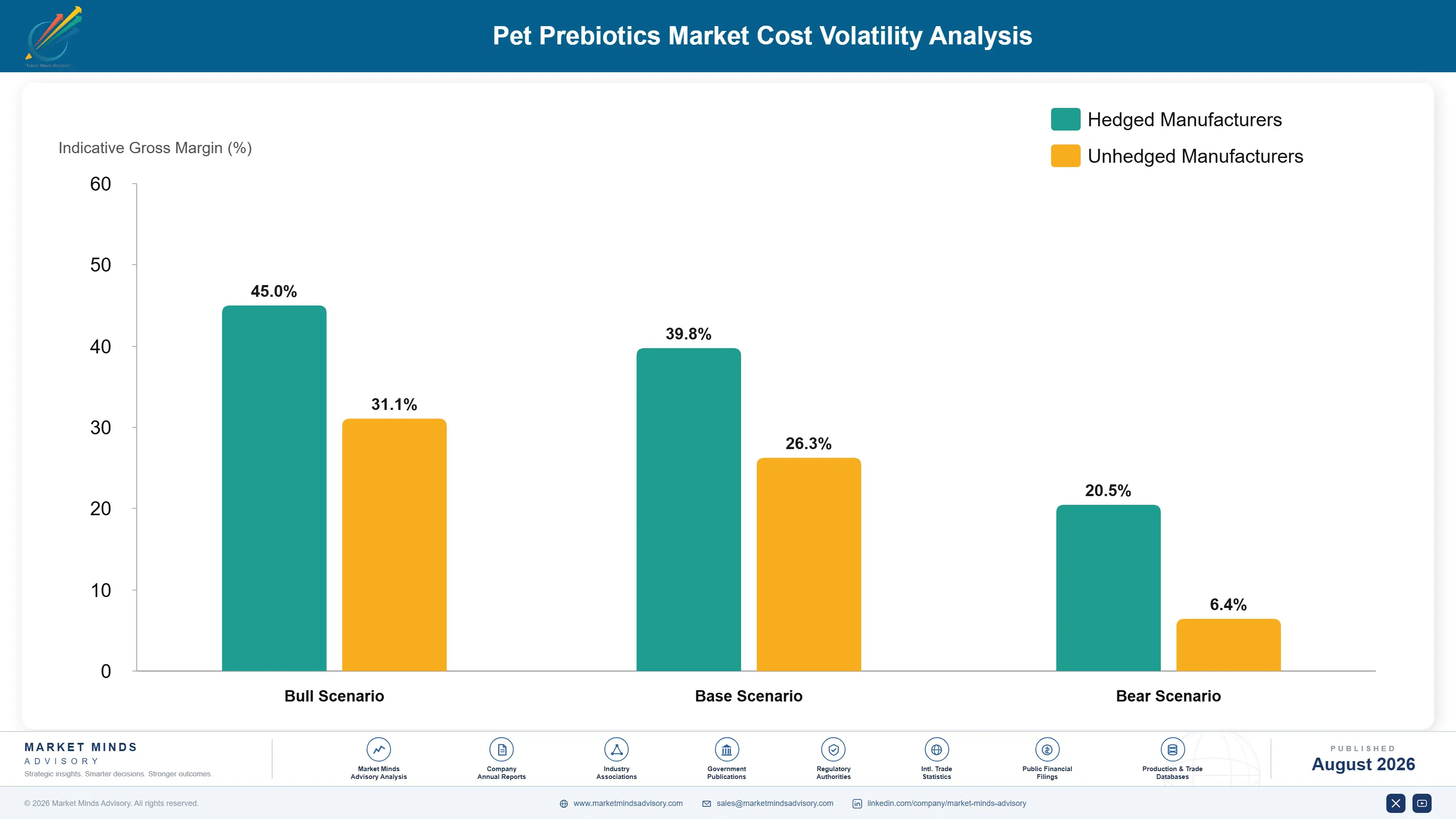
Agricultural raw material accounts for roughly 44% of prebiotic fibre manufactured cost, with chicory root, sugar beet and maize the principal inputs across European and North American production. Energy for extraction and drying adds around 19%, which makes these genuinely energy-intensive processes. Enzyme and processing aids contribute about 11%, packaging and logistics roughly 13%, and quality, testing and regulatory documentation close to 7% of the total.
European energy pricing rose sharply through 2022 and has stayed above the previous decade's baseline since, according to International Energy Agency data, which hit inulin and oligofructose producers hard because extraction and spray drying are both energy-intensive. Chicory root harvests also varied with growing conditions across Belgium, France and the Netherlands. Producers absorbed much of it initially and then passed it through as annual contracts renewed.

The disadvantage mechanism is energy exposure combined with agricultural concentration, and it varies sharply by production location. European inulin producers carry both risks together, while North American producers working from maize face different agricultural exposure and considerably cheaper energy. Manufacturers running yeast-derived or synthetically produced fibres avoid the harvest risk entirely but carry their own feedstock exposure instead, which is a genuinely different position.
pet-prebiotics-market-trends-cost-volatility-analysis-1787322174909

Contract chicory acreage on multi-year grower agreements

Committed acreage with growers across Belgium, France and the Netherlands secures both volume and predictable pricing on an input representing close to half of manufactured cost. It also gives growers the certainty they need to keep planting chicory against competing crop economics. The commitment carries volume risk if demand disappoints, which is the price of the security it buys.

Invest in extraction and drying energy efficiency

Extraction and spray drying together account for most of the energy in this process, and heat recovery, mechanical vapour recompression and drying optimisation cut consumption materially against European pricing that has stayed elevated since 2022. The capital payback runs several years at current energy costs. Producers who invested before the price rise now hold a durable cost advantage.

Diversify fibre sources beyond a single agricultural crop

Yeast-derived, legume-derived and enzymatically produced fibres carry different feedstock exposure from chicory and beet, which reduces the harvest concentration risk sitting inside a single-source portfolio. Manufacturers increasingly want second sources qualified anyway, so the diversification serves customers as well as the producer. Each additional source requires its own qualification work and substantiation, which is where the cost lands.

Portfolio Architecture for Margin Defence

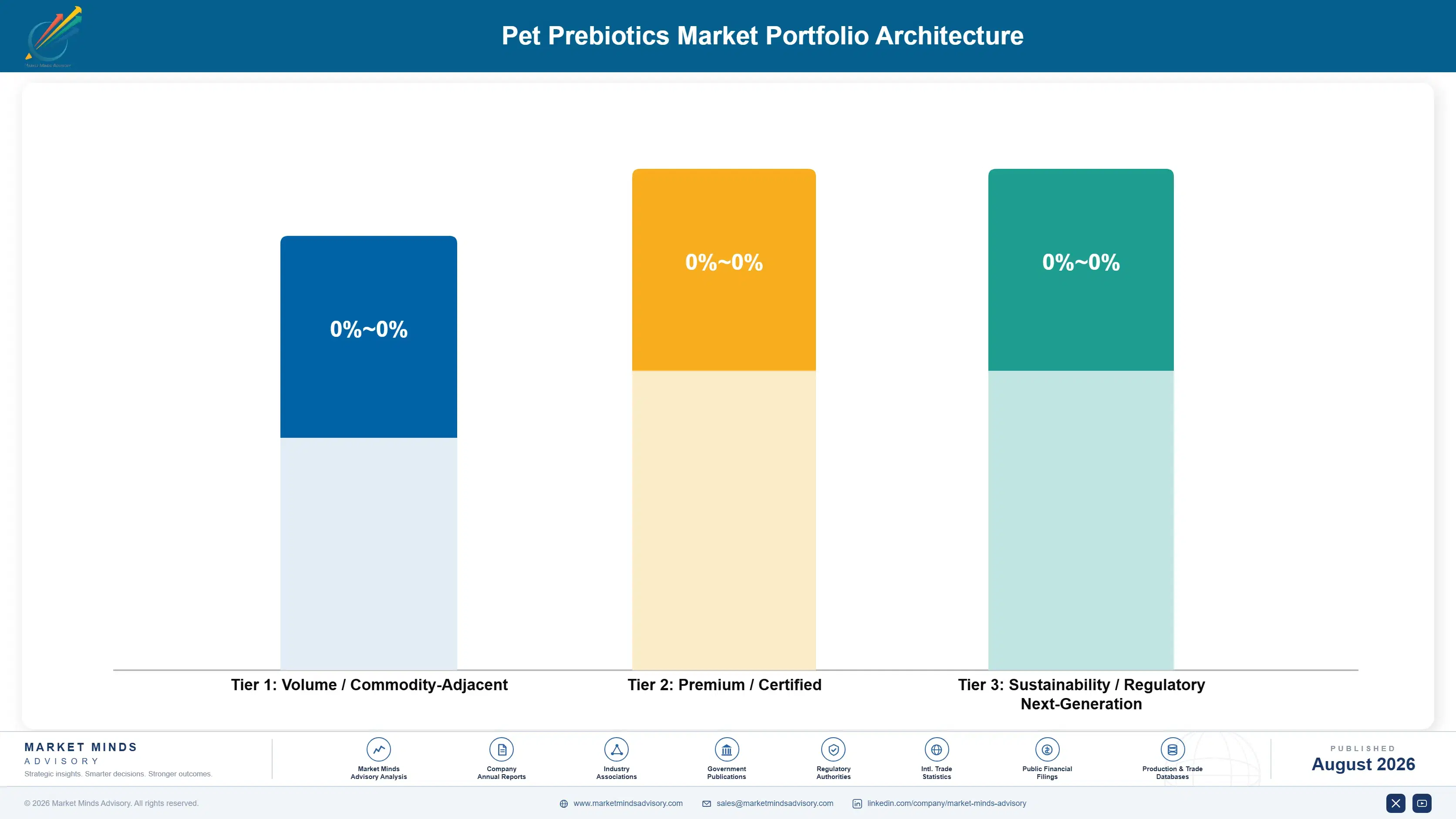
Portfolio economics here divide on customer type rather than on product chemistry. Spot tonnage sold to food manufacturers on price competition earns thin margins and no defensibility whatever, since the buyer runs an annual tender and the supplier holds nothing that makes switching difficult or expensive to contemplate. Energy and feedstock position decide who wins, and neither is a commercial choice.
The middle tier is qualified ingredient supply inside named formulas. Fourteen months of technical work and feeding trials produce a position rarely revisited afterwards, and realised pricing runs 18% to 24% above spot tonnage on volume predictable enough to plan capacity against. Margins reach the low thirties and hold there across contract cycles. Displacing an incumbent is rarely attempted by buyers who gain nothing from it.

Above both sits branded veterinary channel product. Practice recommendation converts far better than any shelf claim, pricing runs around 40% above comparable retail equivalents, and the owner repurchases on professional advice rather than on packaging. Margins reach the high forties. The position requires field detailing and clinical evidence that take years to build, which is exactly why acquirers keep buying it rather than building it.

Volume / Commodity-Adjacent

Spot fibre tonnage sold into food manufacturing on annual tender. The range reflects feedstock cost and energy position rather than anything the supplier controls commercially, and defensibility is effectively zero.
Gross Margin: 12 to 19%

Premium / Certified

Qualified ingredient positions inside named formulas backed by technical service and trial data. The range reflects how deep the technical relationship runs and whether a second source has been qualified alongside.
Gross Margin: 27 to 35%

Sustainability / Regulatory / Next-Generation

Branded veterinary channel supplements supported by clinical evidence and field detailing. The wide range reflects how much detailing capability a participant funds and whether formats are veterinary-exclusive. Detailing capability is the differentiator.
Gross Margin: 41 to 51%
pet-prebiotics-market-trends-portfolio-architecture-1787322175411

High-value Sub-segments and Strategic Watch-out

Veterinary Channel Branded Supplements

High value and high growth together. Practice recommendation converts far better than retail claims and supports pricing roughly 40% above shelf equivalents. The wide range reflects how much field detailing and clinical evidence a participant actually funds. Practice consolidation is steadily making that investment more expensive.
Gross Margin: 41 to 51%

Qualified Formula Ingredient Positions

High value on steady rather than spectacular growth. Fourteen months of qualification work produces a position rarely revisited afterwards. The range reflects technical relationship depth and whether a competing second source sits qualified alongside in the same formula. Displacing an incumbent fibre is rarely attempted by buyers.
Gross Margin: 27 to 35%

Mid-Tier Food Inclusion Volume

The volume core of this market and where most tonnage growth is occurring. Inclusion is spreading down the price ladder defensively rather than as premium differentiation. The range reflects contract structure and whether technical service accompanies the supply. Procurement rather than brand teams now runs these decisions.
Gross Margin: 19 to 26%

Retail Shelf Supplement Ranges

The strategic watch-out. Volumes are real and entry is straightforward, but private label is arriving, conversion is poor without professional recommendation, and demand softens quickly whenever household spending tightens. The range reflects channel mix and promotional depth. Subscription conversion is the only real defence available here.
Gross Margin: 12 to 19%

How Prebiotic Demand Actually Repeats

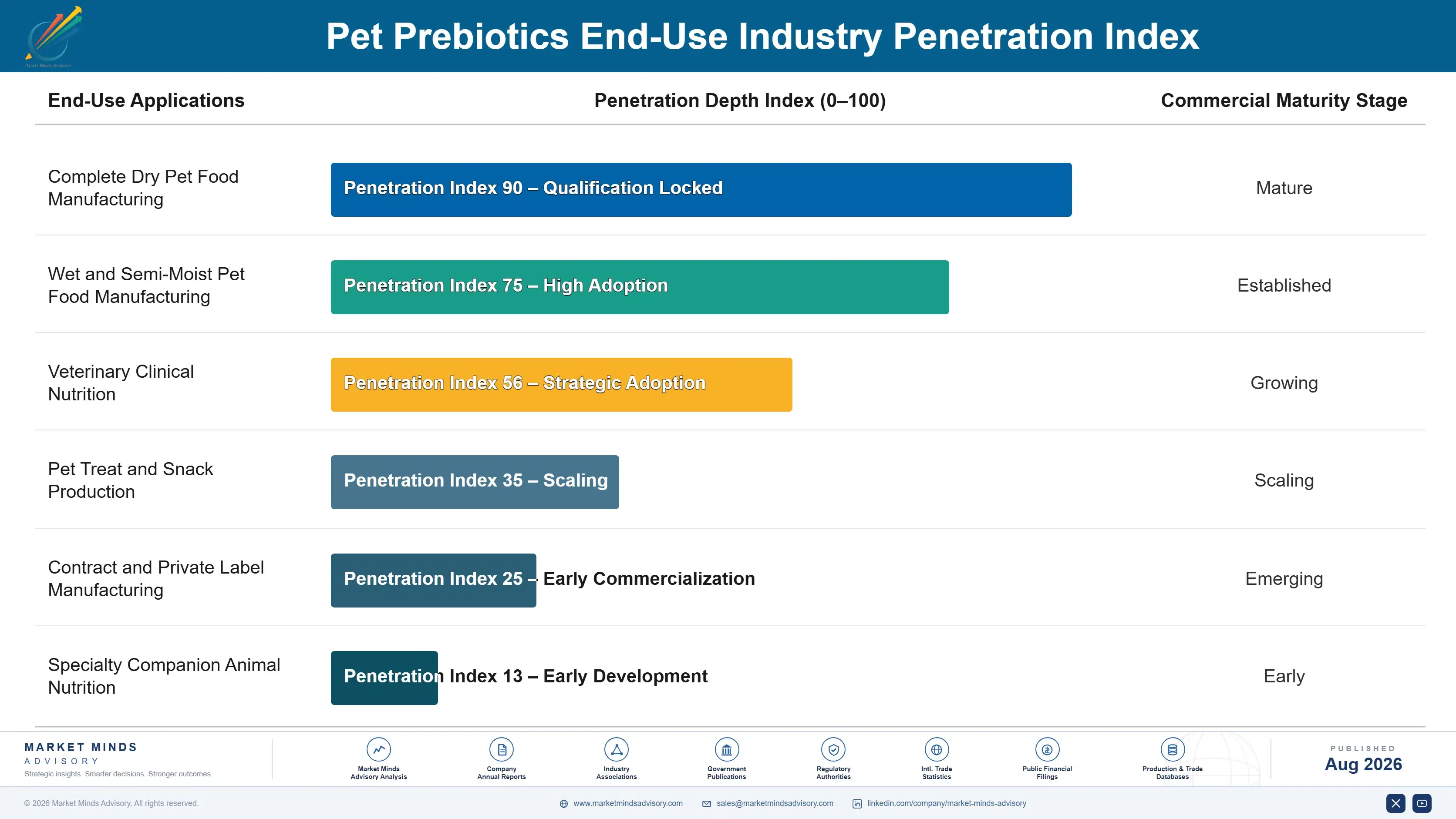
Two repeat mechanisms operate here and only one is genuinely annuity-like. Ingredient supply into a qualified formula repeats automatically for as long as that formula is produced, which is typically years, because requalifying carries cost and risk the manufacturer gains nothing from. Supplement purchase repeats only while the owner chooses to continue, and roughly 48% do so within six months.
Stickiness varies sharply by end use. Veterinary-recommended products hold owners best, since the purchase carries professional authority and the owner is treating a problem rather than buying an enhancement. Prescription-adjacent digestive ranges hold better still. Retail shelf supplements hold worst, because nothing beyond packaging distinguishes one from another and private label arrives at a visibly lower price. Food inclusion holds automatically, since the owner is not choosing the ingredient at all.

The buyer profile has shifted noticeably. Ingredient buying moved from brand teams seeking differentiation to procurement functions optimising cost per tonne, which changed the negotiation entirely. On the owner side, younger households treat digestive supplementation as routine preventive care rather than as a response to a problem, which lengthens the purchase period considerably and favours subscription formats.
pet-prebiotics-market-trends-end-use-penetration-index-1787322175899

Where To Compete And Why

These are among the four positions where our research anticipates prominent divergence between winners and laggards over the coming forecast period. Each is grounded in the demand model, the regulatory perimeter, and the announced capacity pipeline.
01 / FORMULA QUALIFICATION DISCIPLINE

Fourteen months buys years of volume

Qualification with a large pet food manufacturer takes roughly 14 months of technical work, feeding trials and procurement negotiation, and once won the position is rarely revisited because requalifying carries cost and risk the buyer gains nothing from at all. Suppliers holding qualified positions realise 18% to 24% higher pricing than spot tonnage on volume predictable enough to plan capacity against. The investment is technical service capability rather than production capacity, which is precisely what most fibre suppliers underestimate when they enter.
02 / VETERINARY CHANNEL INVESTMENT

Practice recommendation beats shelf marketing decisively

A veterinary recommendation converts far better than any retail shelf claim, because the owner arrives already worried about a specific digestive problem rather than browsing among options. Brands funding field detailing, clinical data and veterinary-exclusive formats reach roughly 31% of supplement value through that channel and hold pricing near 40% above retail equivalents. Practice consolidation into corporate groups is making the channel both more systematic and considerably more expensive to reach, which rewards participants investing now over those waiting to see how it develops.
03 / CLAIM SUBSTANTIATION TIMING

Evidence cannot be funded after enforcement

Digestive claim regulation is tightening across the United States and Europe, and many existing claims outran their supporting evidence while gut health was still purely a marketing device rather than a formulation decision. Feeding trials take 12 to 18 months, which means substantiation cannot be started once enforcement actually arrives on a portfolio. Participants funding evidence now protect label positions worth considerably more than the studies themselves cost to run, while competitors face relabelling across a large part of a portfolio at once.
04 / ENERGY COST POSITIONING

Extraction economics decide who competes

Agricultural raw material accounts for roughly 44% of prebiotic fibre manufactured cost and energy for extraction and drying a further 19%, which makes production location a genuine determinant of who can compete on price. European inulin producers carry both harvest concentration and elevated energy exposure together at once. Efficiency investment and multi-year grower contracts are the only levers genuinely available to producers, and both require capital committed years ahead of any benefit, which is a difficult case to make while margins are already compressed.

Engagement Snapshot From the Field

A live engagement with an industry participant carrying material or product regulatory and market exposure ahead of a defining policy shift, showing how our research translates into a defensible multi-year portfolio strategy.
MARKET MINDS ADVISORY · CLIENT ENGAGEMENT SUMMARY
Pet Prebiotics Producer Strategic Portfolio Review and Transition Roadmap 2026·Investment Scenario on Pet Prebiotics Exposure Evaluation 2025-26
CLIENT PROFILE
A European prebiotic fibre producer with annual revenue near $190 million (client-reported, unverified by MMA), roughly 71% of it from pet and human food ingredient supply with the balance in animal feed. The business held strong technical capability and established chicory sourcing, but most pet food volume moved on annual tender against price rather than through qualified formula positions.
STRATEGIC CHALLENGE
Elevated European energy costs had compressed margins on tonnage business while Asian competitors bid aggressively on the same tenders. Management needed to decide between defending volume on price, investing in qualification and technical service to move up the value chain, or entering finished supplements directly and competing with its own customers.
MMA APPROACH
MMA modelled realised margin by contract type across three years of the client's own sales data, benchmarked qualification cycles and technical service models against comparable ingredient suppliers, and assessed the finished supplement option against required channel investment. Twenty-two expert interviews with pet food formulators, procurement leads and veterinary buyers tested how supplier selection actually happens.
KEY FINDINGS
  1. Qualified formula positions delivered realised margins around 21 percentage points above tender tonnage and had survived an average of more than five years without being revisited by the buyer.
  2. Formulators consistently valued technical service and trial data above price within a reasonable band, and several stated they had never retendered a fibre once it was qualified inside a formula.
  3. Entering finished supplements would have put the client in direct competition with the manufacturers buying most of its tonnage, and interviewed customers said plainly they would have responded.
  4. Energy efficiency investment offered a shorter payback than the client had modelled, because its own comparison used pre-2022 energy pricing rather than the elevated baseline that has since persisted.
CLIENT PROFILE
A European prebiotic fibre producer with annual revenue near $190 million (client-reported, unverified by MMA), roughly 71% of it from pet and human food ingredient supply with the balance in animal feed. The business held strong technical capability and established chicory sourcing, but most pet food volume moved on annual tender against price rather than through qualified formula positions.
STRATEGIC CHALLENGE
Elevated European energy costs had compressed margins on tonnage business while Asian competitors bid aggressively on the same tenders. Management needed to decide between defending volume on price, investing in qualification and technical service to move up the value chain, or entering finished supplements directly and competing with its own customers.
MMA APPROACH
MMA modelled realised margin by contract type across three years of the client's own sales data, benchmarked qualification cycles and technical service models against comparable ingredient suppliers, and assessed the finished supplement option against required channel investment. Twenty-two expert interviews with pet food formulators, procurement leads and veterinary buyers tested how supplier selection actually happens.
KEY FINDINGS
  1. Qualified formula positions delivered realised margins around 21 percentage points above tender tonnage and had survived an average of more than five years without being revisited by the buyer.
  2. Formulators consistently valued technical service and trial data above price within a reasonable band, and several stated they had never retendered a fibre once it was qualified inside a formula.
  3. Entering finished supplements would have put the client in direct competition with the manufacturers buying most of its tonnage, and interviewed customers said plainly they would have responded.
  4. Energy efficiency investment offered a shorter payback than the client had modelled, because its own comparison used pre-2022 energy pricing rather than the elevated baseline that has since persisted.
RECOMMENDED STRATEGY
Phase 1: Phase one: redirect commercial effort from tender defence toward qualification pipelines with mid-tier manufacturers, where inclusion is spreading and incumbency is not yet established. Phase 2: Phase two: fund technical service and feeding trial capability as the qualification differentiator, since formulators value it above price within a reasonable band. Phase 3: Phase three: commit energy efficiency capital on the revised payback, and decline the finished supplement option to protect the existing customer relationships.
OUTCOME
The client added seven qualified formula positions within fourteen months and lifted the qualified share of pet volume from 24% to 43% (client-reported, unverified by MMA). Blended gross margin improved by roughly six points despite flat tonnage, and the energy efficiency programme is running toward completion in 2027 on the revised payback assumptions.

Frequently Asked Questions

Foundational context covering the market sizes, CAGR, scope, country, region and competition that inform every finding below. This section is provided to cover basics and most often pre-purchase conversations, answered from the MMA Primary Research Dataset.

What is the current size of the Pet Prebiotics Market?

The global pet prebiotics market was valued at $0.90 billion in 2025, reaching an estimated $0.99 billion in 2026. That covers prebiotic ingredients into pet food plus finished supplements for companion animals.

How large will the Pet Prebiotics Market be by 2036?

MMA forecasts the market reaching $2.66 billion by 2036, an increase of $1.67 billion over the 2026 base. That represents an expansion multiple of 2.69 times across the forecast period.

What is the CAGR for the Pet Prebiotics Market 2026 to 2036?

The base case compound annual growth rate is 10.4%, with a bull case of 11.6% and a bear case of 9.2%. Historical growth between 2020 and 2025 ran at 9.1% annually.

Which segment is growing fastest?

Prebiotic fibre ingredients for complete pet food grow at 15.6%, a full 1.50 times the market rate, as inclusion spreads through mid-tier formulas. Owner-facing supplements and chews follow at 13.1%.

Who are the major companies in the Pet Prebiotics Market?

Beneo, Cargill, Ingredion, Nestlé Purina PetCare and Mars Petcare lead on prebiotic ingredient and finished product revenue. Together they account for roughly 38% of global value.

Which country is growing fastest?

China grows fastest at 14.8% annually, driven by rapidly expanding urban pet ownership combined with premiumisation that happens within a few years rather than over a decade. India follows closely.

Report Segmentation Architecture

The full report scope spans multiple orthogonal segmentation dimensions, with cross-tabulated demand data provided for each dimension pair. Coverage extends further to regional breakdowns, trend trajectories, and the competitive detail needed to support segment-level decision-making.

By Prebiotic Product Type

  • Prebiotic Fibre Ingredients for Complete Pet Food
  • Owner-Facing Prebiotic Supplements and Chews
  • Veterinary Channel Digestive Products
  • Prebiotic Treats and Functional Toppers
  • Synbiotic Combination Products

By End-Use Industry

  • Complete Dry Pet Food Manufacturing
  • Wet and Semi-Moist Pet Food Manufacturing
  • Veterinary Clinical Nutrition
  • Pet Treat and Snack Production
  • Contract and Private Label Manufacturing
  • Specialty Companion Animal Nutrition

By Commercial Dimension

  • Direct Ingredient Supply to Manufacturers
  • Veterinary Practice Distribution
  • Specialty Pet Retail
  • Grocery and Mass Retail
  • Direct-to-Owner Online and Subscription

By Region

  • North America
  • Western Europe
  • East Asia
  • South Asia and Pacific
  • Latin America
  • Middle East and Africa
  • Eastern Europe

Scope, Methodology, and Coverage

Every figure in this report is reproducible from documented input assumptions. The scope below maps the historical period, the forecast horizon, the segmentation dimensions, and the countries covered, alongside the underlying primary and qualitative methodology.
Historical Period
2020 to 2025
Forecast Period
2026 to 2036
Base Year
2025 (USD billions; MMA Primary Research Dataset, August 2026)
Market Definition
This report covers prebiotic ingredients and finished prebiotic products for companion animals, spanning fibre ingredients supplied into complete dry and wet pet food, owner-facing supplements and chews, veterinary channel digestive products, prebiotic treats and toppers, and synbiotic combination products, across ingredient supply, veterinary, retail and direct channels. Probiotic live cultures supplied without a prebiotic component, general pet food carrying no prebiotic function, livestock and poultry feed additives, and veterinary pharmaceuticals are excluded from the sizing.
Quantitative Units
USD billions at realised supplier and brand value; ingredient volume in thousand tonnes; inclusion rates as percentage of formula.
Segmentation Dimensions
By prebiotic product type; by end-use industry; by commercial dimension; by region.
Regions Covered
North America, Western Europe, East Asia, South Asia and Pacific, Latin America, Middle East and Africa, Eastern Europe
Countries Covered
United States, Canada, Mexico, Brazil, Argentina, United Kingdom, Germany, France, Italy, Spain, Netherlands, Poland, Turkey, China, Japan, South Korea, India, Thailand, Australia, South Africa.
Key Companies Profiled
Beneo, Cargill, Ingredion, Nestlé Purina PetCare, Mars Petcare, Roquette, Tereos, Cosucra, DuPont Nutrition, Kerry Group, ADM, Lallemand, Alltech, Hill's Pet Nutrition and others.
Quantitative Methodology
Primary survey, n=3,800 respondents, Q4 2025, six countries; demand-side model with trade association cross-validation
Qualitative Methodology
47 expert interviews, Q4 2025; applied to validate demand model assumptions, identify emerging dynamics, and assess competitive positioning
Report Format
PDF and XLSX data workbook (Word format preview document)
Publisher
Market Minds Advisory
Report Code
MMA-2026-AGR-061
Published
August 2026
Contact
sales@marketmindsadvisory.com | www.marketmindsadvisory.com

Purchase the full Pet Prebiotics Market Report (2026 to 2036).

The full report sizes the pet prebiotics market across five product types, six end-use categories and seven regions, with ingredient tonnage and inclusion rate detail behind every value estimate. It profiles twenty companies on qualification position, technical service capability and veterinary channel reach. Regional chapters cover ownership trends, manufacturing location and claim regulation by market. Cost analysis quantifies agricultural and energy exposure by production route and geography. Regulatory analysis maps permitted digestive claim wording across the major jurisdictions, with commentary on how enforcement practice differs between them.
Ingredient tonnage and inclusion rate detail by type
Digestive claim regulation comparison across major jurisdictions
Qualification cycle benchmarking across ingredient suppliers
Energy and agricultural cost exposure by production route
Competitive position assessments across twenty companies
Pet ownership and premiumisation trends by regional market

Built For The People Who Decide

From boardroom strategy to bench-side execution, this report is read cover-to-cover by leaders shaping the next decade of their industry, turning demand scenarios, market dynamics and valuation benchmarks into decisions.
CXOs/ Presidents/ VPs/ Managers
M&A and Corporate Development
Strategy Teams and R&D Heads
Procurement and Product Directors
Regulatory and Compliance Leaders
Investor Relations and Equity Analysts