Market Minds Advisory
PET Food Trays Market

PET Food Trays Market: Ready Meal Formats, Recycled Content Structures, and Modified Atmosphere Packaging

Recycled content mandates are forcing PET tray manufacturers to rebuild supply chains around food-grade rPET feedstock, reshaping capital investment priorities across an industry that historically sourced virgin resin without meaningful traceability requirements.

Lead Analyst

Bilal Shaikh

Published

September 2026

Make Smarter Decisions with Customized Research Insights

Request a free sample report and evaluate market opportunities, growth trends, and competitive dynamics relevant to your business needs.

2025 MARKET VALUE$4.6BMarket Size 2025
2036 FORECAST VALUE$9.3BBase Case , 2026 to 2036
CAGR 2026 TO 20366.6 %Bull 7.8% / Bear 5.3%
INCREMENTAL OPPORTUNITY$4.4BNet 10- year value creation
EXPANSION MULTIPLE1.89x2036 value over 2026 base
Strategic Levers
M&A Pipeline
Regional Outlook
Country Rankings
Competitive Intelligence
Segmental Deep-dive
Call-Us : 91 93563 13602

Executive Snapshot and Market Trajectory

Recycled content mandates are forcing PET tray manufacturers to rebuild supply chains around food-grade rPET feedstock, reshaping capital investment priorities across an industry that historically sourced virgin resin without meaningful traceability requirements at all, a shift few converters anticipated when virgin resin sourcing still dominated category economics entirely today.
Ready meal and prepared food trays are growing fastest as convenience food consumption expands globally, with demand concentrating in North America and East Asia, where large retail refrigerated sections and rapidly expanding ready meal categories sustain the deepest tray production and consumption volume of any regions tracked, well ahead of every other region tracked in this study, where large refrigerated retail infrastructure sustains category depth few other regions can match at comparable scale.
Competition remains moderately concentrated across a mix of large diversified packaging manufacturers and specialized rigid tray converters, while tightening recyclability regulation and resin price volatility reshape which manufacturers can sustain margin without compromising food safety barrier performance, forcing even long-established converters to defend market position against fast-moving rPET-focused rivals entering adjacent format categories nationwide, internationally, and across previously unaffected customer segments nationally and abroad.
Market Definition
This market covers rigid PET trays used for packaging ready meals, fresh produce, meat, poultry, bakery, and dairy products across retail and food service channels. It excludes flexible film packaging, glass containers, and non-PET rigid plastic packaging formats entirely.
Base Year Value
$4.6B in 2025 (MMA Primary Research Dataset, August 2026)
Forecast Period
2026 to 2036, eleven discrete annual values
CAGR
6.6% base case. Bull 7.8%. Bear 5.3%.
Fastest Growth Segment
Ready Meal and Prepared Food Trays: 9.8% CAGR
Fastest Growth Country
India: 9.0% CAGR
Fastest Growth Region
South Asia and Pacific: 8.6% CAGR
Largest Region
North America: 27% of 2025 global value
Market Leaders
Sonoco Products Company, Sealed Air Corporation, Amcor plc, Faerch Group A/S, Placon Corporation. Source: MMA Analysis based on company annual reports.
Primary Survey
n=3,800 procurement and R&D decision-makers, Q4 2025, six countries
Methodology
Demand-side build-up, cross-validated against public data, 47 expert interviews

PET Food Trays Market Forecast Scenarios

pet-food-trays-market-size-forecast-scenario-1787307366960
PET food tray market spending grew at roughly 5.8% annually between 2020 and 2025, as pandemic-era retail packaged food demand and expanding ready meal consumption drove strong category growth across most major retail markets tracked in this study, a pattern that has held steady even as individual application categories diverged meaningfully in underlying growth trajectory.
The base case assumes continued ready meal category expansion, growing recycled content adoption under tightening packaging regulation, and steady modified atmosphere packaging demand, sustaining a 6.6% blended annual growth rate through 2036 as manufacturers balance regulatory compliance investment against persistent resin pricing pressure. These three mechanisms reinforce each other: ready meal growth widens the buyer pool, recycled content lifts premium mix, and modified atmosphere demand sustains resilience across most major manufacturing regions tracked in this study.
A bull scenario assumes faster-than-expected ready meal category growth pulls tray demand well ahead of current projections across major retail markets. The bear case centers on resin price volatility and recycled content compliance costs that could meaningfully compress manufacturer margins across the broader category, lifting growth toward 7.8% if adoption accelerates. The bear case pulls growth down toward 5.3% instead if resin disruption intensifies faster than expected.

Recyclability Regulation Reshapes a Growth Category

The PET food tray market sits at the convergence of expanding convenience food demand and a genuinely disruptive regulatory shift toward recycled content requirements, a combination pulling this historically virgin-resin-dependent category into more circular, compliance-driven competitive territory across most major retail markets, a shift accelerating faster than most virgin-resin-focused converters originally expected when planning multi-year investment budgets even a few years earlier when re
MARKET CONCENTRATIONCR5 38%share held by the five largest PET tray manufacturers combined
AVERAGE TRAY PRICE$0.09 per unitblended average selling price across standard PET food tray formats
LEADING COUNTRY SHAREUnited States 22%of global category production in a single manufacturing base
RESIN SHARE OF COGS55%of manufacturing cost attributable to virgin and recycled PET resin
RECYCLED CONTENT PENETRATION31%of tray volume now produced using food-grade recycled PET content
MANUFACTURING CAPACITY UTILISATION74%average operating capacity across major PET tray thermoforming facilities globally
Commercially, this market splits between high-volume standard PET trays sold to mainstream retail and food service customers, and premium recycled-content and barrier-enhanced trays sold at higher price points to sustainability-conscious brand owners, a divide reshaping which manufacturers capture margin growth, leaving slower-moving standard-only manufacturers increasingly confined to thin-margin, price-competitive volume categories nationwide as this bifurcation continues deepening across most manufacturing regions tracked.
Over the next decade, tightening recycled content regulation, continued ready meal category expansion, and growing modified atmosphere packaging adoption will keep pulling manufacturer investment toward food-grade rPET sourcing and barrier technology across most major packaging categories and customer segments tracked in this study, reshaping research, manufacturing, and procurement investment priorities across nearly every major tray producer globally across research, manufacturing, and procurement planning alike nationwide.
"A PET tray used to be judged entirely on shelf life. Now retailers ask about recycled content percentage before they ask about barrier performance."
Director, Food Packaging and Materials Practice · MMA Packaging Practice &

Market Trends

Recycled Content Mandates Reshape Resin Sourcing

Recycled content regulation adopted across a growing number of national and regional jurisdictions continues forcing PET tray manufacturers to rebuild resin sourcing around food-grade recycled PET feedstock that meets emerging mandatory content thresholds while still satisfying strict food contact safety requirements. Industry data indicates recycled content now represents roughly 31% of total tray production volume, a meaningful increase from a much smaller base just several years earlier before major recycled content mandates reached full implementation across leading retail markets. This shift is pulling manufacturers without dedicated food-grade rPET sourcing capability to invest rapidly or lose regulated shelf space.
Market Impact: Expands convenience food volume 19

Ready Meal Category Growth Sustains Tray Demand

Continued expansion of ready meal and prepared food retail categories continues sustaining strong demand for PET trays engineered for microwave compatibility, extended shelf life, and attractive shelf presentation, a category that has grown considerably faster than traditional fresh produce and meat packaging applications over recent years across most major retail markets. Retail industry data confirms ready meal category shelf space has expanded meaningfully as consumer convenience food preferences continue shifting, directly expanding the addressable market for specialized PET tray formats across most major grocery retail chains. This trend is pulling manufacturers to prioritize ready meal tray development further.
Market Impact: Expands MAP-compatible demand 17 pe

Market Opportunities and Growth Drivers

Expanding Global Convenience Food Consumption Patterns

Continued global convenience food consumption growth, driven by busier consumer lifestyles and expanding dual-income households, continues driving demand for PET trays engineered for ready meal and prepared food applications, a category that has expanded meaningfully faster than traditional fresh food packaging over the past several years. Retail industry data confirms ready meal category sales have grown considerably across most major consumer markets tracked in this study, directly expanding the addressable market for specialized microwave-compatible and extended shelf life tray formats. This driver is expected to keep sustaining above-average growth in convenience food packaging applications through the coming decade broadly.
Market Impact: Margins compressed by 11 percent

Modified Atmosphere Packaging Adoption Keeps Expanding

Growing retailer and food processor adoption of modified atmosphere packaging technology continues expanding demand for specialized PET trays engineered to maintain precise gas compositions that extend fresh food shelf life considerably compared to standard packaging formats used in less demanding applications. Food safety industry data confirms modified atmosphere packaging adoption has expanded meaningfully across major meat, poultry, and prepared food categories over the past several years, directly expanding the addressable market for compatible tray structures. This driver is expected to keep sustaining above-average growth in modified atmosphere applications through the coming decade across most major regional food retail markets tracked.
Market Impact: Limits supply to 68 percent

Market Restraints and Challenges

PET Resin Price Volatility Compresses Manufacturer Margins

Continued volatility in virgin and recycled PET resin pricing, driven by broader petrochemical feedstock market fluctuation and constrained food-grade recycled content supply, continues compressing manufacturer margins, where limited pricing power prevents manufacturers from fully passing through input cost increases to price-sensitive retail and food service customers. The root cause is that food-grade recycled PET supply remains genuinely constrained relative to rapidly growing mandatory content requirements, creating persistent premium pricing for compliant feedstock. This pressure disproportionately affects smaller manufacturers lacking resin hedging capability or long-term supply contracts. Manufacturers are responding by pursuing direct recycler partnerships to secure reliable food-grade rPET supply.
Market Impact: Reaches 31 percent recycled content

Food-Grade Recycled PET Supply Constraints Limit Growth

Persistent constraints in food-grade recycled PET supply continue limiting how quickly manufacturers can scale recycled content production to meet tightening regulatory thresholds, as collection and reprocessing infrastructure has not kept pace with rapidly growing mandatory content requirements across major regulated markets. The underlying cause is that food-grade recycling requires specialized decontamination processes that most conventional recycling infrastructure was never designed to provide at meaningful commercial scale. This constraint disproportionately affects smaller manufacturers lacking direct recycler relationships or vertically integrated reprocessing capability. Manufacturers are responding by investing directly in recycling infrastructure and long-term collection partnerships.
Market Impact: Grows ready meal volume 24 percent
3 additional market trends, 4 additional growth drivers, and 3 additional restraints and challenges are covered in the full report. Contact sales@marketmindsadvisory.com to access the complete intelligence.

Segment CAGR and Growth Architecture

This market segments by end-use application spanning ready meal and prepared food trays, fresh produce and fruit trays, meat and poultry trays, bakery and confectionery trays, dairy and deli trays, and frozen food trays sold across retail and food service channels globally, covering both premium and standard commodity formats nationwide and across leading global retail chains.
pet-food-trays-market-market-share-analysis-1787307367531

Ready Meal and Prepared Food Trays

Ready meal and prepared food trays are the fastest-growing segment as convenience food consumption continues expanding globally, driving strong demand for tray formats engineered for microwave compatibility, extended shelf life, and attractive shelf presentation that traditional fresh food packaging was never designed to serve across most major retail markets. Leading manufacturers have invested in multi-compartment tray designs and barrier coating technology enabling complex meal formats to maintain quality across extended shelf life. This segment commands meaningfully higher pricing than standard produce and meat trays, reflecting both the additional engineering complexity required and genuine retailer willingness to pay for formats that support premium ready meal category growth. Manufacturers are pursuing expanded ready meal tray product lines to compete for this segment.
CAGR 9.8%

Frozen Food Trays

Frozen food trays are growing considerably faster than the broader market as e-commerce frozen food delivery and expanding retail frozen food categories continue driving demand for tray formats engineered to withstand freeze-thaw cycles while maintaining structural integrity and food safety barrier performance across extended frozen storage periods. Leading manufacturers have invested significantly in specialized PET formulations and barrier coating technology that resist cracking and maintain seal integrity under extreme temperature cycling that standard ambient temperature trays were never designed to withstand reliably. This segment benefits from genuine crossover with rapidly growing e-commerce frozen delivery services that require sturdier, more durable packaging than traditional in-store frozen retail alone ever demanded. Manufacturers are investing in freeze-resistant formulation development to compete here.
CAGR 8.5%
Full segment breakdown across 6 segments available in the complete report.

Regional Architecture and Country Demand Map

North America and East Asia lead global PET tray production and consumption given large retail refrigerated infrastructure, while South Asia and Pacific sustains the fastest growth from expanding packaged food consumption broadly across most categories tracked in this report and abroad, well beyond the leading markets alone.

North America

The United States anchors North American demand through extensive retail refrigerated infrastructure and a rapidly expanding ready meal category that sustains steady tray production and consumption volume across most major grocery retail chains nationwide. Canada follows a broadly similar consumption pattern driven by comparable retail infrastructure and convenience food demand at meaningfully smaller absolute scale relative to its larger neighbor. Recycled content adoption has accelerated meaningfully across the region as major retailers publish formal packaging sustainability commitments requiring supplier transition toward food-grade rPET structures within defined multi-year timelines. State-level recycled content regulation continues expanding, creating a genuinely fragmented but steadily tightening compliance landscape for manufacturers serving this market. Mexico contributes growing demand as nearshoring investment expands regional supply chain needs.
Share: 27% | CAGR: 6.6% (2026 to 2036)

Western Europe

Germany and France anchor Western European demand through comparatively mature recycled content regulatory frameworks that have pushed rPET tray adoption further than most other global regions, reflecting the European Union's broader packaging waste directive implementation across member states over the past several years. The United Kingdom maintains steady demand through its own evolving plastic packaging tax framework, which has directly incentivized recycled content adoption among domestic tray manufacturers and food processors alike. Smaller Western European markets including the Netherlands and Scandinavian countries show comparatively high recycled content penetration despite modest absolute market size, reflecting strong regulatory compliance culture and advanced recycling infrastructure broadly across the region. Italy and Spain contribute additional demand, both showing accelerating recycled content adoption nationally.
Share: 24% | CAGR: 5.1% (2026 to 2036)
Regional intelligence for 5 additional markets available in the complete report: East Asia, South Asia and Pacific, Latin America, Middle East and Africa, Eastern Europe. Contact sales@marketmindsadvisory.com.
pet-food-trays-market-country-cagr-analysis-1787307368048

Recycled Content Sourcing and Barrier Innovation Strategy

Manufacturers are shifting commercial strategy toward food-grade recycled content sourcing, barrier technology differentiation, and direct retailer sustainability partnership, capturing premium pricing power that standard virgin resin production alone increasingly cannot sustain across regulation-tightening major retail markets globally, from large conglomerates to smaller regional converters and packaging startups pursuing next-generation circular economy positioning nationwide and internationa

Food-Grade Recycled Content Sourcing Investment Programme

Manufacturers are investing in direct recycler partnerships and vertically integrated reprocessing capability to secure reliable food-grade recycled PET supply that meets tightening mandatory content thresholds while still satisfying strict food contact safety requirements across most demanding retail applications tracked. This lever requires meaningful capital investment in recycling infrastructure and supply chain relationships, but successfully secured supply commands materially stronger customer loyalty as regulated retailers increasingly require verified recycled content compliance. Manufacturers report recycled content sourcing investment improving premium contract win rates by roughly 27% compared to standard virgin resin offerings.
Market Impact: Improves premium contract win rates

Barrier and Structural Technology Differentiation Programme

Manufacturers are investing in advanced barrier coating and structural design technology that enables modified atmosphere packaging compatibility and extended shelf life performance, capturing premium pricing that standard commodity trays cannot command given their comparatively limited protective performance characteristics across demanding food safety applications. This lever requires substantial research and development investment, but successfully differentiated products capture durable, long-term food safety customer relationships. Manufacturers report barrier technology differentiation improving average selling price realization by roughly 23% compared to standard commodity tray portfolios across most major food safety categories tracked in this report.
Market Impact: Improves price realization by rough

Direct Retailer Sustainability Partnership Programme Strategy

Manufacturers are building direct sustainability partnership relationships with major grocery retailers, co-developing customized recycled content and barrier solutions that meet specific packaging sustainability commitments while securing longer-term supply agreements than commodity spot-market transactions traditionally provided across the broader category historically. This lever requires meaningful technical collaboration investment, but successfully established partnerships generate materially more predictable, higher-margin revenue than transactional commodity sales. Manufacturers report direct partnership strategies improving contract revenue predictability by roughly 29% compared to spot-market commodity sales across most major grocery retail relationships tracked, particularly among retailers facing the nearest-term regulatory compliance deadlines nationally.
Market Impact: Improves revenue predictability by

Ready Meal Category Co-Development Programme Strategy

Manufacturers are partnering directly with prepared food and ready meal brand owners to co-develop customized tray formats optimized for specific product categories, capturing premium pricing that standard generic tray formats cannot command given their comparatively limited product-specific engineering and shelf presentation optimization capability across growing ready meal categories. This lever requires meaningful design and engineering collaboration investment, but successfully co-developed formats generate durable, long-term category exclusivity relationships. Manufacturers report ready meal co-development strategies improving contract exclusivity duration by roughly 32% compared to generic tray supply arrangements nationwide, particularly within the fastest-growing convenience food categories tracked broadly.
Market Impact: Improves contract exclusivity by ro

Who Controls the Margin Pool

The top five manufacturers control roughly 38% of global category spending, a moderately concentrated market reflecting genuinely meaningful barriers to entry including thermoforming capital investment, food safety certification requirements, and recycled content sourcing relationships that most smaller converters cannot easily replicate within a reasonable commercial timeframe, and this concentration level has held roughly steady even as regional converters keep gaining share in specific nation
Current competitive activity centers on food-grade recycled content sourcing investment, barrier and structural technology differentiation, and direct retailer sustainability partnership development, as leading manufacturers pursue genuinely different strategic emphases depending on whether they compete primarily in standard or premium regulated tray categories across most major manufacturing regions and retail customer segments tracked in this study broadly.

Emerging pressure comes from regional converters in East Asia and South Asia investing in expanded manufacturing capacity to serve growing domestic ready meal demand, alongside specialty materials companies developing next-generation bio-based and mono-material alternatives that could eventually reshape which companies lead the fastest-growing recycled content segment specifically, forcing established leaders to respond with acquisitions and technology investment rather than organic capability alone across most product categories.
pet-food-trays-market-company-positioning-matrix-1787307368571

Competitive Moat and Risk Dimensions

SONOCO PRODUCTS COMPANY

Moat: Vertically Integrated Manufacturing Network

Sonoco maintains an extensive vertically integrated rigid plastic packaging manufacturing network spanning North America and Europe, giving it cost advantages and supply reliability that smaller regional converters would need years of comparable investment to replicate at similar international scale nationwide and beyond nationally nationwide today.
SONOCO PRODUCTS COMPANY

Risk: PET Resin Price Volatility Exposure

Sonoco faces meaningful exposure to volatile virgin and recycled PET resin pricing given its high-volume commodity tray production base, and continued feedstock price disruption could meaningfully compress margins within its largest, least-differentiated product categories relative to more specialized competitors over time and beyond overall currently.
FAERCH GROUP A/S

Moat: Leading European rPET Recycling Infrastructure

Faerch benefits from leading European recycled PET tray recycling and manufacturing infrastructure built specifically around circular economy positioning, giving it supply security and regulatory credibility in demanding European markets that newer entrants cannot replicate without comparable specialized capital investment broadly and beyond nationally nationwide today.
FAERCH GROUP A/S

Risk: EU Recyclability Mandate Capital Exposure

Faerch faces meaningful exposure to tightening European Union recyclability mandates that could require continued heavy capital reinvestment in recycling infrastructure, constraining the company's ability to sustain margin if regulatory requirements accelerate faster than currently anticipated across member states over time and beyond overall broadly currently.

Players Tracked

Prominent Players

Sonoco Products Company
Sealed Air Corporation
Amcor plc
Faerch Group A/S
Placon Corporation

Other Key Players

Dart Container Corporation
Genpak LLC
Anchor Packaging LLC
CKF Inc.
Sabert Corporation
Coveris Holdings S.A.
Linpac Packaging Limited
Paccor Group
Huhtamaki Oyj
Berry Global Group Inc.
ProAmpac LLC
Reynolds Group Holdings Limited
Charter Next Generation Inc.
Display Pack Inc.
Novolex Holdings LLC

Recent Developments

MARCH 2026

Sonoco Expands Food-Grade rPET Reprocessing Capacity

Sonoco announced expanded food-grade recycled PET reprocessing capacity at its North American facility, broadening recycled content tray production to meet tightening state-level regulatory requirements across major retail customer accounts nationwide, following months of internal planning and equipment procurement across the facility broadly today and beyond.
Signal: Reflects continued large manufacturer inve
OCTOBER 2025

Faerch Signs Multi-Year Supply Agreement With European Retailer

Faerch Group secured a multi-year recycled content tray supply agreement with a major European grocery retailer, expanding its circular economy product line across the retailer's fresh food and ready meal packaging portfolio under newly established terms following an extended competitive process among several qualified recycled content suppliers.
Signal: Indicates growing direct retailer engageme
JANUARY 2026

Sealed Air Launches Barrier-Enhanced Ready Meal Tray Line

Sealed Air launched a new barrier-enhanced ready meal tray line designed for extended shelf life applications, targeting prepared food brand owners seeking improved modified atmosphere packaging compatibility within the fastest-growing tray segment following months of internal product development and customer testing across several pilot accounts.
Signal: Signals continued manufacturer investment

PET Resin and Recycled Feedstock Exposure

Virgin and recycled PET resin, along with barrier coating additives, together represent roughly 55% of cost of goods sold for tray manufacturers, with resin sourced from a concentrated group of petrochemical producers and recyclers whose output tracks broader crude oil feedstock and collection infrastructure conditions, where limited redundancy across production capacity shapes long-term sourcing strategy for most manufacturers regardless of scale.
PET resin prices rose meaningfully during 2021 and 2022 amid broader petrochemical supply chain disruption and constrained food-grade recycled content availability, with company annual reports from major manufacturers confirming elevated resin costs persisted through much of 2022 before moderating gradually through 2023 and 2024 to date, according to company annual reports and IEA commentary tracking upstream petrochemical feedstock market conditions closely, with 2022 marking the peak of disruption across most producing regions tracked in this study.

Manufacturers without long-term resin supply contracts or direct recycler relationships face materially higher input cost exposure and margin volatility than better-capitalized competitors, creating a durable cost stability advantage for larger companies able to invest in dedicated procurement and recycling infrastructure, particularly as retail customers increasingly require verified recycled content sourcing across most premium product categories nationally.
pet-food-trays-market-cost-volatility-analysis-1787307368765

Long-Term PET Resin Supply Contracts With Fixed Terms

Larger manufacturers are locking in multi-year resin supply contracts with petrochemical producers and recyclers, stabilizing input costs and securing reliable supply volume ahead of anticipated demand growth, reducing exposure to spot-market price swings that periodically disrupt smaller converters lacking comparable contract leverage, a mitigation strategy requiring substantial procurement sophistication most smaller converters cannot access easily.

Vertical Integration Into Recycling Infrastructure

Manufacturers are investing directly in food-grade PET reprocessing capability to reduce dependency on open-market recycled resin purchasing, insulating production costs and supply reliability from the volatility that smaller competitors remain fully exposed to during constrained feedstock periods, giving affiliated converters a durable cost stability advantage over standalone independent competitors nationwide and across most other regional markets.

Collection Partnership Diversification Strategy

Manufacturers are qualifying additional collection and reprocessing partners across multiple geographic regions to reduce dependency on any single feedstock source, building resilience against regional supply disruption affecting concentrated recycled content supply chains broadly, an approach increasingly standard among larger, better-capitalized manufacturers operating across multiple production regions, particularly across regions facing periodic collection infrastructure disruption or trade policy uncertainty nationally.

Portfolio Architecture for Margin Defence

This market organizes into three commercial tiers spanning standard virgin PET trays at the volume end, certified recycled content and barrier-enhanced trays in the middle tier, and premium ready meal and specialty format trays capturing the strongest margins at the top of the portfolio architecture given regulatory and category tailwinds, a structure that increasingly mirrors the broader industry's shift toward regulation-driven premiumization across most major manufacturing regions.
Volume and premium tiers pull manufacturers in genuinely different directions: standard trays sustain broad retail distribution at thin margins, while recycled content and premium format trays deliver materially stronger margins that increasingly fund the sourcing and engineering investment this regulation-driven category requires to remain compliant and competitive, forcing many manufacturers to run genuinely distinct commercial and technical teams for each tier simultaneously.

The highest-value pools concentrate around recycled content trays and premium ready meal formats sold to regulation-driven and convenience-focused retail customers, where sourcing differentiation and engineering capability together sustain premium pricing power that standard virgin resin trays simply cannot match across comparable production volume, making these categories the clearest strategic priority for manufacturers planning multi-year capital investment across the industry.

Volume / Commodity-Adjacent Tier

Standard virgin PET trays sold on price to fresh produce and general retail packaging customers across most manufacturing regions broadly, competing primarily on unit price and delivery reliability rather than sustainability credentials or barrier performance.
Gross Margin: 16-24%

Premium / Certified Tier

Barrier-enhanced and modified atmosphere packaging compatible trays sold under food safety certification to premium retail accounts nationally, typically requiring specialized coating technology that standard commodity converters rarely maintain in-house broadly.
Gross Margin: 28-36%

Sustainability / Regulatory / Next-Generation Tier

Recycled content and premium ready meal formats commanding the strongest regulatory and category compliance premium available today, typically sold under long-term supply agreements tied directly to retailer sustainability commitments and compliance deadlines.
Gross Margin: 38-46%
pet-food-trays-market-portfolio-architecture-1787307369263

High-value Sub-segments and Strategic Watch-out

Ready Meal and Prepared Food Trays

The fastest-growing and highest-margin segment, combining strong convenience food category momentum with genuine retailer willingness to pay premium pricing for engineered ready meal formats broadly, drawing intense manufacturer research investment and rapidly expanding co-development activity across the broader industry nationwide today, drawing sustained investment across most major manufacturers tracked.
Gross Margin: 38-46%

Frozen Food Trays

Strong margins and rapid growth driven by e-commerce frozen delivery expansion that traditional in-store retail formats never previously required at meaningful commercial scale nationwide, particularly among grocery and specialty retailers expanding online frozen food delivery capability nationally and internationally today, with adoption spreading steadily across additional grocery retail chains.
Gross Margin: 32-40%

Fresh Produce and Fruit Trays

The volume core segment sustaining broad retail distribution even as premium categories increasingly capture disproportionate industry profit growth nationally across most markets, even as manufacturers increasingly redirect incremental investment toward faster-growing ready meal and frozen categories instead overall broadly, anchoring baseline manufacturer revenue across most product portfolios broadly.
Gross Margin: 16-24%

Standard Virgin PET Meat and Poultry Trays

A strategic watch-out segment facing accelerating recycled content mandate pressure, requiring manufacturers to transition volume while defending remaining legacy customer relationships, particularly across jurisdictions where recycled content phase-in timelines have already been formally established and abroad currently, requiring careful volume management across the coming several years.
Gross Margin: 14-22%

Category-Anchored Supply Contract Streams

Winning a long-term supply contract with a major grocery retailer or ready meal brand owner functions as an annuity anchor across the multi-year agreement period: securing contract inclusion generates recurring tray sales throughout the guaranteed volume commitment, and losing that contract to a lower-priced or more compliant competitor can eliminate a manufacturer's account almost immediately within a single procurement cycle affecting broader retail relationships.
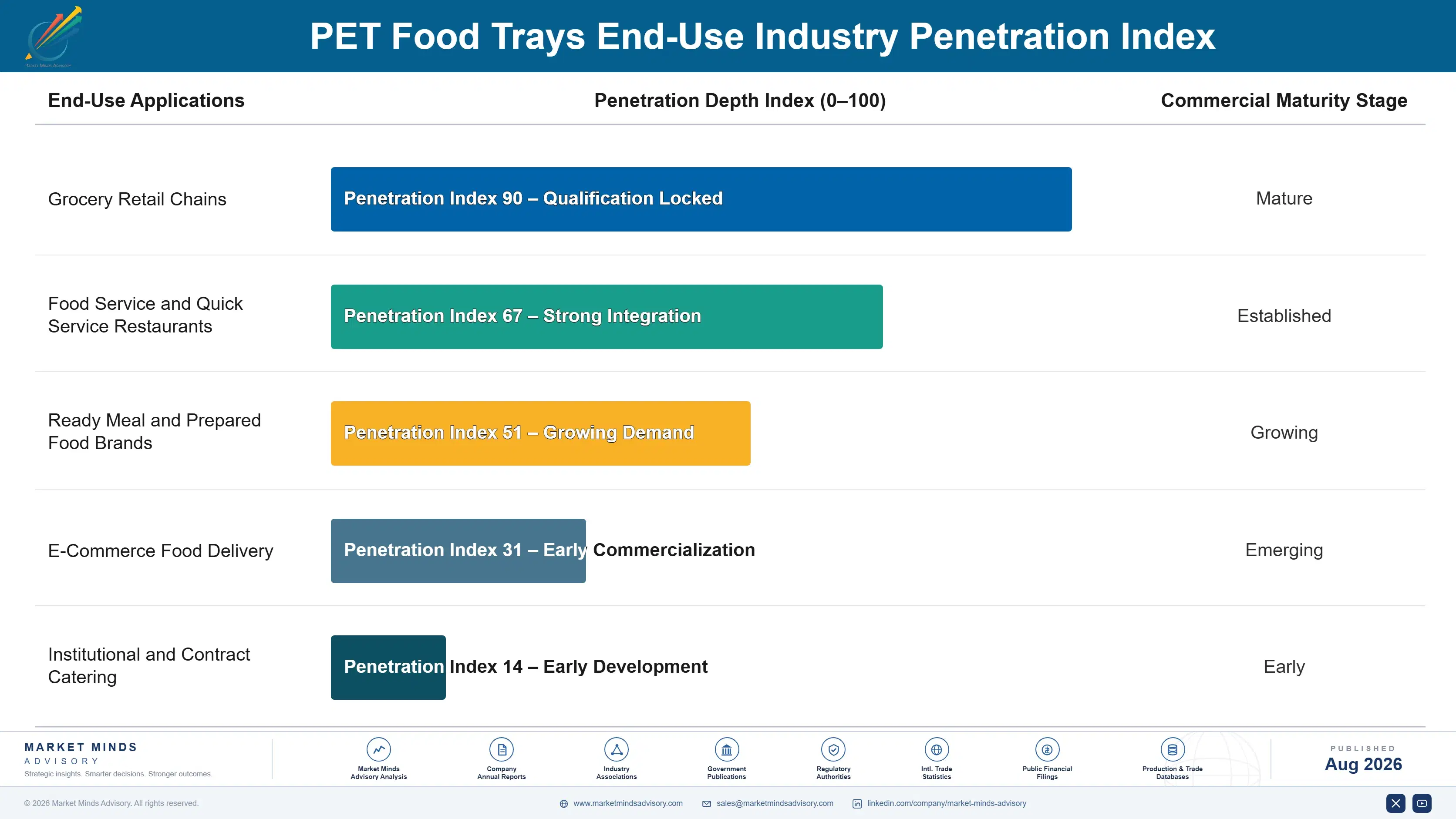
Adoption depth varies considerably by end-use vertical: ready meal and premium prepared food customers adopt engineered, barrier-enhanced trays earliest given clear commercial return on extended shelf life and shelf presentation investment, while general fresh produce customers more often continue purchasing standard tray formats until regulation forces broader category transition, a pattern that continues shifting gradually as regulatory deadlines and category growth accumulate across most retail markets broadly.

A generational shift is underway as younger procurement professionals and retail sustainability officers enter purchasing roles expecting verified recycled content supply chains as standard consideration, gradually normalizing a category that older procurement generations historically evaluated almost entirely on unit price and shelf life alone, a shift manufacturers slow to recognize risk finding themselves increasingly disconnected from where procurement decision-making is heading.
pet-food-trays-market-end-use-penetration-index-1787307369756

Where PET Tray Economics Are Heading

These are among the four positions where our research anticipates prominent divergence between winners and laggards over the coming forecast period. Each is grounded in the demand model, the regulatory perimeter, and the announced capacity pipeline.
01 / RECYCLED CONTENT SOURCING RACE

Food-grade rPET access will separate compliant leaders from laggards

Manufacturers investing in direct recycler partnerships and vertically integrated reprocessing capability are capturing disproportionate share of the fastest-growing, highest-margin premium segments where regulatory compliance increasingly determines customer eligibility and long-term contract access. Companies without meaningful recycled content sourcing investment risk losing regulated accounts entirely as content mandates tighten further. Expect recycled content sourcing capability to become the single most important competitive differentiator for manufacturers seeking sustainable premium positioning through the coming decade, well ahead of manufacturers relying purely on legacy virgin resin production alone.
02 / READY MEAL FORMAT INVESTMENT

Engineered tray formats will determine convenience segment leadership

Manufacturers investing in engineered ready meal and barrier-enhanced tray formats are capturing disproportionate share of the fastest-growing convenience food segment, where demonstrated shelf life and presentation performance increasingly determine retailer loyalty and premium pricing power over commodity alternatives. Companies without meaningful format investment risk being confined to lower-margin standard tray categories facing intensifying price competition. Expect engineered format investment to become an increasingly important determinant of convenience segment leadership, particularly within the fastest-growing convenience food and ready meal segments tracked.
03 / RESIN PRICE RISK MANAGEMENT

Supply chain sophistication will separate stable margins from volatile ones

Manufacturers with sophisticated resin hedging and direct recycler relationship capability are sustaining considerably steadier margins than competitors exposed fully to spot-market petrochemical and recycled feedstock pricing volatility, and this advantage compounds further during periods of constrained supply affecting the broader industry. Companies without meaningful supply chain sophistication face persistently higher margin volatility regardless of underlying demand strength. Expect supply chain risk management sophistication to become an increasingly important determinant of manufacturer profitability stability, especially as feedstock and collection infrastructure volatility continues affecting the broader industry.
04 / REGIONAL MANUFACTURING SHIFT

East Asian and South Asian capacity will keep pulling production eastward

Continued East Asian and South Asian manufacturing capacity expansion is steadily pulling global PET tray production toward the region, reflecting both proximity to major petrochemical feedstock sources and rapidly growing domestic convenience food and ready meal demand across these markets. This trajectory shows no sign of reversing given sustained regional manufacturing investment and demand growth outpacing most other global regions. Expect East Asian and South Asian production share to continue expanding meaningfully throughout the current forecast period across most major tray categories.

Engagement Snapshot From the Field

A live engagement with an industry participant carrying material or product regulatory and market exposure ahead of a defining policy shift, showing how our research translates into a defensible multi-year portfolio strategy.
MARKET MINDS ADVISORY · CLIENT ENGAGEMENT SUMMARY
PET Food Trays Producer Strategic Portfolio Review and Transition Roadmap 2026·Investment Scenario on PET Food Trays Exposure Evaluation 2025-26
CLIENT PROFILE
The client is a mid-sized regional PET tray converter generating projected annual revenue of approximately $110 million (client-reported, unverified by MMA) upon successful recycled content sourcing transition. Leadership sought guidance on securing reliable food-grade rPET supply ahead of tightening state-level recycled content mandates affecting several key retail customer markets, running through the following two fiscal quarters ahead of the planned transition.
STRATEGIC CHALLENGE
The client had historically sourced virgin PET resin exclusively, and leadership was uncertain whether investing in direct recycler partnerships would generate sufficient supply reliability and premium pricing to justify the substantial upfront capital and relationship-building investment required for the transition across the client's broader virgin-resin-dependent product portfolio within a limited capital budget.
MMA APPROACH
MMA's team benchmarked comparable converter recycled content sourcing strategies, modeled projected supply reliability and margin improvement under various recycler partnership scenarios, and assessed the client's existing customer portfolio for regulatory exposure and recycled content willingness to pay specifically across accounts, drawing on primary interview data gathered from major grocery retailer sustainability teams.
KEY FINDINGS
  1. Comparable converters that secured direct recycler partnerships achieved meaningfully more reliable food-grade rPET supply within twelve months compared to converters relying entirely on open-market recycled resin purchasing.
  2. A substantial share of the client's existing customer portfolio faced near-term recycled content compliance deadlines that would require verified rPET sourcing within the following two years.
  3. Customers facing the earliest regulatory deadlines showed strong willingness to pay premium pricing for verified recycled content supply, reducing the client's projected commercial risk considerably.
  4. A phased recycler partnership strategy targeting the highest-exposure customer segments first reduced projected transition risk compared to converting the entire supply chain simultaneously.
CLIENT PROFILE
The client is a mid-sized regional PET tray converter generating projected annual revenue of approximately $110 million (client-reported, unverified by MMA) upon successful recycled content sourcing transition. Leadership sought guidance on securing reliable food-grade rPET supply ahead of tightening state-level recycled content mandates affecting several key retail customer markets, running through the following two fiscal quarters ahead of the planned transition.
STRATEGIC CHALLENGE
The client had historically sourced virgin PET resin exclusively, and leadership was uncertain whether investing in direct recycler partnerships would generate sufficient supply reliability and premium pricing to justify the substantial upfront capital and relationship-building investment required for the transition across the client's broader virgin-resin-dependent product portfolio within a limited capital budget.
MMA APPROACH
MMA's team benchmarked comparable converter recycled content sourcing strategies, modeled projected supply reliability and margin improvement under various recycler partnership scenarios, and assessed the client's existing customer portfolio for regulatory exposure and recycled content willingness to pay specifically across accounts, drawing on primary interview data gathered from major grocery retailer sustainability teams.
KEY FINDINGS
  1. Comparable converters that secured direct recycler partnerships achieved meaningfully more reliable food-grade rPET supply within twelve months compared to converters relying entirely on open-market recycled resin purchasing.
  2. A substantial share of the client's existing customer portfolio faced near-term recycled content compliance deadlines that would require verified rPET sourcing within the following two years.
  3. Customers facing the earliest regulatory deadlines showed strong willingness to pay premium pricing for verified recycled content supply, reducing the client's projected commercial risk considerably.
  4. A phased recycler partnership strategy targeting the highest-exposure customer segments first reduced projected transition risk compared to converting the entire supply chain simultaneously.
RECOMMENDED STRATEGY
Phase 1: Phase 1 (Months 1-7): Establish direct recycler partnerships targeting the client's highest regulatory-exposure customer accounts first and validate recycled content quality against food safety requirements. Phase 2: Phase 2 (Months 8-15): Launch recycled content product lines commercially and secure long-term supply agreements with priority customers while preparing supporting materials for additional accounts. Phase 3: Phase 3 (Months 16-24): Expand recycled content sourcing to additional product categories based on initial results and demand and broader competitive market feedback gathered along the way.
OUTCOME
The client established its direct recycler partnerships and launched its recycled content product line within the recommended timeline, reporting supply reliability and margin improvement results consistent with initial modeling projections (client-reported, unverified by MMA), exceeding the client's original internal projections modestly during the first year following implementation.

Frequently Asked Questions

Foundational context covering the market sizes, CAGR, scope, country, region and competition that inform every finding below. This section is provided to cover basics and most often pre-purchase conversations, answered from the MMA Primary Research Dataset.

What is the current size of the PET Food Trays Market?

The market was valued at approximately $4.6 billion in 2025. This includes ready meal, fresh produce, meat, and bakery PET tray formats used across global retail channels.

How large will the PET Food Trays Market be by 2036?

The market is projected to reach approximately $9.3 billion by 2036, up from about $4.9 billion in 2026. This reflects strong ready meal category and recycled content growth.

What is the CAGR for the PET Food Trays Market 2026 to 2036?

The market is expected to grow at a compound annual growth rate of 6.6% between 2026 and 2036. This reflects expanding convenience food demand and regulatory-driven premium mix.

Which segment is growing fastest?

Ready meal and prepared food trays are the fastest-growing segment, expanding at approximately 9.8% annually, well above the market's 6.6% blended growth rate. This reflects strong convenience food demand.

Who are the major companies in the PET Food Trays Market?

Leading companies include Sonoco, Sealed Air, Amcor, Faerch Group, and Placon Corporation. Together these five manufacturers account for roughly 38% of global category spending globally.

Which country is growing fastest?

India is the fastest-growing major country at an estimated 9.0% CAGR, driven by its rapidly expanding organized retail sector and packaged food consumption nationwide today.

Report Segmentation Architecture

The full report scope spans multiple orthogonal segmentation dimensions, with cross-tabulated demand data provided for each dimension pair. Coverage extends further to regional breakdowns, trend trajectories, and the competitive detail needed to support segment-level decision-making.

By End-Use Application

  • Ready Meal and Prepared Food Trays
  • Fresh Produce and Fruit Trays
  • Meat and Poultry Trays
  • Bakery and Confectionery Trays
  • Dairy and Deli Trays
  • Frozen Food Trays

By End-Use Industry

  • Grocery Retail Chains
  • Food Service and Quick Service Restaurants
  • Ready Meal and Prepared Food Brands
  • E-Commerce Food Delivery
  • Institutional and Contract Catering

By Commercial Dimension

  • Direct Manufacturer Supply Contracts
  • Packaging Distributor Channels
  • Private Label Brand Partnerships
  • Spot Market Commodity Sales

By Region

  • North America
  • Western Europe
  • East Asia
  • South Asia and Pacific
  • Latin America
  • Middle East and Africa
  • Eastern Europe

Scope, Methodology, and Coverage

Every figure in this report is reproducible from documented input assumptions. The scope below maps the historical period, the forecast horizon, the segmentation dimensions, and the countries covered, alongside the underlying primary and qualitative methodology.
Historical Period
2020 to 2025
Forecast Period
2026 to 2036
Base Year
2025 (USD billions; MMA Primary Research Dataset, August 2026)
Market Definition
This report covers rigid PET trays used for packaging ready meals, fresh produce, meat, poultry, bakery, and dairy products across retail and food service channels. It excludes flexible film packaging, glass containers, and non-PET rigid plastic packaging formats entirely.
Quantitative Units
USD billions (current prices); production volume in units; average selling price per tray
Segmentation Dimensions
By End-Use Application; By End-Use Industry; By Commercial Dimension; By Region
Regions Covered
North America, Western Europe, East Asia, South Asia and Pacific, Latin America, Middle East and Africa, Eastern Europe
Countries Covered
USA, China, Germany, France, UK, Japan, South Korea, India, Australia, Canada, Brazil, Mexico, Indonesia, Vietnam, Thailand, Malaysia, UAE, Saudi Arabia, South Africa, Nigeria, Turkey, Poland, Netherlands, Italy, Spain, Sweden, Switzerland, Argentina, Colombia, Singapore, and additional markets relevant to this sector
Key Companies Profiled
Sonoco Products Company, Sealed Air Corporation, Amcor plc, Faerch Group A/S, Placon Corporation, Dart Container Corporation, Genpak LLC, Anchor Packaging LLC, CKF Inc., Sabert Corporation, Coveris Holdings S.A., Linpac Packaging Limited, Paccor Group, Huhtamaki Oyj, Berry Global Group Inc., ProAmpac LLC, Reynolds Group Holdings Limited, Charter Next Generation Inc., Display Pack Inc., Novolex Holdings LLC
Quantitative Methodology
Primary survey, n=3,800 respondents, Q4 2025, six countries; demand-side model with trade association cross-validation
Qualitative Methodology
47 expert interviews, Q4 2025; applied to validate demand model assumptions, identify emerging dynamics, and assess competitive positioning
Report Format
PDF and XLSX data workbook (Word format preview document)
Publisher
Market Minds Advisory
Report Code
MMA-2026-PAC-135
Published
August 2026
Contact
sales@marketmindsadvisory.com | www.marketmindsadvisory.com

Purchase the full PET Food Trays Market Report (2026 to 2036).

The full report provides detailed application-level segmentation, country-level production capacity analysis, and channel distribution tracking across major global manufacturing regions covered in this study. It includes manufacturer-level competitive benchmarking based on recycled content sourcing and barrier technology capability, alongside detailed regulatory pathway commentary relevant to compliance planning. Subscribers receive quarterly updates tracking new product launches and recycled content policy changes as they occur. A companion dataset provides production capacity estimates by country for detailed market sizing purposes, including scenario modeling for recycled content sourcing and ready meal category expansion planning.
Application-level segmentation breakdown by tray category
Country-level production capacity and trend analysis
Distribution channel tracking and benchmarking service
Manufacturer competitive benchmarking scorecards and overview
Quarterly regulatory policy update and alert service
Production capacity dataset segmented by country region

Built For The People Who Decide

From boardroom strategy to bench-side execution, this report is read cover-to-cover by leaders shaping the next decade of their industry, turning demand scenarios, market dynamics and valuation benchmarks into decisions.
CXOs/ Presidents/ VPs/ Managers
M&A and Corporate Development
Strategy Teams and R&D Heads
Procurement and Product Directors
Regulatory and Compliance Leaders
Investor Relations and Equity Analysts