Market Minds Advisory
PET Dome Lids Market

PET Dome Lids Market: Selling Height, Surviving the Straw Ban, and Thermoforming Economics

A dome lid exists to make a portion look larger than the cup that is holding it, which is a merchandising function that packaging engineers rarely admit is the entire point.

Lead Analyst

Bilal Shaikh

Published

September 2026

Make Smarter Decisions with Customized Research Insights

Request a free sample report and evaluate market opportunities, growth trends, and competitive dynamics relevant to your business needs.

2025 MARKET VALUE$1.3BMarket Size 2025
2036 FORECAST VALUE$2.5BBase Case , 2026 to 2036
CAGR 2026 TO 20366.4 %Bull 7.6% / Bear 5.2%
INCREMENTAL OPPORTUNITY$1.2BNet 10- year value creation
EXPANSION MULTIPLE1.86x2036 value over 2026 base
Strategic Levers
M&A Pipeline
Regional Outlook
Country Rankings
Competitive Intelligence
Segmental Deep-dive
Call-Us : 91 93563 13602

Executive Snapshot and Market Trajectory

Nobody buys a dome lid for protection. It exists so that whipped cream, a swirl of toppings or a piled salad reads as generous through a transparent curve, and operators pay a premium over a flat lid for exactly that visual effect. The premium buys visible headroom and nothing else.
Strawless sip and drink-through domes compound at 9.6%, a full 1.50x the market rate, because plastic straw bans forced a redesign that turned a passive cover into a functional drinking component. East Asia holds the largest share at 32%, on Chinese thermoforming capacity and a bubble tea and iced beverage culture that consumes domes at a rate nowhere else matches. Attachment rates there exceed anything coffee-led markets achieve.
Concentration is moderate at 41%, held by thermoformers whose economics turn on tooling amortisation and stacking density rather than on resin chemistry. Recycled PET content is now specified by most large foodservice chains, which favours converters with sheet extrusion capability and disadvantages those buying sheet on the open market. A dome also loses roughly 38% of case stacking density, which penalises every shipment. Freight consequently works against domes on every single shipment made.
Market Definition
This market covers transparent domed lids thermoformed or injection moulded from polyethylene terephthalate for foodservice and retail food containers, spanning standard dome lids, strawless sip and drink-through domes, high-dome and extended-height lids, recycled content PET domes, and retail produce and bakery dome closures. Flat lids, paper and moulded fibre lids, cups and containers themselves, polypropylene and polystyrene lids, straws and cutlery, and thermoforming equipment are excluded.
Base Year Value
$1.3B in 2025 (MMA Primary Research Dataset, August 2026)
Forecast Period
2026 to 2036, eleven discrete annual values
CAGR
6.4% base case. Bull 7.6%. Bear 5.2%.
Fastest Growth Segment
Strawless Sip and Drink-Through Domes: 9.6% CAGR
Fastest Growth Country
India: 10.6% CAGR
Fastest Growth Region
South Asia and Pacific: 8.6% CAGR
Largest Region
East Asia: 32% of 2025 global value
Market Leaders
Pactiv Evergreen, Dart Container, Huhtamaki, Berry Global, and Genpak. Source: MMA Primary Research Dataset, July 2026.
Primary Survey
n=3,800 procurement and R&D decision-makers, Q4 2025, six countries
Methodology
Demand-side build-up, cross-validated against public data, 47 expert interviews

PET Dome Lids Market Forecast Scenarios

pet-dome-lids-market-size-forecast-scenario-1787307276009
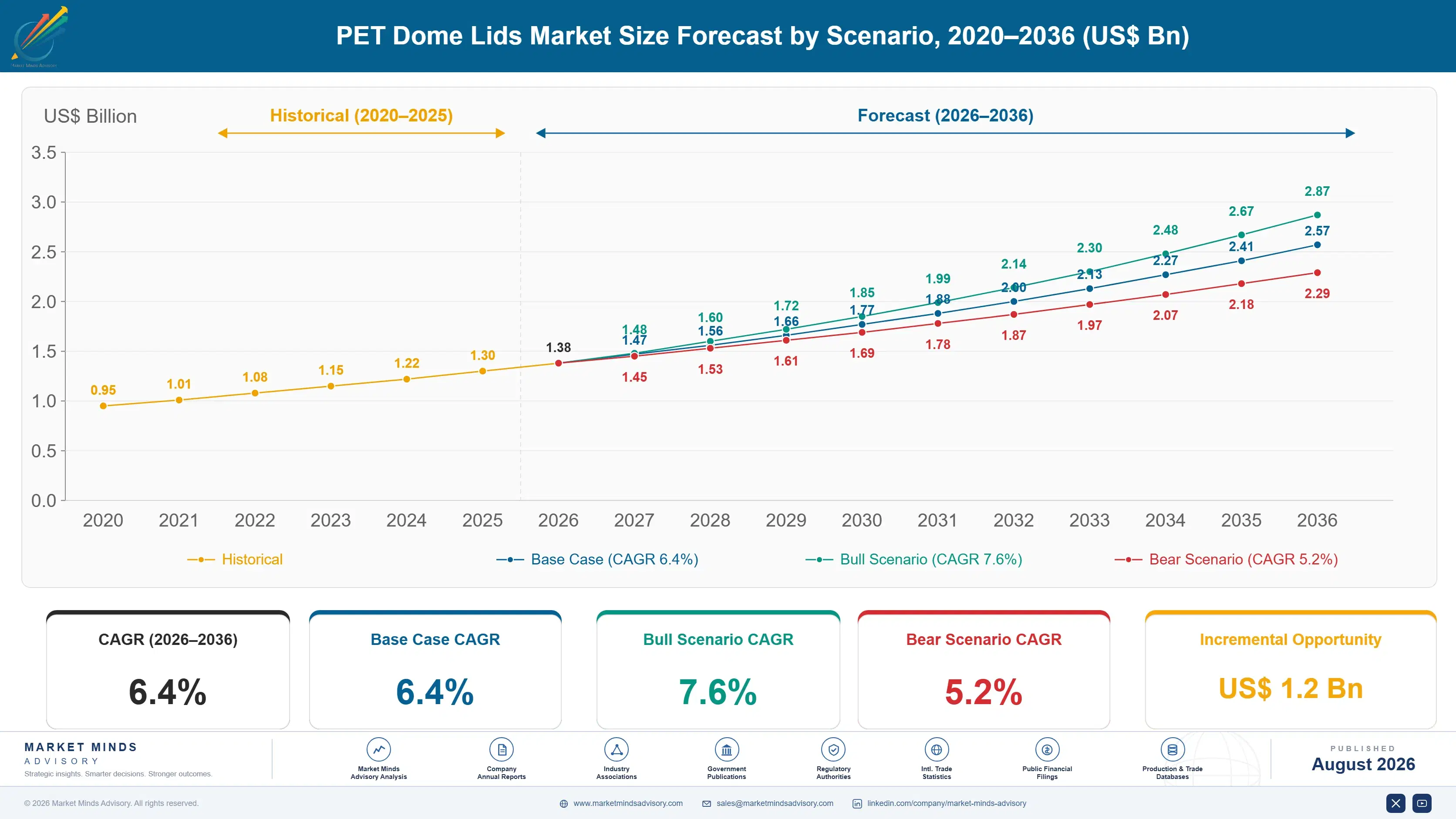
Growth ran near 5.4% from 2020 to 2025 and the composition changed completely partway through. Takeaway and delivery volumes rose sharply and stayed elevated, which lifted dome consumption across cold beverages and prepared food. Then single-use plastic rules arrived in Europe and several Asian markets, and converters spent two years redesigning lids to work without a straw rather than expanding volume.
Base case growth of 6.4% rests on three mechanisms. Cold and iced beverage consumption keeps rising across Asia and the Middle East, where dome lids are effectively standard. Strawless designs continue replacing straw-hole domes as regulation widens beyond the markets that moved first. And recycled content specifications keep pushing volume toward converters who can meet them, which changes who supplies rather than how much is sold. None of the three depends on Western European volume recovering at all.
The bull case at 7.6% assumes bubble tea and speciality iced beverage formats keep expanding outside their home markets at recent rates, since those formats consume tall domes at higher unit values. The bear case at 5.2% reflects reusable cup mandates advancing in European foodservice, which would remove dome volume entirely rather than redesigning it.

Dome Lids: Height, Regulation and Stacking

A dome lid does one thing a flat lid cannot: it creates visible headroom. Whipped cream, a topping swirl, a piled salad or a tall drink read as more generous through a transparent curve, and operators pay roughly 1.7 times a flat lid for that. Packaging engineers describe it as accommodating product height, which is true and understates the merchandising function that actually justifies the premium.
TOP FIVE CONCENTRATION41%Concentrated among thermoformers serving established foodservice distribution networks
DOME PRICE PREMIUM1.7xPrice against a flat lid of equivalent diameter and material
STACKING DENSITY LOSS38%Reduction in units per case against comparable flat lids
RECYCLED CONTENT SPECIFIED56%Foodservice volume now carrying a recycled content requirement in contracts
STRAWLESS DESIGN SHARE43%Dome lids designed for drinking without a separate straw component
TOOLING AMORTISATION VOLUME14 million unitsUnits a thermoform tool must run to recover cost
The height costs money elsewhere. A dome stacks far less densely than a flat lid, losing around 38% of units per case, which raises freight cost per lid, warehouse space per thousand and handling time at the counter. Operators accept that trade because the visual effect sells product, but it means every dome shipment carries a freight penalty that flat lids avoid entirely.
Regulation then rewrote the product. Single-use plastic straw bans removed the component that dome lids were designed to accommodate, and converters had to redesign a passive cover into something a customer drinks through directly. Roughly 43% of domes are now strawless designs, and that redesign turned a commodity thermoform into a product with genuine engineering content and tooling investment behind it.
"The straw ban was the best thing that happened to this category. Dome lids were a commodity thermoform competing on price per thousand, and then regulation forced a redesign that requires actual engineering, new tooling and testing that somebody has to pay for. Suddenly there is something to compete on besides resin cost."
Principal Analyst, Foodservice Packaging and Rigid Converting Practice · MMA Pac

Market Trends

Straw bans turned a passive cover into a functional component

Single-use plastic straw prohibitions removed the component dome lids existed to accommodate, forcing converters to redesign the lid into something a customer drinks through directly. That required genuine engineering around lip geometry, flow, spill resistance and the mouthfeel of drinking from a rigid edge, alongside new tooling for every diameter. Roughly 43% of domes are now strawless, and the redesign gave a commodity thermoform a technical dimension that price-per-thousand competition had entirely lacked before. Regulation continues widening into new jurisdictions on published timetables, which converts standard domes to strawless designs on dates that converters can tool against in advance.
Market Impact: India compounding at 10.6% annually
Recycled content specification changes who can supply

Around 56% of foodservice dome volume now carries a recycled content requirement written into supply contracts, driven by chain sustainability commitments rather than by any regulation in most markets. Meeting it reliably requires access to food-grade recycled PET sheet, which favours converters with their own sheet extrusion and disadvantages those buying sheet on the open market where recycled grades are tighter and pricier. The specification changes who supplies rather than how much is sold. Clarity in recycled sheet is also genuinely harder, and a transparent dome shows every defect. Integrated sheet extrusion is the decisive capability.
Market Impact: Domes priced at 1.7x flat lids

Market Opportunities and Growth Drivers

Iced beverage culture consumes domes at exceptional rates

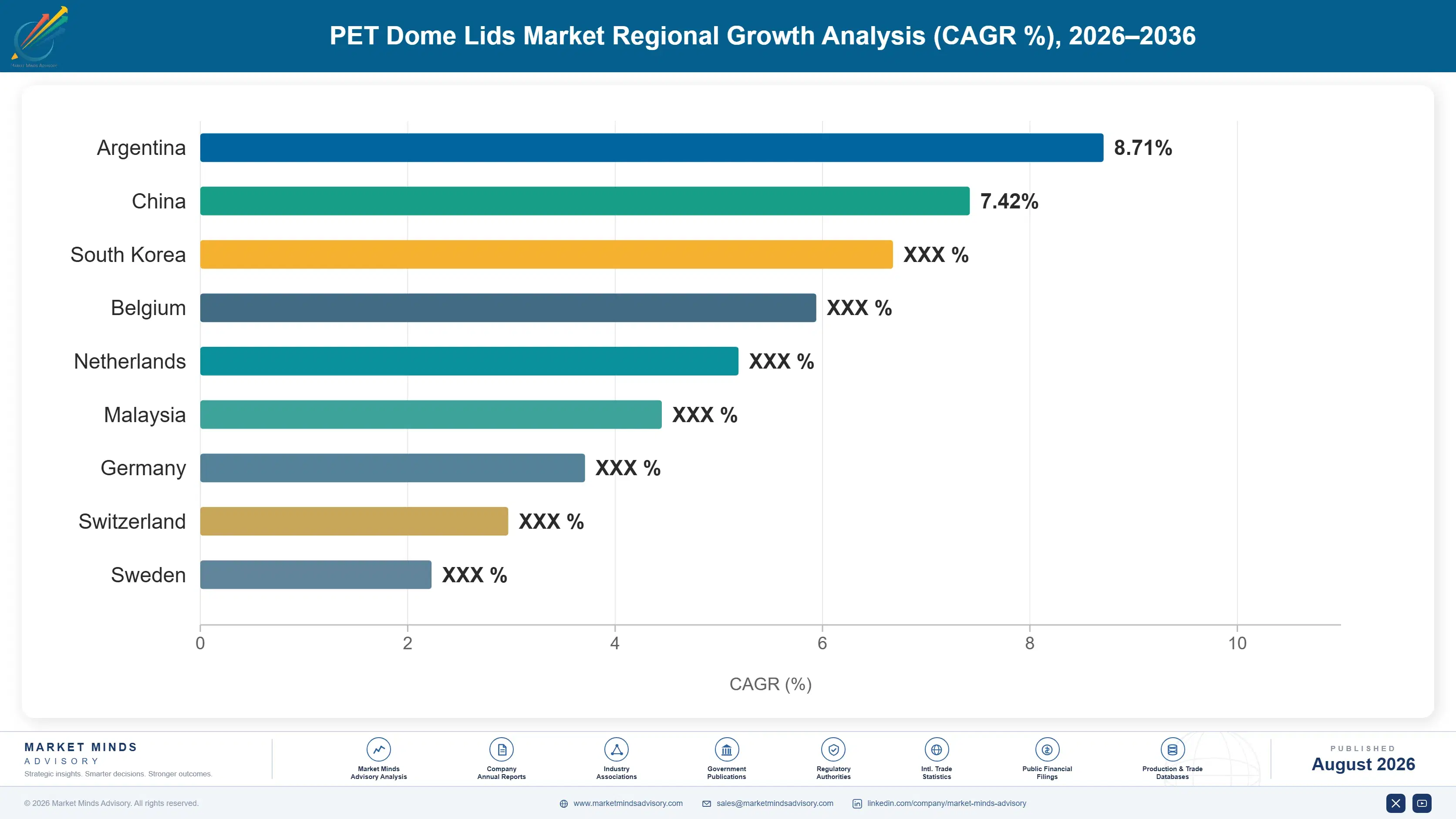
Bubble tea, iced coffee, layered speciality drinks and shaved ice formats all require tall transparent lids that display the product, and consumption of these formats is rising fastest across Asia and the Middle East. A bubble tea shop uses dome lids on essentially every serving, which is a materially higher attachment rate than a Western coffee chain achieves. India compounds at 10.6%, faster than any country covered, as these formats spread through metropolitan foodservice at considerable speed. Chain packaging decisions are typically taken centrally before any outlet opens, which makes early supply relationships considerably more valuable than they appear.
Market Impact: Losing 38% of case density

Delivery volumes favour lids that seal and display

Food delivery volumes rose sharply and stayed elevated, and a delivered order is judged on arrival appearance in a way a counter-served one never was. Dome lids that seal reliably against spillage while displaying the product protect both the food and the operator's rating on delivery platforms. Operators have consequently specified tighter sealing performance than counter service ever demanded, which raises the technical requirement and supports pricing above the 1.7 times flat lid premium. A failed seal damages the operator's platform rating rather than just the meal. Sealing requirements have risen accordingly across the channel.
Market Impact: Reuse targets covering 100% dine-in

Market Restraints and Challenges

Stacking density penalises every dome shipment

A dome loses roughly 38% of units per case against a flat lid of the same diameter, which raises freight cost per lid, warehouse cube per thousand and handling time behind the counter. The root cause is geometry that no design change resolves without removing the headroom the product exists to provide. Commercial impact is that distribution economics work against domes on every shipment. Participants respond by nesting designs more efficiently, shipping closer to customers and bundling domes with cups to spread freight. Geometry rather than design causes it. Nesting design helps only marginally.
Market Impact: Strawless designs reaching 43% shar

Reusable mandates would remove volume rather than redesign it

European foodservice reuse targets and deposit systems for in-store consumption threaten to eliminate single-use lid demand in affected settings rather than converting it to a different design. The root cause is that reuse policy addresses the format itself rather than the material, which is a fundamentally different threat from the straw ban that converters absorbed successfully. Commercial impact would fall on dine-in volume first. Participants respond by concentrating on takeaway and delivery where reuse mandates apply far less readily. Takeaway and delivery are where converters have concentrated effort in response.
Market Impact: Recycled content on 56% of volume
3 additional market trends, 4 additional growth drivers, and 2 additional restraints and challenges are covered in the full report. Contact sales@marketmindsadvisory.com to access the complete intelligence.

Segment CAGR and Growth Architecture

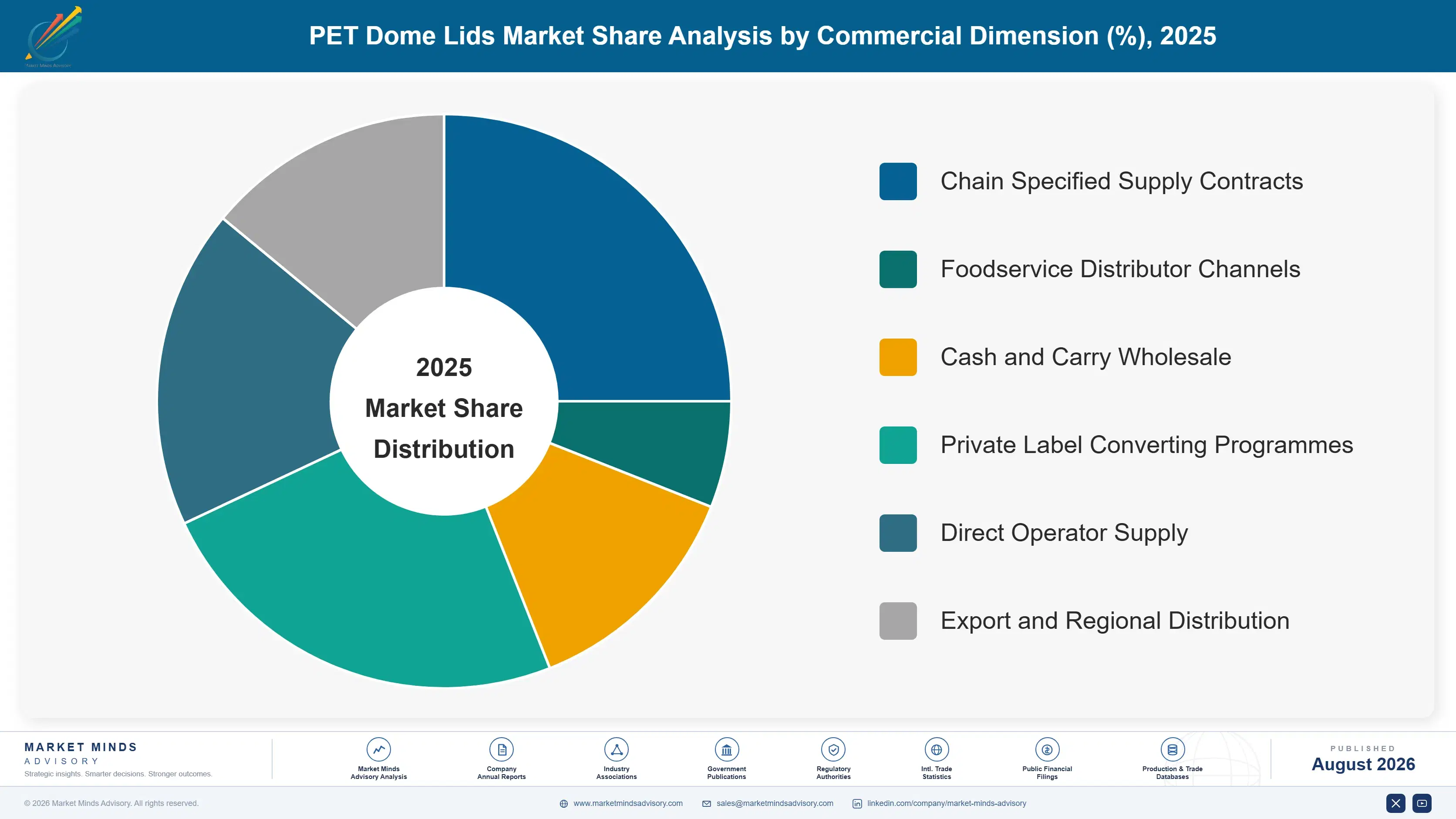
Five lid classes divide this market by design function and material specification, which together determine tooling investment and who can realistically supply. The division separates commodity domes competing on price per thousand from designs carrying engineering content that regulation created and that tooling cost protects. Regulation created most of the engineering content this category now carries.
pet-dome-lids-market-market-share-analysis-1787307276601

Strawless Sip and Drink-Through Domes

Compounding at 9.6%, a full 1.50x the market rate, these designs replaced the straw hole with an integrated drinking aperture after single-use straw prohibitions removed the component the original lid accommodated. Engineering around lip geometry, flow rate, spill resistance and drinking comfort is genuine rather than cosmetic, and every diameter requires its own tooling. That investment gave the category a technical dimension it previously lacked entirely. Regulation continues widening into new markets, which converts standard domes to strawless designs on published timetables converters can plan against. Being tooled first captures conversion that latecomers contest at a clear disadvantage. Tooling per diameter is the entry cost, and the amortisation threshold near 14 million units punishes narrow variants badly.
CAGR 9.6%

Recycled Content PET Domes

Growing at 8.2%, recycled content domes now cover around 56% of foodservice volume under contract specifications driven by chain sustainability commitments rather than by regulation in most markets. Food-grade recycled PET sheet availability is the constraint rather than any converting difficulty, which favours converters with integrated sheet extrusion and disadvantages those buying on the open market. Clarity and colour consistency in recycled sheet remain technically harder than in virgin material, and dome lids display those defects more visibly than opaque packaging ever would. Integrated sheet extrusion is therefore the decisive capability rather than any thermoforming advantage. Recycled grades trade at a premium to virgin resin during periods of tight collection, which inverts the usual economics entirely.
CAGR 8.2%
Full segment breakdown across 5 segments available in the complete report.

Regional Architecture and Country Demand Map

Regional distribution follows foodservice beverage culture and thermoforming capacity, which happen to coincide in Asia. Dome consumption per outlet varies enormously by format, and markets built on iced and layered drinks consume them at rates that coffee-led markets never approach. Attachment rate per outlet varies more than outlet count does.

East Asia

Thirty-two per cent of global value, the largest regional position, and beverage format explains it. Note: this exceeds the 22 to 30% band because bubble tea, iced coffee and layered speciality drinks originated across the region and consume dome lids on essentially every serving, which is a far higher attachment rate than coffee-led Western markets achieve. Chinese thermoforming capacity also supplies domes into other regions where freight allows. Taiwan and China originated the formats now spreading globally, and Japanese and South Korean convenience retail consumes domes across prepared food as well as beverages. Freight economics keep most production close to the outlets consuming it. Bubble tea shops use a dome on essentially every serving they make.
Share: 32% | CAGR: 7.4% (2026 to 2036)

North America

Twenty-six per cent of value, driven by foodservice scale and by recycled content specification rather than by beverage format intensity. Large chains have written recycled PET requirements into supply contracts covering a substantial share of volume, which reshaped supplier selection toward converters with sheet extrusion capability. Straw regulation operates at state and municipal level rather than nationally, producing a patchwork that converters must serve with both strawless and conventional designs simultaneously. Delivery volumes have raised sealing performance requirements considerably across the region. State and municipal straw rules produce a patchwork that converters must serve with both strawless and conventional designs at once, which multiplies tooling investment considerably. Distribution relationships matter more than manufacturing advantage here.
Share: 26% | CAGR: 6.0% (2026 to 2036)
Regional intelligence for 5 additional markets available in the complete report: Western Europe, South Asia and Pacific, Latin America, Middle East and Africa, Eastern Europe. Contact sales@marketmindsadvisory.com.
pet-dome-lids-market-country-cagr-analysis-1787307277122

Where Dome Lid Value Actually Sits

A standard dome is a commodity thermoform competing on price per thousand, and nothing changes that. Value comes from designs regulation created and tooling protects, from recycled sheet access that specifications now demand, and from placing capacity close enough to absorb the freight penalty domes always carry. Price per thousand is not a position worth defending.

Own tooling for strawless designs regulation is creating

Straw prohibitions convert standard domes to strawless designs on published timetables, and every diameter requires its own tool costing real money to cut and validate. Roughly 43% of domes are now strawless and the proportion rises with each jurisdiction. Converters holding validated tooling ahead of an implementation date capture conversion that competitors must then tool for after the fact, arriving months late into a decision already made. The timetables are public and the tooling lead time is known precisely. Tooling lead time is known precisely in advance. The implementation dates are entirely public.
Market Impact: Strawless designs now reaching 43%

Secure food-grade recycled sheet, not just capacity

Recycled content requirements now cover around 56% of foodservice dome volume under contract, and meeting them depends on access to food-grade recycled PET sheet rather than on any converting capability. Converters with integrated sheet extrusion control that access while those buying on the open market compete for tighter and pricier recycled grades. Clarity and colour consistency are also harder in recycled sheet, and a transparent dome displays those defects far more visibly than opaque packaging does. Ineligibility to bid removes the account regardless of price. Sustainability functions apply the criterion, not operations.
Market Impact: Requirements now covering 56% of al

Place capacity against the stacking freight penalty

A dome loses roughly 38% of case density against a flat lid, so every shipment carries a freight penalty that flat lids avoid entirely and no design change removes. Production close to consuming outlets absorbs that penalty where distant capacity cannot, and it also shortens replenishment for operators who hold limited back-of-house space. Converters shipping domes across long distances find freight consuming the scale advantage their larger plants were supposed to deliver. Replenishment speed matters to operators with limited back-of-house space, which adds a second argument for proximity beyond the freight cost itself.
Market Impact: Case density lower by 38% than flat

Follow iced beverage formats into new geographies

Bubble tea, cold coffee and layered speciality drinks consume dome lids on essentially every serving, which is a far higher attachment rate than coffee-led formats produce, and those formats are spreading well beyond their home markets. India compounds at 10.6% on exactly that expansion. Establishing supply relationships as these chains enter a market secures volume for the duration of their growth, and chain packaging decisions are typically made centrally before any outlet opens. Attachment rates in these formats far exceed coffee-led equivalents. Securing a chain before it enters a market is worth years of volume.
Market Impact: India compounding at 10.6% in every

Who Controls the Margin Pool

The top five hold 41% of the market measured on revenue from PET dome lid products, the basis used throughout this section. Concentration is moderate and reflects foodservice distribution relationships more than manufacturing advantage, since thermoforming capability is widely held. Pactiv Evergreen and Dart Container lead through positions supplying cups, containers and lids together to the same distributors and chains under single agreements.
Competitive activity runs along three lines. Converters are investing in strawless tooling ahead of regulatory implementation dates, since being tooled first captures conversion that latecomers contest at a disadvantage. Several are securing food-grade recycled PET sheet supply or integrating sheet extrusion to meet content specifications reliably. And regional thermoformers are expanding near growing foodservice clusters, where the freight penalty on domes gives them a defensible local position.

Pressure comes from two directions. Recycled content specifications favour integrated converters and squeeze those buying sheet on open markets where recycled grades are tight. And European reuse mandates threaten to remove dine-in volume entirely rather than converting it. Rankings shift on recycled sheet access and on tooling readiness, because both determine whether a converter can bid at all when a chain specification changes.
pet-dome-lids-market-company-positioning-matrix-1787307277643

Competitive Moat and Risk Dimensions

PACTIV EVERGREEN

Moat: Cup and lid supplied together

Supplying cups, containers and matching lids under one agreement means the dome is rarely evaluated as a standalone purchase, and distributors prefer fewer suppliers handling more of the foodservice consumable base. That breadth also spreads the freight penalty domes carry across a shipment containing denser items, which improves delivered economics in a way a lid specialist cannot replicate.
PACTIV EVERGREEN

Risk: Recycled sheet supply exposure

Recycled content specifications now cover around 56% of foodservice volume, and meeting them depends on food-grade recycled PET sheet supply that is tighter and pricier than virgin material. Converters without fully integrated sheet extrusion compete for constrained recycled grades on open markets, and losing that access removes eligibility to bid on specified contracts entirely.
DART CONTAINER

Moat: Distribution reach into independents

Deep distribution across independent foodservice operators as well as chains reaches a fragmented customer base that competitors serving only large accounts cannot access economically. Independents buy through distributors on availability and price rather than through negotiated specifications, and being the default stocked item across that network is a position built over decades of distributor relationships.
DART CONTAINER

Risk: Tooling investment across diameters

Strawless conversion requires separate tooling for every lid diameter, and a broad product range serving many cup sizes multiplies that investment considerably against a tool amortisation threshold near 14 million units. Converters with narrower ranges reach amortisation faster per tool, while a wide range spreads regulatory conversion cost across many low-volume variants.

Players Tracked

Prominent Players

Pactiv Evergreen
Dart Container
Huhtamaki
Berry Global
Genpak

Other Key Players

Sabert
Placon
Anchor Packaging
Fabri-Kal
WNA
Karat Packaging
Lollicup
Greiner Packaging
RPC Bebo
Coveris
Ilip
Wenzhou Lingyi
Guangdong Green Packing
Hotpack Global
Uflex Rigid

Recent Developments

JULY 2021

European single-use plastic rules prohibit straws

European single-use plastic legislation took effect prohibiting plastic straws alongside other items, removing the component that dome lids had been designed to accommodate. This was a regulatory measure rather than any commercial development, and it forced converters to redesign a passive cover into a functional drinking component quickly.
Signal: Regulation removed one component and inadv
MARCH 2023

Foodservice chains write recycled content into supply contracts

Major foodservice chains moved recycled content commitments from public targets into contractual supply requirements covering dome lids and other rigid packaging. These were commercial procurement decisions rather than regulatory measures, and they shifted supplier selection toward converters with reliable food-grade recycled sheet access. Ineligibility replaced price as the first filter.
Signal: Voluntary commitments became contract term
JANUARY 2025

European reuse targets advance for in-store consumption

European packaging regulation advanced reuse and refill targets applying to beverages consumed on premises, which threatens single-use lid volume in dine-in settings rather than converting it to alternative designs. This was a legislative development rather than any commercial event, and it represents a different order of threat from material substitution.
Signal: Reuse policy attacks the format itself, wh

What Actually Costs Money Here

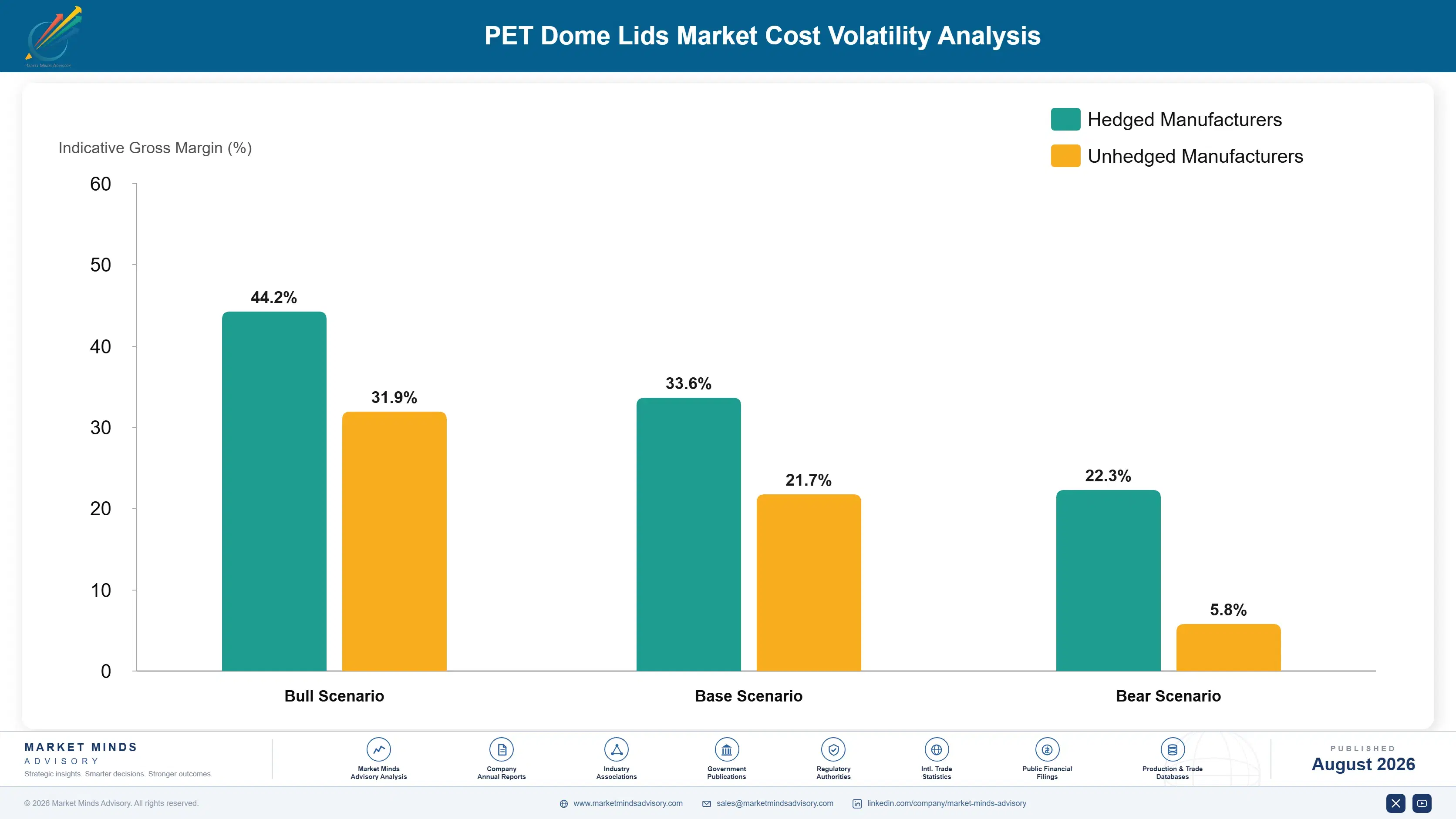
Resin and sheet dominate, and tooling sits behind them as the fixed cost that decides which products are viable. Polyethylene terephthalate resin and extruded sheet account for roughly 52% of cost of goods, with food-grade recycled grades commanding a premium over virgin material that varies with collection rates. Thermoforming energy and labour absorb around 19%, and tooling amortisation adds a further layer that only volume resolves.
PET resin pricing moved sharply through 2021 and 2022 on feedstock and energy costs, and converters on annual foodservice contracts absorbed the increase before repricing. Rigid packaging sector reporting documented that compression. Food-grade recycled PET has separately traded at a premium to virgin resin during periods of tight collection, which inverts the usual economics and makes recycled content specifications genuinely expensive rather than merely administrative.

Exposure varies most by integration and by freight position. Converters with their own sheet extrusion control recycled grade access and capture the extrusion margin, while those buying sheet carry both a margin loss and a supply risk on specified contracts. Freight matters more here than in most packaging, since a dome loses roughly 38% of case density, making production location a cost variable rather than a logistics detail.
pet-dome-lids-market-cost-volatility-analysis-1787307277837

Integrated sheet extrusion for recycled grade access

Food-grade recycled PET sheet is tighter and pricier than virgin material, and converters buying on open markets compete for constrained supply while losing the extrusion margin. Integration secures access and captures that margin, at capital cost and a commitment to volumes that justify running an extrusion line continuously rather than intermittently. Continuous running is the condition for the return.

Tool design shared across adjacent diameters

Strawless conversion requires tooling per diameter and amortisation runs near 14 million units, which punishes broad product ranges serving many cup sizes. Designing tools with shared components across adjacent diameters cuts the investment per variant, at the cost of some design compromise that operators occasionally notice in fit tolerance. Operators occasionally notice the fit compromise involved.

Regional capacity against the stacking penalty

A dome carries a permanent freight disadvantage of roughly 38% lower case density, which makes production location a genuine cost variable. Regional plants near foodservice clusters absorb that penalty where distant capacity cannot, though smaller plants sacrifice the thermoforming scale economics that larger centralised sites achieve. Smaller regional plants sacrifice the thermoforming scale that centralised sites achieve.

Portfolio Architecture for Margin Defence

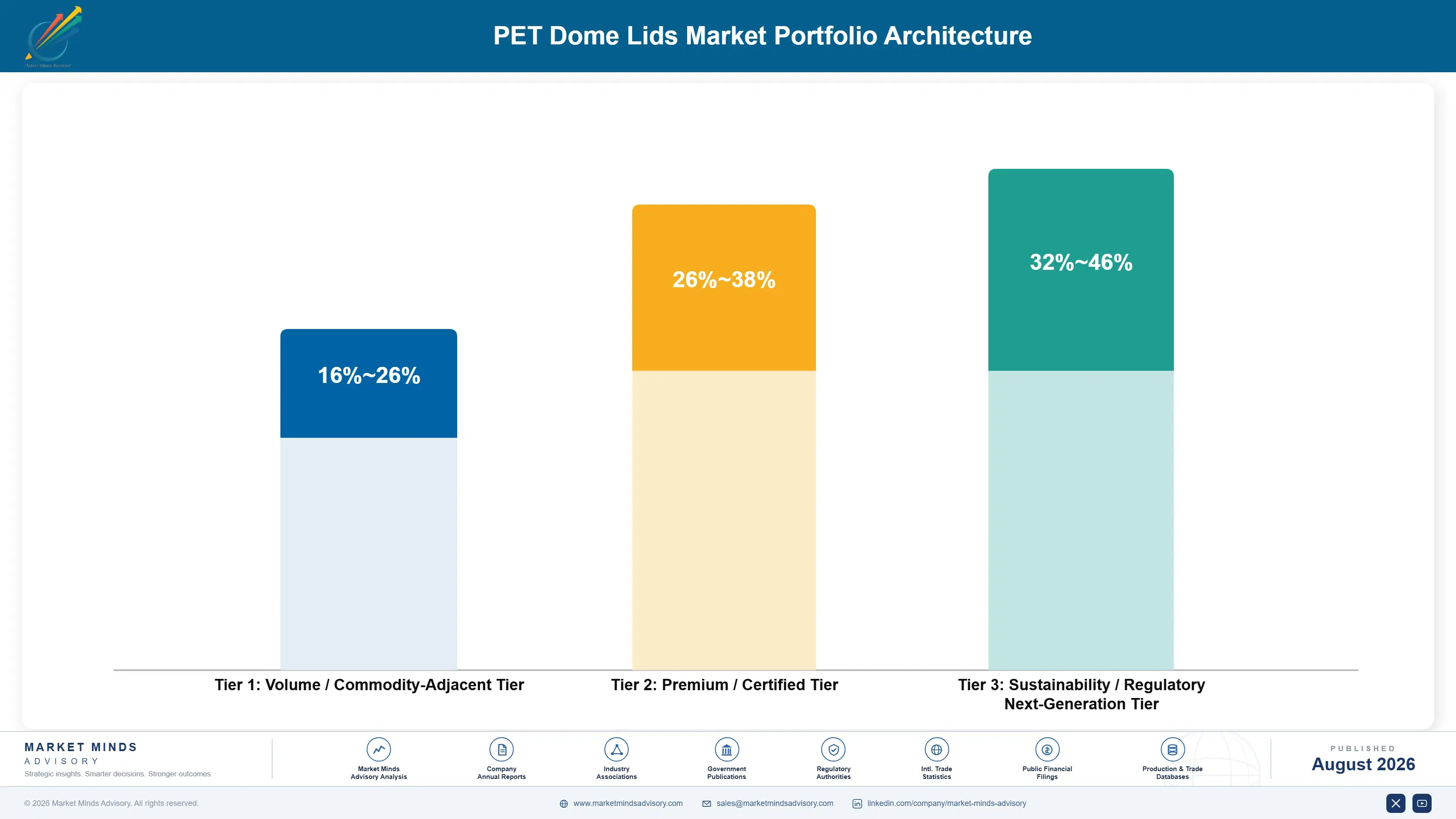
Margin architecture separates by whether a design carries tooling and specification barriers. Standard domes made to common diameters compete against every thermoformer with comparable equipment and clear gross margins in the high teens. Strawless designs requiring validated tooling per diameter, and recycled content domes requiring secured food-grade sheet, both carry entry barriers that hold margins roughly ten points higher. Equipment is frequently identical across all three tiers.
The tension is between range and amortisation. A broad diameter range serves more customers and multiplies tooling investment against an amortisation threshold near 14 million units per tool, which punishes low-volume variants severely. A narrow range reaches amortisation quickly and forfeits accounts requiring sizes it does not offer. Converters serving large chains face this more acutely than those serving distributors.

High-value pools concentrate where regulation or specification restricts who may supply. Strawless designs in jurisdictions with implementation dates, recycled content contracts requiring secured sheet, and tall dome formats for speciality beverages all sit there. Everything competing on price per thousand for a standard diameter competes against thermoformers with identical equipment buying the same resin. Nothing about that comparison improves with better thermoforming.

Volume / Commodity-Adjacent Tier

Standard dome lids in common diameters supplied through foodservice distribution, where thermoforming capability is widely held and delivered price decides awards across nearly every account. Resin is bought on the same markets by everybody.
Gross Margin: 16-26%

Premium / Certified Tier

Strawless sip and drink-through designs requiring validated tooling per diameter and drinking performance testing, protected by tooling investment and by regulatory implementation timetables converters plan against. Implementation dates are published years ahead.
Gross Margin: 26-38%

Sustainability / Regulatory / Next-Generation Tier

Recycled content domes meeting contractual food-grade specifications and tall speciality beverage formats, defended by secured recycled sheet access and by clarity performance that recycled material makes genuinely difficult. Sheet access rather than converting decides participation.
Gross Margin: 32-46%
pet-dome-lids-market-portfolio-architecture-1787307278339

High-value Sub-segments and Strategic Watch-out

Strawless Sip and Drink-Through Domes

The fastest growth at 9.6%, created entirely by straw prohibitions that continue widening into new jurisdictions on published timetables. Tooling per diameter is the entry barrier, and being tooled first captures the conversion. Timetables are public and lead times known. Latecomers arrive after the decision.
Gross Margin: 26-38%

Recycled Content PET Domes

High value at 8.2% and covering 56% of foodservice volume under contract. Food-grade recycled sheet access rather than converting capability decides participation, which favours integrated converters decisively. Clarity in recycled sheet is genuinely harder, and a transparent dome shows every defect that opaque packaging hides.
Gross Margin: 32-46%

Standard PET Dome Lids

The volume core at 4.4%, spreading thermoforming and tooling overhead across the asset base. Entirely undefended, with every converter holding comparable equipment and buying identical resin on the same markets. Overhead spreading is its only contribution. Every converter holds comparable equipment here. Resin comes from identical markets.
Gross Margin: 16-26%

High-Dome Speciality Beverage Lids

The strategic watch-out at 8.8%. Tall formats for bubble tea and layered drinks carry higher unit values and worse stacking density, which sharpens the freight penalty exactly where volume is growing fastest. Unit values are correspondingly higher though. Freight penalty sharpens where growth is fastest.
Gross Margin: 30-42%

Who Specifies and What Repeats

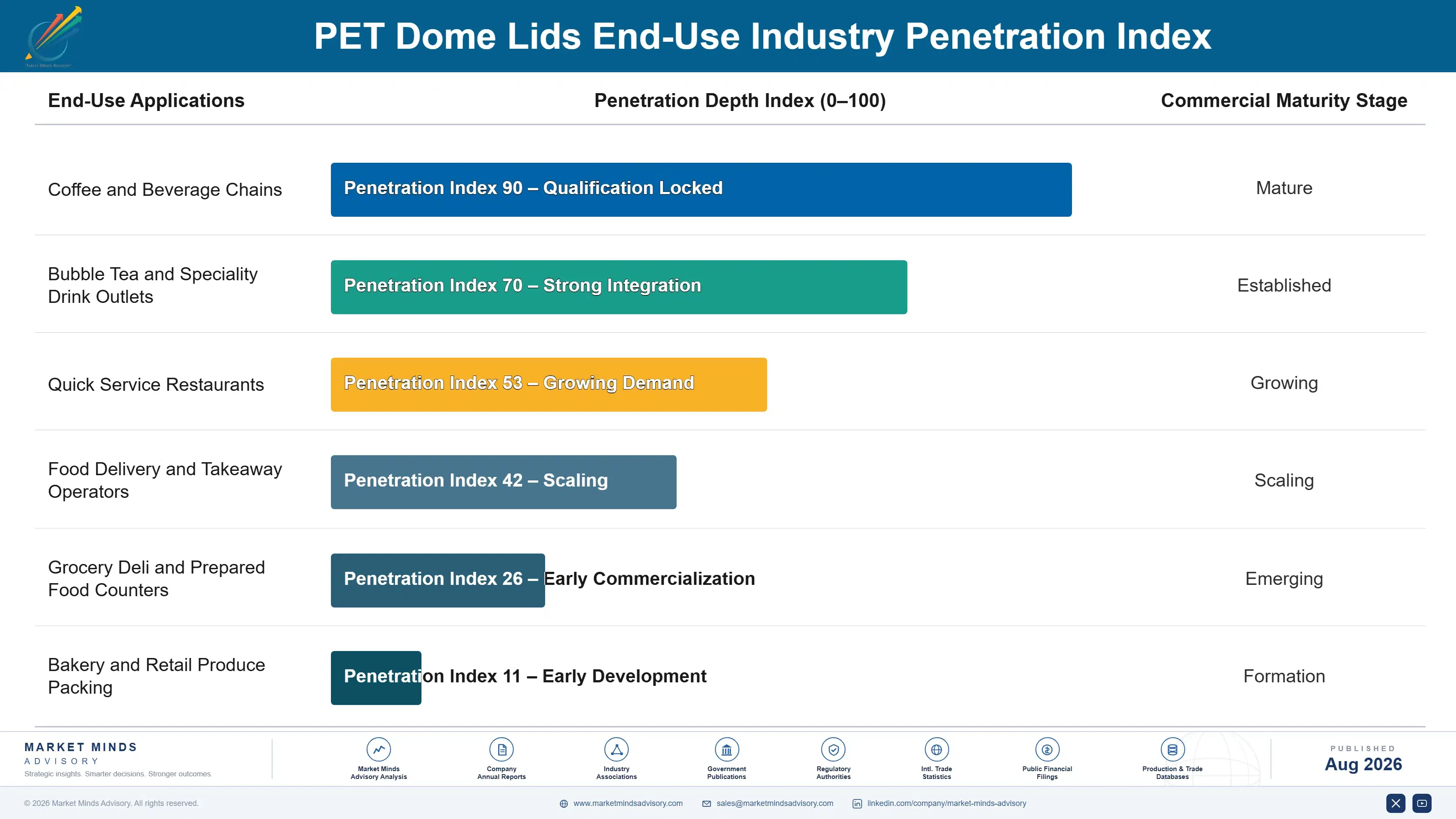
Revenue is genuinely recurring and tracks foodservice transaction volumes closely, since a dome lid is consumed with every serving it covers. That makes demand predictable at the outlet level and volatile at the account level, because losing a chain removes a large block of volume at once. Distribution through foodservice wholesalers adds a buffer, since independents reorder against availability rather than negotiated agreements.
Stickiness varies sharply by customer type. Large chains specify centrally, write recycled content and design requirements into contracts, and change suppliers on formal tender cycles that a converter can lose entirely. Independent operators buy whatever the distributor stocks, which makes distributor relationships worth more than any individual account. Speciality beverage chains sit between, specifying tall formats that limit the field of capable suppliers considerably.

The specifying voice has moved toward sustainability functions in large accounts. Dome lids were once chosen by operations on fit, clarity and price alone. Recycled content requirements now involve sustainability teams tracking corporate commitments, which introduces a criterion that operations never applied and that converters without secured recycled sheet cannot satisfy at any price. That single addition reshaped supplier eligibility across a substantial share of volume.
pet-dome-lids-market-end-use-penetration-index-1787307278827

Where Value Actually Sits

These are among the four positions where our research anticipates prominent divergence between winners and laggards over the coming forecast period. Each is grounded in the demand model, the regulatory perimeter, and the announced capacity pipeline.
01 / TOOLING READINESS TIMING

Being tooled first captures the whole conversion

Straw prohibitions convert standard domes into strawless designs on implementation dates published years beforehand, and every single lid diameter requires its own validated tool costing real money to cut and test. Roughly 43% of all domes are now strawless designs, and that proportion rises with each new jurisdiction that acts. Converters that hold validated tooling ahead of an implementation date capture the conversion that competitors must then tool for afterward, arriving months late into a decision that was already taken.
02 / RECYCLED SHEET ACCESS

Specification decides eligibility before price does

Recycled content requirements now cover around 56% of foodservice dome volume under contract, and satisfying them depends entirely on access to food-grade recycled PET sheet rather than on any converting capability at all. Converters with integrated sheet extrusion control that access directly, while those buying on open markets compete for tighter and considerably pricier recycled grades. Losing that access removes eligibility to bid on specified contracts altogether, regardless of what price a converter might otherwise have been able to offer.
03 / FREIGHT PENALTY MANAGEMENT

Thirty-eight per cent less in every case shipped

A dome lid loses roughly 38% of units per case against a flat lid of identical diameter, and no design change removes that penalty without also removing the very headroom the product exists to provide. Every single shipment therefore carries a freight cost that flat lids avoid entirely, and that scale in distant plants cannot offset at all. Production placed close to the consuming outlets absorbs that penalty in a way that centralised capacity at a distance simply never can.
04 / FORMAT EXPANSION FOLLOWING

Bubble tea uses a dome on every single serving

Iced, layered and other speciality beverage formats consume dome lids at attachment rates that coffee-led Western formats never once approach, and those formats keep on spreading well beyond the Asian markets that originally created them. India compounds at 10.6% on precisely that format expansion across its metropolitan foodservice sector. Chain packaging decisions are typically taken centrally well before any single outlet opens its doors, which makes those early supply relationships worth considerably more than they appear to be at the time.

Engagement Snapshot From the Field

A live engagement with an industry participant carrying material or product regulatory and market exposure ahead of a defining policy shift, showing how our research translates into a defensible multi-year portfolio strategy.
MARKET MINDS ADVISORY · CLIENT ENGAGEMENT SUMMARY
PET Dome Lids Producer Strategic Portfolio Review and Transition Roadmap 2026·Investment Scenario on PET Dome Lids Exposure Evaluation 2025-26
CLIENT PROFILE
A rigid foodservice packaging converter with annual revenue near $240 million (client-reported, unverified by MMA), thermoforming cups, containers and lids at three plants for distributors and regional chains. Dome lid volume had grown while margin fell for three consecutive years, and leadership could not identify whether the problem was pricing, product mix or cost allocation.
STRATEGIC CHALLENGE
The company offered dome lids across fourteen diameters to serve every customer request, and tooling investment had accumulated without anybody assessing whether individual variants reached amortisation. Leadership also faced recycled content requirements appearing in tenders it could not reliably meet, having bought sheet on the open market rather than extruding its own.
MMA APPROACH
We rebuilt profitability by diameter including tooling amortisation, allocating on actual production volume rather than on revenue. Twenty-four foodservice distributors and chain procurement managers were interviewed on specification, recycled content and switching behaviour. We modelled sheet extrusion investment against continued open market purchasing using contract eligibility as the comparison. Tooling records were reviewed per diameter.
KEY FINDINGS
  1. Six of fourteen dome diameters had never reached tooling amortisation and were contributing negative margin, while three high-volume diameters carried the entire product line's profitability.
  2. Recycled content requirements appeared in 61% of chain tenders in the final year examined, and the client had been ineligible to bid on most of them for lack of secured food-grade sheet.
  3. Distributors buying for independent operators specified almost nothing beyond diameter and clarity, and treated recycled content as irrelevant to their purchasing decisions entirely.
  4. Sheet extrusion investment modelled a return within four years on contract eligibility alone, before any margin captured from the extrusion step itself was counted.
CLIENT PROFILE
A rigid foodservice packaging converter with annual revenue near $240 million (client-reported, unverified by MMA), thermoforming cups, containers and lids at three plants for distributors and regional chains. Dome lid volume had grown while margin fell for three consecutive years, and leadership could not identify whether the problem was pricing, product mix or cost allocation.
STRATEGIC CHALLENGE
The company offered dome lids across fourteen diameters to serve every customer request, and tooling investment had accumulated without anybody assessing whether individual variants reached amortisation. Leadership also faced recycled content requirements appearing in tenders it could not reliably meet, having bought sheet on the open market rather than extruding its own.
MMA APPROACH
We rebuilt profitability by diameter including tooling amortisation, allocating on actual production volume rather than on revenue. Twenty-four foodservice distributors and chain procurement managers were interviewed on specification, recycled content and switching behaviour. We modelled sheet extrusion investment against continued open market purchasing using contract eligibility as the comparison. Tooling records were reviewed per diameter.
KEY FINDINGS
  1. Six of fourteen dome diameters had never reached tooling amortisation and were contributing negative margin, while three high-volume diameters carried the entire product line's profitability.
  2. Recycled content requirements appeared in 61% of chain tenders in the final year examined, and the client had been ineligible to bid on most of them for lack of secured food-grade sheet.
  3. Distributors buying for independent operators specified almost nothing beyond diameter and clarity, and treated recycled content as irrelevant to their purchasing decisions entirely.
  4. Sheet extrusion investment modelled a return within four years on contract eligibility alone, before any margin captured from the extrusion step itself was counted.
RECOMMENDED STRATEGY
Phase 1: Phase one: discontinue the six diameters below amortisation, accepting narrower range in exchange for removing the tooling drag on the product line. Phase 2: Phase two: invest in food-grade recycled sheet extrusion, since eligibility for specified contracts rather than margin alone justifies the capital. Phase 3: Phase three: tool strawless designs for the three high-volume diameters ahead of the next regulatory implementation date in target markets.
OUTCOME
Six diameters were discontinued and dome line margin improved by nine points within a year despite lower volume (client-reported, unverified by MMA). Sheet extrusion was commissioned and made the company eligible for four chain tenders it had previously been excluded from. Strawless tooling was completed ahead of two implementation dates.

Frequently Asked Questions

Foundational context covering the market sizes, CAGR, scope, country, region and competition that inform every finding below. This section is provided to cover basics and most often pre-purchase conversations, answered from the MMA Primary Research Dataset.

What is the current size of the PET Dome Lids Market?

The global market is valued at $1.28 billion in 2025, rising to $1.36 billion in 2026. East Asia holds the largest share at 32%, reflecting iced beverage formats that consume domes on nearly every serving.

How large will the PET Dome Lids Market be by 2036?

MMA forecasts $2.53 billion by 2036, an increase of $1.17 billion over the 2026 base and an expansion multiple of 1.86x. Strawless designs and iced beverage expansion carry most of that growth.

What is the CAGR for the PET Dome Lids Market 2026 to 2036?

The base case compound annual growth rate is 6.4%, with a bull case at 7.6% and a bear case at 5.2%. Historical growth from 2020 to 2025 ran near 5.4% through a period of regulatory redesign.

Which segment is growing fastest?

Strawless sip and drink-through domes compound at 9.6%, a full 1.50x the market rate. Straw prohibitions forced a redesign that turned a passive cover into a functional drinking component.

Who are the major companies in the PET Dome Lids Market?

Pactiv Evergreen, Dart Container, Huhtamaki, Berry Global and Genpak together hold 41% of PET dome lid revenue. Concentration reflects foodservice distribution relationships more than any manufacturing advantage.

Which country is growing fastest?

India compounds at 10.6%, faster than any other country covered, as bubble tea, cold coffee and speciality iced formats spread through metropolitan foodservice. Local thermoforming capacity is expanding alongside.

Report Segmentation Architecture

The full report scope spans multiple orthogonal segmentation dimensions, with cross-tabulated demand data provided for each dimension pair. Coverage extends further to regional breakdowns, trend trajectories, and the competitive detail needed to support segment-level decision-making.

By Lid Class

  • Standard PET Dome Lids
  • Strawless Sip and Drink-Through Domes
  • High-Dome and Extended-Height Lids
  • Recycled Content PET Domes
  • Retail Produce and Bakery Dome Closures

By End-Use Industry

  • Coffee and Beverage Chains
  • Bubble Tea and Speciality Drink Outlets
  • Quick Service Restaurants
  • Food Delivery and Takeaway Operators
  • Grocery Deli and Prepared Food Counters
  • Bakery and Retail Produce Packing

By Commercial Dimension

  • Chain Specified Supply Contracts
  • Foodservice Distributor Channels
  • Cash and Carry Wholesale
  • Private Label Converting Programmes
  • Direct Operator Supply
  • Export and Regional Distribution

By Region

  • East Asia
  • North America
  • Western Europe
  • South Asia and Pacific
  • Latin America
  • Middle East and Africa
  • Eastern Europe

Scope, Methodology, and Coverage

Every figure in this report is reproducible from documented input assumptions. The scope below maps the historical period, the forecast horizon, the segmentation dimensions, and the countries covered, alongside the underlying primary and qualitative methodology.
Historical Period
2020 to 2025
Forecast Period
2026 to 2036
Base Year
2025 (USD billions; MMA Primary Research Dataset, August 2026)
Market Definition
This market comprises transparent domed lids thermoformed or injection moulded from polyethylene terephthalate for foodservice and retail food containers, measured at converter revenue across chain specified supply contracts, foodservice distributor channels, cash and carry wholesale, private label converting programmes, direct operator supply, and export or regional distribution. Coverage spans standard dome lids across common cup and container diameters, strawless sip and drink-through domes incorporating an integrated drinking aperture, high-dome and extended-height lids for tall or layered products, recycled content PET domes meeting food-grade specifications, and retail produce and bakery dome closures. Flat and recessed lids of every material, paper, moulded fibre and compostable lids, cups, bowls, trays and containers themselves, lids formed from polypropylene, polystyrene or polylactic acid, straws, cutlery and serviceware, thermoforming and injection moulding equipment, and PET resin or sheet supplied as raw material fall outside scope.
Quantitative Units
USD millions (current prices); units shipped by lid class; price against flat lid equivalents; recycled content share of volume; strawless design share; case stacking density; tooling amortisation volume
Segmentation Dimensions
By Lid Class; By End-Use Industry; By Commercial Dimension; By Region
Regions Covered
East Asia, North America, Western Europe, South Asia and Pacific, Latin America, Middle East and Africa, Eastern Europe
Countries Covered
China, Taiwan, Japan, South Korea, Hong Kong, United States, Canada, Mexico, United Kingdom, Germany, France, Italy, Spain, Netherlands, Sweden, India, Indonesia, Thailand, Vietnam, Philippines, Malaysia, Australia, Brazil, Colombia, Argentina, Chile, Saudi Arabia, United Arab Emirates, Nigeria, Kenya, South Africa, Poland, Turkey, Czechia, Romania, and additional markets relevant to foodservice packaging analysis
Key Companies Profiled
Pactiv Evergreen, Dart Container, Huhtamaki, Berry Global, Genpak, Sabert, Placon, Anchor Packaging, Fabri-Kal, WNA, Karat Packaging, Lollicup, Greiner Packaging, RPC Bebo, Coveris, Ilip, Wenzhou Lingyi, Guangdong Green Packing, Hotpack Global, Uflex Rigid
Quantitative Methodology
Primary survey, n=3,800 respondents, Q4 2025, six countries; demand-side model with trade association cross-validation
Qualitative Methodology
47 expert interviews, Q4 2025; applied to validate demand model assumptions, identify emerging dynamics, and assess competitive positioning
Report Format
PDF and XLSX data workbook (Word format preview document)
Publisher
Market Minds Advisory
Report Code
MMA-2026-PAC-584
Published
August 2026
Contact
sales@marketmindsadvisory.com | www.marketmindsadvisory.com

Purchase the full PET Dome Lids Market Report (2026 to 2036).

The full MMA report treats the dome as a merchandising device with a freight penalty attached, and follows how straw regulation and recycled content specifications reshaped who can supply it. It sizes five lid classes and seven regions to 2036, modelling units shipped, pricing against flat equivalents, recycled content share, strawless penetration, stacking density and tooling amortisation separately. Competitive assessment covers twenty converters on one consistent revenue basis. Cost exposure is traced through resin, sheet, tooling and freight. Four commercial levers and a strategic verdict close the report, grounded in 47 expert interviews and a 3,800-respondent survey.
Five lid classes sized separately through 2036
Straw regulation implementation timetables mapped by jurisdiction
Recycled content specification prevalence tracked across chain tenders
Twenty converters assessed on one consistent revenue basis
Tooling amortisation modelled by diameter and production volume
Anonymised converter engagement with tested portfolio rationalisation recommendations

Built For The People Who Decide

From boardroom strategy to bench-side execution, this report is read cover-to-cover by leaders shaping the next decade of their industry, turning demand scenarios, market dynamics and valuation benchmarks into decisions.
CXOs/ Presidents/ VPs/ Managers
M&A and Corporate Development
Strategy Teams and R&D Heads
Procurement and Product Directors
Regulatory and Compliance Leaders
Investor Relations and Equity Analysts