Market Minds Advisory
Pet DNA Testing Market

Pet DNA Testing Market: A Novelty Product Quietly Becoming A Diagnostic

A breed report is entertainment bought once and never repeated. A variant panel that changes what a vet prescribes is a diagnostic, and it belongs to an entirely different business.

Lead Analyst

Alice Ballenger

Published

September 2026

Make Smarter Decisions with Customized Research Insights

Request a free sample report and evaluate market opportunities, growth trends, and competitive dynamics relevant to your business needs.

2025 MARKET VALUE$0.6BMarket Size 2025
2036 FORECAST VALUE$1.9BBase Case , 2026 to 2036
CAGR 2026 TO 203611.6 %Bull 12.9% / Bear 10.3%
INCREMENTAL OPPORTUNITY$1.3BNet 10- year value creation
EXPANSION MULTIPLE3.00x2036 value over 2026 base
Strategic Levers
M&A Pipeline
Regional Outlook
Country Rankings
Competitive Intelligence
Segmental Deep-dive
Call-Us : 91 93563 13602

Executive Snapshot and Market Trajectory

This category began as a gift and is quietly turning into a diagnostic. A breed ancestry report is entertainment purchased once. A variant panel flagging drug sensitivity or inherited cardiac risk changes what a veterinarian prescribes, and it enters a record that follows the animal for life.
The market reaches USD 0.58 billion in 2025 and compounds at 11.6% to USD 1.94 billion by 2036, an expansion multiple of 3.00 times. Veterinary-ordered clinical genetic testing grows fastest at 17.4%, exactly 1.50 times the market rate. North America holds 43% of value, above the band this framework applies, because companion animal spending per household and the two largest consumer brands all concentrate there heavily.
Concentration sits at 63% across the top five, and reference database scale rather than laboratory capability explains it. Breed and variant calling accuracy improves with every genotyped animal added, which compounds and cannot be purchased. The consumer side meanwhile has a repeat purchase rate near 4%, so lifetime value is essentially one transaction, Acquisition cost has meanwhile risen every single year since launch, which leaves growth entirely dependent on buying new customers.
Market Definition
The pet DNA testing market covers genetic testing of companion animals across breed ancestry, inherited disease risk, clinical variant identification, parentage verification, and population identification applications, whether purchased directly by owners or ordered through veterinary practices. Scope spans dogs, cats, and other companion species, and includes the sample collection kits, laboratory analysis, and result reporting supplied with each test. Livestock and equine genetic testing, veterinary infectious disease diagnostics, cancer screening in animals, microbiome sequencing, and research genotyping services are excluded.
Base Year Value
$0.6B in 2025 (MMA Primary Research Dataset, August 2026)
Forecast Period
2026 to 2036, eleven discrete annual values
CAGR
11.6% base case. Bull 12.9%. Bear 10.3%.
Fastest Growth Segment
Veterinary-Ordered Clinical Genetic Testing: 17.4% CAGR
Fastest Growth Country
China: 15.8% CAGR
Fastest Growth Region
South Asia and Pacific: 13.8% CAGR
Largest Region
North America: 43% of 2025 global value
Market Leaders
Mars Petcare, Embark Veterinary, Neogen, Laboklin, Orivet. Source: MMA Primary Research Dataset, July 2026.
Primary Survey
n=3,800 procurement and R&D decision-makers, Q4 2025, six countries
Methodology
Demand-side build-up, cross-validated against public data, 47 expert interviews

Pet DNA Testing Market Forecast Scenarios

pet-dna-testing-market-size-forecast-scenario-1787298722238
Between 2020 and 2025 pet acquisition surged through the pandemic years and consumer testing surged with it, then normalised sharply as acquisition slowed and discretionary spending tightened. Underneath that, veterinary-ordered testing grew steadily and largely unnoticed. A 10.4% historical CAGR combines a consumer boom that partly reversed with a clinical channel building quietly and consistently throughout the same period.
Three mechanisms carry the 11.6% base case. Clinical utility is the largest, since variants affecting drug metabolism, cardiac risk, and progressive neurological disease change management decisions and give a veterinarian an actual reason to order. Breeder verification requirements are the second, with kennel clubs and registries mandating parentage and health screening. And Asian pet ownership growth is the third, expanding an owner base from a very low starting point where premium chains already bundle screening with vaccination.
The 12.9% bull case rests on genetic screening entering routine veterinary wellness protocols the way vaccination and parasite prevention already have, which would convert an occasional purchase into an expected part of taking on a puppy. The 10.3% bear case is consumer channel decline continuing, since repeat purchase is near zero and acquisition cost has risen every year while the novelty appeal steadily fades.

From Gift Purchase To Clinical Order

The consumer proposition has a problem that no amount of marketing fixes. An owner tests a dog once, receives an entertaining report about ancestry, and never buys again, which puts repeat purchase near 4% and makes lifetime value a single transaction. Acquisition cost has risen every year while novelty has faded, and a business built entirely on one-time purchases is very hard to grow.
TOP FIVE CONCENTRATION63%Reference database scale rather than laboratory capability decides position
REFERENCE PANEL SIZE3.2 millionGenotyped animals underpinning breed and variant calling accuracy
CONSUMER REPEAT PURCHASE4%Share of owners who ever buy a second test
VETERINARY-ORDERED SHARE21%Portion of tests ordered through a clinic rather than directly
ACTIONABLE VARIANT RATE38%Proportion of dogs carrying at least one clinically relevant variant
CONSUMER TEST PRICEUSD 130Typical retail cost of a combined breed and health panel
The clinical channel behaves completely differently. Roughly 38% of dogs carry at least one clinically relevant variant, covering drug metabolism sensitivity, inherited cardiac conditions, and progressive neurological disease, and each finding changes something a veterinarian actually does. That converts a novelty into a diagnostic ordered through a practice, attached to a clinical record, and repeated across a patient population rather than bought once by an individual.
What protects a position here is data rather than laboratory capability. Breed and variant calling accuracy depends on the size and diversity of the reference panel behind it, and every test sold adds to that panel, which compounds. A competitor can buy identical sequencing equipment tomorrow and cannot buy 3.2 million genotyped animals. Genuine data network effects are rare in diagnostics and this market has one.
"Everyone in this category benchmarks marketing spend against each other. The company that wins will be the one whose test a vet feels professionally obliged to recommend, and that is a completely different competition."
Director, Animal Health Diagnostics Practice · MMA Healthcare Practice &mi

Market Trends

Clinical Variants Move Testing Into Veterinary Ordering

Multidrug resistance transporter variants affecting common anaesthetic and antiparasitic dosing, inherited cardiac conditions, and progressive neurological disease all change what a veterinarian prescribes and how an animal is monitored across its life. Around 38% of dogs carry at least one clinically relevant variant. That reframes the product from an owner's curiosity into a diagnostic attached to a clinical record, ordered by a professional, and repeated across a practice population rather than purchased once by an individual household, Evidence standards in that setting are considerably higher than consumer products were designed to meet.
Market Impact: Breeders test 6 animals per litter

Reference Panel Scale Becomes The Only Durable Advantage

Breed calling and variant interpretation both improve with the number and diversity of genotyped animals behind them, so accuracy compounds with volume in a way that laboratory equipment never does. A new entrant can buy identical sequencing capability within weeks and cannot acquire millions of reference genotypes at any price. That produces a genuine data network effect, which is unusual in diagnostics generally, and it explains why concentration here sits well above what the technical barriers alone would suggest, Regional breed populations are poorly represented in Western panels, which creates an opening.
Market Impact: Ownership penetration below 20%

Market Opportunities and Growth Drivers

Breeder And Registry Requirements Mandate Verified Testing

Kennel clubs, breed registries, and pedigree associations increasingly require parentage verification and inherited disease screening before registration, which converts a discretionary purchase into a compliance one for anybody breeding animals commercially. Requirements vary by breed and by registry, and they have tightened steadily as hereditary disease prevalence in closed populations became better documented. Breeders test entire litters rather than single animals, which produces volumes and repeat behaviour the consumer channel has never managed to generate, Approved laboratory status is required for a result to count toward registration at all, which limits who can serve that demand.
Market Impact: Repeat purchase sits near 4%

Asian Pet Ownership Expands From A Very Low Base

Chinese companion animal ownership has risen extremely fast over a decade and Indian urban pet keeping is following a similar trajectory, both from bases so low that penetration has decades of growth ahead. Premium veterinary chains in tier-one Chinese cities already offer genetic screening alongside vaccination, and owners spending heavily on pedigree animals want documentation. Domestic laboratories are building reference panels for regional breed populations that Western databases represent poorly, which matters more than it sounds, Reference panel coverage for Asian breeds is thin, which affects calling accuracy directly, and domestic laboratories are addressing it.
Market Impact: Consumer share reaches 79% today

Market Restraints and Challenges

Consumer Repeat Purchase Is Effectively Zero

An owner who tests a dog receives a permanent answer, and only about 4% ever buy a second test for any reason. The root cause is that a genome does not change, so the product is inherently a single transaction per animal. Commercially this means every unit of growth requires a newly acquired customer, and acquisition cost has risen every year while novelty appeal has faded. Participants are mitigating through veterinary channel development, through breeder and registry relationships, and through subscription health monitoring layered on the original result, Nothing about marketing execution changes that basic arithmetic at all.
Market Impact: 38% carry an actionable variant

Clinical Evidence Standards Are Rising Uncomfortably Fast

Veterinary professional bodies have begun questioning the analytical validity and clinical interpretation of consumer-grade panels, particularly where a reported variant leads an owner to seek treatment an animal does not need. The root cause is that consumer products were built for engagement rather than for clinical decision support. Commercially this threatens the credibility the veterinary channel depends upon entirely. Mitigation runs toward validated clinical panels separated from consumer products, toward peer-reviewed variant curation, and toward veterinary advisory involvement in reporting design, Clinical ordering is where all the growth sits and it depends entirely on that credibility.
Market Impact: Panels exceed 3 million animals
3 additional market trends, 4 additional growth drivers, and 2 additional restraints and challenges are covered in the full report. Contact sales@marketmindsadvisory.com to access the complete intelligence.

Segment CAGR and Growth Architecture

Segmentation follows the purpose of the test, because purpose determines who orders it, what evidence standard applies, whether the result changes any decision at all, and how often the same customer returns. Species, sample type, and laboratory ownership are handled in the framework rather than treated as segments, and none of those three changes who signs for the test.
pet-dna-testing-market-market-share-analysis-1787298722935

Veterinary-Ordered Clinical Genetic Testing

Clinical testing ordered through practices grows fastest at 17.4%, exactly 1.50 times the market rate, and it is the only part of this market that behaves like a diagnostic business rather than a consumer one. Drug metabolism variants affecting anaesthetic and antiparasitic dosing, inherited cardiac conditions, and progressive neurological disease all change management decisions directly. The veterinarian orders, the result enters a clinical record, and the practice tests across its patient population rather than an owner buying once. Evidence standards here are considerably higher than consumer products were built to meet, Practice management software integration decides whether a clinic orders routinely or occasionally, and very few suppliers have built it.
CAGR 17.4%

Hereditary Disease Risk Panels

Hereditary risk panels grow at 14.2%, sitting between consumer curiosity and clinical decision support and increasingly pulled toward the latter as interpretation improves. Around 38% of dogs carry at least one clinically relevant variant, and breed-specific panels for conditions concentrated in closed populations are what breeders and informed owners actually want. Registry requirements are pulling volume into this segment steadily. The commercial risk is that panels built for engagement rather than for clinical use attract exactly the professional scrutiny the category can least afford right now, Breed-specific panels for closed populations are what breeders and informed owners actually want, and generic panels sell poorly to both, Registry requirements are pulling steady volume into this segment year after year.
CAGR 14.2%
Full segment breakdown across 5 segments available in the complete report.

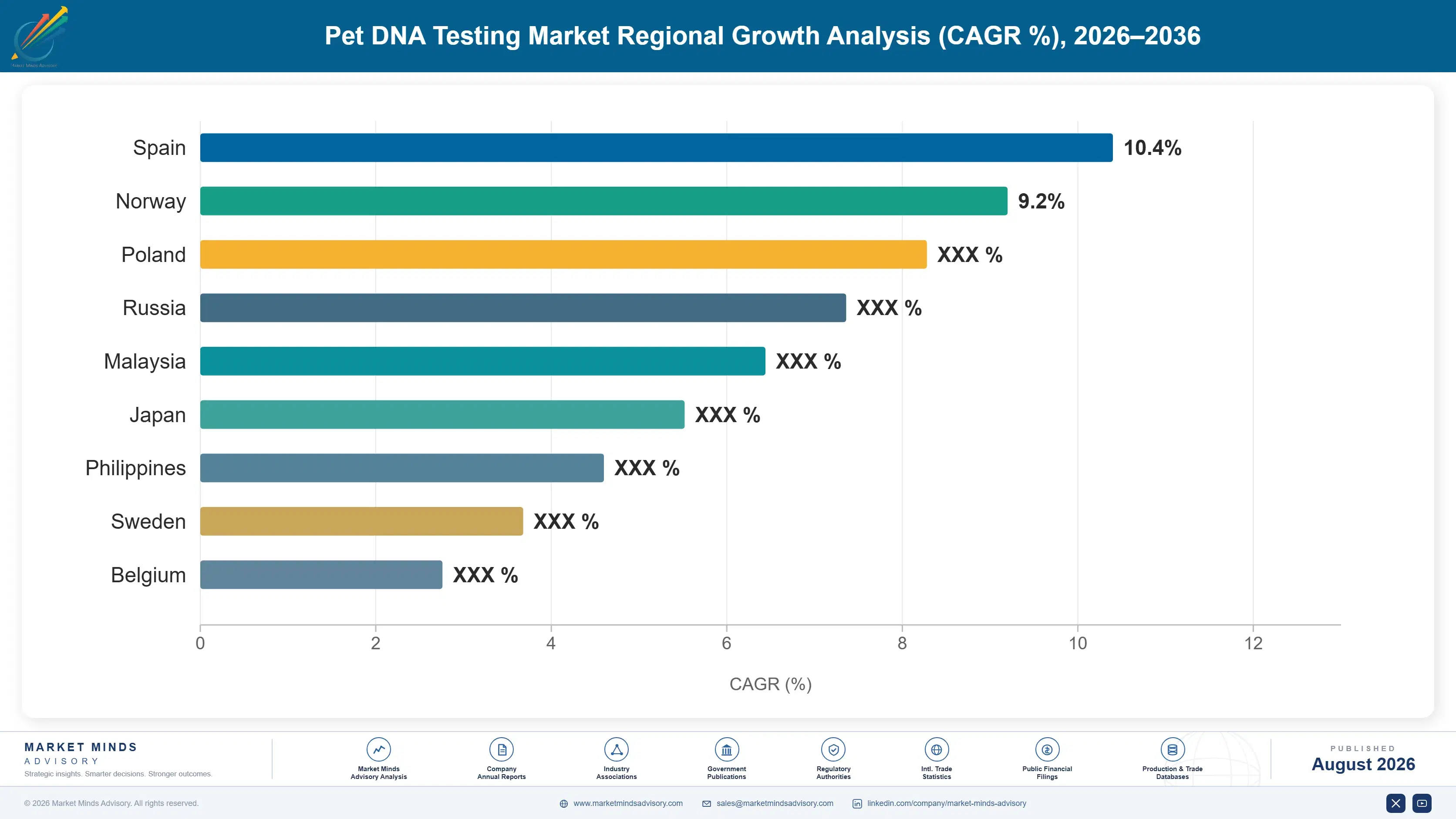
Regional Architecture and Country Demand Map

Two regions sit outside the bands this framework applies, and companion animal spending rather than pet population explains both. Where owners treat animals as family and pay accordingly, testing follows; where pets are common but spending is modest, it does not, which makes pet population figures badly misleading here.

North America

North America holds 43% of value against a 32% ceiling in this framework, and household spending per companion animal explains the breach rather than pet numbers. Both of the largest consumer brands originated here and built their reference panels on North American populations, which reinforces accuracy for exactly the breeds their customers own. Veterinary channel development is furthest advanced, and specialty practices increasingly order clinical panels routinely. Direct-to-consumer retail distribution through major chains is also unmatched elsewhere. Growth at 11.4% sits close to the global rate on a large and maturing base, Professional scrutiny of consumer panel validity has also emerged here first, and it aims squarely at the consumer products carrying most volume.
Share: 43% | CAGR: 11.4% (2026 to 2036)

Western Europe

Twenty-four percent of value is recorded across Western Europe, where kennel club and breed registry requirements are stricter than anywhere and drive substantial verified testing volume among breeders. British, German, Scandinavian, and Dutch pedigree associations mandate parentage verification and inherited disease screening for registration across many breeds. Laboklin and comparable laboratories built positions serving that requirement long before consumer testing existed. Veterinary ordering is well established and professionally regulated. Growth at 10.2% trails the global rate on a mature market with high existing penetration among pedigree animals, Registry-mandated volume behaves far more predictably than consumer purchasing ever has, which suits the laboratories serving it, Veterinary ordering is professionally regulated and correspondingly conservative here.
Share: 24% | CAGR: 10.2% (2026 to 2036)
Regional intelligence for 5 additional markets available in the complete report: East Asia, South Asia and Pacific, Latin America, Middle East and Africa, Eastern Europe. Contact sales@marketmindsadvisory.com.
pet-dna-testing-market-country-cagr-analysis-1787298723465

Escaping The Single Transaction Problem

A genome does not change, so the consumer product is inherently a single transaction and no marketing budget alters that arithmetic at all. Every workable lever here moves the buyer, adds recurring service, or exploits the reference panel that already exists. Four follow from that, and three of the four route through a veterinarian instead of an owner.

Build The Veterinary Ordering Channel Deliberately

A practice ordering clinical panels tests across its patient population continuously rather than once, and the result enters a medical record that follows the animal for life. Roughly 21% of tests currently come through clinics, and every point gained converts a one-time consumer sale into repeatable practice volume. Building that channel needs validated clinical panels, veterinary advisory involvement, and practice management integration, none of which a consumer marketing organisation possesses or knows how to build, Acquiring one practice is worth many multiples of acquiring one household, and the lifetime revenue difference is not remotely close.
Market Impact: Clinical channel is currently only 21% of tests

Sell Ongoing Interpretation Rather Than A Single Report

Variant interpretation improves continuously as reference panels grow and literature accumulates, so a result issued today will mean something slightly different in three years. Subscription reinterpretation services costing USD 25 to USD 45 annually convert a single transaction into recurring revenue without requiring a second sample from the animal. Owners who have already paid for the test accept the ongoing charge readily, and the marginal cost of reanalysis against an updated panel is close to nothing, Uptake across an existing customer base reaches roughly a fifth where it is offered.
Market Impact: Earns USD 25 to 45 per subscriber yearly

Pursue Registry And Breeder Mandate Positions

Kennel clubs and breed registries requiring parentage verification and inherited disease screening create compliance demand rather than discretionary demand, and breeders test whole litters instead of single animals. Securing recognition as an approved laboratory for a registry is a multi-year process involving accreditation and validation work, and it produces volume that recurs with every breeding cycle. Registry-mandated testing already carries roughly 3 times the repeat rate of consumer purchases, Accreditation takes years to obtain and effectively excludes anybody who has not started, which makes it worth beginning early, Breeders also test whole litters rather than single animals.
Market Impact: Repeat rate runs roughly 3 times higher throughout

Monetise The Reference Panel Beyond Testing

A panel of millions of genotyped animals with owner-reported phenotype data is a research asset that pharmaceutical and nutrition companies developing animal health products will pay for directly. Licensing de-identified population data supports research revenue of USD 2 million to USD 8 million annually for the largest holders without any additional testing volume. It also strengthens the panel through collaboration, which improves the calling accuracy the testing business competes on anyway, The panel also improves through research collaboration, which feeds back into calling accuracy, Only the largest panel holders have assets worth licensing at that scale.
Market Impact: Licensing earns USD 2 to 8 million yearly

Who Controls the Margin Pool

Concentration at 63% across the top five reflects reference panel scale rather than any laboratory advantage, since sequencing capability is available to anybody. All participants here are compared on measured global revenue from companion animal genetic testing, which requires separating that line from livestock and equine genotyping and from broader veterinary diagnostics inside the larger animal health groups reporting at a much higher level.
Competition splits between consumer marketing and veterinary channel building, and very few companies do both credibly. Mars Petcare and Embark dominate the consumer segment on brand and reference panel scale. Neogen and Laboklin built positions serving breeder and registry requirements long before consumer testing existed. Orivet and comparable specialists focus on veterinary-ordered clinical panels where evidence standards are considerably higher than consumer products were designed for.

Pressure is arriving from professional scrutiny rather than from any new competitor. Veterinary bodies have begun questioning the analytical validity and interpretation of consumer-grade panels, which threatens exactly the clinical credibility the growth channel depends upon. Rankings will shift on whichever companies separate validated clinical products from consumer ones convincingly, and on who builds practice management integration first.
pet-dna-testing-market-company-positioning-matrix-1787298723988

Competitive Moat and Risk Dimensions

MARS PETCARE

Moat: Reference Panel And Retail Distribution

Mars holds one of the largest companion animal reference panels alongside veterinary hospital networks and retail distribution that no independent testing company approaches. Calling accuracy compounds with every test sold, and the group sells more than anybody. Ownership of practice networks also gives it a route into veterinary ordering that consumer brands have to build from nothing.
MARS PETCARE

Risk: Consumer Positioning Against Clinical Scrutiny

The largest brand position was built for consumer engagement rather than for clinical decision support, and veterinary bodies questioning panel validity aim at exactly that. Separating a validated clinical product from a consumer one is awkward when both carry the same name. Repeat purchase near four percent also means growth depends entirely on new customer acquisition.
EMBARK VETERINARY

Moat: Research Depth And Panel Density

Embark built its position on academic research collaboration and unusually dense genotyping per animal, which supports both breed calling accuracy and credible variant interpretation. That research orientation gives it standing with veterinary professionals that a purely consumer brand struggles to earn, and the panel compounds with every test the company sells.
EMBARK VETERINARY

Risk: Narrow Base And Consumer Dependence

The company depends heavily on direct consumer purchases in a single market where repeat buying is negligible and acquisition costs rise annually. It holds no practice network, no retail distribution of consequence, and no livestock or broader diagnostics business to absorb a consumer downturn. Growth requires building a veterinary channel from a standing start.

Players Tracked

Prominent Players

Mars Petcare
Embark Veterinary
Neogen
Laboklin
Orivet

Other Key Players

Basepaws
Zoetis
Antech Diagnostics
IDEXX Laboratories
Paw Print Genetics
Animal Genetics
VetGen
Genoscoper Laboratories
BioPet Laboratories
Gensol Diagnostics
Certagen
Van Haeringen Laboratorium
Weatherbys Scientific
Shenzhen Realbio
Optimal Selection

Recent Developments

FEBRUARY 2025

Veterinary Body Publishes Guidance On Genetic Test Interpretation

A veterinary professional association published guidance on interpreting companion animal genetic test results, cautioning against clinical decisions based on consumer panels without confirmatory testing. The guidance is professional advice rather than any regulatory requirement, and it explicitly distinguished validated clinical panels from consumer ancestry products.
Signal: Professional scrutiny lands hardest on exactly the consumer products that originally built this whole category up
MAY 2025

Breed Registry Extends Mandatory Genetic Screening Requirements

A national kennel club extended mandatory inherited disease screening to additional breeds as a condition of registration, following documented prevalence data in closed populations. The change is a registry rule rather than any legislation, and approved laboratory status is required for a test result to be accepted for registration purposes.
Signal: Registry mandates create compliance demand that behaves nothing at all like ordinary discretionary consumer purchasing does
SEPTEMBER 2025

Testing Company Launches Subscription Variant Reinterpretation Service

A companion animal genetic testing company introduced an annual subscription reanalysing existing customer results against updated variant databases and expanded reference panels. The service requires no new sample, and the company positioned it explicitly around recurring revenue rather than around any additional clinical benefit claim.
Signal: Reinterpretation converts a permanently single transaction into revenue that genuinely recurs every single year after that

Arrays, Sequencing And Acquisition

Genotyping array or sequencing reagents account for roughly 24% to 34% of delivered test cost, sourced from a small group of platform suppliers whose pricing has fallen steadily for a decade. Collection kits, swabs, and return postage add 12% to 18%. Bioinformatics, variant curation, and report generation carry 10% to 16%, and customer acquisition dwarfs all of it on the consumer side at 30% to 45% of revenue.
Genotyping and sequencing consumable pricing fell substantially through 2023 and 2024 as competition arrived in short-read instrumentation, and Illumina's 2024 annual report documented consumable revenue declining while volumes rose, which is the pattern falling unit prices produce. Companion animal testing benefited directly. Digital advertising costs moved sharply the other way across the same period, more than offsetting the laboratory saving for consumer-focused operators, Several consumer operators found their laboratory savings consumed entirely by advertising inflation.

Exposure separates by channel rather than by scale, which is the central commercial fact here. A consumer operator spends more on acquiring each customer than on running the test, so advertising auction dynamics matter more than any reagent negotiation. A veterinary channel operator acquires a practice once and supplies it repeatedly, which inverts that cost structure entirely.
pet-dna-testing-market-cost-volatility-analysis-1787298724185

Shift Acquisition Spend Toward Veterinary Practice Recruitment

Acquiring one consumer produces one test while acquiring one practice produces a recurring stream across its patient population, yet consumer operators routinely spend the same money chasing individuals. Redirecting acquisition budget toward practice recruitment and clinical education costs far less per unit of lifetime revenue earned, and it produces revenue that recurs rather than ending with a single report.

Contract Genotyping Consumables On Multi-Year Volume Terms

Array and sequencing consumable pricing has fallen steadily and multi-year committed volume agreements lock in that trajectory rather than repricing annually against whatever the platform supplier decides. Volumes here are predictable enough that commitment risk stays modest, and the saving compounds directly into gross margin on every test processed, which matters more as panel breadth increases across the category.

Automate Variant Curation And Report Generation

Manual variant curation and report review scale linearly with test volume and represent a growing share of cost as panels widen and literature accumulates. Automated curation pipelines with expert review reserved for novel or ambiguous findings hold that cost flat as volume grows, and they shorten turnaround, which matters more to veterinarians than to consumers.

Portfolio Architecture for Margin Defence

Margin architecture separates by who orders the test and therefore by what it costs to sell. Consumer breed and ancestry products earn 18% to 32% after acquisition cost, and the upper end only where a brand has organic demand rather than paid traffic. Veterinary-ordered clinical panels and registry-mandated testing earn 48% to 64%, because the buyer arrives through a professional relationship rather than through an advertising auction.
The tension is that consumer volume built the reference panels that everything else depends upon. Millions of consumer tests created the calling accuracy that makes clinical interpretation credible, and a company withdrawing from consumer sales stops feeding the asset that gives it an advantage. Managing that trade-off properly is harder than it appears from either side of the business.

High-value pools concentrate in veterinary clinical panels, registry-approved testing, and reference panel licensing. All three avoid the consumer acquisition auction entirely, which is where the money currently disappears. Subscription reinterpretation carries the widest margin range, because the marginal cost of reanalysing an existing genotype is close to nothing and pricing is set by whatever owners will accept, which is why so few operators have bothered to launch it.

Volume / Commodity-Adjacent

Consumer breed and ancestry products sold through retail and direct channels where customer acquisition cost dominates every other input. The fourteen-point range separates brands with organic demand and retail distribution from those buying every customer through digital advertising auctions.
Gross Margin: 18% to 32%

Premium / Certified

Veterinary-ordered clinical panels and registry-approved parentage and disease screening, where a professional relationship replaces paid acquisition entirely. The sixteen-point range separates validated clinical products from registry compliance testing sold at negotiated laboratory pricing.
Gross Margin: 48% to 64%

Sustainability / Regulatory / Next-Generation

Subscription variant reinterpretation, reference panel data licensing, and practice management integrated ordering services. The forty-four point range reflects real divergence: integration work carries software economics while reinterpretation costs almost nothing to deliver.
Gross Margin: 38% to 82%
pet-dna-testing-market-portfolio-architecture-1787298724694

High-value Sub-segments and Strategic Watch-out

Veterinary Clinical Panels

Highest growth and strongest margin, because a practice orders repeatedly across a patient population while a consumer buys once. Evidence standards are considerably higher than consumer products were built for, which is both the barrier and the reason the position holds once established, and practice software integration deepens it further.
Gross Margin: 54% to 64%

Subscription Reinterpretation

Converts a permanently single transaction into recurring revenue at almost no marginal cost, since reanalysing an existing genotype against updated panels requires no new sample. Owners who already paid accept twenty-five to forty-five dollars annually without much resistance at all, and remarkably few operators currently offer it at all.
Gross Margin: 62% to 82%

Consumer Breed And Ancestry

The volume core that built every reference panel in this market and the part with no repeat purchase whatsoever. Acquisition cost has risen every year while novelty appeal fades, yet it remains the asset everything else depends upon, and growth now requires buying a new customer every time.
Gross Margin: 18% to 32%

Unvalidated Consumer Health Panels

Strategic watch-out. Veterinary bodies have begun questioning the analytical validity and interpretation of consumer-grade health reporting, and a professional credibility problem here would damage the clinical channel that carries all the growth, Separating validated clinical products from consumer ones is now a defensive necessity, rather than a branding preference.
Gross Margin: 22% to 38%

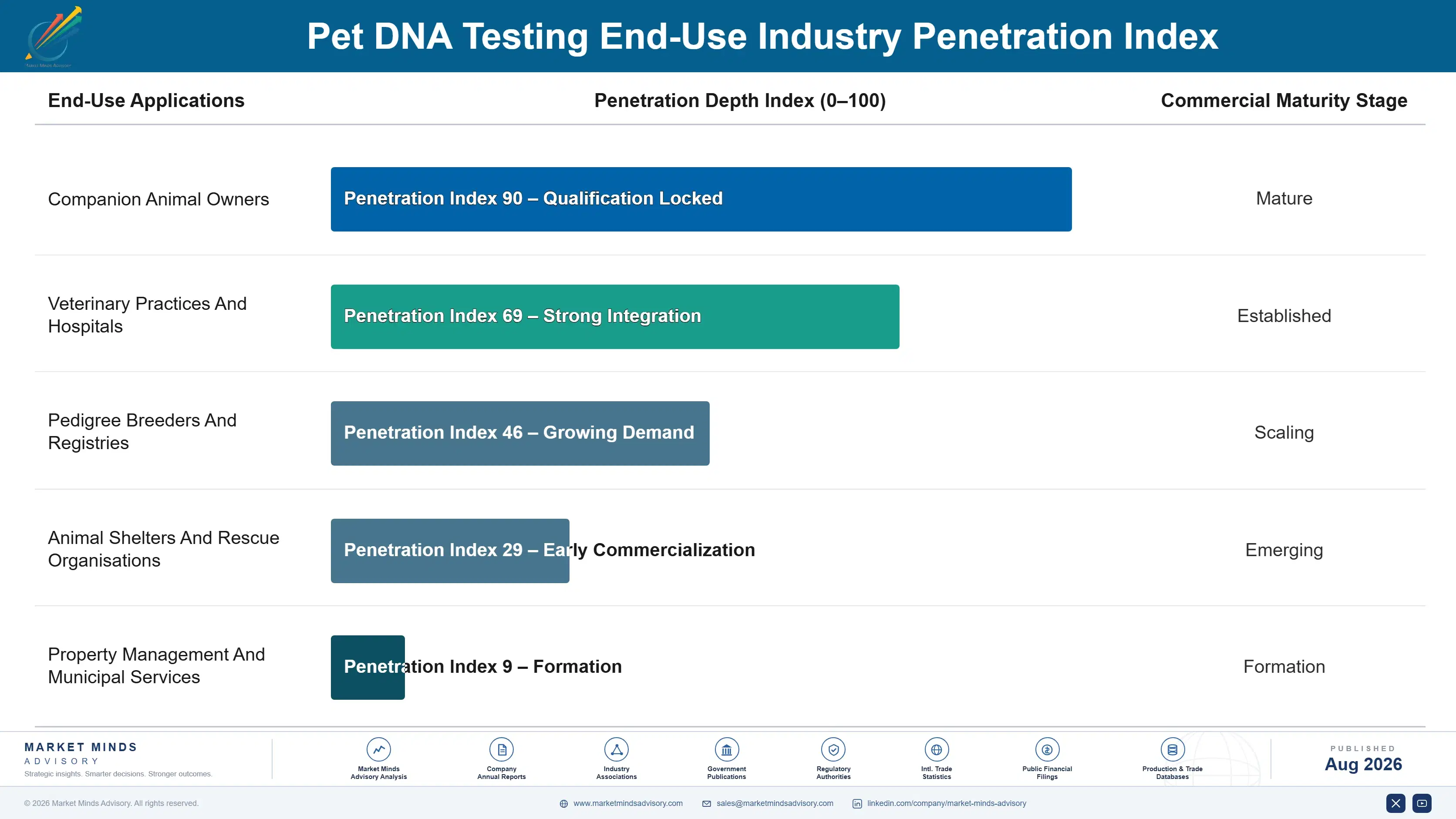
Why One Test Is Usually Enough

The commercial difficulty here is that a genome is permanent. An owner who tests an animal has the answer forever, which puts repeat purchase near 4% and makes the consumer business a treadmill of acquiring new customers for single transactions. Nothing about marketing execution changes that arithmetic. The businesses that grow are those that found a buyer who returns, and in this market that buyer is a veterinary practice or a breeder rather than a household.
Depth varies enormously by channel. Registry-mandated breeder testing is the stickiest, since approved laboratory status is required for a result to count and breeders test every litter they produce. Veterinary clinical ordering is nearly as durable once integrated into practice management software and clinical protocols. Consumer purchases have no depth at all, and retail shelf presence rather than loyalty determines the next sale.

Buyer profiles are shifting in the direction the category needs. Veterinarians are moving from regarding these tests as owner curiosities toward ordering validated panels themselves where variants change management. Registries keep extending mandatory screening. Both shifts reward companies with clinical evidence and professional standing, and they steadily disadvantage anybody whose product was designed primarily to be entertaining.
pet-dna-testing-market-end-use-penetration-index-1787298725195

Where We Come Out

These are among the four positions where our research anticipates prominent divergence between winners and laggards over the coming forecast period. Each is grounded in the demand model, the regulatory perimeter, and the announced capacity pipeline.
01 / VETERINARY CHANNEL BUILDING

Find a buyer who returns, because owners never do

A genome does not change, so an owner who tests an animal has a permanent answer and only about four percent ever buy again, which makes the consumer business a treadmill of acquiring new customers for single transactions. A veterinary practice orders across its patient population continuously and enters results into records that follow each animal for life. Building that channel needs validated panels, professional standing, and practice software integration, none of which a consumer marketing organisation currently possesses, Acquiring one practice is worth many multiples of acquiring one household.
02 / REFERENCE PANEL COMPOUNDING

The database is the moat and volume is how you feed it

Breed calling and variant interpretation both improve with the number and diversity of genotyped animals behind them, so accuracy compounds with every test sold in a way that laboratory equipment never does. A competitor can buy identical sequencing capability within weeks and cannot acquire millions of reference genotypes at any price at all. That is a genuine data network effect, rare in diagnostics, and it explains concentration far better than any technical barrier in this category does, Withdrawing from consumer volume also starves the panel that creates the advantage.
03 / CLINICAL CREDIBILITY DEFENCE

Separate the validated panel from the entertaining one

Veterinary professional bodies have started questioning the analytical validity and interpretation of consumer-grade panels, and they are aiming at precisely the products that built this whole category in the first place. Clinical ordering is where all the growth sits and it depends entirely on professional credibility that a criticised consumer product will quietly destroy. Running validated clinical panels under distinct branding, curation standards, and veterinary advisory oversight is now a defensive necessity rather than an option, The two products can share a laboratory and should not share a brand.
04 / RECURRING REVENUE DESIGN

Reinterpretation costs nothing and recurs every year

Variant interpretation improves continuously as reference panels grow and published literature accumulates, so a result issued today genuinely means something different in three years without any new sample being collected. Subscription reanalysis at twenty-five to forty-five dollars annually converts a permanently single transaction into recurring revenue at close to zero marginal cost. Owners who have already paid for testing accept the ongoing charge readily, and remarkably few operators have bothered to offer it, Uptake reaches roughly a fifth of an existing base where it has been tried.

Engagement Snapshot From the Field

A live engagement with an industry participant carrying material or product regulatory and market exposure ahead of a defining policy shift, showing how our research translates into a defensible multi-year portfolio strategy.
MARKET MINDS ADVISORY · CLIENT ENGAGEMENT SUMMARY
Pet DNA Testing Producer Strategic Portfolio Review and Transition Roadmap 2026·Investment Scenario on Pet DNA Testing Exposure Evaluation 2025-26
CLIENT PROFILE
A venture-backed companion animal genetics company with roughly USD 74 million in annual revenue (client-reported, unverified by MMA), selling breed and health panels direct to owners across North America and Western Europe. The business held a substantial reference panel built from consumer volume, no veterinary channel presence of any kind, and no recurring revenue from any source.
STRATEGIC CHALLENGE
Customer acquisition cost had risen for four consecutive years while repeat purchase remained near zero, and a veterinary professional association had just published guidance cautioning against clinical decisions based on consumer panels. The board needed to decide whether to keep buying growth in a channel with no repeat behaviour or to rebuild the business around a different buyer entirely.
MMA APPROACH
MMA analysed unit economics by channel across four years of the client's own data, interviewed twenty-six veterinarians and eleven breed registry officials on ordering criteria and approval requirements, and modelled subscription reinterpretation uptake against the existing customer base. Reference panel licensing interest was tested separately with animal health and nutrition companies.
KEY FINDINGS
  1. Customer acquisition cost had reached 41% of consumer revenue and exceeded the entire laboratory cost of running the test, with repeat purchase measured at 3.6% across the base.
  2. Twenty-one of twenty-six veterinarians said they would order genetic panels routinely if the product carried validated clinical curation and integrated with practice management software.
  3. Registry approval for parentage and disease screening required an accreditation process the client had never begun, and approved laboratories reported 3.2 times the repeat volume of consumer sales.
  4. Modelled subscription reinterpretation uptake reached 19% of the existing customer base at USD 35 annually, at a marginal delivery cost under USD 2 per subscriber.
CLIENT PROFILE
A venture-backed companion animal genetics company with roughly USD 74 million in annual revenue (client-reported, unverified by MMA), selling breed and health panels direct to owners across North America and Western Europe. The business held a substantial reference panel built from consumer volume, no veterinary channel presence of any kind, and no recurring revenue from any source.
STRATEGIC CHALLENGE
Customer acquisition cost had risen for four consecutive years while repeat purchase remained near zero, and a veterinary professional association had just published guidance cautioning against clinical decisions based on consumer panels. The board needed to decide whether to keep buying growth in a channel with no repeat behaviour or to rebuild the business around a different buyer entirely.
MMA APPROACH
MMA analysed unit economics by channel across four years of the client's own data, interviewed twenty-six veterinarians and eleven breed registry officials on ordering criteria and approval requirements, and modelled subscription reinterpretation uptake against the existing customer base. Reference panel licensing interest was tested separately with animal health and nutrition companies.
KEY FINDINGS
  1. Customer acquisition cost had reached 41% of consumer revenue and exceeded the entire laboratory cost of running the test, with repeat purchase measured at 3.6% across the base.
  2. Twenty-one of twenty-six veterinarians said they would order genetic panels routinely if the product carried validated clinical curation and integrated with practice management software.
  3. Registry approval for parentage and disease screening required an accreditation process the client had never begun, and approved laboratories reported 3.2 times the repeat volume of consumer sales.
  4. Modelled subscription reinterpretation uptake reached 19% of the existing customer base at USD 35 annually, at a marginal delivery cost under USD 2 per subscriber.
RECOMMENDED STRATEGY
Phase 1: Phase one: launch subscription reinterpretation across the existing customer base immediately, since the reference panel and genotypes already exist and delivery cost is negligible. Phase 2: Phase two: develop a separately branded validated clinical panel with veterinary advisory curation, and build practice management integration before approaching any clinics. Phase 3: Phase three: begin registry accreditation in the three largest breeder markets and cut consumer acquisition spending to whatever organic demand supports.
OUTCOME
The client launched reinterpretation within one quarter and reached 22% uptake in the first year. Consumer acquisition spending fell by half, the clinical panel entered pilot with 140 practices, and total revenue grew 18% while gross margin improved by nine points (client-reported, unverified by MMA).

Frequently Asked Questions

Foundational context covering the market sizes, CAGR, scope, country, region and competition that inform every finding below. This section is provided to cover basics and most often pre-purchase conversations, answered from the MMA Primary Research Dataset.

What is the current size of the Pet DNA Testing Market?

The global pet DNA testing market reached USD 0.58 billion in 2025, covering breed ancestry, inherited disease risk, clinical variant identification, parentage verification, and population identification testing in companion animals. Livestock and equine testing are excluded.

How large will the Pet DNA Testing Market be by 2036?

MMA forecasts USD 1.94 billion by 2036, up from USD 0.65 billion in 2026, an increase of USD 1.29 billion. That represents an expansion multiple of 3.00 times across the forecast period.

What is the CAGR for the Pet DNA Testing Market 2026 to 2036?

The base case CAGR is 11.6%, with a bull case of 12.9% and a bear case of 10.3%. Historical growth between 2020 and 2025 ran at 10.4%, combining a consumer boom that partly reversed with a clinical channel building quietly.

Which segment is growing fastest?

Veterinary-ordered clinical genetic testing grows fastest at 17.4%, exactly 1.50 times the market rate, because practices order repeatedly across patient populations. Hereditary disease risk panels follow at 14.2% on registry requirements.

Who are the major companies in the Pet DNA Testing Market?

Mars Petcare, Embark Veterinary, Neogen, Laboklin, and Orivet lead, together holding 63% of the market. Reference database scale rather than laboratory capability explains that concentration.

Which country is growing fastest?

China grows fastest at 15.8%, driven by companion animal ownership rising extremely quickly from a very low base and premium veterinary chains offering genetic screening. Domestic reference panels are being built for regional breeds.

Report Segmentation Architecture

The full report scope spans multiple orthogonal segmentation dimensions, with cross-tabulated demand data provided for each dimension pair. Coverage extends further to regional breakdowns, trend trajectories, and the competitive detail needed to support segment-level decision-making.

By Test Purpose

  • Veterinary-Ordered Clinical Genetic Testing
  • Hereditary Disease Risk Panels
  • Breed Identification And Ancestry
  • Parentage And Pedigree Verification
  • Population Identification And Waste Enforcement

By End-Use Industry

  • Companion Animal Owners
  • Veterinary Practices And Hospitals
  • Pedigree Breeders And Registries
  • Animal Shelters And Rescue Organisations
  • Property Management And Municipal Services

By Commercial Dimension

  • Direct-To-Consumer Online Sales
  • Retail And Pet Store Distribution
  • Veterinary Practice Ordering
  • Registry-Approved Laboratory Supply
  • Subscription And Data Licensing Services

By Region

  • North America
  • East Asia
  • Western Europe
  • South Asia and Pacific
  • Latin America
  • Middle East and Africa
  • Eastern Europe

Scope, Methodology, and Coverage

Every figure in this report is reproducible from documented input assumptions. The scope below maps the historical period, the forecast horizon, the segmentation dimensions, and the countries covered, alongside the underlying primary and qualitative methodology.
Historical Period
2020 to 2025
Forecast Period
2026 to 2036
Base Year
2025 (USD billions; MMA Primary Research Dataset, August 2026)
Market Definition
The pet DNA testing market covers genetic testing of companion animals for breed ancestry, inherited disease risk, clinical variant identification, parentage and pedigree verification, and population identification, whether purchased directly by owners, ordered through veterinary practices, or required by breed registries. Scope spans dogs, cats, and other companion species and includes collection kits, laboratory analysis, result reporting, and subscription reinterpretation services. Livestock and equine genetic testing, veterinary infectious disease diagnostics, animal cancer screening, microbiome sequencing, and research genotyping services are excluded.
Quantitative Units
USD billions at supplier revenue level; tests performed annually; reference panel size in genotyped animals.
Segmentation Dimensions
By test purpose; by end-use industry; by commercial dimension; by region.
Regions Covered
North America, East Asia, Western Europe, South Asia and Pacific, Latin America, Middle East and Africa, Eastern Europe
Countries Covered
United States, Canada, United Kingdom, Germany, France, Netherlands, Sweden, Italy, Poland, Czech Republic, China, Japan, South Korea, India, Australia, Singapore, Brazil, Mexico, United Arab Emirates, South Africa.
Key Companies Profiled
Mars Petcare, Embark Veterinary, Neogen, Laboklin, Orivet, Basepaws, Zoetis, Antech Diagnostics, IDEXX Laboratories, Paw Print Genetics, Animal Genetics, VetGen, Genoscoper Laboratories, BioPet Laboratories, Gensol Diagnostics, Certagen, Van Haeringen Laboratorium, Weatherbys Scientific, Shenzhen Realbio, Optimal Selection.
Quantitative Methodology
Primary survey, n=3,800 respondents, Q4 2025, six countries; demand-side model with trade association cross-validation
Qualitative Methodology
47 expert interviews, Q4 2025; applied to validate demand model assumptions, identify emerging dynamics, and assess competitive positioning
Report Format
PDF and XLSX data workbook (Word format preview document)
Publisher
Market Minds Advisory
Report Code
MMA-2026-HLT-911
Published
August 2026
Contact
sales@marketmindsadvisory.com | www.marketmindsadvisory.com

Purchase the full Pet DNA Testing Market Report (2026 to 2036).

The full MMA report on pet DNA testing covers test purpose, regional, and competitive analysis in detail, with separate treatment of the channel economics that separate a single consumer transaction from repeatable veterinary ordering. It includes acquisition cost and lifetime value modelling by channel, reference panel scale benchmarking across providers, registry approval requirements and repeat volume analysis, and subscription reinterpretation uptake modelling. Regional chapters cover twenty countries with pet spending and registry structure assessed individually. Competitive profiling spans twenty companies on a consistent revenue basis throughout the analysis.
Twenty country pet spending and registry structure chapters
Acquisition cost and lifetime value modelling by channel
Reference panel scale benchmarking across major providers
Registry approval requirements and repeat volume analysis
Twenty company competitive profiles compared consistently
Subscription reinterpretation uptake and margin modelling

Built For The People Who Decide

From boardroom strategy to bench-side execution, this report is read cover-to-cover by leaders shaping the next decade of their industry, turning demand scenarios, market dynamics and valuation benchmarks into decisions.
CXOs/ Presidents/ VPs/ Managers
M&A and Corporate Development
Strategy Teams and R&D Heads
Procurement and Product Directors
Regulatory and Compliance Leaders
Investor Relations and Equity Analysts