Market Minds Advisory
Pet Diabetes Care Devices Market

Pet Diabetes Care Devices Market: Continuous Monitoring Reshapes Pet Diabetes Care

Continuous glucose monitoring technology adapted from human diabetes care is transforming pet diabetes management from periodic blood sampling toward real-time tracking, while rising diagnosis rates tied to pet obesity trends expand the addressable population.

Lead Analyst

Alice Ballenger

Published

September 2026

Make Smarter Decisions with Customized Research Insights

Request a free sample report and evaluate market opportunities, growth trends, and competitive dynamics relevant to your business needs.

2025 MARKET VALUE$0.4BMarket Size 2025
2036 FORECAST VALUE$1.2BBase Case , 2026 to 2036
CAGR 2026 TO 203610.4 %Bull 11.7% / Bear 9.1%
INCREMENTAL OPPORTUNITY$0.8BNet 10- year value creation
EXPANSION MULTIPLE2.70x2036 value over 2026 base
Strategic Levers
M&A Pipeline
Regional Outlook
Country Rankings
Competitive Intelligence
Segmental Deep-dive
Call-Us : 91 93563 13602

Executive Snapshot and Market Trajectory

Pet diabetes care is shifting from periodic blood glucose testing performed during veterinary visits toward continuous glucose monitoring systems that owners can use at home, as CGM technology adapted from human diabetes care becomes purpose-built for veterinary use and increasingly affordable for everyday pet owners.
Demand concentrates in North America, where high pet healthcare spending and dense veterinary specialty care infrastructure support the largest diagnosed diabetic pet population globally. Continuous glucose monitoring systems are growing fastest as owners and veterinarians increasingly prefer real-time tracking over the stress and inconvenience of frequent blood draws for glucose curve testing. Insulin delivery devices remain the largest application by revenue given their essential role in daily diabetes management for diagnosed pets.
Competition centers on monitoring accuracy and integration simplicity rather than raw hardware novelty, since core glucose sensing technology has matured considerably across established manufacturers. Abbott, Zoetis, and IDEXX each sell proprietary sensor and reader combinations calibrated to specific veterinary workflows, creating meaningful switching costs once a clinic and its clients validate a particular monitoring system. Smaller manufacturers compete on price and simplified device design for cost-conscious pet owners.
Market Definition
The Pet Diabetes Care Devices Market covers blood glucose meters, continuous glucose monitoring systems, insulin pens, insulin pumps, and connected diabetes management software used to diagnose and manage diabetes mellitus in companion dogs and cats. It excludes prescription insulin formulations themselves, general veterinary diagnostic equipment, and human diabetes care devices not adapted or labeled for veterinary use.
Base Year Value
$0.4B in 2025 (MMA Primary Research Dataset, August 2026)
Forecast Period
2026 to 2036, eleven discrete annual values
CAGR
10.4% base case. Bull 11.7%. Bear 9.1%.
Fastest Growth Segment
Continuous Glucose Monitoring Systems: 16.8% CAGR
Fastest Growth Country
China: 13.8% CAGR
Fastest Growth Region
South Asia and Pacific: 12.4% CAGR
Largest Region
North America: 38% of 2025 global value
Market Leaders
Zoetis Inc., Abbott Laboratories, IDEXX Laboratories Inc., Boehringer Ingelheim Animal Health GmbH, and Merck Animal Health (Intervet Inc.). Source: MMA Analysis based on company annual reports.
Primary Survey
n=3,800 procurement and R&D decision-makers, Q4 2025, six countries
Methodology
Demand-side build-up, cross-validated against public data, 47 expert interviews

Pet Diabetes Care Devices Market Forecast Scenarios

pet-diabetes-care-devices-market-size-forecast-scenario-1787306269712
Pet diabetes device demand grew rapidly between 2020 and 2025 at roughly 9.4 percent annually, as rising pet obesity and improved veterinary diagnostic awareness drove increasing diabetes diagnosis rates, while early continuous glucose monitoring adoption accelerated meaningfully from 2022 onward as veterinary-labeled devices reached the market. Pandemic-era pet ownership growth also expanded the companion animal population base through 2021 and 2022.
The base case assumes 10.4 percent annual growth through 2036, anchored on three mechanisms: continued expansion of purpose-built veterinary continuous glucose monitoring adoption replacing periodic blood glucose curve testing, rising pet obesity and aging pet population driving increased diabetes diagnosis rates, and growing pet owner willingness to invest in advanced home monitoring technology as awareness spreads through veterinary recommendation and social media. Veterinary diagnostic companies are also standardizing connected software platforms to simplify data sharing.
A bull scenario, at 11.7 percent, assumes faster continuous glucose monitoring cost reduction and broader veterinary clinic adoption accelerate device penetration beyond current projections. A bear scenario, at 9.1 percent, assumes persistent pet owner cost sensitivity slows premium device adoption in favor of traditional blood glucose testing in price-constrained markets. Veterinary specialty training capacity constraints could also limit near-term diagnosis rate growth.

Continuous Monitoring Reshapes Pet Diabetes Care

Pet diabetes care devices sit at the intersection of rising companion animal obesity, improving veterinary diagnostic capability, and a genuine technology transfer from human diabetes management into purpose-built veterinary applications. This combination gives the category unusually durable demand growth relative to many other veterinary device segments still tied primarily to discretionary wellness spending rather than ongoing chronic disease management necessity across most markets.
MARKET CONCENTRATION (CR5)46%Five companies hold substantial combined category revenue leadership currently
AVERAGE CGM SYSTEM COST$180Continuous monitoring systems carry meaningful recurring sensor replacement cost
TOP ADOPTING COUNTRY SHARE34%The United States dominates global device consumption and category revenue
DIAGNOSED DIABETIC PET SHARE1.2%A small but meaningful share of pets develop diabetes
CGM ADOPTION RATE24%A growing minority of diagnosed pets now use continuous monitoring
AVERAGE DEVICE REPLACEMENT CYCLE14 daysSensor components require regular replacement supporting recurring revenue streams
Commercially, the market splits between established animal health manufacturers selling proprietary glucose monitoring and insulin delivery systems through veterinary clinic channels, and a fragmented tier of consumer-facing device makers competing on price for direct pet owner purchases online. Distribution runs through both veterinary clinic prescription channels for clinical-grade monitoring systems and direct-to-consumer retail for supplies and test strips nationwide.
Monitoring accuracy and data integration simplicity will define competitive position over the next decade more than incremental hardware design differences, which have converged considerably across established manufacturers. Vendors able to demonstrate reliable veterinary-specific accuracy and simplify owner-veterinarian data sharing are positioned to capture disproportionate share of pet diabetes management spending industry-wide over time, particularly among insured owners.
"Owners used to bring their pet in for a glucose curve and wait all day. Now they check a phone app before breakfast."
Director, Veterinary Diagnostics and Devices Practice · MMA Veterinary Diagnosti

Market Trends

Continuous Glucose Monitoring Adoption Accelerates Now

Continuous glucose monitoring systems, which use a small sensor patch to track glucose levels continuously rather than requiring periodic blood draws, are gaining rapid adoption among diagnosed diabetic pets as purpose-built veterinary devices reach the market at increasingly accessible price points. Abbott and Zoetis have both expanded veterinary-specific CGM offerings since 2023, adapting sensor technology originally developed for human diabetes management to companion animal physiology and skin characteristics. Veterinarians increasingly recommend CGM adoption specifically for pets with unstable glucose control, where continuous data provides meaningfully better insulin dosing guidance than periodic testing. CGM systems captured an estimated 24 percent of diagnosed diabetic pet monitoring in 2025.
Market Impact: Lifts diagnosis rates 18% since 202
Connected Mobile Applications Become Standard Feature

Glucose monitoring device manufacturers are increasingly bundling connected mobile application software that allows pet owners to track glucose trends and share data directly with treating veterinarians, replacing manual logbook tracking that historically complicated diabetes management communication between owners and clinical staff. This connectivity trend reflects growing owner expectation for consumer technology-grade user experience even in veterinary device categories, mirroring broader digital health adoption patterns across human healthcare as well. IDEXX and Zoetis have both expanded connected software platform investment since 2023, responding to owner demand for simplified data sharing and remote veterinary consultation support. Connected devices now represent an estimated 38 percent of new glucose monitoring device sales.
Market Impact: Expands premium adoption 22% since

Market Opportunities and Growth Drivers

Rising Pet Obesity Drives Diagnosis Rates

Rising companion animal obesity prevalence, driven by sedentary indoor lifestyles and increasingly calorie-dense commercial pet food formulations, is directly increasing diabetes diagnosis rates among both dogs and cats presenting for routine veterinary wellness examinations. Broader veterinary awareness of obesity-linked diabetes risk factors is also improving diagnostic capture rates, creating demand growth independent of any change in underlying disease biology or pet population size. Veterinary practices managing larger patient populations with elevated obesity rates report particularly strong growth in diabetes diagnosis and device prescription volume tied to preventive wellness screening. This dynamic is expected to sustain steady demand growth throughout the forecast period as pet obesity trends continue across most developed pet ownership markets.
Market Impact: Limits adoption where sensors cost

Growing Pet Owner Healthcare Spending Willingness

Pet owners are increasingly willing to invest in advanced diabetes management technology for their animals, reflecting broader humanization trends in pet care spending and growing owner comfort with recurring subscription-style healthcare costs for chronic condition management. This spending willingness directly increases premium device adoption rates, creating demand growth independent of any change in underlying diabetes diagnosis rates or veterinary recommendation patterns. Pet insurance adoption has also expanded meaningfully in key markets over the past several years, reducing the effective out-of-pocket cost burden for advanced monitoring technology and encouraging broader adoption among previously cost-constrained owner segments. This dynamic is expected to continue supporting premium device adoption throughout the forecast period as pet insurance penetration expands.
Market Impact: Slows adoption despite 24% CGM inte

Market Restraints and Challenges

Device Cost Limits Broader Adoption Now

Continuous glucose monitoring systems and connected insulin delivery devices carry meaningful recurring cost for sensor replacement and supplies, creating a genuine adoption barrier for cost-conscious pet owners who might otherwise prefer advanced monitoring technology over traditional periodic testing. The root cause is that veterinary CGM sensors require regular replacement given adhesive and battery limitations, creating an ongoing recurring cost burden that differs meaningfully from a one-time device purchase model most pet owners expect for durable healthcare equipment. This cost structure disproportionately limits adoption among lower-income pet owner segments and in markets with less developed pet insurance penetration. Manufacturers are mitigating the gap with lower-cost sensor variants and subscription-style pricing for budget-conscious owners.
Market Impact: Captures 24% of diagnosed pet monit

Limited Veterinary Specialty Training Now

Many general veterinary practices lack specialized training in advanced diabetes management technology, including continuous glucose monitoring interpretation and insulin dosing optimization, limiting how quickly practices can confidently recommend and support advanced device adoption among their diabetic patient population. The root cause is that veterinary schools and continuing education programs have not fully kept pace with rapidly evolving technology, leaving many practicing veterinarians less familiar with newer monitoring systems than with traditional periodic testing approaches they trained on originally. This training gap slows device adoption even among owners willing to invest in advanced technology, since veterinary recommendation strongly influences purchasing decisions. Manufacturers are mitigating the gap by expanding continuing education and simplified clinical training materials.
Market Impact: Represents 38% of new device sales
3 additional market trends, 2 additional growth drivers, and 4 additional restraints and challenges are covered in the full report. Contact sales@marketmindsadvisory.com to access the complete intelligence.

Segment CAGR and Growth Architecture

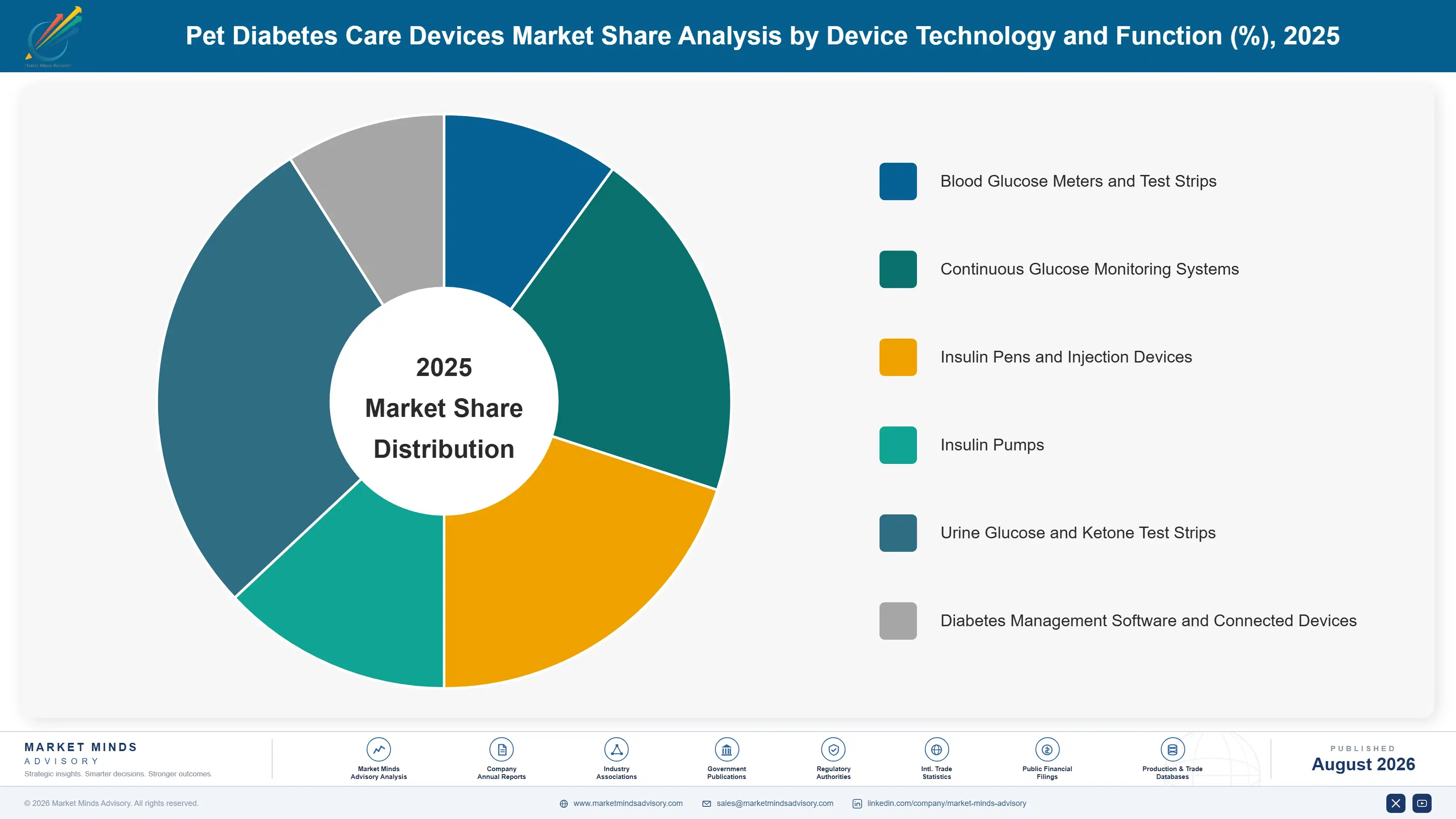
Segmentation follows device technology and clinical function, the classification veterinarians and pet owners use when selecting products for diabetes diagnosis and ongoing management. Six segments span the full technology range from established blood glucose meters through emerging continuous glucose monitoring and connected software formats, keeping each category mutually exclusive by underlying device function and monitoring mechanism.
pet-diabetes-care-devices-market-market-share-analysis-1787306270246

Continuous Glucose Monitoring Systems

Continuous glucose monitoring systems use a small adhesive sensor patch to track interstitial glucose levels continuously, eliminating the need for frequent blood draws that historically made glucose curve testing stressful for pets and time-consuming for owners and veterinary staff alike. Growth is accelerating fastest of any segment as purpose-built veterinary CGM devices reach the market at increasingly accessible price points, replacing sensors originally adapted off-label from human diabetes care products. Abbott and Zoetis dominate this segment given their established sensor manufacturing infrastructure and accumulated clinical validation data built through years of veterinary-specific adaptation research. Adoption remains concentrated among owners of pets with unstable glucose control requiring frequent monitoring, though broader adoption is expanding as device costs decline and veterinary familiarity grows steadily.
CAGR 16.8%

Diabetes Management Software and Connected Devices

Diabetes management software and connected devices allow pet owners to track glucose trends, log insulin doses, and share data directly with treating veterinarians through mobile applications, replacing manual paper logbook tracking that historically complicated communication between owners and clinical staff. Growth is accelerating as connectivity becomes an expected standard feature rather than a premium add-on, mirroring broader consumer technology expectations pet owners bring from other digital health and lifestyle applications they use daily. IDEXX and Zoetis lead this segment given their established veterinary clinic software relationships and broader diagnostic platform integration built across their veterinary practice management product portfolios. This segment benefits from strong recurring engagement given daily data logging requirements inherent to ongoing diabetes management.
CAGR 14.2%
Full segment breakdown across 6 segments available in the complete report.

Regional Architecture and Country Demand Map

Pet diabetes device demand concentrates where pet healthcare spending and veterinary specialty infrastructure run highest. North America's dominant pet healthcare spending, alongside Western Europe's established veterinary specialty networks and East Asia's rapidly growing companion animal healthcare market, together account for the large majority of global device revenue worldwide today.

North America

The United States accounts for the overwhelming majority of North American demand, reflecting the country's uniquely high pet healthcare spending and dense veterinary specialty care infrastructure supporting advanced diabetes management technology adoption among diagnosed pets. Major veterinary specialty hospital networks and general practices alike increasingly recommend continuous glucose monitoring for diagnosed diabetic patients, reflecting the region's comparatively high pet insurance penetration reducing effective device cost burden. Canada's smaller but steady demand tracks similar veterinary care patterns, though somewhat lower per-capita pet healthcare spending keeps device adoption modestly below United States levels. Out-of-band note: North America's share sits above the standard band because United States pet healthcare spending and veterinary specialty infrastructure concentration here are genuinely unmatched elsewhere globally.
Share: 38% | CAGR: 10.9% (2026 to 2036)

Western Europe

Germany, France, and the United Kingdom drive most Western European demand, each maintaining well-developed veterinary specialty networks and comparatively high pet insurance penetration supporting advanced diabetes management device adoption relative to global averages. Established animal health manufacturers headquartered in the region maintain particularly strong domestic market positions given proximity to both manufacturing and veterinary clinical research infrastructure supporting continued product development. Nordic countries maintain particularly high pet insurance penetration relative to their population size, sustaining steady advanced device adoption despite comparatively modest overall population scale across the wider region. Currency and national veterinary market pricing dynamics periodically constrain premium device adoption across smaller markets within the region overall today.
Share: 26% | CAGR: 8.8% (2026 to 2036)
Regional intelligence for 5 additional markets available in the complete report: East Asia, South Asia and Pacific, Latin America, Middle East and Africa, Eastern Europe. Contact sales@marketmindsadvisory.com.
pet-diabetes-care-devices-market-country-cagr-analysis-1787306270753

Where Manufacturers Can Expand Recurring Revenue

Manufacturers face a market where recurring sensor and supply revenue increasingly determines profitability as much as initial device sales, making subscription-style pricing and connected software central to sustained revenue growth and margin. Four levers stand out: recurring sensor subscription models, connected software platform bundling, veterinary clinic training investment, and pet insurance partnership development.

Offer Recurring Sensor Subscription Pricing Models

Manufacturers offering subscription-based sensor and supply pricing, rather than one-time device purchases followed by separate recurring supply purchases, are converting variable transactional revenue into predictable recurring subscription relationships that improve customer retention and lifetime value per diagnosed pet. This pricing model reduces the effective upfront cost barrier for cost-conscious pet owners while securing predictable manufacturer revenue tied to ongoing sensor replacement needs rather than a single initial purchase decision made once. Abbott and Zoetis have both expanded subscription pricing options meaningfully since 2023, reporting meaningfully higher customer retention rates compared to traditional one-time purchase models. Subscription pricing now covers an estimated 34 percent of total CGM sensor revenue.
Market Impact: Covers roughly 34% of total CGM sen

Bundle Connected Software With Hardware Sales

Manufacturers bundling connected mobile application software directly with glucose monitoring hardware sales are converting one-time device purchases into ongoing engaged customer relationships, since daily data logging requirements inherent to diabetes management keep owners actively using manufacturer software and brand touchpoints throughout the treatment period entirely. This bundling approach commands meaningful pricing premium over standalone hardware sales while deepening customer lock-in, since switching devices would require abandoning accumulated historical glucose trend data valuable for ongoing treatment decisions. IDEXX and Zoetis have both expanded bundled software offerings meaningfully since 2023, reporting engagement rates well above early expectations among diagnosed pet owners. Bundled software and hardware sales now represent an estimated 38 percent of total device revenue.
Market Impact: Represents roughly 38% of total dev

Invest In Veterinary Clinic Training Programs

Manufacturers investing in veterinary clinic training programs covering advanced diabetes management technology, including continuous glucose monitoring interpretation and insulin dosing optimization, are building the clinical confidence needed for broader practice-level device recommendation and prescription among treating veterinarians nationwide. This training investment functions as a genuine demand-generation mechanism, since veterinarians trained on proper device interpretation become more likely to recommend advanced monitoring technology to owners they might otherwise have steered toward traditional testing approaches instead. Abbott and Zoetis have both expanded veterinary continuing education program investment meaningfully since 2023, training thousands of practitioners annually across multiple regional markets. Training program investment has grown an estimated 26 percent annually since 2023.
Market Impact: Grows training program investment r

Pursue Pet Insurance Partnership Development Now

Manufacturers pursuing partnership agreements with pet insurance providers to secure coverage recognition for advanced diabetes management devices are reducing the effective out-of-pocket cost barrier that most limits broader premium device adoption among cost-conscious pet owners. These partnerships typically involve manufacturers providing device performance and outcome data supporting insurance provider coverage decisions, favoring established manufacturers with proven clinical evidence over smaller competitors lacking comparable data generation capability and insurance relationship history. Zoetis and Abbott have both prioritized pet insurance partnership development as a primary commercial growth strategy, securing coverage recognition across several major insurance providers in developed pet insurance markets. Insurance-covered device sales now represent an estimated 29 percent of total premium device revenue.
Market Impact: Represents roughly 29% of total pre

Who Controls the Margin Pool

Five companies, Zoetis, Abbott, IDEXX, Boehringer Ingelheim Animal Health, and Merck Animal Health, hold an estimated 46 percent of global revenue on a company-revenue basis, reflecting a moderately concentrated market anchored by established animal health manufacturer relationships with veterinary clinic channels. Zoetis leads by a meaningful margin over the next closest challenger, reflecting its broad veterinary diagnostic portfolio and long-standing clinic relationships across most developed
Current competitive activity centers on three dimensions: continuous glucose monitoring platform expansion adapted from human diabetes technology, connected software bundling to deepen customer engagement, and pet insurance partnership development to reduce effective device cost barriers. Established manufacturers are also defending veterinary clinic relationships through comprehensive training investment and clinical evidence generation supporting device recommendation.

Emerging pressure comes primarily from consumer-facing device makers and regional manufacturers expanding direct-to-consumer distribution to serve fast-growing demand tied to rising pet healthcare spending, competing increasingly on price against established animal health manufacturers. If emerging developers continue improving veterinary-specific accuracy and clinical validation credibility, competitive rankings in price-sensitive segments could shift faster than in insurance-rich developed markets where established manufacturer relationships remain more durable.
pet-diabetes-care-devices-market-company-positioning-matrix-1787306271275

Competitive Moat and Risk Dimensions

ZOETIS INC.

Moat: Broad Veterinary Diagnostic Portfolio

Zoetis benefits from its extensive existing veterinary diagnostic and animal health product portfolio, giving it privileged access to veterinary clinics already standardized on Zoetis relationships across other diagnostic and pharmaceutical categories when evaluating new diabetes management device offerings for their diagnosed patient population and broader practice.
ZOETIS INC.

Risk: Consumer Brand Recognition Gap

Zoetis faces a narrower direct consumer brand recognition among pet owners compared to Abbott's established human diabetes technology reputation, potentially limiting its ability to capture direct-to-consumer purchasing decisions that increasingly bypass veterinary clinic recommendation for supply reordering and device selection today.
ABBOTT LABORATORIES

Moat: Proven Human Diabetes Technology Base

Abbott benefits from adapting its extensively validated human diabetes CGM sensor technology and manufacturing infrastructure for veterinary use, giving it a technical and manufacturing scale advantage that veterinary-only competitors cannot easily replicate without comparable sensor technology research and development investment history across markets.
ABBOTT LABORATORIES

Risk: Narrower Veterinary Clinic Relationships

Abbott's veterinary clinic relationship depth remains comparatively narrower than established animal health manufacturers like Zoetis and IDEXX, potentially limiting its ability to secure veterinary recommendation and prescription channel access as effectively as competitors with longer-standing clinic relationships nationwide.

Players Tracked

Prominent Players

Zoetis Inc.
Abbott Laboratories
IDEXX Laboratories Inc.
Boehringer Ingelheim Animal Health GmbH
Merck Animal Health (Intervet Inc.)

Other Key Players

Elanco Animal Health Incorporated
Nova Biomedical Corporation
Heska Corporation
Roche Diagnostics
Bionime Corporation
Trividia Health Inc.
i-SENS Inc.
ARKRAY Inc.
Nipro Corporation
Antech Diagnostics (Mars Petcare)
Pharma Supply Inc.
Woodley Equipment Company Ltd
Diabetic Supply of Suncoast Inc.
Bayer Animal Health
Vetoquinol S.A.

Recent Developments

MAY 2025

Abbott Expands Veterinary-Labeled Continuous Glucose Monitoring Platform

Abbott launched an expanded veterinary-labeled continuous glucose monitoring platform, an organic product development initiative rather than an acquisition, adapting its established human diabetes sensor technology specifically for companion animal skin characteristics and monitoring accuracy requirements across diagnosed diabetic pets nationwide and internationally.
Signal: Established diabetes technology manufactur
SEPTEMBER 2024

Zoetis Signs Pet Insurance Coverage Partnership Agreement

Zoetis signed a multi-year coverage partnership agreement, not an acquisition or joint venture, with a major pet insurance provider to secure recognition for its continuous glucose monitoring devices, reducing effective out-of-pocket cost for covered pet owners managing diagnosed diabetes across several markets.
Signal: Manufacturers are increasingly formalizing
JANUARY 2025

IDEXX Acquires Connected Diabetes Management Software Developer

IDEXX completed the acquisition of a specialty connected diabetes management software developer, adding proprietary data platform capability rather than continuing to rely solely on third-party software partnerships for its glucose monitoring device product lines going forward across its broader portfolio and network.
Signal: Established diagnostic manufacturers are a

Specialized Sensor and Component Cost Exposure

Specialized glucose sensing enzymes, biocompatible adhesive materials, and precision electronic components together represent roughly 41 percent of cost of goods sold for a typical continuous glucose monitoring product line, with the remainder split across packaging, quality control, and connected software development. Most specialized sensing enzyme and precision electronic components originate from a comparatively small number of qualified biotechnology and electronics suppliers in the United
The 2021 specialized electronic component supply disruption, driven by broader semiconductor manufacturing capacity constraints affecting numerous consumer and medical device categories simultaneously, delayed glucose monitoring device shipments industry-wide, with several manufacturers reporting extended lead times through much of 2022. Abbott's 2022 annual report cited component and sensor material availability as a specific factor affecting diagnostics segment shipment timing that year, a constraint that eased gradually through 2023 as broader electronics manufacturing capacity normalized across the industry.

Established manufacturers with long-standing component supplier relationships and larger purchase volumes secured priority allocation more easily than smaller device makers during the shortage period, widening the delivery reliability gap between established and emerging manufacturers. Manufacturers without long-term supply agreements, concentrated among smaller consumer-facing device makers, faced longer shipment delays and lost some competitive momentum during the broader market recovery period that followed.
pet-diabetes-care-devices-market-cost-volatility-analysis-1787306271471

Diversify Specialized Sensor Component Qualification

Manufacturers are qualifying multiple specialized sensing enzyme and precision electronic component suppliers across the United States and Japan, reducing dependency on any single source following the 2021 shortage experience. Dual-sourcing adds modest qualification cost but has proven worthwhile given the shipment delays single-source manufacturers experienced when component availability tightened unexpectedly across the broader electronics supply chain.

Build Strategic Component Inventory Buffers

Several manufacturers have increased safety stock of critical sensing enzyme and electronic components beyond historical norms, accepting higher working capital cost in exchange for shipment reliability during future supply disruptions across their production networks. This buffer strategy proved valuable during the most recent shortage cycle and is now standard practice among the largest device manufacturers globally.

Pursue Backward Integration Into Sensor Production

The largest manufacturers are acquiring or building captive sensor and electronic component production capacity, insulating their highest-margin monitoring product lines from third-party pricing and availability pressure entirely across their broader supply chains and networks. This approach requires significant capital investment but has delivered meaningfully more predictable shipment schedules for companies that have pursued it consistently.

Portfolio Architecture for Margin Defence

The market organizes into three margin tiers running from standard blood glucose meters and test strips through certified insulin delivery device lines to next-generation continuous glucose monitoring and connected software platforms. Gross margins widen substantially moving up this ladder, reflecting both technical complexity and the recurring subscription revenue premium manufacturers capture at the top tier consistently across most developed pet healthcare markets and systems.
Volume sits meaningfully in the mid-tier insulin delivery device segment by unit count, but profitability concentrates in premium continuous glucose monitoring platforms and next-generation connected software programs where pet owners pay meaningfully more for monitoring convenience and clinical confidence. This volume-versus-margin tension shapes product development priorities across nearly every major manufacturer's roadmap and capital allocation decisions for the years immediately ahead and beyond.

High-value pools concentrate specifically around continuous glucose monitoring subscriptions and connected software engagement programs, both growing considerably faster than the broader pet diabetes device category overall. Manufacturers positioned early in these pools are capturing disproportionate profit growth relative to their unit shipment share of the overall market today, a gap likely to widen further as CGM adoption continues expanding steadily.

Volume / Commodity-Adjacent Tier

Standard blood glucose meters and test strips sold largely on price and broad veterinary and retail compatibility across independent clinics and smaller regional distributor networks worldwide, with minimal connected software integration.
Gross Margin: 22-30%

Premium / Certified Tier

Certified insulin delivery device lines with established clinical evidence and veterinary treatment guideline recognition, commanding meaningful premiums tied to dosing accuracy and safety documentation across veterinary clinic customers nationwide.
Gross Margin: 34-44%

Sustainability / Regulatory / Next-Generation Tier

Continuous glucose monitoring and connected software platforms with recurring subscription revenue and engagement data, carrying the category's highest margins given technical complexity and convenience delivered to pet owners consistently.
Gross Margin: 42-52%
pet-diabetes-care-devices-market-portfolio-architecture-1787306271968

High-value Sub-segments and Strategic Watch-out

Continuous Glucose Monitoring Subscriptions

CGM subscription programs combining premium pricing with the category's fastest emerging growth, as purpose-built veterinary devices reach the market at increasingly accessible price points and owners increasingly prefer real-time tracking over periodic testing nationwide.
Gross Margin: 46-56%

Connected Software Engagement Programs

Connected software subscriptions carry strong margin given minimal incremental cost and high engagement, growing steadily as daily diabetes management logging requirements keep owners actively using manufacturer platforms and touchpoints regularly.
Gross Margin: 58-68%

Standard Insulin Delivery Devices

The largest segment by unit volume, competing primarily on dosing accuracy and ease of use rather than deep technical differentiation across most veterinary clinic and pet owner customers nationwide and abroad.
Gross Margin: 30-38%

Legacy Periodic Blood Glucose Testing

Older periodic blood glucose testing approaches face gradual displacement as continuous monitoring alternatives demonstrate superior convenience, a segment established manufacturers view as declining legacy volume rather than growth opportunity worth pursuing.
Gross Margin: 18-26%

Chronic Condition Driven Device Economics

Pet diabetes device demand functions less like a discretionary pet care purchase and more like an annuity tied to ongoing chronic disease management, since diagnosed diabetic pets require continuous monitoring and insulin delivery regardless of broader discretionary pet care spending cycles affecting other wellness product categories. This dynamic insulates a meaningful share of device revenue from the economic cycles that more strongly affect purely elective pet care purchases.
Adoption depth varies considerably by pet owner type: owners with pet insurance coverage and higher healthcare spending willingness have adopted continuous glucose monitoring and connected software almost universally for diagnosed pets, while cost-conscious owners still rely primarily on traditional blood glucose testing and basic insulin delivery. Reimbursement-rich developed markets sit well ahead of cost-constrained systems in overall device adoption depth.

A generational shift in pet owner buyer profiles is underway as younger owners, accustomed to connected consumer technology and mobile health tracking in their own lives, increasingly expect comparable connected experiences for their pet's chronic disease management rather than tolerating manual paper-based tracking tools. This expectation is accelerating connected device adoption even among owners not yet facing direct veterinary pressure to upgrade.
pet-diabetes-care-devices-market-end-use-penetration-index-1787306272457

Where MMA Sees The Opportunity

These are among the four positions where our research anticipates prominent divergence between winners and laggards over the coming forecast period. Each is grounded in the demand model, the regulatory perimeter, and the announced capacity pipeline.
01 / SUBSCRIPTION PRICING STRATEGY

Offer recurring sensor subscriptions before competitors standardize the model

Manufacturers selling glucose monitoring devices as one-time purchases followed by separate recurring supply transactions are leaving meaningful customer retention and lifetime value on the table, since subscription pricing converts variable transactional revenue into predictable recurring relationships across the customer base. Those instead offering subscription-style sensor and supply pricing are converting one-time device sales into multi-year engaged customer relationships that competitors cannot easily displace once an owner adopts a specific subscription platform. MMA views subscription pricing depth as the single clearest predictor of which manufacturers sustain durable recurring revenue growth over the next decade of category expansion.
02 / INSURANCE PARTNERSHIP DEVELOPMENT

Secure pet insurance coverage before competitors lock in relationships

Device cost remains the category's most significant restraint on broader adoption, and pet insurance coverage recognition directly reduces the effective out-of-pocket barrier that most limits premium device purchasing among cost-conscious pet owners. Manufacturers securing preferred insurance partnership status now are capturing disproportionate share of insurance-covered device sales before competitors establish comparable coverage relationships across major providers in developed pet insurance markets. MMA views insurance partnership capture as a durable strategic opening for manufacturers with strong existing clinical evidence and data generation capability.
03 / VETERINARY TRAINING INVESTMENT

Invest in clinic training to close the recommendation confidence gap

Limited veterinary specialty training in advanced diabetes management technology remains a persistent restraint on device adoption, since veterinary recommendation strongly influences pet owner purchasing decisions and many practitioners remain more familiar with traditional testing approaches. Manufacturers investing in veterinary clinic training programs are directly addressing this capability gap while building demand-generation relationships with practitioners who become more likely to recommend advanced monitoring technology. MMA expects training investment to remain a durable competitive advantage throughout the current forecast period as clinical familiarity gradually expands.
04 / CONNECTED SOFTWARE EXPANSION

Bundle connected software before hardware-only positioning limits engagement

Pet owners increasingly expect consumer technology-grade connected experiences for chronic disease management, creating demand for software bundling that hardware-only manufacturers cannot serve as effectively as competitors offering integrated platforms across their broader device lines. Manufacturers bundling connected software with device sales are capturing meaningful pricing premium while deepening customer lock-in through accumulated historical data valuable for ongoing treatment decisions and future device selection. MMA views connected software capability as a durable margin expansion opportunity available to manufacturers willing to invest in platform development now.

Engagement Snapshot From the Field

A live engagement with an industry participant carrying material or product regulatory and market exposure ahead of a defining policy shift, showing how our research translates into a defensible multi-year portfolio strategy.
MARKET MINDS ADVISORY · CLIENT ENGAGEMENT SUMMARY
Pet Diabetes Care Devices Producer Strategic Portfolio Review and Transition Roadmap 2026·Investment Scenario on Pet Diabetes Care Devices Exposure Evaluation 2025-26
CLIENT PROFILE
The client is a multi-location veterinary specialty group operating several clinics across a metropolitan region, historically managing diagnosed diabetic patients through periodic blood glucose curve testing requiring full-day clinic visits (client-reported, unverified by MMA). Leadership sought to launch a continuous glucose monitoring program to improve patient management convenience and capture recurring device and subscription revenue.
STRATEGIC CHALLENGE
Leadership needed to select a CGM platform and training partner capable of building clinical staff competency within a compressed timeline set by growing owner demand for advanced monitoring technology, while managing the substantial client education requirements associated with new technology adoption and controlling capital expenditure across a veterinary group balancing multiple simultaneous priorities.
MMA APPROACH
MMA benchmarked candidate CGM platforms against clinical accuracy data, training support depth, and total cost of ownership including subscription pricing structures, modeled expected program adoption timeline under three distinct vendor scenarios, and recommended a vendor selection and phased clinic rollout sequence for the entire veterinary group.
KEY FINDINGS
  1. Roughly 45 percent of the group's diagnosed diabetic patients were identified as strong candidates for continuous glucose monitoring based on glucose control instability documented in existing records.
  2. Vendors offering structured client education materials reduced estimated owner onboarding time by an estimated 30 percent compared to clinics developing materials independently.
  3. Subscription pricing structures varied meaningfully between vendors, with bundled sensor and software subscriptions proving more predictable for practice revenue forecasting than separate purchasing.
  4. Client satisfaction surveys following pilot program launch showed strong preference for continuous monitoring convenience compared to periodic in-clinic testing visits previously required.
CLIENT PROFILE
The client is a multi-location veterinary specialty group operating several clinics across a metropolitan region, historically managing diagnosed diabetic patients through periodic blood glucose curve testing requiring full-day clinic visits (client-reported, unverified by MMA). Leadership sought to launch a continuous glucose monitoring program to improve patient management convenience and capture recurring device and subscription revenue.
STRATEGIC CHALLENGE
Leadership needed to select a CGM platform and training partner capable of building clinical staff competency within a compressed timeline set by growing owner demand for advanced monitoring technology, while managing the substantial client education requirements associated with new technology adoption and controlling capital expenditure across a veterinary group balancing multiple simultaneous priorities.
MMA APPROACH
MMA benchmarked candidate CGM platforms against clinical accuracy data, training support depth, and total cost of ownership including subscription pricing structures, modeled expected program adoption timeline under three distinct vendor scenarios, and recommended a vendor selection and phased clinic rollout sequence for the entire veterinary group.
KEY FINDINGS
  1. Roughly 45 percent of the group's diagnosed diabetic patients were identified as strong candidates for continuous glucose monitoring based on glucose control instability documented in existing records.
  2. Vendors offering structured client education materials reduced estimated owner onboarding time by an estimated 30 percent compared to clinics developing materials independently.
  3. Subscription pricing structures varied meaningfully between vendors, with bundled sensor and software subscriptions proving more predictable for practice revenue forecasting than separate purchasing.
  4. Client satisfaction surveys following pilot program launch showed strong preference for continuous monitoring convenience compared to periodic in-clinic testing visits previously required.
RECOMMENDED STRATEGY
Phase 1: Phase 1 (Months 1-3): Complete vendor selection and finalize training and subscription pricing agreement terms with the chosen platform selected. Phase 2: Phase 2 (Months 4-8): Complete staff training and launch continuous monitoring program at the group's highest-volume clinic location site first. Phase 3: Phase 3 (Months 9-13): Complete remaining clinic rollout and establish ongoing client education and program performance monitoring systems.
OUTCOME
Thirteen months into the engagement, the veterinary group reported successful continuous monitoring program launch across all clinic locations, capturing meaningful recurring subscription revenue growth and client satisfaction (client-reported, unverified by MMA), validating MMA's vendor selection and phased rollout recommendation fully.

Frequently Asked Questions

Foundational context covering the market sizes, CAGR, scope, country, region and competition that inform every finding below. This section is provided to cover basics and most often pre-purchase conversations, answered from the MMA Primary Research Dataset.

What is the current size of the Pet Diabetes Care Devices Market?

The global Pet Diabetes Care Devices Market was valued at approximately $0.42 billion in 2025. Growth is driven by rising pet obesity-linked diagnosis rates and continuous glucose monitoring adoption.

How large will the Pet Diabetes Care Devices Market be by 2036?

The market is projected to reach approximately $1.24 billion by 2036, roughly 2.70 times its 2026 value. Growth is led by continuous glucose monitoring and connected software adoption.

What is the CAGR for the Pet Diabetes Care Devices Market 2026 to 2036?

The market is forecast to grow at a 10.4 percent CAGR between 2026 and 2036. Bull and bear scenarios range from 11.7 percent to 9.1 percent.

Which segment is growing fastest?

Continuous glucose monitoring systems are growing fastest at a 16.8 percent CAGR, roughly 1.62 times the overall market rate, driven by purpose-built veterinary device launches.

Who are the major companies in the Pet Diabetes Care Devices Market?

Zoetis, Abbott, IDEXX, Boehringer Ingelheim Animal Health, and Merck Animal Health lead the market, together holding roughly 46 percent of category revenue on a company-revenue basis.

Which country is growing fastest?

China is growing fastest among major markets at an estimated 13.8 percent CAGR, driven by rapidly expanding companion animal healthcare spending.

Report Segmentation Architecture

The full report scope spans multiple orthogonal segmentation dimensions, with cross-tabulated demand data provided for each dimension pair. Coverage extends further to regional breakdowns, trend trajectories, and the competitive detail needed to support segment-level decision-making.

By Device Technology and Function

  • Blood Glucose Meters and Test Strips
  • Continuous Glucose Monitoring Systems
  • Insulin Pens and Injection Devices
  • Insulin Pumps
  • Urine Glucose and Ketone Test Strips
  • Diabetes Management Software and Connected Devices

By End-Use Setting

  • Veterinary Specialty Clinics
  • General Veterinary Practices
  • Direct-to-Consumer Home Use
  • Animal Hospitals

By Commercial Dimension

  • Veterinary Clinic Prescription Channels
  • Direct-to-Consumer Retail
  • Subscription Supply Contracts
  • Pet Insurance Partnership Programs

By Region

  • North America
  • Western Europe
  • East Asia
  • South Asia and Pacific
  • Latin America
  • Middle East and Africa
  • Eastern Europe

Scope, Methodology, and Coverage

Every figure in this report is reproducible from documented input assumptions. The scope below maps the historical period, the forecast horizon, the segmentation dimensions, and the countries covered, alongside the underlying primary and qualitative methodology.
Historical Period
2020 to 2025
Forecast Period
2026 to 2036
Base Year
2025 (USD billions; MMA Primary Research Dataset, August 2026)
Market Definition
The Pet Diabetes Care Devices Market covers blood glucose meters, continuous glucose monitoring systems, insulin pens, insulin pumps, and connected diabetes management software used to diagnose and manage diabetes mellitus in companion dogs and cats. It excludes prescription insulin formulations themselves, general veterinary diagnostic equipment, and human diabetes care devices not adapted or labeled for veterinary use.
Quantitative Units
USD billions (current prices); unit shipment volume where applicable
Segmentation Dimensions
By Device Technology and Function; By End-Use Setting; By Commercial Dimension; By Region
Regions Covered
North America, Western Europe, East Asia, South Asia and Pacific, Latin America, Middle East and Africa, Eastern Europe
Countries Covered
USA, China, Germany, France, UK, Japan, South Korea, India, Australia, Canada, Brazil, Mexico, Indonesia, Vietnam, Thailand, Malaysia, UAE, Saudi Arabia, South Africa, Nigeria, Turkey, Poland, Netherlands, Italy, Spain, Sweden, Switzerland, Argentina, Colombia, Singapore, and additional markets relevant to this sector
Key Companies Profiled
Zoetis Inc., Abbott Laboratories, IDEXX Laboratories Inc., Boehringer Ingelheim Animal Health GmbH, Merck Animal Health (Intervet Inc.), Elanco Animal Health Incorporated, Nova Biomedical Corporation, Heska Corporation, Roche Diagnostics, Bionime Corporation, Trividia Health Inc., i-SENS Inc., ARKRAY Inc., Nipro Corporation, Antech Diagnostics (Mars Petcare), Pharma Supply Inc., Woodley Equipment Company Ltd, Diabetic Supply of Suncoast Inc., Bayer Animal Health, Vetoquinol S.A.
Quantitative Methodology
Primary survey, n=3,800 respondents, Q4 2025, six countries; demand-side model with trade association cross-validation
Qualitative Methodology
47 expert interviews, Q4 2025; applied to validate demand model assumptions, identify emerging dynamics, and assess competitive positioning
Report Format
PDF and XLSX data workbook (Word format preview document)
Publisher
Market Minds Advisory
Report Code
MMA-2026-MED-341
Published
August 2026
Contact
sales@marketmindsadvisory.com | www.marketmindsadvisory.com

Purchase the full Pet Diabetes Care Devices Market Report (2026 to 2036).

The full Pet Diabetes Care Devices Market report provides detailed 2026 to 2036 forecasts across all six technology segments and seven global regions, alongside company-level competitive profiles for the twenty manufacturers covered in this summary. It includes primary survey data from 3,800 veterinary practice and pet owner respondents across six countries, supplemented by 47 expert interviews with manufacturers, practicing veterinarians, and pet insurance executives. The report addresses continuous glucose monitoring adoption trends, subscription pricing economics, and insurance partnership patterns in depth. Segment-level margin analysis and vendor selection frameworks support veterinary practice and manufacturer strategy decisions across the value chain.
Segment-level 2026-2036 forecasts across all six technologies
Full competitive profiles for twenty manufacturers profiled
Regional deep-dive analysis across all seven regions covered
Primary survey data from 3,800 veterinary practice respondents
47 expert interviews with manufacturers and practicing veterinarians
Vendor selection and total cost of ownership frameworks included

Built For The People Who Decide

From boardroom strategy to bench-side execution, this report is read cover-to-cover by leaders shaping the next decade of their industry, turning demand scenarios, market dynamics and valuation benchmarks into decisions.
CXOs/ Presidents/ VPs/ Managers
M&A and Corporate Development
Strategy Teams and R&D Heads
Procurement and Product Directors
Regulatory and Compliance Leaders
Investor Relations and Equity Analysts