Market Minds Advisory
PET Bottles Market

PET Bottles Market: Recycled Content Mandates Rewrite a Mature Category's Cost Base

Binding recycled content mandates across the European Union and American states are forcing PET bottle converters to secure scarce food-grade rPET supply, turning a commodity category into a resin sourcing competition.

Lead Analyst

Bilal Shaikh

Published

September 2026

Make Smarter Decisions with Customized Research Insights

Request a free sample report and evaluate market opportunities, growth trends, and competitive dynamics relevant to your business needs.

2025 MARKET VALUE$98.5BMarket Size 2025
2036 FORECAST VALUE$154.9BBase Case , 2026 to 2036
CAGR 2026 TO 20364.2 %Bull 5.4% / Bear 3.0%
INCREMENTAL OPPORTUNITY$52.2BNet 10- year value creation
EXPANSION MULTIPLE1.51x2036 value over 2026 base
Strategic Levers
M&A Pipeline
Regional Outlook
Country Rankings
Competitive Intelligence
Segmental Deep-dive
Call-Us : 91 93563 13602

Executive Snapshot and Market Trajectory

PET bottle demand keeps growing steadily on beverage and personal care volume, but the real story is cost. Recycled content mandates are turning cheap, abundant virgin resin into a category where scarce food-grade rPET now decides margin. That repricing is happening faster than most converters expected.
Pharmaceutical and nutraceutical bottles grow fastest as health-conscious consumers expand supplement and over-the-counter medication packaging demand, followed closely by bottled water on continued hydration-driven volume growth across emerging markets. East Asia holds the largest share on massive beverage manufacturing scale and rapidly expanding domestic consumption. That geographic concentration keeps deepening as regional converters add capacity. Converters serving multiple regions increasingly manage divergent regulatory timelines simultaneously across their production networks. That planning burden favors larger converters.
Competitive intensity concentrates among global converters with integrated preform and resin sourcing capability, while regional players compete largely on price and proximity to bottling customers. Recycled content regulation is reshaping sourcing strategy across the industry, forcing converters without secured rPET supply agreements to compete for an increasingly constrained feedstock pool. Converters without secured feedstock increasingly find themselves excluded from the highest-value compliance-driven contracts entirely.
Market Definition
The PET bottles market covers rigid polyethylene terephthalate bottles manufactured through blow molding for beverage, personal care, household chemical, food, and pharmaceutical packaging applications. It excludes PET film, PET sheet and thermoformed trays, other rigid plastic bottle resins such as HDPE or PP, and glass or metal bottle packaging formats.
Base Year Value
$98.5B in 2025 (MMA Primary Research Dataset, August 2026)
Forecast Period
2026 to 2036, eleven discrete annual values
CAGR
4.2% base case. Bull 5.4%. Bear 3.0%.
Fastest Growth Segment
Pharmaceutical and Nutraceutical PET Bottles: 7.5% CAGR
Fastest Growth Country
India: 9.5% CAGR
Fastest Growth Region
South Asia and Pacific: 6.3% CAGR
Largest Region
East Asia: 28% of 2025 global value
Market Leaders
Amcor plc, ALPLA Werke Alwin Lehner GmbH & Co KG, Gerresheimer AG, Plastipak Holdings Inc., Resilux NV. Source: MMA Analysis based on company annual reports.
Primary Survey
n=3,800 procurement and R&D decision-makers, Q4 2025, six countries
Methodology
Demand-side build-up, cross-validated against public data, 47 expert interviews

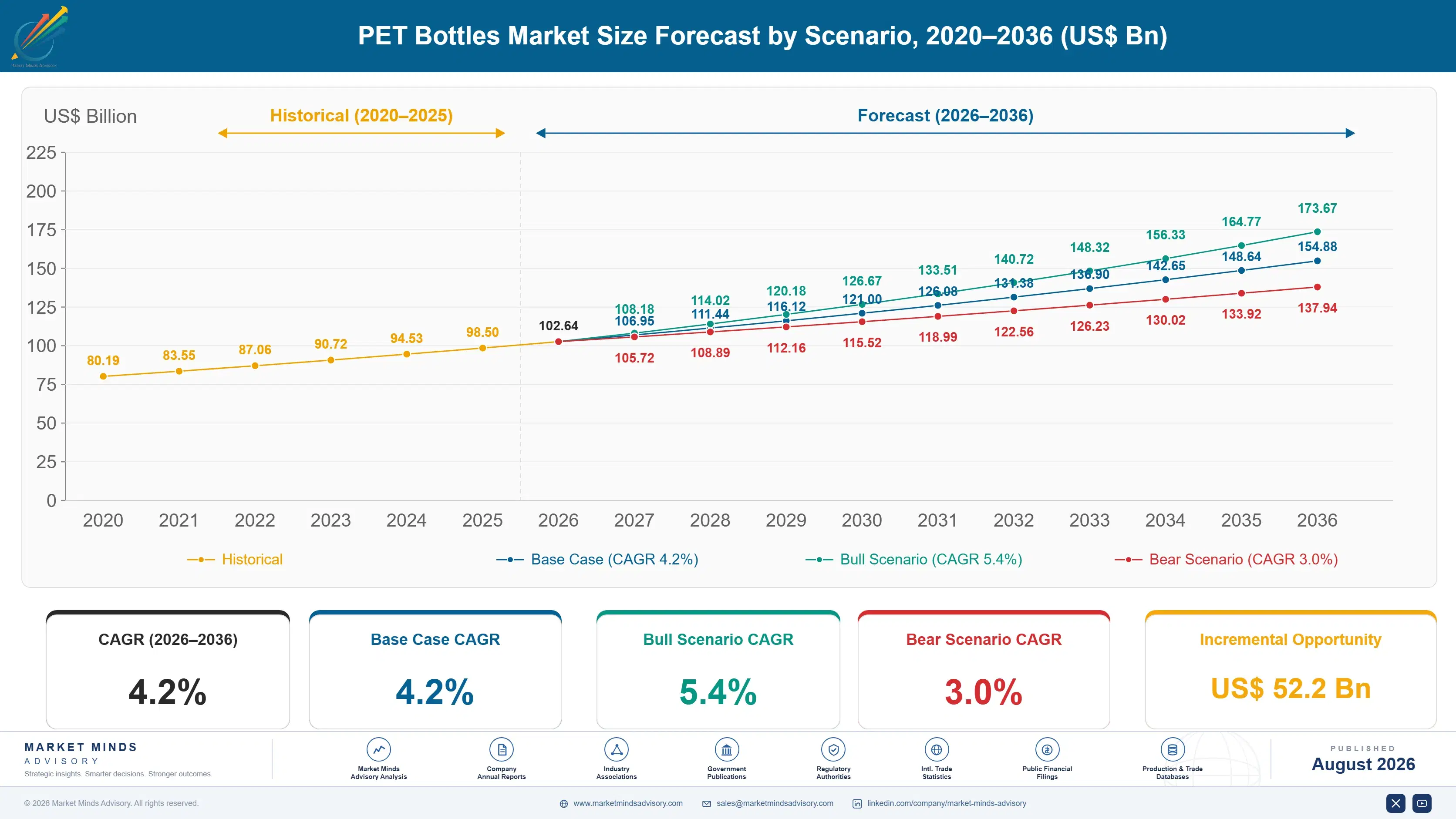
PET Bottles Market Forecast Scenarios

pet-bottles-market-size-forecast-scenario-1787307074475
Between 2020 and 2025 the market grew at roughly 3.4% a year, a mature category expanding steadily on beverage volume growth while recycled content regulation began reshaping sourcing strategy meaningfully only toward the end of the period as binding mandates approached implementation. That gradual buildout meant most converters absorbed regulatory change incrementally rather than confronting a single disruptive compliance cliff.
The base case carries the market to a 4.2% CAGR on three mechanisms. First, bottled water and ready-to-drink beverage volume keeps expanding in emerging markets as hydration habits shift. Second, pharmaceutical and nutraceutical packaging keeps growing on health-conscious consumer demand. Third, recycled content premiums keep lifting average selling price even where unit volume growth stays modest across mature developed markets. These three mechanisms reinforce each other unevenly across different regional markets and applications.
The bull case reaches 5.4% if emerging market bottled water volume and rPET premium pricing both accelerate faster than currently scheduled. The bear case falls to 3.0% if recycled content supply constraints meaningfully compress converter margin and slow capacity investment relative to mandate deadlines. That divergence rests largely on rPET supply availability. That divergence rests largely on how quickly recycling infrastructure investment actually scales.

Recycled Content Scarcity Is Rewriting Margin Economics

Three forces converge on this mature market at once. Bottled water and ready-to-drink beverage volume keeps expanding in emerging markets, pharmaceutical and nutraceutical packaging keeps growing on health-conscious demand, and recycled content mandates keep lifting average selling price even where unit volume stays flat. Converters without secured rPET supply agreements risk losing bidding access to brand owners facing binding compliance deadlines. Converters unable to secure compliant feedstoc
MARKET CONCENTRATION (CR5)30%Top five converters hold well under a third share
AVERAGE BOTTLE PRICE$0.09/unitStandard beverage bottles priced on thin per-unit margin
TOP PRODUCING COUNTRY SHARE26%China leads installed PET bottle manufacturing capacity globally
CAPACITY UTILISATION83%Blow molding lines run near full continuous operating schedules
TRADE INTENSITY18%Bottled water trades locally given weight and freight cost
RESIN COST SHARE52% of COGSVirgin and recycled PET resin dominate production cost
Commercially, the market splits between high-volume beverage bottles, priced on thin margin and sold largely on production scale and proximity to bottling customers, and specialty pharmaceutical and personal care bottles, priced at meaningful premium and sold on regulatory compliance and barrier performance conventional beverage bottles do not require. That specialty category commands disproportionate margin relative to its unit volume share of the overall market. That margin gap widens as brand owners demand documented compliance readiness.
Over the next decade the defining question is whether recycled content mandates spread to enough additional jurisdictions to durably reprice the entire category, or whether feedstock scarcity keeps rPET premium pricing concentrated in the specific markets with binding compliance deadlines rather than resetting global bottle economics broadly. Regulatory clarity will likely determine that pace.
"This used to be a category where you won on scale and freight cost, full stop. Now a converter without a locked-in food-grade rPET supply agreement cannot even bid on some European contracts, and that single sourcing constraint is quietly reordering who gets to compete for the best accounts."
Director, Rigid Plastics and Resin Sourcing Practice · MMA Packaging / Rigid Pla

Market Trends

Recycled Content Mandates Force Scarce rPET Supply Competition

The European Union's packaging and packaging waste regulation and an expanding number of American state laws now require binding minimum recycled content thresholds in PET beverage bottles, forcing converters to secure food-grade rPET supply agreements years ahead of compliance deadlines rather than sourcing feedstock reactively on spot markets. Amcor and ALPLA have both signed long-term rPET offtake agreements with recycling processors specifically to secure compliant feedstock ahead of binding deadlines. Converters without secured supply risk losing bidding access to brand owners facing regulatory compliance requirements entirely. That exclusion risk is compounding as more jurisdictions adopt binding mandates each year.
Market Impact: Adds 4% to 6% volume yearly
Lightweighting Technology Cuts Resin Volume Per Bottle

Continued preform and bottle design innovation keeps reducing resin weight per unit while maintaining structural integrity and barrier performance, a cost reduction lever converters have pursued for over a decade that remains commercially relevant even as recycled content costs rise separately. Gerresheimer and Plastipak have both expanded lightweighting engineering capability specifically targeting high-volume beverage bottle customers seeking resin cost reduction. Converters with proven lightweighting technology increasingly win volume contracts competitors without comparable design capability cannot match on delivered cost. Converters without proven lightweighting capability increasingly lose volume contracts to competitors offering meaningfully lower delivered cost.
Market Impact: Adds 6% to 9% volume yearly

Market Opportunities and Growth Drivers

Bottled Water Volume Growth Sustains Emerging Market Demand

Bottled water consumption keeps expanding across emerging markets as urbanization and hydration habits shift, tracked by national beverage industry associations, creating durable multi-year unit volume demand that grows in direct proportion to population and disposable income trends rather than depending on any single regulatory driver. Each newly urbanizing market segment represents recurring bottle demand tied directly to underlying beverage consumption growth, giving converters a demand driver considerably more predictable than categories dependent purely on discretionary spending. That underlying volume growth gives converters unusually reliable long-term capacity planning visibility. That predictability compounds across multiple regional markets simultaneously.
Market Impact: Limits compliance to 60-75%

Health-Conscious Consumers Expand Nutraceutical Packaging Demand

Consumer demand for vitamins, supplements, and over-the-counter medications keeps expanding as health-conscious purchasing behavior grows across both developed and emerging markets, driving pharmaceutical and nutraceutical bottle demand that commands meaningfully higher margin than standard beverage packaging given barrier performance and regulatory compliance requirements. Converters serving this category increasingly build specialized barrier resin and child-resistant closure capability that differentiates them from commodity beverage bottle competitors lacking comparable technical investment. That specialization advantage compounds as nutraceutical brand owners increasingly demand documented quality compliance from suppliers. Converters serving multiple nutraceutical brand owners increasingly capture cross-selling opportunities across adjacent supplement product lines.
Market Impact: Adds 3% to 7% cost pressure

Market Restraints and Challenges

Recycled PET Supply Constraints Limit Mandate Compliance

Food-grade recycled PET supply remains meaningfully constrained relative to expanding mandate volume requirements, and the root cause is that collection and reprocessing infrastructure in most markets has not scaled fast enough to match binding regulatory deadlines converters must meet regardless of feedstock availability. This scarcity creates genuine competitive disadvantage for smaller converters without long-term supply agreements, who must compete for spot market rPET at premium pricing against larger competitors with secured contracts. Converters are mitigating the constraint through direct investment in recycling infrastructure and long-term offtake agreements with processors specifically.
Market Impact: Covers 25-30% mandated content

Extended Producer Responsibility Fees Raise Compliance Cost

Extended producer responsibility schemes, now implemented across an expanding number of jurisdictions, require brand owners and converters to fund packaging collection and recycling infrastructure through per-unit fees, and the root cause is that regulators are shifting recycling system funding from public budgets toward the packaging producers generating the waste stream directly. This cost pressure compresses margin for converters serving fee-liable brand owners, particularly in categories with thin existing margin like standard beverage bottles. Converters are mitigating the impact through lightweighting investment that reduces per-unit fee exposure alongside resin cost specifically.
Market Impact: Cuts resin use 8% to 15%
3 additional market trends, 4 additional growth drivers, and 3 additional restraints and challenges are covered in the full report. Contact sales@marketmindsadvisory.com to access the complete intelligence.

Segment CAGR and Growth Architecture

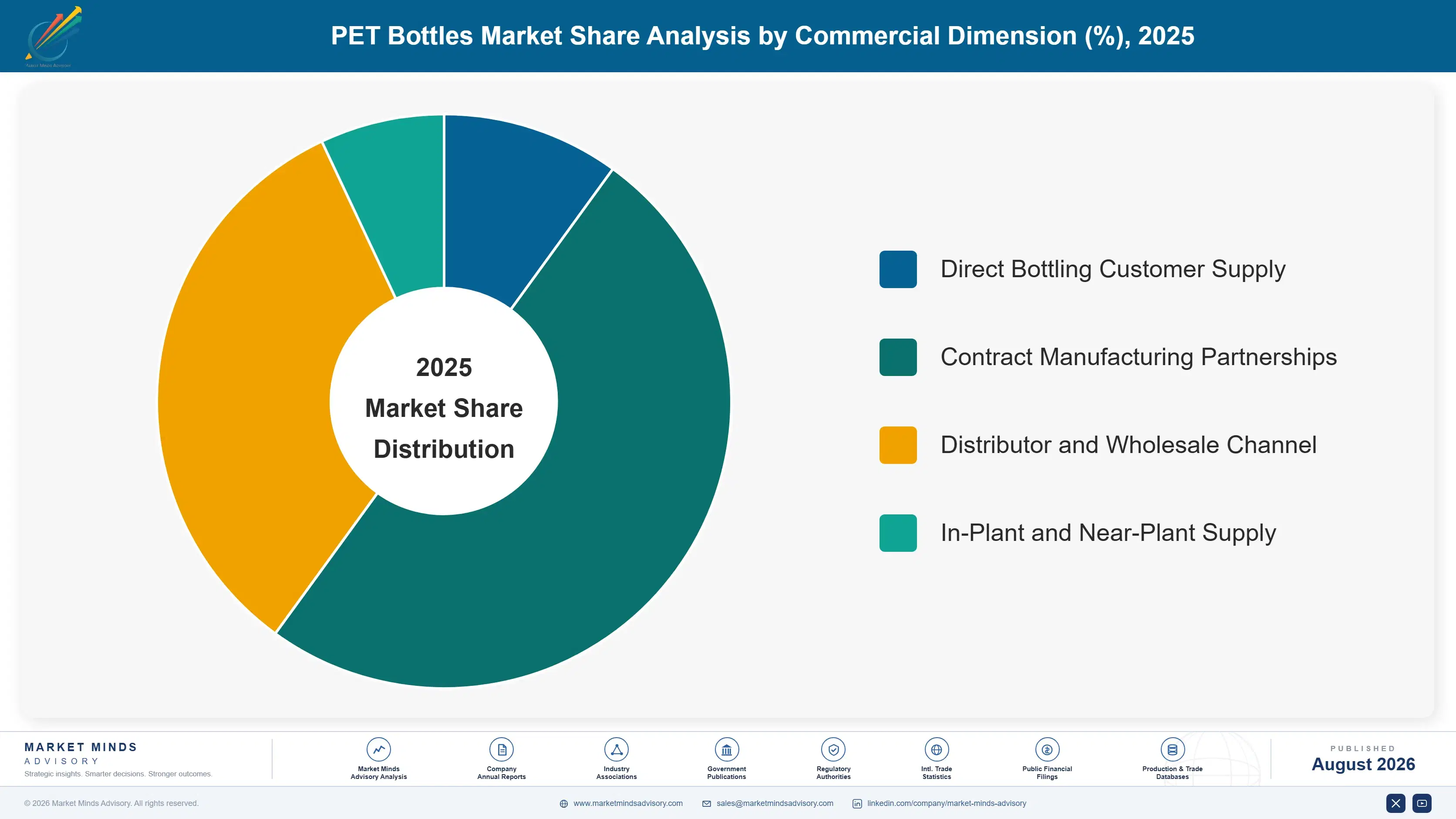
Segmentation follows end-use beverage and product application, a single commercial logic distinguishing regulatory requirements, barrier performance needs, and customer type. Resin source and bottle weight are treated as separate technical dimensions, not parallel segments here. Regulatory compliance requirements and barrier performance needs vary meaningfully across these applications, shaping which converters can credibly compete for each category.
pet-bottles-market-market-share-analysis-1787307075014

Pharmaceutical and Nutraceutical PET Bottles

Pharmaceutical and nutraceutical bottles grow fastest at 7.5%, about 1.79 times the overall rate, as health-conscious consumer demand for vitamins, supplements, and over-the-counter medications keeps expanding across both developed and emerging markets. These bottles command substantial premium pricing over standard beverage bottles that reflects genuine barrier performance and child-resistant closure requirements regulatory compliance demands directly. Gerresheimer leads commercial capacity expansion, having invested heavily in specialized barrier resin production lines since 2023 specifically targeting this application. Adoption is fastest among supplement and nutraceutical brand owners expanding product lines, while pharmaceutical adoption continues growing steadily alongside broader healthcare packaging demand across major markets globally. Converters without specialized barrier resin capability increasingly find themselves excluded from this category entirely.
CAGR 7.5%

Bottled Water

Bottled water, the highest-volume application by unit count, grows at 6.8%, the second-fastest category, as urbanization and hydration-driven consumption keep expanding rapidly across emerging markets where tap water access remains inconsistent. This category commands thin per-unit margin reflecting intense price competition, but its sheer volume scale makes it commercially significant for converters serving large domestic bottling customers directly. ALPLA maintains substantial bottled water bottle production capacity serving both multinational and regional bottling customers across multiple continents. Growth here reflects genuine underlying consumption expansion rather than pure share shift from competing packaging formats. Converters serving this category increasingly compete on freight efficiency and production scale rather than technical differentiation, since bottled water customers prioritize delivered cost above nearly everything else.
CAGR 6.8%
Full segment breakdown across 6 segments available in the complete report.

Regional Architecture and Country Demand Map

East Asia leads on massive beverage manufacturing scale and rapidly expanding domestic consumption, North America follows on established bottling infrastructure, and South Asia and Pacific grows fastest on hydration-driven volume expansion. Latin America and the Middle East grow steadily off smaller bases, while Eastern Europe trails the regional average.

North America

The United States hosts an extensive, mature bottling infrastructure network, with major beverage and personal care brand owners driving stable demand that grows in close proportion to population and modest per-capita consumption increases tracked by national beverage trade associations. Plastipak and Amcor both run substantial domestic manufacturing capacity, serving beverage, personal care, and pharmaceutical customers from facilities across the country. Canada's smaller but stable packaging market follows similar demand patterns, generally trailing the pace of American recycled content regulation adoption specifically. Growth trails East Asia and South Asia and Pacific because the region's beverage consumption is already largely mature, leaving recycled content premium pricing rather than unit volume expansion as the primary growth driver going forward.
Share: 22% | CAGR: 3.6% (2026 to 2036)

Western Europe

The European Union's packaging and packaging waste regulation has driven comprehensive recycled content conversion across member states, with binding thresholds already reshaping converter sourcing strategy and pricing structure at major beverage and personal care brand owners throughout the region substantially. Germany and France both maintain well-developed PET bottle manufacturing capacity, with ALPLA's substantial European operations anchoring regional supply serving both domestic and export markets across the continent. The United Kingdom's post-Brexit regulatory framework has largely maintained comparable recycled content targets, sustaining consistent regional demand for compliant rPET supply. Growth trails other regions as the market here is mature and regulatory-driven repricing, not unit volume growth, drives most of the region's expansion.
Share: 19% | CAGR: 2.7% (2026 to 2036)
Regional intelligence for 5 additional markets available in the complete report: East Asia, South Asia and Pacific, Latin America, Middle East and Africa, Eastern Europe. Contact sales@marketmindsadvisory.com.
pet-bottles-market-country-cagr-analysis-1787307075529

Where PET Bottle Converters Can Defend Margin

Four commercial moves separate converters capturing durable recycled content premium growth from those competing purely on commodity beverage bottle pricing: rPET supply security, lightweighting investment, specialty barrier technology, and brand partnership depth. Each move converts a technical or sourcing advantage into a defensible commercial position competitors without matching supply security or technical depth cannot easily replicate.

Secure Long-Term rPET Supply Ahead of Mandate Deadlines

Brand owners facing binding recycled content deadlines need converters who can actually deliver compliant volume, and converters securing long-term rPET offtake agreements ahead of confirmed mandate enforcement dates capture disproportionate share of compliance-driven contracts as customers lock in supply relationships well before deadlines force urgent decisions. This is a genuine sourcing race, and converters who wait for mandates to fully materialize before securing supply risk losing accounts to competitors already contracted and ready. Converters with secured supply typically capture 30% to 45% of the resulting compliance-driven volume before competitors can match sourcing.
Market Impact: Early movers capture 30% to 45% of

Invest in Lightweighting to Reduce Delivered Resin Cost

Resin cost pressure from both virgin price volatility and recycled content premiums makes lightweighting a durable margin lever, and converters investing in advanced preform and bottle design technology that reduces resin weight while maintaining performance capture cost advantage competitors without comparable design capability cannot match. This technology investment differentiates beyond pure capacity and pricing competition, addressing resin cost directly rather than only through sourcing strategy. Converters with proven lightweighting technology report reducing delivered resin cost by 8% to 15% relative to competitors using standard bottle designs. That cost advantage compounds as resin prices continue climbing industry-wide.
Market Impact: Reduces delivered resin cost by 8%

Build Specialty Barrier Technology for Pharmaceutical Accounts

Pharmaceutical and nutraceutical brand owners increasingly seek converter partners who can support barrier performance and child-resistant closure development rather than pure commodity beverage bottle supply, and converters building this deeper technical capability capture premium specialty business commodity-focused competitors cannot access as easily. This capability investment also builds switching costs, since a pharmaceutical customer's regulatory quality documentation often becomes tied to the specific converter relationship over time. Converters building this specialty depth report commanding 25% to 35% pricing premiums over competitors offering purely commodity beverage bottle supply. That documentation dependency increasingly locks in multi-year specialty account relationships.
Market Impact: Commands 25% to 35% premium for spe

Build Deep Brand Partnership Relationships for Volume Retention

Large beverage and personal care brand owners increasingly consolidate packaging vendor relationships to reduce supplier management complexity, and converters building genuine partnership depth across multiple product lines and regions capture broader volume commitments than competitors serving customers on a purely transactional, contract-by-contract basis. This partnership approach builds durable switching costs as bottle specifications and quality documentation become tied to the specific converter relationship over multi-year periods. Converters building this partnership depth report retaining 15% to 25% more volume during customer packaging strategy reviews than transactional competitors. That retention advantage compounds meaningfully across multiple product line renewals.
Market Impact: Retains 15% to 25% more volume at r

Who Controls the Margin Pool

Concentration sits at a modest CR5 of 30%, with a gap separating global converters with integrated preform and resin sourcing capability from regional players competing largely on price. Amcor and ALPLA compete on manufacturing scale and rPET sourcing depth, while Gerresheimer and Plastipak anchor strong positions in specialty pharmaceutical and lightweighting innovation respectively. Numerous smaller regional converters compete on price for standard beverage bottle volume.
Current competitive activity runs along three lines: rPET supply security, where converters race to lock in compliant feedstock ahead of mandate deadlines; lightweighting technology development, increasingly central to defending margin against rising resin costs; and specialty barrier capability building, as converters compete for premium pharmaceutical and nutraceutical business. All participants are assessed on one consistent basis, annual revenue from PET bottle products.

Pressure is building from two directions. Converters with strong rPET supply security are capturing disproportionate compliance-driven share, a dynamic slower-moving competitors cannot easily counter through pricing alone. Meanwhile Asian manufacturers are scaling both price-competitive and increasingly technically capable production, pressuring Western incumbents in cost-sensitive beverage bottle segments. Rankings over the next five years will shift toward converters combining sourcing security with genuine lightweighting and barrier technology depth.
pet-bottles-market-company-positioning-matrix-1787307076047

Competitive Moat and Risk Dimensions

AMCOR PLC

Moat: Broadest global rPET sourcing network

Amcor's global manufacturing footprint and long-term rPET offtake agreements across multiple regions let it serve multinational beverage and personal care customers as a single-vendor relationship few narrower competitors can match, particularly valuable as brand owners consolidate packaging vendor relationships. That sourcing breadth compounds as recycled content mandates spread to additional jurisdictions requiring secured feedstock.
AMCOR PLC

Risk: Virgin resin price exposure remains

Amcor's substantial standard beverage bottle volume still depends heavily on virgin PET resin pricing, exposing a meaningful share of its commodity bottle revenue to petrochemical feedstock volatility its recycled content premium business does not face to the same degree. This exposure becomes particularly acute during petrochemical feedstock price spikes that recycled content premium business does not experience.
ALPLA WERKE ALWIN LEHNER GMBH & CO KG

Moat: Deep bottling customer manufacturing footprint

ALPLA's extensive network of in-plant and near-plant manufacturing facilities located directly at major bottling customer sites gives it a defensible logistics and freight cost advantage that funds expansion into lightweighting and rPET sourcing capability few narrower competitors can match. That proximity advantage compounds as freight and logistics costs remain a persistent share of delivered bottle cost.
ALPLA WERKE ALWIN LEHNER GMBH & CO KG

Risk: Beverage category concentration risk

ALPLA's historical revenue concentration in beverage bottling, while highly defensible, leaves it more exposed than diversified competitors to any sustained shift in beverage packaging format or alternative material adoption within that specific narrow category over the coming decade. Diversification into pharmaceutical and specialty bottles remains a work in progress relative to more balanced competitors already established.

Players Tracked

Prominent Players

Amcor plc
ALPLA Werke Alwin Lehner GmbH & Co KG
Gerresheimer AG
Plastipak Holdings Inc.
Resilux NV

Other Key Players

Nampak Ltd
Berry Global Group Inc.
Indorama Ventures PCL
Graham Packaging Company
CCL Industries Inc.
Silgan Holdings Inc.
Logoplaste
Envases Universales de Mexico
Consolidated Container Company LLC
PET Power BV
Alpek SAB de CV
UltrePET LLC
Loop Industries Inc.
Origin Materials Inc.
Container Corporation

Recent Developments

MAY 2025

ALPLA expands rPET recycling infrastructure investment

ALPLA commissioned expanded food-grade rPET recycling capacity specifically targeting European Union recycled content mandate compliance for major beverage customers. This was an organic capacity expansion funded from existing capital, not an acquisition or partnership, reflecting sustained demand from brand owners facing binding compliance deadlines. reflecting mounting mandate pressure.
Signal: Continued investment in recycling infrastr
NOVEMBER 2024

Amcor signs long-term rPET supply agreement with recycling processor

Amcor signed a multi-year offtake agreement with a major recycling processor to secure food-grade rPET supply for its European beverage bottle production ahead of upcoming regulatory compliance deadlines. This was a commercial supply agreement, not a joint venture or acquisition, securing recurring feedstock volume across facilities.
Signal: Large rPET offtake agreements show convert
JANUARY 2025

Gerresheimer acquires specialty pharmaceutical bottle manufacturer

Gerresheimer completed the acquisition of a privately held company specializing in barrier-performance pharmaceutical PET bottle manufacturing for the nutraceutical and over-the-counter medication markets. This was an acquisition, not a joint venture or minority investment, giving Gerresheimer full ownership and control of the acquired technology and customer relationships.
Signal: Continued acquisition activity in specialt

Resin Sourcing Splits Virgin and Recycled Cost

Virgin and recycled PET resin inputs together account for roughly fifty-two percent of production COGS, sourced from a mix of petrochemical producers for virgin resin and recycling processors for rPET, concentrated in North America, Western Europe, and increasingly China, where reprocessing capacity has expanded steadily since 2020. Coloring agents and specialty additives for barrier performance add a further meaningful cost layer in pharmaceutical applications specifically.
The clearest recent volatility event traces to 2022 and 2023, when food-grade rPET pricing rose sharply relative to virgin resin as binding European Union recycled content mandates approached implementation, a divergence documented by European Commission packaging waste reporting that caught several converters without secured supply agreements exposed to steep spot market premiums. Converters without long-term offtake agreements reported meaningful margin compression during this period specifically.

Exposure varies by converter scale and sourcing relationships. Larger converters with direct, long-term rPET offtake agreements and diversified sourcing across multiple regions weathered the volatility with meaningfully less disruption than smaller converters dependent on spot market purchasing. Converters serving beverage accounts under fixed multi-year contracts faced particular pressure to maintain pricing commitments despite raw material cost increases across the category.
pet-bottles-market-cost-volatility-analysis-1787307076250

Secure Long-Term rPET Offtake Agreements

Converters are increasingly signing multi-year offtake agreements directly with recycling processors, reducing exposure to spot market rPET price volatility and securing compliant feedstock volume ahead of binding mandate deadlines across multiple jurisdictions. This approach reduces long-term supply risk meaningfully. Converters without such agreements increasingly find themselves priced out of compliance-driven bidding opportunities across major markets.

Invest Directly in Recycling Infrastructure Capacity

Some larger converters are investing directly in recycling and reprocessing infrastructure, capturing feedstock margin previously earned by third-party processors while securing guaranteed supply independent of external market volatility. This vertical integration increasingly favors converters with sufficient capital to fund infrastructure investment ahead of demand. That integration advantage compounds as external market volatility continues rising.

Invest in Resin-Efficient Bottle Design to Reduce Input Volume

Some converters are optimizing preform and bottle wall thickness to reduce resin volume required per unit while maintaining structural integrity and barrier performance, cutting raw material exposure per bottle even as design optimization requires meaningful upfront engineering investment. That efficiency gain increasingly favors converters with strong design engineering expertise. That efficiency gain compounds across large production volumes considerably.

Portfolio Architecture for Margin Defence

The portfolio splits into three tiers with real margin separation. Volume beverage bottles compete largely on price and freight proximity, earning thin margins defended through production scale. Certified specialty pharmaceutical and personal care bottles earn substantially more because customers pay for barrier performance and regulatory compliance conventional beverage bottles alone cannot deliver. That gap widens as customers demand documented compliance before committing budget. Converters u
The tension between beverage volume and specialty premium positioning shapes converter strategy directly: beverage bottles keep production lines running and build broad customer relationships, but converters that let beverage volume crowd out specialty and rPET sourcing investment risk losing the fastest-growing, highest-margin pharmaceutical category to more capability-focused competitors. Converters that manage this balance well capture both broad customer presence and premium margin.

High-value pools concentrate in pharmaceutical, nutraceutical, and rPET-compliant premium bottles, where regulatory compliance value and barrier performance justify premium economics few commodity-focused competitors can match. The recycled content compliance tier currently earns unevenly as converters absorb sourcing cost against still-developing feedstock market maturity. That unevenness should ease as recycling infrastructure scales and rPET supply grows more predictable.

Volume / Commodity-Adjacent Tier

Standard beverage bottles sold on price and freight proximity to bottling customers across carbonated soft drinks and mainstream water categories, where production scale determines which converters sustain acceptable margin. Freight cost proximity to bottling customers matters as much as unit price here.
Gross Margin: 8-16%

Premium / Certified Tier

Pharmaceutical, nutraceutical, and personal care bottles commanding premium pricing from customers prioritizing barrier performance and regulatory compliance, who pay durable premiums for documented quality assurance rather than risk noncompliance. Regulatory-driven customers pay these premiums without hesitation given compliance risk.
Gross Margin: 24-38%

Sustainability / Regulatory / Next-Generation Tier

Recycled content compliant and next-generation bio-based resin bottles still absorbing sourcing and development investment against developing feedstock market maturity, where converters are securing supply they expect regulators to mandate broadly within several years.
Gross Margin: 12-30%
pet-bottles-market-portfolio-architecture-1787307076754

High-value Sub-segments and Strategic Watch-out

rPET-Compliant Premium Beverage Bottles

High value and high growth as recycled content mandates expand across jurisdictions, commanding durable premium pricing once compliance deadlines force secured-sourcing decisions industry-wide. Converters with the strongest supply security increasingly win contracts competitors slower to secure simply cannot access at all today. That gap widens further each quarter.
Gross Margin: 20-32%

Pharmaceutical and Nutraceutical Bottles

High value with strong current growth as health-conscious consumer demand expands, priced well above standard beverage bottles while remaining accessible to mainstream supplement and medication brand budgets. Adoption is broadening steadily as more brand owners launch new supplement and medication product lines. Momentum keeps building steadily.
Gross Margin: 24-38%

Standard Beverage Bottles

The volume core, sold on price and proximity to bottling customers, defended mainly through production scale and thin per-unit margin discipline across facilities. Competitive pressure here concentrates on production efficiency and freight cost rather than the sustainability differentiation reshaping premium tiers overall today. overall consistently today.
Gross Margin: 8-16%

Unsecured Spot-Market Resin Dependent Converters

The strategic watch-out, facing mounting margin compression as rPET spot market pricing rises relative to converters with secured long-term offtake agreements. Converters still dependent on spot market sourcing should be actively pursuing long-term agreements rather than absorbing volatility that better-positioned competitors have already eliminated. steadily.
Gross Margin: 4-14%

How PET Bottle Demand Actually Recurs

Demand here runs on continuous consumption tied directly to beverage and personal care product shipment volume rather than discrete purchase events. A bottling customer qualified on a converter's bottle design consumes matched packaging with every production run, making a single qualification worth years of recurring volume rather than a standalone transaction. That recurring pattern gives converters unusually predictable, multi-year revenue visibility once a supply agreement is signed.
Adoption depth varies sharply by customer type. Large beverage bottlers integrate bottle specifications deeply into standardized filling line equipment once qualified, making supplier switching costly and rare absent a compelling cost or performance reason. Personal care and pharmaceutical customers, by contrast, evaluate suppliers more frequently based on barrier performance and regulatory compliance needs, creating more switching opportunities between competing converters as formulations change.

Buyer profiles are shifting generationally as younger packaging procurement professionals, trained on sustainability-first specification frameworks, increasingly treat recycled content and supply chain transparency as baseline requirements rather than differentiators requiring special justification. Older procurement teams trained primarily on cost-first specification are adapting more gradually, but that generational shift is accelerating as regulatory deadlines force sourcing decisions across the industry broadly.
pet-bottles-market-end-use-penetration-index-1787307077246

Where PET Bottle Value Concentrates Next

These are among the four positions where our research anticipates prominent divergence between winners and laggards over the coming forecast period. Each is grounded in the demand model, the regulatory perimeter, and the announced capacity pipeline.
01 / RPET SUPPLY SECURITY

Secure long-term recycled content supply ahead of deadlines

Brand owners facing binding recycled content deadlines need converters ready to deliver compliant volume on schedule, and converters securing supply ahead of confirmed mandate enforcement dates capture the compliance wave before competitors catch up. This is a genuine sourcing race with real consequences for companies that wait too long to commit capital. Converters moving decisively now will own the relationships that mandate expansion is about to make urgently valuable across an expanding list of jurisdictions., a race with real consequences for hesitant converters.
02 / LIGHTWEIGHTING INVESTMENT DEPTH

Reduce delivered resin cost before margin compresses further

Rising resin costs from both virgin volatility and recycled content premiums genuinely threaten converter margin, and converters investing in lightweighting technology that reduces resin volume per unit capture cost advantage competitors without comparable design capability cannot match. This technology investment differentiates beyond pure capacity and pricing competition. Companies treating lightweighting as secondary to raw capacity expansion are underestimating how directly it determines margin resilience as resin costs keep climbing., and that margin pressure will only intensify as resin costs keep climbing across the category broadly.
03 / SPECIALTY BARRIER CAPABILITY

Build pharmaceutical technical depth beyond commodity supply

Pharmaceutical and nutraceutical brand owners increasingly seek converter partners for broader quality and barrier performance conversations, not pure transactional supply, and converters building this deeper capability capture premium business transactional competitors cannot access. This capability investment also builds genuine switching costs over time. Companies still selling purely on price and specification sheets are missing the technical depth that increasingly determines premium account retention long-term., and that technical gap only widens as pharmaceutical customers increasingly demand deeper quality documentation and barrier performance validation over time.
04 / VERTICAL RECYCLING INTEGRATION

Invest directly in recycling infrastructure before scarcity worsens

Food-grade rPET scarcity is a persistent feature of a category dependent on still-developing recycling infrastructure outside converter control, and converters without secured feedstock remain exposed to margin compression every time compliance deadlines tighten further. Investing directly in recycling capacity now, rather than reactively after the next mandate expansion, protects margin durably. This is a defensive priority every converter serving compliance-exposed customers should treat as non-negotiable given how exposed unprotected supply becomes., a defensive discipline that increasingly separates resilient converters from exposed ones industry-wide.

Engagement Snapshot From the Field

A live engagement with an industry participant carrying material or product regulatory and market exposure ahead of a defining policy shift, showing how our research translates into a defensible multi-year portfolio strategy.
MARKET MINDS ADVISORY · CLIENT ENGAGEMENT SUMMARY
PET Bottles Producer Strategic Portfolio Review and Transition Roadmap 2026·Investment Scenario on PET Bottles Exposure Evaluation 2025-26
CLIENT PROFILE
A multinational beverage bottler operating filling lines across twelve European countries approached MMA while planning compliance with binding recycled content mandates ahead of upcoming national deadlines. The client reported roughly USD 210 million in annual PET bottle packaging spending across its European network, with fragmented supplier relationships built up over many years (client-reported, unverified by MMA).
STRATEGIC CHALLENGE
Management needed to consolidate fragmented converter relationships into a smaller group capable of guaranteeing compliant rPET supply across all twelve countries, while managing the cost increase recycled content represented over virgin resin without disrupting existing filling line operations. The board wanted a defensible sourcing consolidation plan before national deadlines arrived across the network.
MMA APPROACH
MMA benchmarked rPET supply security and pricing commitments across six qualified converters against the client's country-by-country compliance requirements and deadlines, modeled total cost of consolidation including transition risk, and assessed each converter's track record delivering comparable-scale compliance programs for other multinational bottlers. We also interviewed the client's procurement team directly to confirm real-world filling line compatibility constraints the quantitative model alone could not capture.
KEY FINDINGS
  1. Only three of six benchmarked converters could credibly commit to guaranteeing compliant rPET supply across all twelve countries within the client's compliance timeline given current contracted volumes.
  2. The cost differential versus virgin resin was meaningfully lower than the client's initial internal estimate once volume-based pricing was properly benchmarked against comparable multinational contracts.
  3. One converter's prior experience consolidating a comparably sized multinational bottler's sourcing provided a proven transition playbook built on documented approval precedent. built on documented compliance precedent from prior engagements.
  4. Sequencing the consolidation by country rather than attempting a single simultaneous network-wide changeover reduced supply chain risk while still meeting compliance deadlines comfortably (client-reported, unverified by MMA).
CLIENT PROFILE
A multinational beverage bottler operating filling lines across twelve European countries approached MMA while planning compliance with binding recycled content mandates ahead of upcoming national deadlines. The client reported roughly USD 210 million in annual PET bottle packaging spending across its European network, with fragmented supplier relationships built up over many years (client-reported, unverified by MMA).
STRATEGIC CHALLENGE
Management needed to consolidate fragmented converter relationships into a smaller group capable of guaranteeing compliant rPET supply across all twelve countries, while managing the cost increase recycled content represented over virgin resin without disrupting existing filling line operations. The board wanted a defensible sourcing consolidation plan before national deadlines arrived across the network.
MMA APPROACH
MMA benchmarked rPET supply security and pricing commitments across six qualified converters against the client's country-by-country compliance requirements and deadlines, modeled total cost of consolidation including transition risk, and assessed each converter's track record delivering comparable-scale compliance programs for other multinational bottlers. We also interviewed the client's procurement team directly to confirm real-world filling line compatibility constraints the quantitative model alone could not capture.
KEY FINDINGS
  1. Only three of six benchmarked converters could credibly commit to guaranteeing compliant rPET supply across all twelve countries within the client's compliance timeline given current contracted volumes.
  2. The cost differential versus virgin resin was meaningfully lower than the client's initial internal estimate once volume-based pricing was properly benchmarked against comparable multinational contracts.
  3. One converter's prior experience consolidating a comparably sized multinational bottler's sourcing provided a proven transition playbook built on documented approval precedent. built on documented compliance precedent from prior engagements.
  4. Sequencing the consolidation by country rather than attempting a single simultaneous network-wide changeover reduced supply chain risk while still meeting compliance deadlines comfortably (client-reported, unverified by MMA).
RECOMMENDED STRATEGY
Phase 1: Phase 1 (0 to 4 months): Finalize supply agreements with the selected converters and begin country-by-country transition sequencing planning. across all filling line locations. Phase 2: Phase 2 (4 to 10 months): Execute the phased country transition, prioritizing countries with the earliest compliance deadlines while maintaining full regulatory documentation. Phase 3: Phase 3 (10 to 16 months): Complete transition across all remaining countries and evaluate performance against the original sourcing benchmark.
OUTCOME
The beverage bottler began Phase 1 implementation on schedule, reporting that the consolidated sourcing approach kept total compliance cost within the client's original approved budget. The client also reported improved supply reliability across its European network following the consolidation (client-reported, unverified by MMA). reflecting stronger supplier reliability overall.

Frequently Asked Questions

Foundational context covering the market sizes, CAGR, scope, country, region and competition that inform every finding below. This section is provided to cover basics and most often pre-purchase conversations, answered from the MMA Primary Research Dataset.

What is the current size of the PET Bottles Market?

The PET bottles market was valued at USD 98.5 billion in 2025. Growth is driven by bottled water volume expansion, pharmaceutical packaging demand, and recycled content mandate premiums.

How large will the PET Bottles Market be by 2036?

The market is projected to reach USD 154.9 billion by 2036 under the base case scenario. That reflects an expansion multiple of roughly 1.51 times the 2026 value.

What is the CAGR for the PET Bottles Market 2026 to 2036?

The base case CAGR is 4.2%, with a bull case of 5.4% and a bear case of 3.0%. Recycled content mandate expansion and rPET supply availability are the main swing factors.

Which segment is growing fastest?

Pharmaceutical and nutraceutical PET bottles grow fastest at 7.5% CAGR, roughly 1.79 times the overall market rate. Bottled water follows as the second-fastest segment at 6.8%.

Who are the major companies in the PET Bottles Market?

Leading converters include Amcor plc, ALPLA Werke Alwin Lehner GmbH & Co KG, Gerresheimer AG, Plastipak Holdings Inc., and Resilux NV. The top five hold a combined 30% of the market.

Which country is growing fastest?

India is the fastest-growing country at 9.5% CAGR, driven by rapidly expanding bottled water consumption and urban population growth. Nutraceutical packaging demand adds further momentum.

Report Segmentation Architecture

The full report scope spans multiple orthogonal segmentation dimensions, with cross-tabulated demand data provided for each dimension pair. Coverage extends further to regional breakdowns, trend trajectories, and the competitive detail needed to support segment-level decision-making.

By End-Use Application

  • Carbonated Soft Drinks
  • Bottled Water
  • Personal Care and Household Chemicals
  • Food, Sauces and Condiments
  • Pharmaceutical and Nutraceutical
  • Edible Oils and Alcoholic Beverages

By End-Use Industry

  • Beverage and Bottling
  • Personal Care and Cosmetics
  • Pharmaceutical and Healthcare
  • Food and Condiments
  • Household Chemicals

By Commercial Dimension

  • Direct Bottling Customer Supply
  • Contract Manufacturing Partnerships
  • Distributor and Wholesale Channel
  • In-Plant and Near-Plant Supply

By Region

  • North America
  • Western Europe
  • East Asia
  • South Asia and Pacific
  • Latin America
  • Middle East and Africa
  • Eastern Europe

Scope, Methodology, and Coverage

Every figure in this report is reproducible from documented input assumptions. The scope below maps the historical period, the forecast horizon, the segmentation dimensions, and the countries covered, alongside the underlying primary and qualitative methodology.
Historical Period
2020 to 2025
Forecast Period
2026 to 2036
Base Year
2025 (USD billions; MMA Primary Research Dataset, August 2026)
Market Definition
The PET bottles market comprises rigid polyethylene terephthalate bottles manufactured through blow molding for beverage, personal care, household chemical, food, and pharmaceutical packaging applications. PET film, PET sheet and thermoformed trays, other rigid plastic bottle resins such as HDPE or PP, and glass or metal bottle packaging formats are excluded.
Quantitative Units
USD billions (current prices); unit volume of bottles produced where applicable
Segmentation Dimensions
By End-Use Application; By End-Use Industry; By Commercial Dimension; By Region
Regions Covered
North America, Western Europe, East Asia, South Asia and Pacific, Latin America, Middle East and Africa, Eastern Europe
Countries Covered
USA, China, Germany, France, UK, Japan, South Korea, India, Australia, Canada, Brazil, Mexico, Indonesia, Vietnam, Thailand, Malaysia, UAE, Saudi Arabia, South Africa, Nigeria, Turkey, Poland, Netherlands, Italy, Spain, Sweden, Switzerland, Argentina, Colombia, Singapore, and additional markets relevant to this sector
Key Companies Profiled
Amcor plc, ALPLA Werke Alwin Lehner GmbH & Co KG, Gerresheimer AG, Plastipak Holdings Inc., Resilux NV, Nampak Ltd, Berry Global Group Inc., Indorama Ventures PCL, Graham Packaging Company, CCL Industries Inc., Silgan Holdings Inc., Logoplaste, Envases Universales de Mexico, Consolidated Container Company LLC, PET Power BV, Alpek SAB de CV, UltrePET LLC, Loop Industries Inc., Origin Materials Inc., Container Corporation
Quantitative Methodology
Primary survey, n=3,800 respondents, Q4 2025, six countries; demand-side model with trade association cross-validation
Qualitative Methodology
47 expert interviews, Q4 2025; applied to validate demand model assumptions, identify emerging dynamics, and assess competitive positioning
Report Format
PDF and XLSX data workbook (Word format preview document)
Publisher
Market Minds Advisory
Report Code
MMA-2026-PAC-703
Published
August 2026
Contact
sales@marketmindsadvisory.com | www.marketmindsadvisory.com

Purchase the full PET Bottles Market Report (2026 to 2036).

The full MMA PET Bottles Market report sizes demand across six end-use application categories, five end-use industries, four commercial dimensions, and seven regions through 2036. It profiles twenty companies on a consistent revenue basis, scoring each on rPET supply security, lightweighting technology depth, and specialty barrier capability. Scenario models quantify how recycled content mandate expansion and rPET feedstock scarcity move both demand and realizable pricing. The report includes delivered-cost modeling by application category and a converter compliance-readiness screen built for beverage and personal care brand owner procurement teams. Regional recycling infrastructure tracking rounds out the coverage for supply chain planning teams.
rPET sourcing cost-curve modeling across major applications
Recycled content mandate tracking and compliance deadline database
Bottled water and beverage demand forecasts by country
Lightweighting and barrier performance benchmarking across converters
Resin sourcing cost exposure modeling by converter scale
Recycled content mandate scenarios under bull and bear cases

Built For The People Who Decide

From boardroom strategy to bench-side execution, this report is read cover-to-cover by leaders shaping the next decade of their industry, turning demand scenarios, market dynamics and valuation benchmarks into decisions.
CXOs/ Presidents/ VPs/ Managers
M&A and Corporate Development
Strategy Teams and R&D Heads
Procurement and Product Directors
Regulatory and Compliance Leaders
Investor Relations and Equity Analysts