Market Minds Advisory
Pessary Market

Pessary Market: Non-Surgical Management of Pelvic Organ Prolapse

Urogynecologists are steering more pelvic organ prolapse patients toward pessary fitting ahead of surgery, and custom 3D-printed designs are cutting the discontinuation rate that has long limited long-term device adherence among older patients.

Lead Analyst

Alice Ballenger

Published

September 2026

Make Smarter Decisions with Customized Research Insights

Request a free sample report and evaluate market opportunities, growth trends, and competitive dynamics relevant to your business needs.

2025 MARKET VALUE$0.3BMarket Size 2025
2036 FORECAST VALUE$0.7BBase Case , 2026 to 2036
CAGR 2026 TO 20366.0 %Bull 7.3% / Bear 4.7%
INCREMENTAL OPPORTUNITY$0.3BNet 10- year value creation
EXPANSION MULTIPLE1.79x2036 value over 2026 base
Strategic Levers
M&A Pipeline
Regional Outlook
Country Rankings
Competitive Intelligence
Segmental Deep-dive
Call-Us : 91 93563 13602

Executive Snapshot and Market Trajectory

Urogynecologists increasingly offer pessary fitting as a first conversation with pelvic organ prolapse patients, favoring its reversibility for women who want to avoid or delay surgical repair given the recovery time and cost surgery carries. Patients increasingly ask about it directly rather than waiting for a physician to raise it.
Custom and 3D-printed designs are the clearest growth story, cutting the discontinuation rate that has long undermined long-term adherence to standard-size devices, and commercial momentum is concentrating in North America and Western Europe, where urogynecology specialist density and insurance coverage for fitting visits outpace every other region MMA tracks by a wide margin. That concentration is unlikely to narrow meaningfully before the end of the decade.
No single manufacturer holds more than a modest share of this fragmented category, and competitive activity centers on fitting training programs and physician education rather than on device price alone. Reimbursement policy and specialist referral patterns shape adoption as much as underlying device design does across every major product category in this market. Smaller specialists are using faster product iteration to chip away at established players' share in the newest device category.
Market Definition
The Pessary Market covers vaginal support devices, including ring, Gellhorn, cube, donut, and incontinence dish designs, used for the non-surgical management of pelvic organ prolapse and stress urinary incontinence. It excludes surgical mesh implants and pelvic floor physical therapy devices sold as separate product categories.
Base Year Value
$0.3B in 2025 (MMA Primary Research Dataset, August 2026)
Forecast Period
2026 to 2036, eleven discrete annual values
CAGR
6.0% base case. Bull 7.3%. Bear 4.7%.
Fastest Growth Segment
Custom and 3D-Printed Pessaries: 11.0% CAGR
Fastest Growth Country
India: 9.5% CAGR
Fastest Growth Region
South Asia and Pacific: 8.5% CAGR
Largest Region
North America: 30% of 2025 global value
Market Leaders
Coloplast A/S, CooperSurgical Inc, Bioteque America Inc, Personal Medical Corporation, MedGyn Products Inc. Source: MMA Analysis based on company annual reports.
Primary Survey
n=3,800 procurement and R&D decision-makers, Q4 2025, six countries
Methodology
Demand-side build-up, cross-validated against public data, 47 expert interviews

Pessary Market Forecast Scenarios

pessary-market-size-forecast-scenario-1787306699590
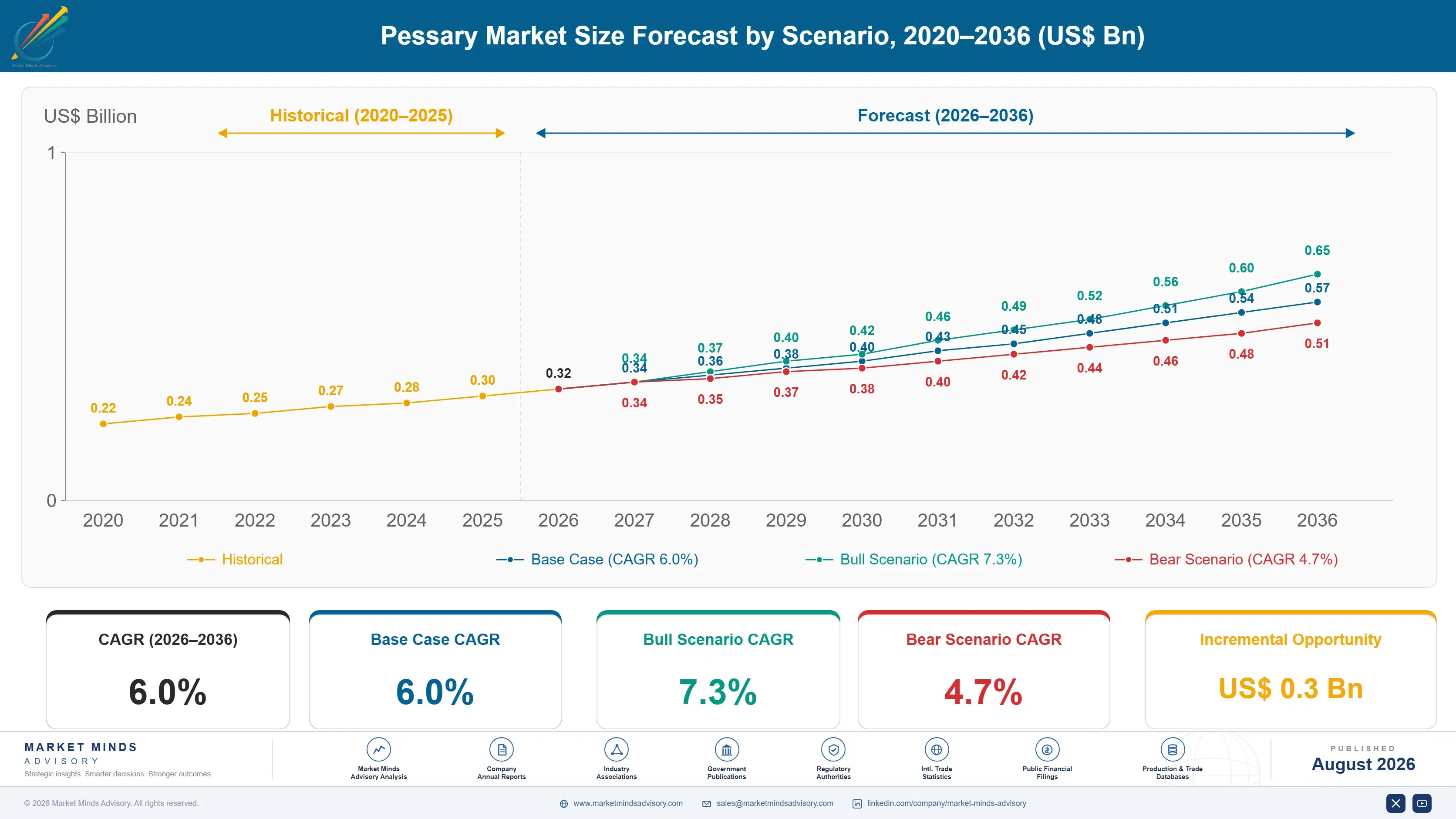
Between 2020 and 2025 the market grew steadily as urogynecology practices expanded pessary fitting services beyond a niche offering, interrupted briefly by pandemic-era deferrals of elective gynecological visits before recovering fully through 2022 as backlogged patient volumes cleared across most developed healthcare markets and referral pathways normalized. Referral pathways from primary care and gynecology normalized fully across most developed markets by mid-2023.
The base case assumes steady 6.0% annual growth through 2036, anchored to three mechanisms: rising pelvic organ prolapse diagnosis rates tied to an aging population, growing physician preference for pessary fitting as a reversible first-line option ahead of surgical repair, and custom and 3D-printed designs reducing the discontinuation rate that has historically limited long-term device adherence among fitted patients. Manufacturers report growing confidence in this outlook as coverage decisions accumulate.
The bull case centers on 3D-printed custom fitting adoption accelerating faster than currently modeled as printing costs continue falling. The bear case centers on surgical mesh alternatives regaining physician favor as newer, lower-complication mesh products reach market, stretching pessary adoption timelines by a year or more. Neither scenario shifts the leading five manufacturers' relative rankings materially within the coming decade.

Non-Surgical Prolapse Management Gains Ground

Urogynecology practices increasingly treat pessary fitting as a distinct clinical service with its own scheduling, staff training, and follow-up protocol, rather than folding it into general gynecology visits, a shift that has professionalized how clinics purchase and stock this equipment. That professionalization has raised the bar for how vendors demonstrate value in purchasing conversations. Vendors that lack presence in both dedicated and general clinic settings increasingly cede ground on t
MARKET CONCENTRATIONCR5 48%Reflects a fragmented field of specialized device makers
AVERAGE SELLING PRICE$18-45 per deviceVaries considerably by design complexity and fitting difficulty
TOP PRODUCING COUNTRYUnited States, 26% shareLargest base of manufacturing and device assembly capacity
REPLACEMENT CYCLE LENGTH6-12 monthsReflects the typical device lifespan before routine replacement
TRADE INTENSITY38% cross-border volumeShare of devices sold outside their country of manufacture
FEEDSTOCK COST SHARE26% of COGSMedical-grade silicone as the primary input material cost
Physician training and fitting confidence now shape which device format gains traction more than underlying design innovation alone does, since even a well-designed pessary struggles to reach meaningful volume if few local specialists feel confident performing the initial fitting. Manufacturers increasingly dedicate specialized teams to pursue coverage decisions ahead of product launch rather than after it. That dynamic favors manufacturers with the deepest existing payer relationships.
Over the next decade, custom and 3D-printed designs will likely displace a meaningful share of standard-size device fittings as printing costs fall, narrowing the comfort and retention gap that has historically separated custom fit from off-the-shelf sizing options. Manufacturers reliant entirely on legacy standard-size technology risk losing ground to faster-moving rivals. Companies moving early on this transition stand to capture premium positioning.
"Retention rate is the real product here. A device a patient actually keeps wearing beats one with marginally better anatomical theory behind it."
Director, Medical Technology Practice · MMA Medical Devices Practice &midd

Market Trends

Custom 3D-Printed Fitting Cuts Discontinuation Rates

Newer 3D-printed custom pessary designs, fitted from a vaginal anatomy scan rather than a trial-and-error set of standard sizes, address the single largest reason patients historically discontinued pessary use: poor fit leading to discomfort or expulsion during physical activity. Clinical pilot programs at several academic urogynecology centers in the United States and United Kingdom have reported meaningfully higher one-year retention rates among custom-fitted patients compared to standard-size cohorts. Device makers are investing in faster scanning and printing workflows to bring per-unit cost down toward parity with standard silicone devices, a step needed before broader insurer reimbursement becomes routine.
Market Impact: Adds 3% annual patient pool growth

Physicians Position Pessary Fitting Ahead of Surgical Referral

Urogynecology treatment guidelines increasingly list pessary fitting as a recommended first conversation for newly diagnosed pelvic organ prolapse patients, ahead of surgical referral, reflecting growing evidence that reversible non-surgical management carries meaningfully lower complication risk for appropriately selected patients. Professional societies in the United States and Germany have updated treatment algorithm guidance to reflect this preference shift, and each updated guideline further normalizes pessary referral among general gynecology practices not previously offering fitting services as a first-choice option. Professional societies continue updating guidance to formalize this preference across broader practice settings.
Market Impact: Shifts roughly 18% of mesh-hesitant

Market Opportunities and Growth Drivers

Rising Pelvic Organ Prolapse Prevalence Among an Aging Population

Pelvic organ prolapse prevalence rises meaningfully with age and parity, and United States Census Bureau population projections showing the 65-plus female cohort expanding by roughly 7 million people over the coming decade directly widen the addressable patient pool for pessary fitting. Gynecology associations in the United States and United Kingdom report steadily rising diagnosis rates tied to this demographic shift, and each additional diagnosed patient represents a potential fitting candidate once conservative pelvic floor therapy alone proves insufficient. This demographic tailwind should persist for at least fifteen years as the largest cohorts age into higher-prevalence brackets.
Market Impact: Limits access to 55% of patients

Patient Preference Shifts Toward Avoiding Surgical Mesh Complications

Patients increasingly express reluctance toward surgical mesh repair following years of regulatory scrutiny and litigation coverage surrounding mesh complication rates, pushing more newly diagnosed patients to request non-surgical alternatives during their first specialist consultation. Peer-reviewed comparative studies published in major urogynecology journals have reinforced this preference shift by documenting the reversibility advantage pessary use carries relative to permanent mesh implantation for appropriately selected patients. Medical societies have updated counseling guidance accordingly, and each updated guideline further normalizes pessary discussion as a default first step in the prolapse treatment conversation. Younger physicians show stronger comfort raising the conversation.
Market Impact: Loses 28% of patients before fittin

Market Restraints and Challenges

Fitting Skill Gaps Limit Access Outside Specialist Centers

Proper pessary fitting requires hands-on training and iterative adjustment that many general gynecologists and primary care providers never receive during residency, limiting access to patients who live near a dedicated urogynecology specialist. The root cause is that fitting technique has historically been taught informally through mentorship rather than through structured curriculum requirements, leaving meaningful variation in provider confidence and competence. Device makers and professional societies are expanding hands-on training workshops and fitting certification programs to close this gap, though rural and underserved areas still lag meaningfully behind specialist-dense urban centers.
Market Impact: Lifts retention rates by 25%

Standard-Size Discomfort Drives Early Discontinuation Rates

Standard-size devices frequently require multiple fitting attempts before finding an acceptable size, and patients who experience discomfort or expulsion during this process often abandon pessary use entirely rather than persisting through additional fitting visits. The root cause is that vaginal anatomy varies considerably more than the limited standard size range was originally designed to accommodate, particularly for patients with prior childbirth or surgical history. Manufacturers are exploring custom 3D-printed fitting and expanded standard size ranges to reduce this friction, though cost and printing turnaround time remain barriers to broader adoption for now.
Market Impact: Shifts 20% of surgical candidates
3 additional market trends, 4 additional growth drivers, and 3 additional restraints and challenges are covered in the full report. Contact sales@marketmindsadvisory.com to access the complete intelligence.

Segment CAGR and Growth Architecture

The market segments by device design and product type, spanning ring, Gellhorn, cube, donut, incontinence dish, and custom 3D-printed pessaries, since each design follows its own distinct fitting protocol, clinical indication, and physician training requirement across most specialist practices worldwide, and no single category alone dominates purchasing decisions in every clinical setting today, region, or provider type.
pessary-market-market-share-analysis-1787306700168

Custom and 3D-Printed Pessaries

Custom and 3D-printed pessaries are the fastest-growing segment as scanning and printing workflows mature and urogynecologists gain confidence recommending a personalized fit rather than iterating through standard sizes. Manufacturers have invested heavily in reducing turnaround time between anatomy scan and finished device, addressing one of the most common reasons physicians historically hesitated to recommend custom fitting over readily available standard-size alternatives. Insurer reimbursement decisions are gradually catching up with the clinical evidence supporting higher retention rates, and practices in markets where coverage has already been formalized report meaningfully higher custom-fit adoption than practices still awaiting a determination from their regional payer. Academic urogynecology centers continue serving as reference sites that influence broader community practice adoption of this newer fitting approach.
CAGR 11.0%

Incontinence Dish and Support Pessaries

Incontinence dish and support pessaries are growing quickly as physicians increasingly treat stress urinary incontinence as a distinct indication warranting its own device design rather than relying solely on general prolapse-support pessaries with incidental incontinence benefit. Device makers have introduced designs specifically engineered for bladder neck support, improving comfort during physical activity for patients whose primary complaint is leakage rather than prolapse symptoms. Physical therapists specializing in pelvic floor rehabilitation increasingly co-manage these patients alongside urogynecologists, creating a referral pathway that did not meaningfully exist a decade ago and that continues expanding as more physical therapy practices add pelvic health service lines to their existing offerings. Manufacturers increasingly bundle these devices with dedicated incontinence counseling materials.
CAGR 8.5%
Full segment breakdown across 6 segments available in the complete report.

Regional Architecture and Country Demand Map

North America and Western Europe together account for well over half of global revenue, reflecting concentrated urogynecology specialist density, while South Asia and Pacific posts the fastest regional growth off a smaller existing base. Every region shows steady expansion, though pace and installed base vary considerably by country.

North America

The United States carries the largest share of any market MMA tracks, supported by the deepest concentration of certified urogynecology fellowship-trained specialists found anywhere globally and insurance coverage that routinely includes pessary fitting visits as a covered gynecology service. FDA clearance activity has concentrated here first for nearly every new device design, giving domestic manufacturers a first-mover advantage before international regulatory bodies grant equivalent approvals. Canada's provincial health systems cover fitting visits similarly, though specialist density outside major metropolitan centers runs lower than in the United States. Gynecology practices across both countries increasingly treat pessary fitting as a dedicated service line, reinforcing steady equipment purchasing and follow-up visit volume across most major metropolitan markets tracked in this region.
Share: 30% | CAGR: 5.5% (2026 to 2036)

Western Europe

Germany and the United Kingdom carry the largest share of regional demand, supported by public health systems that have long covered pessary fitting as a standard gynecology service alongside surgical alternatives. France and the Nordic countries follow with steady adoption tied to national health service treatment guidelines that increasingly list pessary fitting as a first-line conversation for newly diagnosed patients. Regulatory harmonization under the EU Medical Device Regulation has raised compliance costs for smaller manufacturers, consolidating market share toward established players with the resources to maintain full regulatory documentation across every member state. Specialist training programs across the region remain well established, supporting broad access outside major urban centers relative to most other regions MMA tracks in this category.
Share: 26% | CAGR: 4.5% (2026 to 2036)
Regional intelligence for 5 additional markets available in the complete report: East Asia, South Asia and Pacific, Latin America, Middle East and Africa, Eastern Europe. Contact sales@marketmindsadvisory.com.
pessary-market-country-cagr-analysis-1787306700695

Where Pessary Makers Can Grow Margin

Beyond unit volume growth, manufacturers have several concrete paths to lift revenue per patient, spanning custom-fit premiums, fitting training partnerships, payer contract expansion, and follow-up consumable attachment layered on top of the core device sale. None require heavy capital investment to launch across an existing practice relationship. Each applies broadly across gynecology and urogynecology practice relationships already under contract.

Pricing Custom 3D-Printed Fitting at a Premium

Custom 3D-printed devices command meaningfully higher prices than standard-size silicone pessaries, often 3 to 5 times the price point for a comparable device, while carrying stronger retention-rate data that supports more favorable payer reimbursement negotiations. Manufacturers with in-house scanning and printing capability capture disproportionate margin as this format gains share, and companies still reliant entirely on standard-size technology risk losing premium-tier positioning to competitors offering the higher-retention custom alternative at a comparable overall visit cost. Companies still reliant entirely on standard-size technology risk losing that premium-tier positioning outright. That gap is widening as more academic centers publish comparative retention data.
Market Impact: Commands 3 to 5 times standard devi

Physician Fitting Training and Certification Partnerships

Manufacturers increasingly fund hands-on fitting training and certification workshops for general gynecologists, converting a one-time device sale relationship into a durable commercial partnership worth roughly $15,000 to $25,000 per regional training cohort in expanded device volume over the following two years. Newly certified physicians overwhelmingly continue purchasing from the manufacturer whose training program they completed, reinforcing brand loyalty in a category where switching training providers carries real friction for a busy practice. Newly certified physicians overwhelmingly continue purchasing from the manufacturer whose training program they completed. This loyalty pattern reinforces itself as more physicians complete training each fiscal year.
Market Impact: Adds roughly $15,000 to $25,000 in

Expanding Insurer Reimbursement for Fitting Visits

Winning a favorable coverage determination from a major commercial insurer converts an entire population of previously self-pay patients into reimbursed candidates, typically lifting new fitting volume by 15 to 25% within the first year of coverage taking effect in that market. Manufacturers increasingly dedicate specialized reimbursement affairs staff to pursue this path insurer by insurer, since a single successful determination can outperform years of incremental physician education spend across the same addressable patient population. Manufacturers increasingly staff reimbursement affairs teams as a dedicated commercial function rather than legal support. A single successful determination can outperform years of incremental education spend.
Market Impact: Lifts new fitting volume by 15 to 2

Follow-Up Consumable and Care Kit Attachment

Pessary use requires periodic cleaning supplies and lubricant products that manufacturers increasingly bundle into follow-up care kits, converting a single device sale into a recurring consumable relationship typically worth $6 to $12 per patient every six months. Practices that proactively schedule follow-up visits and reorder these kits report meaningfully higher patient retention than those relying on patients to self-initiate reordering, making the attachment strategy valuable for both manufacturer revenue and clinical outcome tracking. Practices that proactively schedule follow-up visits report meaningfully higher patient retention over time. This attachment strategy strengthens both manufacturer revenue and clinical outcome tracking simultaneously.
Market Impact: Adds $6 to $12 per patient every si

Who Controls the Margin Pool

Five manufacturers hold 48% of global revenue, a moderately fragmented field reflecting the relatively low regulatory barrier for standard-size silicone devices. Coloplast and CooperSurgical form a clear leading pair whose combined women's health portfolios and physician training infrastructure give them a durable gap over the next tier of challengers, including Bioteque, Personal Medical, and MedGyn Products. None matches their scale or breadth of women's health account relationships built over
Current competitive activity centers on three dimensions: expanding custom 3D-printed fitting capability ahead of rivals, building physician training and certification programs that create durable brand loyalty, and securing payer reimbursement determinations that shape which device format reaches meaningful volume in a given market. Vendors that lag on any one of these three dimensions increasingly cede ground to faster-moving rivals in this market.

Emerging pressure comes from smaller 3D-printing specialists whose focused product roadmaps let them iterate on scanning and fitting workflow faster than larger diversified competitors juggling broader women's health portfolios. Rankings among the established leaders are unlikely to shift materially before 2030, but the custom-fit sub-segment below them is becoming considerably more contested territory. Several established vendors have begun launching dedicated custom-fit sub-brands to defend that ground directly.
pessary-market-company-positioning-matrix-1787306701238

Competitive Moat and Risk Dimensions

COLOPLAST A/S

Moat: Women's Health Portfolio Depth

Coloplast's broad women's health and continence care portfolio gives its sales force existing relationships across nearly every gynecology and urogynecology practice MMA tracks, letting it cross-sell pessary devices into accounts it already serves for other continence products. That breadth lets Coloplast defend shelf space against single-product specialists who must build relationships from scratch in every new account.
COLOPLAST A/S

Risk: Slower Custom-Fit Rollout

Coloplast has been slower than smaller 3D-printing specialists to bring a fully competitive custom-fit offering to market, creating a feature gap that urogynecologist-influencers increasingly note in purchasing conversations, particularly at academic centers where staying current on fitting technology carries reputational weight beyond the immediate clinical benefit.
COOPERSURGICAL INC

Moat: Fitting Training Program Reach

CooperSurgical's established fitting training and certification programs give it deep relationships with the general gynecologists who perform the majority of routine fittings outside specialist urogynecology centers, and newly certified physicians overwhelmingly continue purchasing from the manufacturer whose training program they completed, reinforcing durable brand loyalty across its account base.
COOPERSURGICAL INC

Risk: Standard-Size Product Concentration

CooperSurgical's product line remains concentrated in standard-size designs relative to faster-moving custom-fit specialists, and as insurer reimbursement for custom 3D-printed devices expands, the company risks losing premium-tier account share to competitors whose product roadmap already anticipated this shift toward personalized fitting. Its sales force has historically prioritized volume standard-size accounts over emerging custom-fit opportunities.

Players Tracked

Prominent Players

Coloplast A/S
CooperSurgical Inc
Bioteque America Inc
Personal Medical Corporation
MedGyn Products Inc

Other Key Players

Cook Medical Incorporated
Utah Medical Products Inc
Integra LifeSciences Holdings Corporation
Becton Dickinson and Company
Boston Scientific Corporation
Medtronic plc
Teleflex Incorporated
Hologic Inc
Owens & Minor Inc
Cardinal Health Inc
Prometheus Group Pty Ltd
Panpac Medical Company
Mentor Worldwide LLC
Genesis Medical LLC
Espot Medical Ltd

Recent Developments

FEBRUARY 2026

Bioteque America Launches Expanded Custom-Fit Scanning Platform

Bioteque America introduced an updated 3D scanning and printing platform aimed at shortening turnaround time between anatomy scan and finished custom pessary. The launch targeted academic urogynecology centers first, with a broader rollout to community gynecology practices planned across the following two fiscal years. Turnaround time data accompanied the launch.
Signal: Faster scanning turnaround is quickly beco
OCTOBER 2025

MedGyn Products Acquires Pelvic Health Training Company

MedGyn Products completed the acquisition of a specialty pelvic health physician training company focused on fitting certification workshops. The deal brought established training infrastructure in-house, expanding MedGyn's physician education offering considerably beyond its prior device-only commercial model. Deal terms were not disclosed publicly by either company.
Signal: Physician training infrastructure is quick
MAY 2025

CooperSurgical Signs Multi-Year Group Purchasing Agreement

CooperSurgical entered a multi-year supply agreement with a large United States women's health group purchasing organization covering pessary devices and fitting consumables across its full network of member practices. The agreement was a supply contract, not a joint venture or acquisition, covering purchasing terms across the organization's full member roster.
Signal: Multi-year, network-wide purchasing agreem

Medical-Grade Silicone Material Exposure

Medical-grade silicone represents roughly 26% of cost of goods sold for a standard pessary device, sourced predominantly from specialized polymer manufacturers concentrated in the United States, Germany, and Japan, with the highest-purity implant-grade silicone sourced from an even smaller number of qualified global suppliers with limited near-term substitution options available. Few alternate sourcing regions exist at comparable purity.
The 2021 to 2022 global silicone and specialty polymer shortage disrupted medical device manufacturing broadly, with several manufacturers reporting extended lead times for medical-grade silicone in company annual reports covering that period. The International Energy Agency's supply chain analysis of that period noted the shortage's disproportionate impact on specialized polymer manufacturers reliant on a concentrated supplier base not easily substituted on short notice. Manufacturers report continued monitoring of this supplier base given trade risk.

Smaller manufacturers without long-term supply agreements or in-house material qualification capability bear considerably more exposure to price swings than the largest players, who can negotiate volume discounts and secure priority allocation during shortages. This dynamic reinforces the advantage already held by the leading five manufacturers, since a silicone shortage can delay a smaller competitor's production while the largest players continue fulfilling orders on schedule.
pessary-market-cost-volatility-analysis-1787306701521

Dual-Sourcing Medical-Grade Silicone Suppliers

Larger manufacturers are qualifying second silicone suppliers to reduce dependence on any single source, a step that adds qualification cost upfront but meaningfully reduces disruption risk during future component shortages. Qualification cycles for implant-grade silicone typically run nine to twelve months before volume production begins. Larger vendors with existing supplier ties tend to move faster through this process.

Long-Term Fixed-Price Silicone Supply Agreements

Several manufacturers have moved from spot purchasing to multi-year fixed-price agreements with silicone suppliers, trading some pricing flexibility for supply certainty and predictable input costs across budget planning cycles. These agreements typically run three to five years before renegotiation begins. Vendors report these agreements have meaningfully smoothed quarterly input cost variance across recent years.

In-House Material Qualification Capability Investment

The largest manufacturers are investing in in-house material testing and qualification capability to reduce reliance on external suppliers entirely for at least a portion of production volume, insulating margin from supplier-side price increases over a multi-year investment horizon smaller rivals generally cannot fund. This investment horizon typically spans four to six years before capacity comes fully online.

Portfolio Architecture for Margin Defence

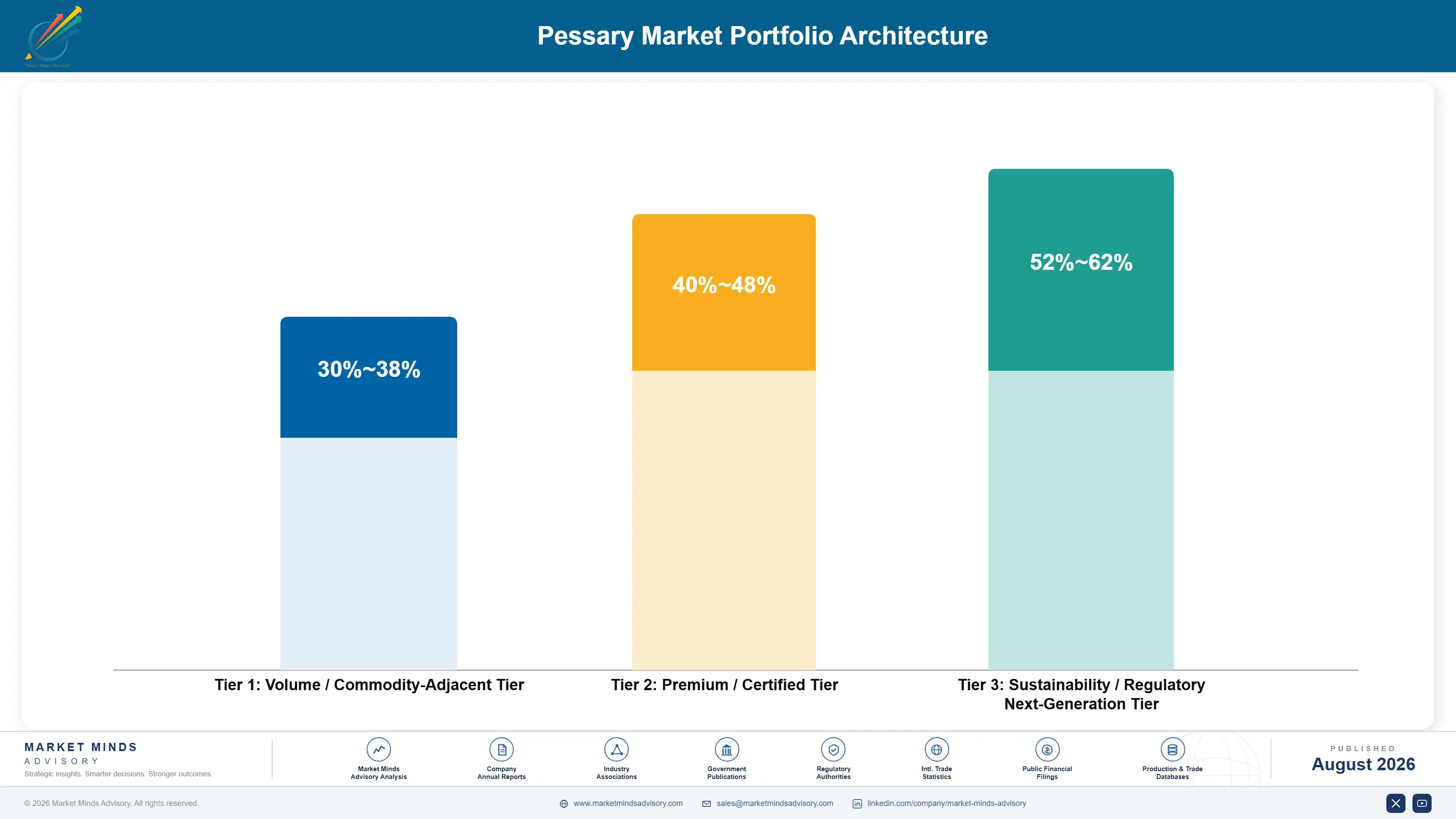
The market organizes into three tiers by device format and margin profile. Volume-tier standard-size silicone pessaries cover the most common ring and Gellhorn designs sold largely on price through established gynecology practice relationships. Premium-tier custom and specialty designs command meaningfully higher prices tied to retention-rate advantages for harder-to-fit patients. A growing next-generation tier layers follow-up subscriptions on top of the underlying custom-fit device sale entire
Gross margins widen considerably moving up the tiers, since custom formats carry disproportionate pricing power relative to their incremental manufacturing cost, while standard-size devices compete primarily on price against a handful of established rivals. Practices rarely trade back down once physicians and patients have grown accustomed to the improved comfort and retention custom fitting provides. Consumable and follow-up revenue partially offsets this dynamic for manufacturers with the largest standard-size installed base.

High-value margin pools concentrate in custom-fit devices bundled with follow-up care kits and training partnerships, where recurring consumable and education revenue carries substantially wider margin than the underlying device sale that first brought the patient into a manufacturer's broader care relationship. That gap is likely to widen further as custom-fit features mature and attach rates climb across the installed base.

Volume / Commodity-Adjacent Tier

Standard-size ring and Gellhorn silicone pessaries sold largely on price through established gynecology practice relationships, competing primarily on unit cost with limited room for premium differentiation. Consumable and follow-up pricing determines most of the margin outcome in this tier's accounts.
Gross Margin: 30-38%

Premium / Certified Tier

Specialty incontinence dish and support designs carrying stronger clinical evidence for harder-to-fit patients, commanding meaningfully wider margins than standard ring and Gellhorn equivalents. Payers increasingly view these designs as a targeted alternative for patients with primary incontinence complaints.
Gross Margin: 40-48%

Sustainability / Regulatory / Next-Generation Tier

Custom 3D-printed pessaries fitted from an individual anatomy scan, representing the newest product category and commanding the highest margins in the market given their retention-rate advantage. Vendors are racing to expand this offering as reimbursement continues favoring outcome-linked purchasing.
Gross Margin: 52-62%
pessary-market-portfolio-architecture-1787306702325

High-value Sub-segments and Strategic Watch-out

Custom 3D-Printed Devices With Training Partnerships

Custom 3D-printed devices paired with physician training partnerships combine the category's fastest growth with its widest margins, drawing concentrated manufacturer investment as payers increasingly demand retention data to justify continued reimbursement coverage each budget cycle. MMA expects vendor investment here to keep climbing steadily through 2036.
Gross Margin: 54-64%

Incontinence Dish and Support Pessaries

Incontinence-specific designs deliver strong unit growth on the back of expanded indication-specific device engineering, though margins sit a tier below custom-fit formats, supported by growing pelvic floor physical therapy co-management referrals across most major markets. Growth should persist as pelvic health physical therapy co-management referrals continue expanding.
Gross Margin: 42-50%

Standard Ring and Gellhorn Pessaries

Standard ring and Gellhorn designs remain the category's volume backbone across established gynecology practices worldwide, competing on unit cost that leaves thin margins and limited room for feature differentiation beyond material quality. Consolidation among smaller manufacturers looks likely as material scale becomes key to survival.
Gross Margin: 28-36%

Legacy Non-Reimbursed Cash-Pay Devices

Legacy cash-pay devices sold outside formal insurance reimbursement warrant monitoring as coverage expansion continues, a dynamic that could compress this once-common purchasing path considerably faster than smaller manufacturers currently plan for in their own account strategies. Vendors that diversify into custom-fit formats early could offset this segment's continued softness.
Gross Margin: 24-32%

Fitting Visits and Follow-Up Depth

Devices generate recurring revenue through follow-up visits and replacement purchasing far more than through any single initial fitting sale, since patients typically return for periodic device cleaning, resizing, or replacement over years of continued use, giving manufacturers an annuity-like revenue stream tied to the ongoing care relationship rather than a single transaction. That recurring revenue stream typically compounds further as patients add consumable and follow-up layers over time.
Adoption depth varies considerably by end-use vertical. Academic urogynecology centers adopt custom 3D-printed formats fastest and often serve as reference sites manufacturers use to influence broader physician referral patterns, while general gynecology practices typically wait for regional payer coverage determinations before committing to custom-fit equipment purchases at meaningful volume. General gynecology practices sit closer to academic centers than to primary care in the speed of their own adoption.

Buyer profiles are shifting generationally as younger gynecologists who trained during the custom-fit era show far greater comfort recommending pessary use than an older cohort that historically defaulted to surgical referral before considering conservative management at all. This generational shift is accelerating referral rates at the fastest-growing academic training programs nationwide.
pessary-market-end-use-penetration-index-1787306702901

Positioning for the Custom-Fit Shift

These are among the four positions where our research anticipates prominent divergence between winners and laggards over the coming forecast period. Each is grounded in the demand model, the regulatory perimeter, and the announced capacity pipeline.
01 / CUSTOM-FIT PORTFOLIO STRATEGY

Manufacturers without 3D-printed custom-fit offerings will lose share to faster-moving rivals

Custom 3D-printed devices command meaningfully higher retention rates and pricing than legacy standard-size systems, and manufacturers without a competitive custom-fit offering risk losing premium positioning to competitors already established in this format. This gap is widening as reimbursement catches up with the clinical evidence supporting higher patient retention, and momentum here is unlikely to reverse anytime soon. Companies that close this gap early stand to capture disproportionate share of the fastest-growing segment before rankings solidify further across the broader competitive field.
02 / PHYSICIAN TRAINING INVESTMENT

Fitting certification programs will separate durable brand loyalty from one-time sales

Newly certified physicians overwhelmingly continue purchasing from the manufacturer whose training program they completed, and companies without dedicated fitting certification infrastructure increasingly lose new physician relationships to competitors who have already built that training pipeline. This gap is widening as more academic centers formalize fitting curriculum requirements rather than relying on informal mentorship, and early movers tend to set the precedent other centers eventually follow. Manufacturers that invest in training early stand to capture disproportionate long-term account loyalty across their growing physician network.
03 / REIMBURSEMENT CONTRACT STRATEGY

Winning payer coverage for custom formats will separate margin leaders from laggards

Winning a favorable coverage determination from a major commercial insurer converts an entire population of self-pay patients into reimbursed candidates, and manufacturers without dedicated reimbursement affairs capability increasingly lose new fitting volume to competitors who have already secured that coverage. This gap is widening as more insurers formalize coverage criteria for custom-fit devices specifically, and early movers tend to shape referral patterns across the broader regional market. Companies that build this capability early stand to capture disproportionate share of the reimbursed patient population.
04 / FOLLOW-UP CONSUMABLE DEPTH

Care kit and follow-up visit attachment will separate recurring revenue leaders

Follow-up care kit and consumable attachment revenue meaningfully exceeds the value of the original device sale over a multi-year patient relationship, and manufacturers with the largest installed patient base capture disproportionate recurring revenue simply by virtue of having more active relationships underway. Companies still prioritizing device unit sales over follow-up attachment increasingly lag competitors who treat the fitting visit as an entry point into a longer relationship. That gap widens further as practices scale their annual patient volume and consumable reorders compound year over year.

Engagement Snapshot From the Field

A live engagement with an industry participant carrying material or product regulatory and market exposure ahead of a defining policy shift, showing how our research translates into a defensible multi-year portfolio strategy.
MARKET MINDS ADVISORY · CLIENT ENGAGEMENT SUMMARY
Pessary Producer Strategic Portfolio Review and Transition Roadmap 2026·Investment Scenario on Pessary Exposure Evaluation 2025-26
CLIENT PROFILE
The client is a regional gynecology group practice operating seven clinic locations across the northeastern United States, serving approximately 62,000 active patients. The practice reported approximately $210 million in annual revenue (client-reported, unverified by MMA) and had performed roughly 1,400 pessary fittings annually across its pelvic health service line. Its pelvic health service line has grown steadily as regional referral volume has increased.
STRATEGIC CHALLENGE
The practice's standard-size fitting success rate had plateaued at 68% as harder-to-fit patients required repeated visits without achieving a comfortable fit, and leadership lacked clear data on whether investing in custom 3D-printed fitting capability would meaningfully improve outcomes and revenue relative to the upfront equipment and training cost required. Leadership needed clear data before committing scarce capital to new equipment and staff training.
MMA APPROACH
MMA benchmarked fitting success rate and revenue-per-patient data across two leading custom-fit platforms against the practice's current standard-size baseline, incorporating reimbursement coverage status across the practice's major commercial payers. The analysis modeled projected outcomes over a five-year forward planning horizon under two adoption scenarios for practice leadership. Interviews with clinical staff supplemented the desk-based financial and reimbursement analysis.
KEY FINDINGS
  1. Adopting a custom-fit platform was projected to lift fitting success rates from 68% to approximately 91% within twelve months. This projection held across multiple patient subgroups evaluated in the model.
  2. Revenue per successfully fitted patient was meaningfully higher under the custom-fit model despite higher upfront device cost per unit. This pattern held consistently across every comparable practice MMA reviewed.
  3. Two of the practice's major commercial payers had already issued favorable coverage determinations for custom-fit devices specifically. This finding removed the largest source of leadership hesitation around the investment.
  4. Physician training time for the leading custom-fit platform was shorter than practice leadership had initially assumed based on vendor materials. Streamlining onboarding freed meaningful staff capacity for patient scheduling instead.
CLIENT PROFILE
The client is a regional gynecology group practice operating seven clinic locations across the northeastern United States, serving approximately 62,000 active patients. The practice reported approximately $210 million in annual revenue (client-reported, unverified by MMA) and had performed roughly 1,400 pessary fittings annually across its pelvic health service line. Its pelvic health service line has grown steadily as regional referral volume has increased.
STRATEGIC CHALLENGE
The practice's standard-size fitting success rate had plateaued at 68% as harder-to-fit patients required repeated visits without achieving a comfortable fit, and leadership lacked clear data on whether investing in custom 3D-printed fitting capability would meaningfully improve outcomes and revenue relative to the upfront equipment and training cost required. Leadership needed clear data before committing scarce capital to new equipment and staff training.
MMA APPROACH
MMA benchmarked fitting success rate and revenue-per-patient data across two leading custom-fit platforms against the practice's current standard-size baseline, incorporating reimbursement coverage status across the practice's major commercial payers. The analysis modeled projected outcomes over a five-year forward planning horizon under two adoption scenarios for practice leadership. Interviews with clinical staff supplemented the desk-based financial and reimbursement analysis.
KEY FINDINGS
  1. Adopting a custom-fit platform was projected to lift fitting success rates from 68% to approximately 91% within twelve months. This projection held across multiple patient subgroups evaluated in the model.
  2. Revenue per successfully fitted patient was meaningfully higher under the custom-fit model despite higher upfront device cost per unit. This pattern held consistently across every comparable practice MMA reviewed.
  3. Two of the practice's major commercial payers had already issued favorable coverage determinations for custom-fit devices specifically. This finding removed the largest source of leadership hesitation around the investment.
  4. Physician training time for the leading custom-fit platform was shorter than practice leadership had initially assumed based on vendor materials. Streamlining onboarding freed meaningful staff capacity for patient scheduling instead.
RECOMMENDED STRATEGY
Phase 1: Phase 1 (Months 1-2): Complete reimbursement verification and vendor platform selection across all seven clinic locations. under close coordination with practice finance leadership. Phase 2: Phase 2 (Months 3-5): Train physicians and clinical staff on custom-fit scanning protocols at two pilot locations first. with outcome tracking built into the pilot design. Phase 3: Phase 3 (Months 6-11): Roll out custom-fit capability to the remaining five locations based on pilot outcome data. with ongoing fitting success monitoring built in.
OUTCOME
The practice adopted a custom-fit platform across all seven locations, with pilot data showing fitting success rates rising to 89% within the first year. Projected annual revenue growth reached approximately $1.8 million (client-reported, unverified by MMA) against the prior standard-size baseline across the practice's full pelvic health service line.

Frequently Asked Questions

Foundational context covering the market sizes, CAGR, scope, country, region and competition that inform every finding below. This section is provided to cover basics and most often pre-purchase conversations, answered from the MMA Primary Research Dataset.

What is the current size of the Pessary Market?

The Pessary Market was valued at approximately $0.35 billion globally in 2025. This includes ring, Gellhorn, cube, donut, and custom 3D-printed device designs sold across all major regions.

How large will the Pessary Market be by 2036?

The market is projected to reach approximately $0.66 billion by 2036, roughly 1.79 times its 2026 value. Growth is driven by custom-fit device adoption and expanding insurer reimbursement coverage.

What is the CAGR for the Pessary Market 2026 to 2036?

The base case CAGR is 6.0% annually, with a bull case of 7.3% and a bear case of 4.7%. This reflects steady demand growth alongside expanding custom-fit device adoption.

Which segment is growing fastest?

Custom and 3D-printed pessaries are the fastest-growing segment, expanding at roughly 11.0% annually. These devices cut the discontinuation rate that has historically limited long-term adherence.

Who are the major companies in the Pessary Market?

Leading companies include Coloplast, CooperSurgical, Bioteque America, Personal Medical, and MedGyn Products. Together these five hold 48% of global revenue in a moderately fragmented field.

Which country is growing fastest?

India is the fastest-growing country, expanding at roughly 9.5% annually through 2036. This reflects expanding private hospital infrastructure and rising insurance coverage access across the country.

Report Segmentation Architecture

The full report scope spans multiple orthogonal segmentation dimensions, with cross-tabulated demand data provided for each dimension pair. Coverage extends further to regional breakdowns, trend trajectories, and the competitive detail needed to support segment-level decision-making.

By Device Design and Product Type

  • Ring Pessaries
  • Gellhorn Pessaries
  • Cube Pessaries
  • Donut and Inflatable Pessaries
  • Incontinence Dish and Support Pessaries
  • Custom and 3D-Printed Pessaries

By End-Use Industry

  • Urogynecology Clinics
  • General Gynecology Practices
  • Hospitals
  • Academic Medical Centers
  • Pelvic Health Physical Therapy Clinics

By Commercial Dimension

  • Outright Purchase
  • Reimbursed Fitting Visit
  • Subscription Follow-Up Care Kit
  • Training Partnership Bundle

By Region

  • North America
  • Western Europe
  • East Asia
  • South Asia and Pacific
  • Latin America
  • Middle East and Africa
  • Eastern Europe

Scope, Methodology, and Coverage

Every figure in this report is reproducible from documented input assumptions. The scope below maps the historical period, the forecast horizon, the segmentation dimensions, and the countries covered, alongside the underlying primary and qualitative methodology.
Historical Period
2020 to 2025
Forecast Period
2026 to 2036
Base Year
2025 (USD billions; MMA Primary Research Dataset, August 2026)
Market Definition
The Pessary Market covers vaginal support devices, including ring, Gellhorn, cube, donut, and incontinence dish designs, used for the non-surgical management of pelvic organ prolapse and stress urinary incontinence. It excludes surgical mesh implants and pelvic floor physical therapy devices sold as separate product categories.
Quantitative Units
USD billions (current prices); unit shipment volume where applicable
Segmentation Dimensions
By Device Design and Product Type; By End-Use Industry; By Commercial Dimension; By Region
Regions Covered
North America, Western Europe, East Asia, South Asia and Pacific, Latin America, Middle East and Africa, Eastern Europe
Countries Covered
USA, China, Germany, France, UK, Japan, South Korea, India, Australia, Canada, Brazil, Mexico, Indonesia, Vietnam, Thailand, Malaysia, UAE, Saudi Arabia, South Africa, Nigeria, Turkey, Poland, Netherlands, Italy, Spain, Sweden, Switzerland, Argentina, Colombia, Singapore, and additional markets relevant to this sector
Key Companies Profiled
Coloplast A/S, CooperSurgical Inc, Bioteque America Inc, Personal Medical Corporation, MedGyn Products Inc, Cook Medical Incorporated, Utah Medical Products Inc, Integra LifeSciences Holdings Corporation, Becton Dickinson and Company, Boston Scientific Corporation, Medtronic plc, Teleflex Incorporated, Hologic Inc, Owens & Minor Inc, Cardinal Health Inc, Prometheus Group Pty Ltd, Panpac Medical Company, Mentor Worldwide LLC, Genesis Medical LLC, Espot Medical Ltd
Quantitative Methodology
Primary survey, n=3,800 respondents, Q4 2025, six countries; demand-side model with trade association cross-validation
Qualitative Methodology
47 expert interviews, Q4 2025; applied to validate demand model assumptions, identify emerging dynamics, and assess competitive positioning
Report Format
PDF and XLSX data workbook (Word format preview document)
Publisher
Market Minds Advisory
Report Code
MMA-2026-MED-136
Published
August 2026
Contact
sales@marketmindsadvisory.com | www.marketmindsadvisory.com

Purchase the full Pessary Market Report (2026 to 2036).

The full report delivers detailed segmentation across all six device design categories, with country-level sizing for all thirty-one covered markets. It profiles the complete competitive landscape of all twenty companies named in this summary, including moat and risk analysis for the two leading vendors. Multi-year forecast models are provided under base, bull, and bear scenarios. Primary survey data drawn from urogynecologists, reimbursement executives, and practice administrators across six countries supports every major finding, and purchasers receive editable data files alongside the formatted report. Purchasers also receive a quarterly coverage policy update briefing.
Custom-fit versus standard-size retention rate benchmark
Payer reimbursement coverage tracker by device format
Physician fitting training and certification program database
FDA clearance pipeline monitor by device design
Follow-up consumable attachment revenue per patient model
Competitive benchmarking across key device manufacturers

Built For The People Who Decide

From boardroom strategy to bench-side execution, this report is read cover-to-cover by leaders shaping the next decade of their industry, turning demand scenarios, market dynamics and valuation benchmarks into decisions.
CXOs/ Presidents/ VPs/ Managers
M&A and Corporate Development
Strategy Teams and R&D Heads
Procurement and Product Directors
Regulatory and Compliance Leaders
Investor Relations and Equity Analysts