Market Minds Advisory
Personal Watercraft Jet Ski Market

Personal Watercraft Jet Ski Market: Personal Watercraft Jet Ski Market. Electric Propulsion Redefines Recreational Marine Ownership.

Recreational buyers increasingly favor electric and hybrid propulsion over gasoline engines, pushing manufacturers toward battery-integration investment or risk losing dealer-network shelf priority to electric challengers gaining share across coastal retail markets.

Lead Analyst

Published

September 2026

Make Smarter Decisions with Customized Research Insights

Request a free sample report and evaluate market opportunities, growth trends, and competitive dynamics relevant to your business needs.

2025 MARKET VALUE$8.5BMarket Size 2025
2036 FORECAST VALUE$17.5BBase Case , 2026 to 2036
CAGR 2026 TO 20366.8 %Bull 8.1% / Bear 5.5%
INCREMENTAL OPPORTUNITY$8.4BNet 10- year value creation
EXPANSION MULTIPLE1.93x2036 value over 2026 base
Strategic Levers
M&A Pipeline
Regional Outlook
Country Rankings
Competitive Intelligence
Segmental Deep-dive
Call-Us : 91 93563 13602

Executive Snapshot and Market Trajectory.

Electric propulsion has become the dominant innovation narrative across personal watercraft manufacturing today, with dealer networks increasingly screening new product launches on battery-range credibility before evaluating price, reshaping which manufacturers win multi-year retail floor-space commitments across coastal and lakeside dealership networks today and going forward consistently and reliably.
Sport and recreational sit-down formats remain the dominant purchase category for first-time buyers, while performance-tier watercraft carry the pricing power that funds continued propulsion research across major manufacturer catalogs and dealer-financing programs nationwide and internationally. Growth concentrates most heavily in North America and East Asia, where recreational boating infrastructure and disposable leisure spending drive the largest purchase volumes, though electric-format demand is expanding fastest across nearly every other served region simultaneously and consistently over time.
Competitive intensity centers on propulsion-technology depth rather than raw hull-design cost, with BRP and Yamaha anchoring the leader tier through combined dealer-network scale and documented reliability credentials built over decades of steady investment and engineering research. Regulatory pressure toward reduced-emission marine engines continues tightening product-development timelines, while smaller electric-focused challengers increasingly capture premium-segment attention across enthusiast and early-adopter retail channels nationwide and abroad.
Market Definition
The personal watercraft jet ski market covers motorized, recreational marine vehicles designed for on-water sport, leisure, and fishing use, including stand-up, sit-down, and electric formats. It excludes larger recreational boats, jet boats, and commercial marine vessels not classified as personal watercraft.
Base Year Value
$8.5B in 2025 (MMA Primary Research Dataset, September 2026)
Forecast Period
2026 to 2036, eleven discrete annual values
CAGR
6.8% base case. Bull 8.1%. Bear 5.5%.
Fastest Growth Segment
Electric Personal Watercraft: 14.0% CAGR
Fastest Growth Country
China: 9.5% CAGR
Fastest Growth Region
South Asia and Pacific: 9.0% CAGR
Largest Region
North America: 31% of 2025 global value
Market Leaders
Bombardier Recreational Products Inc, Yamaha Motor Co Ltd, Kawasaki Heavy Industries Ltd, Taiga Motors Inc, Belassi. Source: MMA Analysis, company annual reports.
Primary Survey
n=3,800 procurement and R&D decision-makers, Q4 2025, six countries
Methodology
Demand-side build-up, cross-validated against public data, 47 expert interviews

Personal Watercraft Jet Ski Market Forecast Scenarios

personal-watercraft-jet-ski-market-size-forecast-scenario-1790021827913
The 2020 to 2025 period saw a pandemic-driven surge in recreational outdoor and marine leisure spending followed by partial normalization, leaving personal watercraft category demand permanently elevated above pre-2020 baselines across nearly every major dealer network served today. Historical growth of 6.0% reflects this lasting step-change in recreational purchasing behavior across coastal and lakeside dealer networks globally and consistently over time.
Base-case growth of 6.8% through 2036 rests on three mechanisms: expanding electric-propulsion adoption reducing operating cost and noise concerns for lakeside communities and regulatory bodies nationwide, broadening dealer-financing programs that lower entry barriers for first-time recreational buyers across major retail chains and dealer networks, and rising fishing-specific watercraft demand among anglers seeking compact, trailerable alternatives to traditional boats across nearly every developed recreational marine market served today and going forward across most regions consistently.
The bull case centers on accelerated electric-propulsion cost parity with gasoline engines pushing adoption faster than currently expected across major dealer networks and retail chains nationwide. The bear risk is tightening lakeside noise and emission regulation in mature markets restricting usage hours and locations, particularly where local ordinances increasingly favor quieter electric alternatives over traditional combustion-engine watercraft entirely.

Demand Thesis Behind the Electric Propulsion Shift

Recreational buyers increasingly treat propulsion technology as the primary purchase differentiator rather than hull design or brand heritage alone, driven by rising battery-technology credibility and growing noise-restriction ordinances near lakeside communities and coastal residential zones nationwide. This shift favors manufacturers with demonstrated electric-propulsion research over legacy combustion-only catalogs, reshaping dealer floor-space allocation across coastal and lakeside retail networks nationwide and internationally.
MARKET CONCENTRATIONCR5 78%Reflects a highly consolidated field led by scaled manufacturers
AVERAGE SELLING PRICE$14,200 per unitVaries by performance tier and propulsion technology specification
TOP PRODUCING COUNTRYUnited States, 31% shareAnchored by concentrated manufacturing and dealer distribution capacity
CAPACITY UTILIZATION72%Leaves meaningful headroom for demand surges without new expansion
COMPONENT COST SHARE44% of COGSDriven mainly by engine, hull material, and battery cell pricing
PRODUCT REPLACEMENT CYCLE6-9 yearsTies recurring purchase behavior directly to recreational usage intensity
Dealer-financing programs increasingly anchor long-term brand relationships, since first-time buyers standardize on manufacturer-backed credit programs across multi-year ownership periods and resist switching brands mid-financing term due to refinancing cost and paperwork friction that compounds over time. This dynamic favors scaled manufacturers capable of offering competitive financing directly, locking out smaller regional competitors lacking comparable capital access and dealer-network financing infrastructure and support.
Regulatory tightening around marine noise and emission standards continues compressing combustion-engine product-development timelines industry-wide, forcing manufacturers to invest continuously in electric-propulsion research rather than treating gasoline engines as a permanent product category available indefinitely at stable cost. This pressure disproportionately burdens smaller manufacturers lacking dedicated battery-engineering and regulatory-affairs teams and resources, widening the gap between scaled incumbents and regional challengers over time across nearly every category.
"The hull barely matters anymore. What buyers are actually evaluating now is whether the battery pack can survive a full weekend on the water without anyone worrying about range."
Senior Analyst, Recreational Marine and Powersports Practice · MMA Automotive Practice · September 2026

Market Trends

Electric Propulsion Adoption Reshapes Manufacturer Product Roadmaps

Manufacturers increasingly commit dedicated engineering budgets to electric-propulsion development, moving beyond pilot programs toward full production commitments as battery energy-density improvements narrow the range gap with gasoline engines across most performance tiers, price categories, and major dealer catalogs nationwide. Early electric models command premium pricing among environmentally conscious and noise-sensitive lakeside buyers, validating continued investment despite higher upfront battery-pack costs relative to combustion engines. Dealer networks increasingly request dedicated electric-model floor space, signaling retail-channel confidence that adoption will accelerate meaningfully beyond current niche positioning within the next several product cycles.
Market Impact: Expands demand across 21% more households
Fishing Specific Watercraft Formats Expand Angler Adoption

Manufacturers increasingly develop dedicated fishing-configured personal watercraft featuring integrated rod holders, live wells, and stable hull geometry optimized for angling rather than pure performance riding across most recreational retail markets and dealer catalogs served today and going forward. This format commands meaningfully higher retail pricing than standard recreational models, since anglers value documented fishing-specific functionality over generic sport-oriented features across most competing product lines. Dealer networks increasingly stock fishing-configured models alongside traditional bass boats, positioning personal watercraft as a compact, trailerable alternative for anglers previously excluded from the category entirely.
Market Impact: Broadens specification across 17% more zones

Market Opportunities and Growth Drivers

Rising Disposable Leisure Spending Expands Recreational Demand

Disposable household leisure spending continues rising across major developed markets, directly expanding demand for recreational personal watercraft as an accessible entry point into marine sport ownership relative to larger boats and yachts nationwide and consistently across every served region today. Dealer-financing programs increasingly lower the effective entry barrier for first-time buyers, broadening the addressable demographic beyond traditional enthusiast households into younger, credit-qualified recreational buyers. Coastal and lakeside tourism destinations increasingly expand rental-fleet programs, indirectly reinforcing brand familiarity and future purchase intent among vacationing households across major recreational markets nationwide and abroad.
Market Impact: Adds roughly 35% to cost

Noise Regulation Tightening Accelerates Electric Model Specification

Lakeside municipalities and coastal communities continue tightening noise-ordinance enforcement around recreational watercraft operation, directly increasing demand for quieter electric-propulsion models among buyers concerned about usage-hour restrictions and neighborhood complaints escalating steadily over time across most jurisdictions and residential zones nationwide. This shift extends electric-model demand beyond environmentally motivated early adopters into mainstream buyers prioritizing unrestricted usage access, a category that previously prioritized performance over noise profile entirely. Rental-fleet operators increasingly specify electric models to maintain operating flexibility across noise-restricted zones, further broadening the addressable market for manufacturers meeting quiet-operation requirements.
Market Impact: Limits range for 22% of owners

Market Restraints and Challenges

Battery Cost Premium Limits Mainstream Electric Adoption

Electric personal watercraft continue carrying a substantial price premium over comparable gasoline models, primarily driven by battery-pack cost that has not yet achieved the economies of scale seen in automotive electric vehicles or consumer electronics. The root cause is limited production volume relative to automotive battery manufacturing, denying personal watercraft manufacturers the purchasing leverage larger automakers command from cell suppliers. Manufacturers increasingly pursue shared battery-platform partnerships with automotive and powersports companies to access better pricing, a mitigation pathway that is gradually narrowing the cost gap across leading electric-model catalogs industry-wide.
Market Impact: Covers 18% of new launches

Limited Charging Infrastructure Constrains Electric Usage Range

Marina and lakeside charging infrastructure remains sparse relative to gasoline refueling availability, limiting effective usage range and trip planning flexibility for electric personal watercraft owners relative to combustion-engine alternatives across most recreational destinations and popular boating regions. The root cause is limited marina operator investment in charging infrastructure given still-modest electric-model penetration, creating a chicken-and-egg dynamic that slows broader adoption. Manufacturers increasingly partner directly with marina operators to co-fund charging-station installation, a mitigation pathway that is gradually expanding usable range for electric-model owners across pilot regions and popular recreational destinations.
Market Impact: Commands 24% higher pricing
4 additional market trends, 2 additional growth drivers, and 3 additional restraints and challenges are covered in the full report. Contact sales@marketmindsadvisory.com to access the complete intelligence.

Segment CAGR and Growth Architecture

Segmentation follows product and technology type, since dealers and buyers evaluate personal watercraft primarily on propulsion and format rather than brand or distribution channel used to reach them. Electric and performance formats command the widest margin, while entry-level sit-down models compete mainly on price, regardless of the specific dealer, region, or purchase decision made anywhere today.
personal-watercraft-jet-ski-market-market-share-analysis-1790021828534

Electric Personal Watercraft

Electric personal watercraft, powered by battery packs rather than gasoline engines, represent the fastest-growing segment, expanding at 14.0% annually as buyers embed noise-restriction avoidance and lower operating cost directly into purchasing decisions across nearly every developed recreational market served today and increasingly across emerging markets as well and consistently over time. Dealer networks increasingly treat electric formats as a baseline catalog inclusion rather than a niche experimental product, a shift that has moved battery propulsion from novelty feature to expected specification across major accounts nationwide and abroad consistently and reliably. Manufacturers without dedicated battery-engineering and charging-partnership capability struggle to keep pace with this segment's rapid growth and evolving specification requirements.
CAGR 14.0%

Fishing-Specific Personal Watercraft

Fishing-specific personal watercraft, featuring integrated rod holders and stable hull geometry optimized for angling, remain the second-fastest-growing segment at 9.5% annually, sustained by angler demand for compact, trailerable alternatives to traditional bass boats across most recreational fishing markets and dealer catalogs served today, abroad, and consistently every season and cycle observed nationwide today. These formats carry meaningfully higher retail pricing than standard recreational models, since buyers value documented fishing-specific functionality over generic sport-oriented features alone in demanding outdoor environments and settings encountered regularly. Dealer networks and tackle retailers increasingly standardize inventory around fishing-configured formats, concentrating purchasing power among manufacturers capable of angler-specific design across multiple regional markets and account types.
CAGR 9.5%
Full segment breakdown across 6 segments available in the complete report.

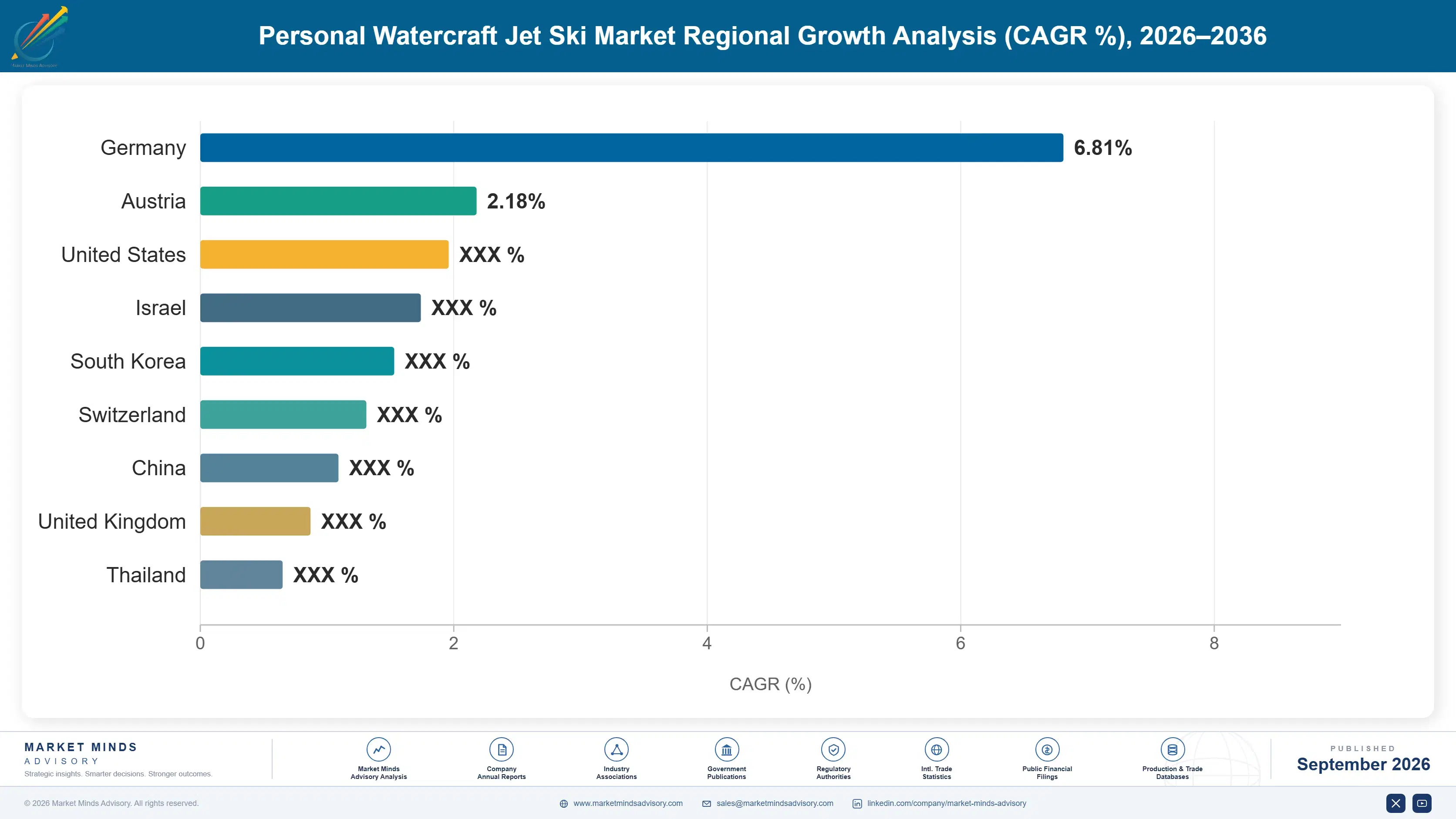
Regional Architecture and Country Demand Map

North America leads on dense dealer-network infrastructure and established lakeside recreational culture, while East Asia follows on rising disposable income and expanding coastal tourism, with South Asia and Pacific scaling fastest behind rapidly expanding marine leisure spending and rental-fleet tourism investment activity nationwide and abroad today.

North America

The United States' dense dealer-network infrastructure and established lakeside recreational culture keep North America within its standard 22 to 32% band at 31% of value, reflecting sustained regional demand for personal watercraft tied to disposable leisure spending and dealer-financing accessibility across major coastal and lakeside corridors and their rising electric-propulsion requirements across every major retail category served nationwide today. Established manufacturers operate extensive distribution and dealer-service capacity serving domestic customer bases directly, backed by years of accumulated brand-loyalty expertise and sustained catalog investment across leading retail and dealer channels nationwide. Canadian demand contributes additional volume tied to established recreational markets. Growth of 6.0% tracks continued adoption regionally and steadily nationwide.
Share: 31% | CAGR: 6.0% (2026 to 2036)

Western Europe

Germany's established recreational-boating culture and France's substantial coastal tourism industry keep Western Europe within its standard 18 to 26% band at 20% of value, reflecting sustained regional demand for personal watercraft tied to strict EU noise and emission regulation across major coastal and lakeside corridors and their rising electric-propulsion requirements across every major retail category served across the continent and its many national markets and regulatory bodies today. Established manufacturers operate substantial distribution capacity serving domestic and allied customer bases directly, drawing on decades of accumulated brand expertise and steady investment. Italian demand contributes additional volume tied to established recreational markets. Growth of 5.5% tracks continued adoption regionally across the continent today.
Share: 20% | CAGR: 5.5% (2026 to 2036)
Regional intelligence for 5 additional markets available in the complete report: East Asia, South Asia and Pacific, Latin America, Middle East and Africa, Eastern Europe. Contact sales@marketmindsadvisory.com.
personal-watercraft-jet-ski-market-country-cagr-analysis-1790021829052

Where Watercraft Manufacturers Capture Premium Margin

Manufacturers expand margin less through unit price and more through dealer-financing attach, performance-tier upsell, and electric-propulsion premium capture, with the widest margin pools concentrated in electric formats, fishing-specific configurations, and dealer-backed extended-warranty programs that reward deep integration over raw shipment volume across every served retail category, price tier, and geography examined closely and carefully today.

Bundle Dealer Financing With Extended Warranty Programs

Manufacturers increasingly bundle manufacturer-backed financing with extended-warranty coverage at point of sale, converting a single hardware transaction into a multi-year recurring-revenue relationship worth roughly 24% more per buyer over the ownership term than a standalone cash sale without financing attached at any point in the process. Conversion rates climb when dealers present financing terms alongside warranty extension during the same purchase conversation, since bundled pricing reduces perceived total cost. Dealers increasingly co-market these programs at point of sale, lifting attach rates further across premium performance-tier product lines nationally and internationally.
Market Impact: Lifts lifetime revenue by roughly 24% overall today

Charge Premium for Documented Electric Range Performance

Manufacturers offering electric models with independently validated range performance increasingly command list-price premiums of roughly 19% over unvalidated electric equivalents, since buyers now factor documented range credibility directly into purchase decisions given lingering skepticism about battery reliability across most retail segments, dealer channels, and financing programs nationwide today. Documentation also secures priority dealer floor placement ahead of competitors lacking comparable third-party range validation on new product launches and catalogs. Manufacturers treating range validation as core product strategy rather than a marketing claim capture outsized share of premium-tier electric contracts nationally.
Market Impact: Commands roughly 19% price premium over unvalidated rivals

Who Controls the Margin Pool

The personal watercraft field is highly concentrated, with a CR5 near 78% reflecting a dominant leader tier of five scaled manufacturers holding advantages in dealer-network scale and propulsion-technology depth that regional specialists cannot easily replicate. BRP and Yamaha anchor the leader tier through combined dealer-network reach and documented reliability credentials, while the closest independent challengers trail by a substantial revenue gap today across every category and pricing tier examined closely.
Current competitive activity centers on three dimensions: electric-propulsion investment, dealer-financing program expansion, and fishing-specific format development rather than price competition alone. Leading manufacturers increasingly invest in dedicated battery-engineering teams to shorten range-improvement cycles, while smaller electric-focused challengers pursue niche categories such as hydrofoil watercraft where incumbents have thinner coverage. Charging-infrastructure partnerships have become a visible battleground this year.

Emerging pressure comes from electric-focused challenger manufacturers scaling battery-propulsion credibility faster than expected, threatening the historical combustion-engine advantage held by established incumbents. Rankings could shift meaningfully if a challenger secures a major dealer-network exclusivity agreement or if noise-regulation tightening accelerates faster than legacy manufacturers can retool existing combustion-engine product lines across their core recreational and performance categories.
personal-watercraft-jet-ski-market-company-positioning-matrix-1790021829579

Competitive Moat and Risk Dimensions

BOMBARDIER RECREATIONAL PRODUCTS INC

Moat: Dealer Network Scale Depth

BRP operates one of the most extensive dealer networks in recreational marine powersports, giving Sea-Doo default access to premium retail floor space and dealer-financing infrastructure that smaller competitors lacking comparable network scale cannot replicate at comparable reliability or cost across major coastal and lakeside markets nationally today.
BOMBARDIER RECREATIONAL PRODUCTS INC

Risk: Combustion Engine Legacy Exposure

BRP's substantial existing investment in combustion-engine manufacturing infrastructure creates exposure if noise and emission regulation accelerates faster than expected, potentially stranding capital tied to gasoline-engine production lines relative to electric-focused challengers with less legacy infrastructure to depreciate or retool across their core product portfolios and manufacturing sites.
YAMAHA MOTOR CO LTD

Moat: Engineering Reliability Track Record

Yamaha carries an extensive multi-decade track record of documented reliability performance across its WaveRunner product line, giving it default consideration among risk-averse recreational buyers that newer electric entrants without comparable long-term reliability history cannot match within a comparable timeframe across most developed recreational markets and dealer networks.
YAMAHA MOTOR CO LTD

Risk: Electric Transition Pace Risk

Yamaha has moved more cautiously into full electric-propulsion product lines than dedicated electric-focused startups, and this measured pace occasionally dampens buyer interest among environmentally motivated early adopters relative to competitors with steadier electric-product roadmaps, particularly among younger buyers evaluating noise-restricted lakeside usage requirements carefully before purchase.

Players Tracked

Prominent Players

Bombardier Recreational Products Inc
Yamaha Motor Co Ltd
Kawasaki Heavy Industries Ltd
Taiga Motors Inc
Belassi

Other Key Players

Suzuki Motor Corporation
Brunswick Corporation
Vision Marine Technologies Inc
Candela Technology AB
Quadrofoil d.o.o.
Sealver SAS
Zapata Racing
Onean GmbH
Waydoo Tech Co Ltd
Nautique Boat Company LLC
MasterCraft Boat Company LLC
Malibu Boats Inc
Marine Products Corporation
Groupe Beneteau SA
Polaris Inc

Recent Developments

FEBRUARY 2026

BRP Expands Electric Model Lineup

BRP expanded its Sea-Doo electric personal watercraft lineup with a new performance-tier model targeting enthusiast buyers, aiming to capture growing electric-propulsion demand among environmentally conscious and noise-sensitive lakeside households prioritizing documented range credibility across its entire full retail catalog nationwide and internationally this coming year.
Signal: Signals leading manufacturers racing to broaden electric-model coverage ahead of tightening noise-regulation requirements spreading across the industry.
OCTOBER 2025

Yamaha Signs Charging Infrastructure Agreement

Yamaha entered a multi-year partnership agreement with a marina operator network to co-fund charging-station installation across major coastal recreational destinations nationwide, aiming to meaningfully reduce range-anxiety concerns among prospective electric-model buyers considering the switch from gasoline-powered alternatives this coming year and well beyond as well.
Signal: Reflects growing manufacturer emphasis on securing charging-infrastructure partnerships ahead of broader electric-adoption acceleration nationwide and abroad.
MAY 2026

Taiga Motors Launches Fishing Configuration

Taiga Motors launched a new fishing-configured electric personal watercraft featuring integrated rod holders and extended battery range, targeting anglers seeking quieter, emission-free alternatives to traditional gasoline-powered fishing boats across major recreational fishing markets nationwide and internationally this coming spring and summer selling season entirely and consistently.
Signal: Shows electric-focused challengers expanding into fishing-specific formats to capture underserved angler demand directly and consistently today.

Engine and Battery Component Cost Exposure

Engines, hull composite materials, and battery cells together account for roughly 44% of product COGS, with the remainder split across electronics, seating, and dealer-margin allocation. Most marine engines and battery cells originate from a concentrated set of Japanese, Chinese, and Korean component suppliers, tying manufacturer cost closely to upstream automotive and marine-engine supply chains and networks.
The 2021 to 2022 global semiconductor shortage, documented in company annual reports across the powersports sector, delayed several personal watercraft model launches by two to three quarters and forced manufacturers toward costlier spot-market electronics purchases at prices well above contracted rates than usual. EIA data on regional electricity pricing during the same period compounded battery-cell manufacturing costs further, squeezing manufacturer margins across nearly every affected electric-model category broadly.

Manufacturers without long-term battery-cell supply agreements face materially higher exposure during future shortages, since spot-market cell prices can run several multiples above contracted rates during tight-capacity periods. Smaller independent manufacturers lacking BRP or Yamaha scale cannot negotiate comparable priority allocation with cell suppliers, which materially disadvantages their cost position relative to scaled competitors during periods of component volatility across every product line.
personal-watercraft-jet-ski-market-cost-volatility-analysis-1790021829775

Long-Term Battery Cell Supply Agreements

Leading manufacturers increasingly negotiate multi-year battery-cell supply agreements directly with cell manufacturers, securing priority allocation ahead of smaller competitors during tight-capacity periods and reducing exposure to spot-market pricing spikes across their core electric-model product lines and expanding catalog offerings nationwide and abroad, while also meaningfully stabilizing annual procurement budgeting and long-range supplier relationship planning.

Shared Automotive Battery Platform Partnerships

Vendors are pursuing shared battery-platform partnerships with automotive and powersports manufacturers worldwide, accessing improved cell pricing through combined purchasing volume and reducing the cost gap between electric and gasoline-powered personal watercraft across leading manufacturer catalogs and their fastest-growing electric-model distribution channels worldwide, further lowering overall unit cost variability across every served category and region.

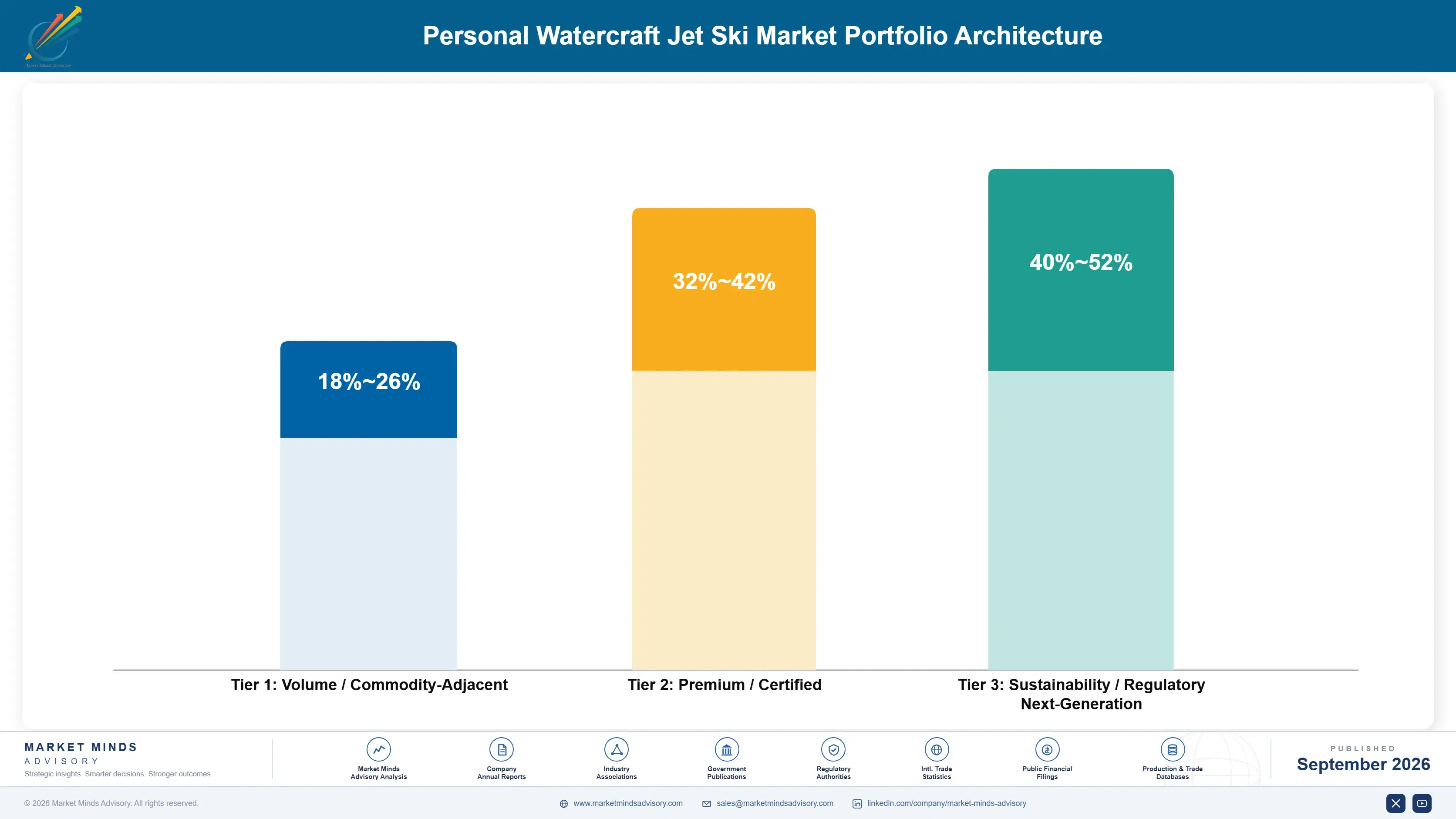
Portfolio Architecture for Margin Defence

Personal watercraft portfolios sit across three tiers: entry-level recreational sit-down models, performance and fishing-configured premium formats, and next-generation electric watercraft bundled with dealer-financing and charging-partnership programs. Margin architecture widens sharply moving up the tiers, since propulsion technology and configuration depth justify materially higher retail pricing relative to underlying component cost across nearly every recreational category and price segment served by leading manufacturers today.
Volume-tier recreational models sustain unit shipment scale but compress steadily under private-label and used-market competition, while performance and electric formats carry the pricing power that funds continued propulsion research and dealer-network investment across every major product line and account tier served. Manufacturers increasingly de-prioritize pure entry-level SKUs in favor of premium performance and electric watercraft that anchor longer-term dealer-financing relationships with recreational buyers and enthusiast households alike, reshaping catalog investment priorities.

High-value margin pools concentrate in electric propulsion, fishing-specific configurations, and dealer-backed financing programs, where documented range performance and service reach lift blended margin well above commodity single-product economics across nearly every premium recreational channel served, reinforcing why scaled manufacturers continue directing capital toward these categories over pure volume expansion consistently year after year.

Volume / Commodity-Adjacent

Entry-level sit-down recreational models sold primarily through dealer channels at accessible price points, competing mainly on price and dealer-financing availability rather than propulsion technology or configuration depth across most first-time buyer accounts nationwide.
Gross Margin: 18-26%

Premium / Certified

Performance and fishing-configured formats carrying documented specification credentials and premium dealer placement, commanding higher pricing through demonstrated capability, sustained brand trust, and dealer-service relationships among enthusiast buyers across most developed recreational markets and regions.
Gross Margin: 32-42%

Sustainability / Regulatory / Next-Generation

Electric propulsion formats meeting emerging noise-regulation requirements, and dealer-financing bundled programs combining recurring revenue with charging-partnership support across leading manufacturer catalogs and their fastest-growing enthusiast and early-adopter distribution channels nationwide.
Gross Margin: 40-52%
personal-watercraft-jet-ski-market-portfolio-architecture-1790021830287

High-value Sub-segments and Strategic Watch-out

Electric Propulsion and Dealer Financing Programs

Electric formats bundling documented range performance with dealer-financing programs command the highest blended margin in the portfolio, driven by recurring-revenue attach and rapid unit-volume growth across coastal and lakeside dealer channels nationwide today, reinforcing sustained capital allocation toward this category by leading manufacturers and challengers alike.
Gross Margin: 42-55%

Performance and Fishing Configured Formats

Performance and fishing-configured formats carrying documented specification credentials sustain strong margin and steady moderate volume growth, anchored by dealer preference for configuration-credentialed hardware over generic recreational alternatives across most retail channels, with dealer partnerships further reinforcing category durability going forward into future planned product cycles.
Gross Margin: 34-46%

Entry Level Recreational Sit Down Models

Entry-level recreational models retain substantial shipment volume but face continuous private-label and used-market price pressure, keeping margin persistently the thinnest tier in the portfolio despite steady unit demand across dealer channels, where price and financing availability remain the dominant competitive factors above all else today.
Gross Margin: 16-24%

Legacy Combustion Only Product Lines

Formats built entirely on legacy combustion-only propulsion face accelerating dealer delisting risk as noise-regulation requirements spread, making this segment the clearest strategic watch-out for manufacturers still carrying legacy catalog inventory into the coming electric-propulsion-driven retail transition across most major developed and emerging markets alike today.
Gross Margin: 14-22%

Why Dealer Financing Compounds Brand Loyalty

Personal watercraft purchasing behaves less like a one-time hardware transaction and more like an annuity once a buyer commits to a manufacturer-backed financing relationship, since switching costs accumulate through multi-year loan terms, extended-warranty coverage, and dealer-service familiarity built over the ownership period and years of maintenance visits. Charging-partnership and range-performance validation compound this further, generating recurring service revenue that persists across multiple ownership cycles spanning years per household.
Adoption depth varies sharply by end-use vertical: enthusiast buyers anchor spend around performance and electric formats with deep dealer-service engagement, while casual recreational buyers concentrate purchases on entry-level sit-down formats carrying thinner financing attach and shorter replacement cycles. Fishing-focused buyers adopt narrower, angler-specific specification sets, while rental-fleet operators invest in broader multi-unit programs tied closely to tourism-season utilization and replacement-cycle planning.

Younger buyers increasingly default to digital dealer-research platforms and electric-model comparison tools made independently of traditional in-person dealer visits, while older and more established recreational buyers still favor relationship-driven purchasing bundling financing consultation with equipment selection and maintenance. This generational split is reshaping manufacturer go-to-market investment, pushing dealers toward digital-first sales channels while service-dependent categories such as performance tuning consolidate around fewer, larger dealer networks nationally.
personal-watercraft-jet-ski-market-end-use-penetration-index-1790021830779

Where to Compete in Personal Watercraft

These are among the four positions where our research anticipates prominent divergence between winners and laggards over the coming forecast period. Each is grounded in the demand model, the regulatory perimeter, and the announced capacity pipeline.
01 / ELECTRIC PROPULSION TIMING

Invest in electric propulsion now, before noise regulation forces it

Noise-restriction ordinances near lakeside communities are already reshaping electric-model demand, and this pressure is widening as regulators tighten usage-hour restrictions across major developed recreational markets tracked in this report and its underlying regional data and dealer surveys. Manufacturers that build electric capability now gain first access to premium dealer floor space ahead of the coming regulatory tightening curve. Waiting until electric propulsion becomes mandatory means competing for battery supply against every rival simultaneously, a materially weaker position for smaller manufacturers.
02 / DEALER FINANCING BUNDLING

Bundle financing with extended warranty at point of sale

Financing-bundled sales already lift lifetime buyer revenue by roughly 24% versus standalone cash transactions, and buyers increasingly expect financing terms presented alongside warranty options during the same purchase conversation across most dealer networks and retail channels nationwide and internationally today and going forward. Manufacturers treating financing as core sales strategy rather than an optional add-on consistently capture disproportionate share of premium performance-tier sales across every served region. This gap compounds across each dealer-financing renewal cycle and subsequent household purchase decision.
03 / COMPONENT SUPPLY SECURITY

Secure battery cell agreements ahead of the next shortage

The 2021 to 2022 semiconductor shortage delayed personal watercraft launches by two to three quarters industry-wide, and smaller manufacturers lacking dual-source flexibility still cannot match the cost position of scaled incumbents with diversified cell-supply agreements today across nearly every product category, account type, dealer channel, and retail segment served. Securing long-term battery-cell contracts now, while supply remains relatively available, costs materially less than scrambling for alternatives during the next cyclical shortage. This single sourcing decision determines launch-timing reliability for years ahead.
04 / GEOGRAPHIC EXPANSION PRIORITY

Prioritize South Asia and Pacific for the fastest unit growth

South Asia and Pacific carries the fastest regional growth rate of the seven regions tracked, led by rapidly expanding marine leisure spending and rental-fleet tourism investment that outpaces every other region tracked in this report by a wide margin and steady pace. Manufacturers currently concentrated on North America and East Asia distribution risk ceding early-mover dealer and rental-fleet relationships to regional challengers already scaling investment there. Establishing local distribution partnerships now costs far less than entering after a regional leader consolidates share.

Engagement Snapshot From the Field

A live engagement with an industry participant carrying material or product regulatory and market exposure ahead of a defining policy shift, showing how our research translates into a defensible multi-year portfolio strategy.
MARKET MINDS ADVISORY · CLIENT ENGAGEMENT SUMMARY
Personal Watercraft Jet Ski Producer Strategic Portfolio Review and Transition Roadmap 2026·Investment Scenario on Personal Watercraft Jet Ski Exposure Evaluation 2025-26
CLIENT PROFILE
The client is a mid-tier recreational marine dealer group operating a multi-location dealership network across coastal North America, generating annual revenue of approximately $52 million (client-reported, unverified by MMA) prior to this engagement. The company had limited electric-model inventory and relied entirely on standard manufacturer-financing programs rather than differentiated dealer-level offerings, leaving it exposed to margin compression from larger dealer networks.
STRATEGIC CHALLENGE
Leadership needed to decide whether to expand electric-model inventory allocation, invest in dedicated charging-partnership infrastructure at dealership locations, or continue competing primarily on standard manufacturer-financing terms given intensifying competition from larger regional dealer networks. Internal teams disagreed on whether charging-infrastructure investment could offset the multi-year capital cost required to compete credibly against scaled electric-focused dealers.
MMA APPROACH
MMA conducted primary interviews with recreational buyers and manufacturer regional representatives, benchmarked charging-infrastructure payback against disclosed competitor margins, and modeled dealer-financing bundling economics under three investment scenarios. The analysis weighted regional demand concentration, existing dealer-relationship fit, and realistic timeline to achieve competitive electric-model positioning against the client's balance-sheet capacity for a multi-year strategic transition.
KEY FINDINGS
  1. Electric-model inventory market expansion required roughly 40% less upfront capital investment than full charging-infrastructure buildout while still capturing meaningful electric-buyer interest and traffic.
  2. Existing manufacturer-financing relationships covered only about 30% of the premium performance-tier buyers needed to compete against larger regional dealer networks directly and credibly.
  3. Entry-level model cost structure remained competitive with regional rivals, but electric-model scarcity risked eroding walk-in traffic faster than inventory expansion could offset it.
  4. South Asia and Pacific rental-fleet partnerships offered a meaningfully lower-cost growth path than immediate direct competition in saturated North American coastal channels.
CLIENT PROFILE
The client is a mid-tier recreational marine dealer group operating a multi-location dealership network across coastal North America, generating annual revenue of approximately $52 million (client-reported, unverified by MMA) prior to this engagement. The company had limited electric-model inventory and relied entirely on standard manufacturer-financing programs rather than differentiated dealer-level offerings, leaving it exposed to margin compression from larger dealer networks.
STRATEGIC CHALLENGE
Leadership needed to decide whether to expand electric-model inventory allocation, invest in dedicated charging-partnership infrastructure at dealership locations, or continue competing primarily on standard manufacturer-financing terms given intensifying competition from larger regional dealer networks. Internal teams disagreed on whether charging-infrastructure investment could offset the multi-year capital cost required to compete credibly against scaled electric-focused dealers.
MMA APPROACH
MMA conducted primary interviews with recreational buyers and manufacturer regional representatives, benchmarked charging-infrastructure payback against disclosed competitor margins, and modeled dealer-financing bundling economics under three investment scenarios. The analysis weighted regional demand concentration, existing dealer-relationship fit, and realistic timeline to achieve competitive electric-model positioning against the client's balance-sheet capacity for a multi-year strategic transition.
KEY FINDINGS
  1. Electric-model inventory market expansion required roughly 40% less upfront capital investment than full charging-infrastructure buildout while still capturing meaningful electric-buyer interest and traffic.
  2. Existing manufacturer-financing relationships covered only about 30% of the premium performance-tier buyers needed to compete against larger regional dealer networks directly and credibly.
  3. Entry-level model cost structure remained competitive with regional rivals, but electric-model scarcity risked eroding walk-in traffic faster than inventory expansion could offset it.
  4. South Asia and Pacific rental-fleet partnerships offered a meaningfully lower-cost growth path than immediate direct competition in saturated North American coastal channels.
RECOMMENDED STRATEGY
Phase 1: Phase 1 (Months 1 to 4): Expand electric-model inventory allocation across the two highest-traffic dealership locations specifically and immediately this quarter. Phase 2: Phase 2 (Months 5 to 11): Establish a charging-partnership pilot with a marina operator ahead of full infrastructure buildout and rollout. Phase 3: Phase 3 (Months 12 to 18): Evaluate full multi-location charging-infrastructure investment only after electric-model sell-through reaches internal target thresholds set earlier.
OUTCOME
Within thirteen months of following the phased approach, the client's electric-model sales reached an estimated $7.4 million in incremental annual revenue (client-reported, unverified by MMA), with walk-in traffic exceeding internal targets set earlier. The charging-partnership pilot progressed faster than the originally planned full buildout, validating the phased sequencing recommendation overall.

Frequently Asked Questions

Foundational context covering the market sizes, CAGR, scope, country, region and competition that inform every finding below. This section is provided to cover basics and most often pre-purchase conversations, answered from the MMA Primary Research Dataset.

What is the current size of the Personal Watercraft Jet Ski Market?

The Personal Watercraft Jet Ski Market reached $8.5 billion in base-year 2025, reflecting sustained demand for electric, performance, and fishing-configured recreational formats worldwide and consistently.

How large will the Personal Watercraft Jet Ski Market be by 2036?

The market is forecast to reach $17.5 billion by 2036, roughly 1.93 times its 2026 value, driven by sustained electric-propulsion expansion and dealer-financing accessibility nationwide.

What is the CAGR for the Personal Watercraft Jet Ski Market 2026 to 2036?

The market is projected to grow at a 6.8% CAGR between 2026 and 2036, supported by rising electric-propulsion adoption and expanding fishing-specific format investment activity.

Which segment is growing fastest?

Electric Personal Watercraft leads at a 14.0% CAGR, roughly 2.06 times the overall market rate, as noise-restriction ordinances accelerate battery-propulsion adoption across most developed markets.

Who are the major companies in the Personal Watercraft Jet Ski Market?

BRP, Yamaha, Kawasaki, Taiga Motors, and Belassi lead the market, evaluated closely on dealer-network reach, propulsion depth, and financing-program breadth across most major regions today.

Which country is growing fastest?

China leads country-level growth at a 9.5% CAGR, driven by rapidly expanding disposable income and coastal tourism infrastructure investment across its recreational marine sector broadly.

Report Segmentation Architecture

The full report scope spans multiple orthogonal segmentation dimensions, with cross-tabulated demand data provided for each dimension pair. Coverage extends further to regional breakdowns, trend trajectories, and the competitive detail needed to support segment-level decision-making.

By Primary Market Dimension

  • Electric Personal Watercraft
  • Sit-Down Recreational Personal Watercraft
  • Performance and Sport Personal Watercraft
  • Stand-Up Personal Watercraft
  • Fishing-Specific Personal Watercraft
  • Commercial and Rental Fleet Personal Watercraft

By End-Use Industry

  • Individual Recreational Ownership
  • Rental Fleet and Tourism Operations
  • Fishing and Angling
  • Racing and Competitive Sport
  • Commercial and Patrol Use

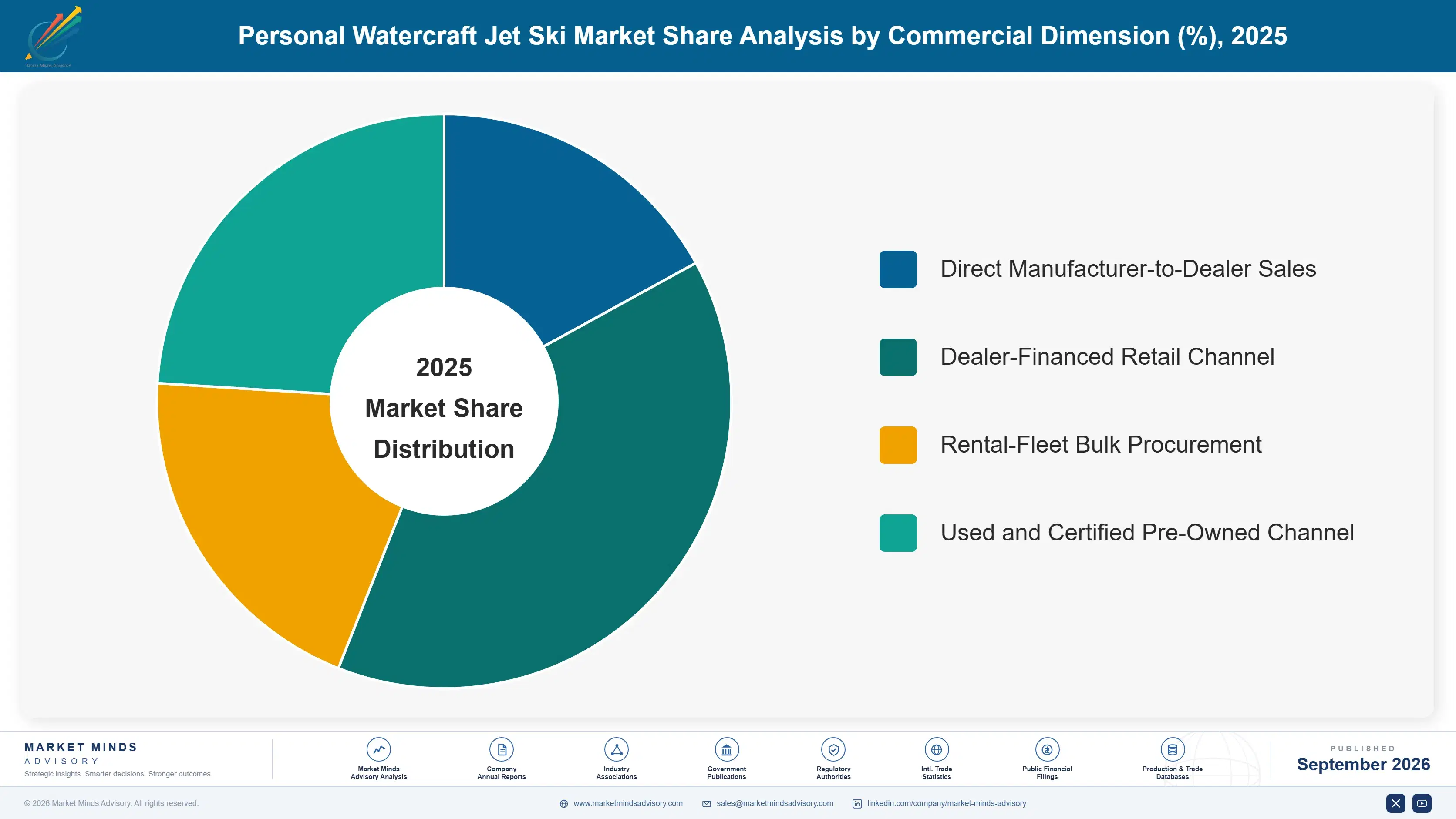
By Commercial Dimension

  • Direct Manufacturer-to-Dealer Sales
  • Dealer-Financed Retail Channel
  • Rental-Fleet Bulk Procurement
  • Used and Certified Pre-Owned Channel

By Region

  • North America
  • Western Europe
  • East Asia
  • South Asia and Pacific
  • Latin America
  • Middle East and Africa
  • Eastern Europe

Scope, Methodology, and Coverage

Every figure in this report is reproducible from documented input assumptions. The scope below maps the historical period, the forecast horizon, the segmentation dimensions, and the countries covered, alongside the underlying primary and qualitative methodology.
Historical Period
2020 to 2025
Forecast Period
2026 to 2036
Base Year
2025 (USD billions; MMA Primary Research Dataset, September 2026)
Market Definition
The personal watercraft jet ski market covers motorized, recreational marine vehicles designed for on-water sport, leisure, and fishing use, including stand-up, sit-down, and electric formats sold through dealer networks. It excludes larger recreational boats, jet boats, and commercial marine vessels not classified as personal watercraft.
Quantitative Units
USD billions (current prices); unit shipment volumes where applicable
Segmentation Dimensions
By Primary Market Dimension; By End-Use Industry; By Commercial Dimension; By Region
Regions Covered
North America, Western Europe, East Asia, South Asia and Pacific, Latin America, Middle East and Africa, Eastern Europe
Countries Covered
USA, China, Germany, France, UK, Japan, South Korea, India, Australia, Canada, Brazil, Mexico, Indonesia, Vietnam, Thailand, Malaysia, UAE, Saudi Arabia, South Africa, Nigeria, Turkey, Poland, Netherlands, Italy, Spain, Sweden, Switzerland, Argentina, Colombia, Singapore, and additional markets relevant to this sector
Key Companies Profiled
Bombardier Recreational Products Inc, Yamaha Motor Co Ltd, Kawasaki Heavy Industries Ltd, Taiga Motors Inc, Belassi, Suzuki Motor Corporation, Brunswick Corporation, Vision Marine Technologies Inc, Candela Technology AB, Quadrofoil d.o.o., Sealver SAS, Zapata Racing, Onean GmbH, Waydoo Tech Co Ltd, Nautique Boat Company LLC, MasterCraft Boat Company LLC, Malibu Boats Inc, Marine Products Corporation, Groupe Beneteau SA, Polaris Inc
Quantitative Methodology
Primary survey, n=3,800 respondents, Q4 2025, six countries; demand-side model with trade association cross-validation
Qualitative Methodology
47 expert interviews, Q4 2025; applied to validate demand model assumptions, identify emerging dynamics, and assess competitive positioning
Report Format
PDF and XLSX data workbook (Word format preview document)
Publisher
Market Minds Advisory
Report Code
MMA-2026-AUT-187
Published
September 2026
Contact
sales@marketmindsadvisory.com | www.marketmindsadvisory.com

Purchase the full Personal Watercraft Jet Ski Market Report (2026 to 2036).

The complete report expands substantially on this shorter preview summary. It provides detailed country-level sizing across all thirty covered markets, full historical and forecast data tables spanning 2020 through 2036, and granular segment-level revenue breakdowns unavailable in this preview version. Extended competitive profiles cover all twenty companies profiled here in much greater depth, alongside complete primary-research and expert-interview methodology documentation. A downloadable data appendix supports direct integration into internal corporate forecasting and strategic planning models used regularly by category strategy, product, and dealer-network teams across the organization.
Full 2020 to 2036 historical and forecast data
Country-level sizing across thirty covered markets
Complete competitive profiles for twenty companies
Downloadable data appendix and Excel workbook
Segment-level revenue breakdowns by all dimensions
Primary survey and expert interview source data

Built For The People Who Decide

From boardroom strategy to bench-side execution, this report is read cover-to-cover by leaders shaping the next decade of their industry, turning demand scenarios, market dynamics and valuation benchmarks into decisions.
CXOs/ Presidents/ VPs/ Managers
M&A and Corporate Development
Strategy Teams and R&D Heads
Procurement and Product Directors
Regulatory and Compliance Leaders
Investor Relations and Equity Analysts