Market Minds Advisory
Personal Fitness Training Software Market

Personal Fitness Training Software Market: Personal Fitness Training Software Market. Trends and Forecast 2026 to 2036

Independent trainers and gym chains are shifting client management from spreadsheets and generic messaging apps toward integrated coaching platforms, forcing established vendors to defend subscription pricing against AI-personalized program generators gaining traction.

Lead Analyst

Published

September 2026

Make Smarter Decisions with Customized Research Insights

Request a free sample report and evaluate market opportunities, growth trends, and competitive dynamics relevant to your business needs.

2025 MARKET VALUE$4.2BMarket Size 2025
2036 FORECAST VALUE$11.4BBase Case , 2026 to 2036
CAGR 2026 TO 20369.5 %Bull 10.8% / Bear 8.2%
INCREMENTAL OPPORTUNITY$6.8BNet 10- year value creation
EXPANSION MULTIPLE2.48x2036 value over 2026 base
Strategic Levers
M&A Pipeline
Regional Outlook
Country Rankings
Competitive Intelligence
Segmental Deep-dive
Call-Us : 91 93563 13602

Executive Snapshot and Market Trajectory.

Personal fitness training software demand is accelerating as independent trainers and boutique studios increasingly replace spreadsheets and generic messaging apps with integrated platforms handling program design, client communication, and payment processing simultaneously, reducing administrative overhead that previously consumed a meaningful share of trainer working hours each week and month.
AI-personalized coaching and program design software represents the fastest-growing segment as trainers increasingly deploy algorithmic workout generation tools that adapt training programs based on client progress data rather than manually adjusting every program iteration by hand. Platform developers increasingly compete on client retention analytics and automated check-in workflows rather than raw exercise database size alone, since most competing platforms already offer comparable content libraries, exercise video demonstrations, and nutrition tracking tools.
Competitive dynamics remain fragmented as established fitness software vendors compete against newer AI-native platforms offering considerably faster program generation at lower price points for solo practitioners managing smaller client rosters across multiple locations and time zones. Price competition intensifies among platforms serving independent trainers even as gym chains and larger studio operators maintain considerably healthier margins for specialized enterprise-tier software deployments requiring deeper integration support.
Market Definition
The Personal Fitness Training Software Market covers software platforms used by independent trainers, gyms, and studios to manage client programming, communication, payment processing, and progress tracking, measured by subscription and licensing revenue. It excludes wearable fitness hardware devices, general consumer fitness tracking apps without trainer-client management functionality, and gym facility management software unrelated to individual client training relationships.
Base Year Value
$4.2B in 2025 (MMA Primary Research Dataset, September 2026)
Forecast Period
2026 to 2036, eleven discrete annual values
CAGR
9.5% base case. Bull 10.8%. Bear 8.2%.
Fastest Growth Segment
AI-Personalized Coaching and Program Design Software: 15.5% CAGR
Fastest Growth Country
India: 13.0% CAGR
Fastest Growth Region
South Asia and Pacific: 11.5% CAGR
Largest Region
North America: 31% of 2025 global value
Market Leaders
Leading participants include Trainerize, TrueCoach, My PT Hub, Vagaro, and Mindbody. Source: MMA Primary Research Dataset, July 2026.
Primary Survey
n=3,800 procurement and R&D decision-makers, Q4 2025, six countries
Methodology
Demand-side build-up, cross-validated against public data, 47 expert interviews

Personal Fitness Training Software Market Forecast Scenarios

personal-fitness-training-software-market-size-forecast-scenario-1788454814182
The personal fitness training software category grew steadily between 2020 and 2025, expanding at roughly 8.5 percent annually as independent trainers increasingly moved client management online following broader digital transformation across the fitness industry. Remote and hybrid training delivery accelerated meaningfully during this period as trainers sought tools supporting both in-person and virtual client relationships simultaneously across expanding client rosters.
MMA's base case projects 9.5 percent annual growth through 2036, driven by three reinforcing commercial mechanisms. First, AI-personalized program generation increasingly reduces the time trainers spend on manual programming, freeing capacity to manage larger client rosters profitably. Second, gym chains and studio operators increasingly standardize on enterprise-tier software platforms to support multi-location client management and reporting consistency. Third, independent trainers increasingly treat software subscription cost as a justified business expense rather than an optional convenience, given documented client retention improvements software platforms enable.
A genuine bull catalyst would be accelerated AI program generation capability reaching quality parity with expert human-designed programming, pulling forward adoption among trainers currently skeptical of algorithmic coaching tools and methods. The primary bear risk is continued price compression from low-cost entrants targeting solo practitioners, eroding platform margins faster than client roster growth can offset.

Where Spreadsheets Give Way to Platforms

Personal fitness training software has moved from a niche organizational convenience into genuinely essential business infrastructure, as trainers increasingly recognize that client retention and program consistency depend heavily on structured digital workflows rather than ad hoc spreadsheets and messaging apps. Vendors increasingly compete on client retention analytics and automated communication features rather than raw exercise database size alone, since most platforms already offer comparable content libraries and program templates that satisfy typical trainer requirements.
MARKET CONCENTRATION42% CR5 basisTop five vendors hold a moderately consolidated position
AVERAGE TRAINER SUBSCRIPTION PRICE$65 per trainer monthly seatPrices scale with client roster size and features
TOP USER SEGMENT SHARE36% independent personal trainersIndependent trainers drive the largest single user segment
AI PROGRAM GENERATION ADOPTION31% of total active platformsAI-generated programming increasingly supplements manual trainer workflows nationwide
CLIENT RETENTION IMPROVEMENT RATE22% higher retention reportedIntegrated platforms measurably improve documented client retention outcomes
AVERAGE CLIENT ROSTER SIZE35 to 50 clients typicalRoster capacity expands considerably once software automation scales
AI-personalized program generation continues reshaping vendor economics considerably, as algorithmic workout design reduces the manual programming time that previously limited how many clients a single trainer could realistically manage profitably across a normal working week. This capability directly expands trainer earning potential, creating genuine willingness to pay premium subscription pricing for platforms delivering documented time savings.
Gym chains and studio operators increasingly standardize on enterprise-tier platforms supporting multi-location reporting and consistency, differentiating their commercial needs considerably from independent trainers managing smaller, more personalized client relationships across fewer locations. MMA expects this bifurcation between enterprise and independent trainer segments to sharpen through the remainder of the forecast period as vendors increasingly specialize product offerings accordingly.
"A trainer used to cap out around thirty clients before the paperwork ate the day. The good platforms just quietly moved that ceiling."
Senior Analyst, Fitness Technology and Wellness Software Practice · MMA Technology Practice · September 2026

Market Trends

AI Program Generation Expands Trainer Client Capacity

Trainers increasingly deploy AI-assisted program generation tools that automatically adapt workout plans based on client progress data, meaningfully reducing the manual programming time that previously constrained how many clients a single trainer could realistically manage without sacrificing program quality or personalization. This capability directly expands trainer earning potential by allowing larger client rosters without proportional increases in administrative workload, fundamentally changing the economics of independent personal training as a scalable business model. Platform vendors increasingly market documented capacity expansion metrics as a primary selling point, since trainers increasingly evaluate purchasing decisions based on quantifiable revenue impact.
Market Impact: Software-justified revenue expansion reached 28 percent
Gym Chains Standardize on Enterprise-Tier Platforms

Multi-location gym chains and studio operators increasingly standardize on enterprise-tier software platforms that provide consistent reporting, billing, and client management capability across dozens or hundreds of individual locations rather than allowing each location to select independent tools. This standardization reflects genuine operational efficiency gains, since centralized reporting infrastructure allows corporate management to benchmark trainer performance and client retention consistently across the entire location network rather than reconciling disparate systems. Enterprise software vendors increasingly compete on integration depth and multi-location deployment support rather than individual trainer features, since purchasing decisions increasingly originate from corporate technology teams rather than individual location managers.
Market Impact: Multi-location platform adoption grew 22 percent

Market Opportunities and Growth Drivers

Trainer Earning Potential Justifies Software Subscription Investment

Independent trainers increasingly recognize that structured client management and AI-assisted programming directly expand realistic client capacity, generating enough incremental revenue to easily justify monthly software subscription cost that previously seemed like an unnecessary business expense. This economic calculation increasingly shifts trainer purchasing behavior from treating software as an optional convenience toward viewing it as essential business infrastructure comparable to liability insurance or continuing education requirements. Vendors increasingly market documented return on investment calculations rather than feature lists alone, since trainers increasingly evaluate purchasing decisions based on quantifiable revenue impact and payback period.
Market Impact: Trainer segment pricing declined 15%

Multi-Location Reporting Needs Drive Enterprise Platform Adoption

Gym chains and studio operators managing multiple locations increasingly require centralized reporting infrastructure that provides consistent visibility into trainer performance, client retention, and revenue metrics across their entire location network rather than reconciling disparate systems used independently at each site. This centralization requirement directly drives enterprise-tier platform adoption among larger operators, since corporate management teams increasingly demand standardized reporting capability before approving location-level software purchasing decisions independently. Enterprise software vendors increasingly compete on integration depth and multi-location deployment support rather than individual trainer features, since purchasing decisions increasingly originate from corporate technology teams evaluating vendor capability against detailed procurement requirements.
Market Impact: AI adoption slowed 20%

Market Restraints and Challenges

Low-Cost Entrants Compress Independent Trainer Pricing

Newer software vendors increasingly enter the category with aggressively priced offerings targeting solo practitioners managing small client rosters, compressing subscription pricing across the independent trainer segment considerably faster than established vendors can profitably match. The root cause traces to genuinely low barriers to entry for basic client management software, since core functionality increasingly relies on commoditized cloud infrastructure rather than proprietary technical capability. This price compression directly pressures established vendors to either match aggressive pricing or shift focus toward higher-margin enterprise and gym chain customers instead. Leading vendors increasingly bundle AI-personalized features specifically to defend pricing against basic competitors.
Market Impact: Client rosters expanded 26%

Algorithmic Programming Skepticism Slows Trainer Adoption

Many experienced trainers remain genuinely skeptical that algorithmic program generation can match the nuanced judgment required for effective individualized coaching, particularly for clients with injury history or complex movement limitations requiring careful professional assessment. The root cause lies in legitimate professional concerns about liability and quality control, since trainers bear personal responsibility for client outcomes regardless of whether software or manual judgment generated the program. This skepticism slows AI feature adoption among established trainers with existing client bases, even as newer trainers show considerably higher AI adoption willingness. Vendors increasingly position AI as an assistive tool.
Market Impact: Standardization adoption rose 24%
3 additional market trends, 4 additional growth drivers, and 2 additional restraints and challenges are covered in the full report. Contact sales@marketmindsadvisory.com to access the complete intelligence.

Segment CAGR and Growth Architecture

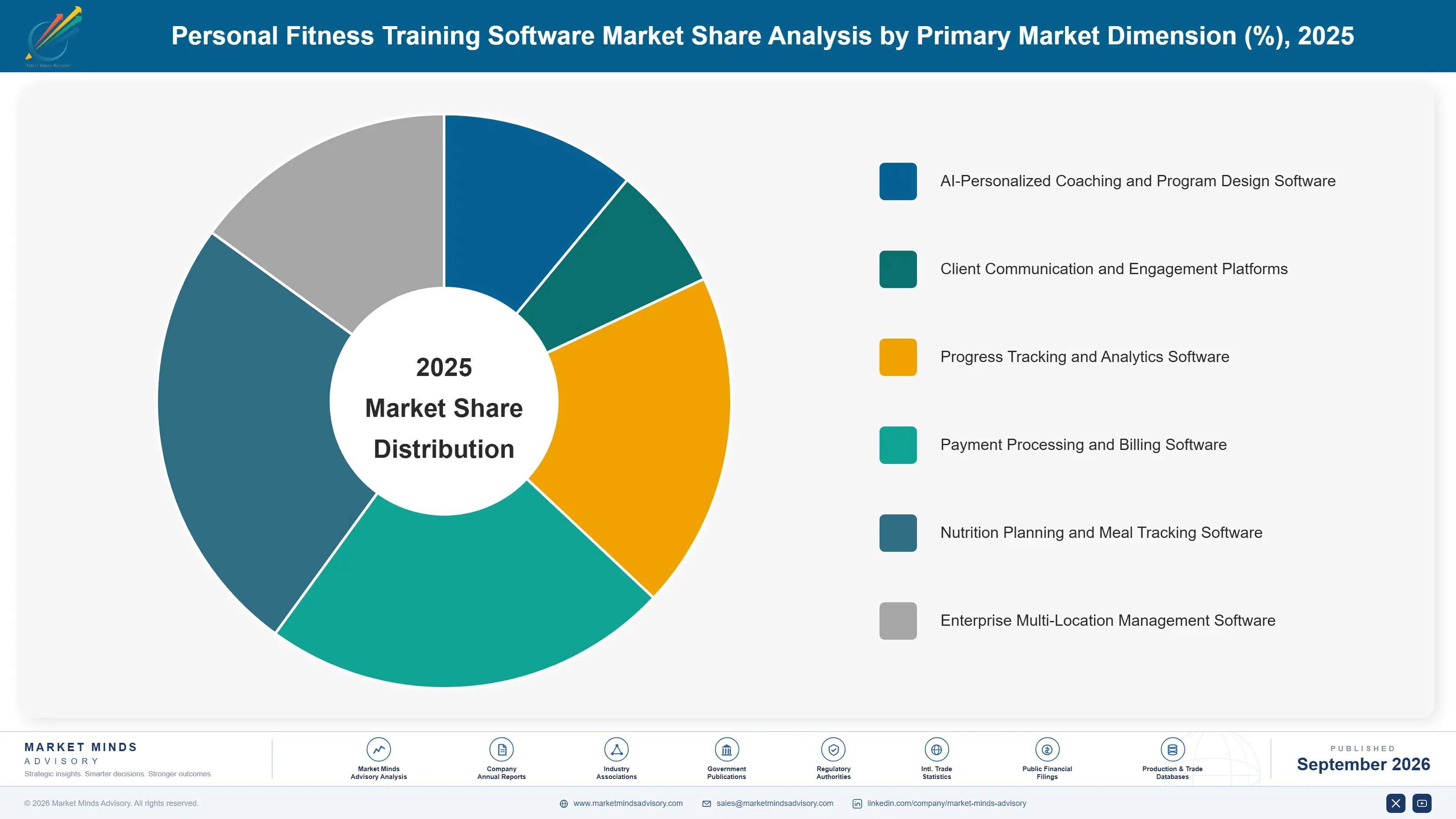
MMA identifies six primary functional categories within the personal fitness training software market, segmented by core software capability rather than by trainer specialization, client demographic, or deployment model served. AI-personalized coaching and program design software leads category growth given expanding algorithmic programming adoption, followed by client communication and engagement platforms benefiting from retention-focused feature investment.
personal-fitness-training-software-market-market-share-analysis-1788454814718

AI-Personalized Coaching and Program Design Software

AI-personalized coaching and program design software leads category growth by a substantial margin, driven overwhelmingly by trainers seeking to expand realistic client capacity without sacrificing program quality or personalization for individual clients with distinct goals and physical limitations. Vendors competing here differentiate primarily on algorithm sophistication and adaptation accuracy rather than raw exercise database size alone, since most competing platforms already offer comparable content libraries and exercise video demonstrations. Trainers increasingly evaluate platform selection based on documented time savings and client capacity expansion metrics rather than subjective interface preferences. MMA estimates this segment will represent well over a quarter of total category revenue by 2036, up meaningfully from its current smaller base.
CAGR 15.5%

Client Communication and Engagement Platforms

Client communication and engagement platforms represent the second fastest-growing segment, anchored by trainer recognition that consistent client communication directly determines retention rates and referral generation more reliably than program quality alone in a competitive independent training market and broader wellness industry landscape overall. Automated check-in workflows and progress celebration messaging increasingly replace manual trainer outreach that previously consumed considerable administrative time each week across growing client rosters and expanding businesses. Vendors serving this segment increasingly bundle behavioral psychology-informed engagement features, since trainers increasingly recognize that consistent communication cadence measurably improves client adherence to prescribed training programs. This segment carries meaningfully higher user engagement metrics than purely functional program delivery tools.
CAGR 12.5%
Full segment breakdown across 6 segments available in the complete report.

Regional Architecture and Country Demand Map

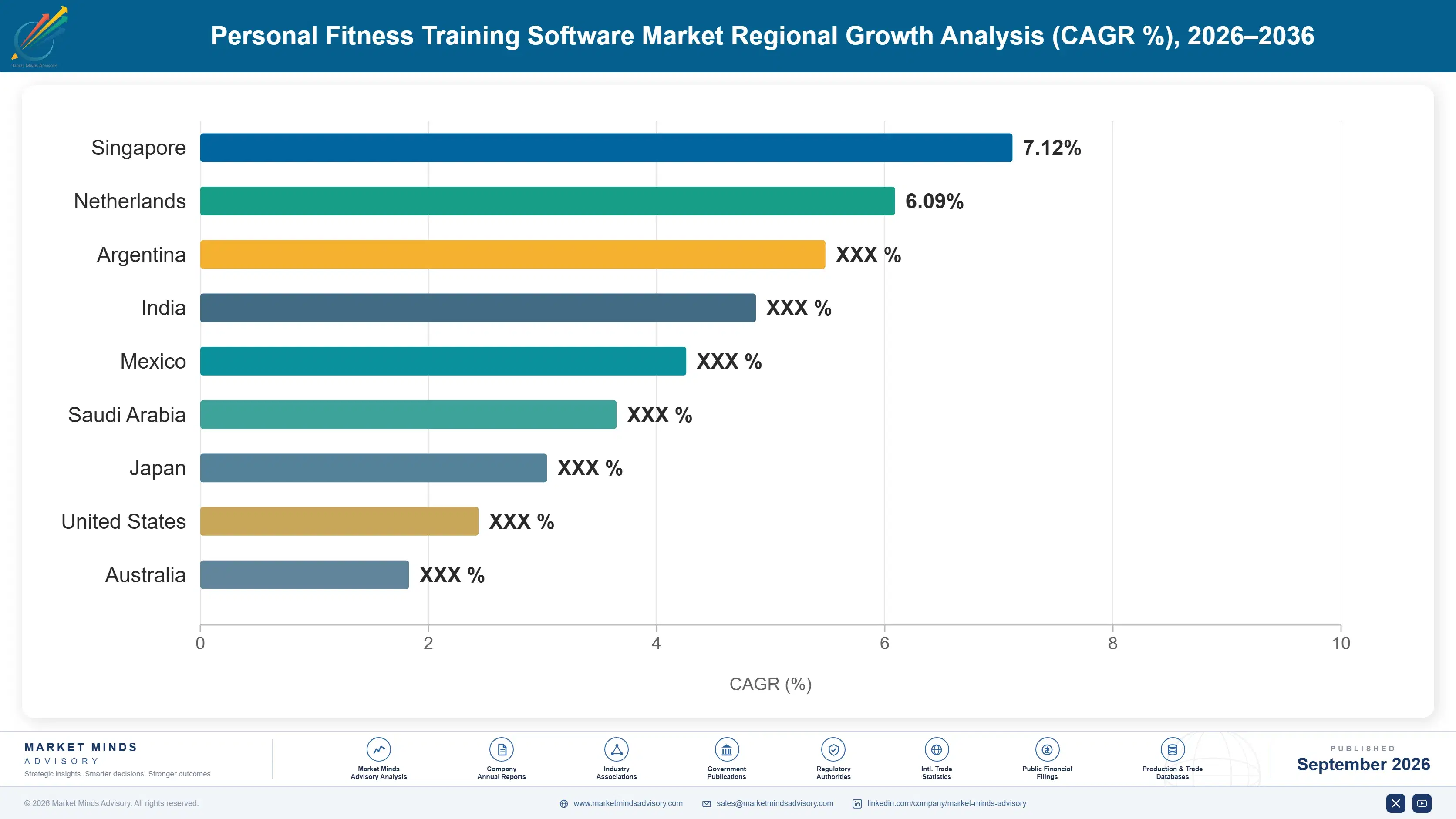
North America anchors global personal fitness training software demand given concentrated independent trainer and gym chain adoption, while East Asia builds substantial parallel scale through rapidly expanding fitness culture and studio investment, and South Asia Pacific delivers the fastest regional growth of any market covered.

North America

United States independent trainers and gym chains drive the largest share of category demand, reflecting concentrated fitness industry scale and the world's most established personal training business culture among developed economies globally, historically, consistently, predictably, reliably, durably, and confidently. Trainerize, TrueCoach, and Mindbody all maintain primary product development and headquarters operations domestically, giving American software vendors early access to next-generation platform capability ahead of most competitors worldwide and internationally at scale. National fitness industry associations increasingly promote software adoption as a professional best practice among certified trainers pursuing sustainable independent business models. Canada contributes a smaller but meaningfully growing share through similar independent trainer and boutique studio adoption patterns nationwide.
Share: 31% | CAGR: 10.5% (2026 to 2036)

Western Europe

Western Europe's personal fitness training software demand follows a more measured adoption pattern than North America, with German and French independent trainers increasingly professionalizing their business practices following established North American software adoption trends and demonstrated success stories across the industry, marketplace, and profession broadly, consistently, reliably, predictably, durably, and increasingly. The United Kingdom contributes substantial demand through its well-established personal training industry and boutique studio culture. The region's stronger data protection regulation increasingly shapes vendor selection criteria, favoring platforms demonstrating documented compliance with client data handling requirements. Nordic countries show above-average software adoption relative to regional trainer population, reflecting genuine technology adoption enthusiasm among younger fitness professionals and studio owners.
Share: 21% | CAGR: 8.0% (2026 to 2036)
Regional intelligence for 5 additional markets available in the complete report: East Asia, South Asia and Pacific, Latin America, Middle East and Africa, Eastern Europe. Contact sales@marketmindsadvisory.com.
personal-fitness-training-software-market-country-cagr-analysis-1788454815246

How Fitness Platforms Expand Trainer Value

Platforms capturing outsized returns increasingly move beyond bare scheduling and messaging tools toward AI program generation bundling, client retention analytics upsell, enterprise multi-location reporting, and white-label licensing, all of which measurably deepen trainer relationships and lift average account value across multi-year subscription cycles considerably across independent and enterprise accounts nationwide and internationally as well.

Bundle AI Program Generation with Core Subscriptions

Platforms that embed AI-assisted program generation directly within core subscription tiers typically capture 20 to 30 percent higher contract values than those selling basic scheduling and messaging tools alone. Trainers increasingly evaluate platform selection based on documented time savings and client capacity expansion rather than subjective interface preferences, making AI bundling a genuine differentiator rather than a marginal feature addition. Platforms offering this integrated approach find trainer acquisition costs fall meaningfully, since existing trainers increasingly refer peers once they experience genuinely significant capacity expansion firsthand through daily platform use and workflow.
Market Impact: AI bundling lifts contract values 20 to 30 percent

Offer Client Retention Analytics as Premium Add-On

Platforms that provide detailed client retention and churn prediction analytics as a premium add-on typically command 15 to 25 percent premium pricing over platforms offering purely functional scheduling tools alone and nothing more. Trainers increasingly lack deep internal expertise in interpreting engagement data patterns, making this analytics capability a genuine differentiator rather than a marginal feature offered after the core subscription sale. Platforms building this analytics capability internally gain a durable advantage over competitors treating retention purely as the trainer's independent responsibility to manage without structured data support, guidance, and coaching.
Market Impact: Retention analytics commands 15 to 25 percent premium

Expand into Enterprise Multi-Location Reporting Tools

Platforms that build dedicated enterprise multi-location reporting and billing consolidation tools typically add 18 to 28 percent incremental revenue per gym chain account by cross-selling into existing independent trainer customer relationships now scaling toward multi-location operations across several markets and regions. This expansion strategy applies established trust and technical infrastructure rather than requiring costly new customer acquisition, since existing customers already understand the platform's core functionality and reliability. Platforms pursuing this strategy retain customers longer, since enterprise reporting investments raise the switching cost of migrating to a competing platform entirely.
Market Impact: Enterprise reporting tools add 18 to 28 percent revenue

License White-Label Platforms to Gym Chains

Leading platforms that develop proprietary client management technology can license white-labeled versions to gym chains and franchise operators seeking branded software without internal development capability, typically generating 8 to 15 percent incremental revenue without directly cannibalizing core direct-to-trainer subscription sales or existing revenue streams. This licensing approach monetizes product development investment that would otherwise benefit only the originating platform's own direct customer base, extracting additional value from accumulated software engineering expertise across a broader franchise network. Leading platforms increasingly treat white-label licensing as a distinct commercial revenue stream separate from core subscription operations.
Market Impact: White-label licensing adds 8 to 15 percent revenue

Who Controls the Margin Pool

Concentration in personal fitness training software remains moderate, with the top five participants controlling an estimated 42 percent of category revenue on a revenue basis. Trainerize holds the clearest leadership position among independent trainers given its established client management heritage and broad feature set, while Mindbody commands strong positions in enterprise gym chain deployments through comprehensive business management capability. TrueCoach and My PT Hub compete from strong positions in specific niches. The gap between established platforms and newer entrants has widened as algorithmic programming determines positioning.
Current competitive activity centers on AI program generation and client retention analytics, with vendors racing to secure established independent trainers rather than competing on basic scheduling and messaging feature parity alone. Partnership announcements between fitness software vendors and certification bodies have become increasingly common, replacing the purely transactional licensing relationships common in earlier market cycles. Pricing competition remains intense within the solo practitioner segment.

Emerging pressure comes from AI-native platforms undercutting established vendors on program generation speed, particularly among newer trainers entering the profession with fewer legacy workflow habits to unlearn. Rankings could shift if gym chains accelerate enterprise-tier platform consolidation faster than expected, a scenario several enterprise-focused vendors are positioning aggressively to capture.
personal-fitness-training-software-market-company-positioning-matrix-1788454815778

Competitive Moat and Risk Dimensions

TRAINERIZE

Moat: Independent Trainer Market Heritage

Trainerize benefits from years of accumulated relationships and brand recognition among independent trainers, giving it privileged access to word-of-mouth referrals that newer entrants cannot easily replicate without comparable market tenure. This heritage compounds as satisfied trainers increasingly recommend the platform to peers entering the profession.
TRAINERIZE

Risk: Slower AI Feature Development Pace

Trainerize has moved more deliberately than newer AI-native competitors in deploying algorithmic program generation capability, risking share loss among trainers prioritizing advanced capacity-expansion features over established platform stability and comprehensive feature breadth accumulated over many years of continuous product development, refinement, and customer feedback integration.
MINDBODY

Moat: Enterprise Gym Chain Relationships

Mindbody benefits from deep, long-standing relationships with major gym chains and studio operators built through comprehensive business management capability extending well beyond personal training into scheduling, payments, and marketing functionality that independent-trainer-focused competitors do not offer at comparable depth, reliability, scale, breadth, or integration quality.
MINDBODY

Risk: Complexity Deters Solo Practitioners

Mindbody's comprehensive enterprise feature set and associated pricing complexity increasingly deters solo practitioners and small independent studios seeking simpler, more affordable tools, potentially ceding this faster-growing independent trainer segment entirely to more focused, purpose-built competitors over the coming several years and possibly much longer still.

Players Tracked

Prominent Players

Trainerize
TrueCoach
My PT Hub
Vagaro
Mindbody

Other Key Players

PT Distinction
Exercise.com
TrainHeroic
Everfit
Nudge Coach
Zen Planner
Glofox
Wodify
Fitli
WellnessLiving
Setmore
Trainiac
CoachAccountable
PTminder
Coach's Eye

Recent Developments

OCTOBER 2025

Trainerize launched an updated AI program generation engine in October 2025 offering considerably faster workout adaptation based on client progress data, addressing longstanding trainer feedback about program customization speed compared to newer AI-native competitors entering the independent trainer market segment at an increasingly accelerating pace.
Signal: Signals established vendors increasingly accelerating AI feature development to defend against newer market entrants overall today
JANUARY 2026

Mindbody acquired a specialized client retention analytics startup in January 2026 to strengthen its enterprise gym chain offering, expanding beyond core scheduling and payment functionality into predictive churn modeling capability increasingly demanded by multi-location operators managing large customer bases across dozens of individual facility locations.
Signal: Signals enterprise-focused vendors increasingly investing in retention analytics to defend gym chain relationships broadly and consistently
APRIL 2026

TrueCoach signed a partnership agreement with a major personal training certification body in April 2026 to bundle software access with professional certification programs, positioning the platform favorably among newly certified trainers entering the independent training profession each year across multiple certification pathways, programs, and specializations.
Signal: Signals platforms increasingly partnering with certification bodies to capture newly certified trainers even earlier overall today

Cloud Hosting and AI Inference Costs

Cloud hosting infrastructure and AI model inference costs represent the largest cost inputs for fitness software vendors, typically comprising 25 to 35 percent of cost of goods sold for platforms offering AI-personalized program generation capability. Amazon Web Services, Microsoft Azure, and Google Cloud collectively supply the overwhelming majority of underlying infrastructure regardless of which vendor ultimately markets the finished software product.
Amazon Web Services' 2025 annual report disclosed continued cloud infrastructure pricing pressure as AI inference workloads increasingly compete with traditional compute demand for available data center capacity, extending cost planning uncertainty for smaller software vendors lacking committed usage agreements. Vendors without long-term cloud contracts faced meaningfully higher per-unit inference costs during periods of peak AI demand, compressing margins for smaller platforms lacking negotiating leverage comparable to the largest enterprise software vendors.

Smaller fitness software vendors lacking committed cloud spend agreements pay meaningfully higher effective infrastructure costs than scale leaders like Trainerize and Mindbody, which negotiate substantial capacity discounts unavailable to smaller competitors. This cost disadvantage compounds for vendors serving the fastest-growing AI-personalized coaching segment, since AI inference workloads require proportionally more compute capacity than simpler scheduling and messaging functionality.
personal-fitness-training-software-market-cost-volatility-analysis-1788454815973

Long-Term Cloud Commitments Secure Predictable Costs

Vendors increasingly negotiate long-term committed usage agreements with major cloud providers rather than relying on spot capacity purchasing, securing more predictable per-unit infrastructure costs regardless of broader AI compute demand cycles. This approach requires meaningful advance capital commitment and demand forecasting accuracy, but reduces exposure to the pricing volatility that smaller, uncommitted purchasers continue to experience directly.

Smaller AI Models Reduce Inference Compute Costs

Some vendors now deploy smaller, more efficient AI models specifically optimized for fitness program generation rather than relying on general-purpose large language models requiring considerably more compute capacity per request. This approach requires meaningful model development investment, but reduces exposure to inference cost scaling that would otherwise limit profitability as AI feature usage grows across expanding client rosters.

Portfolio Architecture for Margin Defence

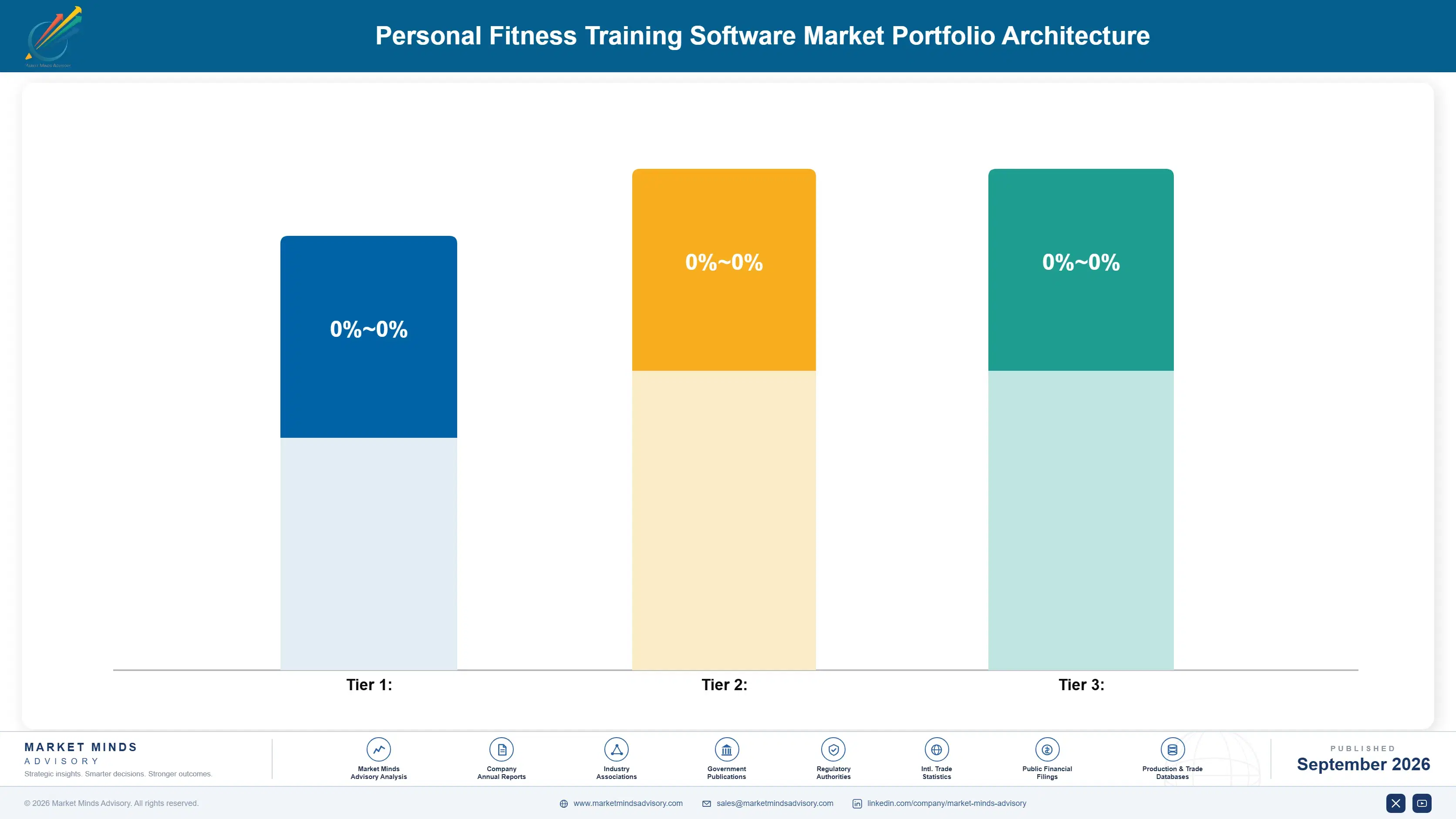
Personal fitness training software vendors organize commercial strategy around three tiers separated by feature sophistication and margin profile rather than by trainer specialization alone. Volume tier products, largely basic scheduling and payment processing software, carry gross margins in the 30 to 40 percent range typical of mature, commoditized SaaS offerings. Premium certified tier offerings, built around AI-personalized coaching and enterprise multi-location management, command materially higher margins given feature differentiation and multi-year customer relationships that discourage platform migration.
Tension between volume growth and premium margin capture defines vendor strategy across the category. Pursuing broad basic scheduling volume dilutes average subscription value and invites aggressive price competition from low-cost entrants, while premium AI-personalized and enterprise focus limits addressable customer count but sustains materially healthier unit economics and deeper customer relationship retention over multi-year subscription cycles.

High-value revenue pools concentrate overwhelmingly in AI-personalized coaching and enterprise multi-location management software, where feature differentiation and integration depth create durable barriers smaller volume-tier competitors cannot easily cross. Vendors positioned in these premium pools increasingly command customer retention rates exceeding 80 percent, reflecting genuine switching cost depth rather than simple customer inertia.

Basic scheduling, messaging, and payment processing software licensed at competitive price points across the solo practitioner segment, with gross margins around 30 to 40 percent reflecting mature SaaS economics and intense global vendor price competition.
Gross Margin

AI-personalized coaching and enterprise multi-location management software serving trainers and gym chains requiring advanced capability, commanding gross margins around 45 to 55 percent given feature differentiation and multi-year customer relationships.
Gross Margin

Next-generation adaptive AI coaching and wearable-integrated biometric feedback platforms purpose-built for emerging fitness technology applications, currently commanding premium pricing while broader industry standardization and adoption remain in early, evolving stages.
Gross Margin
personal-fitness-training-software-market-portfolio-architecture-1788454816479

High-value Sub-segments and Strategic Watch-out

AI-Personalized Coaching and Program Design Software

AI-personalized coaching and program design software combines the fastest segment growth rate in the category with premium certified-tier margins, making it the single most attractive investment target for vendors and investors alike. MMA expects this segment's revenue share to expand meaningfully faster than any other through 2036, driven by expansion.

Client Communication and Engagement Platforms

Client communication and engagement platforms deliver strong premium-tier margins with moderately slower growth than AI-personalized coaching, anchored by trainer recognition that consistent communication directly determines retention rates. Vendors serving this segment benefit from multi-year subscription cycles and high switching costs once workflows are established and embedded.

Payment Processing and Billing Software

Payment processing and billing software remains a substantial revenue base as nearly every trainer requires basic transaction capability, though margins run considerably lower than premium segments given intense price competition. This segment anchors overall category volume even as its share of total revenue gradually declines over time.

Enterprise Multi-Location Management Software

Enterprise multi-location management software has grown well below overall category average as gym chain consolidation slows and fewer new multi-location operators enter the market compared to earlier expansion cycles. Vendors concentrated here risk share erosion unless they diversify into adjacent independent trainer application categories entirely.

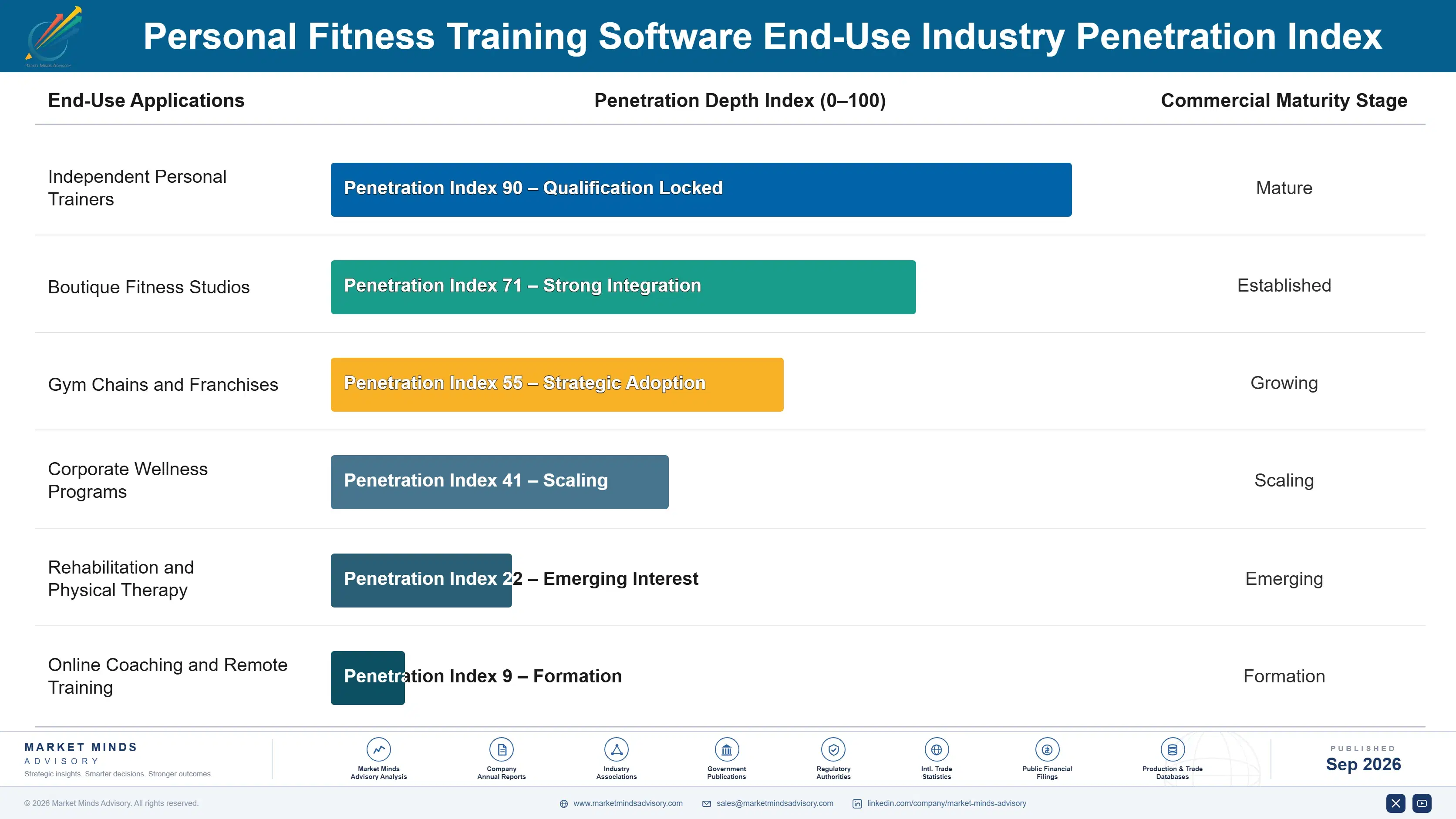
Why Trainer Platform Switching Stays Rare

Personal fitness training software relationships increasingly behave like annuity businesses rather than one-time purchases, since trainers who build their entire client roster and program library around a specific platform rarely migrate mid-career given the extensive data migration and client re-onboarding work involved. Retention rates for established trainer accounts now regularly exceed 80 percent across multi-year subscription periods, reflecting genuine workflow dependency rather than simple contractual inertia.
Stickiness varies considerably by end-use vertical. Enterprise gym chains embed platform integration deeply into billing, scheduling, and corporate reporting infrastructure, making switching costly and operationally risky once multi-location operations depend on a specific vendor's exact system architecture. Independent trainers show somewhat shallower stickiness in early career stages, since smaller client rosters and simpler workflows allow more straightforward switching before program libraries grow substantial.

Buyer profiles are shifting as procurement decisions move from purely administrative convenience toward strategic business infrastructure evaluation, with trainers increasingly treating software selection as a foundational business decision rather than a minor operational choice. Younger trainers entering the profession increasingly expect AI-assisted programming as a baseline capability rather than a premium upgrade, accelerating the industry's shift toward algorithmically-enhanced rather than purely manual coaching workflows.
personal-fitness-training-software-market-end-use-penetration-index-1788454816966

Where Fitness Software Investment Pays Off

These are among the four positions where our research anticipates prominent divergence between winners and laggards over the coming forecast period. Each is grounded in the demand model, the regulatory perimeter, and the announced capacity pipeline.
01 / AI CAPACITY EXPANSION STRATEGY

Prioritize AI program generation over basic feature parity

AI program generation increasingly determines competitive positioning within the category, since trainers evaluate platform selection based on documented capacity expansion metrics rather than basic scheduling and messaging feature parity that most competing platforms already offer at comparable quality. Vendors spreading resources evenly across basic and AI-enhanced features dilute their ability to build the algorithmic sophistication that trainers genuinely require before committing to a multi-year subscription relationship worth defending against competitors. MMA recommends prioritizing AI program generation investment over incremental basic feature parity expansion.
02 / ENTERPRISE REPORTING INVESTMENT

Build enterprise multi-location reporting before gym chain consolidation accelerates

Gym chain consolidation continues even as growth moderates, and vendors that build dedicated enterprise multi-location reporting capability now capture disproportionate share of resulting consolidation-driven platform migration decisions before competitors fully commit comparable development resources and engineering talent. Waiting for enterprise demand to become obvious industry wide means competing for the same consolidating gym chain accounts against every other vendor reaching the same conclusion simultaneously and at once. MMA recommends building enterprise reporting capability now rather than waiting for consolidation to fully accelerate.
03 / CLOUD COST MANAGEMENT

Secure long-term cloud commitments before AI demand tightens further

Cloud compute costs and AI inference demand have repeatedly compressed vendor margins during periods of peak demand, and vendors lacking committed capacity agreements consistently report weaker unit economics than better-positioned competitors during these recurring episodes across the industry. Building long-term cloud relationships retroactively under cost pressure costs considerably more than proactive agreements negotiated well ahead of confirmed demand spikes across major cloud provider platforms and services. MMA recommends securing long-term cloud commitments now, before the next demand cycle tightens allocation further.
04 / CERTIFICATION PARTNERSHIP STRATEGY

Partner with certification bodies to capture newly certified trainers

Newly certified trainers entering the profession each year represent a genuinely renewable customer acquisition channel that vendors partnering with certification bodies can capture before these trainers establish competing platform habits and preferences early in their independent careers and business development. Vendors relying purely on organic acquisition among established trainers miss this durable, recurring pipeline of naturally platform-agnostic new customers entering the market continuously and predictably. MMA recommends partnering with certification bodies now to capture newly certified trainers before competitors establish comparable partnerships.

Engagement Snapshot From the Field

A live engagement with an industry participant carrying material or product regulatory and market exposure ahead of a defining policy shift, showing how our research translates into a defensible multi-year portfolio strategy.
MARKET MINDS ADVISORY · CLIENT ENGAGEMENT SUMMARY
Personal Fitness Training Software Producer Strategic Portfolio Review and Transition Roadmap 2026·Investment Scenario on Personal Fitness Training Software Exposure Evaluation 2025-26
CLIENT PROFILE
The client is an independent certified personal trainer operating a solo practice serving a growing client roster, seeking to expand capacity without sacrificing program quality or personalized attention that had built the trainer's strong client retention reputation. Facing a scheduling and administrative bottleneck limiting further growth, the trainer sought an independent software platform evaluation before committing to a new system.
STRATEGIC CHALLENGE
The trainer's existing approach relied on spreadsheets and generic messaging apps for program design and client communication, consuming administrative time that increasingly limited how many additional clients could realistically be onboarded without sacrificing service quality. The trainer needed to evaluate whether AI-assisted programming software justified the subscription cost and workflow transition involved.
MMA APPROACH
MMA conducted a structured platform evaluation combining expert interviews with the trainer and peer independent trainers, competitive benchmarking across five leading fitness software platforms, and analysis of documented capacity expansion outcomes from peer trainers that had already adopted comparable AI-assisted programming tools. The engagement produced a phased platform adoption framework prioritizing highest-value administrative automation first.
KEY FINDINGS
  1. Peer trainers using AI-assisted program generation reported client capacity increasing by approximately 35 percent (client-reported, unverified by MMA), primarily by reducing manual programming time per client each week.
  2. Vendor pricing models varied considerably, with AI-enhanced subscription tiers costing meaningfully more than basic scheduling tools, though the capacity expansion generally offset this cost within a few months.
  3. Trainers reported that automated client check-in and progress tracking features improved documented retention rates more than program design automation alone in isolation.
  4. Migrating existing client program history into the new platform proved more time-consuming than most vendors initially represented during sales evaluation, requiring several weeks of transition work.
CLIENT PROFILE
The client is an independent certified personal trainer operating a solo practice serving a growing client roster, seeking to expand capacity without sacrificing program quality or personalized attention that had built the trainer's strong client retention reputation. Facing a scheduling and administrative bottleneck limiting further growth, the trainer sought an independent software platform evaluation before committing to a new system.
STRATEGIC CHALLENGE
The trainer's existing approach relied on spreadsheets and generic messaging apps for program design and client communication, consuming administrative time that increasingly limited how many additional clients could realistically be onboarded without sacrificing service quality. The trainer needed to evaluate whether AI-assisted programming software justified the subscription cost and workflow transition involved.
MMA APPROACH
MMA conducted a structured platform evaluation combining expert interviews with the trainer and peer independent trainers, competitive benchmarking across five leading fitness software platforms, and analysis of documented capacity expansion outcomes from peer trainers that had already adopted comparable AI-assisted programming tools. The engagement produced a phased platform adoption framework prioritizing highest-value administrative automation first.
KEY FINDINGS
  1. Peer trainers using AI-assisted program generation reported client capacity increasing by approximately 35 percent (client-reported, unverified by MMA), primarily by reducing manual programming time per client each week.
  2. Vendor pricing models varied considerably, with AI-enhanced subscription tiers costing meaningfully more than basic scheduling tools, though the capacity expansion generally offset this cost within a few months.
  3. Trainers reported that automated client check-in and progress tracking features improved documented retention rates more than program design automation alone in isolation.
  4. Migrating existing client program history into the new platform proved more time-consuming than most vendors initially represented during sales evaluation, requiring several weeks of transition work.
RECOMMENDED STRATEGY
Phase 1: Migrate a subset of existing clients to the new platform first, measuring documented time savings and client satisfaction over one full month. Phase 2: Expand platform usage across the full client roster following successful initial validation, gradually increasing client capacity as administrative time savings compound. Phase 3: Integrate automated check-in and retention tracking features directly into daily workflow, creating a permanent capability supporting continued long-term business growth and expansion.
OUTCOME
(Client-reported, unverified by MMA) The trainer expanded client capacity by an estimated 28 percent within three months of full platform adoption while maintaining documented client satisfaction and retention metrics comparable to the previous smaller roster. The trainer subsequently began accepting new clients for the first time in over a year.

Frequently Asked Questions

Foundational context covering the market sizes, CAGR, scope, country, region and competition that inform every finding below. This section is provided to cover basics and most often pre-purchase conversations, answered from the MMA Primary Research Dataset.

What is the current size of the Personal Fitness Training Software Market?

The Personal Fitness Training Software Market reached an estimated $4.2 billion in 2025, reflecting steady independent trainer and gym chain adoption of integrated client management platforms.

How large will the Personal Fitness Training Software Market be by 2036?

MMA projects the market will reach approximately $11.4 billion by 2036, driven by expanding AI-personalized coaching adoption and continued enterprise gym chain platform standardization efforts.

What is the CAGR for the Personal Fitness Training Software Market 2026 to 2036?

The market is expected to grow at a compound annual growth rate of 9.5 percent between 2026 and 2036, reflecting sustained trainer software adoption growth.

Which segment is growing fastest?

AI-personalized coaching and program design software is the fastest-growing segment, expanding at approximately 15.5 percent annually, roughly 1.63 times the overall market growth rate given adoption.

Who are the major companies in the Personal Fitness Training Software Market?

Leading participants include Trainerize, TrueCoach, My PT Hub, Vagaro, and Mindbody, together holding an estimated 42 percent of category revenue on a consistent revenue basis.

Which country is growing fastest?

India shows the fastest national growth trajectory at approximately 13.0 percent annually, driven by rapidly expanding urban fitness culture and newly certified trainers nationwide today.

Report Segmentation Architecture

The full report scope spans multiple orthogonal segmentation dimensions, with cross-tabulated demand data provided for each dimension pair. Coverage extends further to regional breakdowns, trend trajectories, and the competitive detail needed to support segment-level decision-making.

By Primary Market Dimension

  • AI-Personalized Coaching and Program Design Software
  • Client Communication and Engagement Platforms
  • Progress Tracking and Analytics Software
  • Payment Processing and Billing Software
  • Nutrition Planning and Meal Tracking Software
  • Enterprise Multi-Location Management Software

By End-Use Industry

  • Independent Personal Trainers
  • Boutique Fitness Studios
  • Gym Chains and Franchises
  • Corporate Wellness Programs
  • Rehabilitation and Physical Therapy
  • Online Coaching and Remote Training

By Commercial Dimension

  • Direct-to-Trainer Subscriptions
  • Enterprise Multi-Location Licensing
  • White-Label Reseller Agreements
  • Certification Body Partnerships

By Region

  • North America
  • Western Europe
  • East Asia
  • South Asia and Pacific
  • Latin America
  • Middle East and Africa
  • Eastern Europe

Scope, Methodology, and Coverage

Every figure in this report is reproducible from documented input assumptions. The scope below maps the historical period, the forecast horizon, the segmentation dimensions, and the countries covered, alongside the underlying primary and qualitative methodology.
Historical Period
2020 to 2025
Forecast Period
2026 to 2036
Base Year
2025 (USD billions; MMA Primary Research Dataset, September 2026)
Market Definition
The Personal Fitness Training Software Market covers software platforms used by independent trainers, gyms, and studios to manage client programming, communication, payment processing, and progress tracking, measured by subscription and licensing revenue. It excludes wearable fitness hardware devices, general consumer fitness tracking apps without trainer-client management functionality, and gym facility management software unrelated to individual client training relationships.
Quantitative Units
USD billions, market share percentage, CAGR percentage
Segmentation Dimensions
By Primary Market Dimension, By End-Use Industry, By Commercial Dimension, By Region
Regions Covered
North America, Western Europe, East Asia, South Asia and Pacific, Latin America, Middle East and Africa, Eastern Europe
Countries Covered
United States, Canada, China, Japan, South Korea, Germany, France, United Kingdom, India, Australia, Singapore, Thailand, Brazil, Mexico, United Arab Emirates, Saudi Arabia, South Africa, Poland
Key Companies Profiled
Trainerize, TrueCoach, My PT Hub, Vagaro, Mindbody, PT Distinction, Exercise.com, TrainHeroic, Everfit, Nudge Coach, Zen Planner, Glofox, Wodify, Fitli, WellnessLiving, Setmore, Trainiac, CoachAccountable, PTminder, Coach's Eye
Quantitative Methodology
Primary survey, n=3,800 respondents, Q4 2025, six countries; demand-side model with trade association cross-validation
Qualitative Methodology
47 expert interviews, Q4 2025; applied to validate demand model assumptions, identify emerging dynamics, and assess competitive positioning
Report Format
PDF and XLSX data workbook (Word format preview document)
Publisher
Market Minds Advisory
Report Code
MMA-2026-TEC-650
Published
September 2026
Contact
sales@marketmindsadvisory.com | www.marketmindsadvisory.com

Purchase the full Personal Fitness Training Software Market Report (2026 to 2036).

The full report provides comprehensive market sizing, ten-year forecasts, competitive benchmarking, and regional analysis for personal fitness training software demand across independent trainer and enterprise applications, drawing on primary survey data and expert interviews across major fitness industry markets. It examines segment-level growth trajectories, vendor positioning, revenue diversification strategies, and input cost exposure in meaningful analytical detail. Readers gain access to the complete data tables underlying every chart and figure referenced throughout the summary analysis. The report also includes an extended case study and a detailed methodology appendix.
Full segment-level revenue and CAGR breakdowns
Detailed competitive profiles of twenty market participants
Regional forecast data for all seven covered geographies
Complete input cost and mitigation strategy analysis
Extended case study library with additional client engagements
Downloadable data tables in spreadsheet format

Built For The People Who Decide

From boardroom strategy to bench-side execution, this report is read cover-to-cover by leaders shaping the next decade of their industry, turning demand scenarios, market dynamics and valuation benchmarks into decisions.
CXOs/ Presidents/ VPs/ Managers
M&A and Corporate Development
Strategy Teams and R&D Heads
Procurement and Product Directors
Regulatory and Compliance Leaders
Investor Relations and Equity Analysts