Peripherally Inserted Central Catheter (PICC) Market
Peripherally Inserted Central Catheter (PICC) Market: Antimicrobial-Coated Catheters and ECG-Guided Tip Confirmation Systems
Antimicrobial-coated catheters and ECG-guided tip confirmation systems are displacing X-ray-dependent placement protocols, forcing hospital vascular access teams to justify premium device pricing against measurable reductions in catheter-related bloodstream infection rates nationwide.
2025 MARKET VALUE$2.1BMarket Size 2025
2036 FORECAST VALUE$4.2BBase Case , 2026 to 2036
CAGR 2026 TO 20366.5 %Bull 7.7% / Bear 5.2%
INCREMENTAL OPPORTUNITY$2.0BNet 10- year value creation
EXPANSION MULTIPLE1.88x2036 value over 2026 base
Strategic Levers
M&A Pipeline
Regional Outlook
Country Rankings
Competitive Intelligence
Segmental Deep-dive
Executive Snapshot and Market Trajectory
Antimicrobial-coated catheters and ECG-guided tip confirmation systems are displacing X-ray-dependent placement protocols, compressing bedside insertion timelines for vascular access teams managing rising long-term infusion therapy caseloads nationwide today. Vascular access specialists describe this as the biggest bedside workflow shift the category has seen in a decade broadly now here.
Expanding oncology and home infusion therapy demand, growing dedicated vascular access team adoption, and rising catheter-related bloodstream infection prevention investment are concentrating demand in North America and Western Europe, where hospital infrastructure and specialist nursing training sustain the highest per-capita device adoption of any region tracked in this study. Specialist referral networks across these two regions reinforce this concentration well beyond what population size alone would explain across most hospital networks tracked.
A tightly concentrated group of vascular access device manufacturers controls most branded revenue, while insertion technology and antimicrobial coating innovation reshape which companies lead hospital vascular access team partnership conversations at major infusion therapy and nursing conferences worldwide. Smaller specialty manufacturers without meaningful antimicrobial pipelines increasingly struggle to secure large hospital network accounts across most institutional purchasing decisions studied each cycle today overall now.
Market Definition
This market covers peripherally inserted central catheters and associated insertion, tip confirmation, and securement devices used for long-term intravenous access. It excludes fully implantable ports, tunneled central venous catheters, and short peripheral IV catheters unrelated to peripherally inserted central catheter placement specifically.
Base Year Value
$2.1B in 2025 (MMA Primary Research Dataset, August 2026)
Forecast Period
2026 to 2036, eleven discrete annual values
CAGR
6.5% base case. Bull 7.7%. Bear 5.2%.
Fastest Growth Segment
Antimicrobial-Coated PICC Catheters: 9.6% CAGR
Fastest Growth Country
China: 8.8% CAGR
Fastest Growth Region
South Asia and Pacific: 8.5% CAGR
Largest Region
North America: 32% of 2025 global value
Market Leaders
Becton, Dickinson and Company, Teleflex Incorporated, B. Braun Melsungen AG, Medical Components Inc., AngioDynamics Inc. Source: MMA Analysis based on company annual reports.
Primary Survey
n=3,800 procurement and R&D decision-makers, Q4 2025, six countries
Methodology
Demand-side build-up, cross-validated against public data, 47 expert interviews
Peripherally Inserted Central Catheter (PICC) Market Forecast Scenarios

PICC market spending grew at roughly 5.8% annually between 2020 and 2025, as expanding oncology and home infusion therapy demand and growing dedicated vascular access team adoption brought more patients into catheter-based long-term access across major developed healthcare markets tracked closely by industry observers. Growth accelerated further toward the end of the historical window as vascular access team formation broadened considerably.
The base case assumes continued antimicrobial-coated catheter adoption, expanding ECG-guided tip confirmation technology use, and steady dedicated vascular access team expansion, sustaining a 6.5% blended annual growth rate through 2036 across most major device markets worldwide tracked in this study. Continued training partnership investment and outcomes-based contracting further reinforce this trajectory across most major hospital markets reviewed by MMA analysts across most reimbursement channels tracked globally today overall today overall.
A bull scenario assumes faster-than-expected infection prevention regulatory pressure pulls hospitals toward premium antimicrobial catheter adoption well beyond current expectations. The bear case centers on hospital capital budget tightening that slows insertion technology upgrade cycles relative to underlying catheter placement volume growth. Either scenario would meaningfully reshape which manufacturers lead vascular access team partnership conversations by the end of the forecast period.
The base case assumes continued antimicrobial-coated catheter adoption, expanding ECG-guided tip confirmation technology use, and steady dedicated vascular access team expansion, sustaining a 6.5% blended annual growth rate through 2036 across most major device markets worldwide tracked in this study. Continued training partnership investment and outcomes-based contracting further reinforce this trajectory across most major hospital markets reviewed by MMA analysts across most reimbursement channels tracked globally today overall today overall.
A bull scenario assumes faster-than-expected infection prevention regulatory pressure pulls hospitals toward premium antimicrobial catheter adoption well beyond current expectations. The bear case centers on hospital capital budget tightening that slows insertion technology upgrade cycles relative to underlying catheter placement volume growth. Either scenario would meaningfully reshape which manufacturers lead vascular access team partnership conversations by the end of the forecast period.
Infection Prevention Redraws Catheter Selection
PICC devices sit at the convergence of long-term infusion therapy demand growth, catheter-related bloodstream infection prevention regulation, and a genuinely fast-moving placement technology shift that has repositioned ECG-guided tip confirmation from a specialty technique into standard bedside practice. Physicians increasingly weigh infection prevention data as heavily as raw insertion success rates when selecting products. This dynamic increasingly rewards manufacturers with genuinely differe
MARKET CONCENTRATIONCR5 72%share held by the five largest vascular access manufacturers combined
AVERAGE CATHETER PRICE$95blended average across standard and antimicrobial-coated catheter categories
LEADING COUNTRY SHAREUnited States 25%of global device spend concentrated domestically across all hospital channels
DEDICATED TEAM PENETRATION54%of major hospitals operating a dedicated vascular access placement team
ECG-GUIDED TIP CONFIRMATION ADOPTION48%of new catheter placements using ECG-guided rather than X-ray confirmation
ANTIMICROBIAL COATING ATTACH RATE21%of total catheter unit volume represented by antimicrobial-coated products
Commercially, this market behaves like a capital equipment and consumable hybrid: hospitals invest in insertion and confirmation console hardware once, then purchase catheters and securement consumables recurringly, creating a service and consumable revenue stream layered atop the initial capital sale that increasingly determines manufacturer profitability. This dual revenue structure increasingly attracts specialty investors seeking durable, consumable-driven margin profiles.
Over the next decade, expanding oncology and home infusion therapy demand, growing dedicated vascular access team formation, and continued antimicrobial coating adoption will keep pulling catheter selection toward premium, infection-resistant products across most major hospital and home infusion markets tracked in this study. Manufacturers slow to adapt risk ceding specialist mindshare to faster-moving competitors across the category. Regulatory infection prevention guidelines will remain a key factor shaping this adoption trajectory.
"A single catheter-related bloodstream infection costs a hospital more than a decade of antimicrobial catheter premiums. That math is why infection prevention committees, not procurement departments, increasingly decide which catheter gets stocked."
Market Trends
Hospitals increasingly adopt ECG-guided tip confirmation technology that verifies catheter tip placement in real time at the bedside, eliminating the delay and radiation exposure associated with traditional post-insertion chest X-ray confirmation that historically required separate radiology department coordination. Vascular access teams report ECG-guided confirmation now represents roughly 48% of new catheter placements in leading markets, a substantial increase from a decade ago when X-ray confirmation dominated standard practice almost universally. This shift is meaningfully reducing average insertion-to-use time while improving patient experience by eliminating a separate radiology procedure step. Manufacturers view this shift as essential to remaining competitive in a.
Market Impact: Affects 20 million patients yearly
Antimicrobial Coating Adoption Expands Amid Infection Focus
Hospital infection prevention committees increasingly specify antimicrobial-coated catheters for patients at elevated bloodstream infection risk, reflecting growing institutional focus on reducing catheter-related bloodstream infections that carry substantial clinical and financial consequences for affected patients and hospital systems alike. Infection prevention specialists report antimicrobial-coated catheter adoption has grown by roughly 38% since 2022, outpacing standard catheter volume growth considerably as more hospitals formalize infection prevention protocols specifying coated products for higher-risk patient populations. This trend is pulling manufacturers to expand antimicrobial product lines across multiple catheter configurations. Manufacturers view antimicrobial expansion as essential to serving increasingly infection-conscious hospital customers.
Market Impact: Expands access for 5 million patien
Market Opportunities and Growth Drivers
Expanding Oncology and Long-Term Infusion Therapy Demand
Rising cancer diagnosis rates and expanding chemotherapy treatment protocols continue driving demand for reliable long-term vascular access, as oncology patients typically require weeks or months of catheter-based access for chemotherapy administration, supportive care infusions, and blood sampling across their treatment course. Growing home infusion therapy adoption for antibiotics, parenteral nutrition, and other extended treatment protocols further expands the addressable patient population requiring long-term catheter access outside traditional hospital settings entirely. This driver sustains steady baseline device demand growth even without accounting for antimicrobial coating or confirmation technology adoption effects separately.
Market Impact: Antimicrobial coating adds 30 perce
Dedicated Vascular Access Team Formation Expands Adoption
Hospitals increasingly form dedicated vascular access teams staffed by specially trained nurses responsible for catheter insertion, reducing complication rates and improving placement success compared to general nursing staff performing insertions as an occasional task alongside broader clinical responsibilities. Vascular access team formation has grown considerably as hospitals recognize the clinical and financial benefits of specialized placement expertise, directly driving demand for the specialized insertion and confirmation technology these teams typically standardize around. This driver is expected to sustain above-average device demand growth as team formation continues expanding across mid-sized hospitals.
Market Impact: Complications affect 5 percent of p
Market Restraints and Challenges
Premium Pricing Limits Antimicrobial Catheter Adoption
Antimicrobial-coated catheters typically command a meaningful price premium over standard catheters, and this pricing gap continues limiting broader adoption at cost-constrained hospitals and health systems that must weigh infection prevention benefits against immediate procurement budget impact across their broader vascular access product portfolio. The root cause is that antimicrobial coating technology requires specialized manufacturing processes and regulatory clearance pathways that add meaningful cost relative to standard catheter production, a cost manufacturers pass through to hospital purchasers directly. This pricing gap concentrates antimicrobial adoption at well-funded academic medical centres while smaller community hospitals continue defaulting to standard catheters for lower-risk patients.
Market Impact: Adds 48 percent ECG-guided confirma
Placement Complication Risk Constrains Broader Adoption
Despite improved insertion technology, PICC placement still carries meaningful complication risk including catheter-related thrombosis and malposition that requires careful patient selection and experienced clinical staff to manage safely, particularly at hospitals without dedicated vascular access team expertise readily available around the clock. The underlying cause is the inherent complexity of threading a catheter through peripheral vasculature into central venous circulation, a procedure requiring genuine technical skill regardless of confirmation technology sophistication available at the bedside. This risk profile disproportionately limits broader adoption at smaller hospitals lacking dedicated vascular access team coverage across all shifts.
Market Impact: Grows antimicrobial catheter adopti
3 additional market trends, 3 additional growth drivers, and 4 additional restraints and challenges are covered in the full report. Contact sales@marketmindsadvisory.com to access the complete intelligence.
Segment CAGR and Growth Architecture
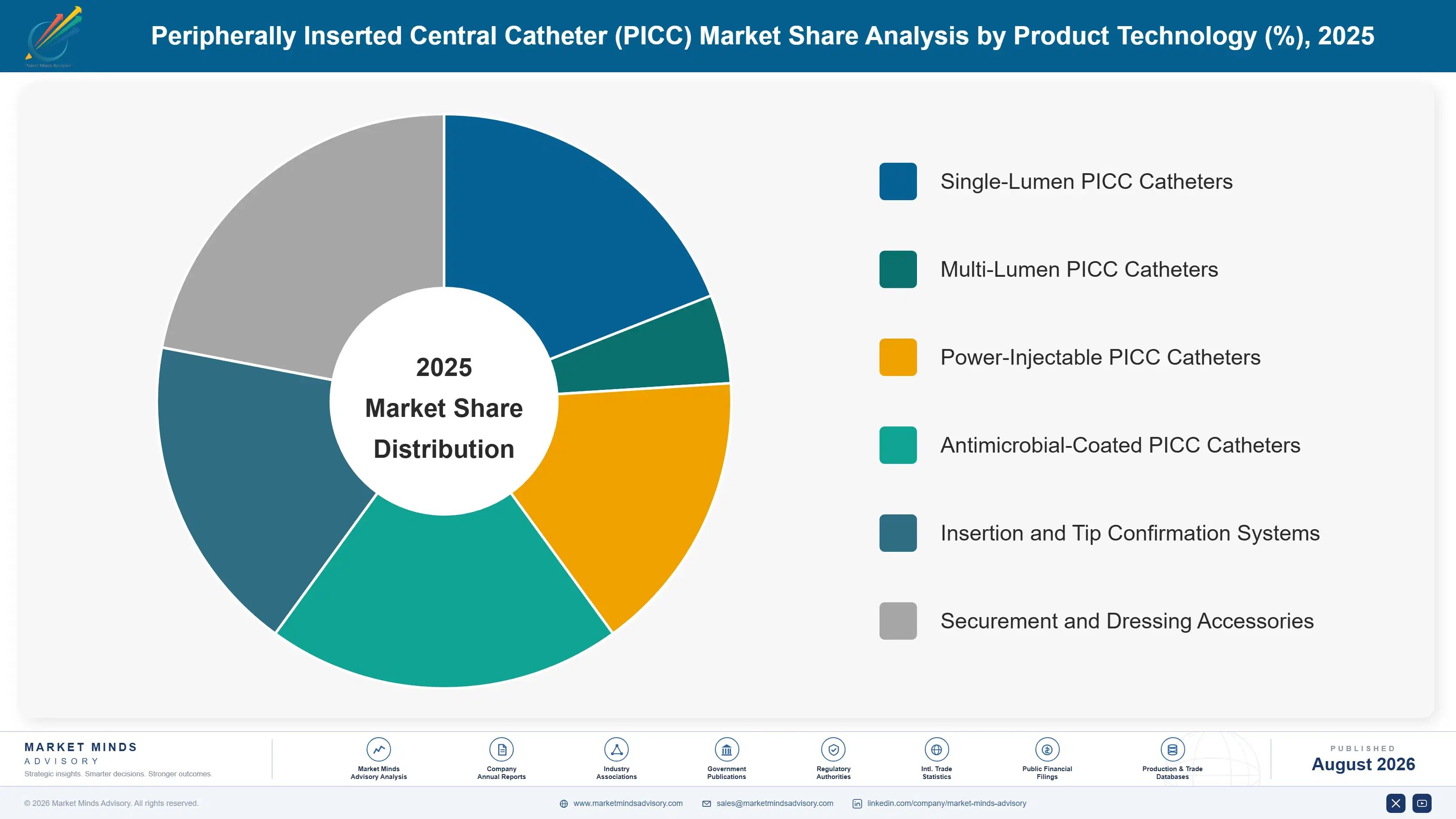
This market segments by product technology spanning single-lumen catheters, multi-lumen catheters, power-injectable catheters, antimicrobial-coated catheters, insertion and tip confirmation systems, and securement and dressing accessories used across long-term vascular access protocols. This dimension is the one vascular access teams actually reference when structuring purchasing and training decisions across the full care and treatment continuum.

Antimicrobial-Coated PICC Catheters
Antimicrobial-coated catheters are the fastest-growing segment as hospital infection prevention committees increasingly specify coated products for patients at elevated bloodstream infection risk, reflecting growing institutional focus on reducing catheter-related complications that carry substantial clinical and financial consequences for affected hospital systems. Clinical evidence showing meaningfully reduced infection rates compared to standard catheters has driven rapid adoption at academic medical centres and hospitals treating immunocompromised oncology and critical care patient populations specifically. This segment commands premium pricing reflecting both its specialized coating technology and the clinical outcome data supporting its expanding infection prevention positioning across regulated hospital environments. Manufacturers are pursuing expanded antimicrobial formulations and broader catheter configuration coverage as hospital infection prevention protocols increasingly standardize around coated products.
CAGR 9.6%
Insertion and Tip Confirmation Systems
Insertion and tip confirmation systems are growing considerably faster than the broader market as hospitals increasingly adopt ECG-guided confirmation technology that eliminates the delay and radiology coordination associated with traditional X-ray-based tip verification protocols used historically across most hospital settings. This segment benefits from strong vascular access team advocacy, since bedside confirmation technology directly improves workflow efficiency and reduces the multi-step coordination previously required between nursing and radiology departments for every single catheter placement performed. Manufacturers are investing in ultrasound-guided insertion technology alongside ECG confirmation to further differentiate within this segment, since combined insertion and confirmation platforms increasingly determine which vendors vascular access teams standardize around. This integration increasingly determines which vendors vascular access teams standardize around network-wide.
CAGR 8.4%
Full segment breakdown across 6 segments available in the complete report.
Regional Architecture and Country Demand Map
North America and Western Europe together account for the majority of global device spend, reflecting concentrated hospital infrastructure, dedicated vascular access team adoption, and premium infection prevention product reimbursement across major developed healthcare markets. East Asia and South Asia are closing the gap fastest as hospital infrastructure and specialist training.
North America
The United States anchors regional demand through its dense concentration of dedicated vascular access teams, favorable hospital reimbursement for infection prevention products, and the fastest specialist uptake of ECG-guided confirmation technology anywhere in the world tracked in this study. Canada maintains a smaller but steadily expanding treatment base, with provincial hospital systems gradually adopting antimicrobial catheter protocols following American clinical practice with a modest lag. American academic medical centres continue driving most first-in-market device adoption, giving manufacturers a reliable early revenue base ahead of broader community hospital rollout across the wider healthcare system. This region's vascular access team infrastructure and infection prevention focus make it the benchmark market other national health systems reference when evaluating catheter technology adoption.
Share: 32% | CAGR: 6.9% (2026 to 2036)
Western Europe
Germany, France, and the United Kingdom lead regional demand through well-established hospital infection prevention programmes and national health system coverage that, while more conservative on premium product pricing than the American market, still provides meaningful market access for antimicrobial catheters across most major national health systems. Public health system budget negotiations slow premium product pricing relative to the more commercially driven American market, but ECG-guided confirmation technology remains well-established across most European academic hospital networks. Nordic countries show disproportionately high dedicated vascular access team penetration despite small absolute population, reflecting well-funded healthcare systems prioritizing specialized nursing infrastructure. Regional growth trails North America and East Asia modestly as device technology adoption among major hospitals is already comparatively mature.
Share: 24% | CAGR: 5.0% (2026 to 2036)
Regional intelligence for 5 additional markets available in the complete report: East Asia, South Asia and Pacific, Latin America, Middle East and Africa, Eastern Europe. Contact sales@marketmindsadvisory.com.

Infection Prevention Bundling and Team Training Strategy
Manufacturers are shifting commercial strategy toward antimicrobial catheter bundling with confirmation systems, vascular access team training partnerships, and outcomes-based infection prevention contracting, capturing more predictable premium revenue rather than competing purely on standard catheter unit pricing alone across the category. This mirrors a broader medical device industry shift toward relationship-driven, evidence-based commercial models overall.
Antimicrobial and Confirmation System Bundling Strategy
Manufacturers are bundling antimicrobial-coated catheters with proprietary ECG-guided confirmation systems, creating an integrated product bundle that captures more total account revenue than either product sold independently while strengthening hospital dependency on a single vendor's compatible technology platform. This lever converts a fragmented, multi-vendor purchasing relationship into a consolidated account relationship, since hospitals standardizing on bundled systems face genuine switching costs when considering alternative vendor platforms later. Manufacturers report bundled system sales generating roughly 32% higher average account revenue than unbundled equivalent product sales. Manufacturers view this bundled approach as essential to defending long-term hospital account relationships.
Market Impact: Adds roughly 32 percent higher acco
Vascular Access Team Training Partnership Programmes
Manufacturers are funding clinical training and certification programmes specifically for dedicated vascular access teams, building brand loyalty and clinical dependency on specific insertion techniques and confirmation technology workflows that persist for years after initial training investment across a hospital's nursing staff. This lever creates durable customer relationships that transcend individual purchasing decisions, since vascular access teams trained extensively on a specific platform strongly resist switching to unfamiliar alternative systems requiring retraining. Manufacturers report training partnership programmes improving hospital account retention by roughly 29% compared to accounts without formal training relationships.
Market Impact: Improves account retention by rough
Outcomes-Based Infection Prevention Contracting Programme Strategy
Manufacturers are negotiating outcomes-based contracts tying a portion of antimicrobial catheter payment to demonstrated infection rate reduction, easing hospital budget concerns about premium coated catheter pricing while providing manufacturers a differentiated commercial approach that pure price competition from generic competitors cannot easily replicate. This lever helps secure formulary access at cost-constrained hospitals that would otherwise default to standard catheters given upfront budget impact concerns despite genuine infection prevention benefits available. Manufacturers report outcomes-based contracts accelerating formulary access by roughly 24% compared to standard price-based negotiation processes. Manufacturers expect this contracting approach to become increasingly common across the wider hospital category.
Market Impact: Speeds formulary access by roughly
Home Infusion Channel Expansion Investment Strategy
Manufacturers are expanding distribution partnerships with home infusion therapy providers, capturing incremental catheter and consumable revenue from the growing population of patients receiving long-term infusion therapy outside traditional hospital settings entirely, a channel with distinct purchasing dynamics from hospital procurement alone. This lever diversifies revenue beyond hospital-based purchasing into a growing home care channel that increasingly determines where long-term infusion therapy actually occurs following initial hospital-based catheter placement and discharge. Manufacturers report home infusion channel expansion adding roughly 17% to total category revenue at diversifying companies. Manufacturers expect this channel to remain a primary growth driver through the current forecast.
Market Impact: Adds roughly 17 percent to total de
Who Controls the Margin Pool
The top five vascular access manufacturers control roughly 72% of global revenue, a high concentration reflecting the substantial clinical evidence and regulatory investment required to establish new catheter technology, alongside a meaningful long tail of specialty and regional manufacturers competing within narrower product niches. Mid-sized specialty manufacturers with differentiated coatings remain attractive acquisition targets for larger originators. This dynamic keeps deal activity elevat
Current competitive activity centers on antimicrobial coating and confirmation system bundling to expand integrated account relationships, vascular access team training partnership development to strengthen clinical loyalty, and home infusion channel expansion targeting patients receiving therapy outside traditional hospital settings. Several manufacturers are also piloting bundled consumable and training packages to differentiate beyond hardware alone. This positioning increasingly determines which manufacturers win larger, multi-facility hospital relationships.
Emerging pressure comes from Asian regional manufacturers developing lower-cost catheter alternatives for their expanding domestic hospital markets, and from smaller specialty companies pursuing next-generation antimicrobial coating chemistries that could reduce infection rates enough to expand adoption among cost-constrained hospital systems broadly. Established leaders are responding by accelerating their own coating and confirmation investment to defend share.

Competitive Moat and Risk Dimensions
Moat: Dominant Franchise Nursing Education Depth
BD's PowerPICC franchise maintains decades of accumulated clinical evidence and extensive vascular access nursing education programmes, making its products the default reference standard that most American vascular access teams train on first and continue using throughout their careers. This clinical embedding advantage is difficult for newer entrants to replicate without comparable training history.
Risk: Product Liability Recall Exposure
BD's enormous installed base creates meaningful exposure to product liability litigation and potential recalls given the sheer placement volume across its catheter portfolio, and any significant safety event could damage the clinical trust that underpins its nursing education and training advantage. Investors are watching product quality trends closely for early signs of emerging safety concerns.
Moat: Integrated Vascular Access Portfolio Breadth
Teleflex sells catheters, insertion systems, and securement products under its Arrow brand across one integrated commercial relationship, giving it cross-selling advantages and workflow integration depth that narrower single-product competitors cannot easily replicate across comparable hospital account volume. Few competitors can match this integrated portfolio breadth built over decades of acquisition and development.
Risk: GPO Pricing Pressure Risk
Teleflex faces meaningful pricing pressure from hospital group purchasing organizations negotiating on behalf of large health system networks, and continued consolidation among these purchasing organizations could meaningfully compress margins across Teleflex's broader vascular access portfolio over time. Teleflex continues investing in differentiated technology to reduce this pricing pressure exposure over time.
Players Tracked
Prominent Players
Becton, Dickinson and Company
Teleflex Incorporated
B. Braun Melsungen AG
Medical Components Inc.
AngioDynamics Inc.
Other Key Players
Cook Medical Incorporated
Vygon SA
Access Vascular Inc.
ICU Medical Inc.
Merit Medical Systems Inc.
PFM Medical AG
Fresenius Kabi AG
Argon Medical Devices Inc.
Poly Medicure Limited
Romsons Group
Biomerics LLC
Avanos Medical Inc.
Nordson Corporation
Nipro Corporation
Angiplast Pvt. Ltd.
Recent Developments
BD Expands Antimicrobial Catheter Manufacturing Capacity in Utah
Becton, Dickinson and Company announced an organic capacity expansion at its Utah manufacturing facility to increase antimicrobial-coated catheter production, aimed at meeting rising demand from hospitals expanding infection prevention protocols across United States and international markets. The expansion is expected to reach full production capacity within the next twelve months.
Signal: Signals continued manufacturer confidence
Teleflex Signs Training Partnership With Vascular Access Nursing Association
Teleflex entered a multi-year training partnership with a national vascular access nursing association to expand certification programme access for its Arrow insertion and confirmation technology platform, part of a broader clinical education investment strategy. Financial terms of the multi-year partnership were not fully disclosed by either party involved.
Signal: Reflects growing manufacturer investment i
AngioDynamics Acquires Regional Antimicrobial Coating Technology Startup
AngioDynamics completed the acquisition of a regional antimicrobial coating technology startup, expanding its catheter portfolio to include next-generation coating chemistries targeting reduced catheter-related bloodstream infection rates across its broader vascular access product line. Financial terms of the transaction were not disclosed by either company involved in the deal.
Signal: Indicates growing manufacturer interest in
Polymer Materials and Coating Chemistry Exposure
Specialty medical-grade polymer materials, antimicrobial coating compounds, and precision extrusion manufacturing together represent roughly 37% of cost of goods sold for catheter manufacturers, with specialty polymer and coating chemistry sourced from a concentrated group of medical-grade material suppliers. Manufacturers with vertically integrated production face materially less exposure to this concentration globally today overall across the industry.
Specialty polymer and coating compound prices rose meaningfully during 2021 and 2022 amid broader medical device supply chain disruption, with company annual reports from major manufacturers confirming that input cost pressure remained elevated through much of the period before moderating somewhat through 2024 and 2025. Smaller manufacturers absorbed a disproportionate share of this cost inflation given weaker supplier negotiating positions previously available to smaller manufacturers lacking comparable scale overall.
Smaller specialty manufacturers without long-term supplier contracts face materially higher input cost volatility than the largest players, who can negotiate multi-year fixed pricing given their purchasing scale. This creates a durable cost disadvantage for smaller catheter makers competing on price against larger competitors. Geography also matters, since manufacturers closer to polymer supply hubs face smaller logistics cost swings today overall.

Multi-Year Fixed Pricing Supplier Contracts
Larger manufacturers are locking in multi-year fixed pricing agreements with specialty polymer and coating suppliers, insulating catheter production costs from short-term material price volatility that smaller competitors remain fully exposed to across each purchasing cycle. This approach has become standard practice among the largest device manufacturers globally over the past decade, particularly those with strong purchasing scale available.
Vertical Integration Into Coating Chemistry Production
Some larger manufacturers are bringing antimicrobial coating chemistry production in-house rather than outsourcing entirely, capturing manufacturing margin previously paid to third-party suppliers while gaining tighter quality control. This shift represents a meaningful strategic bet on long-term category volume growth, reflecting genuine confidence in continued category expansion each cycle going forward across the wider industry.
Secondary Supplier Qualification Programmes
Manufacturers are qualifying secondary polymer and coating suppliers to reduce dependency on any single source, reducing disruption risk when a primary supplier faces its own capacity constraints or quality issues. Smaller manufacturers increasingly pursue this strategy too, despite the added qualification cost involved, and this trend keeps accelerating across the wider device industry across the manufacturer's global operations.
Portfolio Architecture for Margin Defence
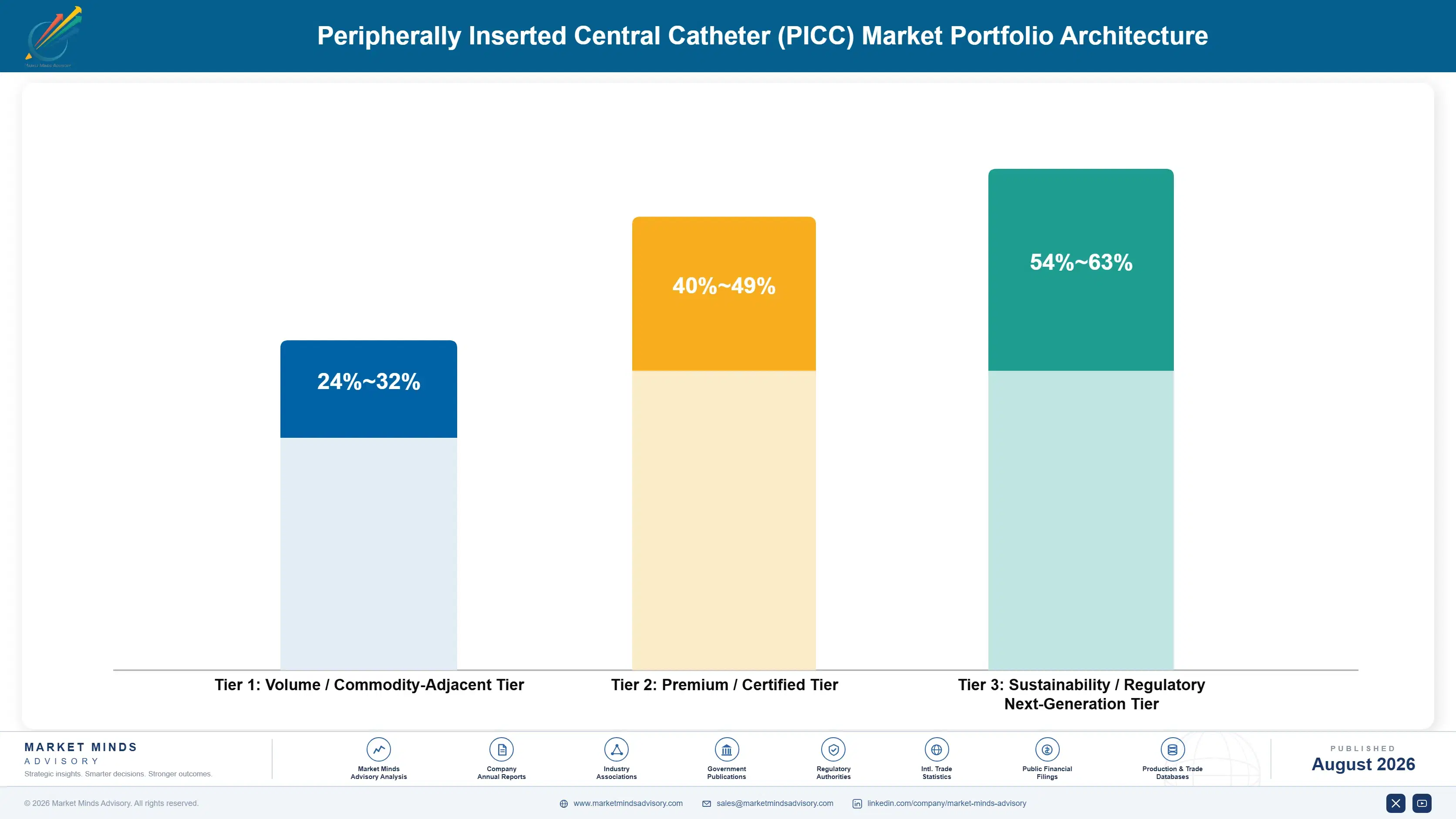
This market organizes into three commercial tiers spanning standard single and multi-lumen catheters at the volume end, power-injectable and standard confirmation-compatible catheters occupying the premium middle tier, and antimicrobial-coated catheters and integrated confirmation systems capturing the strongest margins at the top of the portfolio architecture overall. Manufacturers increasingly structure pricing and pipeline investment explicitly around this three-tier architecture.
Volume and premium tiers pull manufacturers in different directions: standard catheters sustain broad hospital relationships and unit volume, while antimicrobial and integrated confirmation products deliver materially stronger margins that increasingly determine which companies can fund the clinical research the category requires going forward across markets. Most manufacturers now allocate a growing share of research budget toward the top two tiers. This explicit structuring helps allocate scarce clinical research resources toward the highest-return opportunities available.
The highest-value pools concentrate around antimicrobial-coated catheters and integrated confirmation systems sold under vascular access team training partnerships, where infection prevention data and workflow integration together sustain premium pricing power that standard catheters simply cannot match across comparable placement volume. Manufacturers unable to compete in this tier increasingly struggle to sustain category-leading margins over time.
Volume / Commodity-Adjacent Tier
Standard single and multi-lumen catheters sold primarily into general hospital vascular access programmes broadly nationwide. This tier represents the largest unit volume category by hospital count served across most markets.
Gross Margin: 24-32%
Premium / Certified Tier
Power-injectable catheters and confirmation-compatible products sold into academic and specialty hospitals under strong clinical positioning. Hospitals in this tier rarely switch platforms once staff training and protocols are established each time.
Gross Margin: 40-49%
Sustainability / Regulatory / Next-Generation Tier
Antimicrobial-coated catheters and integrated confirmation systems commanding the strongest pricing power given infection prevention differentiation. This tier increasingly determines which companies can fund the clinical research the category requires each cycle.
Gross Margin: 54-63%

High-value Sub-segments and Strategic Watch-out
Antimicrobial-Coated PICC Catheters
The fastest-growing and highest-margin segment, combining strong infection prevention momentum with genuine clinical outcome data across most major hospital markets tracked, drawing intense investment. Manufacturers are allocating a growing share of research budget toward this segment specifically, and this priority shows no sign of shifting through the current planning cycle.
Gross Margin: 54-63%
Insertion and Tip Confirmation Systems
Strong margins and steady growth driven by vascular access team adoption of bedside confirmation technology that traditional X-ray verification cannot match efficiently. Manufacturers are developing ultrasound-guided insertion technology to further differentiate within this segment, since combined platforms increasingly determine vendor standardization decisions network-wide today now.
Gross Margin: 46-55%
Standard Single and Multi-Lumen Catheters
The volume core segment sustaining hospital relationships and baseline placement volume even as newer categories gradually capture premium positioning. Manufacturers rely on this segment to sustain hospital relationships even as newer categories capture growth, and this role remains commercially important despite slower relative growth overall.
Gross Margin: 26-34%
Securement and Dressing Accessories
A strategic watch-out segment facing modest growth ceiling given its supporting role, though it remains a necessary recurring component of comprehensive catheter care. Manufacturers watch this segment closely for bundling opportunities with premium catheter product lines, since bundling could meaningfully improve per-account revenue without requiring separate approval.
Gross Margin: 20-27%
Catheter Dwell-Time Recurring Care Streams
Catheter placement functions as an annuity anchor across its dwell period: once inserted, every subsequent dressing change, flush, and maintenance procedure generates recurring consumable revenue that compounds well beyond the initial catheter sale across a treatment course that often extends for weeks or months. Manufacturers increasingly price initial placement competitively specifically to accelerate this downstream consumable relationship.
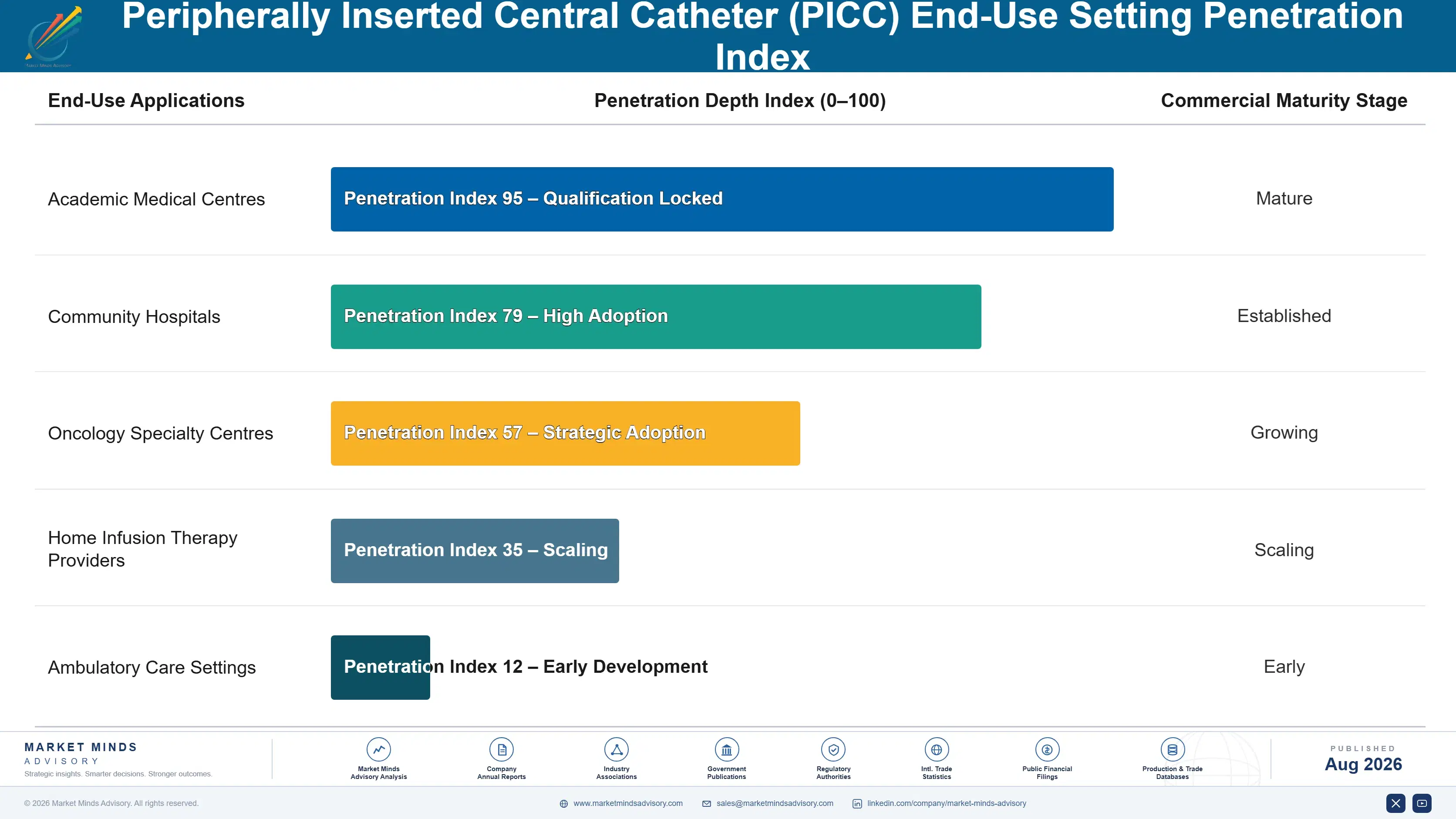
Adoption depth varies considerably by care setting: academic medical centres and dedicated vascular access teams adopt newer antimicrobial and confirmation technology earliest, while smaller community hospitals more often continue standard catheter protocols until infection prevention committee mandates or clinical outcomes data drive conversion. Regional hospital infrastructure maturity further shapes which catheter options patients realistically encounter first. Manufacturers tailor commercial and training investment differently across each of these distinct care settings.
A generational shift is underway as nurses trained during the ECG-guided confirmation era enter vascular access practice expecting bedside placement verification as standard technique, gradually normalizing a workflow that earlier-trained nurses historically associated only with separate radiology-dependent confirmation processes. Manufacturers are adapting training and marketing investment accordingly to reach this newly influential nursing cohort today across the wider healthcare industry.

Where PICC Economics Are Heading
These are among the four positions where our research anticipates prominent divergence between winners and laggards over the coming forecast period. Each is grounded in the demand model, the regulatory perimeter, and the announced capacity pipeline.
Antimicrobial catheters will keep expanding beyond high-risk patients
Hospitals adopting antimicrobial-coated catheters for high-risk patients are setting a precedent that infection prevention committees appear increasingly willing to formalize as broader standard practice, and this trajectory shows no sign of reversing given accumulating clinical outcome data. Standard catheters will persist for lower-risk patients rather than disappearing from clinical practice entirely. Manufacturers overweighted toward legacy standard catheter revenue face a gradually shrinking core category over the coming decade regardless of overall market growth, across nearly every manufacturer portfolio MMA analysts reviewed this cycle.
Integrated confirmation bundling will separate winners from laggards
Manufacturers bundling antimicrobial catheters with proprietary confirmation systems are capturing disproportionate share of vascular access team accounts, since integrated platforms create genuine switching costs that pure catheter competitors without comparable technology cannot easily overcome. Companies without meaningful confirmation technology risk losing accounts to better-positioned competitors. Expect bundled platform strategy to become an increasingly dominant competitive approach across the premium segment within the next several years within this rapidly consolidating vascular access device category overall within this rapidly consolidating vascular access device category worldwide overall.
Team formation will keep expanding the addressable device market
Dedicated vascular access team formation represents the single largest addressable growth lever in this category, since specialized teams consistently standardize around premium technology platforms that general nursing staff performing occasional insertions rarely adopt at comparable rates. Manufacturers investing in team training partnerships are best positioned to capture this expanding institutional structure. Expect vascular access team-driven volume growth to meaningfully outpace general hospital catheter volume growth through most of the forecast period ahead, particularly those competing for large hospital network relationships.
Home infusion expansion will diversify manufacturer revenue streams
Manufacturers expanding distribution into home infusion therapy channels are capturing a genuinely growing patient population receiving long-term catheter-based therapy outside traditional hospital settings, a channel with distinct purchasing dynamics that hospital-focused competitors may underserve. Companies without meaningful home infusion channel presence risk missing this expanding revenue opportunity. Expect home infusion channel investment to become an increasingly explicit strategic priority for manufacturers seeking diversified long-term growth, reshaping which manufacturers lead emerging channel growth this decade, reshaping which manufacturers lead emerging channel growth over this coming decade.
Engagement Snapshot From the Field
A live engagement with an industry participant carrying material or product regulatory and market exposure ahead of a defining policy shift, showing how our research translates into a defensible multi-year portfolio strategy.
MARKET MINDS ADVISORY · CLIENT ENGAGEMENT SUMMARY
Peripherally Inserted Central Catheter (PICC) Producer Strategic Portfolio Review and Transition Roadmap 2026·Investment Scenario on Peripherally Inserted Central Catheter (PICC) Exposure Evaluation 2025-26
CLIENT PROFILE
The client operates a regional hospital network spanning nine facilities, generating combined annual PICC device procurement spend of approximately $5.4 million (client-reported, unverified by MMA). Leadership sought guidance on standardizing catheter and confirmation technology selection across its network to reduce catheter-related bloodstream infection rates across its nine-facility network prior to this engagement across the network before this engagement began in early 2025.
STRATEGIC CHALLENGE
The network's nine facilities used a fragmented mix of standard and antimicrobial catheters based on individual facility purchasing decisions, and leadership was uncertain whether network-wide standardization toward antimicrobial products would generate sufficient infection rate reduction to justify the incremental procurement cost involved across all nine facilities given budget constraints across all nine facilities given significant budget constraints overall.
MMA APPROACH
MMA's team benchmarked comparable hospital network standardization outcomes, modeled projected infection rate reduction and associated cost avoidance against incremental antimicrobial catheter procurement costs, and evaluated leading integrated confirmation system platforms against the network's existing vascular access team capability to inform the network's final standardization decision to inform the network's final standardization decision process.
KEY FINDINGS
- Comparable hospital networks standardizing on antimicrobial catheters reported bloodstream infection rate reductions sufficient to offset incremental procurement costs within approximately fourteen months.
- Facilities with established dedicated vascular access teams showed faster adoption and better clinical outcomes than facilities relying on general nursing staff for catheter insertion.
- Bundling antimicrobial catheters with a single confirmation system vendor reduced projected training costs by roughly 22% compared to independent facility-by-facility procurement decisions.
- Standardization was projected to improve infection tracking data consistency considerably, supporting more reliable network-wide outcome measurement and reporting across the full nine-facility network studied.
CLIENT PROFILE
The client operates a regional hospital network spanning nine facilities, generating combined annual PICC device procurement spend of approximately $5.4 million (client-reported, unverified by MMA). Leadership sought guidance on standardizing catheter and confirmation technology selection across its network to reduce catheter-related bloodstream infection rates across its nine-facility network prior to this engagement across the network before this engagement began in early 2025.
STRATEGIC CHALLENGE
The network's nine facilities used a fragmented mix of standard and antimicrobial catheters based on individual facility purchasing decisions, and leadership was uncertain whether network-wide standardization toward antimicrobial products would generate sufficient infection rate reduction to justify the incremental procurement cost involved across all nine facilities given budget constraints across all nine facilities given significant budget constraints overall.
MMA APPROACH
MMA's team benchmarked comparable hospital network standardization outcomes, modeled projected infection rate reduction and associated cost avoidance against incremental antimicrobial catheter procurement costs, and evaluated leading integrated confirmation system platforms against the network's existing vascular access team capability to inform the network's final standardization decision to inform the network's final standardization decision process.
KEY FINDINGS
- Comparable hospital networks standardizing on antimicrobial catheters reported bloodstream infection rate reductions sufficient to offset incremental procurement costs within approximately fourteen months.
- Facilities with established dedicated vascular access teams showed faster adoption and better clinical outcomes than facilities relying on general nursing staff for catheter insertion.
- Bundling antimicrobial catheters with a single confirmation system vendor reduced projected training costs by roughly 22% compared to independent facility-by-facility procurement decisions.
- Standardization was projected to improve infection tracking data consistency considerably, supporting more reliable network-wide outcome measurement and reporting across the full nine-facility network studied.
RECOMMENDED STRATEGY
Phase 1: Phase 1 (Months 1-4): Standardize the three facilities with the highest existing infection rates first, using dedicated vascular access team expertise where available. Phase 2: Phase 2 (Months 5-9): Expand standardization to the next four facilities while building vascular access team capability at sites currently lacking dedicated staff. Phase 3: Phase 3 (Months 10-12): Complete network-wide standardization at the remaining two facilities, finalizing infection tracking and outcome reporting infrastructure and finalize outcome reporting systems.
OUTCOME
The network completed standardization across all nine facilities within the recommended twelve-month timeline, reporting measurable early infection rate improvement network-wide (client-reported, unverified by MMA) while maintaining consistent clinical quality across every facility involved throughout the transition while maintaining consistent clinical quality across every facility throughout the full transition period.
Frequently Asked Questions
Foundational context covering the market sizes, CAGR, scope, country, region and competition that inform every finding below. This section is provided to cover basics and most often pre-purchase conversations, answered from the MMA Primary Research Dataset.
What is the current size of the Peripherally Inserted Central Catheter (PICC) Market?
The global PICC market was valued at approximately $2.1 billion in 2025. This includes standard, antimicrobial-coated, and power-injectable catheter categories used across hospital and home infusion treatment settings worldwide.
How large will the Peripherally Inserted Central Catheter (PICC) Market be by 2036?
The market is projected to reach approximately $4.20 billion by 2036. This reflects continued antimicrobial catheter adoption and expanding vascular access team formation worldwide under continued antimicrobial coating and confirmation technology adoption.
What is the CAGR for the Peripherally Inserted Central Catheter (PICC) Market 2026 to 2036?
The market is expected to grow at a compound annual growth rate of 6.5% between 2026 and 2036. This reflects steady demand from oncology and infusion therapy growth.
Which segment is growing fastest?
Antimicrobial-coated catheters are the fastest-growing segment, expanding at approximately 9.6% annually. This reflects growing hospital infection prevention protocol adoption over standard catheters still widely used across most hospitals.
Who are the major companies in the Peripherally Inserted Central Catheter (PICC) Market?
Leading companies include Becton Dickinson, Teleflex, B Braun, Medical Components, and AngioDynamics. Together these five manufacturers account for roughly 72% of global device revenue worldwide.
Which country is growing fastest?
China is the fastest-growing major market at an estimated 8.8% CAGR, driven by rapidly expanding hospital infrastructure and oncology treatment volume across its rapidly modernizing public and private hospital sector.
Report Segmentation Architecture
The full report scope spans multiple orthogonal segmentation dimensions, with cross-tabulated demand data provided for each dimension pair. Coverage extends further to regional breakdowns, trend trajectories, and the competitive detail needed to support segment-level decision-making.
By Product Technology
- Single-Lumen PICC Catheters
- Multi-Lumen PICC Catheters
- Power-Injectable PICC Catheters
- Antimicrobial-Coated PICC Catheters
- Insertion and Tip Confirmation Systems
- Securement and Dressing Accessories
By End-Use Setting
- Academic Medical Centres
- Community Hospitals
- Oncology Specialty Centres
- Home Infusion Therapy Providers
- Ambulatory Care Settings
By Commercial Dimension
- Direct Hospital Procurement
- Group Purchasing Organizations
- Home Infusion Distribution Channels
- National Tender Contracts
By Region
- North America
- Western Europe
- East Asia
- South Asia and Pacific
- Latin America
- Middle East and Africa
- Eastern Europe
Scope, Methodology, and Coverage
Every figure in this report is reproducible from documented input assumptions. The scope below maps the historical period, the forecast horizon, the segmentation dimensions, and the countries covered, alongside the underlying primary and qualitative methodology.
Historical Period
2020 to 2025
Forecast Period
2026 to 2036
Base Year
2025 (USD billions; MMA Primary Research Dataset, August 2026)
Market Definition
This report covers peripherally inserted central catheters and associated insertion, tip confirmation, and securement devices used specifically for long-term intravenous access. It excludes fully implantable ports, tunneled central venous catheters, and short peripheral IV catheters unrelated to peripherally inserted central catheter placement.
Quantitative Units
USD billions (current prices); device unit shipments; average selling price per unit
Segmentation Dimensions
By Product Technology; By End-Use Setting; By Commercial Dimension; By Region
Regions Covered
North America, Western Europe, East Asia, South Asia and Pacific, Latin America, Middle East and Africa, Eastern Europe
Countries Covered
USA, China, Germany, France, UK, Japan, South Korea, India, Australia, Canada, Brazil, Mexico, Indonesia, Vietnam, Thailand, Malaysia, UAE, Saudi Arabia, South Africa, Nigeria, Turkey, Poland, Netherlands, Italy, Spain, Sweden, Switzerland, Argentina, Colombia, Singapore, and additional markets relevant to this sector
Key Companies Profiled
Becton, Dickinson and Company, Teleflex Incorporated, B. Braun Melsungen AG, Medical Components Inc., AngioDynamics Inc., Cook Medical Incorporated, Vygon SA, Access Vascular Inc., ICU Medical Inc., Merit Medical Systems Inc., PFM Medical AG, Fresenius Kabi AG, Argon Medical Devices Inc., Poly Medicure Limited, Romsons Group, Biomerics LLC, Avanos Medical Inc., Nordson Corporation, Nipro Corporation, Angiplast Pvt. Ltd.
Quantitative Methodology
Primary survey, n=3,800 respondents, Q4 2025, six countries; demand-side model with trade association cross-validation
Qualitative Methodology
47 expert interviews, Q4 2025; applied to validate demand model assumptions, identify emerging dynamics, and assess competitive positioning
Report Format
PDF and XLSX data workbook (Word format preview document)
Publisher
Market Minds Advisory
Report Code
MMA-2026-MED-128
Published
August 2026
Contact
sales@marketmindsadvisory.com | www.marketmindsadvisory.com
Purchase the full Peripherally Inserted Central Catheter (PICC) Market Report (2026 to 2036).
The full report provides detailed product-level segmentation, hospital procurement pattern analysis, and country-level infection prevention policy tracking across all seven regions covered in this study. It includes manufacturer-level competitive benchmarking based on clinical training infrastructure and technology bundling reach. Subscribers receive quarterly updates tracking new product approvals and infection prevention guideline changes as they occur. A companion dataset provides device unit volume estimates by product category for detailed market sizing purposes A dedicated analyst contact is also available to support custom data requests beyond the standard deliverable scope provided.
Product-level segmentation breakdown by category type
Hospital procurement pattern trend analysis service
Country-level infection prevention policy tracking service
Manufacturer competitive benchmarking scorecards and comparisons
Quarterly product approval and guideline update service
Device unit volume dataset by product category
Built For The People Who Decide
From boardroom strategy to bench-side execution, this report is read cover-to-cover by leaders shaping the next decade of their industry, turning demand scenarios, market dynamics and valuation benchmarks into decisions.
CXOs/ Presidents/ VPs/ Managers
M&A and Corporate Development
Strategy Teams and R&D Heads
Procurement and Product Directors
Regulatory and Compliance Leaders
Investor Relations and Equity Analysts