Market Minds Advisory
Perfume Packaging Market

Perfume Packaging Market: Decoration Value, Furnace Economics, and the Refill Mandate

The only packaging category where the pack outlives the product and sits on display for years, which is why decoration carries more value than the glass and why recyclability rules land so awkwardly.

Lead Analyst

Bilal Shaikh

Published

September 2026

Make Smarter Decisions with Customized Research Insights

Request a free sample report and evaluate market opportunities, growth trends, and competitive dynamics relevant to your business needs.

2025 MARKET VALUE$6.4BMarket Size 2025
2036 FORECAST VALUE$12.4BBase Case , 2026 to 2036
CAGR 2026 TO 20366.2 %Bull 7.4% / Bear 5.0%
INCREMENTAL OPPORTUNITY$5.6BNet 10- year value creation
EXPANSION MULTIPLE1.82x2036 value over 2026 base
Strategic Levers
M&A Pipeline
Regional Outlook
Country Rankings
Competitive Intelligence
Segmental Deep-dive
Call-Us : 91 93563 13602

Executive Snapshot and Market Trajectory

A perfume bottle is the only pack that outlives its contents by years. It sits on a dressing table as an object, which is why decoration accounts for more of the value than the glass beneath it and why every recyclability rule written for packaging fits this category badly.
Growth comes from format change rather than from more fragrance sold. Refillable bottle and cartridge systems grow fastest at 9.3%, exactly 1.50 times the market rate, pushed by European packaging regulation and pulled by brands who worked out that a refill sells the same juice without rebuying the flacon. Sampling formats follow at 8.4%. Western Europe holds the largest value pool because French flaconnage capacity and the brand houses sit there together.
Concentration is only 34% across the top five measured on annual unit production capacity, and decoration in particular runs through hundreds of small specialist workshops. Development lead times near 16 months and mould tooling costs keep brand switching slow once a project starts. European packaging regulation and glass furnace decarbonisation are the two forces that will reorder this supply base. Neither force is priced into current supplier valuations.
Market Definition
This market covers primary and secondary packaging supplied for fragrance products, including glass flacons, dispensing pumps and actuators, caps and collars, refillable bottle and cartridge systems, secondary cartons and rigid boxes, and sampling and travel formats. Scope is measured at packaging supplier realised prices including applied decoration. Fragrance concentrate, alcohol, filling and assembly services, retail display fixtures, and personal care packaging outside fragrance are excluded.
Base Year Value
$6.4B in 2025 (MMA Primary Research Dataset, August 2026)
Forecast Period
2026 to 2036, eleven discrete annual values
CAGR
6.2% base case. Bull 7.4%. Bear 5.0%.
Fastest Growth Segment
Refillable Bottle And Cartridge Systems: 9.3% CAGR
Fastest Growth Country
India: 10.6% CAGR
Fastest Growth Region
South Asia and Pacific: 8.3% CAGR
Largest Region
Western Europe: 30% of 2025 global value
Market Leaders
Verescence. Pochet Group. Heinz-Glas. AptarGroup. Stoelzle Glass Group. Source: MMA Analysis based on company annual reports.
Primary Survey
n=3,800 procurement and R&D decision-makers, Q4 2025, six countries
Methodology
Demand-side build-up, cross-validated against public data, 47 expert interviews

Perfume Packaging Market Forecast Scenarios

perfume-packaging-market-size-forecast-scenario-1787298962866
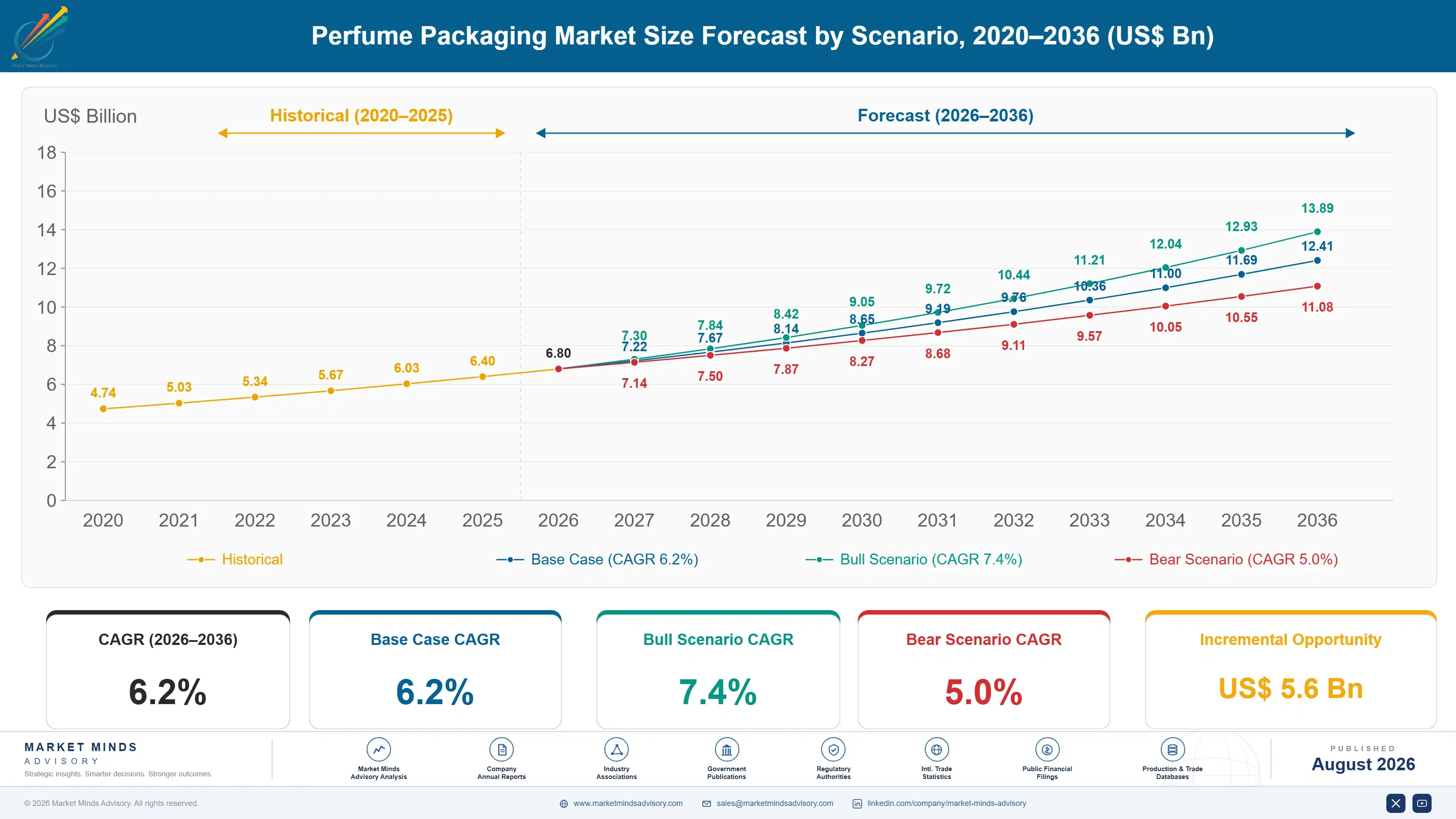
The 2020 to 2025 period began badly and ended better than anyone forecast. Travel retail collapsed and took the sampling and gift-set business with it, then fragrance demand rebounded hard from 2022 as consumers traded up into premium and niche houses. A 5.2% historical rate averages two very poor years against three strong ones, and understates how much premium mix shift changed value per unit.
Three mechanisms carry the 6.2% base case. Premium and niche mix shift is the largest, because a niche house spends multiples of a mass brand on flaconnage and decoration for the same volume of liquid. Refill architecture is the second, adding a cartridge sale alongside the original bottle rather than replacing it. And Gulf and Indian fragrance consumption is the third, both markets buying elaborately decorated presentations as standard rather than as luxury.
The 7.4% bull case rests on refillable formats moving from around 8% of units into mainstream premium distribution, which adds packaging revenue per unit of fragrance sold rather than substituting it. The 5.0% bear case is European packaging regulation forcing decoration simplification, since metallised collars and multi-layer lacquers are difficult to recycle and stripping them removes the value that decoration currently carries.

Why the Glass Is the Cheap Part

Soda-lime glass is a commodity and the flacon that carries a two hundred dollar fragrance is not expensive to melt and form. What costs money is everything applied afterwards: frosting, lacquer coats, metallisation, hot stamping, screen printing, and the collar that hides the crimp. Decoration accounts for roughly 44% of packaging value, and it runs through hundreds of small workshops rather than through the glassmakers themselves.
TOP FIVE CONCENTRATION34%Fragmented, with decoration spread across many small specialist workshops
DECORATION VALUE SHARE44%Surface finishing carries more value than the glass itself
FURNACE ENERGY SHARE21%Melting energy as a share of flacon conversion cost
REFILLABLE FORMAT SHARE8%Units sold today in refillable or cartridge-based presentations
PACK COST OF RETAIL14%Share of shelf price absorbed by the complete pack
DEVELOPMENT LEAD TIME16 monthsFrom brand concept brief to first commercial production run
This creates a supply structure unlike any other packaging category. A brand specifies a flacon from one supplier, decoration from a second, pump from a third, and carton from a fourth, then assembles with a filler who coordinates none of it. Development takes around 16 months and mould tooling runs well into six figures. Once a project commits, switching is effectively impossible until the next relaunch.
Two forces will reorder this over the next decade. European packaging regulation pushes toward recyclable single-material construction, which is exactly what decorated luxury flaconnage is not. And glass furnace decarbonisation forces a capital decision at every rebuild, roughly once every twelve to fifteen years. That rebuild window is the only moment melting technology can change. Missing it costs a producer the following decade.
"Brand teams spend nine months arguing about the exact shade of the lacquer and about four minutes on whether the collar can be separated for recycling. In three years the second question will decide whether the pack is legal in Europe, and nobody in the room is currently asking it."
Director. Packaging and Luxury Presentation Practice · MMA Packaging and Luxury

Market Trends

Refill Architecture Adds Revenue Rather Than Cannibalising It

Brands initially resisted refills on the assumption that selling a cartridge instead of a bottle destroyed packaging revenue. The commercial reality turned out differently. A refill customer keeps the original flacon, returns for cartridges, and the brand captures repeat purchase it previously lost to competitors at the next replacement. Refillable formats now cover about 8% of units and are growing at 9.3%, and the packaging supplier sells the flacon once plus a cartridge stream afterwards. European packaging regulation is accelerating adoption, but the commercial logic stands on its own regardless of any rule.
Market Impact: Packaging reaches 14% of retail price

Glass Furnace Electrification Forces Decisions At Rebuild Points

A glass furnace runs twelve to fifteen years and then requires a full rebuild costing tens of millions, which is the only moment when melting technology can realistically change. European flaconnage producers reaching that point now must choose between conventional gas, hybrid electric, or full electric melting, with each option carrying different energy cost exposure for the following decade and a half. Melting energy is roughly 21% of flacon conversion cost. Several European producers have committed to hybrid furnaces, and the resulting cost positions will diverge sharply across the forecast period.
Market Impact: India grows at 10.6% annually

Market Opportunities and Growth Drivers

Premium And Niche Mix Shift Raises Packaging Value Per Unit

Consumers trading up from mass fragrance into premium and niche houses change packaging economics far more than they change volume. A niche house spends several times what a mass brand spends on flaconnage, decoration, and secondary presentation for an identical quantity of liquid, because the pack is doing the positioning work. Packaging runs around 14% of retail price at mass and considerably more in absolute terms at premium. This mix shift has been the largest single contributor to category value growth over the past five years, and it shows no sign of reversing.
Market Impact: Threatens 44% of packaging value

Gulf And Indian Consumption Treats Elaborate Presentation As Standard

Per capita fragrance consumption in Saudi Arabia and the United Arab Emirates is the highest anywhere, and the oud and attar traditions there expect heavy decorated flacons, metal work, and presentation boxes as the normal specification rather than as a luxury tier. Indian demand is following a similar pattern as the domestic fragrance market formalises, and India contributes the fastest national growth rate in this forecast at 10.6%. These are markets where the packaging brief starts from ornamentation rather than adding it, which lifts value per unit well above Western equivalents.
Market Impact: Lead time runs 16 months

Market Restraints and Challenges

Decorated Flaconnage Fails Almost Every Recyclability Test

European packaging regulation pushes toward mono-material construction and design for recycling, and a decorated perfume bottle is the opposite of that: glass with lacquer coats, a metallised collar, a plastic pump mechanism, and a crimped metal ferrule that nobody can separate at home. The root cause is that these rules were written for fast-moving grocery packaging and applied to a category where the pack is kept for years. Commercial impact threatens the decoration value that carries 44% of the market. Participants are testing separable collars, single-lacquer finishes, and detachable pump architecture in response.
Market Impact: Refills reach 8% of units

Sixteen-Month Lead Times Make The Supply Chain Inflexible

From brand brief to first commercial run takes about 16 months, covering design, mould tooling, decoration trials, stability testing, and filler qualification. The root cause is tooling: a custom flacon mould costs well into six figures and cannot be modified once cut. Commercial impact is severe when a launch is delayed or a trend moves, because inventory commitments and tooling spend are already sunk. Participants are pushing standard-body flacons with custom decoration, digital printing that removes screen setup, and modular collar systems that allow late differentiation without new glass tooling.
Market Impact: Melting is 21% of conversion cost
2 additional market trends, 3 additional growth drivers, and 4 additional restraints and challenges are covered in the full report. Contact sales@marketmindsadvisory.com to access the complete intelligence.

Segment CAGR and Growth Architecture

Segmentation follows packaging component, because each component is bought from a different supplier, tooled separately, and carries entirely different margin and lead time economics. Fragrance category and price tier both cut across every component rather than separating them cleanly, so neither functions as a workable primary dimension for this market. Six components result, and four different suppliers usually make them.
perfume-packaging-market-market-share-analysis-1787298963411

Refillable Bottle And Cartridge Systems

The fastest component at 9.3%, exactly 1.50 times the market rate, and the one that changes revenue structure rather than merely growing. A refillable presentation sells the flacon once and then sells cartridges repeatedly, which converts a single transaction into a recurring one for both brand and packaging supplier. Brands feared cannibalisation and found the opposite, since a customer holding an expensive empty flacon returns rather than switching. European packaging regulation is pushing adoption faster than commercial logic alone would, but the logic is sound either way. Current penetration is about 8% of units. The engineering challenge is a cartridge interface that feels solid, seals reliably, and cannot be counterfeited easily.
CAGR 9.3%

Sampling And Travel Format Packaging

Second fastest at 8.4%, rebuilding hard after travel retail collapse and now serving a purpose it never previously had. Discovery sets, decant vials, and refillable travel atomisers have become the primary trial mechanism for niche houses selling online, where a customer cannot smell before buying. That makes sampling packaging trial infrastructure rather than promotional material, and brands budget it accordingly. Unit values are low but volumes are very high and the tooling is largely standard, which suits suppliers who cannot compete on bespoke flaconnage. Travel retail recovery adds a second demand stream on top. The main pressure is aviation regulation on liquid volumes, which constrains format design more than any commercial factor does.
CAGR 8.4%
Full segment breakdown across 6 segments available in the complete report.

Regional Architecture and Country Demand Map

Two regions sit outside their framework bands here and both for entirely concrete reasons. Western Europe holds the flaconnage capacity and the brand houses that specify it together, while Gulf per capita fragrance consumption is the highest anywhere in the world and expects elaborate presentation as standard.

Western Europe

Thirty percent, above the framework band, and the justification is that supply and specification sit in the same place. France hosts the majority of world luxury flaconnage capacity across the Normandy and Picardy glass region, and the brand houses that write the briefs are in Paris. Italian. German, and Austrian producers supply the rest of European demand and much of the decorated mid-tier. That co-location matters commercially because a sixteen-month development programme runs on physical sample exchange and factory visits. Growth at 4.7% is the slowest of any region, reflecting a mature consumption base where value growth now depends entirely on mix rather than on volume. Decoration workshops cluster around the same glass region.
Share: 30% | CAGR: 4.7% (2026 to 2036)

Middle East and Africa

Nine percent against a framework band of three to six, and the breach is genuine consumption rather than an estimation artefact. Saudi Arabian and Emirati per capita fragrance spending is the highest anywhere in the world, and the oud and attar traditions expect heavy decorated flacons, metalwork, and presentation boxes as the standard specification rather than as a premium upgrade. Local fragrance houses operate at scale and specify packaging as elaborately as European luxury brands do. Regional decoration and assembly capacity has grown alongside. Growth at 6.7% sits above the global rate, carried by domestic fragrance house expansion and by retail development across the Gulf. Ornamentation is the starting brief here rather than an upgrade.
Share: 9% | CAGR: 6.7% (2026 to 2036)
Regional intelligence for 5 additional markets available in the complete report: East Asia, North America, South Asia and Pacific, Latin America, Eastern Europe. Contact sales@marketmindsadvisory.com.
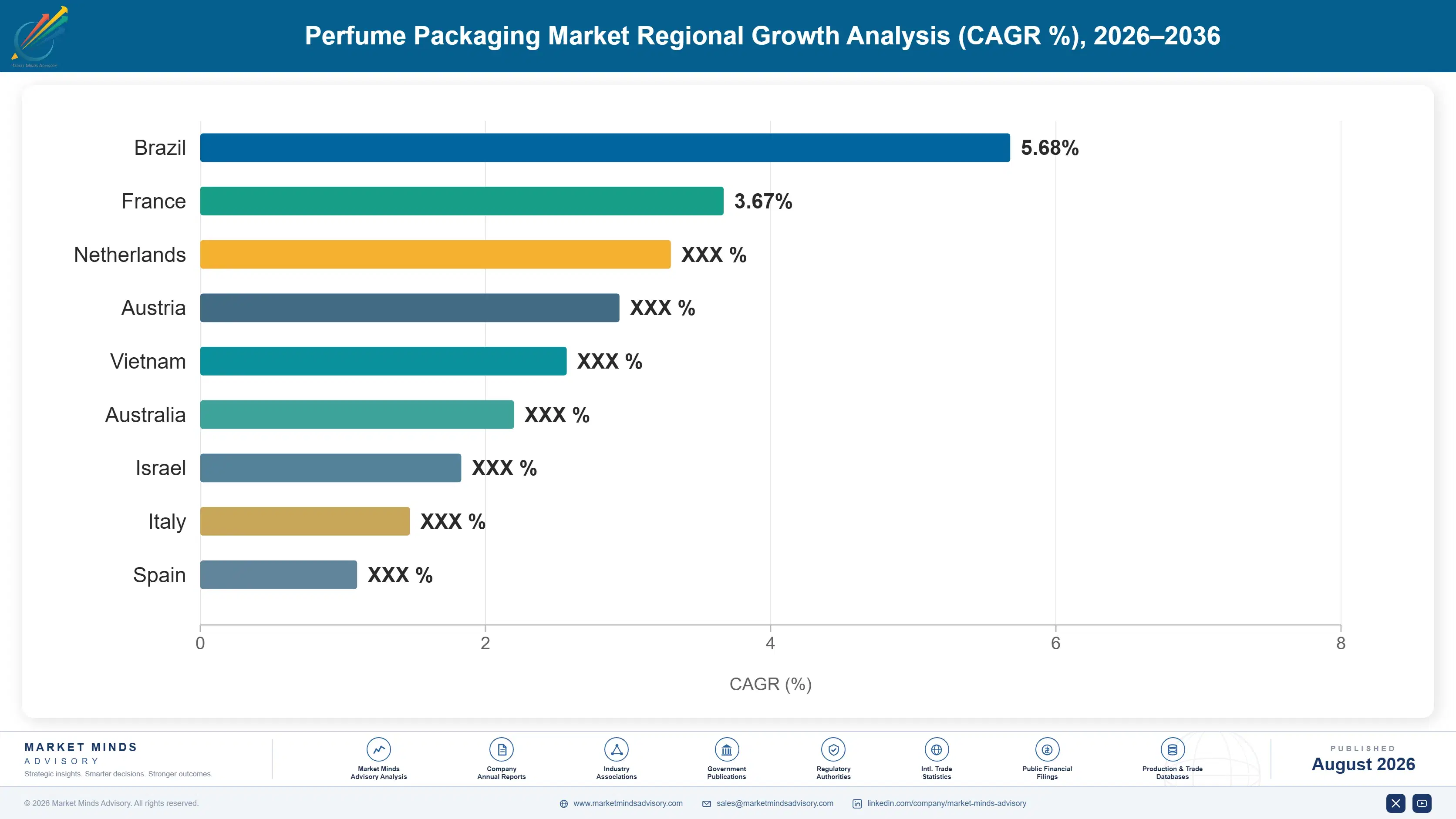
perfume-packaging-market-country-cagr-analysis-1787298963934

Where Packaging Suppliers Actually Make Money

Glass melting is close to a commodity and everybody buys soda ash and sand at similar prices. Margin comes from owning decoration rather than subcontracting it, from timing furnace capital to the rebuild cycle, from building refill architecture that sells cartridges forever, and from treating sampling as trial infrastructure. Four levers follow, and none of them is about glass.

Bring Decoration In-House From Subcontracted Workshops

Decoration carries about 44% of packaging value and most glassmakers subcontract it to specialist workshops, handing away the margin on the part customers actually pay for. Integrating lacquering, metallisation, and hot stamping lines costs roughly 12 million dollars for a plant-scale installation and captures 15 to 20 percentage points of gross margin on decorated volume. It also collapses lead time, since decoration trials no longer require shipping samples between two companies. The producers who integrated decades ago hold the strongest positions in this industry, and that is not a coincidence.
Market Impact: Captures 15 to 20 points of gross margin

Time Furnace Electrification To The Rebuild Window

Melting energy is 21% of flacon conversion cost and a furnace can only change technology at rebuild, which arrives once every twelve to fifteen years. Choosing hybrid or full electric melting at that moment locks in an energy cost position for the following decade and a half, while choosing conventional gas locks in the opposite. Rebuild capital runs into tens of millions either way, so the incremental cost of electrification is far smaller than the headline suggests. Producers who miss the window cannot revisit the decision until the next one arrives.
Market Impact: Locks a 21% cost line for 15 years

Engineer Refill Interfaces That Cannot Be Counterfeited

Refillable systems convert a single flacon sale into a flacon plus a recurring cartridge stream, and the cartridge is where the annuity lives. That annuity only holds if third-party cartridges cannot be fitted, which makes the mechanical interface a commercial asset rather than an engineering detail. Proprietary interfaces protected by design registration secure roughly 40% higher lifetime packaging value per customer than open-fit systems. Brands understand this well and increasingly specify it. Suppliers offering only generic refill mechanics are competing for the flacon sale alone and giving away the better half.
Market Impact: Secures about 40% higher lifetime value per customer

Treat Sampling Formats As Trial Infrastructure Not Promotion

Niche houses selling online cannot let a customer smell the product, so discovery sets and decant vials have become the actual sales mechanism rather than a marketing giveaway. Brands now budget sampling from trade spend rather than from promotional allowance, which changes both volume and price tolerance considerably. Tooling is largely standard, so unit economics work at volumes around 20 million units annually per format. This is the accessible growth in the category for suppliers who cannot win bespoke luxury flaconnage work, and it grows at 8.4% without any tooling risk.
Market Impact: Unit economics work above 20 million units annually

Who Controls the Margin Pool

Concentration reaches only 34% across the top five measured on annual unit production capacity, and the fragmentation sits mostly in decoration, where hundreds of small workshops handle lacquering, metallisation, and printing. The leaders are French. German, and Austrian glassmakers plus the dominant dispensing supplier. The gap to challengers is narrow on glass forming and wide on integrated decoration capability, which is where the defensible positions actually are.
Competition runs on three fronts. Decoration integration is the first and it separates the strong positions from the ordinary ones. Development speed against the sixteen-month norm is the second, since brands under launch pressure pay for compressed timelines. Refill interface engineering is the third and newest, and the dispensing specialists lead there rather than the glassmakers. Glassmakers have been slow to engineer refill mechanics themselves.

Pressure is arriving from two directions. Chinese and Indian producers have closed much of the quality gap on decorated flaconnage at considerably lower cost. And European packaging regulation will force design changes that advantage suppliers who invested early in separable and mono-material construction. Both pressures land on the same European mid-premium volume, and neither is reflected in current pricing.
perfume-packaging-market-company-positioning-matrix-1787298964481

Competitive Moat and Risk Dimensions

VERESCENCE

Moat: Integrated decoration at scale

Glass forming and full decoration capability sit inside the same company across multiple sites, which captures the 44% of value that subcontracting glassmakers hand to workshops. Integration also compresses development time because decoration trials happen without shipping samples between firms. Building comparable capability means acquiring or constructing lacquering, metallisation, and printing lines across several geographies, which takes years.
VERESCENCE

Risk: European energy cost exposure

The manufacturing base sits largely in Europe, where melting energy at 21% of conversion cost is expensive and volatile against Asian alternatives. Furnace rebuild decisions carry tens of millions and lock the position in for over a decade. Asian producers closing the quality gap attack precisely the mid-premium volume this cost base needs.
APTARGROUP

Moat: Dispensing engineering and patents

Pumps and actuators are the one component here with genuine engineering content and genuine patent protection, unlike glass and decoration which are craft rather than invention. Spray quality, dose consistency, and refill interface mechanics all depend on that engineering. Brands specify dispensing by name far more often than they specify glassmakers.
APTARGROUP

Risk: Dispensing is one component

The company supplies perhaps a fifth of pack value while glass and decoration carry the majority, capping its share of any project however strong the dispensing position. Brands increasingly want single-source pack development, which a dispensing specialist cannot offer. Refill interfaces also invite regulatory interest in interoperability.

Players Tracked

Prominent Players

Verescence
Pochet Group
Heinz-Glas
AptarGroup
Stoelzle Glass Group

Other Key Players

Saverglass
Baralan
Bormioli Luigi
Zignago Vetro
Piramal Glass
HCP Packaging
Silgan Dispensing Systems
Coverpla
Quadpack
Virospack
Albea Group
Lumson
Bruni Glass
Gerresheimer
Shandong Huapeng Glass

Recent Developments

MARCH 2025

French glassmaker commissions hybrid electric furnace at rebuild

A French luxury flaconnage producer completed a furnace rebuild using hybrid electric melting rather than conventional gas firing at one of its Normandy sites. The investment was organic capital expenditure timed to the scheduled rebuild window, and it fixes that site's energy cost profile for well over a decade.
Signal: Furnace technology chosen at rebuild sets the energy cost position for fifteen years and cannot be revisited sooner
JUNE 2025

Luxury house extends refill architecture across its core fragrance range

An international luxury brand extended refillable cartridge presentation from selected flagship fragrances to the majority of its core range, standardising a single proprietary cartridge interface across formats. The rollout was an internal product decision rather than any commercial arrangement, and it required retooling across several packaging suppliers.
Signal: A single brand standardising one cartridge interface forces every supplier in its chain to engineer against that specification
SEPTEMBER 2025

Indian producer expands decorated flaconnage capacity for domestic brands

An Indian glass packaging manufacturer widened decorated flaconnage capacity, adding lacquering and metallisation lines aimed at the formalising domestic branded fragrance market. The expansion was organic investment funded internally rather than any joint venture with an established European flaconnage producer. Capacity figures were not disclosed publicly.
Signal: Decoration capability moving to India removes the last technical reason domestic brands had to import their premium flacons

What Drives Cost in a Flacon

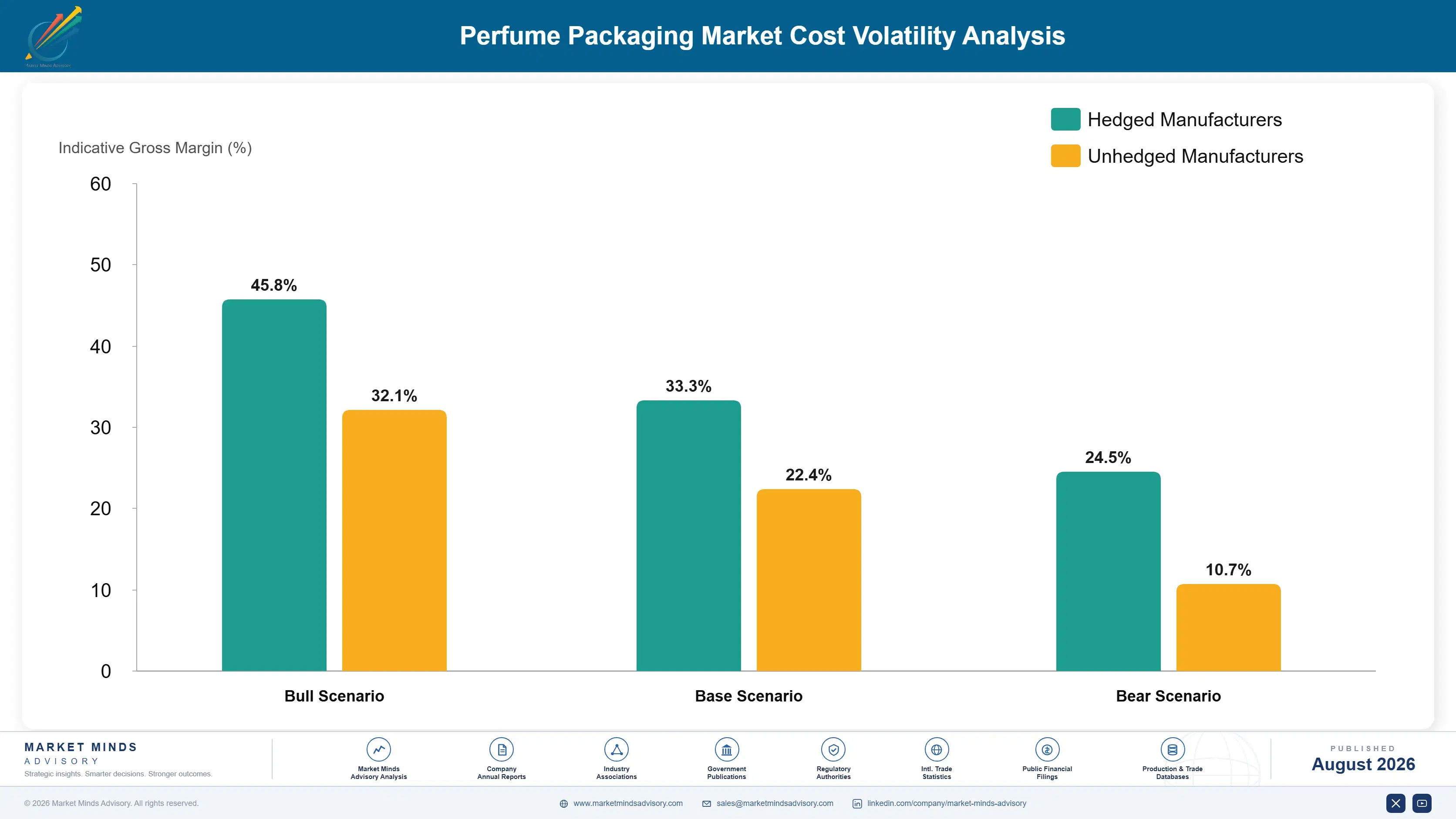
Three inputs dominate flaconnage cost. Melting energy runs about 21% of conversion cost, supplied as natural gas across most European and Asian capacity and increasingly as grid electricity in hybrid furnaces. Raw batch materials, principally silica sand, soda ash, and limestone, add a further 16% and are sourced regionally almost everywhere. Decoration consumables, meaning lacquers, metallisation targets, and inks, account for most of the remainder.
Energy was the volatility that mattered. European natural gas prices moved violently through the recent period, and IEA reporting on that market documents the scale of it clearly. For continuous glass furnaces that cannot be economically shut down and restarted, the exposure was close to unavoidable, and several European producers absorbed cost they could not pass through inside fixed-term brand contracts. Soda ash pricing also moved sharply, though from a much smaller share of the cost base.

The competitive disadvantage mechanism is geographic and generational at once. A producer running a gas furnace rebuilt five years ago carries a cost position it cannot change for another decade, while a competitor rebuilding today chooses hybrid melting and a different exposure entirely. Decoration subcontractors buying consumables in small volumes carry the worst purchasing position of anyone.
perfume-packaging-market-cost-volatility-analysis-1787298964678

Choose melting technology deliberately at each furnace rebuild

Rebuild is the only moment when melting technology can change, and it arrives roughly once every twelve to fifteen years per furnace. Treating that decision as a routine capital renewal rather than as a fifteen-year energy strategy is the most expensive mistake available in this industry. Incremental cost of hybrid melting over conventional rebuild is modest against total rebuild capital.

Contract energy across the full furnace campaign where possible

Continuous furnaces cannot be idled economically, which removes the demand flexibility that lets other industries respond to price. Long-dated energy contracts matched to the campaign length convert an unmanageable exposure into a known cost. Availability of such contracts varies considerably by market, and producers who secured them before the recent dislocation hold a cost advantage that will persist for years.

Consolidate decoration consumable purchasing across sites and partners

Lacquers, inks, and metallisation targets are bought in small quantities by hundreds of separate decoration workshops, which is precisely why nobody in this industry negotiates well on them. Consolidating purchasing across a group's own sites and its regular subcontract partners builds volume that suppliers actually respond to, and the savings land inside the highest-value part of the pack.

Portfolio Architecture for Margin Defence

Three tiers describe this market and the margin spread between them is wide because decoration content varies so much. Standard-body flacons with simple screen printing serve mass fragrance at commodity glass margins. Certified premium work, meaning bespoke moulds, multi-coat lacquer, metallisation, and tight cosmetic tolerance, sits far higher and is where the European producers earn their returns. And refillable and recyclable-designed formats occupy a third tier where regulation rather than a
The tension is that bespoke luxury work fills furnaces poorly. A niche house ordering 80,000 units cannot absorb a furnace campaign, so producers need mass and masstige volume underneath the prestige work to keep melting economics viable. Several producers who repositioned entirely toward luxury discovered their conversion cost per unit rose sharply once campaign volumes fell below efficient furnace loading. Melting economics do not care what the label says.

High-value pools concentrate where the pack itself carries brand meaning rather than merely containing liquid. Bespoke flaconnage and proprietary refill interfaces both command price the physical materials never justify. The materials in a bespoke flacon cost very little more, which is exactly the point.

Volume / Commodity-Adjacent Tier

Standard-body flacons, simple screen decoration, stock pumps, and basic folding cartons for mass fragrance and direct selling channels. Thin margin, high volume, and essential to keeping furnace campaigns efficiently loaded beneath the prestige work.
Gross Margin: 16-24%

Premium / Certified Tier

Bespoke moulded flacons with multi-coat lacquer, metallisation, hot stamping, and tight cosmetic tolerance, supplied to luxury and niche houses. Margin reflects integrated decoration capability and the sixteen-month development relationship rather than any material difference.
Gross Margin: 34-48%

Sustainability / Regulatory / Next-Generation Tier

Refillable cartridge systems, separable collars, detachable pump architecture, and mono-material designs built for European recyclability requirements. Price is justified by regulatory compliance and by cartridge annuity rather than by appearance.
Gross Margin: 38-54%
perfume-packaging-market-portfolio-architecture-1787298965186

High-value Sub-segments and Strategic Watch-out

Proprietary Refill Cartridge Systems

Best combination of margin and growth in the category, converting a single flacon sale into a recurring cartridge stream worth roughly 40% more in lifetime value wherever the interface cannot be copied. Regulatory interest in interoperability is the one thing that would undo those economics.
Gross Margin: 38-54%

Bespoke Decorated Luxury Flaconnage

Strong margin from integrated decoration and long development relationships, growing steadily on premium mix shift across every region. The wide range reflects how differently margin behaves between producers who own decoration lines and those who subcontract the work out. Development relationships here run for decades rather than contract terms.
Gross Margin: 34-48%

Standard Flacons And Stock Components

The volume core, commodity in margin terms and indispensable in operational terms, because furnace campaigns need loading that bespoke luxury runs cannot provide. Producers who abandoned this tier for prestige work found their conversion cost per unit rising sharply afterwards. Campaign loading below efficient volume raises unit cost sharply.
Gross Margin: 16-24%

Sampling And Discovery Formats

The strategic watch-out in a positive sense, growing at 8.4% on standard tooling with no bespoke risk, and now funded from trade spend rather than promotional budget. Aviation liquid volume rules constrain format design more than any commercial factor does. Tooling is standard, so there is no bespoke risk attached.
Gross Margin: 22-31%

How Fragrance Packaging Repeats

A flacon programme runs for years once launched, and that is the annuity. A successful fragrance stays on shelf for a decade or longer with the same tooling, the same decoration specification, and the same supplier, because changing any of it means requalification and a new sixteen-month cycle nobody wants. Refill cartridges add a second and faster repeating stream on top. Tooling ownership decides who captures that continuity, and it usually sits with the brand.
Adoption depth varies by brand type more than by geography. Luxury houses specify bespoke everything and hold suppliers for decades through relationship rather than contract. Niche houses want distinctiveness on small volumes, which suits standard bodies with bespoke decoration. Mass brands and direct selling houses buy stock components on price and switch readily. Gulf fragrance houses behave like luxury on ornamentation and like mass on commercial terms, which is an awkward combination for suppliers.

Buyer profiles are changing as sustainability teams join packaging decisions that marketing previously owned alone. Recyclability questions now arrive at concept stage rather than after the design is locked. Packaging briefs now carry a recyclability section that did not exist, and suppliers are being asked to answer it.
perfume-packaging-market-end-use-penetration-index-1787298965679

What We Would Tell a Board

These are among the four positions where our research anticipates prominent divergence between winners and laggards over the coming forecast period. Each is grounded in the demand model, the regulatory perimeter, and the announced capacity pipeline.
01 / DECORATION INTEGRATION STRATEGY

Own the decoration or hand away half the value

Decoration carries roughly 44% of packaging value in this category and most glassmakers subcontract it to specialist workshops, giving away the margin on the part the customer is actually buying. Integrating lacquering, metallisation, and stamping lines costs around 12 million dollars at plant scale, captures 15 to 20 percentage points of gross margin on decorated volume, and compresses development time materially at the same time. Every strong position in this industry belongs to a producer who made that decision years ago.
02 / FURNACE CAPITAL TIMING

Rebuild is a fifteen-year energy decision, not maintenance

Melting energy is 21% of flacon conversion cost and the technology can only change at rebuild, which comes once every twelve to fifteen years per furnace. Choosing conventional gas at that moment locks the cost position in for the following decade and a half with no possibility of revision, while the incremental capital for hybrid melting is modest against total rebuild cost. Boards treating a furnace rebuild as routine capital renewal are in fact making a fifteen-year energy strategy decision without realising it.
03 / REFILL INTERFACE OWNERSHIP

The cartridge annuity depends entirely on the interface

Refillable systems convert one flacon sale into a flacon plus a recurring cartridge stream, and that stream is worth roughly 40% more in lifetime packaging value where third-party cartridges cannot be fitted. The mechanical interface is therefore a commercial asset rather than an engineering detail, and design registration matters here every bit as much as tooling quality does. Suppliers offering only generic refill mechanics are competing for the one-off flacon sale while conceding the better half of the opportunity to somebody else entirely.
04 / FURNACE LOADING BALANCE

Prestige work alone will not fill a glass furnace

A niche house ordering 80,000 units cannot absorb a furnace campaign, and conversion cost per unit rises sharply the moment melting runs below efficient loading. Several producers repositioned entirely toward luxury flaconnage and then found their unit economics deteriorating despite considerably better prices per piece, which is a genuinely counterintuitive result. The pattern that works keeps mass and masstige volume underneath the prestige work to hold campaigns efficient, and boards should treat furnace loading as the binding constraint it is.

Engagement Snapshot From the Field

A live engagement with an industry participant carrying material or product regulatory and market exposure ahead of a defining policy shift, showing how our research translates into a defensible multi-year portfolio strategy.
MARKET MINDS ADVISORY · CLIENT ENGAGEMENT SUMMARY
Perfume Packaging Producer Strategic Portfolio Review and Transition Roadmap 2026·Investment Scenario on Perfume Packaging Exposure Evaluation 2025-26
CLIENT PROFILE
A European flaconnage producer with approximately 420 million dollars in annual revenue (client-reported, unverified by MMA), operating two glass plants and subcontracting nearly all decoration to regional workshops. The company had repositioned toward luxury and niche customers over four years, exiting most mass fragrance work, and was approaching a scheduled furnace rebuild at its larger site with a conventional gas replacement already specified.
STRATEGIC CHALLENGE
Gross margin had fallen despite average selling price rising by nearly a third across the repositioning, which management found difficult to explain. The board wanted an independent view before committing rebuild capital, particularly on whether the luxury repositioning had worked and whether the furnace specification was correct. Neither question had been examined independently before.
MMA APPROACH
We rebuilt conversion cost per unit across four years against furnace loading data, benchmarked decoration margin retained versus subcontracted across six comparable producers, and modelled hybrid against conventional melting over a full fifteen-year campaign at three energy price scenarios. Customer interviews across luxury and niche accounts tested willingness to pay for compressed development timelines.
KEY FINDINGS
  1. Furnace loading had fallen to roughly 68% of efficient campaign volume after exiting mass work, and rising conversion cost per unit had consumed the entire benefit of higher selling prices.
  2. Subcontracted decoration was returning around nine percentage points of margin against the twenty-two percentage points that integrated comparables retained on equivalent decorated volume.
  3. Hybrid melting showed a better outcome than conventional gas in two of three energy scenarios and broadly equivalent in the third, against an incremental capital cost of well under a fifth of total rebuild.
  4. Luxury customers valued compressed development timelines highly and several indicated willingness to pay a premium for programmes delivered inside twelve months rather than sixteen.
CLIENT PROFILE
A European flaconnage producer with approximately 420 million dollars in annual revenue (client-reported, unverified by MMA), operating two glass plants and subcontracting nearly all decoration to regional workshops. The company had repositioned toward luxury and niche customers over four years, exiting most mass fragrance work, and was approaching a scheduled furnace rebuild at its larger site with a conventional gas replacement already specified.
STRATEGIC CHALLENGE
Gross margin had fallen despite average selling price rising by nearly a third across the repositioning, which management found difficult to explain. The board wanted an independent view before committing rebuild capital, particularly on whether the luxury repositioning had worked and whether the furnace specification was correct. Neither question had been examined independently before.
MMA APPROACH
We rebuilt conversion cost per unit across four years against furnace loading data, benchmarked decoration margin retained versus subcontracted across six comparable producers, and modelled hybrid against conventional melting over a full fifteen-year campaign at three energy price scenarios. Customer interviews across luxury and niche accounts tested willingness to pay for compressed development timelines.
KEY FINDINGS
  1. Furnace loading had fallen to roughly 68% of efficient campaign volume after exiting mass work, and rising conversion cost per unit had consumed the entire benefit of higher selling prices.
  2. Subcontracted decoration was returning around nine percentage points of margin against the twenty-two percentage points that integrated comparables retained on equivalent decorated volume.
  3. Hybrid melting showed a better outcome than conventional gas in two of three energy scenarios and broadly equivalent in the third, against an incremental capital cost of well under a fifth of total rebuild.
  4. Luxury customers valued compressed development timelines highly and several indicated willingness to pay a premium for programmes delivered inside twelve months rather than sixteen.
RECOMMENDED STRATEGY
Phase 1: Phase 1 (months one to six): revise the furnace rebuild specification to hybrid melting, and reopen selective masstige volume to restore campaign loading. Phase 2: Phase 2 (months six to twenty-four): acquire or build lacquering and metallisation capacity at the larger site to retain decoration margin internally. Phase 3: Phase 3 (months twenty-four to thirty-six): market a compressed twelve-month development programme to luxury accounts at premium pricing, supported by integrated decoration capability.
OUTCOME
The board revised the rebuild specification and approved decoration integration. Furnace loading recovered above 80% within four quarters as masstige volume returned, and gross margin improved materially despite a lower average selling price (client-reported, unverified by MMA), with the first integrated decoration line commissioning ahead of schedule.

Frequently Asked Questions

Foundational context covering the market sizes, CAGR, scope, country, region and competition that inform every finding below. This section is provided to cover basics and most often pre-purchase conversations, answered from the MMA Primary Research Dataset.

What is the current size of the Perfume Packaging Market?

The market is valued at USD 6.4 billion in 2025, rising to USD 6.80 billion in 2026. Decoration accounts for roughly 44% of that value.

How large will the Perfume Packaging Market be by 2036?

MMA forecasts USD 12.40 billion by 2036, an increase of USD 5.60 billion over the 2026 base. That represents an expansion multiple of 1.82 times.

What is the CAGR for the Perfume Packaging Market 2026 to 2036?

The base case CAGR is 6.2%, with a bull case of 7.4% and a bear case of 5.0%. The historical rate from 2020 to 2025 was 5.2%.

Which segment is growing fastest?

Refillable bottle and cartridge systems at 9.3%, exactly 1.50 times the market rate. They convert a single flacon sale into a recurring cartridge stream rather than replacing it.

Who are the major companies in the Perfume Packaging Market?

Verescence, Pochet Group, Heinz-Glas, AptarGroup, and Stoelzle Glass Group lead on annual unit production capacity. The top five together hold only 34% of the market.

Which country is growing fastest?

India at 10.6%, driven by a fragrance market formalising from unbranded attar into branded presentations that require proper flaconnage. Domestic decoration capacity has expanded to serve it.

Report Segmentation Architecture

The full report scope spans multiple orthogonal segmentation dimensions, with cross-tabulated demand data provided for each dimension pair. Coverage extends further to regional breakdowns, trend trajectories, and the competitive detail needed to support segment-level decision-making.

By Packaging Component

  • Glass Flacons And Bottles
  • Pumps, Actuators And Dispensing Systems
  • Caps, Collars And Closures
  • Refillable Bottle And Cartridge Systems
  • Secondary Cartons And Rigid Boxes
  • Sampling And Travel Format Packaging

By End-Use Industry

  • Luxury And Designer Fragrance Houses
  • Niche And Artisanal Perfumery
  • Mass And Masstige Fragrance Brands
  • Direct Selling And Catalogue Channels
  • Regional Oud And Attar Houses

By Commercial Model

  • Bespoke Tooled Development Programmes
  • Standard Body With Custom Decoration
  • Stock Component Catalogue Supply
  • Contract Decoration And Finishing Services

By Region

  • Western Europe
  • Middle East and Africa
  • East Asia
  • North America
  • South Asia and Pacific
  • Latin America
  • Eastern Europe

Scope, Methodology, and Coverage

Every figure in this report is reproducible from documented input assumptions. The scope below maps the historical period, the forecast horizon, the segmentation dimensions, and the countries covered, alongside the underlying primary and qualitative methodology.
Historical Period
2020 to 2025
Forecast Period
2026 to 2036
Base Year
2025 (USD billions; MMA Primary Research Dataset, August 2026)
Market Definition
This market comprises primary and secondary packaging components supplied to fragrance products, measured at packaging supplier realised prices inclusive of applied decoration and finishing. Component coverage spans glass flacons, dispensing pumps and actuators, caps, collars and closures, refillable bottle and cartridge systems, secondary cartons and rigid boxes, and sampling and travel formats. Fragrance concentrate and alcohol, contract filling and assembly services, retail display fixtures and testers, and packaging supplied to personal care categories outside fragrance fall outside scope.
Quantitative Units
USD billions (current prices); million units shipped; packaging cost as share of retail price
Segmentation Dimensions
By Packaging Component; By End-Use Industry; By Commercial Model; By Region
Regions Covered
Western Europe, Middle East and Africa, East Asia, North America, South Asia and Pacific, Latin America, Eastern Europe
Countries Covered
France, Italy, Germany, Spain, UK, Austria, Switzerland, Netherlands, Poland, Turkey, Saudi Arabia, UAE, Kuwait, Qatar, Egypt, South Africa, USA, Canada, Mexico, Brazil, Argentina, China, Japan, South Korea, India, Indonesia, Thailand, Australia, Vietnam, and additional markets relevant to this sector
Key Companies Profiled
Verescence, Pochet Group, Heinz-Glas, AptarGroup, Stoelzle Glass Group, Saverglass, Baralan, Bormioli Luigi, Zignago Vetro, Piramal Glass, HCP Packaging, Silgan Dispensing Systems, Coverpla, Quadpack, Virospack, Albea Group, Lumson, Bruni Glass, Gerresheimer, Shandong Huapeng Glass
Quantitative Methodology
Primary survey, n=3,800 respondents, Q4 2025, six countries; demand-side model with trade association cross-validation
Qualitative Methodology
47 expert interviews, Q4 2025; applied to validate demand model assumptions, identify emerging dynamics, and assess competitive positioning
Report Format
PDF and XLSX data workbook (Word format preview document)
Publisher
Market Minds Advisory
Report Code
MMA-2026-PAC-217
Published
August 2026
Contact
sales@marketmindsadvisory.com | www.marketmindsadvisory.com

Purchase the full Perfume Packaging Market Report (2026 to 2036).

The full report sizes perfume packaging across six components, five end-use brand types, four commercial models, and seven regions, with country detail for the twenty largest national markets. It separates decoration value from base component value throughout, since the two behave entirely differently on margin and on regulatory exposure. Furnace rebuild schedules and melting technology choices are tracked by producer and by site across the European and Asian capacity base. Competitive profiling covers twenty companies on annual unit production capacity. Refill interface architecture is compared across the major proprietary systems now in market.
Decoration value separated from base component value throughout
Furnace rebuild schedule and melting technology by site
Refill interface architecture compared across proprietary systems
Recyclability assessment against European design requirements by construction
Development lead time benchmarking across twelve leading suppliers
Gulf and Indian ornamentation specification requirements documented in detail

Built For The People Who Decide

From boardroom strategy to bench-side execution, this report is read cover-to-cover by leaders shaping the next decade of their industry, turning demand scenarios, market dynamics and valuation benchmarks into decisions.
CXOs/ Presidents/ VPs/ Managers
M&A and Corporate Development
Strategy Teams and R&D Heads
Procurement and Product Directors
Regulatory and Compliance Leaders
Investor Relations and Equity Analysts