Market Minds Advisory
Pelvic Floor Diagnostics Market

Pelvic Floor Diagnostics Market: The Trial That Narrowed Urodynamics, Silence, and Standardisation

A randomised trial showed that the field's flagship test did not change outcomes in its commonest indication, and the market has been living with that finding ever since it appeared.

Lead Analyst

Alice Ballenger

Published

September 2026

Make Smarter Decisions with Customized Research Insights

Request a free sample report and evaluate market opportunities, growth trends, and competitive dynamics relevant to your business needs.

2025 MARKET VALUE$0.4BMarket Size 2025
2036 FORECAST VALUE$0.8BBase Case , 2026 to 2036
CAGR 2026 TO 20365.8 %Bull 7.0% / Bear 4.6%
INCREMENTAL OPPORTUNITY$0.3BNet 10- year value creation
EXPANSION MULTIPLE1.74x2036 value over 2026 base
Strategic Levers
M&A Pipeline
Regional Outlook
Country Rankings
Competitive Intelligence
Segmental Deep-dive
Call-Us : 91 93563 13602

Executive Snapshot and Market Trajectory

A randomised trial found that pre-operative urodynamics did not improve outcomes in women with uncomplicated stress incontinence compared with office evaluation alone. Guidelines narrowed accordingly, and the field's flagship modality retreated to complex cases. Only about 34% of investigations now alter the treatment plan already intended.
High-resolution anorectal manometry compounds at 8.7%, a full 1.50x the market rate, because standardised interpretation criteria published in 2020 gave a modality that previously produced uncomparable results a common language. East Asia holds the largest share at 28%, since Chinese maternity hospitals screen and treat post-partum pelvic floor dysfunction at a scale no Western health system has ever attempted. Equipment demand there skews toward assessment rather than urodynamics.
Concentration is moderate at 58%, and the binding constraint is neither equipment nor evidence. Roughly 62% of affected people never present at all, because incontinence and prolapse are still widely regarded as an unavoidable consequence of childbirth and ageing rather than as treatable conditions. No improvement in diagnostic technology addresses that, which makes the field's largest available growth a conversation rather than a device. Mesh restriction meanwhile pushed treatment toward conservative pathways needing different assessment.
Market Definition
This market covers devices, consumables and tools used to assess pelvic floor function and dysfunction, spanning urodynamic testing systems, high-resolution anorectal manometry systems, pelvic floor electromyography and biofeedback assessment devices, pelvic floor imaging systems, single-use catheters, probes and consumables, and digital symptom assessment and bladder diary tools, measured at manufacturer revenue. Therapeutic devices including neuromodulation and pessaries, surgical mesh and implants, continence care absorbent products, general radiology equipment, and clinic service revenue are excluded.
Base Year Value
$0.4B in 2025 (MMA Primary Research Dataset, August 2026)
Forecast Period
2026 to 2036, eleven discrete annual values
CAGR
5.8% base case. Bull 7.0%. Bear 4.6%.
Fastest Growth Segment
High-Resolution Anorectal Manometry Systems: 8.7% CAGR
Fastest Growth Country
China: 9.6% CAGR
Fastest Growth Region
South Asia and Pacific: 7.8% CAGR
Largest Region
East Asia: 28% of 2025 global value
Market Leaders
Laborie, Medtronic, Diversatek Healthcare, Albyn Medical, and Andromeda Medizinische Systeme. Source: MMA Primary Research Dataset, July 2026.
Primary Survey
n=3,800 procurement and R&D decision-makers, Q4 2025, six countries
Methodology
Demand-side build-up, cross-validated against public data, 47 expert interviews

Pelvic Floor Diagnostics Market Forecast Scenarios

pelvic-floor-diagnostics-market-size-forecast-scenario-1787305778524
Growth ran near 4.8% from 2020 to 2025 as two separate contractions worked through the field. Urodynamic study volumes in uncomplicated stress incontinence had already fallen after randomised evidence showed the test did not change outcomes, and guidelines followed. Then transvaginal mesh restrictions removed a surgical pathway across many countries, which redirected treatment toward conservative management and changed what assessment those patients actually needed.
Base case growth of 5.8% rests on three mechanisms. Anorectal manometry expands as standardised interpretation criteria make results comparable between centres for the first time. Single-use catheters and probes convert from reusable equivalents on infection control and reprocessing cost grounds. And Chinese post-partum pelvic floor screening programmes continue extending across maternity hospitals, generating assessment volume on a scale no other health system produces. None of the three depends on the others arriving first.
The bull case at 7.0% assumes presentation rates rise materially as public awareness campaigns and remote symptom tools reduce the reticence that keeps roughly 62% of affected people out of clinics entirely. The bear case at 4.6% is further evidentiary narrowing: additional trials find limited management change from testing in more indications, guidelines contract further, and reimbursement follows them downward across developed markets.

Pelvic Floor Testing: Evidence, Silence and Standards

Most diagnostic markets are shaped by what a test can detect. This one was reshaped by what a test failed to change. A randomised trial comparing pre-operative urodynamics against office evaluation in women with uncomplicated stress incontinence found no outcome difference, and guidelines subsequently narrowed the indication considerably. The modality retreated toward neurogenic bladder, revision surgery, male post-prostatectomy incontinence and complex mixed symptoms, where it genuinely does al
TOP FIVE CONCENTRATION58%Concentrated after consolidation across urodynamics and motility testing specialists
UNDIAGNOSED PREVALENCE SHARE62%Affected people who never present for assessment or treatment anywhere
URODYNAMIC STUDY COSTUSD 640Typical reimbursed cost of a complete multichannel study in hospital
SINGLE-USE CATHETER SHARE54%Assessment catheters and probes discarded after a single patient study
TRAINED TECHNICIAN VACANCY19%Unfilled specialist positions across centres offering functional testing services
STUDIES CHANGING MANAGEMENT34%Investigations whose findings alter the treatment plan already intended
That contraction happened alongside another. Transvaginal mesh for prolapse was restricted or withdrawn across many countries after serious complications, which removed a surgical pathway and pushed treatment toward pelvic floor muscle training and conservative care. Those patients need functional assessment and biofeedback rather than pressure-flow studies, so the mix shifted alongside the volume. Roughly 34% of studies now change the management already intended.
The genuine constraint sits outside the clinic entirely. Around 62% of people with pelvic floor dysfunction never present, because leakage after childbirth and in later life is still understood as normal rather than treatable. No improvement in diagnostic technology addresses that, and the field's largest available growth is not a better test but a conversation that most affected people have never had with anybody.
"You can buy the best urodynamics system in the world and it will not find the six people in ten who never walk through the door. This is a market limited by embarrassment, and no manufacturer has ever known what to do about that."
Principal Analyst, Urology and Functional Diagnostics Practice · MMA Medical Dev

Market Trends

Standardised interpretation makes manometry results finally comparable

High-resolution anorectal manometry produced results that varied so much between centres and equipment types that comparison was effectively impossible, which limited both clinical confidence and research use. Consensus interpretation criteria published in 2020 gave the modality a common classification language for the first time. The segment compounds at 8.7% on that standardisation rather than on any hardware advance, and water-perfused systems are being displaced by solid-state high-resolution catheters throughout. Gastroenterology rather than urology purchases this equipment, which means a different clinical audience and different congresses from the urodynamics business most manufacturers in this field were originally built around entirely.
Market Impact: China compounding at 9.6% annually
Single-use catheters displace reprocessed assessment consumables

Assessment catheters and probes enter the bladder, rectum and vagina, and reprocessing them properly costs more than most centres had ever calculated once tracking, cleaning validation and labour are all counted. Single-use versions now account for 54% of consumables used, and the conversion follows the same arithmetic that moved airway and endoscopy devices. That shift converts a capital-led business into one where recurring consumable revenue tracks study volume directly rather than equipment replacement. Sterile services departments costing reprocessing properly drove the conversion more effectively than infection control policy managed. Airway and endoscopy devices followed the same pattern.
Market Impact: Restrictions across 6 major markets

Market Opportunities and Growth Drivers

Chinese post-partum screening operates at unmatched national scale

Chinese maternity hospitals routinely screen post-partum women for pelvic floor dysfunction and refer them into rehabilitation programmes, which is a systematic approach no Western health system has attempted at comparable scale. China compounds at 9.6% as that model extends across provincial and county facilities. Equipment demand follows directly, weighted toward electromyography, biofeedback and assessment rather than the urodynamic testing that dominates Western procurement patterns. Domestic manufacturers including Longest and Vishee supply much of that demand directly at prices international suppliers cannot approach, and they are beginning to export the same equipment elsewhere.
Market Impact: Only 34% change management

Conservative management pathways require functional assessment instead

Transvaginal mesh restriction removed a surgical route for prolapse across many countries, and treatment shifted toward pelvic floor muscle training, physiotherapy and pessary management. Those pathways need electromyography, biofeedback and muscle function assessment rather than pressure-flow studies, so demand moved between modalities rather than disappearing. Physiotherapy-led services have expanded considerably as a result, and they purchase assessment equipment on entirely different criteria from urology departments. Physiotherapy-led continence services have expanded considerably as a result, and they purchase assessment equipment on ease of use and price rather than on clinical specification, which most manufacturers here were never organised to sell against.
Market Impact: Roughly 62% never present

Market Restraints and Challenges

Randomised evidence narrowed the flagship modality's indication

A trial comparing pre-operative urodynamics with office evaluation in uncomplicated stress incontinence found no outcome difference, and guidelines narrowed the indication considerably afterwards. The root cause is that the test measured physiology that did not alter the surgical decision in straightforward cases. Commercial impact removed routine volume from the field's highest-value study, with only 34% of investigations now changing intended management. Participants responded by concentrating on complex, neurogenic and male indications where the test genuinely does inform treatment. Reimbursement followed the guidelines downward across developed markets. Complex work is what remains.
Market Impact: Compounding at 8.7% each year

Most affected people never present for assessment at all

Roughly 62% of people with pelvic floor dysfunction never seek help, because urinary leakage after childbirth and in later life is widely understood as an unavoidable consequence rather than a treatable condition. The root cause is social rather than clinical, and no diagnostic improvement addresses it. Commercial impact is an addressable population a fraction of the prevalent one. Participants support awareness campaigns, remote symptom capture tools and primary care case-finding, none of which any single manufacturer can fund alone. The addressable population is a fraction of the prevalent one. Awareness work exceeds any manufacturer.
Market Impact: Single-use reaching 54% of consumab
3 additional market trends, 4 additional growth drivers, and 2 additional restraints and challenges are covered in the full report. Contact sales@marketmindsadvisory.com to access the complete intelligence.

Segment CAGR and Growth Architecture

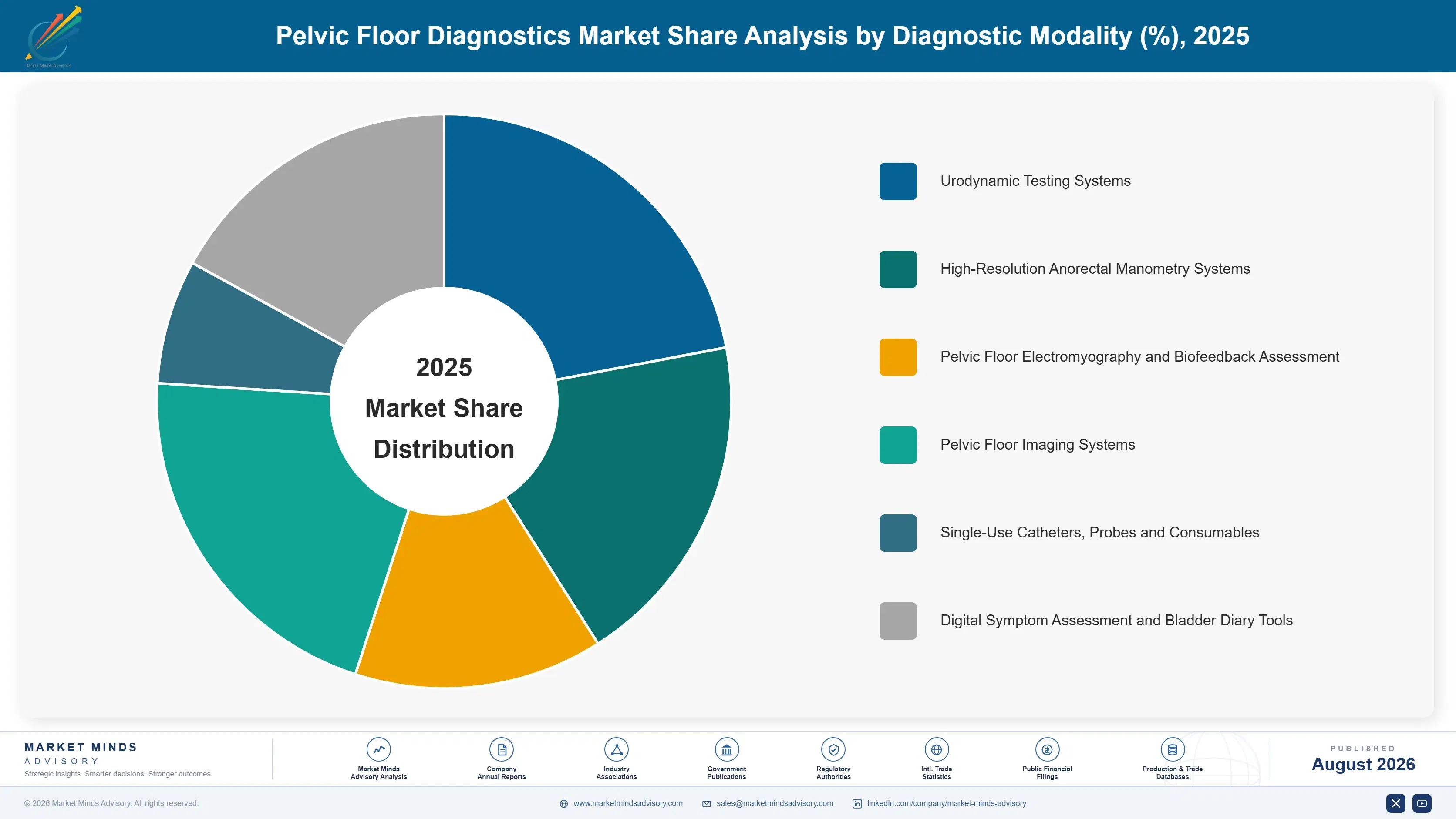
Segmentation follows diagnostic modality, because modality determines the physiology measured, the clinical question answered, the specialist required to perform it and whether revenue arrives as capital or as recurring consumable consumption. Six modalities cover pelvic floor assessment supply without overlap. Care setting and patient population cut across every modality and are treated as use attributes.
pelvic-floor-diagnostics-market-market-share-analysis-1787305779056

High-Resolution Anorectal Manometry Systems

Growing at 8.7%, a full 1.50x the market rate, high-resolution anorectal manometry measures pressure across closely spaced sensors rather than at a few points, which produces a spatial picture of sphincter and rectal function that water-perfused systems could never generate. The decisive change was interpretive rather than technical: consensus classification criteria published in 2020 made results comparable between centres for the first time and gave clinicians confidence that a report meant the same thing everywhere. Faecal incontinence and defaecatory disorder assessment drive demand, and gastroenterology purchases this equipment rather than urology. Interpretation software applying those criteria consistently now matters more to a purchasing decision than the pressure measurement hardware underneath it does.
CAGR 8.7%

Single-Use Catheters, Probes and Consumables

Single-use consumables grow at 7.6% and already account for 54% of assessment catheters and probes in use, converting from reusable equivalents on the same reprocessing arithmetic that moved airway and endoscopy devices before them. These items enter the bladder, rectum and vagina, and reprocessing them properly costs more than most centres had ever calculated once tracking, validated cleaning and labour were counted. Commercially the shift matters more than the clinical argument, because it converts a capital business into one where revenue tracks study volume rather than equipment replacement cycles. Architecture decided at system design determines whether a placement earns that revenue, and open systems accepting third-party consumables surrendered it permanently.
CAGR 7.6%
Full segment breakdown across 6 segments available in the complete report.

Regional Architecture and Country Demand Map

Regional value follows how health systems have chosen to organise pelvic floor care rather than underlying prevalence, which varies far less between populations than assessment volume does. How care is organised explains far more of the pattern below than underlying disease prevalence ever could. Prevalence varies remarkably little.

East Asia

East Asia holds the largest share at 28% because China organises pelvic floor care in a way no Western system does. Maternity hospitals routinely screen post-partum women and refer them into rehabilitation, generating volume at national scale rather than through individual presentation. China compounds at 9.6% as the model extends into provincial and county facilities. Equipment demand skews toward electromyography, biofeedback and muscle assessment rather than urodynamics, and domestic manufacturers including Longest and Vishee supply much of it directly at prices international suppliers cannot approach. Regional assessment volume exceeds any Western health system's by a wide margin, and the equipment mix reflects a screening model rather than a referral one.
Share: 28% | CAGR: 7.0% (2026 to 2036)

North America

Twenty-six per cent of value, growing at 5.0%. Urodynamics volumes contracted after randomised evidence narrowed the indication, and reimbursement followed guidelines downward, which removed routine pre-operative testing from a very large population of uncomplicated cases. What remains is complex, neurogenic, revision and male post-prostatectomy work where the study genuinely alters management. Anorectal manometry has grown within gastroenterology on standardised interpretation. Specialist technician vacancies near 19% leave several centres holding equipment they cannot fully staff. Gastroenterology purchases manometry through channels entirely separate from urology procurement, which several manufacturers built around hospital urology have found difficult to reach at all. Reimbursement followed guidelines downward, which removed routine testing volume permanently. Complex referrals sustain the remaining volume.
Share: 26% | CAGR: 5.0% (2026 to 2036)
Regional intelligence for 5 additional markets available in the complete report: Western Europe, South Asia and Pacific, Latin America, Middle East and Africa, Eastern Europe. Contact sales@marketmindsadvisory.com.
pelvic-floor-diagnostics-market-country-cagr-analysis-1787305779574

Where Pelvic Floor Testing Value Sits

Evidence narrowed the flagship study, most affected people never present, and trained technicians are scarce. Value therefore accrues to recurring consumables rather than capital, to the modality that standardisation has just made credible, and to assessment that non-specialists can actually perform. Capital placement alone predicts very little now. Recurring revenue is the whole question.

Convert the business from capital to consumable

Single-use catheters and probes already account for 54% of consumables in use, and that conversion ties revenue to study volume rather than to equipment replacement cycles that stretch across many years in a constrained-budget specialty. The reprocessing arithmetic drove the shift more effectively than infection control policy did, because sterile services departments cost it properly. Manufacturers whose systems accept third-party consumables surrendered that recurring revenue permanently, and no installed base has been reclaimed afterwards. Recovering that position from an installed base has proved impossible everywhere. It is a design decision rather than a commercial one.
Market Impact: Single-use already covers 54% of ev

Follow standardisation directly into anorectal manometry

Consensus interpretation criteria published in 2020 made high-resolution manometry results comparable between centres for the first time, which is what turns a modality from a research curiosity into a routine clinical test. The segment compounds at 8.7% on that alone. Gastroenterology rather than urology purchases this equipment, which means a different clinical audience, different congresses and different key opinion leaders from the urodynamics business most manufacturers in this field were built around. Interpretation software applying those criteria decides purchases more than hardware does. Hardware differentiation across this field has largely converged.
Market Impact: Manometry is now growing at 8.7% ev

Design assessment that a non-specialist can perform

Specialist technician vacancies run near 19% and full urodynamic studies require training that few centres can maintain, which leaves equipment underused rather than unbought. Simplified assessment protocols, guided workflows and biofeedback systems that a physiotherapist or nurse can operate reach settings where a dedicated technician will never exist. Physiotherapy-led continence services purchase on entirely different criteria from hospital urology, and manufacturers built for the latter frequently cannot sell to the former. Equipment nobody can staff earns nothing at all regardless of capability. Physiotherapy services buy on entirely different criteria. Most manufacturers cannot sell to them.
Market Impact: Technician vacancy rates are now ru

Support case-finding rather than better testing

Roughly 62% of people with pelvic floor dysfunction never present, which caps the addressable population far below prevalence and cannot be improved by any technical advance whatsoever. Remote symptom capture, digital bladder diaries and primary care case-finding tools each reach people before a clinic visit. No single manufacturer can fund the awareness work required, but those supporting professional bodies and primary care pathways influence the flow of patients that every participant then competes for. Professional bodies and primary care pathways are the practical route. Every participant then competes for the patients that flow through.
Market Impact: Reaches the 62% who never present a

Who Controls the Margin Pool

Concentration is moderate at 58% across the top five, measured on annual revenue from pelvic floor assessment systems, consumables and digital tools, the single basis applied throughout this analysis. Laborie leads following sustained acquisition across urodynamics, manometry and consumables, with Medtronic holding gastrointestinal motility positions and Diversatek, Albyn Medical and Andromeda occupying specialist positions built over many years.
Competition runs on three dimensions with different buyers. Urodynamics competes on system capability and technician workflow within hospital urology, in a shrinking indication where guidelines set the boundaries. Anorectal manometry competes within gastroenterology on interpretation software and catheter performance. Assessment and biofeedback equipment competes in physiotherapy-led services on ease of use and price, against buyers most manufacturers in this field were never organised to reach.

Pressure builds from two directions. Chinese domestic manufacturers supply the post-partum screening programmes that generate the largest single block of assessment volume anywhere, at prices international suppliers cannot approach, and they are beginning to export. Separately, evidentiary narrowing continues to threaten urodynamics volumes. Rankings shift most where a manufacturer holds closed consumable architecture across a growing installed base rather than relying on capital sales.
pelvic-floor-diagnostics-market-company-positioning-matrix-1787305780086

Competitive Moat and Risk Dimensions

LABORIE

Moat: Consolidated modality and consumable breadth

Sustained acquisition across urodynamics, anorectal manometry and assessment consumables gives Laborie a portfolio spanning nearly every modality a functional testing service uses, which lets it supply a whole department rather than one machine. Proprietary consumable architecture across that installed base converts placements into recurring revenue tied to study volume rather than equipment replacement.
LABORIE

Risk: Urodynamics indication contraction

The largest part of the portfolio sits in a modality whose indication randomised evidence narrowed considerably, with only 34% of studies now changing intended management. Chinese manufacturers supply the fastest-growing assessment volume anywhere at prices the company cannot match. Physiotherapy-led buyers purchase on criteria the hospital sales organisation is not built for.
MEDTRONIC

Moat: Gastrointestinal motility channel access

An established gastroenterology commercial organisation reaches the specialty that actually purchases anorectal manometry, which is the fastest growing modality in this field and a different clinical audience from the urology departments most competitors were built around. Breadth across the wider gastrointestinal portfolio supports bundled purchasing that specialist manufacturers cannot offer.
MEDTRONIC

Risk: Limited urology functional presence

Position in urodynamics and pelvic floor assessment outside gastrointestinal motility is modest, which leaves the company absent from most of the department a functional testing service actually equips. Specialist competitors hold deeper interpretive software and catheter capability. Functional diagnostics is small relative to the wider portfolio and competes internally for investment attention.

Players Tracked

Prominent Players

Laborie
Medtronic
Diversatek Healthcare
Albyn Medical
Andromeda Medizinische Systeme

Other Key Players

SRS Medical
Menfis Biomedica
Tic Medizintechnik
Schippers-Medizintechnik
Verathon
Natus Medical
THD
Coloplast
Wellspect HealthCare
Neomedic International
Aymed Medical Technology
Guangzhou Longest Science and Technology
Nanjing Vishee Medical
Sanro Electromedicina
Dantec Dynamics

Recent Developments

APRIL 2025

Standardised manometry classification drives protocol adoption across centres

Gastroenterology services widened adoption of consensus anorectal manometry classification criteria published in 2020, an organic clinical standardisation making results comparable between centres and equipment types for the first time in the modality's history. Interpretation software applying those criteria became a purchasing criterion. Water-perfused systems continued being displaced.
Signal: Interpretive standardisation rather than a
SEPTEMBER 2025

Single-use assessment consumables pass reprocessed volumes in major markets

Single-use catheters and probes exceeded reprocessed equivalents across several developed markets, an organic conversion driven by sterile services departments costing reprocessing properly rather than by any change in infection control regulation. Reprocessing cost more than most centres had calculated. Tracking and validated cleaning carried most of that cost.
Signal: The department that costed reprocessing pr
JANUARY 2026

Chinese post-partum screening equipment demand extends into county facilities

Chinese post-partum pelvic floor screening and rehabilitation programmes extended further into provincial and county maternity facilities, an organic public health expansion generating assessment equipment demand at a scale no other health system produces. Domestic manufacturers supplied most of that demand. Assessment rather than urodynamic equipment carried the volume.
Signal: One country's care model now generates mor

Sensor, Catheter and Software Cost Exposure

Cost structures differ sharply between capital and consumable lines. Pressure sensors, transducers and precision catheter extrusion account for roughly 41% of consumable cost of goods, with solid-state high-resolution catheters carrying considerably higher sensor content than water-perfused alternatives. Electronics, amplifiers and display hardware dominate system cost. Interpretation and reporting software carries development and regulatory cost that sits outside cost of goods entirely and incr
Medical polymer and specialist sensor supply tightened materially through 2021 and 2022 as several resin producers withdrew from medical applications and semiconductor allocation favoured larger buyers, and functional diagnostics volumes command no priority in either supply chain. Manufacturer annual reports across the period documented extended lead times and material requalification work. Small specialist manufacturers in this field were affected considerably more severely than diversified competitors with broader purchasing scale.

Exposure varies most by product line rather than by scale. Consumable-weighted businesses carry catheter and sensor cost on every study performed, while capital-weighted businesses carry electronics cost once per placement and then very little. Geography compounds it: Chinese manufacturers supplying domestic screening programmes operate at component and assembly costs European specialist manufacturers cannot approach, and those cost positions are beginning to travel into export markets.
pelvic-floor-diagnostics-market-cost-volatility-analysis-1787305780281

Integrate catheter and sensor manufacture rather than buying assemblies

Sensors and precision catheter extrusion represent the largest input in the consumable line that now carries recurring revenue, and buying finished assemblies carries supplier margin into every study performed. Internal manufacture converts that into process cost and permits design variation that purchased assemblies do not allow. It also protects the closed architecture that makes the consumable business defensible.

Qualify alternate medical polymer grades well before disruption

Several resin producers exited medical applications on liability grounds, and small specialist manufacturers in this field discovered the dependency only when supply stopped arriving. Qualifying alternate grades during ordinary conditions costs validation and regulatory filing work rather than any capital. The exposure is easy to overlook because these materials had been inexpensive and reliably available for decades beforehand.

Treat interpretation software as the competitive investment

Standardised classification criteria made manometry results comparable, and the software that applies those criteria consistently is what clinicians actually judge a system by rather than the hardware measuring pressure. Development and regulatory cost sits outside cost of goods and increasingly determines which system a department selects. Hardware differentiation in this field has largely converged.

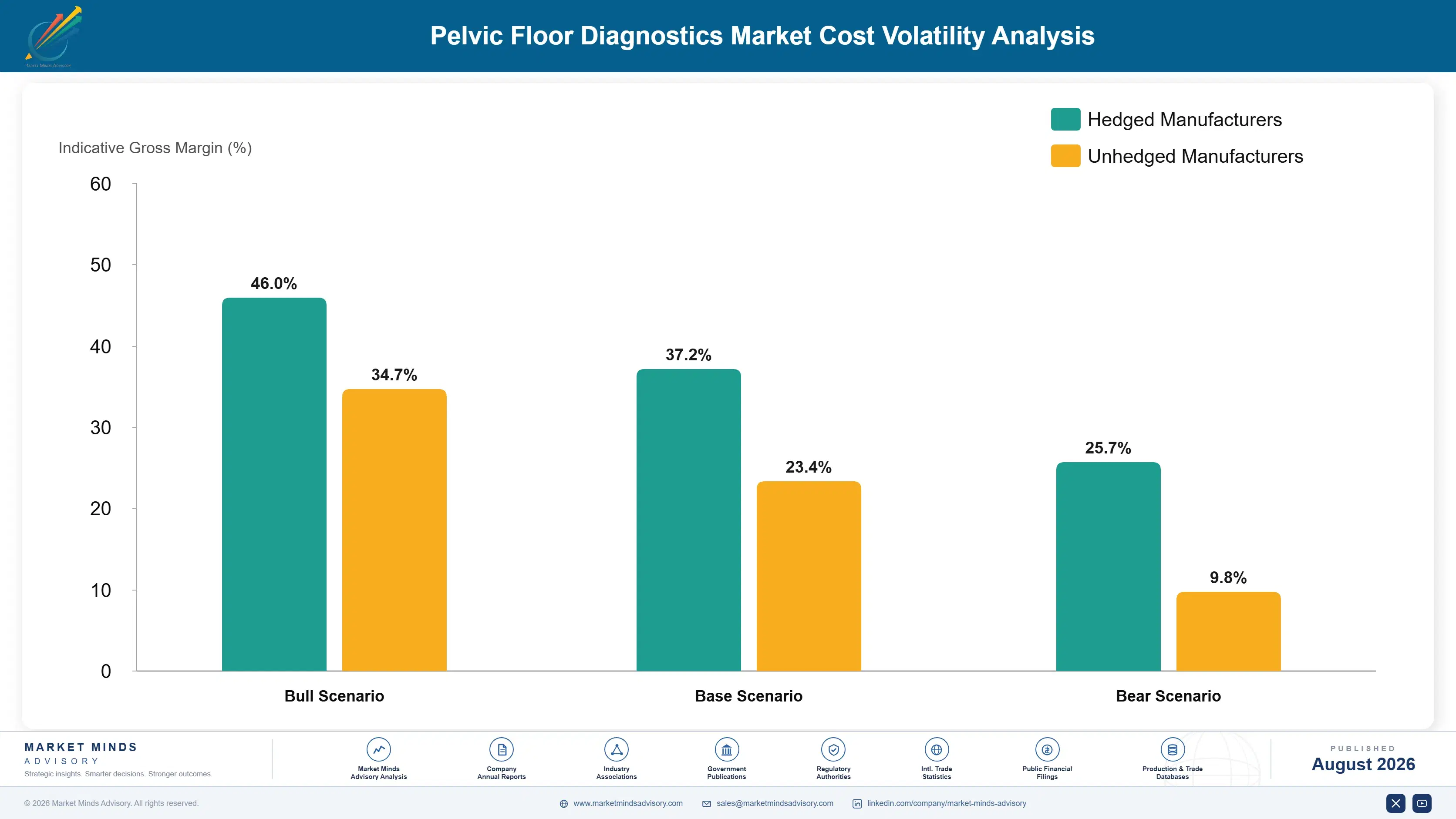
Portfolio Architecture for Margin Defence

Margin architecture separates on whether revenue recurs with each study. Capital systems sold into departments with constrained budgets and long replacement cycles earn respectable margins on infrequent transactions, and public procurement compresses those further. Proprietary single-use consumables tied to an installed base earn considerably better and arrive with every patient assessed. Interpretation software licensed alongside hardware earns best, because clinicians increasingly judge system
The volume against premium tension runs along care setting. Hospital urology and gastroenterology purchase complete systems at high prices for relatively few studies each, and those departments face contracting or standardising indications respectively. Physiotherapy-led continence services and Chinese screening programmes generate far more assessment volume at much lower equipment prices. Serving both requires two commercial organisations, and most manufacturers in this field have only ever had one.

High-value pools concentrate around consumables, software and the modality standardisation has just legitimised. Proprietary catheters tied to installed systems, interpretation software applying consensus classification, and anorectal manometry within gastroenterology all command pricing that capital hardware does not. Urodynamic systems sold into a narrowed indication, whatever their capability, face guidelines that removed their routine use case and reimbursement that followed.

Volume / Commodity-Adjacent Tier

Assessment and biofeedback equipment sold into physiotherapy services and screening programmes, where Chinese manufacturers compete effectively on price and clinical differentiation carries limited weight with buyers. Ease of use decides these purchases.
Gross Margin: 34-46%

Premium / Certified Tier

Complete urodynamic and manometry systems sold into hospital departments, protected by technician familiarity, integration with existing reporting workflows and replacement cycles that stretch across many years. Indications are narrowing in one and standardising in the other.
Gross Margin: 52-64%

Sustainability / Regulatory / Next-Generation Tier

Proprietary single-use catheters and probes tied to installed systems, together with interpretation software applying consensus classification criteria, commanding premium because neither can be readily substituted. Architecture decided at design protects both.
Gross Margin: 66-80%
pelvic-floor-diagnostics-market-portfolio-architecture-1787305780781

High-value Sub-segments and Strategic Watch-out

Proprietary Single-Use Consumables

Already 54% of assessment catheters and probes in use, converting revenue from capital replacement cycles to per-study consumption. Architecture decided at system design determines whether a placement earns that revenue or none at all. Reprocessing arithmetic drove the conversion. Recovery afterwards has proved impossible. Design settles it.
Gross Margin: 66-80%

Standardised Manometry Systems

Fastest growth at 8.7% following consensus classification criteria that made results comparable between centres for the first time. Gastroenterology rather than urology purchases this equipment, which is a different audience entirely. Interpretation software decides the purchase. Hardware differentiation has largely converged across suppliers. Software decides purchases.
Gross Margin: 52-64%

Physiotherapy Assessment Equipment

The volume core outside hospitals, serving conservative care pathways that mesh restriction expanded considerably. Chinese manufacturers compete effectively here and buyers purchase on ease of use and price rather than clinical specification. Volumes here exceed hospital urology considerably. Conservative care pathways expanded this considerably after mesh restriction.
Gross Margin: 34-46%

Urodynamics Indication Narrowing

The strategic watch-out rather than a growth line. Randomised evidence removed routine pre-operative testing from uncomplicated cases and only 34% of studies now change intended management, with reimbursement following guidelines downward. Complex and neurogenic work is what remains. Reimbursement followed the guidelines downward across developed markets.
Gross Margin: n/a

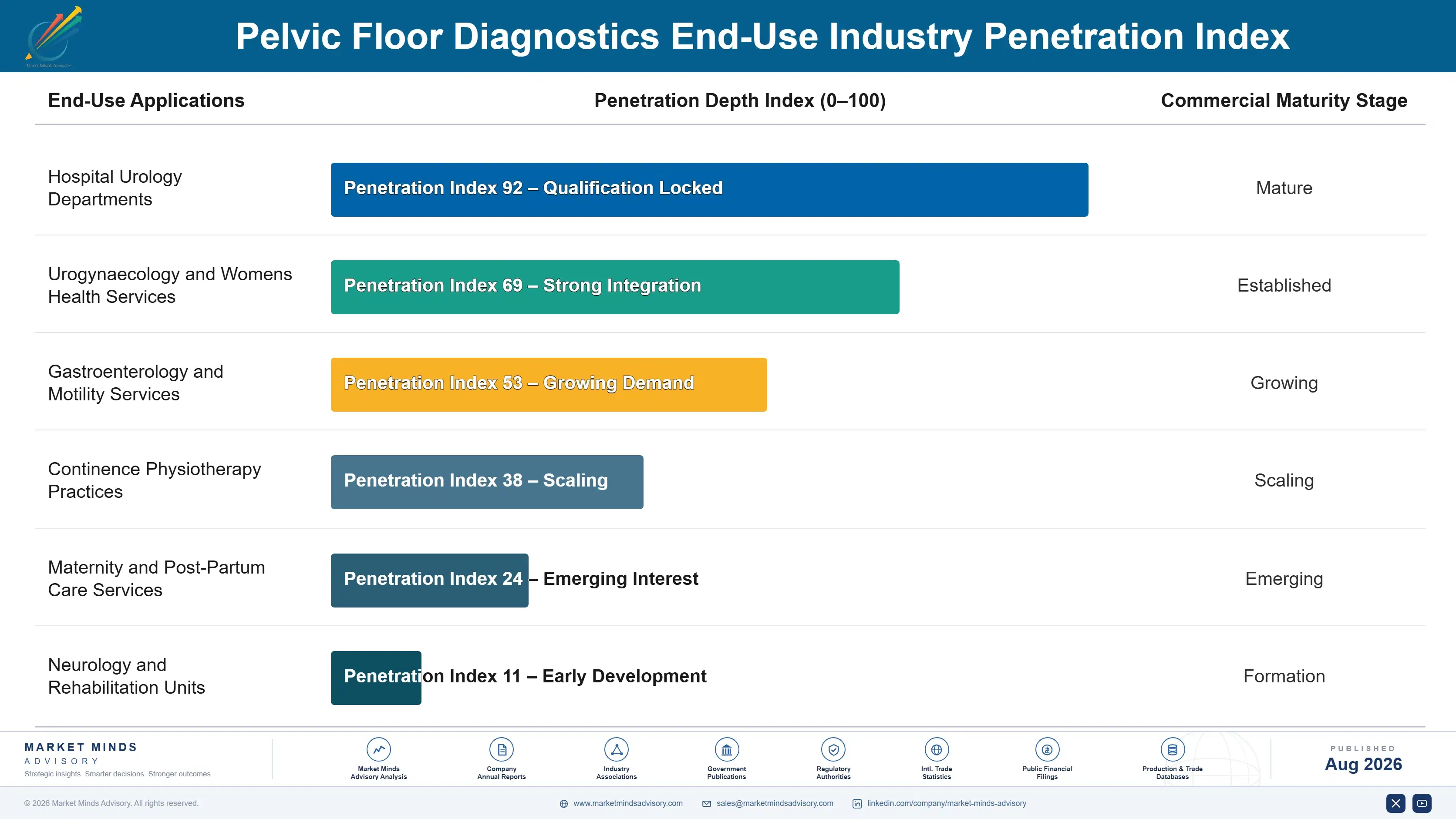
Study-Linked Consumption and Referral Gates

Demand now tracks studies performed rather than equipment purchased, which is a recent change in this field. Every assessment consumes a catheter, probe or electrode set, and 54% of those are discarded afterwards, so revenue follows clinical activity directly. Capital systems are replaced on cycles stretching many years in a specialty where budgets are genuinely constrained, which makes placement volume a poor predictor of anything.
Depth of use varies sharply by referral pathway rather than by equipment availability. Tertiary urology centres receiving complex, neurogenic and revision referrals perform studies that genuinely change management and use the full modality range. General urology and gynaecology services perform far fewer since guidelines narrowed the indication. Physiotherapy-led continence services assess very large numbers of patients using simpler equipment, and they represent the fastest-growing volume in most developed markets.

Purchasing profiles have broadened well beyond the traditional buyer. Hospital urology departments once made nearly every decision in this field. Gastroenterology now purchases anorectal manometry on its own criteria, physiotherapy services buy assessment and biofeedback equipment on ease of use and price, and Chinese maternity hospitals procure screening equipment through entirely separate channels. Few manufacturers reach more than two of those four buyers competently.
pelvic-floor-diagnostics-market-end-use-penetration-index-1787305781269

Where Pelvic Floor Testing Strategy Lands

These are among the four positions where our research anticipates prominent divergence between winners and laggards over the coming forecast period. Each is grounded in the demand model, the regulatory perimeter, and the announced capacity pipeline.
01 / CONSUMABLE CONVERSION PRIORITY

Capital sales cannot carry a constrained-budget specialty

Single-use catheters and probes already account for 54% of assessment consumables in use, and that conversion ties revenue directly to the studies performed rather than to equipment replacement cycles stretching across many years in a genuinely budget-constrained specialty. Sterile services departments that costed reprocessing properly drove the shift far more effectively than any infection control policy ever managed to. Manufacturers whose systems accept third-party consumables surrendered that recurring revenue permanently, and no installed base anywhere has ever been reclaimed afterwards.
02 / STANDARDISATION FOLLOWING PRIORITY

Interpretation criteria did what hardware never could

High-resolution anorectal manometry produced results that varied so widely between centres and equipment types that clinical comparison was effectively impossible, which limited the modality to research and specialist use for years. Consensus classification criteria published in 2020 gave it a common language, and the segment compounds at 8.7% on that interpretive change alone. Gastroenterology rather than urology purchases this particular equipment, which means an entirely different clinical audience from the one that most manufacturers in this field were originally built around.
03 / PRESENTATION GAP REALITY

Six in ten never walk through the door

Roughly 62% of people with pelvic floor dysfunction never present for assessment, because urinary leakage after childbirth and in later life remains widely understood as an unavoidable consequence rather than a treatable clinical condition. No improvement in diagnostic technology addresses that particular constraint in any way at all. The field's largest available growth is therefore a conversation that most affected people have never had with anybody at all, and no single manufacturer can fund the awareness work required to change it.
04 / NON-SPECIALIST ACCESS DESIGN

Equipment nobody can staff earns nothing at all

Specialist technician vacancies run near 19% and complete urodynamic studies demand training that comparatively few centres can realistically maintain, which leaves already placed equipment underused rather than simply unbought at all. Simplified protocols, guided workflows and biofeedback systems operable by a physiotherapist or a nurse reach settings where any dedicated technician will never realistically exist at all. Physiotherapy-led continence services purchase on entirely different criteria again, and manufacturers built for hospital urology departments frequently cannot sell to them at all.

Engagement Snapshot From the Field

A live engagement with an industry participant carrying material or product regulatory and market exposure ahead of a defining policy shift, showing how our research translates into a defensible multi-year portfolio strategy.
MARKET MINDS ADVISORY · CLIENT ENGAGEMENT SUMMARY
Pelvic Floor Diagnostics Producer Strategic Portfolio Review and Transition Roadmap 2026·Investment Scenario on Pelvic Floor Diagnostics Exposure Evaluation 2025-26
CLIENT PROFILE
A functional diagnostics manufacturer with an established urodynamics system range, an open consumable architecture and no anorectal manometry product. Annual revenue was approximately USD 46 million (client-reported, unverified by MMA), concentrated in hospital urology departments across European and Latin American markets where guideline narrowing had reduced study volumes considerably. Third-party catheters had displaced its own across the installed base.
STRATEGIC CHALLENGE
Urodynamic study volumes had fallen as guidelines narrowed the indication following randomised evidence, while the open consumable architecture meant the installed base generated almost no recurring revenue and hospitals bought third-party catheters. The board needed to decide whether to defend urodynamics, enter anorectal manometry within gastroenterology, or pursue the physiotherapy-led assessment market instead.
MMA APPROACH
MMA conducted 47 expert interviews spanning urologists, urogynaecologists, gastroenterologists, continence physiotherapists, urodynamics technicians, sterile services managers and hospital procurement leads across six countries. A quantitative survey of 3,800 respondents established referral behaviour, presentation rates, equipment purchasing criteria and consumable switching. We then modelled revenue and margin outcomes under defence, manometry entry and physiotherapy channel strategies against observed study volume data.
KEY FINDINGS
  1. Urologists in five of six markets reported performing urodynamics only in complex, neurogenic, revision or male cases, and none had returned to routine pre-operative testing since guidelines narrowed.
  2. Hospitals with open consumable architecture had qualified third-party catheters in nearly every surveyed case, eliminating recurring revenue from the entire installed base.
  3. Gastroenterologists reported growing anorectal manometry use following the standardised classification, and they purchased that equipment entirely through channels separate from urology procurement.
  4. Continence physiotherapists assessed far more patients than urology departments did, and bought equipment on ease of use and price rather than on any clinical specification.
CLIENT PROFILE
A functional diagnostics manufacturer with an established urodynamics system range, an open consumable architecture and no anorectal manometry product. Annual revenue was approximately USD 46 million (client-reported, unverified by MMA), concentrated in hospital urology departments across European and Latin American markets where guideline narrowing had reduced study volumes considerably. Third-party catheters had displaced its own across the installed base.
STRATEGIC CHALLENGE
Urodynamic study volumes had fallen as guidelines narrowed the indication following randomised evidence, while the open consumable architecture meant the installed base generated almost no recurring revenue and hospitals bought third-party catheters. The board needed to decide whether to defend urodynamics, enter anorectal manometry within gastroenterology, or pursue the physiotherapy-led assessment market instead.
MMA APPROACH
MMA conducted 47 expert interviews spanning urologists, urogynaecologists, gastroenterologists, continence physiotherapists, urodynamics technicians, sterile services managers and hospital procurement leads across six countries. A quantitative survey of 3,800 respondents established referral behaviour, presentation rates, equipment purchasing criteria and consumable switching. We then modelled revenue and margin outcomes under defence, manometry entry and physiotherapy channel strategies against observed study volume data.
KEY FINDINGS
  1. Urologists in five of six markets reported performing urodynamics only in complex, neurogenic, revision or male cases, and none had returned to routine pre-operative testing since guidelines narrowed.
  2. Hospitals with open consumable architecture had qualified third-party catheters in nearly every surveyed case, eliminating recurring revenue from the entire installed base.
  3. Gastroenterologists reported growing anorectal manometry use following the standardised classification, and they purchased that equipment entirely through channels separate from urology procurement.
  4. Continence physiotherapists assessed far more patients than urology departments did, and bought equipment on ease of use and price rather than on any clinical specification.
RECOMMENDED STRATEGY
Phase 1: Phase one: close consumable architecture on the next system generation, since recurring revenue is decided at design and cannot be recovered from an installed base afterwards. Phase 2: Phase two: enter anorectal manometry through a gastroenterology channel, following the standardisation that has made the modality routine rather than defending a narrowing one. Phase 3: Phase three: develop simplified assessment equipment for physiotherapy-led services, which assess far more patients and buy on entirely different criteria.
OUTCOME
The client closed consumable architecture on its next system, licensed a manometry platform and launched a simplified physiotherapy assessment device (client-reported, unverified by MMA). Consumable revenue on new placements reached a meaningful share within eighteen months, manometry entered two gastroenterology accounts, and the physiotherapy line exceeded its first-year plan.

Frequently Asked Questions

Foundational context covering the market sizes, CAGR, scope, country, region and competition that inform every finding below. This section is provided to cover basics and most often pre-purchase conversations, answered from the MMA Primary Research Dataset.

What is the current size of the Pelvic Floor Diagnostics Market?

The global pelvic floor diagnostics market was valued at USD 0.44 billion in 2025, spanning urodynamics, anorectal manometry, electromyography, imaging, consumables and digital assessment tools. Roughly 62% of affected people never present for assessment at all.

How large will the Pelvic Floor Diagnostics Market be by 2036?

MMA forecasts the market at USD 0.82 billion by 2036, expanding 1.74 times from the 2026 base of USD 0.47 billion. That represents roughly USD 0.35 billion of incremental value across the forecast decade.

What is the CAGR for the Pelvic Floor Diagnostics Market 2026 to 2036?

The base case compound annual growth rate is 5.8%, with a bull case of 7.0% and a bear case of 4.6%. The bull case assumes presentation rates rise as awareness campaigns and remote symptom tools reduce reticence.

Which segment is growing fastest?

High-resolution anorectal manometry grows at 8.7%, a full 1.50x the overall market rate. Consensus interpretation criteria published in 2020 made results comparable between centres for the first time.

Who are the major companies in the Pelvic Floor Diagnostics Market?

Laborie, Medtronic, Diversatek Healthcare, Albyn Medical and Andromeda together hold 58% of revenue. Laborie leads following sustained consolidation across urodynamics, manometry and assessment consumable product lines.

Which country is growing fastest?

China grows fastest at 9.6%, as post-partum pelvic floor screening extends across provincial and county maternity facilities. East Asia is the largest region at 28% of value on that programme alone.

Report Segmentation Architecture

The full report scope spans multiple orthogonal segmentation dimensions, with cross-tabulated demand data provided for each dimension pair. Coverage extends further to regional breakdowns, trend trajectories, and the competitive detail needed to support segment-level decision-making.

By Diagnostic Modality

  • Urodynamic Testing Systems
  • High-Resolution Anorectal Manometry Systems
  • Pelvic Floor Electromyography and Biofeedback Assessment
  • Pelvic Floor Imaging Systems
  • Single-Use Catheters, Probes and Consumables
  • Digital Symptom Assessment and Bladder Diary Tools

By End-Use Industry

  • Hospital Urology Departments
  • Urogynaecology and Womens Health Services
  • Gastroenterology and Motility Services
  • Continence Physiotherapy Practices
  • Maternity and Post-Partum Care Services
  • Neurology and Rehabilitation Units

By Commercial Dimension

  • Hospital Capital Equipment Purchase
  • Proprietary Consumable Supply Agreements
  • Public Tender and Framework Procurement
  • Distributor and Dealer Channel Supply
  • Software Licensing and Reporting Subscriptions
  • Training and Accreditation Programme Bundles

By Region

  • East Asia
  • North America
  • Western Europe
  • South Asia and Pacific
  • Latin America
  • Middle East and Africa
  • Eastern Europe

Scope, Methodology, and Coverage

Every figure in this report is reproducible from documented input assumptions. The scope below maps the historical period, the forecast horizon, the segmentation dimensions, and the countries covered, alongside the underlying primary and qualitative methodology.
Historical Period
2020 to 2025
Forecast Period
2026 to 2036
Base Year
2025 (USD billions; MMA Primary Research Dataset, August 2026)
Market Definition
This market comprises devices, consumables and digital tools used to assess pelvic floor function and dysfunction, measured at manufacturer revenue across hospital capital purchase, proprietary consumable supply agreements, public tender procurement, distributor channels, software licensing and training programme bundles. Coverage spans multichannel urodynamic testing systems including uroflowmetry, cystometry, pressure-flow and video-urodynamic configurations, high-resolution and conventional anorectal manometry systems, pelvic floor electromyography and biofeedback assessment devices, dedicated pelvic floor imaging systems including endoanal and perineal ultrasound, single-use and reusable catheters, probes and electrode consumables, and digital symptom assessment, questionnaire and bladder diary tools. Therapeutic devices including sacral and tibial neuromodulation, electrical stimulation for treatment, pessaries and surgical mesh or implants, continence care absorbent products and catheters for drainage, general radiology and magnetic resonance equipment used incidentally for defecography, and clinic procedure or service fee revenue fall outside scope.
Quantitative Units
USD millions (current prices); studies performed by modality; systems placed; consumables consumed per study; study cost; single-use conversion share; technician availability
Segmentation Dimensions
By Diagnostic Modality; By End-Use Industry; By Commercial Dimension; By Region
Regions Covered
East Asia, North America, Western Europe, South Asia and Pacific, Latin America, Middle East and Africa, Eastern Europe
Countries Covered
China, Japan, South Korea, Taiwan, United States, Canada, Mexico, Germany, France, United Kingdom, Italy, Spain, Netherlands, Sweden, Belgium, India, Australia, Thailand, Indonesia, Singapore, Brazil, Argentina, Colombia, Chile, Saudi Arabia, United Arab Emirates, Israel, South Africa, Poland, Czechia, Hungary, and additional markets relevant to functional diagnostics analysis
Key Companies Profiled
Laborie, Medtronic, Diversatek Healthcare, Albyn Medical, Andromeda Medizinische Systeme, SRS Medical, Menfis Biomedica, Tic Medizintechnik, Schippers-Medizintechnik, Verathon, Natus Medical, THD, Coloplast, Wellspect HealthCare, Neomedic International, Aymed Medical Technology, Guangzhou Longest Science and Technology, Nanjing Vishee Medical, Sanro Electromedicina, Dantec Dynamics
Quantitative Methodology
Primary survey, n=3,800 respondents, Q4 2025, six countries; demand-side model with trade association cross-validation
Qualitative Methodology
47 expert interviews, Q4 2025; applied to validate demand model assumptions, identify emerging dynamics, and assess competitive positioning
Report Format
PDF and XLSX data workbook (Word format preview document)
Publisher
Market Minds Advisory
Report Code
MMA-2026-MED-381
Published
August 2026
Contact
sales@marketmindsadvisory.com | www.marketmindsadvisory.com

Purchase the full Pelvic Floor Diagnostics Market Report (2026 to 2036).

The full MMA report examines a diagnostic market reshaped by evidence that narrowed its flagship modality, quantifying where assessment demand moved as a result. It sizes six modalities and seven regions to 2036, modelling studies performed, systems placed, consumable consumption per study, single-use conversion and technician availability separately so that recurring revenue can be assessed against capital placement. Competitive assessment covers twenty manufacturers on one consistent revenue basis. Cost exposure is traced through sensor, catheter and software inputs. Four commercial levers and a strategic verdict close the report, grounded in 47 expert interviews and a 3,800-respondent survey.
Six diagnostic modalities sized separately through 2036
Guideline narrowing modelled against urodynamic study volume decline
Single-use consumable conversion tracked by region and setting
Twenty manufacturers assessed on one consistent revenue basis
Presentation rates quantified against underlying condition prevalence
Anonymised client engagement with tested strategic recommendations

Built For The People Who Decide

From boardroom strategy to bench-side execution, this report is read cover-to-cover by leaders shaping the next decade of their industry, turning demand scenarios, market dynamics and valuation benchmarks into decisions.
CXOs/ Presidents/ VPs/ Managers
M&A and Corporate Development
Strategy Teams and R&D Heads
Procurement and Product Directors
Regulatory and Compliance Leaders
Investor Relations and Equity Analysts