

Market Minds Advisory
Peel off Face Mask Market

Peel off Face Mask Market: Peel off Face Mask Market. Premiumization and K-Beauty Innovation Drive Category Expansion

Rising premiumization toward collagen and hydrogel formulations, expanding K-beauty innovation leadership, and growing brightening ingredient adoption are reshaping peel-off mask purchasing across mass, prestige, and direct-to-consumer retail channels. each season.

Lead Analyst

Published

September 2026

Make Smarter Decisions with Customized Research Insights

Request a free sample report and evaluate market opportunities, growth trends, and competitive dynamics relevant to your business needs.

2025 MARKET VALUE$2.6BMarket Size 2025
2036 FORECAST VALUE$6.4BBase Case , 2026 to 2036
CAGR 2026 TO 20368.5 %Bull 9.8% / Bear 7.2%
INCREMENTAL OPPORTUNITY$3.6BNet 10- year value creation
EXPANSION MULTIPLE2.26x2036 value over 2026 base
Strategic Levers
M&A Pipeline
Regional Outlook
Country Rankings
Competitive Intelligence
Segmental Deep-dive
Call-Us : 91 93563 13602

Executive Snapshot and Market Trajectory.

Collagen and hydrogel peel-off masks are reshaping the market fastest right now, propelled by premiumization trends spreading from broader anti-aging skincare into a category historically dominated by basic charcoal formulations. Manufacturers are responding by launching dedicated collagen and hydrogel lines that command meaningfully higher price points than basic charcoal formulations.
Commercial momentum concentrates around K-beauty innovation leadership, direct-to-consumer brand growth, and rising brightening ingredient adoption, with East Asia and North America together anchoring the largest share of global purchasing across nearly every retail channel tracked this year. Retailers report the strongest growth within premium ingredient tiers rather than basic blackhead-removal formulations favored by earlier generations of shoppers. Subscription and repeat purchase behavior increasingly favors brands offering visible ingredient differentiation over generic charcoal claims.
The competitive field spans mass-market conglomerate brands and independent Korean formulation specialists, with ingredient innovation increasingly separating brands more than blackhead-removal marketing claims alone within an increasingly crowded category. Independent Korean brands slower to build strong global distribution risk losing visibility to established conglomerates. These smaller brands move faster on trend-driven formulations, though they lack the global distribution scale mass conglomerates possess.
Market Definition
The Peel off Face Mask Market covers charcoal, clay, collagen, and hydrogel facial mask formulations that harden and peel away from the skin. It excludes sheet masks, wash-off masks, and overnight leave-on mask formulations.
Base Year Value
$2.6B in 2025 (MMA Primary Research Dataset, September 2026)
Forecast Period
2026 to 2036, eleven discrete annual values
CAGR
8.5% base case. Bull 9.8%. Bear 7.2%.
Fastest Growth Segment
Collagen and Hydrogel Peel-Off Masks: 13.0% CAGR
Fastest Growth Country
India: 10.5% CAGR
Fastest Growth Region
South Asia and Pacific: 10.5% CAGR
Largest Region
East Asia: 30% of 2025 global value
Market Leaders
Biore, GlamGlow, L'Oreal Paris, Freeman Beauty, and Innisfree lead the global competitive field. Source: MMA Analysis, company annual reports and investor filings, 2025.
Primary Survey
n=3,800 procurement and R&D decision-makers, Q4 2025, six countries
Methodology
Demand-side build-up, cross-validated against public data, 47 expert interviews

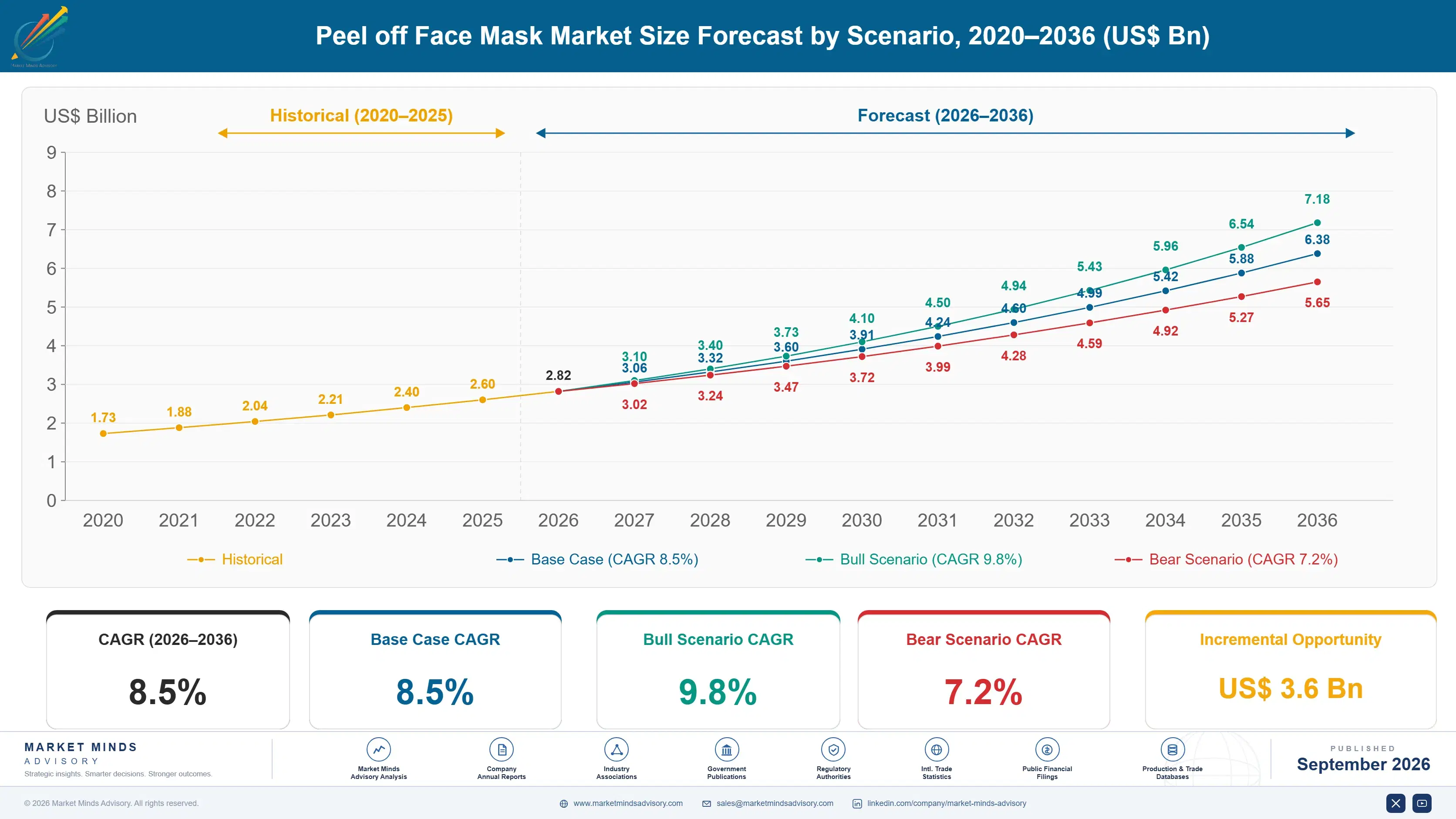
Peel off Face Mask Market Forecast Scenarios

peel-off-face-mask-market-size-forecast-scenario-1790021026102
Between 2020 and 2025, the market grew at an estimated 7.5 percent annually, a period shaped by K-beauty content driven discovery that introduced peel-off masks to a much broader global consumer base than earlier niche wellness positioning ever reached. Independent Korean brands captured disproportionate share as social media reviews substituted for traditional advertising among younger consumers discovering the category.
The base case assumes 8.5 percent annual growth through 2036, driven by three commercial mechanisms: expanding collagen and hydrogel formulation adoption, rising direct-to-consumer brand competition within K-beauty positioning, and growing mass-tier incorporation of brightening and anti-aging active ingredients beyond niche charcoal-only formulations. Mass-market conglomerates are responding by launching dedicated premium collagen and hydrogel product lines, though independent Korean brands retain a meaningful formulation credibility advantage among consumers who value original K-beauty innovation and ingredient sourcing.
The bull case, at 9.8 percent, assumes accelerated premiumization and faster K-beauty international expansion. The bear case, at 7.2 percent, assumes consumer skepticism toward unsubstantiated blackhead-removal claims persists, limiting growth to core charcoal and clay segments alone. Currency and input cost volatility could also meaningfully affect realized growth in either direction depending on how manufacturers manage pricing across regional retail channels over the coming decade.

Ingredient Innovation Redefines Category Value

Manufacturing remains concentrated in South Korea and China, which together supply the majority of formulation and packaging output even as final branding happens closer to end markets. Several brands have begun qualifying secondary formulation partners in Vietnam and Indonesia to reduce single-country dependency, though specialized collagen and hydrogel ingredient sourcing remains heavily concentrated regardless of final packaging location chosen. Tariff exposure on imported cosmetic ingredients remains a meaningful cost consideration for brands sourcing internationally across multiple regions.
MARKET CONCENTRATION26% CR5Fragmented field spread across conglomerate and independent Korean brands
AVERAGE SELLING PRICE$9.00Blended price across mass and premium formulation tiers combined
TOP PRODUCING COUNTRYSouth Korea 24%Leads global formulation innovation and manufacturing output categories
DIRECT-TO-CONSUMER PENETRATION31%Share of sales flowing through owned online brand channels
REPLACEMENT CYCLE LENGTH2 monthsAverage time between routine consumer replacement purchases occurring
RAW MATERIAL COST SHARE29% of COGSCharcoal, collagen, and hydrogel active ingredient costs combined
Direct-to-consumer channels continue expanding steadily, particularly among independent Korean brands whose social media driven customer acquisition strategies bypass traditional beauty retail entirely in many cases. Traditional beauty retailers are responding by expanding dedicated K-beauty and premium ingredient sections to compete directly with these digitally native challenger brands for younger, ingredient-conscious shoppers.
Replacement cycle length reflects genuinely frequent household repurchase behavior, since masks are consumed with regular skincare routine use rather than replaced on a fashion or seasonal cycle basis. Manufacturers increasingly publish recommended application frequency guidance based on skin sensitivity testing, helping consumers understand realistic usage timelines for active ingredient formulations. This usage guidance approach is becoming an increasingly common industry practice across most major brands and product categories.
"Peel-off masks used to mean one charcoal formula and a satisfying video moment. The brands winning now are the ones that turned that novelty into an actual skincare routine step."
Director, Cosmetics and Personal Care Practice · MMA Charcoal Practice · September 2026

Market Trends

Collagen and Hydrogel Formulations Gain Premium Ground

Peel-off masks formulated with collagen, hyaluronic acid, and hydrogel bases are capturing share from traditional charcoal formulations, as consumers increasingly expect peel-off masks to deliver genuine anti-aging and hydration benefits rather than simple blackhead extraction and satisfying peel sensation alone. Korean formulation specialists led this shift, prompting mass-market conglomerates to launch competing premium lines within the past two years. Retailers report premium collagen and hydrogel mask sales climbing meaningfully faster than the category average across most tracked markets, with continued growth expected as formulation innovation accelerates further. Adoption continues broadening across most demographic segments.
Market Impact: Expands addressable base by 18 percent

Social Media Content Sustains K-Beauty Discovery

Short-form video content demonstrating peel-off mask application and reveal moments continues driving category discovery among younger consumers who might not otherwise encounter these products through traditional beauty retail browsing or advertising channels entirely. Brands with strong social media followings report meaningfully lower customer acquisition costs than competitors relying primarily on paid advertising, since organic content generates sustained discovery well beyond any single campaign's initial reach. This discovery channel also supports genuine product education, helping consumers understand realistic expectations for active ingredient formulations. Retailers report growing awareness of these products among consumers who first discovered them through short-form video content.
Market Impact: Raises brand trial 22 percent

Market Opportunities and Growth Drivers

Rising Skincare Routine Complexity Expands Demand

Growing consumer adoption of multi-step skincare routines across most developed markets is expanding demand for peel-off masks as a dedicated routine step rather than an occasional novelty treatment reserved for special occasions or specific skin concerns. Younger consumers in particular increasingly treat peel-off masks as a regular part of their weekly skincare regimen, driven by social media education about ingredient benefits and application techniques previously unfamiliar to mainstream users. Retailers report meaningfully higher basket sizes among consumers purchasing peel-off masks alongside other skincare routine products in the same transaction. today.
Market Impact: Limits frequent use among 16 percent

K-Beauty Cultural Influence Sustains Global Demand

Sustained global cultural influence of Korean beauty standards and skincare philosophy continues driving demand for peel-off masks associated with K-beauty formulation credibility, even among consumers who might not otherwise seek out Korean beauty products specifically for other skincare categories. Brands successfully positioning products with authentic Korean formulation heritage report meaningfully stronger trial rates than competitors lacking this credibility, since consumers increasingly associate peel-off mask innovation specifically with Korean research and development investment. This cultural association supports premium pricing that generic formulations struggle to command. Retailers report growing consumer awareness of this Korean formulation heritage driving purchase decisions considerably.
Market Impact: Raises input costs by 14 percent

Market Restraints and Challenges

Skin Irritation Concerns Limit Frequent Application

Peel-off masks, particularly charcoal and clay formulations designed for strong adhesion, can cause skin irritation and micro-tearing for a meaningful share of users with sensitive skin, limiting how frequently dermatologists recommend application beyond occasional treatment use. The root cause traces to the mechanical peeling action itself, since removing a hardened film inevitably pulls at surface skin cells regardless of how gentle the underlying formulation ingredients themselves may be. Manufacturers are responding by developing gentler hydrogel and gel-based alternatives that deliver similar benefits without the mechanical peeling action causing irritation. today.
Market Impact: Lifts segment growth to 13.0 percent

Collagen Ingredient Cost Volatility Pressures Margins

Collagen and hydrogel active ingredient prices have experienced meaningful volatility tied to specialty biotechnology manufacturing capacity constraints and raw material sourcing challenges, squeezing manufacturer margins particularly among smaller brands lacking long-term supply contracts with established ingredient suppliers. Larger manufacturers with locked-in supplier agreements have weathered this volatility with comparatively less margin disruption, widening the competitive gap between scaled and boutique brands operating in the category. Several smaller manufacturers have begun passing a portion of these cost increases directly through to retail pricing. Store-brand style budget alternatives have also emerged, competing at meaningfully lower price points.
Market Impact: Lowers acquisition cost by 21 percent
4 additional market trends, 3 additional growth drivers, and 2 additional restraints and challenges are covered in the full report. Contact sales@marketmindsadvisory.com to access the complete intelligence.

Segment CAGR and Growth Architecture

Peel-off masks segment cleanly by product type, spanning charcoal, clay, collagen and hydrogel, blackhead-removal, brightening, and multi-step kit categories. Collagen and hydrogel formulations currently lead category growth, reflecting premiumization gains and anti-aging demand. This split reflects distinct consumer motivations tied to anti-aging premiumization and brightening-specific concerns rather than a single uniform demand driver. today.
peel-off-face-mask-market-market-share-analysis-1790021026679

Collagen and Hydrogel Peel-Off Masks

Collagen and hydrogel peel-off masks have moved from a niche prestige category into one of the fastest-growing segments in the entire market, driven by premiumization trends spreading from broader anti-aging skincare into peel-off mask formulation specifically. Korean formulation specialists led this shift, capturing disproportionate share from mass-market conglomerates slower to reformulate their core charcoal product lines toward genuine anti-aging and hydration benefits. Formulation innovation, particularly around hyaluronic acid and peptide actives borrowed from broader premium skincare, continues expanding the category's addressable audience among ingredient-conscious younger consumers who previously ignored peel-off masks almost entirely. Retailers report growing willingness among consumers to pay a meaningful premium once the anti-aging benefit is clearly communicated at point of sale.
CAGR 13.0%

Brightening and Vitamin C Peel-Off Masks

Brightening peel-off masks formulated with vitamin C and niacinamide benefit from strong crossover appeal between the peel-off category and mainstream brightening skincare, since these active ingredients address a widely recognized consumer concern spanning multiple skincare product categories simultaneously. Manufacturers increasingly incorporate stabilized vitamin C derivatives specifically formulated to withstand the peel-off mask manufacturing and shelf-life process, differentiating from earlier unstable formulations that degraded before use. Retailers report strong crossover purchasing between brightening peel-off masks and complementary vitamin C serums within the same shopping visit. Growth here tracks broader brightening skincare category trends more closely than general peel-off mask novelty purchasing, making it somewhat more resilient than blackhead-removal categories overall. Adoption continues broadening.
CAGR 10.5%
Full segment breakdown across 6 segments available in the complete report.

Regional Architecture and Country Demand Map

East Asia leads global peel-off mask demand, anchored by South Korean formulation innovation and massive Chinese skincare market scale, while South Asia and Pacific accelerates fastest on rising disposable income. Manufacturers increasingly tailor formulation and marketing regionally rather than applying one uniform global product assortment strategy.

East Asia

East Asia holds the largest regional share, anchored by South Korea's globally influential K-beauty formulation innovation and China's expanding middle-class skincare market that has become the world's largest by absolute consumer spending. Chinese consumers increasingly favor domestic brands that have absorbed Korean formulation techniques, building meaningfully strong local competition against imported products. Japan contributes a distinct preference for gentle, dermatologist-tested formulations suited to its broader minimalist beauty aesthetic, while Chinese e-commerce platforms drive discovery of both domestic and imported peel-off mask brands. Regional distributors increasingly favor domestic brands over imported alternatives given competitive pricing. South Korean brands are also expanding aggressively into Southeast Asian export markets nearby, building on existing beauty export success.
Share: 30% | CAGR: 9.5% (2026 to 2036)

North America

The United States drives the overwhelming majority of North American demand, supported by strong K-beauty cultural influence and dense mass and prestige beauty retail infrastructure serving both value and premium purchasing behavior. Direct-to-consumer brand competition runs particularly intense across American digital marketing channels, reflecting the market's outsized influence on global beauty trends and social media content creation. Canada contributes a smaller but steadily growing share, particularly within eco-conscious formulation categories favored by urban consumers. Retailers report the deepest bench of loyal repeat premium buyers anywhere in the world. Brand loyalty programs and subscription discounts are becoming increasingly common across major specialty beauty retail chains nationwide. Retailers increasingly bundle first-purchase discounts with educational content targeting first-time premium buyers.
Share: 24% | CAGR: 8.5% (2026 to 2036)
Regional intelligence for 5 additional markets available in the complete report: Western Europe, South Asia and Pacific, Latin America, Middle East and Africa, Eastern Europe. Contact sales@marketmindsadvisory.com.
peel-off-face-mask-market-country-cagr-analysis-1790021027204

Premium Formulation Trade-Up Strategy Playbook

Brands capture disproportionate margin by trading consumers up from basic charcoal formulations toward collagen and hydrogel premium tiers, by publishing formulation credibility content built around K-beauty positioning, by bundling peel-off masks with complementary skincare routine products, and by building subscription programs around replacement cycle timing. Execution discipline determines which brands convert rising demand into durable margin over time.

Building Structured Premium Ingredient Trade-Up Programs

Brands running structured trade-up programs, showcasing collagen and hydrogel formulation benefits through in-store demonstrations and online comparison content, report meaningfully higher conversion into the higher-margin premium category than passive shelf placement alone ever achieves among comparable customers. This approach works because most consumers have never directly experienced the difference between basic charcoal and premium hydrogel formulations, making educational content considerably more persuasive than product descriptions alone. Brands running these structured programs report conversion rates near 20 percent within the first six months of program launch across participating retail locations. Retailers report growing loyalty toward brands publishing comparison content.
Market Impact: Lifts premium conversion rate by roughly 20 percent

Publishing Authentic K-Beauty Formulation Credibility Content

Publishing detailed content about Korean formulation heritage and research and development investment justifies premium pricing that generic competitors simply cannot sustain, since informed consumers increasingly associate peel-off mask innovation specifically with Korean skincare expertise and credibility. This approach also strengthens a brand's negotiating position with retailers, since specialty and prestige buyers increasingly favor suppliers with credible formulation heritage over brands relying on generic marketing claims alone when allocating limited shelf space. Brands publishing this content report price premiums of 17 to 22 percent over comparable generic competitor products. Retailers report growing preference for suppliers with credible heritage.
Market Impact: Adds a 17 to 22 percent price premium

Bundling Peel-Off Masks With Skincare Routine Products

Selling peel-off masks bundled with complementary skincare routine products like serums and moisturizers increases average order value and introduces customers to a broader product range they might not otherwise discover through single-item browsing behavior at retail or online. Bundled offerings also reduce per-unit marketing spend relative to individual product campaigns while increasing the likelihood that a customer sources their entire skincare routine from one brand rather than mixing in competitor products purchased elsewhere. Brands report bundle attach rates reaching roughly 24 percent among first-time premium tier buyers within the first purchase cycle.
Market Impact: Raises bundled average order value by 24 percent

Launching Structured Subscription Replenishment Programs Broadly

Subscription programs timed around known product replacement cycles convert meaningfully better than one-time purchase marketing, since customers enrolled in these programs face far less friction repurchasing than those who must remember to restock before running out of product entirely. This approach also increases exposure to complementary product cross-sell opportunities, since subscribers periodically encounter recommendations for adjacent premium formulations they had not previously considered. Brands running structured subscription programs report retention rates exceeding 52 percent of enrolled subscribers after the first full year of enrollment. Programs recommending complementary items at the point of replacement perform strongest overall.
Market Impact: Raises twelve-month subscriber retention by roughly 25 percent

Who Controls the Margin Pool

Biore, GlamGlow, L'Oreal Paris, Freeman Beauty, and Innisfree together account for roughly 26 percent of global peel-off mask revenue, a fragmented concentration level typical of a category spanning both mass conglomerate brands and independent Korean formulation specialists. The gap between the top two revenue leaders and the third-ranked player is narrow, since global distribution scale still matters considerably more than formulation credibility within the mass-tier price segment specifically.
Competitive activity currently centers on premium ingredient formulation, K-beauty positioning, and direct-to-consumer channel expansion rather than aggressive price competition alone. Several independent Korean brands have pursued formulation partnerships with dermatology research firms to strengthen efficacy claims, while mass-market conglomerates have launched dedicated collagen and hydrogel lines to capture share from smaller pioneers lacking comparable distribution scale. These investments generate credible content that resonates more with skeptical consumers than advertising alone.

Rankings could shift meaningfully as independent Korean brands continue capturing share from legacy mass-market manufacturers slower to invest in premium ingredient formulation research. A brand that successfully bridges genuine K-beauty formulation credibility with global distribution scale stands a real chance of overtaking incumbents that have not modernized their premium ingredient strategy within the next several years.
peel-off-face-mask-market-company-positioning-matrix-1790021027727

Competitive Moat and Risk Dimensions

BIORE

Moat: Category-Defining Brand Recognition

Biore holds category-defining brand recognition built over decades of market presence in the charcoal peel-off mask category specifically, giving it shelf placement leverage and consumer trust that newer independent entrants cannot easily replicate regardless of comparable formulation quality. This scale advantage remains difficult for smaller, focused competitors to replicate even with comparable formulation quality and marketing investment.
BIORE

Risk: Slower Premium Reformulation Pace

Biore's large-scale manufacturing infrastructure, optimized for existing charcoal formulations, makes rapid reformulation toward premium collagen and hydrogel alternatives more operationally complex than for smaller, more agile Korean competitors built around premiumization from inception. The company has responded with dedicated premium reformulation investment aimed at closing this gap over the coming several years.
INNISFREE

Moat: Authentic K-Beauty Formulation Credibility

Innisfree built its brand reputation almost entirely around genuine Korean formulation credibility and natural ingredient sourcing established well before K-beauty became a mainstream global positioning strategy, giving it authentic credibility that newly reformulating mass-market brands cannot quickly manufacture through marketing alone. This authenticity supports pricing power that newly reformulating mass-market brands sometimes struggle to sustain without comparable substantiation.
INNISFREE

Risk: Limited Mass Retail Distribution Scale

Innisfree's comparatively limited mass retail distribution scale outside East Asia constrains its ability to reach price-sensitive consumers who shop primarily through mainstream grocery channels rather than specialty beauty retail where Innisfree has built its strongest presence. Expanding mass retail partnerships would help close this gap but requires capital investment Innisfree has approached cautiously so far.

Players Tracked

Prominent Players

Biore
GlamGlow
L'Oreal Paris
Freeman Beauty
Innisfree

Other Key Players

Montagne Jeunesse
Tony Moly
Missha
Nature Republic
Elizavecca
Purederm
Neutrogena
Peter Thomas Roth
Boscia
Skin1004
Some By Mi
Banila Co
Holika Holika
Skinfood
Dermalogica

Recent Developments

MARCH 2025

GlamGlow Launches Clinically Substantiated Hydrogel Line

GlamGlow launched a new hydrogel peel-off mask line supported by published wear-time and hydration testing data, targeting formulation-conscious consumers and marking a deliberate expansion beyond the brand's traditional charcoal product range into premium categories. Company disclosures suggest broader rollout across additional product categories should follow within the coming collection cycle.
Signal: Signals continued prestige investment in clinically substantiated hydrogel formulations as component costs continue falling industry-wide overall
JULY 2025

Innisfree Expands Mass Retail Distribution Agreement

Innisfree expanded its mass retail distribution agreement with several major grocery chains outside East Asia, placing peel-off masks directly alongside conventional branded products for the first time in many stores. Industry observers view the expansion as a meaningful test of whether K-beauty credibility translates into broader mainstream commercial demand.
Signal: Reflects accelerating mainstream retail normalization of K-beauty formulations as retailers increasingly treat K-beauty as mainstream overall
DECEMBER 2025

Freeman Beauty Signs Dermatology Testing Partnership

Freeman Beauty signed a research partnership agreement with a dermatology clinical testing firm to substantiate formulation claims across its core peel-off mask product line, addressing credibility gaps that have increasingly affected consumer trust industry-wide. The partnership is expected to strengthen Freeman's competitive position against smaller brands lacking comparable research capabilities.
Signal: Indicates intensifying mass-market brand investment in clinical substantiation capability as substantiation becomes a genuine differentiator overall

Collagen and Charcoal Cost Exposure

Charcoal, collagen, and hydrogel active ingredients together represent roughly 29 percent of cost of goods sold across peel-off mask manufacturers, with charcoal sourced from regional activated carbon processors and collagen and hydrogel actives sourced from a concentrated set of specialized biotechnology suppliers based primarily in South Korea and Japan. Manufacturers with vertically integrated collagen extraction maintain somewhat more predictable input costs than those purchasing finished actives from third-party specialty suppliers.
Collagen ingredient prices experienced meaningful volatility during 2025 amid specialty biotechnology manufacturing capacity constraints, according to South Korean government commentary on cosmetic ingredient supply trends, squeezing margins particularly among smaller brands lacking long-term supply agreements with established biotechnology suppliers. Some manufacturers responded by reformulating toward alternative collagen sources, partially offsetting the exposure that narrow supplier dependency otherwise carried through the disruption period entirely across most affected product lines.

Smaller independent brands without locked-in supplier agreements face a distinct competitive disadvantage, since they absorb spot-market collagen price swings directly into product cost while larger, vertically integrated competitors maintain comparatively stable input pricing. This gap widens during sustained volatility, pushing some smaller brands toward acquisition rather than continued independent operation. Acquisition provides needed scale for these smaller players.
peel-off-face-mask-market-cost-volatility-analysis-1790021027924

Long-Term Collagen Supply Contracts

Larger manufacturers are negotiating multi-year fixed-price collagen supply contracts directly with biotechnology suppliers, reducing exposure to spot-market volatility that smaller competitors without comparable purchasing scale cannot easily replicate through their own procurement relationships. Manufacturers that locked in pricing before the 2025 disruption report meaningfully steadier margins than competitors still exposed to spot-market collagen pricing.

Alternative Marine Collagen Sourcing

Several manufacturers are researching alternative marine and plant-based collagen sources to reduce dependence on volatile specialty biotechnology markets, aiming to lower input cost volatility while supporting broader sustainability marketing claims. Early testing suggests alternative sources perform comparably in efficacy, though costs remain modestly higher than conventional collagen actives for now. Broader rollout remains years away.

Diversified Regional Ingredient Sourcing

Manufacturers are qualifying secondary charcoal and collagen suppliers across multiple regions to reduce dependence on any single geography, spreading weather and geopolitical supply disruption risk more broadly across their manufacturing networks. This diversification adds modest logistics complexity but meaningfully reduces the risk that any single region's disruption halts production entirely. Lead times have lengthened modestly during the supplier qualification period.

Portfolio Architecture for Margin Defence

Peel-off mask portfolios split across three tiers with meaningfully different margin economics. Volume-tier charcoal formulations compete on price and mass retail availability, while premium collagen and hydrogel lines command higher margins from consumers willing to pay for anti-aging benefits and formulation credibility across the product lineup. Brands that misjudge which tier a customer segment actually values often overinvest in clinical claims that budget-focused buyers never intended to pay for.
The tension between volume and premium positioning plays out differently across manufacturers. Mass-market brands chasing volume risk commoditization as basic charcoal products flood budget retail channels, while independent Korean brands pushing premium tiers benefit from genuinely differentiated demand that mass-market competitors have not yet meaningfully penetrated across specialty retail channels. Brands straddling both tiers tend to protect revenue better through demand cycles than single-tier specialists.

High-value margin pools concentrate in collagen and hydrogel formulations carrying credible K-beauty positioning, where formulation heritage and anti-aging benefits support pricing that basic charcoal alternatives cannot match. Brands positioned at this intersection of technical differentiation and cultural credibility capture the strongest pricing power across the category today, a position likely to persist. through the medium term as K-beauty positioning continues spreading across the broader mass market.

Entry-level charcoal formulations sold through mass retail on price and availability

Entry-level charcoal peel-off masks sold through mass drugstore retail, where price and basic blackhead-removal claims matter more than premium ingredients or formulation heritage. Margins here remain thinnest as private-label competition intensifies across major mass retail channels each year.
Gross Margin: 20 to 28 percent

Collagen and hydrogel formulations sold through specialty and prestige channels

Premium collagen and hydrogel formulations with substantiated anti-aging claims, sold through specialty and prestige retail channels at a meaningful price premium over mass alternatives. Buyers in this tier increasingly research formulation credentials and clinical claims before committing to a purchase.
Gross Margin: 34 to 44 percent

Next-generation marine-collagen and clean-label formulations anticipating future disclosure requirements

Next-generation marine-collagen and clean-label formulations anticipating tightening ingredient disclosure expectations, commanding the highest margins among an early adopter base. Adoption remains concentrated among ingredient-conscious buyers willing to pay ahead of broader mainstream disclosure norms taking effect.
Gross Margin: 40 to 50 percent
peel-off-face-mask-market-portfolio-architecture-1790021028423

High-value Sub-segments and Strategic Watch-out

Collagen and Hydrogel Peel-Off Masks

The fastest-growing and highest-value segment, driven by premiumization demand that continues supporting strong pricing power for brands with credible formulation claims and marketing. Demand here continues outpacing supply of certified formulations, giving early movers meaningful pricing leverage over the next several years. each year. indeed.
Gross Margin: 36 to 44 percent

Brightening and Vitamin C Peel-Off Masks

High-value segment tied closely to broader brightening skincare category trends, appealing to buyers willing to pay for targeted actives over lowest available mass-market price. Growth here tracks broader brightening skincare category trends more closely than general peel-off mask novelty purchasing across most tracked markets. overall.
Gross Margin: 32 to 40 percent

Standard Charcoal Peel-Off Masks

The volume core of the category, sold at competitive pricing through mass retail channels where brand differentiation matters less than consistent availability and affordable everyday pricing. Consistent volume here anchors overall brand revenue even as margin growth increasingly concentrates elsewhere within the broader category. overall.
Gross Margin: 22 to 30 percent

Unsubstantiated Novelty Peel-Off Products

A strategic watch-out segment facing margin compression as consumer skepticism toward unproven claims grows, leaving unsubstantiated products exposed to continued share loss. Brands still dependent on this segment should invest in substantiation before pricing pressure intensifies meaningfully further. across channels. indeed truly. over time. today.
Gross Margin: 14 to 20 percent

Replacement Cycle and Routine Economics

Peel-off mask demand carries genuine replacement annuity characteristics once a consumer incorporates the product into a regular skincare routine, since routine repurchase every couple of months keeps loyal customers returning to a trusted brand rather than reconsidering the entire purchase decision each time. This replacement pattern gives incumbent brands a meaningful retention advantage over new entrants, who must win a customer's initial purchase before ever benefiting from these recurring replacement sales down the road.
Adoption depth and stickiness vary meaningfully by end-use vertical. Formulation-conscious skincare enthusiasts develop strong brand loyalty tied to ingredient credibility, while casual weekly-treatment shoppers treat the category more interchangeably, switching brands opportunistically whenever a promotional discount or trending social media product catches their attention. Contract-based professional estheticians sit somewhere between these two extremes, prioritizing reliability and consistent results over brand loyalty when selecting products for client treatment use.

Buyer profiles are shifting generationally as younger consumers, introduced to skincare through social media education rather than inherited habits from their mothers, increasingly favor brands with credible formulation heritage over legacy brands built purely on decades of drugstore shelf presence and advertising recall. Brands lacking credible social media presence risk losing relevance among this generation.
peel-off-face-mask-market-end-use-penetration-index-1790021028920

Where Peel-Off Mask Brands Win

These are among the four positions where our research anticipates prominent divergence between winners and laggards over the coming forecast period. Each is grounded in the demand model, the regulatory perimeter, and the announced capacity pipeline.
01 / PREMIUM FORMULATION INVESTMENT PRIORITY

Reformulate toward collagen and hydrogel before rivals close gap

Collagen and hydrogel masks are growing at 13.0 percent annually, well ahead of the category's 8.5 percent overall CAGR, and brands with credible premium formulations are capturing disproportionate share from basic charcoal competitors. Brands still relying on charcoal-only product lines risk losing this fast-growing segment entirely to more formulation-credible competitors within the next several years as consumer sophistication grows. MMA recommends premium formulation investment take priority over incremental charcoal line extensions for brands still meaningfully under-indexed in this fast-growing segment relative to overall category demand.
02 / K-BEAUTY POSITIONING PRIORITY

Build authentic K-beauty credibility ahead of continued expansion

Brands publishing content about Korean formulation heritage report price premiums of 17 to 22 percent over comparable generic competitor products, a gap that continues widening as consumers increasingly associate innovation specifically with Korean research investment. Brands without authentic K-beauty positioning risk a lasting disadvantage relative to competitors already embedded in credible formulation heritage across major retail markets. MMA advises prioritizing authentic positioning investment over generic marketing wherever limited budget forces a sequencing decision between the two competing priorities facing leadership this year.
03 / BUNDLING AND CROSS-SELL PRIORITY

Bundle peel-off masks with skincare routine products broadly

Brands successfully bundling peel-off masks with adjacent skincare items report bundle attach rates reaching roughly 24 percent among first-time premium tier buyers, meaningfully increasing average order value beyond single-item purchase behavior. Brands that ignore this bundling opportunity risk lower basket sizes and slower category cross-sell than competitors already capturing this incremental revenue across every channel tracked. MMA recommends bundling investment take priority over standalone product marketing for brands still competing primarily on single-item purchase behavior rather than curated routine-based selling.
04 / EAST ASIAN ANCHOR STRATEGY

Defend the East Asian base while South Asia accelerates

East Asia currently holds the largest single regional share at 30 percent, anchored by South Korean formulation innovation and Chinese market scale unmatched anywhere else in the world today. South Asia and Pacific is expanding fastest at 10.5 percent annually, offering the strongest incremental growth opportunity available anywhere in the category today. Brands should defend the East Asian base while building early distribution relationships across South Asian urban markets, starting well ahead of most competitors currently active in the region.

Engagement Snapshot From the Field

A live engagement with an industry participant carrying material or product regulatory and market exposure ahead of a defining policy shift, showing how our research translates into a defensible multi-year portfolio strategy.
MARKET MINDS ADVISORY · CLIENT ENGAGEMENT SUMMARY
Peel off Face Mask Producer Strategic Portfolio Review and Transition Roadmap 2026·Investment Scenario on Peel off Face Mask Exposure Evaluation 2025-26
CLIENT PROFILE
The client is an independent Korean peel-off mask brand generating annual revenue in the tens of millions of dollars, built primarily through social media marketing and direct-to-consumer online sales (client-reported, unverified by MMA). The brand had achieved strong domestic and online loyalty but lacked mass retail presence in Western markets it sought to enter. it sought to enter.
STRATEGIC CHALLENGE
The client needed to determine which Western retail partners would accept its premium pricing without demanding steep margin concessions, while managing limited international sales experience and avoiding a retail partnership that could dilute its authentic K-beauty brand positioning. The client's small internal team also lacked prior experience negotiating Western retail placement agreements.
MMA APPROACH
MMA conducted a structured retail partner assessment across five candidate specialty beauty chains, evaluating shelf placement terms, margin expectations, and existing K-beauty product assortment fit. The engagement combined retail buyer interviews and comparative benchmarking against the client's existing direct-to-consumer pricing and margin structure. Findings were validated against the client's brand positioning guidelines before final recommendations reached leadership for approval.
KEY FINDINGS
  1. Two of the five candidate retailers offered shelf placement terms that preserved the client's target margin without significant concessions. This finding significantly narrowed the client's final partner shortlist.
  2. Retailers with existing K-beauty product sections converted new brand trial at meaningfully higher rates than general skincare aisles. This insight directly informed the final partnership recommendation approach.
  3. A phased regional rollout proved more effective than a broader simultaneous launch across all candidate retail partners nationwide. This phased approach reduced execution risk considerably for the team.
  4. In-store educational signage about Korean formulation heritage meaningfully improved first-time buyer conversion (client-reported, unverified by MMA). This finding validated the overall retail expansion strategy chosen.
CLIENT PROFILE
The client is an independent Korean peel-off mask brand generating annual revenue in the tens of millions of dollars, built primarily through social media marketing and direct-to-consumer online sales (client-reported, unverified by MMA). The brand had achieved strong domestic and online loyalty but lacked mass retail presence in Western markets it sought to enter. it sought to enter.
STRATEGIC CHALLENGE
The client needed to determine which Western retail partners would accept its premium pricing without demanding steep margin concessions, while managing limited international sales experience and avoiding a retail partnership that could dilute its authentic K-beauty brand positioning. The client's small internal team also lacked prior experience negotiating Western retail placement agreements.
MMA APPROACH
MMA conducted a structured retail partner assessment across five candidate specialty beauty chains, evaluating shelf placement terms, margin expectations, and existing K-beauty product assortment fit. The engagement combined retail buyer interviews and comparative benchmarking against the client's existing direct-to-consumer pricing and margin structure. Findings were validated against the client's brand positioning guidelines before final recommendations reached leadership for approval.
KEY FINDINGS
  1. Two of the five candidate retailers offered shelf placement terms that preserved the client's target margin without significant concessions. This finding significantly narrowed the client's final partner shortlist.
  2. Retailers with existing K-beauty product sections converted new brand trial at meaningfully higher rates than general skincare aisles. This insight directly informed the final partnership recommendation approach.
  3. A phased regional rollout proved more effective than a broader simultaneous launch across all candidate retail partners nationwide. This phased approach reduced execution risk considerably for the team.
  4. In-store educational signage about Korean formulation heritage meaningfully improved first-time buyer conversion (client-reported, unverified by MMA). This finding validated the overall retail expansion strategy chosen.
RECOMMENDED STRATEGY
Phase 1: Phase one: launch with the two highest-fit retail partners in a limited regional test before broader commitment. No broader commitment should occur before test results are reviewed. Phase 2: Phase two: expand to additional regions based on sell-through performance data from the initial retail partnership cohort. Underperforming regions should be deprioritized quickly to conserve resources. Phase 3: Phase three: negotiate improved shelf placement and marketing co-investment terms once proven sell-through performance is established. Terms should be reserved for the strongest performing partnerships only.
OUTCOME
The client successfully launched Western retail distribution across two specialty chains within six months and reported meaningful incremental revenue beyond its existing direct-to-consumer base (client-reported, unverified by MMA). The brand has since expanded to three additional retail partners. Retail-driven customers also showed encouraging early repeat purchase behavior.

Frequently Asked Questions

Foundational context covering the market sizes, CAGR, scope, country, region and competition that inform every finding below. This section is provided to cover basics and most often pre-purchase conversations, answered from the MMA Primary Research Dataset.

What is the current size of the Peel off Face Mask Market?

The Peel off Face Mask Market reached an estimated 2.6 billion dollars in 2025. This figure reflects global revenue across charcoal, clay, collagen, and hydrogel mask formulations.

How large will the Peel off Face Mask Market be by 2036?

MMA projects the market will reach approximately 6.38 billion dollars by 2036. That represents a 2.26 times expansion from the 2026 base value over the ten-year forecast window.

What is the CAGR for the Peel off Face Mask Market 2026 to 2036?

The market is projected to grow at an 8.5 percent compound annual growth rate between 2026 and 2036. This reflects premiumization and rising K-beauty formulation influence.

Which segment is growing fastest?

Collagen and Hydrogel Peel-Off Masks is the fastest-growing segment, expanding at roughly 13.0 percent annually. That is well ahead of the category's overall 8.5 percent CAGR.

Who are the major companies in the Peel off Face Mask Market?

Leading companies include Biore, GlamGlow, L'Oreal Paris, Freeman Beauty, and Innisfree. Together these five companies hold roughly 26 percent of global category revenue combined today.

Which country is growing fastest?

India leads global growth at an estimated 10.5 percent annually, driven by rising disposable income and expanding K-beauty category awareness. This builds on the country's rapidly growing middle-class beauty consumer base.

Report Segmentation Architecture

The full report scope spans multiple orthogonal segmentation dimensions, with cross-tabulated demand data provided for each dimension pair. Coverage extends further to regional breakdowns, trend trajectories, and the competitive detail needed to support segment-level decision-making.

By Primary Market Dimension

  • Charcoal Peel-Off Masks
  • Clay-Based Peel-Off Masks
  • Collagen and Hydrogel Peel-Off Masks
  • Blackhead-Removal Peel-Off Masks
  • Brightening and Vitamin C Masks
  • Peel-Off Mask Kits and Sets

By End-Use Industry

  • Everyday Skincare Routine Use
  • Anti-Aging and Prestige Skincare
  • Blackhead and Pore Care
  • Professional Spa and Esthetician Use
  • Special Occasion and Event Prep

By Commercial Dimension

  • Mass Drugstore and Grocery Retail
  • Prestige and Specialty Retail
  • Direct-to-Consumer Online Sales
  • Professional Beauty Supply Distribution

By Region

  • North America
  • Western Europe
  • East Asia
  • South Asia and Pacific
  • Latin America
  • Middle East and Africa
  • Eastern Europe

Scope, Methodology, and Coverage

Every figure in this report is reproducible from documented input assumptions. The scope below maps the historical period, the forecast horizon, the segmentation dimensions, and the countries covered, alongside the underlying primary and qualitative methodology.
Historical Period
2020 to 2025
Forecast Period
2026 to 2036
Base Year
2025 (USD billions; MMA Primary Research Dataset, September 2026)
Market Definition
The Peel off Face Mask Market covers charcoal, clay, collagen, and hydrogel facial mask formulations that harden and peel away from the skin. It excludes sheet masks, wash-off masks, and overnight leave-on mask formulations.
Quantitative Units
USD billions (current prices); unit shipment volume where applicable
Segmentation Dimensions
By Primary Market Dimension; By End-Use Industry; By Commercial Dimension; By Region
Regions Covered
North America, Western Europe, East Asia, South Asia and Pacific, Latin America, Middle East and Africa, Eastern Europe
Countries Covered
USA, China, Germany, France, UK, Japan, South Korea, India, Australia, Canada, Brazil, Mexico, Indonesia, Vietnam, Thailand, Malaysia, UAE, Saudi Arabia, South Africa, Nigeria, Turkey, Poland, Netherlands, Italy, Spain, Sweden, Switzerland, Argentina, Colombia, Singapore, and additional markets relevant to this sector
Key Companies Profiled
Biore, GlamGlow, L'Oreal Paris, Freeman Beauty, Innisfree, Montagne Jeunesse, Tony Moly, Missha, Nature Republic, Elizavecca, Purederm, Neutrogena, Peter Thomas Roth, Boscia, Skin1004, Some By Mi, Banila Co, Holika Holika, Skinfood, Dermalogica
Quantitative Methodology
Primary survey, n=3,800 respondents, Q4 2025, six countries; demand-side model with trade association cross-validation
Qualitative Methodology
47 expert interviews, Q4 2025; applied to validate demand model assumptions, identify emerging dynamics, and assess competitive positioning
Report Format
PDF and XLSX data workbook (Word format preview document)
Publisher
Market Minds Advisory
Report Code
MMA-2026-CHM-694
Published
September 2026
Contact
sales@marketmindsadvisory.com | www.marketmindsadvisory.com

Purchase the full Peel off Face Mask Market Report (2026 to 2036).

This report delivers a complete assessment of the Peel off Face Mask Market, covering historical performance, ten-year forecasts, and segment-level growth trajectories across charcoal, collagen, and brightening categories. It profiles the twenty most significant brands, evaluated consistently on global revenue, alongside detailed regional demand analysis across all seven regions worldwide. The report also includes portfolio economics, input cost exposure, and a strategic verdict section translating findings into actionable brand recommendations. An anonymized client case study illustrates practical application within a real global expansion decision. today.
Ten-year revenue forecasts by segment and region
Competitive benchmarking across twenty profiled brands
Regional demand analysis across seven global regions
Input cost exposure and mitigation pathway assessment
Portfolio tier economics and margin benchmarking
Strategic verdict with actionable brand recommendations

Built For The People Who Decide

From boardroom strategy to bench-side execution, this report is read cover-to-cover by leaders shaping the next decade of their industry, turning demand scenarios, market dynamics and valuation benchmarks into decisions.
CXOs/ Presidents/ VPs/ Managers
M&A and Corporate Development
Strategy Teams and R&D Heads
Procurement and Product Directors
Regulatory and Compliance Leaders
Investor Relations and Equity Analysts