Market Minds Advisory
Pediatrics Supplements Market

Pediatrics Supplements Market: Clinical Trust and Format Innovation in Children's Nutrition

Parents increasingly demand clinical evidence behind children's vitamins, pushing brands toward third-party testing, pediatrician endorsement, and reduced sugar formulations, while regulators tighten dosing accuracy standards across gummy, chewable, and liquid supplement formats worldwide.

Lead Analyst

Lisa Gevelber

Published

September 2026

Make Smarter Decisions with Customized Research Insights

Request a free sample report and evaluate market opportunities, growth trends, and competitive dynamics relevant to your business needs.

2025 MARKET VALUE$3.6BMarket Size 2025
2036 FORECAST VALUE$9.7BBase Case , 2026 to 2036
CAGR 2026 TO 20369.4 %Bull 10.7% / Bear 8.1%
INCREMENTAL OPPORTUNITY$5.7BNet 10- year value creation
EXPANSION MULTIPLE2.46x2036 value over 2026 base
Strategic Levers
M&A Pipeline
Regional Outlook
Country Rankings
Competitive Intelligence
Segmental Deep-dive
Call-Us : 91 93563 13602

Executive Snapshot and Market Trajectory

Pediatric supplement demand has shifted from generic multivitamins toward condition-specific formulations for immunity, gut health, and cognitive support, as parents research active ingredients online before purchase and pediatricians increasingly recommend branded products by name rather than generic categories, a shift reshaping shelf strategy at mass retail and pharmacy chains alike.
Powder sachets and functional sticks are growing fastest as parents seek precise, portion-controlled dosing for infants and toddlers who cannot yet chew gummies, expanding at roughly 16.8 percent annually against the category's 9.4 percent baseline. North America commands the largest regional share on the strength of pharmacy-led distribution and pediatrician referral networks, while East Asia's premiumization wave and India's expanding middle-class household spending push South Asia and Pacific into the fastest-growing regional bracket.
Competitive intensity has risen sharply as legacy vitamin manufacturers acquire digitally native challenger brands to capture younger, ingredient-literate parents, compressing margins for mid-tier players lacking clinical substantiation budgets. Regulators in the United States and European Union have tightened added-sugar thresholds and third-party testing requirements for children's formulations, forcing reformulation cycles that favor companies with in-house pediatric research capacity over smaller private-label manufacturers dependent on contract formulation.
Market Definition
The pediatric supplements market covers vitamins, minerals, probiotics, and functional nutrition products formulated and marketed specifically for infants, children, and adolescents through age seventeen, sold across gummy, chewable, liquid, and powder formats. It excludes prescription pediatric pharmaceuticals, medical foods requiring physician administration, and infant formula regulated as a standalone nutrition category.
Base Year Value
$3.6B in 2025 (MMA Primary Research Dataset, August 2026)
Forecast Period
2026 to 2036, eleven discrete annual values
CAGR
9.4% base case. Bull 10.7%. Bear 8.1%.
Fastest Growth Segment
Powder Sachets and Functional Sticks: 16.8% CAGR
Fastest Growth Country
India: 13.6% CAGR
Fastest Growth Region
South Asia and Pacific: 11.6% CAGR
Largest Region
North America: 27% of 2025 global value
Market Leaders
Nature's Way, Church & Dwight (Vitafusion, L'il Critters), Nordic Naturals, Ritual, and Zarbee's Naturals lead by retail and e-commerce revenue. Source: MMA Analysis based on company annual reports and retail scan data.
Primary Survey
n=3,800 procurement and R&D decision-makers, Q4 2025, six countries
Methodology
Demand-side build-up, cross-validated against public data, 47 expert interviews

Pediatrics Supplements Market Forecast Scenarios

pediatrics-supplements-market-trends-size-forecast-scenario-1787375103871
Between 2020 and 2025, pediatric supplement demand accelerated from pandemic-driven immunity stockpiling into a sustained premiumization cycle, as parents shifted spend from bulk generic multivitamins toward condition-specific, clinically referenced formulations. Direct-to-consumer subscription models scaled quickly, and e-commerce penetration nearly doubled across the category. The segment posted an estimated 8.4 percent historical CAGR, outpacing the broader adult supplement market throughout the period.
MMA's base case projects 9.4 percent annual growth through 2036, anchored in three commercial mechanisms. First, pediatrician-endorsed branded recommendations continue converting first-time buyers into repeat purchasers at a higher rate than mass-market generics. Second, subscription and auto-replenishment programs lift customer lifetime value and reduce churn across direct-to-consumer channels. Third, retailers are expanding dedicated pediatric supplement shelf space as category sales density outpaces adjacent adult wellness aisles, reinforcing distribution gains that compound alongside underlying volume growth through the decade.
The bull case rests on a national pediatric micronutrient screening initiative that could push physician-directed supplementation into routine well-child visits, lifting category penetration well beyond current retail-driven adoption. The principal bear risk is tightening added-sugar and artificial-color restrictions under revised FDA and EU labeling rules, which could force costly reformulation and slow new product launches across the gummy and chewable segments.

Trust, Format, and the New Pediatric Purchase Path

Household purchasing behavior for children's nutrition has moved decisively toward ingredient scrutiny. Parents now cross-reference third-party testing certificates and clean-label claims before adding a product to cart, a habit accelerated by pediatric wellness influencers and searchable ingredient databases that did not exist a decade ago. Even smaller regional brands now publish certificate-of-analysis documents on packaging to keep pace with this scrutiny.
MARKET CONCENTRATIONCR5 33%top five brands hold moderate combined shelf share
AVERAGE SELLING PRICE$0.34/dosepremium clinical formulas command notable price gaps versus generics
PHARMACY CHANNEL SHARE41%pharmacy counters remain the single most trusted channel
REPEAT PURCHASE RATE58%subscription programs drive strong household repurchase loyalty over time
REFORMULATION CYCLE LENGTH18 monthsregulatory pressure keeps shortening typical product refresh timing cycles
CLINICAL SUBSTANTIATION SPEND6.8% of revenueleading brands fund trials to defend efficacy claims
Retail economics reward brands that can prove efficacy without resorting to fear-based marketing. Mass retailers have compressed shelf space for undifferentiated multivitamins while expanding dedicated bays for condition-specific formulas, forcing manufacturers to fund clinical studies simply to keep placement they once held by default. Buyers at major chains now request trial data before renewing planogram slots, a requirement that barely existed five years earlier and now shapes annual category review negotiations.
Over the next decade, format innovation and dosing precision will matter as much as ingredient sourcing. Brands that solve the portion-control problem for infants and toddlers, while satisfying tightening added-sugar limits, stand to capture disproportionate share as pharmacy and e-commerce channels both tighten formulation scrutiny. Manufacturers slow to adapt dosing formats risk losing shelf renewal negotiations to smaller, faster-moving challenger brands entirely.
"The category stopped competing on flavor years ago. Every serious pediatric supplement brand is now, quietly, a clinical evidence company that happens to sell gummies."
Director, Consumer Health and Nutrition Practice · MMA Consumer Health and Nutrition Practice · August 2026

Market Trends

Clinical Substantiation Becomes a Retail Listing Requirement

Major pharmacy and grocery chains have begun requiring published clinical or pharmacokinetic data before granting or renewing planogram space for children's supplement brands, a shift that started with immunity gummies in 2023 and has since spread to cognitive and gut-health formulas. Brands lacking a dedicated research budget now face delisting risk even with strong sell-through, since buyers increasingly weight evidence quality alongside velocity when deciding annual category resets. Contract manufacturers report a 34 percent rise in requests for stability and bioavailability testing packages since 2023, reflecting how deeply this requirement has reshaped supplier relationships across the value chain.
Market Impact: Adds 9% conversion among first buyers
Dosing-Precision Formats Steadily Displace One-Size-Fits-All Multivitamins

Powder sachets, dissolvable strips, and metered liquid droppers are capturing share from traditional chewables because they let parents adjust dosage by age and weight, a capability regulators in several markets now favor explicitly in labeling guidance. Infant and toddler households, who cannot use choking-hazard gummies, have driven most of the early adoption, but pediatricians are now recommending precision formats for school-age children managing specific deficiencies as well. Manufacturers investing in single-dose packaging lines have captured outsized retail growth, while chewable-only portfolios have seen listing requests plateau across several key accounts.
Market Impact: Raises eligible-brand order value 22%

Market Opportunities and Growth Drivers

Pediatrician Endorsement Programs Expand Branded Recommendations

A growing number of pediatric practice networks in the United States and United Kingdom now run formal product review panels that certify specific supplement brands for recommendation during well-child visits, replacing the informal verbal suggestions that once dominated the channel. Brands accepted into these programs report meaningfully higher conversion among first-time buyers, since a named physician endorsement carries far more weight than shelf marketing or influencer content with skeptical parents. Roughly 1,900 pediatric practices across six countries now participate in at least one formal endorsement panel, up sharply from a handful of pilot programs launched only three years earlier.
Market Impact: Adds 14% reformulation cost per SKU

Insurance and Employer Wellness Plans Add Supplement Reimbursement

Several large employers and a handful of insurers have begun including pediatric supplement categories, particularly immunity and cognitive formulas, within flexible spending and wellness reimbursement accounts, a benefit design change that did not exist at scale before 2022. This shift removes price sensitivity as a barrier for a meaningful slice of higher-income households and pushes brands to seek reimbursement-eligible certification alongside standard retail listings. Early adopter brands that secured eligibility status have reported average order values roughly 22 percent higher than non-eligible competitors selling comparable formulas through the same retail channels.
Market Impact: Cuts trust-driven conversion by 7 points

Market Restraints and Challenges

Added-Sugar and Artificial-Color Limits Force Costly Reformulation

Revised labeling thresholds in the United States and European Union now cap added sugar per serving in products marketed to children, a rule that directly targets the gummy format responsible for a large share of category revenue. The root cause is regulatory concern over pediatric obesity trends rather than supplement safety specifically, but the commercial impact falls hardest on gummy-format manufacturers who must replace sugar with costlier alternative sweeteners and rebuild taste profiles from scratch. Several manufacturers are piloting monk fruit and allulose blends and shifting portfolio mix toward chewable tablets and powders to reduce exposure to further tightening.
Market Impact: Lifts qualified brand shelf renewal 12%

Parental Skepticism Toward Unsubstantiated Efficacy Claims Grows

Media coverage of overstated immunity and cognitive claims has made a growing share of parents distrustful of marketing language that cannot be traced to a specific clinical study, particularly among higher-income, higher-education households who represent the category's most profitable segment. The root cause is a wave of enforcement actions against unsubstantiated claims that received wide press coverage in 2023 and 2024. Brands are responding by publishing plain-language summaries of underlying research and adding QR codes linking directly to trial data, though smaller manufacturers without dedicated research budgets struggle to keep pace with this shift toward proof.
Market Impact: Adds 4.2 points category share
3 additional market trends, 4 additional growth drivers, and 3 additional restraints and challenges are covered in the full report. Contact sales@marketmindsadvisory.com to access the complete intelligence.

Segment CAGR and Growth Architecture

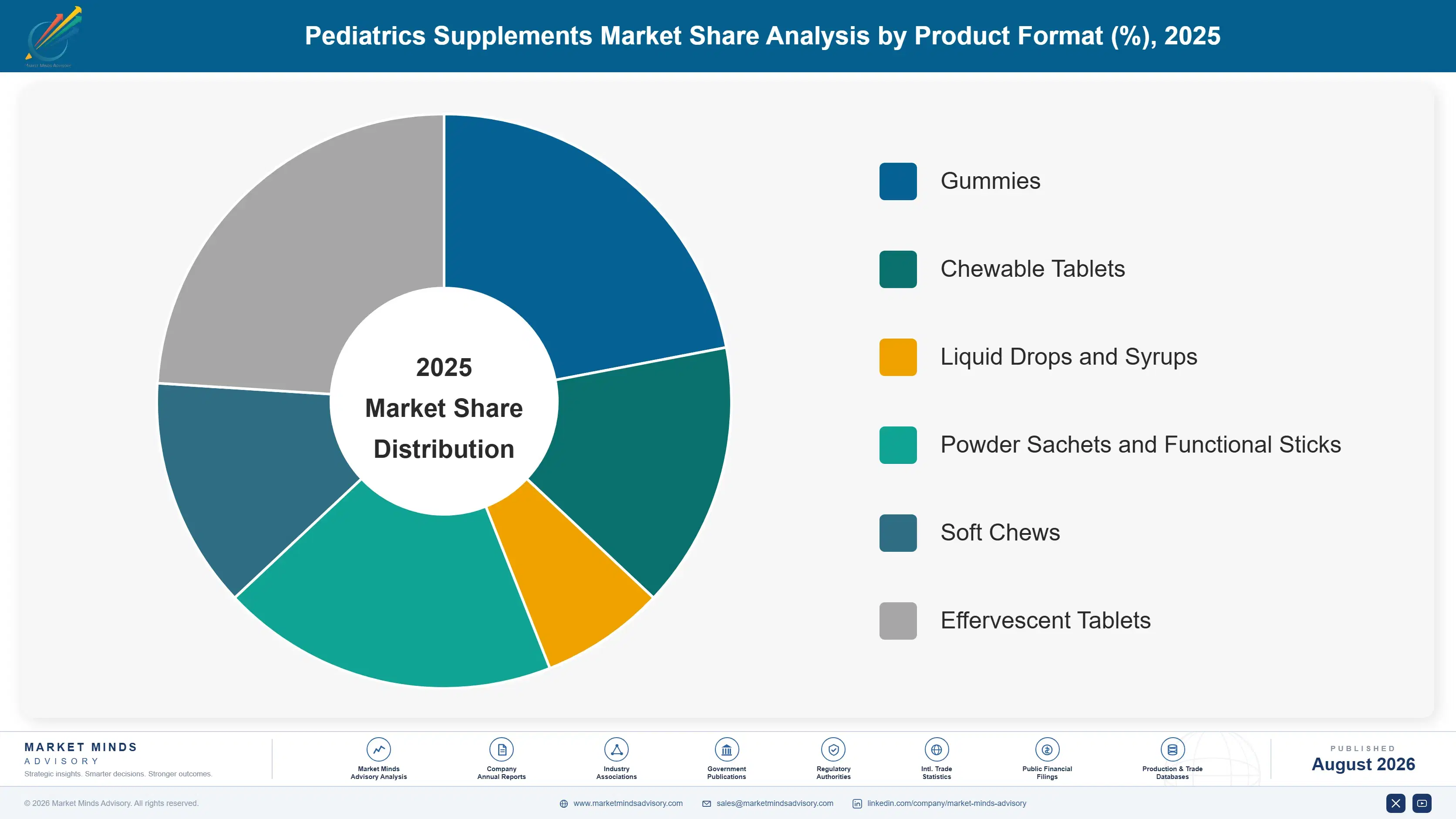
Product format is the dimension that determines shelf placement, dosing accuracy, and age eligibility, so MMA segments the market by delivery format rather than by ingredient category or health indication. Six distinct formats span the category, ranging from infant-friendly liquids through mainstream gummies to tablets favored by older, compliance-driven households and the caregivers who manage their daily routines.
pediatrics-supplements-market-trends-market-share-analysis-1787375104456

Powder Sachets and Functional Sticks

Powder sachets and single-serve functional sticks are the fastest-growing format because they solve the dosing problem that gummies and chewables cannot: precise, weight-adjustable amounts for infants and toddlers who cannot yet chew solid supplements safely. Parents mix sachets into formula, water, or pureed food, which pediatricians increasingly recommend as the safest delivery method for children under three. Growth is concentrated among brands offering flavorless or neutral-tasting powders that blend invisibly into existing feeding routines, since taste rejection remains the single biggest driver of parental switching within this format. Contract manufacturers report sachet packaging lines running near full utilization as legacy multivitamin makers race to add powder SKUs, growing roughly 1.8 times the category average.
CAGR 16.8%

Liquid Drops and Syrups

Liquid drops and syrups remain the preferred format for infants and very young children because they require no chewing and allow droplet-level dosing precision that powders cannot always match for water-soluble vitamins like D and B12. Pediatric practices frequently recommend liquid formats immediately after birth, establishing early brand loyalty that persists as households add older siblings to the same regimen. Growth here is driven less by new household formation and more by expanding indication breadth, as manufacturers add iron, DHA, and probiotic liquid lines beyond the traditional vitamin D staple. Flavor-masking technology has become a genuine competitive differentiator, since bitter aftertaste remains the leading cause of product abandonment in this format among toddlers.
CAGR 13.9%
Full segment breakdown across 6 segments available in the complete report.

Regional Architecture and Country Demand Map

North America leads on pharmacy-anchored distribution and pediatrician referral density, while South Asia and Pacific grows fastest as rising household incomes and expanding organized retail widen access across India and Southeast Asia, steadily narrowing the regional demand gap steadily over the coming forecast decade ahead.

North America

Pharmacy-led distribution anchors demand here more than in any other region, with roughly four in ten purchases still occurring at a pharmacy counter where a pharmacist or in-store clinician can field questions directly. Formal pediatrician endorsement panels, now active across nearly two thousand practices in the United States and Canada combined, give branded products a credibility channel that generic retail marketing cannot replicate. Employer wellness reimbursement programs have added a second growth lever unique to this region, removing price sensitivity for a meaningful slice of higher-income households. Subscription and auto-replenishment penetration also runs highest here, supported by mature e-commerce logistics and a consumer base accustomed to recurring health and wellness billing relationships.
Share: 27% | CAGR: 9.6% (2026 to 2036)

Western Europe

Regulatory conservatism shapes this region's growth path more directly than anywhere else, as national health authorities in Germany, France, and the United Kingdom maintain some of the strictest added-sugar and additive thresholds for children's products globally. Growth concentrates in pharmacy and specialty organic retail rather than mass grocery, reflecting a consumer base that associates children's supplements with medical-grade trust rather than convenience shopping. Scandinavian markets lead regional innovation in sugar-free and naturally sweetened formats, often previewing reformulation trends that later spread to Germany and France. Private label penetration remains comparatively low, since parents here show a stronger preference for established, clinically documented brand names over store-brand alternatives, even at a meaningful price premium.
Share: 21% | CAGR: 7.9% (2026 to 2036)
Regional intelligence for 5 additional markets available in the complete report: East Asia, South Asia and Pacific, Latin America, Middle East and Africa, Eastern Europe. Contact sales@marketmindsadvisory.com.
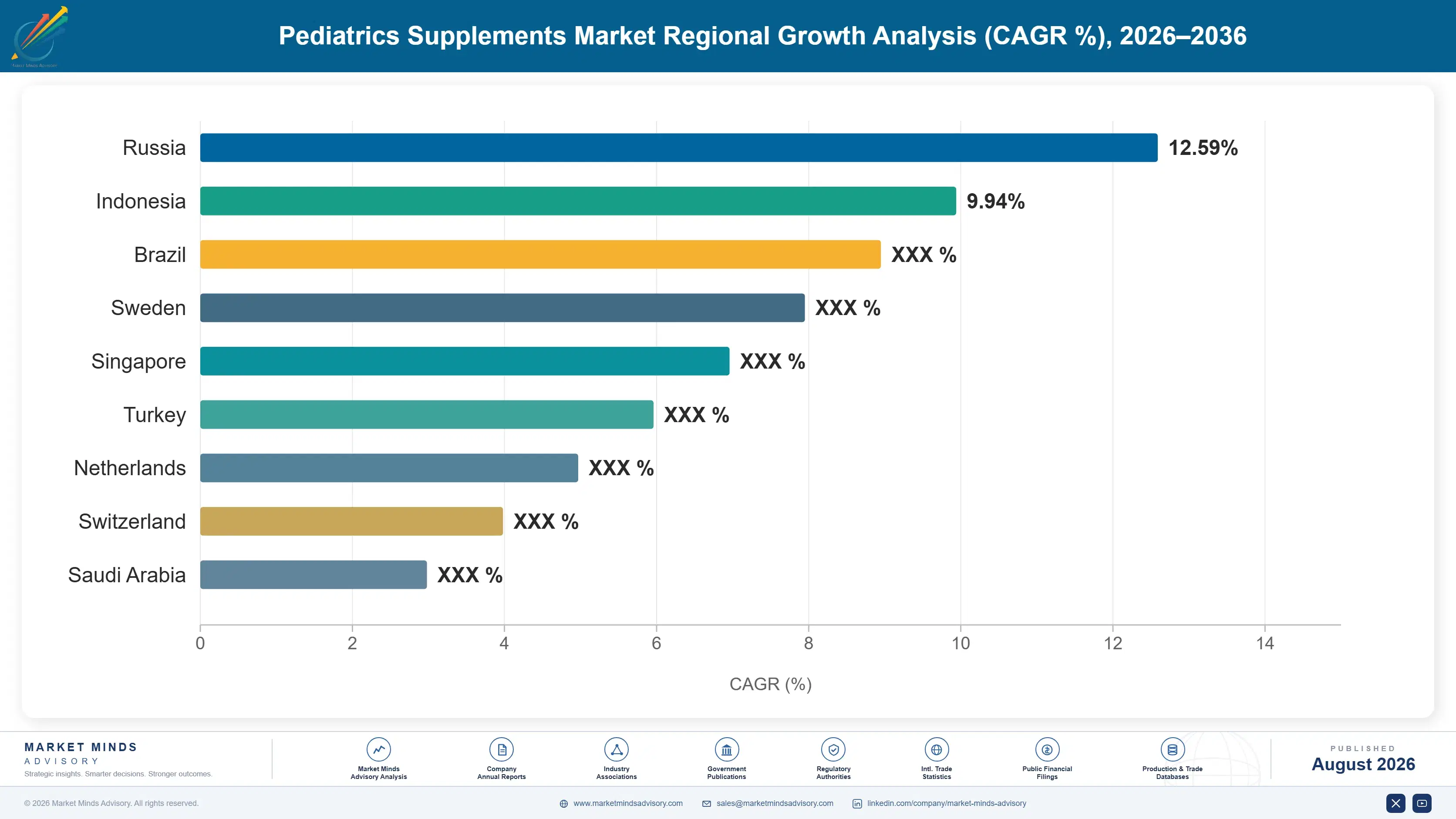
pediatrics-supplements-market-trends-country-cagr-analysis-1787375105036

Where Margin Actually Concentrates in the Category

Four commercial levers separate brands earning premium margins from those trapped in commodity gummy competition: clinical proof, subscription retention, precision dosing formats, and pediatrician-facing distribution that generic retail marketing alone cannot replicate, each requiring sustained upfront investment well before the resulting margin gain becomes visible on a quarterly income statement or in shelf renewal negotiations with major retail buyers.

Fund Publishable Clinical and Bioavailability Trials

Brands that commission and publish their own bioavailability or efficacy trials, rather than relying on generic ingredient-level research, gain a defensible claim that retail buyers now weight heavily during annual category resets. The upfront cost, typically 400 thousand to 1.2 million dollars per formula, is steep for smaller manufacturers, but brands that clear this bar report retail listing renewal rates roughly 18 percent higher than competitors relying on ingredient-level citations alone. Several contract research organizations now offer pediatric-specific trial packages sized for mid-tier manufacturers, lowering the entry cost over the past two years.
Market Impact: Lifts retail listing renewal rate 18 points overall

Build Direct Subscription and Auto-Replenishment Programs

Subscription models convert an unpredictable, low-frequency purchase into a recurring revenue stream, and brands with mature auto-replenishment programs report household lifetime value roughly 2.3 times that of single-purchase customers acquired through mass retail alone. Building this capability requires direct-to-consumer logistics and billing infrastructure that many legacy vitamin manufacturers still lack, creating an opening for digitally native challengers. Retention economics improve further when brands bundle multiple children's ages into a single household subscription, reducing churn as families add younger siblings to an existing regimen over time and delay switching to a competing brand for as long as the bundle remains convenient.
Market Impact: Raises household lifetime value 2.3 times over baseline

Expand Precision Dosing Formats for Infants and Toddlers

Manufacturers that add powder sachet and metered liquid lines capture demand from the roughly 30 percent of pediatric households with a child under three who cannot safely use gummies or chewables, a segment growing nearly twice as fast as the category overall. Packaging line conversion costs run high initially, but early movers have captured retail placement ahead of slower competitors still redesigning production. Brands that solve neutral-taste formulation alongside precision dosing see the strongest repeat-purchase rates within this expanding format tier, particularly among households managing multiple children across different age brackets simultaneously.
Market Impact: Captures 30% of currently underserved toddler households nationwide

Secure Formal Pediatrician Endorsement Panel Membership

Acceptance into a formal pediatric practice network endorsement panel converts a generic retail purchase into a physician-recommended one, and brands with panel membership report first-time buyer conversion rates roughly 9 percentage points higher than non-endorsed competitors selling comparable formulas. Panel review processes typically require submitted clinical data and take six to twelve months to complete, favoring manufacturers who invest early and budget for the delay. Once secured, endorsement status tends to be sticky, since practice networks rarely rotate recommended brands more than once every few years, giving early entrants a durable referral advantage.
Market Impact: Adds 9 points to first-time buyer conversion rate

Who Controls the Margin Pool

The top five brands hold a combined 33 percent of category revenue, a moderate concentration that leaves meaningful room for challenger growth. The gap between the leading brand and the fifth-ranked player is narrower than in most consumer health categories, since no single manufacturer has yet achieved the clinical and distribution scale advantage that would let it pull decisively ahead.
Current competitive activity centers on three fronts: legacy vitamin manufacturers acquiring digitally native challenger brands to capture younger parents, incumbents racing to fund clinical trials that smaller rivals cannot afford, and packaging investment in precision dosing formats aimed at the underserved infant and toddler segment. Retail buyers have become active participants in this competition, using shelf renewal negotiations to push evidence standards higher across the entire category.

Emerging pressure is coming from direct-to-consumer subscription brands that bypass traditional retail entirely, building loyalty through personalized dosing questionnaires and pediatrician telehealth partnerships. Rankings are most likely to shift among mid-tier players lacking either the clinical research budget of the leaders or the digital-native agility of the newest entrants, leaving them squeezed from both directions as the category's evidence bar keeps rising.
pediatrics-supplements-market-trends-company-positioning-matrix-1787375105656

Competitive Moat and Risk Dimensions

CHURCH & DWIGHT CO., INC.

Moat: Multi-brand shelf dominance

Church & Dwight's Vitafusion and L'il Critters brands occupy the largest combined pharmacy and grocery shelf footprint in the category, giving the company negotiating leverage during annual retail resets that smaller rivals cannot match. Decades of brand recognition among parents further reinforce this position, particularly for first-time buyers defaulting to a familiar name.
CHURCH & DWIGHT CO., INC.

Risk: Slower clinical evidence pivot

The company's legacy multivitamin portfolio was built before clinical substantiation became a listing requirement, leaving it exposed as retail buyers raise evidence expectations. Retooling a large existing SKU base for published trial data takes longer than launching new formulas, creating a window for evidence-first challengers to gain share.
RITUAL INC.

Moat: Ingredient transparency positioning

Ritual built its brand identity around traceable, third-party tested ingredients and public sourcing documentation, a positioning that resonates strongly with the ingredient-literate parent segment driving category premiumization. This transparency focus predates the current retail evidence requirement wave, giving Ritual an earned credibility advantage over newer entrants.
RITUAL INC.

Risk: Limited pharmacy distribution reach

Ritual's direct-to-consumer and select retail model limits its presence in the pharmacy channel that still drives roughly four in ten category purchases, particularly among households seeking pharmacist guidance for a first supplement purchase. Expanding pharmacy distribution would require a channel strategy shift the company has moved on cautiously.

Players Tracked

Prominent Players

Church & Dwight Co., Inc.
Ritual Inc.
Nature's Way Products, LLC
Nordic Naturals, Inc.
Zarbee's Naturals, Inc.

Other Key Players

Bayer AG (One A Day Kids)
Haleon plc (Centrum Kids)
Mary Ruth Organics LLC
OLLY Public Benefit Corporation
SmartyPants Vitamins LLC
Garden of Life, LLC
Pfizer Consumer Healthcare
Nutraceutical International Corporation
Rainbow Light Nutritional Systems
NOW Health Group, Inc.
Hero Nutritionals, Inc.
PediaCare (Prestige Consumer Healthcare)
Culturelle (i-Health, Inc.)
Yum-V's, LLC
UpSpring Baby, LLC

Recent Developments

MARCH 2025

Church & Dwight Expands Vitafusion Powder Sachet Line

Church & Dwight launched a new powder sachet line under the Vitafusion brand targeting toddlers under three years old, adding precision dosing capability to a portfolio previously concentrated entirely in gummy formats across its major pharmacy and grocery retail accounts nationwide, matching a format shift already underway among smaller rivals.
Signal: Signals legacy multivitamin brands chasing precision dosing format growth among underserved toddler households nationwide, not only smaller challengers
SEPTEMBER 2024

Ritual Secures Pediatric Practice Endorsement Panel Membership

Ritual gained acceptance into a multi-state pediatric practice endorsement panel after submitting bioavailability trial data for its children's multivitamin line, becoming one of the first direct-to-consumer brands to secure this credibility channel, ahead of several larger, longer-established competitors that are still preparing their own formal submissions for review.
Signal: Confirms published clinical proof now opens physician-level branded distribution channels faster than legacy retail listing routes
JANUARY 2025

Haleon Acquires Pediatric Probiotic Challenger Brand

Haleon acquired a venture-backed pediatric probiotic startup to add condition-specific gut-health formulas to its Centrum Kids portfolio, expanding beyond traditional multivitamin positioning into the faster-growing functional health segment ahead of several competing multinational consumer health divisions still weighing similar acquisition targets in the same space.
Signal: Shows large incumbents buying growth directly in functional pediatric health sub-categories rather than building it organically in-house

Clinical Testing Now Rivals Raw Material Cost

Raw vitamin and mineral premixes, gelatin or pectin for gummy bases, and specialty sweeteners together represent roughly 38 percent of cost of goods sold, sourced primarily from Chinese and European premix manufacturers with concentrated global supply. Packaging, particularly child-resistant and single-dose sachet formats, adds another meaningful cost layer that has grown as precision dosing formats expand across the category.
Vitamin C and vitamin D premix prices rose sharply in 2023 after a major Chinese manufacturing disruption tightened global supply, an event the International Energy Agency's broader industrial input tracking and several manufacturers' annual reports both referenced when explaining margin compression that year. Gummy-format manufacturers absorbed the steepest cost increases, since pectin and gelatin substitutes proved difficult to source at comparable quality within the same delivery timelines.

Exposure varies sharply by player type: brands with in-house formulation and premix blending capacity absorbed volatility more easily than contract-manufactured private label competitors, who faced longer lead times renegotiating supplier contracts. Smaller manufacturers dependent on a single premix supplier faced the steepest margin pressure, while vertically integrated leaders used scale purchasing agreements to smooth cost swings across multiple product lines.
pediatrics-supplements-market-trends-cost-volatility-analysis-1787375105857

Dual-Source Premix Supply Across Two Geographies

Leading manufacturers now qualify at least two premix suppliers across different geographies for core vitamins like C and D, reducing exposure to any single country's manufacturing disruption. This adds modest qualification cost but has prevented stockouts during recent volatility events, and several brands report the practice paid for itself within eighteen months of adoption.

Lock Multi-Year Sweetener and Gelatin Contracts

Multi-year fixed-price contracts with sweetener and gelatin suppliers protect gross margin against short-term spot market volatility, though they require accurate demand forecasting to avoid overcommitment. Several large brands have expanded this practice since the 2023 disruption, locking pricing through 2027 for their highest-volume formulations and freeing up working capital previously reserved for spot market purchases.

Shift Formulation Toward Less Volatile Inputs

Some manufacturers are reformulating toward powder and tablet formats that use fewer gelatin-dependent inputs, reducing exposure to the most volatile cost category while also addressing the separate regulatory push against added sugar in gummy formats. Early movers report both cost and reformulation-compliance benefits from this dual-purpose shift, alongside notably faster regulatory approval timelines in most jurisdictions.

Portfolio Architecture for Margin Defence

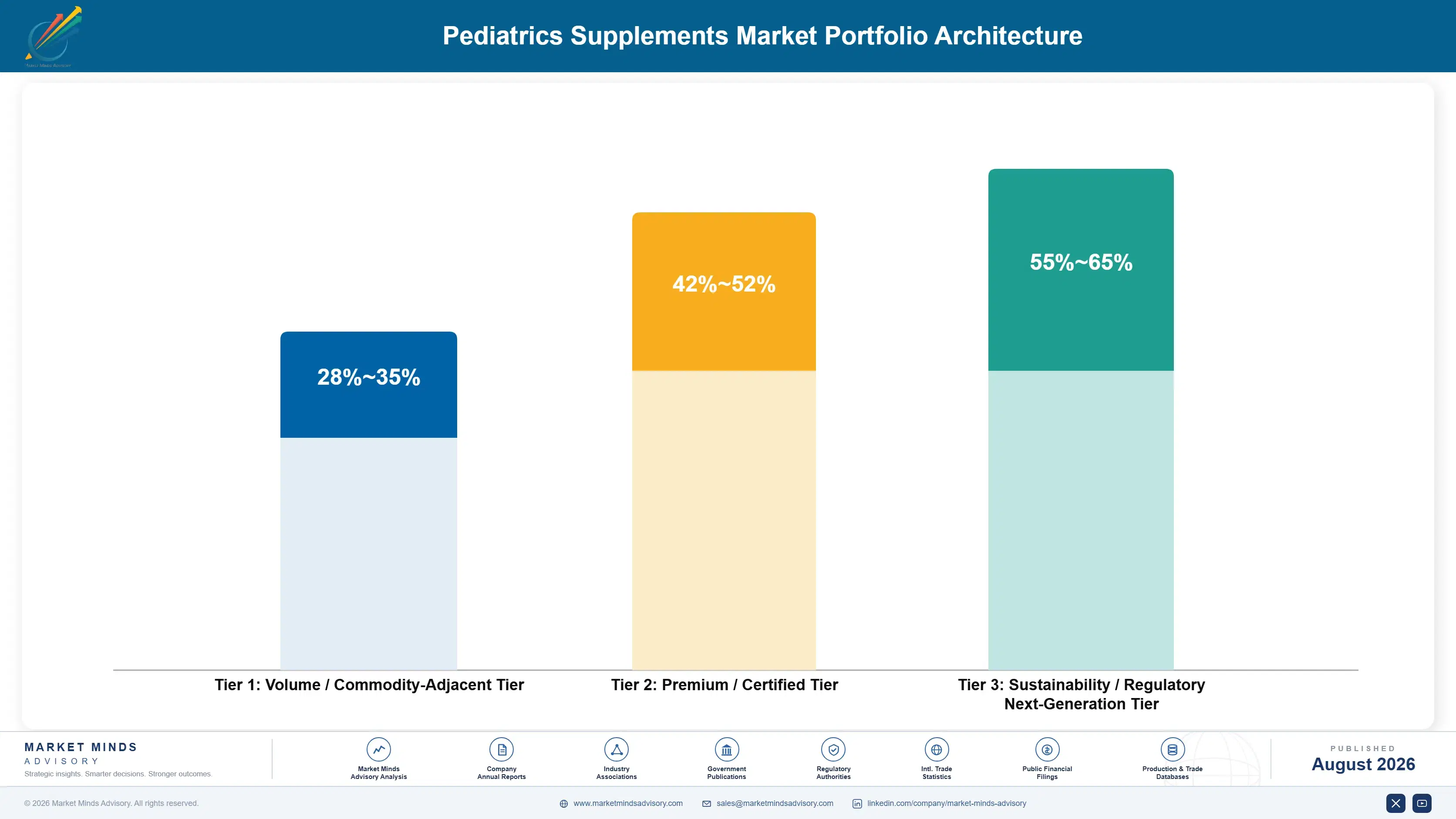
Three tiers structure this category's margin economics. Volume multivitamins compete on price and retail presence with thin margins, premium certified formulas earn a meaningful markup on third-party testing and organic sourcing claims, and next-generation condition-specific products command the steepest prices by solving a named health concern parents actively research and discuss with their pediatrician before purchase.
Tension between volume and premium tiers is intensifying as mass retailers compress shelf space for undifferentiated multivitamins while expanding premium and clinically substantiated bays. Manufacturers straddling both tiers face difficult portfolio choices, since the operational capabilities required, clinical trial funding versus manufacturing scale efficiency, pull in genuinely different directions and rarely reward companies that try to excel at both simultaneously across every product line in the catalog.

High-value margin pools concentrate in condition-specific formulas addressing immunity, gut health, and cognitive development, where parents show the least price sensitivity and the strongest willingness to pay for documented efficacy. Precision dosing formats for infants and toddlers represent the fastest-growing high-value pool as the category's underserved segment finally gets dedicated manufacturing and marketing attention from major incumbents and well-funded challenger brands alike.

Volume / Commodity-Adjacent Tier

Mass-market multivitamins sold primarily through grocery and value retail chains, competing chiefly on price, shelf visibility, and broad household name recognition rather than documented clinical differentiation, with the thinnest margins in the entire category.
Gross Margin: 28-35%

Premium / Certified Tier

Third-party tested, organic, or allergen-free formulas sold through pharmacy and specialty retail at a clear premium, targeting ingredient-literate parents willing to pay for verified sourcing, manufacturing transparency, and recognizable certification marks on the label.
Gross Margin: 42-52%

Sustainability / Regulatory / Next-Generation Tier

Clinically substantiated, condition-specific formulas addressing immunity, gut health, or cognitive support with published trial data, increasingly required for continued placement in pediatrician-endorsed distribution channels and premium pharmacy accounts nationwide today.
Gross Margin: 55-65%
pediatrics-supplements-market-trends-portfolio-architecture-1787375106387

High-value Sub-segments and Strategic Watch-out

Clinically Studied Immunity and Gut-Health Formulas

This segment combines the category's highest growth rate with its richest margins, as parents pay a clear premium for published clinical evidence behind immunity and probiotic claims. Retail buyers now prioritize this segment during shelf resets, reinforcing its high-value position as evidence requirements tighten across accounts.
Gross Margin: 58-65%

Precision Dosing Powder and Liquid Formats

Growing fast but still building margin scale, this segment benefits from solving the underserved toddler dosing problem, though packaging line conversion costs currently compress near-term profitability relative to mature gummy manufacturing, a gap expected to narrow as production volume scales over the next several years across leading manufacturers.
Gross Margin: 45-52%

Mainstream Gummy Multivitamins

The category's volume anchor, mainstream gummies retain the largest revenue base even as growth slows relative to newer formats, sustaining category cash flow while margins stay comparatively thin against premium alternatives and face continued added-sugar reformulation pressure from regulators across most major consumer markets tracked.
Gross Margin: 30-36%

Private-Label Store-Brand Multivitamins

Retailers are expanding store-brand pediatric lines to capture margin from price-sensitive households, a watch-out for branded manufacturers as private label quality gaps narrow and retailer negotiating leverage grows heading into the next several annual category reset cycles across most major retail accounts nationwide right now.
Gross Margin: 20-27%

Repeat Purchase Economics by Household

Pediatric supplements behave like an annuity once a household establishes a routine, since parents rarely stop a regimen a pediatrician or trusted brand recommended, and siblings entering the target age range extend household revenue well beyond a single child's usage window without any incremental acquisition cost. Households commonly stay with a single brand across multiple children spanning a decade or more of continuous purchasing.
Adoption depth varies meaningfully by vertical: immunity and multivitamin categories see near-universal trial but moderate daily compliance, while condition-specific formulas addressing a diagnosed concern, such as iron deficiency or documented gut sensitivity, see lower trial rates paired with far stickier daily usage once a family commits, since discontinuation carries a perceived health risk that generic multivitamin lapses do not.

Younger millennial and Gen Z parents research ingredients far more actively before a first purchase than prior generations, delaying initial conversion but producing more loyal, evidence-driven customers once won. This generational shift rewards brands investing early in transparent sourcing documentation over those relying on legacy shelf presence alone, reshaping which companies ultimately capture the next full decade of new household formation growth.
pediatrics-supplements-market-trends-end-use-penetration-index-1787375106903

Where MMA Sees the Category Heading

These are among the four positions where our research anticipates prominent divergence between winners and laggards over the coming forecast period. Each is grounded in the demand model, the regulatory perimeter, and the announced capacity pipeline.
01 / EVIDENCE INVESTMENT PRIORITY

Fund clinical trials before expanding SKU count

Retail buyers now treat published clinical or bioavailability data as a listing prerequisite rather than a marketing nicety, and this shift will only deepen as more pharmacy and grocery chains formalize evidence-based reset criteria across their category review calendars. Manufacturers still funding SKU proliferation over trial investment risk losing shelf space to smaller, better-substantiated rivals within the next two annual reset cycles, regardless of current sell-through velocity. MMA views clinical investment as the single highest-leverage capital allocation decision facing mid-tier brands in this category today.
02 / FORMAT EXPANSION URGENCY

Add precision dosing formats within eighteen months

The infant and toddler dosing gap remains the category's most underexploited growth pool, and early movers in powder sachets and metered liquids are already capturing disproportionate retail placement ahead of slower, chewable-only competitors still redesigning their production lines. Packaging conversion costs are real but manageable relative to the growth rate reward currently available in this underserved format tier. MMA expects the current format leadership window to close within roughly two to three years as well-capitalized legacy manufacturers eventually catch up.
03 / CHANNEL DIVERSIFICATION NEED

Build direct-to-consumer capability alongside retail

Brands dependent solely on mass retail distribution remain exposed to shelf reset volatility that direct-to-consumer subscription relationships largely avoid, particularly as evidence requirements keep tightening across major accounts nationwide. Building this capability requires meaningful logistics and billing infrastructure investment that many smaller manufacturers still lack the capital to build in-house today. MMA recommends treating subscription infrastructure as a defensive necessity rather than an optional growth experiment, given how quickly digitally native challengers have already scaled well past slower, retail-only incumbents nationwide.
04 / REGULATORY READINESS PLANNING

Reformulate ahead of further added-sugar tightening

Added-sugar and artificial-color restrictions are very likely to tighten further across major markets over the next several years, and brands that reformulate proactively will avoid the costly, reactive scramble that followed the 2023 and 2024 rule changes across the United States and European Union. Sweetener substitution research takes many months to perfect without sacrificing taste acceptance among young children who reject bitter aftertaste quickly. MMA advises building reformulation buffer capacity now rather than waiting for the next regulatory deadline announcement to force the issue.

Engagement Snapshot From the Field

A live engagement with an industry participant carrying material or product regulatory and market exposure ahead of a defining policy shift, showing how our research translates into a defensible multi-year portfolio strategy.
MARKET MINDS ADVISORY · CLIENT ENGAGEMENT SUMMARY
Pediatrics Supplements Producer Strategic Portfolio Review and Transition Roadmap 2026·Investment Scenario on Pediatrics Supplements Exposure Evaluation 2025-26
CLIENT PROFILE
The client operates a regional pharmacy chain with roughly 340 stores across the southeastern United States, generating approximately 60 million dollars (client-reported, unverified by MMA) in annual pediatric supplement category revenue. The chain sought to reposition its children's health aisle after losing share to national competitors expanding evidence-based product curation across comparable store formats and trade areas.
STRATEGIC CHALLENGE
Category sales had plateaued despite rising foot traffic, and store buyers lacked a consistent framework for deciding which pediatric supplement brands deserved renewed shelf space each reset cycle. Competing chains had begun publicly marketing their curation standards, creating a credibility gap the client needed to close quickly before the next planogram review.
MMA APPROACH
MMA conducted a structured audit of category SKUs against clinical substantiation, format innovation, and pediatrician endorsement criteria, cross-referencing findings against primary survey data from parent households across the client's core trade area and several adjacent metro markets. The engagement produced a tiered brand scorecard for ongoing buyer use during future quarterly category reviews.
KEY FINDINGS
  1. Only 22 percent of shelved SKUs carried any published clinical or bioavailability substantiation behind their core marketing claims, well below competing chains.
  2. Precision dosing formats represented under 6 percent of total shelf facings despite covering a fast-growing local customer segment that competitors were already courting.
  3. Households citing a pediatrician recommendation converted at nearly double the rate of those relying purely on shelf browsing decisions without prior guidance.
  4. Three national competitor pharmacy chains had already adopted formal evidence-based curation standards within the preceding eighteen months, ahead of the client's own timeline.
CLIENT PROFILE
The client operates a regional pharmacy chain with roughly 340 stores across the southeastern United States, generating approximately 60 million dollars (client-reported, unverified by MMA) in annual pediatric supplement category revenue. The chain sought to reposition its children's health aisle after losing share to national competitors expanding evidence-based product curation across comparable store formats and trade areas.
STRATEGIC CHALLENGE
Category sales had plateaued despite rising foot traffic, and store buyers lacked a consistent framework for deciding which pediatric supplement brands deserved renewed shelf space each reset cycle. Competing chains had begun publicly marketing their curation standards, creating a credibility gap the client needed to close quickly before the next planogram review.
MMA APPROACH
MMA conducted a structured audit of category SKUs against clinical substantiation, format innovation, and pediatrician endorsement criteria, cross-referencing findings against primary survey data from parent households across the client's core trade area and several adjacent metro markets. The engagement produced a tiered brand scorecard for ongoing buyer use during future quarterly category reviews.
KEY FINDINGS
  1. Only 22 percent of shelved SKUs carried any published clinical or bioavailability substantiation behind their core marketing claims, well below competing chains.
  2. Precision dosing formats represented under 6 percent of total shelf facings despite covering a fast-growing local customer segment that competitors were already courting.
  3. Households citing a pediatrician recommendation converted at nearly double the rate of those relying purely on shelf browsing decisions without prior guidance.
  4. Three national competitor pharmacy chains had already adopted formal evidence-based curation standards within the preceding eighteen months, ahead of the client's own timeline.
RECOMMENDED STRATEGY
Phase 1: Phase 1 (Months 1-3): Score all shelved SKUs against a clinical substantiation and format-innovation review framework built for repeated reuse. Phase 2: Phase 2 (Months 4-8): Rebalance shelf space toward evidence-backed brands and expand precision dosing format facings across all client stores. Phase 3: Phase 3 (Months 9-12): Launch a pharmacist-led recommendation program tied publicly to the chain's new curation standard messaging campaign launch.
OUTCOME
Within twelve months of implementation, the client reported (client-reported, unverified by MMA) a 14 percent increase in pediatric supplement category revenue and a measurable rise in customer-reported trust scores tied to the pharmacy's new curation messaging. Store buyers adopted the scorecard as a standing quarterly review tool.

Frequently Asked Questions

Foundational context covering the market sizes, CAGR, scope, country, region and competition that inform every finding below. This section is provided to cover basics and most often pre-purchase conversations, answered from the MMA Primary Research Dataset.

What is the current size of the Pediatrics Supplements Market?

The pediatrics supplements market was valued at approximately $3.6 billion in 2025. Growth is driven by rising clinical substantiation demand and expanding precision dosing formats for infants and toddlers.

How large will the Pediatrics Supplements Market be by 2036?

MMA projects the market will reach approximately $9.68 billion by 2036, up from $3.94 billion in 2026. This represents an incremental opportunity of roughly $5.74 billion over the forecast period.

What is the CAGR for the Pediatrics Supplements Market 2026 to 2036?

The market is projected to grow at a 9.4 percent compound annual growth rate between 2026 and 2036. Bull and bear scenarios range from 8.1 to 10.7 percent annually.

Which segment is growing fastest?

Powder sachets and functional sticks are growing fastest at 16.8 percent annually, roughly 1.8 times the category average, driven by precision dosing needs for infants and toddlers.

Who are the major companies in the Pediatrics Supplements Market?

Church & Dwight, Ritual, Nature's Way, Nordic Naturals, and Zarbee's Naturals lead the category. Together the top five hold a moderate combined share, leaving meaningful room for challenger brands.

Which country is growing fastest?

India leads country-level growth at 13.6 percent annually as organized pharmacy retail expands into tier-two and tier-three cities. This outpaces the broader South Asia and Pacific regional average.

Report Segmentation Architecture

The full report scope spans multiple orthogonal segmentation dimensions, with cross-tabulated demand data provided for each dimension pair. Coverage extends further to regional breakdowns, trend trajectories, and the competitive detail needed to support segment-level decision-making.

By Product Format

  • Gummies
  • Chewable Tablets
  • Liquid Drops and Syrups
  • Powder Sachets and Functional Sticks
  • Soft Chews
  • Effervescent Tablets

By End-Use Industry

  • Pharmacy and Drugstore Retail
  • Mass Grocery and Hypermarket Retail
  • E-Commerce and Direct-to-Consumer
  • Specialty and Health Food Retail
  • Clinical and Pediatric Practice Channels

By Commercial Dimension

  • Infant and Toddler (0-3 Years)
  • Child (4-8 Years)
  • Adolescent (9-17 Years)
  • Subscription and Auto-Replenishment

By Region

  • North America
  • Western Europe
  • East Asia
  • South Asia and Pacific
  • Latin America
  • Middle East and Africa
  • Eastern Europe

Scope, Methodology, and Coverage

Every figure in this report is reproducible from documented input assumptions. The scope below maps the historical period, the forecast horizon, the segmentation dimensions, and the countries covered, alongside the underlying primary and qualitative methodology.
Historical Period
2020 to 2025
Forecast Period
2026 to 2036
Base Year
2025 (USD billions; MMA Primary Research Dataset, August 2026)
Market Definition
This report covers vitamins, minerals, probiotics, and functional nutrition products formulated and marketed specifically for infants, children, and adolescents through age seventeen, across gummy, chewable, liquid, and powder delivery formats. It excludes prescription pediatric pharmaceuticals, medical foods requiring physician administration, and standalone infant formula.
Quantitative Units
USD billions (current prices); volume in metric tons and million units where applicable
Segmentation Dimensions
By Product Format; By End-Use Industry; By Commercial Dimension; By Region
Regions Covered
North America, Western Europe, East Asia, South Asia and Pacific, Latin America, Middle East and Africa, Eastern Europe
Countries Covered
USA, China, Germany, France, UK, Japan, South Korea, India, Australia, Canada, Brazil, Mexico, Indonesia, Vietnam, Thailand, Malaysia, UAE, Saudi Arabia, South Africa, Nigeria, Turkey, Poland, Netherlands, Italy, Spain, Sweden, Switzerland, Argentina, Colombia, Singapore, and additional markets relevant to this sector
Key Companies Profiled
Church & Dwight Co., Inc., Ritual Inc., Nature's Way Products, LLC, Nordic Naturals, Inc., Zarbee's Naturals, Inc., Bayer AG (One A Day Kids), Haleon plc (Centrum Kids), Mary Ruth Organics LLC, OLLY Public Benefit Corporation, SmartyPants Vitamins LLC, Garden of Life, LLC, Pfizer Consumer Healthcare, Nutraceutical International Corporation, Rainbow Light Nutritional Systems, NOW Health Group, Inc., Hero Nutritionals, Inc., PediaCare (Prestige Consumer Healthcare), Culturelle (i-Health, Inc.), Yum-V's, LLC, UpSpring Baby, LLC
Quantitative Methodology
Primary survey, n=3,800 respondents, Q4 2025, six countries; demand-side model with trade association cross-validation
Qualitative Methodology
47 expert interviews, Q4 2025; applied to validate demand model assumptions, identify emerging dynamics, and assess competitive positioning
Report Format
PDF and XLSX data workbook (Word format preview document)
Publisher
Market Minds Advisory
Report Code
MMA-2026-AGR-110
Published
August 2026
Contact
sales@marketmindsadvisory.com | www.marketmindsadvisory.com

Purchase the full Pediatrics Supplements Market Report (2026 to 2036).

The full report delivers a comprehensive 200-plus page analysis of the global pediatrics supplements market, including detailed segmentation by product format, end-use channel, and commercial dimension across all seven world regions tracked in this study. It provides company profiles for twenty key and emerging players, benchmarked against a consistent revenue and pharmacy shelf-share basis throughout. Buyers receive access to MMA's underlying primary survey dataset spanning 3,800 respondents and 47 expert interviews conducted in Q4 2025. Custom data cuts and direct analyst inquiry access are available for enterprise licensees upon request.
Twenty detailed company profiles with moat and risk analysis
Seven-region market sizing data through 2036
Primary survey dataset, n equals 3,800 respondents
Forty-seven expert interview transcript summary excerpts
Segment-level CAGR and regional share breakdowns
Quarterly market update subscription add-on option

Built For The People Who Decide

From boardroom strategy to bench-side execution, this report is read cover-to-cover by leaders shaping the next decade of their industry, turning demand scenarios, market dynamics and valuation benchmarks into decisions.
CXOs/ Presidents/ VPs/ Managers
M&A and Corporate Development
Strategy Teams and R&D Heads
Procurement and Product Directors
Regulatory and Compliance Leaders
Investor Relations and Equity Analysts