Market Minds Advisory
Pea Grits Market

Pea Grits Market: Grain-Free Pet Food Legacy and the Plant Protein Pull

Pea grits sit between the grain-free pet food boom that built this ingredient's base and a fast-emerging plant-based meat feedstock role, two demand streams competing for the same Saskatchewan and French pea harvest.

Lead Analyst

Lisa Gevelber

Published

September 2026

Make Smarter Decisions with Customized Research Insights

Request a free sample report and evaluate market opportunities, growth trends, and competitive dynamics relevant to your business needs.

2025 MARKET VALUE$0.9BMarket Size 2025
2036 FORECAST VALUE$2.0BBase Case , 2026 to 2036
CAGR 2026 TO 20367.2 %Bull 8.4% / Bear 6.0%
INCREMENTAL OPPORTUNITY$1.0BNet 10- year value creation
EXPANSION MULTIPLE2.00x2036 value over 2026 base
Strategic Levers
M&A Pipeline
Regional Outlook
Country Rankings
Competitive Intelligence
Segmental Deep-dive
Call-Us : 91 93563 13602

Executive Snapshot and Market Trajectory

Pea grits built their commercial base almost entirely inside the pet food bag, riding the grain-free formulation boom that reshaped an entire category over the past decade. Plant-based meat demand is now pulling the same coarsely milled pea into a second, faster-growing role.
Plant-based meat alternative feedstock is growing fastest as formulators specify pea grits for protein isolate extraction ahead of competing pulse sources. North America anchors global demand on Saskatchewan's dominant pea growing and processing base, while Western Europe's established pet food and food ingredient manufacturing keeps it close behind on formulation depth rather than raw acreage. Both regions are racing to build the specification depth this fastest-growing segment increasingly demands.
Twenty companies compete across a market split between bulk pet food grade grits sold largely on delivered cost, and protein isolate feedstock grade earning meaningfully more on protein content consistency and processing yield. Crop yield variability tied to weather genuinely affects supply consistency in ways that buyers increasingly hedge against through multi-origin sourcing. Buyers increasingly hedge through multi-origin sourcing rather than simply accept the risk. Multi-origin producers increasingly win the largest, most predictable contracts.
Market Definition
The market covers pea grits, coarsely milled or cracked dried yellow and green pea, sold as an ingredient into pet food, animal feed, snack and bakery, brewing, and plant protein extraction applications. Whole dried peas, pea protein isolate itself, and fresh or frozen peas are excluded.
Base Year Value
$0.9B in 2025 (MMA Primary Research Dataset, August 2026)
Forecast Period
2026 to 2036, eleven discrete annual values
CAGR
7.2% base case. Bull 8.4%. Bear 6.0%.
Fastest Growth Segment
Plant-Based Meat Alternative Feedstock: 11.5% CAGR
Fastest Growth Country
India: 9.8% CAGR
Fastest Growth Region
South Asia and Pacific: 9.2% CAGR
Largest Region
North America: 31% of 2025 global value
Market Leaders
Roquette Frères, AGT Food and Ingredients, Puris Proteins, Ingredion Incorporated, Cosucra Groupe Warcoing. Source: MMA Analysis based on company annual reports.
Primary Survey
n=3,800 procurement and R&D decision-makers, Q4 2025, six countries
Methodology
Demand-side build-up, cross-validated against public data, 47 expert interviews

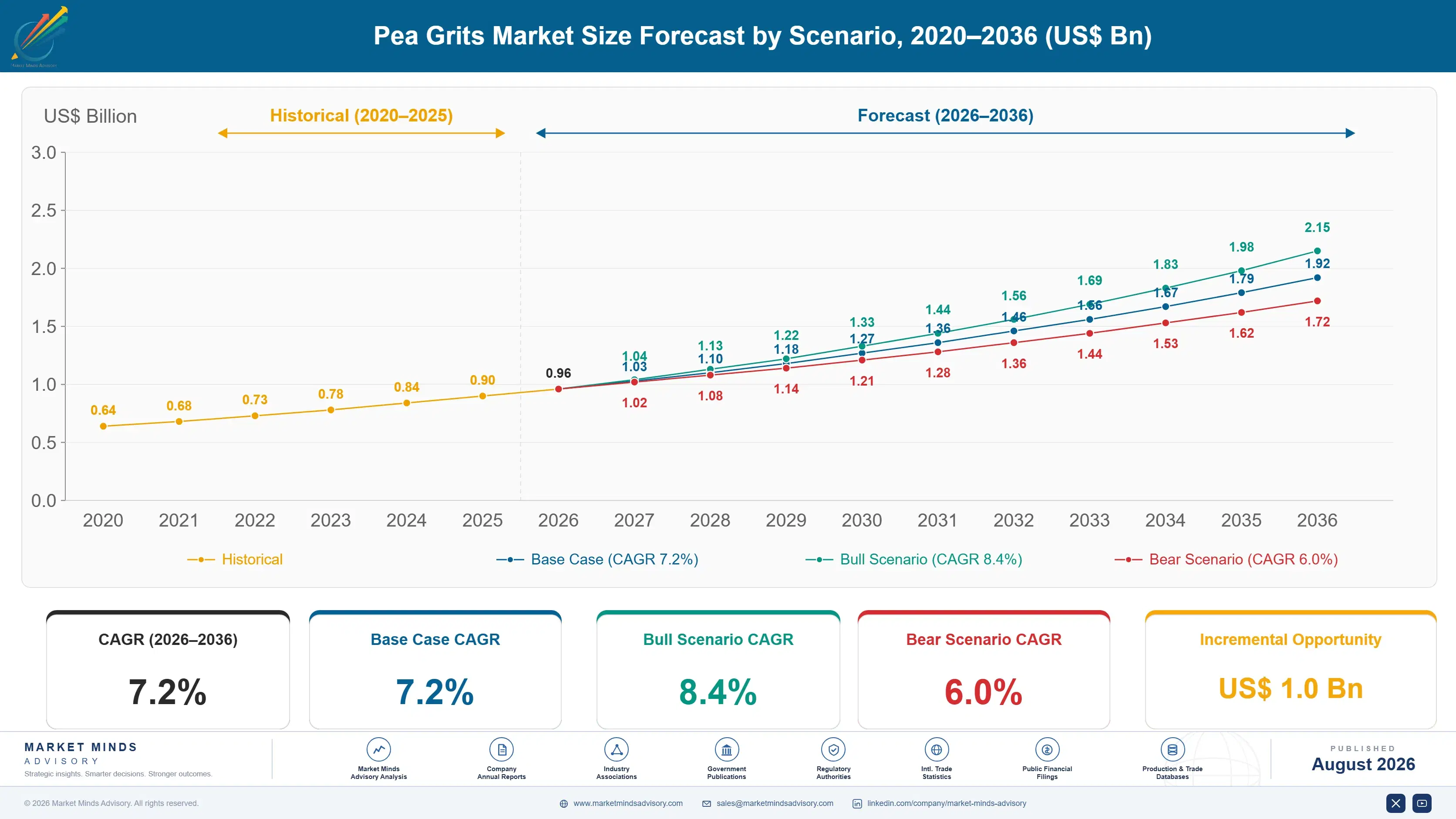
Pea Grits Market Forecast Scenarios

pea-grits-market-trends-size-forecast-scenario-1787559174186
Between 2020 and 2025 the market grew near 6.2% a year, accelerated by pandemic-era grain-free pet food demand before plant-based protein feedstock demand began contributing meaningfully to overall growth as that category matured beyond its earliest hype cycle. Plant protein feedstock demand barely registered as a meaningful growth contributor at the start of that same stretch.
The base case carries the market to 7.2% CAGR on three mechanisms: continued grain-free and limited-ingredient pet food formulation demand, plant-based meat alternative feedstock growth as formulators specify pea protein isolate over competing pulse sources, and rising global snack and bakery demand for pea-based ingredients in emerging markets. None of these three mechanisms depends on any single retail category trend alone. Each mechanism moves largely independently of the others, which is what makes the base case durable across cycles.
The bull case at 8.4% assumes faster plant-based meat category recovery and protein isolate feedstock demand than currently modelled. The bear case at 6.0% assumes crop yield disruption and slower pet food category growth in key developed markets than currently anticipated. Neither scenario depends on any single national retail category trend alone. Both remain plausible given how quickly plant protein reformulation trends have moved recently.

Pet Food Legacy Meets the Protein Isolate Pull

Three forces converge on this market at once, and each moves on its own separate schedule. Grain-free pet food demand tracks pet ownership and premiumization trends that move independently of broader food ingredient cycles, plant-based meat feedstock demand tracks a category still finding its long-term growth rate after early hype, and snack and bakery demand tracks broader packaged food consumption trends across emerging markets specifically. None of these three schedules move in step, which is why regional cycles rarely align.
PET FOOD CHANNEL SHARE48%share of volume sold into pet food and animal feed
AVERAGE SELLING PRICEUSD 580/tonneblended price across pet food and feedstock grades
TOP PRODUCER SHARE16%largest single producer share of global processing capacity
FEEDSTOCK COST SHARE58% of COGSraw dried pea procurement cost across integrated processors
TRADE INTENSITY40%share of global output moving across a border annually
HHI CONCENTRATION420a moderately concentrated global specialty processor base overall
Commercially, the market behaves like an agricultural commodity trade wearing a specialty ingredient label. Grade differentiation genuinely exists, protein isolate feedstock grade commanding real premiums over standard pet food grade, but landed price still tracks harvest yield and freight cost more than any processor's formulation expertise or branding investment. Buyers who lock multi-year supply contracts before harvest season routinely outperform those still buying on the spot market.
Over the next decade, protein isolate feedstock demand and multi-origin sourcing resilience will decide winners more than pet food volume growth alone, since pet food demand is already a largely mature, formulation-tied base. Processors investing early in isolate-grade processing will capture margin that pet-food-only competitors cannot easily replicate without significant reformulation investment.
"Everyone still thinks of this as a pet food ingredient, but the real growth conversation now happens at a protein isolate extraction plant, not a kibble factory."
Director, Agriculture and Food Ingredients Practice · MMA Agriculture and Food Ingredients Practice · August 2026

Market Trends

Plant-Based Meat Reformulation Favours Pea Protein Blends

Plant-based meat manufacturers have increasingly specified pea protein isolate over soy in flagship product reformulations, citing both allergen positioning and functional performance in extruded meat analogue applications, and pea grits serve as the primary feedstock for that isolate extraction process. This reformulation trend has proven more durable than the broader plant-based meat category's overall growth rate, since it reflects genuine formulation preference rather than pure category expansion. Processors with established isolate extraction relationships are capturing feedstock supply contracts that pure pet food grade suppliers cannot access at comparable volume. Several plant-based meat brands have reformulated flagship products around pea protein.
Market Impact: Adds 45,000 tonnes by 2029
Pet Food Formulators Shift Toward Novel Limited-Ingredient Recipes

Pet food brands continue expanding limited-ingredient and novel-protein formulations that specify pea grits alongside single animal protein sources, responding to consumer demand for simplified, traceable ingredient lists in premium pet food categories. This shift has proven resilient even as some grain-free formulations face renewed scrutiny over unrelated cardiac health research, since limited-ingredient positioning addresses a different consumer concern around ingredient transparency specifically. Pet food manufacturers increasingly specify pea grits sourced from traceable, single-origin supply chains to support premium label claims. Several premium brands have expanded traceable, single-origin sourcing programmes specifically to support these positioning claims.
Market Impact: Adds USD 28 million by 2028

Market Opportunities and Growth Drivers

Grain-Free Pet Food Category Sustains Core Demand

Grain-free and limited-ingredient pet food remains a substantial and growing category across North America and Western Europe, and pea grits serve as the standard carbohydrate and binding ingredient across most grain-free kibble formulations sold today. Pet food manufacturers specify pea grits for its functional extrusion properties and clean-label positioning, a combination competing carbohydrate sources struggle to match at comparable cost. This demand base remains the single largest application for pea grits globally, providing a stable foundation even as newer applications grow faster in percentage terms. Established manufacturer relationships continue anchoring the bulk of this demand.
Market Impact: Cuts Canadian yield up to 22%

Rising Global Plant Protein Demand Expands Feedstock Use

Global plant protein consumption keeps expanding as consumers across developed and emerging markets seek protein sources alternative to animal meat, and pea protein isolate has emerged as one of the fastest-growing plant protein categories given its favourable allergen and functional profile compared with soy. Pea grits serve as the primary feedstock for this isolate extraction process, and demand growth in isolate manufacturing translates directly into feedstock grits demand. Food and beverage companies increasingly specify pea protein in products ranging from beverages to bars, expanding the addressable feedstock market well beyond plant-based meat alone.
Market Impact: Caps share loss at 8 points

Market Restraints and Challenges

Crop Yield Variability Disrupts Supply Consistency

Dried pea yields vary meaningfully year to year based on weather conditions across Saskatchewan, the primary global growing region, and this variability directly affects pea grits supply consistency and pricing for both pet food and feedstock grade buyers. The root cause is straightforward agricultural exposure to drought, excess moisture, and temperature swings during the growing season, none of which processing technology can fully offset once yield is determined. Buyers are responding by diversifying sourcing across Canadian, French, and increasingly Australian growing regions, while some processors are signing pre-harvest contracts with built-in yield-shortfall pricing clauses to share risk.
Market Impact: Adds USD 35 million in demand

Competing Pulse Ingredients Pressure Overlapping Applications

Chickpea, lentil, and faba bean-based ingredients compete directly with pea grits in several pet food and plant protein applications, and buyers in some categories are substituting toward these alternatives given marginally different functional or allergen profiles that appeal to specific formulation needs. The root cause is genuine ingredient substitutability in applications not requiring pea grits' specific extrusion or protein extraction properties, since several pulse ingredients share broadly comparable nutritional profiles. Pea grits suppliers are responding by emphasizing applications where established scale gives them a decisive advantage. Several processors now offer blended formulations to hedge this risk.
Market Impact: Lifts premium pet food share 11%
3 additional market trends, 4 additional growth drivers, and 2 additional restraints and challenges are covered in the full report. Contact sales@marketmindsadvisory.com to access the complete intelligence.

Segment CAGR and Growth Architecture

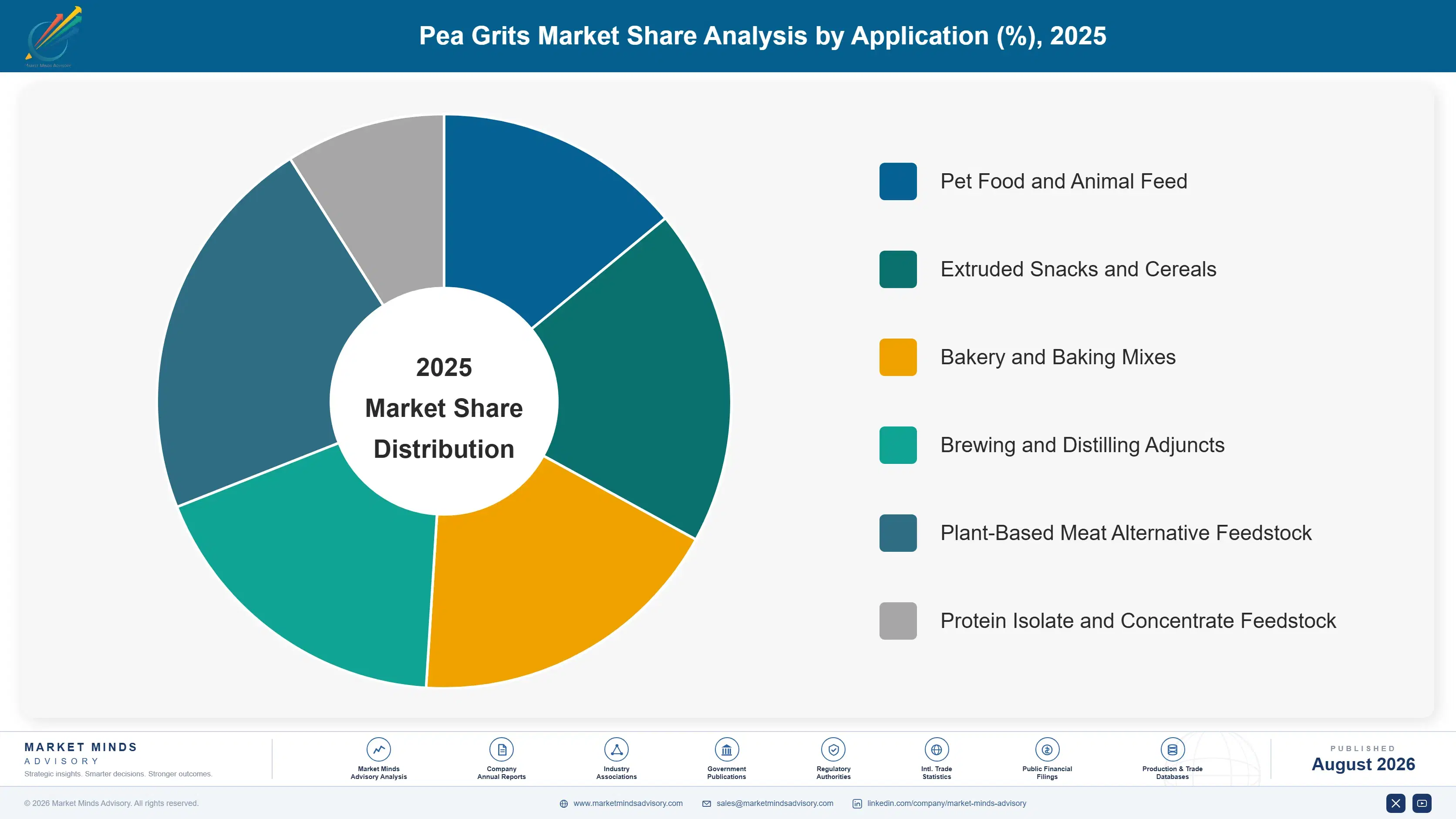
Segmentation follows end-use application, the single commercial logic determining grit grade, particle size, and buyer relationship structure. Pet food and animal feed dominate by volume, while plant-based meat and protein isolate feedstock applications are growing fastest on formulation-driven demand. Brewing, bakery, and snack applications each carry distinct buyer bases and specification cycles of their own.
pea-grits-market-trends-market-share-analysis-1787559174755

Plant-Based Meat Alternative Feedstock

Plant-based meat alternative feedstock grows fastest at 11.5%, about 1.60 times the overall 7.2% rate, as formulators increasingly specify pea protein isolate over soy in flagship meat analogue reformulations, citing both allergen positioning and functional extrusion performance. Pea grits serve as the primary feedstock for that isolate extraction process, and demand growth in isolate manufacturing capacity translates directly into feedstock grits demand at processing plants across North America and Europe. This reformulation trend has proven more durable than the broader plant-based meat category's overall growth rate, since it reflects genuine formulation preference within the category rather than pure category expansion. Suppliers here need consistency specifications considerably more rigorous than standard pet food grade material.
CAGR 11.5%

Protein Isolate and Concentrate Feedstock

Protein isolate and concentrate feedstock grows second-fastest at 9.0%, driven by expanding food and beverage industry demand for pea protein across products ranging from beverages to nutrition bars well beyond plant-based meat alone. Food companies increasingly specify pea protein isolate for its favourable allergen profile compared with soy and whey, expanding the addressable feedstock market considerably. Processors serving this segment require dedicated extraction-grade sourcing relationships distinct from standard pet food grade supply chains, favouring established processors with direct grower relationships over commodity traders lacking comparable traceability. This segment remains smaller than pet food by absolute volume but continues drawing dedicated processing investment. Contract terms typically span multiple years given extraction validation requirements.
CAGR 9.0%
Full segment breakdown across 6 segments available in the complete report.

Regional Architecture and Country Demand Map

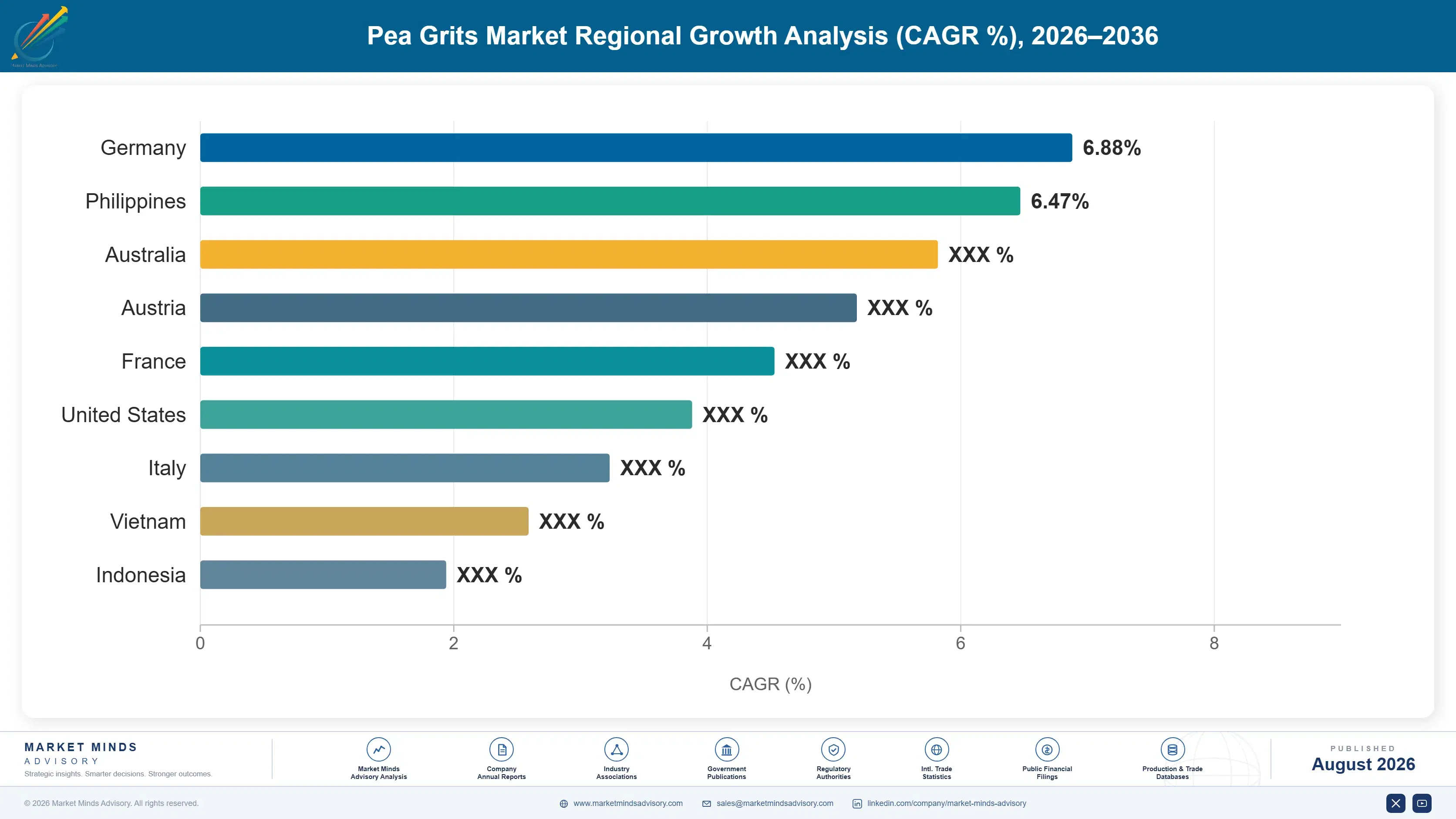
North America leads on Saskatchewan's dominant pea growing and processing base, Western Europe follows on established ingredient formulation depth, and South Asia and Pacific posts the fastest regional growth on expanding food manufacturing. Latin America and remaining regions add demand tied mostly to pet food and food manufacturing expansion.

North America

Saskatchewan's dominant global pea growing and processing base explains North America's 31% share, the largest of any region, anchored by AGT Food and Ingredients and Puris facilities drawing on some of the largest dried pea harvests found anywhere globally. American and Canadian pet food manufacturers anchor the region's largest single demand category, while plant-based meat and protein isolate feedstock demand has expanded meaningfully from domestic processing capacity built over the past decade. Growth of 7.5% tracks continued protein isolate feedstock demand expansion more than any new pet food volume growth, since American and Canadian pet food category growth is already broadly mature. Mexican demand remains a smaller extension of North American supply chains.
Share: 31% | CAGR: 7.5% (2026 to 2036)

Western Europe

Established food ingredient formulation expertise explains Western Europe's 24% share, though its 5.8% growth trails East Asia and South Asia given a more mature pet food and food ingredient base overall. French growing regions, anchored by Roquette's processing capacity, supply much of the region's pea grits alongside Canadian imports, giving European processors genuine multi-origin sourcing flexibility. Cosucra Groupe Warcoing and Emsland Group both maintain substantial European processing capacity serving pet food, bakery, and protein isolate customers across the continent. Growth stays modest because European pet food and bakery demand growth remains slower than Asian food manufacturing expansion specifically. Protein isolate demand is emerging as a genuine second growth driver here as well.
Share: 24% | CAGR: 5.8% (2026 to 2036)
Regional intelligence for 5 additional markets available in the complete report: East Asia, South Asia and Pacific, Latin America, Middle East and Africa, Eastern Europe. Contact sales@marketmindsadvisory.com.
pea-grits-market-trends-country-cagr-analysis-1787559175269

Where Processors Can Defend Margin

Crop yield risk sets the ceiling on margin in this market, but four commercial moves let processors capture more value above that ceiling regardless of origin country, and regardless of how any single harvest season's yield outcome ultimately turns out. nationally across every major growing origin and buyer segment. Processors combining several moves are pulling ahead of single-strategy rivals.

Build Protein Isolate Feedstock Grade Capability Early

Processors investing in protein content consistency and processing yield capability for isolate feedstock grade capture plant protein manufacturer contracts that pure pet food grade suppliers cannot service at required specification levels. This investment requires real capital and quality system development, but isolate-grade material already commands premiums of 15% to 25% over pet food grade pricing, and early movers are securing multi-year formulator relationships that later entrants will find considerably harder to displace once qualified. Later movers will find these early formulator relationships considerably harder to displace once qualified. Few competitors serve both buyer types with equal depth.
Market Impact: Captures a 15% to 25% price premium overall

Diversify Sourcing Across Multiple Growing Origins

Processors sourcing from Canada, France, and increasingly Australia simultaneously can shift volume toward whichever origin delivers acceptable yield in any given season, avoiding the total supply disruption single-origin buyers faced during recent Canadian yield shortfalls. This diversification requires investment in multiple supplier relationships and quality certification across origins, but it has proven decisive for maintaining year-round supply continuity across at least 3 distinct growing regions. Buyers increasingly treat this diversification as a baseline procurement requirement rather than an optional resilience measure. Buyers screening suppliers now routinely ask about origin diversification before signing any large volume contract.
Market Impact: Cuts supply disruption risk by roughly 40% overall

Lock Multi-Year Supply Contracts Ahead of Harvest

Buyers who commit to multi-year volume and price agreements before harvest season begins routinely secure better terms than those buying reactively on the spot market once yield outcomes are already known. Processors offering these contracts gain planning certainty that lets them invest confidently in isolate-grade processing capacity rather than scrambling for buyers each season, and premiums of 5% to 8% over spot pricing are common for guaranteed multi-year volume commitments spanning 3 to 5 years. Contract terms sequenced this way have proven decisive for maintaining stable processing economics across multiple seasons.
Market Impact: Locks in a 5% to 8% pricing premium

Build Traceable Single-Origin Supply Chains for Premium Brands

Pet food and food manufacturers increasingly specify traceable, single-origin pea grits to support premium label claims, and processors building dedicated traceability systems capture this premium positioning that commodity-sourced grits cannot access. This capability requires investment in supply chain documentation and grower relationship management, but it has proven valuable for winning premium formulation contracts worth considerably more than standard commodity-grade supply agreements over a typical 3-year contract. Competitors without comparable documentation struggle to compete on anything beyond price alone. Brand owners increasingly audit this documentation directly before renewing any premium formulation contract each year.
Market Impact: Wins roughly 18% more premium formulation deals overall

Who Controls the Margin Pool

Concentration sits at a moderate CR5 of 42%, measured consistently across all participants on pea ingredient processing revenue. Roquette Frères and AGT Food and Ingredients lead on integrated growing region access and processing scale respectively, and the gap to Puris and other challengers reflects feedstock sourcing depth rather than any single processing technology advantage a challenger cannot eventually close.
Competitive activity today runs along three lines: protein isolate feedstock grade capability investment targeting the fastest-growing segment, multi-origin sourcing diversification to reduce single-harvest exposure, and traceable single-origin supply chain development for premium pet food and food brands. Smaller regional processors increasingly pursue supply agreements with larger integrated companies rather than building direct isolate manufacturer relationships, given the capital intensity involved.

Pressure is building from plant protein manufacturers expanding feedstock sourcing relationships specifically to serve growing isolate extraction capacity, while pet food formulators increasingly demand traceable, single-origin supply. Any processor still relying purely on commodity pet food grade volume without isolate feedstock or traceability investment faces a widening margin disadvantage that pure processing scale cannot offset indefinitely. That widening gap should keep accelerating as isolate and traceability investment compound further across the industry.
pea-grits-market-trends-company-positioning-matrix-1787559175787

Competitive Moat and Risk Dimensions

ROQUETTE FRÈRES

Moat: Integrated multi-origin sourcing scale

Roquette operates processing facilities across both French and Canadian growing regions, giving it sourcing flexibility single-origin competitors lack entirely. Its established protein isolate manufacturing capability, built over decades of plant-based ingredient research, also lets it serve both pet food and plant protein customers from one integrated technical platform.
ROQUETTE FRÈRES

Risk: Complex portfolio dilutes focus

Roquette's breadth across dozens of plant-based ingredient categories beyond pea grits means this specific segment receives less dedicated management attention than at smaller, category-focused competitors. This could slow its response to fast-moving trends like plant-based meat reformulation relative to more specialized rivals. Faster-moving specialty rivals could capture emerging formulation trends more quickly.
AGT FOOD AND INGREDIENTS

Moat: Deep Saskatchewan grower relationships

AGT Food and Ingredients holds established relationships with Saskatchewan pea growers built over decades of direct sourcing, giving it feedstock access and quality consistency that newer entrants cannot replicate quickly. Its logistics infrastructure across major growing regions also lets it serve both pet food and export customers efficiently.
AGT FOOD AND INGREDIENTS

Risk: Concentrated feedstock geography

AGT's reliance on Saskatchewan growing regions concentrates its feedstock risk in a single geographic area, exposing it to any localized weather disruption or yield shortfall more directly than geographically diversified competitors. This concentration could become a genuine vulnerability during a sustained regional drought or crop failure event.

Players Tracked

Prominent Players

Roquette Frères
AGT Food and Ingredients
Puris Proteins
Ingredion Incorporated
Cosucra Groupe Warcoing

Other Key Players

Emsland Group
Vestkorn Milling
Yantai Shuangta Food
Sotexpro
Nutri-Pea Limited
Best Cooking Pulses
Parrheim Foods
Anchor Ingredients
Verdient Foods
Meelunie
Diefenbaker Spice and Pulse
Farbest Brands
Glanbia plc
Kerry Group
Batory Foods

Recent Developments

FEBRUARY 2025

Roquette expands pea processing capacity in Manitoba

Roquette Frères completed a capacity expansion at a pea processing facility in Manitoba, adding protein isolate feedstock grade production lines ahead of rising plant protein demand. The project was an organic capacity expansion funded internally, not an acquisition or joint venture, and targeted North American plant protein manufacturer customers specifically.
Signal: Global processors keep investing directly in Canadian capacity rather than relying purely on spot-market feedstock purchases.
OCTOBER 2024

Puris signs plant-based meat feedstock supply agreement

Puris Proteins signed a multi-year raw pea grits supply agreement with a major plant-based meat manufacturer covering several growing seasons of guaranteed feedstock volume. The arrangement was a commercial supply contract, not an equity investment or joint venture, and included built-in pricing clauses tied to yield outcomes.
Signal: Plant protein manufacturers are locking in multi-year feedstock supply well ahead of broader category demand growth.
JUNE 2025

Ingredion acquires pea ingredient processor

Ingredion Incorporated acquired a smaller pea ingredient processor outright, a genuine acquisition rather than a joint venture or minority stake, adding protein isolate feedstock capability and expanding its regional processing footprint. Terms of the transaction were not disclosed. The deal closed within the same quarter.
Signal: Diversified ingredient companies are increasingly buying specialized pea processing capability rather than building it entirely internally.

Raw Pea Procurement and Harvest Risk

Raw dried pea procurement runs 58% of cost of goods sold across integrated processors, sourced from growers across Saskatchewan, France, and increasingly Australia under a mix of spot purchase and pre-harvest contract arrangements. Milling, quality testing, and packaging add a further 18% to 24%, with logistics and distribution making up the remainder of total processing cost.
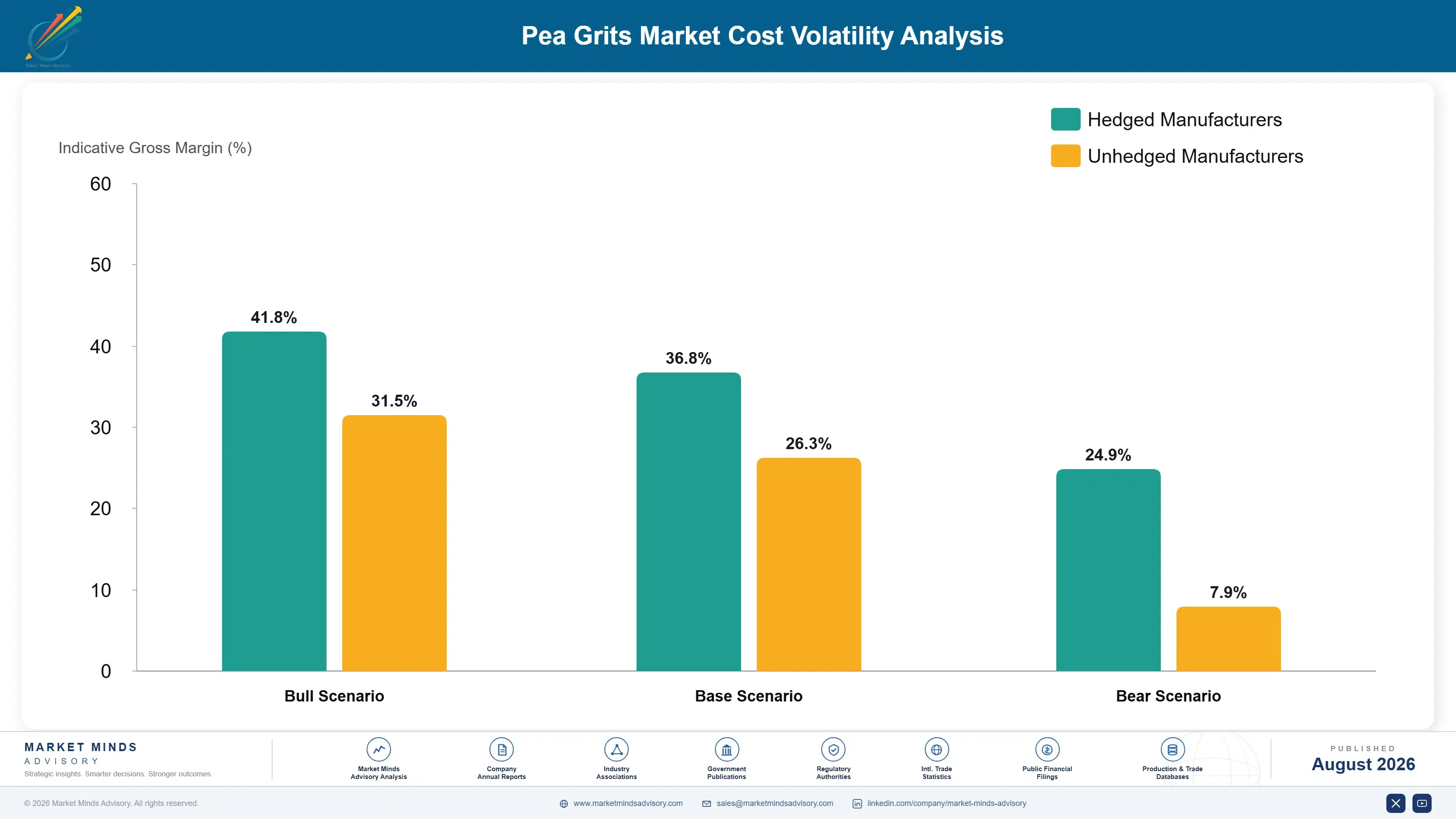
The 2021 Canadian drought showed how directly that exposure translates into buyer cost. Severe drought conditions across Saskatchewan cut pea yields sharply that season, and Canadian government agricultural data recorded pea production falling substantially compared with the prior year. Global buyers without diversified sourcing paid materially higher spot prices to secure replacement volume from French and other suppliers on short notice. Smaller processors absorbed the increase almost immediately into thinner margins.

Exposure separates buyers cleanly by sourcing strategy. Multi-origin buyers with contracts spanning Canada, France, and Australia absorbed that shock by shifting volume toward unaffected origins, while single-origin buyers dependent purely on Canadian supply carried the full price spike directly into their own cost structure. That gap has hardened into a durable disadvantage for any processor unwilling to invest in multi-origin sourcing relationships.
pea-grits-market-trends-cost-volatility-analysis-1787559175984

Diversify sourcing across at least three growing origins

Buyers sourcing from Canada, France, and Australia simultaneously can shift volume toward whichever origin delivers acceptable yield in any given season. This approach has proven decisive during recent Canadian yield shortfalls, letting diversified buyers avoid the spot-price spikes that hit single-origin competitors hard during the 2021 disruption specifically. Several larger buyers now treat this as standard procurement practice.

Sign pre-harvest contracts with built-in yield clauses

Locking price and volume before harvest outcomes are known removes much of the spot-market volatility that follows a poor season, provided contracts include yield-shortfall clauses that share risk fairly between grower and buyer. This structure has become increasingly standard among large processors seeking supply predictability across multiple growing seasons. Growers generally accept these clauses since they remove contract-loss risk.

Invest in storage to smooth seasonal price swings

Processors holding meaningful grain storage inventory can sell steadily through the year rather than being forced to buy expensive replacement volume during shortfalls or dump excess supply during bumper harvests. The capital cost is real but has proven worthwhile for processors serving buyers who demand year-round supply continuity regardless of any single season's outcome.

Portfolio Architecture for Margin Defence

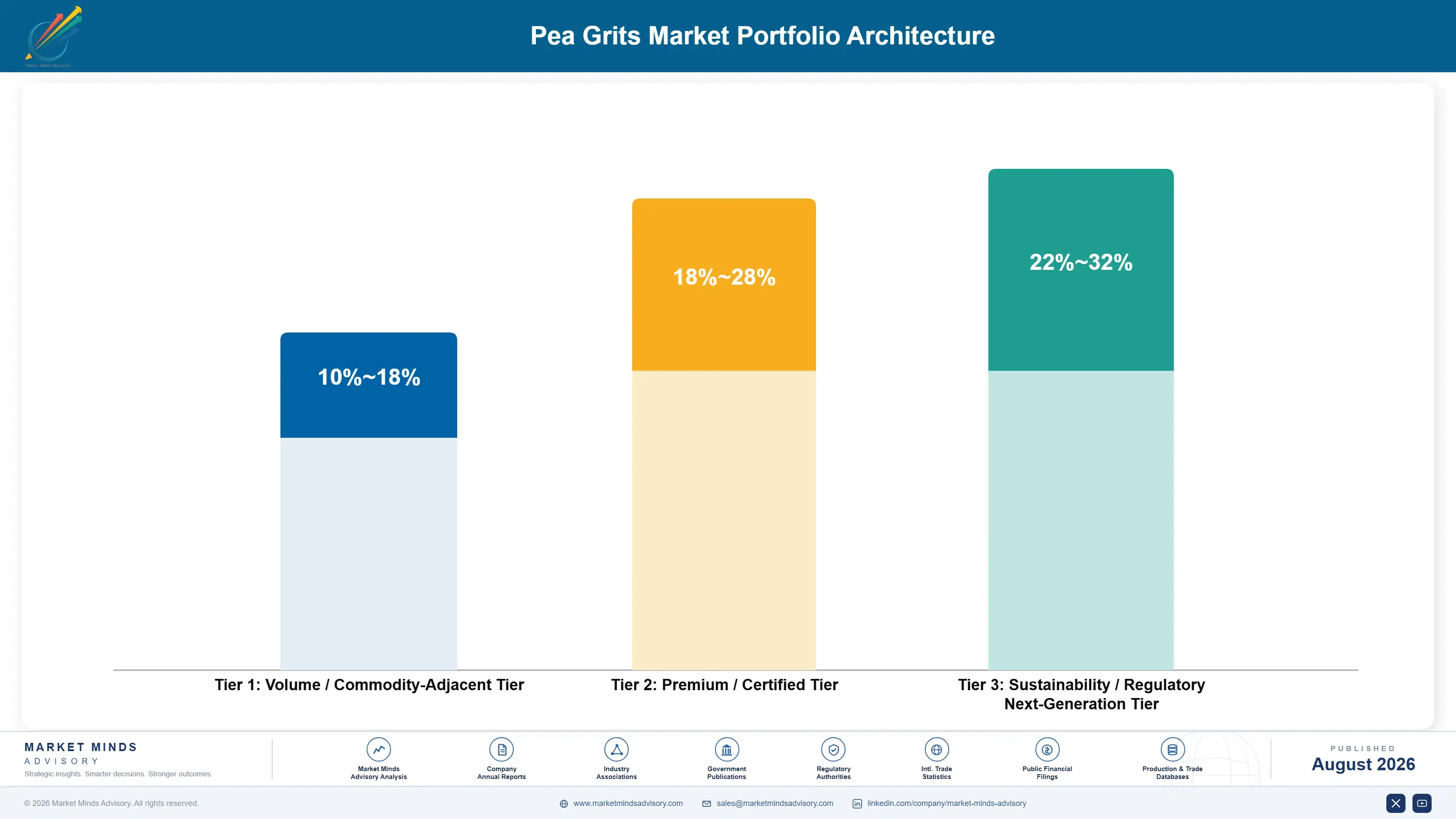
The portfolio splits into three tiers with real margin separation tied to specification depth and buyer sophistication rather than raw pea variety alone. Standard pet food grade grits compete almost entirely on delivered cost against harvest-year benchmark pricing, while protein isolate and traceable single-origin grades earn meaningfully more on consistency and documentation that commodity grits simply cannot match at any price. Buyers increasingly specify grade explicitly during supplier qualification rather than treating pea grits as one undifferentiated commodity.
The tension between volume and premium runs through every processor's sourcing decision each season. Bulk pet food grade volume dwarfs protein isolate and traceable categories and will likely keep doing so for years, yet margin increasingly concentrates in isolate feedstock and single-origin traceable grits that require dedicated quality infrastructure most bulk-focused processors have never built. That specification gap, more than any difference in underlying pea variety, is what separates the tiers most sharply today.

High-value pools concentrate specifically where formulation requirements or traceability demands limit substitutable supply: protein isolate feedstock commanding the strictest consistency premiums, and traceable single-origin grits serving premium pet food and food brands willing to pay for recognisable provenance.

Volume / Commodity-Adjacent Tier

Standard pet food and animal feed grade grits sold largely on harvest-year delivered cost against benchmark pricing across major trade lanes. Producers here compete on delivered cost and logistics reliability far more than on any formulation advantage.
Gross Margin: 10-18%

Premium / Certified Tier

Traceable single-origin grits meeting premium pet food and food brand specification requirements, commanding real premiums over commodity-grade material. Buyers rarely switch suppliers once documentation and traceability systems are fully established.
Gross Margin: 18-28%

Sustainability / Regulatory / Next-Generation Tier

Protein isolate feedstock grade grits meeting the consistency and yield requirements of plant-based meat and protein manufacturers. Supply remains genuinely constrained by consistency requirements most bulk-focused processors lack. Manufacturers demand rigorous, ongoing quality documentation from every qualified supplier.
Gross Margin: 22-32%
pea-grits-market-trends-portfolio-architecture-1787559176482

High-value Sub-segments and Strategic Watch-out

Plant-Based Meat Alternative Feedstock

High value and the fastest-growing segment at 11.5% CAGR, anchored by formulator preference for pea protein isolate over soy in flagship meat analogue reformulations. Premiums reflect genuine consistency requirements rather than brand positioning alone. Early movers are locking in formulator relationships before slower competitors even complete comparable investment.
Gross Margin: 22-30%

Protein Isolate and Concentrate Feedstock

High value with strong second-fastest growth at 9.0%, driven by expanding food and beverage industry pea protein demand beyond plant-based meat alone. Supply remains constrained by extraction-grade sourcing requirements that generic pet food suppliers lack. Multi-year specification cycles compound this advantage further for early technical leaders.
Gross Margin: 20-28%

Standard Pet Food and Animal Feed Grits

The volume core of the market, competing on harvest-year delivered cost against benchmark pricing with thin margins and intense processor rivalry across every major trade lane. Growth tracks pet food category consumption directly. Producers here compete almost entirely on delivered cost and harvest-year pricing. Little differentiation exists beyond delivery reliability.
Gross Margin: 10-18%

Single-Origin Dependent Processors

The strategic watch-out. Processors sourcing from only one growing region carry real exposure to the yield shortfalls that have hit Canadian harvests periodically, and continued weather variability threatens their long-term reliability against diversified multi-origin competitors. These processors risk losing relevance as diversified competitors increasingly define category leadership.
Gross Margin: 6-14%

Contract Timing and Buyer Switching Cost

Demand here runs overwhelmingly on pre-harvest annual contracts rather than spot transactions for major buyers, since pet food and plant protein manufacturers need volume certainty locked in months before any given season's yield outcome is even known. Contract negotiation typically concludes before harvest begins each year, giving processors who deliver reliably a real advantage in the following season's renewal discussions. Missing a renewal window can cost a processor years of relationship-building effort to win the account back.
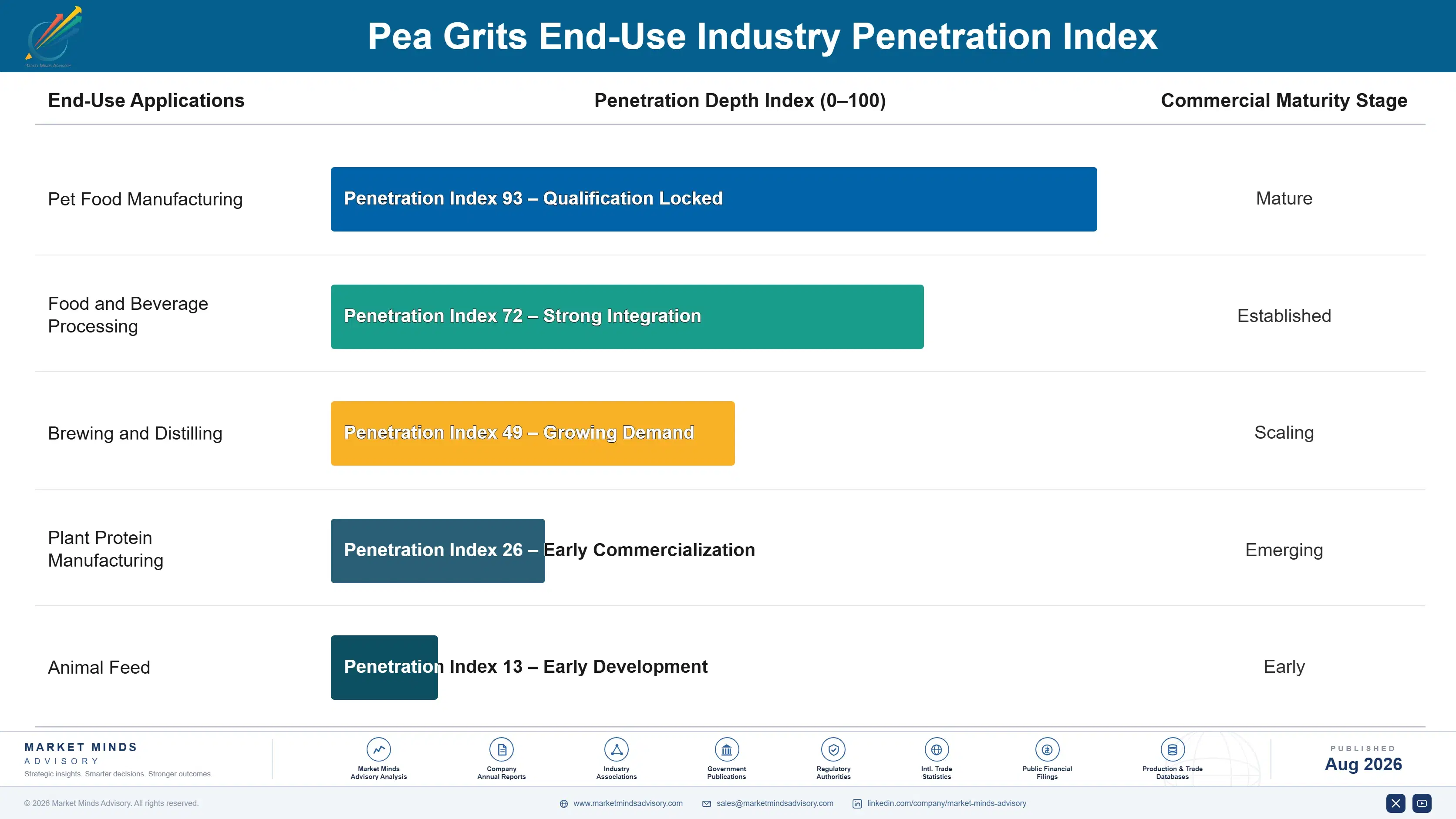
Adoption depth varies sharply by end-use vertical. Plant protein and isolate feedstock manufacturers show the strongest supplier loyalty once a qualified relationship is established, given the extraction process validation required to switch sources, while bulk pet food grade buyers switch relatively freely based on harvest-year pricing alone. Bakery and snack buyers sit between the two, valuing delivery reliability and consistency over strict long-term supplier commitment.

Buyer profiles have shifted generationally as plant protein sourcing moved from a niche premium positioning to a mainstream procurement requirement across most major food and pet food companies. Younger procurement teams now weigh traceability and harvest-risk resilience alongside price, a shift that favours processors with genuine multi-origin sourcing capability over single-region suppliers competing purely on cost.
pea-grits-market-trends-end-use-penetration-index-1787559176977

Where Sourcing Resilience Decides Outcomes

These are among the four positions where our research anticipates prominent divergence between winners and laggards over the coming forecast period. Each is grounded in the demand model, the regulatory perimeter, and the announced capacity pipeline.
01 / MULTI-ORIGIN SOURCING PRIORITY

Diversified sourcing will separate resilient processors from exposed ones

Processors dependent on a single growing region carry real exposure to the yield volatility that has hit Canadian harvests periodically, and that exposure will not close through processing efficiency alone since it stems from weather rather than management execution. Buyers have already begun favouring multi-origin suppliers who can absorb a single-region shortfall without disrupting supply commitments, and processors slow to diversify risk losing preferred-supplier status entirely. Expect continued investment in French and Australian sourcing specifically to reduce concentrated Canadian exposure across the industry.
02 / PROTEIN ISOLATE FEEDSTOCK RACE

Early isolate capability investment will outcompete late entrants

Plant protein manufacturers demand the strictest consistency and yield specifications in the market, and that requirement leaves little room for processors who delay building dedicated capability until demand is already fully proven. Isolate feedstock capacity remains genuinely scarce today relative to the segment's 11.5% growth rate, sustaining real premiums for early movers who invested ahead of the requirement across every major origin. Processors building this capability now capture premium pricing well before broader industry investment eventually compresses that advantage for everyone else.
03 / TRACEABILITY AND PREMIUM POSITIONING

Single-origin traceable supply will keep commanding real premiums

Premium pet food and food brands increasingly specify traceable, single-origin pea grits to support label claims, and processors building dedicated traceability systems are capturing this premium positioning that commodity-sourced grits cannot access at all. This capability requires genuine investment in supply chain documentation and grower relationship management rather than simple branding, and processors slow to build it risk losing share to more transparent competitors entirely. Expect continued premium capture by processors who built traceability infrastructure well ahead of brand-owner demand becoming widespread.
04 / ASIAN FOOD MANUFACTURING GROWTH

Indian and Chinese food manufacturing will keep driving new demand

India and China's expanding food manufacturing capacity is a genuine driver of pea grits demand growth, and that expansion shows no sign of slowing given rising domestic consumer interest in plant protein and premium pet food across both markets. Processors building regional sourcing and distribution capability directly in these markets will capture demand growth that exporting from distant Western facilities cannot serve as efficiently, and those without presence will find it hard to capture remotely. Expect continued capacity investment concentrating specifically in India and China as food manufacturing keeps expanding.

Engagement Snapshot From the Field

A live engagement with an industry participant carrying material or product regulatory and market exposure ahead of a defining policy shift, showing how our research translates into a defensible multi-year portfolio strategy.
MARKET MINDS ADVISORY · CLIENT ENGAGEMENT SUMMARY
Pea Grits Producer Strategic Portfolio Review and Transition Roadmap 2026·Investment Scenario on Pea Grits Exposure Evaluation 2025-26
CLIENT PROFILE
A plant-based meat manufacturer supplying retail and foodservice customers across North America approached MMA while facing rising pea protein isolate cost following a poor Canadian harvest season. The client reported annual pea protein feedstock spend near USD 18 million, with more than 80% of its supply sourced from a single Canadian processor prior to the disruption (client-reported, unverified by MMA).
STRATEGIC CHALLENGE
Management needed to rebuild feedstock sourcing resilience after the disruption exposed how concentrated its supply chain had become, while avoiding a costly spot-market scramble each time Canadian yields underperformed. The procurement team wanted to diversify suppliers quickly, while the quality function worried that new origins would require lengthy requalification that could disrupt production continuity.
MMA APPROACH
MMA benchmarked pea grits quality, cost, and yield-reliability data across Canadian, French, and Australian growing regions, then modelled realistic multi-origin sourcing allocations that would have avoided the client's recent shortfall entirely. We also assessed requalification timelines and cost for each candidate origin against the client's existing extraction process requirements. We benchmarked lead times against comparable regional manufacturers that had already diversified.
KEY FINDINGS
  1. The client's single-origin exposure meant a single Canadian weather event disrupted more than 80% of its feedstock supply simultaneously, a concentration risk far beyond what management had previously assumed (client-reported, unverified by MMA).
  2. French and Australian pea grits matched Canadian quality specifications closely enough that requalification could be completed within one growing season rather than the multi-year timeline initially feared.
  3. A three-origin sourcing model spanning Canada, France, and Australia would have fully covered the recent shortfall without any spot-market purchase at all.
  4. Locking multi-year contracts across all three origins simultaneously secured better blended pricing than the client's previous single-origin arrangement. while preserving continuity across the client's existing extraction line schedule.
CLIENT PROFILE
A plant-based meat manufacturer supplying retail and foodservice customers across North America approached MMA while facing rising pea protein isolate cost following a poor Canadian harvest season. The client reported annual pea protein feedstock spend near USD 18 million, with more than 80% of its supply sourced from a single Canadian processor prior to the disruption (client-reported, unverified by MMA).
STRATEGIC CHALLENGE
Management needed to rebuild feedstock sourcing resilience after the disruption exposed how concentrated its supply chain had become, while avoiding a costly spot-market scramble each time Canadian yields underperformed. The procurement team wanted to diversify suppliers quickly, while the quality function worried that new origins would require lengthy requalification that could disrupt production continuity.
MMA APPROACH
MMA benchmarked pea grits quality, cost, and yield-reliability data across Canadian, French, and Australian growing regions, then modelled realistic multi-origin sourcing allocations that would have avoided the client's recent shortfall entirely. We also assessed requalification timelines and cost for each candidate origin against the client's existing extraction process requirements. We benchmarked lead times against comparable regional manufacturers that had already diversified.
KEY FINDINGS
  1. The client's single-origin exposure meant a single Canadian weather event disrupted more than 80% of its feedstock supply simultaneously, a concentration risk far beyond what management had previously assumed (client-reported, unverified by MMA).
  2. French and Australian pea grits matched Canadian quality specifications closely enough that requalification could be completed within one growing season rather than the multi-year timeline initially feared.
  3. A three-origin sourcing model spanning Canada, France, and Australia would have fully covered the recent shortfall without any spot-market purchase at all.
  4. Locking multi-year contracts across all three origins simultaneously secured better blended pricing than the client's previous single-origin arrangement. while preserving continuity across the client's existing extraction line schedule.
RECOMMENDED STRATEGY
Phase 1: Phase 1 (0 to 6 months): Qualify French and Australian suppliers in parallel while maintaining existing Canadian volume commitments. Begin joint testing within the first sixty days. Phase 2: Phase 2 (6 to 18 months): Shift 35% of total volume to the newly qualified origins, rebalancing exposure away from Canada specifically. Phase 3: Phase 3 (18 to 36 months): Formalise a three-origin, multi-year sourcing model with yield-shortfall pricing clauses at each origin. Review terms annually against realised yield data.
OUTCOME
The client completed multi-origin qualification within one growing season, well ahead of the multi-year timeline it had originally feared, and avoided any spot-market purchase during the following season's Canadian yield shortfall. The diversified sourcing model also reduced average feedstock cost by a reported 7% through improved negotiating leverage across three competing origins (client-reported, unverified by MMA).

Frequently Asked Questions

Foundational context covering the market sizes, CAGR, scope, country, region and competition that inform every finding below. This section is provided to cover basics and most often pre-purchase conversations, answered from the MMA Primary Research Dataset.

What is the current size of the Pea Grits Market?

The pea grits market reached USD 0.92 billion in 2025. This figure covers pet food, animal feed, bakery, and plant protein feedstock sales sold globally.

How large will the Pea Grits Market be by 2036?

The market is projected to reach USD 1.98 billion by 2036 under the base case scenario. That represents a 2.00 times expansion over the 2026 starting value.

What is the CAGR for the Pea Grits Market 2026 to 2036?

The base case CAGR is 7.2%, with a bull case of 8.4% and a bear case of 6.0%. Plant protein feedstock demand and harvest yield variability drive most of the variance.

Which segment is growing fastest?

Plant-based meat alternative feedstock grows fastest at 11.5% CAGR, about 1.60 times the overall market rate. Formulator preference for pea protein isolate over soy drives this growth directly.

Who are the major companies in the Pea Grits Market?

Leading processors include Roquette Frères, AGT Food and Ingredients, Puris Proteins, Ingredion Incorporated, and Cosucra Groupe Warcoing. These five hold roughly 42% combined market share.

Which country is growing fastest?

India posts the fastest national growth at 9.8% CAGR, driven by expanding food manufacturing capacity and rising plant protein awareness. Growing domestic consumer interest anchors most of this growth.

Report Segmentation Architecture

The full report scope spans multiple orthogonal segmentation dimensions, with cross-tabulated demand data provided for each dimension pair. Coverage extends further to regional breakdowns, trend trajectories, and the competitive detail needed to support segment-level decision-making.

By Application

  • Pet Food and Animal Feed
  • Extruded Snacks and Cereals
  • Bakery and Baking Mixes
  • Brewing and Distilling Adjuncts
  • Plant-Based Meat Alternative Feedstock
  • Protein Isolate and Concentrate Feedstock

By End-Use Industry

  • Pet Food Manufacturing
  • Food and Beverage Processing
  • Brewing and Distilling
  • Plant Protein Manufacturing
  • Animal Feed

By Commercial Dimension

  • Direct Processor Supply
  • Distributor and Trader Channel
  • Long-Term Contract Sales
  • Spot Market Sales

By Region

  • North America
  • Western Europe
  • East Asia
  • South Asia and Pacific
  • Latin America
  • Middle East and Africa
  • Eastern Europe

Scope, Methodology, and Coverage

Every figure in this report is reproducible from documented input assumptions. The scope below maps the historical period, the forecast horizon, the segmentation dimensions, and the countries covered, alongside the underlying primary and qualitative methodology.
Historical Period
2020 to 2025
Forecast Period
2026 to 2036
Base Year
2025 (USD billions; MMA Primary Research Dataset, August 2026)
Market Definition
This market comprises pea grits, coarsely milled or cracked dried yellow and green pea, sold as an ingredient into pet food, animal feed, snack and bakery, brewing, and plant protein extraction applications. Whole dried peas, pea protein isolate itself, and fresh or frozen peas are excluded from this scope.
Quantitative Units
USD billions (current prices); metric tonnes of pea grits volume where applicable
Segmentation Dimensions
By Application; By End-Use Industry; By Commercial Dimension; By Region
Regions Covered
North America, Western Europe, East Asia, South Asia and Pacific, Latin America, Middle East and Africa, Eastern Europe
Countries Covered
USA, China, Germany, France, UK, Japan, South Korea, India, Australia, Canada, Brazil, Mexico, Indonesia, Vietnam, Thailand, Malaysia, UAE, Saudi Arabia, South Africa, Nigeria, Turkey, Poland, Netherlands, Italy, Spain, Sweden, Switzerland, Argentina, Colombia, Singapore, and additional markets relevant to this sector
Key Companies Profiled
Roquette Frères, AGT Food and Ingredients, Puris Proteins, Ingredion Incorporated, Cosucra Groupe Warcoing, Emsland Group, Vestkorn Milling, Yantai Shuangta Food, Sotexpro, Nutri-Pea Limited, Best Cooking Pulses, Parrheim Foods, Anchor Ingredients, Verdient Foods, Meelunie, Diefenbaker Spice and Pulse, Farbest Brands, Glanbia plc, Kerry Group, Batory Foods
Quantitative Methodology
Primary survey, n=3,800 respondents, Q4 2025, six countries; demand-side model with trade association cross-validation
Qualitative Methodology
47 expert interviews, Q4 2025; applied to validate demand model assumptions, identify emerging dynamics, and assess competitive positioning
Report Format
PDF and XLSX data workbook (Word format preview document)
Publisher
Market Minds Advisory
Report Code
MMA-2026-AGR-244
Published
August 2026
Contact
sales@marketmindsadvisory.com | www.marketmindsadvisory.com

Purchase the full Pea Grits Market Report (2026 to 2036).

The full MMA Pea Grits report sizes the market across six application segments, five end-use industries, four commercial channels, and seven regions through 2036. It profiles twenty processors on a consistent basis of pea ingredient processing revenue, scoring each on multi-origin sourcing resilience, isolate feedstock readiness, and traceability capability. Scenario models quantify how harvest yield variability, plant-based meat reformulation, and pet food category trends move both supply reliability and realised pricing. The report also includes delivered-cost modelling by origin, a harvest-risk exposure screen, and protein isolate feedstock segment economics built for procurement, strategy, and investment teams.
Six-segment global application demand breakdown detail
Origin-by-origin delivered-cost bridge modelling review detail
Harvest-risk exposure screening framework detail overview
Processor sourcing resilience benchmarking detail review
Protein isolate feedstock economics deep detail
Regional trade flow corridor mapping review

Built For The People Who Decide

From boardroom strategy to bench-side execution, this report is read cover-to-cover by leaders shaping the next decade of their industry, turning demand scenarios, market dynamics and valuation benchmarks into decisions.
CXOs/ Presidents/ VPs/ Managers
M&A and Corporate Development
Strategy Teams and R&D Heads
Procurement and Product Directors
Regulatory and Compliance Leaders
Investor Relations and Equity Analysts