Market Minds Advisory
Pea Flakes Market

Pea Flakes Market: Micronisation Economics, Feedstock Competition and Protein Autonomy Policy, 2026 to 2036

Pea protein isolate plants now bid for exactly the same field peas that flaking mills need, and that single competing demand has changed feedstock economics for everyone processing the crop.

Lead Analyst

Lisa Gevelber

Published

September 2026

Make Smarter Decisions with Customized Research Insights

Request a free sample report and evaluate market opportunities, growth trends, and competitive dynamics relevant to your business needs.

2025 MARKET VALUE$0.6BMarket Size 2025
2036 FORECAST VALUE$1.2BBase Case , 2026 to 2036
CAGR 2026 TO 20366.2 %Bull 7.4% / Bear 5.0%
INCREMENTAL OPPORTUNITY$0.5BNet 10- year value creation
EXPANSION MULTIPLE1.83x2036 value over 2026 base
Strategic Levers
M&A Pipeline
Regional Outlook
Country Rankings
Competitive Intelligence
Segmental Deep-dive
Call-Us : 91 93563 13602

Executive Snapshot and Market Trajectory

Heat treatment is the only thing separating a commodity pulse from a functional ingredient here. Micronisation gelatinises pea starch and destroys the trypsin inhibitors and lectins that limit digestibility, and that single processing step is why flaked peas sell well above the whole peas they were made from.
Micronised pea flakes grow at 9.3%, a full 1.50 times the market rate, pulled by pet food formulators reformulating away from grain and by European feed compounders working under protein autonomy targets. East Asia holds 28% of global value, the largest single share, because China imports more field peas than any other country and converts a growing proportion into flaked and processed forms rather than whole pulse.
Concentration is low at 29% for the top five, which is normal where processing sits close to the crop and regional millers hold local supply relationships. Raw peas are 58% of cost of goods, and the competitive picture changed when pea protein isolate plants began bidding for exactly the same feedstock. Flaking mills now compete for crop against buyers whose end product sells at several times flake pricing per tonne of input.
Market Definition
The market covers pea flakes produced by rolling or flaking field peas, including micronised, pre-gelatinised, steam-rolled, split and coarse feed grades, supplied into animal feed, pet food and human food applications. It excludes whole and split peas sold unprocessed, pea protein isolates and concentrates, pea starch and fibre fractions, pea flour and grits, fresh and frozen garden peas, and other pulse flakes made from beans, lentils or chickpeas.
Base Year Value
$0.6B in 2025 (MMA Primary Research Dataset, August 2026)
Forecast Period
2026 to 2036, eleven discrete annual values
CAGR
6.2% base case. Bull 7.4%. Bear 5.0%.
Fastest Growth Segment
Micronised Pea Flakes: 9.3% CAGR
Fastest Growth Country
India: 9.0% CAGR
Fastest Growth Region
South Asia and Pacific: 8.5% CAGR
Largest Region
East Asia: 28% of 2025 global value
Market Leaders
AGT Food and Ingredients, Roquette, Emsland Group, Vestkorn Milling, Limagrain Ingredients. Source: MMA Primary Research Dataset, July 2026.
Primary Survey
n=3,800 procurement and R&D decision-makers, Q4 2025, six countries
Methodology
Demand-side build-up, cross-validated against public data, 47 expert interviews

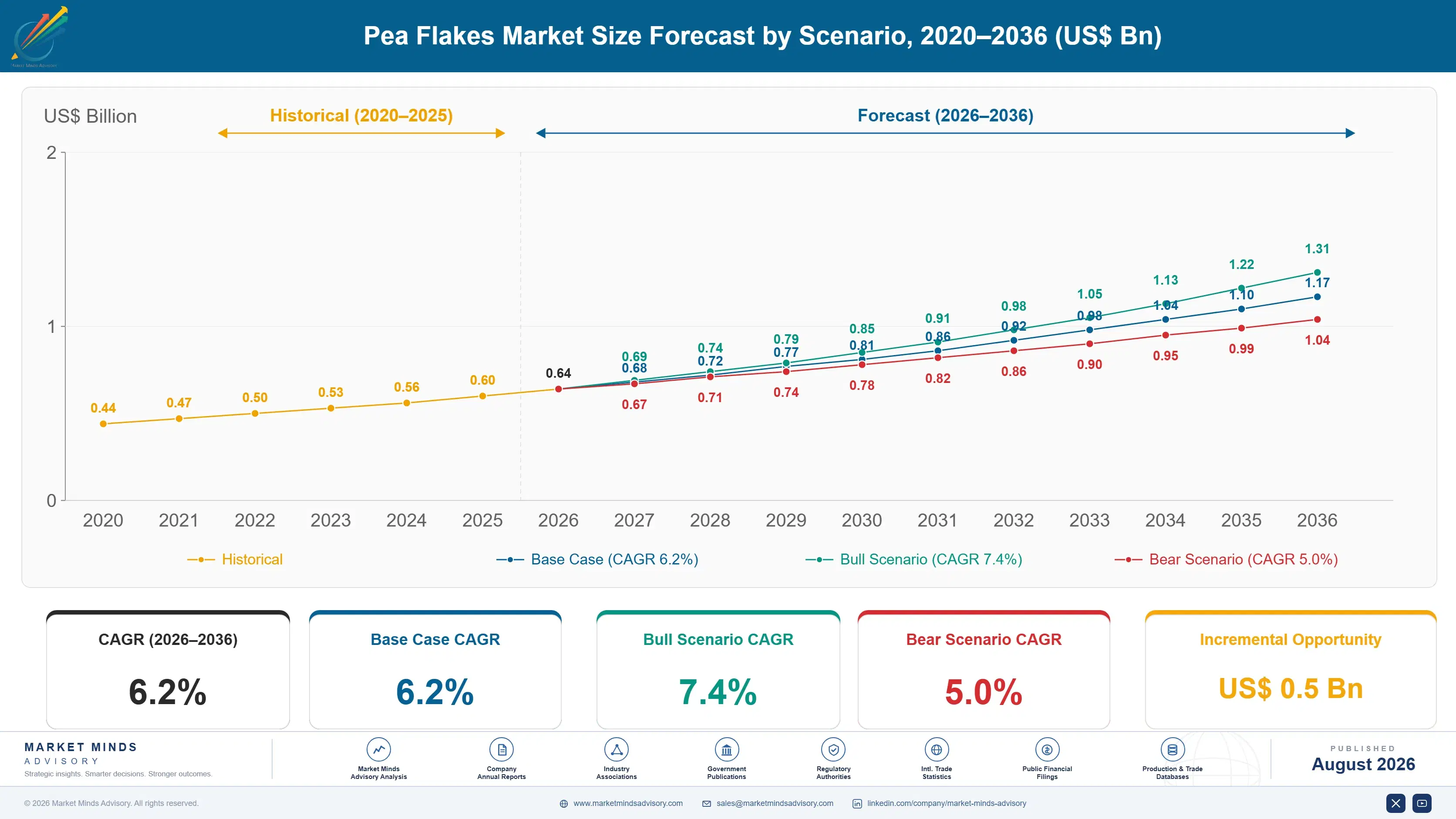
Pea Flakes Market Forecast Scenarios

pea-flakes-market-trends-size-forecast-scenario-1787312543281
The market compounded at 5.0% between 2020 and 2025, and feedstock availability shaped the pattern as much as demand did. Canadian pea crops varied sharply, with the 2021 drought cutting exportable supply and lifting prices well into the following year. Pet food demand grew steadily throughout, while European feed compounders began substituting peas for imported soybean meal in earnest.
The 6.2% base case rests on three mechanisms. First, pet food formulators continue using peas as a grain replacement and as a functional carbohydrate, and micronised flakes suit extrusion better than raw pulse does. Second, European protein autonomy policy keeps pushing feed compounders toward domestically grown pulses and away from imported meal. Third, human food applications expand as pulse-based convenience products, instant soups and high-protein snacks take shelf space they did not previously hold.
The bull case at 7.4% assumes European protein substitution targets tighten as announced while pet food premiumisation continues. The bear case at 5.0% turns on feedstock competition: pea protein isolate capacity additions bidding for the same crop would raise raw pea costs beyond what flake pricing can absorb, and flaking mills would lose volume to processors whose end product carries far more value per input tonne.

Why Heat Treatment Creates The Value

A field pea and a micronised pea flake are the same crop with a very different commercial character. Raw peas carry trypsin inhibitors, lectins and resistant starch that limit how much a monogastric animal can actually digest, which caps inclusion rates in feed formulations regardless of price.
TOP FIVE CONCENTRATION29%Combined position of the five largest pea flaking processors
AVERAGE SELLING PRICE$780 per tonneTypical realised price across feed and food grades
LEADING EXPORT COUNTRY SHARE26%Canadian share of global field pea export supply
RAW PEA COST SHARE58% of COGSField pea feedstock share of delivered processing cost
FEED DEMAND SHARE62%Portion of output consumed by animal and pet feed
FLAKING YIELD RATE88%Share of input pea converted into saleable flake product
Micronisation removes that constraint. Infrared heating raises the internal temperature quickly enough to gelatinise starch and denature the antinutritional factors, and the pea is then rolled while still hot. The resulting flake permits inclusion rates roughly double what raw peas allow in pig, poultry and pet food formulations. That is the whole basis of the price premium, and it is why the market divides so cleanly between processors who own micronisation capability and those simply rolling peas cold.
Feedstock competition has become the defining commercial pressure. Pea protein isolate plants built across Canada, Europe and China since 2019 buy the same yellow peas that flaking mills need, and their end product sells at many times flake pricing per tonne of input. A flaking mill therefore competes for crop against a buyer with far greater ability to pay. Processors with grower contracts or origination relationships hold a position that spot purchasers increasingly cannot.
"Nobody built a pea protein plant thinking about what it would do to the flaking industry, but that is where the real consequence landed. Millers who spent decades buying peas comfortably on the spot market now find themselves outbid by a factory whose product sells for four times what theirs does. The technology gap matters, but the crop contract matters more."
Senior Analyst, Pulse Processing and Feed Ingredients Practice · MMA Agriculture

Market Trends

Pet Food Reformulation Pulls Peas Into Premium Recipes

Grain-free and limited-ingredient pet food positioning has made peas a standard carbohydrate and protein carrier across premium dry formulations, and micronised flakes extrude far more predictably than raw pulse does through a twin-screw line. Peas now appear in roughly 34% of premium dry dog food formulations sold across North America and Western Europe, against under 20% only a decade earlier. Pet food pays considerably better than livestock feed and its buyers specify consistency rather than negotiating purely on price, which changes the commercial character of this volume entirely against livestock feed supply.
Market Impact: Expands European pulse area 18%

Protein Isolate Plants Compete For The Same Crop

Pea protein isolate capacity built across Canada, Europe and China since 2019 buys yellow peas from exactly the growing regions flaking mills depend on, and that isolate sells at several times flake pricing per tonne of the input crop consumed. That capacity has added roughly 900,000 tonnes of annual pea demand into a crop whose planted area responds slowly. Flaking mills without grower contracts now find themselves outbid in tight years. The commercial response has been contracting acreage directly with growers rather than continuing to buy through the elevator system at all.
Market Impact: Supplies 21% of pea flake volume

Market Opportunities and Growth Drivers

European Protein Autonomy Policy Substitutes Domestic Pulses

European Union and national protein strategies aim to reduce dependence on imported soybean meal, and field peas are the most practical domestically grown substitute across much of the continent. Compounders have raised pulse inclusion in pig and poultry rations accordingly, and micronisation is precisely what allows those inclusion rates to rise without depressing animal performance. European pulse area has expanded roughly 18% since 2020 under these programmes. The demand this creates is policy-driven rather than price-driven, which makes it unusually durable through the feed commodity cycles that move everything else.
Market Impact: Exposes 58% of processing cost

Equine And Specialty Feed Demand Values Digestibility

Horse feed, calf starter and specialty ruminant rations all pay for digestibility and palatability in ways commodity livestock feed does not, and micronised pea flakes deliver both while adding starch that is gelatinised rather than resistant. Those segments accept ingredient costs several times higher than any broiler ration would ever tolerate. Specialty and equine feed now accounts for roughly 21% of pea flake volume at a considerably larger share of value. Buyers here also change formulations slowly, which makes this demand considerably steadier than any commodity feed contract ever is.
Market Impact: Threatens 34% of premium formulatio

Market Restraints and Challenges

Raw Pea Cost Dominates And Cannot Be Passed Through

Field peas represent 58% of cost of goods, the highest feedstock share of almost any processed feed ingredient, and pea pricing swings with Canadian, Russian and French harvest outcomes. The root cause is that flaking adds modest processing value onto a dominant raw material cost. Commercially this means a poor harvest destroys processor margin regardless of operational quality, since feed compounders reformulate away rather than accept increases. Participants manage it through grower contracting, through multi-origin sourcing across hemispheres, and through indexed pricing that pet food customers accept more readily than feed mills do.
Market Impact: Appears in 34% of premium formulati

Grain-Free Pet Food Scrutiny Threatens Premium Volume

Regulatory attention to a possible association between grain-free diets containing pulses and canine dilated cardiomyopathy has made some formulators cautious, and several premium brands have quietly reintroduced grains to their formulations. The root cause is scientific uncertainty rather than any established causation, which makes the commercial risk difficult to size. Commercially this threatens the highest-value demand pool in the market. Participants are responding by supporting nutritional research, by positioning peas as a protein and fibre contributor rather than a grain replacement, and by broadening deliberately into livestock feed and human food applications instead.
Market Impact: Adds 900,000 tonnes of pea demand
4 additional market trends, 2 additional growth drivers, and 3 additional restraints and challenges are covered in the full report. Contact sales@marketmindsadvisory.com to access the complete intelligence.

Segment CAGR and Growth Architecture

Segmentation here follows processing form, meaning the heat treatment and rolling method applied to the pea before it ever reaches a customer. That single dimension determines starch gelatinisation, antinutritional factor destruction, achievable inclusion rate and food safety documentation, and it accounts for very nearly the whole of the price range visible across this market today.
pea-flakes-market-trends-market-share-analysis-1787312543811

Micronised Pea Flakes

The fastest segment at 9.3%, a full 1.50 times the market rate, covering peas heat-treated by infrared micronisation before rolling, which gelatinises the starch and denatures trypsin inhibitors and lectins together. That treatment roughly doubles the inclusion rate a monogastric formulation can carry, which is the entire commercial justification for the premium that these flakes command over untreated material. Pet food and specialty feed together take most of the volume, with European compounders working under protein substitution targets absorbing the remainder. Micronisation equipment is the capability barrier, since cold rolling produces a visually similar flake carrying none of the nutritional benefit at all, which buyers discover only in performance data.
CAGR 9.3%

Instant and Pre-Gelatinised Pea Flakes

Growing at 8.1% annually on peas cooked and flaked to full starch gelatinisation, for applications requiring immediate hydration without any further cooking step at all. Instant soups, ready meals, infant and toddler foods, and extruded snack formulations all take this particular grade of material, and the human food positioning carries the food safety and traceability documentation that feed grades never require at all. Realised pricing here runs well above feed material, on genuinely higher processing cost and considerably tighter specification limits. Growth here follows pulse-based convenience food expansion rather than any animal feed dynamic at all, which makes this the segment least exposed to either livestock or pet food demand cycles.
CAGR 8.1%
Full segment breakdown across 5 segments available in the complete report.

Regional Architecture and Country Demand Map

East Asia leads on Chinese field pea import volume converted into flaked and processed forms. South Asia and Pacific grows fastest of all as Indian pulse processing and pet food manufacture both expand. Western Europe holds the deepest micronisation capability anywhere and the strongest policy support.

East Asia

Twenty-eight percent of global value, the largest single regional share, and it rests on import volume rather than domestic production. China buys more field peas than any other country, historically for starch and vermicelli manufacture, and an increasing proportion now moves into flaked and heat-treated forms for feed and pet food use. Domestic pet food manufacture has grown very quickly and formulators there follow Western premium recipes closely. Growth of 7.4% reflects pet food expansion alongside feed compounders trialling pulse inclusion. Japanese and Korean demand is smaller and weighted toward human food and specialty pet applications rather than livestock feed. Vermicelli and starch manufacture still absorbs the largest single share of imports.
Share: 28% | CAGR: 7.4% (2026 to 2036)

Western Europe

Twenty-six percent of value on 4.6% growth, and this is where micronisation capability is deepest anywhere in the world. British, French, Danish and Dutch processors built infrared treatment capacity over decades serving equine, calf and pig feed markets, and that installed base has no equivalent elsewhere. European Union and national protein autonomy strategies have added policy-driven demand on top, pushing compounders toward domestically grown pulses in place of imported soybean meal. Growth runs below the global rate because the base is already large and mature. Pet food manufacture across the region is substantial and premium-weighted. Equine and calf feed applications remain the highest-value demand pool within the region. Premiumisation here runs well ahead of every other region.
Share: 26% | CAGR: 4.6% (2026 to 2036)
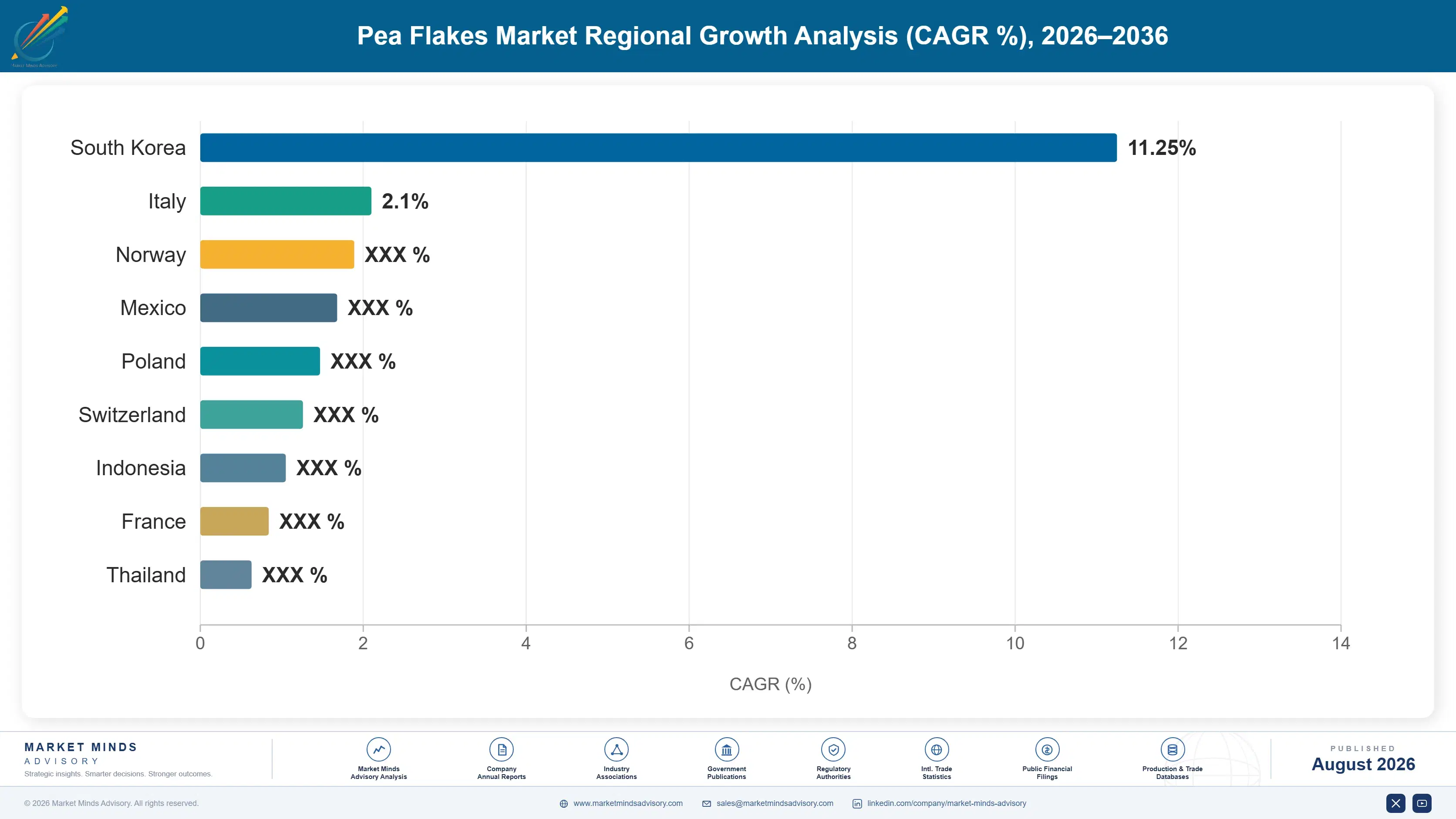
Regional intelligence for 5 additional markets available in the complete report: North America, South Asia and Pacific, Latin America, Middle East and Africa, Eastern Europe. Contact sales@marketmindsadvisory.com.
pea-flakes-market-trends-country-cagr-analysis-1787312544320

Where Processing Margin Actually Accumulates

Four commercial moves separate the processors earning genuine ingredient margins from those merely rolling peas at commodity spread economics. Each one depends on holding something that a feed compounder simply cannot obtain by retendering the business: micronisation capability, contracted grower acreage, food grade documentation, or the pet food specification positions that formulators change only very reluctantly.

Install Micronisation Rather Than Cold Rolling

Cold-rolled peas look similar and deliver none of the digestibility benefit, which is why micronised flakes realise roughly 45% higher pricing into the same feed formulations. Infrared micronisation equipment costs $4 million to $9 million per line and pays back inside three years at typical throughputs. The capability barrier is real but modest, and the reason more processors have not crossed it is that flaking was historically treated as a commodity operation rather than as ingredient manufacture. That framing, rather than the capital, is what has kept the field small.
Market Impact: Realises roughly 45% higher pricing

Contract Grower Acreage Ahead Of Isolate Plants

Pea protein isolate plants have added roughly 900,000 tonnes of annual demand against a crop whose planted area responds slowly, and they can outbid flaking mills comfortably because their end product sells at several times flake value per tonne of input. Processors contracting acreage directly with growers secure both volume and price stability that spot buyers cannot match in tight years. Contracting typically costs a premium of six to nine percent over expected spot, which is close to trivial when set against being unable to run the mill at all during a tight year.
Market Impact: Secures crop against 900,000 tonnes

Qualify Food Grade Documentation And Traceability

Human food applications require food safety certification, allergen controls and traceability documentation that feed grades never demand, and that paperwork gates access to instant soup, ready meal and snack formulators entirely. Realised pricing into human food applications runs 30% to 45% above feed grade on only modestly higher processing cost. Certification and quality system investment costs under $2 million at an existing mill site. Most pulse processors have never pursued it, because their entire commercial history sits in animal feed, and that leaves the opening unusually wide for anyone who does.
Market Impact: Earns up to 45% above feed grade pr

Win Pet Food Specification Positions Deliberately

Pet food formulators pay considerably more than livestock feed compounders and change their recipes far more slowly, because any formulation change requires palatability trials and frequently a label revision as well. Processors holding named specification positions inside premium dry formulations report volume retention above 85% across three-year periods, against under 60% in ordinary commodity feed supply arrangements. Winning those positions requires consistency documentation and extrusion performance data rather than price competitiveness, which suits processors holding micronisation capability specifically rather than any low-cost commodity operator. Positions once won tend to persist across several product generations.
Market Impact: Retains above 85% of volume over 3

Who Controls the Margin Pool

Concentration is low at 29% for the five largest processors, measured on pea flake revenue across all participants, and it stays low because processing sits close to the crop. AGT Food and Ingredients leads on origination reach across Canadian and international pulse supply, and the gap to the second tier is widest in crop access rather than capacity.
Competition runs on three dimensions here. Feedstock access decides who can run at all in a tight crop year, and grower contracting separates processors more reliably than any operational measure does. Micronisation capability decides which formulations a processor can serve, since untreated flakes cannot reach the inclusion rates premium feed requires. Price competition is fiercest in untreated feed grades, where flakes compete against whole pulse on cost per unit of protein alone.

Two pressures build. Pea protein isolate processors keep expanding and bidding for the same crop, which raises the floor under feedstock cost for everyone flaking peas. Meanwhile pet food formulators watch the grain-free scientific debate closely, and any regulatory conclusion would move the highest-value demand pool sharply either way. Rankings shift where grower contracting meets micronisation capability, since one without the other leaves a processor exposed.
pea-flakes-market-trends-company-positioning-matrix-1787312544837

Competitive Moat and Risk Dimensions

AGT FOOD AND INGREDIENTS

Moat: Deepest pulse origination network

Origination relationships across Canadian, Turkish and Australian pulse growing regions give the company crop access that competitors buying through elevators cannot match in a tight year. As protein isolate plants bid for the same peas, that origination position has moved from an operational convenience to the single most valuable asset in the business.
AGT FOOD AND INGREDIENTS

Risk: Exposure to crop year volatility

Revenue depends heavily on pulse crop outcomes across a small number of growing regions, and a poor Canadian season compresses both volume and margin simultaneously. Diversification across hemispheres helps but does not eliminate the exposure, since global pea pricing moves together. Processing margin cannot absorb a crop failure that raw material represents fifty-eight percent of.
ROQUETTE

Moat: Integrated pulse fractionation position

Operating pea protein, starch and fibre fractionation alongside flaking lets the company direct crop toward whichever output carries the best return in a given period, which single-product flaking mills cannot do at all. That flexibility is worth most in exactly the tight crop years when independent processors struggle most to secure feedstock economically.
ROQUETTE

Risk: Flaking subordinate to protein economics

Pea flakes sit well down the priority order behind protein isolate within an integrated operation, and crop is naturally directed toward the higher-value output first. Flaking customers may therefore find supply deprioritised in tight years precisely when they most need continuity. That internal competition is a genuine service risk for buyers rather than a theoretical one.

Players Tracked

Prominent Players

AGT Food and Ingredients
Roquette
Emsland Group
Vestkorn Milling
Limagrain Ingredients

Other Key Players

Micronizing Company
Cargill
Archer Daniels Midland
Ingredion
Puris
Cosucra
Yantai Shuangta Food
Shandong Jianyuan Group
Best Cooking Pulses
Parrheim Foods
InfraReady Products
Bunge
Meelunie
Sotexpro
Batory Foods

Recent Developments

JANUARY 2025

AGT expands contracted pulse acreage across western Canada

Substantially increased direct grower contracting was concluded by the company across Saskatchewan and Alberta pulse acreage, responding to protein isolate plants competing for the same field peas and to the difficulty that spot purchasers faced securing adequate volume during each of the recent tight crop years.
Signal: Grower contracting rather than processing
MAY 2025

Emsland Group commissions additional micronisation capacity

New infrared micronisation and flaking capacity entered commercial service at a German site during the year, aimed squarely at feed compounders now raising pulse inclusion rates under European protein autonomy targets and at the pet food manufacturers requiring genuinely consistent extrusion performance from heat-treated material.
Signal: European protein substitution policy is no
SEPTEMBER 2025

Vestkorn secures food grade certification for pulse flake range

Food safety certification and full traceability documentation were completed by the company across the whole of the company's pulse flake range during the period, opening up instant soup, ready meal and snack formulators that had previously been quite unable to source flaked pulse from any feed-certified processing operation.
Signal: Food grade documentation is now opening ap

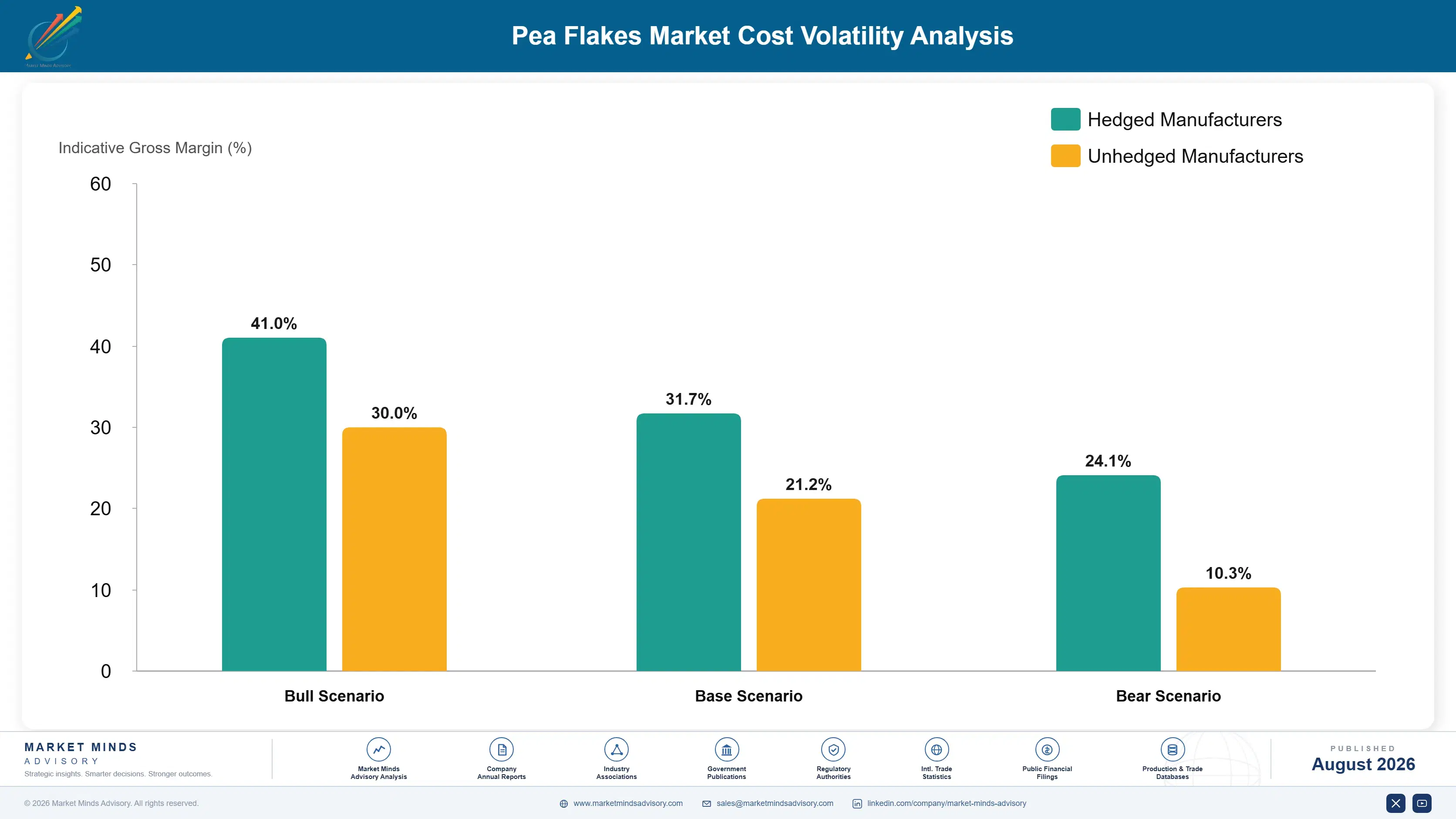
What Drives Delivered Flake Cost

Field peas account for roughly 58% of cost of goods, the highest feedstock share of almost any processed feed ingredient, and pricing moves with Canadian, Russian, French and Australian harvest outcomes together. Energy for infrared micronisation and drying contributes 12%, freight on a low-value bulk product 11%, labour 8%, and packaging and quality control the balance across food grades.
The 2021 Canadian drought was the defining recent event. Prairie pea yields fell sharply, exportable supply tightened and pea pricing rose above levels flaking mills could recover from feed compounders, who simply reformulated toward alternative protein sources instead. AGT Food and Ingredients reporting for that period documented substantial raw material cost pressure across its pulse processing operations. Several smaller European millers ran reduced schedules rather than process at negative margin.

The competitive disadvantage mechanism runs through crop access, not processing cost. A processor holding contracted acreage secures both volume and predictable price in exactly the years when spot buyers can secure neither. One buying through the elevator system competes against isolate plants whose product carries several times the value per input tonne, and loses. Integrated fractionators sit best of all, directing crop toward whichever output pays most that season.
pea-flakes-market-trends-cost-volatility-analysis-1787312545031

Contract acreage directly across separate hemispheres

Single-origin pea sourcing exposes a processor to one harvest outcome, and Canadian, European and Australian crops fail in different years for different reasons. Contracting acreage across hemispheres costs a premium of six to nine percent over expected spot pricing and removes most of the volume risk that makes flaking mills unrunnable in a tight year.

Index pet food contracts to published pulse benchmarks

Pet food customers accept indexation considerably more readily than commodity feed compounders do, because their own product carries margin that absorbs ingredient movement. Processors now reference published pulse benchmarks with quarterly reset in pet food agreements, which protects the highest-value volume in the portfolio without putting the far more price-sensitive feed business at any risk.

Recover micronisation heat into pre-drying stages

Infrared treatment and subsequent drying dominate energy consumption at a flaking mill, and much of the applied heat currently leaves as exhaust. Recovery into incoming pea pre-conditioning costs roughly $900,000 per line and cuts energy cost of goods by around three percentage points, paying back inside four years at current European industrial energy prices.

Portfolio Architecture for Margin Defence

Margin architecture tracks heat treatment and documentation rather than the pea itself. Untreated coarse feed flakes run at gross margins in the low teens, competing directly against whole peas and other pulses on cost per unit of protein. Micronised and food grade material earns two to three times that on the same crop.
The volume-versus-premium tension is real because flaking lines need throughput. Commodity feed grades are what fill a mill between higher-value orders, and a processor declining that work finds both the line and the grower contract underutilised. Yet feed grades barely cover conversion cost when peas are expensive. Most processors therefore run both, using commodity volume to hold grower relationships and mill loading while margin comes almost entirely from treated and food grade output.

Value concentrates where a customer cannot verify performance from a specification sheet. Pet food specification positions sit at the top, because formulators run palatability and extrusion trials before adopting a material and will not repeat them casually. Food grade material sits alongside on documentation logic. Untreated feed flakes sit at the other extreme, where a protein and starch analysis tells the buyer everything and pricing compresses toward the raw pea plus rolling.

Volume / Commodity-Adjacent

Untreated coarse and split flakes supplied into commodity livestock feed at inclusion rates raw pulse limitations permit. Buyers compare cost per unit of protein against whole peas and competing pulses directly. This volume exists to hold mill throughput and justify grower contracting.
Gross Margin: 11-18%

Premium / Certified

Steam-rolled and micronised flakes supplied into pig, poultry, equine and calf feed where digestibility and inclusion rate matter commercially. Heat treatment capability holds pricing because untreated alternatives cannot reach the same inclusion levels. Range reflects the spread across feed segments.
Gross Margin: 22-32%

Sustainability / Regulatory / Next-Generation

Micronised material in named pet food specifications plus food grade and pre-gelatinised flakes carrying full traceability documentation. Formulation lock-in and food safety certification, rather than any property of the pea, justify the pricing achieved in this tier.
Gross Margin: 32-46%
pea-flakes-market-trends-portfolio-architecture-1787312545523

High-value Sub-segments and Strategic Watch-out

Pet Food Specification Volume

High value on genuinely high growth, protected because formulators run palatability and extrusion trials before adopting a material and will not repeat that work casually. Volume retention runs above eighty-five percent across three-year periods, far ahead of anything that commodity feed supply has ever achieved.
Gross Margin: 34-46%

Food Grade Pre-Gelatinised

Strong margins on rapid growth at 8.1%, gated entirely by the food safety certification and traceability documentation that feed-only processors have never assembled. Demand follows pulse-based convenience food rather than any feed cycle, which makes this the least exposed demand pool anywhere in the portfolio.
Gross Margin: 32-42%

Commodity Feed Flakes

The throughput that holds mill loading and grower relationships together, earning gross margins in the low teens and barely covering conversion when peas are expensive. Buyers compare cost per unit of protein against whole pulse directly and they switch away without needing any qualification work at all.
Gross Margin: 11-18%

Grain-Free Pet Formulations

The strategic watch-out in this portfolio. Peas appear in roughly a third of premium dry dog food, but regulatory attention to a possible dilated cardiomyopathy association remains unresolved, and any adverse regulatory conclusion would move the highest-value demand pool in this market very quickly indeed.
Gross Margin: 34-46%

How This Demand Actually Repeats

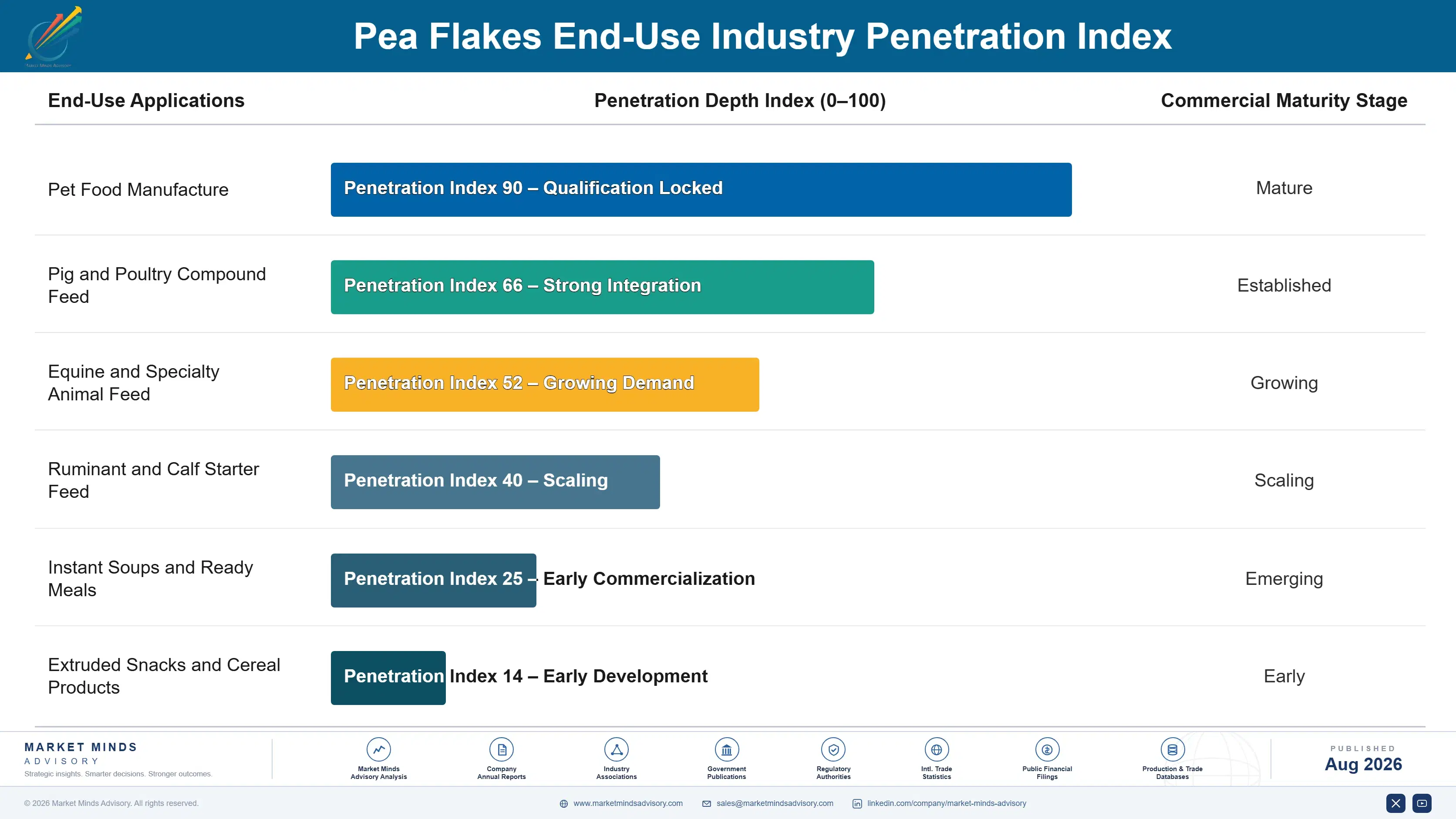
Demand behaves as an annuity attached to a formulation rather than to any purchasing relationship. Once micronised flakes are designed into a pet food recipe or a specialty feed ration, they ship against every production run for years, because changing the ingredient means repeating palatability trials and often revising the label declaration too.
Stickiness varies sharply by application. Pet food specification positions are the tightest, since formulators run extrusion and palatability work before adoption and treat any change as a project. Equine and specialty feed is moderately sticky, with nutritionists holding preferred ingredients but reviewing them seasonally. Commodity livestock feed is barely sticky at all, with compounders reoptimising least-cost rations weekly and dropping peas entirely whenever the arithmetic turns.

Buyer profiles have shifted considerably. Purchasing once sat with feed mill nutritionists comparing protein, starch and price in a least-cost formulation model. It now frequently involves pet food product developers, food safety functions and sustainability teams asking about origin traceability, antinutritional factor testing and crop provenance. Processors whose commercial approach still leads with a nutritional analysis sheet find themselves talking to buyers for whom that was settled first.
pea-flakes-market-trends-end-use-penetration-index-1787312546009

Where To Place Capital

These are among the four positions where our research anticipates prominent divergence between winners and laggards over the coming forecast period. Each is grounded in the demand model, the regulatory perimeter, and the announced capacity pipeline.
01 / MICRONISATION CAPABILITY BUILD

Cold rolling is not the same product at all

Untreated flakes look similar and deliver none of the digestibility benefit, which is why micronised material realises roughly 45% higher pricing into identical feed formulations. Infrared equipment costs $4 million to $9 million per line and pays back inside three years at typical throughputs. The barrier has been commercial framing rather than capital, since flaking was historically run as a milling operation instead of as ingredient manufacture, and that framing rather than the equipment cost is what kept competitors out.
02 / GROWER CONTRACT COVERAGE

Crop access now decides who runs at all

Pea protein isolate plants have added roughly 900,000 tonnes of annual demand against a crop whose planted area adjusts slowly, and they outbid flaking mills comfortably, because their output sells at several times flake value per tonne of crop consumed. Contracting acreage directly with growers costs a premium of six to nine percent over expected spot pricing. Against the alternative of an idle mill throughout a tight crop year, that premium is close to irrelevant to the overall processing economics.
03 / FOOD GRADE QUALIFICATION

Certification opens a market feed processors cannot

Human food applications demand food safety certification, allergen control and traceability documentation that feed grades never require, and that paperwork alone gates access to every instant soup, ready meal and snack formulator in the market. Realised pricing runs 30% to 45% above feed grade on modestly higher processing cost, and the certification itself costs under $2 million at an existing mill site. Most pulse processors have simply never pursued it, because their entire commercial history sits in animal feed rather than food.
04 / PET FOOD EXPOSURE BALANCE

The best pool carries an unresolved scientific risk

Pet food pays best of all, changes its formulations slowly and retains volume above 85% across three-year periods, which together make it the most attractive demand pool in this market by some considerable distance. It also carries unresolved regulatory attention to a possible dilated cardiomyopathy association with the pulse-heavy grain-free diets driving that demand. Processors should build the position while deliberately broadening into livestock feed and human food, rather than concentrating everything on a pool whose scientific standing remains genuinely uncertain today.

Engagement Snapshot From the Field

A live engagement with an industry participant carrying material or product regulatory and market exposure ahead of a defining policy shift, showing how our research translates into a defensible multi-year portfolio strategy.
MARKET MINDS ADVISORY · CLIENT ENGAGEMENT SUMMARY
Pea Flakes Producer Strategic Portfolio Review and Transition Roadmap 2026·Investment Scenario on Pea Flakes Exposure Evaluation 2025-26
CLIENT PROFILE
A European pulse flaking processor with annual revenue near $95 million (client-reported, unverified by MMA), operating three flaking lines of which only one held infrared micronisation capability. Roughly 68% of volume sold as untreated feed flakes into commodity livestock compounding, peas were purchased almost entirely through the merchant market, and no food grade certification existed at any site.
STRATEGIC CHALLENGE
A tight Canadian crop year had left the company unable to secure adequate peas at workable cost while pea protein plants outbid it consistently, and commodity feed margins had fallen below conversion cost for two consecutive quarters. The board needed to decide between securing feedstock, converting lines to micronisation, or pursuing food grade certification, with capital for only one.
MMA APPROACH
MMA modelled margin and volume outcomes under three investment scenarios, quantified the feedstock cost gap between contracted and merchant-purchased peas across five crop years, and assessed food grade certification requirements against the client's existing quality systems. Findings were tested against 47 expert interviews covering pulse origination practice, pet food formulator qualification and European feed compounder inclusion decisions.
KEY FINDINGS
  1. Merchant purchasing had cost the client an estimated 11% premium over contracted equivalents across the two tightest crop years, and left it short of volume in both.
  2. Converting a second line to micronisation would cost approximately $5.6 million (client-reported estimate, unverified by MMA) and lift realised pricing on that volume by roughly 42%.
  3. Food grade certification at under $1.7 million was the cheapest of the three options and opened human food formulators the company had never been able to approach at all.
  4. Commodity feed volume could not be abandoned without dropping mill throughput below the level that justified grower relationships and fixed cost recovery together.
CLIENT PROFILE
A European pulse flaking processor with annual revenue near $95 million (client-reported, unverified by MMA), operating three flaking lines of which only one held infrared micronisation capability. Roughly 68% of volume sold as untreated feed flakes into commodity livestock compounding, peas were purchased almost entirely through the merchant market, and no food grade certification existed at any site.
STRATEGIC CHALLENGE
A tight Canadian crop year had left the company unable to secure adequate peas at workable cost while pea protein plants outbid it consistently, and commodity feed margins had fallen below conversion cost for two consecutive quarters. The board needed to decide between securing feedstock, converting lines to micronisation, or pursuing food grade certification, with capital for only one.
MMA APPROACH
MMA modelled margin and volume outcomes under three investment scenarios, quantified the feedstock cost gap between contracted and merchant-purchased peas across five crop years, and assessed food grade certification requirements against the client's existing quality systems. Findings were tested against 47 expert interviews covering pulse origination practice, pet food formulator qualification and European feed compounder inclusion decisions.
KEY FINDINGS
  1. Merchant purchasing had cost the client an estimated 11% premium over contracted equivalents across the two tightest crop years, and left it short of volume in both.
  2. Converting a second line to micronisation would cost approximately $5.6 million (client-reported estimate, unverified by MMA) and lift realised pricing on that volume by roughly 42%.
  3. Food grade certification at under $1.7 million was the cheapest of the three options and opened human food formulators the company had never been able to approach at all.
  4. Commodity feed volume could not be abandoned without dropping mill throughput below the level that justified grower relationships and fixed cost recovery together.
RECOMMENDED STRATEGY
Phase 1: Phase one: contract grower acreage across two hemispheres before any capital request, since feedstock access gates whether the mill can run at all. Phase 2: Phase two: complete food grade certification, which costs least of the three options and opens applications the company has never served. Phase 3: Phase three: convert the second flaking line to micronisation, sized against pet food and specialty feed demand rather than total capacity.
OUTCOME
The client contracted acreage across Canadian and European growers within seven months and completed food grade certification the following year, reporting realised pricing on food grade material roughly 38% above its feed equivalents (client-reported, unverified by MMA). Micronisation conversion was approved on that basis, and commodity feed volume was deliberately retained for mill throughput.

Frequently Asked Questions

Foundational context covering the market sizes, CAGR, scope, country, region and competition that inform every finding below. This section is provided to cover basics and most often pre-purchase conversations, answered from the MMA Primary Research Dataset.

What is the current size of the Pea Flakes Market?

The market was worth $0.6 billion in 2025 and is forecast to reach $0.64 billion in 2026. This covers flaked field peas across feed, pet food and human food applications.

How large will the Pea Flakes Market be by 2036?

MMA forecasts $1.17 billion by 2036, an expansion multiple of 1.83 times the 2026 base. That represents $0.53 billion of incremental value across the forecast period.

What is the CAGR for the Pea Flakes Market 2026 to 2036?

The base case compound annual growth rate is 6.2%, with a bull case of 7.4% and a bear case of 5.0%. Historical growth from 2020 to 2025 also ran at 5.0%.

Which segment is growing fastest?

Micronised pea flakes at 9.3%, a full 1.50 times the market rate. Infrared heat treatment roughly doubles the inclusion rate monogastric feed formulations can carry.

Who are the major companies in the Pea Flakes Market?

AGT Food and Ingredients, Roquette, Emsland Group, Vestkorn Milling and Limagrain Ingredients lead with 29% between them. Fifteen further processors hold meaningful regional or grade positions.

Which country is growing fastest?

India at 9.0%, driven by a very large domestic pulse processing sector and by pet food manufacture expanding quickly as urban pet ownership rises. Domestic crop supports both.

Report Segmentation Architecture

The full report scope spans multiple orthogonal segmentation dimensions, with cross-tabulated demand data provided for each dimension pair. Coverage extends further to regional breakdowns, trend trajectories, and the competitive detail needed to support segment-level decision-making.

By Processing Form

  • Micronised Pea Flakes
  • Instant and Pre-Gelatinised Pea Flakes
  • Steam-Rolled Whole Pea Flakes
  • Split and Dehulled Pea Flakes
  • Coarse Feed Grade Pea Flakes

By End-Use Industry

  • Pet Food Manufacture
  • Pig and Poultry Compound Feed
  • Equine and Specialty Animal Feed
  • Ruminant and Calf Starter Feed
  • Instant Soups and Ready Meals
  • Extruded Snacks and Cereal Products

By Commercial Dimension

  • Direct Supply to Pet Food Manufacturers
  • Feed Compounder Contract Supply
  • Food Ingredient Distributor Channel
  • Toll Micronisation and Contract Flaking
  • Grower-Contracted Integrated Supply

By Region

  • North America
  • Western Europe
  • East Asia
  • South Asia and Pacific
  • Latin America
  • Middle East and Africa
  • Eastern Europe

Scope, Methodology, and Coverage

Every figure in this report is reproducible from documented input assumptions. The scope below maps the historical period, the forecast horizon, the segmentation dimensions, and the countries covered, alongside the underlying primary and qualitative methodology.
Historical Period
2020 to 2025
Forecast Period
2026 to 2036
Base Year
2025 (USD billions; MMA Primary Research Dataset, August 2026)
Market Definition
This report covers pea flakes produced by rolling or flaking field peas, spanning micronised, instant and pre-gelatinised, steam-rolled whole, split and dehulled, and coarse feed grade material supplied into animal feed, pet food and human food applications. Coverage includes the infrared micronisation and heat treatment services applied before flaking. Whole and split peas sold unprocessed, pea protein isolates and concentrates, pea starch and fibre fractions, pea flour and grits, fresh and frozen garden peas, and flakes made from beans, lentils or chickpeas are excluded from scope.
Quantitative Units
USD billions at processor realised prices; volume in thousand tonnes of finished flake; gross margin percentages and flaking yields by tier.
Segmentation Dimensions
Processing form, end-use industry, commercial dimension, region.
Regions Covered
North America, Western Europe, East Asia, South Asia and Pacific, Latin America, Middle East and Africa, Eastern Europe
Countries Covered
China, Japan, South Korea, India, Australia, Vietnam, Thailand, Canada, United States, Mexico, United Kingdom, France, Germany, Denmark, Netherlands, Brazil, Russia, Poland, Turkey, South Africa.
Key Companies Profiled
AGT Food and Ingredients, Roquette, Emsland Group, Vestkorn Milling, Limagrain Ingredients, Micronizing Company, Cosucra, Yantai Shuangta Food, Best Cooking Pulses, InfraReady Products, and ten further processors.
Quantitative Methodology
Primary survey, n=3,800 respondents, Q4 2025, six countries; demand-side model with trade association cross-validation
Qualitative Methodology
47 expert interviews, Q4 2025; applied to validate demand model assumptions, identify emerging dynamics, and assess competitive positioning
Report Format
PDF and XLSX data workbook (Word format preview document)
Publisher
Market Minds Advisory
Report Code
MMA-2026-AGR-795
Published
August 2026
Contact
sales@marketmindsadvisory.com | www.marketmindsadvisory.com

Purchase the full Pea Flakes Market Report (2026 to 2036).

The full report sets out ten-year forecasts for pea flakes by processing form, end-use industry and commercial model across seven regions. It quantifies feedstock competition from pea protein isolate capacity crop region by crop region through 2036. Competitive assessment covers twenty processors on a consistent revenue basis, mapping micronisation capability and grower contract coverage separately from flaking capacity. Raw pea cost exposure is modelled across contracted and merchant purchasing structures using five historical crop years. Findings draw on a quantitative survey of 3,800 respondents across six countries and 47 expert interviews conducted during the fourth quarter of 2025.
Ten-year forecasts by processing form and region
Protein isolate feedstock competition quantified by crop region
Micronisation capability mapped across twenty named processors
Contracted versus merchant purchasing modelled across crop years
Pet food specification retention benchmarked against feed supply
Margin architecture across three commercial portfolio tiers

Built For The People Who Decide

From boardroom strategy to bench-side execution, this report is read cover-to-cover by leaders shaping the next decade of their industry, turning demand scenarios, market dynamics and valuation benchmarks into decisions.
CXOs/ Presidents/ VPs/ Managers
M&A and Corporate Development
Strategy Teams and R&D Heads
Procurement and Product Directors
Regulatory and Compliance Leaders
Investor Relations and Equity Analysts