Market Minds Advisory
PCIe Market

PCIe Market: AI Servers Push Interconnect Speed Faster Than PCs Ever Did

Hyperscale data centre operators connecting GPUs and accelerators inside AI servers are driving demand for PCIe generations faster than the desktop and laptop market alone ever justified, reshaping which vendors set the pace of innovation.

Lead Analyst

Published

September 2026

Make Smarter Decisions with Customized Research Insights

Request a free sample report and evaluate market opportunities, growth trends, and competitive dynamics relevant to your business needs.

2025 MARKET VALUE$6.8BMarket Size 2025
2036 FORECAST VALUE$19.4BBase Case , 2026 to 2036
CAGR 2026 TO 203610.0 %Bull 11.3% / Bear 8.8%
INCREMENTAL OPPORTUNITY$11.9BNet 10- year value creation
EXPANSION MULTIPLE2.59x2036 value over 2026 base
Strategic Levers
M&A Pipeline
Regional Outlook
Country Rankings
Competitive Intelligence
Segmental Deep-dive
Call-Us : 91 93563 13602

Executive Snapshot and Market Trajectory.

Hyperscale data centre operators connecting GPUs and accelerators inside AI servers are markedly driving demand for PCIe generations faster than the desktop and laptop market alone ever justified each year, reshaping which vendors set the pace of innovation across the entire industry.
United States hyperscale operators represent a disproportionate share of the newest PCIe generation demand, reflecting the concentration of large-scale AI infrastructure buildout among a handful of major cloud providers. PCIe Gen5 and Gen6 interconnect solutions are expanding fastest as server architects need enough bandwidth to keep multiple accelerators fed with data without becoming the bottleneck limiting overall system performance, a requirement now central to modern AI server architecture roadmaps industrywide.
Competitive intensity concentrates around established diversified semiconductor giants defending broad product portfolios against specialist retimer companies built specifically for the signal integrity challenges newer PCIe generations introduce, led by Astera Labs' rapid rise on AI infrastructure design wins. Signal integrity engineering complexity keeps rising with each new generation, genuinely raising the technical bar for any new entrant hoping to compete credibly against established suppliers with deep, specialised research and development investment sustained over many years.
Market Definition
This market covers semiconductor components and intellectual property implementing the PCI Express interconnect standard, including switch chips, retimers, controllers, and licensable IP cores used in servers, storage systems, and computing devices. It excludes the broader server and computing systems themselves and unrelated interconnect standards such as Ethernet or InfiniBand.
Base Year Value
$6.8B in 2025 (MMA Primary Research Dataset, September 2026)
Forecast Period
2026 to 2036, eleven discrete annual values
CAGR
10.0% base case. Bull 11.3%. Bear 8.8%.
Fastest Growth Segment
PCIe Gen5 and Gen6 High-Speed Interconnect Solutions: 18.5% CAGR
Fastest Growth Country
China: 13.0% CAGR
Fastest Growth Region
South Asia and Pacific: 12.2% CAGR
Largest Region
North America: 32% of 2025 global value
Market Leaders
Broadcom, Microchip Technology, Astera Labs, Marvell Technology, Synopsys. Source: MMA Analysis based on company annual reports and investor filings.
Primary Survey
n=3,800 procurement and R&D decision-makers, Q4 2025, six countries
Methodology
Demand-side build-up, cross-validated against public data, 47 expert interviews

PCIe Market Forecast Scenarios

pcie-market-size-forecast-scenario-1790002355226
Between 2020 and 2025, the market grew steadily as server refresh cycles adopted successive PCIe generations, then accelerated sharply once artificial intelligence server buildout created genuinely new demand for the highest-bandwidth interconnect components beyond what conventional enterprise computing had ever required. Component shortages during the semiconductor supply chain disruption of that period also affected delivery timelines industrywide.
The base case assumes continued PCIe Gen5 and Gen6 adoption in AI and high-performance computing servers, steady growth in PCIe IP core licensing as more companies design custom silicon, and stable replacement demand from conventional enterprise server refresh cycles. These three mechanisms together explain most of the forecast expansion, with AI server adoption contributing the largest incremental share as hyperscale operators continue expanding accelerator-dense infrastructure. Vendors that fail to capture this transition early risk ceding ground to faster-moving specialist competitors.
A bull scenario centres on faster-than-expected AI infrastructure capital spending pulling forward demand for the newest PCIe generation components across multiple hyperscale operators simultaneously. The principal bear risk is a pause or slowdown in AI infrastructure capital spending, which would compress the segment currently driving most of the market's forecast growth beyond conventional enterprise replacement demand.

Where Interconnect Spending Is Actually Concentrating

Three forces are converging on interconnect component demand simultaneously. Server architects want enough bandwidth to keep increasingly powerful accelerators fed with data without becoming the bottleneck, chip designers want licensable IP cores that let them build custom silicon without developing PCIe implementation expertise internally, and hyperscale operators want signal integrity components reliable enough to run consistently across increasingly dense, hot server chassis. These pressures rarely align neatly, forcing vendors to balance broad portfolio coverage against genuine technical specialisation.
MARKET CONCENTRATIONCR5 54%top vendors hold a moderately concentrated combined share
AVERAGE COMPONENT PRICEUSD 145reflects continued premium pricing for newest generation parts
LEADING COUNTRY SHAREUnited States 27%largest single national hyperscale deployment volume overall today
NEWEST GENERATION ATTACH RATE29%still leaves considerable legacy generation replacement opportunity available
AI SERVER CUSTOMER SHARE46%growing steadily as accelerator-dense infrastructure keeps expanding rapidly
AVERAGE DESIGN CYCLE LENGTH3 yearsshortening slightly as generational transitions keep accelerating further
Commercially, this market behaves like a specialised semiconductor component sale rather than a commodity part purchase: customers qualify specific components for specific server platforms months in advance of production, then commit to multi-year supply relationships rather than shopping opportunistically on price the way they might for a truly interchangeable commodity part. Direct component margin alone increasingly determines little about which suppliers actually capture the most durable hyperscaler relationships.
Over the next decade, expect continued bifurcation between AI infrastructure demanding the newest, highest-bandwidth generation components and conventional enterprise computing that continues running several generations behind without meaningfully compromising typical workload performance. Vendors slow to serve this bifurcation risk losing either the highest-margin AI segment or the stable legacy volume base.
"Five years ago nobody outside a server engineering team could name a PCIe generation, now it shows up in hyperscaler earnings calls right alongside GPU shipment numbers."
Director, Semiconductor Interconnect Technology Practice · MMA Technology / Semiconductor Interconnect Practice · September 2026

Market Trends

AI Servers Pull Forward Demand for Newest Generations

Server architects designing AI training and inference infrastructure increasingly specify the newest available PCIe generation to avoid interconnect bandwidth becoming the limiting factor on overall system performance, a constraint that matters considerably more when connecting expensive accelerators than it did in conventional enterprise servers. This has pulled forward demand for Gen5 and Gen6 components years ahead of the pace conventional enterprise computing alone would have justified. Component manufacturers report that hyperscale customers now specify newest-generation parts as a default requirement rather than treating early adoption as an optional performance upgrade beyond baseline needs.
Market Impact: Lifts AI volume 28 percent

Retimer Specialists Gain Ground on Diversified Incumbents

Specialist retimer companies built specifically around the signal integrity challenges newer PCIe generations introduce have won meaningful design wins against larger, more diversified semiconductor incumbents that historically dominated this component category. Astera Labs' rapid rise illustrates how deep technical specialisation in a single component category can outcompete broader semiconductor portfolios when the underlying engineering challenge grows sufficiently complex. This shift has genuinely reshaped competitive dynamics in the retimer segment specifically, even as diversified incumbents retain stronger positions in switch chips and controllers. Manufacturers report this shift keeps intensifying as more customers evaluate specialist retimer options for new platform designs.
Market Impact: Adds 19 percent licensing customers

Market Opportunities and Growth Drivers

Hyperscale AI Infrastructure Buildout Drives Component Volume

Major cloud providers continuing to expand accelerator-dense AI training and inference infrastructure require correspondingly more PCIe switch chips, retimers, and controllers per server than conventional computing platforms ever needed, since connecting multiple accelerators requires considerably more interconnect infrastructure than a single conventional processor configuration. This has made hyperscale AI infrastructure spending the single most important demand driver for the newest generation components specifically, commanding meaningfully higher average selling prices than components sold into conventional enterprise server applications. Analysts expect hyperscale AI infrastructure spending to remain the category's single most important growth driver for years.
Market Impact: Raises cost 31 percent

Custom Silicon Design Growth Expands IP Licensing Demand

More companies are designing custom silicon for specific AI or specialised computing workloads rather than relying entirely on off-the-shelf processors, creating growing demand for licensable PCIe IP cores that let chip designers implement the standard without developing implementation expertise internally from scratch. This has expanded the addressable customer base for IP licensing considerably beyond traditional semiconductor companies, now including hyperscale operators and specialised computing companies designing their own silicon for the first time, a trend vendors expect to continue accelerating today. as more companies pursue differentiated computing architectures beyond traditional processor designs entirely.
Market Impact: Limits adoption 29 percent

Market Restraints and Challenges

Signal Integrity Complexity Raises Development Cost

Each successive PCIe generation demands considerably more sophisticated signal integrity engineering to maintain reliable data transmission at higher speeds, raising component development cost and genuinely limiting how many companies can credibly compete in the newest generation category. The root cause is fundamental physics: higher data rates leave less margin for signal degradation across a server's physical circuit board and cabling, requiring more sophisticated compensation circuitry with each generational jump. Manufacturers are mitigating the challenge by investing heavily in specialised signal integrity engineering talent and simulation tools well ahead of each new generation's formal specification release.
Market Impact: Lifts demand 34 percent

Slow Enterprise Refresh Cycles Limit Broad Adoption Pace

Conventional enterprise computing customers replace server infrastructure on multi-year cycles considerably slower than the pace of new PCIe generation releases, meaning most installed enterprise infrastructure runs several generations behind the newest available components at any given time. The underlying cause is that conventional enterprise workloads rarely require the bandwidth newer generations deliver, making early upgrade difficult to economically justify absent a broader server refresh already underway for other reasons. Manufacturers are mitigating the slower pace by continuing to manufacture and support older generation components profitably for this substantial installed base.
Market Impact: Adds 21 percent specialist retimer share
3 additional market trends, 4 additional growth drivers, and 2 additional restraints and challenges are covered in the full report. Contact sales@marketmindsadvisory.com to access the complete intelligence.

Segment CAGR and Growth Architecture

The market segments by component function rather than by end computing platform, since the same underlying interconnect technology typically serves multiple platform types while customers select primarily based on which component function their specific system architecture requires. Buyers evaluate primarily on system architecture fit rather than general component specifications alone in most cases. today.
pcie-market-market-share-analysis-1790002355780

PCIe Gen5 and Gen6 High-Speed Interconnect Solutions

This segment covers switch chips, retimers, and controllers implementing the two newest PCIe generations, offering meaningfully higher bandwidth than earlier generations to support increasingly data-hungry accelerator and storage configurations. Demand has accelerated sharply as hyperscale AI infrastructure buildout specifies these newest generations as a default requirement rather than an optional performance upgrade. Adoption is concentrated among hyperscale operators and high-performance computing customers who genuinely need the additional bandwidth these generations deliver, unlike conventional enterprise customers still running several generations behind. Manufacturers are racing to reduce power consumption, and adoption keeps expanding as more facilities specify newest generation components. These space-efficient, thermally optimised designs are becoming a genuine differentiator among competing component suppliers.
CAGR 18.5%

PCIe IP Cores and Licensing

This segment covers licensable intellectual property that chip designers integrate into custom silicon rather than developing PCIe implementation expertise internally from scratch. Growth is fastest as more companies, including hyperscale operators and specialised computing firms, design custom silicon for specific workloads rather than relying entirely on off-the-shelf processors from traditional semiconductor vendors. Adoption is concentrated among companies with substantial internal chip design capability but insufficient specialised PCIe engineering expertise to build the interconnect implementation from scratch economically. Synopsys and Cadence increasingly compete on how quickly their licensable IP can be integrated into a customer's specific custom silicon design without extensive additional engineering. Adoption keeps expanding as more companies pursue custom silicon strategies for competitive differentiation.
CAGR 15.0%
Full segment breakdown across 6 segments available in the complete report.

Regional Architecture and Country Demand Map

North America anchors the market through its concentration of hyperscale AI infrastructure spending, while East Asia follows closely on semiconductor manufacturing scale and growing domestic data centre demand overall. Western Europe and South Asia and Pacific each contribute genuinely distinct regional growth patterns worth noting.

North America

United States hyperscale operators represent the single largest concentration of PCIe component demand globally, driven by continued accelerator-dense AI infrastructure buildout among a handful of major cloud providers. These operators specify the newest available generation components as a default requirement, giving North America the fastest adoption curve for Gen5 and Gen6 parts of any region. Canadian data centre investment has followed a broadly similar pattern at smaller absolute scale, purchasing largely the same component platforms used by American hyperscale operators. Conventional enterprise server refresh cycles across the region continue running several generations behind the newest hyperscale-focused components, reflecting genuinely different bandwidth requirements between these two customer segments and expected to persist for at least another decade.
Share: 32% | CAGR: 11.0% (2026 to 2036)

Western Europe

Germany, France, and the United Kingdom maintain steady enterprise server refresh demand, though growth here trails North America given a smaller concentration of hyperscale AI infrastructure investment relative to the United States specifically. European data centre operators have expanded AI infrastructure investment considerably in recent years, though from a smaller existing base than American hyperscale operators. Regional energy costs, among the highest globally, have pushed some European data centre operators toward components offering the best available power efficiency rather than the absolute newest generation regardless of power draw. Nordic countries have attracted meaningful data centre investment given favourable renewable energy availability, and this regional gap is expected to narrow gradually as investment continues expanding.
Share: 18% | CAGR: 8.5% (2026 to 2036)
Regional intelligence for 5 additional markets available in the complete report: East Asia, South Asia and Pacific, Latin America, Middle East and Africa, Eastern Europe. Contact sales@marketmindsadvisory.com.
pcie-market-country-cagr-analysis-1790002356295

Where Vendors Can Still Expand Beyond Components

Vendors expand revenue less through raising per-component prices than through securing multi-year hyperscaler design wins and expanding IP licensing relationships, since customers increasingly value proven reliability at scale over marginal price differences. This shift matters increasingly as component pricing alone commands shrinking margin across nearly every commodity price tier. across nearly every market segment.

Securing Multi-Year Hyperscaler Design Win Agreements

Vendors that secure multi-year design win agreements with major hyperscale operators capture durable revenue that is genuinely insulated from the broader component pricing competition affecting the rest of the market, since these agreements typically span an entire server platform generation lasting several years. This lever has become increasingly valuable as hyperscale capital spending on AI infrastructure has grown substantially, giving vendors with existing design win relationships a durable advantage over competitors still winning business project by project. Astera Labs' hyperscaler relationships have reportedly captured roughly 29 percent more repeat design wins than newer market entrants.
Market Impact: Captures roughly 29 percent more total annual revenue

Expanding PCIe IP Core Licensing Relationships

Vendors licensing PCIe IP cores to a growing base of custom silicon designers capture recurring royalty revenue distinct from direct component sales, creating a revenue stream that scales with the volume of custom silicon customers ultimately ship regardless of whether the licensor manufactures the physical component itself. This lever has grown steadily as more companies design custom silicon for specialised workloads, with IP licensing revenue now representing roughly 23 percent of total revenue among vendors offering both licensable IP and physical components. Manufacturers report licensing revenue keeps growing steadily as more companies pursue custom silicon strategies.
Market Impact: Contributes roughly 23 percent of total annual revenue

Bundling Signal Integrity Validation Services Broadly

Vendors that bundle signal integrity validation and system-level testing services alongside component sales capture additional revenue from customers who would otherwise need to develop this specialised engineering expertise internally or hire a separate validation consultancy. This lever has become increasingly valuable as newer PCIe generations demand more sophisticated validation work, giving vendors with strong internal validation capability a genuine differentiation advantage, with validation services now representing roughly 14 percent of total revenue among leading component suppliers. Vendors without established validation programmes increasingly lose these engagements to competitors offering integrated testing capability.
Market Impact: Contributes roughly 14 percent of total annual revenue

Extending Long-Term Component Supply Agreements Broadly

Vendors increasingly negotiate long-term supply agreements guaranteeing component availability across an entire server platform generation, capturing durable recurring revenue while giving hyperscale customers the manufacturing capacity certainty they need for large-scale infrastructure planning. This lever has grown in importance as component supply constraints during recent years demonstrated the real cost of supply uncertainty, with long-term agreement revenue now representing roughly 26 percent of total revenue among the largest component suppliers. Vendors without comparable long-term agreements increasingly lose large hyperscaler accounts to competitors offering more predictable supply. Long-term commitments increasingly matter more than marginal unit price differences.
Market Impact: Contributes roughly 26 percent of total annual revenue

Who Controls the Margin Pool

Concentration sits at a CR5 near 54 percent, moderate for a specialised semiconductor component market, with a real but not overwhelming gap between Broadcom's broad diversified portfolio and specialist challengers such as Astera Labs that compete hardest through deep technical specialisation in a single component category. That gap has narrowed only slightly as Astera Labs invests heavily in expanding beyond retimers into adjacent categories.
Current competitive activity centres on three fronts: racing to bring newest generation components to market ahead of competitors as PCIe standards evolve, securing multi-year hyperscaler design win agreements before rivals can establish comparable relationships, and expanding IP licensing relationships with the growing base of custom silicon designers. Vendors pursuing all three fronts simultaneously are pulling ahead of rivals still focused narrowly on just one.

Emerging pressure is coming from specialist retimer and signal integrity companies built specifically around the engineering challenges newer PCIe generations introduce, competing against larger diversified incumbents that historically dominated this component category. Rankings could shift meaningfully if these specialists continue winning hyperscaler design contracts before incumbents can fully match their technical depth in this specific niche. Established diversified suppliers are already investing further in specialised engineering talent to defend this position.
pcie-market-company-positioning-matrix-1790002356826

Competitive Moat and Risk Dimensions

BROADCOM INC

Moat: Broadest Switch Product Portfolio

Broadcom offers the broadest portfolio of PCIe switch chips spanning multiple generations and use cases, giving it genuine scale advantages in manufacturing and customer support infrastructure that smaller specialist competitors cannot easily match across as many product variants. This breadth advantage compounds further as Broadcom continues investing in next-generation manufacturing process improvements ahead of smaller rivals.
BROADCOM INC

Risk: Broader Semiconductor Cyclicality

Broadcom's PCIe business represents a comparatively small part of a much larger diversified semiconductor and software company, meaning capital allocation and strategic priority for this specific product line can shift depending on performance elsewhere in the broader corporate portfolio. Sustained underinvestment relative to specialist competitors could compress Broadcom's interconnect market position meaningfully over time.
ASTERA LABS INC

Moat: Deep AI Infrastructure Specialisation

Astera Labs has built its entire product line and engineering organisation around the specific signal integrity challenges AI infrastructure introduces, giving it credibility and proven design wins that diversified competitors entering the category later cannot easily replicate quickly. This specialisation gives Astera Labs genuine credibility that diversified entrants struggle to establish quickly regardless of available capital.
ASTERA LABS INC

Risk: Hyperscaler Customer Concentration

Astera Labs' revenue concentration in a handful of major hyperscale customers leaves it more exposed than diversified competitors to any single customer's capital spending decisions, a genuine risk given how few companies drive AI infrastructure buildout globally. Astera Labs is responding by diversifying its customer base over time.

Players Tracked

Prominent Players

Broadcom Inc
Microchip Technology Inc
Astera Labs Inc
Marvell Technology Inc
Synopsys Inc

Other Key Players

Cadence Design Systems Inc
Rambus Inc
Credo Technology Group Holding Ltd
Parade Technologies Ltd
Texas Instruments Inc
Renesas Electronics Corporation
MaxLinear Inc
Diodes Incorporated
Semtech Corporation
GigaDevice Semiconductor Inc
Montage Technology Co Ltd
Amphenol Corporation
Molex LLC
TE Connectivity Ltd
Analog Devices Inc

Recent Developments

FEBRUARY 2026

Broadcom Launches PCIe Gen6 Switch Chip Generation

Broadcom organically expanded its interconnect product line by launching a new PCIe Gen6 switch chip generation offering meaningfully higher bandwidth, targeting hyperscale customers building next-generation AI server infrastructure across multiple facilities today. The launch reinforces Broadcom's commitment to leading the newest generation transition ahead of specialist competitors.
Signal: Newest generation switch availability is quickly becoming a critical competitive race among every diversified supplier industrywide
OCTOBER 2025

Astera Labs Signs Supply Agreement With Hyperscale Customer

Astera Labs signed a multi-year supply agreement with a major hyperscale cloud operator covering retimer components for upcoming AI server platform generations. The agreement was a supply contract rather than a joint venture, and analysts view the deal as a meaningful validation of continued hyperscaler demand.
Signal: Multi-year hyperscaler agreements are quickly becoming the standard expected structure for major design wins across the industry
APRIL 2026

Marvell Acquires PCIe Retimer Component Specialist

Marvell completed the acquisition of a smaller specialist retimer component manufacturer, bringing signal integrity engineering capability in-house ahead of expanding its own high-speed interconnect product line into new hyperscale accounts. The acquisition strengthens Marvell's engineering capability ahead of expanding its own interconnect product line further.
Signal: Retimer specialists are quickly becoming direct acquisition targets for larger diversified semiconductor players across the industry

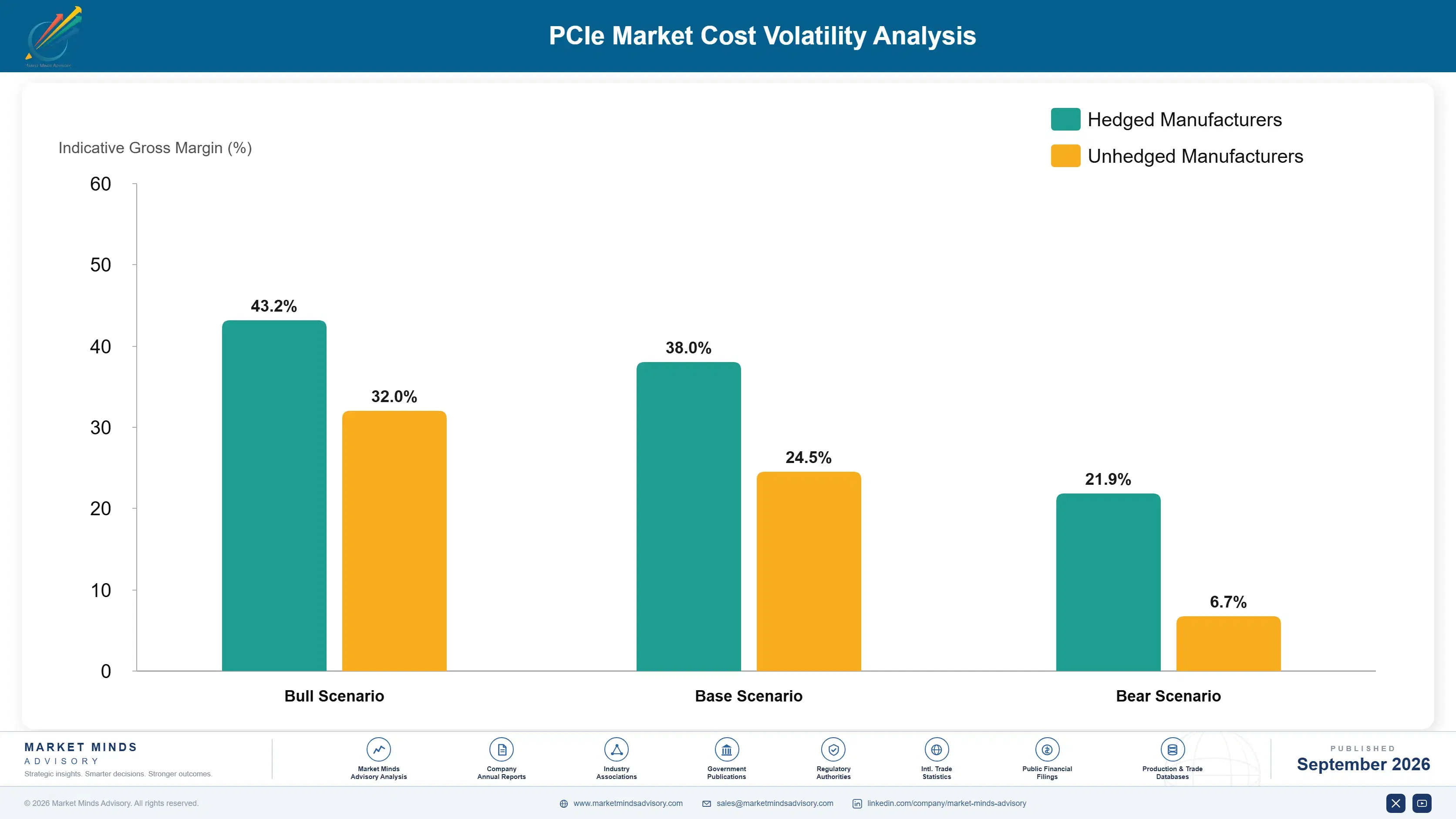
What Actually Drives Component Manufacturing Cost

Advanced process node semiconductor manufacturing and specialised packaging together represent 48 to 56 percent of cost of goods sold for PCIe component manufacturers, sourced primarily from a small number of leading-edge semiconductor foundries concentrated in Taiwan and South Korea. Manufacturers with large existing purchase volumes typically negotiate more favourable foundry pricing than smaller competitors purchasing similar volumes.
Advanced node manufacturing capacity experienced significant demand pressure during 2023 as AI chip production competed directly for the same foundry capacity, a dynamic documented in company annual reports describing allocation constraints, forcing several component manufacturers to accept longer lead times or pay premium pricing for guaranteed capacity today. Several manufacturers reported extending delivery windows by multiple months during the peak of this capacity constraint, directly affecting server production schedules for customers depending on timely component availability.

Smaller specialist manufacturers without long-term foundry capacity agreements absorb a proportionally larger share of any renewed capacity constraints than Broadcom or Marvell, which negotiate dedicated capacity allocations directly with leading foundries across their much larger combined semiconductor order volumes. This cost gap compounds the competitive disadvantage smaller vendors already face on hyperscaler relationship scale, squeezing margins from multiple directions during periods of foundry capacity constraint.
pcie-market-cost-volatility-analysis-1790002357023

Negotiating Long-Term Foundry Capacity Agreements

Larger manufacturers lock in dedicated leading-edge foundry capacity through multi-year agreements rather than competing for available capacity on shorter terms, trading some pricing flexibility for meaningfully more reliable manufacturing access during periods of industry-wide capacity constraints affecting smaller competitors more severely. This approach has become standard practice among the five largest interconnect component manufacturers in the market today.

Diversifying Across Multiple Foundry Partners

Manufacturers are qualifying designs across multiple foundry partners rather than depending on a single manufacturing source, reducing exposure to any individual foundry's capacity allocation decisions during periods when overall industry semiconductor demand tightens unexpectedly. Smaller manufacturers increasingly follow this same practice to reduce comparable exposure. This practice has become increasingly common across the broader semiconductor component industry.

Optimising Chip Designs for Manufacturing Efficiency

Engineering teams are optimising component designs to achieve required performance using less advanced, more available process nodes where technically feasible, reducing dependence on the most capacity-constrained leading-edge manufacturing nodes without compromising reliability standards. Smaller vendors rarely have comparable engineering resources for this optimisation work. This capability increasingly separates leading vendors from competitors relying entirely on premium capacity access.

Portfolio Architecture for Margin Defence

The portfolio splits into three tiers running from commodity-adjacent legacy generation components through certified current-generation enterprise parts to next-generation AI infrastructure components, with gross margin widening meaningfully at each step as signal integrity complexity and validation requirements increase substantially. This layered structure closely mirrors how semiconductor component margins generally scale with validation complexity. Margins expand accordingly at each successive step of the value chain.
Volume tier legacy components compete largely on price for conventional enterprise server platforms still running older generations, while premium current-generation parts command materially higher margin because they bundle validation services and platform-specific certification that smaller deployments neither need nor can afford. Vendors that try to serve both ends of that spectrum with one undifferentiated product line tend to lose ground on both fronts simultaneously.

The highest-value margin pools concentrate in the next-generation tier, where AI infrastructure components carry premium pricing that hyperscale customers accept precisely because interconnect bandwidth now directly determines whether an accelerator-dense system can achieve its intended performance at all. Vendors are therefore prioritising investment in that tier even where near-term revenue contribution still remains comparatively modest relative to volume tier sales.

Volume / Commodity-Adjacent Tier

Legacy generation components sold mainly on price for conventional enterprise server platforms still running older generations. These components rely on simple manufacturing processes with minimal signal integrity engineering differentiation. Margins remain genuinely thin here overall.
Gross Margin: 22-30%

Premium / Certified Tier

Current-generation components bundling platform certification, validation services, and extended technical support. Customers at this tier typically renew supply relationships for multiple consecutive platform generations once qualified. Renewal rates stay consistently strong here.
Gross Margin: 36-44%

Sustainability / Regulatory / Next-Generation Tier

AI infrastructure components commanding the highest per-unit pricing available in the market. Pricing here reflects genuine engineering differentiation rather than incremental additions to legacy designs. Adoption keeps expanding steadily each year.
Gross Margin: 46-54%
pcie-market-portfolio-architecture-1790002357520

High-value Sub-segments and Strategic Watch-out

AI Infrastructure Interconnect Components

Highest growth and highest margin pool in the market, driven by hyperscale operators needing maximum bandwidth for accelerator-dense server architectures. Vendors investing heavily here today are positioning for the largest share of long-term margin expansion, constrained mainly by signal integrity engineering complexity. Adoption keeps accelerating steadily.
Gross Margin: 48-56%

PCIe IP Core Licensing for Custom Silicon

High-value segment growing more moderately as custom silicon design activity expands, favouring vendors with proven, easily integrated licensable implementations. Continued custom silicon growth should keep steadily reinforcing this segment's relative commercial importance in coming years. Vendors without established licensable IP portfolios face a materially harder path to winning share here.
Gross Margin: 40-48%

Standard Enterprise Server Components

The volume core of the market, growing near the overall market average as most remaining demand comes from steady conventional server refresh cycles. Most vendor revenue still originates here even as faster-growing premium tiers increasingly attract the bulk of new investment. Growth continues steadily as conventional server refresh cycles proceed.
Gross Margin: 26-34%

Legacy Generation Replacement Parts

A shrinking segment vendors should watch closely, as remaining older platforms delay replacement but still represent thinning revenue with rising support cost per unit. Vendors ignoring this shrinking segment risk losing replacement revenue faster than expected as remaining platforms finally retire. Support cost per remaining unit keeps rising steadily.
Gross Margin: 14-20%

Why Design Wins Lock In Revenue

Component design wins behave like a multi-year annuity once secured, since customers rarely switch suppliers mid-platform given the substantial engineering validation and qualification cost required to certify a new component for an existing server generation already in production. Customers rarely revert to a previous supplier once a full platform qualification cycle has been completed successfully. Switching would require substantial re-validation work that few customers are willing to undertake without a genuinely compelling reason.
Adoption runs deepest among hyperscale operators building accelerator-dense AI infrastructure, who extract the most value from newest generation bandwidth and therefore upgrade fastest, while conventional enterprise customers with less bandwidth-intensive workloads adopt more slowly and often run several generations behind for years before ever justifying the premium newest components command. This divide has widened as newest generation components increasingly command a meaningful premium over legacy alternatives.

A generational shift in buyer profile is underway as hyperscale infrastructure architects increasingly prioritise signal integrity and validation depth over pure component cost, favouring suppliers who can demonstrate proven reliability at scale over those competing purely on unit price alone. This shift is reshaping vendor sales strategy across nearly every major semiconductor interconnect supplier competing for these accounts.
pcie-market-end-use-penetration-index-1790002358013

What Determines Who Wins This Market

These are among the four positions where our research anticipates prominent divergence between winners and laggards over the coming forecast period. Each is grounded in the demand model, the regulatory perimeter, and the announced capacity pipeline.
01 / HYPERSCALER DESIGN WIN DEPTH

Winning AI infrastructure contracts matters more than defending legacy volume

Vendors that secure multi-year hyperscaler design win agreements capture durable revenue genuinely insulated from broader component pricing competition, since these agreements typically span an entire server platform generation lasting several years. Astera Labs' rapid hyperscaler relationship building illustrates how quickly a specialist can compound this advantage against larger, more diversified incumbents, establishing a durable lead in subsequent procurement cycles. Vendors still focused primarily on conventional enterprise components risk losing the fastest-growing, highest-margin segment of the market entirely to more specialised competitors.
02 / SIGNAL INTEGRITY ENGINEERING DEPTH

Deep specialisation in one component category can beat broad portfolios

Specialist retimer companies built specifically around newer PCIe generation signal integrity challenges have won meaningful design wins against larger, diversified semiconductor incumbents, demonstrating that deep technical specialisation can outcompete broader portfolios when engineering complexity grows sufficiently demanding. Vendors without comparable specialised engineering depth risk losing the highest-value design wins to competitors built specifically around these challenges, even where the diversified vendor maintains stronger overall market presence across other product categories. Diversified incumbents that fail to match this specialised depth risk permanently ceding the highest-margin design wins to focused competitors.
03 / FOUNDRY CAPACITY ACCESS STRATEGY

Securing manufacturing capacity is becoming as important as design innovation

Vendors with long-term leading-edge foundry capacity agreements maintain more reliable manufacturing access than smaller competitors during periods of industry-wide capacity constraint, a genuine competitive advantage as AI chip production increasingly competes for the same limited advanced semiconductor manufacturing capacity. This dynamic will likely intensify further as AI infrastructure demand continues growing faster than global leading-edge foundry capacity can expand, making capacity access a genuine strategic priority rather than a purely operational concern. Vendors without comparable capacity commitments risk losing large hyperscaler contracts to competitors who can guarantee delivery certainty.
04 / IP LICENSING MARKET EXPANSION

Licensing revenue provides genuine insulation from component pricing cycles

Vendors licensing PCIe IP cores to the growing base of custom silicon designers capture recurring royalty revenue distinct from direct component sales, a revenue stream that scales with customer shipment volume regardless of component pricing competition elsewhere in the market. This lever matters increasingly as more companies design custom silicon for specialised workloads, and vendors without established licensing relationships risk missing this growing revenue opportunity entirely to competitors who invested earlier. Vendors that establish licensing relationships early tend to retain that advantage as customer shipment volumes continue growing.

Engagement Snapshot From the Field

A live engagement with an industry participant carrying material or product regulatory and market exposure ahead of a defining policy shift, showing how our research translates into a defensible multi-year portfolio strategy.
MARKET MINDS ADVISORY · CLIENT ENGAGEMENT SUMMARY
PCIe Producer Strategic Portfolio Review and Transition Roadmap 2026·Investment Scenario on PCIe Exposure Evaluation 2025-26
CLIENT PROFILE
The client, a mid-sized cloud infrastructure provider expanding its AI-focused server offerings, needed to select PCIe component suppliers for a new accelerator-dense server platform. Annual component procurement spending had reached approximately 18 million dollars (client-reported, unverified by MMA), with leadership evaluating whether to work with established diversified suppliers or newer specialist vendors. Leadership sought an evidence-based recommendation before committing significant capital to either supplier relationship.
STRATEGIC CHALLENGE
The provider needed components capable of reliably supporting its new accelerator-dense platform's demanding bandwidth requirements, but had limited internal signal integrity engineering expertise to independently validate whether a given specialist vendor's components would perform reliably at the scale the provider's new platform required. within a reasonable validation timeline given the provider's aggressive planned platform launch schedule.
MMA APPROACH
MMA benchmarked candidate suppliers against the provider's specific platform requirements and existing engineering capability, modelling total validation timeline and risk under both an established diversified supplier and a newer specialist vendor scenario. The analysis prioritised understanding which vendors offered the strongest reference deployments at comparable hyperscale infrastructure providers already using similar server configurations.
KEY FINDINGS
  1. Specialist vendors offered meaningfully better signal integrity performance data for the provider's specific high-density configuration., a factor that materially influenced the final vendor selection recommendation for this platform.
  2. Established diversified suppliers offered lower perceived execution risk given longer overall track records across many customer platforms., though this advantage mattered less once independent validation data became available for review.
  3. Reference customers using specialist vendor components reported reliability performance consistent with the specialist's own published specifications., providing genuine confidence in the specialist vendor's real-world reliability claims.
  4. A dual-sourcing approach could reduce supply concentration risk while still capturing the specialist vendor's superior technical performance., balancing performance benefits against the provider's genuine risk tolerance for this platform.
CLIENT PROFILE
The client, a mid-sized cloud infrastructure provider expanding its AI-focused server offerings, needed to select PCIe component suppliers for a new accelerator-dense server platform. Annual component procurement spending had reached approximately 18 million dollars (client-reported, unverified by MMA), with leadership evaluating whether to work with established diversified suppliers or newer specialist vendors. Leadership sought an evidence-based recommendation before committing significant capital to either supplier relationship.
STRATEGIC CHALLENGE
The provider needed components capable of reliably supporting its new accelerator-dense platform's demanding bandwidth requirements, but had limited internal signal integrity engineering expertise to independently validate whether a given specialist vendor's components would perform reliably at the scale the provider's new platform required. within a reasonable validation timeline given the provider's aggressive planned platform launch schedule.
MMA APPROACH
MMA benchmarked candidate suppliers against the provider's specific platform requirements and existing engineering capability, modelling total validation timeline and risk under both an established diversified supplier and a newer specialist vendor scenario. The analysis prioritised understanding which vendors offered the strongest reference deployments at comparable hyperscale infrastructure providers already using similar server configurations.
KEY FINDINGS
  1. Specialist vendors offered meaningfully better signal integrity performance data for the provider's specific high-density configuration., a factor that materially influenced the final vendor selection recommendation for this platform.
  2. Established diversified suppliers offered lower perceived execution risk given longer overall track records across many customer platforms., though this advantage mattered less once independent validation data became available for review.
  3. Reference customers using specialist vendor components reported reliability performance consistent with the specialist's own published specifications., providing genuine confidence in the specialist vendor's real-world reliability claims.
  4. A dual-sourcing approach could reduce supply concentration risk while still capturing the specialist vendor's superior technical performance., balancing performance benefits against the provider's genuine risk tolerance for this platform.
RECOMMENDED STRATEGY
Phase 1: Phase 1 (Months 1 to 3): Conduct parallel validation testing of both an established supplier and a specialist vendor's components on the new platform. Phase 2: Phase 2 (Months 4 to 8): Deploy the better-performing supplier as primary source while qualifying the second as a backup supply option. Phase 3: Phase 3 (Months 9 to 14): Scale production deployment while monitoring reliability data to confirm the initial validation results hold at full scale.
OUTCOME
The provider selected the specialist vendor as its primary component supplier and completed platform deployment within the recommended timeframe, reporting reliability performance consistent with MMA's validation projections (client-reported, unverified by MMA). Leadership credited the dual-sourcing approach with reducing supply risk without sacrificing performance. Leadership specifically praised the parallel validation approach for reducing selection risk before full-scale commitment.

Frequently Asked Questions

Foundational context covering the market sizes, CAGR, scope, country, region and competition that inform every finding below. This section is provided to cover basics and most often pre-purchase conversations, answered from the MMA Primary Research Dataset.

What is the current size of the PCIe Market?

The global market was valued at 6.8 billion dollars in 2025, with the United States representing the largest single national hyperscale deployment base within that total.

How large will the PCIe Market be by 2036?

The global market is projected to reach 19.401 billion dollars by 2036, up from 7.48 billion dollars in 2026, a 2.59x expansion over the forecast decade.

What is the CAGR for the PCIe Market 2026 to 2036?

The market is forecast to grow at a 10.0 percent compound annual rate globally, with the newest generation components growing considerably faster than the overall category average.

Which segment is growing fastest?

PCIe Gen5 and Gen6 high-speed interconnect solutions lead all segments at an 18.5 percent CAGR, roughly 1.85 times the overall market rate, as AI infrastructure demand accelerates.

Who are the major companies in the PCIe Market?

Broadcom, Microchip Technology, Astera Labs, Marvell Technology, and Synopsys together hold the largest share, with CR5 concentration near 54 percent globally. That concentration reflects continued diversification across established and specialist vendors alike.

Which country is growing fastest?

China leads growth at a 13.0 percent CAGR, driven by rapidly expanding domestic data centre infrastructure investment alongside the country's existing semiconductor manufacturing base. Domestic manufacturers continue expanding aggressively within this large addressable base.

Report Segmentation Architecture

The full report scope spans multiple orthogonal segmentation dimensions, with cross-tabulated demand data provided for each dimension pair. Coverage extends further to regional breakdowns, trend trajectories, and the competitive detail needed to support segment-level decision-making.

By Primary Market Dimension

  • PCIe Switch Chips
  • PCIe Retimers and Redrivers
  • PCIe Host and Endpoint Controllers
  • PCIe Gen5 and Gen6 High-Speed Interconnect Solutions
  • PCIe IP Cores and Licensing
  • PCIe Cabling and Connector Solutions

By End-Use Industry

  • Hyperscale Cloud Computing
  • Enterprise Data Centres
  • High-Performance Computing
  • Consumer Computing
  • Storage Systems

By Commercial Dimension

  • Direct Hyperscaler Component Sales
  • Enterprise Server OEM Sales
  • IP Licensing Agreements
  • Distribution Channel Sales

By Region

  • North America
  • Western Europe
  • East Asia
  • South Asia and Pacific
  • Latin America
  • Middle East and Africa
  • Eastern Europe

Scope, Methodology, and Coverage

Every figure in this report is reproducible from documented input assumptions. The scope below maps the historical period, the forecast horizon, the segmentation dimensions, and the countries covered, alongside the underlying primary and qualitative methodology.
Historical Period
2020 to 2025
Forecast Period
2026 to 2036
Base Year
2025 (USD billions; MMA Primary Research Dataset, September 2026)
Market Definition
This market covers semiconductor components and intellectual property implementing the PCI Express interconnect standard, including switch chips, retimers, controllers, and licensable IP cores used in servers, storage systems, and computing devices. It excludes the broader server and computing systems themselves and unrelated interconnect standards such as Ethernet or InfiniBand.
Quantitative Units
USD billions (current prices); regional and segment CAGR in percent
Segmentation Dimensions
By Primary Market Dimension; By End-Use Industry; By Commercial Dimension; By Region
Regions Covered
North America, Western Europe, East Asia, South Asia and Pacific, Latin America, Middle East and Africa, Eastern Europe
Countries Covered
USA, China, Germany, France, UK, Japan, South Korea, India, Australia, Canada, Brazil, Mexico, Indonesia, Vietnam, Thailand, Malaysia, UAE, Saudi Arabia, South Africa, Nigeria, Turkey, Poland, Netherlands, Italy, Spain, Sweden, Switzerland, Argentina, Colombia, Singapore, and additional markets relevant to this sector
Key Companies Profiled
Broadcom Inc, Microchip Technology Inc, Astera Labs Inc, Marvell Technology Inc, Synopsys Inc, Cadence Design Systems Inc, Rambus Inc, Credo Technology Group Holding Ltd, Parade Technologies Ltd, Texas Instruments Inc, Renesas Electronics Corporation, MaxLinear Inc, Diodes Incorporated, Semtech Corporation, GigaDevice Semiconductor Inc, Montage Technology Co Ltd, Amphenol Corporation, Molex LLC, TE Connectivity Ltd, Analog Devices Inc
Quantitative Methodology
Primary survey, n=3,800 respondents, Q4 2025, six countries; demand-side model with trade association cross-validation
Qualitative Methodology
47 expert interviews, Q4 2025; applied to validate demand model assumptions, identify emerging dynamics, and assess competitive positioning
Report Format
PDF and XLSX data workbook (Word format preview document)
Publisher
Market Minds Advisory
Report Code
MMA-2026-TEC-630
Published
September 2026
Contact
sales@marketmindsadvisory.com | www.marketmindsadvisory.com

Purchase the full PCIe Market Report (2026 to 2036).

The full report delivers a complete quantitative and qualitative assessment of the PCIe Market across all seven regions and six product segments. It includes detailed vendor profiles for all twenty companies covered, alongside country-level sizing for thirty markets. Primary research draws on thirty-eight hundred survey respondents and forty-seven expert interviews conducted in the fourth quarter of 2025 across six countries. Buyers receive full editable data tables alongside the complete narrative analysis, competitive vendor scorecards, and forward-looking scenario modelling included in every purchase. Analysts remain available for direct follow-up questions after purchase.
Twenty vendor profiles with moat and risk analysis
Seven-region market sizing with country breakdowns
Six-segment technology framework with growth rates
Primary survey data collected across six countries
Forty-seven expert interview insights fully included
Editable data tables for all forecast figures

Built For The People Who Decide

From boardroom strategy to bench-side execution, this report is read cover-to-cover by leaders shaping the next decade of their industry, turning demand scenarios, market dynamics and valuation benchmarks into decisions.
CXOs/ Presidents/ VPs/ Managers
M&A and Corporate Development
Strategy Teams and R&D Heads
Procurement and Product Directors
Regulatory and Compliance Leaders
Investor Relations and Equity Analysts