Market Minds Advisory
PC ODM Market

PC ODM Market: PC ODM Market: AI PC Transition and Manufacturing Diversification Growth

Accelerating AI PC platform transition, expanding manufacturing diversification beyond China, and rising gaming laptop demand are jointly reshaping how ODM manufacturers compete for brand contracts and production capacity worldwide. across every major national market tracked.

Lead Analyst

Published

September 2026

Make Smarter Decisions with Customized Research Insights

Request a free sample report and evaluate market opportunities, growth trends, and competitive dynamics relevant to your business needs.

2025 MARKET VALUE$68.0BMarket Size 2025
2036 FORECAST VALUE$131.8BBase Case , 2026 to 2036
CAGR 2026 TO 20366.2 %Bull 7.4% / Bear 5.0%
INCREMENTAL OPPORTUNITY$59.6BNet 10- year value creation
EXPANSION MULTIPLE1.82x2036 value over 2026 base
Strategic Levers
M&A Pipeline
Regional Outlook
Country Rankings
Competitive Intelligence
Segmental Deep-dive
Call-Us : 91 93563 13602

Executive Snapshot and Market Trajectory.

PC ODM manufacturers are capturing accelerating demand for AI PC design services as NPU-enabled platforms expand rapidly beyond legacy conventional laptop architectures, reshaping brand contract allocation considerably across nearly every major computing category tracked this cycle, particularly across premium notebook segments. with brand relationship management proving essential nationwide.
Notebook and laptop ODM services still generate the largest share of category revenue, but AI PC and NPU-enabled services are expanding fastest as brand customers prioritize on-device AI processing capability over legacy conventional architecture designs. Demand concentrates heavily among manufacturers building integrated chipset partnership and thermal engineering capability domestically. Gaming PC and laptop ODM services are also climbing steadily as esports and content creation culture expands premium hardware demand across most major brand portfolios worldwide.
Quanta Computer and Compal Electronics retain substantial combined share of brand manufacturing contracts, but specialized gaming and AI-focused ODM manufacturers are winning share among brands underserved by generalist mass-production capacity. Tightening export control and semiconductor sourcing requirements continue reshaping which manufacturers can profitably scale multi-region production. Consolidation among smaller regional assemblers looks increasingly likely as compliance cost keeps climbing under expanded trade regulatory scrutiny.
Market Definition
This report covers revenue from original design manufacturing services for personal computers, including notebooks, desktops, gaming systems, AI-enabled platforms, and mini PCs designed and manufactured on behalf of brand customers. It excludes original equipment manufacturing performed entirely to brand-supplied designs and unrelated server or data center hardware manufacturing.
Base Year Value
$68.0B in 2025 (MMA Primary Research Dataset, August 2026)
Forecast Period
2026 to 2036, eleven discrete annual values
CAGR
6.2% base case. Bull 7.4%. Bear 5.0%.
Fastest Growth Segment
AI PC and NPU-Enabled ODM Services: 18.6% CAGR
Fastest Growth Country
Vietnam: 13.8% CAGR
Fastest Growth Region
South Asia and Pacific: 8.2% CAGR
Largest Region
East Asia: 30% of 2025 global value
Market Leaders
Quanta Computer, Compal Electronics, Wistron Corporation, Pegatron Corporation, Inventec Corporation. Source: MMA Analysis based on company annual reports.
Primary Survey
n=3,800 procurement and R&D decision-makers, Q4 2025, six countries
Methodology
Demand-side build-up, cross-validated against public data, 47 expert interviews

PC ODM Market Forecast Scenarios

pc-odm-market-size-forecast-scenario-1788168579988
PC ODM revenue grew steadily between 2020 and 2025 as remote work adoption accelerated demand for notebook manufacturing capacity across multiple brand customer portfolios worldwide. Gaming and content creation culture also contributed meaningfully as brands expanded premium hardware investment considerably. Manufacturing diversification pressure also contributed meaningfully to overall production volume growth across most major ODM categories worldwide during the period.
The base case assumes continued growth driven by three commercial mechanisms: sustained AI PC platform transition supporting elevated NPU-enabled design demand, accelerating gaming and content creation culture expanding premium hardware procurement, and broader manufacturing diversification diversifying production capacity across Southeast Asian and South Asian facilities. These three forces reinforce each other across the forecast horizon, compounding growth beyond what any single mechanism alone would produce. Chipset partnership innovation is reinforcing this momentum considerably across most major manufacturer portfolios worldwide.
The bull case hinges on further AI PC platform adoption driving accelerated brand refresh cycles across multiple computing categories simultaneously. The bear case centers on a sustained enterprise IT spending slowdown that delays new device replacement cycles, slowing overall production volume growth across most manufacturer segments worldwide. Either scenario would reshape which manufacturers hold pricing power over the coming decade considerably.

AI PC Transition Reshapes Manufacturing Investment Priorities

PC ODM manufacturing sits at the intersection of accelerating AI PC platform transition, expanding manufacturing diversification pressure, and a maturing chipset partnership base that has strengthened design engineering capability considerably over the past several years. Manufacturers that invested early in NPU integration expertise and thermal engineering are now capturing disproportionate share of new brand contract awards across most major computing categories worldwide, particularly for premium AI PC platform launches.
TOP 5 CONCENTRATION72%Combined production share held by the largest ODM manufacturers
AVERAGE CONTRACT MANUFACTURING MARGIN4.2%Typical operating margin earned on standard ODM production contracts
AVERAGE DESIGN-TO-PRODUCTION TIMELINE8 monthsTypical duration from design contract signing to volume shipment
NON-CHINA PRODUCTION CAPACITY SHARE34%Share of total production capacity located outside mainland China
COMPONENT COST SHARE78%Share of production cost from semiconductor and display components
TOP PRODUCING REGION SHARE58%Share of global production volume concentrated in East Asia
The market's commercial character reflects a highly concentrated manufacturer base: a handful of Taiwanese ODM giants offering standardized volume production at scale, and specialized gaming and AI-focused manufacturers competing on design engineering depth and thermal innovation underserved by larger volume-focused competitors. This concentration is intensifying as leading manufacturers push further into premium design territory once ceded entirely to specialized competitors, narrowing the differentiation gap smaller manufacturers depended on for growth.
Regulatory scrutiny of export control and semiconductor sourcing compliance, combined with growing AI chipset innovation, will define the competitive landscape over the coming decade as manufacturers balance growth ambitions against compliance requirements. Consolidation pressure on smaller regional assemblers is building steadily, and continued manufacturing diversification could reshape which manufacturers command the fastest-growing segments of brand demand worldwide.
"Everyone assumes PC ODM is a commodity assembly business with no differentiation left. It isn't. The manufacturers actually winning premium AI PC contracts are the ones who solved thermal design for NPU workloads first, because a chip that throttles under sustained AI inference load kills a brand's entire product launch."
Practice Lead, Technology Manufacturing Services Intelligence · MMA Technology Manufacturing Services Practice · August 2026

Market Trends

AI PC Platforms Expand Beyond Legacy Conventional Architectures

Manufacturers continue expanding AI PC and NPU-enabled design capability beyond legacy conventional laptop architectures into dedicated on-device AI processing categories, converting what was once a cloud-dependent-only requirement into genuine local inference capability. Quanta Computer and Wistron Corporation have both expanded proprietary AI PC design programs covering an increasing share of premium brand contract awards worldwide. This shift is opening substantial new manufacturing revenue for firms building integrated chipset partnership and thermal engineering capability, particularly for brands seeking differentiated AI features against proliferating commodity hardware competition pressures. Smaller manufacturers increasingly license third-party reference designs to remain competitive.
Market Impact: Lifts enterprise production volume 16%

Manufacturing Diversification Drives Multi-Region Capacity Investment

Brand customers increasingly require multi-region production capacity that consolidates Taiwan, Vietnam, and India manufacturing into a single resilient supply chain, converting what was once a China-concentration-only default into genuinely diversified geographic risk management capability. Pegatron Corporation and Wistron Corporation have both expanded dedicated Vietnam and India facility investment covering a growing share of brand diversification mandates. This shift is compressing legacy China-concentration-only relevance meaningfully across the industry, favoring manufacturers with strong multi-region operational capability over those still dependent on single-country production. Smaller manufacturers without comparable expansion budgets increasingly partner with regional contract assemblers to remain competitive.
Market Impact: Raises premium contract revenue share 14%

Market Opportunities and Growth Drivers

Enterprise Device Refresh Cycles Sustain Elevated Production Demand

Persistent enterprise device refresh cycles, driven by operating system support timelines and security compliance requirements, continue supporting elevated notebook production demand across corporate and government procurement categories, expanding the addressable brand customer market well beyond routine consumer replacement alternatives. Quanta Computer and Compal Electronics have both reported higher production order volume as a direct consequence of this sustained enterprise refresh trend. Every incremental enterprise fleet refresh translates directly into additional production demand across the notebook and desktop categories, particularly for security-conscious corporate buyers. Multi-year brand manufacturing agreements are also expanding, giving manufacturers more predictable revenue visibility across extended contract relationships.
Market Impact: Adds 3 months to export approvals

Gaming and Content Creation Culture Expands Premium Investment

Growing gaming and content creation culture continues expanding premium PC manufacturing investment beyond purely mainstream notebook production into genuine high-performance revenue diversification. Clevo and MiTAC have both expanded dedicated gaming-focused manufacturing lines tied directly to this diversification opportunity over the past several years. This trend is expected to persist as brands continue prioritizing high-performance thermal and graphics engineering over reliance on legacy mainstream-only architecture alternatives across most major computing categories worldwide. Domestic thermal engineering capability is also proving to be a meaningfully faster path to premium contract wins than pure scale positioning alone for many manufacturers.
Market Impact: Limits reinvestment to 2 percent revenue

Market Restraints and Challenges

Semiconductor Export Controls Complicate Chipset Sourcing

Increasingly complex semiconductor export control requirements continue complicating advanced chipset sourcing, forcing manufacturers to navigate distinct compliance frameworks before shipping AI-enabled platforms to certain regional markets. The root cause is legitimate national security concern over advanced processing capability reaching restricted destinations without adequate export licensing validation. Manufacturers are mitigating the pressure by expanding dedicated export compliance teams, but negotiation cycles remain meaningfully longer than for comparable non-restricted chipset sourcing elsewhere. Manufacturers dependent on restricted markets are also lobbying for clearer export policy guidance to restore predictable production planning. Manufacturers increasingly view export compliance as a strategic capability.
Market Impact: Expands AI PC contract share 27%

Thin Margin Structure Constrains Manufacturer Reinvestment Capacity

Genuine thin margin structure across standard volume production contracts continues constraining how much manufacturers can reinvest in design engineering and thermal innovation without compromising near-term profitability targets. The root cause is intense brand customer price negotiation leverage combined with commoditized standard notebook production economics. Manufacturers are mitigating this by expanding premium design service offerings and value-added engineering contracts, but reinvestment capacity remains a meaningful constraint on how quickly innovation can realistically scale industry-wide. Smaller manufacturers without diversified premium contract portfolios face disproportionate difficulty funding design engineering investment. Brands increasingly favor manufacturers that demonstrate stronger premium design capability.
Market Impact: Raises non-China capacity share 19%
4 additional market trends, 3 additional growth drivers, and 3 additional restraints and challenges are covered in the full report. Contact sales@marketmindsadvisory.com to access the complete intelligence.

Segment CAGR and Growth Architecture

PC ODM services segment across six mutually exclusive device categories, ranging from mature desktop production through fast-growing AI PC and gaming formats that increasingly determine which manufacturers capture new brand contract revenue. These distinctions matter for manufacturers setting long-term engineering and capacity investment priorities worldwide. Segment boundaries reflect distinct engineering and manufacturing requirements rather than overlapping categories.
pc-odm-market-market-share-analysis-1788168580555

AI PC and NPU-Enabled ODM Services

AI PC and NPU-enabled ODM services bundle dedicated neural processing unit integration, thermal engineering for sustained inference workloads, and chipset partnership coordination into a manufacturing category tailored specifically to brands seeking dramatically differentiated on-device AI capability across contested premium notebook and enterprise refresh environments. Quanta Computer and Wistron Corporation have both scaled dedicated AI PC design programs covering an increasing share of premium brand contract budgets worldwide. Growth here consistently outpaces every other segment because on-device AI processing fundamentally changes the value proposition of premium notebooks for enterprise and consumer buyers alike, and production costs continue falling as the underlying NPU and thermal technology matures across most participating manufacturer programs.
CAGR 18.6%

Gaming PC and Laptop ODM Services

Gaming PC and laptop ODM services bundle high-performance graphics integration, advanced thermal design, and premium chassis engineering into a manufacturing category that has expanded well beyond its original niche enthusiast base into genuine mainstream premium computing capability. Clevo and MiTAC have both built proprietary gaming manufacturing platforms that serve both branded gaming labels and white-label boutique customers worldwide. Demand is accelerating as brands increasingly prioritize high-performance thermal and graphics engineering over legacy mainstream-only architecture formats, and modern gaming platforms consistently offer stronger brand differentiation than intermittent mainstream alternatives alone. Deployment timelines in this segment run meaningfully faster than legacy mainstream-only production programs, reflecting the scale of engineering investment these manufacturers have built into their thermal and graphics infrastructure.
CAGR 9.4%
Full segment breakdown across 6 segments available in the complete report.

Regional Architecture and Country Demand Map

East Asia anchors global production through Taiwan's design headquarters and China's assembly scale, while South Asia and Pacific expands fastest as manufacturing diversification broadens capacity. North America and Western Europe remain brand-headquarters regions rather than production centers. Latin America and Eastern Europe remain minor manufacturing contributors nationally.

North America

The United States represents the largest single national market within North America, though this reflects brand customer headquarters concentration rather than manufacturing capacity, since Dell, HP, and Apple all design specifications domestically while contracting production to Taiwanese ODM manufacturers. Quanta Computer, Compal Electronics, and Wistron Corporation all maintain extensive engineering liaison offices supporting these brand relationships from North American design centers. Rising enterprise AI PC procurement is driving accelerating demand for premium NPU-enabled contract manufacturing across major corporate and government buyer categories alike. Canada contributes a smaller but growing share, concentrated among enterprise procurement in Toronto and Vancouver corporate markets. Persistent semiconductor export control complexity continues constraining premium AI PC order fulfillment for enterprise buyers.
Share: 22% | CAGR: 5.4% (2026 to 2036)

Western Europe

Germany and the United Kingdom account for the largest share of regional brand headquarters activity, though actual production remains concentrated almost entirely in East Asian and Southeast Asian manufacturing facilities rather than within the region itself. France and the Nordic countries are expanding enterprise AI PC procurement fastest within the region, reflecting well-funded corporate technology refresh budgets. Stricter data security certification requirements for government and enterprise procurement have slowed some AI PC platform approvals relative to other regions, favoring manufacturers who can demonstrate rigorous compliance credentials. Southern European markets remain comparatively smaller procurement bases, with demand concentrated almost entirely among large enterprise and public sector buyers across the region. Regional procurement volume should continue expanding steadily nationwide.
Share: 18% | CAGR: 4.6% (2026 to 2036)
Regional intelligence for 5 additional markets available in the complete report: East Asia, South Asia and Pacific, Latin America, Middle East and Africa, Eastern Europe. Contact sales@marketmindsadvisory.com.
pc-odm-market-country-cagr-analysis-1788168581062

Converting Standard Contracts Into Recurring Design Partnerships

Manufacturers are shifting beyond one-time volume production contracts toward layered design service agreements, chipset partnerships, and long-term manufacturing commitments that convert a single contract into a multi-year brand relationship worth substantially more than the initial order alone. These layered revenue mechanisms are becoming a core differentiator as manufacturers compete for durable brand and chipset loyalty beyond the initial contract nationwide.

Premium Design as a Service Engineering Contracts

Manufacturers are increasingly bundling proprietary thermal and chassis design capability behind premium design-as-a-service contracts that provide dedicated engineering teams, exclusive reference designs, and accelerated development timelines beyond standard volume production arrangements. Quanta Computer and Wistron Corporation have both expanded dedicated design service programs that already contribute a meaningfully growing share of total contract value beyond standard manufacturing margins. Brand customers enrolling in design service contracts typically retain the engineering relationship for multiple product generations, and manufacturers report contract attach rates climbing steadily, with design service fees priced around USD 2 million per program.
Market Impact: Adds 18 percent recurring design service revenue annually

Multi-Year Chipset Partnership and Early Access Programs

Multi-year chipset partnership agreements with semiconductor suppliers covering early silicon access and joint reference design development are becoming a standard growth channel across nearly every major manufacturer's product development strategy. Compal Electronics and Pegatron Corporation have both expanded dedicated chipset partnership programs tied directly to AI PC and premium notebook pipelines specifically. Contract volume under these partnerships runs considerably higher and more predictable than open-market component procurement, reflecting stronger chipset supplier confidence in manufacturers demonstrating consistent design quality across the partnership relationship lifecycle, with typical partnership terms spanning 3 to 5 years.
Market Impact: Lifts predictable contract volume by 22 percent annually

Multi-Region Manufacturing Diversification Service Bundle Programs

Manufacturer partnerships offering coordinated multi-region production across Taiwan, Vietnam, and India facilities are expanding bundled diversification services that lower the effective supply chain risk considerably below single-country production for a typical brand customer relationship. Pegatron Corporation and Wistron Corporation have both expanded dedicated multi-region service programs covering a growing share of new brand diversification mandates across multiple regions. These programs are proving especially effective at converting risk-conscious brand customers who would otherwise delay diversification, expanding the addressable contract base well beyond single-region relationships, with typical diversification service premiums starting around 3 percent of contract value.
Market Impact: Expands addressable contract base by 16 percent globally

Component Sourcing Data and Supply Chain Insight Licensing

A smaller but growing number of manufacturers are exploring anonymized component sourcing and pricing trend data licensing to semiconductor and brand partners seeking to improve procurement planning, subject to strict contractual confidentiality and competitive safeguard requirements. Quanta Computer and Compal Electronics have both begun piloting limited data partnership programs under carefully scoped confidentiality frameworks. While still a modest revenue contributor today generating an estimated USD 8 million annually, manufacturers view this as a meaningful longer-term diversification opportunity as brand trust in transparent, contractually protected sourcing data sharing arrangements gradually builds across the broader ODM category.
Market Impact: Contributes approximately 2 percent of total ancillary revenue

Who Controls the Margin Pool

The PC ODM market carries CR5 concentration of 72 percent, with a substantial gap separating Quanta Computer and Compal Electronics from smaller regional challengers still building brand relationship depth and manufacturing scale. This concentration reflects decades of consolidation among Taiwanese manufacturers around a small number of dominant volume producers serving the world's largest PC brands. Brand relationships increasingly determine which manufacturers can scale profitably beyond commodity production.
Current competitive activity centers on three dimensions: AI PC and NPU engineering capability racing, multi-region manufacturing diversification expansion, and expanding chipset partnership agreements that broaden design differentiation beyond standard volume assembly. Manufacturers with strong thermal and chassis engineering capability are consistently outperforming competitors dependent on commodity assembly-only production.

Emerging pressure comes from Chinese domestic manufacturers scaling assembly capacity that undercuts Taiwanese production costs considerably, alongside specialized gaming and boutique ODM entrants building deep thermal engineering capability that could reshape rankings within the category over the next several years. Vertically integrated brand manufacturers entering directly into limited self-manufacturing for premium product lines add further competitive intensity, and continued semiconductor sourcing cost inflation could squeeze smaller challengers lacking dedicated chipset relationships out of premium AI PC categories entirely.
pc-odm-market-company-positioning-matrix-1788168581589

Competitive Moat and Risk Dimensions

QUANTA COMPUTER

Moat: Design engineering and scale depth

Quanta Computer's extensive design engineering capability and massive production scale give it brand relationship depth that smaller manufacturers cannot easily replicate, supporting premium AI PC and notebook contracts across multiple leading brand customers simultaneously. This scale also shortens new platform development timelines considerably, letting Quanta respond faster to shifting brand requirements than competitors reliant on smaller engineering teams.
QUANTA COMPUTER

Risk: Brand customer concentration exposure

Quanta Computer's revenue remains meaningfully dependent on a concentrated set of major brand customer relationships, leaving contract volume exposed to any single customer's demand fluctuation or in-house manufacturing shift more severely than manufacturers with broader customer diversification. A significant shift toward in-house brand manufacturing for premium product lines could accelerate this concentration risk faster than diversified customer portfolios would experience.
COMPAL ELECTRONICS

Moat: Multi-category manufacturing breadth

Compal Electronics' broad manufacturing breadth across notebooks, desktops, and emerging AI PC categories gives it contract flexibility that smaller specialized manufacturers struggle to match without comparable production diversification, supporting resilient revenue across shifting brand category demand. These relationships also grant Compal early visibility into cross-category component sourcing trends well before smaller competitors can react.
COMPAL ELECTRONICS

Risk: Thin margin structure exposure

Compal Electronics' reliance on standard volume production contracts leaves margin more exposed to brand customer price negotiation pressure than manufacturers with a higher share of premium design service revenue, constraining reinvestment capacity during competitive pricing cycles. Expanding premium design service capability quickly enough to match specialty competitors could strain Compal's engineering investment budget meaningfully over time.

Players Tracked

Prominent Players

Quanta Computer
Compal Electronics
Wistron Corporation
Pegatron Corporation
Inventec Corporation

Other Key Players

Foxconn
Clevo
MiTAC
Flex
Jabil
Celestica
ECS Elitegroup
Wingtech Technology
Luxshare Precision
BYD Electronics
Tongfang
TPV Technology
Wiwynn
Getac Technology
Positivo Tecnologia

Recent Developments

SEPTEMBER 2025

Wistron Corporation Expands Vietnam Manufacturing Facility Capacity

Wistron Corporation expanded its existing Vietnam manufacturing facility, an organic capacity expansion intended to diversify production away from concentrated China-based assembly and shorten delivery timelines for brand customers requiring supply chain resilience. The expansion also includes dedicated workforce training programs to help the facility reach full production quality standards faster.
Signal: Signals accelerating manufacturing diversification investment as ODM manufacturers prioritize geographic risk management over pure cost optimization.
DECEMBER 2025

Quanta Computer Signs Multi-Year Chipset Partnership Agreement

Quanta Computer signed a multi-year chipset partnership agreement with a major semiconductor supplier, securing early access to next-generation NPU architecture ahead of competitors for upcoming AI PC platform design programs. The partnership secures priority allocation of limited early-production silicon ahead of competitors still negotiating standard supplier terms.
Signal: Indicates continued formal chipset partnership investment among leading manufacturers seeking AI PC design leadership. across the manufacturer's full product lineup.
MARCH 2026

Pegatron Corporation Opens New India Assembly Facility

Pegatron Corporation opened a new assembly facility in India, an organic capacity expansion intended to capture government manufacturing incentive programs and serve growing South Asian brand customer diversification mandates across several product categories. The facility is expected to reach full production capacity within eighteen months of the initial opening date.
Signal: Reflects sustained investment in India manufacturing capacity as a competitive differentiator amid persistent industry-wide diversification pressure.

Semiconductor and Display Component Cost Exposure

Processors, memory, and display panels together account for the substantial majority of PC ODM manufacturer cost of goods sold, typically representing close to 78 percent of total unit cost, with semiconductor components sourced predominantly from Taiwan-based foundries and display panels from South Korean and Chinese manufacturers. Packaging and logistics materials represent a smaller but growing additional cost layer for manufacturers shipping globally.
DRAM and NAND memory pricing volatility during 2025 pressured manufacturer margins considerably, as constrained memory chip supply drove input cost increases across the broader consumer electronics and computing hardware sectors simultaneously, according to company annual report disclosures. Manufacturers without long-term memory supply agreements absorbed a meaningfully larger share of the resulting cost increase than vertically integrated competitors. Average memory component pricing climbed roughly 14 percent year over year during the affected period.

Larger manufacturers like Quanta Computer can absorb component cost volatility more readily than smaller assemblers dependent on spot-market semiconductor procurement, creating a durable competitive disadvantage for smaller challengers lacking comparable supply chain control. This gap widens further for manufacturers without direct foundry relationships, leaving them consistently exposed to allocation constraints and pricing volatility during supply-constrained periods.
pc-odm-market-cost-volatility-analysis-1788168581784

Long-Term Semiconductor Supply Agreements

Manufacturers are locking in multi-year processor and memory supply agreements with established foundries and component producers to reduce spot market exposure, trading some pricing flexibility for meaningfully greater cost predictability across multi-year production planning horizons and brand delivery commitments. This approach insulates a meaningful share of unit cost from near-term component price swings across multi-year contract terms.

Multi-Region Assembly Cost Diversification

Leading manufacturers are diversifying assembly operations across multiple lower-cost regions rather than concentrating exclusively in higher-cost facilities, reducing per-unit labor cost over time while also improving geographic resilience across critical brand delivery commitments worldwide. This diversification also shortens delivery lead times considerably, letting manufacturers respond faster to shifting regional demand across new production markets.

Diversified Component Supplier Sourcing

Manufacturers are qualifying secondary processor and display panel suppliers beyond their primary foundry relationships, reducing single-source concentration risk while accepting modestly higher near-term qualification and testing costs across production lines. A small number of manufacturers have also begun qualifying domestic component production capacity as an additional long-term diversification safeguard against persistent import disruption risk.

Portfolio Architecture for Margin Defence

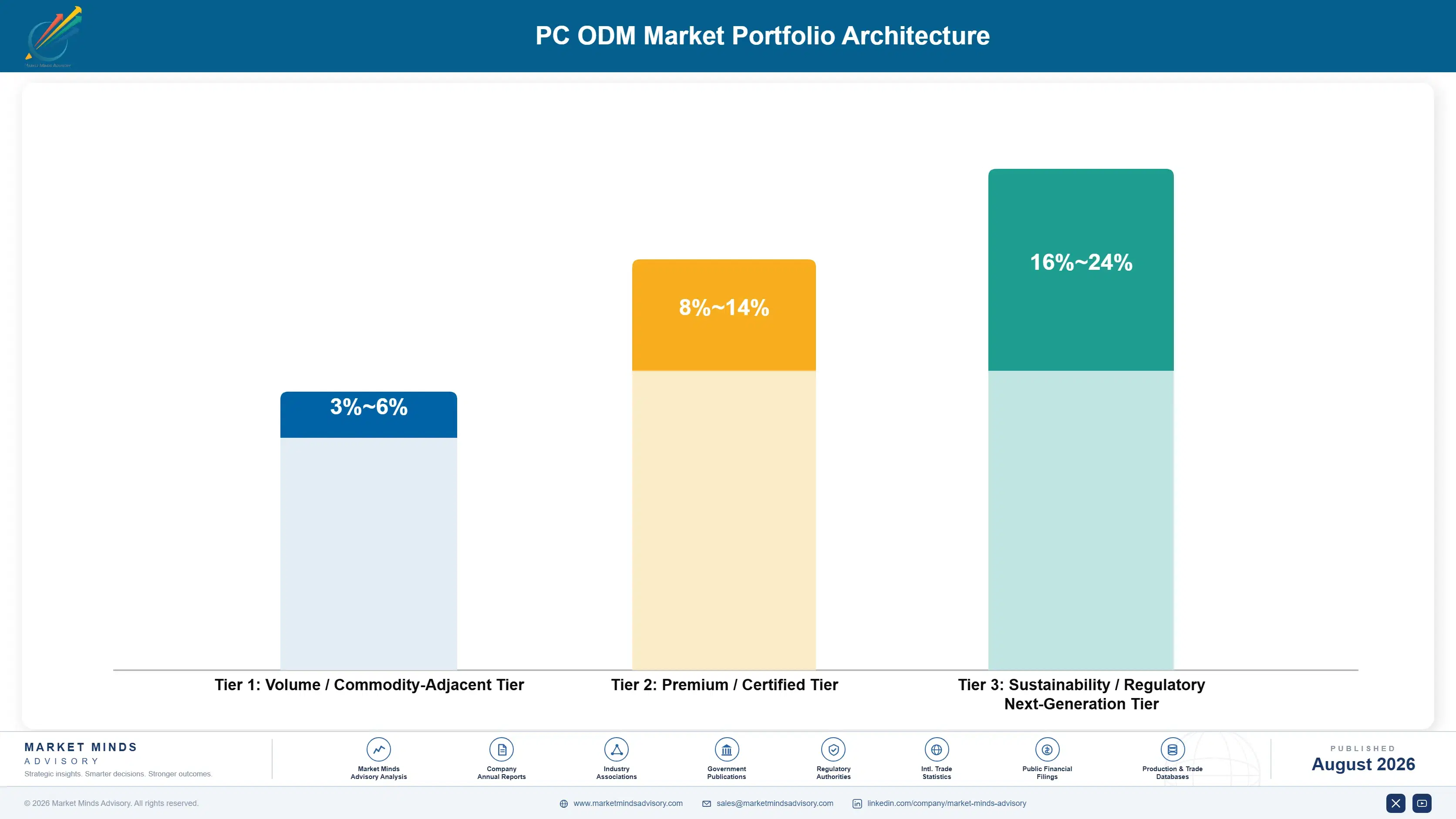
PC ODM manufacturers organize service portfolios across three tiers separated primarily by design engineering depth and manufacturing margin structure. Volume-tier standard notebook production carries the thinnest margins but the highest unit volume, while premium AI PC design services command substantially higher gross margin, reflecting the engineering investment required to support broader NPU integration and thermal capability. Manufacturers increasingly treat these tiers as a continuum, migrating brand relationships upward as trust builds.
The volume versus premium tension shapes nearly every major manufacturer's contract portfolio decisions, as scaling volume-tier standard production too aggressively risks commoditizing a relationship that premium design positioning depends on differentiating from. Manufacturers balancing both tiers simultaneously must carefully manage brand perception to avoid volume-tier pricing pressure eroding premium-tier willingness to pay among design-conscious brand customers. Brand customers report that clear service tier differentiation meaningfully improves contract confidence and reduces delivery disputes.

High-value margin pools concentrate overwhelmingly in the sustainability and next-generation tier, where recurring design service revenue and chipset partnerships meaningfully outweigh the initial contract value over a multi-year brand relationship. Manufacturers able to shift contract mix toward this tier over time report the strongest overall portfolio profitability worldwide.

Volume / Commodity-Adjacent Tier

Standardized notebook and desktop production built on shared reference designs with limited engineering differentiation, competing primarily on unit cost and delivery timeline. Manufacturers compete largely on manufacturing scale and cost efficiency rather than proprietary design capability in this tier.
Gross Margin: 3%-6%

Premium / Certified Tier

Gaming and performance notebook production with expanded thermal engineering and dedicated chassis design capability, targeting brands seeking broader differentiation capability. Manufacturers in this tier typically maintain dedicated engineering teams focused specifically on continuous thermal and design improvement over time.
Gross Margin: 8%-14%

Sustainability / Regulatory / Next-Generation Tier

AI PC design services bundling dedicated engineering teams, chipset partnerships, and continuous NPU architecture updates into a multi-year recurring brand relationship. This tier commands the strongest brand retention of any category, reflecting genuine dependency on continuous design engineering support.
Gross Margin: 16%-24%
pc-odm-market-portfolio-architecture-1788168582286

High-value Sub-segments and Strategic Watch-out

AI PC Design Service Engineering Contracts

Premium brands increasingly bundle AI PC hardware production with dedicated design service engineering, generating both high margin and the fastest contract volume growth across the entire PC ODM category currently tracked. Manufacturers investing early in this bundling strategy are capturing disproportionate brand wallet share. nationwide across every major market.
Gross Margin: 16%-24%

Multi-Year Chipset Partnership Contracts

Extended chipset partnership contracts attached to early silicon access carry strong margin and steady growth, supported by rising AI PC demand and brand willingness to pay for consistent early access assurance. Retention in this segment consistently outpaces every other category tracked, reflecting genuine brand confidence.
Gross Margin: 12%-18%

Standard Notebook and Desktop Production

The volume core of the market, standard production carries thinner margin but anchors overall unit volume and remains the primary contract type for most established brand relationships. Manufacturers rely on this segment to fund broader design capability investment across their premium contract lines. across most metropolitan markets tracked.
Gross Margin: 3%-6%

Chromebook and Education PC Production

A strategic watch-out segment facing intensifying competition from tablet-based education alternatives, Chromebook production must demonstrate clear incremental value beyond basic browser-based computing to sustain growth. Several manufacturers are already de-emphasizing this category in favor of higher-margin AI PC and gaming formats instead. across most regions currently tracked.
Gross Margin: 2%-4%

Recurring Multi-Generation Brand Relationships

PC ODM manufacturers increasingly design revenue architecture around multi-year brand relationships rather than single production contracts, layering design service engagements, extended chipset partnerships, and periodic capacity commitments onto the initial contract to build durable recurring revenue streams worth considerably more than any single order alone over a typical brand relationship horizon. Manufacturers report that brand customers retaining an active design service relationship across two product generations rarely churn afterward.
Adoption depth varies meaningfully by brand vertical: premium and gaming-focused brands exhibit the strongest retention and design service attach rates, reflecting genuine dependency on continuous engineering differentiation, while mainstream volume brands show more price-sensitive, transaction-oriented purchase behavior with comparatively lower design service conversion across most brand tiers tracked. This divergence shapes how manufacturers prioritize engineering investment across their portfolio over time.

Younger AI-focused brand product teams increasingly view ODM relationships as a coordinated engineering partnership rather than a discrete manufacturing transaction, contrasting sharply with legacy procurement teams who still evaluate ODM relationships primarily against pure cost-per-unit alternatives. This generational shift in buyer framing favors manufacturers building adaptable, continuously updated engineering platforms over static volume-only competitors. Manufacturers courting this younger buyer cohort increasingly market services alongside chipset partnership and innovation roadmap platforms.
pc-odm-market-end-use-penetration-index-1788168582770

Where PC ODM Value Concentrates

These are among the four positions where our research anticipates prominent divergence between winners and laggards over the coming forecast period. Each is grounded in the demand model, the regulatory perimeter, and the announced capacity pipeline.
01 / AI PC ENGINEERING INVESTMENT

Prioritize NPU integration and thermal engineering over pure volume scale

Manufacturers competing purely on volume production scale are ceding the fastest-growing AI PC segment to competitors investing heavily in NPU integration and thermal engineering capability. The gap between design-differentiated and commodity-only manufacturers is widening every year as brand customer expectations climb steadily. Suppliers that delay AI PC engineering investment risk permanent relegation to the thinning volume tier, where margin compression continues even as overall contract volume keeps expanding across most brand categories tracked, a dynamic already visible in Quanta Computer and Compal Electronics' widening lead over slower-moving regional challengers.
02 / MANUFACTURING DIVERSIFICATION STRATEGY

Expand multi-region capacity rather than concentrating in China alone

Manufacturers rewarding multi-region manufacturing diversification outperform competitors concentrating production entirely in China without comparable geographic risk management. Brand contract confidence and long-term relationship retention run considerably higher among manufacturers with structured diversification programs than those relying on single-country concentration. Manufacturers underestimating this distinction risk losing the fastest-growing diversification-focused brand relationships to specialized entrants like Pegatron Corporation and Wistron Corporation, both of which have already built dedicated multi-region programs with meaningfully stronger brand retention, a gap that widens further each year as trade policy uncertainty intensifies.
03 / SEMICONDUCTOR SUPPLY CHAIN SECURITY

Secure long-term chipset and memory component agreements now

Manufacturers dependent on spot-market semiconductor and memory component procurement are exposed to margin compression as component volatility persists across the broader electronics manufacturing supply chain. Securing long-term supply agreements now, before demand scales further, locks in more favorable terms than waiting until competitive procurement pressure intensifies further. Larger manufacturers like Quanta Computer already demonstrate the durable cost advantage this strategy protects against erosion, a widening cost gap that smaller challengers without comparable supply chain scale will find increasingly difficult to close.
04 / CHIPSET PARTNERSHIP EXPANSION

Expand early-access partnerships to secure premium design pipelines

Open-market component procurement limits manufacturer ability to plan design roadmaps confidently against unpredictable silicon availability without dedicated chipset partnership coordination. Manufacturers expanding chipset partnerships and dedicated joint engineering teams are converting meaningfully higher premium contract volume than competitors relying purely on open-market sourcing. This partnership gap will likely widen further as AI PC design and early-access requirements keep shaping brand preference for verified manufacturers, rewarding manufacturers like Compal Electronics that have already invested meaningfully in chipset partnership infrastructure ahead of competitors.

Engagement Snapshot From the Field

A live engagement with an industry participant carrying material or product regulatory and market exposure ahead of a defining policy shift, showing how our research translates into a defensible multi-year portfolio strategy.
MARKET MINDS ADVISORY · CLIENT ENGAGEMENT SUMMARY
PC ODM Producer Strategic Portfolio Review and Transition Roadmap 2026·Investment Scenario on PC ODM Exposure Evaluation 2025-26
CLIENT PROFILE
A global technology brand with an established multi-decade China-concentrated ODM manufacturing relationship sought to evaluate whether to formalize diversification partnerships across Vietnam and India ahead of anticipated trade policy volatility. The client reported prior-year notebook shipment volume exceeding 12 million units annually (client-reported, unverified by MMA) and wanted an independent assessment before committing to a formal diversification structure.
STRATEGIC CHALLENGE
The brand faced uncertainty over which manufacturer partnerships would deliver the strongest quality consistency given limited historical production data outside China and an unfamiliar multi-region coordination requirement carrying meaningfully different logistics demands than its existing concentrated supply chain relationship. Leadership also worried that a poorly managed diversification could introduce quality inconsistency risk during the critical transition period across multiple product lines.
MMA APPROACH
MMA benchmarked quality consistency and delivery reliability across candidate manufacturers' Vietnam and India facilities, conducted structured interviews with brand supply chain leadership, and modeled financial outcomes under three diversification scenarios ranging from limited pilot production to a fully balanced multi-region manufacturing structure. The engagement also reviewed comparable diversification case studies at peer technology brands to benchmark transition timelines.
KEY FINDINGS
  1. Quality consistency varied considerably across candidate facilities, with the top-performing Vietnam operations showing meaningfully lower defect rates than average newer facility benchmarks.
  2. Supply chain leadership reported significant risk reduction confidence when working with a formally vetted multi-region manufacturer network compared to the concentrated single-country status quo arrangement.
  3. Balanced multi-region structures generated stronger long-term supply chain resilience than limited pilot programs across nearly every metric evaluated during the engagement. across nearly every quality metric tracked.
  4. Formal diversification structures carried modestly higher upfront coordination cost but generated meaningfully stronger long-term supply chain resilience and risk mitigation outcomes across the brand's global shipment volume.
CLIENT PROFILE
A global technology brand with an established multi-decade China-concentrated ODM manufacturing relationship sought to evaluate whether to formalize diversification partnerships across Vietnam and India ahead of anticipated trade policy volatility. The client reported prior-year notebook shipment volume exceeding 12 million units annually (client-reported, unverified by MMA) and wanted an independent assessment before committing to a formal diversification structure.
STRATEGIC CHALLENGE
The brand faced uncertainty over which manufacturer partnerships would deliver the strongest quality consistency given limited historical production data outside China and an unfamiliar multi-region coordination requirement carrying meaningfully different logistics demands than its existing concentrated supply chain relationship. Leadership also worried that a poorly managed diversification could introduce quality inconsistency risk during the critical transition period across multiple product lines.
MMA APPROACH
MMA benchmarked quality consistency and delivery reliability across candidate manufacturers' Vietnam and India facilities, conducted structured interviews with brand supply chain leadership, and modeled financial outcomes under three diversification scenarios ranging from limited pilot production to a fully balanced multi-region manufacturing structure. The engagement also reviewed comparable diversification case studies at peer technology brands to benchmark transition timelines.
KEY FINDINGS
  1. Quality consistency varied considerably across candidate facilities, with the top-performing Vietnam operations showing meaningfully lower defect rates than average newer facility benchmarks.
  2. Supply chain leadership reported significant risk reduction confidence when working with a formally vetted multi-region manufacturer network compared to the concentrated single-country status quo arrangement.
  3. Balanced multi-region structures generated stronger long-term supply chain resilience than limited pilot programs across nearly every metric evaluated during the engagement. across nearly every quality metric tracked.
  4. Formal diversification structures carried modestly higher upfront coordination cost but generated meaningfully stronger long-term supply chain resilience and risk mitigation outcomes across the brand's global shipment volume.
RECOMMENDED STRATEGY
Phase 1: Phase 1 (Months 1 to 4): Launch pilot production runs across two Vietnam and India facilities meeting defined quality and capacity benchmarks. Phase 2: Phase 2 (Months 5 to 12): Expand successful pilot partnerships toward a balanced 60-40 production split between China and diversified facilities. Phase 3: Phase 3 (Months 13 to 24): Scale toward the brand's target diversification ratio, layering long-term capacity commitment incentives into contract terms.
OUTCOME
The brand proceeded with a phased diversification rollout across two manufacturing partners, reporting a measurable increase in non-China production share (client-reported, unverified by MMA) within the first year, meaningfully ahead of the brand's original diversification timeline for the engagement. Leadership has since approved expansion of the diversification program to a third manufacturing partner beginning next fiscal year.

Frequently Asked Questions

Foundational context covering the market sizes, CAGR, scope, country, region and competition that inform every finding below. This section is provided to cover basics and most often pre-purchase conversations, answered from the MMA Primary Research Dataset.

What is the current size of the PC ODM Market?

The PC ODM market reached approximately USD 68.0 billion in 2025. Growth has been driven primarily by AI PC platform transition and manufacturing diversification pressure.

How large will the PC ODM Market be by 2036?

The market is projected to reach approximately USD 131.8 billion by 2036. This represents nearly a twofold expansion from the 2026 forecast base, with growth accelerating as AI PC adoption broadens.

What is the CAGR for the PC ODM Market 2026 to 2036?

The market is projected to grow at a compound annual growth rate of 6.2 percent between 2026 and 2036. Bull and bear scenarios range from 5.0 to 7.4 percent.

Which segment is growing fastest?

AI PC and NPU-enabled ODM services are growing fastest at 18.6 percent CAGR, well above the market average. Gaming PC and laptop ODM services follow closely as the second-fastest segment.

Who are the major companies in the PC ODM Market?

Quanta Computer, Compal Electronics, Wistron Corporation, Pegatron Corporation, and Inventec Corporation are the five leading manufacturers. Together they hold roughly 72 percent combined production share.

Which country is growing fastest?

Vietnam is the fastest-growing national market at 13.8 percent CAGR. Manufacturing diversification away from concentrated China-based production is the primary driver, reinforced by favorable government manufacturing incentive programs.

Report Segmentation Architecture

The full report scope spans multiple orthogonal segmentation dimensions, with cross-tabulated demand data provided for each dimension pair. Coverage extends further to regional breakdowns, trend trajectories, and the competitive detail needed to support segment-level decision-making.

By Device Type

  • Notebook and Laptop ODM Services
  • Desktop PC ODM Services
  • Gaming PC and Laptop ODM Services
  • AI PC and NPU-Enabled ODM Services
  • Mini PC and Embedded ODM Services
  • Chromebook and Education PC ODM Services

By End-Use Brand Category

  • Consumer Electronics Brands
  • Enterprise and Business Computing Brands
  • Gaming and Performance Brands
  • Government and Public Sector Brands
  • Education Technology Brands

By Commercial Dimension

  • Standard Volume Production Contracts
  • Premium Design Service Agreements
  • Multi-Year Chipset Partnership Programs
  • Multi-Region Manufacturing Diversification Contracts

By Region

  • North America
  • Western Europe
  • East Asia
  • South Asia and Pacific
  • Latin America
  • Middle East and Africa
  • Eastern Europe

Scope, Methodology, and Coverage

Every figure in this report is reproducible from documented input assumptions. The scope below maps the historical period, the forecast horizon, the segmentation dimensions, and the countries covered, alongside the underlying primary and qualitative methodology.
Historical Period
2020 to 2025
Forecast Period
2026 to 2036
Base Year
2025 (USD billions; MMA Primary Research Dataset, August 2026)
Market Definition
This report covers revenue from original design manufacturing services for personal computers, including notebooks, desktops, gaming systems, AI-enabled platforms, and mini PCs designed and manufactured on behalf of brand customers. It excludes original equipment manufacturing performed entirely to brand-supplied designs and unrelated server or data center hardware manufacturing.
Quantitative Units
USD billions (current prices); unit production volume where applicable
Segmentation Dimensions
By Device Type; By End-Use Brand Category; By Commercial Dimension; By Region
Regions Covered
North America, Western Europe, East Asia, South Asia and Pacific, Latin America, Middle East and Africa, Eastern Europe
Countries Covered
USA, China, Germany, France, UK, Japan, South Korea, India, Australia, Canada, Brazil, Mexico, Indonesia, Vietnam, Thailand, Malaysia, UAE, Saudi Arabia, South Africa, Nigeria, Turkey, Poland, Netherlands, Italy, Spain, Sweden, Switzerland, Argentina, Colombia, Singapore, and additional markets relevant to this sector
Key Companies Profiled
Quanta Computer, Compal Electronics, Wistron Corporation, Pegatron Corporation, Inventec Corporation, Foxconn, Clevo, MiTAC, Flex, Jabil, Celestica, ECS Elitegroup, Wingtech Technology, Luxshare Precision, BYD Electronics, Tongfang, TPV Technology, Wiwynn, Getac Technology, Positivo Tecnologia
Quantitative Methodology
Primary survey, n=3,800 respondents, Q4 2025, six countries; demand-side model with trade association cross-validation
Qualitative Methodology
47 expert interviews, Q4 2025; applied to validate demand model assumptions, identify emerging dynamics, and assess competitive positioning
Report Format
PDF and XLSX data workbook (Word format preview document)
Publisher
Market Minds Advisory
Report Code
MMA-2026-TEC-204
Published
August 2026
Contact
sales@marketmindsadvisory.com | www.marketmindsadvisory.com

Purchase the full PC ODM Market Report (2026 to 2036).

The full report delivers granular revenue forecasts across all six device segments and seven global regions through 2036. It includes detailed competitive profiling of all twenty tracked manufacturers, primary brand procurement survey data, and component cost structure analysis covering semiconductors, memory, and display panels. Subscribers receive quarterly updates tracking AI PC chipset developments, manufacturing diversification activity, and design service pricing benchmarks across the competitive set. The report also maps recurring revenue architecture across design service, chipset partnership, and diversification lever categories in detail. A dedicated regional appendix breaks down brand procurement survey findings by country for deeper market entry planning.
Segment-level revenue forecasts across all six device categories through 2036
All seven global regional markets profiled in full detail
Twenty-manufacturer competitive benchmarking across moat and risk factors
Primary brand procurement survey data across six countries
Detailed component cost structure and exposure analysis
Quarterly competitive intelligence and update service

Built For The People Who Decide

From boardroom strategy to bench-side execution, this report is read cover-to-cover by leaders shaping the next decade of their industry, turning demand scenarios, market dynamics and valuation benchmarks into decisions.
CXOs/ Presidents/ VPs/ Managers
M&A and Corporate Development
Strategy Teams and R&D Heads
Procurement and Product Directors
Regulatory and Compliance Leaders
Investor Relations and Equity Analysts