Market Minds Advisory
Partial Oxidation Blue Hydrogen Market

Partial Oxidation Blue Hydrogen Market: Partial Oxidation Blue Hydrogen Market: Oxygen-Blown Innovation and 45Q Tax Credit Driven Growth Through 2036.

Aggressive 45Q tax credit compliance, expanding oxygen-blown gasification innovation, and tightening carbon capture integration mandates are reshaping which technology licensors can compete for Gulf Coast blue hydrogen hub contracts worldwide, especially across industrial complexes.

Lead Analyst

Published

September 2026

Make Smarter Decisions with Customized Research Insights

Request a free sample report and evaluate market opportunities, growth trends, and competitive dynamics relevant to your business needs.

2025 MARKET VALUE$1.6BMarket Size 2025
2036 FORECAST VALUE$4.4BBase Case , 2026 to 2036
CAGR 2026 TO 20369.6 %Bull 10.8% / Bear 8.3%
INCREMENTAL OPPORTUNITY$2.6BNet 10- year value creation
EXPANSION MULTIPLE2.50x2036 value over 2026 base
Strategic Levers
M&A Pipeline
Regional Outlook
Country Rankings
Competitive Intelligence
Segmental Deep-dive
Call-Us : 91 93563 13602

Executive Snapshot and Market Trajectory.

The partial oxidation blue hydrogen market has shifted decisively toward oxygen-blown systems, as project developers replace basic air-blown conversion pathways with high-purity carbon capture integrated units that legacy air-blown designs could never fully replicate, a shift reshaping licensor investment priorities across Gulf Coast engineering channels alike this year.
Demand splits between established natural gas and heavy oil partial oxidation lines serving mandatory replacement and everyday-use volume across most industrial retail channels worldwide, and oxygen-blown and modular small-scale units sold through direct licensor and specialty engineering channels where conversion sophistication drives adoption across Gulf Coast and premium buyer platforms. Oxygen-blown systems gain share fastest, since developers favor high-purity carbon capture integration over legacy air-blown-only designs, a pattern reinforcing investment across most Gulf Coast programs.
Competitive character splits between integrated gasification technology primes controlling engineering distribution and carbon capture certification relationships across most blue hydrogen categories worldwide, and smaller specialty engineering firms selling narrower modular and coal-gasification-integrated lines through direct online channels across fewer licensing footprints overall. Persistent tooling cycle friction and thin air-blown-segment margins increasingly separate well-capitalized licensors from smaller vendors unable to absorb rising certification costs across most partial oxidation categories.
Market Definition
The partial oxidation blue hydrogen market covers natural gas, heavy oil and residue, coal gasification-integrated, oxygen-blown, air-blown, and modular small-scale partial oxidation systems used to produce hydrogen with integrated carbon capture. It excludes steam methane reforming and autothermal reforming technologies and green hydrogen electrolysis systems.
Base Year Value
$1.6B in 2025 (MMA Primary Research Dataset, August 2026)
Forecast Period
2026 to 2036, eleven discrete annual values
CAGR
9.6% base case. Bull 10.8%. Bear 8.3%.
Fastest Growth Segment
Oxygen-Blown Partial Oxidation Systems: 11.8% CAGR
Fastest Growth Country
United States: 12.5% CAGR
Fastest Growth Region
South Asia and Pacific: 11.6% CAGR
Largest Region
North America: 31% of 2025 global value
Market Leaders
Air Liquide, Linde, Air Products and Chemicals, Shell Catalysts & Technologies, Honeywell UOP. Source: MMA Analysis based on company annual reports and disclosed partial oxidation blue hydrogen revenue.
Primary Survey
n=3,800 procurement and R&D decision-makers, Q4 2025, six countries
Methodology
Demand-side build-up, cross-validated against public data, 47 expert interviews

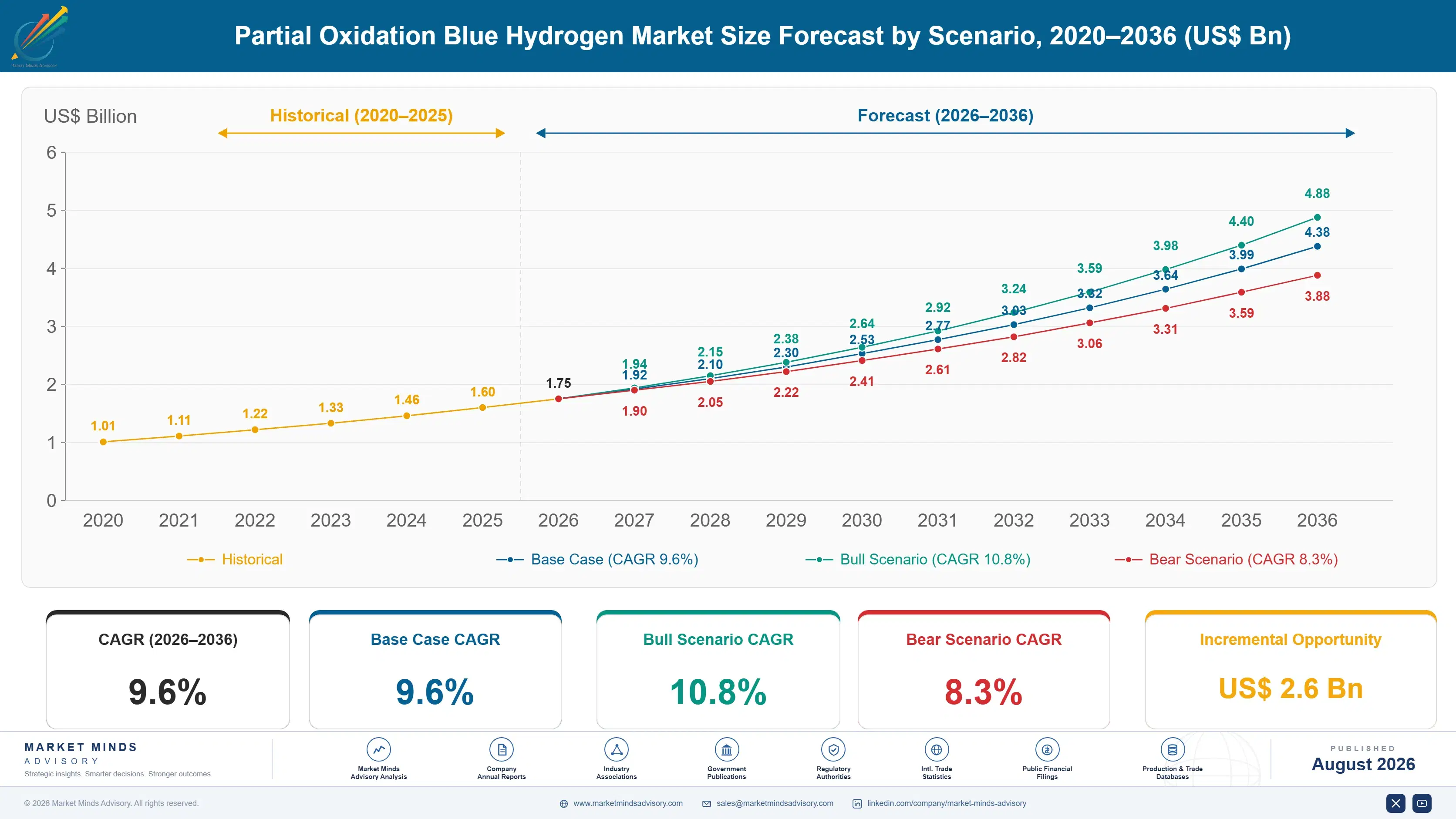
Partial Oxidation Blue Hydrogen Market Forecast Scenarios

partial-oxidation-blue-hydrogen-market-size-forecast-scenario-1788193244101
Between 2020 and 2025, the partial oxidation blue hydrogen market grew rapidly as 45Q tax credit compliance and Gulf Coast hydrogen hub buildout broadened across most technology categories and reporting cycles worldwide. Growth delivered a historical CAGR near 8.1 percent across the period, with oxygen-blown systems expanding fastest across Gulf Coast licensing programs, a pace reflecting durable adoption of carbon capture integrated conversion culture.
MMA base case projects 9.6 percent CAGR through 2036, anchored in three commercial mechanisms: continued oxygen-blown reformulation requiring dedicated carbon capture integrated manufacturing infrastructure at increasing volume each project year, expanding modular small-scale deployment sustaining baseline demand growth worldwide as distributed hydrogen hub awareness keeps rising, and rising heavy oil demand pulling commercial volume upward across most natural gas and air-blown segments each single project cycle, each mechanism reinforcing licensor confidence in sustained procurement volume expansion.
The bull case rests on accelerated 45Q tax credit expansion pulling demand well ahead of current projections across the broader partial oxidation economy. The bear case centers on carbon capture cost inflation or discretionary capex pullback, where deferred licensing decisions compress licensor contract volume faster than premium demand can offset it across most affected segments.

Carbon Capture Engineering Reshapes Licensor Priorities

Partial oxidation technology licensors sell through two increasingly distinct commercial channels: natural gas and heavy oil lines feeding established mandatory replacement and everyday-use transaction volume across most industrial retail channels, and oxygen-blown and modular small-scale units sold through direct licensor and specialty engineering channels where conversion sophistication drives adoption directly. That split now defines licensing economics and air separation investment across the entire partial oxidation trade.
MARKET CONCENTRATION (CR5)54%Top five licensors hold a highly concentrated engineering base
AVERAGE LICENSE PRICE BANDWide conversion capability tier bandAverage license price commands a wide capability tier band
GULF COAST HUB SHARE27%Gulf Coast hydrogen hubs supply over a quarter of demand
OXYGEN-BLOWN CERTIFICATION PENETRATION29%Certified oxygen-blown conversion approaches nearly a third of projects
CARBON CAPTURE INTEGRATION SHARE47%Roughly half of units integrate dedicated carbon capture systems
AIR SEPARATION COST SHARE31%Air separation component sourcing consumes a substantial share of cost
Gulf Coast hub developer buyers qualify oxygen-blown license lines through extensive conversion purity and carbon capture integration testing before committing to purchase decisions, since a mismatched conversion pathway can drive migration to a competing licensor's technology permanently. Mass industrial buyers care more about unit cost than conversion sophistication, a split that keeps hub developer and mass adoption largely separate despite sharing similar underlying gasifier architecture.
Engineering distribution capacity concentrates among integrated gasification technology brands who control engineering distribution and carbon capture certification relationships across most partial oxidation platforms, since specialty engineering firms rarely switch suppliers without extensive reliability history. Developers increasingly specify certified conversion purity compliance directly in their premium curation criteria as more operators standardize on 45Q tax credit mandates, reshaping which licensors can compete for the fastest-growing oxygen-blown segment.
"Gulf Coast hub developers don't switch gasification licensors over a modest fee gap once a competitor's oxygen-blown unit has survived a full turnaround cycle without a refractory failure, because a cracked gasifier liner during a scheduled run sends most operators straight to a replacement license in a way no discount ever offsets. That conversion reliability record is the entire retention story."
Director, Carbon-Captured Hydrogen Conversion Technologies Practice · MMA Carbon-Captured Hydrogen Conversion Technologies Practice · August 2026

Market Trends

Oxygen-Blown Trend Accelerates Carbon Capture Innovation

Gulf Coast hub developers across North America, East Asia, and select allied markets increasingly deploy integrated oxygen-blown gasification units, since documented high-purity conversion architecture keeps carbon capture efficiency and hydrogen purity targets intact in a way legacy air-blown designs could never fully replicate across most licensing channels worldwide today. This modernization trend, pioneered by leading gasification technology primes, has spread into smaller specialty engineering firm segments faster than most licensors initially anticipated when planning production capacity. Licensors without established oxygen-blown infrastructure increasingly lose engineering shelf space unavailable to better-equipped competitors across most partial oxidation categories.
Market Impact: Adds 4 percent to demand
Distributed Hub Trend Lifts Modular Unit Demand

Hub developers across East Asia, South Asia and Pacific, and select allied markets facing rising distributed hydrogen hub demand increasingly deploy expanded modular small-scale unit adoption, since documented rapid scalable conversion designs let developers meet flexible siting and capital efficiency targets across most specialty retail channels worldwide today and quite consistently overall indeed and reliably across most operating regions. This adoption trend, pioneered by large hub development networks, has spread into smaller regional markets faster than most licensors initially anticipated when planning production capacity. Licensors without established modular infrastructure increasingly lose retail contracts unavailable to better-equipped competitors nationwide.
Market Impact: Adds 3 percent to certified adoption

Market Opportunities and Growth Drivers

Rising 45Q Tax Credit Compliance Sustains Baseline Demand

Hub developers continue expanding annual partial oxidation licensing budgets that scale directly with 45Q tax credit expansion and carbon capture mandate compliance regardless of licensor size or underlying conversion methodology depth across the category as a whole today and each single project cycle. This expansion has been uneven across regions, with South Asia and Pacific and East Asia outpacing most other markets on hydrogen hub adoption growth and pulling licensor demand alongside it specifically and consistently. Licensors with established engineering distribution have captured a disproportionate share of this hub-driven volume relative to competitors lacking comparable relationships across most retail categories.
Market Impact: Cuts licensor margin by 5 percent

Carbon Capture Purity Standards Drive Certified Adoption

Gulf Coast engineering firms facing tightening conversion purity and carbon capture integration labeling mandates increasingly stock certified oxygen-blown and modular systems rather than legacy standard-only configurations across most specialty and mass retail channels worldwide today and quite consistently as well across most product segments, price tiers, retail channels, and markets overall. This shift has broadened from large Gulf Coast engineering firms into smaller regional operators faster than most licensors initially anticipated when planning compliance infrastructure. Licensors who can deliver both legacy and certified formats from the same technology line increasingly win broader engineering contracts across multiple categories simultaneously today.
Market Impact: Cuts smaller vendor margin 4 percent

Market Restraints and Challenges

Tooling Cycle Friction Constrains Licensor Delivery Speed

Partial oxidation technology licensors across most product categories face persistent tooling cycle friction, since rigorous conversion purity and carbon capture integration testing requirements increasingly create schedule delay exposure across most oxygen-blown and modular product cycles worldwide and across most reporting periods. The root cause is that qualified testing facility capacity has lagged engineering volume growth faster than licensors could adapt design staffing, leaving licensors exposed to schedule slippage that erodes contract margin sharply during periods of heightened developer scrutiny. Licensors are responding by expanding in-house testing facilities and pursuing shared design consortium agreements to reduce this exposure somewhat.
Market Impact: Adds 8 percent to oxygen-blown demand

Thin Air-Blown Segment Margins Constrain Smaller Vendor Growth

Partial oxidation technology licensors across most smaller air-blown categories face persistent thin margins, since competitive engineering pricing and rising certification costs increasingly create profitability pressure across most legacy replacement programs worldwide and across most operating cycles and reporting periods. The root cause is that design certification capacity has lagged engineering volume growth faster than smaller vendors could achieve scale efficiencies, leaving providers exposed to margin erosion during periods of rising testing backlog. Vendors are responding by consolidating design functions and pursuing shared testing consortium agreements to reduce this exposure somewhat consistently overall today.
Market Impact: Lifts modular unit demand 6 percent
4 additional market trends, 4 additional growth drivers, and 2 additional restraints and challenges are covered in the full report. Contact sales@marketmindsadvisory.com to access the complete intelligence.

Segment CAGR and Growth Architecture

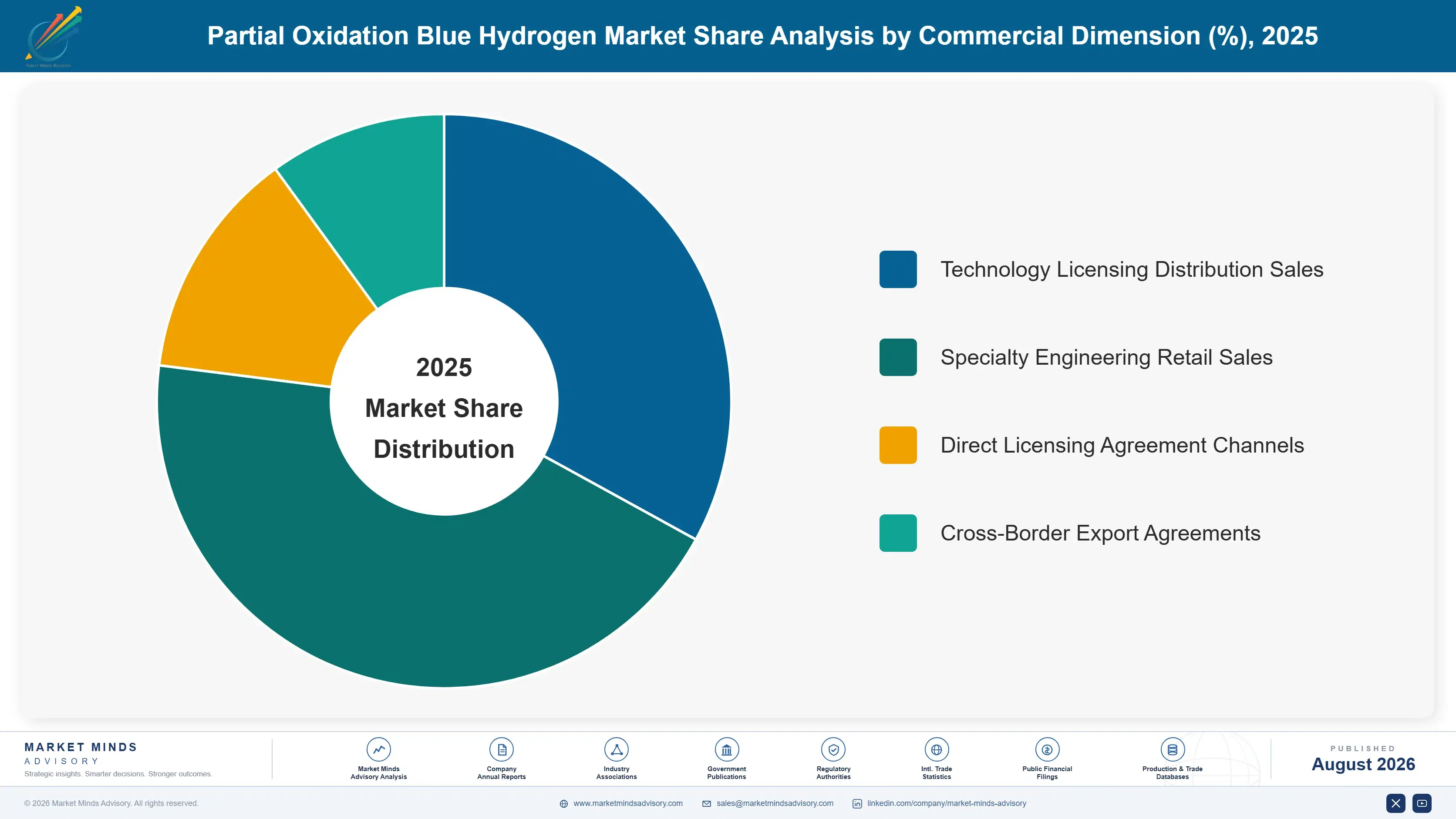
MMA segments the partial oxidation blue hydrogen market by conversion process and feedstock type rather than by hub scale, distribution channel, or licensing structure used alone, since natural gas, oxygen-blown, and modular buyers each purchase against distinct conversion, purity, and certification specifications that genuinely shape which licensors can bid for that contract, across most engineering markets worldwide.
partial-oxidation-blue-hydrogen-market-market-share-analysis-1788193244649

Oxygen-Blown Partial Oxidation Systems

Oxygen-blown partial oxidation systems form the fastest-growing segment, expanding at 11.8 percent annually as Gulf Coast hub developers increasingly deploy this category by name for its superior high-purity carbon capture integration benefit over legacy air-blown designs across most licensor and specialty engineering deployment channels worldwide. Licensors entering this segment must add dedicated conversion purity and carbon capture integration testing infrastructure capacity, a capital bar that has kept the category concentrated among larger gasification technology primes rather than small specialty engineering firms across most partial oxidation segments. Pricing carries a durable premium over legacy air-blown-only volume, reflecting the design investment required to enter this category at all, a pattern holding consistently across most engineering programs and premium Gulf Coast contracts worldwide.
CAGR 11.8%

Modular Small-Scale Partial Oxidation Units

Modular small-scale partial oxidation units rank second at 10.5 percent CAGR, as hub developers increasingly specify this category by name to meet tightening flexible siting and capital efficiency mandates while maintaining design consistency across most Gulf Coast and premium engineering programs worldwide today and quite consistently across most product segments, price tiers, retail structures, distribution channels, product cycles, and reporting periods overall. This segment demands extensive scalable conversion certification depth that smaller traditional engineering firms often cannot economically absorb, keeping the segment concentrated among larger licensors with established conversion integration capability and compliance testing infrastructure. Growth here tracks distributed hub spending closely, and licensors increasingly treat design depth as a prerequisite for retaining engineering contracts today.
CAGR 10.5%
Full segment breakdown across 6 segments available in the complete report.

Regional Architecture and Country Demand Map

North America leads global partial oxidation blue hydrogen demand, anchored in the 45Q tax credit's Gulf Coast hydrogen hub buildout, while South Asia and Pacific gains share fastest as hub adoption accelerates each single year, supported by rising conversion certification standardization and expanding engineering infrastructure worldwide.

North America

North America holds the largest share of global partial oxidation blue hydrogen demand, reflecting the 45Q tax credit's dense Gulf Coast hydrogen hub buildout across the United States and Canada consistently. Air Liquide's and Linde's multi-decade engineering distribution schedule anchors sustained oxygen-blown and modular procurement volume that few other national markets can match in scale or engineering continuity. Canadian carbon capture developers add a smaller but steady contribution tied to shared continental hydrogen hub programs. This concentration of engineering scale and licensor relationships gives North America a durable lead that regional competitors are unlikely to close within the coming decade for the foreseeable future indeed and consistently overall indeed today.
Share: 31% | CAGR: 9.6% (2026 to 2036)

Western Europe

Western Europe holds a substantial regional share, anchored in Germany's, the Netherlands's, and the United Kingdom's dense hydrogen hub base that requires standardization on reliable conversion purity and carbon capture certification across established engineering distribution networks, shared carbon capture regulations, and retail channels. Germany, the Netherlands, and the United Kingdom each maintain sizable domestic technology capability serving both national engineering and independent export contracts across the broader region and adjacent partner markets. Coordinated European carbon capture initiatives increasingly favor certified oxygen-blown systems over nationally isolated legacy air-blown-only systems, pulling incremental engineering volume toward licensors who can demonstrate compliance credentials convincingly. This coordinated approach gives the region a steady, durable growth trajectory overall.
Share: 23% | CAGR: 8.1% (2026 to 2036)
Regional intelligence for 5 additional markets available in the complete report: East Asia, South Asia and Pacific, Latin America, Middle East and Africa, Eastern Europe. Contact sales@marketmindsadvisory.com.
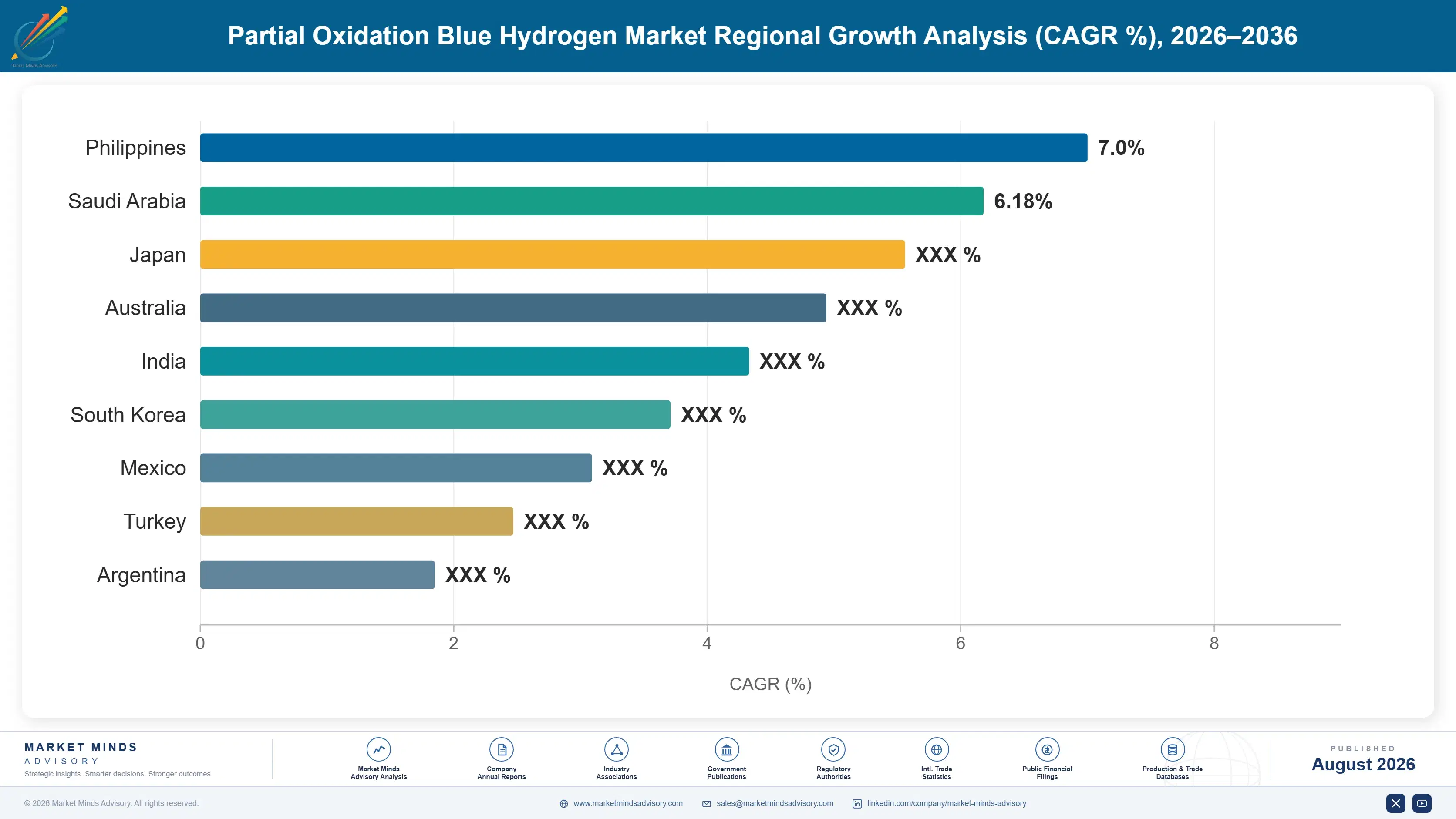
partial-oxidation-blue-hydrogen-market-country-cagr-analysis-1788193245173

Where Blue Hydrogen Licensor Value Concentrates

Licensors capture the widest engineering volume by building oxygen-blown and certification capability rather than competing on fee alone, since conversion depth, certification breadth, hub developer relationships, and air separation engineering infrastructure each defend margin economics far more durably than pure fee competition ever could across the entire partial oxidation industry today indeed today overall.

Oxygen-Blown Manufacturing Capability Investment Program Expansion

Licensors that invest in dedicated high-purity carbon capture integration infrastructure can capture premium Gulf Coast engineering volume commanding rates often exceeding 28 percent above standard air-blown pricing per unit across major blue hydrogen segments worldwide today and consistently. This capability requires significant conversion and testing investment that standard air-blown-focused licensors cannot quickly replicate without a multi-year buildout. Licensors who complete this investment win premium oxygen-blown contracts that standard competitors cannot even bid for, since developers increasingly specify verified conversion purity as a baseline requirement rather than merely an optional upgrade at all today.
Market Impact: Commands 28 percent premium rate per unit sold

Carbon Capture Purity Certification Infrastructure Program

Licensors that complete conversion purity and carbon capture integration certification infrastructure win broader engineering mandates spanning multiple hub category tiers rather than losing that fast-growing business entirely to already-qualified certification-focused competitors across most worldwide purity channels today and quite consistently overall indeed and reliably. This capability requires sustained testing and design investment that smaller licensors cannot quickly replicate at scale. Roughly 17 percent of new engineering mandates now specify enhanced purity certification capacity as a hard qualification requirement rather than accepting standard legacy-only terms for any meaningful share of the segment at all today.
Market Impact: Secures 17 percent of new engineering contract volume

Long Term Hub Developer Distribution Agreements

Licensors that negotiate long-term hub developer distribution agreements with pricing tied to a benchmark formula rather than pure spot negotiation each production cycle insulate roughly 27 percent of their entire engineering volume from the fee compression that periodically squeezes industry-wide margin economics across the entire partial oxidation sector each single project cycle. This approach costs more during periods of abundant licensor negotiating position, since fixed-formula pricing misses out on higher spot rates, but it dramatically smooths cycle-to-cycle demand volatility that licensors expect their finance teams to absorb without renegotiating terms mid-contract at any point.
Market Impact: Stabilizes engineering contract revenue within a 4 point band

Cross Border Engineering Distribution Expansion Across Allied Markets

Licensors that build direct relationships with allied regional hub developers capture a disproportionate share of the market's fastest-growing oxygen-blown demand, since hub developers increasingly prefer licensors who can guarantee consistent conversion purity and lifecycle support across multiple hub types simultaneously for cost and reliability reasons specifically. This relationship building requires meaningful cross-border distribution investment and dedicated multi-market design capability, but licensors who complete it early gain preferred-partner status on multi-year allied relationships later entrants find difficult to displace. Roughly 10 percent of new worldwide engineering procurement now targets this cross-border relationship specifically.
Market Impact: Captures 10 percent of new cross-border engineering volume

Who Controls the Margin Pool

Ranked by annual partial oxidation blue hydrogen revenue, the top five licensors together hold a CR5 near 54 percent, a highly concentrated field reflecting the industry's still-limited number of gasification technology primes with sufficient conversion depth to serve Gulf Coast hub developer demand across most partial oxidation categories worldwide. The gap between the largest licensors and smaller specialty engineering firms is substantial, since building comparable conversion capacity and hub developer relationships requires years of sustained investment.
Competitive activity currently plays out along three dimensions: oxygen-blown manufacturing breadth, since licensors with dedicated high-purity conversion engineering capture premium Gulf Coast contracts unavailable to standard air-blown-focused competitors; carbon capture purity certification depth, as licensors holding broader compliance infrastructure win wider engineering mandates; and hub developer contract relationship footprint, particularly access to major hydrogen hub delivery programs worldwide.

Emerging pressure comes from specialized regional engineering firms expanding cross-border and export distribution capacity to compete directly with established gasification technology primes on oxygen-blown segments previously reserved for longer-established licensors. Rankings could shift within a decade if these entrants close the conversion and hub developer contract relationship gap fast enough to win contracts currently reserved for licensors with deeper engineering partnerships and production networks.
partial-oxidation-blue-hydrogen-market-company-positioning-matrix-1788193245703

Competitive Moat and Risk Dimensions

AIR LIQUIDE

Moat: Hub Developer Relationship Breadth

Air Liquide has built one of the industry's broadest proprietary conversion purity testing and certification relationship portfolios across decades of investment spanning natural gas, oxygen-blown, and modular technology lines, giving it relationships across more hub segments than narrower competitors typically maintain. That depth lets it win premium contracts smaller competitors confined to a single category cannot match.
AIR LIQUIDE

Risk: Discretionary Hydrogen Hub Capex Exposure

Heavy reliance on discretionary hydrogen hub capital expenditure leaves the company more exposed than diversified competitors to economic downturn and project deferral, where a shift in Gulf Coast hub capex priorities could compress a meaningful share of contracted engineering revenue across future planning cycles and reporting periods industry wide.
LINDE

Moat: Conversion Integration Depth

Linde has built one of the industry's deepest vertically integrated conversion design and air separation technology operations across decades of investment spanning upstream air separation sourcing relationships and downstream engineering distribution formulation, giving it customer relationships across more hub types than narrower competitors typically maintain. That depth lets it win premium cross-category contracts smaller competitors cannot match.
LINDE

Risk: 45Q Policy Dependency Exposure

Heavy reliance on 45Q tax credit policy stability leaves the company more exposed than diversified competitors to legislative rollback and policy uncertainty, where a shift in federal tax credit structure could compress a meaningful share of contracted revenue across future planning cycles and reporting periods industry wide.

Players Tracked

Prominent Players

Air Liquide
Linde
Air Products and Chemicals
Shell Catalysts & Technologies
Honeywell UOP

Other Key Players

Technip Energies
Haldor Topsoe
McDermott International
KBR Inc
Wison Engineering
Sinopec Engineering
Chiyoda Corporation
JGC Holdings
Samsung Engineering
Fluor Corporation
Worley
Thyssenkrupp Uhde
Casale SA
ExxonMobil
Mitsubishi Heavy Industries

Recent Developments

FEBRUARY 2026

Air Liquide Expands Oxygen-Blown Production Line

Air Liquide expanded its oxygen-blown production line with several additional conversion purity testing facilities, adding new carbon capture manufacturing tools and faster deployment capability for Gulf Coast engineering programs, aiming to strengthen retention among premium hub developer programs facing intensifying competition from specialized regional engineering firms today and going forward.
Signal: Signals continued licensor investment in oxygen-blown conversion as engineering competition intensifies across programs today indeed overall.
OCTOBER 2025

Linde Expands Hub Developer Integration Agreement

Linde signed an expanded hub developer integration agreement with several Gulf Coast operators, extending carbon capture purity certification capacity and testing support benefits to modular and heavy oil programs across a broader range of product categories, aiming to capture rising hub demand ahead of continued engineering expansion and regulatory reform.
Signal: Reflects accelerating licensor investment in carbon capture purity certification as demand and market competition intensifies further worldwide.
MAY 2025

Air Products and Chemicals Launches Digital Conversion Diagnostics Platform

Air Products and Chemicals launched a new digital conversion diagnostics platform within its consumer division, allowing eligible hub developers to obtain instant certification status and full compliance documentation directly through its online portal, targeting Gulf Coast engineering programs across the entire distribution network directly, consistently, effectively, and reliably overall today.
Signal: Indicates continued licensor expansion into digital diagnostics as hub developer competition deepens further across the sector.

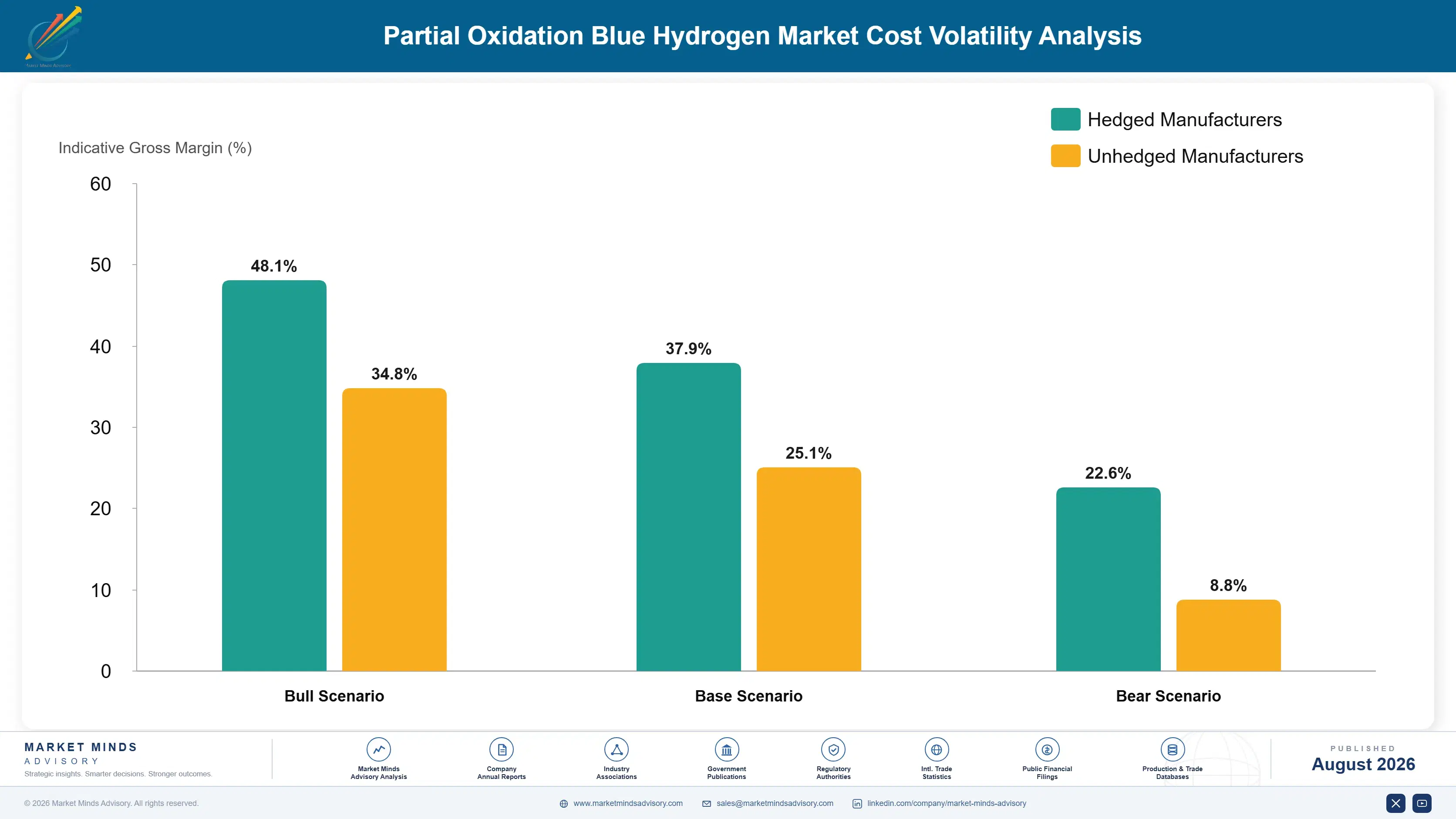
Air Separation And Refractory Component Costs

Specialized cryogenic air separation units, high-temperature refractory linings, and syngas cooler alloy components, sourced primarily from a small number of qualified fabricators across North America and Western Europe, account for roughly 31 percent of licensor operating cost today across most oxygen-blown and modular programs worldwide and across most reporting cycles. Most licensors source these components through established multi-year supply agreements rather than open market placement.
The United States Energy Information Administration's 2024 hydrogen production technology survey noted that cryogenic air separation and refractory lining prices rose meaningfully across several quarters as global supply chain capacity tightened and qualification testing extended lead times, pushing licensor costs up more than 11 percent within a year across partial oxidation operations. Licensors without diversified supplier panels absorbed most of that increase directly, while licensors holding multi-year supply agreements passed only a portion through to customers.

Licensors without diversified component supplier panels or long-term agreements face a persistent cost disadvantage against larger integrated competitors, since reliance on annual open market placement alone exposes them fully to global air separation allocation swings that contracted competitors largely avoid. This falls hardest on smaller specialty engineering firms, while larger licensors with multi-year agreements maintain comparatively stable operating costs.
partial-oxidation-blue-hydrogen-market-cost-volatility-analysis-1788193245901

Diversified Component Supplier Panel Sourcing Strategy

Licensors are increasingly diversifying cryogenic air separation and refractory lining supplier relationships across multiple qualified fabricators rather than relying entirely on a single dominant supplier for critical partial oxidation components. This approach typically incorporates layered supply agreements alongside allocation reservation arrangements, improving component cost predictability, giving licensors a defensible basis for offering more competitive pricing terms.

Long Term Supply Agreements With Fixed Allocation

Maintaining long-term component supply agreements with fabricators across North America and Western Europe protects licensors against localized allocation disruption or pricing spikes tied to a single fabricator's capacity constraints and qualification testing delays. While diversification adds modest administrative overhead, it meaningfully reduces the odds of a component shortfall tied to a single supplier's limitations.

Component Cost Hedging Through Design Standardization

Some larger licensors are hedging component cost exposure through design standardization and allocation reservation timing strategies, locking in a defined component cost band well ahead of production planning rather than exposing operations to spot global air separation pricing volatility across most reporting periods and allocation cycles. This requires sophisticated procurement forecasting capability that smaller licensors often lack.

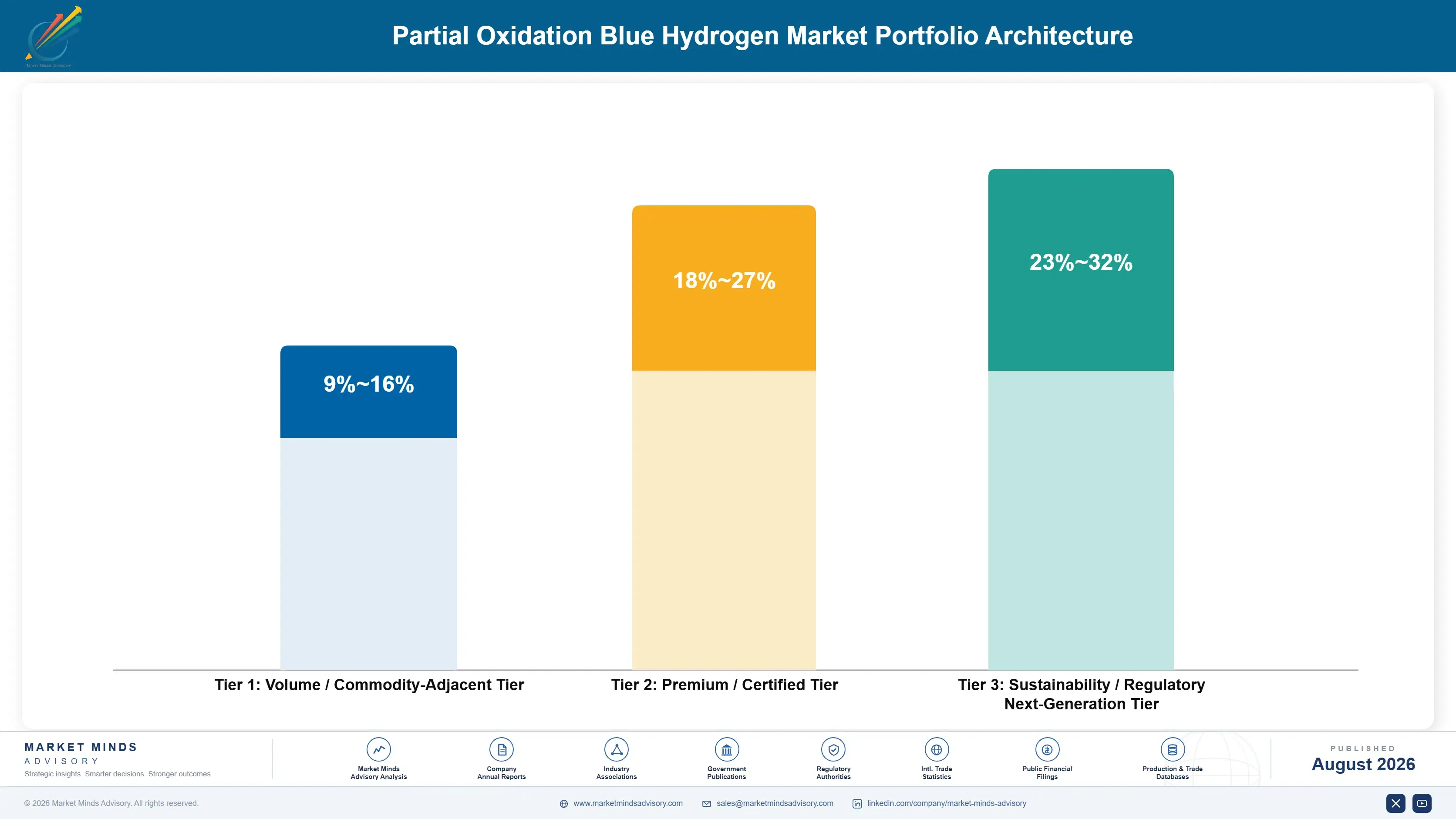
Portfolio Architecture for Margin Defence

Partial oxidation blue hydrogen portfolio splits into three margin tiers that track conversion and certification sophistication rather than unit volume alone. Standard natural gas and legacy air-blown lines serving mass-market comfort exposure compete largely on fee price, while certified heavy oil grade earns a durable premium, and next-generation oxygen-blown and modular grade with advanced conversion infrastructure commands the highest margins within the entire category overall today.
The tension between volume and premium tiers plays out in oxygen-blown investment decisions, since building certification capability sacrifices some near-term natural-gas-tier throughput focus for a considerably higher, more durable margin later on across the entire partial oxidation operation. Licensors that hesitate to build that capability risk ceding the fastest-growing, highest-margin oxygen-blown and modular segments to competitors willing to invest in conversion depth first.

High-value margin pools concentrate almost entirely in oxygen-blown and modular grade, where conversion integration and air separation technology barriers keep casual entrants out far longer than in any other tier of the entire category structure. Heavy oil grade sits in between, commanding a moderate premium tied to certification depth rather than processing difficulty, while standard natural gas volume remains price-competitive regardless of licensor scale.

Volume / Commodity-Adjacent Tier

Standard natural gas and legacy air-blown technologies sold into mainstream mass-market comfort exposure across most engineering tiers, priced largely on licensing formulas against competing licensors with minimal quality differentiation between technologies.
Gross Margin: 9%-16%

Premium / Certified Tier

Certified heavy oil grade carrying conversion purity and durability compliance documentation that commands a durable premium over standard grade across moderate-tier engineering channels specifically and consistently overall today and indeed.
Gross Margin: 18%-27%

Sustainability / Regulatory / Next-Generation Tier

Next-generation oxygen-blown and modular grade meeting the highest conversion purity and certification requirements for premium Gulf Coast and hub development segments, priced at a significant premium reflecting the specialized manufacturing investment required to produce it.
Gross Margin: 23%-32%
partial-oxidation-blue-hydrogen-market-portfolio-architecture-1788193246398

High-value Sub-segments and Strategic Watch-out

Oxygen-Blown Partial Oxidation Systems

Oxygen-blown partial oxidation systems combine the fastest segment CAGR at 11.8 percent with strong achievable margins across the entire worldwide category, protected by the conversion and certification investment barrier held by licensors who invested early in dedicated purity testing infrastructure, integration capability, and validation engineering expertise overall.
Gross Margin: 22%-31%

Modular Small-Scale Partial Oxidation Units

Modular small-scale partial oxidation units grow at 10.5 percent and command a solid margin premium tied to certification positioning across the entire broader category, though competitive intensity is rising steadily as more licensors pursue this fast-growing certification-driven category directly across most worldwide segments and hub structures today overall.
Gross Margin: 17%-26%

Natural Gas and Heavy Oil Partial Oxidation Systems

Natural gas and heavy oil partial oxidation systems remain the volume anchor of the entire portfolio structure, growing near the overall market average each single year with thinner margins tied closely to competing licensor pricing rates and ongoing engineering constraints across most contracts, channels, and hub programs sold worldwide.
Gross Margin: 8%-15%

Air-Blown and Coal Gasification-Integrated Systems

Air-blown and coal gasification-integrated systems warrant a strategic watch, since persistently thin margins and rising commercial commoditization leave this legacy segment quite vulnerable to further contraction if oxygen-blown and modular licensors ever fully capture remaining design budget across most remaining programs worldwide going forward each single year.
Gross Margin: 7%-13%

Why Hub Ties Outlast Cycles

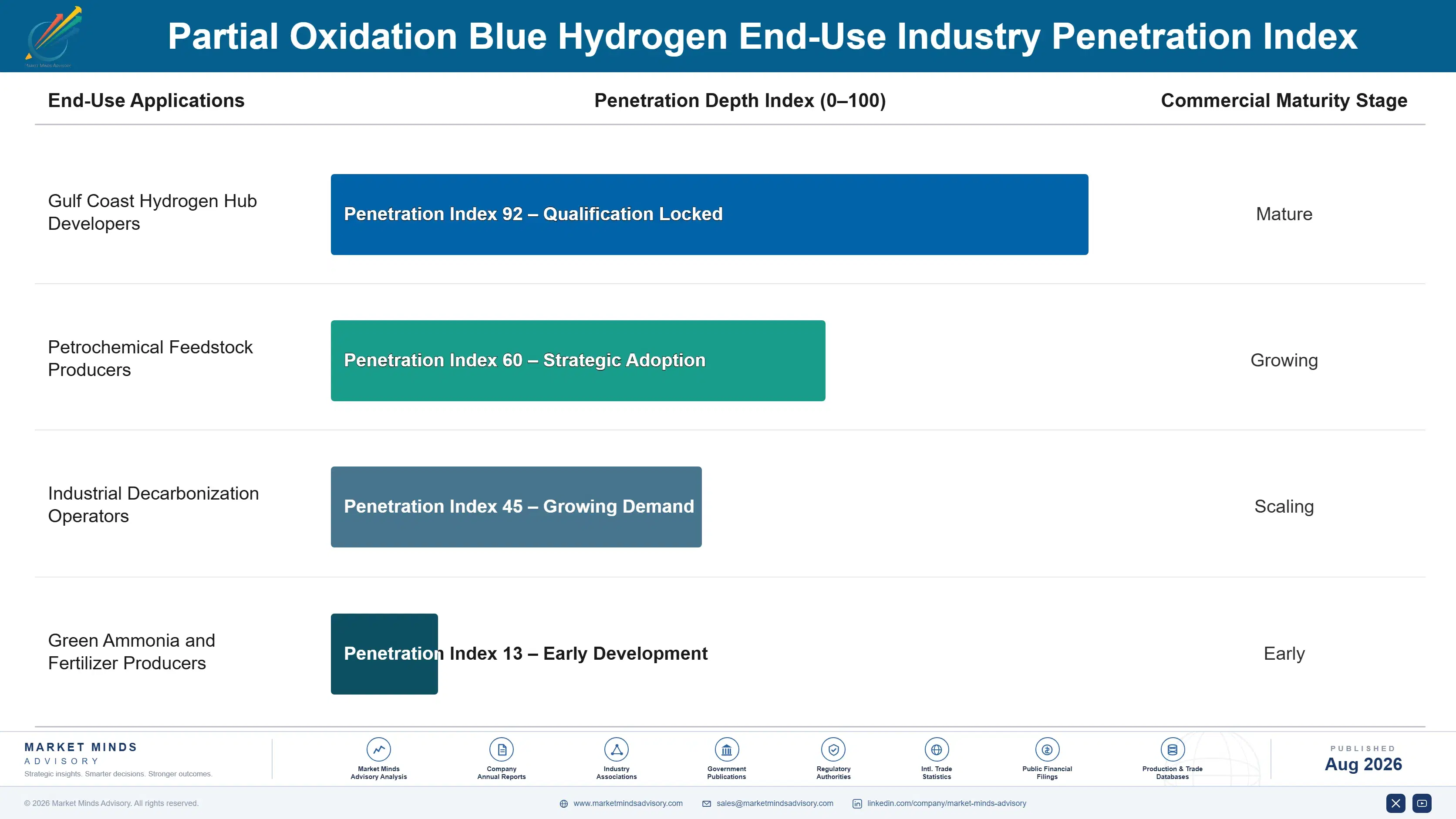
Once a licensor qualifies for a hub developer program through conversion purity and compliance testing, that relationship behaves more like an annuity than a transactional sale, since switching to an alternate licensor means re-running conversion assessment while risking a project disruption that jeopardizes an entire hub developer relationship. Mass industrial buyers tolerate modest fee adjustments from an incumbent licensor rather than restart that qualification process for marginal gains.
Stickiness varies sharply by end-use vertical. Gulf Coast hub developer buyers rarely switch licensors once conversion purity and certification track record accumulates, since any change risks reopening a costly re-evaluation process mid-project cycle. Mass industrial buyers face somewhat more competition, since fee sensitivity evolves faster and multiple licensors can compete for the same project placement. Distributed hub buyers show moderate stickiness, tied closely to design depth.

A generational shift is also underway among developer purchasing habits. Younger process engineers increasingly demand conversion transparency and modular scale-up flexibility alongside traditional cost and reliability targets, favoring licensors who can demonstrate genuine conversion depth. This shift is gradual rather than abrupt, but it is steering incremental purchase volume toward licensors investing early in oxygen-blown and certification capability across most consumer segments worldwide.
partial-oxidation-blue-hydrogen-market-end-use-penetration-index-1788193246897

Where MMA Sees the Advantage

These are among the four positions where our research anticipates prominent divergence between winners and laggards over the coming forecast period. Each is grounded in the demand model, the regulatory perimeter, and the announced capacity pipeline.
01 / OXYGEN-BLOWN INNOVATION STRATEGY

Build dedicated oxygen-blown capability before rivals lock it up

Gulf Coast hub developers increasingly specify verified high-purity carbon capture integration over standard air-blown-only configurations, and few legacy-focused licensors can quickly build the conversion and testing capability this genuinely requires across the entire production chain today and consistently. Licensors who invest in oxygen-blown manufacturing now command premium rates often exceeding 28 percent above standard grade and win engineering contracts before competitors catch up on conversion depth. Waiting risks losing next-generation engineering segments entirely to licensors already deploying that capital investment, conversion expertise, and manufacturing discipline today.
02 / PURITY CERTIFICATION STRATEGY

Complete purity certification before it becomes a hard requirement

Hub developers increasingly specify enhanced conversion purity directly in their purchase mandate criteria, and roughly 17 percent of new engineering mandates now treat this as a hard qualification requirement rather than an optional differentiator across most worldwide purity channels today. Licensors who complete certification investment now win broader engineering mandates spanning multiple hub tiers rather than losing premium-tier business entirely to already-equipped certification-focused competitors with established compliance infrastructure. Competitors without this capability risk losing entire premium categories to licensors who can prove certification depth today.
03 / COMPONENT HEDGING STRATEGY

Lock in diversified component supply panels before the next pricing cycle

Specialized components account for 31 percent of operating cost and track allocation cycles that have swung component costs more than 11 percent within a year during periods of unexpected qualification testing disruption and air separation allocation tightening today. Licensors still sourcing entirely through open market placement absorb that volatility directly, while those with multi-year supply agreements lock in predictable cost well ahead of disruption events. Securing forward allocation now, before the next pricing cycle, would meaningfully reduce operating cost variability across future reporting periods.
04 / HUB CHANNEL STRATEGY

Build cross border hub relationships before rivals capture the wave

Cross-border engineering and allied oxygen-blown demand continues growing faster than most other segments worldwide today, and hub developers increasingly prefer licensors who can guarantee consistent conversion purity and lifecycle support across multiple hub types simultaneously for cost and reliability reasons. Licensors who build direct hub relationships now capture roughly 10 percent of new worldwide engineering procurement and secure preferred-partner status before later entrants can displace them. Competitors who delay risk finding hub relationships already locked in by faster-moving rivals with established conversion capability and support depth.

Engagement Snapshot From the Field

A live engagement with an industry participant carrying material or product regulatory and market exposure ahead of a defining policy shift, showing how our research translates into a defensible multi-year portfolio strategy.
MARKET MINDS ADVISORY · CLIENT ENGAGEMENT SUMMARY
Partial Oxidation Blue Hydrogen Producer Strategic Portfolio Review and Transition Roadmap 2026·Investment Scenario on Partial Oxidation Blue Hydrogen Exposure Evaluation 2025-26
CLIENT PROFILE
The client, a mid-size regional gasification technology licensor serving natural gas and legacy air-blown lines across several longstanding hub developer relationships across three technology lines, generated approximately 29 million US dollars in annual partial oxidation revenue (client-reported, unverified by MMA) and had relied exclusively on legacy air-blown design for well over five years without any dedicated oxygen-blown capability developed internally at all.
STRATEGIC CHALLENGE
Facing a major Gulf Coast hub developer's decisive shift toward certified high-purity oxygen-blown units as a baseline expectation among premium hydrogen hub programs, the client risked losing its entire engineering pipeline within nine months, threatening a significant share of its future growth base, engineering contract renewals, compliance readiness, design talent retention, and long-term contract revenue overall.
MMA APPROACH
MMA benchmarked oxygen-blown technology options across three vendors, assessing integration cost, conversion purity certification depth, and deployment timeline for each option available today. The team modeled hub developer acquisition value at risk against investment cost, and facilitated technical discussions between the client's design team and two shortlisted technology vendors offering faster deployment.
KEY FINDINGS
  1. The client's legacy air-blown model put approximately 31 percent of its target engineering pipeline at direct, immediate risk of complete loss across all lines.
  2. One shortlisted technology vendor offered oxygen-blown certification integration deployment roughly 18 percent faster than building similar infrastructure entirely in-house from scratch internally today.
  3. Building full oxygen-blown capability internally would require substantial capital investment recoverable within roughly eleven months given projected engineering volume forecasts provided today.
  4. Losing the engineering pipeline without oxygen-blown capability would have eliminated the client's fastest-growing product segment entirely and quite abruptly within a single quarter.
CLIENT PROFILE
The client, a mid-size regional gasification technology licensor serving natural gas and legacy air-blown lines across several longstanding hub developer relationships across three technology lines, generated approximately 29 million US dollars in annual partial oxidation revenue (client-reported, unverified by MMA) and had relied exclusively on legacy air-blown design for well over five years without any dedicated oxygen-blown capability developed internally at all.
STRATEGIC CHALLENGE
Facing a major Gulf Coast hub developer's decisive shift toward certified high-purity oxygen-blown units as a baseline expectation among premium hydrogen hub programs, the client risked losing its entire engineering pipeline within nine months, threatening a significant share of its future growth base, engineering contract renewals, compliance readiness, design talent retention, and long-term contract revenue overall.
MMA APPROACH
MMA benchmarked oxygen-blown technology options across three vendors, assessing integration cost, conversion purity certification depth, and deployment timeline for each option available today. The team modeled hub developer acquisition value at risk against investment cost, and facilitated technical discussions between the client's design team and two shortlisted technology vendors offering faster deployment.
KEY FINDINGS
  1. The client's legacy air-blown model put approximately 31 percent of its target engineering pipeline at direct, immediate risk of complete loss across all lines.
  2. One shortlisted technology vendor offered oxygen-blown certification integration deployment roughly 18 percent faster than building similar infrastructure entirely in-house from scratch internally today.
  3. Building full oxygen-blown capability internally would require substantial capital investment recoverable within roughly eleven months given projected engineering volume forecasts provided today.
  4. Losing the engineering pipeline without oxygen-blown capability would have eliminated the client's fastest-growing product segment entirely and quite abruptly within a single quarter.
RECOMMENDED STRATEGY
Phase 1: Phase 1 (Months 1 to 2): Complete thorough technology vendor benchmarking and finalize the chosen design agreement selected in full. Phase 2: Phase 2 (Months 3 to 7): Complete full oxygen-blown manufacturing integration and conversion validation work for the entire design pipeline today. Phase 3: Phase 3 (Months 8 to 9): Finalize product certification fully and begin full engineering delivery immediately for all new orders.
OUTCOME
The client completed oxygen-blown certification within eight months, retaining its full engineering pipeline and expanding contract revenue throughout the entire transition period. Reported new engineering contract volume grew by approximately 17 percent (client-reported, unverified by MMA) within the first full year following capability completion, well ahead of initial timeline projections.

Frequently Asked Questions

Foundational context covering the market sizes, CAGR, scope, country, region and competition that inform every finding below. This section is provided to cover basics and most often pre-purchase conversations, answered from the MMA Primary Research Dataset.

What is the current size of the Partial Oxidation Blue Hydrogen Market?

MMA estimates the partial oxidation blue hydrogen market at 1.6 billion US dollars in 2025, spanning natural gas, oxygen-blown, and modular systems licensed worldwide across Gulf Coast engineering channels.

How large will the Partial Oxidation Blue Hydrogen Market be by 2036?

MMA projects the market to reach approximately 4.37 billion US dollars by 2036, up from 1.75 billion in 2026, as oxygen-blown adoption continues outpacing legacy air-blown demand.

What is the CAGR for the Partial Oxidation Blue Hydrogen Market 2026 to 2036?

The base case CAGR is 9.6 percent for 2026 to 2036. Bull and bear scenarios range between 10.8 percent and 8.3 percent depending on 45Q tax credit and hub outcomes.

Which segment is growing fastest?

Oxygen-blown partial oxidation systems form the fastest-growing segment at 11.8 percent CAGR, roughly 1.23 times the overall market rate, driven by high-purity conversion demand worldwide today.

Who are the major companies in the Partial Oxidation Blue Hydrogen Market?

Leading licensors in this highly concentrated market include Air Liquide, Linde, Air Products and Chemicals, Shell Catalysts & Technologies, and Honeywell UOP, together holding an estimated CR5 near 54 percent.

Which country is growing fastest?

Within the broader region, the United States is the fastest-growing national market at approximately 12.5 percent CAGR, supported by the 45Q tax credit's Gulf Coast hydrogen hub buildout nationwide.

Report Segmentation Architecture

The full report scope spans multiple orthogonal segmentation dimensions, with cross-tabulated demand data provided for each dimension pair. Coverage extends further to regional breakdowns, trend trajectories, and the competitive detail needed to support segment-level decision-making.

By Primary Market Dimension

  • Natural Gas Partial Oxidation Systems
  • Heavy Oil and Residue Partial Oxidation Systems
  • Coal Gasification-Integrated Partial Oxidation Systems
  • Oxygen-Blown Partial Oxidation Systems
  • Air-Blown Partial Oxidation Systems
  • Modular Small-Scale Partial Oxidation Units

By End-Use Industry

  • Gulf Coast Hydrogen Hub Developers
  • Petrochemical Feedstock Producers
  • Industrial Decarbonization Operators
  • Green Ammonia and Fertilizer Producers

By Commercial Dimension

  • Technology Licensing Distribution Sales
  • Specialty Engineering Retail Sales
  • Direct Licensing Agreement Channels
  • Cross-Border Export Agreements

By Region

  • North America
  • Western Europe
  • East Asia
  • South Asia and Pacific
  • Latin America
  • Middle East and Africa
  • Eastern Europe

Scope, Methodology, and Coverage

Every figure in this report is reproducible from documented input assumptions. The scope below maps the historical period, the forecast horizon, the segmentation dimensions, and the countries covered, alongside the underlying primary and qualitative methodology.
Historical Period
2020 to 2025
Forecast Period
2026 to 2036
Base Year
2025 (USD billions; MMA Primary Research Dataset, August 2026)
Market Definition
The partial oxidation blue hydrogen market covers natural gas, heavy oil and residue, coal gasification-integrated, oxygen-blown, air-blown, and modular small-scale partial oxidation systems used to produce hydrogen with integrated carbon capture. It excludes steam methane reforming and autothermal reforming technologies and green hydrogen electrolysis systems.
Quantitative Units
USD billions (current prices); licensed capacity volume for technology-level segment analysis
Segmentation Dimensions
By Conversion Process and Feedstock Type; By End-Use Industry; By Commercial Dimension; By Region
Regions Covered
North America, Western Europe, East Asia, South Asia and Pacific, Latin America, Middle East and Africa, Eastern Europe
Countries Covered
USA, Canada, Germany, Netherlands, UK, China, Japan, South Korea, India, Australia, Brazil, Mexico, Saudi Arabia, UAE, South Africa, Poland, and additional markets relevant to this sector
Key Companies Profiled
Air Liquide, Linde, Air Products and Chemicals, Shell Catalysts & Technologies, Honeywell UOP, Technip Energies, Haldor Topsoe, McDermott International, KBR Inc, Wison Engineering, Sinopec Engineering, Chiyoda Corporation, JGC Holdings, Samsung Engineering, Fluor Corporation, Worley, Thyssenkrupp Uhde, Casale SA, ExxonMobil, Mitsubishi Heavy Industries
Quantitative Methodology
Primary survey, n=3,800 respondents, Q4 2025, six countries; demand-side model with trade association cross-validation
Qualitative Methodology
47 expert interviews, Q4 2025; applied to validate demand model assumptions, identify emerging dynamics, and assess competitive positioning
Report Format
PDF and XLSX data workbook (Word format preview document)
Publisher
Market Minds Advisory
Report Code
MMA-2026-ENE-602
Published
August 2026
Contact
sales@marketmindsadvisory.com | www.marketmindsadvisory.com

Purchase the full Partial Oxidation Blue Hydrogen Market Report (2026 to 2036).

This report gives partial oxidation technology licensors, Gulf Coast hub developer strategy officers, and investment analysts a full commercial picture of the market through 2036. It covers segmentation by conversion process and feedstock type, all seven regional markets with detailed demand mechanisms, and a competitive assessment of twenty licensors evaluated on partial oxidation revenue. Readers get quantified trend, driver, and restraint analysis, air separation cost exposure modeling, and portfolio margin architecture across three distinct certification tiers. A dedicated revenue lever framework and anonymized case study translate the analysis into specific, actionable engineering decisions.
Twenty-licensor competitive benchmarking on partial oxidation revenue basis
Seven-region demand architecture with quantified growth mechanisms
Segment-level CAGR modeling across six MECE conversion process types
Air separation cost exposure and hedging mitigation playbook analysis
Three-tier portfolio margin architecture and certification analysis
Anonymized client case study with recommended oxygen-blown certification strategy

Built For The People Who Decide

From boardroom strategy to bench-side execution, this report is read cover-to-cover by leaders shaping the next decade of their industry, turning demand scenarios, market dynamics and valuation benchmarks into decisions.
CXOs/ Presidents/ VPs/ Managers
M&A and Corporate Development
Strategy Teams and R&D Heads
Procurement and Product Directors
Regulatory and Compliance Leaders
Investor Relations and Equity Analysts